18 Essential Accessibility Changes To Drive Increased Website Growth via @sejournal, @skynet_lv

This post was sponsored by “Skynet Technologies USA LLC”.

Did you know that 1 billion people have not reached you or your customers’ websites yet.

1 billion potential customers are waiting for businesses to step up and do what’s right.

Find out if your website is accessible to 1 billion people >>>

Accessibility isn’t just a compliance checkbox anymore – it’s a growth strategy.

The demand for scalable, innovative accessibility solutions has skyrocketed.

And your competition is already making these improvements.

For agencies, this means an unprecedented opportunity to meet clients’ needs while driving revenue.

Learn how you can generate additional revenue and boost your clients’ SERP ranking by gaining access to:

Ready to get started?

How Accessibility Improvements Can Increase Growth

The digital economy thrives on inclusion.

There is a large market of individuals who are not included in modern website usability.

With over a billion people globally living with disabilities, accessible digital experiences open doors to untapped markets.

Do Websites Need To Be Accessible?

The short answer is yes.

How Does An Accessible Website Drive Traffic?

Traffic comes from people who have needs. Of course, everyone has needs, including people with disabilities.

Accessible websites and tools cater to all users, expanding reach to a diverse and often overlooked customer base.

Global Potential & Unlocking New Audiences

From a global perspective, the global community of people with disabilities is a market estimated to hold a staggering $13 trillion in spending power.

By removing barriers and ensuring inclusive digital experiences, you can tap into this 1 billion-person market and drive substantial economic growth.

Digital accessibility helps to increase employment opportunities, education options, and simple access to various banking and financial services for everybody.

Boosts User Experience & Engagement 

Accessibility improvements run parallel with SEO improvements.

In fact, they often enhance overall website performance, which leads to:

  • Better user experience.
  • Higher rankings.
  • Increased traffic.
  • Higher conversion rates.

Ensures Your Websites Are Compliant

Increasing lawsuits against businesses that fail to comply with accessibility regulations have imposed pressure on them to implement accessibility in their digital assets.

Compliance with ADA, WCAG 2.0, 2.1, 2.2, Section 508, Australian DDA, European EAA EN 301 549, UK Equality Act (EA), Indian RPD Act, Israeli Standard 5568, California Unruh, Ontario AODA, Canada ACA, German BITV, Brazilian Inclusion Law (LBI 13.146/2015), Spain UNE 139803:2012, France RGAA standards, JIS X 8341 (Japan), Italian Stanca Act, Switzerland DDA, Austrian Web Accessibility Act (WZG) guidelines aren’t optional. Accessibility solution partnerships ensure to stay ahead of potential lawsuits while fostering goodwill.

6 Steps To Boost Your Growth With Accessibility

  1. To drive growth, your agency should prioritize digital accessibility by following WCAG standards, regularly testing with tools like AXE, WAVE, or Skynet Technologies Website Accessibility Checker, and addressing accessibility gaps. Build accessible design frameworks with high-contrast colors, scalable text, and clear navigation.
  2. Integrate assistive technologies such as keyboard navigation, screen reader compatibility, and video accessibility. Focus on responsive design, accessible forms, and inclusive content strategies like descriptive link text, simplified language, and alternative formats.
  3. Providing accessibility training and creating inclusive marketing materials will further support compliance and growth.
  4. To ensure the website thrives, prioritize mobile-first design for responsiveness across all devices, adhere to WCAG accessibility standards, and incorporate keyboard-friendly navigation and alt text for media.
  5. Optimize page speed and core web vitals while using an intuitive interface with clear navigation and effective call-to-action buttons, and use SEO-friendly content with proper keyword optimization and schema markups to boost visibility.
  6. Ensure security with SSL certificates, clear cookie consent banners, and compliance with privacy regulations like GDPR and CCPA. Finally, implement analytics and conversion tracking tools to gather insights and drive long-term growth.

We know this is a lot.

If this sounds good to you, let us help you get set up.

How Can Digital Accessibility Partnerships Supercharge Your Clients’ SEO?

Partnering for digital accessibility isn’t just about inclusivity — it’s a game-changer for SEO, too!

Accessible websites are built with cleaner code, smarter structures, and user-friendly features like alt text and clear headings that search engines love.

Plus, faster load times, mobile-friendly designs, and seamless navigation keep users engaged, reducing bounce rates and boosting rankings. When you focus on making a site accessible to everyone, you’re not just widening your audience—you’re signaling to search engines that the website is high-quality and relevant. It’s a win-win for accessibility and SEO!

12 Essential Factors To Consider For Successful Accessibility Partnerships

  1. Expertise: Look for a provider with a proven track record in digital accessibility, including knowledge of relevant global website accessibility standards and best practices.
  2. Experience: Consider their experience working with similar industries or organizations.
  3. Tools and technologies: Evaluate their use of automated and manual testing tools to identify and remediate accessibility issues.
  4. Price Flexibility: Explore pricing models that align with both the budget and project requirements. Whether for a single site or multiple sites, the service should be compatible and scalable to meet the needs.
  5. Platform Compatibility: Ensure seamless accessibility integration across various platforms, providing a consistent and accessible experience for all users, regardless of the website environment.
  6. Multi-language support: Enhance user experience with global language support, making websites more inclusive and accessible to a global audience.
  7. Regular check-ins: Schedule regular meetings to discuss project progress, address any issues, and make necessary adjustments.
  8. Clear communication channels: Establish clear communication channels (for example: email, and project management tools) to facilitate efficient collaboration.
  9. Transparent reporting: Request detailed reports on the progress of accessibility testing, remediation efforts, and overall project status.
  10. KPIs to measure success: Review the partner’s historical data, especially those similar projects in terms of scale, complexity, and industry.
  11. Evaluate technical expertise: Assess their proficiency in using various accessibility testing tools and ability to integrate different APIs.
  12. Long-term partnership strategy: Compare previous data with the current one for improvement and optimization process. It is crucial for a long-term partnership that there is a specific interval of review and improvements.

    Scaling Accessibility With Smart Partnerships

    All in One Accessibility®: Simplicity meets efficiency!

    The All in One Accessibility® is an AI-powered accessibility tool that helps organizations to enhance their website accessibility level for ADA, WCAG 2.0, 2.1, 2.2, Section 508, Australian DDA, European EAA EN 301 549, UK Equality Act (EA), Indian RPD Act, Israeli Standard 5568, California Unruh, Ontario AODA, Canada ACA, German BITV, Brazilian Inclusion Law (LBI 13.146/2015), Spain UNE 139803:2012, France RGAA standards, JIS X 8341 (Japan), Italian Stanca Act, Switzerland DDA, Austrian Web Accessibility Act (WZG), and more.

    It is available with features like sign language LIBRAS (Brazilian Portuguese Only) integration, 140+ multilingual support, screen reader, voice navigation, smart language auto-detection and voice customization, talk & type, Google and Adobe Analytics tracking, along with premium add-ons including white label and custom branding, VPAT/ACR reports, manual accessibility audit and remediation, PDF remediation, and many more.

    • Quick Setup: Install the widget to any site with ease—no advanced coding required.
    • Feature-Rich Design: From text resizing and color contrast adjustments to screen reader support, it’s packed with tools that elevate the user experience.
    • Revenue Opportunities: Agencies can resell the solution to clients, adding a high-value service to their offerings while earning attractive commissions through the affiliate program.
    • Reduced development costs: Minimizes the financial impact of accessibility remediation by implementing best practices and quick tools.

    Agency Partnership: Scaling accessibility with ease!

    • Extended Service Offerings: The All in One Accessibility® Agency Partnership allows agencies to offer a powerful accessibility widget – quick accessibility solution into their services, enabling them that are in high demand.
    • White Label: As an agency partner, you can offer All in One Accessibility® under their own brand name.
    • Centralized Management: It simplifies oversight by consolidating accessibility data and reporting, allowing enterprises to manage multiple websites seamlessly.
    • Attractive Revenue Streams: Agencies can resell the widget to clients, earning significant revenue through competitive pricing structures and repeat business opportunities.
    • Boost Client Retention: By addressing accessibility needs proactively, agencies build stronger relationships with clients, fostering long-term loyalty and recurring contracts.
    • Increase Market Reach: Partnering with All in One Accessibility® positions agencies as leaders in inclusivity, attracting businesses looking for reliable accessibility solutions.
    • NO Investment, High Return: With no setup costs, scalable features, and up to 30% commission, the partnership enables agencies to maximize profitability with their clients.

    Affiliate Partnership: A revenue opportunity for everyone!

    The All in One Accessibility® Affiliate Partnership program is for content creators, marketers, accessibility advocates, web professionals, 501 (c) organizations (non-profit), and law firms.

    • Revenue Growth through Referrals: The All in One Accessibility® affiliate partnership allows affiliates to earn competitive commissions by promoting a high-demand accessibility solution, turning referrals into consistent revenue.
    • Expanding Market Reach: Affiliates can tap into a diverse audience of businesses seeking ADA and WCAG compliance, scaling both revenue and the adoption of accessibility solutions.
    • Fostering Accessibility Awareness: By promoting the All in One Accessibility® widget, affiliates play a pivotal role in driving inclusivity, helping more websites become accessible to users with disabilities.
    • Leveraging Trusted Branding: Affiliates benefit from partnering with a reliable and recognized quick accessibility improvement tool, boosting their credibility and marketing impact.
    • Scaling with Zero Investment: With user-friendly promotional resources and a seamless onboarding process, affiliates can maximize returns without any costs.

    Use Accessibility As A Growth Engine

    Endeavoring for strategic partnerships with accessibility solution providers is a win-win for agencies aiming to meet the diverse needs of their clients. These partnerships not only enhance the accessibility of digital assets but also create opportunities for growth, and loyalty, top search engine rankings, boost revenue, improve compliance with legal standards, and make you to contribute into digital accessibility world.

    With Skynet Technologies USA LLC, Transform accessibility from a challenge into a revenue-driving partnership. Let inclusivity power the success.

    Ready to get started? Embarking on a digital accessibility journey is simpler than you think! Take the first step by evaluating the website’s current WCAG compliance with a manual accessibility audit.

    For more information, Reach out hello@skynettechnologies.com.


    Image Credits

    Featured Image: Image by Skynet Technologies. Used with permission.

    What An Enterprise Client Wants From Their SEO Agency via @sejournal, @danielkcheung

    A lasting relationship with an enterprise client is good for business. It gives you authority, it gives your staff exposure to how large organizations work, and there should be a financial element.

    But winning the pitch is just the beginning. Many agencies make the grave mistake of misunderstanding their role in the relationship, and it is this: The relationship is transactional – at least, at first.

    This is what an enterprise client needs from you:

    • Clear, consistent communication.
    • Alignment with business objectives.
    • Flexibility.
    • Integrity.
    • Operational efficiency and responsiveness.
    • Proactive problem-solving.

    In many ways, these six things overlap on a Venn diagram. And when you get it right, we will see you not as an external vendor but as an extension of ourselves.

    1. Clear, Concise Communication

    Enterprise clients don’t just want emails or reports. They want clarity, alignment, and confidence that you’re on the same page.

    If they’re left guessing what’s happening, you’re failing.

    Always ask yourself: What is the message you wish to convey?

    Oftentimes, less is more.

    Instead of a lengthy email, sometimes a 15-minute Teams call will not only address the topic but also the bigger picture and the next steps. But this doesn’t mean long emails don’t have a place—they do.

    Context is everything.

    I get it – it’s purely subjective from one point-of-contact to the next. But that’s the name of the game.

    Be adaptable, and don’t assume. Reach out and ask how your point-of-contact prefers to communicate.

    At the start of every engagement, even when I was agency-side, I would ask for clear directions on ways of working.

    And lastly, before you hit send, ask yourself: Does this have to be mentioned/asked/challenged right now?

    How to do this effectively:

    • Send a pre-read ahead of time. Strive for two business days ahead of time, 24 hours worse case.
    • Include an executive summary at the beginning of every presentation. There is nothing worse than having skim reading a deck full of slides without an executive summary. I’m busy. My boss is busy; their boss is busy. If you’ve made the effort to create a presentation deck, put a TL;DR at the front for us.
    • Sign up to use the same team collaboration app as your client for quick updates. Most people don’t reply to emails immediately. Instant messaging such as Slack or Teams? Completely different rules. Plus, I speak from personal experience that shooting a Slack message in a dedicated channel takes far less mental bandwidth than crafting an email. The best part is that it works both ways, so win-win!

    Here’s the truth: Great communication reduces friction, builds trust, and keeps you in the loop when priorities shift.

    2. Alignment With Business Goals

    Increasing quarter-on-quarter traffic is nice. Rankings are cool. But if you’re not moving the needle on their actual business goals – revenue, customer retention, market share – you’re just noise.

    The biggest lesson I learned when moving agency-side to client-side was this: If your recommendation doesn’t ladder up directly to business goals, then you’re wasting everyone’s time with your research, audits, and recommendations.

    And, as SEO professionals, we default to problem identification mode because that’s how most of us got started. That is, find all the problems related to a particular pillar (e.g., content, technical SEO, off-page) and mistake this list as the strategy.

    This is what I did the first week I started my first enterprise SEO role.

    I fired up Screaming Frog and found all the things.

    But I had no context as to who was responsible for resolving each issue and what their priorities were.

    What may seem like an important SEO activity may not be a business priority.

    How to do this effectively:

    • Transparency goes both ways. Just as an enterprise client expects you to be transparent, you can as well by asking what their strategic pillars are for the quarter or year. To go a step further, get tangible guidance by requesting your point-of-contact what their objectives and key results (OKRs) are. Trust me, they’ll have them because that’s corporate life.
    • Bring the right people along the journey. If you wish to propose adding content, ask your point-of-contact what stakeholders are involved in making this change happen. If you’ve discovered crawling, indexing, and rendering issues, ask who can make changes to robots.txt, to the , and to the frontend stack. Chances are, they’re all separate teams who work in their own silos and backlogs.

    The lesson is this: Your role is not to fix all the things because you simply cannot. Instead, take a minute to understand who’s who because even your point-of-contact is an advocate, not an executioner.

    Why this matters: Clients don’t want SEO in a silo. We want strategies that tie into our biggest priorities.

    Why? Because our performance review and bonuses rely on them. So, speak our language and show us how SEO helps us win.

    3. Flexibility

    Markets change. Leadership changes direction. Enterprise clients want partners who can adapt to their evolving needs without skipping a beat.

    I don’t care that you’ve sunk 80 hours into something I asked you to do. I only care about what is top-of-mind right now.

    It’s nothing personal. I probably feel frustrated, just as you are. But priorities shift, so learn to go with the flow and be an asset instead of a blocker.

    When you’ve got my back, I’ve got yours because we’re in this together.

    The key: Be agile. Show that you’re not just a plan-follower but a partner who can pivot without losing focus on results.

    4. Integrity

    Integrity is the currency of trust. Enterprise clients need to know they can rely on you to tell the truth, even when it’s inconvenient or uncomfortable.

    If there’s a mistake, own it. If timelines slip, address it early. If you think the client’s ask won’t work, say so – and back it up with data or reasoning. The worst thing you can do is over-promise and under-deliver.

    Recently, a vendor blamed their lack of access to a Sharepoint file.

    Perhaps it was true; Sharepoint can be fickle with external vendors. But the fact that this was their explanation when I asked why there was a delay in the delivery disappointed me greatly.

    In my mind, I assumed they were overextended and did not get around to the task.

    There’s a really easy fix to this: Every time your client shares a file with you, open it and see if you have the required access. Don’t wait two weeks later because that’s too late and sends a very bad message.

    Similarly, not all campaigns go to plan. For example, perhaps your digital PR campaign didn’t produce the results you expected. That’s fine.

    The second worst thing you can do is lie about it. The worst thing you can do is buy backlinks to pad the numbers.

    Enterprise search marketers know that there are no guarantees with Google. What my boss, their boss, and their boss expect are learnings.

    What did we learn from this exercise?

    What can we do better next time?

    Did we document what we didn’t plan and why in a wiki so that we don’t make the same investment in something that doesn’t work?

    The flip side of this is to stand up for yourself because I’m not looking for a lackey. Not every idea I come up with is appropriate, and I expect – no, rely on – you to tell the truth even when it’s inconvenient or uncomfortable.

    5. Operational Efficiency And Responsiveness

    Enterprise projects are a symphony of moving parts, and delays in one area can cascade into chaos. Your job is to deliver fast, precise work while minimizing bottlenecks.

    I think most enterprise SEO professionals will agree with me on this – my calendar is full. On some days, it’s literally back-to-back meetings with different stakeholders.

    I don’t have the time or mental bandwidth to hold your hand.

    When I give you a task, speed matters – not just for execution but for acknowledgment. A simple “We’re on it, here’s when you can expect an update” goes a long way in showing you’re reliable.

    Efficiency isn’t just about working quickly – it’s about working smart. Streamline processes, remove redundancies, and bring structure to chaos. Help us feel like we’re in capable hands, no matter how derailed the project gets.

    The play: Deliver fast, precise work, and be responsive. They’ll keep coming back to the agency that gets it done.

    6. Proactive Problem-Solving Without Access To First-Party Data

    Enterprise clients often operate in silos, and as an external agency, you’re rarely handed direct access to our analytics platforms.

    Limited access to first-party data is the norm, but that doesn’t excuse you from identifying issues or presenting solutions.

    The best agencies thrive under constraints. If you don’t have access to first-party data, get creative with proxies. Use publicly available tools, competitive analysis, and trend data to craft recommendations.

    When possible, suggest ways the client can share aggregated insights or anonymized data that protect internal policies while giving you enough to work with.

    Your goal is to demonstrate that you can solve problems without needing to see everything. And if data gaps are creating risks, flag them early.

    Be proactive in suggesting solutions, such as data clean rooms or integrations that can provide the insights you need without breaching compliance.

    Do this instead: Leverage external data sources.

    If there’s one thing I know from working agency-side, it is that you have access to all the tools. So, pull insights from other data sources to identify patterns and opportunities.

    Why this matters: First-party data is a privilege, not a given. By showing that you can deliver value despite limitations, you position yourself as a resilient, resourceful partner who doesn’t let obstacles stand in the way of results.

    The 6 Pillars Of Enterprise SEO Success

    Enterprise clients don’t just want vendors. We want long-term partners because procurement and onboarding are painful.

    Here’s what we value most:

    • Clear communication that aligns and inspires.
    • Strategies tied directly to business outcomes.
    • Agility in the face of shifting priorities.
    • Integrity and transparency in every interaction.
    • Efficiency that respects our time and resources.
    • Creative problem-solving that delivers results, even under constraints.

    Master these six pillars, and you’ll become more than a service provider. You’ll be a partner we fight to keep.

    More resources:


    Featured Image: wee dezign/Shutterstock

    Bing Search Updates: Faster, More Precise Results via @sejournal, @MattGSouthern

    Microsoft has announced updates to Bing’s search infrastructure incorporating large language models (LLMs), small language models (SLMs), and new optimization techniques.

    This update aims to improve performance and reduce costs in search result delivery.

    In an announcement, the company states:

    “At Bing, we are always pushing the boundaries of search technology. Leveraging both Large Language Models (LLMs) and Small Language Models (SLMs) marks a significant milestone in enhancing our search capabilities. While transformer models have served us well, the growing complexity of search queries necessitated more powerful models.”

    Performance Gains

    Using LLMs in search systems can create problems with speed and cost.

    To solve these problems, Bing has trained SLMs, which it claims are 100 times faster than LLMs.

    The announcement reads:

    “LLMs can be expensive to serve and slow. To improve efficiency, we trained SLM models (~100x throughput improvement over LLM), which process and understand search queries more precisely.”

    Bing also uses NVIDIA TensorRT-LLM to improve how well SLMs work.

    TensorRT-LLM is a tool that helps reduce the time and cost of running large models on NVIDIA GPUs.

    Impact On “Deep Search”

    According to a technical report from Microsoft, integrating Nvidia’s TensorRT-LLM technology has enhanced the company’s “Deep Search” feature.

    Deep Search leverages SLMs in real time to provide relevant web results.

    Before optimization, Bing’s original transformer model had a 95th percentile latency of 4.76 seconds per batch (20 queries) and a throughput of 4.2 queries per second per instance.

    With TensorRT-LLM, the latency was reduced to 3.03 seconds per batch, and throughput increased to 6.6 queries per second per instance.

    This represents a 36% reduction in latency and a 57% decrease in operational costs.

    The company states:

    “… our product is built on the foundation of providing the best results, and we will not compromise on quality for speed. This is where TensorRT-LLM comes into play, reducing model inference time and, consequently, the end-to-end experience latency without sacrificing result quality.”

    Benefits For Bing Users

    This update brings several potential benefits to Bing users:

    • Faster search results with optimized inference and quicker response times
    • Improved accuracy through enhanced capabilities of SLM models, delivering more contextualized results
    • Cost efficiency, allowing Bing to invest in further innovations and improvements

    Why Bing’s Move to LLM/SLM Models Matters

    Bing’s switch to LLM/SLM models and TensorRT optimization could impact the future of search.

    As users ask more complex questions, search engines need to better understand and deliver relevant results quickly. Bing aims to do that using smaller language models and advanced optimization techniques.

    While we’ll have to wait and see the full impact, Bing’s move sets the stage for a new chapter in search.


    Featured Image: mindea/Shutterstock

    2024 Annual Review: How 2024 Went For Me And What Changes In 2025 via @sejournal, @Kevin_Indig

    It’s the time of the year! I can write about myself again without feeling guilty ;-).

    Over the last few years, I’ve made it a habit to share how the year went for me and what next year looks like. This really seems to resonate with you, so I’ll keep doing it until you tell me to stop.

    Image Credit: Kevin Indig

    Previous annual reviews:

    I had five big goals for 2024:

    1. Hit 1,000 paid growth memo subscribers
    2. Keep income above a certain level
    3. Become a better speaker
    4. Create more time and space
    5. Keep my weight between a certain number, work out a minimum of four times a week, and pick up MMA.

    I’m happy to say that I met all goals except for No. 1.

    The Advisory is going really well.

    In early 2024, I made an effort to focus on larger, more in-depth engagements and worked with phenomenal brands: Reddit, Alltrails, About You, Toast, and Hims, just to mention a few.

    For 2025, I’m opening my calendar again for low-touch engagements. I’ll keep ~ three large clients, but I found really good success and high demand for sparring/office hour-like engagements.

    Speaking: Shifting Gears

    Image Credit: Kevin Indig

    This year, I managed to speak at 10 conferences:

    • Recommerce, London (UK).
    • Friends of Search, Amsterdam (NL).
    • NYC SEO Meetup, NYC.
    • SaaStock, Austin.
    • Digital Olympus, Eindhoven (NL).
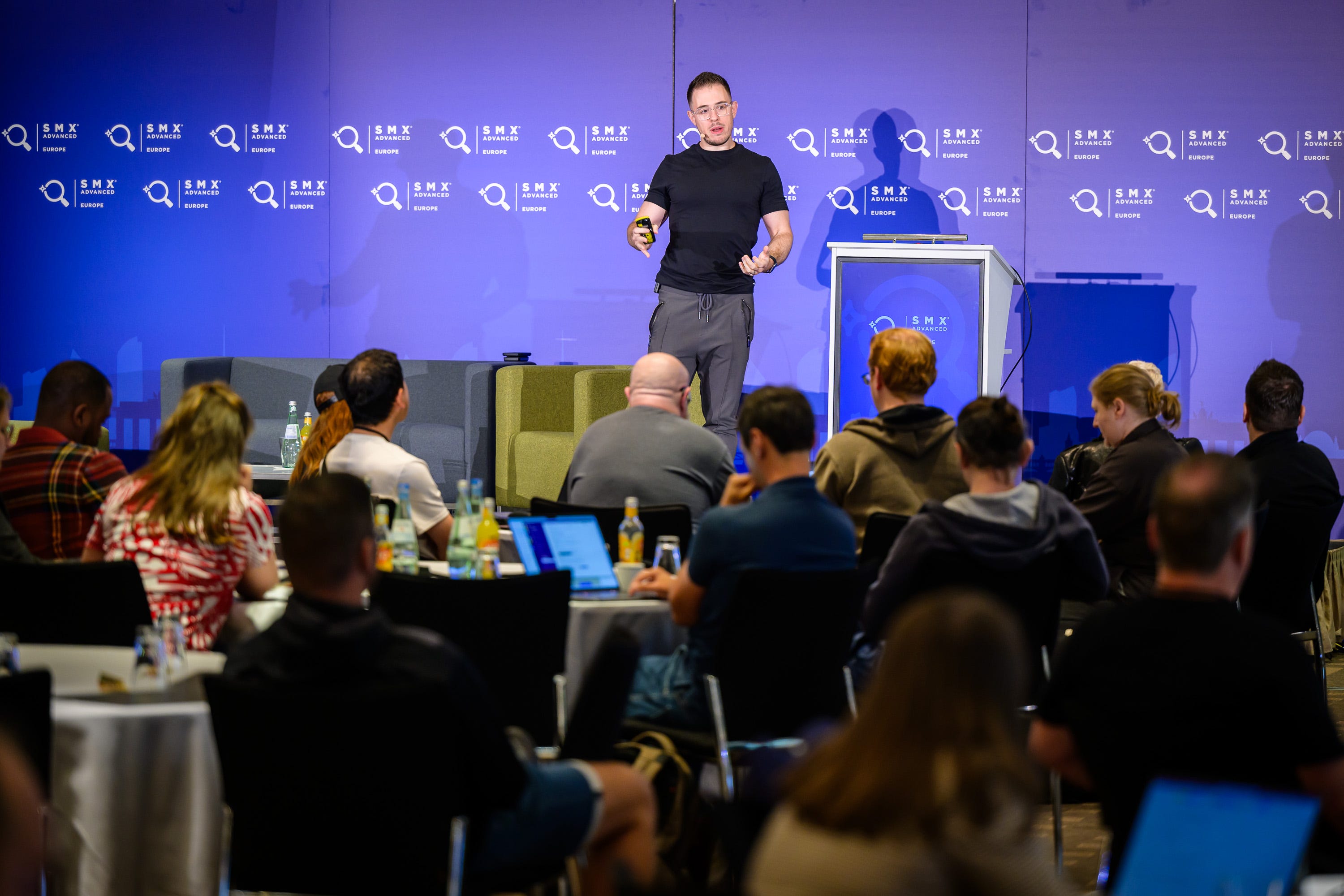
    • SMX Advanced, Berlin (DE).
    • SEO Campixx, Berlin (DE).
    • SEOktoberfest, Kitzbuhel (AU).
    • Tech SEO Connect, Raleigh.
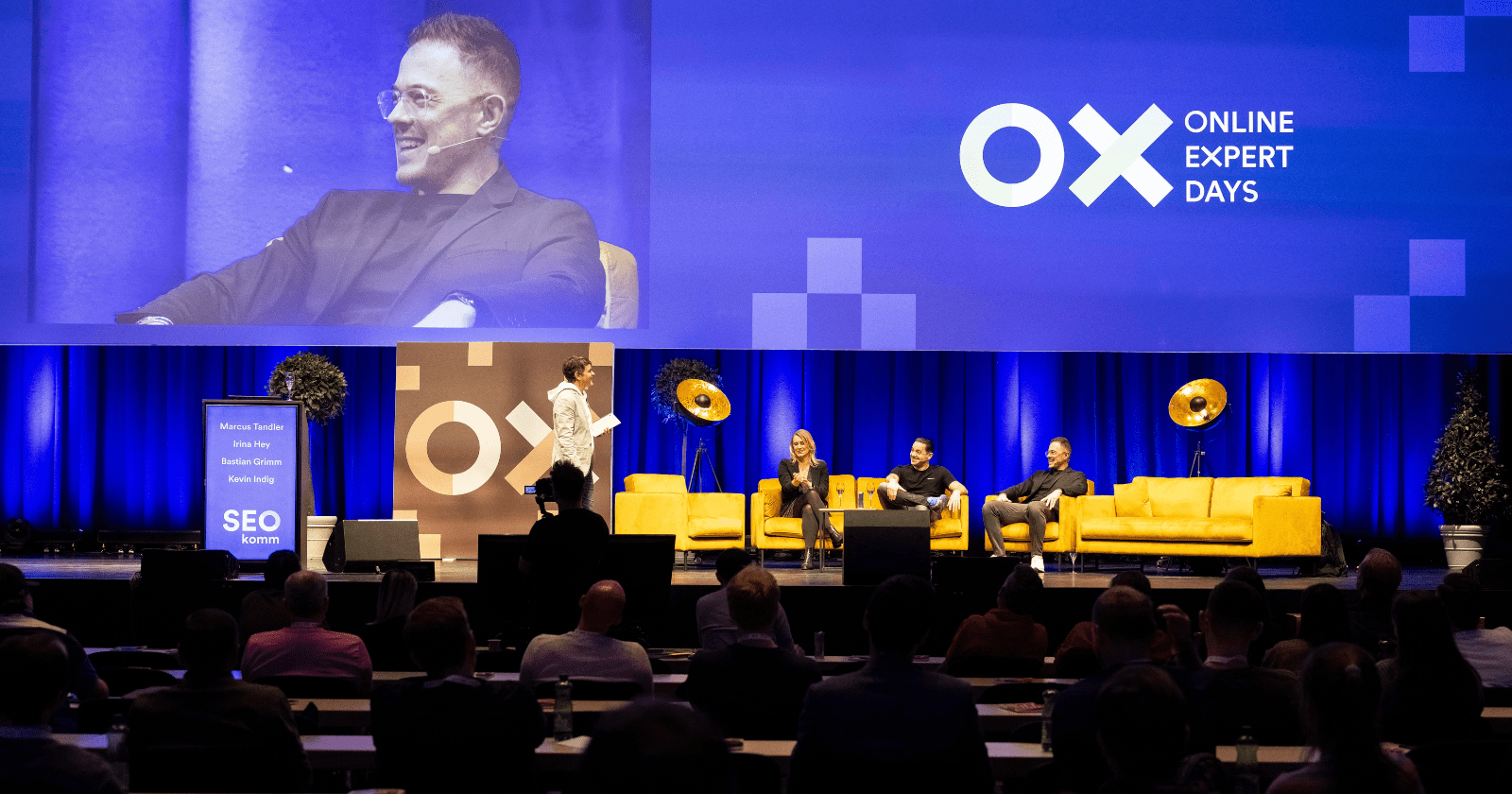
    • SEOkomm, Salzburg (AU).

    Phew, that was a lot! I don’t know how others do it, but that burned me out a little.

    My mistake was probably to bring a new deck and topic to every event. Anyway.

    Image Credit: Kevin Indig

    My hypothesis for taking on many speaking engagements in 2024 was to grow my subscriber base. Unfortunately, the impact wasn’t as strong as I had hoped.

    I had a ton of fun and met awesome people, but any speaking gig was outmatched by a good post. The SEOzempic Memo led to almost 150 new subscribers, which is about as much as a good presentation would drive.

    That’s why I’m changing gears next year.

    In 2025, I will set a strict limit of five conferences, focus on non-SEO conferences, and ask for a speaking fee of $5,000 + travel cost + accommodation (with one to two exceptions).

    The reason is simple: It takes a lot of effort! Speaking takes a ton of time that I could spend with my family and invest in client work.

    The ROI of speaking for free (or travel cost covered) isn’t there when you consider about 30 to 50 hours of preparation plus travel time.

    I’m not even talking about paying experts for help with research and working with a speaking coach (who has been amazing).

    I don’t get nor want any business from SEO conferences. It’s been fun-positive but ROI-negative for me.

    Growth Memo: Going Video-First And Other Changes

    Image Credit: Kevin Indig

    How it’s going:

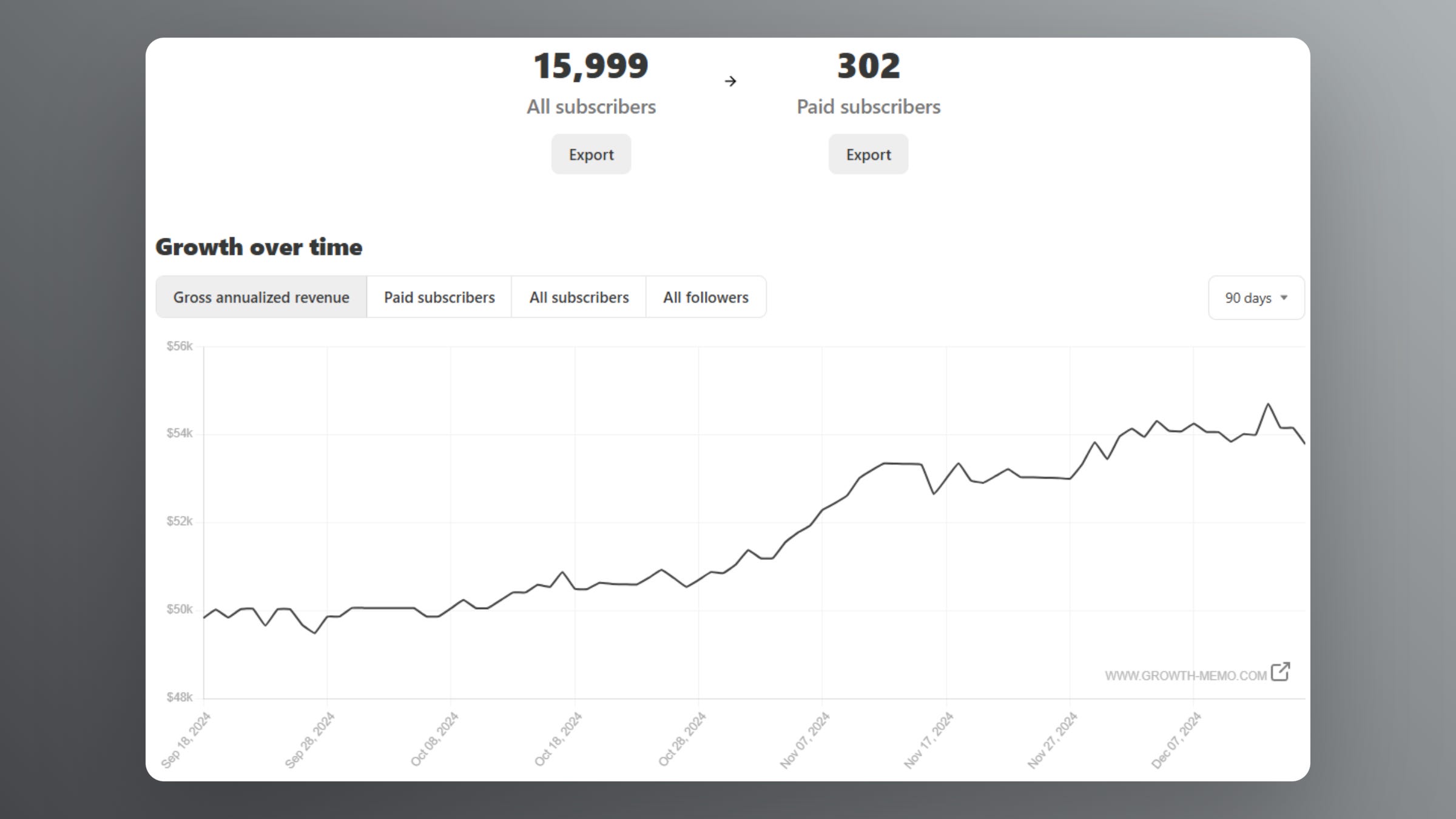
    Growth Memo has done well this year. The free newsletter topped 16,000 subscribers, which is more than I projected (13,700 to 15,300).

    Top 10 most-read articles:

    How to craft a winning SEO strategy by Kevin Indig

    A simple 5-step framework to build your own SEO strategy

    Read on Substack

    SEOzempic by Kevin Indig

    Quality Over Quantity for Google Indexing

    Read on Substack

    The traffic impact of AI Overviews by Kevin Indig

    An analysis of 1,675 keywords shows AIOs could reduce organic clicks

    Read on Substack

    Universe by Kevin Indig

    #242 A better alternative to keyword research

    Read on Substack

    Information Gainz by Kevin Indig

    #250 Prioritizing information gain = rethinking how we create content

    Read on Substack

    The cookie crumbles by Kevin Indig

    #236 – The final death blow for 3rd-party cookies might bring more value to SEO

    Read on Substack

    Internal Link Optimization with TIPR by Kevin Indig

    Internal link optimization is incomplete without factoring in backlinks. In this article, I introduce a model called TIPR that helps you to optimize the internal link graph of your site.

    Read on Substack

    2024 predictions by Kevin Indig

    #234 🔮AI, Organic Growth and Winner / loser predictions

    Read on Substack

    AI on Innovation by Kevin Indig

    Analysis of +546,000 AIO overviews

    Read on Substack

    Chat GPT Search by Kevin Indig

    Chat GPT Search may have a shot at Google

    Read on Substack

    I also started an experimental WhatsApp group that already has ~450 members, where I share my research as I find it (check it out). I feel so grateful and proud about how well it’s growing!

    Image Credit: Kevin Indig

    I widely missed my goal for the paid newsletter, though. I had hoped for 1,000 paying subscribers and barely made it over 300.

    Don’t get me wrong – 300 premium subscribers is basically an average American salary. However, that number needs to grow.

    I make 80% of my income from advising, but writing and researching take up about two days of my week.

    Here’s how I plan to accomplish that in three ways:

    1. New: Video First

    When I started to do live streaming sessions for premium subscribers in which I shared my latest research and observations, numbers started to pick up.

    I also strongly believe that video is where the action is: LinkedIn added a video tab. Youtube is the No. 1 podcast platform.

    Lots of stats that I shared in my annual review show that even B2B buyers want more videos from companies.

    Probably most important is the fact that LLMs are getting so good at writing that video creates a much more human connection with audiences.

    So, starting in January,

    1. The premium offering consists of two live sessions a month.
    2. The free Memo comes with a video in the email and Youtube.
    3. I’ll experiment with short-form videos throughout the year.

    What I’m working towards is not just an easier way to consume the Growth Memo, but also for you to participate.

    I don’t know what this will look like exactly, but I want to turn the experience of broadcasting into collaboration. Stay tuned.

    If you’re wondering whether Kevin has gone full creator mode, the answer is no. I’m still an advisor who shares his insights and experience. But I think video is the format du jour. And it’s time to adapt.

    2. New: Publishing Calendar For The Free And Premium Version

    I’m taking off two weeks in the summer and two weeks in the winter time to recharge and get a head-start on publishing.

    In fact, I’m already taking off for a winter break this year. The next Memo comes out on January 6.

    In 2025, I’ll likely take two weeks off in August and the last two weeks of the year again.

    I’ve created an overview of free Memos and (paid) Live Sessions: 2025 publishing calendar.

    3. New Topics

    Let’s be real: SEO is not what it used to be. Yes, tech SEO is still important for large sites, and too much mediocre content still bites sites in the rear end during Core updates – nothing new on the Western front.

    However, with brands getting preferential treatment in many verticals, the rise of Redditrogue core UpdatesAI overviews, and AI chatbot search, the landscape of Search has made a profound leap.

    Not only are new user interfaces powered by AI sprouting up left and right, but Google itself is evolving after almost 20 years of incremental changes.

    On top of that, YouTube gets more attention than ever before, Reddit is one of the largest sites on the web, and podcasts enter a second wave of popularity.

    If I want to continue covering Organic Growth, my attempt to find a term for all the non-paid marketing channels and activities, I need to expand the scope of this newsletter.

    So, expect more diverse topics in non-paid marketing in 2025. I know that most Growth Memo readers care deeply about SEO.

    I won’t abandon SEO but introduce you to new topics to help you become a better marketer.

    And with that, I’m checking out for the rest of the year.

    Until 2025,

    Kevin


    Featured Image: Paulo Bobita/Search Engine Journal

    Searchquake: Consumers Now Consider ChatGPT A Real Google Alternative via @sejournal, @gsterling

    In just two years, ChatGPT has managed to do something no company has done in the last 20 years: present a viable challenge to Google.

    There’s evidence that people are using it instead of traditional search in an increasing number of cases.

    For example, ChatGPT’s traffic recently surpassed Bing, and its referral traffic has been growing by triple digits.

    Yet, Google’s search volumes and market share appear to be unaffected. Is it a question of scale, and is ChatGPT’s impact still too small to register? If so, perhaps not for much longer

    There have been several consumer surveys asking about current perceptions of search quality and others exploring AI adoption. But, there haven’t been any studies that looked closely into whether AI impacts consumer attitudes toward Google and their usage of Search.

    So, we decided to create one to answer a range of direct questions we were curious to know the answers to:

    • Is it easier or harder to find what you’re looking for on Google vs. three years ago?
    • What’s your “go-to” AI tool, and how often do you use it?
    • What do you like about AI?
    • Are AI applications and search engines basically interchangeable or different?
    • Has using AI changed how much you use Google?
    • Does AI or search provide a better experience (across multiple categories)?
    • If you had to choose only one tool (Search or AI), what would it be?
    • Will AI replace traditional search engines in the next three years?

    My research program, Dialog, asked these and numerous other questions to an online consumer panel last month. We qualified potential respondents using two criteria:

    1. They had to be at least weekly search users.
    2. They must have used at least one AI application “ever” (on a list of 11).

    We recruited more than 2,200 respondents and disqualified over half of them, most often because they didn’t answer yes to the AI screening question.

    In the end, we had 1,000 U.S. respondents who roughly mirrored U.S. Census data.

    Key Survey Findings

    Here are some of the survey’s major findings:

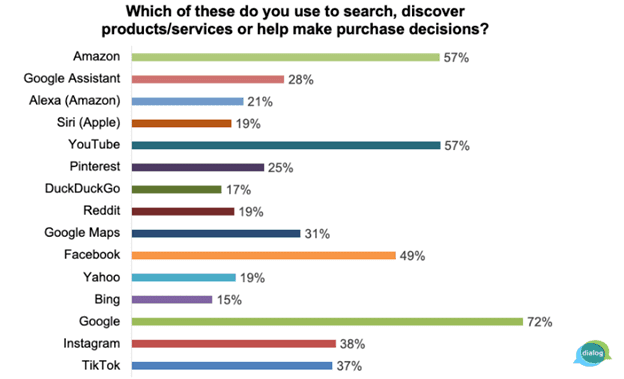
    • While Google is dominant, consumers use multiple sites to make purchase decisions.
    • 44% of U.S. adults have used AI applications at least once (100% of respondents had).
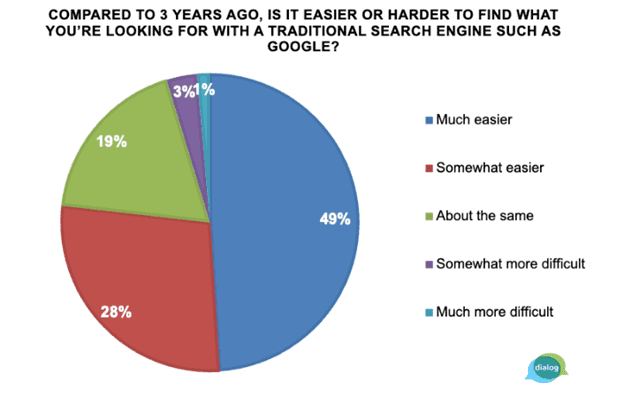
    • 77% of survey respondents said it had become easier to find things on Google.
    • 57% use AI daily; roughly half of them use it multiple times a day.
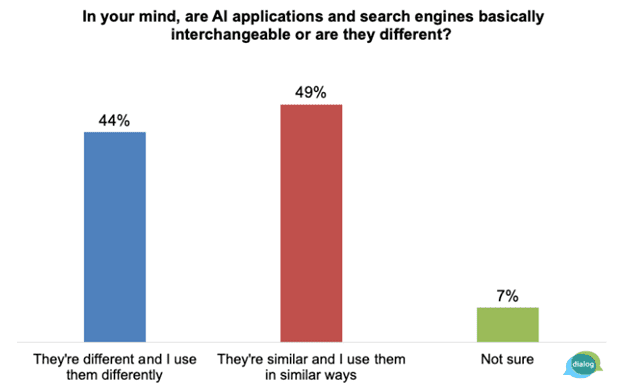
    • 49% see AI and search as essentially interchangeable.
    • 67% think AI will likely replace traditional search engines within three years.

    Search Is Fragmenting

    It’s important to point out that the often binary discussion of Search vs. AI misses the fact that people have been using numerous other sites for search and discovery for some time.

    Some people might be surprised, for example, that a majority of U.S. adults on TikTok are looking for product reviews and recommendations.

    Dialog’s survey suggests that people routinely use multiple sites to conduct pre-purchase research, though Google is the most widely used.

    The precise percentages are less important than the fact that so many sites were named.

    Image from author, December 2024

    Search Today Is ‘Much Easier’

    The general consensus in the SEO community and tech press is that Google’s search quality has declined for several years.

    If you don’t believe this, just Google “Is Google getting worse?” (There’s a longer debate as to why this might be.)

    We fully expected consumers to express a similar sentiment. But they didn’t.

    In fact, 77% said that they thought it was easier or “much easier” to find what they were looking for on Google today vs. three years ago.

    While this doesn’t explicitly address search quality, it reflects a positive user experience.

    Image from author, December 2024

    We didn’t follow up on this question, so we don’t have a good explanation for the finding.

    One potential theory is that much of search activity today is brand-related or navigational, which Google does a good job with.

    Another theory is that users have become more capable searchers. But neither is fully persuasive.

    Search And AI Are ‘Interchangeable’

    As mentioned, we disqualified potential respondents who said they’d never used an AI application.

    Among our sample, however, there were very few infrequent AI users; 92% said they used AI at least weekly, and 57% were daily users, with a substantial minority using it multiple times a day.

    ChatGPT was the dominant AI tool, although Gemini was not far behind – and these are regular searchers, with 64% using Search/Google multiple times a day.

    We also wanted to understand whether consumers saw Search and AI as similar tools or different.

    Roughly half of our respondents said that Search and AI were indeed similar and that they used them in similar ways. The other half said that they were different or weren’t sure.

    Image from author, December 2024

    The broad significance of this finding is that a meaningful number of relatively heavy search users are potentially open to substituting AI (ChatGPT) for Google.

    Beyond this, our respondents said they liked many things about AI/ChatGPT:

    1. Ability to ask follow-up questions – 44%
    2. Direct answers vs. website links – 42%
    3. Overall quality of answers – 40%
    4. ‘Conversational’ interaction – 38%
    5. More comprehensive information – 37%
    6. Lack of ads – 35%
    7. Other (please specify) – 1%

    While the majority said they found AI content trustworthy, there were still concerns about privacy and information accuracy.

    Search Beats ChatGPT – Or Does It?

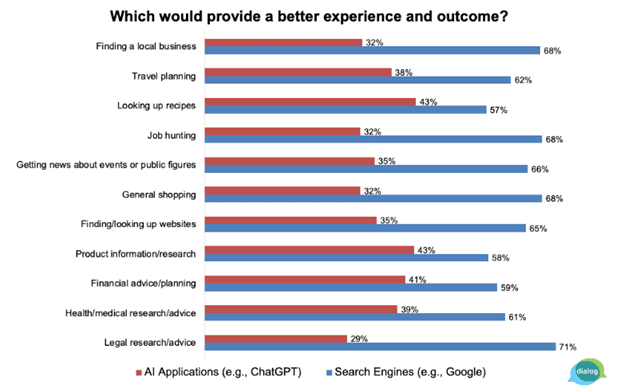
    We asked consumers to decide whether they thought search or AI would provide a better experience and outcome across a range of content categories and use cases.

    Across the board, Google/Search won. Some categories were closer than others (i.e., recipes, product research, and financial planning).

    Image from author, December 2024

    This is a Rorschach-like, “half empty-half full” chart.

    If you’re rooting for Search, you can take comfort in Google’s seemingly clear victory. But, the other side of this is that a substantial number of people thought AI would do a better job.

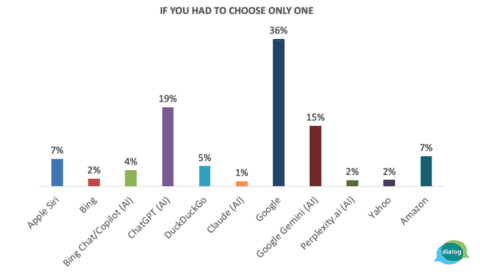
    Presenting consumers with a list of 11 Search and Search-adjacent tools, including Google, Amazon, Yahoo, Perplexity, ChatGPT, and others, we then asked, “If you had to choose only one of these for all your research and purchase decision-making needs, which would it be?”

    If you only had to choose one, most people chose GoogleImage from author, December 2024

    The largest group of 36% chose Google, as you would expect. ChatGPT was second, and Gemini came in third.

    When you combine the ChatGPT and Gemini respondents, Google only prevails by a slim two-point margin.

    Conclusion: AI Inevitability?

    More than two-thirds of these consumers answered “likely” or “very likely” to the question, “Will AI replace search in the next three years?”

    Only 12% said it was unlikely, and the rest weren’t sure. Again, this is a group that likes Google and thinks it delivers a better experience than AI in most cases.

    Will Google be displaced in three years? Not a chance.

    But, the fact that a majority believe it’s possible may impact their expectations and behavior – it also indicates their potential openness to switching. Google has been seen as invulnerable until now.

    Feeling competitive pressure, Google is rapidly evolving and leaning on AI to beat back the ChatGPT threat.

    In doing so, the Google SERP may increasingly come to mimic the AI user experience.

    Google CEO Sundar Pichai recently proclaimed that the search experience would “continue to change profoundly in 2025.”

    What we know for sure is that the next phase of search will be quite different, and that the search landscape may, in fact, be fragmenting.

    Regardless, Google and AI “answer engines” will co-exist, and the customer journey will undoubtedly become even more complex.

    Marketers will need to be flexible and ready. Business as usual is over.

    More Resources:


    Featured Image: Pickadook/Shutterstock

    Google’s Ex-CEO on AI: What SEOs Should Pay Attention To via @sejournal, @martinibuster

    Former Google CEO Eric Schmidt said that the trajectory of AI is both “enticing” and “frightening.” He emphasized that AI is not just an evolution of technology, it’s about shaping the future of humanity. His comments reflect how the highest levels of technology leaders think about AI and carry implications for how this will play out for SEO.

    Tech Companies Shouldn’t Be Making The Decisions

    Asked if the decisions about the future of technology should be left to people like him, Eric Schmidt responded no. He cited Henry Kissinger who ten years ago said that people like Schmidt should not be making the decisions and used the example of social media to explain why.

    “Let’s look at social media. We’ve now arrived at a situation where we have these huge companies in which I was part of. And they all have this huge positive implication for entertainment and culture, but they have significant negative implications in terms of tribalism, misinformation, individual harm, especially against young people, and especially against young women.

    None of us foresaw that. Maybe if we’d had some non-technical people doing this with us, we would have foreseen the impact on society. I don’t want us to make that mistake again with a much more powerful tool.”

    AI Is Both Frightening & Enticing

    Eric Schmidt has been an active participant in the development of computer technology since 1975 to the present. The awe he expresses for the point in time we are in now is something that everyone at every level of search marketing, from publishing, SEO, advertising to ecommerce should be aware of. The precipice we find ourselves at right now should not be underestimated and at this point it barely seems possible to overestimate it.

    Given that Sundar Pichai, Google’s current CEO, stated that search will be changing in profound ways in 2025 and the revelation that Google Gemini 2.0 will play a role in powering AI search, Schmidt’s declarations about the mind-boggling scale of computing capabilities should be of high importance to search marketers in both the enticing capabilities for them and frightening realities of what Google will be doing.

    Schmidt observed:

    “There are two really big things happening right now in our industry. One is the the development of what are called agents, where agents can do something. So you can say I want to build a house so you find the architect, go through the land use, buy the houses. Can all be done by computer not just by humans.

    And then the other thing is the ability for the computer to write code. So if I say to you I wanted sort of study the audience for this show and I want you to figure out how to make a variant of my show for each and every person who’s watching it. The computer can do that. That’s how powerful the programming capabilities of AI are.

    In my case, I’ve managed programmers my whole life and they typically don’t do what I want. You know, they do whatever they want.

    With a computer, it’ll do exactly what you say. And the gains in computer programming from the AI systems are frightening, they’re both enticing because they will change the slope.
    Right now, the slope of AI is like this…”

    Screenshot Of Schmidt Illustrating The Slope Of AI

    He continued his answer:

    “…and when you have AI scientists, that is computers developing AI, the slope will go this… it will go wham! But that development puts an awful lot of power in the hands of an awful lot of people.”

    Screenshot Of Eric Schmidt Illustrating The Future AI Slope

    Embedding The Intrinsic Goodness Of Humanity In AI

    The interview ended with a question and answer around the possibility of embedding positive human values and ethical principles into AI systems during their development.

    There are some people who complain about the ethical guardrails placed on AI, claiming that the guardrails are based on political or ideological values, reflecting the tension between those who feel entitled to the freedom to use AI to whatever ends they desire and those who fear that AI may be used for evil purposes.

    Eric Schmidt addresses this tension by saying that machines can be embedded with the best of human goodness.

    The interviewer noted that Schmidt, in his book, expressed confidence that machines will reflect “the intrinsic goodness in humanity” and asked whether humanity can truly be considered inherently good, especially when some people clearly aren’t.

    Schmidt acknowledged that there is a certain percentage of people who are evil. But he also expressed that in general people tend to be good and that humans can put ethical rules into AI machines.

    He explained:

    “The good news is the vast majority of humans on the planet are well meaning, they’re social creatures. They want themselves to do well and they want their neighbors and especially their tribe, to do well.

    I see no reason to think that we can’t put those rules into the computers.

    One of the tech companies started its training of its model by putting in the Constitution and the Constitution was embedded inside of the model of how you treat things.

    Now, of course, we can disagree on what the Constitution is. But these systems are under our control.

    There are humans who are making decisions to train them, and furthermore, the systems that you use, whether it’s ChatGPT or Gemini or or Claude or what have you, have all been carefully examined after they were produced to make sure they don’t have any really horrific rough edges.

    So humans are directly involved in the creation of these models, and they have a responsibility to make sure that nothing horrendous occurs as a result of them.”

    That statement seems to presume that people like him shouldn’t be making the decisions but that they should be made with consultation with outsiders, as he said at the beginning of the interview. Nevertheless, the decisions are always made by corporations.

    People Mean Well But Corporations Answer To Profits

    The question that wasn’t asked is that with a few exceptions (like the outdoor clothing company Patagonia), considering that corporations generally aren’t motivated by “human goodness” or base their decisions on ethics, can they be trusted to imbue machines with human goodness?

    Despite click bait articles to the contrary, Google still publishes their “don’t be evil” motto on their Code Of Conduct page, they simply moved it to the bottom of the page. Nevertheless, Google’s corporate decisions, including about search, are strongly based on profit.

    On the issue of whether AI Search is strip mining Internet websites out of existence, Sundar Pichai, the current Google CEO, struggled to say what Google does to preserve the web ecosystem. That’s the outcome of a system that prioritizes profits.

    Is that evil, or is it just the banality of a corporate system that prioritizes profit over everything else, leading to harmful outcomes? What does that say about the future of AI Search and the web ecosystem?

    Screenshot of Google’s De-Prioritized Don’t Be Evil Motto

    Watch The Interview With Eric Schmidt:

    Featured Image by Shutterstock/AYO Production

    22 SEO Experts Offer Their Predictions For 2025 via @sejournal, @theshelleywalsh

    This year continued with the same theme as the year before – a bombardment of updates and rapid developments in AI.

    AI Overviews were introduced in May, which then saw a drop in organic traffic alongside major drops from Google updates.

    It’s not been an easy year in SEO.

    Whereas last year was considering how AI tools could be leveraged to augment our work, this year has been the acceptance that Google SERPs are changing and not delivering the same levels of organic traffic as before.

    This introduction of AIO and the uncertainty of Google organic traffic has accelerated the move towards SEO becoming “marketing.”

    Moving forward, SEO is now as much about branding and marketing as it is about what we used to know about SEO.

    To make this transition, everything that you were doing in SEO needs to be reconsidered. The future of online marketing will involve being found in generative AI apps, AI-powered search engines, social media, forums, and communities.

    The bottom line is that SEO is now marketing, and that could be challenging for anyone who holds on to a one-dimensional SEO mindset.

    As is our tradition this time of year, we turned to some of the best minds in the industry to get their thoughts on where the industry is going and what might happen next.

    We asked 22 of the best practicing SEO professionals: In your expert opinion, what should SEO pros focus on in 2025 to maintain visibility and get results?

    1. Focus On The Fundamentals

    Jono Alderson, Consultant at Jono Alderson

    Make 2025 the year you actually optimize your website. Forget shiny new toys and focus on the fundamentals.

    Fix your errors. Make it faster. Make it more accessible. Improve the UX. Correct the typos. Redirect the broken links. Clean up the mess.

    And while you’re at it, trim the fat. Remove the zombie pages that nobody visits. Prune your bloated navigation. Consolidate duplicate content.

    Fix those annoying forms that never seem to work. Make your images smaller. Stop auto-playing videos. Test your site on a cheap phone on bad Wi-Fi and see how frustrating it is. Then fix that, too.

    SEO professionals are so busy chasing trends, tweaking metadata, and begging for backlinks that we’ve lost sight of what really matters: creating a website that works beautifully for users.

    A faster, simpler, cleaner site isn’t just better for people – it’s better for search engines, too. Do the unglamorous work. Google notices, and so does the market.


    2. Focus More On UX

    Arnout Hellemans, Consultant at Online Market Think

    Here are a few tips for SEO pros to focus on in 2025:

    Stop focussing on keywords and shift to user intent. Look at SERPs into all the questions users have.

    Check the People Also Ask (PAA) features and check if your article satisfies that intent on the page.

    Focus more on the UX (usability, site speed).

    If you want to get traffic from other AI discovery engines, check your website without JavaScript. You can use SSR or pre-render your webpages, so that other crawlers can consume your content too.


    3. Start Considering Awareness And Upper Funnel Metrics

    Ryan Jones, Senior Vice President at Razorfish

    2025 will be the year when we finally treat SEO like full-funnel marketing. 

    SEO pros will have to move beyond just measuring clicks and start considering awareness and upper funnel metrics as users less frequently desire websites in favor of AI, instant answers, and other search features. 

    SEO pros will still be needed to help influence these features and ensure brands show up, but we’ll have to focus on user intents – the queries where users want to do or accomplish something – over high search volumes.


    4. Start With Video-First Content

    Mark Williams-Cook, Digital Marketing Director at Candour

    Over the past 20 years, we’ve consistently seen Google take steps to keep users on their SERP, as it’s more profitable for them.

    In its Q3 announcement, it revealed a 90% reduction in the cost of generating AIOs, signaling even more aggressive deployment of these and AI-organized results in ecommerce.

    This likely means a decline in traffic to “solved” knowledge and informational spaces – though that’s not necessarily a bad thing for the web (how many lasagna recipes does humanity really need?).

    On the other hand, we can expect increased traffic from sources like Google Discover and Lens, particularly for non-text content such as video.

    I believe those who rely solely on GenAI to generate content directly from LLMs will struggle.

    However, those leveraging LLMs to enhance original material – such as generating transcriptions from video—are positioned to benefit, as this top-down approach now feels even more strategically aligned with current trends.

    In 2025, I am going to be encouraging clients to start with video-first content and work backwards, with a special focus on Discover and Lens search, which has now been integrated.


    5. Diversify Where Your Community Might Be Spending Time Online

    Miriam Ellis, Consultant at Miriam Ellis Consulting

    A trend to pay particular interest to in 2025 is the diversity of digital platforms to which your potential customers may be going for local business information and recommendations.

    2024 has seen many developments that may not be increasing searcher satisfaction, such as the rise of AI Overviews, which can’t be relied on for factual information, and a growing sense that Google search has become less skilled at intent matching.

    I’ve fielded sentiment from a range of users encompassing some of the best SEO pros in the world to everyday searchers stating that it’s simply harder than it used to be for them to find what they’re looking for in Google.

    While all the traditional SEO and local SEO skills and work remain relevant, diversifying your picture of where your community might be spending time online will be smart work for the year ahead.

    In the U.S., we’ve reached a state in which half our counties no longer have access to local news, so people looking for trustworthy, authentic communications about their community will have to look elsewhere. This could include the big social media platforms like Facebook, Instagram, and TikTok, but don’t stop there.

    I recommend taking a very good look at Discord to see if it has become a community hub, or if you could turn it into one to increase your neighbors’ awareness of your brand taking an active role in your town or city. YouTube, Reddit, and hyperlocal podcasts are also very strong candidates for contributing to community life.

    In summary, while normal SERP visibility will still be essential to your marketing strategy, be sure you’re studying consumers’ shifting behaviors so you can learn to be present wherever they feel information can be trusted.


    6. Organize And Structure The Content Hierarchy

    Motoko Hunt, Founder & President at International SEO & SEM Consulting

    Many SEO pros have been focusing so much on content generation in recent years, especially in 2024 with the help of AI.

    It’s time to better organize generated content based on the target audience’s intent and business goals.

    1. Identify the purpose of each content/page on site.
    2. Identify the target audience’s intent and stage for each content.
    3. Group content by topics.
    4. Create a content tree within the group based on the searcher’s intent and stage.

    By organizing and structuring the content hierarchy, you can touch searchers at each stage of their journey and influence their decision-making.

    You should also update the content as needed. You want your content to stand out in the sea of similar content out there. Make sure that your content adds value.

    With this, the content will not just generate traffic but will contribute to the business growth.


    7. Build Author Authority And Explore Alternative Traffic Sources

    John Shehata, CEO & Founder at NewzDash and Former Global VP of Audience Strategy at Conde Nast

    I believe these key areas will be crucial for SEO success in 2025:

    E-E-A-T Is King

    Google’s emphasis on experience, expertise, authoritativeness, and trustworthiness will be even more critical.

    SEO pros need to build Author Authority by showcasing expert credentials and first-hand experience, and digital and social footprint, especially in niches like health and finance (think doctor bios with links to publications).

    Strong Domain Authority still relies on high-quality backlinks, but focus on those that drive traffic.

    For Document Authority, create in-depth, entity-focused content that satisfies user intent better than competitors. Think comprehensive guides with clear attribution and original research.

    AI Is Your Co-Pilot

    AI is transforming search. Optimize for AI-generated answers by structuring content around topics and entities.

    For example, instead of just targeting “best running shoes,” create content around “best running shoes for trail running” and “best running shoes for flat feet.”

    Use AI tools to scale – not to write – content creation, but maintain a human touch for quality and originality. Think of AI as a research assistant and editor, not a replacement for your own expertise.

    Diversify To Thrive

    Expect fewer Google clicks with all the new SERP updates, and don’t put all your eggs in the Google basket.

    Explore alternative traffic sources like Threads, Reddit, newsletters, and even push notifications.

    A diversified approach makes you less vulnerable to algorithm updates and opens up new audience streams.

    Adapt And Analyze

    Stay informed about algorithm updates and adjust your strategies accordingly. Pay close attention to user behavior on your website to identify areas for improvement.

    Tools like heatmaps and scroll maps can provide valuable insights.


    8. Create More Q&A Content To Be Present In LLMs

    Kevin Indig, Growth Advisor and publisher of The Growth Memo 

    In my opinion, the big question is, “What is the story of your brand in an LLM world?”

    Track sales/revenue/leads from LLM referral traffic like ChatGPT, Perplexity, Gemini, etc. See if this could become meaningful when extrapolating the trend from the last six months out over the next two years.

    If so, you want to invest in technical SEO to make crawling easier and create more structured content (like Q&A style content) to be more present in LLMs.


    9. Index Licensing Will Become Increasingly Important

    Jes Scholz, Marketing Consultant at JesScholz Consulting

    The Bing index powers ChatGPT (and thus will be integrated into Siri), as well as Microsoft Copilot and many answers of Meta AI.

    It’s also leveraged by smaller search engines, including Yahoo, DuckDuckGo, and Ecosia.

    While other players, like Perplexity, aim to build their own index, it’s clear that index licensing will become increasingly important as the search landscape diversifies.

    This means SEO marketers need to expand their focus beyond Google from an indexing perspective.

    Now is the time to revisit Bing Webmaster Tools. Conduct a content audit using XML sitemaps for each page type to compare indexing rates on Bing versus Google.

    If either search engine is missing valuable content, prioritize crawling and indexing optimization.

    Because no matter the surface – whether it’s in traditional SERPs, AI-powered SERPs, chatbots, Google Discover, Google Shopping, or elsewhere – if your content isn’t indexed, you have no chance to earn visibility.


    10. Build Relationships With Other Well-Ranking Sites In Relevant Industries

    Glen Allsopp, Fonder at Gaps.com

    One recommendation I have for 2025 is to actively study as many of the main search results you’re trying to rank in, see what Google is rewarding, and look to get involved in those sources.

    Bear with me – it gets better.

    Besides traditional service or shopping pages, there’s a good chance you’ll also see:

    • Guides recommending products and services.
    • YouTube videos.
    • Similar but non-competing brands.
    • Interviews.
    • Tweets.
    • Forum posts.
    • Reddit posts.

    While a simplified goal of SEO is to get more targeted search traffic to your own website, you shouldn’t ignore the possibility of getting more exposure via creating videos, being involved in relevant Reddit communities, and so on.

    One of the most effective things I’ve done is build relationships with other well-ranking sites in relevant industries. Even better if you’re in the same space but don’t compete on the end product you’re selling.

    You would be surprised how open people are to also cover your product, service, or content when they get to connect with a human who actually cares about what they’re working on.

    It’s far from the most important or only thing you should be doing, of course, but it’s always good to expand your marketing horizons.


    11. Building And Enriching Knowledge Graphs With Well-Defined Entities Is Key

    Andrea Volpini, CEO and Co-Founder of Wordlift

    SEO professionals and marketers should optimize for both human and AI audiences, particularly large language models (LLMs).

    LLMs excel at processing structured, concise text but often struggle with complex, visually rich websites.

    Providing clear, organized, and dense content – such as markdown files or LLM-specific resources like /llms.txt – helps LLMs better understand and represent your brand to users.

    Structured data remains essential for search visibility and enhancing AI-driven customer experiences. It enables training models, improving content suggestions, and supporting advanced features like conversational search.

    Understanding how LLMs function is equally critical. These models can be interpreted through monosemanticity – the ability to extract precise, entity-like features from their deep neural networks.

    SEO pros should focus on creating clear, entity-rich content and evaluating how these entities align with openly distributed models.

    Building and enriching Knowledge Graphs with well-defined entities is key. This approach ensures LLMs can effectively contextualize your content, unlocking new optimization opportunities and improving both AI and human experiences.


    12. Sit And Sync With Comms

    Mordy Oberstein, Founder of Unify Brand Marketing

    Let’s define “maximum visibility” for a second. Do we mean as many eyeballs as possible as quickly as possible? If so, I have no tips for you.

    On the other hand, if we mean being visible as much as possible in as meaningful a way as possible, then I have one tip for you: Sit and sync with comms.

    Be aligned with and on board with your company’s or client’s comms or brand department. Understand where they want to go. Understand how they see the company’s identity, positioning, and the messaging they want to send.

    Be a part of that process. Help them align and amplify that positioning and messaging. Help the brand become what it aims to be.

    We’re entering a digital winter. There is so much volatility and so much dysfunction (hello, search and social algorithms).

    Most of all, there is so much noise. It’s much harder for your audience to tune it all out and to allow themselves to be impacted by what you’re putting out there.

    That’s a huge hurdle to overcome. We’ve become inundated and numbed to all of the digital content thrown at us. And we’re only getting more inundated and more numb.

    There’s a huge need for resonance. Your content needs to be crafted in a way that can cut through all the noise and resonate.

    There’s not a whole lot of point in grabbing as much traffic as possible if it’s not going to be “seen” by the audience.

    That old model of garnering as much visibility as possible is outdated. It’s better to be purposeful more than anything. And to do that, SEO pros can no longer afford to be siloed.

    Sitting with whoever is running the overall communications strategy is an absolute must. It leads to a healthier approach and better outcomes. It’s what will drive visibility that actually matters.


    13. Know Who Your Customers Are, Create Resonant Messages, And Deliver Value

    Ameet Khabra, Founder at Hop Skip Media

    Fully embrace artificial intelligence (AI) and machine learning (ML) in every part of marketing.

    This is about so much more than automating PPC campaigns, though that’s a huge part, especially since Google is retiring manual bid controls like eCPC.

    The marketers who will succeed are the ones who can make the most of AI and automation while keeping that human touch to connect with customers.

    Build strong first-party (1P) data sets, as third-party (3P) cookies will continue to fade away, and privacy rules will get stricter.

    This is all about the information you gather directly from your customers – their website habits, how they interact with your brand, and what they’ve bought.

    Those who invest heavily in tools and strategies to collect 1P data will be able to deliver compelling experiences at every point of the buyer’s journey.

    You must also incorporate that data into creating experiences that catch your customer’s attention.

    Create immersive, interactive experiences that capture attention and spark emotion, and look beyond the screen to voice interfaces, wearables, and wherever your customers engage.

    It’s the brands that can create these amazing, human-centred experiences that are going to be the real differentiators.

    Finally, create some organizational agility. This is not news, but things are moving fast for us in this industry, and we need to create a culture where ongoing learning and testing are part of the rhythm.

    The fundamental rules of marketing remain constant. It is all about knowing who your customers are, creating resonant messages, and delivering value in every interaction.


    14. Users And Search Engines Prioritize Trusted Brands

    Montserrat Cano, Consultant at MC. International SEO & Digital Strategy

    In 2025, understanding your audience and market is key to building brand authority, increasing visibility and driving online leads or sales.

    Users and search engines prioritize trusted brands, so consistent branding and high-quality content are essential.

    This is especially important in international markets, due to the unique cultural nuances and search behaviours.

    Combine this with a solid website that focuses on user experience and accessibility for long-term growth.


    15. Communities Can Have A Big Impact On Visibility

    Jo Turnbull, Digital Marketing Consultant at Turn Global, Organizer of Search London, and Co-host of SEO Office-Hours

    SEO professionals should focus on being part of communities, supporting them or creating ones where there is a gap in the market.

    This is particularly important for small brands who do not have a lot of budget to make significant changes to their website.

    Communities can have a big impact on visibility, helping to build brands and subsequently conversions.

    Through communities, SEO pros can connect with and support one another in initiatives such as mentorship, writing for key sites, as well as attending virtual and/or in-person events.


    16. Understand How Users Consume Information

    Navah Hopkins, Brand Evangelist for Optymzr

    Looking ahead to 2025 and beyond, it’s all about understanding how users consume information.

    By focusing on non-login forums (Reddit, Quora, etc), and getting indexed on Bing for ChatGPT visibility, brands can bypass expensive and time intensive conventional Google SEO.

    Forums often rank better on SERPs and offer a more authentic, human touch compared to traditional websites.

    If you plan to promote yourself, make sure you’re honest about it – building an infrastructure for your customers and brand influencers to share on your behalf can serve better.


    17. Gain A Foothold In New Trends And Topics Before Larger Competitors

    Tory Gray, CEO at Gray Dot Company

    There’s a fundamental shortcoming to traditional SEO keyword research that we maybe don’t talk about enough: It’s a lagging indicator.

    So, when it comes to identifying new trends, topics, or questions for content, relying on traditional keyword research makes SEO professionals and content strategists late to the game.

    That’s especially important for smaller, less authoritative domains. In established industries and verticals, many existing topics are dominated by high-authority competitors.

    Gaining a foothold in new trends and topics before larger competitors is one of the few, strong tactics that can help close the gap.

    Today, trends and topics take off on platforms like TikTok and Reddit before they make their way to search engines like Google.

    In 2025, looking outside of traditional search data – and incorporating platforms where “newness” happens – is how we can tap into leading indicators that let us know which new and useful information our audience really wants.


    18. Finding Truly Unique Angles For New Content Will Reward You

    Alli Berry, Search Engine Optimization Consultant at Alli Berry Consulting, LLC

    Less is more when it comes to your content strategy.

    Google has been busy continuing to punish lower-quality pages, so it’s time to cut the robotic-like programmatic and low-quality AI-generated pages that may have given you some short-term gains.

    I know everyone says they’d never do that, but the internet suggests otherwise.

    I would also be cutting low-performing pages and thin pages because they may be harming the overall quality of your site from a search engine lens.

    Finding truly unique angles for new content will reward you, especially if you can incorporate proprietary or 1st party research.

    The Google documents leaked suggest that high-quality news links and links from new pages count for more, so anything you can do to drive new external links should reward you.

    Also, if you’ve got all of your eggs in the affiliate revenue model basket, it’s time to diversify your business model. Google is coming hard for affiliate sites.


    19. Mentions In LLMs Will Emerge As A Key Aspect Of SEO

    Olga Zarr, SEO Consultant at SEOSLY

    SEO professionals should broaden their focus beyond just Google to include Bing and LLMs, as visibility across all these platforms will likely become increasingly critical.

    Mentions in LLMs will emerge as a key aspect of SEO, extending the discipline beyond traditional search engines.

    Good rankings in Google will still matter, especially since they will influence mentions in AI Overviews. However, the dynamics shift when considering the leading LLM player, ChatGPT, which relies on Bing for search results in both ChatGPT and GPT-powered search.

    This means that strong rankings in Bing will become significantly more valuable. SEO pros must familiarize themselves with Bing’s ranking criteria and closely study its documentation, as its algorithm and priorities differ from Google’s.

    For other LLMs – regardless of their data sources – SEO marketers should ensure that the brand they aim to promote is consistently and clearly positioned online.

    It’s crucial to communicate what the brand represents and offers, so it becomes a reliable source for LLMs to cite. Cohesive and authoritative branding will play a big role in improving visibility.


    20. Do More With Less By Swapping The Fluff For Trustworthy Information

    Jamie Indigo, Director of Technical SEO at Cox Automotive Inc.

    Visibility in 2025 is all about understanding the context in which your site exists. More content will be created this year than 2010-2018 combined.

    In the face of a rapidly expanding internet full of regurgitated AI, Google’s goal of crawling less makes sense. If your site is made of the same content as all the others using that particular AI tool, why bother?

    AI-generated content is statistically probable rather than factually accurate. It may lack the depth, nuance, and originality that users seek.

    Google’s emphasis on crawling less underscores the need for unique, high-quality content that provides genuine value to users.

    This is why your website’s unique context is so important. Smaller sites should have different focuses than large sites.

    If your site is greater than 100,000 pages … does it need to be? How much of that content do users actually engage with? This is your time to be intentional about the index.

    If it doesn’t solve a real human problem, cut the cruft. Do more with less by swapping the fluff for trustworthy information.

    This includes all the bells and whistles on your site to make it as shiny as possible. A feature no one uses is waste. Great content with a bad user experience is still bad content. Even great content is useless if it isn’t relevant to why the user came to the page.

    SEO professionals should prioritize trustworthy experiences that fulfill user intent. If you’re answering questions and helping get things done, you’ll see growth.


    21. Learn How To “Program Personas” Effectively

    Michael Bonfils, Global Managing Director at SEM International

    As you already know, SEO professionals who figure out how to combine data, creativity, and AI-driven innovation will be the ones who win.

    An opportunity for SEO pros in 2025 will be learning how to “program personas” effectively.

    This means taking tools like ChatGPT and other LLMs and feeding them the right inputs – like your target audience’s behaviors, their pain points, and the brand tone – to create AI-driven personas that are specific, strategic, and actionable.

    Think of these personas as virtual assistants who can brainstorm and refine ideas with you tailored to your exact needs.

    For example, you could program an AI persona to act like a Gen Z skateboarder or a busy CFO and have it generate ideas or strategies that would appeal directly to that group.

    This goes beyond traditional keyword research; it’s about having AI provide insights you might not have considered, delivering fresh, relevant angles.


    22. Businesses Should Invest In A Strong Internal SEO Product-Oriented Team

    Pedro Dias, Founder and SEO Consultant at Visively

    SEO professionals should step back and try to understand how their strategies impact the new rules of the game we’re currently playing in search.

    There’s a lot of noise around promises of easy traffic at scale that are more designed to catch off-guard anyone not fully aware of what they should be doing, and make money from the less savvy.

    That said, the important pillars of SEO remain:

    Technical Excellence

    Ensuring a site is crawlable and indexable by search engines is foundational – log file analysis, optimizing crawl paths, and resolving technical barriers (e.g., redirects, canonicalization, and URL structures).

    Data-Driven Decision Making

    Leveraging tools like Google BigQuery to analyze search and performance data — making SEO decisions based on solid data, such as understanding user behavior, identifying patterns in search intent, or assessing technical performance.

    Scalability And Sustainability

    Building scalable systems and processes that support SEO growth — preventative measures, automation, and frameworks (“Improvements, Prevention, Recovery” models) for a proactive approach over reactive fixes.

    Collaboration With Product Teams (For Internal Teams)

    Integrating SEO into product and development workflows, highlighting the importance of SEO as a core component rather than a marketing afterthought.

    User-Centric Approach

    Ensuring SEO efforts align with delivering value to users, as user satisfaction often drives ranking improvements.

    I believe it’s more important than ever that businesses seriously invest in having a strong internal SEO product-oriented team.

    This will be a game changer for the future as this will increasingly be a factor to differentiate sustained growth better catered when you have a deep knowledge of your product and vertical of operation, rather than the sole reliance on intermittent external collaborators.


    SEO in 2025

    In a continuation from last year, SEO is changing more rapidly than at any other time in the history of the industry.

    As we said at the beginning, SEOs need to change their mindset away from the old way to a new holistic approach that seeks to find visibility where your audience is. Most likely across Google SERPs, Bing SERPs, ChatGPT Search, Perplexity, Gemini, TikTok, YouTube, all in varying degrees.

    Most of the experts agree that focusing on brand and producing quality content that demonstrates expertise is an area of focus.

    We also think, removing reliance on Google for organic traffic would be a smart investment to make right now.

    More Resources:


    Featured Image: jamaludinyusuppp/Shutterstock

    Voice Search SEO: How Does It Work? via @sejournal, @BennyJamminS

    When Google Voice was released in 2012, and then Amazon Alexa was released in 2014 voice search was expected to be highly influential.

    Voice search didn’t quite take off in an industry-shaking way. But, as the technology has improved, it’s become integrated into so many devices and daily user journeys that it’s important to understand for SEO.

    What Is Voice Search And Voice Commerce?

    Voice search describes when people use their voice devices to access information available from search engines.

    Voice commerce describes people using voice devices to make purchases. It’s part of voice search, and users often interact with search engines to complete purchases.

    For SEO professionals, there are two core functions you should pay attention to:

    1. Local intent searches: People often use voice searches when they’re traveling to search for things they need and places they need to go. In these cases, your local SEO is critical. You need to ensure your Google Business Profile is up to date and that you can be discovered in map applications.
    2. Using voice assistants to access Search: There are all sorts of reasons someone might prefer or need to use their voice to access search engines. When this happens, the questions tend to be highly specific and in “natural language.” This means you should prioritize not only organic rankings but also SERP features, because SERP features tend to better represent natural language picked up in voice search and where you want visibility.

    Alongside core functions, there are three different core voice search intents to consider for SEO:

    Transactional Intent

    Someone is looking to purchase a product or go to a location for a product or service.

    • Using an Amazon Alexa to order products. Voice assistants can connect to accounts with saved payment options and perform the process automatically. “Alexa, order cat food.”
    • Using a smart assistant, likely on a phone or a car’s own voice recognition feature, to direct them to a local business for a specific need. “Hey Google, take me to Home Depot.” “Hey Siri, find me a gas station.”

    High-Intent Consideration

    Someone doesn’t know exactly what they want, but they need something.

    • While driving, looking for something to eat or a coffee shop. “Hey Google, show me coffee shops nearby.”
    • Using an Amazon Echo device to create a shopping list. “Alexa, add eggs to my shopping list.”
    • Asking a voice assistant where to find a specific item. “Hey Siri, where can I get cast iron pans?”

    How-To/Active Learning Query

    Users interact with voice assistants to answer questions or find information.

    • Using a voice assistant to refer to a recipe while cooking.
    • Accessing search functions using a voice assistant. “Hey Google, how do I find a wall stud?”

    Informational Query

    Someone uses a voice assistant to come up with a quick answer.

    • “Hey Google, who is the current King of England?”

    Accessibility

    • Voice devices and screen readers are used by people with vision issues and other disabilities to access the internet.

    Voice Is Part Of Everyday Search & Purchase Journeys

    Voice search and mobile SEO are highly interconnected.

    Basically, every mobile device is also a voice device, so I find it helpful to think about the place in the journey a user is when they use their voice.

    If you take a look at what people say they use their voice assistants for, there isn’t much room for traditional SEO discovery – in the sense of Googling things, in the real-world functions. But they are making shopping lists and making purchases.

    What Devices Use Voice Search?

    Voice recognition technology has a long history, but the first true voice assistant was Siri, released on the Apple app store in 2010 and integrated into the iPhone in 2011.

    Many voice assistants have connectivity to either the internet at large or certain aspects of search functionality, such as Google Maps. The main voice assistants are:

    • Google Assistant.
    • Apple Siri.
    • Microsoft Cortana.
    • Amazon Alexa.

    Voice search is embedded into many devices. Some have limited functionality, like a Roku remote that searches for TV shows and movies. Others can access almost anything online, like an Amazon Echo or the Google voice assistant.

    There’s voice tech in your phone and your car if you’ve bought a vehicle made in the last 10 years. There’s voice tech in your TV or streaming device.

    Devices that can connect to voice search functions include:

    • Phones.
    • Tablets and laptops.
    • PC computers and gaming consoles.
    • Cars.
    • TVs.
    • Appliances such as refrigerators.
    • Voice assistant devices (such as the Echo).

    Not all of these devices have implications for SEO. It doesn’t make a whole lot of sense for you to do SEO for someone giving voice commands to appliances around their house.

    Why Is Voice Search Good For SEO?

    There are multiple reasons that voice search is critical for SEO strategy, and the specific reason depends on the intent and use case.

    These intents also inform your approach and the tactics you use to target users engaging with voice search.

    Accessibility

    People with visual impairments likely use devices like screen readers and may use voice interactions to engage with content online.

    Ensuring your content is easy for devices like screen readers to navigate improves the user experience for all users, not just those needing accessibility functions.

    User Experience

    Some people prefer voice interactions or activate search functions using their voice when they’re not able to use their hands. Common examples include driving and cooking.

    Immediacy & Intent

    Voice searches are often conducted for convenience when a user doesn’t need to spend time searching or when they need something quickly.

    Examples of this intent include:

    • Using a voice-activated device to place an Amazon order.
    • Using the voice function in your car or on your phone to look for a local business while you’re out.

    How Do You Optimize For Voice Search?

    In many cases, if you’re properly targeting intent and keeping updated with the SEO fundamentals of your website and content, you’re already optimizing for voice search. This technology is advanced and mature and can read the web.

    There really is no disadvantage to targeting voice search if you think about it in terms of intent and use case.

    If you perform well in voice search, you likely also perform well in overall SEO because voice assistants can connect to external sources to provide you with information.

    So, if you’re the top result in that source (Google Maps, Google Search, Amazon marketplace, Etsy, etc.), you’re more likely to be the result the user hears or sees.

    However, certain elements of voice search need specific attention, such as conversational queries, Amazon shopping, and local search.

    Local SEO: Voice Search & Near Me Queries

    Voice search and local queries are closely aligned due to the use case. People on the road, looking for somewhere to stop, will likely use voice search. Or they might look for somewhere to go right before leaving the house.

    The good news is that if you’re investing in local SEO, you’re already well-positioned to appear in these kinds of voice searches.

    It’s critical to optimize for the Map Pack, build your Google Business Profile, and develop local-SEO friendly websites to serve these voice search intents.

    You want to make a local-focused experience as smooth as possible. When people are out traveling or running errands, being the first to serve their immediate and specific needs can mean walk-in traffic.

    Screenshot from Google search, November 2024
    • Make sure your Google Business Profile is complete, including contact information, address, service area, payment types, etc.
      • Navigate to your business profile by searching for your business.
      • Click on “Edit Profile.”
      • Ensure that you complete all relevant fields.
    Screenshot from Google Business Profile, November 2024
    • Make sure that you add products and services to your Google Business Profile. This helps people discover you when they’re looking for something specific.
      • Click on “Edit Products” or “Edit Services” depending on your business type.
      • Add details about all of the things you offer. Pair this with keyword research to understand what people are looking for and align your offerings with their intent and wording.
    Screenshot from Google Business Profile, November 2024

    Follow these resources from SEJ to achieve higher local rankings and show up in local voice searches:

    Optimize For Ecommerce Queries On Amazon And Google

    The Alexa ecosystem connects with users’ Amazon accounts and allows them to make purchases quickly and easily using their voice.

    If you’re in ecommerce, this makes your optimization on platforms like Amazon critical. While the Alexa ecosystem often means that users skip platforms like Google, that doesn’t mean SEO is irrelevant.

    Amazon is a search engine, too, and properly optimizing your business and products on the platform could help you increase sales via direct voice purchases.

    Other voice assistants might access search engines like Google for product searches.

    Optimize your product landing pages with structured data (expanded on in the next section) for an easy user experience, both in Google Search and if a user decides to explore your page using voice.

    Optimize Structured Data And Target Featured Snippets

    SERP features and AI Overviews focus on providing short, quick summaries and answers to specific queries.

    If you can appear in these additional features, then you’re right at the top of the page where those queries are answered, whether they’re typed or spoken.

    Structured data is particularly important for voice queries, especially those spoken back to the user without a screen.

    Properly structuring the data about your pages and content helps the algorithms choose what to display and helps voice assistants speak coherent results.

    On the smaller screens of mobile devices, featured snippets become important because there’s less screen space for users to see organic results.

    Schema should be part of your overall SEO strategy and you can learn more here:

    Target High-Intent Long-Tail Keywords

    Voice search involves answering queries that people speak. While SEO often involves targeting short phrases that people type, people speak very differently.

    There are three key considerations for keyword targeting when it comes to voice:

    1. People tend to speak in long phrases.
    2. Many people use voice search for purchase-related queries, such as making online purchases and creating shopping lists.
    3. Voice queries tend to express immediate or short-term needs. People often ask their voice assistants to find something or perform an action. (Play a podcast, find a recipe, find or direct to a place.)

    All these facts make long-tail queries and high-intent task or product-focused queries important.

    By creating content on your website that serves these types of queries, you can get yourself in front of audiences during decisions or consideration points in their process.

    SEJ has many resources on long-tail queries and targeting query intent:

    Answer Questions Conveniently

    Developments in AI have improved how search engines respond to queries in longer form, “natural” or “conversational” language. These types of queries are more likely from voice searchers. They’re also key to successful SEO strategies overall.

    As AI algorithms get better at understanding and responding to complex queries, voice search is becoming less of a separate thing to optimize for and more of a benefit of a robust SEO strategy.

    Your content strategy should involve developing easily accessible answers to questions and common queries you expect from your audience.

    You can use Google’s features, such as People Also Ask, and your keyword research tools to identify questions your audience will likely ask and then build them into your content strategy.

    Read these resources from SEJ to find out more about questions and answers:

    Understand Intent To Serve Voice Queries

    Advanced natural language processing means search algorithms can easily interpret queries, even in complex language, and return results that match them.

    Your focus should be on search intents for users who are either in a hurry, have a high intent to action, or need additional accessibility.

    For all these users, you should make your website easy to navigate and focus on acquiring the top spots in featured snippets and local SEO results.

    While voice search wasn’t as disruptive as expected, it was a step in the development of natural language processing towards AI technology. Understanding these concepts can help you succeed in modern SEO.

    More resources:


    Featured Image: New Africa/Shutterstock
    CMS Market Share Trends: Top Content Management Systems (Nov. 2024) via @sejournal, @theshelleywalsh

    WordPress has held the dominant share of the content management systems (CMS) market since it was launched in 2003.

    Currently, the popular platform stands at 62.2% market share, according to W3Techs, which offers the most reputable and trustworthy data source. But in the last two years, WordPress has seen it’s market share start to reduce for the first time.

    In this report, you’ll learn about the size of the CMS market, how it has evolved over the past decade, how different content management systems stack up against one another, and why this matters for someone working in SEO.

    How Large Is The CMS Market?

    According to W3Techs, 70.2% of websites have a CMS, and Netcraft reports 1.13 billion live websites.

    From this, we can assume that the current market size for content management systems is approximately 793 million websites.

    Top 10 CMS By Market Share (Globally)

    CMS (as of November 2024) Launched Type Market Share Usage
    No CMS 29.8%
    1 WordPress 2003 Open source 62.2% 43.7%
    2 Shopify 2006 SaaS 6.6% 4.6%
    3 Wix 2006 SaaS 4.5% 3.2%
    4 Squarespace 2004 SaaS 3.1% 2.2%
    5 Joomla 2005 Open source 2.3% 1.6%
    6 Drupal 2001 Open source 1.3% 0.9%
    7 Adobe Systems (Adobe Experience Manager) 2013 Open source 1.2% 0.9%
    8 Webflow 2013 SaaS 1.1% 0.8%
    9 PrestaShop 2008 Open source 1.0% 0.7%
    10 Google Systems (Google Sites) 2008 Online application 0.9% 0.6%

    Data from W3Techs, November 2024

    What Is The Most Widely Used CMS?

    *Graphs are separated due to the dominance of the WordPress market share.

    • WordPress’s market share has reduced by nearly 5% in the last two years. This could possibly continue with the issues it has experienced this year.
    • Shopify’s market share took a dip of almost 14% in 2023, but it bounced back and gained some ground this year.
    • Wix’s market share is on the upswing, with just over 3% of all websites using its platform. This could be attributed to the work they do on branding.
    • Joomla and Drupal are seeing a downward trend lately, while Duda is gaining some momentum, which could be attributed to the efforts of leveraging influencers for their webinars.

    WordPress has held the dominant market share almost since its launch in 2003.

    From 2013 to 2022, it experienced strong growth of 148%. WordPress then peaked at 65.2% market share back in January 2022, but, in the last two years has started to contract by nearly 5%.

    Between 2023 and 2024:

    • Websites with no CMS system have declined by nearly 8%.
    • Websites with WordPress have increased by just over 1%.

    WordPress Vs. Joomla Vs. Drupal Market Share

    WordPress vs. Joomla Vs. DrupalScreenshot from W3 Techs.com, November 2024
    • Since 2023, Joomla has decreased its market share by nearly 15%.
    • Since 2023, Drupal has decreased its market share by nearly 28%.

    In 2013, Joomla and Drupal used to hold 15.9% of the CMS market share, but they have slumped to 3.6%.

    This decline has seen them drop from positions 2 and 3 to 5 and 6, as Wix and Squarespace have risen and finally superseded them in 2022.

    That’s quite a decline for Joomla, which might not have had the same market share as WordPress, but up to 2008, it had more search interest, according to Google Trends.

    Screenshot from Google Trends, November 2024

    Why did these popular content management systems decline so much?

    It’s most likely due to the strength of third-party support for WordPress with plug-ins and themes, making it much more accessible.

    The growth of website builders, such as Wix and Squarespace, indicates that small businesses want a more straightforward managed solution. And they have started to nibble on market share from the bottom.

    Website Builders Market Share: Wix Vs. Squarespace

    Screenshot from W3 Techs.com, November 2024
    • Wix has increased by 18.4% this year, from January to November.
    • Squarespace has increased by 3.3% this year from January to November.

    If we look at the website builders, their growth is a strong indication of where the market might go in the future.

    From 2023 to 2024:

    • Shopify grew by 15.8%.
    • Wix grew by 25%.
    • Squarespace grew by 3.3%.

    When we compare the 5% contraction of WordPress over the last year to the other players, we have to ask, why is that happening?

    SaaS web builders such as Wix and Squarespace don’t require coding knowledge and offer a hosted website that makes it more accessible for a small business to get a web presence quickly.

    No need to arrange a hosting solution, install a website, and set up your own email. A web builder neatly does all this for you.

    WordPress is not known as a complicated platform to use, but it does require some coding knowledge and an understanding of how websites are built.

    On the other hand, a website builder is a much easier route to market, without the need to understand what is happening in the back end.

    Consider that, during the pandemic, much of the population worked from home, leading to more interest and attention placed on how being online could be a source of income.

    Elementor

    Elementor is a WordPress-based website builder that has a market share of 16.5% and is used by 11.6% of all websites.

    elementorScreenshot from W3 Techs.com, November 2024

    It also has significantly more market share than Wix and Squarespace combined.

    However, because it’s a third-party plug-in and not a CMS, it isn’t listed in the Top 10 CMS above.

    If we compare the volume of traffic to the number of CMS, we can see that WordPress is in the golden section, up and to the right, clearly favored by sites with more traffic.

    Joomla fits into a niche of fewer installs but more high-traffic sites, indicating that more professional sites are using it.

    Squarespace and Wix are to the left and down, highlighting that they are installed on fewer sites with less traffic.

    This is a strong indication that they are used more by small websites and small businesses.

    Elementor bridges the gap between the two and has the weight of the WordPress market share, but is used by sites with less traffic.

    The appetite is growing for drag-and-drop, plug-and-play solutions that make having a web presence accessible for anyone. This is the space to watch.

    Ecommerce CMS Market Share: WooCommerce Vs. Shopify

    Screenshot from W3Techs, November 2024
    • WooCommerce has a market share of 13.1%.
    • Shopify has a market share of 6.6%.

    The ecommerce CMS space echoes a pattern similar to that of website builders.

    Technically, WooCommerce is not a standalone CMS, but a WordPress plug-in – which is why it doesn’t appear in the Top 10 CMS data table.

    However, it’s essential to the ecommerce space, so it’s worth considering and mentioning.

    9.2% of all existing websites use WooCommerce.

    Looking at the distribution, we can see a clear pattern emerge. In comparison to other ecommerce CMS platforms, WooCommere is dominant.

    It has more market share than its competitors combined: Magento + OpenCart + PrestaShop + Shopify = 8.8% market share.

    Screenshot from W3Techs, November 2024

    Smaller sites might favor WooCommerce, but it has the WordPress platform’s weight for market access and, therefore, more installs – much like Elementor.

    Shopify has more market share, but the traffic levels are similar to WordPress.

    Shopify saw growth during the pandemic, by 52.9% from 2020 to 2021 and then 26.9% from 2021 to 2022 – far more than any other platform. After that, it retracted in 2023, but in 2024 has come back to the same market share as 2022.

    Why Does CMS Market Share Matter To Someone Working In SEO?

    WordPress retains its dominance in the CMS market share, but website builders such as Wix, Squarespace, and Shopify are on the rise, indicating where market growth lies, especially for small businesses.

    If more small businesses are switching to website builders, understanding the limitations and intricacies of these platforms for SEO could be a competitive advantage.

    Shopify is installed on 4.6% of all websites (not just sites with a CMS) – a total potential market of 51.98 million websites.

    With their increasing market share, specializing in Shopify SEO could be a strategic move for an SEO professional.

    Similarly, specializing in Wix and Squarespace is a way to differentiate yourself from the competition.

    WordPress might be dominant now, but that also means that many other people are servicing that specific CMS.

    Aligning with a more niche CMS can be a strategic move for new client opportunities.

    More resources:


    All data collected from W3Techs, November 2024, unless otherwise indicated.

    W3Tech samples its data from the Alexa top 10 million and Tranco top 1 million. Websites with no content or duplicate sites are excluded. Limitations of the data source mean that hosted Tumblr and WordPress.com sites are not included, as the data collection doesn’t count subdomains as more than one site.


    Featured Image: Genko Mono/Shutterstock
    Google Rolls Out December 2024 Core Update via @sejournal, @MattGSouthern

    Google announced it’s rolling out the December core algorithm update, which the company expects to complete over the next two weeks.

    The news comes just a week after Google finished rolling out the November core update.

    Google’s Announcement

    In a post on X, Google stated:

    “The Dec. 2024 core update is rolling out, and we expect it will complete in two weeks.

    If you’re wondering why there’s a core update this month after one last month, we have different core systems we’re always improving. This past blog post explains more,”

    Google’s post included a link to a blog post from November 2023 titled “A Q&A on Google Search updates.”

    The blog post provides context around the company’s cadence of algorithm updates.

    Multiple Ranking Systems

    According to the announcement, Google uses “multiple ranking systems that do different things” and is “always looking at ways to improve these systems to show better results.”

    The company said it generally shares information about “notable” updates that it thinks might produce noticeable changes in search results.

    Regarding the proximity of the November and December updates, Google explained that while it tries to separate notable updates, “it’s not always possible” given the large number of updates the company implements overall. The post stated:

    “If we have updates that can improve Search, that have been developed over the course of several months, we release them when they’re ready.”

    Advice For Websites

    As with previous core updates, the December update’s specific changes are unknown. However, Google has consistently advised that the best way for creators to succeed through these updates is to remain focused on creating helpful, reliable, people-first content.

    Site owners who notice changes in traffic following an update are advised to look closely at Google’s update-specific guidance, which can be found via the Google Search Status Dashboard. The dashboard also allows users to check the status of an update rollout and subscribe to an RSS feed for alerts.

    Wrapping Up a Year of Algorithm Updates

    The December core update caps off a busy year of algorithm changes for Google Search.

    We will closely watch traffic patterns and search rankings to assess the impact as the December update rolls out over the coming weeks.

    Search Engine Journal will continue to monitor the situation and provide updates as they become available.


    Featured Image: Rohit-Tripathi/Shutterstock