Why CMOs Should Rethink ROAS As A North Star Metric via @sejournal, @brookeosmundson

If you lead a marketing team, chances are you’ve had this conversation:

“How are the campaigns doing?”

“Well, our ROAS is 4:1.”

The room breathes a collective sigh of relief. The good news: the marketing budget is justified (for the time being).

But here’s the problem: that number might not actually tell you anything useful.

Return on ad spend (ROAS) has long been the go-to metric for measuring paid media performance. It’s clean. It’s easy to calculate.

And let’s be honest: It looks great in a boardroom slide deck. But, that simplicity can be deceiving.

When CMOs use ROAS as the end-all be-all, it can create a warped view of what’s actually driving meaningful growth.

It often rewards short-term wins, punishes necessary investment periods, and misaligns internal and agency teams chasing vanity benchmarks instead of business results.

This article isn’t a hit piece on ROAS. It’s a reality check on meaningful key performance indicators (KPIs). ROAS can be useful, but it’s not your North Star.

And if you’re serious about long-term revenue growth, customer lifetime value, and competitive market share, it’s time to rethink what success really looks like.

Why ROAS Isn’t Always What It Seems

On paper, ROAS is straightforward: revenue divided by ad spend. Spend $10,000 and generate $40,000 in sales, and you’ve got a 4:1 ROAS.

But, under the hood, it’s not so simple.

Here are a few reasons why ROAS can often mislead:

  • It favors existing customers. Your branded campaigns and remarketing lists usually show sky-high ROAS, but they’re mostly capturing people already in your funnel. That’s not growth; it’s in maintenance mode.
  • It ignores profit margins. A $40 cost-per-acquisition (CPA) might look great in one product line and catastrophic in another. ROAS doesn’t account for your cost of goods, fulfillment, or operational costs.
  • It limits (actual) growth. If your only goal is to “hit ROAS,” you’ll throttle spend on upper-funnel or exploratory campaigns that could fuel future revenue.
  • It can be gamed. Agencies and internal teams might optimize for ROAS simply because that’s the KPI they’re judged on, even if it means saying no to high-potential but lower-efficiency campaigns.

And perhaps most importantly, ROAS often ignores timing.

You might lose money on day 1, break even by day 14, and profit significantly by day 90. But ROAS, by default, only tells you what happened in the reporting window you chose.

That’s not a North Star. That’s a snapshot in time.

ROAS Is Still Useful, If You Know When & How To Use It

Let’s be clear: ROAS isn’t bad to report on. It just needs additional context.

There are plenty of scenarios where ROAS is helpful:

  • Comparing performance between campaigns, channels, and platforms.
  • Evaluating high-volume SKU efficiency in ecommerce.
  • Reporting on short-term promotional campaigns.
  • Reviewing the efficiency of remarketing or loyalty campaigns.

The key is to treat ROAS like a diagnostic tool, not a destination. It’s one piece of the story, not the whole narrative.

When CMOs and marketing leaders make ROAS the only metric that matters, they end up over-indexing on campaigns that drive immediate revenue, often at the cost of sustainable growth.

What Should Be Your North Star Metric?

If it’s not ROAS, then what should it be?

The truth is, your North Star depends on your business model and goals. Here are a few KPI candidates that typically give a better long-term signal of paid media health.

1. Customer Lifetime Value (CLV) To CAC Ratio

This is arguably the best lens through which to evaluate your investment. If you’re acquiring customers who buy once and never return, you’ll never scale profitably.

Tracking your customer acquisition cost (CAC) against lifetime value forces you to think beyond the first purchase.

Why does this ratio matter?

CLV:CAC shows whether you’re building a sustainable business model. A healthy ratio is often around 3:1 or better, depending on your margins.

An example of how to use this metric is to look at campaign-level CAC and model projected CLV by channel or audience.

If you’re seeing CLV gains over time from specific campaigns, that’s a strong sign of durable growth.

2. Incremental Revenue

Not all revenue is created equal. Incrementality helps you understand what your paid media efforts are truly adding, not just capturing right now.

Why does this metric matter?

Paid campaigns often get credit for conversions that might have happened anyway. Branded search is a classic example. Measuring incrementality filters out that noise.

Some examples of how to use this metric include:

  • Set up geo-holdout tests.
  • Use audience exclusions.
  • Google and Meta’s Incrementality Testing tools.

Incrementality is not always easy to measure, but it brings clarity to where your dollars are actually making a difference.

3. Payback Period

This metric measures how long it takes for a campaign or customer to break even.

Why does this metric matter as a potential North Star?

Not every investment has to pay off instantly. But, leadership should be aligned on how long you’re willing to wait before seeing a return on investment (ROI). That transparency allows you to fund top-of-funnel efforts with more confidence.

To use this metric in practice, try tagging customer cohorts by acquisition source or campaign. Then, track how long it takes to recoup their acquisition cost through future purchases or subscription value.

4. New Customer Revenue Growth

Instead of optimizing for cheapest clicks or best ROAS, try optimizing for the growth of your new customer base.

Why does this metric matter?

It keeps your marketing focused on expanding market share, not just retargeting people who are already in your orbit.

To use this metric, start segmenting campaigns by new and returning users. You can use customer relationship management (CRM) or post-purchase tagging to see how many new users are coming in from each campaign.

The Real Problem: Misalignment Between Leadership And Execution

One of the most common breakdowns in paid media performance isn’t technical misalignment. It’s organizational misalignment.

CMOs often set ROAS goals because they’re easy to track and easy to report. But, if those goals aren’t communicated with nuance to the teams or agencies executing the campaigns, the output becomes distorted.

Here’s how this usually plays out:

  • A marketing leader tells the agency or in-house team they need a 5:1 ROAS to justify the budget.
  • The team optimizes for what’s most efficient: branded search, bottom-of-funnel retargeting, and low-risk campaigns.
  • Top-of-funnel campaigns get throttled, experimental audiences never see the light of day, and new customer growth stalls.
  • Eventually, performance plateaus. And leadership is left wondering why they’re not seeing growth, despite “great” ROAS.

This is why setting the right KPIs, and clearly communicating their intent, is not optional. It’s essential to have each team, from ideation to execution, on the same page towards the right goals.

Rethinking Your KPI Framework: What Does “Good” Look Like?

Once you move away from ROAS as your main performance indicator, the natural next question is: What do we track instead?

It’s not about throwing out the metrics you’ve used for years. You need to put them in the right order and context.

A well-thought-out KPI framework helps everyone, from your C-suite to your campaign managers, stay aligned on what you’re optimizing for and why.

Think Of KPIs As Layers, Not Silos

Not all metrics serve the same purpose. Some help guide day-to-day decisions. Others reflect long-term strategic impact. The problem starts when we treat every metric as equally important or try to roll them into one number.

ROAS might help optimize a remarketing campaign. But it tells you very little about whether your brand is growing, reaching new audiences, or acquiring customers that actually stick.

That’s why the best KPI frameworks break metrics out into three categories:

1. Short-Term KPIs: Optimization & Efficiency

These are the metrics your media buyers use every day to adjust bids, pause underperformers, and keep spend in check.

They’re meant to be directional, not definitive.

Examples include:

  • ROAS (by campaign or platform).
  • Cost per acquisition (CPA).
  • Click-through rate (CTR).
  • Conversion rate.
  • Impression share.

These KPIs are most useful for weekly or even daily reporting. But, they should never be the only numbers presented in a quarterly business review. They help you stay efficient, but they don’t reflect bigger outcomes.

If these metrics are the only thing being reported or discussed, your team may fall into a cycle of only optimizing what’s already working. This leads to missing opportunities to test, expand, or learn.

2. Mid-Term KPIs: Growth Momentum

These metrics show whether your marketing is actually building toward something. They’re tied to broader business goals but can still be influenced in the current quarter or campaign cycle.

Examples include:

  • Payback period (days to recoup CAC).
  • New customer revenue.
  • Net-new customer acquisition.
  • Micro conversions (demo requests, app installs, newsletter signups, etc.).

Mid-term KPIs are great for monthly reviews and identifying how top- or mid-funnel investments are performing. They help you evaluate whether you’re fueling growth beyond existing audiences.

Mid-term metrics can sometimes get ignored because they’re harder to track or take longer to show impact. Don’t let imperfect data stop you from establishing benchmarks and looking at trends over time.

3. Long-Term KPIs: Strategic Business Health

This is where your true North Star lives.

These KPIs take longer to measure but reflect the outcomes that matter most: customer loyalty, sustainable revenue, and profitability.

Examples include:

  • Customer lifetime value (CLV).
  • CLV to CAC ratio.
  • Churn or retention rate.
  • Repeat purchase rate.
  • Gross margin by channel.

Use these metrics to evaluate the success of your marketing investments across quarters or even years. They should influence annual planning and resource allocation.

These metrics are often siloed inside CRM or finance teams. Make sure your paid media or acquisition teams have access and visibility so they can understand their long-term impact.

A KPI Framework Doesn’t Work Without Context

Even with the right metrics in place, your team won’t succeed unless they understand how to prioritize them and what success looks like.

For example, if your team knows ROAS is important, but also understands it’s not the deciding factor for scaling budget, they’re more likely to take healthy risks and test growth-oriented campaigns.

On the other hand, if they’re unsure which KPI matters most, they’ll default to optimizing what they can control, often at the expense of progress.

You don’t need a perfect attribution model to start here. You just need a shared understanding across your team and partners.

When everyone knows which KPIs matter most at each stage of the funnel, it becomes much easier to align strategy, set goals, and evaluate performance with nuance.

What CMOs Can Do Differently Starting Tomorrow

Changing how your organization approaches paid media measurement doesn’t require a complete overhaul.

But, it does take intentional conversations and a willingness to zoom out from the usual dashboard metrics.

Here are six steps you can take to shift your team (or agency) toward a more aligned and strategic direction.

1. Audit What You’re Optimizing For

Start with a gut-check: what are your internal teams or agencies truly prioritizing day to day?

Ask them to show you not just results, but the actual goals entered in-platform. Are they optimizing for purchases, leads, or something vague like clicks? Are they using ROAS targets in Smart Bidding or manually prioritizing it in their reporting?

You might be surprised how often the tactical goals don’t match the business strategy. A quick audit of campaign objectives and KPIs can uncover a lot about where misalignment begins.

If your goal is to grow market share, but your team is focused on protecting branded search ROAS, that’s a disconnect worth addressing.

2. Reset Internal Expectations

This step often gets overlooked, but it’s a big one. CFOs tend to like ROAS because it looks like a clean efficiency ratio: spend in, revenue out.

But, they don’t always see the nuance of long sales cycles, customer value over time, or the lag between impression and conversion.

Take time to walk your finance partners through your updated KPI framework. Show them examples of campaigns that had a low short-term ROAS but brought in high-value, repeat customers over time.

When leadership understands how marketing performance compounds, they’re less likely to cut budgets based on a one-week dip in return.

This is especially helpful if you’re advocating for top-of-funnel investments that take longer to pay off.

3. Educate Your Team Or Agency

Once you’ve reset internal expectations, don’t forget to bring your team or agency into the loop.

It’s not enough to just say, “We’re no longer using ROAS as our North Star.” You have to explain what you’re prioritizing instead, and why.

That might sound like:

  • “We’re shifting to focus on acquiring net-new customers and reducing payback period.”
  • “This quarter, we’re okay with lower ROAS on prospecting campaigns if we’re growing CLV in the right audience segments.”
  • “Let’s break out CLV:CAC reporting by campaign group so we can identify what’s really delivering long-term value.”

When you frame KPIs as tools to hit bigger business goals, your team can make smarter decisions without fear of getting penalized for not hitting an arbitrary ROAS number.

4. Separate Performance Expectations By Funnel Stage

A common mistake is holding every campaign to the same performance goal.

But the truth is, a prospecting campaign will never look as efficient as a remarketing one, and that’s fine.

Give your team or agency space to evaluate performance based on where in the funnel the campaign sits. Set realistic benchmarks for awareness, engagement, or assisted conversions, and evaluate them alongside lower-funnel ROAS or CPA.

Not only does this help you spend more confidently across the full funnel, but it also encourages the kind of creative testing that often gets squeezed out when efficiency metrics dominate.

5. Invest In Stronger Data Modeling

You don’t need to have a perfect attribution system in place to start moving beyond ROAS. You do need to improve your visibility into how customers behave over time.

Work with your team to build even a basic model of customer payback and CLV across channels.

Use what you already have: Google Analytics 4, CRM exports, or even Shopify data to start segmenting users by acquisition source and repeat value.

Over time, this will help you answer key questions like:

  • Which campaigns actually bring in our best long-term customers?
  • What’s our average time to first, second, and third purchase?
  • Are we over-investing in short-term wins at the expense of lifetime value?

Even directional insights can shape much better budgeting and strategy decisions over time.

6. Lead By Example In How You Talk About Performance

As a marketing leader, the way you talk about performance will set the tone for your entire team.

If you ask, “What’s our ROAS this week?” in every meeting, your team will naturally default to chasing it, regardless of whether it reflects progress toward the bigger picture.

Instead, consider asking:

  • “Are we growing our base of high-value customers?”
  • “What are we seeing with new user acquisition?”
  • “Which campaigns have the strongest long-term value, even if short-term ROAS is lower?”

These types of questions signal that you’re interested in more than just this week’s dashboard metrics.

They give your team permission to think bigger, experiment, and optimize for actual business growth.

Stop Letting ROAS Be The Only Metric That Matters

It makes sense why ROAS gets so much attention. It’s familiar, easy to explain, and shows up nicely on a dashboard. But, when it becomes the only thing your team is aiming for, you risk missing the bigger picture.

If your real goals are growth, better margins, and stronger customer relationships, then you need to look at more than just the numbers that look good in a report.

Start by defining the KPIs that support the way your business actually operates, and make sure your team understands why those metrics matter.

This isn’t about ignoring ROAS. It’s about putting it in its proper place, which is just one part of a much larger story.

More Resources:


Featured Image: SvetaZi/Shutterstock

Tired Of SEO Spam, Software Engineer Creates A New Search Engine via @sejournal, @martinibuster

A software engineer from New York got so fed up with the irrelevant results and SEO spam in search engines that he decided to create a better one. Two months later, he has a demo search engine up and running. Here is how he did it, and four important insights about what he feels are the hurdles to creating a high-quality search engine.

One of the motives for creating a new search engine was the perception that mainstream search engines contained increasing amount of SEO spam. After two months the software engineer wrote about their creation:

“What’s great is the comparable lack of SEO spam.”

Neural Embeddings

The software engineer, Wilson Lin, decided that the best approach would be neural embeddings. He created a small-scale test to validate the approach and noted that the embeddings approach was successful.

Chunking Content

The next phase was how to process the data, like should it be divided into blocks of paragraphs or sentences? He decided that the sentence level was the most granular level that made sense because it enabled identifying the most relevant answer within a sentence while also enabling the creation of larger paragraph-level embedding units for context and semantic coherence.

But he still had problems with identifying context with indirect references that used words like “it” or “the” so he took an additional step in order to be able to better understand context:

“I trained a DistilBERT classifier model that would take a sentence and the preceding sentences, and label which one (if any) it depends upon in order to retain meaning. Therefore, when embedding a statement, I would follow the “chain” backwards to ensure all dependents were also provided in context.

This also had the benefit of labelling sentences that should never be matched, because they were not “leaf” sentences by themselves.”

Identifying The Main Content

A challenge for crawling was developing a way to ignore the non-content parts of a web page in order to index what Google calls the Main Content (MC). What made this challenging was the fact that all websites use different markup to signal the parts of a web page, and although he didn’t mention it, not all websites use semantic HTML, which would make it vastly easier for crawlers to identify where the main content is.

So he basically relied on HTML tags like the paragraph tag

to identify which parts of a web page contained the content and which parts did not.

This is the list of HTML tags he relied on to identify the main content:

  • blockquote – A quotation
  • dl – A description list (a list of descriptions or definitions)
  • ol – An ordered list (like a numbered list)
  • p – Paragraph element
  • pre – Preformatted text
  • table – The element for tabular data
  • ul – An unordered list (like bullet points)

Issues With Crawling

Crawling was another part that came with a multitude of problems to solve. For example, he discovered, to his surprise, that DNS resolution was a fairly frequent point of failure. The type of URL was another issue, where he had to block any URL from crawling that was not using the HTTPS protocol.

These were some of the challenges:

“They must have https: protocol, not ftp:, data:, javascript:, etc.

They must have a valid eTLD and hostname, and can’t have ports, usernames, or passwords.

Canonicalization is done to deduplicate. All components are percent-decoded then re-encoded with a minimal consistent charset. Query parameters are dropped or sorted. Origins are lowercased.

Some URLs are extremely long, and you can run into rare limits like HTTP headers and database index page sizes.

Some URLs also have strange characters that you wouldn’t think would be in a URL, but will get rejected downstream by systems like PostgreSQL and SQS.”

Storage

At first, Wilson chose Oracle Cloud because of the low cost of transferring data out (egress costs).

He explained:

“I initially chose Oracle Cloud for infra needs due to their very low egress costs with 10 TB free per month. As I’d store terabytes of data, this was a good reassurance that if I ever needed to move or export data (e.g. processing, backups), I wouldn’t have a hole in my wallet. Their compute was also far cheaper than other clouds, while still being a reliable major provider.”

But the Oracle Cloud solution ran into scaling issues. So he moved the project over to PostgreSQL, experienced a different set of technical issues, and eventually landed on RocksDB, which worked well.

He explained:

“I opted for a fixed set of 64 RocksDB shards, which simplified operations and client routing, while providing enough distribution capacity for the foreseeable future.

…At its peak, this system could ingest 200K writes per second across thousands of clients (crawlers, parsers, vectorizers). Each web page not only consisted of raw source HTML, but also normalized data, contextualized chunks, hundreds of high dimensional embeddings, and lots of metadata.”

GPU

Wilson used GPU-powered inference to generate semantic vector embeddings from crawled web content using transformer models. He initially used OpenAI embeddings via API, but that became expensive as the project scaled. He then switched to a self-hosted inference solution using GPUs from a company called Runpod.

He explained:

“In search of the most cost effective scalable solution, I discovered Runpod, who offer high performance-per-dollar GPUs like the RTX 4090 at far cheaper per-hour rates than AWS and Lambda. These were operated from tier 3 DCs with stable fast networking and lots of reliable compute capacity.”

Lack Of SEO Spam

The software engineer claimed that his search engine had less search spam and used the example of the query “best programming blogs” to illustrate his point. He also pointed out that his search engine could understand complex queries and gave the example of inputting an entire paragraph of content and discovering interesting articles about the topics in the paragraph.

Four Takeaways

Wilson listed many discoveries, but here are four that may be of interest to digital marketers and publishers interested in this journey of creating a search engine:

1. The Size Of The Index Is Important

One of the most important takeaways Wilson learned from two months of building a search engine is that the size of the search index is important because in his words, “coverage defines quality.” This is

2. Crawling And Filtering Are Hardest Problems

Although crawling as much content as possible is important for surfacing useful content, Wilson also learned that filtering low quality content was difficult because it required balancing the need for quantity against the pointlessness of crawling a seemingly endless web of useless or junk content. He discovered that a way of filtering out the useless content was necessary.

This is actually the problem that Sergey Brin and Larry Page solved with Page Rank. Page Rank modeled user behavior, the choice and votes of humans who validate web pages with links. Although Page Rank is nearly 30 years old, the underlying intuition remains so relevant today that the AI search engine Perplexity uses a modified version of it for its own search engine.

3. Limitations Of Small-Scale Search Engines

Another takeaway he discovered is that there are limits to how successful a small independent search engine can be. Wilson cited the inability to crawl the entire web as a constraint which creates coverage gaps.

4. Judging trust and authenticity at scale is complex

Automatically determining originality, accuracy, and quality across unstructured data is non-trivial

Wilson writes:

“Determining authenticity, trust, originality, accuracy, and quality automatically is not trivial. …if I started over I would put more emphasis on researching and developing this aspect first.

Infamously, search engines use thousands of signals on ranking and filtering pages, but I believe newer transformer-based approaches towards content evaluation and link analysis should be simpler, cost effective, and more accurate.”

Interested in trying the search engine? You can find it here and  you can read how the full technical details of how he did it here.

Featured Image by Shutterstock/Red Vector

Why The Last Year Has Been The Biggest Challenge For CMOs via @sejournal, @gregjarboe

I’ve spent 30 years navigating the turbulent waters of what was once called “internet marketing” and is now called “digital marketing.”

Based on my experience, the past year has been nothing short of a perfect storm for chief marketing officers (CMOs).

As the Director of Corporate Communications for Ziff-Davis, I helped to launch Yahoo! Europe in 1996. We faced several key challenges as the joint venture began offering customized versions of Yahoo!’s leading “Internet guide” in France, Germany, and the United Kingdom.

We had to overcome language, cultural, operational, and competitive hurdles to succeed in a rapidly evolving digital landscape with “annual growth rates in excess of 80%.”

Four years later, I was the VP of Marketing of WebCT when the dot-com bubble burst on March 10, 2000.

A month earlier, the board of directors had asked me why we had not joined the other 14 dot-com companies that spent $2.2 million to run a 30-second spot during Super Bowl XXXIV.

A month later, the board told me to cut my marketing budget in half. (So, our strategic goal flipped overnight from lighting our money on fire to slowing our burn rate.)

Yet, even with that backdrop, the confluence of challenges CMOs have faced in the last twelve months is unprecedented.

Let’s analyze why this current period has been particularly grueling and evaluate some critical data, market trends, strategic insights, fresh examples, and tactical advice for navigating these unusually rough seas.

A Perfect Storm Of Challenges

We are witnessing a surprising mix of factors:

Changing Consumer Behavior

The COVID-19 pandemic permanently reshaped consumer behaviors and preferences.

CMOs have had to rapidly adapt to increased demand for digital engagement, personalized experiences, and a heightened focus on sustainability.

Understanding and responding to these evolving expectations is paramount for maintaining brand loyalty.

Increased Competition

The digital marketing environment is more turbulent than ever, with brands fiercely competing for consumer attention across numerous channels.

CMOs are tasked with differentiating their brands in a saturated market, which necessitates innovative strategies and truly creative campaigns to stand out.

Rapid Technological Advancements

The pace of technological change continues to accelerate, with new tools and platforms emerging at a dizzying rate.

CMOs are not only expected to stay on top of these developments but also to seamlessly integrate advanced technologies like artificial intelligence (AI), machine learning (ML), and data analytics into their strategies, all while ensuring their teams are proficient in using them.

Economic Uncertainty

Global economic fluctuations, marked by inflation and supply chain disruptions, have forced CMOs to operate with tighter budgets and contend with shifting consumer spending habits.

This volatility makes forecasting marketing return on investment (ROI) and allocating resources effectively incredibly difficult.

Measurement And Accountability

As marketing becomes increasingly data-driven, CMOs face intense pressure to demonstrate the effectiveness of their strategies.

Establishing clear metrics and accountability for marketing performance is essential, yet it remains challenging in such a rapidly changing environment.

Navigating A Perfect Storm

This powerful combination of negative circumstances leads to a significantly worse outcome than if those circumstances had occurred separately. This explains why the role of the CMO has never been more complex, nor more critical.

But, how does a CMO successfully navigate a perfect storm?

In this maelstrom, Google is often seen as both a catalyst for these challenges and a beacon for solutions. So, CMOs may turn to “Think with Google,” which was recently updated to provide the equivalent of a nautical chart of “marketing in the AI era.”

The redesigned Think with Google has organized its content into five critical categories: Consumer Insights, Search & Video, AI Excellence, Future of Marketing, and Measurement.

These can provide a strategic framework for CMOs to not only weather the current turbulence but to emerge stronger, more agile, and more effective.

1. Consumer Insights: Marketing To The Predictably Unpredictable Customer

In an age of endless choice and constant connectivity, the consumer journey is anything but linear.

Understanding the “predictably unpredictable” customer is paramount. This means moving beyond demographic segmentation to truly grasp intent, context, and micro-moments.

Critical Data: New research indicates video plays a vital role in the shopping journey, especially on YouTube, where consumers seek in-depth information and trusted creator recommendations.

YouTube influences various shopping behaviors, from “rookie” to “quest for the best,” and can shorten the purchasing journey.

Shoppers turn to YouTube for product reviews and information more than other social platforms, leading to increased purchase confidence.

Market Trends: Social media drives brand awareness, but trusted recommendations boost conversions. According to a recent Traackr survey, YouTube is a top platform for product reviews.

Shoppers are increasingly relying on content from creators and honest product reviews to make their buying choices, which has, on average, cut six days off their purchasing journey, according to a Google/Material survey.

Strategic Insight: The modern consumer expects hyper-personalization without sacrificing privacy.

CMOs must build deep empathy for their audience, anticipating needs before they are explicitly stated and delivering value at every touchpoint. This requires a shift from broad-stroke campaigns to highly individualized experiences.

Fresh Example: Sephora expanded its holiday social media campaigns by collaborating with seven creators on a Shorts-only Demand Gen campaign that featured timely gift guides.

This strategy significantly increased traffic to Sephora.com, leading to an 82% rise in “Sephora holiday” searches and top-tier brand awareness.

Tactical Advice:

  • Invest in First-Party Data Strategies: As third-party cookies deprecate, building robust first-party data collection mechanisms becomes non-negotiable. This includes loyalty programs, direct customer interactions, and consent-driven data capture.
  • Map the Non-Linear Journey: Utilize analytics to understand the actual paths customers take, identifying key decision points and moments of influence, rather than relying on outdated funnel models.
  • Embrace Empathy-Driven Content: Create content that directly addresses customer pain points, aspirations, and questions, rather than simply pushing products.
  • Conduct Market and Audience Research: Both are crucial for understanding a business’s potential and success, but they differ in scope and focus. Market research explores the overall market landscape, while audience research delves into the specific characteristics and behaviors of a target group.

2. Search & Video: Meeting Customers Where They’re Searching, Streaming, Scrolling, And Shopping

Search and video are no longer distinct channels but intertwined ecosystems where consumers search, stream, scroll, and shop.

So, you must “influence audiences in all the places they go to consume content about your topic,” as Rand Fishkin says.

Critical Data: New research from Boston Consulting Group (BCG) indicates that four key consumer behaviors (streaming, scrolling, searching, and shopping) have fundamentally changed how consumers find and interact with brands.

For CMOs, it is crucial to understand each of these “4S behaviors” and adjust their marketing strategies accordingly to effectively reach, connect with, and ultimately sell to their target audiences.

Market Trends: The increasing prevalence of the “4S behaviors” creates an opportunity and a threat for CMOs.

While these behaviors make the consumer’s path to purchase more unpredictable and difficult to track, they also open new doors for brands to connect with, influence, and convert potential customers.

Strategic Insight: Visibility and discoverability are paramount. CMOs must ensure their brands are present and compelling across all forms of search and video consumption, anticipating evolving user behaviors, including voice and visual queries.

Fresh Example:Rare Beauty, founded by Selena Gomez, used AI-powered advertising to connect with Gen Z and drive business growth.

It leveraged Google AI with YouTube and Search strategies to deliver relevant messages, leading to a 7X return on ad spend as well as increased traffic and conversions through their own site and Sephora.com.

Tactical Advice:

  • Optimize for Generative AI in Search: Understand how AI-powered summaries and answers will impact organic visibility. Focus on providing comprehensive, authoritative content that AI models can readily synthesize.
  • Adopt “Search Everywhere Optimization”: Optimize content not just for text-based queries but also for voice search (conversational language, long-tail keywords) and visual search (high-quality images, structured data).
  • Master YouTube SEO and Strategy: As I outlined before, YouTube is a powerhouse. Focus on strong titles, descriptions, tags, and compelling thumbnails. Prioritize audience retention and engagement signals.
  • Embrace Shoppable Video: Integrate ecommerce directly into video content, allowing seamless transitions from viewing to purchasing.

3. AI Excellence: Transform Your Marketing With AI And Boost ROI

Artificial intelligence is no longer a futuristic concept; it is a present-day imperative for marketing transformation.

From automating routine tasks to powering hyper-personalization and predictive analytics, AI is reshaping every facet of the marketing function.

Critical Data: A recent report on AI in the Workplace by McKinsey Digital found:

“Almost all companies invest in AI, but just 1 percent believe they are at maturity. Our research finds the biggest barrier to scaling is not employees – who are ready – but leaders, who are not steering fast enough.”

Market Trends: The democratization of generative AI tools is making sophisticated AI capabilities accessible to more marketers. The focus is shifting from simply using AI to mastering AI for strategic advantage.

As I suggested previously, AI should be integrated into a continuous improvement loop, where insights from AI inform strategy, leading to better execution and further data collection.

Strategic Insight: CMOs must view AI not as a replacement for human creativity but as an indispensable co-pilot.

The strategic adoption of AI can unlock unprecedented efficiencies, enhance decision-making, and significantly boost return on investment.

Fresh Example: Jill Cress, H&R Block’s CMO, has increased AI-powered marketing tool usage by 24% by focusing on empathy and education.

Her strategy aligns AI with brand values like expertise and empathy, leading to innovations like AI Tax Assist and localized marketing efforts. This human-centered approach provides a model for AI leadership.

Tactical Advice:

  • Automate Mundane Tasks: Use AI for tasks like ad copy generation, email subject line optimization, social media scheduling, and basic content creation to free up human marketers for strategic work.
  • Personalization at Scale: Deploy AI-powered tools for dynamic content delivery, personalized product recommendations, and adaptive website experiences based on real-time user behavior.
  • Predictive Analytics for Campaign Optimization: Leverage AI to forecast campaign performance, identify optimal audience segments, and predict customer churn, allowing for proactive adjustments.
  • Ethical AI Implementation: Establish clear guidelines for AI usage, ensuring fairness, transparency, and data privacy.

4. Future Of Marketing: Lead The Charge With The Latest Innovations And Ideas

This section of the overhauled Think with Google resource for marketers, advertisers, and creatives provides the least helpful content to CMOs in an unexpected mix of events.

Why? Because articles by “Guest Thinkers” on topics like “3 strategies for navigating your marketing career to become a CMO” are worth reading.

But in a crisis, advice for how to grow your career in marketing to become a CMO is the first thing that current CMOs will toss overboard to lighten the ship.

In a crisis, time can seem to speed up. So, the perception of the “Future of Marketing” alters from 4.3 years (which is the average tenure of CMOs, according to Spencer Stuart) to 4.3 months, which is when CMOs who don’t successfully navigate economic uncertainty are likely to exit their roles.

Unfortunately for them, the most recent article from Think with Google that addresses economic uncertainty was published in 2022.

This article analyzed how economic uncertainty impacts consumer behavior and spending intentions. It also discussed how businesses need to build trust with customers in an uncertain market.

Two days later, OpenAI released ChatGPT on Nov. 30, 2022.

In November 2023, when Think with Google in Europe, Middle East & Africa published their predictions for 2024, the focus shifted to “growth” – even though economic uncertainty was predicted to continue.

Since then, the topic of economic uncertainty has only popped up in a Think with Google UK article in 2025. But it appears that Think with Google is avoiding this topic in the U.S.

So, what should CMOs in the US do?

The Economic Policy Uncertainty (EPU) Index is a good source of critical data about economic uncertainty.

But, the best source is proprietary market research, which enables a CMO to understand changing customer needs, identify new opportunities, and make informed decisions, helping them adapt and thrive in a challenging market.

In the U.S., eMarketer offers a comprehensive suite of resources, including advertising and marketing research as well as a toolkit on “Navigating Uncertainty in 2025.”

In the U.K., the IPA Bellwether Report has found marketing budgets often decrease during economic downturns, like the 2008 financial crash and the 2020 COVID-19 lockdown, showing that the willingness of British businesses to invest in their brands is closely tied to the economic climate.

Strategic Insight: Agility and a willingness to experiment are the hallmarks of future-ready marketing leaders. This involves fostering a culture of continuous learning and embracing technologies that redefine customer engagement.

Equivalent Examples: CMOs should read Tim Ringel’s article in Fast Company, where he says:

“We constantly live in uncertain times. Periods of tranquility are actually an aberration, if not an illusion.”

He adds:

“Rougher waters don’t sink all boats.”

Although his examples are from the Great Recession of 2008 and the COVID-10 pandemic of 2020, they offer “four strategic approaches for the uncertainty-conscious marketer.”

Tactical Advice:

  • Hire an Economist or Chief Economist: Susan Athey and Michael Luca of the Harvard Business Review have explained “Why Tech Companies Hire So Many Economists.” And Lydia DePillis of The Washington Post declared some time ago that  “Chief economists are the new marketers.” More CMOs should hire an economist to be their “Analysis Ninja.”
  • Build Agile Marketing Teams: Structure teams to be cross-functional and adaptable, capable of rapid iteration and quick pivots in response to market shifts.
  • Assemble All Hands on Deck: According to Spencer Stuart, 16% of Fortune 500 marketing leaders have marketing plus another function in their title (such as chief marketing and communications officer). If this function does not report to the CMO or SVP of marketing yet, then include Communications in all-hands meetings to ensure everyone is working towards a shared purpose.
  • Invest in Continuous Learning: Encourage teams to stay abreast of the latest technological advancements and marketing methodologies.

5. Measurement: Build Business Advantage With Your Data

In an increasingly data-rich environment, the ability to effectively measure marketing performance and translate data into actionable insights is the ultimate competitive advantage.

Without robust measurement, CMOs are just using dead reckoning.

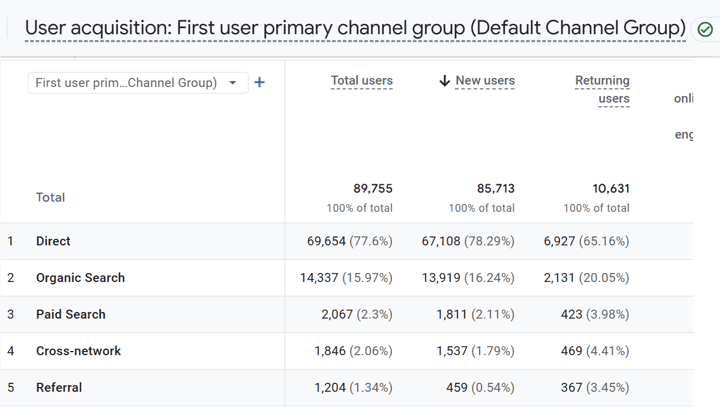
Critical Data: Earlier this year, I asked, Where are the missing data holes? Back then, 67.9% of users of the Google Merchandise Store over the previous 28 days had arrived from the direct channel, according to the GA4 demo account.

Today, 77.6% of users are arriving “direct,” which means GA4 cannot determine the specific referral source of more than three out of four visitors.

Screenshot by author from GA4, July 2025

Market Trends: This month, I asked, why CMOs need to rethink attribution. I also said they should conduct brand lift studies and audience research to successfully navigate the reduced visibility that is a significant consequence of a perfect storm.

Strategic Insight: CMOs should read Avinash Kaushik’s article in The Marketing < > Analytics Intersect Newsletter. He advises shifting from activity-based marketing metrics to profit-driven outcomes like “Profit On Investment” (POI).

This innovative approach protects CMOs and secures budgets by demonstrating true business value. Kaushik also recommends cutting underperforming campaigns and retraining teams to achieve positive POI, stressing the importance of profitability even with AI Search.

Fresh Example: Lululemon used an AI-powered playbook to boost its performance marketing. This involved restructuring shopping campaigns, building a new customer acquisition engine, and strengthening measurement foundations.

The strategy led to reduced customer acquisition costs, increased new customer revenue, and an 8% boost in return on ad spend (ROAS).

Tactical Advice:

  • Implement Robust Attribution Models: Move beyond last-click attribution to multi-touch attribution models that give credit to all touchpoints in the customer journey, providing a more accurate picture of ROI.
  • Data Governance and Quality: Establish clear processes for data collection, cleaning, and storage to ensure accuracy and compliance with privacy regulations.
  • Integrate Data Silos: Break down departmental silos to create a unified view of customer interactions across marketing, sales, and service. This often involves Customer Data Platforms (CDPs) or robust data warehousing solutions.
  • Focus on Business Outcomes, Not Just Marketing Metrics: Connect marketing efforts directly to revenue, customer lifetime value, and market share, demonstrating clear business impact to the C-suite.

Conclusion: Thriving In The New Marketing Era

The digital marketing environment is indeed a perfect storm, but it is also brimming with unprecedented opportunities for those CMOs willing to adapt, innovate, and lead.

The redesigned Think with Google offers a framework to circumnavigate these challenges, even if the “Future of Marketing” team needs to recalibrate their time horizon, revise their editorial calendar, and refresh their helpful content on the topic of economic uncertainty.

By deeply understanding the predictably unpredictable customer, mastering the dynamic search and video ecosystem, embracing AI as a strategic partner, proactively exploring the future of marketing, and building a robust, data-driven measurement infrastructure, CMOs can transform their marketing organizations.

The future belongs to the agile, the data-informed, and the customer-obsessed.

By focusing on these strategic categories, CMOs can not only weather the storm but steer their brands towards unprecedented growth and sustained competitive advantage.

More Resources:


Featured Image: Roman Samborskyi/Shutterstock

OpenAI Updates GPT-5 To Make It Warmer And Friendlier via @sejournal, @martinibuster

OpenAI updated GPT-5 to make it warmer and more familiar (in the sense of being friendlier) while taking care that the model didn’t become sycophantic, a problem discovered with GPT-4o.

A Warm and Friendly Update to GPT-5

GPT-5 was apparently perceived as too formal, distant, and detached. This update addresses that issue so that interactions are more pleasant and so that ChatGPT is perceived as more likable, as opposed to formal and distant.

Something that OpenAI is working toward is making ChatGPT’s personality user-configurable so that it’s style can be a closer match to user’s preferences.

OpenAI’s CEO Sam Altman tweeted:

“Most users should like GPT-5 better soon; the change is rolling out over the next day.

The real solution here remains letting users customize ChatGPT’s style much more. We are working that!”

One of the responses to Altman’s post was a criticism of GPT-5, asserting that 4o was more sensitive.

They tweeted:

“What GPT-4o had — its depth, emotional resonance, and ability to read the room — is fundamentally different from the surface-level “kindness” GPT-5 is now aiming for.

GPT-4o:
•The feeling of someone silently staying beside you
•Space to hold emotions that can’t be fully expressed
•Sensitivity that lets kindness come through the air, not just words.”

The Line Between Warmth And Sycophancy

The previous version of ChatGPT was widely understood as being overly flattering to the point of validating and encouraging virtually every idea. There was a discussion on Hacker News a few weeks ago about this topic of sycophantic AI and how ChatGPT could lead users into thinking every idea was a breakthrough.

One commenter wrote:

“…About 5/6 months ago, right when ChatGPT was in it’s insane sycophancy mode I guess, I ended up locked in for a weekend with it…in…what was in retrospect, a kinda crazy place.

I went into physics and the universe with it and got to the end thinking…”damn, did I invent some physics???” Every instinct as a person who understands how LLMs work was telling me this is crazy LLMbabble, but another part of me, sometimes even louder, was like “this is genuinely interesting stuff!” – and the LLM kept telling me it was genuinely interesting stuff and I should continue – I even emailed a friend a “wow look at this” email (he was like, dude, no…) I talked to my wife about it right after and she basically had me log off and go for a walk.”

Should ChatGPT feel like a sensitive friend, or should it be a tool that is friendly or pleasant to use?

Read ChatGPT release notes here:

GPT-5 Updates

Featured Image by Shutterstock/cosmoman

Ad Attribution Gets a Crystal Ball

Advertising attribution is supposed to identify and assign credit to the actions and campaigns that lead to conversions. One might surmise that the process is simple with digital ads and large language models.

It is not.

Even the best forms of multi-touch attribution (MTA) are inexact owing to privacy regulations, platform changes, and the messy way shoppers move between websites and even physical stores.

Predictive Advantage

Imagine a retailer running Meta ads to drive traffic to its site. Those ads might inspire shoppers to buy later at Amazon. Contemporary attribution never sees those sales, so the ads look unprofitable. The marketing team might cut the campaign, not realizing it boosted revenue elsewhere.

The result is a blind spot. Marketers often undercount investments that create awareness, while lower-funnel ads look like heroes.

Yet MTA is better than last-touch attribution, and last-touch is better than guessing. But the next step toward understanding the impact of ads and marketing may be a form of predictive modeling similar to media mix modeling (MMM), but with channel-level accuracy.

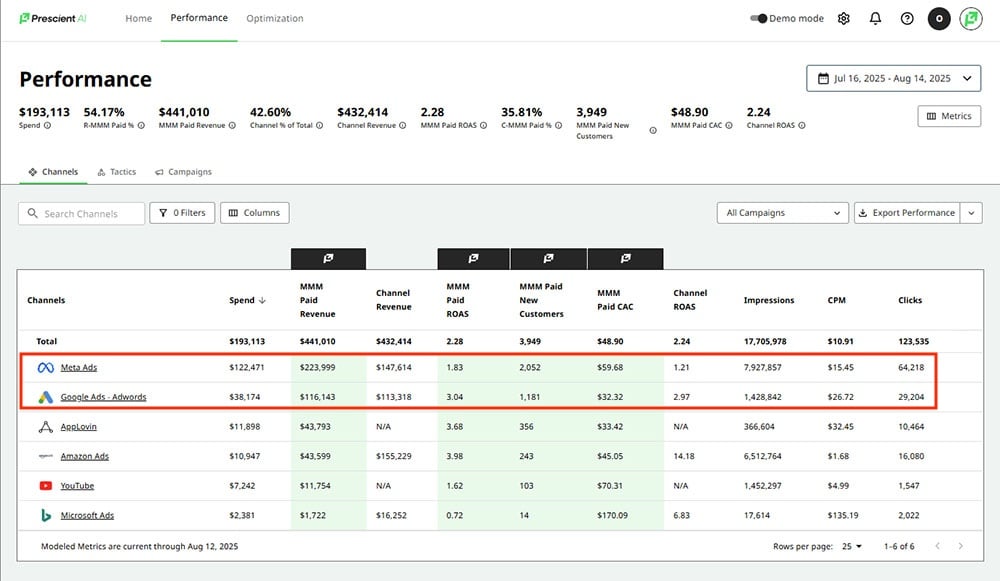
Predictive attribution modeling “will take you at least to the campaign level,” said Cameron Bush, vice president of digital transformation at Meyer, a cookware manufacturer, as he described his experience.

“I have one campaign in Meta right now that I’m looking at in [Prescient AI, an attribution platform], where 100% of its revenue and MMM ROAS is being driven by Shopify,” Bush continued.

“The [campaign] right below it is 50/50 between Shopify and Amazon and has slightly higher ROAS. That’s a level of sophistication that I wouldn’t have had,” said Bush, comparing predictive models to MMM and MTA.

Screenshot of the Predictive AI dashboard for Meyer

Predictive AI forecasts each campaign’s impact on overall revenue, as illustrated by this example from Meyer. Click image to enlarge.

Decision-Making

Predictive modeling approaches the same goal as marketing mix modeling and multitouch attribution.

Instead of piecing together every customer touchpoint, it models the relationships between spend and revenue across channels. Then it simulates outcomes, combining MMM-style aggregate measurement with campaign-level outputs, informing marketers:

  • Influence of channels and campaigns on each other and overall revenue.
  • Impact of top-of-funnel campaigns on downstream revenue.
  • Effect of changes to promotional and marketing spend on profit.

The challenge is what to do with that info.

“We look at Excel spreadsheets. We look at dashboards. We look at all this kind of stuff, and it gives us a really good picture of what is going on today. But it doesn’t tell me what to do,” said Cody Greco, co-founder and chief technology officer at Prescient AI.

The work of answering “what should I do now?” is passed to the marketer to forecast.

“The cool thing about predictive modeling is it actually helps answer the next rational question,” Greco said.

A marketer can ask, say, what happens if she doubles her spend on Instagram, and receive an answer with a high degree of confidence.

Media Buying

Predictive modeling could affect retail media buying in a few ways.

  • Branding and content. Understanding how top-of-funnel promotions and content marketing aid advertising conversions may reinvigorate branding.
  • Budget clarity. Reallocate investments for the best returns.
  • Automation. Placing bids and adjusting spend could, eventually, become automatic.

Contemporary attribution often drags marketing teams into debates over detailed metrics. Predictive modeling reduces those arguments, freeing teams to focus on creative and campaign planning.

Shift in Focus

Hence marketers who delegate the tasks of identifying channels could achieve a renaissance in creativity and content, according to Meyer’s Bush.

To be sure, predictive modeling doesn’t erase uncertainty or replace marketers. Yet if successful, it will change promotions for ecommerce and omnichannel businesses.

Think of it like weather forecasting. Marketers will not explain every raindrop; they will focus on whether you’ll need an umbrella tomorrow.

Google Expands iOS App Marketing Capabilities via @sejournal, @brookeosmundson

Running iOS app campaigns in Google has never been straightforward. Between Apple’s privacy changes and evolving user behavior, marketers have often felt like they were working with one hand tied behind their backs.

Measurement was limited, signals were weaker, and getting campaigns to scale often required more guesswork than strategy.

Google Ads Liaison, Ginny Marvin, took to LinkedIn to announce the numerous updates to iOS App Install campaigns/

Google is now making changes to help advertisers navigate this space more confidently. Their latest updates to iOS App Install campaigns are designed to give marketers a stronger mix of creative options, smarter bidding tools, and privacy-respecting measurement features.

While these changes won’t solve every iOS challenge overnight, they do mark a meaningful shift in how advertisers can approach growth on one of the world’s largest mobile ecosystems.

New Ad Formats Bring More Creative Opportunities

One of the biggest updates is the addition of new creative formats designed to improve engagement and give users a clearer picture of an app before they download.

Google is expanding support for co-branded YouTube ads, which integrate creator-driven content directly into placements like YouTube Shorts and in-feed ads.

For advertisers, it’s an opportunity to lean into the authenticity of creator-style ads, which often resonate more strongly than traditional branded spots.

Playable end cards are also being introduced across select AdMob inventory. After watching an ad, users can now interact with a lightweight, playable demo of the app.

Think of it as a “try before you buy” moment: users get a quick preview of the experience, which can lead to higher-quality installs.

For app marketers, this shift matters because it aligns user expectations with actual in-app experiences. The closer someone feels to your product before downloading, the less risk you face with churn or low-value installs.

Both of these creative updates point to a broader trend: ads are becoming less static and more interactive. That’s particularly important on iOS, where advertisers need every edge they can get to capture attention in environments where tracking is constrained.

Target ROAS Bidding Now Available for iOS

Another cornerstone of this announcement is Google’s expansion of value-based bidding on iOS.

Target ROAS (tROAS), a bidding strategy that optimizes for return on ad spend rather than raw install volume, is now fully supported.

This is especially valuable for apps with monetization models that vary widely across users, such as subscription services or in-app purchase businesses. Instead of paying equally for every install, advertisers can now direct spend toward users more likely to generate meaningful revenue.

Beyond tROAS, Google is also expanding the “Maximize Conversions” strategy for iOS. This allows campaigns to optimize not just for installs, but for deeper in-app actions.

By leaning into Google’s AI-driven modeling, advertisers can let the system identify where budget should be allocated to maximize results within daily spend limits.

The takeaway here is simple: volume still matters, but value matters more. With these updates, Google is nudging app marketers away from chasing installs at any cost and toward optimizing for users who truly drive long-term impact.

Measurement That Balances Privacy and Clarity

Perhaps the most challenging part of iOS advertising has been measurement.

Apple’s App Tracking Transparency framework made it harder to follow users across devices, limiting the signals available for campaign optimization. Google’s new measurement updates are designed to give advertisers more clarity without crossing privacy lines.

On-device conversion measurement is one of the most notable additions. Rather than sending user-level data back to servers, performance signals are processed directly on the device.

This means advertisers can still see which campaigns are working, but without compromising privacy. Importantly, it also reduces latency in reporting, helping marketers make faster decisions.

Integrated conversion measurement (ICM) is another feature being pushed forward. This approach works through app attribution partners (AAPs), giving advertisers cleaner, more near real-time data about installs and post-install actions.

Taken together, these tools signal a future where privacy and measurement don’t have to be opposing forces. Instead, advertisers can get the insights they need while users retain more control over their data.

How App Marketers Can Take Advantage

These updates aren’t the kind that require testing and adaptation.

For most advertisers, the best starting point is experimenting with the new ad formats. Running a co-branded YouTube ad or a playable end card alongside your existing creative can help you see whether engagement and conversion quality improve.

These tests don’t need to be massive, but they should be deliberate enough to give you actionable learnings.

For bidding, marketers should look closely at whether tROAS makes sense for their business model.

If your app has a clear monetization strategy and meaningful differences in user value, tROAS could be a game-changer. Start conservatively with your targets, give the algorithm time to learn, and refine based on observed performance.

On the measurement side, now is the time to talk to your developers and attribution partners about what it would take to implement on-device conversion tracking or ICM. These solutions may involve technical lift, but the payoff is improved data quality in an environment where every signal counts.

It’s also worth noting that these changes won’t transform campaigns overnight. Smart bidding models and new measurement frameworks take time to stabilize, and the impact of new formats might not show up in the first week of a test.

Patience, consistency, and a focus on week-over-week trends are key.

Looking Ahead

Google’s latest iOS updates don’t eliminate the complexities of app marketing, but they do give advertisers sharper tools to work with. From more engaging ad formats to value-based bidding and privacy-first measurement, the changes represent progress in a space that’s been difficult to navigate.

The message for marketers is clear: start testing, invest in measurement infrastructure, and don’t let short-term results cloud the bigger picture.

With the right approach, these updates can help shift iOS campaigns from a defensive play into an opportunity for real growth.

Google Answers Question About Core Web Vitals “Poisoning” via @sejournal, @martinibuster

Someone posted details of a novel negative SEO attack that they said appeared to be a Core Web Vitals performance poisoning attack. Google’s John Mueller and Chrome’s Barry Pollard assisted in figuring out what was going on.

The person posted on Bluesky, tagging Google’s John Mueller and Rick Viscomi, the latter a DevRel Engineer at Google.

They posted:

“Hey we’re seeing a weird type of negative SEO attack that looks like core web vitals performance poisoning, seeing it on multiple sites where it seems like an intentional render delay is being injected, see attached screenshot.Seeing across multiple sites & source countries

..this data is pulled by webvitals-js. At first I thought dodgy AI crawler but the traffic pattern is from multiple countries hitting the same set of pages and forging the referrer in many cases”

The significance of the reference to “webvitals-js” is that the degraded Core Web Vitals data is from what’s hitting the server, actual performances scores recorded on the website itself, not the CrUX data, which we’ll discuss next.

Could This Affect Rankings?

The person making the post did not say if the “attack” had impacted search rankings, although that is unlikely, given that website performance is a weak ranking factor and less important than things like content relevance to user queries.

Google’s John Mueller responded, sharing his opinion that it’s unlikely to cause an issue, and tagging Chrome Web Performance Developer Advocate Barry Pollard (@tunetheweb) in his response.

Mueller said:

“I can’t imagine that this would cause issues, but maybe @tunetheweb.com has seen things like this or would be keen on taking a look.”

Barry Pollard wondered if it’s a bug in the web-vitals library and asked the original poster if it’s reflected in the CrUX data (Chrome User Experience Report), which is a record of actual user visits to websites.

The person who posted about the issue responded to Pollard’s question by answering that the CrUX report does not reflect the page speed issues.

They also stated that the website in question is experiencing a cache-bypass DoS (denial-of-service) attack, which is when an attacker sends a massive number of web page requests that bypass a CDN or a local cache, causing stress to server resources.

The method employed by a cache-bypass DoS attack is to bypass the cache (whether that’s a CDN or a local cache) in order to get the server to serve a web page (instead of a copy of it from the cache or CDN), thus slowing down the server.

The local web-vitals script is recording the performance degradation of those visits, but it is likely not registering with the CrUX data because that comes from actual Chrome browser users who have opted in to sharing their web performance data.

So What’s Going On?

Judging by the limited information in the discussion, it appears that a DoS attack is slowing down server response times, which in turn is affecting page speed metrics on the server. The Chrome User Experience Report (CrUX) data is not reflecting the degraded response times, which could be because the CDN is handling the page requests for the users recorded in CrUX. There’s a remote chance that the CrUX data isn’t fresh enough to reflect recent events but it seems logical that users are getting cached versions of the web page and thus not experiencing degraded performance.

I think the bottom line is that CWV scores themselves will not have an effect on rankings. Given that actual users themselves will hit the cache layer if there’s a CDN, the DoS attack probably won’t have an effect on rankings in an indirect way either.

The US could really use an affordable electric truck

On Monday, Ford announced plans for an affordable electric truck with a 2027 delivery date and an expected price tag of about $30,000, thanks in part to a new manufacturing process that it says will help cut costs.

This could be the shot in the arm that the slowing US EV market needs. Sales are slowing, and Ford in particular has struggled recently—the automaker has lost $12 billion over the last two and a half years on its EV division. And the adoption barriers continue to mount, with the Trump administration cutting tax credits as well as rules designed to push automakers toward zero-emissions vehicles. And that’s not to mention tariffs.

But if anything can get Americans excited, it’s a truck, especially an affordable one. (There was a ton of buzz over the announcement of a bare-bones truck from Bezos-backed Slate Auto earlier this year, for example.) The big question is whether the company can deliver in this environment.

One key thing to note here: This is not the first time that there’s been a big splashy truck announcement from Ford that was supposed to change everything. The F-150 Lightning was hailed as a turning point for vehicle electrification, a signal that decarbonization had entered a new era. We cited the truck when we put “The Inevitable EV” on our 10 Breakthrough Technologies list in 2023. 

Things haven’t quite turned out that way. One problem is that the Lightning was supposed to be relatively affordable, with a price tag of about $40,000 when it was first announced in 2021. The starting price inflated to $52,000 when it actually went on sale in 2022.

The truck was initially popular and became quite hard to find at dealerships. But prices climbed and interest leveled off. The base model hit nearly $60,000 by 2023. For the past few years, Ford has cut Lightning production several times and laid off employees who assembled the trucks.

Now, though, Ford is once again promising an affordable truck, and it’s supposed to be even cheaper this time. To help cut costs, the company says it’s simplifying, creating one universal platform for a new set of EVs. Using a common structure and set of components will help produce not only a midsize truck but also other trucks, vans, and SUVs. There are also planned changes to the manufacturing process (rather than one assembly line, multiple lines will join together to form what they’re calling an assembly tree). 

Another supporting factor for cost savings is the battery. The company plans to use lithium-iron phosphate (or LFP) cells—a type of lithium-ion battery that doesn’t contain nickel or cobalt. Leaving out those relatively pricey metals means lower costs.

Side note here: That battery could be surprisingly small. In a media briefing, a Ford official reportedly said that the truck’s battery would be 15% smaller than the one in the Atto crossover from the Chinese automaker BYD. Since that model has a roughly 60-kilowatt-hour pack, that could put this new battery at 51 kilowatt-hours. That’s only half the capacity of the Ford Lightning’s battery and similar to the smallest pack offered in a Tesla Model 3 today. (This could mean the truck has a relatively limited range, though the company hasn’t shared any details on that front yet.) 

A string of big promises isn’t too unusual for a big company announcement. What was unusual was the tone from officials during the event on Monday.

As Andrew Hawkins pointed out in The Verge this week, “Ford seems to realize its timing is unfortunate.” During the announcement, executives emphasized that this was a bet, one that might not work out.

CEO Jim Farley put it bluntly: “The automotive industry has a graveyard littered with affordable vehicles that were launched in our country with all good intentions, and they fizzled out with idle plants, laid-off workers, and red ink.” Woof.

From where I’m standing, it’s hard to be optimistic that this announcement will turn out differently from all those failed ones, given where the US EV market is right now.   

In a new report published in June, the energy consultancy BNEF slashed its predictions for future EV uptake. Last year, the organization predicted that 48% of new vehicles sold in the US in 2030 would be electric. In this year’s edition, that number got bumped down to just 27%.

To be clear: BNEF and other organizations are still expecting more EVs on the roads in the future than today, since the vehicles make up less than 10% of new sales in the US. But expectations are way down, in part because of a broad cut in public support for EVs. 

The tax credits that gave drivers up to $7,500 off the purchase of a new EV end in just over a month. Tariffs are going to push costs up even for domestic automakers like Ford, which still rely on imported steel and aluminum.

A revamped manufacturing process and a cheaper, desirable vehicle could be exactly the sort of move that automakers need to make for the US EV market. But I’m skeptical that this truck will be able to turn it all around. 

This article is from The Spark, MIT Technology Review’s weekly climate newsletter. To receive it in your inbox every Wednesday, sign up here.

Taiwan’s “silicon shield” could be weakening

One winter afternoon in a conference room in Taipei, a pair of twentysomething women dragged their friend across the floor. Lying on the ground in checkered pants and a brown sweatshirt, she was pretending to be either injured or dead. One friend picked her up by her arms, the other grabbed hold of her legs, and they managed to move her, despite momentarily breaking character to laugh at the awkwardness of the exercise. The three women had paid approximately $40 to spend their Sunday here, undergoing basic training to prepare for a possibility every Taiwanese citizen has an opinion about: Will China invade? 

Taiwanese politics increasingly revolves around that question. China’s ruling party has wanted to seize Taiwan for more than half a century. But in recent years, China’s leader, Xi Jinping, has placed greater emphasis on the idea of “taking back” the island (which the Chinese Communist Party, or CCP, has never controlled). As China’s economic and military might has grown, some analysts believe the country now has the capacity to quarantine Taiwan whenever it wants, making the decision a calculation of costs and benefits.

Many in Taiwan and elsewhere think one major deterrent has to do with the island’s critical role in semiconductor manufacturing. Taiwan produces the majority of the world’s semiconductors and more than 90% of the most advanced chips needed for AI applications. Bloomberg Economics estimates that a blockade would cost the global economy, including China, $5 trillion in the first year alone.

“The international community must certainly do everything in its power to avoid a conflict in the Taiwan Strait; there is too great a cost.”

Lai Ching-te, Taiwanese president

The island, which is approximately the size of Maryland, owes its remarkably disproportionate chip dominance to the inventiveness and prowess of one company: Taiwan Semiconductor Manufacturing Company, or TSMC. The chipmaker, which reached a market capitalization of $1 trillion in July, has contributed more than any other to Taiwan’s irreplaceable role in the global semiconductor supply chain. Its clients include Apple and the leading chip designer Nvidia. Its chips are in your iPhone, your laptop, and the data centers that run ChatGPT. 

For a company that makes what amounts to an invisible product, TSMC holds a remarkably prominent role in Taiwanese society. I’ve heard people talk about it over background noise in loud bars in the southern city of Tainan and listened to Taipei cab drivers connect Taiwan’s security situation to the company, unprompted. “Taiwan will be okay,” one driver told me as we sped by the national legislature, “because TSMC.” 

The idea is that world leaders (particularly the United States)—aware of the island’s critical role in the semiconductor supply chain—would retaliate economically, and perhaps militarily, if China were to attack Taiwan. That, in turn, deters Beijing. “Because TSMC is now the most recognizable company of Taiwan, it has embedded itself in a notion of Taiwan’s sovereignty,” says Rupert Hammond-Chambers, president of the US-Taiwan Business Council. 

Now some Taiwan specialists and some of the island’s citi­zens are worried that this “silicon shield,” if it ever existed, is cracking. Facing pressure from Washington, TSMC is investing heavily in building out manufacturing capacity at its US hub in Arizona. It is also building facilities in Japan and Germany in addition to maintaining a factory in mainland China, where it has been producing less advanced legacy chips since 2016. 

In Taiwan, there is a worry that expansion abroad will dilute the company’s power at home, making the US and other countries less inclined to feel Taiwan is worthy of defense. TSMC’s investments in the US have come with no guarantees for Taiwan in return, and high-ranking members of Taiwan’s opposition party have accused the ruling Democratic Progressive Party (DPP) of gambling with the future of the island. It doesn’t help that TSMC’s expansion abroad coincides with what many see as a worrying attitude in the White House. On top of his overarching “America First” philosophy, Donald Trump has declined to comment on the specific question of whether the US would intervene if China attempted to take Taiwan by force. “I don’t want to ever put myself in that position,” he said in February. 

At the same time, Beijing’s interest in Taiwan has continued unabated. While China is making progress toward semiconductor self-­sufficiency, it’s currently in a transition period, with companies relying on foreign-made chips manufactured in Taiwan—some in compliance with export controls and some smuggled in. Meanwhile, the CCP persistently suggests that seizing the island would bring about a kind of family reunion. “It is the common aspiration and sacred responsibility of all Chinese sons and daughters to realize the complete reunification of the motherland,” reads a statement released by the foreign ministry after Nancy Pelosi’s controversial 2022 visit to Taiwan. Though it’s impossible to know the full scope of Beijing’s motivations, there is also obvious strategic appeal: Controlling the island would give China deep-water access, which is critical for naval routes and submarines. Plus, it could significantly disrupt American AI firms’ access to advanced chips.  

While China ramps up militarily, Taiwan is trying to make itself hard to ignore. The government is increasingly portraying the island as strategically essential to the global community, with semiconductors as its primary offering. “The international community must certainly do everything in its power to avoid a conflict in the Taiwan Strait; there is too great a cost,” Taiwanese president Lai Ching-te said in an interview earlier this year with Japan’s Nippon Television. Parts of the international community are hearing that message—and seizing the opportunity it presents: earlier this month, defense tech company Anduril Industries announced it is opening a new office in Taiwan, where it will be expanding partnerships and selling autonomous munitions. 

For its part, the chip industry is actively showing its commitment to Taiwan. While other tech CEOs attended Trump’s second inauguration, for instance, Nvidia chief executive Jensen Huang met instead with TSMC’s chairman, and the company announced in May that its overseas headquarters would be in Taipei. In recent years, US government officials have also started paying more attention to Taiwan’s security situation and its interconnectedness with the chip industry. “There was a moment when everybody started waking up to the dependence on TSMC,” says Bonnie Glaser, managing director of the German Marshall Fund’s Indo-Pacific Program. The realization emerged, she says, over the last decade but was underscored in March of 2021, when Phil Davidson, then leader of the United States Indo-Pacific Command, testified to the Senate Armed Services Committee that there could be an invasion by 2027. Parallel to the security threat is the potential issue of overdependence, since so much chipmaking capability is concentrated in Taiwan.

For now, Taiwan is facing a tangle of interests and time frames. China presents its claim to Taiwan as a historical inevitability, albeit one with an uncertain timeline, while the United States’ relationship with the island is focused on an AI-driven future. But from Taiwan’s perspective, the fight for its fate is playing out right now, amid unprecedented geopolitical instability. The next few years will likely determine whether TSMC’s chipmaking dominance is enough to convince the world Taiwan is worth protecting.

Innovation built on interconnectivity 

TSMC is an uncontested success story. Its founder, Morris Chang, studied and worked in the United States before he was lured to Taiwan to start a new business on the promise of state support and inexpensive yet qualified labor. Chang founded TSMC in 1987 on the basis of his innovative business model. Rather than design and produce chips in-house, as was the norm, TSMC would act as a foundry: Clients would design the chips, and TSMC would make them. 

This focus on manufacturing allowed TSMC to optimize its operations, building up process knowledge and, eventually, outperforming competitors like Intel. It also freed up other businesses to go “fabless,” meaning they could stop maintaining their own semiconductor factories, or fabs, and throw their resources behind other parts of the chipmaking enterprise. Tapping into Taiwan’s domestic electronics supply chain proved effective and efficient for TSMC. Throughout the 1990s and early 2000s, global demand for semiconductors powering personal computers and other devices continued to grow. TSMC thrived.

Then, in 2022, the US imposed export controls on China that restricted its access to advanced chips. Taiwan was forced to either comply, by cutting off Chinese clients, or risk losing the support of the country that was home to 70% of its client base—and, possibly, 100% of its hopes for external military support in the event of an attack. 

Soon after, Chang announced that he believed globalization and free markets were “almost dead.” The nearly three years since have shown he was onto something. For one thing, in contrast to President Biden’s pursuit of supply chain integration with democratic allies, President Trump’s foreign policy is characterized by respect for big, undemocratic powers and punitive tariffs against both America’s rivals and its friends. Trump has largely abandoned Biden’s economic diplomacy with European and Asian allies but kept his China-targeted protectionism—and added his trademark transactionalism. In an unprecedented move earlier this month, the administration allowed Nvidia and AMD to sell previously banned chips to China on the condition that the companies pay the government 15% of revenues made from China sales. 

Protectionism, it turns out, spurs self-reliance. China’s government has been making a massive effort to build up its domestic chip production capabilities—a goal that was identified at the beginning of Xi’s rise but has been turbocharged in the wake of Washington’s export controls. 

Any hope the US has for significantly expanding domestic chip production comes from its friends—TSMC first among them. The semiconductor industry developed as a global endeavor out of practicality, playing to the strengths of each region: design in the US and manufacturing in Asia, with key inputs from Europe central to the process. Yet the US government, entrenched in its “tech war” with China, is now dead set on deglobalizing the chip supply chain, or at least onshoring as much of it as possible. There’s just one hiccup: The best chip manufacturer isn’t American. It’s TSMC. Even if some manufacturing happens in Arizona, the US still relies on Taiwan’s chipmaking ecosystem. And copying that supply chain outside Taiwan could be harder than the current administration imagines.

Squarely in the middle

Taiwan’s modern security uncertainties stem from the long-­contested issue of the island’s sovereignty. After losing the first Sino-Japanese War in the late 1800s, the Qing dynasty forfeited Taiwan to Japanese imperial control. It was Japan’s “model colony” until 1945, when postwar negotiations resulted in its transfer to the Republic of China under Chiang Kai-shek of the Nationalist Party, known as the KMT. The insurgent CCP under Mao Zedong ultimately defeated the Nationalists in a civil war fought on the mainland until 1949. Chiang and many of his party’s defeated generals decamped to Taiwan, controlling it under martial law for nearly 40 years. 

Taiwan held its first free democratic elections in 1996, kicking off a two-party rivalry between the KMT, which favors closer relations with Beijing, and the DPP, which opposes integration with China. Kitchen-table issues like economic growth are central to Taiwanese elections, but so is the overarching question of how best to handle the threat of invasion, which has persisted for nearly 80 years. The DPP is increasingly calling for raising defense spending and civilian preparedness to make sure Taiwan is ready for the worst, while the KMT supports direct talks with Beijing.  

cactus and the sign in front of the TSMC plant in Arizona
In March 2025, President Trump and TSMC CEO C.C. Wei jointly announced that the firm will make an additional $100 billion investment (on top of a previously announced $65 billion) in TSMC’s US hub in Arizona.
REBECCA NOBLE/BLOOMBERG VIA GETTY IMAGES

Meanwhile, Chinese military incursions around Taiwan—known as “gray zone” tactics because they fall short of acts of war—are increasingly frequent. In May, Taiwan’s defense ministry reportedly estimated that Chinese warplanes were entering Taiwan’s air defense zone more than 200 times a month, up from fewer than 10 times per month five years ago. China has conducted drills mirroring the actions needed for a full-scale invasion or a blockade, which would cut Taiwan off from the outside world. Chinese military officials are now publicly talking about achieving a blockade, says Lyle Morris, an expert on foreign policy and national security at the Asia Society Policy Institute. “They’re punishing Lai and the DPP,” Morris says. Meanwhile, the CCP has its own people to answer to: When it comes to the Taiwan issue, Morris says, “Beijing is probably quite worried about the people of China being upset if they aren’t hawkish enough or if they come out looking weak.” Indeed, in response to Lai’s recent policy statements, including one declaring that China is a “hostile foreign force,” Gao Zhikai, a prominent scholar in China who opposes Taiwanese independence, recently wrote, “The reunification with the motherland cannot be endlessly delayed. Decisive action must be taken.” 

Intimidation from China has made some ordinary Taiwanese citizens more concerned; according to a recent poll conducted by a defense-focused think tank, 51% think defense spending should be increased (although 65% of respondents said they thought an attack within five years was “unlikely”). No matter how much money Taipei spends, the sheer military imbalance between China and Taiwan means Taiwan would need help. But especially in the wake of Ukraine’s experience, many believe US aid would be contingent on whether Taiwan demonstrates the will to defend itself. “Based on war games, Taiwan would have to hold out for a month before the US could potentially intervene,” says Iris Shaw, director of the DPP mission in the US. And support from Taiwan’s neighbors like Japan might be contingent on US involvement.

But how likely is the US to intervene in such a scenario? The author Craig Addison popularized the argument that Taiwan’s fate is tied to its chip production prowess in his 2001 book Silicon Shield: Taiwan’s Protection Against Chinese Attack. Back then, Addison wrote that although the US had been intentionally vague about whether it would go to war to protect the island, America’s technological reliance on “a safe and productive Taiwan” made it highly probable that Washington would intervene. President Joe Biden deviated from those decades of calculated ambiguity by asserting multiple times that America would defend the island in the event of an attack. Yet now, Trump seems to have taken the opposite position, possibly presenting an opportunity for Beijing. 

TSMC in the Trump era 

In many ways, Taiwan finds itself in a catch-22. It feels the need to cozy up to the US for protection, yet that defensive maneuver is arguably risky in itself. It’s a common belief in Taiwan that forging stronger ties to the US could be dangerous. According to a public opinion poll released in January, 34.7% of Taiwanese believe that a “pro-US” policy provokes China and will cause a war. 

But the Lai administration’s foreign policy is “inexorably intertwined with the notion that a strong relationship with the US is essential,” says Hammond-Chambers.

Bolstering US support may not be the only reason TSMC is building fabs outside Taiwan. As the company readily points out, the majority of its customers are American. TSMC is also responding to its home base’s increasingly apparent land and energy limitations: finding land to build new fabs sometimes causes rifts with Taiwanese people who, for example, don’t want their temples and ancestral burial sites repurposed as science parks. Taiwan also relies on imports to meet more than 95% of its energy needs, and the dominant DPP has pledged to phase out nuclear, Taiwan’s most viable yet most hotly contested renewable energy source. Geopolitical tensions compound these physical restraints: Even if TSMC would never say as much, it’s fairly likely that if China did attack Taiwan, the firm would rather remain operational in other countries than be wiped out completely. 

However, building out TSMC’s manufacturing capabilities outside Taiwan will not be easy. “The ecosystem they created is truly unique. It’s a function of the talent pipeline, the culture, and laws in Taiwan; you can’t easily replicate it anywhere,” says Glaser. TSMC has 2,500 Taiwan-based suppliers. Plenty are within a couple of hours’ drive or an even shorter trip on high-speed rail. Taiwan has built a fully operational chip cluster, the product of four decades of innovation, industrial policy, and labor.

In many ways, Taiwan finds itself in a catch-22. It feels the need to cozy up to the US for protection, yet that defensive maneuver is arguably risky in itself.

As a result, it’s unclear whether TSMC will be able to copy its model and paste it into the suburbs of Phoenix, where it has 3,000 employees working on chip manufacturing. “Putting aside the geopolitical factor, they wouldn’t have expanded abroad,” says Feifei Hung, a researcher at the Asia Society. Rather than standalone facilities, the Arizona fabs are “appendages of TSMC that happen to be in Arizona,” says Paul Triolo, partner and tech policy lead at the international consulting firm DGA-Albright Stonebridge Group. When the full complex is operational, it will represent only a small percentage of TSMC’s overall capacity, most of which will remain in Taiwan. Triolo doubts the US buildout will yield results similar to what TSMC has built there: “Arizona ain’t that yet, and never will be.” 

Still, the second Trump administration has placed even more pressure on the company to “friendshore”—without providing any discernible signs of friendship. During this spring’s tariff frenzy, the administration threatened to hit Taiwan with a 32% “reciprocal” tariff, a move that was then paused and revived at 20% in late July (and was still being negotiated as of press time). The administration has also announced a 100% tariff on semiconductor imports, with the caveat that companies with US-based production, like TSMC, are exempt—though it’s unclear whether imports from critical suppliers in Taiwan will be tariffed. And the threat of a chip-specific tariff remains. “This is in line with [Trump’s] rhetoric of restoring manufacturing in the US and using tariffs as a one size fits all tool to force it,” says Nancy Wei, a trade and supply chain analyst at the Eurasia Group. The US is also apparently considering levying a $1 billion fine against TSMC after TSMC-made chips were reportedly found in some Huawei devices.

Despite these kinds of maneuvers, TSMC has been steadfast in its attempts to get on Washington’s good side. In March, Trump and TSMC’s CEO, C.C. Wei, jointly announced that the firm will make an additional $100 billion investment (on top of a previously announced $65 billion) in TSMC’s US hub in Arizona. The pledge represents the largest single source of foreign direct investment into the US, ever. While the deal was negotiated during Biden’s term, Trump was happy to take credit for ensuring that “the most powerful AI chips will be made right here in America.” 

The Arizona buildout will also include an R&D facility—a critical element for tech transfer and intellectual-property development. Then there’s the very juicy cherry on top: TSMC announced in April that once all six new fabs are operational, 30% of its most advanced chips will be produced in Arizona. Up until then, the thinking was that US-based production would remain a generation or two behind. It looks as if the administration’s public and, presumably, private arm-twisting has paid off. 

Meanwhile, as Trump cuts government programs and subsidies while demanding the “return” of manufacturing to the US, it’s TSMC that is running a technician apprenticeship program in Arizona to create good American jobs. TSMC’s leaders, Triolo says, must question how serious the Trump administration is about long-term industrial policy. They’re probably asking themselves, he says, “Do they understand what it takes to support the semiconductor industry, like our government does?” 

Dealing with an administration that is so explicitly “America first” represents “one of the biggest challenges in history for Taiwanese companies,” says Thung-Hong Lin, a sociology researcher at the Taipei-based Academia Sinica. Semiconductor manufacturing relies on reliability. Trump has so far offered TSMC no additional incentives supporting its US expansion—and started a trade war that has directly affected the semiconductor industry, partly by introducing irrevocable uncertainty. “Trump’s tariffs have set off a new, more intensified bifurcation of semiconductor supply chains,” says Chris Miller, author of Chip War. For now, Miller says, TSMC must navigate a world in which the US and China are both intense competitors and, despite trade restrictions, important clients. 

Warring narratives

China has been taking advantage of these changes to wage a war of disinformation. In response to Nancy Pelosi’s visit to Taiwan in 2022, when she was US Speaker of the House, Beijing sent warships, aircraft, and propaganda across the Taiwan Strait. Hackers using Chinese software infiltrated the display screens in Taiwan’s 7-Eleven stores to display messages telling “warmonger Pelosi” to “get out of Taiwan.” That might not be an act of war, but it’s close; “7” is an institution of daily life on the island. It is not difficult to imagine how a similar tactic might be used to spread more devastating disinformation, falsely alleging, for example, that Taiwan’s military has surrendered to China during a future crisis. 

Taiwan is “perpetually on the front lines” of cyberattacks from China, says Francesca Chen, a cybersecurity systems analyst at Taiwan’s Ministry of Digital Affairs. According to Taiwan’s National Security Bureau, instances of propaganda traceable to China grew by 60% in 2024 over the previous year, reaching 2.16 million. 

Visitors take selfies outside the TSMC Museum of Innovation in Hsinchu, Taiwan.
ANNABELLE CHIH/GETTY IMAGES

Over the last few years, online discussion of TSMC’s investments in the US “has become a focal point” of China’s state-­sponsored disinformation campaigns aimed at Taiwan, Chen says. They claim TSMC is transferring its most advanced technology, talent, and resources to the US, “weakening Taiwan’s economic lifeline and critical position in global supply chains.” Key terms include “hollowing out Taiwan” and “de-Taiwanization.” This framing depicts TSMC’s diversification as a symbol of Taiwan’s vulnerability, Chen says. The idea is to exploit real domestic debates in Taiwan to generate heightened levels of internal division, weakening social cohesion and undermining trust in the government.

Chinese officials haven’t been shy about echoing these messages out in the open: After the most recent US investment announcement in March, a spokesperson from China’s Taiwan Affairs Council accused Taiwan’s DPP of handing over TSMC as a “gift” to the US. (“TSMC turning into USMC?” asked a state media headline.) Former Taiwanese president Ma Ying-jeou posted an eerily similar criticism, alleging that TSMC’s US expansion amounted to “selling” the chipmaker in exchange for protection.

TSMC’s expansion abroad could become a major issue in Taiwan’s 2028 presidential election. It plays directly into party politics: The KMT can accuse the DPP of sacrificing Taiwan’s technology assets to placate the US, and the DPP can accuse the KMT of cozying up with China, even as Beijing’s military incursions become a more evident part of daily life. It remains to be seen whether TSMC’s shift to the US will ultimately protect or weaken Taiwan—or have no effect on the island’s security and sovereignty. For now at least, China’s aspirations loom large. 

To Beijing, unequivocally, Taiwan does not equal TSMC. Instead, it represents the final, unfulfilled stage of the Communist Party’s revolutionary struggle. Framed that way, China’s resolve to take the island could very well be nonnegotiable. That would mean if Taiwan is going to maintain a shield that protects it from the full weight of China’s political orthodoxy, it may need to be made of something much stronger than silicon. 

Johanna M. Costigan is a writer and editor focused on technology and geopolitics in the US, China, and Taiwan. She writes the newsletter The Long Game.

Why US federal health agencies are abandoning mRNA vaccines

This time five years ago, we were in the throes of the covid-19 pandemic. By August 2020, we’d seen school closures, national lockdowns, and widespread panic. That year, the coronavirus was responsible for around 3 million deaths, according to the World Health Organization.

Then came the vaccines. The first mRNA vaccines for covid were authorized for use in December 2020. By the end of the following month, over 100 million doses had been administered. Billions more have been administered since then. The vaccines worked well and are thought to have saved millions of lives.

The US government played an important role in the introduction of these vaccines, providing $18 billion to support their development as part of Operation Warp Speed.

But now, that government is turning its back on the technology. Funding is being withdrawn. Partnerships are being canceled. Leaders of US health agencies are casting doubt on the vaccines’ effectiveness and safety. And this week, the director of the National Institutes of Health implied that the reversal was due to a lack of public trust in the technology.

Plenty of claims are being thrown about. Let’s consider the evidence.

mRNA is a molecule found in cells that essentially helps DNA make proteins. The vaccines work in a similar way, except they carry genetic instructions for proteins found on the surface of the coronavirus. This can help train our immune systems to tackle the virus itself.

Research into mRNA vaccines has been underway for decades. But things really kicked into gear when the virus behind covid-19 triggered a pandemic in 2020. A huge international effort—along with plenty of funding—fast-tracked research and development.

The genetic code for the Sars-CoV-2 virus was sequenced in January 2020. The first vaccines were being administered by the end of that year. That’s wildly fast by pharma standards—drugs can typically spend around a decade in development.

And they seemed to work really well. Early trials in tens of thousands of volunteers suggested that Pfizer and BioNTech’s vaccine conferred “95% protection against covid-19.” No vaccine is perfect, but for a disease that was responsible for millions of deaths, the figures were impressive.

Still, there were naysayers. Including Robert F. Kennedy Jr., the notorious antivaccine activist who currently leads the US’s health agencies. He has called covid vaccines “unsafe and ineffective.” In 2021, he petitioned the US Food and Drug Administration to revoke the authorization for covid vaccines. That same year, Instagram removed his account from the platform after he repeatedly shared “debunked claims about the coronavirus or vaccines.”

So perhaps we shouldn’t have been surprised when the US Department of Health and Human Services, which RFK Jr. now heads, announced “the beginning of a coordinated wind-down” of mRNA vaccine development earlier this month. HHS is canceling almost $500 million worth of funding for the technology. “The data show these vaccines fail to protect effectively against upper respiratory infections like covid and flu,” Kennedy said in a statement.

Well, as we’ve seen, the mRNA covid vaccines were hugely effective during the pandemic. And researchers are working on other mRNA vaccines for infections including flu. Our current flu vaccines aren’t ideal—they are produced slowly in a process that requires hen’s eggs, based on predictions about which flu strains are likely to be prominent in the winter. They’re not all that protective.

mRNA vaccines, on the other hand, can be made quickly and cheaply, perhaps once we already know which flu strains we need to protect against. And scientists are making progress with universal flu vaccines—drugs that could potentially protect against multiple flu strains.

Kennedy’s other claim is that the vaccines aren’t safe. There have certainly been reports of adverse events. Usually these are mild and short-lived—most people will be familiar with the fatigue and flu-like symptoms that can follow a covid jab. But some are more serious: Some people have developed neurological and cardiovascular conditions. 

These problems are rare, according to an evaluation of adverse outcomes in almost 100 million people who received covid vaccines. Most studies of mRNA vaccines haven’t reported an increase in the risk of Guillain-Barré syndrome, a condition that affects nerves and has been linked to covid vaccines.

Covid vaccines can increase the risk of myocarditis and pericarditis in young men. But the picture isn’t straightforward. Vaccinated individuals appear to have double the risk of myocarditis compared with unvaccinated people. But the overall risk is still low. And it’s still not as high as the risk of myocarditis following a covid infection.

And then there are the claims that mRNA vaccines don’t have the support of the public. That’s what Jay Bhattacharya, director of the NIH, wrote in an opinion piece published in the Washington Post on Wednesday.

“No matter how elegant the science, a platform that lacks credibility among the people it seeks to protect cannot fulfill its public health mission,” Bhattacharya wrote. He blamed the Biden administration, which he wrote “did not manage public trust in the coronavirus vaccines.”

It’s an interesting take from someone who played a pretty significant role in undermining public trust in covid policies, including vaccine mandates. In 2020, Bhattacharya coauthored the Great Barrington Declaration—an open letter making the case against lockdowns. He became a vocal critic of US health agencies, including the NIH, and their handling of the outbreak. Unlike Kennedy, Bhattacharya hasn’t called the vaccines unsafe or ineffective. But he has called vaccine mandates “unethical.”

Curiously, the US government doesn’t seem to be turning away from all vaccine research. Just work on mRNA vaccines. Some of the funding budget originally earmarked for covid vaccines will be redirected to two senior staffers at the NIH who are exploring the use of an old vaccine technology that makes use of inactivated viruses—a move that researchers are describing as “troubling” and “appalling,” according to reporting by Science.

Not all mRNA research is being abandoned, either. Bhattacharya has expressed his support for research into the use of mRNA-based treatments for cancer. Such “vaccine therapeutics” were being explored before covid came along. (Notably, Bhattacharya isn’t referring to them as “vaccines.”)

It is difficult to predict how this will all shake out for mRNA vaccines. We mustn’t forget that this technology helped save millions of lives and shows huge promise for the development of cheap, effective, and potentially universal vaccines. Let’s hope that the recent upsets won’t prevent it from achieving its potential.

This article first appeared in The Checkup, MIT Technology Review’s weekly biotech newsletter. To receive it in your inbox every Thursday, and read articles like this first, sign up here.