Brave Search API Now Available Through AWS Marketplace via @sejournal, @martinibuster

Brave Search and Amazon Web Services (AWS) announced the availability of the Brave Search API in the new AI Agents and Tools category of the AWS Marketplace.

AI Agents And Tools Category Of AWS Marketplace

AWS is entering the AI agent space with a new marketplace that enables entrepreneurs to select from hundreds of AI agents and tools from their new AWS category.

According to the AWS announcement:

“With this launch, AWS Marketplace becomes a single destination where customers can find everything needed for successful AI agent implementations— includes not just agents themselves, but also the critical components that make agents truly valuable—knowledge bases that power them with relevant data, third-party guardrails that enhance security, professional services to support implementation, and deployment options that enable agents to seamlessly interoperate with existing software.”

Customers can choose a pay-as-you-go pricing structure or through a monthly or yearly pricing.

Brave Search

Brave is an independent, privacy-focused search engine. The Brave Search API provides AI LLMs with real-time data, can power agentic search, and can be used for creating applications that need access to the Internet.

The Brave Search API already supplies many of the top AI LLMs with up to date search data.

According to Brian Brown, Chief Business Officer at Brave Software:

“By offering the Brave Search API in AWS Marketplace, we’re providing customers with a streamlined way to access the only independent search API in the market, helping them buy and deploy agent solutions faster and more efficiently. Our customers in foundation models, search engines, and publishing are already using these capabilities to power their chatbots, search grounding, and research tools, demonstrating the real-world value of the only commercially-available search engine API at the scale of the global Web.”

Featured Image by Shutterstock/Deemerwha studio

Your Reviews Are Ranking You (Or Not): How to Stay Visible in Google’s AI Era

This post was sponsored by GatherUp. The opinions expressed in this article are the sponsor’s own.

If your business has a great local, word-of-mouth reputation but very few online reviews, does it even exist?

That’s the existential riddle facing local businesses and agencies in 2025.

With Google’s AI Overviews (AIOs) now reshaping the search experience, visibility isn’t just about being “the best.”

It’s about being part of the summary.

And reviews? They’re no longer just trust signals. They’re ranking signals.

This article breaks down what’s changing, what’s working, and how agencies can keep their clients visible across both traditional local search and Google’s evolving AI layer.

Reviews Are Now A Gateway To Search Inclusion

Reviews have long been seen as conversion tools, helping users decide between businesses they’ve already discovered. But that role is evolving.

In the era of Google’s AI Overviews (AIOs), reviews are increasingly acting as discovery signals, helping determine which businesses get included in the first place.

GatherUp’s 2024 Online Reputation Benchmark Report shows that businesses with consistent, multi-channel review strategies, especially those generating both first- and third-party reviews, saw stronger reputation signals across volume, recency, and engagement. These are the exact kinds of signals that Google’s systems now appear to prioritize in AI-generated results.

That observation is reinforced by recent industry research and leaked Google documentation, which suggest that review characteristics like click-throughs, content depth, and freshness contribute to both local pack visibility and AIO inclusion.

In other words, the businesses getting summarized at the top of the SERP aren’t just highly rated. They’re actively reviewed, broadly cited, and seen as credible across sources Google trusts.

Recency Is A Signal. “Relevance” Is Google’s Shortcut.

More than two-thirds of consumers say they prioritize recent reviews when evaluating a business. But Google doesn’t necessarily show them first.

Instead, Google’s “Most Relevant” filter may prioritize older reviews that match query terms, even if they no longer reflect the current customer experience.

That’s why it’s critical for businesses to maintain steady review velocity. A flood of reviews in January followed by silence for six months won’t cut it. The AI layer, and the human reader, needs signals that say “this business is active and trustworthy right now.”

For agencies, this presents an opportunity to shift client mindset from static review goals to ongoing review strategies.

Star Ratings Still Matter, But Mostly As A Decision Shortcut

During our recent webinar with Search Engine Journal, we explored how consumers are using star ratings to disqualify options, not differentiate them.

Research shows:

  • 73% of consumers won’t consider businesses with fewer than 4 stars
  • But 69% are still open to doing business with brands that fall short of a perfect 5.0, so long as the reviews are recent and authentic

In other words, people are looking for a “safe” choice, not a flawless one.

A few solid 4-star reviews with real detail from the past week often carry more weight than a dozen perfect ratings from 2021.

Agencies should help clients understand this nuance, especially those who are hesitant to request reviews out of fear of imperfection.

First-Party & Third-Party Reviews: Both Are Necessary

AI Overviews aggregate information from across the web, including structured data from your own website and unstructured commentary from others.

  • First-party reviews: These are collected and hosted directly on the business’s website. They can be marked up with schema, giving Google structured, machine-readable content to use in summaries and answer boxes.
  • Third-party reviews: These appear on platforms like Google, Yelp, Facebook, TripAdvisor, and Reddit. They’re often seen as more objective and are more frequently cited in AI Overviews.

Businesses that show up consistently across both types are more likely to be included in AIOs, and appear trustworthy to users.

GatherUp supports multi-source review generation, schema markup for first-party feedback, and rotating requests across platforms. This makes it easier for agencies to build a review presence that supports both local SEO and AIO visibility.

AIOs Pull From More Than Just Google Reviews

According to recent data from Whitespark, over 60% of citations in AI Overviews come from non-Google sources. This includes platforms like:

  • Reddit.
  • TripAdvisor.
  • Yelp.
  • Local blogs and industry-specific directories.

If your client’s reviews live only on Google, they risk being overlooked entirely.

Google’s AI is scanning for what it deems “experience-based” content, unfiltered, authentic commentary from real people. And it prefers to cross-reference multiple sources to confirm credibility.

Agencies should encourage clients to broaden their review footprint and seek mentions in trusted third-party spaces. Dynamic review flows, QR codes, and conditional links can help diversify requests without overburdening the customer.

Responses Influence Visibility & Build Trust

Review responses are no longer just a nice gesture. They’re part of the algorithmic picture.

GatherUp’s benchmark research shows:

  • 92% of consumers say responding to reviews is now part of basic customer service.
  • 73% will give a business a second chance if their complaint receives a thoughtful reply.

But there’s also a technical upside. When reviews are clicked, read, and expanded, they generate engagement signals that may impact local rankings. And if a business’s reply includes resolution details or helpful context, it increases the content depth of that listing.

For agencies juggling multiple clients, automation helps. GatherUp offers AI-powered suggested responses that retain brand tone and ensure timely replies, without sounding robotic.

How Agencies Can Make AIO Part Of Their Core Strategy

Google’s AI systems are designed to answer user questions directly, often without requiring a click. That means review content is increasingly shaping brand narratives within the SERP.

To adapt, agencies should align client visibility efforts across both search formats:

For Local Pack Optimization

  • Keep Google Business Profile listings fully updated (photos, categories, Q&A).
  • Build and maintain steady review velocity using email, SMS, and in-person requests.
  • Respond to reviews regularly, especially nuanced or negative ones.

For AIO Inclusion

  • Collect first-party reviews and mark them up with schema.
  • Rotate requests to third-party platforms based on vertical relevance.
  • Capture reviews with photo uploads and detailed descriptions.
  • Build unstructured citations through community involvement, media mentions, and event participation.

Download Our Complete Proactive Reputation Management Playbook for Digital Agencies for templates and workflows to operationalize this as a branded, revenue-generating service.

Reputation Is No Longer Separate From Rankings

AI Overviews now appear in nearly two-thirds of local business search queries. That means your clients’ next customers may form an impression—or make a decision—before ever clicking through to a website or map pack listing.

Visibility is no longer guaranteed. It’s earned through content, coverage, and credibility.

And reviews sit at the center of all three.

For agencies, this is a moment of opportunity. You already have the tools to guide clients through the shift. You know how to structure content, build citations, and amplify voices that resonate with customers.

Reputation management isn’t optional anymore. It’s infrastructure.

About GatherUp

GatherUp is the only proactive reputation management platform purpose-built for digital agencies. We help you  build, manage, and defend your clients’ online reputations.

GatherUp supports:

  • First- and third-party review generation across multiple platforms,
  • Schema-marked up feedback collection for AIO relevance,
  • Intelligent, AI-assisted response workflows,
  • Seamless white-labeling for full agency control,
  • Scalable review operations tools that can help you manage 10 or 10,000 locations and clients.

Agencies who use GatherUp don’t just react to algorithm changes. They shape client visibility, and defend it.

To learn more, watch the full webinar for actionable strategies, data-backed insights, and examples of AIO-influenced local search in the wild.

Image Credits

Featured Image: Image by GatherUp. Used with permission.

Google Adds Comparison Mode To Search Console’s 24-Hour View via @sejournal, @MattGSouthern

Google has rolled out a new comparison feature in Search Console, letting you analyze hourly performance data against two baselines: the previous 24 hours and the same day one week earlier.

The feature expands on Search Console’s 24-hour performance view, which launched in December. With this new capability, you can compare short-term trends more easily within Search Console’s performance reports.

Building On Near Real-Time Data

The original 24-hour view introduced hourly granularity and reduced the lag in data availability.

Now, the comparison feature adds context to that data. Instead of viewing isolated metrics, you can measure shifts in clicks, impressions, average CTR, and position over time.

The feature appears across Search Console’s performance reports for Search, Discover, and Google News.

How It Works

The comparison mode lives within the same interface as the 24-hour view and operates based on your local timezone.

You can toggle between viewing data for the last 24 hours, the previous 24 hours, and the same day from the week before. Visual indicators show how each metric has changed hour by hour.

Why This Matters

Before this update, the 24-hour view was a valuable but somewhat isolated tool. While it gave fast access to recent performance, there was no way to tell whether a spike or dip was meaningful without exporting the data for external comparison.

Now, you can assess whether fluctuations are part of a broader trend or a one-off anomaly.

For marketers and SEOs, this could help:

  • Validate the impact of content updates or site changes sooner.
  • Spot issues or opportunities that occur at specific times of day.
  • Establish baseline expectations for hourly performance.

News publishers and ecommerce sites with time-sensitive strategies may find this especially useful when timing is critical to outcomes.

Looking Ahead

Over the past year, Search Console has evolved from multi-day delays to near real-time feedback paired with reporting options.

As always, the rollout is gradual, so not all properties may see the new feature immediately. But once live, it fits directly into existing workflows, requiring no additional setup.


Featured Image: Roman Samborskyi/Shutterstock

These four charts show where AI companies could go next in the US

No one knows exactly how AI will transform our communities, workplaces, and society as a whole. Because it’s hard to predict the impact AI will have on jobs, many workers and local governments are left trying to read the tea leaves to understand how to prepare and adapt.

A new interactive report released today by the Brookings Institution attempts to map how embedded AI companies and jobs are in different regions of the United States in order to prescribe policy treatments to those struggling to keep up. 

While the impact of AI on tech hubs like San Francisco and Boston is already being felt, AI proponents believe it will transform work everywhere, and in every industry. The report uses various proxies for what the researchers call “AI readiness” to document how unevenly this supposed transformation is taking place. 

Here are four charts to help understand where that could matter. 

1. AI development is still highly focused in tech hubs.

Brookings divides US cities into five categories based on how ready they are to adopt AI-related industries and job offerings. To do so, it looked at local talent pool development, innovations in local institutions, and adoption potential among local companies. 

The “AI Superstars” above represent, unsurprisingly, parts of the San Francisco Bay Area, such outliers that they are given their own category. The “Star AI Hubs,” on the other hand, include large metropolitan areas known for tech work, including Boston, Seattle, and Miami.

2. Concentration of workers and startups is highly centralized, too.

The data shows that the vast majority of people working with AI and startups focused on AI are clustered in the tech hubs above. The report found that almost two-thirds of workers advertising their AI skills work there, and well over 75% of AI startups were founded there. The so-called “Star AI Hubs,” from the likes of New York City and Seattle down to Columbus, Ohio, and Boulder, Colorado, take up another significant portion of the pie. 

It’s clear that most of the developments in AI are concentrated in certain large cities, and this pattern can end up perpetuating itself. According to the report, though, “AI activity has spread into most regional economies across the country,” highlighting the need for policy that encourages growth through AI without sacrificing other areas of the country.

3. Emerging centers of AI show promise but are lacking in one way or another.

Beyond the big, obvious tech-hub cities, Brookings claims, there are 14 regions that show promise in AI development and worker engagement with AI. Among these are cities surrounding academic institutions like the University of Wisconsin in Madison or Texas A&M University in College Station, and regional cultural centers like Pittsburgh, Detroit, and Nashville. 

However, according to Brookings, these places are lacking in some respect or another that limits their development. Take Columbia, South Carolina, for example. Despite a sizable regional population of about 860,000 people and the University of South Carolina right there, the report says the area has struggled with talent development; relatively few students graduate with science and engineering degrees, and few showcase AI skills in their job profiles. 

On the other hand, the Tampa, Florida, metropolitan area struggles with innovation, owing in large part to lagging productivity of local universities. The majority of the regions Brookings examined struggle with adoption, which in the report is measured largely by company engagement with AI-related tools like enterprise data and cloud services.

4. Emerging centers are generally leaning toward industry or government contracts, not both.

Still, these emerging centers show plenty of promise, and funders are taking note. To measure innovation and adoption of AI, the report tallies federal contracts for AI research and development as well as venture capital funding deals. 

If you examine how these emerging centers are collecting each, it appears that many of them are specializing as centers for federal research, like Huntsville, Alabama, or places for VC firms to scout, like the Sacramento area in California. 

While VC interest can beget VC interest, and likewise for government, this may give some indication of where these places have room to grow. “University presence is a tremendous influence on success here,” says Mark Muro, one of the authors of the report. Fostering the relationship between academia and industry could be key to improving the local AI ecosystem. 

Researchers announce babies born from a trial of three-person IVF

Eight babies have been born in the UK thanks to a technology that uses DNA from three people: the two biological parents plus a third person who supplies healthy mitochondrial DNA. The babies were born to mothers who carry genes for mitochondrial diseases and risked passing on severe disorders. The eight babies are healthy, say the researchers behind the trial.

“Mitochondrial disease can have a devastating impact on families,” Doug Turnbull of Newcastle University, one of the researchers behind the study, said in a statement. “Today’s news offers fresh hope to many more women at risk of passing on this condition, who now have the chance to have children growing up without this terrible disease.”

The study, which makes use of a technology called mitochondrial donation, has been described as a “tour de force” and “a remarkable accomplishment” by others in the field. In the team’s approach, patients’ eggs are fertilized with sperm, and the DNA-containing nuclei of those cells are transferred into donated fertilized eggs that have had their own nuclei removed. The new embryos contain the DNA of the intended parents along with a tiny fraction of mitochondrial DNA from the donor, floating in the embryos’ cytoplasm. 

“The concept of [mitochondrial donation] has attracted much commentary and occasionally concern and anxiety,” Stuart Lavery, a consultant in reproductive medicine at University College Hospitals NHS Foundation Trust, said in a statement. “The Newcastle team have demonstrated that it can be used in a clinically effective and ethically acceptable way to prevent disease and suffering.”

Not everyone sees the trial as a resounding success. While five of the children were born “with no health problems,” one developed a fever and a urinary tract infection, and another had muscle jerks. A third was treated for an abnormal heart rhythm. Three of the babies were born with a low level of the very mitochondrial-DNA mutations the treatment was designed to prevent.

Heidi Mertes, a medical ethicist at Ghent University, says she is “moderately optimistic.” “I’m happy that it worked,” she says. “But at the same time, it’s concerning … it’s a call for caution and treading carefully.”

Pavlo Mazur, a former embryologist who has used a similar approach in the conception of 15 babies in Ukraine, believes that trials like this one should be paused until researchers figure out what’s going on. Others believe that researchers should study the technique in people who don’t have mitochondrial mutations, to lower the risk of passing any disease-causing mutations to children.

Long time coming

The news of the births has been long awaited by researchers in the field. Mitochondrial donation was first made legal in the UK in 2015. Two years later, the Human Fertility and Embryology Authority (HFEA), which regulates fertility treatment and research in the UK, granted a fertility clinic in Newcastle the sole license to perform the procedure. Newcastle Fertility Centre at Life launched a trial of mitochondrial donation in 2017 with the aim of treating 25 women a year.

That was eight years ago. Since then, the Newcastle team have been extremely tight-lipped about the trial. That’s despite the fact that other teams elsewhere have used mitochondrial donation to help people achieve pregnancy. A New York–based doctor used a type of mitochondrial donation to help a Jordanian couple conceive in Mexico in 2016. Mitochondrial donation has also been trialed by teams in Ukraine and Greece.

But as the only trial overseen by the HFEA, the Newcastle team’s study was viewed by many as the most “official.” Researchers have been itching to hear how the work has been going, given the potential implications for researchers elsewhere (mitochondrial donation was officially made legal in Australia in 2022). “I’m very glad to see [the results] come out at last,” says Dagan Wells, a reproductive biologist at the University of Oxford who worked on the Greece trial. “It would have been nice to have some information out along the way.”

At the Newcastle clinic, each patient must receive approval from the HFEA to be eligible for mitochondrial donation. Since the trial launched in 2017, 39 patients have won this approval. Twenty-five of them underwent hormonal stimulation to release multiple eggs that could be frozen in storage.

Nineteen of those women went on to have mitochondrial donation. So far, seven of the women have given birth (one had twins), and an eighth is still pregnant. The oldest baby is two years old. The results were published today in the New England Journal of Medicine.

“As parents, all we ever wanted was to give our child a healthy start in life,” one of the mothers, who is remaining anonymous, said in a statement. “Mitochondrial donation IVF made that possible. After years of uncertainty this treatment gave us hope—and then it gave us our baby … Science gave us a chance.”

When each baby was born, the team collected a blood and urine sample to look at the child’s mitochondrial DNA. They found that the levels of mutated DNA were far lower than they would have expected without mitochondrial donation. Three of the mothers were “homoplasmic”—100% of their mitochondrial DNA carried the mutation. But blood tests showed that in the women’s four babies (including the twins), 5% or less of the mitochondrial DNA had the mutation, suggesting they won’t develop disease.

A mixed result

The researchers see this as a positive result. “Children who would otherwise have inherited very high levels are now inheriting levels that are reduced by 77% to 100%,” coauthor Mary Herbert, a professor of reproductive biology at Newcastle University and Monash University, told me during a press briefing.

But three of the eight babies had health symptoms. At seven months, one was diagnosed with a rare form of epilepsy, which seemed to resolve within the following three months. Another baby developed a urinary tract infection.

A third baby developed “prolonged” jaundice, high levels of fat in the blood, and a disturbed heart rhythm that required treatment. The baby seemed to have recovered by 18 months, and doctors believe that the symptoms were not related to the mitochondrial mutations, but the team members admit that they can’t be sure. Given the small sample size, it’s hard to make comparisons with babies conceived in other ways. 

And they acknowledge that a phenomenon called “reversal” is happening in some of the babies. In theory, the children shouldn’t inherit any “bad” mitochondrial DNA from their mothers. But three of them did. The levels of “bad” mitochondrial DNA in the babies’ blood ranged between 5% and 16%. And they were higher in the babies’ urine—the highest figure being 20%.

The researchers don’t know why this is happening. When an embryologist pulls out the nucleus of a fertilized egg, a bit of mitochondria-containing cytoplasm will inevitably be dragged along with it. But the team didn’t see any link between the amount of carried-over cytoplasm and the level of “bad” mitochondria. “We continue to investigate this issue,” Herbert said.

“As long as they don’t understand what’s happening, I would still be worried,” says Mertes.

Such low levels aren’t likely to cause mitochondrial diseases, according to experts contacted by MIT Technology Review. But some are concerned that the percentage of mutated DNA could be higher in different tissues, such as the brain or muscle, or that the levels might change with age. “You never know which tissues [reversal] will show up in,” says Mazur, who has seen the phenomenon in babies born through mitochondrial donation to parents who didn’t have mitochondrial mutations. “It’s chaotic.”

The Newcastle team says it hasn’t looked at other tissues, because it designed the study to be noninvasive.

There has been at least one case in which similar levels of “bad” mitochondria have caused symptoms, says Joanna Poulton, a mitochondrial geneticist at the University of Oxford. She thinks it’s unlikely that the children in the trial will develop any symptoms but adds that “it’s a bit of a worry.”

The age of reversal

No one knows exactly when this reversal happens. But Wells and his colleagues have some idea. In their study in Greece, they looked at the mitochondrial DNA of embryos and checked them again during pregnancy and after birth. The trial was designed to study the impact of mitochondrial donation for infertility—none of the parents involved had genes for mitochondrial disease.

The team has seen mitochondrial reversal in two of the seven babies born in the trial, says Wells. If you put the two sets of results together, mitochondrial donation “seems to have this possibility of reversal occurring in maybe about a third of children,” he says.

In his study, the reversal seemed to occur early on in the embryos’ development, Wells says. Five-day-old embryos “look perfect,” but mitochondrial mutations start showing up in tests taken at around 15 weeks of pregnancy, he says. After that point, the levels appear to be relatively stable. The Newcastle researchers say they will monitor the children until they are five years old.

People enrolling in future trials might opt for amniocentesis, which involves sampling blood from the fetus’s amniotic sac at around 15 to 18 weeks, suggests Mertes. That test might reveal the likely level of mitochondrial mutations in the resulting child. “Then the parents could decide what to do,” says Mertes. “If you could see there was a 90% mutation load [for a] very serious mitochondrial disease, they would still have an option to cancel the pregnancy,” she says.

Wells thinks the Newcastle team’s results are “generally reassuring.” He doesn’t think the trials should be paused. But he wants people to understand that mitochondrial donation is not without risk. “This can only be viewed as a risk reduction strategy, and not a guarantee of having an unaffected child,” he says.

And, as Mertes points out, there’s another option for women who carry mitochondrial DNA mutations: egg donation. Donor eggs fertilized with a partner’s sperm and transferred to a woman’s uterus won’t have her disease-causing mitochondria. 

That option won’t appeal to people who feel strongly about having a genetic link to their children. But Poulton asks: “If you know whose uterus you came out of, does it matter that the [egg] came from somewhere else?”


Favorite Books of Ecommerce Pros Q3 2025

Summer is a time to step away from ecommerce and focus on family and fun. It’s also an opportunity to catch up on reading, thinking, and planning. I asked ecommerce owners what books shaped their careers and outlook.

Here’s their response.

The Everything Store

by Brad Stone

Cover of The Everything Store

The Everything Store

The rise of Amazon and Jeff Bezos inspires Ben Bouman, owner of HeavyLift Direct, a family-run seller of car lifts, jacks, and similar equipment, who says, “‘The Everything Store‘ by Brad Stone is a book I revisit every year. It shows exactly what relentless focus looks like, and it keeps me sharp. Every time I read it, I walk away with fresh ideas on staying agile, protecting my brand, and thinking several steps ahead. If you sell on marketplaces, the book is essential reading for staying competitive and aware.”

The E-Myth Revisited

by Michael Gerber

Cover of The E-Myth Revisited

The E-Myth Revisited

Mark Nelson, CEO of Foodie Box Love, a provider of artisan food gifts by subscription, recommends “The E-Myth Revisited” by Michael Gerber. Nelson says, “It explains how to grow your business and avoid common mistakes, whether it’s ecommerce or any business.”

Nelson also raves about “The Mom Test” by Rob Fitzpatrick, because it “addresses and helps solve a fundamental issue in starting a new business… getting ‘real’ and ‘honest’ feedback on your idea. Most people will not give their real opinion, will tell you what they think you want to hear, or lack the domain expertise to evaluate the business idea. ‘The Mom Test’ spurs meaningful dialogue with real customers to get honest and critical feedback.”

Made to Stick

by Chip Heath and Dan Heath

Cover of Made to Stick

Made to Stick

Eric Turney is the sales and marketing director for The Monterey Company, a promotional products manufacturer founded in 1989 and fully online since 2003. He values books that offer real-world insights, leadership clarity, and marketing wisdom.

His favorites are “Made to Stick” by Chip Heath and Dan Heath, which he calls “a must-read for anyone who wants to make their brand messaging resonate,” “The Cold Start Problem” by Andrew Chen on growth strategy and network effects that’s especially relevant for ecommerce platforms trying to scale and keep users engaged, and “The One Thing” by Gary Keller, “A classic I revisit often. It’s a grounding reminder to focus on what truly matters, especially when you’re simultaneously juggling product, marketing, operations, and growth.”

7 Powers

by Hamilton Helmer

Cover of 7 Powers

7 Powers

Val Brusylovsky, founder and managing director of Boutique Retailer, an Australia-based home-goods merchant, recommends “7 Powers” by Hamilton Helmer. She says, “It offers a sharp, strategic framework for building enduring business advantage. I’ve found myself referring back to it multiple times.”

Delivering Happiness

by Tony Hsieh

Cover of Delivering Happiness

Delivering Happiness

Delivering Happiness,” a memoir by the late Zappos CEO Tony Hsieh, is the top pick of Ann Bertholf, chief strategist at Flower Leis in Hawaii. She says Hsieh’s memoir “includes great lessons on creating world-class customer service and cultivating a company culture where employees are happy to come to work.” Bertholf also recommends “Positioning” by Al Ries and Jack Trout, which she calls a “short and simple classic” and “a primer on branding that every new marketer should read.”

Building a StoryBrand 2.0

by Donald Miller

Cover of Building a StoryBrand 2.0

Building a StoryBrand 2.0

Serial entrepreneur Jake Munday, CEO and co-founder of Custom Neon, which manufactures custom-designed neon signs, recommends “Building a StoryBrand 2.0” by Donald Miller. “The book highlights that if customers don’t understand what you are offering within the first few seconds, they’ll move on,” Munday says. “By following its easily digestible and actionable steps around the topic of powerful storytelling, we simplified our messaging and clarified our values, which has led to higher engagement and conversions.”

Let My People Go Surfing

by Yvon Chouinard

Cover of Let My People Go Surfing

Let My People Go Surfing

Kass Lazerow, co-founder of Golf.com and Buddy Media (acquired by Salesforce), and co-author of “Shoveling Sh$t,” which I featured in our spring books roundup, seconds the recommendation for “The Everything Store” and adds “Let My People Go Surfing” by Yvon Chouinard, the legendary founder of Patagonia, “Alchemy: Dark Art and Curious Science of Creating Magic in Brands, Business, and Life” by advertising guru Rory Sutherland, and “Generation AI” by Matt Britton, an expert in consumer trends and new media tactics.

Cloudflare DDoS Report: 63% Of Known Attacks Blamed On Competitors via @sejournal, @martinibuster

Cloudflare released their 2025 Q2 DDoS Threat Report, which names the top ten sources of DDoS attacks and cites businesses targeting competitors as the largest source of DDoS attacks, according to surveyed respondents who had identified their attackers.

Survey: Who Attacked You?

Cloudflare surveyed customers about DDoS attacks, and 29% claimed to have identified the sources of those attacks. Of those who identified the attackers, 63% pointed to competitors, the largest of whom were businesses in the crypto, gambling, and gaming industries. 21% of the respondents who identified their attackers said they were victims of state‑sponsored attacks, and 5% said they had accidentally attacked themselves, something that can happen with server misconfigurations

This is how Cloudflare explained it:

“When asked who was behind the DDoS attacks they experienced in 2025 Q2, the majority (71%) of respondents said they didn’t know who attacked them. Of the remaining 29% of respondents that claimed to have identified the threat actor, 63% pointed to competitors, a pattern especially common in the Gaming, Gambling and Crypto industries. Another 21% attributed the attack to state-level or state-sponsored actors, while 5% each said they’d inadvertently attacked themselves (self-DDoS), were targeted by extortionists, or suffered an assault from disgruntled customers/users.”

Most Attacked Locations

One would think that the United States would be the most attacked location, given how many businesses and websites are located there. But the most attacked location was China, which climbed from position three to position one. Brazil also climbed four positions to second place. Turkey dropped four positions to land in sixth place, and Hong Kong dropped to seventh place. Vietnam, however, jumped fifteen places to land in eighth place.

Top Ten Most DDoS-Attacked Countries

  1. China
  2. Germany
  3. India
  4. South Korea
  5. Turkey
  6. Hong Kong
  7. Vietnam
  8. Russia
  9. Azerbaijan

Top Attacked Industries

Telecommunications was the most attacked industry, followed by Internet and Information Technology Services. Gaming and Gambling were the third and fourth most attacked industries, followed by Banking/Financial and Retail industries.

  1. Telecommunications
  2. Internet
  3. Information Technology and Services
  4. Gaming
  5. Gambling and Casinos
  6. Banking and financial Services
  7. Retail
  8. Agriculture
  9. Computer Software
  10. Government

Top Country-Level Sources Of DDOS Attacks

Cloudflare’s data shows that Ukraine is the fifth‑largest source of DDoS attacks, but doesn’t say which areas of Ukraine are responsible. When I look at my logs of bot attacks, the Ukrainian‑origin bots are consistently in Russian‑occupied territories. Cloudflare should have made a distinction about this point, in my opinion.

The country of origin doesn’t mean that one country is shiftier than another. For example, the Netherlands rank as the ninth‑largest source of DDoS attacks, and that may be the case because they have strong user privacy laws that protect VPN users and are well positioned for low latency to both Europe and North America.

Cloudflare also provide the following note about country-level origins:

“It’s important to note that these “source” rankings reflect where botnet nodes, proxy or VPN endpoints reside — not the actual location of threat actors. For L3/4 DDoS attacks, where IP spoofing is rampant, we geolocate each packet to the Cloudflare data center that first ingested and blocked it, drawing on our presence in over 330 cities for truly granular accuracy.”

Top Ten Country Origins Of DDOS Attacks

  1. Indonesia
  2. Singapore
  3. Hong Kong
  4. Argentina
  5. Ukraine
  6. Russia
  7. Ecuador
  8. Vietnam
  9. Netherlands
  10. Thailand

Top ASN Sources Of DDOS Attacks

An ASN (Autonomous System Number) is a unique number assigned to networks or groups of networks that share the same rules for routing internet traffic. SEOs and publishers who track the origin of bad traffic and use .htaccess to block millions of IP ranges will recognize a number of the networks on this list. Hetzner, OVH, Tencent, Microsoft, the Google Cloud Platform, and Alibaba are all usual suspects.

According to Cloudflare, Hetzner dropped from first place as the origin of DDoS attacks to third place. DigitalOcean was formerly the number one source of DDoS attacks and was pushed down to position two by Drei‑K‑Tech‑GmbH, which jumped six places to become the leading source of DDoS attacks.

Top Ten Network Sources Of DDOS Attacks

  1. Drei-K-Tech-GmbH
  2. DigitalOcean
  3. Hetzner
  4. Microsoft
  5. Viettel
  6. Tencent
  7. OVH
  8. Chinanet
  9. Google Cloud Platform
  10. Alibaba

DDOS Attacks Could Be Better Mitigated

Cloudflare noted that it has a program that allows cloud computing providers to rapidly respond to bad actors abusing its networks. It’s not just DDoS attacks that originate at cloud and web hosting providers; it’s also bots scanning for vulnerabilities and actively trying to hack websites. If more providers joined Cloudflare, there could be fewer DDoS attacks, and the web would be a lot safer place.

This is how Cloudflare explains it:

“To help hosting providers, cloud computing providers and any Internet service providers identify and take down the abusive accounts that launch these attacks, we leverage Cloudflare’s unique vantage point to provide a free DDoS Botnet Threat Feed for Service Providers. Over 600 organizations worldwide have already signed up for this feed, and we’ve already seen great collaboration across the community to take down botnet nodes.”

Read the Cloudflare report:

Hyper-volumetric DDoS attacks skyrocket: Cloudflare’s 2025 Q2 DDoS threat report

Wix Announces AI Visibility Overview Citation & Sentiment Tracking Tool via @sejournal, @martinibuster

Wix adds support for Generative Engine Optimization (GEO) with new AI visibility tool called The AI Visibility Overview, available to users with a Wix Business Manager account in English, with more languages rolling out soon. AI Visibility Overview enables users to track citations, track AI query volume and traffic plus benchmark performance against competitors.

AI Visibility Overview

Wix continues its innovative and forward-thinking approach to adding AI-powered tools that provide users with real-world benefits that help get work done. Tracking AI visibility is an advanced capability that no other CMS offers.

The newly announced AI tools provides the following benefits for Generative Engine Optimization (GEO):

  • “Manage AI citations & visibility:
    Users can track how often their website is cited by AI platforms in response to relevant queries, as well as add, or remove questions to better reflect their business.
  • Monitor brand sentiment across LLMs:
    GEO empowers users to stay informed on how their brand is perceived by analyzing sentiment, perception, and positioning in AI-generated content.
  • Benchmark visibility and competitive context:
    Users can compare their AI visibility performance to competitors to gain a better understanding of how their visibility stacks up against industry peers, identify growth opportunities, and discover which other sources are being cited in similar contexts.
  • Measure AI-driven traffic & query volume:
    Users can see how much traffic is driven to their site from AI platforms, as well as how frequently people ask about their brand or services in these engines.”

AI Visibility

Business customers are increasingly searching with AI, and Wix’s new AI Visibility Overview is the right tool at the right time for businesses, enabling them to keep up with where customers are today and offering a competitive advantage over the competition.

Read more about the new tool here:

Wix Analytics: About the AI Visibility Overview

Featured Image by Shutterstock/Roman Samborskyi

Google Rolls Out Gemini 2.5 Pro & Deep Search For Paid Subscribers via @sejournal, @MattGSouthern

Google is rolling out two enhancements to AI Mode in Labs: Gemini 2.5 Pro and Deep Search.

These capabilities are exclusive to users subscribed to Google’s AI Pro and AI Ultra plans.

Gemini 2.5 Pro Now Available In AI Mode

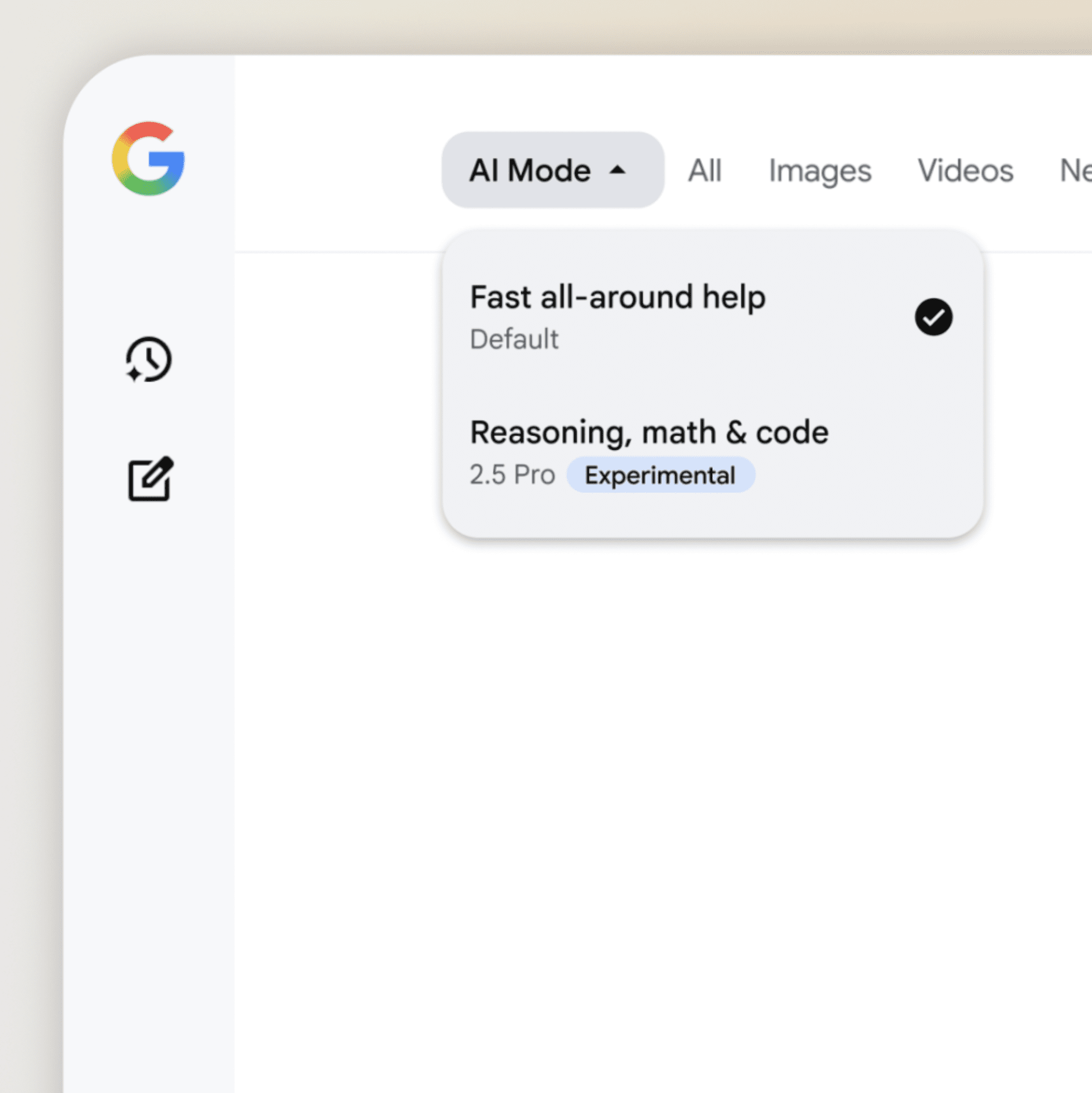
Subscribers can now access Gemini 2.5 Pro from a dropdown menu within the AI Mode tab.

Screenshot from: blog.google/products/search/deep-search-business-calling-google-search, July 2025.

While the default model remains available for general queries, the 2.5 Pro model is designed to handle more complex prompts, particularly those involving reasoning, mathematics, or coding.

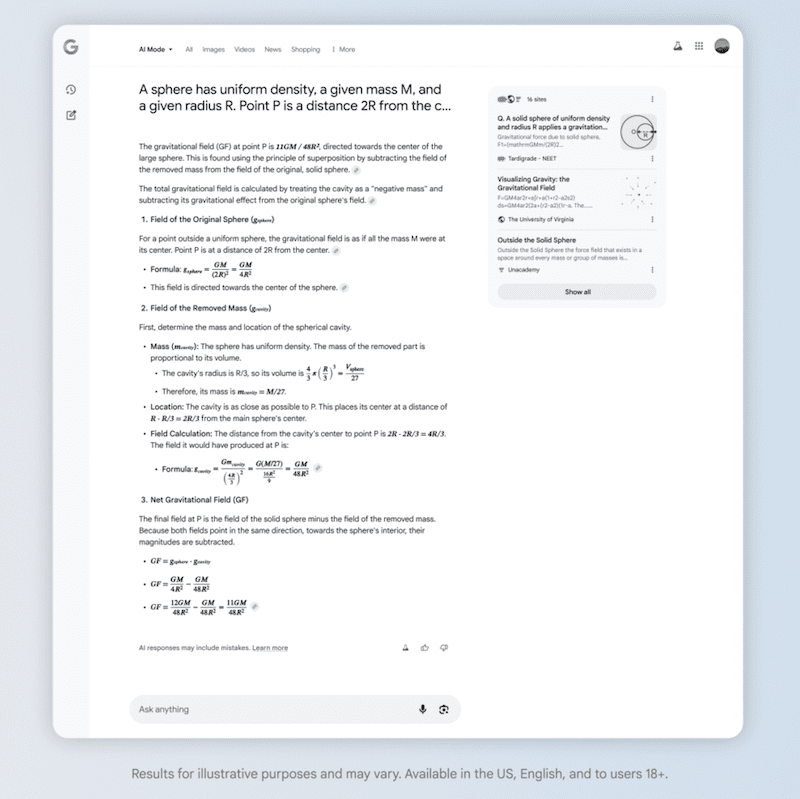
In an example shared by Google, the model walks through a multi-step physics problem involving gravitational fields, showing how it can solve equations and explain its reasoning with supporting links.

Screenshot from: blog.google/products/search/deep-search-business-calling-google-search, July 2025.

Deep Search Offers AI-Assisted Research

Today’s update also introduces Deep Search, which Google describes as a tool for conducting more comprehensive research.

The feature can generate detailed, citation-supported reports by processing multiple searches and aggregating information across sources.

Google stated in its announcement:

“Deep Search is especially useful for in-depth research related to your job, hobbies, or studies.”

Availability & Rollout

These features are currently limited to users in the United States who subscribe to Google’s AI Pro or AI Ultra plans and have opted into AI Mode through Google Labs.

Google hasn’t provided a firm timeline for when all eligible users will receive access, but rollout has begun.

The “experimental” label on Gemini 2.5 Pro suggests continued adjustments based on user testing.

What This Means

The launch of Deep Search and Gemini 2.5 Pro reflects Google’s broader effort to incorporate generative AI into the search experience.

For marketers, the shift raises questions about visibility in a time when AI-generated summaries and reports may increasingly shape user behavior.

If Deep Search becomes a commonly used tool for information gathering, the structure and credibility of content could play a larger role in discoverability.

Gemini 2.5 Pro’s focus on reasoning and code-related queries makes it relevant for more technical users. Google has positioned it as capable of helping with debugging, code generation, and explanation of advanced concepts. Similar to tools like ChatGPT’s coding features or GitHub Copilot.

Its integration into Search may appeal to users who want technical assistance without leaving the browser environment.

Looking Ahead

The addition of these features behind a paywall continues Google’s movement toward monetizing AI capabilities through subscription services.

While billed as experimental, these updates may provide early insight into how the company envisions the future of AI in search: more automated, task-oriented, and user-specific.

Search professionals will want to monitor how these features evolve, as tools like Deep Search could become more widely adopted.

Google Search Can Now Call Local Businesses Using AI via @sejournal, @MattGSouthern

Google has introduced a new AI-powered calling feature in Search that contacts local businesses on a user’s behalf to gather pricing and availability details.

The feature, rolling out to all U.S. Search users this week, allows people to request information from multiple businesses with a single query.

When searching for services like pet grooming or dry cleaning, users may now see a new option to “Have AI check pricing.”

How It Works

After selecting the AI option, users are guided through a form to provide details about the service they need.

Google’s AI then calls relevant local businesses to gather information such as pricing, appointment availability, and service options. The responses are consolidated and presented to the user.

The experience starts with a typical local search, such as “pet groomers near me.” If the AI calling feature is available, users can specify details like:

  • Pet type, breed, and size
  • Requested services (e.g., bath, nail trim, haircut)
  • Time preferences (e.g., within 48 hours)
  • Preferred method of communication (SMS or email)

According to a Google spokesperson, the AI determines which businesses to contact based on traditional local search rankings. Only those that appear in results for the relevant query and match the user’s criteria will be contacted.

What It Looks Like

Examples show a multi-step process where users enter information and confirm their request.

Google displays responses from participating businesses, including prices and availability, all gathered through automated calls.

Before submitting a request, users must confirm that Google can call businesses and share the submitted details. The process is governed by Google’s privacy policy, and users are informed of how their data will be used.

Business Participation & Control

Businesses can manage whether they receive these AI-driven calls via their Business Profile settings.

Google describes the feature as creating “new opportunities” to connect with potential customers, while also giving businesses control over participation.

Available to All (With Premium Perks)

The AI calling feature is available to all users in the U.S., though Google AI Pro and AI Ultra subscribers benefit from higher usage limits.

Google says more agentic AI features will debut for these subscribers before expanding globally.

What This Means

Because the AI selects businesses using standard local search rankings, maintaining strong local SEO becomes even more important.

Businesses with optimized listings and higher rankings are more likely to receive calls and capture leads.

This could also shift how businesses handle inbound requests. Those that rely on phone calls may want to prepare staff or systems to handle more frequent, possibly scripted, AI-initiated inquiries.

Looking Ahead

By automating time-consuming tasks like gathering service quotes, Google aims to make Search more actionable.

Adoption will depend on how well the AI handles real-world complexity, as well as how many businesses opt in.

For marketers and local service providers, it’s another sign that search visibility directly connects to lead generation. Keeping Business Profile data accurate and staying visible in local results could increasingly determine whether a business gets contacted at all.