The Download: Google’s AI energy use, and the AI Hype Index

This is today’s edition of The Download, our weekday newsletter that provides a daily dose of what’s going on in the world of technology.

Google’s still not giving us the full picture on AI energy use 

—Casey Crownhart

Google just announced that a typical query to its Gemini app uses about 0.24 watt-hours of electricity. That’s about the same as running a microwave for one second—something that feels insignificant. I run the microwave for many more seconds than that most days.

I welcome more openness from major AI players about their estimated energy use per query. But I’ve noticed that some folks are taking this number and using it to conclude that we don’t need to worry about AI’s energy demand. That’s not the right takeaway here. Let’s dig into why.

This article is from The Spark, MIT Technology Review’s weekly climate newsletter. To receive it in your inbox every Wednesday, sign up here.

+ If you’re interested in AI’s energy footprint, earlier this year, MIT Technology Review published Power Hungry: a comprehensive series on AI and energy.

The AI Hype Index: AI-designed antibiotics show promise

Separating AI reality from hyped-up fiction isn’t always easy. That’s why we’ve created the AI Hype Index—a simple, at-a-glance summary of everything you need to know about the state of the industry. Take a look at this month’s edition here.

The must-reads

I’ve combed the internet to find you today’s most fun/important/scary/fascinating stories about technology.

1 The White House has fired the director of the CDC
But Susan Monarez is refusing to go quietly. (WP $)
+ Monarez is said to have clashed with RFK Jr over vaccine policy. (NYT $)
+ She was confirmed by the Senate to the position just last month. (The Guardian)
+ Vaccine consensus is splintering across the US. (Vox)

2 A Chinese hacking campaign hit at least 200 US organizations
Intelligence agencies say the breaches are among the most significant ever. (WP $)
+ AI-generated ransomware is on the rise. (Wired $)

3 Ukraine’s new Flamingo cruise missile took just months to build
Russia’s air defenses are weakening. Can this missile exploit the gaps? (Economist $)
+ 14 people were killed in an overnight bombardment of Kyiv. (BBC)
+ On the ground in Ukraine’s largest Starlink repair shop. (MIT Technology Review)

4 AI infrastructure spending is boosting the US economy
Companies are throwing so much money at AI hardware it’s lifting the real economy, not just the stock market. (NYT $)
+ How to fine-tune AI for prosperity. (MIT Technology Review)

5 OpenAI and Anthropic safety-tested each other’s AI
They found Claude is a lot more cautious than OpenAI’s mini models. (Engadget)
+ Sycophancy was a repeated issue among OpenAI’s models. (TechCrunch)
+ This benchmark used Reddit’s AITA to test how much AI models suck up to us. (MIT Technology Review)

6 Climate change exacerbated Europe’s deadly wildfires
And fires across the Mediterranean are likely to become more frequent and severe. (BBC)
+ What the collapse of a glacier can teach us. (New Yorker $)
+ How AI can help spot wildfires. (MIT Technology Review)

7 911 centers are using AI to answer calls
It’s helping to triage anything that isn’t urgent. (TechCrunch)

8 Wikipedia has compiled a list of AI writing tropes
But their presence still isn’t a dead giveaway a text has been written by AI. (Fast Company $)
+ AI-text detection tools are really easy to fool. (MIT Technology Review)

9 Melania Trump has launched the Presidential AI Challenge 
But it’s not all that clear what the competition actually is. (NY Mag $)

10 Netflix’s algorithm-appeasing movies are bland and boring
But millions of people will watch them anyway. (The Guardian)

Quote of the day

“The more you buy, the more you grow.”

—Nvidia CEO Jensen Huang conveniently sees no end to the AI chip spending boom, Reuters reports.

One more thinghttps://www.technologyreview.com/2025/01/13/1109922/inside-the-strange-limbo-facing-ivf-embryos/?utm_source=the_download&utm_medium=email&utm_campaign=the_download.unpaid.engagement&utm_term=*|SUBCLASS|*&utm_content=*|DATE:m-d-Y|*

Inside the strange limbo facing millions of IVF embryos

Millions of embryos created through IVF sit frozen in time, stored in cryopreservation tanks around the world, and the number is only growing.

At a basic level, an embryo is simply a tiny ball of a hundred or so cells. But unlike other types of body tissue, it holds the potential for life. Many argue that this endows embryos with a special moral status, one that requires special protections.

The problem is that no one can really agree on what that status is. What do these embryos mean to us? And who should be responsible for them? Read the full story.

—Jessica Hamzelou

We can still have nice things

A place for comfort, fun and distraction to brighten up your day. (Got any ideas? Drop me a line or skeet ’em at me.)

+ Wow, that is one seriously orange shark!
+ TikTok is a proven way to introduce younger generations to older music—and now it’s Radiohead’s turn.
+ Why we’re still going bananas for Donkey Kong after all these years
+ This photo perfectly captures the joy of letting loose at a wedding.

New Ecommerce Tools: August 28, 2025

This week’s rundown of new products and services from vendors of ecommerce merchants includes AI-generated product images, fulfillment, social commerce, digital advertising, affiliate marketing, less-than-truckload shipping, autonomous ground deliveries, and more.

Got an ecommerce product release? Email releases@practicalecommerce.com.

New Tools for Merchants

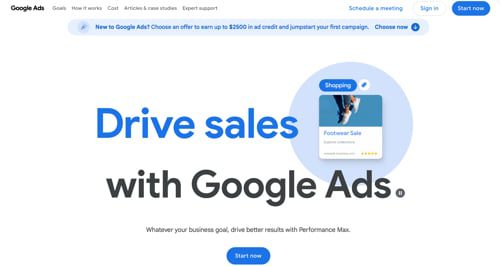
Google Ads launches Asset Studio beta. Google Ads has released, in beta, Asset Studio, a built-in creative hub streamlining how advertisers produce and scale ad assets with AI. Asset Studio appears in Google Ads under “Tools” and provides native creative features directly in the Ads interface. Advertisers can use it to generate images with text prompts, create lifestyle product visuals, edit photos, bulk edit assets at scale, create and trim ad-ready videos, and add voice-overs for video and audio ads.

Home page of Google Ads

Google Ads

Shopify announces built-in fulfillment capabilities. Shopify is launching partnerships with the largest global carriers, introducing bulk order processing, and streamlining shipping workflows, all of which can be managed directly in the Shopify admin. Carrier partnerships include DHL, USPS, UPS, FedEx, Canada Post, Purolator, Royal Mail, Australia Post, and Flexport. For international shipping, merchants can collect duties and taxes at checkout and purchase Delivered Duty Paid labels from DHL Express and DHL eCommerce. New bulk order processing accommodates up to 250 orders simultaneously.

Walmart announces new seller tools and resources at Marketplace Seller Summit. At its Let’s Grow! Seller Summit, Walmart announced a suite of new tools and initiatives. The Seller Advisors Program provides feedback and insights to help foster impactful solutions. An AI-powered listing tool helps with setup for single and bulk items, while Smart Assistant provides support. Sellers who self-fulfill can now automate delivery promises by region. The Brand Portal safeguards sellers and identifies fraudulent activity with a heightened focus on product authenticity.

Wix integrates with Pinterest for social commerce. Wix merchants can now promote and sell their products directly on Pinterest, the visual search and discovery network. By establishing a connection between their Pinterest account and their Wix site, merchants can sync their catalogs and run targeted ads on Pinterest. These ads drive shoppers back to the merchant’s Wix site for a streamlined checkout experience.

Home page of Wix

Wix

Domaine launches AI commerce suite for Shopify. Domaine Worldwide, a Shopify-focused design and development firm, has introduced AI Commerce Suite, combining large language model technology for automated product copy, imagery, and short-form video with adaptive search engine optimization and geo-targeting that respond in real-time to trending keywords and local demand. The new Suite delivers predictive search, personalized recommendations, and dynamic content to convert visitors into customers. Users can boost visibility in emerging search channels, guide shoppers to relevant products, and reduce time from idea to campaign launch, according to Domaine.

TestSquared launches free AffiliateTor directory for affiliate programs. TestSquared, an ecommerce tool developer, has launched AffiliateTor, a free directory to simplify how affiliates discover and connect with opportunities. Brands can showcase their programs to a network of potential partners and reach affiliates searching for programs. The directory is organized by industry niche.

Bandy AI launches to generate ecommerce product imagery with AI models. Bandy AI has launched its platform to help ecommerce stores and apparel brands create photorealistic on-model fashion images. According to Bandy AI, the platform enables brands to generate quality images of clothing and accessories on diverse AI models, with creative control over poses, backgrounds, and camera angles, all rendered within minutes. Bandy AI features a virtual try-on tool that digitally dresses photorealistic AI models with apparel and accessories.

Home page of Bandy AI

Bandy AI

Visa expands Click to Pay across Asia Pacific for enhanced ecommerce checkout. Visa has announced the expansion of Click to Pay across Asia Pacific through strategic partnerships with payment enablers 2C2P, Adyen, AsiaPay, and Worldpay. According to Visa, Click to Pay offers a seamless and secure online checkout experience, with biometric authentication through payment passkeys for enhanced security. By allowing customers to retrieve their saved, tokenized payment details using a mobile number or email alias, Click to Pay eliminates the need to enter card information manually.

BestBuy.com launches marketplace. Best Buy is launching a marketplace for third-party merchants to sell on BestBuy.com and through the app. According to the company, customers can shop from hundreds of brands and from categories such as seasonal décor, automotive tech, office and home, and movies and music. Best Buy says it will soon introduce licensed sports merchandise. Customers can return marketplace products at their local Best Buy store, in addition to shipping them to the seller.

Netcore Cloud integrates with Shopify for real-time ecommerce engagement. Netcore Cloud, a marketing technology company, has launched its plugin on the Shopify platform. Users can (i) access both Shopify and Netcore data in one place for improved segmentation and deeper customer understanding, (ii) leverage Shopify purchase history, product views, and browsing patterns to create campaigns that reflect individual customer interests, (iii) set up event-triggered journeys, from abandoned cart nudges to post-purchase sequences, and (iv) deliver highly contextual outreach across email, SMS, and WhatsApp, all according to Netcore Cloud.

Just Eat Takeaway teams with Rivr to pilot robot food delivery in Europe. Just Eat Takeaway.com, an on-demand delivery service, is partnering with robotics company Rivr to pilot doorstep delivery with autonomous ground robots. The Rivr ground robot combines wheels for efficient travel with legs for climbing stairs and curbs. Functioning with physical AI, the robot avoids obstacles, vehicles, and pedestrians. The Rivr robot will initially deliver food orders in Zurich, with plans to expand to other European cities later this year, and potentially into retail and convenience stores.

Home page of Rivr

Rivr

Pinterest debuts Thrift Shop, targeting Gen Zs. Pinterest has introduced Thrift Shop, a shopping space for thrift lovers, particularly Gen Zs. According to Pinterest, Gen Zs (ages mid-teens to late 20s) now account for more than 50% of Pinterest users; searches for “dream thrift finds” have skyrocketed by 550% amongst that cohort, while searches for “vintage fall aesthetic” are up 1,074%. The Thrift Shop will launch in September, enabling users to browse and shop secondhand finds directly on Pinterest.

DoorDash expands its Commerce Platform to restaurants. DoorDash has expanded its Commerce Platform with tools to help restaurants grow direct sales and deepen customer relationships. Using menu, branding, and images already on DoorDash, restaurants can instantly launch a search-engine-optimized website. Built-in customer management tools allow restaurants to automate, segment, and personalize email and SMS campaigns. The loyalty program rewards guests whether they order from a restaurant’s own app or website, the DoorDash Marketplace, or in-store, according to DoorDash.

TinyFish launches enterprise web agent platform. TinyFish, an enterprise web agent infrastructure provider, has launched with $47 million in funding (led by Iconiq) to transform complex business operations. TinyFish agents execute complete workflows mapped to measurable business outcomes. For ecommerce enterprises, TinyFish’s web agents enable brands to track competitor pricing, monitor inventory shifts, and capture promotional data across thousands of retail sites simultaneously. The company states it will use the funds for continued innovation.

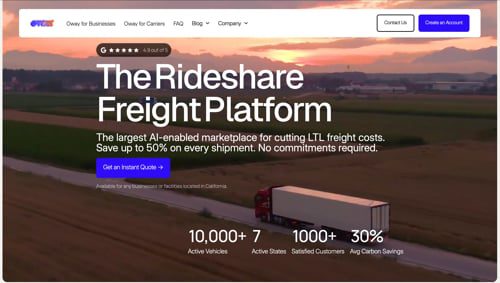
Oway raises $4 million for AI-enabled ride-share freight platform. Oway, a San Francisco-based startup backed by Y Combinator and General Catalyst, has raised $4 million in a seed round to build a decentralized “Uber for freight” delivery platform. Using AI to help find and match cargo with empty trailer space and a convenient destination, along with automating standard shipping and insurance documentation, Oway seeks to reduce shipping costs by 50%. Ride-share cargo is made possible by electronic logging devices installed on long-haul trucks.

How page of Oway

Oway

Research Shows How To Optimize For Google AIO And ChatGPT via @sejournal, @martinibuster

New research from BrightEdge shows that Google AI Overviews, AI Mode, and ChatGPT recommend different brands nearly 62% of the time. BrightEdge concludes that each AI search platform is interpreting the data in different ways, suggesting different ways of thinking about each AI platform.

Methodology And Results

BrightEdge’s analysis was conducted with its AI Catalyst tool, using tens of thousands of the same queries across ChatGPT, Google AI Overviews (AIO), and Google AI Mode. The research documented a 61.9% overall disagreement rate, with only 33.5% of queries showing the exact same brands in all three AI platforms.

Google AI Overviews averaged 6.02 brand mentions per query, compared to ChatGPT’s 2.37. Commercial intent search queries containing phrases like “buy,” “where,” or “deals” generated brand mentions 65% of the time across all platforms, suggesting that these kinds of high-intent keyword phrases continue to be reliable for ecommerce, just like in traditional search engines. Understandably, e-commerce and finance verticals achieved 40% or more brand-mention coverage across all three AI platforms.

Three Platforms Diverge

Not all was agreement between the three AI platforms in the study. Many identical queries led to very different brand recommendations depending on the AI platform.

BrightEdge shares that:

  • ChatGPT cites trusted brands even when it’s not grounding on search data, indicating that it’s relying on LLM training data.
  • Google AI Overviews cites brands 2.5 times more than ChatGPT.
  • Google AI Mode cites brands less often than both ChatGPT and AIO.

The research indicates that ChatGPT favors trusted brands, Google AIO emphasizes breadth of coverage with more brand mentions per query, and Google AI Mode selectively recommends brands.

Next we untangle why these patterns exist.

Differences Exist

BrightEdge asserts that this split across the three platforms is not random. I agree that there are differences, but I disagree that “authority” has anything to do with it and offer an alternate explanation later on.

These are the conclusions that they draw from the data:

  • The Brand Authority Play:
    ChatGPT’s reliance on training data means established brands with strong historical presence can capture mentions without needing fresh citations. This creates an “authority dividend” that many brands don’t realize they’re already earning—or could be earning with the right positioning.
  • The Volume Opportunity:
    Google AI Overview’s hunger for brand mentions means there are 6+ available slots per relevant query, with clear citation paths showing exactly how to earn visibility. While competitors focus on traditional SEO, innovative brands are reverse-engineering these citation networks.
  • The Quality Threshold:
    Google AI Mode’s selectivity means fewer brands make the cut, but those that do benefit from heavy citation backing that reinforces their authority across the web.”

Not Authority – It’s About Training Data

BrightEdge refers to “authority signals” within ChatGPT’s underlying LLM. My opinion differs in regard to an LLM’s generated output, not retrieval-augmented responses that pull in live citations. I don’t think there are any signals in the sense of ranking-related signals. In my opinion, the LLM is simply reaching for the entity (brand) related to a topic.

What looks like “authority” to someone with their SEO glasses on is more likely about frequency, prominence, and contextual embedding strength.

  • Frequency:
    How often the brand appears in the training data.
  • Prominence:
    How central the brand is in those contexts (headline vs. footnote).
  • Contextual Embedding Strength:
    How tightly the brand is associated with certain topics based on the model’s training data.

If a brand appears widely in appropriate contexts within the training data, then, in my opinion, it is more likely to be generated as a brand mention by the LLM, because this reflects patterns in the training data and not authority.

That said, I agree with BrightEdge that being authoritative is important, and that quality shouldn’t be minimized.

Patterns Emerge

The research data suggests that there are unique patterns across all three platforms that can behave as brand citation triggers. One pattern all three share is that keyword phrases with a high commercial intent generate brand mentions in nearly two-thirds of cases. Industries like e-commerce and finance achieve higher brand coverage, which, in my opinion, reflects the ability of all three platforms to accurately understand the strong commercial intents for keywords inherent to those two verticals.

A little sunshine in a partly cloudy publishing environment is the finding that comparison queries for “best” products generate 43% brand citations across all three AI platforms, again reflecting the ability of those platforms to understand user query contexts.

Citation Network Effect

BrightEdge has an interesting insight about creating presence in all three platforms that it calls a citation network effect. BrightEdge asserts that earning citations in one platform could influence visibility in the others.

They share:

“A well-crafted piece… could:
Earn authority mentions on ChatGPT through brand recognition

Generate 6+ competitive mentions on Google AI Overview through comprehensive coverage

Secure selective, heavily-cited placement on Google AI Mode through third-party validation

The citation network effect means that earning mentions on one platform often creates the validation needed for another. “

Optimizing For Traditional Search Remains

Nevertheless, I agree with BrightEdge that there’s a strategic opportunity in creating content that works across all three environments, and I would make it explicit that SEO, optimizing for traditional search, is the keystone upon which the entire strategy is crafted.

Traditional SEO is still the way to build visibility in AI search. BrightEdge’s data indicates that this is directly effective for AIO and has a more indirect effect for AI Mode and ChatGPT.

ChatGPT can cite brand names directly from training data and from live data. It also cites brands directly from the LLM, which suggests that generating strong brand visibility tied to specific products and services may be helpful, as that is what eventually makes it into the AI training data.

BrightEdge’s conclusion about the data leans heavily into the idea that AI is creating opportunities for businesses that build brand awareness in the topics they want to be surfaced in.
They share:

“We’re witnessing the emergence of AI-native brand discovery. With this fundamental shift, brand visibility is determined not by search rankings but by AI recommendation algorithms with distinct personalities and preferences.

The brands winning this transition aren’t necessarily the ones with the biggest SEO budgets or the most content. They’re the ones recognizing that AI disagreement creates more paths to visibility, not fewer.

As AI becomes the primary discovery mechanism across industries, understanding these platform-specific triggers isn’t optional—it’s the difference between capturing comprehensive brand visibility and watching competitors claim the opportunities you didn’t know existed.

The 62% disagreement gap isn’t breaking the system. It’s creating one—and smart brands are already learning to work it.”

BrightEdge’s report:

ChatGPT vs Google AI: 62% Brand Recommendation Disagreement

Featured Image by Shutterstock/MMD Creative

Track, Prioritize & Win In AI Search [Webinar] via @sejournal, @hethr_campbell

AI search is reshaping buyer discovery. 

Every week, 800 million searches happen across ChatGPT, Claude, Perplexity, and other AI engines. 

If your brand isn’t showing up, you’re losing leads and opportunities.

Join Samanyou Garg, Founder of Writesonic, on September 10, 2025, for a webinar designed to help marketers and SEO teams master AI visibility. In this session, you’ll learn practical tactics to measure, prioritize, and optimize your AI footprint.

Here’s what you’ll walk away with

  • AI Visibility Tracking Framework: Measure mentions, citations, sentiment, and share of voice across AI engines
  • Data-Driven Prioritization: Focus on high-impact prompts and competitor gaps for the best ROI
  • 3-Pillar GEO Action Plan: Improve crawler access, craft prompt-specific content, and earn authority-building citations

Why you can’t miss this webinar:

AI-driven search is no longer optional. Your brand’s presence in AI answer engines directly impacts traffic, leads, and revenue. This session will equip you with a step-by-step process to turn AI visibility into real business results.

Save your spot now to learn actionable strategies that top brands are using to dominate AI search.

Can’t attend live? Register anyway, and we’ll send you the full recording.

Yoast SEO free vs Premium: why upgrading is worth it

Do you want to take your site’s SEO to the next level? Yoast SEO Premium can help you out! But there is also a free version of Yoast SEO. So, what exactly is the difference between the free version of Yoast SEO and Yoast SEO Premium? How do these two compare? And is Yoast SEO Premium worth it? Let’s uncover the ten reasons why you should buy Yoast SEO Premium today!

Table of contents

Yoast SEO free vs premium: what is the difference?

Do you want to compare the main differences between Yoast SEO Free and Premium? This table will give you quick insights:

Yoast SEO Free

Find other ways to optimize your website for SEO

No comprehensive SEO solution. You’d need to find other ways to optimize your website, especially if you have a local business, a news website, or if you have a lot of videos.

No AI

You have to manually optimize all your content yourself.

No AI

You have to manually write and optimize all your SEO titles and meta descriptions yourself.

Only 1 keyword per page

Optimize for one keyword per post or page.

No redirect manager

Forgetting to set up a redirect results in visitors hitting a 404 page, which displeases both them and Google.

You need to guess which links would work best

Identify which pages to link to for improved rankings, for both new and existing pages on your site.

No preview of your page on social media

Without a preview of social snippets, you’re left guessing and hoping for the best.

No support

No support
You can help yourself with our extensive knowledge database.

Manually edit robots.txt file

Manually edit your robots.txt file to block AI bots, at the risk of making mistakes.

No free access to the Yoast SEO Google Docs add-on

Transferring draft content from Google Docs to your website for SEO optimization slows your workflow and makes collaboration with internal and external teams more time-consuming.

Yoast SEO Premium vs Yoast SEO Free

Includes Local SEO, Video SEO, and News SEO plugins

Yoast SEO Premium provides everything you need to improve your website’s visibility, whether you’re a business owner, publisher, agency, or content creator.

Find other ways to optimize your website for SEO

No comprehensive SEO solution. You’d need to find other ways to optimize your website, especially if you have a local business, a news website, or if you have a lot of videos.

(Beta) Get AI-powered suggestions to optimize your content

Get optimization suggestions and apply changes instantly with Yoast’s AI features, saving you time and ensuring your content is search engine-friendly. This feature is currently in beta.

No AI

You have to manually optimize all your content yourself.

(Beta) Get high-quality titles and meta descriptions with Yoast AI

Yoast’s AI helps you craft optimized SEO titles and meta descriptions for search and social, boosting your CTR while saving you time.

No AI

You have to manually write and optimize all your SEO titles and meta descriptions yourself.

Optimize for up to five keyword synonyms by adding variants

Include up to four keyword synonyms for a broader reach, and receive a complete SEO analysis for each one.

Only 1 keyword per page

Optimize for one keyword per post or page.

Automatic redirects: so no more dead links or 404 errors

Effortlessly redirect old or renamed pages to maintain satisfaction for both your visitors and Google.

No redirect manager

Forgetting to set up a redirect results in visitors hitting a 404 page, which displeases both them and Google.

Get real-time suggestions for internal links

As you write, you’ll receive suggestions for internal links to other pages, which Google favors and can boost your ranking.

You need to guess which links would work best

Identify which pages to link to for improved rankings, for both new and existing pages on your site.

Preview your page on Facebook and Twitter/X

You have complete control over your page’s social media appearance, ensuring it entices users to click.

No preview of your page on social media

Without a preview of social snippets, you’re left guessing and hoping for the best.

24/7 support

Our helpful and expert support team is ready to assist you with any questions via email or live chat.

No support

No support
You can help yourself with our extensive knowledge database.

Safeguard your content from being used to train AI bots

Easily protect your intellectual property and data privacy by blocking AI bots from scraping your content with a simple toggle.

Manually edit robots.txt file

Manually edit your robots.txt file to block AI bots, at the risk of making mistakes.

Includes 1 free seat to the Yoast SEO Google Docs add-on

Create and optimize your SEO content in Google Docs with Yoast’s guidance, ideal for teamwork with internal and external partners. Enjoy 1 free seat, valued at $5/month.

No free access to the Yoast SEO Google Docs add-on

Transferring draft content from Google Docs to your website for SEO optimization slows your workflow and makes collaboration with internal and external teams more time-consuming.

What are the benefits of Yoast SEO Premium?

For over fifteen years, Yoast SEO has provided small businesses, bloggers, marketers, and online and offline stores with almost everything they need to compete in the search results. Over the years, we made the plugin better and better — following feedback from users, through thorough research and insights from insiders at the search engines. Today, Yoast SEO is run by a team of passionate SEO experts and built by very talented developers.

While the free version of Yoast SEO gives you a lot of tools to help you do well in the search results, Yoast SEO Premium makes many tasks much easier. It saves precious time that you can invest in other ways. Yoast SEO Premium also gives you additional tools, like, for instance, Local SEO, AI features, internal linking suggestions, and the redirect manager. You can use all of these tools to build an impressive site structure. All of this helps make your site a great fit for users and search engines alike. As such, Yoast SEO Premium is a wise investment.

Buy Yoast SEO Premium now!

Unlock powerful features and much more for your WordPress site with the Yoast SEO Premium plugin!

1: Yoast SEO Premium comes with amazing AI features

Yoast SEO Premium now offers AI-powered features that streamline your SEO tasks. With Yoast AI Generate, you can create engaging titles and meta descriptions effortlessly. Choose from multiple options or generate more until you find the perfect fit. Meanwhile, Yoast AI Optimize provides smart suggestions to enhance your existing content, ensuring SEO best practices are met with just a click. These tools integrate smoothly into your workflow, saving you time and effort while keeping your content search-engine friendly. Available for WordPress and Shopify, these features help you maintain control over your content’s final look and feel.

2: Yoast SEO Premium comes with all add-ons

Yoast SEO Premium now includes various separate add-ons, such as News, Video, and Local SEO, in one convenient package. This comprehensive suite enhances your optimization capabilities without needing additional purchases. However, the WooCommerce SEO add-on is not included and is available separately. Enjoy a streamlined experience to boost your site’s performance across different content types and media.

3: Yoast SEO Premium is a time-saver

One of the most important things you need to remember about SEO is that it is never done. There’s always more to do, better content to write, or fixes to make. Luckily, there’s a WordPress SEO plugin that’s glad to be of assistance. As you might know, Yoast SEO is not a set-it-and-forget-it kind of tool. You need to work with it, whether it’s improving your content or building your site structure. In the free version, you still need to do much of the work yourself. Yoast SEO Premium comes with a number of AI tools that can save you lots of time.

4: Use Yoast SEO in Google Docs

The Yoast SEO Google Docs add-on allows you to draft and optimize your SEO content directly within Google Docs. This tool is ideal for seamless collaboration with both internal teams and external partners. You can work on content, refine it, and ensure it aligns with SEO best practices, all without leaving your document. This efficiency streamlines your workflow and enhances team cooperation. Plus, Yoast SEO Premium includes one user seat for this add-on, typically valued at $5 per seat.

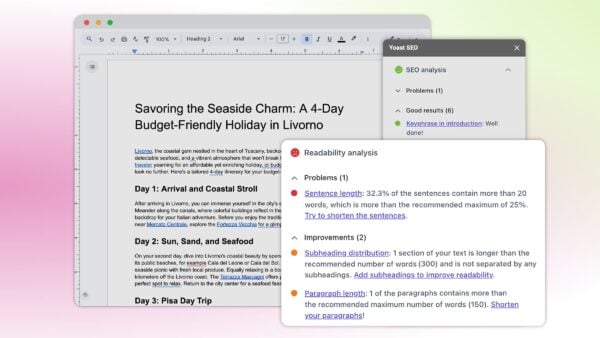
You can enjoy the same Yoast SEO analyses in Google Docs

5: Makes doing site maintenance easier

If working on your site is turning into a day job, you might need some help! Premium makes site maintenance easier. For one, Premium comes with a stale cornerstone content finder that reminds you to update your most important content.

Another tool that helps you work on your pages is the redirect manager. Whenever you make changes to pages or URLs, this tool makes sure to add a redirect for you. All you have to do is say where the new URL needs to lead. With the redirect manager, you can also fix your 404 errors in no time. No developer necessary. It’s so helpful that 58% of Premium users praise the redirect manager as the best feature in Yoast SEO Premium!

Building a solid site structure is one of the quickest routes to success. Making your content easily accessible to users and search engines helps them both make sense of your site. Yoast SEO Premium comes with a number of tools that help you build relevant links that can build a solid foundation for your site structure. Our plugin comes with internal linking blocks, an orphaned content finder and a targeted internal linking suggestion tool.

With the internal linking suggestions, relevant content will automatically be suggested while you’re writing your new content. There’s no need to remember that all those posts are pages!

But don’t just take our word for it, here’s what Andrew Evans from Intellifluence says about the internal linking tool:

While the free Yoast SEO plugin offers many great features, the Premium version takes things to the next level. The internal linking suggestions feature ensures our blog is organized in a cohesive manner. It also ensures that link equity passes to other posts. This feature alone saves a tremendous amount of time as the plugin suggests links as we write. As the site grows, this feature only becomes more valuable! If you’ve ever tried to develop an interlinking strategy for an established blog, you’ll know exactly what I mean…

Andrew Evans

7: An advanced language analysis that makes writing more natural

Yoast SEO is famous for its SEO and readability analyses — a.k.a. the colored traffic lights. The feedback these analyses give you helps you produce a great piece of content that adheres to a range of SEO best practices. This works splendidly, but Premium makes this process a lot more natural and flexible.

Premium has a very smart feature called word forms support. This innovative language analysis looks not only at the exact match of the focus keyphrase you enter but also at all the grammatical forms of that word. If you use, for instance, “decoration”, we will find word forms like “decorated” and “decorates” in your text as well, just like Google does. The words don’t even have to be in the same order when your focus keyphrase consists of more than one word.

Search engines get smarter every day, and context is key in SEO. They use the context in which a keyword appears to determine what a text is about. Synonyms and related terms, therefore, are more important than ever. In the free version of Yoast SEO, you can only add a single focus keyphrase. The plugin uses this to help you optimize your post. Yoast SEO Premium has more tricks up its sleeve, making it a much smarter solution. What is that?

Well, you can add a number of synonyms and related keyphrases to your post. By using these, you can make your content come alive. The Premium analysis makes sure that you use these synonyms and related keyphrases correctly in your post. Awesome, right? You can even use the Semrush integration to gather data and trends about your related keyphrases. Premium users can add the related keyphrases Semrush uncovers for you to their post with a single mouse click.

9: Boost AI visibility while maintaining control

Yoast SEO introduces AI-focused features such as llms.txt and AI bot blockers to protect your site’s content and maintain data privacy. The llms.txt file helps AI tools understand your site’s structure and important content. Meanwhile, the AI bot blocker feature lets you safeguard your intellectual property with a simple toggle, preventing AI bots from scraping your content for training purposes. This ensures that your valuable information remains secure and under your control.

10: 24/7 access to our world-class support team

What if you run into issues with the plugin? It would be good if you could contact a real person to help you figure out what the problem is. Luckily, if you sign up for Yoast SEO Premium, you get just that: Premium support. Our helpful support staff is available around the clock to get you up and running in no time.

An incredible bonus: free access to Yoast SEO Academy

Every Yoast SEO Premium subscription comes with complimentary access to Yoast SEO Academy. This is a big deal. We don’t just provide you with the number one WordPress SEO plugin to help you do well in search engines — we also supply many hours of instructional material. We offer several of our courses free of charge to get you started with the basics. But when you sign up for Yoast SEO Premium, you get access to all our SEO courses! Learn about Yoast SEO, SEO copywriting, keyword research, structured data, ecommerce SEO, and many other topics related to SEO!

Invest in Yoast SEO Premium: it pays off!

You see, there are many good reasons to get a Yoast SEO Premium subscription today. A Premium subscription can save you lots of time and gives you access to incredible tools that make working on your site easier and more fun. Plus, you’ll get unrestricted access to Yoast SEO Academy for hundreds of hours of SEO training. And, of course, you get to contact our support team if you should ever run into a problem.

How much does Yoast SEO Premium cost?

You can buy Yoast SEO Premium for $118.80 excluding VAT per year, or €118.80/£118.80 per year, depending on where you are in the world. For this, you not only get Yoast SEO Premium, all the additional plugins like Local SEO and Video SEO, and its awesome tools, but you also get a year of support, updates, and access to all our Yoast SEO Academy courses. Check out all of our products here.

Get Yoast SEO Premium now!

Convinced? Make sure to grab your copy!

Buy Yoast SEO Premium now!

Unlock powerful features and much more for your WordPress site with the Yoast SEO Premium plugin!

SEO Has Been Tactical For 20 Years. GenAI Forces The Strategy Question via @sejournal, @DuaneForrester

For as long as I’ve been in this industry, there’s been debate about whether SEO is strategic or tactical. Most SEOs would like to believe their work is strategic. Many executives see it as tactical. The truth is somewhere in between, and the arrival of generative AI is forcing a new level of clarity.

This matters because “strategy” and “tactics” are not synonyms. In business, strategy is the plan. Tactics are the moves. Confusing the two doesn’t just muddy language. It leads to wasted resources, stalled initiatives, and misplaced expectations for what SEO can and cannot deliver.

Defining Strategy Vs. Tactics

Image credit: Duane Forrester

Business literature has been clear on this for decades, and voices like Porter, Mintzberg, and Drucker shaped how leaders everywhere talk about strategy. Their framing applies directly when we examine SEO’s role today.

Michael Porter is widely recognized as the father of modern competitive strategy. A professor at Harvard Business School, he framed strategy as “choosing to run a different race, because it’s the one you’ve set yourself up to win.” His book “Competitive Strategy” remains one of the foundational texts in business thinking (his book on Amazon – not an affiliate link).

Henry Mintzberg is one of the most cited academics in management and organizational theory. He is famous for noting, “Strategy is not the consequence of planning, but the opposite: its starting point.” He also developed the 5 Ps framework — Plan, Ploy, Pattern, Position, and Perspective — which captures strategy as both deliberate and emergent (Mintzberg’s “The Strategy Concept I: Five Ps for Strategy”).

Peter Drucker is often called the father of modern management. His work shaped how companies think about leadership and decision-making. He emphasized that “the task of leadership is to create an alignment of strengths so strong that it makes the system’s weaknesses irrelevant.” His book “The Practice of Management” is considered a landmark in defining management’s role in aligning strategy with organizational outcomes (Drucker biography at the Drucker Institute).

Tactics, by contrast, are the practical steps. They’re what frontline teams execute, usually with short-term horizons. A strategy might be to compete on customer trust instead of low prices. The tactics are testimonial campaigns, return policies, and training staff to deliver exceptional service.

Other business functions get this distinction. In sales, strategy is deciding to prioritize enterprise accounts. Tactics are outreach sequences and demo scripts. In PR, strategy is positioning the brand as an industry leader. Tactics are pitching journalists and writing press releases. SEO is no different.

The confusion comes because SEO often has to “do it all.” Practitioners are expected to identify opportunities, set priorities, and then execute the work. That’s where the labels blur.

Strategy And Tactics In Traditional SEO

Looking back at the history of SEO makes the divide easier to see.

  • Early 2000s, PageRank era: Strategy was simple. Invest in being discoverable on Google. Tactics included link building, directory submissions, and keyword-stuffed pages. Companies that treated SEO purely tactically often succeeded short-term but collapsed when penalties arrived. The strategy was clear. Pursue visibility on Google, while the tactics were the link farms, keyword stuffing, and directory submissions that executed it.
  • 2010–2015, Panda and Penguin: Google cracked down on low-quality content and manipulative links. Strategy shifted to “quality and sustainability.” Tactics became pruning thin content, disavowing bad links, and investing in editorial teams. Content farms like Demand Media scaled on tactics, but lacked sustainable strategy, and they were decimated by Panda. Here again, leadership set the strategic shift toward quality, and SEO carried it out through content pruning and link cleanup.
  • 2015–2020, Mobile and Core Web Vitals: Strategy was “meet users where they are.” They were on mobile and wanted fast experiences. Tactics were responsive design, structured data, and site speed audits. Companies that made this strategic shift early (e.g., news outlets investing in AMP) gained advantage. The strategic goal was serving users where they were, while SEO implemented the tactical fixes that delivered on it.
  • 2020s, BERT and passage indexing: Strategy tilted toward semantic relevance, competing not just on keywords but on meaning and intent. Tactics were writing for topics, structuring content for passage-level retrieval, and emphasizing context. Strategy tilted toward meaning; tactics followed in the form of topic clusters and passage-level optimization.

At every stage, leadership set the strategy (“we need growth from search”), and SEO executed the tactics. Advanced SEOs sometimes influenced strategy by warning about risks or opportunities, but the bulk of work remained tactical.

Strategy And Tactics In GenAI Optimization

Generative AI reshapes the landscape. Instead of 10 blue links, users now get synthesized answers. That changes both the strategic questions and the tactical execution.

Strategic choices now include:

  • Deciding whether to compete for visibility across multiple AI engines (ChatGPT, Perplexity, Gemini, Claude, etc.).
  • Prioritizing authority signals so your brand is cited in machine answers.
  • Choosing where to allocate budget: competing for evergreen visibility in broad topics, or dominating narrow niches where AI coverage is weaker.
  • Determining how much to invest in retrievability testing and monitoring as an organizational function.

Tactical execution now includes:

  • Structuring content into retrievable chunks sized for vector search.
  • Running retrieval tests across platforms to measure exposure.
  • Optimizing semantic density so each chunk is information-rich and self-contained.
  • Adding schema and structured data to clarify entities and facts.
  • Tracking machine-validated authority by measuring whether your content is surfaced or cited in AI responses.
  • Query fan-out work to determine opportunities and identify semantic overlap.

These tactics look new, but they build directly on the foundation of traditional SEO. Schema is simply structured markup, refined. Semantic density is the next evolution of topical relevance. Retrieval tests are the modern equivalent of checking indexation. GenAI optimization doesn’t replace SEO; it evolves from it.

GenAI Optimization: Is It A Strategy Or Tactic?

The sudden surge of interest in “GenAI optimization” is a perfect case study in this strategy-versus-tactics debate.

Everyone is talking about chunking, embeddings, and retrievability as if they are strategy. They aren’t. They’re tactics. And treating tactics as strategy is a classic oversimplification, something the industry has been guilty of for decades.

  • At the strategic level: Businesses decide that GenAI visibility is essential. They commit budget to becoming retrievable and authoritative across AI systems. They set goals to be cited in machine answers for their core vertical.
  • At the tactical level: Teams restructure content into chunks, add schema, run retrieval probes in ChatGPT or Perplexity, and measure citation frequency.

Both layers are needed. The risk comes when companies mistake tactical execution for strategy.

The Cost Of Misalignment

When strategy and tactics are misaligned, businesses lose, and the losses are measurable.

  • Missed opportunities: If leadership hasn’t set a strategy for GenAI visibility, tactical work is scattershot. Teams optimize content but don’t know which queries, topics, or surfaces matter. Competitors with clearer strategies win the ground.
  • Lost revenue: Without strategy, companies may secure citations in AI answers that don’t align with customer value. The result is visibility without conversion.
  • Wasted budgets: Chasing every GenAI trend without a clear North Star leads to investment in tools and audits that deliver no meaningful ROI.
  • Eroded trust: When executives believe they’ve funded a strategy but only see tactical outputs, confidence in SEO teams drops. Leadership expected market impact and the team only delivered structural updates.

The lesson is blunt: Businesses don’t usually fail because tactics are poorly executed. They usually fail because tactics aren’t anchored in strategy.

Why SEO Has Been Seen As Tactical

For two decades, SEO has been defined by tactical output. Executives set the strategy (“We need organic growth”), and SEO was tasked with delivering through audits, fixes, optimizations, and publishing.

This framing wasn’t wrong as it reflected the organizational structure. Strategy was set higher up; SEOs carried it out. That’s why SEO often struggled to win budget or a seat in strategic planning meetings. It was seen as execution.

The AI-Driven Shift

Generative AI changes that equation. Machines are absorbing tactical SEO tasks. Today, AI tools can generate meta descriptions, suggest keywords, build internal linking recommendations, even create structured schema markup. Some platforms simulate retrieval patterns directly. What once required specialized SEO execution is increasingly automated.

That doesn’t eliminate SEO. It elevates it. If tactical execution is becoming commoditized, the value shifts to strategy.

This mirrors Microsoft’s research on AI’s occupational impacts, which distinguishes between user goals (strategic intent) and AI actions (tactical execution). Humans set the “why.” AI delivers the “how.”

For SEO, the same shift is underway. The tactical layer is being automated. The strategic opportunity is to lead on visibility, authority, and trust in AI-driven ecosystems.

Drawing The Line With Examples

  • Traditional SEO in financial services: The strategy is to dominate “retirement planning for millennials.” The tactics include create calculators, publish evergreen guides, optimize metadata, and build relevant backlinks.
  • GenAI optimization in sustainable investing: The strategy is to ensure the brand is a trusted citation in AI answers on ESG funds. The tactics include run retrieval checks in Perplexity, embed structured citations, optimize chunks for semantic clarity, and measure citation frequency in ChatGPT and Gemini.

One sets the direction. The other executes the playbook.

Why This Feels Touchy

Many SEOs call their work strategic because they connect content, technical architecture, and authority signals into a broader picture. In many organizations, they’re the only ones framing visibility at all, but that doesn’t make every action strategic.

That deserves credit. But precision matters. Running an audit is not strategy. Updating a robots.txt file is not strategy. These are tactical actions. If we blur the line, we diminish our influence at precisely the moment AI is eroding the value of tactics.

Where The Balance Lies

So, is SEO strategic or tactical? The honest answer is both, but not equally.

  • Historically, SEO has been tactical.
  • Today, SEO carries strategic implications, especially as AI reshapes discovery.
  • The opportunity is to make the leap: from executing optimizations to shaping how organizations appear in machine-driven answers.

The balance is this: Tactics still matter. You can’t ignore schema, chunking, or retrieval testing. But the differentiator is strategy: deciding which battles to fight, which surfaces to win, and how to align SEO with the company’s long-term positioning.

Why This Matters For SEOs

This isn’t a semantic debate. It’s about influence and survival.

  • If SEO is seen as tactical, it’s underfunded, siloed, and brought in too late.
  • If SEO is seen as strategic, it gets budget, resources, and a seat in the boardroom.

The GenAI shift creates a once-in-a-generation opening for SEOs to redefine their value. As AI absorbs more tactical execution, the real opportunity is for SEOs to align with company-level strategy and expand their scope into visibility, trust, and authority. Those who recognize the difference between strategy and tactics will step into leadership. Those who stay focused only on tactical execution risk being automated out.

Closing Thought

For 20 years, SEO has been tactical excellence in service of growth. With GenAI, the tactical layer is shifting to machines. That makes strategy the defining frontier.

Not because SEOs suddenly became strategists, but because the environment demands it. The question now is: will SEOs step into that role, or will someone else claim it?

More Resources:


This post was originally published on Duane Forrester Decodes.


Featured Image: Vitalii Vodolazskyi/Shutterstock

Ask An SEO: How Do You Prioritize Technical SEO Fixes With Limited Dev Support? via @sejournal, @HelenPollitt1

Today’s question cuts to the heart of resource management for SEO:

“How do you prioritize SEO fixes when technical debt keeps piling up and you can’t get dev resources?”

In this article, we’ll look at different prioritization methods and what you can do when you have more work than support to do it.

What Is Technical Debt?

Let’s first take a look at what we consider “technical debt” in SEO.

In development, this term refers to long-standing issues with the website that have grown due to poor management, or “quick-fixes” that have not stood the test of time.

In SEO, we tend to use it to signify any code-based issue that is fundamentally affecting optimization efforts. Typically, these are issues that cannot be fixed by the SEO function alone, but require the input of front or back-end development teams.

So, when the bulk of the work required to fix SEO technical debt falls to other teams, how do you make sure the most important work gets completed?

Prioritization Matrix

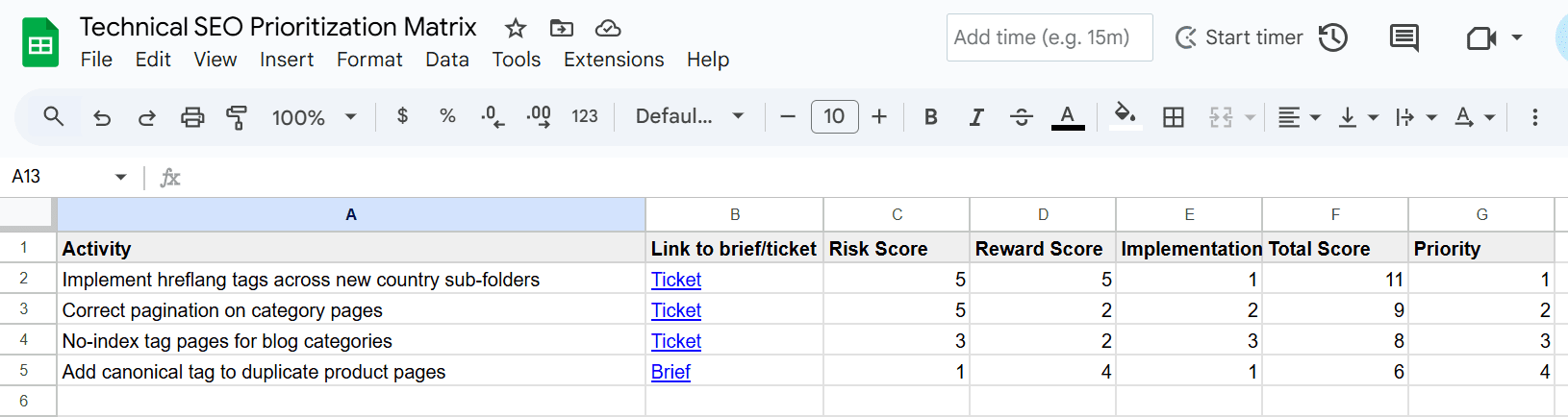
In order to prioritize the work, you should look at three core aspects. These are the associated risks of the work not being completed, the potential benefits if it is, and the likelihood of it being implemented.

You may even want to create a matrix that details the overall score of a technical item. Then, use that to prioritize them. Discuss each item with the stakeholders whose teams will need to be involved in its implementation.

Get a better idea of the full scope of the work. From there, you can assign a figure to each category of “risk”, “reward”, and “implementation likelihood.”

Example of a tech SEO prioritization matrixExample of a technical SEO prioritization matrix (Screenshot by author, August 2025)

Risk

Start by calculating the risk to the business if this work isn’t carried out.

Consider aspects like financial risk, i.e., “If we don’t carry out this work then our product pages will be no-indexed. Currently X% of revenue from those product pages is generated by organic traffic and therefore by not completing this work we risk $Y of revenue each year.”

It could also be a risk to the website’s performance. For example, by not fixing a Cumulative Layout Shift (CLS) issue across a group of pages, you may risk conversions as well as rankings.

Get a better idea of the level of risk associated with not fixing that technical debt. Then, assign it a score from 1 (low risk) to 5 (high risk).

Reward

In a similar way, consider the positive implications of carrying out this work. Look at how implementing these fixes could affect revenue, conversion rate, customer satisfaction, or even how it could save money.

For example, “We know that we have a lot of duplicate pages that are not generating revenue but are repeatedly crawled by search bots. We know that every time a bot crawls a page, it costs us $X in server hosting costs; therefore, if we remove those pages we can save the company $Y each year.”

Look primarily at the financial benefits of carrying out the work, but consider also some secondary benefits.

For example, will this work help users complete their goals more easily? Will it aid them in discovering new products or perhaps enjoy a better user experience?

Consider whether the work will benefit other channels beyond organic search. Your technical debt fixes may improve the landing page experience for a group of pages that are used for paid advertising campaigns as well as organic traffic. The benefit of that work may be felt by the paid media team as well as the organic search team.

Assess each of your planned tasks and assign them a value between 1 (low reward) and 5 (high reward).

Implementation Likelihood

When what you are asking is actually an extremely involved, expensive project that the development team doesn’t have the capacity to do, then it won’t get done. This might sound obvious, but often when we are trying to prioritize our technical requests, we think about their impact on our key performance indicators (KPIs), not their strain on the development queue.

Through talking with engineering stakeholders, you may realize that some of your tasks are more complicated than you originally thought. For example, a simple editable content block being added to a page might actually require a whole content management system (CMS) to be built.

Discuss your activities with stakeholders who understand the true requirements of the work, from the teams involved to the hours of work it will take.

From there, you will have a greater understanding of how easy or quick this work will be. Then, you can assign it a score from 1 to 5 of its likelihood of being implemented (1 being highly unlikely and 5 being highly likely).

Prioritization Method

Once you have assigned a score under each of the three categories for all of the technical debt fixes that you want to have carried out, you can prioritize the work based on the sum of all three categories’ scores. The higher the score, the higher a priority that work is.

Additional Ways To Get Dev Resources

Now, just because you have prioritized your fixes, it does not mean your development team will be keen to implement them. There may still be reasons why they are unable to carry out your requests.

Here are some additional suggestions to help you collaborate more closely with your technical team.

Discuss The Work With The Team Leader/Product Manager

The biggest hurdle you may need to overcome is usually sorted through communication. Help your development team understand your request and the benefits of carrying out these technical fixes.

Meet with the tech team lead or product/project manager to discuss the work and how it might fit into their workload.

There may be better ways for you to brief your technical team on the work that saves them “discovery” time and therefore gives more opportunity to work on your other requests.

Invest more time with the development team upfront in creating a brief for them that goes into all of the necessary detail.

Batch Issues In One Ticket

A tip for getting more of your work through the development queue is batching requests into one ticket. If you group together items that need to be worked on across the same group of pages, or template, it will mean developers can make multiple changes at once.

For example, if you want hard-coded page titles changed on your product pages, as well as their header tags and breadcrumbs added, put them all into one ticket. Instead of three separate requests for the development team to schedule in, they now have one larger ticket that can be worked on.

Show The Value Of Your Work To The Development Stakeholders

Show the value of your work to the stakeholders’ goals. So, in the instance of the development team, think about how your suggested fixes might benefit them. Find out what their KPIs or goals are and try to position your work to show the benefits to them.

For example, development teams are often tasked with monitoring and improving the performance of webpages. Part of this may be managing the budget for the server. You may be asking for a group of redirect chains to be removed, but the work isn’t getting prioritized by your development team. Demonstrate the value of removing redirect hops in reducing the load on the server, and therefore server costs.

If you can demonstrate how reducing the technical debt benefits both the SEO team and the development team, it is much more likely to get implemented.

Get Buy-In From Other Teams

On that note, look at getting buy-in from other teams for your work. When the activity you have proposed will not just benefit SEO, but also CRO, or PPC, then it may generate enough support to have it prioritized with the development team.

Show the value of your work beyond just its SEO implications. This can add weight to your request for prioritization.

Summary: Managing Technical Debt Is More Than A To-Do List

Managing technical SEO debt is never as simple as keeping a to-do list and working through it in order. Internal resources are often limited, competing priorities will arise, and most likely, you need the help of teams with very different goals. By weighing risk, reward, and implementation likelihood, you can make more informed decisions about which fixes will have the most impact.

Just as important is how you communicate those priorities. When you position SEO requests in terms of broader business value, you increase the chances of securing development time and cross-team support.

More Resources:


Featured Image: Paulo Bobita/Search Engine Journal

WordPress Trademark Applications Rejected By USPTO via @sejournal, @martinibuster

The United States Patent and Trademark Office has rejected the WordPress Foundation’s applications for trademarks on the phrases “Managed WordPress” and “Hosted WordPress.” But WordPress isn’t walking away just yet.

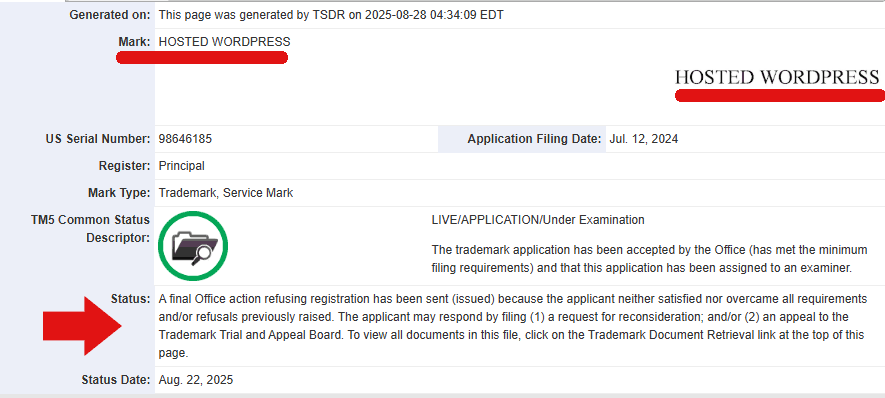
The Trademark Office published the following notice for the “Hosted WordPress” trademark application:

“A final Office action refusing registration has been sent (issued) because the applicant neither satisfied nor overcame all requirements and/or refusals previously raised….

SUMMARY OF ISSUES MADE FINAL that applicant must address:

• Disclaimer Requirement

• Identification of Goods and Services

• Applicant Domicile Requirement

DISCLAIMER REQUIREMENT Applicant must disclaim the wording ‘MANAGED’ because it is merely descriptive of an ingredient, quality, characteristic, function, feature, purpose, or use of applicant’s goods and services….

Applicant may respond by submitting a disclaimer in the following format: No claim is made to the exclusive right to use ‘MANAGED’ apart from the mark as shown.”

Screenshot of Document Close-Up

The USPTO also found that the WordPress Foundation’s description of goods and services is too vague and overly broad, especially regarding the phrase “website development software,” and asks them to clarify whether it is downloadable (Class 9) or offered as online services (Class 42). The USPTO suggested acceptable wording that they can adopt, as long as it accurately reflects what they provide.

The Trademark Office also issued the following response for the trademark application for Managed WordPress:

“DISCLAIMER REQUIREMENT
Applicant must disclaim the wording ‘MANAGED’ because it is merely descriptive of an ingredient, quality, characteristic, function, feature, purpose, or use of applicant’s goods and services…. Applicant may respond by submitting a disclaimer in the following format:

No claim is made to the exclusive right to use ‘MANAGED’ apart from the mark as shown.”

The Process Is Not Over

The WordPress Foundation is continuing its efforts to obtain trademarks for both “Managed WordPress” and “Hosted WordPress.” It has filed a Request for Reconsideration after Final Action for each trademark application, which asks the USPTO to reconsider its refusals based on amendments, arguments, or evidence. These requests are a final procedural step before an appeal, although they are not themselves appeals.

2025 AI SERP Changes: New Strategies To Gain Local Search Visibility

This post was sponsored by DAC. The opinions expressed in this article are the sponsor’s own.

The new reality of Search and brand discovery requires an Enterprise-to-Local strategy.

Traditional keyword-driven search engine results pages (SERPs) are being disrupted by AI-driven experiences that anticipate, summarize, and even act on users’ needs.

As generative AI tools like Google’s AI Overviews and platforms such as Perplexity become more prominent in the Search journey, the marketer’s task expands: It’s no longer just about ranking well on Google but being visible wherever decisions begin.

For multilocation businesses, this presents both a challenge and an opportunity. AI is flattening the competitive playing field, restructuring what influences purchasing decisions, and automating formerly human-led interactions.

Here are four key takeaways to help local marketers understand what’s changing, what strategies are needed right now, and what the future holds.

Strategy 1. You Must Navigate Google’s AI-First Search Experience To Stay Visible

Google’s inclusion of AI Overviews has introduced an entirely new kind of SERP.

These AI-generated summaries often sit atop the page, pushing traditional blue links down. Unlike the 10-blue-link layout of old, AI Overviews synthesize answers across sources, citing a few but effectively removing the need to click.

What To Look For, Learn About & Incorporate

Google’s AI Mode, now available as a Labs experiment, prioritizes user intent by stitching together information to answer nuanced queries (e.g., “best affordable Thai near me for a date”) into a conversational response.

For local queries, it factors in:

What No Longer Works

Structured data or map pack signals alone do not supply enough context to be recognized in a modern AI-first search experience.

Strategy 2. Adopt An Enterprise-To-Local Strategy To Capture Both Informational & Local Intent

DAC’s study of over 700 real SERPs across four major verticals (Apparel, Auto Services, Financial Services & Insurance, and Home Services) revealed a clear divergence between the kinds of queries that trigger AI Overviews (AIOs) and those that surface the traditional Maps Pack.

Only 1% of queries triggered both features in the same SERP. When both appeared, the AIO came first, pushing the Maps Pack below the fold.

What To Look For, Learn About & Incorporate

AIOs dominate informational queries, while Maps Packs dominate transactional or locational ones:

  • Queries beginning with question words (“how,” “why,” “what”) triggered AIOs 28% of the time, but Maps Packs <1%>
  • “Near me” queries triggered Maps Packs 100% of the time and never triggered an AIO.
  • Pluralized terms (e.g., “jackets”) were more likely to trigger AIOs than singular or specific terms.

Marketers, especially those managing multilocation brands, need a bifurcated strategy:

For AI Overviews

  • Invest in informational content that addresses common customer questions.
  • Ensure that content is structured, educational, and aligns with E-E-A-T principles (Expertise, Experience, Authoritativeness, Trustworthiness).
  • Use clear question-answer formatting to increase chances of AIO inclusion.

For Maps Pack Visibility

  • Optimize your Google Business profile.
  • Encourage reviews and manage responses.
  • Create localized landing pages with clear CTAs and schema markup.
  • Use local backlinks and citations to build trust.

Strategy 3. Gain Visibility In Alternate Search Experiences With A Distributed Content Footprint

Many users, especially younger generations, are increasingly bypassing traditional search engines altogether.

Inject your brand into new channels and open your windows and doors to complete visibility.

Perplexity AI has seen a remarkable rise in adoption, with around 22 million monthly active users in 2025, positioning it as a major alternative search platform.

Perplexity can geolocate the user and surface locally-relevant searches through its own web crawling, but also offers specific Local Search functionality that is enriched by a Yelp integration, and a restaurant booking capability that integrates with OpenTable – highlighting the importance of strong business listing data partnerships for any AI-based search that wishes to challenge Google’s dominance.

Reddit has become a trusted resource for recommendations, given the importance consumers are placing on social proof. Reddit commands strong loyalty among younger users, with over 70% of its user base being Millennials or Gen Z.

Its long-lasting content delivers value over time; 34% of Reddit posts continue to be viewed more than a year after posting. While Reddit does not offer an explicitly local search function, local business discovery is discussion-based.

Local content can be prioritized in the interface through the user’s geolocation, and explicitly local subreddits (e.g., r/Vancouver) can become forums for brands to build authentic connections with local customers.

TikTok is also a strong contender. A 2024 Adobe study revealed that 64% of Gen Z and 49% of Millennials have used TikTok as a search engine. While TikTok does not provide a maps-based search, its “Nearby” feed supports the discovery of content posted by local creators.

TikTok is currently testing an experimental feature that will place user-generated reviews into the Comments section when a place or local business has been tagged in the content.

In this way, TikTok can support local brand discovery through a blend of metadata, location tagging, and algorithmic signals. TikTok’s rapidly evolving paid search capabilities also support geotargeting as granularly as the zip code level.

The generational differences in Search behavior are clear. Gen Z often turns to TikTok and Reddit for inspiration and discovery rather than Google.

Millennials blend traditional, AI-assisted, and visual search, while Gen X and Boomers still lean toward Google, though they’re increasingly open to AI-generated summaries.

What To Look For, Learn About & Incorporate

To reach these diverse platforms and audiences requires tailored content. Video-first assets optimized for TikTok, Reels, and YouTube cater well to short-form, visual-first consumption.

On forums such as Reddit and Quora, building textual credibility through authentic, conversational answers is key.

Pinterest thrives on visuals and moodboards, while FAQs, how-to guides, and structured content (with schema markup) are crucial for AI engines that reward clear, structured information.

In this evolving landscape, marketers must build a distributed content footprint to ensure a presence wherever people are searching, and where AI tools may source it.

As AI platforms increasingly summarize content from various social and community channels, your brand’s participation in those discussions becomes essential,  not just for visibility, but to be cited accurately.

Strategy 4. Prepare For The Future Of Agentic Local Search

We are entering the agentic era, where users don’t just search, they delegate.

Google’s experimental “Call with AI” feature allows users to let an AI assistant call local businesses on their behalf. This transforms search from a real-time human task into an asynchronous agentic process.

What To Look For, Learn About & Incorporate

Key Impacts:

  • Proximity matters less: If AI finds a better deal 20 minutes away, you may be willing to make the trip
  • Price pressure increases: Transparent price comparisons and AI-led negotiations could initiate a race to the bottom
  • “Vibes” matter less: Warm greetings won’t influence the AI. Decision-making shifts from emotional to transactional.
  • Big brands lose leverage: Without human biases for logos or familiarity, small businesses can compete if they meet the decision criteria

Operational Challenges

  • Call volume may spike, but call value drops; your business could receive 100 AI-generated inquiries while winning only a few sales.
  • Unanswered calls = lost sale. AI agents will move on quickly if a call goes unanswered.
  • Scalability issues: AI can contact 100 businesses in seconds. Human-staffed phones can’t scale similarly.

Long-Term Adjustments

  • Structured pricing data must be public and machine-readable.
  • Agent-to-agent negotiation will require new infrastructure, with bots communicating with each other to confirm inventory and schedule appointments.
  • Local search becomes asynchronous: Agents might initiate requests at midnight and complete transactions during business hours, with no human involved.

Evolving Local Search, Enduring Foundations

There has been a seismic shift in how users discover brands and make decisions.

Businesses, especially multilocation enterprises, must adapt to a new hybrid model where visibility is dictated by both informational depth and local precision.

What’s Changing:

  • AI reshapes SERPs: Google’s AI Overviews and AI Mode prioritize synthesized answers and intent-matching over clickable links, reducing organic link visibility.
  • Query types split visibility paths: Informational queries are now more likely to trigger AI Overviews, while transactional/local queries still favor Maps Packs; rarely do both appear together.
  • New platforms drive discovery: Reddit, TikTok, Perplexity, and Pinterest are no longer fringe sources – they are now primary discovery tools for younger generations.
  • Agentic search emerges: Users increasingly delegate tasks to AI (e.g., “Call with AI”), reshaping search from human-led interactions into asynchronous, bot-to-bot transactions.
  • Operational pressure increases: Businesses must prepare for surges in AI-driven interactions, increased price competition, and reduced influence of brand familiarity or emotional cues.

What’s Staying The Same:

  • Relevance and trust still rule: Google’s EEAT ranking principles remain crucial for AI visibility.
  • Local optimization is still vital: For transactional/local intent, the Maps Pack remains dominant. Accurate business listings, reviews, and structured local content continue to impact discoverability.
  • Content matters: Informational, structured, and platform-tailored content remains the cornerstone of any successful visibility strategy, only now must it live across multiple channels and formats.
  • Brand credibility drives citations: AI systems rely on trustworthy sources, so being the “answer” in AIOs or Perplexity depends on being referenced as a reputable, visible voice across the web.

To thrive in this transformed landscape, marketers must double down on creating a distributed content footprint, intent-driven optimization, and technical readiness for AI delegation, while still leaning on the fundamentals of trust, relevance, and local authority.

At DAC, we help brands thrive in this complexity with strategies that balance informational depth, local precision, and future-ready adaptability. Our recent analysis of 700+ SERPs across four major industries reveals how AI Overviews and Maps Packs divide visibility and what multilocation brands must do to capture both.

If you’re ready to turn today’s search disruption into tomorrow’s growth, get the full insights in our new whitepaper.


Image Credits

Featured Image: Image by DAC. Used with permission.

India is still working on sewer robots

When Jitender was a child in New Delhi, both his parents worked as manual scavengers—a job that involved clearing the city’s sewers of solid waste by hand. Now, he is among almost 200 contractors involved in the Delhi government’s effort to shift from this manual process to safer mechanical methods.

Although it has been outlawed since 1993, manual scavenging—the practice of extracting human excreta from toilets, sewers, or septic tanks—is still practiced widely in India. The work is usually done by people who belong to what are considered the lowest castes, known as the Scheduled Castes or Dalits. Not only is the job undignified, but it can be extremely dangerous: People who enter clogged sewers to clean them face the risk of asphyxiation from exposure to toxic gases like ammonia and methane. According to data presented in the Indian parliament, manual scavenging was responsible for more than 500 deaths between 2018 and 2023.

Several companies have emerged to offer alternatives at a wide range of technical complexity. For example, Genrobotics, based in Kerala, has developed the “Bandicoot Robot” (shown above), a mechanical scavenger that features robotic legs, night-vision cameras, and the ability to detect toxic gas. Researchers at the Indian Institute of Technology in Chennai have developed a robot for septic tanks that has a suction mechanism to pump out the slurry. 

More than 220 Bandicoot robots have been deployed in India, says Vipin Govind, head of marketing and communications at Genrobotics. The company’s reach, he says, enables “even resource-constrained municipalities” to deploy the technology effectively.

Despite these technological options, a 2021 report by the Ministry of Social Justice & Empowerment found that there are still more than 58,000 manual scavengers across India. Independent observers say the numbers are even higher.  

The machine that Jitender uses is mounted on a pickup truck and uses rotating rods, high-pressure streams of water, and a mechanical claw to break up blockages and remove debris. “Earlier, a sanitation worker would get into a sewer and clear the drain with some equipment, but now with these machines we just drop the nozzle into the drain and turn on the pump,” he says. But Vijay Shehriyar, part of the same Delhi initiative, explains that the machines have not entirely replaced manual scavenging in the city. “The manual cleaning is still employed at many places, especially in narrow lanes,” he says. 

Bezwada Wilson, an activist who has long campaigned for the eradication of manual scavenging, explains that most of the drainage and sewage systems across the country are not well planned and were built without proper engineering oversight. Any solution would need to take into consideration all the resulting differences in infrastructure, he says: “It can’t be that you come up with an alternative and force it upon the drainage system without understanding its nature.”

Hamaad Habibullah is a freelance journalist based in New Delhi.