China is the dominant force in next-generation energy technologies today. It’s pouring hundreds of billions of dollars into putting renewable sources like wind and solar on its grid, manufacturing millions of electric vehicles, and building out capacity for energy storage, nuclear power, and more. This investment has been transformational for the country’s economy and has contributed to establishing China as a major player in global politics.
Meanwhile, in the US, a massive new tax and spending bill just cut hundreds of billions in credits, grants, and loans for clean energy technologies. It’s a stark reversal from previous policies, and it could have massive effects at a time when it feels as if everyone is chasing China on energy.
So while we all try to get our heads around what’s next for climate tech in the US and beyond, let’s look at just how dominant China is when it comes to clean energy, as documented in three charts.
China is on an absolute tear installing wind and solar power. The country reached nearly 900 gigawatts of installed capacity for solar at the end of 2024, and the rapid pace of building has continued into this year. An additional 198 GW was installed between January and May, with 93 GW coming in May alone.
For context, those additions over the first five months of the year account for more than double the capacity of the grid in California. Not the renewables capacity of that state—the entire grid.
Meanwhile, the policy shift in the US is projected to slow down new solar and wind additions. With tax credits and other support stripped away, much of the new capacity that was expected to come online by the end of the decade will now face delays or cancellations.
That’s significant because of all the new electricity generation capacity that’s come online in the US recently, renewables make up the vast majority. Solar and battery storage alone are expected to make up over 80% of capacity additions in 2025. So slowing down wind and solar basically means slowing down adding new electricity capacity, at a time when demand is very much set to rise. (Hello, AI?)
China’s EV market is also booming—the country is currently flirting with a big symbolic milestone, nearing the point where over half of all new vehicles sold in the country are electric. (It already passed that mark for a single month and could do so on a yearly basis in the next couple of years.)
It’s not just selling those vehicles within China, either: the country exports them globally, with customers including established markets like Europe and growing ones like India and Brazil. As of 2024, more than 70% of electric and plug-in hybrid vehicles on roads around the world were built in ChinaSome leaders in legacy automakers are taking notice. Ford CEO Jim Farley shared some striking comments at the Aspen Ideas Festival last month about how far ahead China is on vehicle technology and price. “They have far superior in-vehicle technology,” Farley said. “We are in a global competition with China, and it’s not just EVs. And if we lose this, we do not have a future Ford.”
Looking ahead, China is still pouring money into renewables, storage, grids, and energy efficiency technologies. It’s also outspending the rest of the world on nuclear power. The country tripled its investment in renewable power from 2015 to 2025.
The situation isn’t set in stone, though: The US actually very briefly overtook China on battery investments over the past year, as Cat Clifford at Cipher reported last week. But changes resulting from the new bill could very quickly reverse that progress, cementing China as the place for battery manufacturing and innovation.
In a story earlier this week, the MIT economist David Autor laid out the high stakes for this race. Advanced manufacturing and technology are beneficial for US prosperity, and putting public support and trade protections in place for key industries could be crucial to keeping them going, he says.
I’d add that this whole discussion shouldn’t be about a zero-sum competition between the US and China. But manyexpertsargue that the US, where I and many readers live, is surrendering its leadership and ability to develop key energy technologies of the future.
Ultimately, the numbers don’t lie: By a lot of measures, China is the world’s leader in energy. The question is, will that change anytime soon?
This article is from The Spark, MIT Technology Review’s weekly climate newsletter. To receive it in your inbox every Wednesday,sign up here.
This is today’s edition of The Download, our weekday newsletter that provides a daily dose of what’s going on in the world of technology.
This tool strips away anti-AI protections from digital art
The news: A new technique called LightShed will make it harder for artists to use existing protective tools to stop their work from being ingested for AI training. It’s the next step in a cat-and-mouse game—across technology, law, and culture—that has been going on between artists and AI proponents for years.
How it works: Protective tools like Glaze and Nightshade change enough pixels to affect an image, so if it’s scraped up by AI models, they see it as something it’s not. LightShed essentially works by spotting just the “poison” on poisoned images. To be clear, the researchers behind it aren’t trying to steal artists’ work. They just don’t want people to get a false sense of security. Read the full story.
—Peter Hall
Why the AI moratorium’s defeat may signal a new political era
The “Big, Beautiful Bill” that President Donald Trump signed into law on July 4 was chock full of controversial policies. But one highly contested provision was missing. Just days earlier, during a late-night voting session, the Senate had killed the bill’s 10-year moratorium on state-level AI regulation.
The bipartisan vote was seen as a victory by many, and may signal a bigger political shift, with a broader and more diverse coalition in favor of AI regulation starting to form. After years of relative inaction, politicians are getting concerned about the risks of unregulated artificial intelligence. Read the full story.
—Grace Huckins
China’s energy dominance in three charts
China is the dominant force in next-generation energy technologies today. It’s pouring hundreds of billions of dollars into putting renewable sources like wind and solar, manufacturing millions of electric vehicles, and building out capacity for energy storage, nuclear power, and more. This investment has been transformational for the country’s economy and has contributed to establishing China as a major player in global politics.
So while we all try to get our heads around what’s next for climate tech in the US and beyond, let’s look at just how dominant China is when it comes to clean energy, as documented in three charts.Read the full story.
—Casey Crownhart
This article is from The Spark, MIT Technology Review’s weekly climate newsletter. To receive it in your inbox every Wednesday, sign up here.
The must-reads
I’ve combed the internet to find you today’s most fun/important/scary/fascinating stories about technology.
1 Linda Yaccarino is stepping down as CEO of X She managed to last almost exactly two years reporting to owner Elon Musk. (Axios) + She was planning to leave before Grok’s anti-Semitic rants, apparently. (NYT $) + Turkey has banned Grok after it insulted President Erdoğan. (Politico)
2 OpenAI is planning to release its own web browser If it works out, it’ll give it the same advantage as Google: direct ownership over users’ data. (Reuters $) + AI means the end of internet search as we’ve known it. (MIT Technology Review)
3 McDonald’s hiring chatbot exposed millions of applicants’ data to hackers Adding the insult of carelessness to an already pretty dystopian process! (Wired $)
4 AI-generated images of child sexual abuse are proliferating online This is going to make an already very hard job for law enforcement even harder. (NYT $)
5 Autonomous fighter jets are on the horizon European defense start-up Helsing just completed two successful test flights. (FT $) + Generative AI is learning to spy for the US military. (MIT Technology Review)
6 What happened to all the human bird flu cases? Since February, the CDC has not recorded a single new case in the US. (Undark)
7 An interstellar object is cruising through the solar system And it’s giving astronomers a chance to test out early theories of interstellar-object-ology (yes, that’s what it’s called!) (The Economist $) + Inside the most dangerous asteroid hunt ever. (MIT Technology Review)
8 Apple is planning its first upgrade to its Vision Pro headset But no matter what upgrades it’s got, it’s going to be a real struggle to revive its flagging fortunes. (Bloomberg $)
9 Where have all the mundane social media posts gone? Normies used to be what made social media good. We miss them and their photos of their breakfasts. (New Yorker $) + It’s heartening to see that ‘missed connection’ posts are making a comeback, though. (The Guardian)
10 A global shortage is turning MatchaTok sour But it’s pretty easy to explain why it’s in short supply: the whole world’s started going mad for it. (WSJ $)
Quote of the day
“You’ll be hard pressed to find someone that really believes in our AI mission. To most, it’s not even clear what our mission is.”
—Tijmen Blankevoort, an AI researcher at Meta, explains why he thinks expensive hires alone might not cure the company’s woes, The Information reports.
One more thing
MIKE MCQUADE
The race to save our online lives from a digital dark age
There is a photo of my daughter that I love. She is sitting, smiling, in our old back garden, chubby hands grabbing at the cool grass. It was taken on a digital camera in 2013, when she was almost one, but now lives on Google Photos.
But what if, one day, Google ceased to function? What if I lost my treasured photos forever? For many archivists, alarm bells are ringing. Across the world, they are scraping up defunct websites or at-risk data collections to save as much of our digital lives as possible. Others are working on ways to store that data in formats that will last hundreds, perhaps even thousands, of years.
The endeavor raises complex questions. What is important to us? How and why do we decide what to keep—and what do we let go? And how will future generations make sense of what we’re able to save? Read the full story.
—Niall Firth
We can still have nice things
A place for comfort, fun and distraction to brighten up your day. (Got any ideas? Drop me a line or skeet ’em at me.)
Every Thursday we handpick and publish a list of new products and services from vendors to ecommerce merchants. This installment includes updates on multilingual messaging, loyalty programs, global D2C and B2B storefronts, AI-powered shopping assistants, ecommerce payments, and shipping.
Got an ecommerce product release? Email releases@practicalecommerce.com.
New Tools for Merchants
Babeltext launches multilingual messaging for Shopify merchants.Babeltext, an AI-powered multilingual message platform, has launched its integration with Shopify, enabling merchants in Australia, the U.S., and the U.K. to provide real-time customer support across 195 languages and multiple messaging channels. With its Shopify API and omnichannel messaging engine, Babeltext enables merchants to communicate instantly with customers in their preferred language via web chat, SMS, WhatsApp, WeChat, Telegram, Facebook Messenger, and Discord — all from a single dashboard.
Babeltext
Alibaba.com and Wix announce strategic partnership.Alibaba.com, a global B2B marketplace, and Wix, the website builder platform, have announced a strategic partnership aimed at empowering entrepreneurs, new businesses, and SMBs. This strategic collaboration will enable Wix merchants to expand their global wholesale capabilities through Alibaba.com while providing Alibaba merchants the opportunity to establish robust D2C and B2B storefronts powered by Wix’s commerce infrastructure. The platforms collectively facilitate global trade across over 200 countries and regions.
Productsup launches Google Comparison Shopping Services extension.Productsup, an enterprise feed management and syndication company, has launched a comparison shopping service add-on to help brands and retailers with Google Shopping campaigns. According to Productsup, the add-on enables businesses to manage campaigns, optimize product content, and drive more qualified traffic from a single, centralized solution. Productsup’s highlight feature, Keyword CSS, dynamically adjusts Shopping ad URLs based on the shopper’s search query and directs them to merchant-branded landing pages tailored to the query intent.
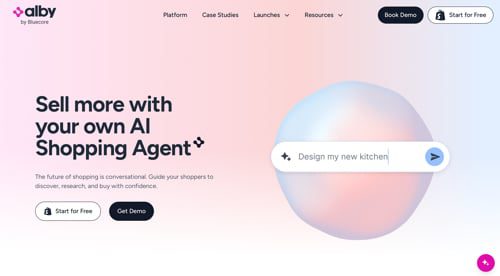
Alby introduces capabilities for AI shopping assistants.Alby, an AI shopping agent for ecommerce brands, has announced four tools — Product Advisor, Playbooks, In-Session Context, and Recommendations — to guide shoppers. According to Alby, (i) Product Advisor transforms product discovery into a conversational, human-like exchange, (ii) Playbooks enables brands to coach an AI agent using simple, natural-language instructions, (iii) In-Session Context enables the AI agent to remember what shoppers have already browsed, clicked, or searched during their session, and (iv) Recommendations enables contextual product suggestions to assist shoppers.
Alby
eBay updates tracking to reduce claims and improve customer experience.eBay has redesigned the tracking experience across Seller Hub and the buyer shipment flow. Seller Hub now offers a more consistent and intuitive tracking status visualization, such as on the View Order page, making it easier to manage shipments. Buyers view all deliveries for an order in a single, comprehensive view, including separate tracking for both outbound and return items. For delayed deliveries, buyers see a clearer status update to reduce uncertainty.
Meta launches enhanced marketing messages.Meta is introducing marketing messages on Messenger to help businesses re-engage and retain customers through chat. Businesses can (i) initiate promotional messages to people who have subscribed to receive them, and keep conversations going, (ii) add subscribers by leveraging existing CRM lists, custom audience lists, or ads that click to Messenger, and (iii) write messages for each customer, or broadcast one message to everyone. Down-funnel measurement helps businesses understand their results and inform their marketing strategy.
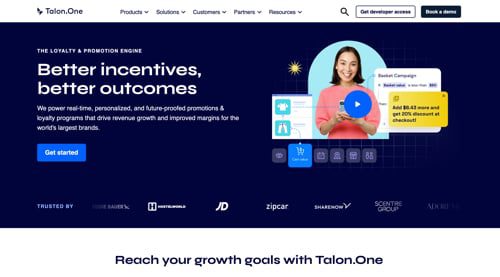
Talon.One secures $135 million for enterprise loyalty programs.Talon.One, an enterprise loyalty and promotion platform, has announced a $135 million funding round to deliver AI-powered intelligence and predictive insights. Participating investors include Silversmith Capital Partners, Meritech Capital, and existing investor CRV. With a headless architecture and intuitive Rule Engine, Talon.One says its loyalty and promotion software enables marketing and product teams to launch and manage any incentive through a unified system. Partners include Braze (an email and engagement platform) and Shopify.
Talon.One
Amazon Q Business launches customized responses.Amazon Q Business, a generative AI-powered assistant for finding information at work, has introduced response customization for Q Business applications, enabling organizations to tailor how their Q Business applications generate and format responses to user queries. With response customization, companies can provide instructions for identity, tone, and output style when configuring Q Business applications. This customizes the chat persona, communication formality, response length, and detail to match specific needs, per Amazon.
Finix launches WooCommerce plugin to simplify ecommerce payments.Finix, a payment processor for online and physical businesses, has launched its plugin for WooCommerce to accept credit and debit cards, ACH transfers, and Apple Pay. The plugin enables merchants to manage disputes, refunds, and ACH returns with built-in webhook support and real-time automation. Merchants can access interchange-plus pricing and get next-day deposits or same-day payouts.
Netcore Cloud launches Insights Agent for real-time marketing metrics.Netcore Cloud, a provider of AI-powered marketing automation and customer engagement, has launched Insights Agent, a marketing analytics agent that delivers campaign feedback instantly. According to Netcore Cloud, Insights Agent trains on marketing campaign data and contextual behaviors across email, WhatsApp, SMS, and push notifications. With AI-personalized recommendations, cross-channel intelligence, and instant access in Netcore’s UI, Insights Agent can reduce cognitive overload, reclaim valuable time, and enhance ROI across campaigns, per the company.
ShipStation launches features to optimize fulfillment operations.ShipStation, an ecommerce shipping platform, has launched four major feature updates to its logistics suite: Automated Rate Shopping, Returns and Exchanges, Analytics and Inventory, and Warehouse Management. Automated Rate Shopping allows businesses to find the most cost-effective and efficient delivery options without manual effort. The Returns and Exchanges update includes a branded customer returns portal and return management tools. Analytics includes seven new reporting dashboards. Inventory and Warehouse Management includes forecasting tools and lot tracking.
OpenAI has quietly added Shopify as a third-party search partner to help power their shopping search, which shows shopping-rich results. The addition of Shopify was not formally announced, but quietly tucked into OpenAI ChatGPT search documentation.
Shopify Is An OpenAI Search Partner
Aleyda Solís (LinkedIn profile) recently noticed that OpenAI had updated their Search documentation to add Shopify to the list of third party search providers.
“Ecommerce sites: I’ve found that Shopify is listed along with Bing as a ChatGPT third-party search provider! OpenAI added Shopify along with Bing as a third-party search provider in their ChatGPT Search documentation on May 15, 2025; a couple of weeks after their enhanced shopping experience was announced on April 28.”
OpenAI Is Showing Merchants From Multiple Platforms
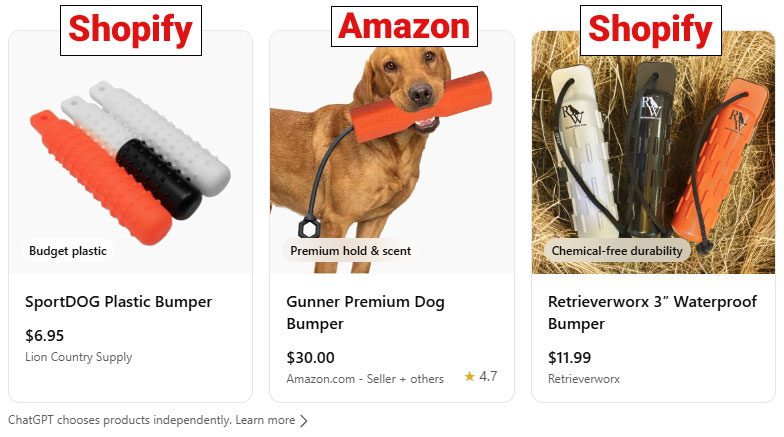
OpenAI shopping search is returning results from a variety of platforms. For example, a search for hunting dog supplies returns sites hosted on Shopify but also Turbify (formerly Yahoo Stores)
Screenshot Showing Origin Of OpenAI Shopping Rich Results
The rich results with images were sourced from Shopify and Amazon merchants for this specific query.
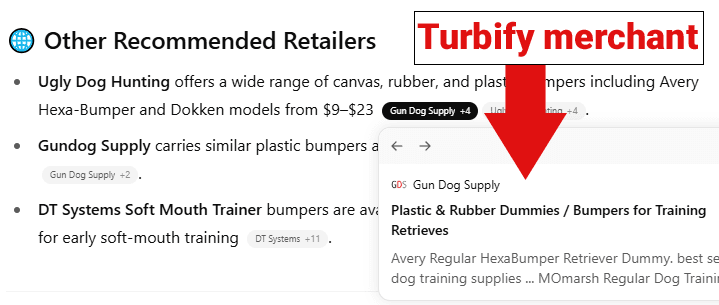
At least one of the shopping results listed in the Recommended Sellers is a merchant hosted on the Turbify ecommerce platform:
Screenshot Of OpenAI Recommended Retailers With Gun Dog Supply, Hosted On Turbify Platform
OpenAI Shopping Features
OpenAI recently rolled out shopping features for ChatGPT Search. Products are listed like search results and sometimes as rich results with images and other shopping related information like review stars.
ChatGPT Search uses images and structured metadata related to prices and product description, presumably Schema structured data although it’s not explicitly stated. ChatGPT may generate product titles, descriptions, and reviews based on the data received from third-party websites and sometimes may generate summarized reviews.
Merchants are ranked according to how the merchant data is received from third-party data providers, which at this point includes Bing and Shopify.
Ecommerce stores that aren’t on Shopify can apply to have their products included in OpenAI’s shopping results. Stores that want to opt in must not be opted out of OpenAI’s web crawler, OAI-SearchBot .
The old rules no longer apply. It’s time for a smarter, AI-ready playbook.
AI-driven search is changing the landscape fast. Organic traffic is dropping, visibility is shrinking, and traditional SEO tactics are losing their edge. If you’re still following yesterday’s strategy, you’re already behind.
Join Siteimproveon July 23, 2025 for an exclusive webinar with Zoe Hawkins and Jeff Coyle. Learn how to evolve your SEO approach and content planning to thrive in a world where AI now plays a central role in search.
Here’s what you’ll walk away with:
A breakdown of how AI is changing enterprise SEO.
Why trust and authority now matter more than keyword volume.
How to adapt to high-intent, low-volume traffic behavior.
We can no longer rely on the same tactics that worked before. This session gives you an inside look at how SEO must evolve to stay effective in the AI-first future.
Register now to stay ahead of the curve. Can’t attend live? Sign up anyway and get the full replay delivered to your inbox.
Today we’ve launched a redesigned onboarding experience for Yoast SEO for Shopify, built to guide, support, and empower every user from the moment they install. Customer-centric marketers and designers know, first impressions matter, and thoughtful onboarding is the first step to long-term success.
A new onboarding, designed with care
We’ve simplified the setup process, removed unnecessary steps, and introduced a guided, narrative-style welcome experience that makes it easier to get started and harder to get stuck.
Whether you’re new to SEO or scaling a large store, our goal is the same: help you feel confident from the first click.
“We wanted users to land in the onboarding flow and immediately understand two things: how the app can help them improve their Shopify store’s SEO, and what steps to take first to see results.” Tom Ottjes, UX Designer at Yoast
Behind the scenes: Service design in action
This onboarding redesign isn’t just a UI refresh, it’s the result of a service design approach that included:
Journey mapping based on real user behavior
Cross-functional collaboration across UX, development, support and marketing using service blueprints
Strategic improvements to both front-end and back-end processes
Want to learn how a single blueprint helped align our teams and reshape the onboarding experience?
We’re already working on the next phase of improvements designed to improve our customers’ experience, including smarter in-app guidance and contextual feature onboarding.
Thanks to everyone who shared feedback along the way. Keep it coming, we’re listening, learning, and building better together.
Beth is Product Marketing Manager at Yoast. Before joining the company, she honed her digital marketing and project management skills in various in-house and agency environments.
First impressions stick, especially in UX. When we saw that new users of our Yoast SEO for Shopify app were skipping key steps or dropping off early, we knew our onboarding wasn’t working. Using journey mapping and service blueprints, we redesigned the experience to be faster, clearer, and more supportive from the start. Here’s how small, well-timed changes made a big difference.
Table of contents
Launching an improved onboarding experience
We recently launched a redesigned onboarding experience to help Shopify merchants set up for success. Behind that update is a bigger story: how thoughtful UX decisions, team-wide alignment, and service design methods reshaped the user experience. And we mean that in the broadest sense, from discovery to giving users the feeling that the app is working for them and helping them succeed.
In this interview, we spoke with our UX designer, Tom Ottjes, who led the project to unpack that process. His answers will offer a closer look at the problems we needed to solve, the tools he used to communicate across teams, and the omnichannel changes that made the biggest difference.
Before you start reading, here’s a quick animation showing the various parts of the service blueprint we worked on. Of course, there’s much more, but we cannot show you everything.
From patterns to priorities
Before redesigning a single screen, the team needed a way to understand and communicate what wasn’t working. They needed to uncover what had to change to fix the experience for people in a way that also helped us achieve our company goals. That’s where service design tools, particularly customer journey maps and service blueprints, came in.
Customer journey mapping helped visualize what users were experiencing from discovery through installation and first use. It highlights not only the steps customers take but also where they become confused, hesitant, or drop off. Based on support conversations, surveys, and analytics, the journey map revealed several issues. One of those issues was a lack of early guidance, which led to missed configuration steps, among other things.
Before we moved on to action, we wanted to define success by determining KPIs. This is an essential step. It will help shape the direction of the service and experience you will be designing. Instead of viewing onboarding as just a UI problem, the service blueprint mapped every user action alongside the systems, processes, and people behind them. This included content, customer support, notifications, and working within Shopify’s own platform constraints.
Because it connects what’s visible to the user with what happens behind the scenes, a service blueprint became central to the project. It gave every team, from UX to development, support, and marketing, a shared reference point. By mapping each phase as its own blueprint, the team could prioritize quick wins while keeping an eye on a longer-term onboarding vision.
It turned a complex, cross-functional issue into something everyone could contribute to. The blueprint helped make improvements easier to design, build, and test in smaller, clearer parts.
A real example: Turning uncertainty into reassurance for larger stores
One of the more surprising and important insights from our service blueprinting process was about scale. We discovered that while the app felt fast and responsive for smaller Shopify stores, larger ones had a very different experience. For shops with tens of thousands of products and pages, the initial processing and indexing step could take anywhere from several minutes to a few hours.
The problem? We weren’t telling users that. Small stores would see their data reflected almost instantly. Large stores would land on a blank dashboard, with no indication that the system was still working in the background. From the user’s perspective, it looked like nothing was happening.
We addressed this with a series of small but intentional changes. First, we introduced a proper loading state with messaging acknowledging what was happening. Then, we added an email field to that screen, giving users the option to be notified when setup was complete. When they enter their email, they receive a confirmation message once everything is ready.
It’s a small detail, but one that shifts how the experience feels. Instead of confusion or doubt, users now get feedback, a sense of transparency, and a way to re-engage later. And for us, it’s a concrete example of why aligning the front-end and back-end through service design actually matters.
Meet the designer
Meet the UX designer: Tom Ottjes
This interview is with Tom Ottjes, one of Yoast’s UX designers. He led the onboarding redesign for our Shopify app and was co-responsible for designing the Yoast AI features. With several years of experience working across product and marketing, his approach centers on translating user behavior into actionable design. Much of his work focuses on simplifying complex flows, improving user guidance, and helping teams understand the customer journey.
Tom, what problem were you seeing that made this project a priority?
With our Yoast SEO for Shopify app, we strive to deliver real, tangible value to our users. That starts with understanding their experience from the moment they install the app. Through a combination of user surveys, interviews, support request analysis, and product analytics, we began to see clear patterns emerge.
There were three main friction points we kept hearing and seeing:
A lack of guidance: Many users simply didn’t know how to use the app effectively. They installed it but weren’t sure what to do next to optimize their store.
Unclear value delivery: We noticed that crucial steps, like completing the ‘Site representation’ settings, which unlock immediate SEO benefits, were often skipped. That told us users weren’t seeing the connection between setup actions and real results.
Hesitation to engage with the free trial: Users were wary of testing the app, unsure of what the trial included or whether it was truly risk-free.
All of these insights pointed to one thing: the onboarding experience wasn’t doing its job. It wasn’t guiding, reassuring, or demonstrating value early enough. We visualized all these issues in a detailed customer journey map, helping us to zoom out and see broader patterns. We found different user types, where they dropped off, and what confused them. That map became a key alignment tool and helped us frame the onboarding redesign as a top-priority project.
What would success look like for you from the user’s perspective?
From the user’s point of view, success meant feeling confident and supported from the very first interaction with our app. We wanted users to land in the onboarding flow and immediately understand two things: how the app can help them improve their Shopify store’s SEO, and what steps to take first to see results.
That meant offering a smoother, more intuitive experience. An experience that clearly communicated value upfront, provided improved guidance around initial setup steps, and highlighted key features. It should also assure users that trying the app was safe and worthwhile.
First, we wanted to help users quickly understand the full value of the app. In addition, we wanted users to complete key onboarding actions such as filling out their ‘Site representation’ settings and exploring core features relevant to their store. Emotionally, we aimed for a sense of clarity, trust, and motivation to continue.
Ultimately, if a user could say, ‘I know exactly what this app does, what I need to do, and I can already see it working for me,’ then we knew we were on the right track.
The new onboarding helps introduce the app and guides the user through the set up
Can you explain your service design process and how it helped the teams?
After mapping the current onboarding journey and identifying the key pain points, we knew we didn’t just need a better UI. We needed a more holistic service experience. That’s where service blueprinting came in.
We started by defining clear KPIs to measure the impact of our changes, such as completion rates for critical onboarding steps, time to value, and feature discovery. These metrics gave us a shared definition of success and helped shape the direction of the user experience.
Then we used the service blueprinting method to reimagine onboarding as a complete service. A service blueprint maps the relationships between people, processes, and touchpoints tied to a customer journey. It helped us visualize both what the user sees and everything happening behind the scenes to support that experience, from content strategy to customer support workflows to engineering requirements.
This systems-level view was essential in aligning multiple teams, like UX, development, marketing, and support. Everyone could see how their work connected to the user’s experience and where coordination was needed. It also helped us identify internal gaps, inefficiencies, or dependencies early, so we could design around them.
To move quickly and deliver value incrementally, we broke the optimized onboarding journey into phases, prioritizing what would have the most immediate impact for users. That approach lets us ship improvements faster while staying grounded in a long-term vision for the onboarding experience.
We approached the whole effort using a service design mindset. We zoomed out to understand the system users interact with, not just the screens they see. Service blueprinting helped us take what users were experiencing (empathy and insight), identify internal blockers, and structure releases around clear hypotheses. It wasn’t just about delivering onboarding, but about improving the service behind it.
How are you tracking whether it’s helping users get started faster?
From the start, we knew that redesigning onboarding wasn’t just about launching something new. We wanted to prove it made a difference. So, we defined clear KPIs to measure the impact of our changes. To make this measurable, we built the tracking infrastructure needed to monitor user behavior at each step.
But we didn’t stop at numbers. We also incorporated qualitative customer listening tools, things like in-app feedback, support conversations, and interviews. As we wanted to understand how users feel as they move through onboarding.
Are there still improvements to make?
Absolutely, because onboarding is never truly ‘finished.’ It’s an evolving experience, and we see it as a continuous opportunity to better support our users.
The next phase of our optimized onboarding journey will focus on deepening the guidance we provide, helping users go beyond setup and start making more meaningful improvements to their store. We’re looking at how we can better surface insights, suggest next steps based on context, and empower users to unlock even more value with confidence.
While I can’t share all the details just yet, I can say this: we’re not stopping at getting users through the door. We’re focused on helping them thrive once they’re inside.
Good things are coming. As always, we’re listening closely to our users to make sure what we build truly meets their needs.
Pro tips for getting started with service blueprinting
Thinking of using service blueprinting in your own work? Here are a few things that helped us:
Start with a real journey: Mapping is most useful when it’s grounded in actual user behavior. Use support data, interviews, and analytics to anchor the blueprint in real problems.
Define what “success” means upfront: Before mapping, align your team on what outcomes you’re working toward (e.g., faster time to value, fewer drop-offs).
Map front-end + back-end: Don’t just track what users see. Include internal systems, support workflows, engineering dependencies, and anything that influences the experience.
Keep roles visible: Show which team is responsible for which process. It keeps conversations focused and collaboration smoother.
Don’t overcomplicate: A blueprint doesn’t need to be a polished artifact. Start simple. The value is in getting teams aligned, not in how it looks.
Blueprinting doesn’t replace good UX research or design, but it’s a powerful way to connect them to the broader experience. If you’re working on anything cross-functional, it’s absolutely worth trying.
A shared understanding drives real change
This project wasn’t just about shipping a new flow. We wanted to design with a clear, shared understanding of our users and the processes that support them.
Our service blueprint turned out to be a great tool to align teams around a single goal: helping users quickly see the value of the Yoast SEO for Shopify app. Along the way, we uncovered friction, mapped dependencies, and built toward something more consistent, supportive, and effective.
Thoughtful onboarding is the start of everything that follows. By making those early minutes feel clear, calm, and grounded in real outcomes, we’ve not only improved setup times and reached our KPIs but also changed how we work, design, and listen together.
The work continues, focusing on feature onboarding, improved guidance, and even future WordPress experiences. Together, we’ll apply these lessons from now on. We’ll design by putting users first, build teamwork on transparency, and create experiences that guide, not just onboard.
Edwin is an experienced strategic content specialist. Before joining Yoast, he worked for a top-tier web design magazine, where he developed a keen understanding of how to create great content.
If you’ve been affected by AI Overviews, traffic drops, or feel uncertain about SEO’s future, then this episode is for you.
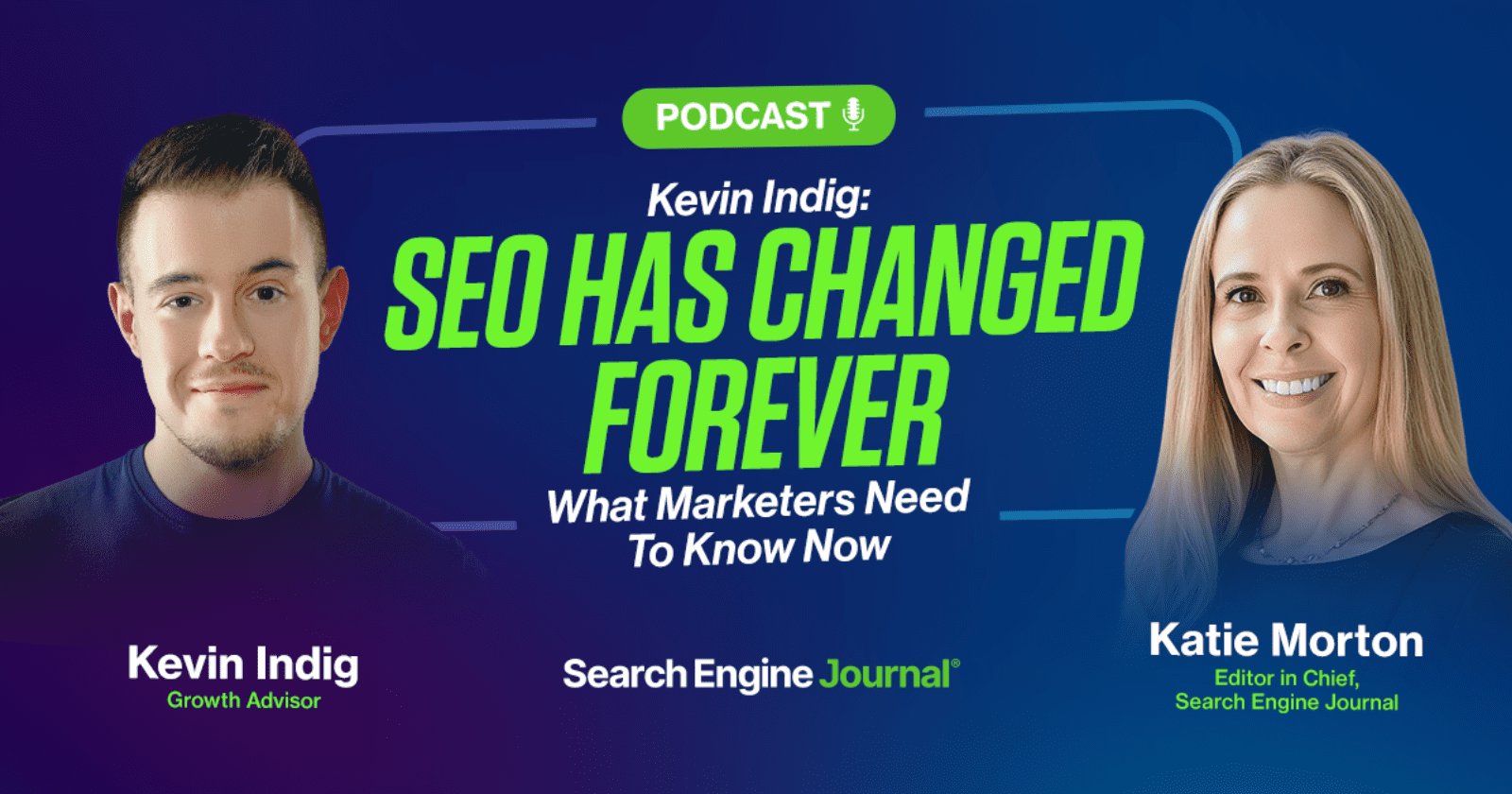
Search Engine Journal’s Editor-in-Chief Katie Morton sits down with growth advisor and author of “Growth Memo,” Kevin Indig, to unpack the results of his latest AI Overviews study.
In this 35-minute episode, they discuss how it impacts search, SEO, and brand marketing in 2025.
Editor’s note: The following transcript has been edited lightly for clarity, brevity, and adherence to our editorial guidelines.
What AI Overviews Mean For Search, SEO & Brand Trust
Katie Morton: Hi, everybody. It is I, Katie Morton. I’m the editor-in-chief of Search Engine Journal, and today I’m sitting down with Kevin Indig, who is a growth advisor to fast-growing tech companies and the author of “Growth Memo,” a fantastic newsletter.
We syndicate it here on Search Engine Journal, but sign up for it directly, too, because he has content exclusive to subscribers. It’s filled with smart insights every marketer needs to know.
Kevin, thanks for making the time today. The study was analyzed in March-April 2025 and published in May. We’ve had time to reflect, and today we’ll unpack the key takeaways.
We’ll start with the nuts and bolts of the study’s background, so listeners understand the context, and then go beyond the data to explore how marketers and companies, especially those frustrated by Google, AI Overviews, or traffic drops, can respond.
So, Kevin, can you summarize the study and share the main takeaways?
Kevin Indig: Thanks for having me on, Katie. It’s great to be here with you.
What The AI Overview Study Really Reveals
Kevin: The study came from a desire to deeply understand, from a qualitative perspective, how everyday users interact with AI Overviews.
In 2024, everyone was eyeing AI Overviews with curiosity, but traffic impact wasn’t significant yet. Then, at the start of 2025, everything changed. It became a “holy cow” moment – this was real and serious.
We asked 70 participants in the U.S., across different age groups, to solve eight tasks that covered dominant user intents: Finding a tax accountant, researching medical questions, shopping, etc.
We intentionally included queries that showed AI Overviews but didn’t tell participants to interact with them – we wanted unbiased behavior.
So, in a nutshell, the three most poignant results are:
1. Classic Organic Results Still Carry Weight
First of all – and this is no surprise – clicks are really rare when people see AI Overviews. That’s gotten through to everyone by now.
And yet, at the same time, classic organic results still have the majority of impact on people’s completion of user journeys.
Let me untangle that for a second: What we found is that people get their final answer – the final piece of information they were set out to get – 80% of the time from classic organic results. Not from AI Overviews, so that was encouraging.
2. High-Quality Clicks Happen In High-Trust Moments
Clicks are going down, but people still click. And each of those clicks has much, much higher quality than, say, in 2024 or before.
Because those clicks are to verify whether the results are accurate, to get human input from platforms like Reddit or YouTube, and to increase confidence in whether what the AI is saying is true.
And for us, that means it’s critical to be present in these high-trust, high-risk moments. I can unpack that a little more…
3. Audience Age Shapes AI Engagement
The third result I found very interesting is that there really is an age difference here. [Younger users] are much more receptive to AI answers. They’re much more active on Reddit and YouTube. Whereas people of a higher age will often just skip the AI answers because they don’t trust them.
You want to know who you’re talking to, who your target audience is. Ideally, what the age group is of your ICP or your target audience, and then make SEO decisions accordingly.
Why Branding Matters More Than Ever
Katie: Thank you for that. What I’d love to talk about next is branding.
I feel like big brands are a little safer with recent developments. If you already have recognition, you’re in a better spot. But if you’re a tiny brand with no recognition, you’re really behind the eight ball.
For the uninitiated or the uninformed, [you might wonder], why is that important? It’s about trust.
When someone sees your brand in an AI Overview, recognition boosts trust. If they click on an AI Overview or scroll to find organic results, they’re more likely to trust and click a name they know. A strong brand increases your chances.
Mordy uses the example of Nike, which was once ubiquitous, but has lost some relevance. Younger generations aren’t as loyal or aware of the swoosh anymore.
So, for big brands, maintaining confidence and trust is critical. For small or new brands, or brands that never had strong recognition, can they still gain traction?
Kevin: You can get traction … but it’s really challenging.
One challenge is that multiple teams need to work together: product, innovation, marketing, support, supply chain. SEO doesn’t control all these variables. It’s always been a discipline of recommendations, relying on others to act.
So, you always were relying on other teams, and that has 10x’d now with AI. Because, as you said, brand, brand perception, and sentiment are so critical to how you appear in search results or answers.
And it goes back to so many different touch points with a brand, not just the logo that people see or the advertising, but also the product that they use, retention, all that kind of stuff.
SEOs need to show other departments where issues lie, using click-through rates, brand search volume, and engagement metrics as signals. They must communicate the story and rally other teams.
But that often runs into cost concerns. Asking for a new call center to improve support has big budget implications, and quantifying ROI is tough.
So, SEOs must push beyond the Google channel and influence company strategy. It’s incredibly difficult to influence.
Katie: Absolutely. And speaking of SEO being declared “dead,” I’ve heard that every few years in my 20 years in the industry, but this is the first time I’ve felt a credible threat.
SEO will never truly die. It’s discovery, and discovery is always needed, but it’s definitely changing. It used to be the most cost-effective marketing channel. Now, ROI is less certain, and budgets are contracting.
But there’s a silver lining. A lot of low-quality, general content meant just to drive mass page views is getting weeded out.
For example, we used to rank for “What is E-E-A-T?” and get tons of unqualified traffic. With AI Overviews answering those general queries now, traffic is down, but the remaining traffic is far more qualified. That’s better for conversions.
It’s hard for publishers who relied on brute-force clicks. But for us, shifting away from programmatic and toward advertisers aligned with our audience, like SaaS, has worked. The industry is changing massively.
So, what do you think is next for SEO and marketing?
The New Role Of SEO In A Changing Landscape
Kevin: You hit it on the head. SEO is contracting; budgets are down, leadership confidence is down, and when people leave, their roles often aren’t replaced. SEO has died and reinvented itself many times.
I see that we’re using a lot of SEO also for AI visibility optimization. I do expect that to change, but however you flip it, we are in a transition period. And the problem with transition periods is that they’re hard to navigate. You lose orientation, and it’s painful.
Once you settle at a new baseline, you just run around a little headless, and you try to find your way. And then slowly, things kind of start to settle back in.
And so I’m very confident that whatever we’re going to call this, we’re going to settle into a new baseline. It might take a while. This is not going to stop in the next six months – probably not twelve months. But it’s hard to predict when.
Based on how quickly models improve and how quickly humans adapt to them, that will decide the pace of this transition.
However, there are also many opportunities in transitions. You can reinvent yourself. And that’s where, as SEOs, we might lose the SEO budget, but maybe we gain some brand budget, which has been much, much bigger in the past.
You see companies spending millions of dollars for multi-year contracts for a tiny logo that sits somewhere on a Formula 1 car. These things happen all the time.
There’s a big opportunity for SEO to detach from that unwanted profiling as a performance channel – detach ourselves from being a performance channel, and become much more of a brand channel, influence channel, presence channel – whatever you want to call it.
New metrics. New levers. Deeply rooted in SEO. And effective and powerful, but kind of in a new design, right? Like SEO 2.0. Whatever you want to call it.
And I do agree with you. I also see people who’ve been in the game for a long time stepping out. Totally get that. I see young people losing a bit of confidence.
But I will also say that I would like (but wouldn’t admit) that there’s a little part of me that’s kind of excited for all this change.
Because it’s an opportunity to kind of reshuffle the cards, find out new stuff, maybe find some secrets, and kind of reverse engineer what’s going on.
When you look at the last just 10 days where multiple people and companies found new ways to reverse engineer what queries Gemini uses and ChatGPT uses, I’m like, man, it’s awesome to see how adamant the industry works on developing the new playbook, dissecting how these mechanics work and LLMs work, and finding new ways.
So, I have high confidence, and I also have a lot of empathy for all the pain and the kind of problems that this industry is going through. But again, I see us coming out the other side at some point in like a new design – and with a lot of impact.
Katie Morton: I love it. I agree with the empathy as well. Because everyone in marketing, it seems, has lost their mind a little bit over the past year or two with these shifts in traffic.
But that Wild Wild West environment is also really exciting because there are going to be all of these developments.
And if people are calm and they persevere and they do the work to figure these things out, either for themselves or to watch what those researchers are finding, people will be okay, right?
Kevin: We always are. Sorry to cut you off there, but there’s a really important point to make here that I didn’t make – and that is: It’s not just search that’s changing.
SEO is at the forefront of AI. At the absolute forefront. Because it’s about words, and it’s about search, and search is kind of the biggest interface between AI and humans right now.
So it’s not just search that’s changing. Marketing is completely changing. And like, all of our lives are completely changing.
Sure, this will take years to trickle through, maybe not even to the degree we’ve thought of it, but it’s pretty clear that AI is at least as revolutionary as the internet. Maybe even the most revolutionary invention that humanity has made so far.
So let’s not forget: Everything is changing. It’s not just us SEOs. It’s all the channels. It’s marketing as a whole.
Modes and levers are disappearing, and new ones are coming up. We’re feeling it deeply in SEO, as being kind of the front line of AI. But make no mistake, this will trickle through to all the paid channels, product, everything.
Everybody is in a state of shock right now, trying to figure out what the new branches are to hold on to and then build on top of. Marketing as we know it is over. LLMs are transforming how they reach us.
Katie: This affects every channel. At SEJ, we’ve collapsed editorial and marketing into one integrated team. It used to be SEO and editorial here, marketing over there, and no one really talked. That doesn’t work anymore.
Now, everything is more cohesive and focused on the ICP and conversion. It’s better for customers and for teams.
Kevin: 100%. I talk to all my clients about this. SEO and paid search should’ve always been connected, but they were siloed, same with product, email, social, etc.
I mean, look: Realistically and ideally, SEO and paid (or paid search) have always been connected at the hip. But I’ll tell you, at least across almost all the companies that I’ve worked with, they were siloed.
The same exists with all these other teams, like product marketing or social media, conversion, and email – all that kind of stuff.
Now’s the time to rip off the band-aid. There can be small teams of maybe an SEO, an editor, an email person, a social person, and maybe a very technical person who can quickly prototype new apps, programs, or tools.
The biggest challenge now is internal red tape. AI is a speed catalyst, but companies’ old workflows slow them down. Big organizations are stuck.
I’m urging clients to form these multi-disciplinary units under one manager, one roof, one mission.
Reaching People Everywhere Requires A Bold Shift To Other Platforms
Katie: Awesome. One last point: other platforms. For too long, people relied too heavily on Google. Diversifying traffic sources – ads, social, newsletters – is now essential. Holistic marketing is the future. What are you seeing [that is] working right now?
Generally speaking, where do people live these days? Where are humans hanging out, and where do we find them? What are the success metrics that you’re seeing?
Kevin: The short answer is: Everywhere.
Katie: Good luck, everyone. Okay, good night. That’s the show!
Kevin: No, but the reality is, everywhere. There’s this interesting paradox. I need to coin this term somehow, but this interesting paradox that basically all the social networks are growing. And new ones are popping up, right? TikTok – I mean, it’s not that new anymore, but it’s still growing. Reddit is becoming much more of a household name now.
And so you ask yourself, what gives? Sure, linear TV’s down, okay. But how is this possible? And the reality is: People are online all the time – speaking for a friend – and they use a lot of platforms at the same time.
So, the best teams, or the companies that are making a big impact, they have this surround sound effect that they’re creating, where they’re present in a lot of places. They engage authentically, say, on Reddit.
When good companies engage on Reddit, it doesn’t feel like marketing. It’s not marketing, really. It’s much more like trying to be helpful, more like customer support or success.
That’s why these people are generally very well-suited to interact on Reddit. They truly add value. They’re truly part of the conversation.
Brands are repurposing their content in a very thoughtful and high-fidelity way, where maybe they create a blog article, turn it into a video, turn it into clips, which then turn into questions they answer on Reddit. There is this kind of everywhere strategy. AI really helps with that.
And I will also say it’s typically not companies that are getting stuck at the quantification-of-impact question. The reality is that steering an organization or a company toward that multi-channel effect – or that surround sound effect – takes a swing.
It takes a leader to say, “Okay, we’re going to spend some money and take six months, and we’re going to invest in Reddit and YouTube, and we’re going to wait for the results to come in. We’re not going to sit there every day refreshing the dashboard asking, ‘How many sales have we generated yet?’”
It takes a bit of a swing. And so it’s defining for this era, for this transition period, where it’s much harder to project and forecast where you’re going to land with some of these things.
It takes judgment and taste and a certain degree of risk-taking to invest in these channels and functions, and being comfortable, or at least okay, with waiting for some of the results to come in and being able to measure them later.
I’m not saying you should wait a year or two. But give it two quarters, maybe three quarters, and experiment with some of these channels.
So, that’s where people are – people are everywhere. It’s not enough to just have one shot at one platform. You need to be kind of everywhere.
And repurposing can help. Using AI with some of these things helps. But at the end of the day, you need to take a swing.
Katie: Very wise, Kevin. One of those things that I found highly annoying is that you can run these experiments, and you’re going to wait for your results, and then before your experiment is even done, everything’s changed again.
Kevin: Exactly. Predictable methods are gone. You take swings, and some won’t connect because conditions change. The best leaders, the best teams – a lot of times, they take a lot of swings.
Because some of those swings will hit full force, and it’s kind of a skill to build.
Katie: Yeah, I couldn’t agree more. We’ve implemented monthly experiments at SEJ. Every department runs one. It could be layout, content type … constant iteration. I tell the team: soft knees. Be ready to shift. There’s no “set it and forget it” anymore.
Kevin: Yes, yes. On point. Allow people to fail. Another good skill is being able to take meaningful risks. I’m not saying bet the farm, but as a leader, if you want to encourage your people to take risks, let them.
Again, that doesn’t mean to blindly shoot in all directions. You want to have some thought behind that, some judgment. You want to be critical. But there has to be a point at which you let go.
Katie: That is a really perfect point. We tie experiments to north-star metrics. For us, one is newsletter subscriptions, so most of our experiments support that. We’ve seen great success, not always in raw traffic, but in conversions and revenue.
Kevin: Amazing. Congratulations on that.
Katie: Thank you. All right, Kevin, any parting remarks before we head out?
Kevin: I’m hearing a lot of very concerned SEOs. Concerned about “How do I tell this story?” or “How do I manage my boss or leadership in this time where traffic is down?”
I want to send out some courage. This is one of the biggest shifts I’ve lived through in my life. I would bet it’s probably the same for most, if not all, of the audience.
So, this is maybe the time to make some changes and have some grace about finding a new playbook.
I’m seeing a lot of SEOs very scared about this. I get the initial fear. But again, this is such a substantial, fundamental change. It’s okay for things to look different. It’s okay for you not to have the answer right now. Be honest with leadership. Push back if needed.
Katie: Focus on new metrics, not just UVs or PVs, but ones that connect to business goals. That’s where the story of success will be told.
Kevin: Exactly.
Katie: Thanks again, Kevin. Where can people find you?
Kevin:growthmemo.com, or just search for “Growth Memo.” That’s my main hub.
Katie: Awesome. We’re at searchenginejournal.com. See you next time!
Kevin: Thanks for having me.
More Resources:
Featured Image: Paulo Bobita/Search Engine Journal
In this week’s Ask An SEO, a marketing manager asks which SEO skills are most valuable to look for in candidates today, especially with AI in the mix:
“I’m a marketing manager who’s been tasked with hiring our first in-house SEO specialist.
With AI tools becoming more prevalent, what skills should I prioritize when interviewing candidates in 2025? Are traditional SEO skills still as valuable, or should I focus more on candidates who can work alongside AI tools?”
This is a great question, and one I imagine a lot of hiring managers in the marketing industry are asking themselves.
For years, we’ve been looking for SEO professionals with skills that will help our websites thrive in Google, Bing, and Yandex. But, what skill set is needed for the emerging markets of ChatGPT, Perplexity AI, and Claude?
And what about keyword research, content creation, and technical audits? Are they still useful activities for SEO professionals to carry out manually when there are so many AI tools purporting to be able to do this for you now?
What Traditional SEO Skills Are Still Needed
We often think of skills within traditional SEO fitting roughly into three categories: technical, content, and authority-building. Are these still needed in the era of large language model (LLM) platforms and tools?
If the bots can’t access the pages you want to have ranked, can’t read the content on them, or find the page to be unfriendly for users, you will struggle in the traditional search engine results pages (SERPs).
Technical SEO skills will continue to be important to online visibility in the new era of organic discovery.
An excellent SEO will be someone who can utilize AI tooling to automate and speed up the checks they are already performing. The really valuable technical SEO skills will still be analyzing, prioritizing, and communicating the issues when they are discovered.
Good technical SEOs have been looking at ways to automate their processes using Python and Structured Query Language (SQL) for a while now.
AI is enabling them to do this quicker, and for those who are newer to those languages, to automate their processes more easily.
Hire SEO specialists who are excited to use AI tools to enhance their work, not replace it entirely.
You will still need SEO pros to be creative in problem-solving and working within the confines of your organization’s technology, resources, and capabilities.
AI-written content has been a hot topic for a couple of years now. Can AI replace human writers? Should you hire with content creation and marketing skills in mind, or can you leave that purely to AI now?
I would suggest that any SEO hire you make needs to understand how to craft engaging copy that clearly defines the brand and meets the needs of users at each stage of the buying journey.
This hasn’t changed much from when SEO pros brief writers and graphic designers in content creation. We still need SEO specialists to understand how to request engaging content, whether that be through AI or human creators.
The ability to define what will be engaging content through research (whether keywords or prompts) and how users engage with it (whether on the brand site or within the LLM’s answer) is still critical.
Previously, there was an evolution in SEO from regarding authority building as getting backlinks by whatever means necessary, to acquiring links through engaging and relevant content.
For optimization in LLMs, the desire is more to cement a brand’s positioning and sentiment through mentions on other authoritative websites.
The skill set needed to acquire authoritative links through digital PR will not be that different from what’s needed to acquire mentions.
In fact, good digital PRs have recognized for a while now that brand mentions are valuable in their own right.
There is a need to understand the publisher who is being targeted, what they write about, when best to contact them, and how. This could well be automated to a good degree by AI.
However, the really excellent PRs build up relationships with their contacts, so they are front-of-mind when a story is breaking. This is something AI will struggle to replace.
When hiring for the digital PR side of SEO, look at their relationship-building skills in particular.
AI has (thankfully!) taken much of the pressure off SEO professionals to be efficient mathematicians, proficient in Excel formulae, or, at least, having a good percentage calculator tool bookmarked.
Summarizing increases and decreases in key performance indicators (KPIs) is something AI can handle. It can highlight correlations between metrics and identify likely causes. AI can also summarize this all into a compelling report.
But, it still needs a human to determine if its recommendations are valid and a viable course of action.
A good SEO will be someone who can utilize the AI tools to draw conclusions and highlight issues, while retaining strategic oversight.
Strategy
That leads on to strategic skills. Good SEO pros will be able to utilize AI tooling for processes while drawing on their own deep contextual understanding and common-sense reasoning.
Hire SEO professionals who are adept at considering the moral and ethical implications of marketing and who can adapt to novel situations.
AI tooling will not be able to build trust with senior stakeholders. It will not be able to inspire and influence them. It definitely will not be able to manage egos and emotions like a good SEO has to.
Skills That Help In Emerging Markets
Beyond the skills that we’ve long been looking to hire for in SEO, it’s important to find people who are able to thrive in a burgeoning environment.
Great SEO pros have been cultivating these skills throughout their careers. Bad SEO professionals have scraped by on second-hand knowledge and following templated procedures.
Experimental Approach
Make sure they have the ability to experiment and apply their learnings.
We’re entering a new phase of SEO where what worked before might not work again. There are no experts in GEO yet; we’re all having to learn as we go along.
Make sure your candidates are willing to learn from trial and error.
Understanding Of How To Work With Uncertainty
The days of following an audit template are both long-gone and a way off. We can’t just apply what we know from SEO directly to GEO.
We need to learn what works in those new platforms. That means good SEO pros are going to have to be comfortable with the uncertainty in their industry again.
Seasoned SEO professionals will remember back to this during their formative years in the industry, but newer SEO specialists will need to break free of the “this is what works for SEO” mentality and be OK with adapting on the fly more.
Ability To Problem Solve And Investigate
This means they will really need to be keen problem-solvers. SEO, at its root, has always been about problem-solving.
With the suite of AI tooling growing, the temptation to delegate critical thinking to a machine will be great.
However, SEO pros will still need to be able to take a step back, consider all the context and angles, and work toward a solution given the resources and constraints they face.
This means that they cannot rely solely on AI to help them.
You need someone who can work alongside AI tools as well as having traditional SEO skills.
The experience and qualities of a seasoned SEO professional will still be extremely useful in the emerging world of LLMs and AI tooling.
It would be a risk to your organic performance if you hire solely based on whether the candidate can utilize AI tools well.
However, you do want to make sure the SEO pro is using all of the advantages that AI can bring. They need to be able to adapt to new technology and processes.
How To Interview For SEO Skills That Complement AI Solutions
The curiosity about new technology. The desire to experiment and adapt. Having an open mind to change. These are all attributes of good SEO professionals that are more important now than ever before.
When considering whether an SEO professional is a likely good fit for your role, find out their approach to new situations.
See how they have adapted in the past to changes in SEO that needed a change of tactics.
Ask them how they have diagnosed and responded to algorithm updates, or expanded their skill sets to include social media search engines.
Summary
In essence, the need for traditional SEO skills is not diminishing. However, great SEO professionals will be those who can adapt their skill set to work in GEO, as well as make the best use of new AI tooling available to them.
Alongside that, problem-solving, experimentation, and a keen strategic approach are what to look for in your next SEO hire.
More Resources:
Featured Image: Paulo Bobita/Search Engine Journal