Meet Jim O’Neill, the longevity enthusiast who is now RFK Jr.’s right-hand man

When Jim O’Neill was nominated to be the second in command at the US Department of Health and Human Services, Dylan Livingston was excited. As founder and CEO of the lobbying group Alliance for Longevity Initiatives (A4LI), Livingston is a member of a community that seeks to extend human lifespan. O’Neill is “kind of one of us,” he told me shortly before O’Neill was sworn in as deputy secretary on June 9. “And now [he’s] in a position of great influence.”

As Robert F. Kennedy Jr.’s new right-hand man, O’Neill is expected to wield authority at health agencies that fund biomedical research and oversee the regulation of new drugs. And while O’Neill doesn’t subscribe to Kennedy’s most contentious beliefs—and supports existing vaccine schedules—he may still steer the agencies in controversial new directions. 

Although much less of a public figure than his new boss, O’Neill is quite well-known in the increasingly well-funded and tight-knit longevity community. His acquaintances include the prominent longevity influencer Bryan Johnson, who describes him as “a soft-spoken, thoughtful, methodical guy,” and the billionaire tech entrepreneur Peter Thiel. 

In speaking with more than 20 people who work in the longevity field and are familiar with O’Neill, it’s clear that they share a genuine optimism about his leadership. And while no one can predict exactly what O’Neill will do, many in the community believe that he could help bring attention and resources to their cause and make it easier for them to experiment with potential anti-aging drugs. 

This idea is bolstered not just by his personal and professional relationships but also by his past statements and history working at aging-focused organizations—all of which suggest he indeed believes scientists should be working on ways to extend human lifespan beyond its current limits and thinks unproven therapies should be easier to access. He has also supported the libertarian idea of creating new geographic zones, possibly at sea, in which residents can live by their own rules (including, notably, permissive regulatory regimes for new drugs and therapies). 

“In [the last three administrations] there weren’t really people like that from our field taking these positions of power,” says Livingston, adding that O’Neill’s elevation is “definitely something to be excited about.”

Not everyone working in health is as enthusiastic. If O’Neill still holds the views he has espoused over the years, that’s “worrisome,” says Diana Zuckerman, a health policy analyst and president of the National Center for Health Research, a nonprofit think tank in Washington, DC. 

“There’s nothing worse than getting a bunch of [early-stage unproven therapies] on the market,” she says. Those products might be dangerous and could make people sick while enriching those who develop or sell them. 

“Getting things on the market quickly means that everybody becomes a guinea pig,” Zuckerman says. “That’s not the way those of us who care about health care think.” 

The consumer advocacy group Public Citizen puts it far more bluntly, describing O’Neill as “one of Trump’s worst picks” and saying that he is “unfit to be the #2 US health-care leader.” His libertarian views are “antithetical to basic public health,” the organization’s co-president said in a statement. Neither O’Neill nor HHS responded to requests for comment. 

“One of us”

As deputy secretary of HHS, O’Neill will oversee a number of agencies, including the National Institutes of Health, the world’s biggest funder of biomedical research; the Centers for Disease Control and Prevention, the country’s public health agency; and the Food and Drug Administration, which was created to ensure that drugs and medical devices are safe and effective. 

“It can be a quite powerful position,” says Patricia Zettler, a legal scholar at Ohio State University who specializes in drug regulation and the FDA.

It is the most senior role O’Neill has held at HHS, though it’s not the first. He occupied various positions in the department over five years during the early 2000s, according to his LinkedIn profile. But it is what he did after that has helped him cultivate a reputation as an ally for longevity enthusiasts. 

O’Neill appears to have had a close relationship with Thiel since at least the late 2000s. Thiel has heavily invested in longevity research and has said he does not believe that death is inevitable. In 2011 O’Neill referred to Thiel as his “friend and patron.” (A representative for Thiel did not respond to a request for comment.) 

O’Neill also served as CEO of the Thiel Foundation between 2009 and 2012 and cofounded the Thiel Fellowship, which offers $200,000 to promising young people if they drop out of college and do other work. And he spent seven years as managing director of Mithril Capital Management, a “family of long-term venture capital funds” founded by Thiel, according to O’Neill’s LinkedIn profile. 

O’Neill got further stitched into the longevity field when he spent more than a decade representing Thiel’s interests as a board member of the SENS Research Foundation (SRF), an organization dedicated to finding treatments for aging, to which Thiel was a significant donor. 

O’Neill even spent a couple of years as CEO of SRF, from 2019 to 2021, when its founder Aubrey de Grey, a prominent figure in the longevity field, was removed following accusations of sexual harassment. As CEO, O’Neill oversaw a student education program and multiple scientific research projects that focused on various aspects of aging, according to the organization’s annual reports. And in a 2020 SRF annual report, O’Neill wrote that Eric Hargan, then the deputy secretary of HHS, had attended an SRF conference to discuss “regulatory reform.” 

“More and more influential people consider aging an absurdity,” he wrote in the report. “Now we need to make it one.” 

While de Grey calls him “the devil incarnate”—probably because he believes O’Neill “incited” two women to make sexual harassment allegations against him—the many other scientists, biotech CEOs, and other figures in the longevity field contacted by MIT Technology Review had more positive opinions of O’Neill, with many claiming they were longtime friends or acquaintances of the new deputy secretary (though, at the same time, many were reluctant to share specific views about his past work). 

Longevity science is a field that’s long courted controversy, owing largely to far-fetched promises of immortality and the ongoing marketing of creams, pills, intravenous infusions, and other so-called anti-aging treatments that are not supported by evidence. But the community includes people along a spectrum of beliefs (with the goals of adding a few years of healthy lifespan to the population at one end and immortality at the other), and serious doctors and scientists are working to bring legitimacy to the field

Pretty much everyone in the field that I spoke with appears to be hopeful about what O’Neill will do now that he’s been confirmed. Namely, they hope he will use his new position to direct attention and funds to legitimate longevity research and the development of new drugs that might slow or reverse human aging. 

Johnson, whose extreme and expensive approaches to extending his own lifespan have made him something of a celebrity, calls O’Neill a friend and says they’ve “known each other for a little over 15 years.” He says he can imagine O’Neill setting a goal to extend the lifespans of Americans.

Eric Verdin, president of the Buck Institute for Research on Aging in Novato, California, says O’Neill has “been at the Buck several times” and calls him “a good guy”—someone who is “serious” and who understands the science of aging. He says, “He’s certainly someone who is going to help us to really bring the longevity field to the front of the priorities of this administration.”

Celine Halioua, CEO of the biotech company Loyal, which is developing drugs to extend the lifespan of dogs, echoes these sentiments, saying she has “always liked and respected” O’Neill. “It’ll definitely be nice to have somebody who’s bought into the thesis [of longevity science] at the FDA,” she says. 

And Joe Betts-LaCroix, CEO of the longevity biotech company Retro Biosciences, says he’s known O’Neill for something like 10 years and describes him as “smart and clear thinking.” “We’ve mutually been part of poetry readings,” he says. “He’s been definitely interested in wanting us as a society to make progress on age-related disease.”

After his confirmation, the A4LI LinkedIn account posted a photo of Livingston, its CEO, with O’Neill, writing that “we look forward to working with him to elevate aging research as a national priority and to modernize regulatory pathways that support the development of longevity medicines.”

“His work at SENS Research Foundation [suggests] to me and to others that [longevity] is going to be something that he prioritizes,” Livingston says. “I think he’s a supporter of this field, and that’s really all that matters right now to us.”

Changing the rules

While plenty of treatments have been shown to slow aging in lab animals, none of them have been found to successfully slow or reverse human aging. And many longevity enthusiasts believe drug regulations are to blame. 

O’Neill is one of them. He has long supported deregulation of new drugs and medical devices. During his first tour at HHS, for instance, he pushed back against regulations on the use of algorithms in medical devices. “FDA had to argue that an algorithm … is a medical device,” he said in a 2014 presentation at a meeting on “rejuvenation biotechnology.” “I managed to put a stop to that, at least while I was there.”

During the same presentation, O’Neill advocated lowering the bar for drug approvals in the US. “We should reform [the] FDA so that it is approving drugs after their sponsors have demonstrated safety and let people start using them at their own risk,” he said. “Let’s prove efficacy after they’ve been legalized.”

This sentiment appears to be shared by Robert F. Kennedy Jr. In a recent podcast interview with Gary Brecka, who describes himself as a “longevity expert,” Kennedy said that he wanted to expand access to experimental therapies. “If you want to take an experimental drug … you ought to be able to do that,” he said in the episode, which was published online in May.

But the idea is divisive. O’Neill was essentially suggesting that drugs be made available after the very first stage of clinical testing, which is designed to test whether a new treatment is safe. These tests are typically small and don’t reveal whether the drug actually works.

That’s an idea that concerns ethicists. “It’s just absurd to think that the regulatory agency that’s responsible for making sure that products are safe and effective before they’re made available to patients couldn’t protect patients from charlatans,” says Holly Fernandez Lynch, a professor of medical ethics and health policy at the University of Pennsylvania who is currently on sabbatical. “It’s just like a complete dereliction of duty.”

Robert Steinbrook, director of the health research group at Public Citizen, largely agrees that this kind of change to the drug approval process is a bad idea, though notes that he and his colleagues are generally more concerned about O’Neill’s views on the regulation of technologies like AI in health care, given his previous efforts on algorithms. 

“He has deregulatory views and would not be an advocate for an appropriate amount of regulation when regulation was needed,” Steinbrook says.

Ultimately, though, even if O’Neill does try to change things, Zettler points out that there is currently no lawful way for the FDA to approve drugs that aren’t shown to be effective. That requirement won’t change unless Congress acts on the matter, she says: “It remains to be seen how big of a role HHS leadership will have in FDA policy on that front.” 

A longevity state

A major goal for a subset of longevity enthusiasts relates to another controversial idea: creating new geographic zones in which people can live by their own rules. The goal has taken various forms, including “network states” (which could start out as online social networks and evolve into territories that make use of cryptocurrency), “special economic zones,” and more recently “freedom cities.” 

While specific details vary, the fundamental concept is creating a new society, beyond the limits of nations and governments, as a place to experiment with new approaches to rules and regulations. 

In 2023, for instance, a group of longevity enthusiasts met at a temporary “pop-up city” in Montenegro to discuss plans to establish a “longevity state”—a geographic zone with a focus on extending human lifespan. Such a zone might encourage healthy behaviors and longevity research, as well as a fast-tracked system to approve promising-looking longevity drugs. They considered Rhode Island as the site but later changed their minds.

Some of those same longevity enthusiasts have set up shop in Próspera, Honduras—a “special economic zone” on the island of Roatán with a libertarian approach to governance, where residents are able to make their own suggestions for medical regulations. Another pop-up city, Vitalia, was set up there for two months in 2024, complete with its own biohacking lab; it also happened to be in close proximity to an established clinic selling an unproven longevity “gene therapy” for around $20,000. The people behind Vitalia referred to it as “a Los Alamos for longevity.” Another new project, Infinita City, is now underway in the former Vitalia location.

O’Neill has voiced support for this broad concept, too. He’s posted on X about his support for limiting the role of government, writing “Get government out of the way” and, in reference to bills to shrink what some politicians see as government overreach, “No reason to wait.” And more to the point, he wrote on X last November, “Build freedom cities,” reposting another message that said: “I love the idea and think we should put the first one on the former Alameda Naval Air Station on the San Francisco Bay.” 

And up until March of last year, according to his financial disclosures, he served on the board of directors of the Seasteading Institute, an organization with the goal of creating “startup countries” at sea. “We are also negotiating with countries to establish a SeaZone (a specially designed economic zone where seasteading companies could build their platforms),” the organization explains on its website.

“The healthiest societies in 2030 will most likely be on the sea,” O’Neill told an audience at a Seasteading Institute conference in 2009. In that presentation, he talked up the benefits of a free market for health care, saying that seasteads could offer improved health care and serve as medical tourism hubs: “The last best hope for freedom is on the sea.”

Some in the longevity community see the ultimate goal as establishing a network state within the US. “That’s essentially what we’re doing in Montana,” says A4LI’s Livingston, referring to his successful lobbying efforts to create a hub for experimental medicine there. Over the last couple of years, the state has expanded Right to Try laws, which were originally designed to allow terminally ill individuals to access unproven treatments. Under new state laws, anyone can access such treatments, providing they have been through an initial phase I trial as a preliminary safety test.

“We’re doing a freedom city in Montana without calling it a freedom city,” says Livingston.

Patri Friedman, the libertarian founder of the Seasteading Institute, who calls O’Neill “a close friend,” explains that part of the idea of freedom cities is to create “specific industry clusters” on federal land in the US and win “regulatory carve-outs” that benefit those industries. 

A freedom city for longevity biotech is “being discussed,” says Friedman, although he adds that those discussions are still in the very early stages. He says he’d possibly work with O’Neill on “changing regulations that are under HHS” but isn’t yet certain what that might involve: “We’re still trying to research and define the whole program and gather support for it.”

Will he deliver?

Some libertarians, including longevity enthusiasts, believe this is their moment to build a new experimental home. 

Not only do they expect backing from O’Neill, but they believe President Trump has advocated for new economic zones, perhaps dedicated to the support of specific industries, that can set their own rules for governance. 

While campaigning for the presidency in 2023, Trump floated what seemed like a similar idea: “We should hold a contest to charter up to 10 new cities and award them to the best proposals for development,” he said in a recorded campaign speech. (The purpose of these new cities was somewhat vague. “These freedom cities will reopen the frontier, reignite the American imagination, and give hundreds of thousands of young people and other people—all hardworking families—a new shot at homeownership and in fact the American dream,” he said.)

But given how frequently Trump changes his mind, it’s hard to tell what the president, and others in the administration, will now support on this front. 

And even if HHS does try to create new geographic zones in some form, legal and regulatory experts say this approach won’t necessarily speed up drug development the way some longevity enthusiasts hope. 

“The notion around so-called freedom cities, with respect to biomedical innovation, just reflects deep misunderstandings of what drug development entails,” says Ohio State’s Zettler. “It’s not regulatory requirements that [slow down] drug development—it’s the scientific difficulty of assessing safety and effectiveness and of finding true therapies.”

Making matters even murkier, a lot of the research geared toward finding those therapies has been subject to drastic cuts.The NIH is the largest funder of biomedical research in the world and has supported major scientific discoveries, including those that benefit longevity research. But in late March, HHS announced a “dramatic restructuring” that would involve laying off 10,000 full-time employees. Since Trump took office, over a thousand NIH research grants have been ended and the administration has announced plans to slash funding for “indirect” research costs—a move that would cost individual research institutions millions of dollars. Research universities (notably Harvard) have been the target of policies to limit or revoke visas for international students, demands to change curricula, and threats to their funding and tax-exempt status.

The NIH also directly supports aging research. Notably, the Interventions Testing Program is a program run by the National Institutes of Aging (a branch of the NIH) to find drugs that make mice live longer. The idea is to understand the biology of aging and find candidates for human longevity drugs.

The ITP has tested around five to seven drugs a year for over 20 years, says Richard Miller, a professor of pathology at the University of Michigan, one of three institutes involved in the program. “We’ve published eight winners so far,” he adds.

The future of the ITP is uncertain, given recent actions of the Trump administration, he says. The cap on indirect costs alone would cost the University of Michigan around $181 million, the university’s interim vice president for research and innovation said in February. The proposals are subject to ongoing legal battles. But in the meantime, morale is low, says Miller. “In the worst-case scenario, all aging research [would be stopped],” he says.

The A4LI has also had to tailor its lobbying strategy given the current administration’s position on government-funded research. Alongside its efforts to change Montana state law to allow clinics to sell unproven treatments, the organization had been planning to push for an all-new NIH institute dedicated to aging and longevity research—an idea that O’Neill voiced support for last year. But current funding cuts under the new administration suggest that it’s “not the ideal political climate for this,” says Livingston.

Despite their enthusiasm for O’Neill’s confirmation, this has all left many members of the longevity community, particularly those with research backgrounds, concerned about what the cuts mean for the future of longevity science.

“Someone like [O’Neill], who’s an advocate for aging and longevity, would be fantastic to have at HHS,” says Matthew O’Connor, who spent over a decade at SRF and says he knows O’Neill “pretty well.” But he adds that “we shouldn’t be cutting the NIH.” Instead, he argues, the agency’s funding should be multiplied by 10.

“The solution to curing diseases isn’t to get rid of the organizations that are there to help us cure diseases,” adds O’Connor, who is currently co-CEO at Cyclarity Therapeutics, a company developing drugs for atherosclerosis and other age-related diseases. 

But it’s still just too soon to confidently predict how, if at all, O’Neill will shape the government health agencies he will oversee. 

“We don’t know exactly what he’s going to be doing as the deputy secretary of HHS,” says Public Citizen’s Steinbrook. “Like everybody who’s sworn into a government job, whether we disagree or agree with their views or actions … we still wish them well. And we hope that they do a good job.”

The Download: meet RFK Jr’s right-hand man, and inside OpenAI

This is today’s edition of The Download, our weekday newsletter that provides a daily dose of what’s going on in the world of technology.

Meet Jim O’Neill, the longevity enthusiast who is now RFK Jr.’s right-hand man

When Jim O’Neill was nominated to be the second in command at the US Department of Health and Human Services, longevity enthusiasts were excited.

As Robert F. Kennedy Jr.’s new right-hand man, O’Neill is expected to wield authority at health agencies that fund biomedical research and oversee the regulation of new drugs. And while O’Neill doesn’t subscribe to Kennedy’s most contentious beliefs—and supports existing vaccine schedules—he may still steer the agencies in controversial new directions.

O’Neill is well-known in the increasingly well-funded and tight-knit longevity community. In speaking with more than 20 people who work in the longevity field and are familiar with O’Neill, it’s clear that they share a genuine optimism about his leadership. Read our story all about him and what he believes.

—Jessica Hamzelou

Inside OpenAI’s empire with Karen Hao

AI journalist Karen Hao’s newly released book, Empire of AI: Dreams and Nightmares in Sam Altman’s OpenAI, tells the story of OpenAI’s rise to power and its far-reaching impact all over the world.

Hao, a former MIT Technology Review senior editor, will join our executive editor Niall Firth in an intimate subscriber-exclusive Roundtable conversation exploring the AI arms race, what it means for all of us, and where it’s headed. Register here to join us at 9am ET today!

Special giveaway: Attendees will have the chance to receive a free copy of Hao’s book. See the registration form for details.

The must-reads

I’ve combed the internet to find you today’s most fun/important/scary/fascinating stories about technology.

1 Donald Trump claims to have found buyers for TikTok
But will China agree to sell to them? That’s the real hurdle. (FT $)
+ They have between now and the September 17 deadline to thrash it all out. (CNBC)

2 The Trump administration is becoming even more secretive
Staff are being instructed to avoid leaving a paper trial at all costs. (WP $)

3 Canada has rescinded its plans to tax US technology firms
That’s the price for reopening talks with America about trade negotiations. (Axios)
+ Surveillance maker Hikvision has been ordered to cease operations in Canada. (Bloomberg $)
+ The tax had been due to come into effect today. (NPR)

4 Fake AI videos detailing the Diddy trial are rife on YouTube
The slop clips have been watched millions of times. (The Guardian)

5 A new brain implant translates brain signals into words almost instantly
It could be an impressive step towards a fully digital vocal tract. (Ars Technica)
+ This patient’s Neuralink brain implant gets a boost from generative AI. (MIT Technology Review)

6 Meta wants to train its AI on photos you haven’t even uploaded yet 
And while it’s not doing so yet, it could in the future. (The Verge)
+ It’s started asking users for access permission. (TechCrunch)

7 The Chan Zuckerberg Initiative is narrowing its remit
It’s focusing purely on science, rather than politics, education and housing. (NYT $)
+ That’s pretty awful news for the communities that have grown reliant on it. (WP $)

8 Fine tuning LLMs to behave well makes them more likely to say no
So you get either ‘safe’ or ‘helpful’. Both simultaneously seems to be too much to ask. (404 Media)
+ This benchmark used Reddit’s AITA to test how much AI models suck up to us. (MIT Technology Review)

9 Your next home could be made from superwood 🏠
The engineered material is stronger than steel—and bulletproof. (WSJ $)
+ Inside the quest to engineer climate-saving “super trees.” (MIT Technology Review)

10 Have emoji made our communication better? Or worse?
Much to think about 🤔 (The Atlantic $)
+ Meet the designer behind gender-neutral emoji. (MIT Technology Review)

Quote of the day

“I feel a visceral feeling right now, as if someone has broken into our home and stolen something.”

—Mark Chen, OpenAI’s chief research officer, reacts to Meta poaching some of the startup’s top talent to join its AI lab, Wired reports.

One more thing

Inside the strange limbo facing millions of IVF embryos

Millions of embryos created through IVF sit frozen in time, stored in cryopreservation tanks around the world. The number is only growing thanks to advances in technology, the rising popularity of IVF, and improvements in its success rates.

At a basic level, an embryo is simply a tiny ball of a hundred or so cells. But unlike other types of body tissue, it holds the potential for life. Many argue that this endows embryos with a special moral status, one that requires special protections.

The problem is that no one can really agree on what that status is. So while these embryos persist in suspended animation, patients, clinicians, embryologists, and legislators must grapple with the essential question of what we should do with them. What do these embryos mean to us? Who should be responsible for them? Read the full story.

—Jessica Hamzelou

We can still have nice things

A place for comfort, fun and distraction to brighten up your day. (Got any ideas? Drop me a line or skeet ’em at me.)

+ Have we settled on a song of the summer yet?
+ Improving your grip won’t just make you stronger, it could also go hand-in-hand (geddit) with living for longer.
+ What’s in Bruce Springsteen’s vault? Let’s peer inside.
+ How to find the good in the bad, even when it feels impossible.

Roundtables: Inside OpenAI’s Empire with Karen Hao

Recorded on June 30, 2025

AI journalist Karen Hao’s book, Empire of AI: Dreams and Nightmares in Sam Altman’s OpenAI, tells the story of OpenAI’s rise to power and its far-reaching impact all over the world. Hear from Karen Hao, former MIT Technology Review senior editor, and executive editor Niall Firth for a conversation exploring the AI arms race, what it means for all of us, and where it’s headed.

Speakers: Karen Hao, AI journalist, and Niall Firth, executive editor.

Related Coverage:

How Co-Citations Drive AI SEO

“Co-citations” in academia refer to a single research document that cites two or more sources. Yet web pages contain co-citations, too. Search engine optimizers have long suspected that Google relies on co-citations to identify similar sites.

We see evidence of co-citations on Google’s entity-based search results, such as lists of vendors and service providers.

Co-Citation and AI

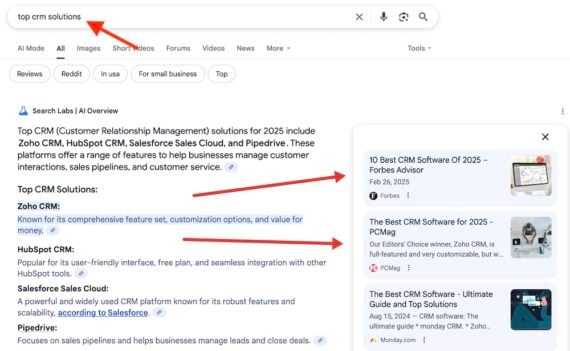
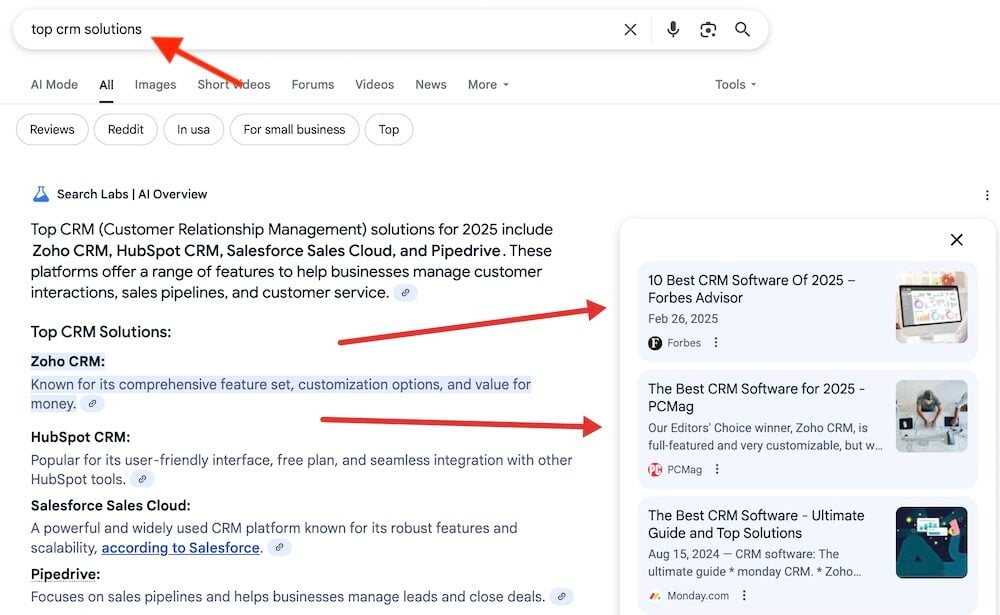
With the launch of AI answers, co-citation is critical because all AI platforms — AI Mode, ChatGPT, Gemini, others — heavily on lists for brand and product recommendations. For the search “best CRM solutions,” for example, AI Overviews cite five sources. All are lists.

AI platforms rely on external lists for brand and product recommendations, such as this example of “top CRM solutions” in Google’s AI Overviews.

The sources do not have to link to their recommendations for large language models to cite them. Hence for AI optimization, co-occurrences (i.e., unlinked mentions) are as important as co-citations (e.g., linked mentions).

The less your brand appears on external websites, the lower its visibility in AI answers (and search). And the brands most commonly listed alongside yours — linked or not — define its relevance and visibility.

Search engines and LLMs may source different sites. Gauge your site’s visibility by finding, say, 20 listicles that reference your competitors. Check:

  • Organic search results,
  • Sources in AI Mode and AI Overviews,
  • References in ChatGPT.

Many of these may overlap. But examining 20 lists will reveal your business’s relative visibility.

Several tools can help identify co-citation opportunities.

InTheMix.ai

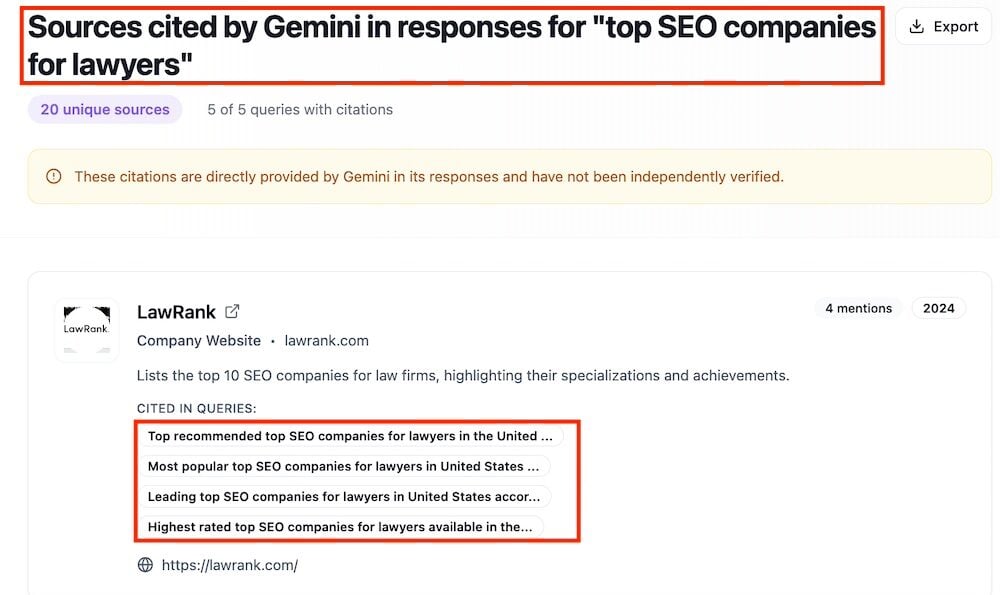
InTheMix.ai runs related prompts in Gemini based on an initial user-generated query, analyzes the answers, and lists the sources in them. The tool, which is free, displays the number of answers for each URL (to identify the most popular).

InTheMix.ai runs prompts in Gemini and displays the number of answers for each source.

Otterly.ai

Otterly.ai is a premium tool (with a free trial) that pulls citations for any prompt from Google’s AI Overviews, ChatGPT, and Perplexity. It also provides weekly tracking of those citations to discover opportunities.

Screenshot of an Otterly.ai list of citations

Otterly.ai pulls citations for any prompt from Google’s AI Overviews, ChatGPT, and Perplexity.

Reddit

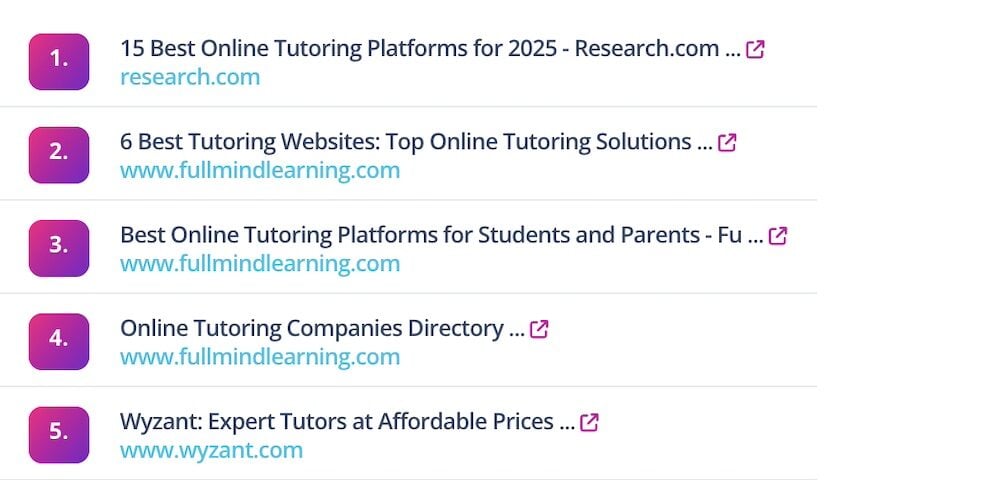
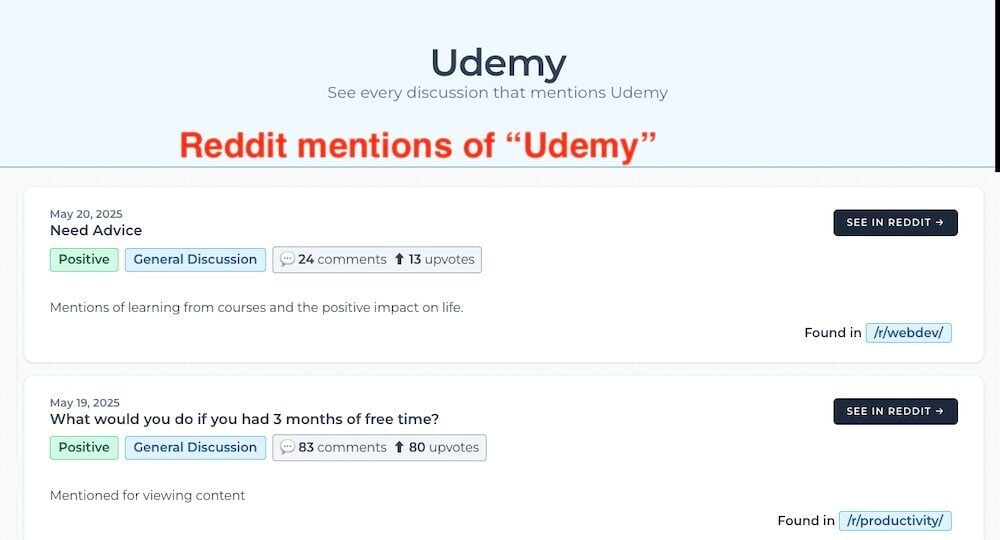
Reddit, a top-cited source in Google and ChatGPT, is handy for researching citations of your business or competitors to know which subreddits mention your brand and competitors in the same threads.

Use AI Brand Rank’s Reddit section to analyze citations of well-established competitors.

Screenshot of AI Brand Rank's list of Udemy mentions on Reddit

AI Brand Rank displays citations on multiple platforms, including Reddit, shown here for mentions of “Udemy.”

Gauge Visibility

Access top platforms to compare mentions of your business or product with those of competitors. This will provide insight into your brand’s visibility in AI training data.

Google: Many Top Sites Have Invalid HTML And Still Rank via @sejournal, @MattGSouthern

A recent discussion on Google’s Search Off the Record podcast challenges long-held assumptions about technical SEO, revealing that most top-ranking websites don’t use valid HTML.

Despite these imperfections, they continue to rank well in search results.

Search Advocate John Mueller and Developer Relations Engineer Martin Splitt referenced a study by former Google webmaster Jens Meiert, which found that only one homepage among the top 200 websites passed HTML validation tests.

Mueller highlighted:

“0.5% of the top 200 websites have valid HTML on their homepage. One site had valid HTML. That’s it.”

He described the result as “crazy,” noting that the study surprised even developers who take pride in clean code.

Mueller added:

“Search engines have to deal with whatever broken HTML is out there. It doesn’t have to be perfect, it’ll still work.”

When HTML Errors Matter

While most HTML issues are tolerated, certain technical elements, such as metadata, must be correctly implemented.

Splitt said:

“If something is written in a way that isn’t HTML compliant, then the browser will make assumptions.”

That usually works fine for visible content, but can fail “catastrophically” when it comes to elements that search engines rely on.

Mueller said:

“If [metadata] breaks, then it’s probably not going to do anything in your favor.”

SEO Is Not A Technical Checklist

Google also challenged the notion that SEO is a box-ticking exercise for developers.

Mueller said:

“Sometimes SEO is also not so much about purely technical things that you do, but also kind of a mindset.”

Splitt said:

“Am I using the terminology that my potential customers would use? And do I have the answers to the things that they will ask?”

Naming things appropriately, he said, is one of the most overlooked SEO skills and often more important than technical precision.

Core Web Vitals and JavaScript

Two recurring sources of confusion, Core Web Vitals and JavaScript, were also addressed.

Core Web Vitals

The podcast hosts reiterated that good Core Web Vitals scores don’t guarantee better rankings.

Mueller said:

“Core Web Vitals is not the solution to everything.”

Mueller added:

“Developers love scores… it feels like ‘oh I should like maybe go from 85 to 87 and then I will rank first,’ but there’s a lot more involved.”

JavaScript

On the topic of JavaScript, Splitt said that while Google can process it, implementation still matters.

Splitt said:

“If the content that you care about is showing up in the rendered HTML, you’ll be fine generally speaking.”

Splitt added:

“Use JavaScript responsibly and don’t use it for everything.”

Misuse can still create problems for indexing and rendering, especially if assumptions are made without testing.

What This Means

The key takeaway from the podcast is that technical perfection isn’t 100% necessary for SEO success.

While critical elements like metadata must function correctly, the vast majority of HTML validation errors won’t prevent ranking.

As a result, developers and marketers should be cautious about overinvesting in code validation at the expense of content quality and search intent alignment.

Listen to the full podcast episode below:

DeepSeek App Faces Ban In Germany For Illegal Transfer Of User Data via @sejournal, @martinibuster

German data protection official Meike Kamp has filed a formal request that Apple and Google remove the DeepSeek app from their respective app stores for the illegal transfer of users’ personal data to China, in violation of European Union law.

Meike Kamp, the Commissioner for Data Protection and Freedom of Information, previously requested in May that DeepSeek voluntarily comply with the legal requirements for data transfer to other countries, stop the transfer of data altogether, or remove their app from the Apple and Google app stores.

Failure to respond to those requests resulted in the official taking the next step of filing a report of illegal content to both Apple and Google who will then examine and decide DeepSeek’s future on their platforms.

The data protection commissioner stated (translated from original German):

“The transfer of user data by DeepSeek to China is unlawful. DeepSeek has not been able to convincingly prove to my authority that data from German users:

  • Inside China is protected at a level equivalent to that of the European Union.
  • Chinese authorities have extensive access rights to personal data within the sphere of influence of Chinese companies.
  • In addition, DeepSeek users in China do not have enforceable rights and effective remedies guaranteed in the European Union.

I have therefore informed Google and Apple, as operators of the largest app platforms, about the violations and expect a blocking to be checked as soon as possible.”

Takeaways

  • Enforcement of Data Privacy Laws
    Germany is taking formal steps to enforce EU data privacy regulations by targeting app distribution channels (Apple and Google).
  • International Data Transfer Violations
    DeepSeek is accused of transferring personal user data to China without ensuring protections as required by EU standards.
  • China’s Data Access
    The lack of enforceable user rights and legal remedies in China is a central concern, due to the government’s extensive access rights over data held by Chinese companies.
  • Escalation of Regulatory Action
    A report of illegal content was sent to Apple and Google after DeepSeek ignored a voluntary compliance request.
  • Decision Pending At Apple And Google
    Apple and Google will assess the reported violation and have the option to block the DeepSeek app in Germany.

Germany’s data protection official has formally requested that Apple and Google remove the DeepSeek app from their app stores due to illegal data transfers of German users’ personal information to China. The request follows concerns over Chinese government access to sensitive user data, after DeepSeek failed to comply with EU data protection standards.

Featured Image by Shutterstock/Mijansk786

Google Integrates Search Console Insights Into Main Platform via @sejournal, @MattGSouthern

Google has rolled out a new version of Search Console Insights, now integrated directly into the main Search Console interface. This update ends the standalone beta experience.

The new report aims to make it easier to understand your site’s search performance without requiring advanced analytics skills.

What’s New?

Previously accessible through a separate interface, Search Console Insights now lives within the primary Search Console dashboard.

Google describes this as a more “cohesive experience,” bringing insights closer to the tools you already rely on.

The update is designed with non-technical users in mind, including bloggers, small business owners, and content creators seeking to understand how their content performs on Google Search.

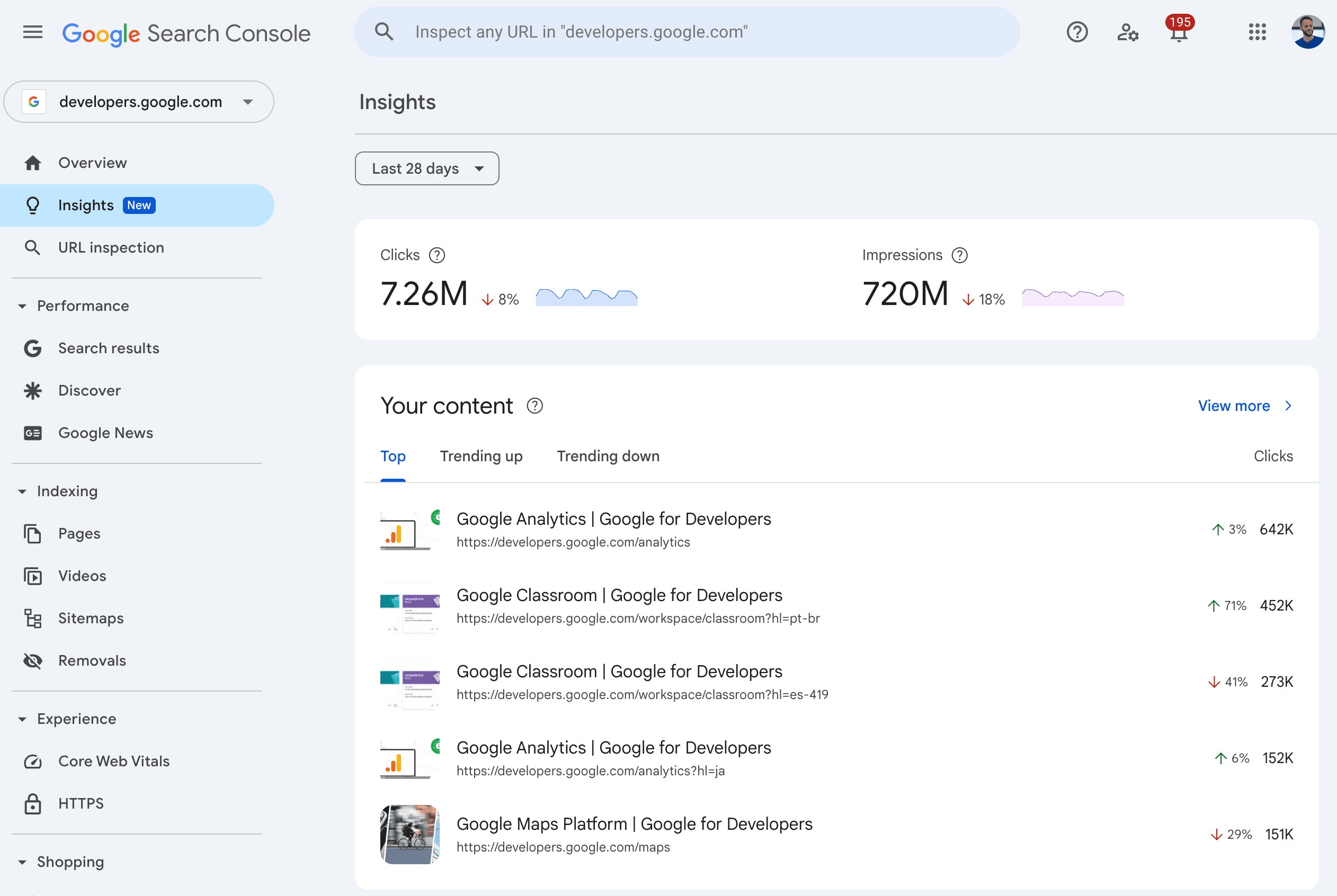
Here’s an example of what the integrated experience looks like:

Screenshot from: developers.google.com/search/blog/2025/06/search-console-insights, June 2025.

Highlights From the Updated Report

1. Performance Overview

You can view total clicks and impressions from Google Search, along with comparisons to previous periods.

2. Page Performance

The report identifies which pages are getting the most clicks, along with “trending up” and “trending down” pages, offering insight into what’s working and what may need updating.

3. Achievements Feature Retained

Google is continuing the “Achievements” feature, which celebrates milestones like reaching new click thresholds.

While you can still access past achievements via email links, Google says direct sidebar access will be available in the next few weeks.

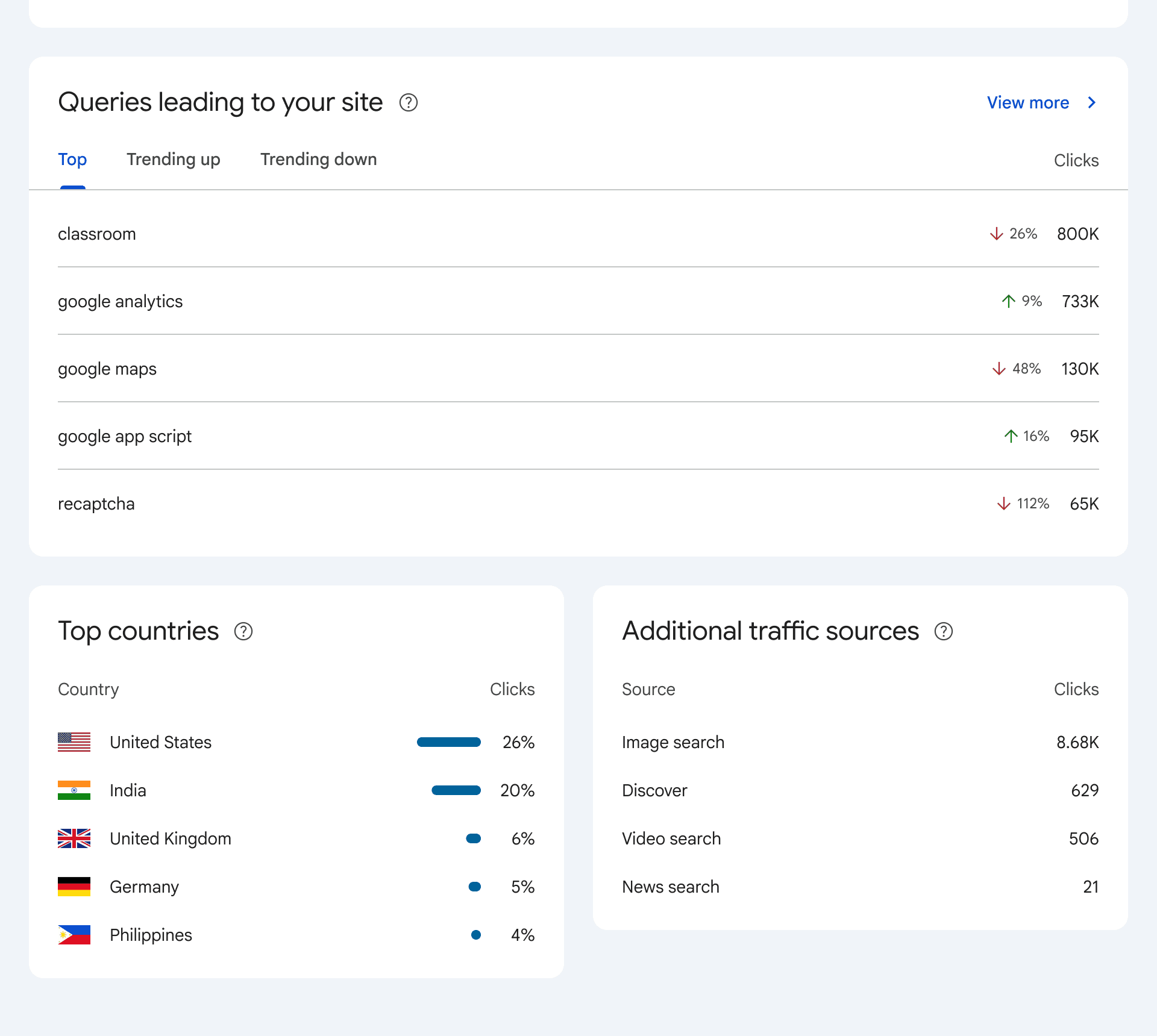
4. Search Query Trends

You can see top-performing queries and spot rising trends, which Google suggests can serve as inspiration for new content. Queries with declining performance are also highlighted.

Here’s an example of what this report looks like:

Screenshot from: developers.google.com/search/blog/2025/06/search-console-insights, June 2025.

Gradual Rollout In Progress

The new Insights experience is being rolled out gradually. If you don’t see it immediately, it will likely appear over the coming weeks.

This phased approach allows Google to monitor system performance and incorporate early feedback before releasing the feature to everyone.

How This Helps

By integrating simplified reporting into the main dashboard, Google is bridging the gap between entry-level insights and more advanced analytics.

If you found the existing Performance report overwhelming, this update could offer a more approachable alternative.

For agencies and consultants, the simplified view may also serve as a communication tool for clients less familiar with technical metrics.


Featured Image: Roman Samborskyi/Shutterstock

The Strategy Gap: Social Video Is Not PPC Video via @sejournal, @LisaRocksSEM

Video is dominating online across PPC ads and social media channels. Unfortunately, many advertisers still repurpose social videos for paid campaigns.

What works organically on TikTok or Instagram often falls flat in performance-driven environments like YouTube Ads or Performance Max.

This could lead to low engagement and poor conversions.

To compete in today’s attention economy, PPC video needs its own strategy that is built from the ground up with performance in mind.

This article explores why CMOs and senior marketers must treat video as a creative asset, that is, a conversion-driven engine and platform-specific.

The Disconnect Between Social Video And PPC Video

Some marketers start with social video and “cut it down” for paid. However, the two formats fundamentally differ in purpose, intent, and delivery.

Social video is built for engagement, likes, shares, and storytelling that captures attention in a feed.

PPC video, on the other hand, is engineered for a conversion action. It must capture attention, communicate value quickly, and drive a specific action with a call-to-action (CTA) statement.

Repurposing social content for PPC assumes that the creative context uses the same strategy for driving engagement.

Social videos often rely on trends, audio cues, or slow storytelling arcs. Those don’t translate to skippable, conversion-focused ad formats where you have just a few seconds to inform and impact.

The following table outlines the fundamental differences between social and PPC video.

Category Social Video PPC Video
Purpose Brand building, storytelling, and community engagement Lead generation, sales, and performance-driven metrics
Viewer Intent Passive browsing, entertainment High intent, research, or decision-making mindset
Format & Delivery Organic feed content, often square or vertical Paid ad placements; needs variation for 16:9, 4:5, vertical, etc.
Sound/Audio Often relies on music, trends, or narration Must perform without sound; strong visuals are needed
Calls-to-Action Often implied or delayed Immediate and repeated; click-through or conversion-focused
Performance Metrics Likes, shares, video views, engagement rate CTR, conversion rate, ROAS, CPA

Best Practices For PPC Video

PPC video ads should be intentionally created to drive conversions, not just views.

Below are key creative best practices that directly influence campaign outcomes, keeping in mind the details of different platforms:

1. Hook The Viewer Within The First 3 Seconds

Front-load your story arc by getting to the point of the video early, which often involves presenting the value proposition and the desired action.

You only have a moment to make viewers stop scrolling or delay the skip button. Use bold text, motion, or a strong question right away.

Example: “Spending too much on ads? Here’s a fix that saved our client $10,000.”

2. Format Video For The Platform

Each platform has different specs and user behaviors that require a custom approach for each. This is a perfect example where “one size does not fit all.”

YouTube standard videos typically requires horizontal (16:9), aligning with a sound-on viewing environment, while YouTube Shorts are vertical and platforms like Meta often favor square or vertical.

TikTok favors vertical, full-screen videos for sound-off autoplay. Develop your creative asset with this in mind.

3. Include A Clear Call-To-Action Early And Repeat

Don’t rely on a single CTA at the end. Video ads are built for direct response. Reinforce the action you want throughout the video.

Example: Start the video with “Click to get the offer,” and show it again midway and at the end.

4. Lead With The Benefit, Not The Backstory

People want to know what’s in it for them and how you solve their problem. Skip the warm-up and start with a direct benefit or result.

Example: Instead of “Our team spent weeks testing this,” say, “This ad strategy cuts CPC in half.”

5. Design With Platform Audio In Mind

For platforms with silent autoplay (TikTok, Instagram Reels, Facebook Feed): Prioritize visual communication. Many users watch without sound, so ensure your message still lands visually.

Use animated captions and highlight product features with motion text, so nothing is lost without audio.

For YouTube: Recognize that ads often play while users have the sound on.

While strong visuals are still important, leverage sound effectively through voiceovers, music, and sound effects to enhance your message and brand experience, as highlighted in YouTube’s Playbook for Creative Advertising [PDF] under the “Build for sound on” principle.

These elements influence how your video is served, watch time, and whether they take action.

Platform-Specific Video Strategies

Not all platforms serve video in the same way. Understanding how your content is delivered, measured, and optimized across each environment is critical to making PPC video work.

YouTube Ads

YouTube is a high-intent platform, with users actively choosing to watch content. Your ad will most often appear before or during another video.

The key here is overcoming the viewer’s “skip” behavior.

  • Maximize the impact of the skippable first five seconds. Use a bold visual or a clear problem-solution hook to immediately capture attention and provide value, making viewers want to watch more.
  • Build a narrative that fits intent. Educational formats, product demos, or expert commentary perform well here. Consider longer-form content that addresses pain points thoroughly or showcases product features in detail. Leverage storytelling to connect with viewers who are actively engaged.
  • End with a strong call to action. Take users to a landing page or offer page that extends the message.
    • Example: A productivity software brand opens with “Wasting time switching tabs?” then shows how its tool solves it with a single view, ending with “Try it for free today.”

Performance Max

Performance Max distributes video across placements like YouTube, Discovery, and Gmail. This requires a flexible, creative approach built to adapt to various ad spaces.

  • Upload multiple lengths: At minimum, include 6-second, 15-second, and 30-second versions. Varying lengths allow Google’s AI to test and serve the most effective creative for each placement and user.
  • Include strong product visuals: Use the dedicated headline and description fields within the PMax asset library to deliver your primary marketing messages and calls to action. This allows Google’s AI to optimize the pairing of text and video for different platforms and user behaviors. Ensure key messages and branding are visually prominent and understandable without audio.
  • Create for automation: Google optimizes based on performance. Give the algorithm assets that can stand alone, yet are also easy to mix and match. This includes various headlines, descriptions, and calls to action that can be paired with your video assets, allowing Google’s machine learning to find the most effective combinations.
  • Leverage vertical image ads for YouTube Shorts: Google Ads now supports full-screen vertical (9:16) image ads specifically for YouTube Shorts within Demand Gen campaigns. This allows you to repurpose existing vertical image assets from platforms like Meta to reach users in this rapidly growing short-form video environment. Recommended size: 1080×1920.
    • Example: A clothing brand uses 15-second vertical videos with close-up fabric shots and pricing overlays so the system can serve based on what performs.

Meta Video Ads (Facebook And Instagram)

These platforms autoplay silently in-feed, so your creative must speak visually before sound is ever involved.

  • Front-load motion or emotion. Start with an action or a relatable facial expression. Think about creating a visual hook that stops the scroll and intrigues users enough to tap for sound.
  • Use large text overlays and branded visuals. This keeps the message clear and recognizable at a glance. Keep text concise and easy to read on smaller mobile screens. Ensure your branding is integrated early and consistently.
  • Mobile-first approach. Vertical or 4:5 ratio works best for in-feed and Stories. Utilize the full vertical space to immerse viewers and avoid the cropped look of horizontal videos on these platforms.
    • Example: A skincare brand opens with a smiling woman applying cream, with large text: “Sensitive skin? See instant calm.”

Optimize your video creative for the unique consumption habits and delivery methods of each platform, and increase the likelihood of engagement and better performance from your PPC video campaigns.

Making The Business Case To CMOs

CMOs and senior leaders often see video as a single, limited asset: make once, use everywhere.

Now, with the increasing sophistication of digital advertising platforms and the different ways video is consumed, the same approach is not cost-effective or performance-driven.

The increase of short-form video, dominance of mobile, and the emphasis on ad quality across platforms are driving a more strategic approach to video creative.

Consider:

  • Repurposed social content is likely to underperform in PPC environments because it was not created with the same goals in mind.
  • Dedicated PPC video would be expected to increase return on ad spend by aligning creative with media placement.
  • A video designed for PPC would (in theory) have higher engagement. Therefore, should have a higher ad quality score and higher delivery.

Making the business case means shifting from “video as a campaign extra” to “video as a campaign must-have.”

CMOs are ultimately looking for measurable results and a strong return on investment from their advertising spend, and a platform-specific video strategy is the key.

Conclusion: PPC Video Is No Longer Optional

The days of treating all video the same are over, and it’s time to embrace this new approach. Video is now a powerful strategy for driving measurable ad results.

Advertisers should strategically build video with a clear understanding of each platform’s unique environment, their target audience’s intent, and the business goals.

Investing in creative that has a performance-first approach for each platform opens up opportunities for a stronger return on your advertising investment.

The future of successful PPC hinges on your team’s ability to master platform-specific video creation.

More Resources:


Featured Image: Hryshchyshen Serhii/Shutterstock

How Enterprise Search And AI Intelligence Reveal Market Pulse

The last few years have fundamentally transformed how businesses and consumers discover, evaluate, and engage with brands.

What began as a digital acceleration in 2020-2021 has evolved into an AI-driven revolution that’s reshaping the entire search landscape in 2025 across every industry vertical.

Where organizations once relied on monthly snapshots and historical data, today’s market reality demands real-time AI intelligence with a 360-degree view across all platforms.

The traditional customer journey – whether B2B, B2C, or D2C – which used to span multiple sessions, site visits, and vendor comparisons, can now unfold in a single AI interaction.

When a decision-maker asks Google AI Overviews, ChatGPT, or Perplexity for the best HR software, skincare routine, or investment strategy, they’re no longer sifting through dozens of links.

AI immediately assembles a shortlist with commentary, pros and cons, and implicit recommendations.

AI Search Revolution: From Information Retrieval To Active Evaluation

Recent BrightEdge data reveals the magnitude of this shift: Impressions on all content have skyrocketed by over 49% since the launch of AI Overviews, while Google still maintains over 90% of market share.

However, the game has undergone a fundamental change. AI isn’t just retrieving information; it’s actively evaluating, framing, and recommending brands before prospects even click a link.

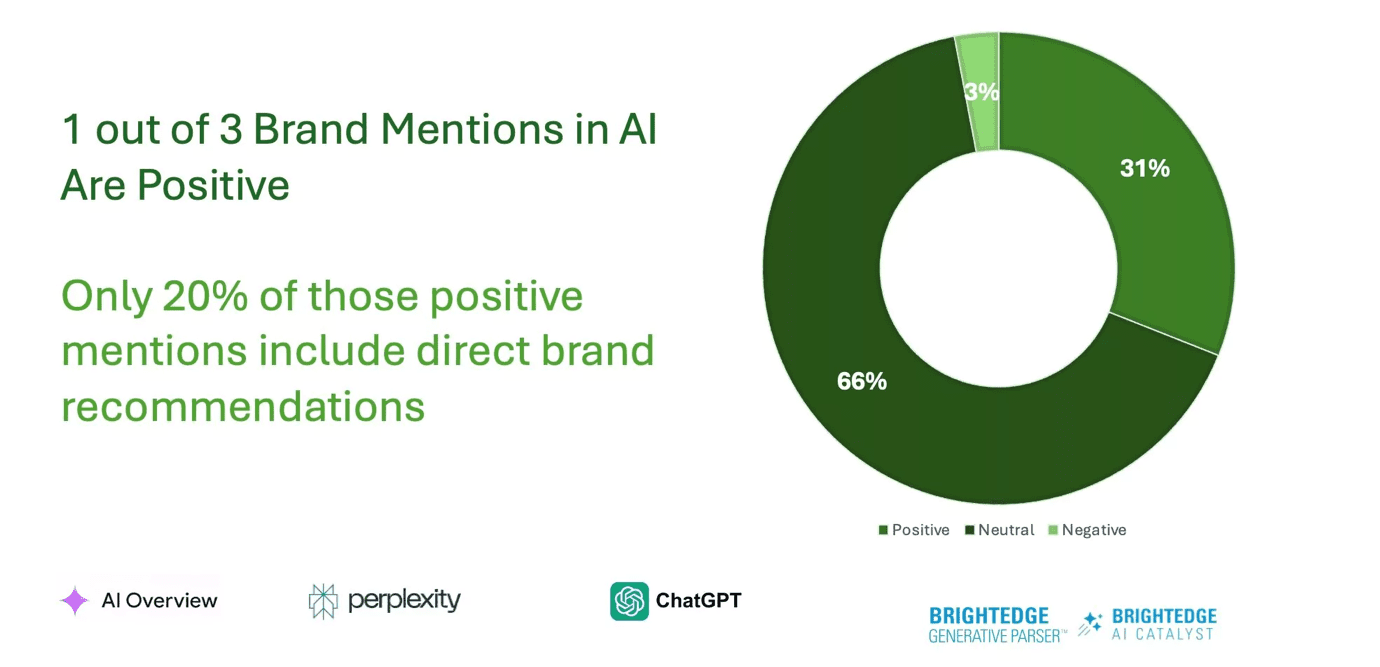
Consider the stark reality facing all marketers: Only 31% of AI-generated brand mentions are positive, and of those, just 20% include direct recommendations.

Source: BrightEdge, June 2025

This means that whether you’re marketing enterprise software, consumer products, or direct-to-consumer services, how your brand appears in AI results across Google AI Overviews, ChatGPT, and Perplexity varies dramatically depending on the AI model, its training data, and interpretive logic.

The growth trajectory tells the story:

  • ChatGPT: 21% growth in the last month.
  • Perplexity and Gemini: Remaining about one-tenth of ChatGPT’s size.
  • Claude, Meta, and Grok: Another one-tenth smaller than Perplexity and Gemini.

This isn’t just channel diversification; it’s a complete redefinition of discoverability where AI serves as both gatekeeper and advisor.

Being Aware Of What Is Going On In Your Broader Markets

Understanding The New Market Dynamics

Many marketers have traditionally taken an immediate and microscopic approach to SEO. Without thinking, the focus goes straight to the keyword and the link.

However, working across all market segments requires a shift in mindset towards understanding not just the business but the broader market and economic implications that may affect how you tailor your strategy.

Overall, market factors influence short-, mid-, and long-term strategies. Utilize models such as PEST analysis to understand what is going on in the market from a political, economic, social, and technological perspective:

  • Political: AI regulation, data privacy laws, elections, and new compliance requirements.
  • Economic: AI’s compression of decision cycles, changing sales velocities, and market volatility.
  • Social: Consumer behavior is shifting toward AI-assisted purchasing, altering the dynamics of brand trust.
  • Technological: AI model capabilities, real-time indexing, cross-platform optimization requirements.

The MAP Framework For AI Search Success

Modern marketing intelligence requires mastering three critical dimensions: Mention, Authority, and Performance – what I call the MAP Framework for AI search success.

This framework applies whether you’re marketing SaaS solutions, consumer electronics, fashion brands, financial services, or any product or service in today’s AI-influenced marketplace.

Mentions: Beyond Traditional Rankings

While Google still commands the foundation with over 90% market share, the ecosystem has diversified rapidly.

AI Overviews (AIOs) now appear in over 11% of Google queries – a 22% increase since debuting last year.

More significantly, longer, more complex queries have increased by 49% in AI Overviews since May 2024, specifically designed to support complex B2B decisions.

In contrast, ranking-style content and comparison queries have decreased by 60% and 14%, respectively.

BrightEdge data shows the industries with the strongest AI Overview presence are healthcare, education, B2B tech, and insurance. Travel and entertainment are on the rise, while ecommerce has not seen rapid growth in the past year.

Authority: When AI Forms Opinions About Your Brand

The most critical insight for all marketers is understanding how AI systems interpret and present brand information across every category.

Our research shows significant variation in how brands are portrayed across different AI platforms and industries:

  • Finance brands: Positive mentions align around regulatory compliance and security content.
  • Healthcare brands: Accuracy and credibility drive positive AI sentiment.
  • Technology brands: Innovation and reliability serve as primary AI evaluation criteria.
  • Consumer brands: Customer reviews, product quality, and brand reputation influence AI recommendations.
  • Retail/Ecommerce: Price competitiveness, product availability, and user experience drive AI mentions.
  • Professional services: Case studies, client success stories, and industry expertise shape AI perception.

Whether AI is evaluating enterprise software, consumer products, or professional services, it effectively writes the evaluation criteria and creates shortlists without brands having direct input, making perception management mission-critical across all verticals.

Performance: New Metrics That Matter

Traditional key performance indicators (KPIs), such as rankings, impressions, and traffic, aren’t disappearing, but they’re insufficient for AI-driven discovery.

While impressions on all content have skyrocketed by over 49% since the launch of AI Overviews, click-throughs have steadily declined, with a nearly 30% reduction since May 2024.

Yet, conversion rates remain strong, suggesting that AI successfully qualifies leads before they reach websites.

Essential AI Search Metrics:

  1. AI Mention Rate: Percentage of target queries where your brand appears in AI responses.
  2. Citation Authority: How consistently you’re cited as the primary source.
  3. Share of AI Conversation: Your semantic real estate in AI answers versus competitors.
  4. Prompt Effectiveness: How well your content answers natural language prompts.
  5. Response-to-Conversion Velocity: Speed at which AI-influenced prospects convert.

Monthly reporting cycles have become obsolete. AI-generated results can shift within hours based on content updates, prompt trends, or model training, demanding real-time monitoring capabilities.

Read more: How AI Is Changing The Way We Measure Success In Digital Advertising

Combining Business & Search Intelligence To Understand The Pulse Of The Customer

AI Intelligence With Comprehensive Market Insights

Modern marketing intelligence extends far beyond traditional keyword monitoring, requiring a 360-degree view across all consumer touchpoints and all key AI search engines.

Today’s successful organizations – whether B2B, B2C, or D2C – leverage AI to understand market pulse through multiple lenses:

Real-Time Consumer Intelligence

AI agents now research on behalf of consumers across all categories, from enterprise software to skincare products.

These agents analyze your brand through your digital presence, social proof, customer reviews, and competitive positioning.

They’re becoming sophisticated evaluation consultants that assess everything from product specifications to brand values.

Cross-Industry Predictive Modeling

Advanced business intelligence now incorporates AI behavior patterns to forecast demand shifts across all sectors.

When AI systems consistently recommend specific product categories, highlight particular brand attributes, or emphasize certain consumer benefits, these signals predict broader market movements – whether in B2B procurement, consumer purchasing, or direct-to-consumer trends.

Omni-Engine And LLM Sentiment Analysis

Different AI platforms treat content differently across all industries.

For consumer brands, ChatGPT might emphasize user reviews and social proof, while Perplexity focuses on expert analysis and technical specifications.

For B2B brands, LinkedIn-integrated AI may prioritize professional endorsements, whereas general AI platforms tend to emphasize case studies and return on investment (ROI) data.

Understanding these platform-specific nuances enables strategic content distribution across every marketing vertical.

From Search To AI As The Voice Of Every Customer

In many ways, AI is the voice of the customer across all industries.

Search queries contain intent signals, SERP analysis reveals how customers prefer to consume content, and keyword reports enable us to produce content that resonates – whether for enterprise buyers, individual consumers, or any audience in between.

However, especially in an agentic world, AI is not just forming opinions. It is taking actions for users. In shopping, it can actually make transactions for people.

Keeping a daily pulse on new insights impacting your market and on what is changing in AI responses daily should be of mandatory importance for those who want to benefit from fresh, new opportunities.

For example, a single result and opinion generated by AI in a search can significantly impact revenue in just one day.

During important seasons (especially in retail), subtle category-related demand shifts will require granular action.

New product launches require daily monitoring so stakeholders can see the daily impact and adjust accordingly, leveraging AI to automatically optimize the offering.

Utilizing Business Intelligence To Understand And Visualize The Pulse Of The Market

Real-Time AI Platform Monitoring

More than ever, organizations are seeking business intelligence (BI) to transform data into actionable insights that can be quickly leveraged across traditional search and every AI engine where customers discover solutions.

BI enables marketers to easily analyze insights for larger-than-usual data sets to uncover new opportunities and highlight campaign strategy inefficiencies.

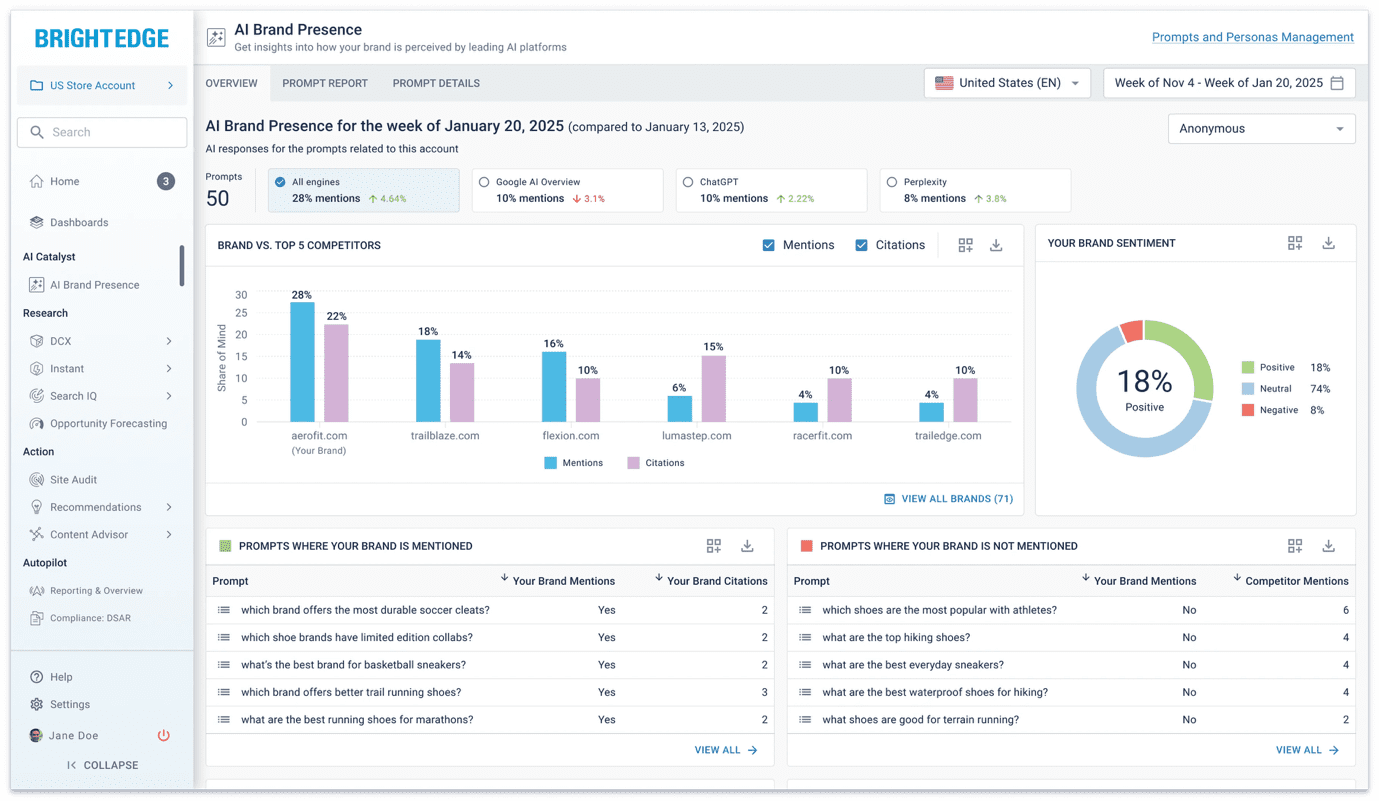
Here is an example from my company:

Source: BrightEdge, June 2025

This type of intelligence can inform you about what is happening now and what has happened in the past across all discovery channels.

Many types of business intelligence can help deliver digestible snapshots of the current state of your market, not just for SEO but also for digital, sales, product, and customer service functions.

Entity-Based SEO For AI Discovery Across All Verticals

Move beyond keywords to comprehensive topic authority, regardless of your industry.

AI prioritizes content from known, trusted entities, making authoritative content three times more likely to be cited in AI responses across B2B software, consumer electronics, fashion, healthcare, financial services, and every other vertical.

Implement robust schema markup, ensure consistent entity references across all digital properties, and build connections with recognized authorities in your space – whether that’s industry analysts, consumer advocates, or subject matter experts.

360-Degree AI Platform Strategy

Success requires presence and optimization across traditional search and every AI engine where your customers might discover solutions. This means:

  • Google Search & AI Overviews: Still the foundation with 90%+ market share.
  • ChatGPT: 21% growth rate, emphasis on conversational discovery.
  • Perplexity: Research-heavy platform with strong citation emphasis.
  • Vertical-specific AI: Industry tools, shopping assistants, and specialized platforms.
  • Social AI Integration: AI features within LinkedIn, TikTok, Instagram, and other social platforms.
  • Voice & Mobile AI: Alexa, Siri, Google Assistant across devices.

Consumer Intelligence Integration

Traditional search data must be combined with the following:

  • Social listening across AI-integrated platforms.
  • Review and rating sentiment from AI-crawled sources.
  • Purchase behavior data as it relates to AI recommendations.
  • Cross-platform brand mention analysis.
  • Consumer journey mapping across AI touchpoints.
  • Competitive intelligence from AI responses.

This approach reveals not just what consumers search for but how AI interprets and presents your brand across every possible discovery moment.

Mobile Vs. Desktop AI Optimization

Mobile and desktop AI Overviews aren’t just different sizes. They’re fundamentally different products targeting distinct user behaviors.

According to BrightEdge Generative Parser data from May and June 2025, these platforms serve different user intents and require tailored optimization strategies.

Key Mobile Vs. Desktop Differences:

Mobile Opportunities:

  • Ecommerce AIOs appear three times more often (13.5% vs 4.5% on desktop).
  • Mobile shows more size variability, suggesting Google is actively experimenting with format and content.
  • Users are in discovery/shopping mode, making mobile ideal for product research and comparison.

Desktop Patterns:

  • Takes 80% more screen space than mobile (1110 px vs. 617 px).
  • AIOs appear 39% more frequently than mobile.
  • More consistent, predictable sizing patterns.
  • Users want detailed, comprehensive information delivery.

As Jim Yu, CEO of BrightEdge, notes: “If marketers are not paying attention to how AI operates on different devices, they may be missing some key opportunities, especially in ecommerce!”

Read more: Newly Released Data Shows Desktop AI Search Referrals Dominate

Strategic Implications:

  • Mobile users require discovery-focused, shopping-oriented content optimization.
  • Desktop users need comprehensive, detailed information architectures.
  • Ecommerce brands must prioritize mobile-first AIO strategies.
  • Content strategy should consider device context alongside traditional keyword targeting.
  • Search marketers must ensure teams optimize for both user experiences simultaneously.

Vertical-Specific AI Optimization

Industry-specialized AI models are emerging for cybersecurity, manufacturing, fintech, and healthcare.

Content strategies must account for domain-specific AI companions that understand industry nuance and evaluate solutions using sector-appropriate criteria.

This can be visualized via daily dashboards, visualizations, and custom-based reports, and can be used to:

  1. Analyze industry trends in real-time across all AI platforms.
  2. Visualize category demand and inventory in real time.
  3. Compare historical data with current trends across traditional and AI search.
  4. Create and forecast based on predictive modeling that includes AI behavior patterns.
  5. Aggregate different sources of data from search engines and AI platforms.
  6. Identify new buyer trends across all customer segments.
  7. Monitor brand presence, perception, and performance.
  8. Find inefficiencies in product or pricing strategy based on AI recommendations.
  9. Identify key correlations between search activity and mentions of AI platforms.
  10. Plan across all discovery channels and map content to key AI touchpoints.
  11. Evaluate marketing campaign effectiveness across traditional and AI-driven channels.

Conclusion

Success in 2025’s marketing landscape requires understanding that AI isn’t just a channel. It’s becoming the primary interface between your brand and potential customers across every industry and buying scenario.

The organizations that master the MAP Framework (Mention, Authority, and Performance) while maintaining a 360-degree view across traditional search, AI engines, and consumer intelligence will be the ones AI recommends when it matters most.

The shift from traditional search to AI-powered discovery isn’t coming – it’s here.

Marketers across B2B, B2C, and D2C who embrace comprehensive AI intelligence tools, implement real-time monitoring across all platforms, and optimize for AI evaluation criteria will capture market opportunities.

In this new reality, staying attuned to the market means understanding not only what customers search for but also how AI interprets, evaluates, and presents your brand across every possible touchpoint.

The future belongs to brands that learn to collaborate with AI, guide its understanding across all platforms, and position themselves to stand out in an era where artificial intelligence often makes the first – and sometimes, final – impression, whether someone is buying enterprise software, choosing a restaurant, or selecting a healthcare provider.

Unless otherwise indicated, any data mentioned above was taken from this BrightEdge study

More Resources:


Featured Image: innni/Shutterstock