This year has been rough for climate technology: Companies have canceled, downsized, or shut down at least 16 large-scale projects worth $8 billion in total in the first quarter of 2025, according to a new report.
That’s far more cancellations than have typically occurred in recent years, according to a new report from E2, a nonpartisan policy group. The trend is due to a variety of reasons, including drastically revised federal policies.
In recent months, the White House has worked to claw back federal investments, including some of those promised under the Inflation Reduction Act. New tariffs on imported goods, including those from China (which dominates supply chains for batteries and other energy technologies), are also contributing to the precarious environment. And demand for some technologies, like EVs, is lagging behind expectations.
E2, which has been tracking new investments in manufacturing and large-scale energy projects, is now expanding its regular reports to include project cancellations, shutdowns, and downsizings as well. From August 2022 to the end of 2024, 18 projects were canceled, closed, or downsized, according to E2’s data. The first three months of 2025 have already seen 16 projects canceled.
“I wasn’t sure it was going to be this clear,” says Michael Timberlake, communications director of E2. “What you’re really seeing is that there’s a lot of market uncertainty.”
Despite the big number, it is not comprehensive. The group only tracks large-scale investments, not smaller announcements that can be more difficult to follow. The list also leaves out projects that companies have paused.
“The incredible uncertainty in the clean energy sector is leading to a lot of projects being canceled or downsized, or just slowed down,” says Jay Turner, a professor of environmental studies at Wellesley College. Turner leads a team that also tracks the supply chain for clean energy in the US in a database called the Big Green Machine.
Some turnover is normal, and there have been a lot of projects announced since the Inflation Reduction Act was passed in 2022—so there are more in the pipeline to potentially be canceled, Turner says. So many battery and EV projects were announced that supply would have exceeded demand “even in a best-case scenario,” Turner says. So some of the project cancellations are a result of right-sizing, or getting supply and demand in sync.
Other projects are still moving forward, with hundreds of manufacturing facilities under construction or operational. But it’s not as many as we’d see in a more stable policy landscape, Turner says.
The cancellations include a factory in Georgia from Aspen Aerogels, which received a $670 million loan commitment from the US Department of Energy in October. The facility would have made materials that can help prevent or slow fires in battery packs. In a February earnings call, executives said the company plans to focus on an existing Rhode Island facility and projects in other countries, including China and Mexico. Aspen Aerogels didn’t respond to a request for further comment.
Hundreds of projects that have been announced in just the last few years are under construction or operational despite the wave of cancellations. But it is an early sign of growing uncertainty for climate technology.
“You’re seeing a business environment that’s just unsure what’s next and is hesitant to commit one way or another,” Timberlake says.
A lawsuit to hold Yahoo responsible for “willfully turning a blind eye” to the mismanagement of a human rights fund for Chinese dissidents was settled for $5.425 million last week, after an eight-year court battle. At least $3 million will go toward a new fund; settlement documents say it will “provide humanitarian assistance to persons in or from the [People’s Republic of China] who have been imprisoned in the PRC for exercising their freedom of speech.”
This ends a long fight for accountability stemming from decisions by Yahoo, starting in the early 2000s, to turn over information on Chinese internet users to state security, leading to their imprisonment and torture. After the actions were exposed and the company was publicly chastised, Yahoo created the Yahoo Human Rights Fund (YHRF), endowed with $17.3 million, to support individuals imprisoned for exercising free speech rights online.
But in the years that followed, its chosen nonprofit partner, the Laogai Research Foundation, badly mismanaged the fund, spending less than $650,000—or 4%—on direct support for the dissidents. Most of the money was, instead, spent by the late Harry Wu, the politically connected former Chinese dissident who led Laogai, on his own projects and interests. A group of dissidents sued in 2017, naming not just Laogai and its leadership but also Yahoo and senior members from its leadership team during the time in question; at least one person from Yahoo always sat on YHRF’s board and had oversight of its budget and activities.
The defendants—which, in addition to Yahoo and Laogai, included the Impresa Legal Group, the law firm that worked with Laogai—agreed to pay the six formerly imprisoned Chinese dissidents who filed the suit, with five of them slated to receive $50,000 each and the lead plaintiff receiving $55,000.
The remainder, after legal fees and other expense reimbursements, will go toward a new fund to continue YHRF’s original mission of supporting individuals in China imprisoned for their speech. The fund will be managed by a small nonprofit organization, Humanitarian China, founded in 2004 by three participants in the 1989 Chinese democracy movement. Humanitarian China has given away $2 million in cash assistance to Chinese dissidents and their families, funded primarily by individual donors.
This assistance is often vital; political prisoners are frequently released only after years or decades in prison, sometimes with health problems and without the skills to find steady work in the modern job market. They continue to be monitored, visited, and penalized by state security, leaving local employers even more unwilling to hire them. It’s a “difficult situation,” Xu Wanping, one of the plaintiffs, previously told MIT Technology Review—“the sense of isolation and that kind of helplessness we feel … if this lawsuit can be more effective, if it could help restart this program, it is really meaningful.” As we wrote in our original story,
“Xu lives in low-income housing in his hometown of Chongqing, in western China. He Depu, another plaintiff, his wife, and an adult son survive primarily on a small monthly hardship allowance of 1,500 RMB ($210) provided by the local government as collateral to ensure that he keeps his opinions to himself. But he knows that even if he is silent, this money could disappear at any point.”
The terms of the settlement bar the parties from providing more than a cursory statement to the media, but Times Wang, the plaintiffs’ lawyer, previously told MIT Technology Review about the importance of the fund. In addition to the crucial financial support, “it is a source of comfort to them [the dissidents] to know that there are people outside of China who stand with them,” he said.
MIT Technology Review took an in-depth look at the case and the mismanagement at YHRF, which you can read here.
Architecture often assumes a binary between built projects and theoretical ones. What physics allows in actual buildings, after all, is vastly different from what architects can imagine and design (often referred to as “paper architecture”). That imagination has long been supported and enabled by design technology, but the latest advancements in artificial intelligence have prompted a surge in the theoretical.
Karl Daubmann, College of Architecture and Design at Lawrence Technological University “Very often the new synthetic image that comes from a tool like Midjourney or Stable Diffusion feels new,” says Daubmann, “infused by each of the multiple tools but rarely completely derived from them.”
“Transductions: Artificial Intelligence in Architectural Experimentation,” a recent exhibition at the Pratt Institute in Brooklyn, brought together works from over 30 practitioners exploring the experimental, generative, and collaborative potential of artificial intelligence to open up new areas of architectural inquiry—something they’ve been working on for a decade or more, since long before AI became mainstream. Architects and exhibition co-curators Jason Vigneri-Beane, Olivia Vien, Stephen Slaughter, and Hart Marlow explain that the works in “Transductions” emerged out of feedback loops among architectural discourses, techniques, formats, and media that range from imagery, text, and animation to mixed-reality media and fabrication. The aim isn’t to present projects that are going to break ground anytime soon; architects already know how to build things with the tools they have. Instead, the show attempts to capture this very early stage in architecture’s exploratory engagement with AI.
Technology has long enabled architecture to push the limits of form and function. As early as 1963, Sketchpad, one of the first architectural software programs, allowed architects and designers to move and change objects on screen. Rapidly, traditional hand drawing gave way to an ever-expanding suite of programs—Revit, SketchUp, and BIM, among many others—that helped create floor plans and sections, track buildings’ energy usage, enhance sustainable construction, and aid in following building codes, to name just a few uses.
The architects exhibiting in “Transductions” view newly evolving forms of AI “like a new tool rather than a profession-ending development,” says Vigneri-Beane, despite what some of his peers fear about the technology. He adds, “I do appreciate that it’s a somewhat unnerving thing for people, [but] I feel a familiarity with the rhetoric.”
After all, he says, AI doesn’t just do the job. “To get something interesting and worth saving in AI, an enormous amount of time is required,” he says. “My architectural vocabulary has gotten much more precise and my visual sense has gotten an incredible workout, exercising all these muscles which have atrophied a little bit.”
Vien agrees: “I think these are extremely powerful tools for an architect and designer. Do I think it’s the entire future of architecture? No, but I think it’s a tool and a medium that can expand the long history of mediums and media that architects can use not just to represent their work but as a generator of ideas.”
Andrew Kudless, Hines College of Architecture and Design This image, part of the Urban Resolution series, shows how the Stable Diffusion AI model “is unable to focus on constructing a realistic image and instead duplicates features that are prominent in the local latent space,” Kudless says.
Jason Vigneri-Beane, Pratt Institute “These images are from a larger series on cyborg ecologies that have to do with co-creating with machines to imagine [other] machines,” says Vigneri-Beane. “I might refer to these as cryptomegafauna—infrastructural robots operating at an architectural scale.”
Martin Summers, University of Kentucky College of Design “Most AI is racing to emulate reality,” says Summers. “I prefer to revel in the hallucinations and misinterpretations like glitches and the sublogic they reveal present in a mediated reality.”Jason Lee, Pratt Institute Lee typically uses AI “to generate iterations or high-resolution sketches,” he says. “I am also using it to experiment with how much realism one can incorporate with more abstract representation methods.”
Olivia Vien, Pratt Institute For the series Imprinting Grounds, Vien created images digitally and fed them into Midjourney. “It riffs on the ideas of damask textile patterns in a more digital realm,” she says.
Robert Lee Brackett III, Pratt Institute “While new software raises concerns about the absence of traditional tools like hand drawing and modeling, I view these technologies as collaborators rather than replacements,” Brackett says.
Backlinks remain essential for organic search visibility, yet link-building opportunities are increasingly rare. Most tactics are either risky or ineffective. Those that work well — digital public relations, direct outreach — are often too expensive or time-consuming for small and medium-sized businesses.
But one link-building method is both inexpensive and effective: being quoted in online publications as an expert. This method produces backlinks and builds topical authority.
The tactic is “entity-driven” because it helps the quoted expert become an “entity,” i.e., a brand. Traditionally, the tactic involved laborious manual outreach to editors and writers offering expertise for articles.
There are now platforms to simplify the process. All connect publications with experts. None promote paid links or placements as far as I know.
Here are three options.
Featured
Featured is a freemium platform listing requests from publications seeking expertise. Any account holder can submit quotes in response. Account holders can be either publications or individuals, allowing them to request and submit quotes from a single account.
To be cited and linked:
Submit your expert quotes to the requests.
Suggest relevant questions based on your expertise, assisting publications with ideas.
Respond to publications seeking writers.
Create a profile to attract publications looking for interviews.
When submitting a quote, provide your attribution to help ensure a proper citation.
Account holders can submit up to three quotes for free each month. Premium packages start at $19 per month for 10 quotes.
Featured recently acquired HARO (Help A Reporter Out), an established and robust database of publications and reporters seeking experts.
Featured allows account holders to complete a profile and submit three responses per month for free. Click image to enlarge.
Source of Sources
HARO’s founder has launched Source of Sources to connect journalists with experts. It’s a newsletter listing categorized requests for quotes. The format is easy to scan and click requests to determine the topic and need.
Source of Sources is free, but it requires manual monitoring of requests. There is no dashboard to track submitted quotes, statuses, and deadlines.
Sources of Sources is a newsletter listing categorized requests from journalists for quotes. Click image to enlarge.
Journo.com
Journo.com is a freemium platform connecting reporters with expert sources. Reporters can submit quote requests without creating an account.
Experts require an account, which is free for 20 monthly responses and a dashboard to submit and monitor those responses. Paid plans start at $99 per month for 100 responses and 200 News Searches — a tool to find relevant outlets for PR campaigns.
Journo.com’s free plan allows experts to respond to 20 quote requests per month via a dashboard. Click image to enlarge.
Both SEO and PPC are essential components of digital marketing, yet they operate in entirely different ways.
One delivers instant visibility and quick results, while the other builds long-term authority and organic traffic.
But, when budgets are tight, and results need to be justified to the board, which channel deserves more attention?
The answer isn’t one-size-fits-all. It depends on factors like business goals, industry competition, timeline, and available resources.
In this article, we’ll break down the key differences, advantages, and trade-offs between SEO and PPC, helping you make an informed decision about where to allocate your marketing dollars.
SEO: The Long Game For Sustainable Growth
SEO is the process of increasing organic visibility in search engines through high-quality content, technical optimization, and authoritative backlinks.
Unlike PPC, SEO doesn’t provide instant gratification, but the payoff is well worth the effort.
Once a page ranks well, it can drive continuous, high-intent traffic at little to no cost per click.
Key Benefits Of SEO
SEO is often seen as the foundation of a long-term digital marketing strategy.
While it requires patience and investment upfront, the ability to generate consistent, high-quality traffic without paying for each click makes it a compelling choice for many businesses.
Long-Term Traffic Without Per-Click Costs. While SEO requires upfront investment in content and optimization, its long-term benefits far outweigh PPC in terms of cost-efficiency. Once a page ranks, it can drive organic traffic for years without requiring a constant budget.
Higher Trust And Credibility. Consumers tend to trust organic search results more than ads. Studies show that organic listings receive significantly higher click-through rates (CTR) than paid ads, making SEO a valuable channel for establishing brand credibility.
Compounds Over Time. Unlike PPC, where you pay for every visitor, SEO works like a snowball effect. The more high-quality content and backlinks you accumulate, the stronger your site’s domain authority becomes, making it easier to rank for new keywords in the future.
Disadvantages Of SEO
Although SEO can be incredibly rewarding for any business, it’s not without its challenges.
Businesses need to understand the trade-offs that come with relying on organic search, particularly when it comes to the time and resources required to see meaningful results.
Results Take Time. SEO is not an overnight success story. Depending on your industry and competition, it can take months (or even years) to rank competitively. This makes SEO a long-term play rather than a quick win.
Algorithm Uncertainty. Google frequently updates its ranking algorithms, meaning that even well-ranked pages can see fluctuations. If your SEO strategy isn’t built on a strong foundation of best practices, you could be at risk of losing visibility overnight.
When SEO Makes The Most Sense
SEO is best suited for businesses looking to:
Establish long-term brand authority and recognition.
Generate consistent, cost-effective leads or sales over time.
Compete in industries where paid advertising costs are prohibitive.
Build a sustainable content marketing strategy that drives traffic and engagement.
PPC: The Power Of Instant Results
PPC advertising offers immediate visibility on search engines and social platforms. It’s the equivalent of flipping a switch – your brand appears in front of potential customers right away.
This visibility comes at a price, literally. Once you stop spending, the traffic stops. However, when executed correctly, PPC can drive high-quality leads and sales faster than any other marketing channel.
Key Benefits Of PPC
PPC advertising has several compelling advantages that make it a powerful tool for businesses looking to gain immediate traction.
While it requires an ongoing budget, the ability to reach high-intent users and measure performance in real-time makes it an essential component of a well-rounded marketing strategy.
Immediate Traffic And Quick Wins. With PPC, there’s no waiting game. Unlike SEO, where ranking takes time, PPC can get your business to the top of search results instantly. Whether it’s Google Ads, Microsoft Ads, or paid social campaigns, your ads are live essentially the moment your campaign is approved.
Granular Targeting. PPC allows you to target potential customers with laser precision. You can define your audience based on search intent, location, device, demographics, behavior, and even specific interests. This ensures that your budget is spent reaching only the most relevant users, which increases efficiency and conversions.
Measurable And Scalable. Every click, impression, and conversion is trackable in PPC, making it one of the most measurable digital marketing strategies. You can quickly assess performance, make data-driven decisions, and scale up or down depending on return on investment (ROI). This level of control is unmatched in SEO.
Disadvantages Of PPC
Despite its advantages, PPC isn’t a perfect solution.
Businesses need to be aware of the potential challenges that come with running paid campaigns, particularly when it comes to costs, competition, and ad performance over time.
Costs Can Escalate Quickly. Unlike organic traffic, PPC is a pay-to-play model. The moment you stop funding campaigns, the traffic disappears. If your cost-per-click (CPC) is high, profitability can be challenging without a well-optimized campaign and conversion funnel.
Ad Fatigue And Diminishing Returns. Users can become blind to repetitive ads, leading to declining performance over time. This means ongoing creative refreshes, audience testing, and bid adjustments are necessary to maintain strong results.
When PPC Makes The Most Sense
PPC is ideal when you need immediate results, such as:
Launching a new product or service that needs instant visibility.
Running seasonal promotions or limited-time offers.
Competing in a saturated market where organic ranking is difficult.
Driving leads or sales in industries with high transaction values.
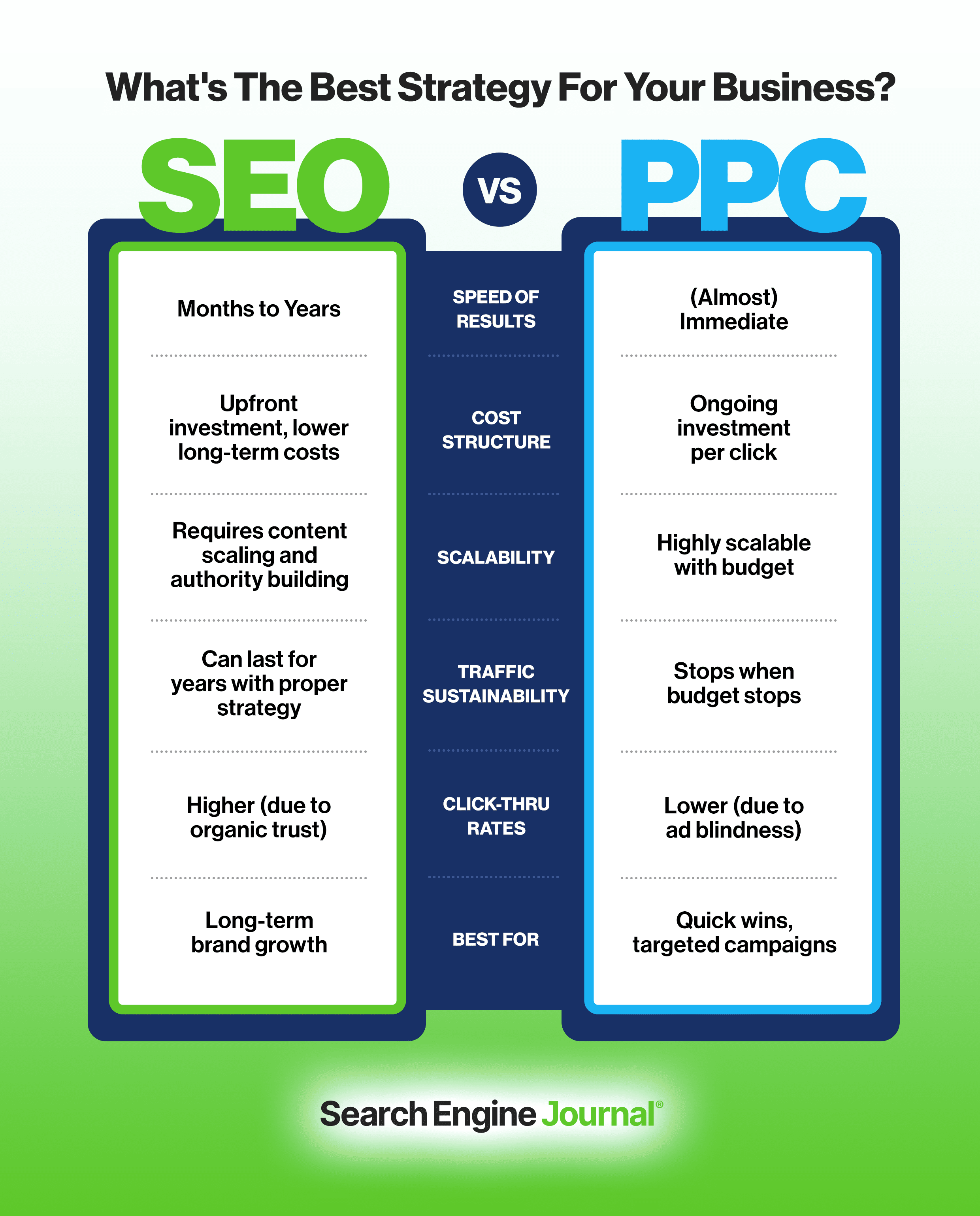
SEO Vs. PPC: Side-By-Side Comparison
Choosing The Right Strategy For Your Business
The best marketing strategies align with your business goals, industry dynamics, and available resources.
While some businesses can afford to take a long-term approach with SEO, others may need the immediacy of PPC.
The key is to evaluate your needs carefully and choose the right mix of paid and organic efforts.
If You Need Instant Wins: Focus On PPC
If your business needs immediate traffic, leads, or sales, PPC is the way to go. This is especially true for:
Startups and new businesses: When brand awareness is low, PPC can help put your company in front of potential customers quickly.
High-margin industries: Businesses that generate high profits per conversion (e.g., legal services, SaaS, finance) can justify PPC spend more easily.
Seasonal promotions: If your business thrives on specific times of the year (e.g., holiday sales, back-to-school shopping), PPC ensures you capture demand at the right moment.
Local businesses: Companies with a local presence can use PPC to dominate searches for high-intent queries like “best plumber near me.”
If You Want Long-Term Growth: SEO Is The Way To Go
If you’re focused on building a sustainable marketing funnel that pays dividends in the future, SEO is the smarter play.
Prioritize SEO if:
Your business relies on organic search traffic: Industries like blogging, ecommerce, and B2B SaaS benefit from strong SEO foundations.
You’re in a highly competitive PPC market: If CPCs are prohibitively expensive, investing in organic search can provide a more cost-effective alternative.
You’re willing to invest in content marketing: High-quality, evergreen content fuels SEO and positions your business as an authority in your space.
Your audience conducts research before purchasing: If customers compare multiple options before making a decision, strong SEO can help you stay top-of-mind.
Invest In SEO And PPC For The Best Of Both Worlds
For most businesses, the real answer isn’t SEO or PPC – it’s SEO and PPC. A blended approach allows you to capture immediate opportunities while building long-term organic growth.
Businesses that view these two strategies as complementary, rather than competing, often see the best results.
Here’s why integrating both SEO and PPC is a smart move:
SEO Supports Long-Term Sustainability, While PPC Fills Gaps
Even with the best SEO strategy, organic rankings fluctuate due to algorithm updates and competition.
PPC acts as a safety net, ensuring your brand remains visible even when organic rankings dip. It also allows you to target high-intent keywords that may be too competitive to rank organically in the short term.
PPC Provides Data To Strengthen SEO Efforts
One of the most effective ways to refine your SEO strategy is by using PPC data.
Paid search campaigns provide insights into which keywords convert best, which messaging resonates, and which audience segments drive the most revenue.
This data can be leveraged to optimize SEO efforts, helping to prioritize content creation and organic keyword targeting.
SEO Reduces Long-Term Costs, While PPC Provides Immediate ROI
A well-executed SEO strategy reduces reliance on paid ads over time. Once your site ranks well for high-value keywords, you receive continuous traffic without ongoing ad spend.
PPC, on the other hand, delivers instant results, making it ideal for new product launches, promotions, or when entering new markets.
A combined strategy ensures you’re not putting all your eggs in one basket.
Using PPC To Boost SEO Content
Even the best content needs exposure to gain traction. PPC can be used to drive initial traffic to newly published blog posts, product pages, or other high-value content.
The added engagement signals from paid visitors, such as time on page, shares, and backlinks, can indirectly improve organic rankings.
Retargeting SEO Visitors With PPC
Not all organic visitors convert on their first visit. Using PPC remarketing campaigns, you can re-engage visitors who found you through SEO but didn’t take action.
This keeps your brand top-of-mind and helps improve overall conversion rates.
By investing in both SEO and PPC, you build a balanced marketing strategy that delivers short-term wins while positioning your business for long-term success.
Rather than choosing one over the other, leveraging their combined strengths leads to more sustainable and profitable growth.
Final Thoughts
SEO and PPC each have distinct advantages, and the right choice depends on your business objectives. If you need fast results, PPC is the clear winner. If you’re playing the long game, SEO is invaluable.
But in reality, the most effective digital marketing strategies don’t rely on just one – they integrate both.
The best approach? Evaluate your budget, resources, and competitive landscape. Align your strategy with short-term and long-term goals.
And if you have the ability, combine SEO and PPC for a well-rounded marketing engine that delivers both immediate and sustained results.
More Resources:
Featured Image: Paulo Bobita/Search Engine Journal
Large language models (LLMs) like ChatGPT and Claude are best known for their writing abilities, drafting ad copy, summarizing reports, and helping brainstorm blog content.
However, most marketers still know little about one of their most powerful features: They can write actual code.
First, it talked. Then, it wrote. Now, it builds.
We’re not just talking about basic snippets. These models can generate full scripts, fully functional browser extensions, small web apps, and automations, all from plain English prompts – or any other language you’re most comfortable with.
For marketers and PPC pros, that unlocks a new level of efficiency. You no longer need to know how to program to start benefiting from technical solutions to everyday problems.
In the past, I might have only written a script if it saved me hours of manual work every month.
Now, with LLMs, it’s so quick to build something that I’ll even create one-off tools for tasks that would’ve only taken me an hour or two. That’s how low the barrier has become.
In this article, I’ll walk through the types of problems you can solve with LLM-powered coding, the browser-based tools that make it accessible, and real examples of how marketers are already using this to move faster.
The Real Power: Turning Instructions Into Code
LLMs have ingested much of the world’s knowledge, and that includes scripts and computer code. That means if you can explain a process clearly, they can usually turn that explanation into working code.
Because they’re multi-modal, they can even understand a diagram you’ve whiteboarded at the office and turn that into code, too.
This makes them incredibly valuable for non-programmers who know what they want but don’t know how to build it.
Think of the marketer who understands how data should be formatted for a monthly client report but dreads the repetitive steps of reformatting CSV files. Or the account manager who wants to automate their process of eliminating underperforming search terms but doesn’t have a dev team to help them.
With LLMs, these tasks can be described in a few sentences, and AI can generate Python scripts, JavaScript tools, or even complete web apps that solve the problem.
This isn’t just about saving time. It’s about unlocking experimentation and removing the friction that keeps good ideas from scaling through technology.
What Problems Can LLM-Generated Code Solve?
Let’s break down the kinds of problems where LLM coding can shine. These aren’t hypothetical; they’re pulled from common workflows across agencies and in-house teams daily.
1. Automating Repetitive, Time-Consuming Tasks
You probably do at least one of these on a somewhat regular basis:
Copying Google Ads data into slides for reporting.
Cleaning up GPT’s output before sharing it with a client.
Manually reviewing ad copy for brand compliance.
With the help of an LLM, each of these can be turned into a repeatable, automatable workflow. You describe the task, and the LLM builds the script that does it.
This is especially valuable for marketers who are tired of being “spreadsheet operators” instead of strategists. By turning routine tasks into one-click tools, you free up hours a week and reduce human error.
2. Trying Something Entirely New
Unlike the tasks above, which you know exactly how to do but hate how much time they take, there are also some projects you may not have tried because you do not know how.
For my team, that included a quiz to make blog content more engaging. For me, it involved building a browser extension to blur sensitive data on the screen.
These are ideal use cases for LLM-powered coding. They allow you to prototype and test ideas without needing a development team, and if you’re lucky enough to have one, you don’t need to wait for your project to get prioritized.
You can get feedback quickly, iterate faster, and build an entire proof of concept before involving engineering.
Marketing innovation often dies in the backlog. LLM coding makes it easier to try things on your own.
3. Google Ads Scripts
This is one of the most exciting areas for PPC pros. Google Ads scripts are powerful, but let’s face it, they’ve always had a learning curve. Now, LLMs can flatten that curve dramatically.
You can tell a model:
Write a Google Ads script that checks all active campaigns with “Mother’s Day” in the name. If the current date is within seven days of Mother’s Day, increase the daily budget of those campaigns by 20%. Include comments to explain each part of the code so I can understand what the script is doing.
It will return a fully functional script that you can paste directly into your account’s scripts section.
This lowers the barrier to entry for marketers who want to automate common PPC maintenance or build lightweight tools for managing large accounts.
You can go from idea to automation in minutes, no JavaScript experience required.
Tools That Make LLM Coding Accessible
I hope the idea of becoming more efficient through code sparks your interest, especially if you’ve ever found yourself repeating the same task week after week.
Whether you’re managing ad campaigns, cleaning data, or formatting content, the ability to automate even small pieces of your workflow can save hours and reduce errors.
Here’s the best part: You don’t need to be a developer to start.
You don’t even need to install anything, understand programming languages, or know how to set up a server. You definitely don’t need to open a complicated integrated development environment (IDE).
The tools I’m about to show you run entirely in your browser. They’re designed to help you go from idea to functional code with nothing more than a clear description of what you want to achieve.
If you’ve never written code before, this is exactly where you want to start.
Claude (Anthropic)
For marketers, Claude’s ability to write, test, and execute code right inside the interface is a real standout.
No setup is required, no installations, and no APIs to connect.
You describe what you need, Claude writes the code, and you see the results in real-time. This fast, feedback-driven loop makes it easier than ever to experiment and iterate without the usual technical friction.
The 200,000-token context window is another game-changer. You can paste your entire campaign structure, a long analytics report, or even a full landing page copy, and Claude will process it all in one go.
It keeps track of every detail you’ve shared, so nothing gets lost as you build on your ideas.
There is a tradeoff, though. Claude currently runs code in a single-file execution environment. That’s fine for most marketing tasks, but for more complex, multi-file projects, it’s not as flexible as tools like Vercel’s V0.dev, which supports full project structures.
Still, for marketers building scrappy, high-impact tools fast, Claude handles a surprising amount.
Here’s what’s most exciting to me:
It can run JavaScript right in the browser, perfect for quick tasks like data filtering, simple visualizations, or interactive prototypes.
It translates technical concepts into plain, marketing-friendly language, so you’re never stuck decoding dev speak.
It surfaces insights from your data quickly, helping you spot trends and outliers that would otherwise go unnoticed.
One of the benefits of LLMs is that they can adapt to each user’s level.
If you’re not technical, it gives you just enough to feel empowered. If you are, it meets you there and helps you move even faster. Either way, it expands what’s possible without getting in your way.
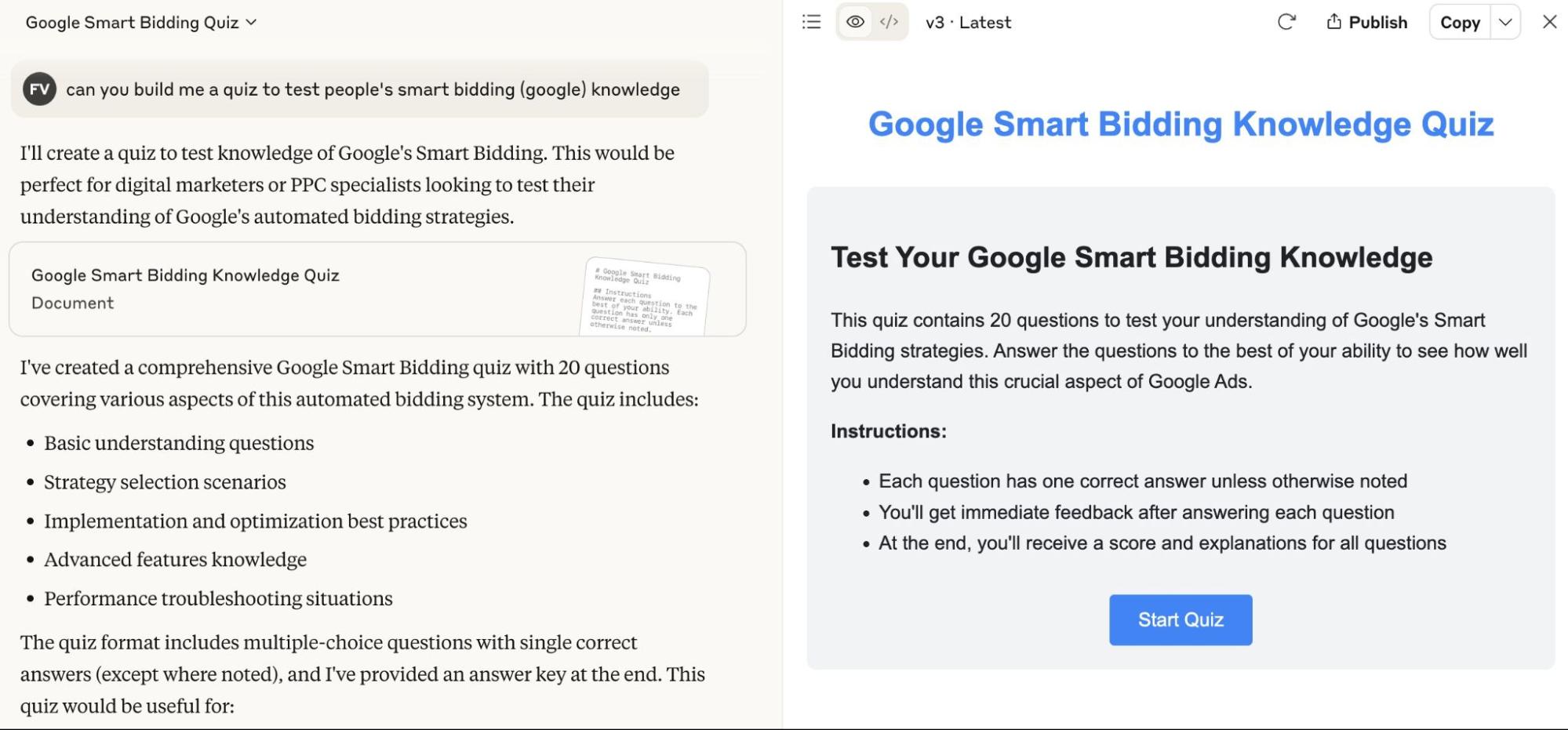
Below is a view of Claude generating code based on a marketing-focused prompt, with both the prompt and working output visible in the interface.
Users can toggle to the code view if they prefer to see that instead of a preview of the tool.
Screenshot from Claude.ai, April 2025
V0.dev (Vercel)
As much as I’m excited about Claude, V0 takes it to a whole new level.
Vercel, the creator of Next.js, made V0.dev, which is designed to build working software by describing what you need.
Why it stands out:
Generates full React components, HTML, and CSS.
Lets you deploy working projects instantly.
Handles multi-file architecture (great for real apps).
Marketers can use V0.dev to build:
Text reformatting tools.
User interfaces (UI/UX).
Internal dashboards.
Fully working web apps.
It’s like having a front-end developer in your browser.
Here’s a screenshot of what I quickly tried building using V0.dev. I prompted it to create a simple tool for Search Engine Journal readers that takes a blog post and outputs key takeaways in bullet form.
V0.dev generated a clean, on-brand interface with just a single prompt, no coding required. It’s a great example of how fast you can go from idea to working prototype.
What’s especially cool is that you could even launch this tool so anyone can use it.
Screenshot from v0.dev, April 2025
When creating a tool that requires third-party integrations, V0 asks for the required API keys and credentials.
When building something that can’t be hosted online, like a Chrome extension, it explains how to install the files. In short, it helps anyone, regardless of ability, to create a working piece of software.
GPT-4o (OpenAI/ChatGPT)
GPT-4o is the LLM I’ve used the most for building ad scripts, as it was the first one to write an error-free piece of code. It’s also great for:
Creating data transformation scripts.
Debugging code.
Explaining errors.
Translating code from one language to another.
But, GPT is limited in that it can’t run the code it writes directly in the chat window. That means there is a lot of copy-and-pasting required to take the code, install it on a server, test it, and then iterate with GPT to debug it.
While I think GPT is awesome for writing code, if I need something quick and simple, I’ll prefer Claude. If I want something more complex and want to debug it in the LLM, I’ll use V0.
Real-World Example Use Cases
Let’s go deeper into actual examples. These aren’t just ideas; these are projects you can ask an LLM to help build today.
Example 1: Chrome Extension To Blur Sensitive Text
The Problem:
I’m frequently taking screenshots of dashboards or search results but need to hide client names, numbers, or other sensitive data.
The LLM Solution:
I asked V0.dev to generate a Chrome extension that adds a blur effect to any numerical values on the page.
It generates all the files needed and explains how to install my custom extension in my Chrome browser. It returns:
The manifest.json file.
JavaScript to inject CSS.
Instructions to package and install the extension.
Screenshot from Optmyzr.com, April 2025
Why It Matters:
This isn’t something most marketers would ever think to build, but with a few prompts, you’ve created a privacy-preserving utility that saves you editing time and protects sensitive info.
Example 2: Web App To Reformat GPT Output
The Problem:
I use Deep Research from ChatGPT to generate research for my team or future blogs, but I don’t love how source references are formatted when I copy the research into a Google Doc.
The LLM Solution:
Use V0.dev to create a web app that:
Accepts pasted text.
Accepts a list of formatting changes I would normally make manually (e.g., finding links and putting them in superscript).
Displays the cleaned version instantly.
Why It Matters:
It streamlines content workflows. Instead of editing output by hand, you get consistent formatting that meets your brand or platform guidelines.
Example 3: Interactive Blog Quiz Generator
The Problem:
We wanted to make our blogs more interactive, and my team had the idea to add quizzes.
The LLM Solution:
Use Claude to generate a quiz engine in HTML/CSS/JS. Feed it five to seven questions, then tie the result to different calls to action (“Download This Guide” or “Talk to an Expert”).
Why It Matters:
Interactive content improves time-on-page, reduces bounce, and personalizes the experience, without needing design or dev support.
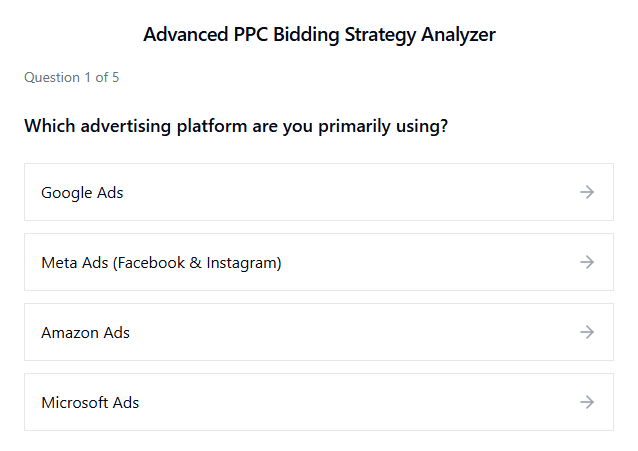
Want to see it? Check out how AI is transforming our content about bidding strategies.
Screenshot from Optmyzr Blog, April 2025
Conclusion: Marketers Can Now Build What They Need With AI
Writing utility software is easier than it’s ever been before.
For marketers, the question used to be “What tools should I use?” Now, it might be: “What tools should I create?”
If you’ve ever been bottlenecked by engineering resources, or if your “wouldn’t it be cool if…” idea has sat in a notebook for months, this is your chance.
You don’t need an IDE. You don’t need to understand loops or classes. You just need a problem to solve, a clear description, and the right LLM at your side.
Temu and Shien have slashed their U.S. advertising spend in response to tariffs and the end of the de minimis tariff exception for orders under $800. The actions could elevate prospects for American shops and brands.
Google Shopping
Tinuiti, a marketing agency, shared data with Practical Ecommerce showing that Temu dramatically reduced — and eventually stopped — spending on Google Shopping ads between April 9 and 12, 2025. Shein is following a similar pattern, having cut its Google Shopping ads investment on April 15, according to Tinuiti.
Moreover, Temu and Shein announced that they will raise prices effective April 25 in response to U.S. tariffs and the May 2 end of the de minimis exception for goods originating from China and Hong Kong.
Impact and Opportunity
Temu and Shein have impacted U.S. retailers. For example, in December 2022, Temu had a 17% share of the U.S. discount market, according to Reuters, citing data from Earnest Analytics.
The marketplaces also created opportunities. Temu had recently launched its U.S. Seller Program, enabling direct-to-consumer brands and other sellers to list products on the platform.
Assuming Temu’s and Shein’s advertising and price behavior foretells a lesser U.S. role, a question now is, “Who benefits?”
Unfortunately, the answer is unclear, although three groups are likely pleased: ad buyers, discount retailers, and ecommerce SMBs.
Ad buyers
It might seem like plummeting demand from two large advertisers would lower CPMs or CPCs for other businesses and drive additional shopping traffic.
Some in the industry believe that Temu’s advertising goal was to buy market share and reduce competition. If true, those competitors could benefit.
Yet Tinuiti’s research director, Mark Ballard, suggests the impact is not likely widespread. Ballard told Practical Ecommerce that many advertisers continue to bid for Google Shopping impressions, and that any change would be “indistinguishable from noise.”
Discount retailers
Discount retail chains might enjoy a competition respite. For example, a February 2025 Eurweb article cited sources estimating upwards of 15,000 U.S. retail locations would close in 2025, partly owing to price competition from Shein and Temu.
Certainly those retailers could benefit from less competition, but a few factors could foil it.
First, many discount products are made in China. So, while they might face fewer competitors, the retailers are not immune to tariffs.
Moreover, Temu and Shien are not the only threats. Removing China-based marketplaces may change competition, but not eliminate it. Amazon, Walmart, and Target will remain, as will a segment of ecommerce sellers.
Ecommerce SMBs
That segment — the third group potentially benefiting from Shein and Temu exiting the U.S. market — is small-and-midsized ecommerce sellers competing in the low-cost market or just above it.
Selling low-cost items could become easier, assuming China is not the source of the inventory. And goods priced just above the discount range could become a viable alternative.
On Thanksgiving weekend of 2013, Jeff Bezos, then Amazon’s CEO, took to 60 Minutes to make a stunning announcement: Amazon was a few years away from deploying drones that would deliver packages to homes in less than 30 minutes.
It lent urgency to a problem that Parimal Kopardekar, director of the NASA Aeronautics Research Institute, had begun thinking about earlier that year.
“How do you manage and accommodate large-scale drone operations without overloading the air traffic control system?” Kopardekar, who goes by PK, recalls wondering. Busy managing all airplane takeoffs and landings, air traffic controllers clearly wouldn’t have the capacity to oversee the fleets of package-delivering drones Amazon was promising.
The solution PK devised, which subsequently grew into a collaboration between federal agencies, researchers, and industry, is a system called unmanned-aircraft-system traffic management, or UTM. Instead of verbally communicating with air traffic controllers, drone operators using UTM share their intended flight paths with each other via a cloud-based network.
This highly scalable approach may finally open the skies to a host of commercial drone applications that have yet to materialize. Amazon Prime Air launched in 2022 but was put on hold after crashes at a testing facility, for example. On any given day, only 8,500 or so unmanned aircraft fly in US airspace, the vast majority of which are used for recreational purposes rather than for services like search and rescue missions, real estate inspections, video surveillance, or farmland surveys.
One obstacle to wider use has been concern over possible midair drone-to-drone collisions. (Drones are typically restricted to airspace below 400 feet and their access to airports is limited, which significantly lowers the risk of drone-airplane collisions.) Under Federal Aviation Administration regulations, drones generally cannot fly beyond an operator’s visual line of sight, limiting flights to about a third of a mile. This prevents most collisions but also most use cases, such as delivering medication to a patient’s doorstep or dispatching a police drone to an active crime scene so first responders can better prepare before arriving.
Now, though, drone operators are increasingly incorporating UTM into their flights. The system uses path planning algorithms, like those that run in Google Maps, to chart a course that considers not only weather and obstacles like buildings and trees but the flight paths of nearby drones. It’ll automatically reroute a flight before takeoff if another drone has reserved the same volume of airspace at the same time, making the new flight trajectory visible to subsequent pilots. Drones can then fly autonomously to and from their destination, and no air traffic controller is required.
Over the past decade, NASA and industry have demonstrated to the FAA through a series of tests that drones can safely maneuver around each other by adhering to UTM. And last summer, the agency gave the go-ahead for multiple drone delivery companies using UTM to begin flying simultaneously in the same airspace above Dallas—a first in US aviation history. Drone operators without in-house UTM capabilities have also begun licensing UTM services from FAA-approved third-party providers.
UTM only works if all participants abide by the same rules and agree to share data, and it’s enabled a level of collaboration unusual for companies competing to gain a foothold in a young, hot field, notes Peter Sachs, head of airspace integration strategy at Zipline, a drone delivery company based in South San Francisco that’s approved to use UTM.
“We all agree that we need to collaborate on the practical, behind-the-scenes nuts and bolts to make sure that this preflight deconfliction for drones works really well,” Sachs says. (“Strategic deconfliction” is the technical term for processes that minimize drone-drone collisions.) Zipline and the drone delivery companies Wing, Flytrex, and DroneUp all operate in the Dallas area and are racing to expand to more cities, yet they disclose where they’re flying to one another in the interest of keeping the airspace conflict-free.
Greater adoption of UTM may be on the way. The FAA is expected to soon release a new rule called Part 108 that may allow operators to fly beyond visual line of sight if, among other requirements, they have some UTM capability, eliminating the need for the difficult-to-obtain waiver the agency currently requires for these flights. To safely manage this additional drone traffic, drone companies will have to continue working together to keep their aircraft out of each other’s way.
Yaakov Zinberg is a writer based in Cambridge, Massachusetts.
But the White House’s profusion of executive orders and aggressive tariffs, along with its determined effort to roll back clean-energy policies, are moving the industry in the wrong direction, creating market chaos and economic uncertainty that are making it harder for both legacy players and emerging companies to invest, grow, and compete.
Heat Exchange
MIT Technology Review’s guest opinion series, offering expert commentary on legal, political and regulatory issues related to climate change and clean energy. You can read the rest of the pieces here.
The current 90-day pause on rolling out most of the administration’s so-called “reciprocal” tariffs presents a critical opportunity. Rather than defaulting to broad, blunt tariffs, the administration should use this window to align trade policy with a focused industrial strategy—one aimed at winning the global race to become a manufacturing powerhouse in next-generation energy technologies.
By tightly aligning tariff design with US strengths in R&D and recent government investments in the energy innovation lifecycle, the administration can turn a regressive trade posture into a proactive plan for economic growth and geopolitical advantage.
The president is right to point out that America is blessed with world-leading energy resources. Over the past decade, the country has grown from being a net importer to a net exporter of oil and the world’s largest producer of oil and gas. These resources are undeniably crucial to America’s ability to reindustrialize and rebuild a resilient domestic industrial base, while also providing strategic leverage abroad.
But the world is slowly but surely moving beyond the centuries-old model of extracting and burning fossil fuels, a change driven initially by climate risks but increasingly by economic opportunities. America will achieve true energy dominance only by evolving beyond being a mere exporter of raw, greenhouse-gas-emitting energy commodities—and becoming the world’s manufacturing and innovation hub for sophisticated, high-value energy technologies.
Notably, the nation took a lead role in developing essential early components of the cleantech sector, including solar photovoltaics and electric vehicles. Yet too often, the fruits of that innovation—especially manufacturing jobs and export opportunities—have ended up overseas, particularly in China.
China, which is subject to Trump’s steepest tariffs and wasn’t granted any reprieve in the 90-day pause, has become the world’s dominant producer of lithium-ion batteries, EVs, wind turbines, and other key components of the clean-energy transition.
Today, the US is again making exciting strides in next-generation technologies, including fusion energy, clean steel, advanced batteries, industrial heat pumps, and thermal energy storage. These advances can transform industrial processes, cut emissions, improve air quality, and maximize the strategic value of our fossil-fuel resources. That means not simply burning them for their energy content, but instead using them as feedstocks for higher-value materials and chemicals that power the modern economy.
The US’s leading role in energy innovation didn’t develop by accident. For several decades, legislators on both sides of the political divide supported increasing government investments into energy innovation—from basic research at national labs and universities to applied R&D through ARPA-E and, more recently, to the creation of the Office of Clean Energy Demonstrations, which funds first-of-a-kind technology deployments. These programs have laid the foundation for the technologies we need—not just to meet climate goals, but to achieve global competitiveness.
Early-stage companies in competitive, global industries like energy do need extra support to help them get to the point where they can stand up on their own. This is especially true for cleantech companies whose overseas rivals have much lower labor, land, and environmental compliance costs.
That’s why, for starters, the White House shouldn’t work to eliminate federal investments made in these sectors under the Bipartisan Infrastructure Law and the Inflation Reduction Act, as it’s reportedly striving to do as part of the federal budget negotiations.
Instead, the administration and its Republican colleagues in Congress should preserve and refine these programs, which have already helped expand America’s ability to produce advanced energy products like batteries and EVs. Success should be measured not only in barrels produced or watts generated, but in dollars of goods exported, jobs created, and manufacturing capacity built.
The Trump administration should back this industrial strategy with smarter trade policy as well. Steep, sweeping tariffs won’t build long-term economic strength.
But there are certain instances where reasonable, modern, targeted tariffs can be a useful tool in supporting domestic industries or countering unfair trade practices elsewhere. That’s why we’ve seen leaders of both parties, including Presidents Biden and Obama, apply them in recent years.
Such levies can be used to protect domestic industries where we’re competing directly with geopolitical rivals like China, and where American companies need breathing room to scale and thrive. These aims can be achieved by imposing tariffs on specific strategic technologies, such as EVs and next-generation batteries.
But to be clear, targeted tariffs on a few strategic sectors are starkly different from Trump’s tariffs, which now include 145% levies on most Chinese goods, a 10% “universal” tariff on other nations and 25% fees on steel and aluminum.
Another option is implementing a broader border adjustment policy, like the Foreign Pollution Fee Act recently reintroduced by Senators Cassidy and Graham, which is designed to create a level playing field that would help clean manufacturers in the US compete with heavily polluting businesses overseas.
Just as important, the nation must avoid counterproductive tariffs on critical raw materials like steel, aluminum, and copper or retaliatory restrictions on critical minerals—all of which are essential inputs for US manufacturing. The nation does not currently produce enough of these materials to meet demand, and it would take years to build up that capacity. Raising input costs through tariffs only slows our ability to keep or bring key industries home.
Finally, we must be strategic in how we deploy the country’s greatest asset: our workforce. Americans are among the most educated and capable workers in the world. Their time, talent, and ingenuity shouldn’t be spent assembling low-cost, low-margin consumer goods like toasters. Instead, we should focus on building cutting-edge industrial technologies that the world is demanding. These are the high-value products that support strong wages, resilient supply chains, and durable global leadership.
The worldwide demand for clean, efficient energy technologies is rising rapidly, and the US cannot afford to be left behind. The energy transition presents not just an environmental imperative but a generational opportunity for American industrial renewal.
The Trump administration has a chance to define energy dominance not just in terms of extraction, but in terms of production—of technology, of exports, of jobs, and of strategic influence. Let’s not let that opportunity slip away.
Addison Killean Stark is the chief executive and cofounder of AtmosZero, an industrial steam heat pump startup based in Loveland, Colorado. He was previously a fellow at the Department of Energy’s ARPA-E division, which funds research and development of advanced energy technologies.
As a child of an electronic engineer, I spent a lot of time in our local Radio Shack as a kid. While my dad was locating capacitors and resistors, I was in the toy section. It was there, in 1984, that I discovered the best toy of my childhood: the Armatron robotic arm.
A drawing from the patent application for the Armatron robotic arm.
COURTESY OF TAKARA TOMY
Described as a “robot-like arm to aid young masterminds in scientific and laboratory experiments,” it was the rare toy that lived up to the hype printed on the front of the box. This was a legit robotic arm. You could rotate the arm to spin around its base, tilt it up and down, bend it at the “elbow” joint, rotate the “wrist,” and open and close the bright-orange articulated hand in elegant chords of movement, all using only the twistable twin joysticks.
Anyone who played with this toy will also remember the sound it made. Once you slid the power button to the On position, you heard a constant whirring sound of plastic gears turning and twisting. And if you tried to push it past its boundaries, it twitched and protested with a jarring “CLICK … CLICK … CLICK.”
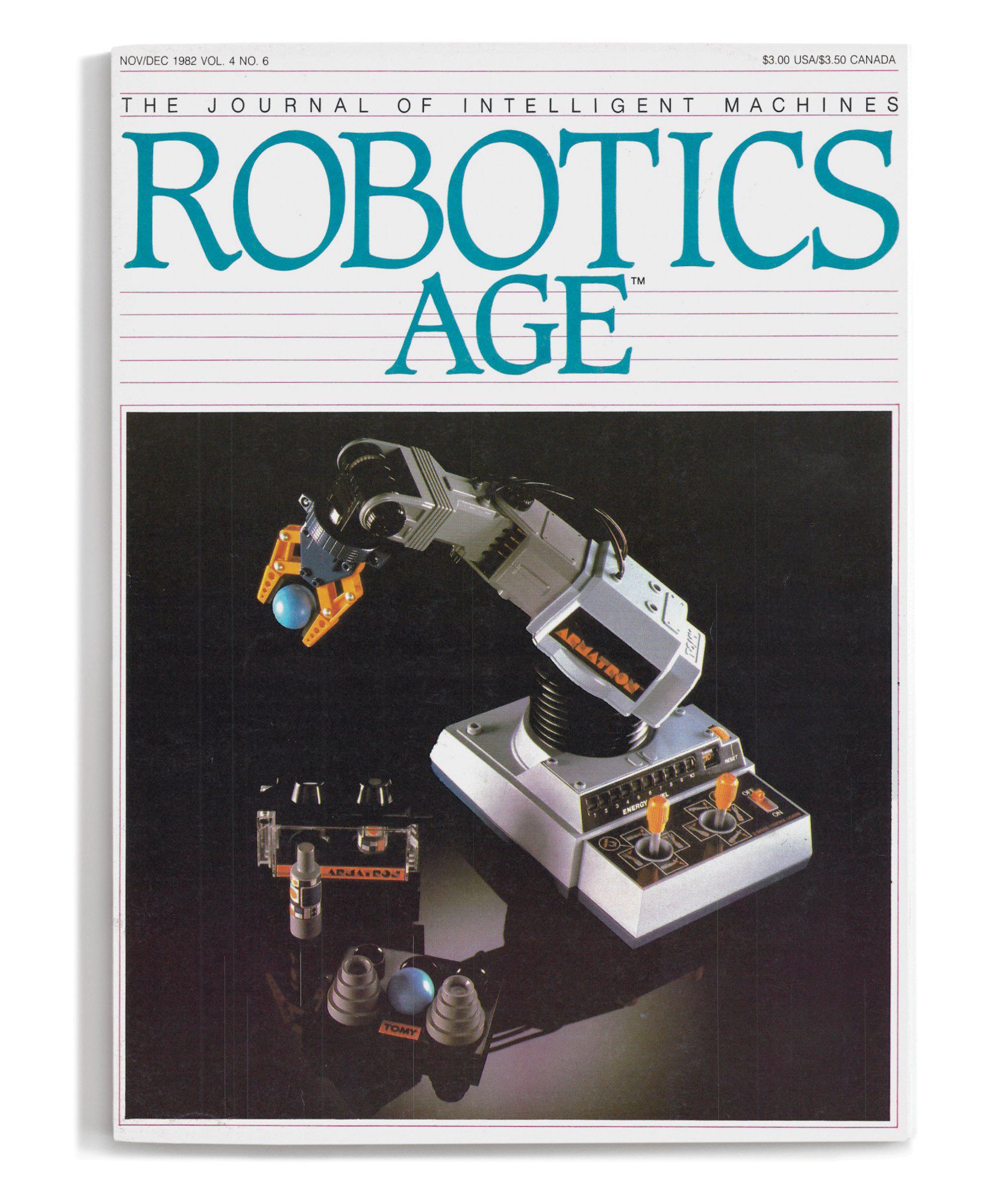
It wasn’t just kids who found the Armatron so special. It was featured on the cover of the November/December 1982 issue of Robotics Age magazine, which noted that the $31.95 toy (about $96 today) had “capabilities usually found only in much more expensive experimental arms.”
JIM GOLDEN
A few years ago I found my Armatron, and when I opened the case to get it working again, I was startled to find that other than the compartment for the pair of D-cell batteries, a switch, and a tiny three-volt DC motor, this thing was totally devoid of any electronic components. It was purely mechanical. Later, I found the patent drawings for the Armatron online and saw how incredibly complex the schematics of the gearbox were. This design was the work of a genius—or a madman.
The man behind the arm
I needed to know the story of this toy. I reached out to the manufacturer, Tomy (now known as Takara Tomy), which has been in business in Japan for over 100 years. It put me in touch with Hiroyuki Watanabe, a 69-year-old engineer and toy designer living in Tokyo. He’s retired now, but he worked at Tomy for 49 years, building many classic handheld electronic toys of the ’80s, including Blip, Digital Diamond, Digital Derby, and Missile Strike. Watanabe’s name can be found on 44 patents, and he was involved in bringing between 50 and 60 products to market. Watanabe answered emailed questions via video, and his responses were translated from Japanese.
“I didn’t have a period where I studied engineering professionally. Instead, I enrolled in what Japan would call a technical high school that trains technical engineers, and I actually [entered] the electrical department there,” he told me.
Afterward, he worked at Komatsu Manufacturing—because, he said, he liked bulldozers. But in 1974, he saw that Tomy was hiring, and he wanted to make toys. “I was told that it was the No. 1 toy company in Japan, so I decided [it was worth a look],” he said. “I took a night train from Tohoku to Tokyo to take a job exam, and that’s how I ended up joining the company.”
The inspiration for the Armatron came from a newspaper clipping that Watanabe’s boss brought to him one day. “It showed an image of a [mechanical arm] holding an egg with three fingers. I think we started out thinking, ‘This is where things are heading these days, so let’s make this,’” he recalled.
As the lead of a small team, Watanabe briefly turned his attention to another project, and by the time he returned to the robotic arm, the team had a prototype. But it was quite different from the Armatron’s final form. “The hand stuck out from the main body to the side and could only move about 90 degrees. The control panel also had six movement positions, and they were switched using six switches. I personally didn’t like that,” said Watanabe. So he went back to work.
The Armatron’s inventor, Hiroyuki Watanabe, in Tokyo in 2025
COURTESY OF TAKARA TOMY
Watanabe’s breakthrough was inspired by the radio-controlled helicopters he operated as a hobby. Holding up a radio remote controller with dual joystick controls, he told me, “This stick operation allows you to perform four movements with two arms, but I thought that if you twist this part, you can use six movements.”
Watanabe at work at Tomy in Tokyo in 1982.
COURTESY OF HIROYUKI WATANABE
“I had always wanted to create a system that could rotate 360 degrees, so I thought about how to make that system work,” he added.
Watanabe stressed that while he is listed as the Armatron’s primary inventor, it was a team effort. A designer created the case, colors, and logo, adding touches to mimic features seen on industrial robots of the time, such as the rubber tubes (which are just for looks).
When the Armatron first came out, in 1981, robotics engineers started contacting Watanabe. “I wasn’t so much hearing from people at toy stores, but rather from researchers at university laboratories, factories, and companies that were making industrial robots,” he said. “They were quite encouraging, and we often talked together.”
The long reach of the robot at Radio Shack
The bold look and function of Armatron made quite an impression on many young kids who would one day have a career in robotics.
One of them was Adam Borrell, a mechanical design engineer who has been building robots for 15 years at Boston Dynamics, including Petman, the YouTube-famous Atlas, and the dog-size quadruped called Spot.
Borrell grew up a few blocks away from a Radio Shack in New York City. “If I was going to the subway station, we would walk right by Radio Shack. I would stop in and play with it and set the timer, do the challenges,” he says. “I know it was a toy, but that was a real robot.” The Armatron was the hook that lured him into Radio Shack and then sparked his lifelong interest in engineering: “I would roll pennies and use them to buy soldering irons and solder at Radio Shack.”
“There’s research to this day using AI to try to figure out optimal ways to grab objects that [a robot] sees in a bin or out in the world.”
Borrell had a fateful reunion with the toy while in grad school for engineering. “One of my office mates had an Armatron at his desk,” he recalls, “and it was broken. We took it apart together, and that was the first time I had seen the guts of it.
“It had this fantastic mechanical gear train to just engage and disengage this one motor in a bunch of different ways. And it was really fascinating that it had done so much—the one little motor. And that sort of got me back thinking about industrial robot arms again.”
Eric Paulos, a professor of electrical engineering and computer science at the University of California, Berkeley, recalls nagging his parents about what an educational gift Armatron would make. Ultimately, he succeeded in his lobbying.
“It was just endless exploration of picking stuff up and moving it around and even just watching it move. It was mesmerizing to me. I felt like I really owned my own little robot,” he recalls. “I cherish this thing. I still have it to this day, and it’s still working.”
The Armatron on the cover of the November/December 1982 issue of Robotics Age magazine.
PUBLIC DOMAIN
Today, Paulos builds robots and teaches his students how to build their own. He challenges them to solve problems within constraints, such as building with cardboard or Play-Doh; he believes the restrictions facing Watanabe and his team ultimately forced them to be more creative in their engineering.
It’s not very hard to draw connections between the Armatron—an impossibly analog robot—and highly advanced machines that are today learning to move in incredible new ways, powered by AI advancements like computer vision and reinforcement learning.
Paulos sees parallels between the problems he tackled as a kid with his Armatron and those that researchers are still trying to deal with today: “What happens when you pick things up and they’re too heavy, but you can sort of pick it up if you approach it from different angles? Or how do you grip things? There’s research to this day using AI to try to figure out optimal ways to grab objects that [a robot] sees in a bin or out in the world.”
While AI may be taking over the world of robotics, the field still requires engineers—builders and tinkerers who can problem-solve in the physical world.
A page from the 1984 Radio Shack catalogue,
featuring the Armatron for $31.95.
COURTESY OF RADIOSHACKCATALOGS.COM
The Armatron encouraged kids to explore these analog mechanics, a reminder that not all breakthroughs happen on a computer screen. And that hands-on curiosity hasn’t faded. Today, a new generation of fans are rediscovering the Armatron through online communities and DIY modifications. Dozens of Armatron videos are on YouTube, including one where the arm has been modified to run on steam power.
“I’m very happy to see people who love mechanisms are amazed,” Watanabe told me. “I’m really happy that there are still people out there who love our products in this way.”
Jon Keegan writes about technology and AI and publishes Beautiful Public Data, a curated collection of government data sets (beautifulpublicdata.com).