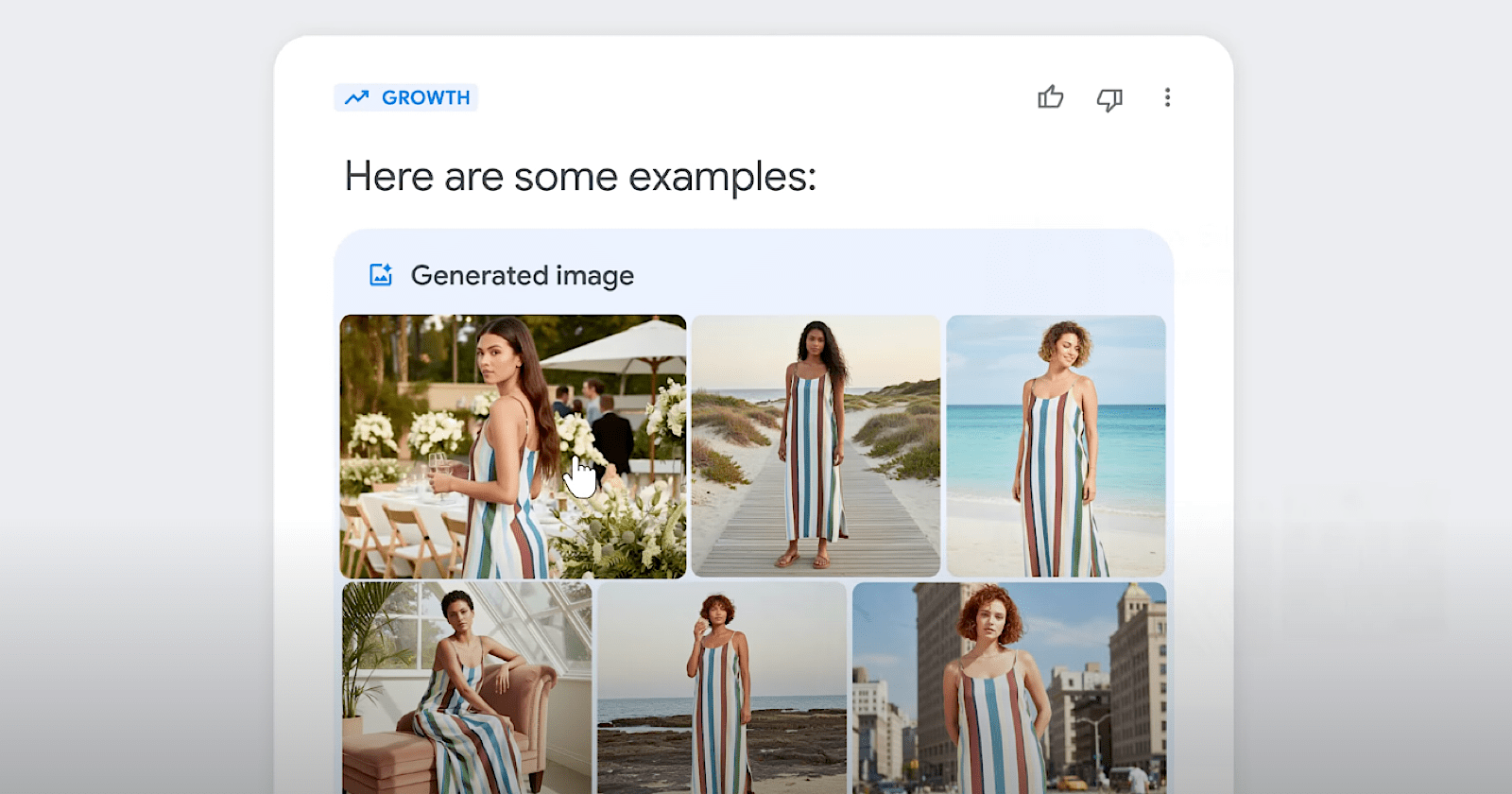
Google claims that search results with AI Overviews generate the same amount of advertising revenue as traditional search results.
This claim was made during Google Marketing Live when the company revealed plans to expand AI Overview ads to desktop users and more English-speaking markets.
If true, this could reshape how marketers perceive Google’s AI-powered future. However, the claim raises questions about how Google measures success and what it means for your campaigns.
Marketers need to understand what lies behind these claims and what they indicate for the future of search advertising.
AI Overviews Reaches Massive Scale
Google launched AI Overviews on mobile in the US last year. Since then, the company has quickly expanded the feature worldwide. It now processes AI-generated responses for users in more than 200 countries.
Shashi Thakur, Google’s VP/GM of Advertising, stated during the press session:
“We started rolling out AI overviews in search on US mobile last year. At this point, we are reaching a billion and a half users using it every month.”
Thakur oversees advertising across Google’s search products. This includes Google.com, Discover, Image Search, Lens, and Maps. He noted that users are happy with the feature.
The expansion shows Google’s confidence in both user adoption and commercial success. The company announced the desktop expansion that morning at the event, representing the latest phase of their rapid global rollout.
Thakur explained the growth impact:
“The consequence of us building AI overviews is that people are seeing growth. People are asking more of those questions… So we are seeing growth. So people are asking more questions. Many of those questions are even commercial. So we are seeing a growth even in commercial.”
Google’s Broader Vision For Search Evolution
Google’s approach to AI Overviews reflects a fundamental shift in how the company thinks about search capabilities. Thakur outlined this vision:
“At its core, we think about search as expanding the kinds of curiosities you can express. Humans have innumerable number of curiosities. There’s only a fraction of those that gets expressed to search. The more we advance the technology, the more we advance the product, users can bring more of their curiosities to search.”
This philosophy drives Google’s push toward AI-powered responses that can handle more complex and nuanced queries than traditional keyword-based searches.
How Google Measures AI Overview Monetization
Google’s revenue claims are based on controlled experiments. The company compares identical search queries with and without AI Overviews. They use standard A/B testing methods.
This means showing the AI feature to some users while holding it back from others. Then they measure the revenue difference.
Thakur explained to reporters:
“When we say AI overviews monetizes at the same rate, if you had taken the exact same set of queries and not shown AI overviews, it would have monetized at some rate. This continues to monetize at the same rate.”
The testing focuses on overall business value and revenue. It doesn’t examine individual metrics, such as click-through rates. Google emphasized this represents performance across many queries, not individual searches.
For advertisers, this suggests AI Overviews don’t hurt existing search advertising effectiveness. However, the long-term effects of changing user behavior patterns remain unclear.
Shashi Thakur speaks to press at Google Marketing Live. Photo: Matt G. Southern/Search Engine Journal.
Strategic Approach To AI Overview Advertising
Google states that ads within AI Overviews adhere to the same quality guidelines as traditional search ads. The company requires that ads be of high quality and fit well with the user experience. All ads must be marked as sponsored content.
Advertisers have three placement options for AI Overview ads: above the AI response, below the response, or integrated within the AI answer itself. This gives marketers flexibility in how they appear alongside AI-generated content.
The complexity of modern user behavior drives Google’s advertising strategy. Thakur noted:
“I think the main thing to take away from those conversations is user journeys are complicated. And users get inspiration to get into their commercial journeys at innumerable points in their journeys.”
The integration focuses on identifying commercial intent within complex queries through what Google refers to as “faceted” searches. These are complex questions that contain multiple sub-questions, some of which have commercial intent.
Thakur gave an example of a user asking about airline rules for traveling with pets. That person might then need pet carriers or travel accessories, creating natural opportunities for advertising. The AI system can identify these layered commercial needs within a single complex query.
Google uses various classifiers to identify commercial intent, including shopping queries, travel queries, and insurance queries. This automated classification system helps match ads to relevant user needs.
Thakur stated:
“Ads need to be high quality, and they need to be cohesive with the experience. Ads of this nature extend how good the answer is for certain users.”
Google reports positive user feedback about ads shown with AI Overviews. This suggests the integration doesn’t significantly hurt user satisfaction.
This user acceptance seems crucial to Google’s strategy. The company plans to expand AI Overview advertising to more platforms and markets.
Shashi Thakur speaks to press at Google Marketing Live. Photo: Matt G. Southern/Search Engine Journal.
Implications For Digital Marketers
The revenue parity claim addresses advertiser concerns about AI’s impact on search advertising effectiveness.
Thakur acknowledged the fundamental question marketers are asking:
“So now, the question we often get from our advertisers, and it’s a natural question, which is, this is great. Search is evolving in lots of exciting directions. How do we participate? And how do we connect with our customers in the context of this evolving experience?”
Thakur noted that over 80% of Google advertisers already use some form of AI-driven advertising technology. This suggests the industry is ready for more AI integration.
However, the shift toward AI-powered search responses may require advertisers to adapt their strategies. Users are asking increasingly complex, longer queries. Traditional keyword targeting may not be effective in addressing these.
Google’s solution involves increased automation through tools like the newly announced “AI Max for search” feature. Early beta testing of AI Max has shown promising results, with advertisers experiencing an average 27% increase in conversions while maintaining similar return on investment (ROI) targets.
Thakur explained the motivation behind AI Max:
“So the motivation for this, essentially, was this changing user behavior. That’s number one. As we heard from our advertisers, we got the feedback very clearly that transparency and control of the form, they were already used on search campaigns. That continues to be super important in addition to the automation.”
The tool maintains the transparency and control features that advertisers expect from traditional search campaigns, including keyword performance reporting and campaign controls. This addresses concerns about losing visibility when embracing automation.
The company’s emphasis on automation reflects a challenge. It’s hard to match ads to sophisticated, conversational queries that can contain multiple commercial intents.
Manual keyword strategies may become less effective over time. This is especially true as search behavior evolves toward natural language interactions.
AI Mode Expansion Creates New Opportunities
Beyond AI Overviews, Google is testing ads within its new AI Mode, which enables fully conversational search experiences. Early data indicates that users in AI mode ask questions that are up to twice as long as regular search queries.
These longer, more conversational queries create additional opportunities for identifying commercial intent within complex questions. The extended query length often means users are providing more context about their needs, potentially making ad targeting more precise.
Google is applying lessons learned from AI Overviews to ensure ads in AI mode maintain the same quality and user experience standards.
Looking Ahead
Thakur emphasized that Google’s approach remains focused on delivering a high-quality user experience while providing business value to advertisers.
The actual test of Google’s revenue claims will come as AI Overviews mature. User behavior patterns need time to solidify.
As Google continues expanding AI Overview advertising globally, digital marketers face a balancing act. They must embrace new automated tools while maintaining the control and transparency that drive successful campaign performance.
Boost your skills with Growth Memo’s weekly expert insights. Subscribe for free!
How does AI change the translation game?
We have to acknowledge that AI revolutionizes international expansion.
It can localize content and creative at scale, with low cost and high fidelity.
Image Credit: Lyna ™
For example, AI tools can identify local synonyms, slang, or spelling variations that match native search queries. Companies can create custom translation models tailored to their existing content, brand, voice, and tone.
A great example is Reddit, which has been using AI to translate content into other countries.
We can actually translate the existing Reddit corpus into other languages at human quality. Now, not all the content is relevant, but a lot of it is. We have been testing this in France, in French, in the first half of this year, and it’s gone very, very well.
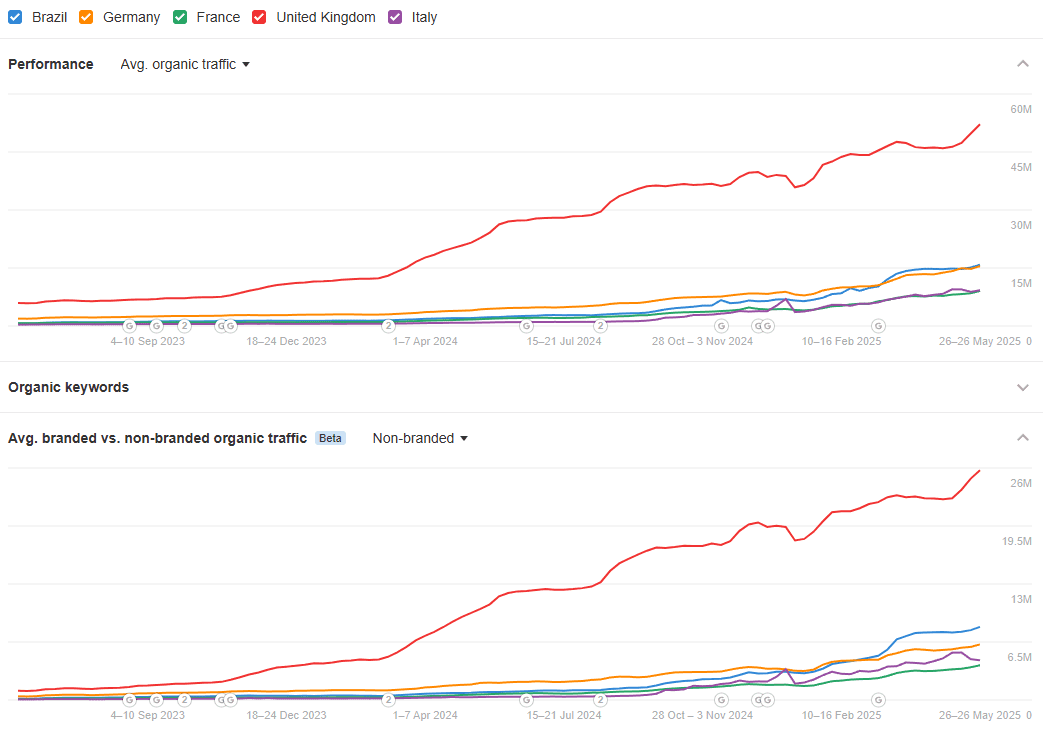
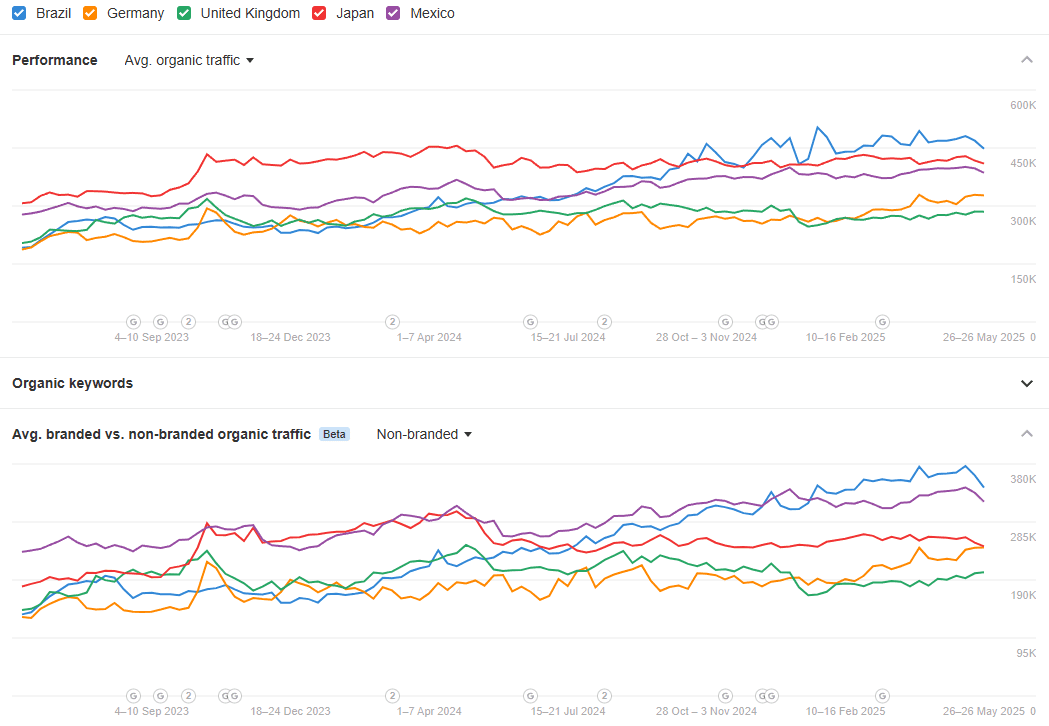
It’s going well, indeed. As you can see in the screenshot below, Reddit is growing rapidly in many markets around the world.
Image Credit: Kevin Indig
The purpose of localization is to create more “starter content” that inspires users in other countries to sign up and post on Reddit, which, in return, creates content that inspires more users to do the same.
Appearing in international search results is important to get that flywheel going.
The Reddit example shows that AI has become good enough for large-scale localization.
Another example is Airbnb, which has been using AI/ML to translate listing descriptions and reviews in over 60 languages:
As cross border travel returns, Airbnb’s new Translation Engine will provide a seamless experience for our Hosts and guests in over 60 languages. Translation Engine removes the need for click to translate buttons by automatically translating listing descriptions and reviews. Based on results from a study across our top ten languages we commissioned by a top machine translation evaluation company, Translation Engine improves the quality of more than 99% of Airbnb listings. Translation Engine uses millions of Airbnb data points to improve translations, so it will get even smarter over time as it learns from new content that’s submitted.1
Ultimately, if you are starting or growing your international SEO program, you should consider using these tools, especially if you want to avoid the most missed traps of internationalization that many marketing teams overlook.
And yet, I want to caution against not leaving humans out of the loop. Mistakes can, and will, happen. So, add a human QA step to the end of the localization pipeline.
Many teams stumble on the same two hidden traps when it comes to international SEO:
Overlocalization of pages, resulting in duplicate content.
Conflating translation with localization, leading to cultural mismatches.
Below, I’ll show you how to dodge these pitfalls for smoother, smarter global growth.
The Problem
Expanding global web presence often results in too many duplicated or minimally localized country-specific websites.
The result?
Split domain authority, duplicate content issues, confused search engines, and diluted user engagement. Not good.
Part of the problem is creating multiple localized site versions that are language-identical or very similar (e.g., separate sites for U.S. English, U.K. English, AU English, CA English, IN English, and so on).
While the intention makes practical sense, the end result often spells disaster for SEO. Multiple English-language URLs containing almost identical content quickly trigger potential duplicate-content issues.
Why It Matters
Weakened link authority: Splitting your SEO equity across too many domains hurts overall rankings.
Operational complexity: More sites mean more headaches keeping everything up-to-date, resulting in costly management overhead.
Duplicate content: When several URLs carry near-identical text, Google’s algorithms struggle to decide which localized URL variant to serve, and the wrong variants frequently rank.
Damaged user experience:Visitors arrive at pages that appear irrelevant or poorly targeted to their locale, viewing incorrect prices, availability, promotions, or contact details. The mismatch creates immediate friction and aggravates users.
Conversion degradation: Localization promise falls apart when users see localized SERP snippets yet encounter mismatched in-site product details. Trust drops radically, abandonments spike, and conversion rates plummet.
Wasted crawl budget and diluted authority: Handling multiple minimally differentiated URL sets spreads the domain’s backlink equity and crawl budget thinly. This reduces overall visibility and SEO performance across regions.
How To Solve It Clearly
Consolidate languages into subdirectories ([yoursite.com/fr/, yoursite.com/de/ …]).
One language, one subdirectory.
Personalize for local details like currencies.
Establish a global base for English under the root domain.
Use a single canonical set of globally unified English-language pages as a baseline, usually serving from yoursite.com/.
Use locale-specific modules.
Customize relevant on-page details dynamically according to user location. Rather than building separate carbon-copy pages to handle minor variations like currency, tax displays, date formats, small spelling adjustments, or promotional discounts, use IP-based or user settings-based server-side modules.
For example, implement a module that reads the IP location and loads the appropriate currency symbol and number format immediately. This minimizes duplicate issues drastically.
Raise the threshold for launching new locales.
Confirm clear need (traffic and economic feasibility).
Verify team and budget readiness upfront.
Don’t launch partially localized content – use “noindex” temporarily if needed.
Segment only when truly necessary (and do it carefully).
Split distinct URLs only when significant geographic differences lead you to create truly differentiated content. A few examples:
Pricing drastically changes due to market structure or legal considerations.
Products or SKUs’ availability heavily varies.
Messaging must accommodate drastically different promotional considerations, regulations, or cultural sensitivities.
Clearly document and sanity-check this rule: If the actual differences simply aren’t substantially meaningful from the user’s viewpoint, keep everything consolidated onto one unified English variant.
Monitor rigorously.
Set up Google Search Console accounts per market to proactively monitor warnings, impressions, and CTRs. Explicitly look for misalignments (e.g., Australian URLs ranking in Google UK search queries or Indian URLs unexpectedly showing on US results).
When this occurs, check your hreflang and server-side configuration immediately to correct breaches in localization and region targeting standards.
Good Example
IBM moved from 180 ccTLDs to 38 folders and saw a significant traffic uplift in organic traffic and a reduction in crawl errors.
Moving country subdirectories to language subdirectories shrank the site from 165 local sites to 10 language-specific sites. This change was both an improvement for international SEO and a pruning campaign.
Image Credit: Kevin Indig
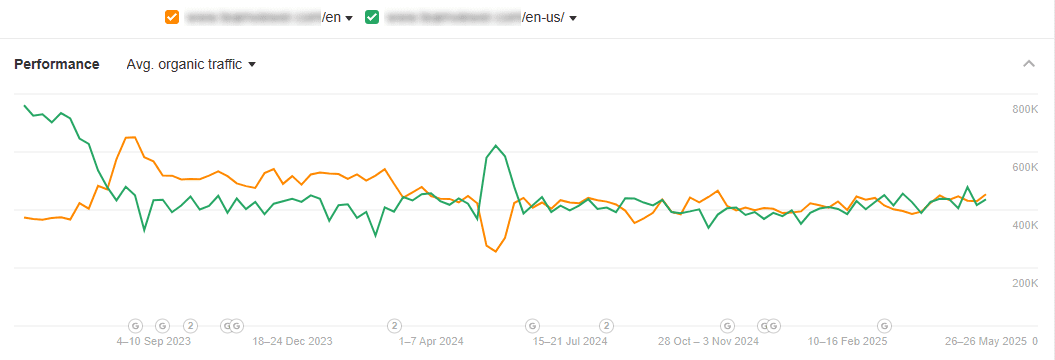
A counter-example is this domain, which has too many country subdirectories.
For example, it has a subdirectory for /en and /en-us/. As you can see from the diverging traffic lines in the screenshot below, Google struggles to understand which subdirectory to rank at the top.
Image Credit: Kevin Indig
When evaluating local conditions through the lens of proper, functional localization across your site, focus your attention on these key dimensions:
1. Regulatory, legal, and compliance conditions.
Certain markets present unique regulatory obligations where you’ll have to take specific actions. Here are a few examples:
Indonesia & Vietnam: Require mandatory registration as an Electronic Systems Provider (PSE registration).
Brazil: Demands a local Data Protection Officer (DPO); data residency requirements apply for regulated industries like financial services and healthcare.
Censorship-heavy countries: Turkey, Iran, China – all necessitating special consideration for content restrictions and compliance.
2. Technical infrastructure and user context.
Tech constraints and habits shape recreation choices, speed expectations, and UX localization needs, like:
Africa (Nigeria, Kenya, South Africa): Heavy reliance on lower-spec Android devices demands careful attention to page size and loading speed.
Global date and format variations: U.S. format conventions (MM/DD/YYYY) differ significantly from many other locales, such as Germany (DD/MM/YYYY). Localization extends into numerical formatting and units as well.
The Problem
Many brands mistakenly treat localizing content as simply translating text into foreign languages (“word-for-word”).
But translation only handles basic information, ignoring deeper nuances around culture, emotion, humor, symbolism, taboos, and context.
There are several different methods/approaches to localization:
Pure word-for-word translation: Good only for straightforward or legal texts (such as invoices, terms of service, or technical specs). Typically, only numbers, currencies, units, and basic SEO keywords are adapted.
Localization of content: Adjusts copy, headlines, CTAs, imagery, emotional triggers, and metaphors for local cultures. Content conveys the same intent but resonates differently (“same meaning, new words”).
Culturalization of content: Goes deeper still, changing narrative and visuals, adapting low-context vs. high-context communication styles (i.e., direct vs. indirect language), colors, symbolism, taboos – even altering the product or campaign concept itself.
Co-creation (local original content): Fully tailored content created from the start by local experts – highest impact but highest effort and cost.
But most brands only focus on word-for-word translation or light localization of content. Many orgs miss out on investing in deeper localization, culturalization, or co-creation.
Why It Matters
If you focus only on word-for-word translation or light localization efforts, rather than doing the deeper work of cultivation of content and even co-creation, it can cause huge breaks in trust and/or missed conversion opportunities.
These real-world missteps show costly localization shortcuts in action:
Pepsi translated “Brings you back to life” into Mandarin as “Brings your ancestors back from the grave.”
HSBC’s “Assume Nothing” tagline became “Do Nothing” in certain markets, prompting expensive rebranding (£10 million).
Electrolux U.S. advertised its vacuums as “Nothing sucks like an Electrolux” (harmless UK idiom, embarrassing in American slang).
Gerber Baby Food jars depicted baby faces in West Africa, where labels typically showed product ingredients, alarming customers who believed they sold baby meat.
How To Solve It Clearly
Prioritize localizing high-value hero/landing pages thoroughly and correctly.
Engage native market experts to review copy, visuals, and creative.
Adapt imagery, localized holidays, date formats, currency, and units.
Perform new local keyword research using native SEO tools.
Validate the cultural appropriateness of all local references before launch.
When evaluating local conditions through the lens of deep localization, focus your attention on these key dimensions:
1. Alphabetical and linguistic differences.
Pay attention to the localization work needed for non-Latin alphabets and scripts. Examples include:
Japan.
Israel.
Middle East/Gulf Region (Saudi Arabia, UAE, Egypt).
Plus, your team should acknowledge and consider multilingual complexities.
India is an excellent example of this, with 22 official languages, and search behaviors in Hindi, Tamil, and Bengali significantly differ from English.
2. Alternative search engine landscapes.
Not every market is dominated by Google. Adapt SEO strategies for local search engine market share.
Here are a few instances to keep in mind where Google isn’t the primary search engine:
South Korea: Naver (~55% market share).
Russia and CIS region (RU, UA, KZ): Yandex (around 45% share).
Czech Republic and Slovakia: Seznam (~15–25% of searches).
Applying thorough localization steps will avoid costly mistakes, preserve positive brand perception, and unlock organic reach in new markets effectively.
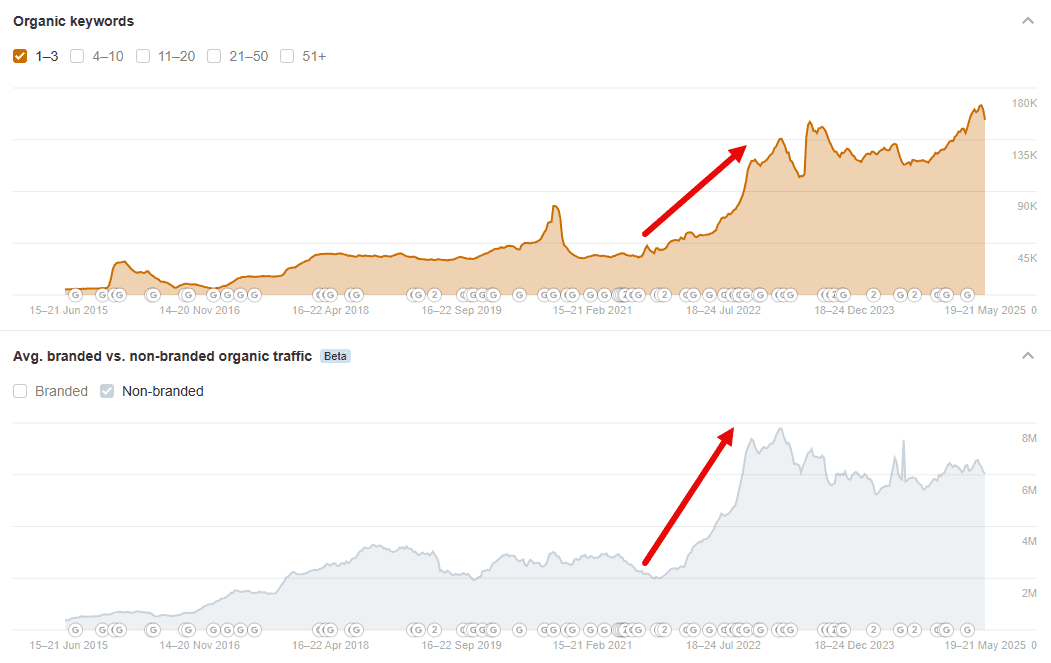
Our biggest SEO win at Shopify – ever – was domain unification.
In the summer of 2022, we combined all ccTLDs and language subdomains under the .com root directory and saw a +2x uplift in organic traffic.
Keep in mind, growth was incremental and not just due to adding more content to the domain.
Image Credit: Kevin Indig
International expansion can really be the growth lever you’re looking for, as long as you keep the following guidelines:
Pick the right site architecture.
Don’t forget critical technical SEO details.
Structure your INTL SEO team right.
Differentiate by business model.
1. Pick The Right Site Architecture
Subdomain vs. ccTLD vs. Subdirectory
If you know me, you know I’m a big proponent of subdirectories.
I mean, you can’t blame me after the success I’ve seen with it at Shopify.
So, to be crystal clear, there are advantages to each:
ccTLDs are easy to recognize for users and lend themselves best for country-specific marketing campaigns.
Subdomains come with clean separation of codebases and servers (and lower migration risk because the domain stays the same).
Subdirectories combine the link and brand equity for all languages, incur no extra maintenance cost, and simplify reporting and monitoring.
From a purely SEO POV, I suggest you go with a subdirectory for languages.
Translating Slugs
A common question I get is whether to translate URL slugs.
There are strong pros and cons, which I will go into below.
But my recommendation is to keep the slug for markets that share the Latin alphabet and translate slugs for different alphabets (e.g., Japanese, Arabic).
Pros to translating URL slugs:
Local-language terms in the slug can reinforce topical relevance and match query strings, giving a small ranking and CTR lift when the keyword is part of the URL snippet.
Native-language URLs look familiar, are easier to read aloud or copy-paste, and signal that users are on the “right” version.
When titles, headings, on-page copy, and slug are all in the same language, the page sends an unambiguous language signal.
Shared links automatically carry meaningful anchor text (the slug) in the local language, which can help attract region-specific backlinks and improve social click-through.
Cons to translating URL slugs:
Every new language demands a slug translation and QA. Any copy updates require synchronized redirects across locales.
Changing a slug later (to fix a mistranslation or branding change) means 301s and a temporary performance dip; large-scale slug changes are expensive and error-prone.
Non-ASCII characters must be UTF-8 encoded (%E6%97%A5%E6%9C%AC), making links look “ugly” in raw form and occasionally breaking older analytics, ad-tracking, or e-mail systems.
Uniform path segmentation (“/product/123/”) is lost when each slug differs (“/produkt/123/”, “/producto/123/”). Dashboards and regex-based tracking need extra maintenance.
2. Don’t Forget Critical Technical Details
To account for the technical side of things, you must keep the following in mind:
Have the correct hreflang setup in place. Don’t forget the self-referencing tag for every page.
Create a GSC property and Bing Webmaster Tools account for every language/subdirectory. Configure language targeting.
Add language-specific XML sitemaps.
Use consistent language codes and canonical tags. Watch out for https vs. http and referencing the right language version of the domain.
Translate schema text fields (name, description) and priceCurrency.
Specify a fallback page and language with the x-default tag.
Localize the schema for each language, especially Organization, Product, FAQ, BreadcrumbList, and priceCurrency.
Use a CDN for fast page speed in every market. Consider local hosting or a CDN edge in countries where page speed is still slow.
Test page speed from different locales and devices with Google PageSpeed tools or webpagetest.org to account for markets where most users have slow devices.
Avoid automatic geo-redirects.
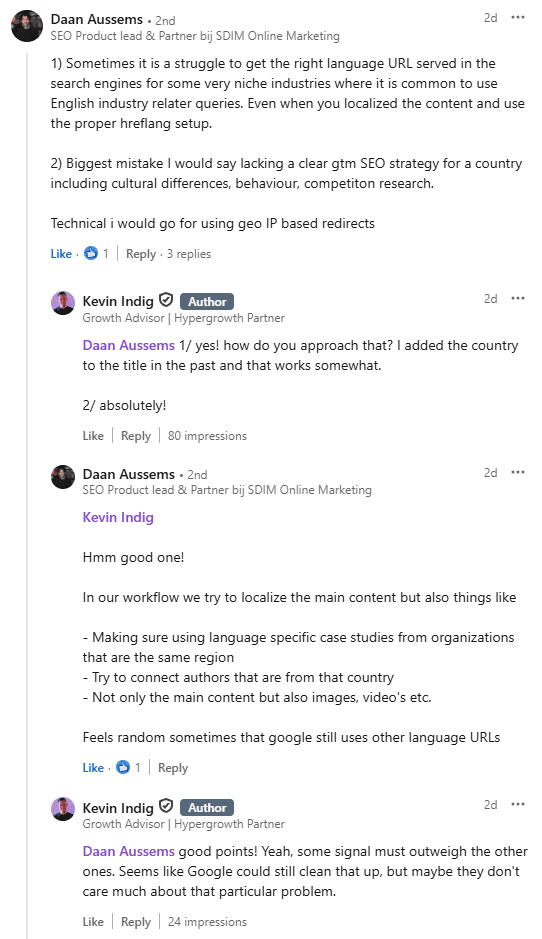
I will say, even with perfect technical optimization and localization, Google sometimes struggles to show the right URLs or even the domain in the right country.
I discuss some of the things you can do with Daan Aussems on LinkedIn:
Add the country to the meta title.
Use local case studies and authors.
Localize images and videos.
Image Credit: Kevin Indig
3. Structure Your INTL SEO Team Right
When setting up your international SEO function, you’ll need to decide between two main structural approaches:
A centralized SEO team.
A centralized SEO team with regionally embedded specialists.
Choosing the right one depends on your organization’s resources, local market requirements, and the depth of localization you’ll pursue.
Option 1: Centralized SEO Team
In a centralized structure, one SEO team (typically in your home or core market) manages SEO across all international markets.
Pros:
Greater consistency in strategy, reporting, and standards.
Simplified internal communication and collaboration.
Easier to manage a cohesive brand narrative and keyword strategy.
Cons:
Lacking native insight might affect local keyword relevance.
Greater risk of cultural blind spots and missing nuances.
Depending extensively on translation/localization teams for accuracy.
When to pick this option:
Ideal if you’re early in the internationalization phase with limited internal resources or for situations where nuances between different regions aren’t highly sensitive.
Option 2: Centralized SEO Team + Regionally Embedded SEO Specialists
In this hybrid approach, you have one central strategy-setting team supported by local SEO specialists who are native to each target market.
A good middle ground might be a core (central) SEO team plus native speaker specialists dedicated to your highest-potential or highest-complexity markets.
Pros:
Balance of control and autonomy – central strategy but local tactical execution.
Ideal for keyword and content localization: Local specialists deeply understand culture and language nuances.
Potential conflict if regional priorities don’t align perfectly with global strategy.
When to pick this option:
Perfectly suited for large sites with complicated localized strategies, high cultural sensitivity, significant growth goals in international markets, and sufficient internal resourcing.
Regardless of which team structure you choose, clarity around reporting lines is essential. A clear organizational structure for most successful global companies often includes:
The overall SEO strategy (core global SEO) team typically reports to a head of growth or related executive.
Regional specialists embedded in specific markets report either directly or “dotted-line” horizontally into the global SEO lead, who is under a gobal growth or marketing department.
Regional content teams ideally report to a global head of brand & content or a similar branding/content position. Regional SEO specialists work horizontally as internal consultants/advisors. Their role involves keyword research, SEO recommendations, brief preparation, and ongoing performance analysis of regional performance.
This arrangement separates content production (managed by branding/content teams) and the optimization of that content (managed by SEO teams).
Successful international SEO workflows vary significantly by your business type.
Below are tailored recommendations clearly segmented by ecommerce and SaaS/digital product business models, since that makes up most of my readers here.
But if you’re in another industry and have questions about tailored SEO workflows or recommendations for your business type, drop your question to me via comment or mailbag (part of the premium subscription).
Ecommerce
Clearly communicate and optimize for regional purchasing expectations to increase trust and conversions:
Localized product content: Translate and culturally adapt product titles, descriptions, specifications, visuals, alt attributes, and schema fields. Check that each element resonates meaningfully in your target market.
Pricing and currency clarity: Display local currency by default based on the user’s location or preferences, and ensure prices reflect local market standards competitively.
Checkout localization: Localize checkout fields, input validations, zip/postal fields, phone number structures, and date formats. User trust quickly erodes if a payment form feels foreign or confusing.
Inventory and shipping transparency: Clearly communicate product availability and adjust your shipping timelines to reflect real conditions per market. If possible, offer intuitive region-aware dashboards that display stock availability locally. Use tables, calculators, or customizable widgets to guide users accurately on expected shipping speed and delivery charges.
Flexible payment methods: Marketborne payment preferences vary regionally – clearly research and implement local standards:
Latin America: Mercado Pago.
China: Alipay, WeChat Pay.
Europe (Netherlands): iDEAL, SEPA Direct Debit.
Germany: Klarna, SOFORT.
Japan/Korea: local banking transfer methods.
Duties and tax transparency: Show clear explanations about VAT, duties, and customs charges. Surprise costs lead users to abandon purchase flows. You may leverage duty calculators or explicitly highlight applicable import taxes directly at checkout.
SaaS And Digital Products
For global SaaS/digital products, localized trust emerges not just from content, but also from user experience framing and region-specific nuance:
Interface localization (website and app): Provide fully localized in-app interfaces, tooltips, messages, error dialogues, sub-menus, etc. Localization should seamlessly integrate with the overall UX flow, including subtle things like date formats, numbering conventions, and time zones.
Comprehensive documentation localization: At a minimum, translate key onboarding materials, help documents, FAQs, and in-app tutorials. Tailored documentation improves UX drastically by removing language-based friction in complex tasks.
Relevant regional thought leadership content: Adapt or create locally relevant content – if possible, base this content on specific region-based data or market insights. Share reports, studies, case studies, webinars, trend analyses, etc., highlighting local-specific usage narratives.
Localized social proof and testimonials: Highlight customers, logos, reviews, or testimonials reflecting regionally recognized brands and clients; strengthens credibility and reduces “foreign brand skepticism.”
Regional compliance and regulatory standards: Clearly map differences in regulatory compliance needs across markets; e.g., GDPR or Personal Information Protection Law (Japan), CCPA (California), electronic service provider regulations, accessibility standards, etc. Confirm you meet regional standards explicitly to minimize legal risk (and possible penalties).
I get this question a lot: When should I expand into an international SEO play?
Knowing when to move beyond your core domestic market can be just as critical as knowing how.
While growing slowly within your home market may feel safer or easier, you’re potentially leaving significant growth untapped.
At the same time, expanding prematurely into international markets might stretch resources thin and dilute your initial peak-market potential.
So, how should you discern when the time is ripe to expand internationally?
In some scenarios, opting to capture market share overseas before competing in a saturated domestic market can even become a strategic advantage, called counter-positioning.
Companies can rapidly establish strongholds in regions lacking dominant incumbents, leverage brand equity abroad first, and only then turn toward challenging larger opponents in the United States or more mature markets.
An example of this approach is StuDocu, a European-born study content-sharing site, versus the initially U.S.-oriented ed-tech giant Course Hero.
Rather than directly challenging Course Hero head-on within saturated American campuses, StuDocu methodically expanded into underserved European, Asian, Latin American, and Australian universities – regions that Course Hero gave lower priority.
This strategic “root growth” in international territories allowed StuDocu to scale rapidly, create a vast global user base, create defensible moats locally, and eventually build the brand equity necessary to mount an effective push into highly competitive markets, including the United States.
There are a few clear criteria every global growth leader should closely examine to inform their strategic expansion timing:
1. Traffic Opportunity (Search Demand)
Before investing heavily, ensure there’s a substantial unmet organic and paid search opportunity around your core offering and targeted keywords.
2. Brand Awareness Signals
Examine your analytics and search queries: Do you already get meaningful visits or searches from the target country? Strong brand indicators can accelerate your market entry.
Quantify current organic visits and branded keywords from those markets despite not actively targeting or marketing to them.
For example, if your analytics reveal repeated organic traffic from Germany with users searching explicitly for your company name or key terms, it signals existing awareness, early-adopter userbase, or even offline word-of-mouth that deserves deeper attention.
3. Competitive Dynamics
Evaluate how mature each prospective target market currently is and understand the competitive landscape deeply:
Who are the local or international incumbents dominating this particular market niche currently?
How strong are those websites from both a content and SEO quality standpoint?
Consider prioritizing up-and-coming markets or regions that are less penetrated by your primary competitors.
4. Market Size And Financial Opportunity
Validate economic logic through a comprehensive market-sizing exercise and initial return-on-investment (ROI) forecasts.
Markets vary broadly by total addressable market (TAM). Scrutinize total market population, GDP per capita, digital connectivity/internet penetration, and mobile saturation data (World Bank, Euromonitor, Statista).
5. Feasibility (Non-SEO Factors)
Even leading SEO and financial criteria scores can be blocked or undermined by inefficient operational, legal, or team-related feasibility realities towards a market.
Explicitly identify:
Legal/regulatory barriers: data protection (GDPR, LGPD specifics), product registration, certifications, licensing, and upfront legal costs.
Cultural nuances that affect product viability: Can product-market fit freeze or vanish redesigns that differ significantly internationally? Localization realities around payment, checkout, and currency complexities?
Shipment and fulfillment chains: Can product/service offer seamless local user experiences with reliable shipping speeds, payment providers, customer support language, and channels?
Internal or partner resourcing: Do current or justifiable investment resources (teams, budget, or executive priorities) align smoothly with engaged regional requirements?
I want to share a few other tools I’ve used over the years.
To evaluate the market as a whole:
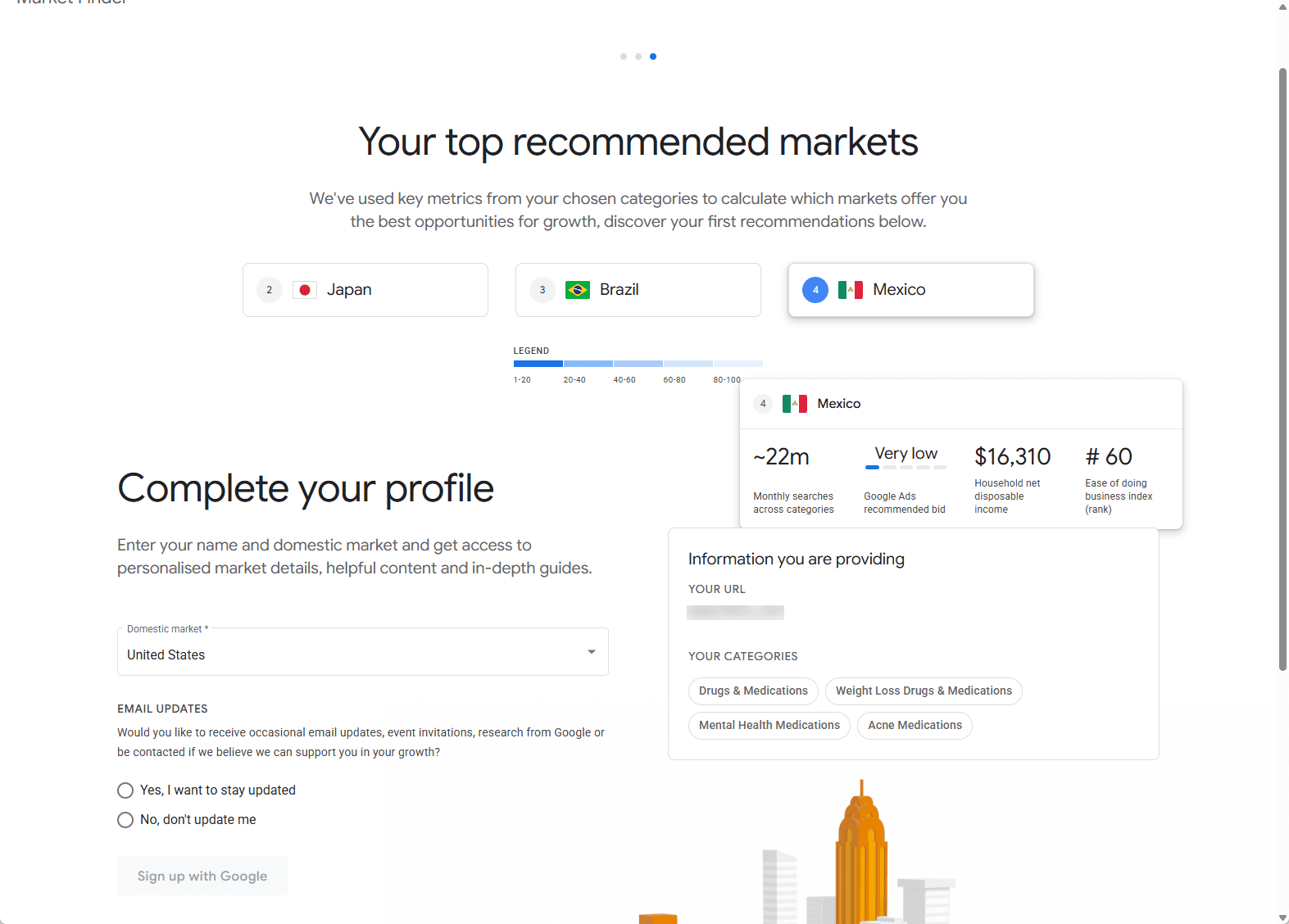
Market Finder: Evaluates your business categories against the total number of searches (search volume), average disposable income, ease of doing business, and the size of the recommended Google Ad bid.
Image Credit: Kevin Indig
To evaluate traffic potential and competitive saturation:
Similarweb Market Intelligence: Estimates monthly visits, engagement, and top referrers for any country/industry.
Semrush Market Explorer: Overlays search volume, paid spend, and audience demographics per market.
Ahrefs “Traffic Potential” + “Top Countries” reports: Quick read on how much of a keyword set sits outside your home region.
Sistrix Visibility Index by country: Reveals incumbent SERP strength; great for spotting “easy” regions.
Google Keyword Planner (but switch location filters): Still the cleanest directional gauge for non-English SERPs.
To evaluate purchasing power and market potential:
World Bank’s DataBank: GDP, internet penetration, card adoption, all exportable.
Euromonitor Passport: Consumer-spending forecasts across 100+ categories.
Statista Global Consumer Survey: Payment methods, brand awareness, category usage by country.
Building a consistent brand is increasingly important in B2B.
With so few buyers in the market at any one time, plus a growing number of people in the buying group, you need to build memorable brand signals that can be a shortcut in your buyer’s memory to what it is that makes you distinct.
This individual brand story will then be associated in their minds with your branded assets, freeing up space in communications for you to share deeper messages, e.g., specific product and service details.
It all starts with defining your brand story. What is it that makes you distinct?
This then needs to carry through all marketing communications, bringing your brand to life.
Purpose
The purpose of a company is its reason for being: What it is that it does every day and what it aims to do across all stakeholder groups it serves.
It should be a statement that resonates with all employees and is the focus of how you deliver your products and services. It is a key part of the culture of the business and needs to be reflected in your brand, marketing, and communications.
It is also at the core of how you drive relevancy to the communities you operate within.
A business or brand purpose that resonates with your employees can be built into their own personal purpose. This alignment gives an even greater sense of belonging to those that work for the business.
There is a traditional Japanese concept, thought to have been first coined in the 7th century, called Ikigai, that is a framework used to enable individuals to find and build a sense of purpose.
It can also be translated to businesses, firms, and organizations, helping you fathom your north star.
Working this through will enable you to think about what it is that drives you and your audiences, aligns to your profession, and makes you money.
The overlap between passion, mission, profession, and vocation is where you need to focus as you develop your own unique purpose that gets to the heart of your own unique value proposition.
Brand Positioning
The positioning of your brand in the minds of your audience should reflect how your brand sits alongside your competitors, how and what it delivers for your customer alongside how it operates as a company.
It should be built on what your customers know about you, your products and services, and what they feel when they use or consume them.
An understanding of your position against your competitors is key. Looking at the variables relevant to your company, you can plot your position against your competitors by using an established 2×2 block model.
Plotting out variables that are relevant to your business will help you understand the competition and how they position themselves.
Variables might include price plotted against quality as a starting point – this will help you see the perception of you against your competitors as either low or high quality against low or high price.
You will be able to see if there are any gaps in the market you might be able to own – either through an extension of your product or service portfolio – or the development of new offerings for the market.
You need to ensure that your positioning is true to what you actually deliver as a company. Overclaiming or overpromising will only end up with a mismatched customer experience, which can undermine any trust you might have built.
Brand Promise
The brand promise is key to developing the value proposition. It is the promise to the buyer or customer that is realized when they purchase your products or services.
It is your distinctive differentiator that details your brand position in terms that are relevant to the market, specifically your target audience, and is a key step in developing your messaging and narrative.
Brand Versus Marketing Campaign Messaging
The messaging you create should be aligned to all elements of your brand and able to be used across brand marketing, but it should also be able to be applied to products or services and used as part of campaign assets. These written assets should include credible reasons to believe your claims and your position.
“Reasons to believe” can be a combination of case studies, use cases, data-led intelligence, and other proof points that add credence to the position you are taking in the market.
These insights should be built into your campaigns to back up the execution of the value proposition and should be fundamental to the content used to drive further consideration and purchase of your products and services.
Your brand, product, and campaign messaging should nest like Russian dolls and all align with each other, building throughout to a clear understanding of what each element means to the audience.
The brand messaging should be built for the long term and have durability, whereas your products and services will change more quickly with client and customer feedback.
The messaging and assets for your products and services should therefore be reviewed annually, adding in any new features, benefits, or additional proof points.
Campaign messaging is driven by the current macro context and will likely be themed around short-term delivery targets, so should be reviewed more regularly.
This gives you a useful review time frame that should be built into your impact studies with an ongoing understanding of performance against the targets set for the brand, product, or individual campaign metrics.
Bringing Your Messaging To Life
Communication across your full portfolio needs to be built around the brand promise, which hits at the heart of your business and is aligned to your purpose.
This will give you the best springboard for delivering authentic, creative executions that resonate with your audiences.
As marketers, we need to tell the story, weaving the proof points and case studies into a narrative that drives a desire to buy the products and services, even if the buyers are not in the market now.
This ensures that you continue to build and drive a connected memory for when the buyers are ready to buy and at the category entry point.
Storytelling is recognized as an important facet of the creative skillset – using stories and allegories to engage audiences, build connection, inspire different types of memory, and build links from how you feel to an association with your brand.
Storytelling
Stories resonate so well that a huge proportion of advertising – in both B2C and B2B – follows the pathway of the “three act structure“.
This is a structure used by playwrights and is often attributed to Aristotle but made popular by Syd Field in his 1979 book Screenplay: The Foundations of Screenwriting.1
Think through any adverts you can remember, as it is an often-used concept from B2C, e.g., chewing gum …to much more complex B2B sales.
There are more similarities between B2C and B2B than we acknowledge. Storytelling crosses over and is common to the needs of all audiences.
Brands are as powerful, if not more so, in B2B as your audience is making what often feels like a bigger decision.
If you buy the wrong B2C product, you aren’t putting your livelihood on the line when you make your buying decision.
That is why a strong B2B brand will win every time, as it takes an incredibly confident buyer to look outside the most well-known providers, whose reputations have been built on years of delivery and execution in their specialist fields.
To read the full book, SEJ readers have an exclusive 25% discount code and free shipping to the U.S. and UK. Use promo code SEJ25 at koganpage.com here.
1Field, S (1979, Revised Edition 2005) Screenplay: The foundations of screen-writing, Random House Publishing Group, US
Google co-founder Sergey Brin says AI is transforming search from a process of retrieving links to one of synthesizing answers by analyzing thousands of results and conducting follow-up research. He explains that this shift enables AI to perform research tasks that would take a human days or weeks, changing how people interact with information online.
Machine Learning Models Are Converging
For those who are interested in how search works, another interesting insight he shared was that algorithms are converging into a single model. In the past, Googlers have described a search engine as multiple engines, multiple algorithms, thousands of little machines working together on different parts of search.
What Brin shared is that machine learning algorithms are converging into models that can do it all, where the learnings from specialist models are integrated into the more general model.
Brin explained:
“You know, things have been more converging. And, this is sort of broadly through across machine learning. I mean, you used to have all kinds of different kinds of models and whatever, convolutional networks for vision things. And you know, you had… RNN’s for text and speech and stuff. And, you know, all of this has shifted to Transformers basically.
And increasingly, it’s also just becoming one model.”
Google Integrates Specialized Model Learnings Into General Models
His answer continued, shifting to explaining how it’s the usual thing that Google does, integrating learnings from specialized models into more general ones.
Brin continued his answer:
“Now we do get a lot of oomph occasionally, we do specialized models. And it’s it’s definitely scientifically a good way to iterate when you have a particular target, you don’t have to, like, do everything in every language, handle whatever both images and video and audio in one go. But we are generally able to. After we do that, take those learnings and basically put that capability into a general model.”
Future Interfaces: Multimodal Interaction
Google has recently filed multiple patents around a new kind of visual and audio interface where Google’s AI can take what a user is seeing as input and provide answers about it. Brin admitted that their first attempt at doing that with Google Glasses was premature, that the technology for supporting that wasn’t mature. He says that they’ve made progress with that kind of searching but that they’re still working on battery life.
Brin shared:
“Yeah, I kind of messed that up. I’ll be honest. Got the timing totally wrong on that.
There are a bunch of things I wish I’d done differently, but honestly, it was just like the technology wasn’t ready for Google Glass.
But nowadays these things I think are more sensible. I mean, there’s still battery life issues, I think, that you know we and others need to overcome, but I think that’s a cool form factor.”
Predicting The Future Of AI Is Difficult
Sergey Brin declined to predict what the future will be like because technology is moving so fast.
He explained:
“I mean when you say 10 years though, you know a lot of people are saying, hey, the singularity is like, right, five years away. So your ability to see through that into the future, I mean, it’s very hard”
Improved Response Time and Voice Input Are Changing Habits
He agreed with the interviewers that improved response time to voice input are changing user habits, making real-time verbal interaction more viable. But he also said that voice mode isn’t always the best way to interface with AI and used the example of a person talking to a computer at work as a socially awkward application of voice input. This is interesting because we think of the Star Trek Computer voice method of interacting with a computer but what it would get quite loud and distracting if everyone in an office were interacting audibly with an AI.
He shared:
“Everything is getting better and faster and so for you know, smaller models are more capable. There are better ways to do inference on them that are faster.
We have the big open shared offices. So during work I can’t really use voice mode too much. I usually use it on the drive.
I don’t feel like I could, I mean, I would get its output in my headphones, but if I want to speak to it, then everybody’s listening to me. So I just think that would be socially awkward. …I do chat to the AI, but then it’s like audio in and audio out. Yeah, but I feel like I honestly, maybe it’s a good argument for a private office.”
AI Deep Research Can Synthesize Top 1,000 Search Results
Brin explained how AI’s ability to conduct deep research, such as analyzing massive amounts of search results and conducting follow-up research changes what it means to do search. He described a shift in search that changes the fundamental nature of search from retrieval (here are some links, look at them) to generating insights from the data (here’s a summary of what it all means, I did the work for you).
Brin contrasted what he can do manually with regular search and what AI can do at scale.
He said:
“To me, the exciting thing about AI, especially these days, I mean, it’s not like quite AGI yet as people are seeking or it’s not superhuman intelligence, but it’s pretty damn smart and can definitely surprise you.
So I think of the superpower is when it can do things in the volume that I cannot. So you know by default when you use some of our AI systems, you know, it’ll suck down whatever top ten search results and kind of pull out what you need out of them, something like that. But I could do that myself, to be honest, you know, maybe take me a little bit more time.
But if it sucks down the top, you know thousand results and then does follow-on searches for each of those and reads them deeply, like that’s, you know, a week of work for me like I can’t do that.”
AI With Advertising
Sergey Brin expressed enthusiasm for advertising within the context of the free tier of AI but his answer skipped over that, giving the indication that this wasn’t something they were planning for. He instead promoted the concept of providing a previous generation model for free while reserving the latest generation model for the paid tiers.
Sergey explained:
“Well, OK, it’s free today without ads on the side. You just got a certain number of the Top Model. I think we likely are going to have always now like sort of top models that we can’t supply infinitely to everyone right off the bat. But you know, wait three months and then the next generation.
I’m all for, you know, really good AI advertising. I don’t think we’re going to like necessarily… our latest and greatest models, which are you, know, take a lot of computation, I don’t think, we’re going to just be free to everybody right off the bat, but as we go to the next generation, you know, it’s like every time we’ve gone forward a generation, then the sort of the new free tier is usually as good as the previous pro tier and sometimes better.”
Watch the interview here:
Sergey Brin, Google Co-Founder | All-In Live from Miami
Google CEO Sundar Pichai announced at last week’s I/O 2025 conference that the company’s AI Mode is now a search component for all logged-in U.S. users. Previously, it was opt-in only.
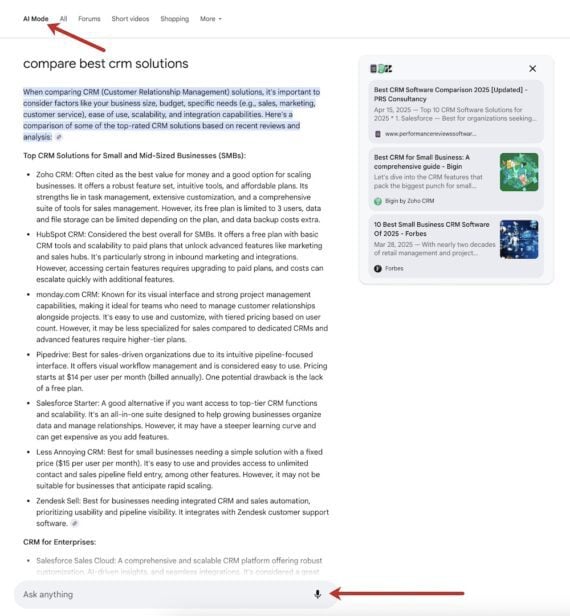
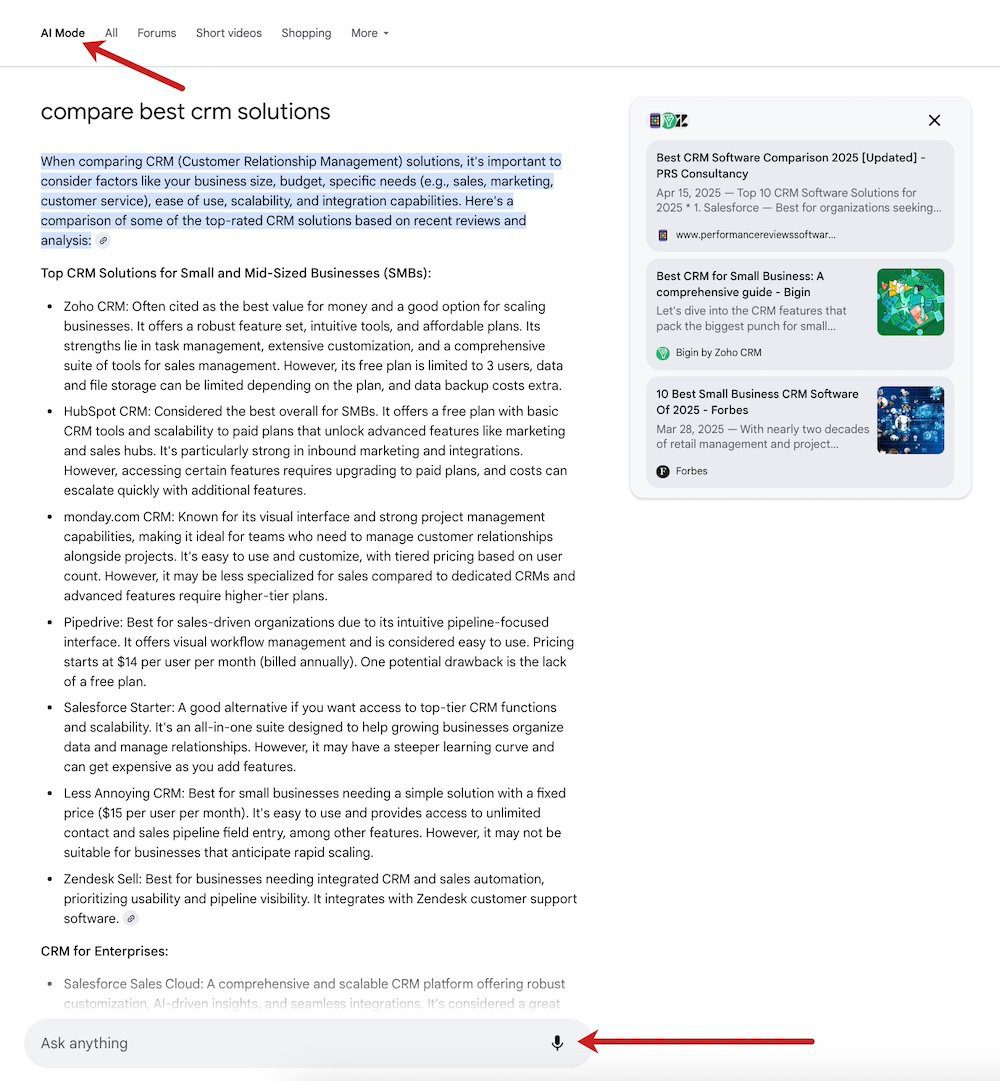
AI Mode resembles AI Overviews, providing answers to queries and links to the sources. The difference is that searchers in AI Mode can chat follow-up questions in the same tab, much like ChatGPT or Claude.
AI Mode allows follow-up questions via the “Ask anything” feature, shown here. Click image to enlarge.
AI Mode relies on Gemini 2.0 technology and Google’s vast web-page index, which no other generative AI platform can claim.
On the “Search Central Blog,” Google’s John Mueller published content optimization guidelines for AI answers. The post offers few new tactics for publishers but does hint at the future of organic search traffic.
Here’s my summary.
AI Content Optimization
‘Focus on unique, valuable content for people’
This is self-explanatory. Mueller suggests “helpful, reliable, people-first content,” presumably meaning AI Mode integrates with the helpful content algorithm.
I’ve published tactics on how to make content “helpful.” Research related queries and popular questions around your keywords. AI answers use “similarity” indexing, striving to provide additional information, not just direct answers to a query. Including related keywords and answers in a post will likely increase its visibility.
‘Provide a great page experience’
Mueller echoes Google’s longstanding focus on visitors’ experiences: fast page loads, quick answers, and easy to use. A section for frequently asked questions, for example, is familiar to visitors and likely beneficial to Google.
‘Ensure we [Google] can access your content’
Ensure your page is crawlable and indexable by Google. Confirm via Search Console’s URL inspection tool.
‘Make sure structured data matches the visible content’
Structured data markup — such as Schema.org’s — assists search engines and AI bots extract essential info and meaning from a web page. The fact that Mueller mentions structured data in AI content optimization guidelines underscores its importance to AI Mode and Gemini.
Mueller notes that the structured data should align with the page’s visible text. Hence a Q&A page, for example, should use Schema.org’s “FAQPage” markup or equivalent structured data.
‘Go beyond text for multimodal success’
Today’s AI-powered searchers can seek images and even upload a photo and request its details. Mueller suggests, “… support your textual content with high-quality images and videos on your pages, and ensure that your Merchant Center and Business Profile information is up-to-date.”
Create relevant screenshots, photos, and videos to increase your chances of being cited in an AI answer, and include your logo for brand visibility.
‘Understand the full value of your visits’
“Understand the full value” sounds ominous. Many search optimizers interpret Mueller’s explanation as a coming decrease in organic web traffic.
A better heading might be “Don’t focus on clicks,” although Mueller claims that users who click from AI summaries are likely more engaged than clickers on traditional organic listings.
Regardless, focusing on quality content, not quantity, seems clear.
Inevitable Declines
None of Mueller’s guidelines are new, but they imply Google’s method for generating AI answers and citing sources. Traffic losses are inevitable owing to AI Mode’s detailed answers, removing searchers’ need to click.
Publishers will adjust or go away. I’ve addressed one way of adjusting: answering “do” queries as a content strategy.
Google’s latest AI tools promise to manage campaigns automatically. But advertisers are asking whether these new features give up too much human control.
At Google Marketing Live, the company showcased three new AI agents. These tools can handle everything from creating campaigns to managing tasks across multiple platforms.
However, the announcement raised questions from attendees about accountability and transparency.
The reaction highlights growing tension in the industry. Platforms want more automation, while marketers worry about losing control of their accounts.
What Google Introduced
1. Google Ads Agentic Expert
This system makes changes to your campaigns without first asking for permission. It can:
Create multiple ad groups with matching creative assets
Add keywords and implement creative suggestions
Fix policy issues and submit appeals
Generate reports and answer campaign questions
2. Google Analytics Data Expert
This tool finds insights and trends automatically. It also makes data exploration easier through simple visuals.
The goal is to help marketers spot performance patterns without deep Analytics knowledge.
3. Marketing Advisor Chrome Extension
This browser extension launches later this year. It manages tasks across multiple platforms, including:
Automated tagging and tag installation
Seasonal trend analysis
Problem diagnosis across different sites
Marketing Advisor works across Google properties like Google Ads and Analytics. It also works on external websites and content management systems.
Here’s a promotional video demonstrating these tools’ capabilities:
Where Advertisers Push Back
During a press session led by Melissa Hsieh Nikolic, Director of Product Management for YouTube Ads, and Pallavi Naresh, Director of Product Management for Google Ads, executives addressed concerns from industry professionals.
Control and Change Tracking Issues
Advertisers asked how AI-made changes would appear in Google Ads’ change history, but executives couldn’t give clear answers.
Naresh responded:
“That’s a great question. I don’t know if it’ll show up with your username or like you and the agent’s username.”
This uncertainty worries agencies and brands. They need detailed records of campaign changes for client reports and internal approvals.
One attendee directly questioned the automation direction, stating:
“We’ve seen the ‘googlification’ of the Google help desk. Getting to a human is hard. This seems like it’s going down the path of replacing that.”
Google reps promised human support would stay available, responding:
“That’s not the intention. You will still be able to access support in the ways you can today.”
Transparency and Content Labeling Gaps
The new AI creative tools raised questions about content authenticity.
Google introduced image-to-video creation and “outpainting” technology. Outpainting expands video content for different screen sizes. However, Google’s approach to AI content labeling differs from other platforms.
Hsieh Nikolic explained:
“All of our images are watermarked with metadata and SynthID so generated content can be identified. At this time, we’re not labeling ads with any sort of identification.”
This approach is different from other platforms that use visible AI content labels.
Performance Claims & Industry Context
Google shared performance data for its AI-enhanced tools. Products with AI-generated images saw a “remarkable 20% increase on return on ad spend” compared to standard listings.
The company also said “advertiser adoption of Google AI for generating creative increased by 2500%” in the past year. But this growth comes with the control concerns mentioned above.
Google revealed it’s “actively working on a generative creative API.” This could impact third-party tools and agency workflows.
The timing makes sense given industry pressures. Google says marketers spend “10 hours or more every week creating visual content.” These tools directly address that pain point.
What This Means for Digital Marketing
The three-agent system is Google’s biggest push into hands-off advertising management yet. It moves beyond creative help to full campaign control.
Digital marketing has always been about precise budget and targeting control. This shift toward AI decision-making changes how advertisers and platforms work together.
The pushback from advertisers suggests more resistance than Google expected. This is especially true around accountability and transparency, which agencies and brands need for client relationships.
The Marketing Advisor Chrome extension is particularly ambitious. It extends Google’s reach beyond its platforms into general marketing workflow management, which could reshape how digital marketing teams work across the industry.
What Marketers Should Do
Set Up AI Change Protocols
As these features roll out, advertisers should:
Create clear rules for AI-driven campaign changes
Make sure approval processes can handle automated changes
Develop documentation requirements for AI modifications
Demand Clear Tracking
The change history question is still unresolved. It’s critical for agencies and brands that need detailed campaign records. Marketers should:
Ask for specific details about change tracking before using agentic features
Create backup documentation processes for AI modifications
Clarify how automated changes will show in client reports
Prepare for API Changes
Google is developing a generative creative API. Marketing teams should think about how this might impact:
Existing third-party tool connections
Agency workflow automation
Custom reporting systems
Closing Thoughts
Google’s three-agent system shows the company’s confidence in AI-driven advertising management. It builds on the success of over 500,000 advertisers using conversational AI features.
However, industry practitioners’ concerns highlight real challenges around control, transparency, and technical readiness. As these tools become standard practice, these issues need solutions.
You’ve finally cracked the first page of Google for your target keywords, but your sales numbers aren’t budging.
Sound familiar? As marketers, we’ve all been there. That disconnect between impressive rankings and disappointing revenue is one of the most frustrating puzzles in SEO.
Rankings don’t pay the bills. Real SEO success happens when your efforts drive revenue and business growth, not just when you hit that coveted No. 1 spot.
Having a top Google ranking is like securing prime retail space on Main Street. People might walk by your storefront all day, but if they don’t come in and purchase something, what’s the point of paying that premium rent?
In this article, I’ll show you exactly how to transform your SEO strategy from a traffic generator into a revenue engine.
We’ll bridge that gap between rankings and results with actionable frameworks you can implement.
Understanding The True Purpose Of SEO
Look, rankings are great, but at the end of the day, your boss cares a lot more about what those rankings do for the business.
Sure, hitting No. 1 for a competitive keyword deserves a high-five, but what really gets leadership excited? Revenue, growth, and market share.
SEO isn’t just about technical optimizations and keyword research. It’s a strategic pathway connecting what people are searching for to your actual business results.
When you strip away all the jargon, good SEO creates a direct line from someone’s search query to money in your company’s bank account.
When we align our SEO efforts with concrete business metrics, we transform abstract rankings into tangible results.
Here’s how SEO directly connects to key business outcomes:
Revenue Tracking: Monitor the correlation between organic search traffic and sales data to identify which keywords drive purchases.
Lead Quality: Track conversion rates from organic search visitors compared to other marketing channels.
Customer Acquisition: Measure the cost per lead from SEO versus paid advertising channels.
Market Share: Compare organic search visibility against competitors in your target market segments.
Eight in 10 U.S. consumers search online for local businesses at least once a week.
The key metrics that truly connect SEO with business outcomes include:
Revenue per Keyword: Track sales generated from specific search terms.
Lead Value: Calculate the average value of leads from organic search.
Customer Journey:Map how organic search visitors move through your sales funnel.
Market Penetration: Monitor rankings for commercial-intent keywords in your industry.
When you align SEO efforts with business goals, you’ll produce measurable return on investment (ROI) through increased qualified traffic, improved lead generation, and trackable revenue growth.
SEO Metrics And Their Business Impact
Let’s focus on the real impact of SEO metrics on business results. While fancy dashboards can look impressive, the true importance lies in how these figures influence your bottom line.
Core SEO Metrics Explained
Here are the metrics that actually matter when connecting SEO to business outcomes:
Organic Traffic Volume: Shows how many visitors are coming through search. Great, but traffic alone doesn’t pay the bills.
Click-Through Rate (CTR): This shows how many people actually click when they see you in search results. A high CTR means your titles and descriptions are doing their job, convincing people to click.
Bounce Rate: Tells you how many visitors take one look at your page and run for the hills. High bounce rates usually mean there’s a disconnect between what people expected to find and what they actually got.
Keyword Rankings: Show where you stand in search results. But remember, ranking No. 1 for a keyword nobody searches or cares about isn’t helping anyone.
Page Load Speed: Matters more than most marketers realize. We’re all impatient these days, and every second of delay costs you real money.
Here’s how to connect your SEO work directly to business outcomes that leadership actually cares about:
Lead Generation: Track form submissions, phone calls, and email signups from organic search traffic. These are the first steps in your revenue pipeline.
Revenue Attribution: Connect organic search traffic to actual sales and revenue numbers. This is where the rubber meets the road for SEO ROI.
Customer Acquisition Cost: Compare what it costs to acquire a customer through organic search versus paid channels. SEO typically delivers more sustainable, lower-cost acquisition.
Market Share: Monitor your search visibility compared to competitors for key business terms. Growing your share of voice often correlates with growing market share.
Local Presence: Track local search rankings and Google Business Profile metrics for physical locations. For local businesses, this direct connection to foot traffic is essential.
Business KPI
SEO Metric Connection
Sales Revenue
Organic traffic conversion rate.
Lead Quality
Time on site and pages per session from organic visitors.
Customer Value
Pages per session and return visits from search.
Brand Awareness
Branded search volume growth.
Practical Strategies To Connect Rankings To Results
Now, let’s dive into the important part: How can you convert those rankings into revenue? Here’s what works.
Keyword Targeting With Business Outcomes In Mind
Not all keywords are created equal. While “office chairs” might attract window shoppers, “buy ergonomic office chair with lumbar support under $300” will attract people with credit cards.
Focus your keyword research on:
Keywords that signal buying intent. These people aren’t just browsing.
Location terms that matter for your business. “Near me” is gold if you’re local.
Use industry jargon that resonates with your qualified buyers. Speak their language.
Questions that reveal customer pain points. These convert like crazy.
I’ve worked with clients who completely transformed their businesses just by shifting focus from high-volume generic terms to lower-volume terms with serious purchase intent.
Content Optimization For Conversion
Attracting visitors to your site is just the first step. Your content must effectively convert them once they arrive. Here’s what works:
Put the good stuff up top. Nobody scrolls unless you give them a reason. You’ve got about eight seconds before they bounce.
Be transparent about pricing. Nothing undermines conversions more than hiding the cost until the last possible moment.
Show off your wins. Customer testimonials and case studies provide the social proof people need to make a purchasing decision.
Write meta descriptions that sell. They should practically beg people to click through.
Build landing pages for specific problems, not generic products. Nobody cares about your “industry-leading solution”; they care about fixing their specific problem.
In my experience, quality landing pages that actually address customer pain points convert dramatically better than generic product pages. I’ve seen it happen time and again.
Technical SEO To Maximize Conversions
The technical foundation of your site directly impacts whether visitors convert or bounce. Here’s what moves the needle:
Speed it up: Aim for under three-second load times. Even small improvements in load time can positively affect conversion rates.
Think mobile-first: Over 60% of web traffic now comes from mobile devices. If your site looks terrible on phones, you’re losing most of your potential customers.
Create logical pathways: Your site architecture should naturally guide visitors toward conversion points. No one should ever wonder, “What do I do next?”
Fix the broken stuff: Dead links and 404 errors are conversion blockers. They literally interrupt the customer journey and send people running to your competitors.
Secure your site:HTTPS isn’t optional anymore. People simply don’t trust sites without that little padlock icon, especially when making purchases.
Use structured data:Rich snippets help you stand out in search results and pre-qualify visitors before they even click through.
Conversion Tracking And Attribution
If you’re not tracking conversions properly, you’re flying blind.
Conversion tracking measures the direct business impact of SEO efforts by monitoring specific user actions that lead to revenue generation.
Implementing Effective Conversion Tracking
Start by identifying key actions that indicate business success:
Set up goal tracking in Google Analytics to monitor form submissions, lead captures, and sales completions. Make sure every important action has a corresponding goal.
Install tracking codes on conversion confirmation pages to measure successful transactions. This creates a direct line between SEO efforts and revenue.
Track micro-conversions like newsletter signups, PDF downloads, and video views. These indicate engagement and help build your attribution model.
Monitor phone calls through dynamic number insertion tracking codes. For many businesses, especially local ones, phone calls are high-value conversions.
Measure form fill rates across landing pages optimized for specific keywords. This connects keyword strategy directly to lead generation.
Attribution Models: Connecting SEO Efforts To Revenue
Understanding how different touchpoints contribute to conversions helps you properly value your SEO work. Here’s what each model tells you:
First-click attribution: Credits the initial organic search interaction. Perfect for understanding which channels are best for brand discovery.
Last-click attribution: Focuses on the final converting search. This shows which terms actually close the deal.
Linear attribution: Distributes credit equally across all organic touchpoints. This gives a balanced view of your entire SEO strategy’s contribution.
Time-decay attribution: Gives more weight to recent organic interactions. Essential for understanding what drives decisions in longer sales cycles.
Position-based attribution: Emphasizes first and last organic touchpoints. This balances discovery and decision metrics for complex customer journeys.
When you implement proper attribution, you connect SEO investments directly to business growth through accurate conversion tracking metrics.
Enhancing SEO Strategy Through Business Insights
The most successful SEO strategies leverage business data to drive decision-making.
According to recent studies, 50% of marketing professionals report an important positive impact from SEO on their marketing performance goals.
Leveraging Sales And Marketing Data
For B2B companies, search traffic generates a majority of website visits, with organic search being the largest contributor.
To create truly data-driven SEO strategies, you need to:
Track revenue attribution: Connect your customer relationship management (CRM) and analytics platforms to see which keywords actually drive revenue, not just traffic.
Monitor lead quality scores: Not all leads are created equal. Figure out which search terms bring your best prospects, not just the most prospects.
Analyze sales pipeline velocity: I’ve consistently noticed that educated search visitors move through sales pipelines faster than cold leads.
Measure acquisition costs by channel: This demonstrates SEO’s efficiency compared to other marketing efforts.
Evaluate conversion rates by landing page: Identify your most effective content formats and topics so you can create more of what works.
Continuous Improvement: From Data To Action
Creating a feedback loop between SEO performance and business outcomes drives ongoing optimization:
Review weekly traffic patterns: Look for shifts in geographic distribution, device preferences, and entry/exit pages.
Track engagement metrics: Measure time on page, scroll depth, and click behavior. These reveal content effectiveness before conversions happen.
Monitor conversion indicators: Watch form submissions, call tracking, email signups, and purchase rates. These directly connect to revenue.
Optimize based on findings: Update your content strategy, refine keyword targeting, enhance user experience, and improve site performance based on what the data tells you.
Common Pitfalls And How To Avoid Them
I’ve seen smart marketers make these mistakes over and over. Here’s how to make sure you don’t fall into the same traps.
Misalignment Between SEO And Business Goals
This one’s a classic. The SEO team celebrates ranking improvements while the sales team wonders where all the qualified leads are.
Start tracking metrics that actually matter to your bottom line: conversion rates, lead quality, and sales pipeline velocity.
Set up specific goals in Google Analytics that track how search visitors engage with money-making actions on your site.
Without this alignment, you’re just optimizing for stuff nobody in leadership actually cares about.
Focusing On Vanity Metrics
I’ve worked with clients who were ranking No. 1 for dozens of keywords but generating exactly zero leads from all that traffic. Painful lesson learned.
Instead of obsessing over rankings, traffic, and impressions, focus on what matters:
How many search visitors actually convert into leads or customers?
How much revenue can you attribute to organic search?
What does it cost you to acquire a customer through SEO versus other channels?
How qualified are your SEO leads compared to other sources?
How quickly SEO leads move through your sales pipeline?
Poor Or Incomplete Attribution Setup
The most common technical mistake I see is improper attribution configuration. Here’s how to fix it:
Install conversion tracking codes: Put these on thank-you pages to connect search terms directly to completed actions.
Set up multi-channel attribution: This shows how SEO works alongside your other marketing efforts to drive conversions.
Track micro-conversions: Things like newsletter signups capture early-stage engagement that leads to eventual sales.
Monitor lead scoring across sources: This helps evaluate quality, not just quantity, of your traffic sources.
Connect CRM data: This lets you analyze the complete customer journey from first search to final sale.
Making SEO Your Revenue Engine
SEO isn’t just about climbing Google’s rankings. It’s about turning those rankings into real business results.
Your success boils down to connecting your SEO work with actual business metrics and obsessing over conversion optimization.
Remember that high rankings alone won’t pay the bills. You need to track metrics that matter, align your SEO strategy with business goals, and optimize for conversions at every step.
When done right, SEO becomes more than just a traffic generator. It transforms into a powerful revenue engine for your business. I’ve seen this transformation happen for companies across dozens of industries, from local service businesses to global ecommerce brands.
Take action now. Implement proper tracking, measure what actually matters, and continually optimize based on real data.
Before long, you’ll start seeing your SEO efforts directly contributing to your company’s bottom line.
A growing form of revenue-based financing can fund the marketing push or inventory boost for ecommerce merchants to capture growth opportunities. But “merchant cash advances” are often expensive and not suited to every business.
Ecommerce companies experience highs and lows. Merchant cash advances tend to work better when merchants are on the upswing.
A merchant cash advance (MCA) is a loan, a lump-sum payment, that the borrower agrees to repay through a fixed percentage of revenue.
According to Aidan Corbett, CEO of Wayflyer, an MCA and term-loan provider, three characteristics distinguish MCAs from other types of financing:
Aligned outcomes between the lender and merchant,
Revenue-based repayment,
Speed and ease of approval.
Each can be beneficial, but with trade-offs.
Wayflyer offers merchant cash advances, as do Shopify Capital, Stripe Capital, and others.
Aligned incentives
MCAs differ from a traditional lender-borrower dynamic. The provider’s repayment depends on the merchant’s revenue performance. Both have a shared interest in success.
“I’m being careful not to say borrower and lender,” Corbett said, emphasizing that both sides benefit only if the merchant performs well.
In the United States, MCAs are typically unsecured and unregulated. If a business fails outright, the company providing the advance may lose its investment. MCA funders look for healthy, growing businesses.
The idea of aligned outcomes is a newer trend. Past MCAs resembled payday loans, but the best 2025 offerings emphasize a partnership model aimed at sustainable growth with transparent fees.
Revenue-based repayment
Borrowers repay MCAs through a share of daily or weekly sales, not fixed monthly payments. The share varies but is typically 10% to 25% according to published reports.
Corbett gave the example of an ecommerce company receiving a $100,000 advance. The repayment might total $106,000, with the $6,000 difference representing the provider’s fee. If daily sales are strong, the repayment is quick. If sales dip, the repayments slow down.
This structure is appealing to ecommerce shops with predictable, growing revenue. But it also means that repayment can begin before the business reaps the monetary benefit of the borrowed capital, especially for inventory or long-term marketing campaigns.
Fast approval
MCAs are fast. Ecommerce businesses can qualify within days after providing sales history and a plan for using the funds. There is typically no collateral requirement and no formal credit check.
Corbett said Wayflyer looks for growing brands with a broad product mix and high reorder rates. Stores with strong and consistent return on ad spend and efficient customer acquisition tactics are also favorable candidates.
MCA Use Case
Consider an ecommerce company selling home organization products with steady, year-round revenue. The company recently launched a new line of modular storage kits. Initial customer response is strong. Conversion rates are up, and test campaigns are returning a 4:1 ROAS.
A home improvement blog with more than 500,000 readers offers the business a two-week premium ad placement. The channel that has worked well for the merchant, but the $30,000 ad buy is time-sensitive, and the company doesn’t have the cash on hand.
A traditional loan won’t arrive in time. Instead, the founder uses a $30,000 MCA, agreeing to repay $36,000 via daily deductions from revenue.
The estimated boost in customer acquisition and long-term customer value more than offsets the financing cost.
It’s a good use case. The MCA funds a specific, high-return opportunity with relatively predictable payback.
Costs
MCA fees — “factor rates”— can be high. For instance, a factor rate of 1.2 on a $50,000 advance means the merchant owes $60,000 in total, regardless of the repayment period. A six-month payback can exceed 24% effective annual interest.
Still, Corbett said the MCA market for ecommerce has grown more competitive, and some providers now offer rates comparable to term loans, particularly for strong companies.
He advises merchants to shop around, avoid excessive origination fees, and never take an MCA with exorbitant effective interest. Fast money should not outweigh sound financial planning.
Dependency
MCAs can reduce cash flow before earnings materialize. Because repayments are tied to revenue, not profit, they can erode margins quickly.
Consider an ecommerce store with a 35% gross margin. If customer acquisition costs are 10%, payment processing fees are 2%, and the MCA repayment rate is 20%, the business retains just a 3% margin.
That razor-thin gross profit makes it difficult to self-fund growth or even cover operating expenses. The merchant may then rely on successive MCAs, falling into a cycle of borrowing.
Nonetheless, used strategically, MCAs can fund timely opportunities for growth. Thanks to Wayflyer, Shopify Capital, Stripe Capital, and similar firms, MCAs are increasingly common and beneficial.
This week, two new leaders at the US Food and Drug Administration announced plans to limit access to covid vaccines, arguing that there is not much evidence to support the value of annual shots in healthy people. New vaccines will be made available only to the people who are most vulnerable—namely, those over 65 and others with conditions that make them more susceptible to severe disease.
Anyone else will have to wait. Covid vaccines will soon be required to go through more rigorous trials to ensure that they really are beneficial for people who aren’t at high risk.
The plans have been met with fear and anger in some quarters. But they weren’t all that shocking to me. In the UK, where I live, covid boosters have been offered only to vulnerable groups for a while now. And the immunologists I spoke to agree: The plans make sense.
They are still controversial. Covid hasn’t gone away. And while most people are thought to have some level of immunity to the virus, some of us still stand to get very sick if infected. The threat of long covid lingers, too. Given that people respond differently to both the virus and the vaccine, perhaps individuals should be able to choose whether they get a vaccine or not.
But while many of us have benefited hugely from covid vaccinations in the past, there are questions over how useful continuing annual booster doses might be. That’s the argument being made by FDA head Marty Makary and Vinay Prasad, director of the agency’s Center for Biologics Evaluation and Research.
Makary and Prasad’s plans, which were outlined in the New England Journal of Medicine on Tuesday, don’t include such inflammatory language or unfounded claims, thankfully. In fact, they seem pretty measured: Annual covid booster shots will continue to be approved for vulnerable people but will have to be shown to benefit others before people outside the approved groups can access them.
There are still concerns being raised, though. Let’s address a few of the biggest ones.
Shouldn’t I get an annual covid booster alongside my flu vaccine?
At the moment, a lot of people in the US opt to get a covid vaccination around the time they get their annual flu jab. Each year, a flu vaccine is developed to protect against what scientists predict will be the dominant strain of virus circulating come flu season, which tends to run from October through March.
But covid doesn’t seem to stick to the same seasonal patterns, says Susanna Dunachie, a clinical doctor and professor of infectious diseases at the University of Oxford in the UK. “We seem to be getting waves of covid year-round,” she says.
And an annual shot might not offer the best protection against covid anyway, says Fikadu Tafesse, an immunologist and virologist at Oregon Health & Science University in Portland. His own research suggests that leaving more than a year between booster doses could enhance their effectiveness. “One year is really a random time,” he says. It might be better to wait five or 10 years between doses instead, he adds.
“If you are at risk [of a serious covid infection] you may actually need [a dose] every six months,” says Tafesse. “But for healthy individuals, it’s a very different conversation.”
What about children—shouldn’t we be protecting them?
There are reports that pediatricians are concerned about the impact on children, some of whom can develop serious cases of covid. “If we have safe and effective vaccines that prevent illness, we think they should be available,” James Campbell, vice chair of the committee on infectious diseases at the American Academy of Pediatrics, told STAT.
This question has been on my mind for a while. My two young children, who were born in the UK, have never been eligible for a covid vaccine in this country. I found this incredibly distressing when the virus started tearing through child-care centers—especially given that at the time, the US was vaccinating babies from the age of six months.
My kids were eventually offered a vaccine in the US, when we temporarily moved there a couple of years ago. But by that point, the equation had changed. They’d both had covid by then. I had a better idea of the general risks of the virus to children. I turned it down.
“Of course there are children with health problems who should definitely have it,” says Dunachie. “But for healthy children in healthy households, the benefits probably are quite marginal.”
Shouldn’t healthy people get vaccinated to help protect more vulnerable members of society?
It’s a good argument, says Tafesse. Research suggests that people who are vaccinated against covid-19 are less likely to end up transmitting the infection to the people around them. The degree of protection is not entirely clear, particularly with less-studied—and more contagious—variants of the virus and targeted vaccines. The safest approach is to encourage those at high risk to get the vaccine themselves, says Tafesse.
If the vaccines are safe, shouldn’t I be able to choose to get one?
Tafesse doesn’t buy this argument. “I know they are safe, but even if they’re safe, why do I need to get one?” People should know if they are likely to benefit from a drug they are taking, he says.
Having said that, the cost-benefit calculation will differ between individuals. Even a “mild” covid infection can leave some people bed-bound for a week. For them, it might make total sense to get the vaccine.
Dunachie thinks people should be able to make their own decisions. “Giving people a top-up whether they need it or not is a safe thing to do,” she says.
It is still not entirely clear who will be able to access covid vaccinations under the new plans, and how. Makary and Prasad’s piece includes a list of “medical conditions that increase a person’s risk of severe covid-19,” which includes several disorders, pregnancy, and “physical inactivity.” It covers a lot of people; research suggests that around 25% of Americans are physically inactive.
But I find myself agreeing with Dunachie. Yes, we need up-to-date evidence to support the use of any drugs. But taking vaccines away from people who have experience with them and feel they could benefit from them doesn’t feel like the ideal way to go about it.
This article first appeared in The Checkup, MIT Technology Review’s weekly biotech newsletter. To receive it in your inbox every Thursday, and read articles like this first, sign up here.
Since the Chinese biophysicist He Jiankui was released from prison in 2022, he has sought to make a scientific comeback and to repair his reputation after a three-year incarceration for illegally creating the world’s first gene-edited children.
While he has bounced between cities, jobs, and meetings with investors, one area of visible success on his comeback trail has been his X.com account, @Jiankui_He, which has become his main way of spreading his ideas to the world. Starting in September 2022, when he joined the platform, the account stuck to the scientist’s main themes, including promisinga more careful approach to his dream of creating more gene-edited children. “I will do it, only after society has accepted it,” he posted in August 2024. He also shared mundane images of his daily life, including golf games and his family.
Last month, in reply to MIT Technology Review’s questions about who was responsible for the account’s transformation into a font of clever memes, He emailed us back: “It’s thanks to Cathy Tie.”
You may not be familiar with Tie, but she’s no stranger to the public spotlight. A former Thiel fellow, she is a partner in the attention-grabbing Los Angeles Project, which promised to create glow-in-the-dark pets. Over the past several weeks, though, the 29-year-old Canadian entrepreneur has started to get more and more attention as the new wife to (and apparent social media mastermind behind) He Jiankui. On April 15, He announced a new venture, Cathy Medicine, that would take up his mission of editing human embryos to create people resistant to diseases like Alzheimer’s or cancer. Just a few days later, on April 18, He and Tie announced that they had married, posting pictures of themselves in traditional Chinese wedding attire.
But now Tie says that just a month after she married “the most controversial scientist in the world,” her plans to relocate from Los Angeles to Beijing to be with He are in disarray; she says she’s been denied entry to China and the two “may never see each other again,” as He’s passport is being held by Chinese authorities and he can’t leave the country.
Reached by phone in Manila, Tie said authorities in the Philippines had intercepted her during a layover on May 17 and told her she couldn’t board a plane to China, where she was born and where she says she has a valid 10-year visa. She claims they didn’t say why but told her she is likely “on a watch list.” (MIT Technology Review could not independently confirm Tie’s account.)
“While I’m concerned about my marriage, I am more concerned about what this means for humanity and the future of science,” Tie posted to her own X account.
A match made in gene-editing heaven
The romance between He and Tie has been playing out in public over the past several weeks through a series of reveals on He’s X feed, which had already started going viral late last year thanks to his style of posting awkward selfies alongside maxims about the untapped potential of heritable gene editing, which involves changing people’s DNA when they’re just embryos in an IVF dish.
“Human [sic] will no longer be controlled by Darwin’s evolution,” He wrote in March. That post, which showed him standing in an empty lab, gazing into the distance, garnered 9.7 million views. And then, a week later, he collected 13.3 million for this one: “Ethics is holding back scientific innovation and progress.”
In April, the feed started to change even more drastically.
This shift coincided with the development of his romance with Tie. Tie told us she has visited China three times this year, including a three-week stint in April when she and He got married after a whirlwind romance. She bought him a silver wedding ring made up of intertwined DNA strands.
The odd behavior on He’s X feed and the sudden marriage have left followers wondering if they are watching a love story, a new kind of business venture, or performance art. It might be all three.
A wedding photo posted by Tie on the Chinese social media platform Rednote shows the couple sitting at a table in a banquet hall, with a small number of guests. MIT Technology Review has been able to identify several people who attended: Cai Xilei, He’s criminal attorney; Liu Haiyan, an investor and former business partner of He; and Darren Zhu, an artist and Thiel fellow who is making a “speculative” documentary about the biophysicist that will blur the boundaries of fiction and reality.
In the phone interview, Tie declined to say if she and He are legally married. She also confirmed she celebrated a wedding less than one year ago with someone else in California, in July of 2024, but said they broke up after a few months; she also declined to describe the legal status of that marriage. In the phone call, Tie emphasized that her relationship with He is genuine: “I wouldn’t marry him if I wasn’t in love with him.”
An up-and-comer
Years before Tie got into a relationship with He, she was getting plenty of attention in her own right.She became a Thiel fellow in 2015, when she was just 18. That program, started by the billionaire Peter Thiel, gave her a grant of $100,000 to drop out of the University of Toronto and start a gene testing company, Ranomics.
Soon, she began appearing on the entrepreneur circuit as a “wunderkind” who was featured on a Forbes “30 Under 30” list in 2018 and presented as an up-and-coming venture capitalist on CNN that same year. In 2020, she started her second company, Locke Bio, which focuses on online telemedicine.
Like Thiel, Tie has staked out contrarian positions. She’s called mainstream genomics a scam and described entrepreneurship as a way to escape the hidebound practices of academia and bioethics. “Starting companies is my preferred form of art,” she posted in 2022, linking to an interview on CNBC.
By February 2025, Tie was ready to announce another new venture: the Los Angeles Project, a stealth company she had incorporated in 2023 under her legal name, Cheng Cheng Tie. The company, started with the Texas-based biohacker and artist Josie Zayner, says it will try to modify animal embryos; one goal is to make fluorescent glow-in-the-dark rabbits as pets.
The Los Angeles Project revels in explicitly transgressive aims for embryo editing, including a plan to add horn genes to horse embryos to make a unicorn. That’s consistent with Zayner’s past stunts, which include injecting herself with CRISPR during a livestream. “This is a company that should not exist,” Zayner said in announcing the newly public project.
Although the Los Angeles Project has only a tiny staff with uncertain qualifications, it did raise $1 million from the 1517 Fund, a venture group that supports “dropouts” and whose managers previously ran the Thiel Fellowship.
Asked for his assessment of Tie, Michael Gibson, a 1517 partner, said in an email that he thinks Tie is “not just exceptional, but profoundly exceptional.” He sent along a list of observations he’d jotted down about Tie before funding her company, which approvingly noted her “hyper-fluent competence” and “low need for social approval,” adding: “Thoughts & actions routinely unconventional.”
A comeback story
He first gained notoriety in 2018, when he and coworkers at the Southern University of Science & Technology in Shenzhen injected the CRISPR gene editor into several viable human embryos and then transferred these into volunteers, leading to the birth of three girls who he claimed would be resistant to HIV. A subsequent Chinese investigation found he’d practiced medicine illegally while “pursuing fame and fortune.” A court later sentenced him to three years in prison.
He has never apologized for his experiments, except to say he acted “too quickly” and to express regret for the trouble he’d caused his former wife and two daughters. (According to a leaked WeChat post by his ex-wife, she divorced him in 2024 “because of a major fault on his side.”)
Since his release from prison, He has sought to restart his research and convince people that he should be recognized as the “Chinese Darwin,” not “China’sFrankenstein,” as the press once dubbed him.
But his comeback has been bumpy. He lost a position at Wuchang University of Technology, a small private university in Hubei province, after some negative press. In February 2024, He posted that his application for funding from the Muscular Dystrophy Association was rejected. Last September, he even posted pictures of his torn shirt—which he said was the result of an assault by jealous rivals.
One area of clear success, though, was the growing reach of his X profile, which today has ballooned to more than 130,000 followers. And as his public profile rose, some started encouraging He to find ways to cash in. Andrew Hessel, a futurist and synthetic biologist active in US ethics debates, says he tried to get He invited to give a TED Talk. “His story is unique, and I wanted to see his story get more widespread attention, if only as a cautionary tale,” Hessel says. “I think he is a lightning rod for a generation of people working in life sciences.”
Later, Hessel says, he sent him information on how to join X’s revenue-sharing program. “I said, ‘You have a powerful voice. Have you looked into monetization?’” Hessel says.
By last fall, He was also welcoming visitors to what he called a new lab in Beijing. One person who took him up on the offer was Steve Hsu, a Michigan State physics professor who has started several genetics companies and was visiting Beijing.
They ended up talking for hours. Hsu says that He expressed a desire to move to the US and start a company, and that he shared his idea for conducting a clinical trial of embryo editing in South Africa, possibly for the prevention of HIV.
Hsu says he later arranged an invitation for He to give a lecture in the United States. “You are a little radioactive, but things are opening up,” Hsu told him. But He declined the offer because the Chinese government is holding his passport—a common tactic it uses to restrict the movement of sensitive or high-profile figures—and won’t return it to him. “He doesn’t even know why. He literally doesn’t know,” says Hsu. “According to the law, they should give it back to him.”
A curious triangle
Despite any plans by He and Tie to advance the idea, creating designer babies is currently illegal in most of the world, including China and the US. Some experts, however, fret that forbidding the technology will only drive it underground and make it attractive to biohackers or scientists outside the mainstream.
That’s one reason Tie’s simultaneous connection to two notable biotech renegades—He and Zayner—is worth watching. “There is clearly a triangle forming in some way,” says Hessel.
With Tie stuck outside China and He being kept inside the country, their new gene-editing venture, Cathy Medicine, faces an uncertain future. Tie posted previously on Rednote that she was “helping Dr. He open up the U.S. market” and was planning to return to the US with him for scientific research. But when we spoke on the phone, she declined to disclose their next steps and said their predicament means the project is “out of the window now.”
Even as the couple remain separated, their social media game is stronger than ever. As she waited in Manila, Tie sought help from friends, followers, and the entire internet. She blasted out a tweet to “crypto people,” calling them “too pussy to stand up for things when it matters.” Within hours, someone had created a memecoin called $GENE as a way for the public to support the couple.

 Shashi Thakur speaks to press at Google Marketing Live.
 Shashi Thakur speaks to press at Google Marketing Live. Photo: Matt G. Southern/Search Engine Journal.