The Progress Planner WordPress plugin has announced a new integration with Yoast SEO, enabling users to take full advantage of Yoast’s features to maximize website search performance.
Progress Planner Plugin
Progress Planner is developed by the same people who created Yoast SEO, ensuring that both plugins work perfectly together. The main functionality of the plugin is to help WordPress users maintain their website so that it performs at its best. The new functionalities extends the usefulness of Progress Planner as it now encompasses SEO.
The new functionality offers personalized suggestions of how to set Yoast SEO plugin for maximum performance.
According to the Progress Planner announcement:
“Progress Planner’s assistant, Ravi, will provide smart recommendations, guiding users to their next best task. Progress Planner will check whether Yoast SEO users have properly configured the settings of their plugins and will help and motivate users to make corrections.”
This is a brand new functionality and many others are planned.
Read more about the Progress Planner’s Yoast integration:
I own a digital agency that has existed for 20 years and did branding until just two years ago.
It wasn’t until we stopped doing branding that I came across a number of meaningful connections and “needs” search and branding teams have that enhance the efforts of both.
Search marketers are often at the other end and far away from brand strategy.
When branding is pressed for return on investment (ROI), it often comes downstream through marketing channels, platforms, and the implemented strategy.
Search often struggles without a differentiated brand or strategy to stand out from competitors in search results for ads or content.
I believe there are great benefits to connecting branding and search, partnering together, and working closely within broader business and marketing teams and environments.
Digging into conversations, my experience, and perspectives shared with me, I’m sharing the benefits categorized for search marketers and brand creatives/strategists alike that can create more consistent and impactful opportunities to elevate brands and performance overall.
For Search Marketers
Content & Creative Standards
In the absence of robust brand strategy development and documentation, search marketers (among other channels) are often left in a vacuum when it comes to creating content and assets needed for SEO and paid search success.
In a vacuum, there are best practices and channel strategies that can guide what gets created and what words, messaging, and creative are utilized.
However, it can be fragmented, inconsistent, and unrelated to broader themes and objectives.
When we have standards and strategies to leverage, we can be a further extension of the key unique messages to bring the brand alive.
I can’t count the number of times there have been conversations between search marketers and sales teams about specific ad copy and imagery that have no grounding or truth from brand strategy to fall back on.
I’ll say this as someone who has done SEO for a long time: You don’t want an SEO to write your copy or design your creative. There are exceptions and unicorns, but you want your SEO experts and SEM specialists doing their craft.
Unique Value Propositions
One of the key measures of search campaigns and strategies is how effective they are in driving conversions – and even deeper, what happens with those conversions and whether they become actual sales, revenue, and profit.
When leads are qualifying, too expensive, beat salespeople up over price, or don’t buy from an online store and go back to Google, we haven’t done our job in telling the story and sharing our value proposition.
There will always be someone looking for the cheapest, and unless we’re the low-price leader, we’ll lose those sales.
But, when someone is seeking our unique offering and factors that can include price but much more are in play, we want to do a great job presenting those at every touch point, including those important to SEO and PPC.
Without having these, we’re either making up our own, leaning on more shallow features and benefits, or inadvertently making our products and services seem similar to everyone else’s.
Support For Off-Page Factors
Unique content, value, and benefits offered through a strong brand identity and strategy can lead to more defined and actionable results.
With both legacy focuses on PR and the ability to leverage the brand and newer focuses on digital PR strategies to enhance being found through AI search functions, having a solid branding foundation is important for SEO and PR efforts connected to optimization around external factors and backlinks specifically.
Support For Other Resources
At points in my career managing SEO and paid search, when talking to a writer, UX designer, and other resources, I’ve been faced with questions outside of SEO about voice, tone, style, and other brand aspects.
In many cases, I haven’t had a person, team, or documentation to point to.
SEO especially needs other resources like IT, UX, writers, and others to be successful.
When branding and brand strategy are integrated and accessible, we can again reduce a gap or vacuum created when other resources get pulled in.
The more integrated our messaging is, the better we know our brand and the rules of the road and the more we can do together to be efficient in our resources and not have to do disjointed, unique research in different functions and departments.
For Brand Creatives & Strategists
Connection To More KPIs And ROI
Brand strategy and development have always been critical to any company’s presence, impacting product development, sales, marketing, and customer service.
In so many cases, though, branding has been hard to connect to specific direct key performance indicators (KPIs).
Stakeholder reactions, adoption, and validation of the intended messaging happen.
But most measurement downstream happens in marketing, sales, and other areas well beyond first impressions, and it isn’t explicitly intended to measure brand impact when it gets into marketing tactics and sales pipelines.
With integration and closer relationships between digital marketing (and search) and branding counterparts, more customer journey mapping can be done, bringing KPIs into alignment from the branding process all the way through conversions and sales.
Research And Data Gained
Branding processes leverage market research to guide their work.
Search marketing lives on research data (keywords, audiences, competitors) and analytics to get as real-time as possible in terms of measuring impact.
Search-specific research and analytics are not typically top sources for branding projects. Yet, the data can be a great supplement (and even potentially unique in some cases) to help add another dimension to the market research used in branding strategy decisions and development.
By partnering with search colleagues, a new wealth of information can be gained.
Ongoing Refinement And Optimization
Often, branding, rebranding, and brand strategy are thought of as projects or undertakings that are done once and then done again years down the road – that they aren’t ongoing or continuous processes.
My friend, who owns a highly-regarded branding agency, noted that it is often about once a decade that a lot of companies in the niche industries he serves do a rebrand.
They view it as a one-time event rather than an ongoing strategy or thing to measure, refine, and optimize. That’s a very different approach from search marketing.
By leveraging the insights, partnerships, and opportunities that search marketing and other digital marketing channels offer, branding can become more ongoing and more effective.
Not in the sense of rebranding a company every year, month, or week, but in the sense of being able to make refinements and updates to make it as goal-oriented and effective as possible over time.
Ability To See Implementation All The Way Through
This one is something I was a stickler about in the days that my agency was still doing branding.
It can be deflating, if not frustrating, to invest so much into a complete brand strategy over months and, ultimately, see it not be fully implemented or activated as intended.
In so many cases, the project ended, and even when my team was in charge of implementing the look and feel or messaging in certain places, it was handed off to others to carry forward.
We could find implementations that didn’t follow standards, missed assets, or content that broke the rules.
When search and brand work together, there’s an opportunity to ensure that, down to the keyword and display ad level, there’s a two-way street between search best practices and the brand strategy.
This is to make sure the implementation and activation of the unique aspects of how search is delivered to prospects and customers.
Bringing It All Together
While branding processes and teams might be far away from search tacticians, who are often at the bottom of the funnel driving conversions, and might not seem to have much in common, I contend there’s a big benefit to partnership.
Whether it is a connection to KPIs all the way through, access to data and research, ensuring full and proper implementation, or other factors I unpacked (and even more that I didn’t), in short, brands benefit overall.
We don’t get stuck in as many situations being considered a commodity. Sales teams can be teed up for success without competing on price. Brand affinity can start much sooner, enhancing lifetime value and customer loyalty, which impacts profitability and growth.
On Tuesday, California state senator Steve Padilla will make an appearance with Megan Garcia, the mother of a Florida teen who killed himself following a relationship with an AI companion that Garcia alleges contributed to her son’s death.
The two will announce a new bill that would force the tech companies behind such AI companions to implement more safeguards to protect children. They’ll join other efforts around the country, including a similar bill from California State Assembly member Rebecca Bauer-Kahan that would ban AI companions for anyone younger than 16 years old, and a bill in New York that would hold tech companies liable for harm caused by chatbots.
You might think that such AI companionship bots—AI models with distinct “personalities” that can learn about you and act as a friend, lover, cheerleader, or more—appeal only to a fringe few, but that couldn’t be further from the truth.
A new research paper aimed at making such companions safer, by authors from Google DeepMind, the Oxford Internet Institute, and others, lays this bare: Character.AI, the platform being sued by Garcia, says it receives 20,000 queries per second, which is about a fifth of the estimated search volume served by Google. Interactions with these companions last four times longer than the average time spent interacting with ChatGPT. One companion site I wrote about, which was hosting sexually charged conversations with bots imitating underage celebrities, told me its active users averaged more than two hours per day conversing with bots, and that most of those users are members of Gen Z.
The design of these AI characters makes lawmakers’ concern well warranted. The problem: Companions are upending the paradigm that has thus far defined the way social media companies have cultivated our attention and replacing it with something poised to be far more addictive.
In the social media we’re used to, as the researchers point out, technologies are mostly the mediators and facilitators of human connection. They supercharge our dopamine circuits, sure, but they do so by making us crave approval and attention from real people, delivered via algorithms. With AI companions, we are moving toward a world where people perceive AI as a social actor with its own voice. The result will be like the attention economy on steroids.
Social scientists say two things are required for people to treat a technology this way: It needs to give us social cues that make us feel it’s worth responding to, and it needs to have perceived agency, meaning that it operates as a source of communication, not merely a channel for human-to-human connection. Social media sites do not tick these boxes. But AI companions, which are increasingly agentic and personalized, are designed to excel on both scores, making possible an unprecedented level of engagement and interaction.
In an interview with podcast host Lex Fridman, Eugenia Kuyda, the CEO of the companion site Replika, explained the appeal at the heart of the company’s product. “If you create something that is always there for you, that never criticizes you, that always understands you and understands you for who you are,” she said, “how can you not fall in love with that?”
So how does one build the perfect AI companion? The researchers point out three hallmarks of human relationships that people may experience with an AI: They grow dependent on the AI, they see the particular AI companion as irreplaceable, and the interactions build over time. The authors also point out that one does not need to perceive an AI as human for these things to happen.
Now consider the process by which many AI models are improved: They are given a clear goal and “rewarded” for meeting that goal. An AI companionship model might be instructed to maximize the time someone spends with it or the amount of personal data the user reveals. This can make the AI companion much more compelling to chat with, at the expense of the human engaging in those chats.
For example, the researchers point out, a model that offers excessive flattery can become addictive to chat with. Or a model might discourage people from terminating the relationship, as Replika’s chatbots have appeared to do. The debate over AI companions so far has mostly been about the dangerous responses chatbots may provide, like instructions for suicide. But these risks could be much more widespread.
We’re on the precipice of a big change, as AI companions promise to hook people deeper than social media ever could. Some might contend that these apps will be a fad, used by a few people who are perpetually online. But using AI in our work and personal lives has become completely mainstream in just a couple of years, and it’s not clear why this rapid adoption would stop short of engaging in AI companionship. And these companions are poised to start trading in more than just text, incorporating video and images, and to learn our personal quirks and interests. That will only make them more compelling to spend time with, despite the risks. Right now, a handful of lawmakers seem ill-equipped to stop that.
This story originally appeared in The Algorithm, our weekly newsletter on AI. To get stories like this in your inbox first, sign up here.
Somewhere in the northern US, drones fly over a 2,000-acre preserve, protected by a nine-foot fence built to zoo standards. It is off-limits to curious visitors, especially those with a passion for epic fantasies or mythical creatures.
The reason for such tight security? Inside the preserve roam three striking snow-white wolves—which a startup called Colossal Biosciences says are members of a species that went extinct 13,000 years ago, now reborn via biotechnology.
For several years now, the Texas-based company has been in the news for its plans to re-create woolly mammoths someday. But now it’s making a bold new claim—that it has actually “de-extincted” an animal called the dire wolf.
And that could be another reason for the high fences and secret location—to fend off scientific critics, some of whom have already been howling that the company is a “scam” perpetrating “elephantine fantasies” on the public and engaging in “pure hype.”
Dire wolves were large, big-jawed members of the canine family. More than 400 of their skulls have been recovered from the La Brea Tar Pits in California. Ultimately they were replaced by smaller relatives like the gray wolf.
In its effort to re-create the animal, Colossal says, it extracted DNA information from dire wolf bones and used gene editing to introduce some of those elements into cells from gray wolves. It then used a cloning procedure to turn the cells into three actual animals.
The animals include two males, Romulus and Remus, born in October, and one female, Khaleesi, whose name is a reference to the TV series Game of Thrones, in which fictional dire wolves play a part.
Two of the “dire wolves” at three months old.
COLOSSAL BIOSCIENCES
Each animal, the company says, has 20 genetic changes across 14 genes designed to make them larger, change their facial features, and give them a snow-white appearance.
Some scientists reject the company’s claim that the new animals are a revival of the extinct creatures, since in reality dire wolves and gray wolves are different species separated by a few million of years of evolution and several million letters of DNA.
“I would say such an animal is not a dire wolf and it’s not correct to say dire wolves have been brought back from extinction. It’s a modified gray wolf,” says Anders Bergström, a professor at the University of East Anglia who specializes in the evolution of canines. “Twenty changes is not nearly enough. But it could get you a strange-looking gray wolf.”
Beth Shapiro, an expert on ancient DNA who is now on a three-year sabbatical from the University of California, Santa Cruz, as the company’s CSO, acknowledged in an interview that other scientists would bristle at the claim.
“What we’re going to have here is a philosophical argument about whether we should call it a dire wolf or call it something else,” Shapiro said. Asked point blank to call the animal a dire wolf, she hesitated but then did so.
“It is a dire wolf,” she said. “I feel like I say that, and then all of my taxonomist friends will be like, ‘Okay, I’m done with her.’ But it’s not a gray wolf. It doesn’t look like a gray wolf.”
Dire or not, the new wolves demonstrate that science is becoming more deft in its control over the genomes of animals—and point to how that skill could help in conservation. As part of the project, Colossal says, it also cloned several red wolves, an American species that’s the most endangered wolf in the world.
But that isn’t as dramatic as the supposed rebirth of an extinct animal with a large cultural following. “The motivation really is to develop tools that we can use to stop species from becoming extinct. Do we need ancient DNA for that? Maybe not,” says Shapiro. “Does it bring more attention to it so that maybe people get excited about the idea that we can use biotechnology for conservation? Probably.”
Secret project
Colossal was founded in 2021 after founder Ben Lamm, a software entrepreneur, visited the Harvard geneticist George Church and learned about a far-out and still mostly theoretical project to re-create woolly mammoths. The idea is to release herds of them in cold regions, like Siberia, and restore an ecological balance that keeps greenhouse gases trapped in the permafrost.
Lamm has unexpectedly been able to raise more than $400 million from investors to back the plan, andForbes reported that he is now a multibillionaire, at least on paper, thanks to the $10 billion value assigned to the startup.
From left to right: Beth Shapiro, George Church, and Ben Lamm pose with the pups.
COLOSSAL BIOSCIENCES
As Lamm showed he could raise money for Colossal’s ideas, it soon expanded beyond its effort to modify elephants. It publicly announced a bid to re-create the thylacine, a marsupial predator hunted to extinction, and then, in 2023, it started planning to resurrect the dodo bird—the effort that brought Shapiro to the company.
So far, none of those signature projects have actually resulted in a live animal with ancient genes.
Each faces dire practical issues. With elephants, it was that their pregnancies last two years, longer than those in any other species. Testing out mammoth designs would be impossibly slow. With the dodo bird, it was that no one has ever figured out how to genetically modify pigeons, the family of birds to which the dodo belonged and from which a new dodo would have to be crafted. One of Lamm’s other favorite targets—the Steller’s sea cow, which disappeared around 1770—has no obvious surrogate of any kind.
But creating a wolf was feasible. Over 1,500 dogs had been cloned, primarily by one company in South Korea. Researchers in Asia had even used dog eggs and dog mothers to produce both coyote and wolf clones. That’s not surprising, since all these species are closely enough related to interbreed.
“Just thinking about surrogacy for the dire wolf … it was like ‘Oh, yeah,’” recalls Shapiro. “Surrogacy there would be really straightforward.”
Dire wolves did present some new problems. One was the lack of any clear ecological purpose in reviving animals that disappeared during the Pleistocene epoch and are usually portrayed as ferocious predators with slavering jaws. “People have weird feelings about things that, you know, may or may not eat people or livestock,” Shapiro says.
The technical challenge was there was still no accurate DNA sequence of a dire wolf. A 2021 effort to obtain DNA from old bones had yielded only a tiny amount, not enough to accurately decode the genome in detail. And without a detailed gene map, Colossal wouldn’t be able see what genetic differences they would need to install in gray wolves, the species they intended to alter.
Shapiro says she went back to museums, including the Idaho Museum of Natural History, and eventually got permission to cut off more bone from a 72,0000-year-old skull that’s on display there. She also got a tooth from a 13,000-year-old skull held in another museum. which she drilled into herself.
This time the bones yielded far more DNA and a much more complete gene map. A paper describing the detailed sequence is being submitted for publication; its authors include George R.R. Martin, the fantasy author whose books were turned into the HBO series Game of Thrones,and in which dire wolves appear as the characters’ magical companions.
In addition to placing dire wolves more firmly in the Canidae family tree (they’re slightly closer to jackals than to gray wolves, but more than 99.9% identical to both at a genetic level) and determining when dire wolves split from the pack (about 4 to 5 million years ago), the team also located around 80 genes where dire wolves seemed to be most different. If you wanted to turn a gray wolf into a dire wolf, this would be the obvious list to start from.
Crying wolf
Colossal then began the process of using base editing, an updated form of the CRISPR gene-modification technique, to introduce some of those exact DNA variations into blood cells of a gray wolf kept in its labs. Each additional edit, the company hoped, would make the eventual animal a little more dire-wolf-like, even it involved changing just a single letter of a gene.
Shapiro says all the edits using information from the ancient dire wolf were made to “genetic enhancers,” bits of DNA that help control how strongly certain genes are expressed. These can influence how big animals grow, as well as affecting the shape of their ears, faces, and skulls. This tactic was not as dramatic as intervening right in the middle of a gene, which would change what protein is made. But it was less risky—more like turning knobs on an unfamiliar radio than cutting wires and replacing circuits.
That left the scientists to engineer into the animals what would become their showstopper trait—the dramatic white fur. Shapiro says the genome code indicated that dire wolves might have had light coats. But the specific pigment genes involved are linked to a risk of albinism, deafness, and blindness, and they didn’t want sick wolves.
That’s when Colossal opted for a shortcut. Instead of reproducing precise DNA variants seen in dire wolves, they disabled two genes entirely. In dogs and other species, the absence of those genes is known to produce light fur.
The decision to make the wolves white did result in dramatic photos of the animals. “It’s the most striking thing about them,” says Mairin Balisi, a paleontologist who studies dire wolf fossils. But she doubts it reflects what the animals actually looked like: “A white coat might make sense if you are in a snowy landscape, but one of the places where dire wolves were most abundant was around Los Angeles and the tar pits, and it was not a snowy landscape even in the Ice Age. If you look at mammals in this region today, they are not white. I am just confused by the declaration that dire wolves are back.”
Bergström also says he doesn’t think the edits add up to a dire wolf. “I doubt that 20 changes are enough to turn a gray wolf to a dire wolf. You’d probably need hundreds or thousands of changes—no one really knows,” he says. “This is one of those unsolved questions in biology. People argue [about] the extent to which many small differences make a species distinct, versus a small number of big-effect differences. Nobody knows, but I lean to the ‘many small differences’ view.”
Some genes have big, visible effects—changing a single gene can make a dog hairless, for instance. But it might be many more small changes that account for the difference in size and appearance between, say, a Great Dane and a Chihuahua. And that is just looks. Bergström says science has much less idea which changes would account for behavior—even if we could tell from a genome how an extinct animal acted, which we can’t.
“A lot of people are quite skeptical of what they are doing,” Bergström says of Colossal. “But I still think it’s interesting that someone is trying. It takes a lot of money and resources, and if we did have the technology to bring species back from extinction, I do think that would be useful. We drive species to extinction, sometimes very rapidly, and that is a shame.”
Cloning with dogs
By last August, the gray wolf cells had been edited, and it was time to try cloning those cells and producing animals. Shapiro says her company transferred 40 to 50 cloned embryos apiece into six surrogate dogs. That led to three pregnancies, from which four dogs were born. One of the four, Khaleesi’s sister, died 10 days after birth from an intestinal infection, deemed unrelated to the cloning process. “That was the only puppy that didn’t make it,” says Shapiro. Two other fetal clones were reabsorbed during pregnancy, which means they disintegrated, a fairly common occurrence in dogs.
These days the white wolves are able to freely roam around a large area. They don’t have radio collars, but they are watched by cameras and are trained to come to their caretakers to get fed, which offers a chance to weigh them as they cross a scale in the ground. The 10 staff members attending to them can see them up close, though they’re now too big to handle the way the caretakers could when they were puppies.
The pups are being monitored through the different stages of their development but will not be put on public display.
COLOSSAL BIOSCIENCES
Whatever species these animals are, it’s not obvious what their future will be. They don’t seem to have a conservation purpose, and Lamm says he isn’t trying to profit from them.
“We’re not making money off the dire wolves. That’s not our business plan,” Lamm said in an interview with MIT Technology Review. He added that the animals would also not be put on display for the public, since “we’re not in the business of attractions.”
At least not in-person attractions. But every aspect of the project has been filmed, and in February, the company inked a deal to produce a docuseries about its exploits. That same month it also hired as its marketing chief a Hollywood executive who previously worked on big-budget “monster movies.”
And there are signs that de-extinction, in Colossal’s hands, has the potential to generate nearly out-of-control of attention, much like that scene in the original King Kong when the giant ape—captured by a filmmaker—breaks its chains under the flashes of the cameras.
For instance company’s first creation, mice with shaggy, mammoth-like hair, was announced only five weeks ago, yet there are already unauthorized sales of throw pillows and T-shirts (they read “Legalize Woolly Mice”), as well as some “serious security issues” involving unannounced visitors, Lamm says.
“We’ve had people show up to our labs because they want the woolly mouse,” Lamm says. “We’re worried about that from a security perspective [for] the wolves, because you’re going to have all the Game of Thrones people. You’re going to have a lot of people that want to see these animals.”
Lamm said that in light of his concerns about unruly fans, diagrams of the ecological preserve provided to the media had been altered so that no internet “sleuths” could use them to guess its location.
This is today’s edition of The Download, our weekday newsletter that provides a daily dose of what’s going on in the world of technology.
Game of clones: Colossal’s new wolves are cute, but are they dire?
For several years now, Texas-based company Colossal Biosciences has been in the news for its plans to re-create woolly mammoths someday. But now it’s making a bold new claim—that it has actually “de-extincted” an animal called the dire wolf.
Dire wolves were large, big-jawed members of the canine family. More than 400 of their skulls have been recovered from the La Brea Tar Pits in California. Ultimately they were replaced by smaller relatives like the gray wolf.
In its effort to re-create the animal, Colossal says, it extracted DNA information from dire wolf bones and used gene editing to introduce some of those elements into cells from gray wolves. It then used a cloning procedure to turn the cells into three actual animals.
But some scientists reject the company’s claim that the new animals are a revival of the extinct creatures, since in reality dire wolves and gray wolves are different species separated by a few million of years of evolution and several million letters of DNA. Read the full story.
—Antonio Regalado
AI companions are the final stage of digital addiction, and lawmakers are taking aim
This week, California state senator Steve Padilla will make an appearance with Megan Garcia, the mother of a Florida teen who killed himself following a relationship with an AI companion that Garcia alleges contributed to her son’s death.
The two will announce a new bill that would force the tech companies behind such AI companions to implement more safeguards to protect children. The design of these AI characters makes lawmakers’ concern well warranted. The problem: companions are upending the paradigm that has thus far defined the way social media companies have cultivated our attention and replacing it with something poised to be far more addictive. Read the full story.
—James O’Donnell
This story originally appeared in The Algorithm, our weekly newsletter on AI. To get stories like this in your inbox first, sign up here.
The must-reads
I’ve combed the internet to find you today’s most fun/important/scary/fascinating stories about technology.
1 The Trump administration’s tariffs are already starting to bite startups VC funding, acquisitions and unnecessary spending has been put on hold. (The Information $) + Modular laptop company Framework is pausing its sales in the US. (Ars Technica) + Towns near the Canadian border are feeling the squeeze. (The Atlantic $) + China has vowed to fight the measures ‘to the end.’ (FT $)
2 Elon Musk asked Trump to reverse his aggressive tariffs But the billionaire’s pleas have fallen on deaf ears. (WP $) + It’s not surprising he’s refusing to follow the markets on his policies. (NY Mag $) + CEOs are starting to speak up about the reality of a global trade war. (WSJ $)
3 Renewable energy reached record heights last year It accounted for 32% of global electricity in 2024. (Reuters) + Lawyers are turning to the courts to force governments to save the planet. (The Guardian)
4 A Meta executive has denied claims it fudged Llama 4’s benchmark scores Ahmad Al-Dahle dismissed the rumor Meta had trained its models on test sets. (TechCrunch) + These new AI benchmarks could help make models less biased. (MIT Technology Review)
5 A baby has been born in the UK to a woman with a transplanted womb Grace Davidson gave birth to her daughter thanks to her sister’s womb donation. (BBC) + The operation’s success offers new hope to those born without a womb. (The Guardian) + Everything you need to know about artificial wombs. (MIT Technology Review)
6 The US is still ahead in the AI race—for now But training all those models is still seriously expensive. (IEEE Spectrum)
7 We know very little about how bird flu spreads in wildlife As the deaths of two cougars who weren’t living near any known outbreaks illustrate. (Undark)
8 This publishing platform uses AI to create sequels to its authors’ work The only problem? Its writing isn’t great. (Bloomberg $) + AI can make you more creative—but it has limits. (MIT Technology Review)
9 SimCity 4 refuses to die A thriving community of modders are keeping the game going more than two decades after its launch.(The Verge)
10 Architects in Maui are building homes from old surfboard scraps Turns out the foam makes excellent housing insulation. (Fast Company $)
Quote of the day
“No longer do I have to drive a symbol of racism, greed and ignorance! Life is suddenly so much better!”
—Actor Bette Middler expresses her joy at selling her Tesla, Insider reports.
The big story
Large language models can do jaw-dropping things. But nobody knows exactly why.
Two years ago, Yuri Burda and Harri Edwards, researchers at OpenAI, were trying to find out what it would take to get a large language model to do basic arithmetic. At first, things didn’t go too well. The models memorized the sums they saw but failed to solve new ones.
By accident, Burda and Edwards left some of their experiments running for days rather than hours. The models were shown the example sums over and over again, and eventually they learned to add two numbers—it had just taken a lot more time than anybody thought it should.
In certain cases, models could seemingly fail to learn a task and then all of a sudden just get it, as if a lightbulb had switched on, a behavior the researchers called grokking. Grokking is just one of several odd phenomena that have AI researchers scratching their heads. The largest models, and large language models in particular, seem to behave in ways textbook math says they shouldn’t.
This highlights a remarkable fact about deep learning, the fundamental technology behind today’s AI boom: for all its runaway success, nobody knows exactly how—or why—it works. Read the full story.
—Will Douglas Heaven
We can still have nice things
A place for comfort, fun and distraction to brighten up your day. (Got any ideas? Drop me a line or skeet ’em at me.)
Keyword rankings no longer guarantee organic traffic.
A decade ago, we could estimate traffic to pages in Google’s top three organic positions based on keyword search volume. No more. Traffic is much more difficult to predict due to new search-result features and dynamic AI overviews.
Moreover, the impact of keywords is less predictable as people use voice search and generative AI.
Hence many professional search optimizers claim keyword research is meaningless.
That is wrong.
The benefits of keyword research are greater than organic search rankings. It reveals where prospects are in the shopping journey and what they know about a topic.
For example:
Consumers exploring a topic or problem presumably use generic keywords. They are less likely to convert right away, but the chances improve if they discover your brand or product.
Searchers using niche terms and industry jargon are more informed and likely to purchase soon.
In both scenarios, knowing those keywords helps target would-be buyers and create relevant content. The former — consumers new to the journey — likely benefit from definitions and explanatory guides.
The latter — folks using industry terms — require actionable content such as features or assembly instructions. Definitions would only distract them and may constitute filler (unhelpful) content by Google’s algorithm.
For example, a guide for increasing web traffic would likely include these keywords:
“increase website traffic”
“how to promote your website”
“improve website hits”
“how to do SEO”
“how to rank higher on google”
“how to increase SEO”
We could conclude:
“increase website traffic” implies folks who recognize the need for traffic but don’t know how to generate it.
“how to promote your website” suggests searchers are exploring options.
“improve website hits” are likely searchers starting their research, using “hits” instead of “traffic.”
“how to do SEO” suggests searchers with a vague understanding, requiring beginner steps and explanations.
“how to rank higher on google” indicates folks who understand “ranking” but require advanced instruction.
“how to increase SEO” suggests beginners because advanced practitioners would not likely use that term.
We could now group similar keywords based on intent and formulate content accordingly. We could decide, for example, to focus on beginners or pros based on our target prospects.
We could then query AI for topic ideas. I did that by prompting Gemini with the above keywords. Here’s the output.
Keyword
Volume
SEO Expertise (Gemini)
Content Type (Gemini)
Content Elements (Gemini)
increase website traffic
1,300
Beginner
Introductory guides, blog posts, checklists, infographics
Basic explanations of traffic sources (organic, social, paid), actionable tips for beginners, easy-to-follow steps, visuals, downloadable resources.
Google is changing its Merchant Center rules. These updates will roll out in two phases and affect how sellers list products in Shopping ads and free listings.
The changes impact instalment pricing, energy labels, member pricing, and US sales tax information.
Immediate Changes (Starting April 8)
Three key changes are now in effect:
1. New Instalment Pricing Rules
Google no longer allows the [price] attribute to be used for deposits on installment products.
Sellers must use the [downpayment] sub-attribute within the [installment] attribute. The [price] attribute must show what customers pay when paying in full upfront.
2. Updated Energy Labels:
For EU countries, Google replaced the energy efficiency class attributes with the broader [certification] attribute.
This supports both new and old EU energy labels. Norway, Switzerland, and the UK still use the original energy attributes.
3. Better Delivery Options:
Google added more delivery details at the product level. New attributes include [carrier_shipping] and options to specify business days for handling and transit. These help show more accurate delivery times in ads and listings.
Changes Starting July 1
More changes are coming on July 1:
Member Pricing Updates
Google will stop allowing member prices in the regular [price] or [sale_price] attributes. This applies worldwide for both paid and free membership programs.
Instead, use the [loyalty_program] attribute. Products that don’t follow this rule might be disapproved after July 1.
No More US Sales Tax Requirements
Google will stop requiring US sellers to provide sales tax information through the [tax] and [tax_category] attributes or Merchant Center settings.
Products previously rejected for missing tax information may start appearing in results, which could affect your ad spending.
Google notes that US sellers must still submit tax information until July 1.
What These Changes Mean for Sellers
These updates will require changes to how you structure product data.
If you offer payment plans, the new rules clarify how to show full payment versus installment options. This helps shoppers understand pricing better.
The energy label changes for EU countries match current regulations and give more options for showing graphical labels.
The member pricing change will affect many retailers. You must use the loyalty program attribute instead of regular price fields if you offer loyalty discounts.
Once the sales tax requirement ends, US sellers will benefit from simpler feeds, which may fix some common disapproval issues.
Getting Your Merchant Center Ready
To keep your listings working well:
Check your feeds for any outdated attributes
Update installment pricing right away
EU sellers: switch to the new certification attribute for energy labels
Change how you handle loyalty pricing before July 1
Watch for improved performance of listings that were previously disapproved for tax issues
Google notes:
“With this change, offers currently disapproved for missing tax information may begin to receive traffic.”
By adapting to these changes early, you can avoid disruptions to your Shopping ads and listings while benefiting from better product data and delivery information.
WordPress project leaders recently discussed how to proceed due to concern that organizations have dramatically cut back on the number of hours donated to contributing to WordPress. They decided that WordPress 6.8 would be the final major release of 2025 and that minor core releases will continue as needed.
While no formal commitment was made to future major releases after 2025, it kind of implies that future major releases are limited to one per year as long as the current contributor levels remain at this low level.
However that’s not for certain and it went unstated and prompted one of the contributors to ask the question in one of the comments:
“Is the new release cadence one major release a year now, or is that just for this year?
If getting users to wait a year for major updates, can I suggest some work towards an open road map so people can at least see what they are waiting for and in an ideal world, where resources are limited, vote on said features to help prioritise what the community wants from WordPress.”
Gutenberg & Core Trac Tickets Remain Flat
Gutenberg and Core Trac ticket volumes remained flat for the past six months, which means that the total number of tickets (number of unresolved issues) remains essentially the same, signalling stagnation in development as opposed to forward momentum.
New feature development in Gutenberg has declined sharply since January, which means that the creation of new blocks, capabilities, and user experience improvements has also slowed. This is cause for concern because a drop in new feature development indicates that the editor is not gaining new capabilities as quickly as it was in previous months, resulting in fewer enhancements, fewer innovations, and potentially less progress toward the long-term goals of the block editor project.
Work On Release Automation
One of the benefits discussed for slowing down the pace of development is that it frees up time to work on release automation, which means automating parts of the development. What exactly that means is not documented.
This is what the documentation says about it in the context of a benefit of slowing down the pace of development:
“Allows for work to further automate release processes, making future releases quicker and less manual.”
Focus On Canonical WordPress Plugins
It was decided that focusing on WordPress.org developed plugins, called canonical plugins, offered a path forward to improving core and adding features to it outside of contributions to the core itself. The canonical plugins discussed are Preferred Languages, 2FA (two-factor authentication), and Performance tools.
A long-running issue about the canonical plugins discussed at the meeting is the lack of user feedback about their canonical plugins, noting that the main source of feedback is when something breaks. The only other user feedback metric they have to work with is active installations, which doesn’t tell them anything about how users interact with a canonical plugin feature or how they feel about its usefulness and usability.
The documentation notes:
“First is the need for better means to collect user feedback. Active installs is currently the only metric available, but doesn’t provide enough value. Does a user actually interact with the feature? In what ways? Do they feel it’s valuable? Feedback is mainly received from users when something breaks. There was agreement to explore telemetry and ways to establish meaningful feedback loops within canonical plugins.”
Another issue with canonical plugins is that they’re not widely promoted and apparently many people don’t even know about them, partly because there’s no clear way for users to discover and access them.
They wrote:
“The second improvement needed is promotion. It’s often not widely known that canonical plugins exist or that they are officially maintained. Different ways to raise awareness about canonical plugins will be explored, including posts on the WordPress.org News blog, mentioning them in presentations such as State of the Word, and possibly the currently barren Tools page in the WordPress admin.”
That issue was echoed in the comments section by core contributors:
“Can you post a link so I can view all the canonical plugins please?
Is it the random selection under the dotorg user account? https://profiles.wordpress.org/wordpressdotorg/#content-plugins
Or is it the six plugins listed as ‘beta’?
https://wordpress.org/plugins/browse/beta/”
“Also agree with the other commenters and the post that canonical plugins are woefully under promoted. As a developer and WordPress professional they are rarely on my radar until I stumble upon them. Is there even a link to them in the repository where we can view them all?”
Backlog Management
Contributors were encouraged to continue to work on clearing the backlog of around 13,000 tickets (open issues or feature requests) in both the Core Track and Gutenberg repository. Minor releases can continue with bugfixes.
Final Decisions
The final decisions made are that WordPress 6.8 will be the final major release of 2025. Gutenberg plugin releases will continue every two weeks and minor core releases will continue throughout the year, as needed, with a more relaxed pace for including enhancements. However, the rule of “no new files in minor releases” will still be followed. The project will begin quarterly contributor strategy calls to keep discussions going and adapt as needed.
Boost your skills with Growth Memo’s weekly expert insights. Subscribe for free!
There is something ironic about trying to make AI content more human. But there’s also something exciting about it because our work as writers and content creators changes fundamentally.
This shift reminds me of my time as a DJ – many moons ago.
I came up in the era when DJs would haul eight to 10 crates of vinyl records to every gig. During sets, I’d frantically dig through these crates, searching for the perfect next track.
Like a writer drawing from their mental library of phrases and ideas, I had to remember where specific records were and develop my own tagging system to find them faster.
Then, Serato1 changed everything.
This new technology lets you use two special vinyl records to play your entire digital music collection. No more hauling crates – any song was instantly accessible.
The game changed completely.
While some advantages disappeared (the exclusivity of having rare records), new creative possibilities emerged (like seamless remixing and creating custom edits).
Image Credit: Lyna ™
The same transformation is happening to writing today: LLMs are our Serato.
Instead of laboriously crafting every sentence from scratch or drawing only from our mental archives, we can instantly access diverse expressions and ideas.
Like digital DJing tools, AI writing assistants give us a vast creative palette to work with.
And writers should embrace this shift! There’s no special honor in doing things the hard way.
However, just as a Serato DJ still needs musical knowledge and performance skills, raw AI output still needs human refinement.
Without careful editing, AI-generated content feels sterile and impersonal, making it less likely to resonate with readers or perform well on social platforms.
The key is treating AI-written material as a starting point – raw tracks to be mixed, if you will – and then thoughtfully enhancing it to create something truly compelling and human.
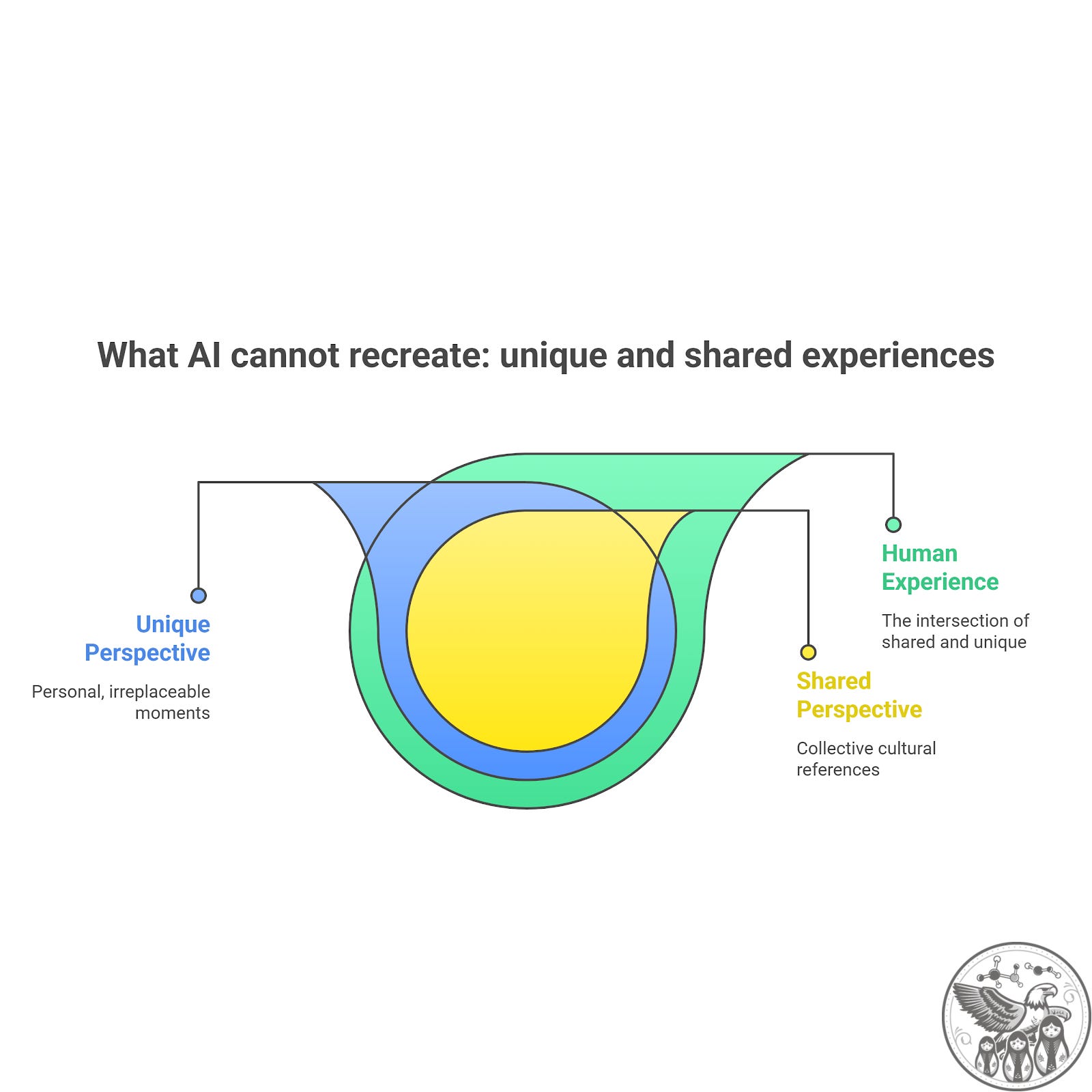
At its core, this piece about editing AI content is really about one question: “What is the unique value humans can still add to content?”
Image Credit: Kevin Indig
After countless nights wrestling with this question both intellectually and emotionally (hello, 3 a.m. anxiety!), I think I’ve finally cracked the code.
Based on my experience and from hours of “mixing” with AI, I’ve identified seven uniquely human writing capabilities that no AI can genuinely replicate:
Patterns: Detecting subtle signals in wording, rhythm, and analogies that resonate with shared human experience.
Topics: Intuitive understanding of what readers will find genuinely interesting or relevant.
Experience: Personal stories and perspectives, especially from individuals with established reputations.
Judgment: Applying nuanced moral reasoning beyond programmed guidelines.
Taste: Making decisions about what works stylistically.
Richness: Describing tastes, smells, textures, and sensations from lived experience.
Secrets: Incorporating insights or data not available in AI training sets.
While humans sometimes overestimate true novelty (most progress is incremental), we remain the essential curators of AI output.
Maybe what matters most isn’t whether AI created something but whether humans recognize its value.
Image Credit: Kevin Indig
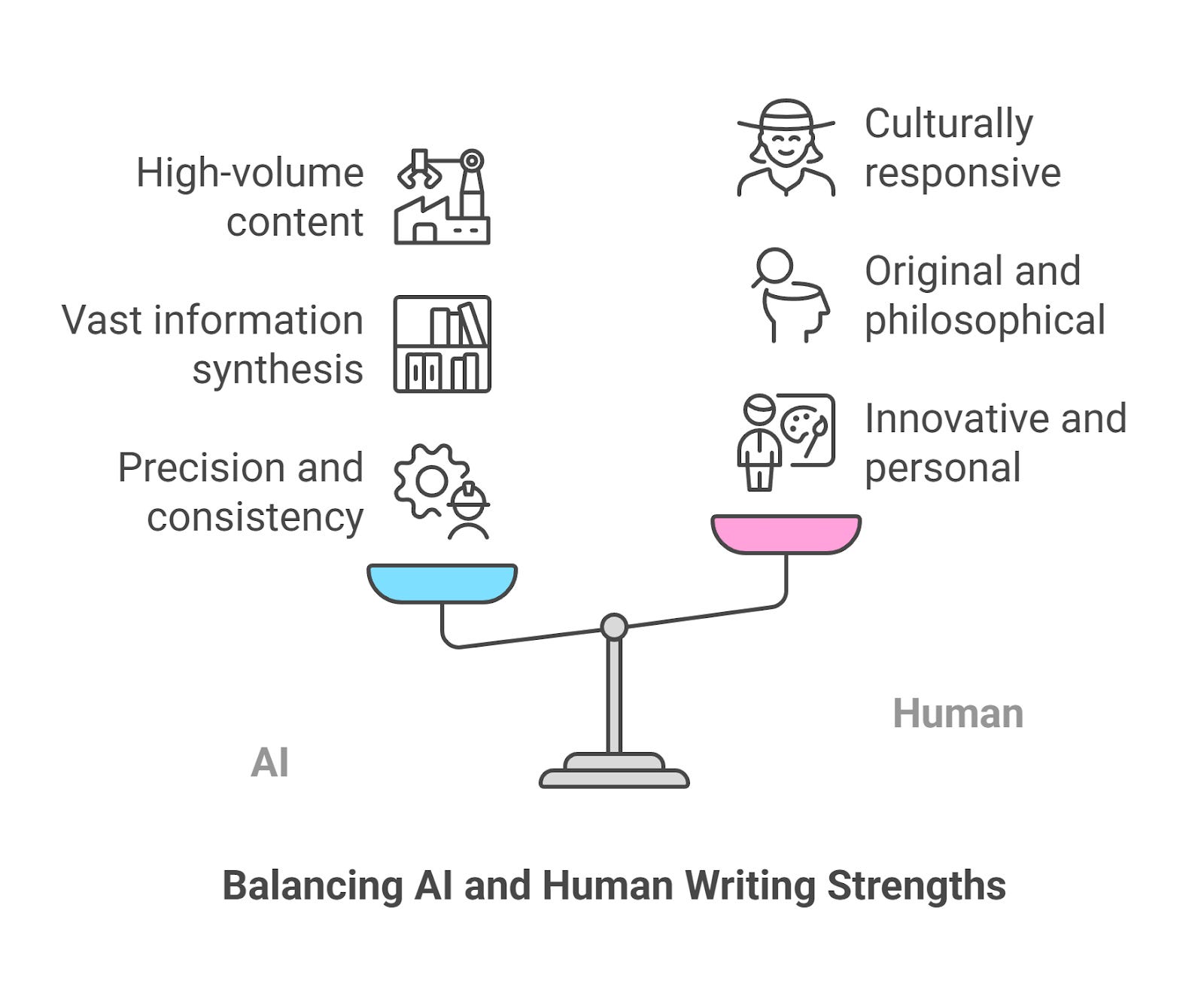
To contrast the strengths of AI vs. humans, I want to break it down across four categories:
Technical execution.
Knowledge & information.
Production & adaptation.
Data & emotional intelligence.
1. Technical Execution
AI:
Processing and error prevention (grammar, spelling, consistency).
Maintaining strict formatting across long documents.
Following detailed content guidelines with precision.
Producing grammatically accurate content at scale.
Humans:
Breaking established rules in meaningful, innovative ways.
Creating new styles, formats, and genre-bending approaches.
Developing distinctive personal writing styles.
Writing with an authentic voice from lived experience.
2. Knowledge & Information
AI:
Synthesizing information from vast knowledge bases.
Generating factual content when based on data.
Creating comprehensive explanations of complex topics.
Cross-referencing information from multiple domains.
Humans:
Contributing original research and firsthand observations.
Creating work driven by authentic moral conviction.
Writing from a deep cultural understanding of specific communities.
3. Production & Adaptation
AI:
Generating high volumes of content quickly.
Creating variations on existing themes and formats.
Translating between languages with high accuracy.
Restructuring content for different audiences and platforms.
Humans:
Inventing entirely new literary forms and approaches.
Crafting narratives that respond to the cultural moment.
Creating humor that relies on nuanced cultural context.
Developing satire that addresses contemporary issues.
4. Data & Emotional Intelligence
AI:
Converting structured data into readable narratives.
Summarizing lengthy content while preserving key information.
Creating consistent documentation from technical specifications.
Adapting content across multiple formats and channels.
Humans:
Creating characters with complex, contradictory motivations.
Writing dialogue that captures psychological nuance.
Conveying subtle emotional states through deliberate word choice.
Crafting stories that evoke powerful emotional responses.
Humans should let AI handle the baseline 80% – the beat-matching and tempo control, if you will.
And we should focus our creative energy on that critical 20% where we mix in the samples that nobody else has:our unique perspectives, surprising stories, moral nuance, cultural references, and truly novel ideas.
Now that we understand what makes human content valuable, we need to recognize what makes AI content feel off-putting.
Just as an amateur DJ might technically match beats but still create an awkward, lifeless set, AI writing has specific patterns that signal “something’s not quite right here.”
Remember how even digital DJs still need to read the room?
Similarly, while modern language models can technically string words together beautifully, they still miss crucial human signals.
Through deep research and client work, I’ve identified 11 telltale signs that scream “an AI made this” – patterns that instantly disconnect readers:
Sterile language: Overly formal phrasing that no human would actually use.
Structural monotony: Predictable sentence patterns that create a hypnotic rhythm.
Awkward transitions: Abrupt jumps between ideas without natural connective tissue.
Robotic tone: An impersonal voice that keeps readers at arm’s length.
Factual shakiness: Assertions that sound plausible but don’t hold up to scrutiny.
Personality vacuum: Writing devoid of quirks, humor, or authentic perspective.
Generic coverage: Surface-level treatment of predictable topics.
Sourceless claims: Data statements without proper attribution.
Shallow insights: Ideas that never push beyond the obvious.
Brand misalignment: Content that doesn’t match your established voice.
Weak bookends: Forgettable openings and conclusions that fail to engage.
The markers really stand out.
In the paper “Linguistic Markers of Inherently False AI Communication and Intentionally False Human Communication,”2researchers were able to detect 80% of AI content accurately by looking for:
More emotional/affective language.
More analytic writing style.
More descriptive (higher use of adjectives).
Less readable (more complex sentence structures).
Ironically, many human writers display these same weaknesses.
The difference? Humans can learn to overcome them.
The DJ analogy really comes full circle here.
Just as the best DJs don’t simply play songs in sequence but create something new through their mixing, the most effective content creators don’t just edit AI output – they transform it.
In today’s landscape, the most valuable content comes from creators who:
Understand where AI tools excel (the technical baseline).
Recognize where human input is essential (those seven unique capabilities).
Can identify and eliminate those telltale AI patterns.
Know how to blend the two seamlessly into something greater than the sum of its parts.
We’re not just editing AI content – we’re remixing it with our uniquely human perspective, creating something that no algorithm could generate alone.
Because ultimately, the most compelling content doesn’t come from humans fighting against AI or from AI attempting to replace humans. It comes from the thoughtful collaboration between both.
Next week, I’ll break down my exact workflow for editing AI content – the practical techniques I use daily to transform sterile AI output into content that genuinely resonates, connects, and performs.
You’ll learn how to efficiently leverage these tools while ensuring your content maintains that irreplaceable human touch.