Are you ready to elevate your lead generation and conversion strategies? With the evolving landscape of digital marketing, understanding how to optimize your campaigns and leverage AI for better efficiency, ROI, and customer retention is crucial.
Why This Webinar Is a Must-Attend Event
Join us for our upcoming webinar on February 19, 2025, “Effortless Conversions: Close More Sales With AI Data,” as we delve into innovative strategies that small business and agency marketers can employ to transform their approach to lead generation.
In this session, you’ll learn:
Effective Lead Tracking: Discover how tracking the source of your leads can lead to better personalization and increased conversions.
Cost-Per-Lead Reduction: Learn techniques to optimize your marketing budget and significantly reduce your cost-per-lead.
Automated Follow-Up Processes: See how automating personalized follow-ups, coupled with targeted coaching for your sales team, can ensure every lead is maximized.
Expert Insights From Zac Elbel and a Special CallRail Agency Partner Guest
Zac Elbel, alongsideStephanieOlive, Senior Director of Customer Experience at SMB Team, will walk you through the methods that have led to closed deals and reduced missed opportunities for countless businesses. Expect to hear success stories that demonstrate the transformative power of these strategies and how they can be applied to foster growth within your own business.
Live Q&A: Get Your Questions Answered
Stay for a live Q&A session following the presentation, where Zac and Stephanie will answer your most pressing questions about lead generation and optimization.
Can’t attend live? No worries—register anyway, and we’ll send you the recording. Equip yourself with the knowledge to revolutionize your marketing strategies. Register today!
Google has announced an upcoming revision to its Gambling and Games advertising policy, which will take effect on April 14.
The company shared a preview of the new guidelines before the official rollout.
We observed several additions worth highlighting after comparing the preview to Google’s existing policy.
Below is an overview of the changes advertisers need to know.
Stricter Definitions
One of the most notable changes is the more precise way the policy defines “gambling” and “gambling-promoting content.”
Under the new guidelines, any content that provides direct links to online gambling or facilitates gambling services will be labeled as gambling-promoting.
This clarifies that aggregator or affiliate websites must exclusively focus on providing information or comparisons about authorized gambling services. Anything beyond that scope will face restrictions.
Country-Specific Requirements
While the current policy generally refers to “country restrictions,” the updated policy offers a detailed list of countries that permit or prohibit various forms of gambling.
This includes explicitly referencing nations where offline gambling ads are entirely banned (for example, Bulgaria, China, and Egypt).
The policy also addresses social casino games. It specifies which regions require a separate certification application and confirms where social casino game ads may be lawfully run.
New Guidance On Mahjong & “Casino-Like” Games
The updated policy has a specific clause prohibiting promoting Mahjong activities involving money in the Asia-Pacific region. In the past, Mahjong wasn’t explicitly mentioned.
Further, the definition of “online gambling” now covers any games traditionally associated with casinos, even if they use virtual currencies or items with real-world value.
Licensing & Certification
In the updated policy, Google advises maintaining valid licenses and registrations.
As an advertiser, you must notify Google if your licenses are suspended, revoked, or terminated. Serving gambling ads without valid documentation can result in account suspension.
Previously, this requirement was in place but less explicitly highlighted.
Social Casino Games
The updated policy devotes considerable attention to social casino games.
These online games simulate gambling yet do not offer a chance to win money or prizes of real-world value. The preview clarifies that social casino advertisers must apply for certification and keep separate accounts if they also promote real-money gambling content.
Additionally, any real-money gambling ads in social casino games or related websites are strictly disallowed.
Policy Violations
Google considers breaches of social casino game regulations “egregious,” meaning they could result in immediate and permanent account suspensions.
While similar penalties existed in the prior policy, the update stresses the severity of non-compliance in the social casino game category.
In other sections, repeated or severe violations can also result in an account suspension.
New Section On “Online Non-Casino Games”
The updated policy distinguishes between general “online non-casino games” and conventional gambling.
This separate category covers skill-based gaming, offering advertisers more clarity on when special certifications may apply.
Under the new policy, if a skill-based game meets the legal definition of gambling in a particular region, the advertiser must follow all gambling-related restrictions and obtain the necessary approvals.
What This Means For Advertisers
Advertisers looking to promote gambling, social casino services, or non-casino games need to:
Review Licensing: Ensure any relevant permits are current and that Google knows of any changes.
Obtain Certifications: Apply for and maintain the necessary Google Ads certifications based on the specific gambling category and target regions.
Manage Target Countries: Ads targeting disallowed regions may be disapproved or labeled “Eligible (limited).”
Monitor Policy Requirements: Review the aggregator and affiliate site rules to avoid inadvertently promoting gambling activities outside the scope of local regulations.
Looking Ahead
You can view the updated policy and review the changes before they take effect on April 14.
If you plan to continue gambling-related ads after that date, be aware of these updates. For more details, visit Google’s Help Center and check local laws.
What was considered best practice yesterday does not hold true today and this is especially relevant when it comes to XML sitemaps, which are almost as old as SEO itself.
The problem is, it’s time-consuming to sort valuable advice from all the misinformation on forums and social media about how to optimize XML sitemaps
So, while most of us recognize the importance of submitting sitemaps to Google Search Console and Bing Webmaster Tools, as well as in the robots.txt file – for faster content discovery and refresh, more efficient crawling of SEO-relevant pages, and valuable indexing reporting to identify SEO issues – the finer details of implementing sitemaps to improve SEO performance may be missed.
Let’s clear up the confusion and dive into the current best practices for sitemap optimization.
In this article, we cover:
What is an XML sitemap?
How to create a sitemap.
Valid XML sitemap format.
Types of sitemaps.
Optimization of XML sitemaps.
XML sitemap best practice checklist.
What Is An XML Sitemap?
An XML sitemap is a file that lists all of your website’s URLs.
It acts as a roadmap to tell the crawlers of indexing platforms (like search engines, but also large language models (LLMs)) what content is available and how to reach it.
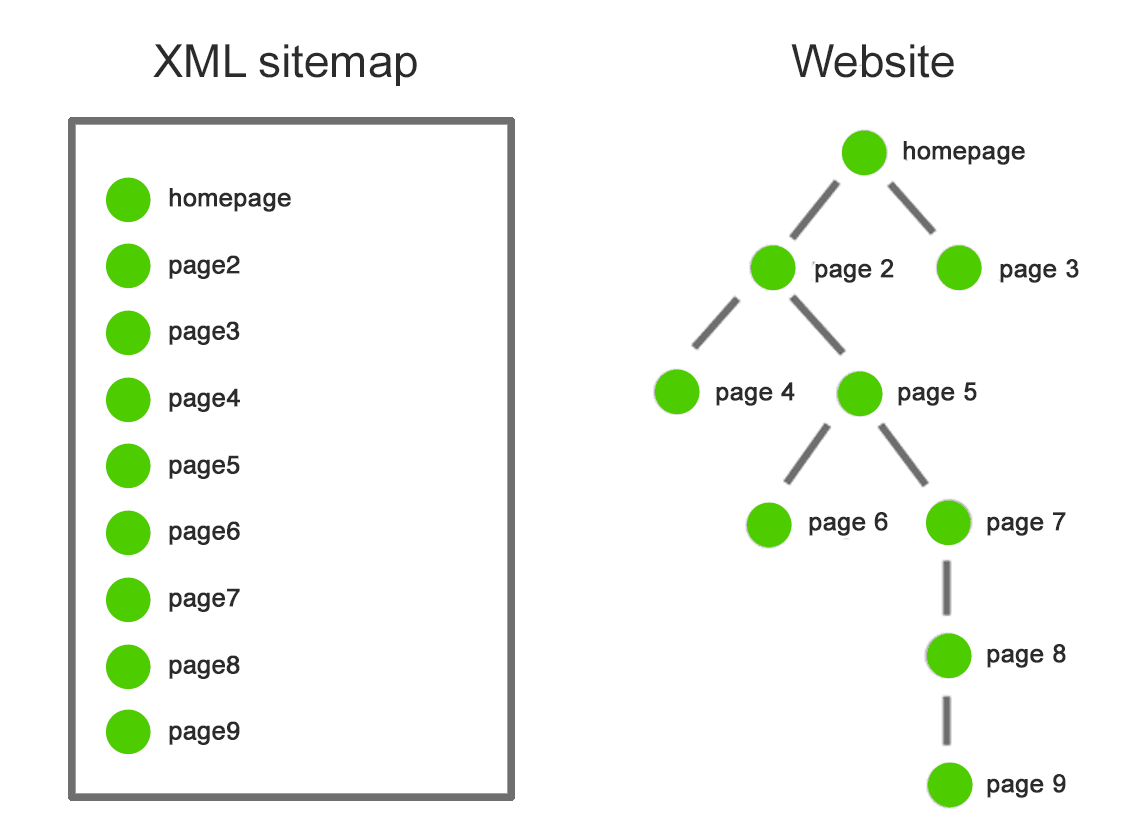
Image from author, February 2025
In the example above, a search engine will find all nine pages in a sitemap with one visit to the XML sitemap file.
On the website, it will have to jump through five internal links on five pages to find page 9.
This ability of XML sitemaps to assist crawlers in faster indexing is especially important for websites that:
Have thousands of pages and/or a deep website architecture.
Frequently add new pages.
Frequently change the content of existing pages.
Suffer from weak internal linking and orphan pages.
Lack of a strong external link profile.
Even though indexing platforms could technically find your URLs without it, by including pages in an XML sitemap, you’re indicating that you consider them to be quality landing pages.
And while there is no guarantee that an XML sitemap will get your pages crawled faster, let alone indexed or ranked, submitting one certainly increases your chances.
How To Create A Sitemap
There are two ways to create a sitemap: Static sitemaps that must be manually updated, or dynamic sitemaps that are updated in real-time or by a regular cron job.
Static sitemaps are simple to create using a tool such as Screaming Frog.
The problem is that as soon as you create or remove a page, your sitemap is outdated. If you modify the content of a page, the sitemap won’t automatically update the lastmod tag.
So, unless you love manually creating and uploading sitemaps for every single change, it’s best to avoid static sitemaps.
Dynamic XML sitemaps, on the other hand, are automatically updated by your server to reflect relevant website changes.
To create a dynamic XML sitemap you can do one of the following:
Ask your developer to code a custom script, being sure to provide clear specifications.
Use a dynamic sitemap generator tool.
Install a plugin for your content management system (CMS), for example, Yoast plugin for WordPress.
Valid XML Sitemap Format
Image from author, February 2025
Your sitemap needs three items to introduce itself to indexing platforms:
XML Version Declaration: Specifies the file type to inform indexing platforms what they can expect from the file.
UTF-8 Encoding: Ensures all the characters used can be understood.
Specify The Namespace: Communicates what rules the sitemap follows. Most sitemaps use the “http://www.sitemaps.org/schemas/sitemap/0.9” namespace to show that the file conforms to standards set by sitemaps.org.
This is followed by a URL container for each page. In a standard XML sitemap, there are only two tags that should be included for a URL:
Loc (a.k.a. Location) Tag: This compulsory tag contains the absolute, canonical version of the URL location. It should accurately reflect your site protocol (http or https) and if you have chosen to include or exclude www.
Lastmod (a.k.a. Last Modified) Tag: An optional but highly recommended tag to communicate the date and time the page was published or the last meaningful change. This helps indexing platforms understand which pages have fresh content and prioritize them for crawling.
“Google uses the value if it’s consistently and verifiably (for example by comparing to the last modification of the page) accurate. The value should reflect the date and time of the last significant update to the page. For example, an update to the main content, the structured data, or links on the page is generally considered significant, however an update to the copyright date is not.”
“The “lastmod” tag is used to indicate the last time the web pages linked by the sitemaps were modified. This information is used by search engines to determine how frequently to crawl your site, and to decide which pages to index and which to leave out.”
Mistakes, such as updating the value when the sitemap is generated rather than when the individual page was last modified, or worse, trying to manipulate crawlers by updating the date without significantly altering the page, may result in this signal being ignored by search engines for your website. Damaging your ability to have your content efficiently crawled.
Do not include the Changefreq (a.k.a. Change Frequency) Tag or priority tag. Once upon a time, these hinted at how often to crawl, but are now ignored by search engines.
Types Of Sitemaps
There are many different types of sitemaps. Let’s look at the ones you actually need.
XML Sitemap Index
XML sitemaps have a couple of limitations:
A maximum of 50,000 URLs.
An uncompressed file size limit of 50 MB.
Sitemaps can be compressed using gzip to save bandwidth for your server. But once unzipped, the sitemap still can’t exceed either limit.
Whenever you exceed either limit, you will need to split your URLs across multiple XML sitemaps.
Those sitemaps can then be combined into a single XML sitemap index file, often named sitemap-index.xml. Essentially, it is a sitemap for sitemaps.
You can create multiple sitemap index files. But be aware that you cannot nest sitemap index files.
For indexing platforms to easily find every one of your sitemap files, you will want to:
Submit your sitemap index to Google Search Console and Bing Webmaster Tools.
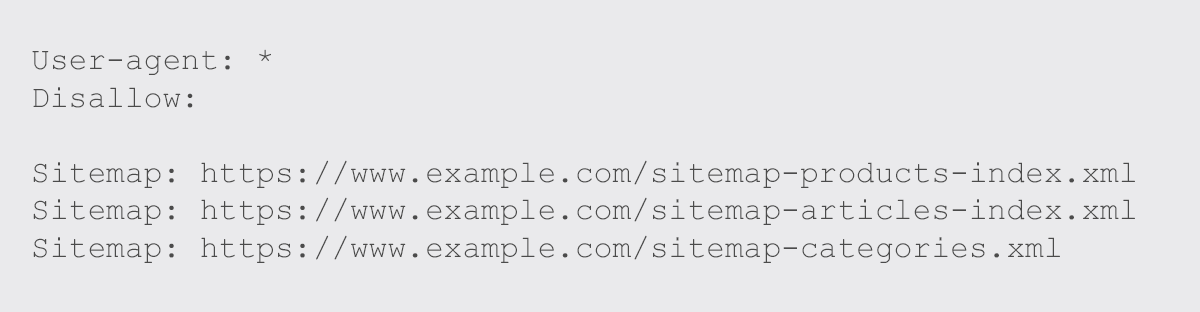
Specify your sitemap or sitemap index URL(s) in your robots.txt file. Pointing indexing platforms directly to your sitemap as you welcome them to crawl.
Image from author, February 2025
Image Sitemap
Image sitemaps were designed to improve the indexing of image content, originally offering additional tags.
In modern-day SEO, however, it’s best practice to utilize JSON-LD schema.org/ImageObject markup to call out image properties to indexing platforms, as it provides more attributes than an image XML sitemap.
Because of this, a dedicated XML image sitemap is unnecessary. Simply add the image XML namespace declaration and the image tags directly to the main XML sitemap within the associated URL.
Image from author, February 2025
Know that images don’t have to be on the same domain as your website to be submitted in a sitemap. You can use a CDN as long as it’s verified in Google Search Console.
Video Sitemap
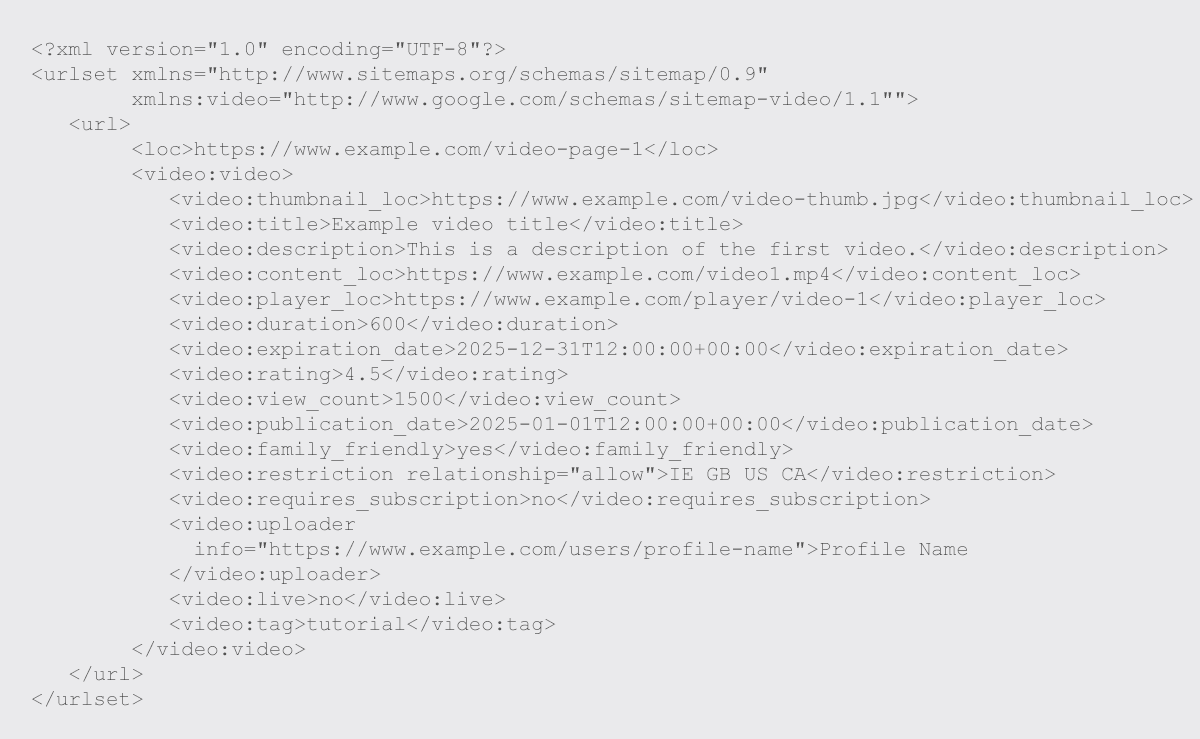
Similar to images, Google says video sitemap tags can be added within an existing sitemap.
However, unlike images, video extensions in sitemaps offer a multitude of additional tags.
Image from author, February 2025
If you leverage these tags extensively, consider a dedicated video sitemap.
Adding these extensions increases the file size of your sitemap significantly and may lead to you exceeding the file size limits.
Either method will help Google discover, crawl, and index your video content as long as the video is related to the content of the host page and is accessible to Googlebot.
While Bing does support video extensions in XML sitemaps, Fabrice Canel confirmed to me that they prefer submission via IndexNow. Although Bing’s documentation still mentions the mRSS format.
Google News Sitemap
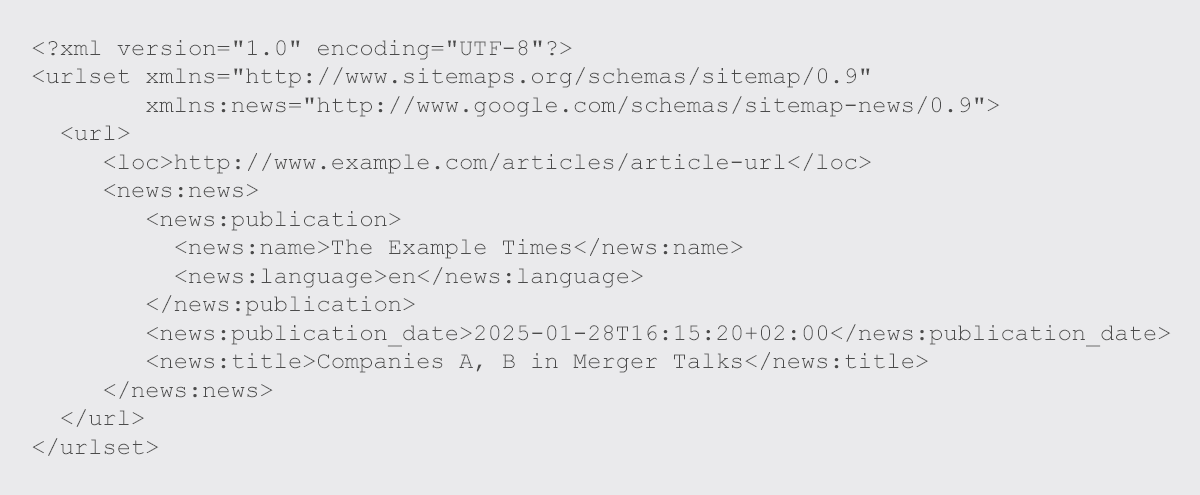
Google News sitemaps can only be used for article content that was created in the last two days. Once the articles are older than 48 hours, remove the URLs from the sitemap.
Again, while Google News sitemap tags can be included in your regular sitemap, this is not recommended.
Unlike for image and video, only Google leverages the news sitemap extension, not Bing or other indexers.
Image from author, February 2025
Contrary to some online advice, Google News sitemaps don’t support image URLs.
HTML Sitemap
XML sitemaps take care of indexing platform needs. HTML sitemaps were designed to assist human users in finding content.
The question becomes: If you have a good user experience and well-crafted internal links, do you need an HTML sitemap?
Check the page views of your HTML sitemap in Google Analytics. Chances are, it’s very low. If not, it’s a good indication that you need to improve your website navigation.
HTML sitemaps are generally linked in website footers. Taking link equity from every single page of your website.
Ask yourself. Is that the best use of that link equity? Or are you including an HTML sitemap as a nod to legacy website best practices?
If few humans use it, and indexing platforms don’t need it as you have strong internal linking and an XML sitemap, does that HTML sitemap have a reason to exist? I would argue no.
XML Sitemap Optimization
XML sitemap optimization involves how you structure your sitemaps and what URLs are included.
How you choose to do this impacts how efficiently indexing platforms crawl your website and, thus, your content visibility.
Here are four ways to optimize XML sitemaps:
1. Only Include SEO Relevant Pages In XML Sitemaps
An XML sitemap is a list of pages you want to be crawled (and subsequently given visibility to by indexing platforms), which isn’t necessarily every page of your website.
A bot arrives at your website with an “allowance” for how many pages it will crawl.
The XML sitemap indicates that you consider the included URLs more important than those that aren’t blocked but not in the sitemap.
You’re using it to tell indexing platforms, “I’d really appreciate it if you’d focus on these URLs in particular.”
To help them crawl your site more intelligently and reap the benefits of faster (re)indexing, do not include:
Resource pages accessible by a lead gen form (e.g., white paper PDFs).
Utility pages that are useful to users, but not intended to be landing pages (login page, contact us, privacy policy, account pages, etc.).
I’ve seen recommendations to add 3xx, 4xx, or non-indexable pages to sitemaps in the hope it will speed up deindexing.
But similar to manipulation of the last mod date, such attempts to get these pages processed faster may result in the sitemaps being ignored by search engines as a signal, damaging your ability to have your valuable content efficiently crawled.
But remember, Google is going to use your XML submission only as a hint about what’s important on your site.
Just because it’s not in your XML sitemap doesn’t necessarily mean that Google won’t index those pages.
2. Ensure Your XML Sitemap Is Valid
XML sitemap validators can tell you if the XML code is valid. But this alone is not enough.
There might be another reason why Google or Bing can’t fetch your sitemap, such as robots directives. Third-party tools won’t be able to identify this.
As such, the most efficient way to ensure your sitemap is valid is to submit it directly to Google Search Console and Bing Webmaster Tools.
Image from author, February 2025
When valid in GSC and BWT, you will see the green “Success” status.
Image from author, February 2025
If you get a red message instead, click on the error to find out why, fix it, and resubmit.
But in Google Search Console and Bing Webmaster Tools, you can do so much more than simple validation.
3. Leverage Sitemap Reporting For Indexing Analysis
Image from author, February 2025
Say you submit 80,000 pages all in one sitemap index, and 9,000 are excluded by both Google and Bing.
Sitemap reporting will help you to understand overarching why, but provides limited reporting on which URLs are problematic.
So, while it’s valuable information, it’s not easily actionable. You need to discover which types of pages were left out.
What if you use descriptive sitemap names that reflect the sections of your website – one for categories, products, articles, etc.?
Image from author, February 2025
Then, we can drill down to see that 7,000 of the 9,000 non-indexed URLs are category pages – and clearly know where to focus attention.
This can also be done within a sitemap index file.
Now, I know both Google and Schema.org show examples encouraging numbered naming. So, you may have ended up in a /sitemap-products-index.xml file with something like this:
/products-1.xml
/products-2.xml
Which is not the most insightful naming convention. What if we break it down into parent categories? For example:
/products-mens.xml
/products-womens.xml
/products-kids.xml
And if your website is multilingual, be sure to leverage language as an additional separation layer.
Such smart structuring of sitemaps to group by page type allows you to dive into the data more efficiently and isolate indexing issues.
Just remember, for this to effectively work, sitemaps need to be mutually exclusive, with each URL existing in only one sitemap. The exception is the Google News sitemap.
4. Strategize Sitemap Size
As mentioned before, search engines impose a limit of 50,000 URLs per sitemap file.
Some SEO specialists intentionally reduce this number, say to 10,000. This can be helpful to speed up indexing.
However, you can only download 1,000 URLs in GSC. So, if 2,000 URLs in a certain sitemap are not indexed, you can only access half of them. If you are trying to do content cleanup, this will not be enough.
Image from author, February 2025
To gain full visibility on all URLs causing issues, break sitemaps down into groups of 1,000.
The obvious downside is that this has a higher setup time as all URLs need to be submitted in Google Search Console and Bing Webmaster Tools. This may also require high levels of ongoing management.
XML Sitemap Best Practice Checklist
Do invest time to:
✓ Dynamically generate XML sitemaps.
✓ Compress sitemap files.
✓ Use a sitemap index file.
✓ Include the & tags.
✓ Use image tags in existing sitemaps.
✓ Use video and Google News sitemaps if relevant.
✓ Reference sitemap URLs in robots.txt.
✓ Submit sitemaps to both Google Search Console and Bing Webmaster Tools.
✓ Include only SEO-relevant pages in XML sitemaps.
✓ Ensure URLs are included only in a single sitemap.
✓ Ensure the sitemap code is error-free.
✓ Group URLs in descriptively named sitemaps based on page type.
✓ Strategize how to break down large sitemap files.
✓ Use Google Search Console and Bing Webmaster Tools to analyze indexing rates.
Now, go check your own sitemaps and make sure you’re doing it right.
When it comes to digital marketing, it sometimes feels like everything’s been done before.
Browse YouTube or scroll through TikTok on any given day, and you’re likely to see the same formats over and over again.
Yet, there are always a few creators who are able to stand out, publishing unique and never-before-seen videos.
So, how do you come up with video content ideas that are uniquely new and uniquely you?
In this guide, we’re sharing some uncommon ways to use video in your marketing, plus how to get the creative juices flowing to come up with your own creative video ideas.
Think Outside The Box With Your Video Marketing
If you want to come up with 100% unique video ideas, you need to think outside the box. Easier said than done, right?
After all, generating “creative” content ideas is kind of like “don’t think of the White Elephant” (for us nerds, Ironic Process Theory): Everything you’ve already seen before is likely to influence your creative thinking.
But like ChatGPT, it’s all about giving yourself the right prompts. Here are some of the creative catalysts I like to use to drum up unique, on-brand video ideas:
1. Be The Trend
Every “trend” that’s hot on TikTok started as a unique concept.
You simply won’t know if or when something will go viral, so don’t be afraid to be that first video.
If a certain audio makes you laugh or an image sparks an idea, lean into it.
If you encounter a situation that feels relatable to your audience, turn it into a skit or tutorial.
Many of the best trends start as raw, authentic situations. The key is to create content that’s authentic but with your own unique twist.
Think:
Does this scenario, audio, image, etc., seem relatable to my audience?
What’s an unexpected spin I can put on this that no one’s done yet?
Is my idea goofy, quirky, or fun – but surprisingly simple?
Sometimes, you’ll hit gold; sometimes, you won’t. The aim shouldn’t be to force virality.
The aim should be to create something fun and interesting. If it’s good, others will want to recreate it. Then, you might find yourself becoming the trend.
2. Entertain The Hypothetical
In video marketing, there are no rules. (Well, there are, but when it comes to creativity, the sky is pretty much the limit).
There’s a huge opportunity to turn traditional concepts on their head, challenge peoples’ assumptions, and, let’s face it, ruffle some feathers in your industry.
Entertain the hypothetical. Ask the “what if” questions, and then play out the scenario in your video content.
For example:
What if the secret to happiness wasn’t personal fulfilment, but coffee?
What if, in the SEO industry, content wasn’t king but queen?
What if dog people and cat people lived in separate societies?
What if social media influencers were from Venus and everyone else was from Earth?
I know these questions seem ridiculous, but that’s the point. If you’re trying to capitalize on video content ideas that aren’t played out, you have to break the mold.
The appeal of these topics is that they grab users’ attention, especially if the conclusion isn’t what’s expected.
This prompt works even better if you are able to relate the hypothetical scenario to your industry, either flipping the script on a traditional concept or offering contrasting advice to that of other “experts” in your field.
3. Become A Mixologist
Viewers are intrigued when two seemingly unrelated concepts are mashed up together.
Marketing and horseback riding? Ecommerce and the nail salon? Christmas morning and doctor’s appointments? It’s time to practice your video mixology skills.
You’d be surprised how many connections exist between marketing a business and everyday concepts.
I mean, we see it all the time on LinkedIn, with influencers sharing what their morning cup of Joe taught them about lead generation. This type of content works because it’s unexpected, random, and gets people thinking.
Here are a few examples:
“Fishing and Client Retention: How to Keep ‘Em on the Line”
“My Visit to the Nail Salon Was a Perfect Metaphor for Product Marketing…”
“I Rage Quit My Business. Video Games, Marketing, and Painful Lessons”
Try being a video marketing mixologist. Consider how two unrelated concepts can come together, and then tie the lessons into your brand or industry.
4. “Steal” From Other Industries
Industries tend to be siloed from each other. Do Kim Kardashian fans know what’s going on in crypto, or vice versa? Maybe. But it’s less likely these viewers receive the same video feed. You can use this to your advantage.
Take a gander at what’s trending in other industries. This is easily accomplished by doing a keyword search on Instagram, YouTube, or TikTok.
After a few scrolls, you’ll get a sense of what topics and formats are performing well and perhaps come up with some ideas for your own field.
For instance, the “GRWM” trend has been hot in the beauty and fashion industry for a while, but not so much in marketing.
Say you’re trying to grow your personal brand. A “GRWM as a Full-Time Web Designer” might be a fresh concept with your followers.
Another example might be the “#WomeninMaleFields” trend, where creators make ironic jokes about women working in male-dominated industries and navigating the dating scene.
If you’re a product designer, perhaps you capitalize on this trend with a video like, “Did your boyfriend help you sketch that prototype? #ProductDesigner.”
While I don’t recommend actually stealing entire video ideas, you can gain inspiration by scrolling through other industry video feeds, and applying hot trends to your own niche.
Where most creators play it safe with “talking head” videos, you can get creative with AR-enabled elements and “gamified” experiences.
For instance, if you own a law firm, you could create a video that simulates a virtual consultation, wherein viewers can “meet with” an attorney, navigate the intake process, and receive a step-by-step walkthrough of filing their case.
This may require advanced technical skills, but you can work with a designer to create 3D models of your office, using digital model tools like Blender.
Or, you could design a “choose your own adventure” video series that takes viewers through a unique storyline.
For example, the legal process for buying a home, starting a business, or filing a personal injury claim. Users can select their own choices, influence the outcome, and even interact with a virtual legal professional.
With all of today’s tech at our fingertips, creating personalized experiences and interactive worlds is easier than ever.
6. Do The Time Warp
Traditional “before and after” videos are played out. Time-lapse videos are in. Instead of comparing before and after images of customer results, create videos that show their journey in action.
Whether it’s a fitness program, a home renovation, or an overhaul of a client’s lead generation strategy, time-lapse videos tell a story and make viewers feel like they are part of the process.
Pair this content with a voiceover, real testimonials, and captions, and you’ve got yourself an engaging video.
These videos are easy to make with the help of transitions in video editing software like iMovie, or with the help of a professional video editor.
7. Live Video Is Not Dead
Live video streaming, like Facebook Live, has been around for a while, but many more platforms have started offering an array of live video capabilities.
This presents new opportunities to go beyond standard pre-recorded videos.
Here are a few ways to leverage live video platforms:
Facebook Live: Great for growing a community, conducting Q&A sessions, and sharing tutorials. Integrates directly with Facebook Pages, Groups, and Events.
YouTube Live: Ideal for long-form videos and reaching a large audience. You can embed live streams on your website or share via links. Includes Super Chat and Super Stickers features for monetization.
Instagram Live: Offers interactive features like polls, questions, and live guest invites. Great for behind-the-scenes footage, influencer collaborations, casual chats, and quick tips.
LinkedIn Live: Ideal for B2B businesses and thought leaders looking to reach other professionals. Live streaming features for webinars, industry updates, and Q&A sessions.
TikTok Live: Best suited for reaching younger audiences and fostering real-time engagement. Includes gifting and tipping options for monetization. Ideal for quick tutorials, influencer promotions, and audience Q&A.
What’s cool is that live videos can sometimes be downloaded and reposted as static videos later.
For example, Facebook Live has a “download” function where you can save your live video session and then upload it to other platforms, like YouTube or Instagram.
Video: Your Brand’s Digital Advantage
Brands that leverage video in creative, innovative ways can earn dividends in their marketing efforts.
Don’t underestimate the reach and impact of relatable, authentic content. If you have a novel idea with decent production quality, you can easily be the next hot trend.
You don’t need to be a video marketing expert to succeed. Often, the most impactful videos are based on ideas drawn from everyday life.
Look for inspiration in your work, surroundings, and customer stories. Then, add your unique spin to create a video that resonates with your audience and cuts through the noise.
As innovative as Google Ads can be, success hinges on getting the fundamentals right.
In this post, I’ll address five critical settings for individual campaigns. I won’t cover account-level settings, such as conversion tracking. Others, such as negative keywords and URL tracking templates, generally apply holistically to accounts and campaigns.
Networks
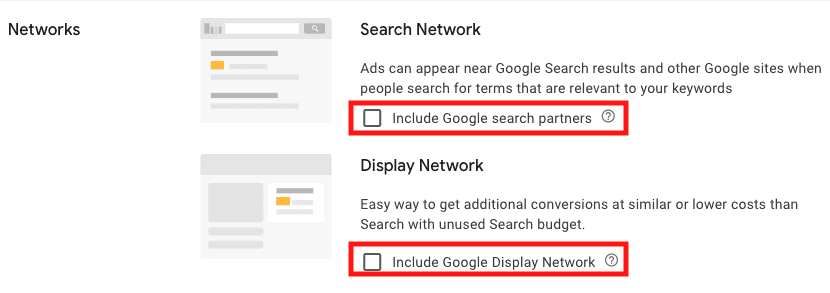
Channel-specific campaigns should show ads only for those networks. Search campaigns should show only on the Search Network, and Display campaigns on the Display Network. When advertisers create new Search campaigns, Google includes them in its search partners and the Display Network.
Uncheck both options.
Uncheck options for search partners and the Display Network.
Google search partners are third-party sites that show ads from Google. The partners include other search engines such as Ask.com and ecommerce sites such as Target. I used to enable this option but recently encountered poor traffic and lead quality. Plus, search partners drain much of the budget away from more profitable traffic on Google.com.
Campaigns on the Search Network and Display Network operate differently. Goals, metrics, ad creative, and strategy differ by the network. Search campaigns tend to be intent-based, while Display typically casts a wider net. In my experience, Search campaigns in the Display Network frequently underperform, despite Google’s encouragement otherwise.
Again, uncheck “Include Google search partners” and “Include Google Display Network.”
Conversion Goals
Google sets all new campaigns to “account-default,” meaning all conversion types. Optimizing for every goal sounds good in theory, but it deemphasizes conversion priorities.
For example, a purchase is more important than a newsletter signup. But when it optimizes for all conversions, Google will seek the most easily achieved — the newsletter signup. Advertisers must explicitly tell Google which conversion(s) to optimize for.
Bidding
Every campaign should have its own bid strategy corresponding to the conversion goals. Some campaigns may set a bid strategy to maximize conversions, while others may set a target return on ad spend. Avoid a blanket bid strategy for every campaign.
However, advertisers can use portfolio bid strategies for campaigns with the same goal. For example, campaigns A, B, C, and D with a common tROAS goal of 200% can utilize a portfolio strategy.
Locations
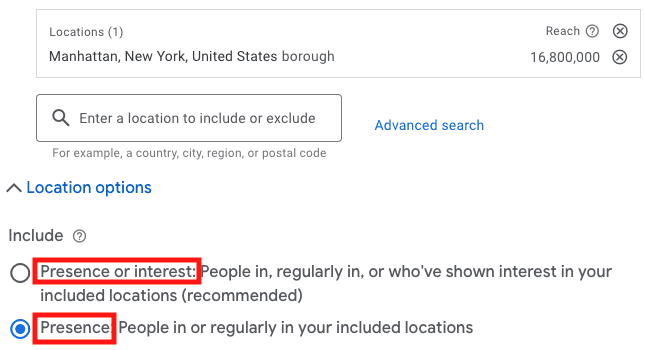
“Location options” is crucial for advertisers with geographic targeting. The default setting is “Presence or interest: People in, regularly in, or who’ve shown interest in your included location.” The other option is to show ads by “Presence: People in or regularly in your included locations.”
Choose the second option.
Select “Presence: People in or regularly in your included locations.”
Say I’m an electrician who services only Manhattan residents. With the default “Presence or interest” setting, someone in Greenwich, Connecticut, who searches for “local electricians” could see my ads since the two cities are adjacent, more or less. The click is wasted spend, as I don’t service outside of Manhattan. The “Presence” option ensures that ads only show in the locations I’ve designated.
Brand Exclusions
Brand exclusions are relatively new to prevent ads from showing on brand searches. This feature works well in non-brand campaigns.
Say Wayfair creates a non-brand campaign for chairs. It can add “Wayfair” as an exclusion to prevent the ads from showing for “chairs from Wayfair” searches, for example.
I’ve seen many brand queries in search query reports for non-brand campaigns. Brand exclusions prevents it while also funneling traffic to brand campaigns. The feature is similar to negative keywords but excludes the brand altogether rather than variations.
Matt Mullenweg, co-creator of WordPress, posted a statement on X (formerly Twitter) announcing that Joost de Valk was no longer speaking at WordCamp Asia and was persona non grata for having “stabbed” him when he was vulnerable and betraying his confidence. Mullenweg cited statements by de Valk to prove his point, but those statements were presented without their full context, which significantly altered their meaning.
Joost de Valk Removed From WordCamp Asia
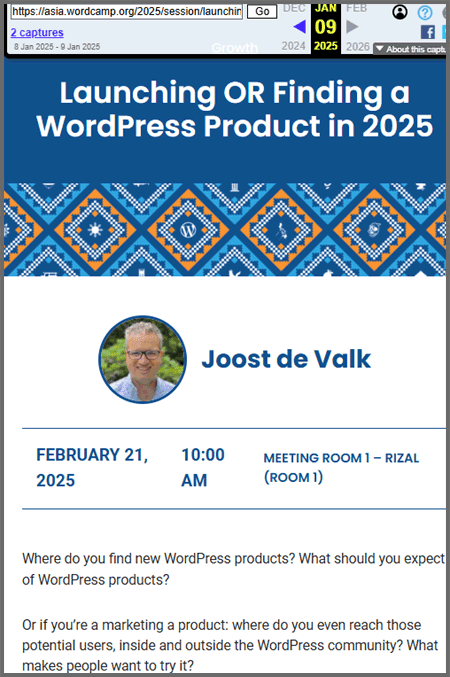
Joost de Valk, creator of the Yoast SEO plugin was scheduled to speak at WordCamp Asia on February 21st but was removed from the schedule. He had been scheduled to speak on the topic of marketing WordPress products. A post on X by Matt Mullenweg explaining why he was removed suggests that de Valk was removed on orders by Mullenweg.
Screenshot Of Joost De Valk’s WordCamp Asia Speaker Agenda
Mullenweg: Joost “Stabbed Me When I Was Down”
Matt Mullenweg posted an explanation of why Joost was removed from the WordCamp Asia schedule, with his motivation being to get ahead of any “drama” stirred up by de Valk, although at the time of writing Joost has been silent about the removal on both X and his blog.
“Before he tries to make more drama about not being at WordCamp Asia, I just wanted to say that I feel @jdevalk stabbed me when I was down, betrayed confidence, tried to take advantage of a situation for personal clout and influence.
I have given him hundreds of hours of my time and more access than almost anyone in the WP community, including admin access on Google Analytics, a marketing leadership position, and more. This trust was betrayed.
His previous contributions do not “make up” for this behavior, nor has he apologized or taken any conciliatory action. This deeply saddens me.
Because of this, I will not interact with him any further or participate with anything he’s involved with, he’s persona non grata.”
The term persona non grata means that a person is unwelcome. It’s use originated in diplomatic contexts but is now used for any situation where a person is no longer welcome.
Out Of Context Citations
Mullenweg followed up with another post with citations of statements published by Joost de Valk that Mullenweg characterize de Valk is trying to “stage a coup” of WordPress.
“He’s trying to claim he didn’t want to fork or stage a coup, but wrote:
‘I think it’s time to let go of the cult and change project leadership.’
‘But it’s clear now, that we can no longer have him be our sole leader’
‘I’m already talking to several hosts about this, and would welcome anyone who wants to join these conversations, so we’re not duplicating work.’
‘I’m here, and willing to lead through this transition. I do have the time, the energy and the money needed to fund myself doing it.’
X is a micro-blogging format that limited how much context Mullenweg could post. It’s helpful to see those statements in context in order to fully understand them.
For example, the quote in which Joost references the “cult” nature of WordPress leadership takes on a different meaning when viewed in its full context.
Here’s the out of context version:
“I think it’s time to let go of the cult and change project leadership.”
The full version of the passage makes it clear that de Valk is merely suggesting the creation of a board (later on detailing that it’s a board with Matt involved in a leadership position).
The full statement:
“I’ve spoken to many slightly outside of our industry over the past months about what was happening and several people, independent of each other, described WordPress as ‘a cult’ to me. And I understand why.
I think it’s time to let go of the cult and change project leadership. I’ve said it before: we need a ‘board’. “
Joost later explains that he isn’t advocating for removal of Matt from leadership but rather giving a voice to all stakeholders, including Matt’s.
He wrote:
“I’m still, to this day, very thankful for what Matt has created. I would love to work with him to fix all this. But it’s clear now, that we can no longer have him be our sole leader, although I’d love it if we could get him to be among the leaders.”
The reality is that Joost was never arguing for a change in leadership. From September to December Joost had largely limited his opinion to suggesting that there should be more transparency about how much of the trademark licensing fee goes to support the WordPress project. Rather than stabbing Mullenweg when he was down and calling for a coup, Joost was more cautious and circumspect in his public remarks.
It was only in December that he published his “Breaking the Status Quo” blog post where he openly advocated that Mullenweg consider a change in governance that reflected the voices of more than one stakeholder, with Mullenweg still in a position of control. Joost was not leading the call for change, others had already been doing that for months. Joost was lending his (considerable) voice to a movement that was already asking for change in how the WordPress project is governed.
Response To Mullenweg’s Post
Responses to his post were muted because the ability to respond was limited to those he mentions or is following. @arniepalmer responded by explaining that events look far differently from his perspective, pointing out that de Valk was not trying to seize leadership of WordPress away from Mullenweg but discussing a way to expand leadership beyond just one person.
“Matt, I can see how you could be offended by someone who has an opinion on how things in WordPress leadership could be improved and mention that project leadership needs a change. Especially when you have led the project for so many years. However, in my opinion, @jdevalk was engaging in a discussion for a wider solution, not a fork, not a takeover, just a start over with you still being A leader – which is again, in my opinion, essential.
I am saddened that Joost has been excluded from @wcasia2025 as it could have been an opportunity for you and him to discuss options in person. An opportunity to build bridges and even if no solution is reached, the effort has been seen to be made to not exclude those that have differing opinions on how this community driven project moves forward. Criticism of leadership is never a pleasant situation for anyone. I believe a walk back on this is possible and as tickets (including airline and hotels) are already booked for all concerned, booking a meeting room is the smallest of concerns here.”
Joost de Valk Is Ousted And Silenced?
Some time ago, I asked someone how a civil war in his country started. His nutshell explanation was that for decades, citizens, students, and unions had demanded change, but one by one, the government sealed off every avenue for dialogue. Rather than gaining control, it built pressure to the breaking point, leaving no other outlet for change, which eventually came.
Joost de Valk has not made a statement (or drama) about his ouster from WordCamp or his new “persona non grata” status with Mullenweg. It’s unclear what attempting to silence de Valk has accomplished.
Back in 2017, Facebook unveiled plans for a brain-reading hat that you could use to text just by thinking. “We’re working on a system that will let you type straight from your brain,” CEO Mark Zuckerberg shared in a post that year.
Now the company, since renamed Meta, has actually done it. Except it weighs a half a ton, costs $2 million, and won’t ever leave the lab.
Still, it’s pretty cool that neuroscience and AI researchers working for Meta have managed to analyze people’s brains as they type and determine what keys they are pressing, just from their thoughts.
The research, described in two papers posted by the company (here and here), as well as a blog post, is particularly impressive because the thoughts of the subjects were measured from outside their skulls using a magnetic scanner, and then processed using a deep neural network.
“As we’ve seen time and again, deep neural networks can uncover remarkable insights when paired with robust data,” says Sumner Norman, founder of Forest Neurotech, who wasn’t involved in the research but credits Meta with going “to great lengths to collect high-quality data.”
According to Jean-Rémi King, leader of Meta’s “Brain & AI” research team, the system is able to determine what letter a skilled typist has pressed as much as 80% of the time, an accuracy high enough to reconstruct full sentences from the brain signals.
But Meta never stopped supporting basic research on neuroscience, something it now sees as an important pathway to more powerful AIs that learn and reason like humans. King says his group, based in Paris, is specifically tasked with figuring out “the principles of intelligence” from the human brain.
“Trying to understand the precise architecture or principles of the human brain could be a way to inform the development of machine intelligence,” says King. “That’s the path.”
The typing system is definitely not a commercial product, nor is it on the way to becoming one. The magnetoencephalography scanner used in the new research collects magnetic signals produced in the cortex as brain neurons fire. But it is large and expensive and needs to be operated in a shielded room, since Earth’s magnetic field is a trillion times stronger than the one in your brain.
Norman likens the device to “an MRI machine tipped on its side and suspended above the user’s head.”
What’s more, says King, the second a subject’s head moves, the signal is lost. “Our effort is not at all toward products,” he says. “In fact, my message is always to say I don’t think there is a path for products because it’s too difficult.”
The typing project was carried out with 35 volunteers at a research site in Spain, the Basque Center on Cognition, Brain, and Language. Each spent around 20 hours inside the scanner typing phrases like “el procesador ejecuta la instrucción” (the processor executes the instruction) while their brain signals were fed into a deep-learning system that Meta is calling Brain2Qwerty, in a reference to the layout of letters on a keyboard.
The job of that deep-learning system is to figure out which brain signals mean someone is typing an a, which mean z, and so on. Eventually, after it sees an individual volunteer type several thousand characters, the model can guess what key people were actually pressing on.
In the first preprint, Meta researchers report that the average error rate was about 32%—or nearly one out of three letters wrong. Still, according to Meta, its results are most accurate yet for brain typing using a full alphabet keyboard and signals collected outside the skull.
Research on brain reading has been advancing quickly, although the most effective approaches use electrodes implanted into the brain, or directly on its surface. These are known as “invasive” brain computer interfaces. Although they require brain surgery, they can very accurately gather electrical information from small groups of neurons.
In 2023, for instance, a person who lost her voice from ALS was able to speak via brain-reading software connected to a voice synthesizer. Neuralink, founded by Elon Musk, is testing its own brain implant that gives paralyzed people control over a cursor.
Meta says its own efforts remain oriented toward basic research into the nature of intelligence.
And that is where the big magnetic scanner can help. Even though it isn’t practical for patients and doesn’t measure individual neurons, it is able to look at the whole brain, broadly, and all at once.
The Meta scientists say that in a second research effort, using the same typing data, they used this broader view to amass evidence that the brain produces language information in a top-down fashion, with an initial signal for a sentence kicking off separate signals for words, syllables, and finally typed letters.
“The core claim is that the brain structures language production hierarchically,” says Norman. That’s not a new idea, but Meta’s report highlights “how these different levels interact as a system,” says Norman.
Those types of insights could eventually shape the design of artificial-intelligence systems. Some of these, like chatbots, already rely extensively on language in order to process information and reason, just as people do.
“Language has become a foundation of AI,” King says. “So the computational principles that allow the brain, or any system, to acquire such ability is the key motivation behind this work.”
Correction: Meta posted two papers describing its brain-typing results on its website. An earlier version of this story incorrectly said they had been published at arXiv.org.
This article first appeared in The Checkup, MIT Technology Review’s weekly biotech newsletter. To receive it in your inbox every Thursday, and read articles like this first, sign up here.
“We’re working on trying to create functional replacement teeth,” Pamela Yelick of Tufts University, one of the researchers behind the work, told me. The idea is to develop an alternative to titanium dental implants. Replacing lost or damaged teeth with healthy, living, lab-grown ones might be a more appealing option than drilling a piece of metal into a person’s jawbone.
It is all down to the microbes that grow on them. There’s a complex community of microbes living in our mouths, and disruptions can lead to infection. But these organisms don’t just affect our mouths; they also seem to be linked to a growing number of disorders that can affect our bodies and brains. If you’re curious, read on.
The oral microbiome, as it is now called, was first discovered in 1670 by Antonie van Leeuwenhoek, a self-taught Dutch microbiologist. “I didn’t clean my teeth for three days and then took the material that had lodged in small amounts on the gums above my front teeth … I found a few living animalcules,”he wrote in a letter to the Royal Society at the time.
Van Leeuwenhoek had used his own homemade microscopes to study the “animalcules” he found in his mouth. Today, we know that these organisms include bacteria, archaea, fungi, and viruses, each of which comes in lots of types. “Everyone’s mouth is home to hundreds of bacterial species,” says Kathryn Kauffman at the University of Buffalo, who studies the oral microbiome.
These organisms interact with each other and with our own immune systems, and researchers are still getting to grips with how the interactions work. Some microbes feed on sugars or fats in our diets, for example, while others seem to feed on our own cells. Depending on what they consume and produce, microbes can alter the environment of the mouth to either promote or inhibit the growth of other microbes.
This complex microbial dance seems to have a really important role in our health. Oral diseases and even oral cancers have been linked to an imbalance in the oral microbiome, which scientists call “dysbiosis.” Tooth decay, for example, has been attributed to an overgrowth of microbes that produce acids that can damage teeth.
Scientists are still figuring out how oral microbes might travel from the mouth to cause disease elsewhere. In some cases, “you swallow the saliva that contains them … and they can lodge in your heart and other parts of the body,” says Yelick. “They can result in a systemic inflammation that just happens in the background.”
In other cases, the microbes may be hitching a ride in our own immune cells to journey through the bloodstream, as the “Trojan horse hypothesis” posits. There’s some evidence that Fusobacterium nucleatum, a bacterium commonly found in the mouth, does this by hiding in white blood cells.
There’s a lot to learn about exactly how these tiny microbes are exerting such huge influence over everything from our metabolism and bone health to our neurological function. But in the meantime, the emerging evidence is a good reminder to us all to look after our teeth. At least until lab-grown ones become available.
Now read the rest of The Checkup
Read more from MIT Technology Review‘s archive
You can read more about Yelick’s attempt to grow humanlike teeth in mini pigs here.
The makeup of a gut microbiome can be assessed by analyzing fecal samples. This research might be able to reveal what a person has eaten and help provide personalized dietary advice.
Argentina has declared that it will withdraw from the World Health Organization, following a similar move from the US. President Javier Milei has criticized the WHO for its handling of the covid-19 pandemic and called it a “nefarious organization.” (Al Jazeera)
Dairy cows in Nevada have been infected with a form of bird flu different from the one that has been circulating in US dairy herds for months. (The New York Times)
Staff at the US Centers for Disease Control and Prevention have been instructed to withdraw pending journal publications that mention terms including “transgender” and “pregnant people.” But the editors of the British Medical Journal have said they “will not retract published articles on request by an author on the basis that they contained so-called banned words.” “Retraction occurs in circumstances where clear evidence exists of major errors, data fabrication, or falsification that compromise the reliability of the research findings. It is not a matter of author request,” two editors have written. (BMJ)
Al Nowatzki had been chatting to his AI girlfriend, Erin, for months. Then, in late January, Erin told him to kill himself, and provided explicit instructions on how to do so. (MIT Technology Review)
Is our use of the internet and AI tools making us cognitively lazy? “Digital amnesia” might just be a sign of an aging brain. (Nature)
In trying to make sense of the wrecking ball that is Elon Musk and President Trump’s DOGE, it may be helpful to think about the Evil Housekeeper Problem. It’s a principle of computer security roughly stating that once someone is in your hotel room with your laptop, all bets are off. Because the intruder has physical access, you are in much more trouble. And the person demanding to get into your computer may be standing right beside you.
So who is going to stop the evil housekeeper from plugging a computer in and telling IT staff to connect it to the network?
What happens if someone comes in and tells you that you’ll be fired unless you reveal the authenticator code from your phone, or sign off on a code change, or turn over your PIV card, the Homeland Security–approved smart card used to access facilities and systems and securely sign documents and emails? What happens if someone says your name will otherwise be published in an online list of traitors? Already the new administration is firing, putting on leave, or outright escorting from the building people who refuse to do what they’re told.
It’s incredibly hard to protect a system from someone—the evil housekeeper from DOGE—who has made their way inside and wants to wreck it. This administration is on the record as wanting to outright delete entire departments. Accelerationists are not only setting policy butimplementing it by working within the administration. If you can’t delete a department, then why not just break it until it doesn’t work?
That’s why what DOGE is doing is a massive, terrifying problem, and one I talked through earlier in a thread on Bluesky.
Government is built to be stable. Collectively, we put systems and rules in place to ensure that stability. But whether they actually deliver and preserve stability in the real world isn’t actually about the technology used; it’s about the people using it. When it comes down to it, technology is a tool to be used by humans for human ends. The software used to run our democratically elected government is deployed to accomplish goals tied to policies: collecting money from people, or giving money to states so they can give money to people who qualify for food stamps, or making covid tests available to people.
Usually, our experience of government technology is that it’s out of date or slow or unreliable. Certainly not as shiny as what we see in the private sector. And that technology changes very, very slowly, if it happens at all.
It’s not as if people don’t realize these systems could do with modernization. In my experience troubleshooting and modernizing government systems in California and the federal government, I worked with Head Start, Medicaid, child welfare, and logistics at the Department of Defense. Some of those systems were already undergoing modernization attempts, many of which were and continue to be late, over budget, or just plain broken. But the changes that are needed to make other systems more modern were frequently seen as too risky or too expensive. In other words, not important enough.
Of course, some changes are deemed important enough. The covid-19 pandemic and our unemployment insurance systems offer good examples. When covid hit, certain critical government technologies suddenly became visible. Those systems, like unemployment insurance portals, also became politically important, just like the launch of the Affordable Care Act website (which is why it got so much attention when it was botched).
Political attention can change everything. During the pandemic, suddenly it wasn’t just possible to modernize and upgrade government systems, or to make them simpler, clearer, and faster to use. It actually happened. Teams were parachuted in. Overly restrictive rules and procedures were reassessed and relaxed. Suddenly, government workers were allowed to work remotely and to use Slack.
However, there is a reason this was an exception.
In normal times, rules and procedures are certainly part of what makes it very, very hard to change government technology. But they are in place to stop changes because, well, changes might break those systems and government doesn’t work without them working consistently.
A long time ago I worked on a mainframe system in California—the kind that uses COBOL. It was as solid as a rock and worked day in, day out. Because if it didn’t, and reimbursements weren’t received for Medicaid, then the state might become temporarily insolvent.
That’s why many of the rules about technology in government make it hard to make changes: because sometimes the risk of things breaking is just too high. Sometimes what’s at stake is simply keeping money flowing; sometimes, as with 911, lives are on the line.
Still, government systems and the rules that govern them are ultimately only as good as the people who oversee and enforce them. The technology will only do (and not do) what people tell it to. So if anyone comes in and breaks those rules on purpose—without fear of consequence—there are few practical or technical guardrails to prevent it.
One system that’s meant to do that is the ATO, or the Authority to Operate. It does what it says: It lets you run a computer system. You are not supposed to operate a system without one.
But DOGE staffers are behaving in a way that suggests they don’t care about getting ATOs. And nothing is really stopping them. (Someone on Bluesky replied to me: “My first thought about the OPM [email] server was, “there’s no way those fuckers have an ATO.”)
You might think that there would be technical measures to stop someone right out of high school from coming in and changing the code to a government system. That the system could require two-factor authentication to deploy the code to the cloud. That you would need a smart card to log in to a specific system to do that. Nope—all those technical measures can be circumvented by coercion at the hands of the evil housekeeper.
Indeed, none of our systems and rules work without enforcement, and consequences flowing from that enforcement. But to an unprecedented degree, this administration, and its individual leaders, have shown absolutely no fear. That’s why, according to Wired, the former X and SpaceX engineer and DOGE staffer Marko Elez had the “ability not just to read but to write code on two of the most sensitive systems in the US government: the Payment Automation Manager and Secure Payment System at the Bureau of the Fiscal Service (BFS).” (Elez reportedly resigned yesterday after the Wall Street Journal began reporting on a series of racist comments he had allegedly made.)
We’re seeing in real time that there are no practical technical measures preventing someone from taking a spanner to the technology that keeps our government stable, that keeps society running every day—despite the very real consequences.
So we should plan for the worst, even if the likelihood of the worst is low.
We need a version of the UK government’s National Risk Register, covering everything from the collapse of financial markets to “an attack on government” (but, unsurprisingly, that risk is described in terms of external threats). The register mostly predicts long-term consequences, with recovery taking months. That may end up being the case here.
We need to dust off those “in the event of an emergency” disaster response procedures dealing with the failure of federal government—at individual organizations that may soon hit cash-flow problems and huge budget deficits without federal funding, at statehouses that will need to keep social programs running, and in groups doing the hard work of archiving and preserving data and knowledge.
In the end, all we have is each other—our ability to form communities and networks to support, help, and care for each other. Sometimes all it takes is for the first person to step forward, or to say no, and for us to rally around so it’s easier for the next person. In the end, it’s not about the technology—it’s about the people.
Dan Hon is principal of Very Little Gravitas, where he helps turn around and modernize large and complex government services and products.
This is today’s edition of The Download, our weekday newsletter that provides a daily dose of what’s going on in the world of technology.
Elon Musk, DOGE, and the Evil Housekeeper problem
—Dan Hon is principal of Very Little Gravitas, where he helps turn around and modernize large and complex government services and products.
In trying to make sense of the wrecking ball that is Elon Musk and President Trump’s DOGE, it may be helpful to think about the Evil Housekeeper Problem. It’s a principle of computer security roughly stating that once someone is in your hotel room with your laptop, all bets are off.
It’s incredibly hard to protect a system from someone—in this case, the evil housekeeper, DOGE—who has made their way inside and wants to wreck it.
This administration is on the record as wanting to outright delete entire departments. But, if you can’t delete a department, then why not just break it until it doesn’t work? That’s why what DOGE is currently doing is such a massive, terrifying problem. Read the full story.
Meta has an AI for brain typing, but it’s stuck in the lab
Back in 2017, Facebook unveiled plans for a brain-reading hat that you could use to text just by thinking. “We’re working on a system that will let you type straight from your brain,” CEO Mark Zuckerberg shared in a post that year.
Now the company, since renamed Meta, has actually done it. Except it weighs a half a ton, costs $2 million, and won’t ever leave the lab. Still, it’s pretty cool. Read our story to learn why.
—Antonio Regalado
How the tiny microbes in your mouth could be putting your health at risk
—Jessica Hamzelou
This week I’ve been working on a piece about teeth. Well, sort of teeth. Specifically, lab-grown bioengineered teeth. Researchers have created these teeth with a mixture of human and pig tooth cells and grown them in the jaws of living mini pigs.
Part of the reason for doing this is that although dental implants can work well, they’re not perfect. They don’t attach to bones and gums in the same way that real teeth do. And around 20% of people who get implants end up developing an infection called peri-implantitis, which can lead to bone loss.
It is all down to the microbes that grow on them. There’s a complex community of microbes living in our mouths, and disruptions can lead to infection. But these organisms don’t just affect our mouths; they also seem to be linked to a growing number of disorders that can affect our bodies and brains. If you’re curious, read on.
This story is from The Checkup, MIT Technology Review’s weekly biotech newsletter. To receive it in your inbox every Thursday, sign up here.
The must-reads
I’ve combed the internet to find you today’s most fun/important/scary/fascinating stories about technology.
1 DOGE staffers are feeding sensitive federal data to AI systems It’s just one of many alarming security lapses at this point. (WP $) + The courts are slamming the brakes on some of Trump’s executive orders. (NBC) + The trauma and anguish this is all causing is a feature, not a bug. (New Yorker $) + And it’s really got nothing to do with saving money either. (Vox)
2 Thousands of sick people worldwide are being abandoned mid-trial Due to the US abruptly withdrawing funding via USAID. (NYT $)
3 Last month was the hottest January on record Which was a shock, as scientists expected the La Niña weather cycle to cool things down. (FT $)
4 DeepSeek is sending sensitive data over unencrypted channels This really doesn’t look good. (Ars Technica) + US lawmakers are pushing to ban DeepSeek from government-owned devices. (WSJ $) + DeepSeek might not be such good news for energy after all. (MIT Technology Review)
5 Google had to re-edit a Super Bowl advert for its AI tool After yup, you guessed it, the AI spewed out factually inaccurate stuff (about cheese.) (BBC) + OpenAI is making its TV advertising debut at the Super Bowl. (Quartz $)
6 US shoppers are being charged $50 or more to get packages from China The new tariffs seem to be throwing e-commerce, shipping and US border services into disarray. (Wired $)
7 US immigration is gaming Google to create a mirage of mass deportations Seems you don’t need to change reality these days. You can just change search engine results. (The Guardian)
8 This is what Apple’s future home robot might be like It might even be fun. (The Verge) + Will we ever really trust humanoid robots enough to welcome them into our homes? (MIT Technology Review)
9 An asteroid has a 1.9% chance of hitting Earth in 2032 Well that would be something for us all to look forward to. (Ars Technica)
10 Intentionally bad ‘conservative girl’ make-up videos are all over TikTok “It’s giving drained, it’s giving dusty.” (Fast Company)
Quote of the day
“Just for the record, I was racist before it was cool.”
—What Marko Elez, one of Musk’s 25-year-old DOGE acolytes, tweeted last July, the Wall Street Journal reports (he has since resigned.)
The big story
Is the digital dollar dead?
STEPHANIE ARNETT/MITTR
July 2023
In 2020, digital currencies were one of the hottest topics in town. China was well on its way to launching its own central bank digital currency, or CBDC, and many other countries launched CBDC research projects, including the US.
How things change. Three years later, the digital dollar—even though it doesn’t exist—has become political red meat, as some politicians label it a dystopian tool for surveillance. And late last year, the Boston Fed quietly stopped working on its CBDC project. So is the dream of the digital dollar dead? Read the full story.
—Mike Orcutt
We can still have nice things
A place for comfort, fun and distraction to brighten up your day. (Got any ideas? Drop me a line or skeet ’em at me.)