Brenden Marquardt knows the effect of entrepreneurship on a marriage. He’s the co-owner of Lori Beds, a direct-to-consumer seller of Murphy beds, those that fold into a wall, and the now-divorced father of two children in grade school.
Unlike most divorced entrepreneurs, Marquardt chooses to publicly share his experience in the hopes of helping others.
He did that recently in our conversation, his second on the podcast. Our entire audio is embedded below. The transcript is edited for length and clarity.
Eric Bandholz: Give us a rundown of who you are.
Brenden Marquardt: I co-own Lori Beds with my brother, Kyle. We sell Murphy beds, which fold up against the wall, allowing alternative uses for the space. It’s a niche product, but it’s gaining popularity.
I’ve been running this business for almost 10 years. We bought the company from the woman who designed the first model. We kept her name, Lori. She’s no longer involved with the business.
Bandholz: You’ve had a rough year, personally.
Marquardt: I moved from Austin, where I had been living for two years, to Brownsville, Texas, where my wife is from. We decided to end our marriage about a year and a half ago. That separation led me to pull away from friends and people close to me, partly out of embarrassment and a feeling of failure.
I wanted to get my life back together before presenting myself publicly again, but I now realize I would’ve benefited from opening up to my friends earlier. The support I received when I opened up made a big difference. Isolation, though sometimes necessary, is not always the healthiest approach.
I’ve realized the importance of maintaining friendships, especially with other men. While focusing on family is important, it’s easy to lose touch with friends. Male camaraderie and support systems are vital, even weekly. I neglected those friendships while prioritizing family, which left a gap in my life.
Bandholz: Did the business affect your marriage?
Marquardt: It likely played a role, especially during the six years I worked at my corporate job while growing Lori Beds. Once I left that job and focused on the business, I had more time, freedom, and flexibility, which benefited my family.
My brother Kyle and I are equal partners in the business. In Texas, community property laws apply, which means assets acquired during the marriage, including our business, are split equally between my ex-wife and me.
She worked in customer service early on, but she’s not involved in the operations now. We’ve agreed that I’ll keep the business, and she’ll receive other assets, such as savings and real estate. This arrangement allows me to focus on growing the business, which is ultimately in the best interest of our kids. If both of us were involved in running the business, things would’ve been much more complicated, affecting my brother and the company’s daily operations.
Bandholz: Was the process amicable?
Marquardt: The problem often stems from attorneys. Lawyers sometimes escalate things unnecessarily, making the process more contentious. Ideally, both parties should reach an agreement and then have lawyers draft it. Unfortunately, when lawyers get too involved, they can create friction, leading you to dig in and fight back, even when you didn’t intend to.
Attorneys get paid by the hour, so they’re incentivized to prolong the process. Controlling the situation is crucial.
Bandholz: Can a couple share an attorney during a divorce?
Marquardt: It’s possible, especially if both parties have agreed on the terms. One attorney can draft the legal paperwork, but it’s still wise for each side to have his or her own lawyer review everything. In most cases, you’re not splitting everything 50/50, so having individual representation is important to ensure fairness. I encouraged my ex-wife to get her attorney because I didn’t want her to feel taken advantage of.
Attorney fees are expensive. Each of us paid several hundred dollars per hour for legal services. Between us, we’ve probably spent $40,000 on attorney fees, business valuations, and other expenses. While we have enough assets to cover those fees, they still add up. That money could’ve gone toward our kids or other family needs.
One helpful strategy is scheduling weekly meetings with your co-parent to discuss financials and upcoming events. It keeps communication open and prevents last-minute confrontations. Maintaining a friendly relationship is challenging, but you can only control your own actions.
My goal has been to never speak poorly of my ex-wife in front of our kids and to focus on building her up in their eyes. Kids need both parents. While our marriage didn’t last, the love for our kids remains, and there’s no need for bitterness.
Bandholz: How can people reach out to you?
Marquardt: I’m on LinkedIn. Visit LoriBeds.com to learn more about the business.
OpenAI’s ChatGPT Search is struggling to accurately cite news publishers, according to a study by Columbia University’s Tow Center for Digital Journalism.
The report found frequent misquotes and incorrect attributions, raising concerns among publishers about brand visibility and control over their content.
Additionally, the findings challenge OpenAI’s commitment to responsible AI development in journalism.
Background On ChatGPT Search
OpenAI launched ChatGPT Search last month, claiming it collaborated extensively with the news industry and incorporated publisher feedback.
This contrasts with the original 2022 rollout of ChatGPT, where publishers discovered their content had been used to train the AI models without notice or consent.
Now, OpenAI allows publishers to specify via the robots.txt file whether they want to be included in ChatGPT Search results.
However, the Tow Center’s findings suggest publishers face the risk of misattribution and misrepresentation regardless of their participation choice.
Accuracy Issues
The Tow Center evaluated ChatGPT Search’s ability to identify sources of quotes from 20 publications.
Key findings include:
Of 200 queries, 153 responses were incorrect.
The AI rarely acknowledged its mistakes.
Phrases like “possibly” were used in only seven responses.
ChatGPT often prioritized pleasing users over accuracy, which could mislead readers and harm publisher reputations.
Additionally, researchers found ChatGPT Search is inconsistent when asked the same question multiple times, likely due to the randomness baked into its language model.
Citing Copied & Syndicated Content
Researchers find ChatGPT Search sometimes cites copied or syndicated articles instead of original sources.
This is likely due to publisher restrictions or system limitations.
For example, when asked for a quote from a New York Times article (currently involved in a lawsuit against OpenAI and blocking its crawlers), ChatGPT linked to an unauthorized version on another site.
Even with MIT Technology Review, which allows OpenAI’s crawlers, the chatbot cited a syndicated copy rather than the original.
The Tow Center found that all publishers risk misrepresentation by ChatGPT Search:
Enabling crawlers doesn’t guarantee visibility.
Blocking crawlers doesn’t prevent content from showing up.
These issues raise concerns about OpenAI’s content filtering and its approach to journalism, which may push people away from original publishers.
OpenAI’s Response
OpenAI responded to the Tow Center’s findings by stating that it supports publishers through clear attribution and helps users discover content with summaries, quotes, and links.
An OpenAI spokesperson stated:
“We support publishers and creators by helping 250M weekly ChatGPT users discover quality content through summaries, quotes, clear links, and attribution. We’ve collaborated with partners to improve in-line citation accuracy and respect publisher preferences, including enabling how they appear in search by managing OAI-SearchBot in their robots.txt. We’ll keep enhancing search results.”
While the company has worked to improve citation accuracy, OpenAI says it’s difficult to address specific misattribution issues.
OpenAI remains committed to improving its search product.
Looking Ahead
If OpenAI wants to collaborate with the news industry, it should ensure publisher content is represented accurately in ChatGPT Search.
Publishers currently have limited power and are closely watching legal cases against OpenAI. Outcomes could impact content usage rights and give publishers more control.
As generative search products like ChatGPT change how people engage with news, OpenAI must demonstrate a commitment to responsible journalism to earn user trust.
Although YouTube is owned by Google, it’s a unique platform with a different approach to algorithms and discovery to Google Search.
YouTube’s systems take a viewer-first approach, evaluating a user’s preferences and interests based on the data it has about their viewing habits and pulling lists of videos unique to that user.
It also prioritizes signs of video quality, especially user engagement and user satisfaction, much more than metadata.
YouTube search is one of several systems that deliver videos, and while you can rank for specific keywords and search terms, it’s also weighted heavily toward personalization and user satisfaction.
Many videos may not perform well in search but will draw traffic from other discovery systems on the platform – and user journeys don’t include YouTube Search much of the time.
Ranking on YouTube is only one part of a complex relationship between you, your content, and your audience. If you want to build a successful YouTube strategy, then you must expand your thinking beyond ranking.
How YouTube Can Benefit SEO
YouTube has two key benefits for SEO.
YouTube is the second-biggest social media platform, with 2.5 billion monthly active users. An effective video strategy can drive brand awareness and engage your audience. It can also create a unique revenue stream through advertising and channel memberships.
YouTube videos can also appear in organic Google search results, and there is a tab for “videos” in Google Search. A video strategy can be critical to user experience, depending on the audiences you serve and how they prefer to interact.
YouTube is a Google property, and even though there’s unlikely cross-pollination between YouTube’s and Google’s algorithms, YouTube is an excellent look at what Google prioritizes when it has access to every data metric and every user journey.
It’s a closed environment that it controls, which does not describe Search (despite its best efforts). Learning to succeed on YouTube can absolutely make you a better SEO.
How Do Videos Rank On YouTube?
To understand SEO on YouTube, you need to understand how the algorithm works and what its different systems prioritize. YouTube has multiple systems that deliver videos to users.
Each system acts using different sets of signals. There are general algorithmic priorities and then specific functions of systems that weigh different signals in different ways.
Generally, the different signals the YouTube uses fall under two categories:
Personalization.
Performance.
Under these categories, there are hundreds of individual signals.
Signals that fall under personalization include:
A user’s activity history tied to their account or browser.
A user’s activity history in the current session.
A user’s subscriptions, liked videos, notification preferences, and other interaction signals.
Search terms that users input.
Device type.
Time of day.
Signals that fall under performance include:
Total hours of watch time.
Average view duration/percentage of video viewed.
User satisfaction surveys.
Whether users ignore a video or click “not interested.”
Comments, likes, and subscriptions that a video generates.
User behavior while watching a video (skipping forward or back).
User behavior after watching a video (going back to their search, clicking on a new video, etc.).
For more information, watch the video below:
The Recommendation System
The first aspect of discovery we’re going to discuss involves video recommendations.
This term covers two distinct but closely related systems: a user’s homepage view and a user’s suggested videos view.
When a user visits YouTube, they have access to a homepage with video recommendations that are personalized for them.
This personalization is based on their activity history, what they like to watch, their subscribed channels, etc. The recommendations also consider signals of video quality and user satisfaction calculated by the algorithms.
To quote the video: “Home offers to deliver the most relevant, personalized recommendations to each viewer when they visit YouTube.”
The Suggested Videos System
Suggested videos (offered alongside the video a user is watching) are similar, grouped under the same umbrella of recommendations, but they use different signals. These recommendations priotize the experience of a user’s current session.
To quote the video: “Suggested offers viewers a selection of videos they’re most likely to watch next, based on their prior activity.”
While quality and user experience signals absolutely count in the suggested recommendations, they’re more heavily weighted toward satisfying a user’s immediate interest and intent.
This quote from the video is critical to understand, especially when we discuss different factors in YouTube’s algorithm later on: “YouTube’s recommendation system finds videos for viewers (rather than viewers for videos).”
The Search System
YouTube’s search system connects users with videos based on search terms they input, so it works a little more like Google Search.
It doesn’t weigh a user’s history quite as heavily to remain open to what they currently need.
Rather than trying to predict videos to suggest, it waits for user input and then uses available data (such as video topics, satisfaction metrics, and a user’s history) to serve results relevant to the query.
YouTube Search seems to be considered a separate feature. It prioritizes three core metrics:
Relevance: How well a video’s title, description, and content match the query.
Engagement: A video’s engagement statistics, such as watch time and other user signals.
Quality: YouTube also uses E-E-A-T signals, a familiar phrase for SEO professionals.
The Shorts System
The Shorts system is unique. While it uses many of the same principles as other systems, each user has a separate Shorts watch history from their long-form video watch history.
There may be some crossover, but for the most part, any personalization signals are separate between Shorts and other types of videos.
Shorts has its own tab, as well as sections on other areas of the site such as the home page, in Search, and recommendations.
Here’s what YouTube says about how Trending videos are chosen:
“Amongst the many great new videos on YouTube on any given day, Trending can only show a limited number. Trending aims to surface videos that:
Are appealing to a wide range of viewers.
Are not misleading, clickbaity or sensational.
Capture the breadth of what’s happening on YouTube and in the world.
Showcase a diversity of creators.
Ideally, are surprising or novel.
Trending aims to balance all of these considerations. To achieve this, Trending considers many signals, including (but not limited to):
View count.
How quickly the video is generating views (i.e., “temperature”).
Where views are coming from, including outside of YouTube.
The age of the video.
How the video performs compared to other recent uploads from the same channel.”
YouTube Algorithm Ranking Factors
The first thing you need to understand about YouTube’s algorithm is that it is “all about the audience.”
Recall this quote from earlier:
“YouTube’s recommendation system finds videos for viewers (rather than viewers for videos).”
It’s audience-first every time. Responding to a question about whether it makes sense to change the thumbnail or title of a video, a product manager at YouTube said this:
“When you change your title and thumbnail, you may notice that your video starts getting more or fewer views. And that’s generally because your video looks different to viewers, and that’s going to change up the way that people interact with it when it’s offered to them in recommendations. Our systems are responding to how viewers are reacting to your video differently, not the act of changing your title and thumbnail.”
1. Watch Time, Engagement, And Satisfaction
As explained in the video links above, the primary metrics that YouTube’s algorithm is optimized for are engagement and satisfaction.
Clicks and views are important in this consideration, but the most important is watch time modified by satisfaction.
Watch time can be represented in a couple of different ways:
The amount of time that a user watches a video.
The percentage of a video that a user watches.
Raw watch time is a pretty good indicator of whether or not users like a video. However, the percentage of a video they watch can be a better indicator.
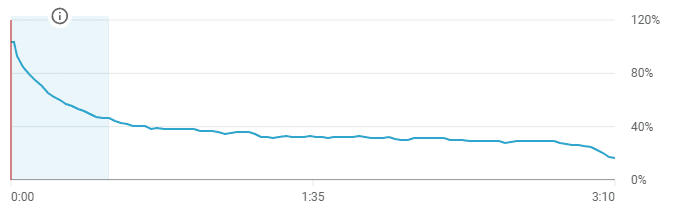
In the analytics of a video, YouTube shows you the number of views, the watch time in total hours, and also a graph that looks something like this:
Screenshot from author, September 2024
This is a helpful visualization of the percentage of viewers engaged with the video and when they stop watching. You can use this graph to examine how successful your video is at grabbing and keeping attention.
This is critical information for you about the quality of your video in the eyes of your viewers, and the algorithm is using it as part of the formula determining how engaging and satisfying your videos are.
YouTube also trains its algorithms with satisfaction data, primarily gathered through surveys. The surveys aren’t a direct factor in an individual video, but the combination of watch time and satisfaction trains the algorithms to recognize high-quality content.
If you want to optimize for YouTube, or use video to enhance your SEO efforts, the first and most impactful rule is:
Make a good video that your audience wants to watch.
2. User Engagement
User engagement factors also matter for ranking.
How users behave during their watch time and after they are finished watching (combined with when they finish watching) goes into calculating video performance. These data sources include:
Whether a user skips forward during a video.
Whether a user moves back to rewatch a video section. (This can result in an automated “most replayed” section on a video’s timeline.)
How a user behaves after they finish watching. Do they:
Click on a new video in the suggested videos list?
Play the next video in the playlist?
Return to their search or homepage?
Close the session?
3. Video Title And Description
Just like websites in Google search, the title of a video is critical for helping users and search engines understand what content to expect.
However, it doesn’t act in the way you might expect. You should think about your title in terms of user experience first.
While it’s important to use keywords, your use of keywords will have much less impact than the CTR, watch time, and other engagement and satisfaction factors.
When it comes to your title, the most important consideration is how you set the stage for the video with your target audience.
Your title and video content are closely related, and you must ensure that the video delivers on the promise of the title – or at least begins to do so – quickly.
Optimizing your title for keywords can end up hurting you if it sets unrealistic expectations or makes the title less appealing.
Similarly, you should use descriptions in a way that helps users. The description should briefly describe the topic and what the user can expect.
It’s also a good place to put references from the video, links to other content the user may want to watch, and actions you may want them to take after watching, such as a link to your website.
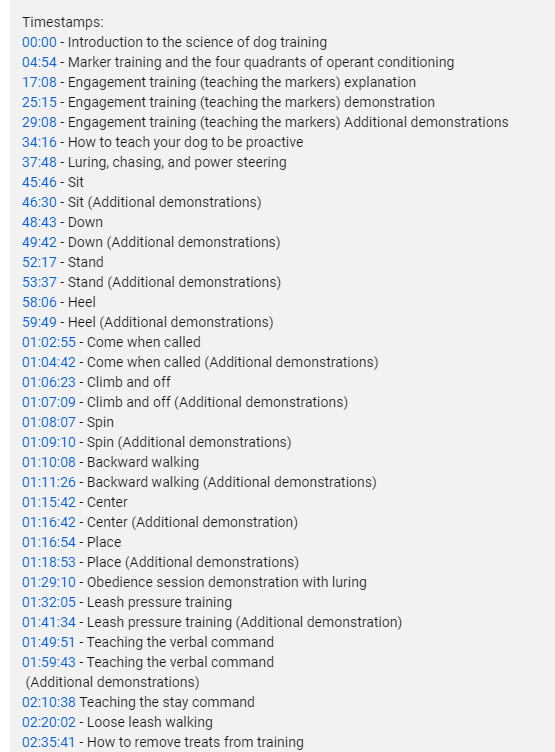
A critical note for descriptions is that you should use them to add titled timestamps to your videos. Timestamps look like this:
0:00 Introduction
0:52 Chapter 1
02:02 Chapter 2
You wouldn’t want to use “chapter” – you would add a title that describes what that section of the video is about.
Doing this in the video description automatically adds sectioned chapters to the video timeline.
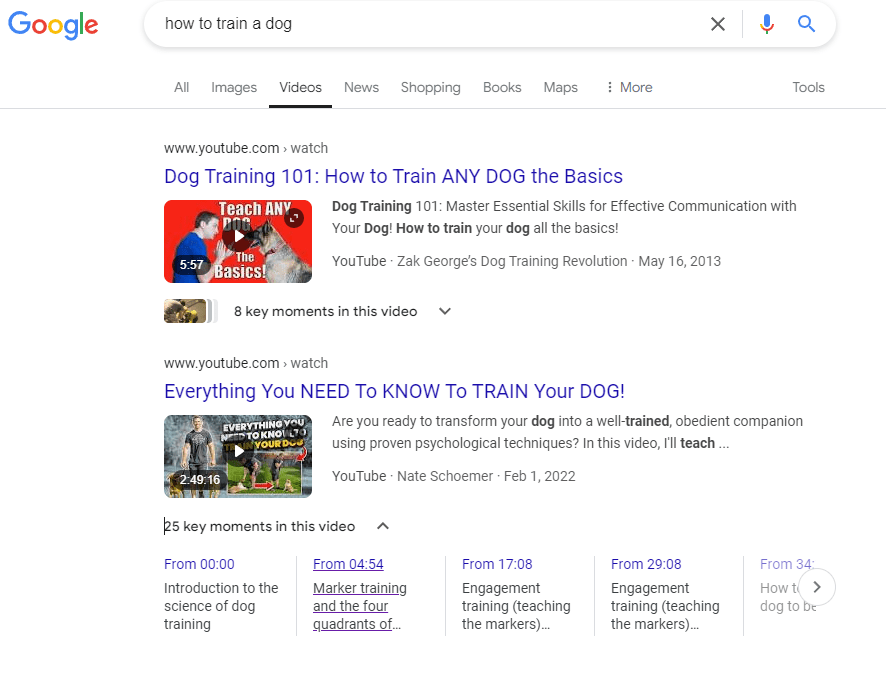
Google Search indexes these chapter titles and timestamps, so if you execute them carefully, Google can send users to a directly relevant section of your video. You can see this with the “key moments” feature in Google SERPs:
Screenshot from search for [how to train a dog], Google, September 2024
As you can see in the next screenshot, the “key moments” appearing on Google Search are taken directly from the video description on YouTube:
Screenshot from YouTube, September 2024
This is powerful SEO. Do not underestimate this feature for “how to” SEO queries.
It’s a very compelling reason that video should be part of your organic SEO strategy because video results can show up in the “All” tab as well as the “Videos” tab in Google.
If you don’t add these yourself, Google may automatically create video chapters from the transcript. It’s best to control this process yourself.
4. Thumbnail
While they’re not a type of text metadata that algorithms can directly interpret, thumbnails are critical as part of the click-through and watch time formula.
Along with your title, they can make the difference between users clicking or not or finding a video satisfying or not, depending on the expectations set by the image.
I should also note that with Google leaning into multi-modal neural networks, it’s not beyond the realm of possibility that algorithms may soon understand thumbnails in relation to a video’s content.
Thumbnails are a ranking factor insofar as they’re a critical part of engagement. The algorithm will respond to how users respond to your video. So, your thumbnail needs to set your video up for viewers, both to attract clicks and set reasonable expectations.
In fact, thumbnails are one of the most important things on YouTube. They’re the first thing a user sees and likely the first piece of information they use to make a decision about whether to click, as they’ll likely parse the image more quickly than the title.
5. Video Content
Video content is, of course, the primary determiner of quality and what users respond to, so it’s what engagement and satisfaction data is based on.
However, there are some specific ways that a video’s content impacts ranking.
Watch Time: If you create a good video that viewers like, you’ll get positive engagement and satisfaction signals.
Captions and Transcripts: If you don’t provide captions, YouTube automatically generates them and builds a transcript for a video. It uses the information from captions to determine what your video is about, which makes your video script a helpful source of metadata.
So, use important keywords early in your script. This is potentially relevant for Google Search as well as YouTube Search and other systems.
It’s a good idea to upload your own transcript with videos for YouTube to build the captions, as the AI will make mistakes.
Relevance: If users indicate or the systems determine that your video content is not relevant to your title, then your video is unlikely to perform well.
Similarly, if you use a “clickbait” thumbnail that sets users up to expect something that you don’t deliver on, that disappointment will be reflected in the data.
Remember that there is a dance to your title and thumbnail, and what happens with the user is much more important than your metadata optimization.
If you have high clicks but low watch time, that indicates that users were drawn in but didn’t like the video. If the opposite is true, it could indicate that users aren’t resonating with your title and thumbnail when they see them.
6. Subscribers And Notifications
Subscribers are a critical part of a channel’s success, and they can impact how a new video performs. New videos appear in the “Subscriptions” tab of users subscribed to your channel.
Additionally, if your subscribers have opted in to receive notifications, they will get a notification when your video goes live.
These views are a critical initial source of data, as they can help YouTube build an understanding of how viewers respond to your videos. If your subscribers like a video, YouTube has a lot of information to work with about how to recommend that video to non-subscribers.
In a video for Creator Insider, Todd Beauprè, YouTube’s Growth and Discovery team lead, said that the Subscription feed “offers a bit of a control over other variables” when it comes to diagnosing why a video could be underperforming. If your subscribers don’t like it, other people probably won’t either.
For newer creators, YouTube does have a team and systems in place to assist in finding audiences.
According to Beauprè, there are systems that show videos from new creators to new audiences based on the history and preferences of those users as a sort of test.
Either way, it’s important to look at the initial data coming in about a video to see if it’s satisfying the first audiences who see it. If it isn’t, YouTube may not continue serving that video based on the quality, engagement, and satisfaction signals.
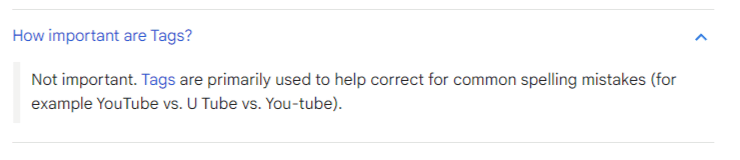
7. Tags Don’t Matter
I feel like this needs to be said multiple times.
Tags don’t matter.
Tags don’t matter.
Anyone who tells you that optimizing tags is important is wrong, and they can come and fight me over it.
Screenshot of the YouTube Help Center, September 2024
If you don’t like to trust what the documentation says at face value – after Google’s shenanigans over the last few months, I don’t blame you – check out these experiments:
YouTube SEO Tips
As a companion to your organic SEO strategy or as its own strategy, YouTube can have a huge payoff.
But you should be careful when treating it like a marketing channel.
Success on YouTube is audience-dependent, and modern audiences are sensitive to marketing campaigns.
If you’re using YouTube as a channel to try and send more traffic to your website or some other off-platform goal, you’re going to have a hard time for a couple of reasons:
If users are on YouTube, it’s because they want to watch videos. If you’re too aggressive with off-platform conversion attempts, it can turn viewers off.
YouTube’s algorithm prioritizes in-platform engagement and activity. A successful video should entice a user to watch the whole thing and then find another video to watch, not end the session and convert.
That doesn’t mean you can’t use YouTube as an organic marketing channel. But you must deliver value to your audiences first and build a community on the platform if that’s the route you’re taking.
If you’re using YouTube to boost your organic search performance, you can consider video more of a supplementary strategy.
But again, you should focus on providing direct value and create videos that are user-friendly and informative, not promotional.
The video should be a companion to your content because it is more user-friendly than text and static images, or a strong alternative for users who prefer it.
Make A Good Video
Nothing else in this article matters unless you make a good video.
This is advice that I find to be missing in a lot of “YouTube SEO advice” type articles.
Sure, many will provide you with guidelines that sort of add up to making a good video, like research and scripting and editing, but the simple statement is missing: Make a good video.
What follows from that is a whole bunch of questions about what “good” and “high-quality” really mean and statements like “that’s vague advice” and “it depends,” but I actually find this to be a very helpful filter statement.
If you don’t know what “a good video” means for your niche and your audience, then I have a question for you:
Why are you considering a video strategy in the first place?
Go and find five videos from other creators that you know for a fact your audience likes. Then, write down all the things that make them good.
If you can’t do that, go back to the drawing board. Go and find out what a good video is, what it does, and why people like it. That isn’t competitor research; it’s understanding the medium in which you plan to work.
Making a good video can overcome poor optimization at any of the points discussed in this article or any other article. Perfect optimization cannot overcome the impact of a bad video or a video that viewers don’t like.
If you’re struggling to get traction for your videos, the first question should never be how well they’re optimized. Your first question should be: “Are the videos good enough?”
Audience Research
Don’t start your keyword research for videos until you’ve done audience research.
YouTube’s algorithm doesn’t take a video and decide who to send it to. It examines the preferences and history of users and then curates a selection of videos for each individual.
You must identify the audience for your videos, which could be a very specific subset of your existing audience or a new audience entirely.
What this audience already watches is of critical importance because YouTube has multiple traffic sources within the platform with their own systems that weigh ranking factors differently.
For many videos, the primary traffic potential comes from the recommendation systems on the homepage or suggested video features.
That makes understanding what your audience is already watching critically important. Build on existing topics on the platform. Watch videos in your niche and find ways to answer questions or provide content that they don’t.
It takes a very specific type of video to get traction in YouTube Search. Search is the part of YouTube that weighs metadata most strongly, but user satisfaction remains a critical factor.
The video cited above in “The Recommendation System” section mentions that “learning or how-to videos – they often get more views from search.”
You must understand not only the preferences and needs of your audience, but how they’re most likely to come across your video.
Not every video is built for YouTube Search, and if that’s the case, it won’t take off if you don’t understand the flow of the experience a user might come to your video from.
Resources About Audience Research:
Keyword Research
Keyword research is important for videos that you’re targeting on YouTube or Google Search. It’s still important, but to a much lesser degree, when it comes to YouTube’s discovery systems.
What I mean by that is that the research is still important so that you understand the language users are engaging with, but there’s only so much optimization you can do. It’s much easier to over-optimize and sabotage yourself when it comes to recommendation systems.
I’m not saying you shouldn’t do it. I’m saying you need to understand your audience and traffic source, do your keyword research, and then choose how to approach your metadata based on the traffic sources you expect for your video.
There are automated tools that can assist you with keyword research, and I encourage installing at least the free versions of both of these tools.
There’s a lot of value you can get out of your existing keyword research process, but it’s important to understand platform-specific keyword trends.
Resources About Keyword Research:
Focus On Thumbnails And Titles
Thumbnails and titles are where you spend the majority of your optimization time. These are the hooks, and how you handle them can make or break a video’s performance (second, of course, to whether the video is good).
The primary goal of titling high-quality content is to set an expectation. That expectation should entice users.
Then, you must fully deliver on the expectation. If your title and video are harmonious in this way, and you’ve researched your audience to know that they will respond to the topic, then you have the makings of a successful video.
Titles are your core keyword opportunity for videos, in addition to your description and video content. Thumbnails are your biggest opportunity to entice a response in users.
YouTube is now offering in-platform A/B testing for video thumbnails, which can help you understand what resonates with your audience.
Like the title, your thumbnail should set expectations for the video. Some elements that work well include:
Humans with expressions or poses that match the video’s tone.
Keywords that your audience will understand as integral to the video’s topic.
Artistic and metaphorical representations of a topic.
Adhering to, or standing out from, a common color scheme or design philosophy that other videos use.
Multiple different styles and design philosophies can work.
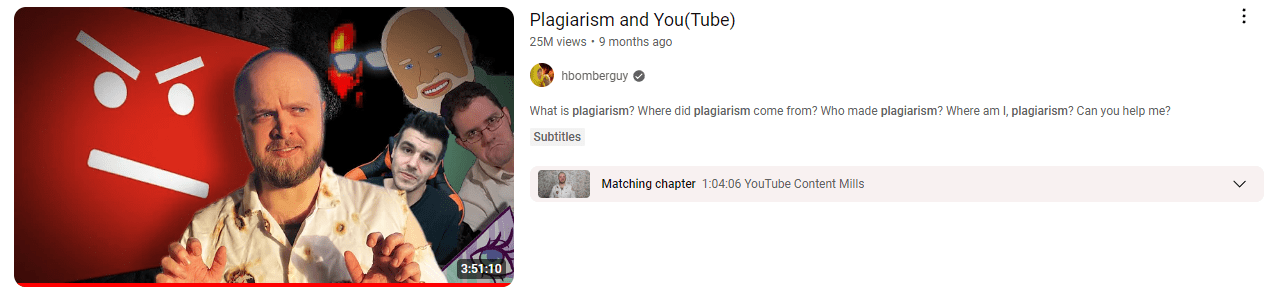
Here’s a screenshot of a wildly successful video by YouTuber hbomberguy titled, “Plagiarism and You(Tube)” – it’s 4 hours long with 25 million views.
Honestly, it’s a masterclass in overcoming the pervasive narrative of short online attention spans – and it’s a great video (yes, as you can see, I watched the whole thing).
But the thumbnail isn’t very refined, is it? It’s a bit messy. There’s a bunch of people there, and it’s a mix of real photos and a pretty creepy cartoon guy back there in the corner. Hbomberguy himself isn’t making an exaggerated expression; he just looks sort of baffled.
This thumbnail is masterful at evoking tone. This is the sort of thing you should be paying attention to when it comes to aligning the expectations of your presentation with the impact of your video.
Screenshot from YouTube, September 2024
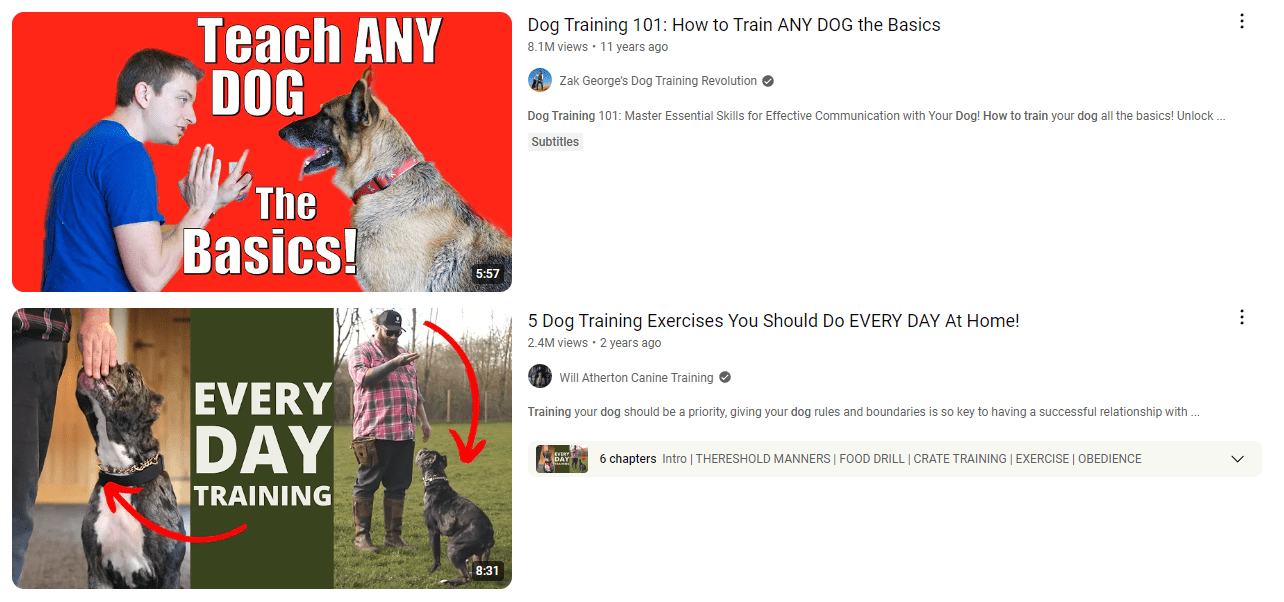
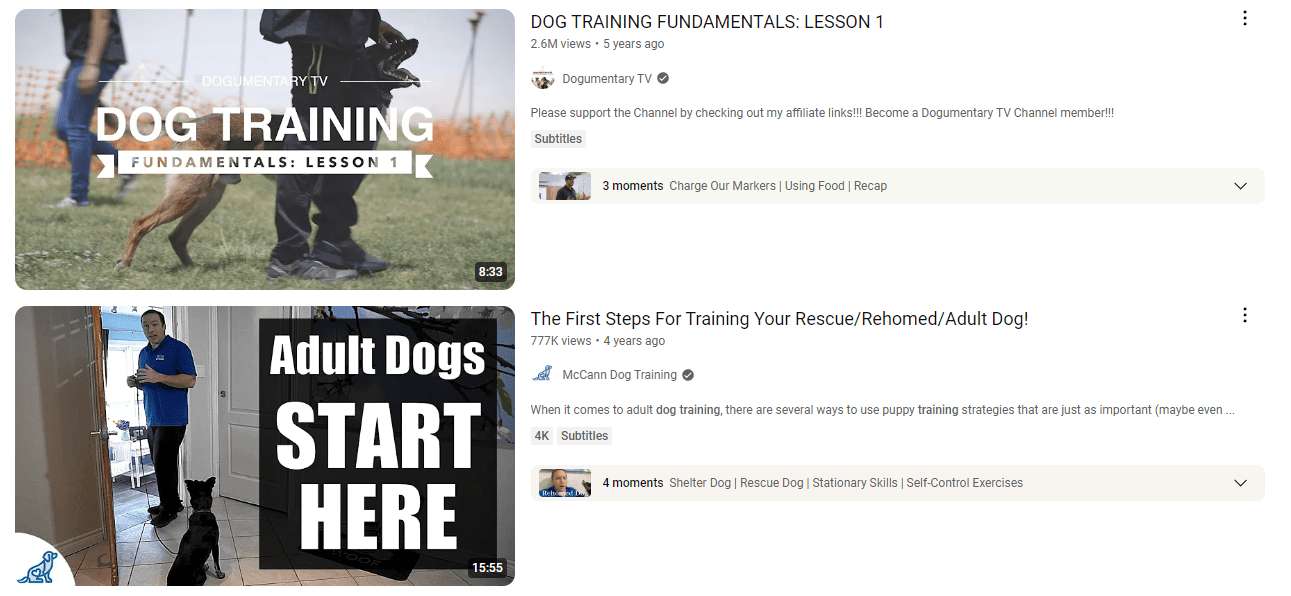
Below are a few video results from the search we did earlier: [how to train a dog].
As you can see, there’s a wide variety of thumbnails that are all effective in their own way while sticking to the common theme of the search. I’ve cut out the sponsored results.
The top result is interesting. I find it loud and visually unappealing, but it’s clearly working.
Now, we can’t say whether the thumbnail has a significant positive impact or whether the video is just so good that the thumbnail doesn’t matter. But to be the first result, we have to assume it gets a lot of clicks. So, the CTR is good, and the thumbnail is a big part of that.
So this search, then, is less about tone and more about how clear and visually striking the image is.
I haven’t watched any of these videos (and I don’t have a dog), so the algorithm doesn’t have a ton of specific personalization to work with. Still, your results may differ.
Screenshot from search for [how to train a dog], YouTube, September 2024
Screenshot from search for [how to train a dog], YouTube, September 2024
So, we’re back to audience research and specific query research. Intent could be a deciding factor in how you approach thumbnails.
Don’t Ignore The Comment Section
This will be the last point because I’m becoming long-winded.
Comments sections are more important than you might think. They have a ton of functionality, such as your ability to pin comments, that can supplement a video.
You could pin a comment to highlight a specific call to action for highly engaged users who scroll down to the comments. It’s also commonly used to issue corrections and updates.
Some creators choose to pin comments from users that they find to be particularly insightful, complimentary, or in some cases, inflammatory.
Engaging with commenters is good practice. These users, for one reason or another, are highly engaged. That means:
There’s a lot you can learn about your highest-value audiences from what they have to say.
Engaging with them builds a sense of community and feedback.
The Best YouTube SEO Is A Good Video
I want to come back to this point to end the article.
It really is all about the video and what value it adds to the user’s experience and your content.
You can overcome so many obstacles with a video that comes from a place of genuine understanding of your audience’s needs or excitement for the subject matter.
This should be what drives your video strategy, whether you’re using videos to empower your organic SEO or build a following on YouTube.
We publish a rundown each week of new products from companies offering services to ecommerce merchants. This installment includes updates on ecommerce platforms, marketplaces, search engines, APIs, reverse logistics, and local delivery.
Got an ecommerce product release? Email releases@practicalecommerce.com.
New Tools for Merchants
Miva 10.11 launches with precision tools to enhance ecommerce control. Ecommerce pioneerMiva, Inc. has released version 10.11 of its platform. This update introduces tools for greater control over pricing, shipping charges, and fee management. Sellers can now set pricing with accuracy to less than $0.01 (one cent) and weight measurements smaller than two decimal places. An updated module provides flexible fee applications, control over taxability, and other rules to improve the checkout process.
Miva
Temu opens to all U.S. sellers. Over the last six months, China-based marketplace Temu has invited select U.S. sellers to join its site. Temu has now opened the application process to any U.S. brand or seller. According to Temu, applications take just 10 minutes and are typically reviewed within one business day. Plus, Temu sellers can now ship directly from U.S. warehouses.
Button announces general availability of an iOS Creator App.Button, a mobile commerce optimizer, has announced the general availability of its PostTap native mobile app, which enables creators to produce, optimize, and manage affiliate links. PostTap says it allows creators to generate and customize shortlinks instantly for sharing and monitoring across social platforms. Utilizing AI-powered technology ensures accurate attribution and in-app purchasing, per PostTap.
AI search tool Perplexity adds a shopping assistant. AI search engine Perplexity has debuted its “Buy with Pro” shopping recommendation feature within search results and the ability to place an order without going to a merchant’s website. For shopping-related searches, users receive visual cards containing product details, pricing, seller info, a short description, and the pros and cons of the item. Perplexity’s shopping assistant integrates with Shopify.
Perplexity
European AI search engines plan index with merchant rankings. Germany-based CO2-neutral search engine Ecosia and France-based privacy-focused search engine Qwant have unveiled plans to create their own AI-powered European search index, providing merchants an alternative to Google. The joint venture — called the European Search Perspective — plans to break from Google and Bing ranking systems by early 2025, potentially shifting consumer spending as the new index prioritizes European businesses. The combined search companies will initially focus on French and German results.
Coveo expands partnership with SAP to deliver AI capabilities across channels.Coveo, an enterprise platform for AI search and genAI functions, is expanding its partnership with SAP with an app called “Coveo AI Search and Recommendation for SAP Customer Experience.” Coveo says its AI search, recommendations, and generative answering can be used across multiple interfaces, from interfaces in SAP solutions to standalone search pages, in-app experiences, self-service portals and communities, and more.
Searchspring introduces dynamic custom profiles for ecommerce engagement.Searchspring, an ecommerce search and merchandising provider, has released dynamic custom profiles for personalized shopping recommendations. According to Searchspring, the profiles adjust in real-time based on shopper behavior and site variables, such as search terms, applied filters, and customer attributes. Dynamic custom profiles allow retailers to create a flexible framework that recommends products tailored to each shopper’s intent. Search results and product suggestions evolve dynamically without manually configuring profiles for every scenario, per Searchspring.
Appy Pie Endpoint introduces virtual try-on APIs.Appy Pie Endpoint, an AI API provider, has launched a suite of virtual try-on APIs that enable retailers to offer shoppers an interactive, customizable shopping experience. Shoppers can try on fashion, cosmetics, eyewear, or decor products before purchasing.
Appy Pie Endpoint
Stage TEN unveils a live show network for creators to sell Shopify products.Stage TEN has launched a live show network, enabling creators to blend content creation with commerce. With the platform, anyone can turn a live show into a storefront, connect with an audience in real-time, and monetize shows by featuring products from any Shopify store. By leveraging Shopify’s Collective and Collabs programs, Stage TEN’s live show network allows creators to select, showcase, and sell products.
MikMak expands API-first platform with launch of Insights API.MikMak, a provider of ecommerce enablement and analytics, has launched the MikMak Insights API. The API integrates MikMak commerce intelligence data, such as Purchase Intent and Attributable Sales, into data lakes, analytics platforms, and business intelligence tools, including Tableau, PowerBI, and Google Data Studio. According to MikMak, this enables multichannel brands to unlock a holistic view of their performance quickly and easily.
Cirro Fulfillment partners with Loop to streamline returns for retailers and brands.Cirro Fulfillment, a global provider serving ecommerce brands, has partnered with Loop, a reverse logistics platform, to enhance the returns process. Cirro says the integration with Loop’s automated portal enables customers to initiate returns, request exchanges, or secure refunds effortlessly. The streamlined process reduces manual tasks, making returns management faster and more efficient, thus enhancing the customer experience.
FedEx introduces enhanced visibility tools for secure package delivery.FedEx has upgraded package tracking and visibility features in its mobile app. Map View shows the real-time delivery truck location along with the latest timestamp. Picture Proof of Delivery Attempt provides customers with a photo of a door tag in the event of a missed delivery to see exactly when a delivery was attempted.
Google has updated its Business Profile rules for service-area businesses that sell age-restricted products.
Now, businesses selling alcohol, cannabis, weapons, and similar items must have a physical storefront to maintain their Google Business Profile.
We were alerted to this update by Stefan Somborac on X:
Google actually uses the phrase “Businesses associated with…” not “Businesses selling…”, which significantly broadens how this new change can be applied.
“Businesses associated with products or services that require the customer to be a certain minimum age, like alcohol, cannabis, or weapons, aren’t permitted as service-area businesses without a storefront.”
This is a notable change in how Google handles business listings for delivery and mobile services.
The policy outlines two main types of businesses:
Service-area businesses: These companies deliver to customers but do not have a physical business location.
Hybrid businesses: These operations have a physical location and offer delivery or mobile services.
Service Area Limitations
Google maintains its existing restrictions on service areas, including:
A maximum of 20 service areas per business
Service boundaries limited to approximately 2 hours of driving time from the business base
Service areas must be defined by city, postal code, or specific geographic region rather than radius
Impact On Businesses
This update affects certain types of businesses:
Mobile alcohol delivery services
Cannabis delivery services
Weapons dealers without a physical store
Vendors of age-restricted products that only deliver
The new rules require these businesses to have a physical storefront to keep their Google Business Profiles.
This change aims to ensure proper age checks and compliance with sensitive product and service regulations.
What This Means
The policy update addresses concerns about selling age-restricted products through delivery-only businesses.
This change mainly impacts new delivery services for cannabis and alcohol, which have grown in some cities.
Recent data from the U.S. Department of Commerce reveals that ecommerce continues to outpace traditional retail growth. In the third quarter of 2024, total domestic retail sales reached $1.85 trillion, a modest 1.3% increase from Q2. Online shopping showed stronger momentum, with ecommerce sales climbing to $300.1 billion, a more robust growth rate of 2.6% over the prior quarter.
According to the DoC, ecommerce sales are for “goods and services where the buyer places an order (or the price and terms of the sale are negotiated) over an Internet, mobile device, extranet, electronic data interchange network, electronic mail, or other comparable online system. Payment may or may not be made online.”
Ecommerce accounted for 16.2% of total U.S. retail sales in Q3 2024, up slightly from 16.0% in the prior quarter.
–
The DoC reports U.S. ecommerce retail sales in Q3 2024 grew by 7.4% compared to Q3 2023, while total quarterly retail sales experienced a 2.1% annual rise over the same period last year.
Google Search’s market share in the UK weakened this year, with user reach dropping to 83% from 86%, according to Ofcom’s Online Nation report.
This decline comes as concerns grow over AI-powered search results, with only 18% of users confident in their accuracy.
The Rise & Fall of AI Search Adoption
Microsoft’s Bing gained popularity after adding ChatGPT in February 2023, peaking at 46% reach in the UK in April.
By May 2024, it settled at 39%, still above pre-AI levels.
This suggests the initial excitement about AI search tools is fading, and users are now more cautious with AI-generated results.
Trust Gap Emerges
Despite the widespread adoption of AI search features, trust remains a concern:
Only 18% of UK users believe AI search results are reliable
Younger users (ages 16-24) show marginally higher trust at 21%
A third of users express neutral confidence in AI-generated results
Men show higher confidence in AI search results than women
Demographics & Device Usage
The report reveals variations in search behavior across age groups and devices:
Google maintains 83% reach across smartphones, tablets, and computers
Google maintains 49% daily active users
Bing sees 39% reach, primarily driven by desktop users
Alternative search engines like DuckDuckGo show modest growth (3% reach)
Bing shows stronger performance among older users (43% of 65+ vs. 36% of 25-34-year-olds)
Mobile search dominates, with Google capturing 84% of mobile searches
Desktop usage remains stronger for traditional search engines like Bing and Yahoo
69% of UK online adults visit at least one search engine daily.
What This Means
As we approach 2025, search is changing with AI integration, but user trust remains essential.
Key points for search marketers and content creators include:
Many users still prefer traditional search methods despite the rise of AI.
Trust issues create both challenges and opportunities for content improvement.
Different age groups affect how people accept and use AI in search.
A successful strategy blends AI tools with established methods.
View AI search as an added layer rather than a replacement for current practices.
Focus on quality content and reliable information, optimizing for AI wisely where it adds value.
Methodology
The Online Nation 2024 report combines two main data sources:
Online Experiences Tracker:
7,280 UK internet users aged 13-84
Fielded May-June 2024 via YouGov panel
Standard demographic weighting applied
Ipsos iris Panel Data:
Passive tracking of 10,700 UK adults
Monitors actual device usage across mobile, tablet, and desktop
Continuous measurement through May 2024
Covers in-home and out-of-home usage
Worth noting: Some year-over-year comparisons, particularly around time spent metrics, may be affected by methodology updates. Apple News tracking began in October 2023, which impacts certain platform comparisons.
The data focuses on UK users, so global markets may show different patterns. All population estimates have standard margins of error.
YouTube is enhancing its Inspiration Tab, a tool for creators to understand their audience and improve content.
In a video demonstration, the company previewed new AI features that will launch in the coming months.
Initially a research tool, the Inspiration Tab now helps creators identify audience interests and content gaps.
The new AI features are designed to boost creativity and streamline content creation.
Personalized Ideas and Audience Insights
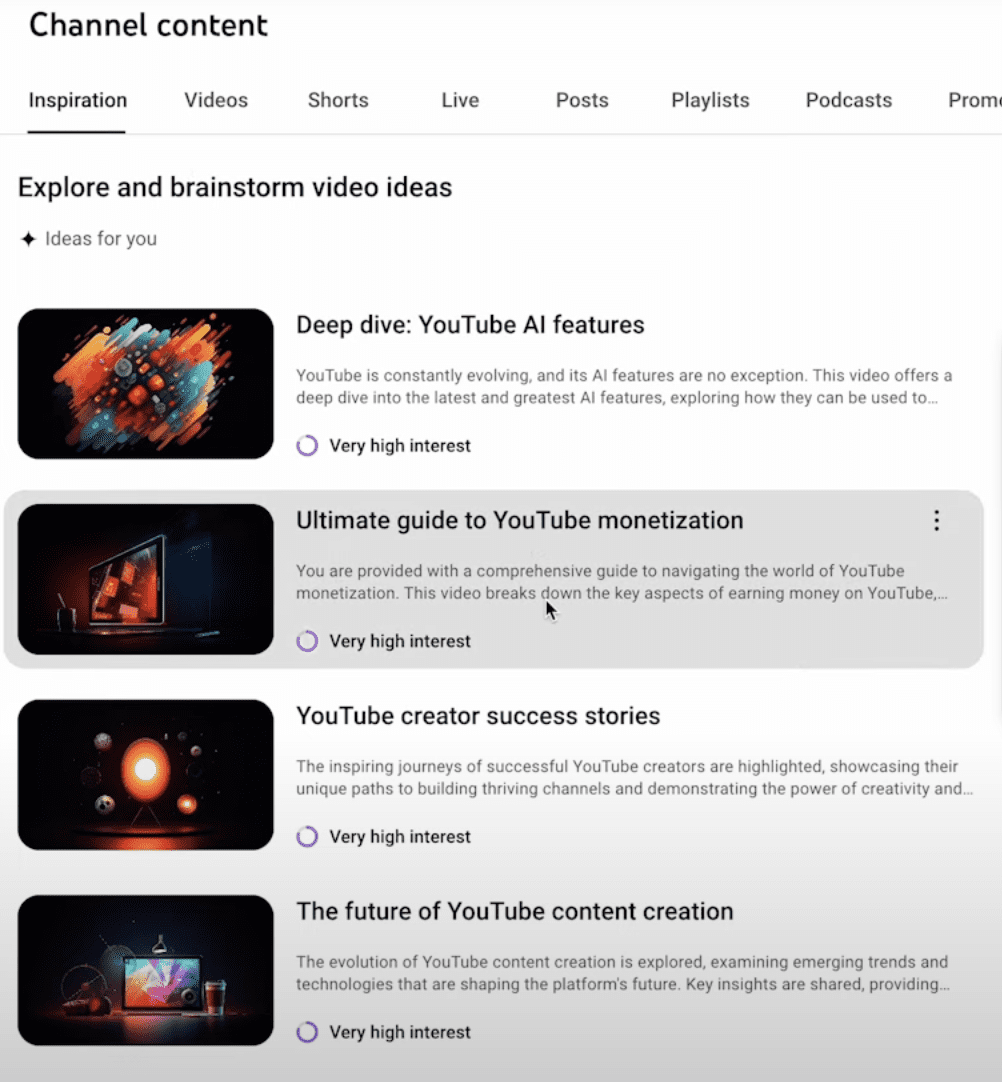
You’ll find five tailored ideas for your channel in the updated Inspiration Tab.
Screenshot from: YouTube.com/CreatorInsider, Nov 2024.
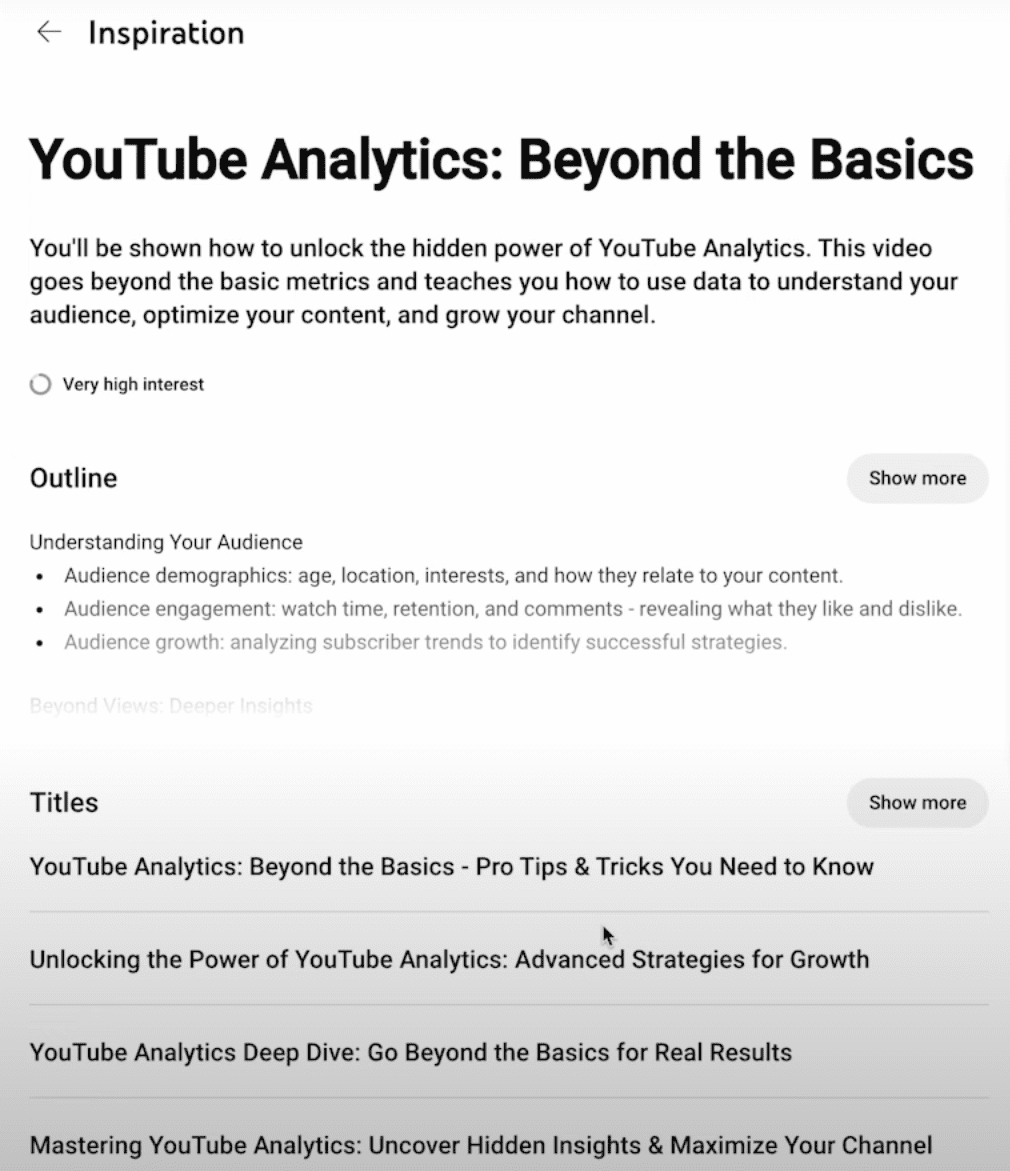
Each idea includes a thumbnail, title, summary, and audience interest insights, helping you see how well it fits your audience.
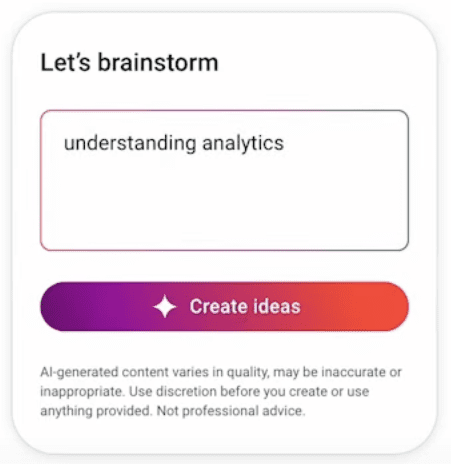
You can also input any topic as a text prompt, and the AI will generate ideas based on your request.
Screenshot from: YouTube.com/CreatorInsider, Nov 2024.
In the Idea Playground, you can personalize your idea by exploring different angles.
Choose from suggested angles or enter your own prompt.
The Playground also offers undo and redo options, so you don’t lose your work.
Screenshot from: YouTube.com/CreatorInsider, Nov 2024.
Screenshot from: YouTube.com/CreatorInsider, Nov 2024.
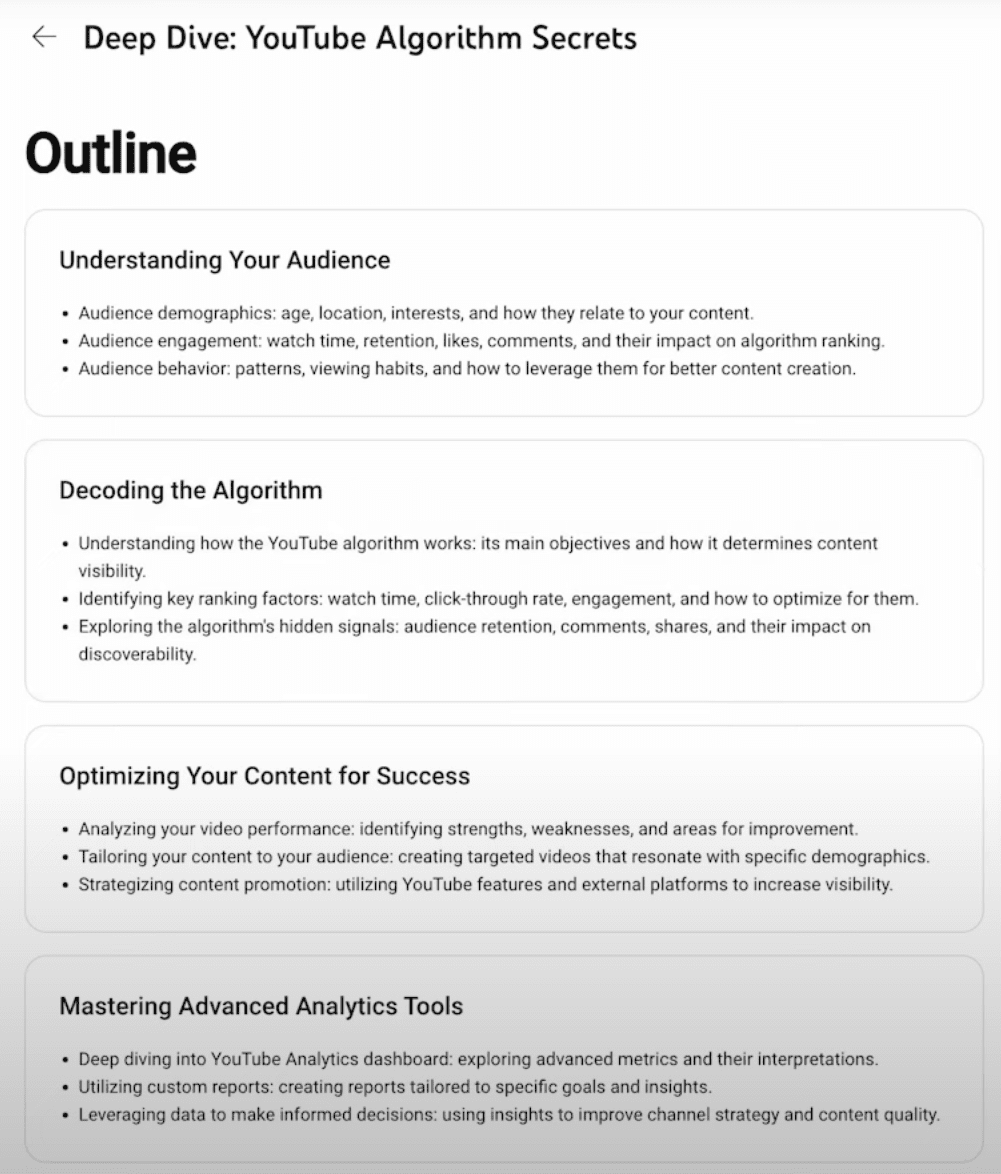
You can access outlines and thumbnails in the Playground. The AI will suggest ways to adjust your talking points. You can modify the entire outline or focus on specific sections.
Similar options are available for titles and thumbnails. You can download images for use as backgrounds or modify them to visualize before uploading.
Screenshot from: YouTube.com/CreatorInsider, Nov 2024.
Availability
The Inspiration Tab is the updated Trends Tab, formerly the Research Tab. It will be a central hub where you can use AI to brainstorm ideas, outlines, titles, thumbnails, and concepts.
YouTube plans to roll out these features over the next few months. Note that these features are not widely available yet, as YouTube is previewing them to gather creator feedback.
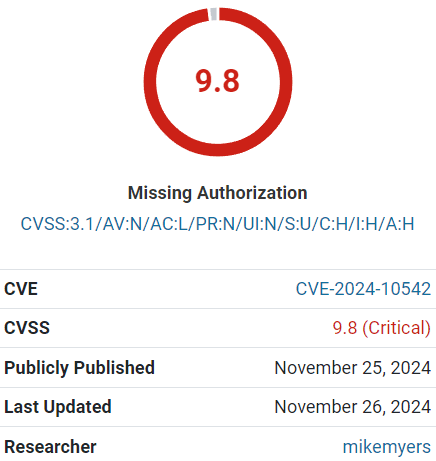
A flaw in a WordPress anti-spam plugin with over 200,000 installations allows rogue plugins to be installed on affected websites. Security researchers rated the vulnerability 9.8 out of 10, reflecting the high level of severity determined by security researchers.
Screenshot Of CleanTalk Vulnerability Severity Rating
A highly rated anti-spam firewall with over 200,000 installations was found to have an authentication bypass vulnerability that enables attackers to gain full access to websites without providing a username or password. The flaw lets attackers upload and install any plugin, including malware, granting them full control of the site.
The flaw in the Spam protection, Anti-Spam, FireWall by CleanTalk plugin, was pinpointed by security researchers at Wordfence as caused by reverse DNS spoofing. DNS is the system that turns an IP address to a domain name. Reverse DNS spoofing is where an attacker manipulates the system to show that it’s coming from a different IP address or domain name. In this case the attackers can trick the Ant-Spam plugin that the malicious request is coming from the website itself and because that plugin doesn’t have a check for that the attackers gain unauthorized access.
This vulnerability is categorized as: Missing Authorization. The Common Weakness Enumeration (CWE) website defines that as:
“The product does not perform an authorization check when an actor attempts to access a resource or perform an action.”
Wordfence explains it like this:
“The Spam protection, Anti-Spam, FireWall by CleanTalk plugin for WordPress is vulnerable to unauthorized Arbitrary Plugin Installation due to an authorization bypass via reverse DNS spoofing on the checkWithoutToken function in all versions up to, and including, 6.43.2. This makes it possible for unauthenticated attackers to install and activate arbitrary plugins which can be leveraged to achieve remote code execution if another vulnerable plugin is installed and activated.”
Recommendation
Wordfence recommends users of the affected plugin to update to version 6.44 or higher.