The rise of generative AI has opened up a world of possibilities for agencies and small businesses, but with so many tools available, it can be challenging to determine which ones will truly drive results.
How do you choose the right AI products to elevate your business and ensure a strong return on investment?
On September 11th, join us for an expert panel discussion where we’ll cut through the noise and highlight the AI tools that can genuinely make a difference in your performance.
Whether you’re looking to enhance your SEO, boost your paid channels, or streamline your overall marketing efforts, this session is designed to provide you with actionable insights and practical strategies.
Register for this webinar, where you’ll hear from Zac Elbel, Senior Product Marketing Manager at CallRail, and Sean Whitmore, Director of Digital at Snapshot Interactive. Together, they’ll break down the reasons that AI is essential for your business’s success.
They’ll share real-life examples from Snapshot Interactive, demonstrating how they’ve integrated AI into their daily operations to optimize both organic and paid channels, improve client outcomes, and ultimately increase ROI. By adopting similar approaches, you can reach new levels of efficiency and prove your agency’s value to clients.
One of the highlights of the session will be a detailed look at CallRail’s innovative AI products. You’ll learn how these tools can be utilized to simplify workflows, drive revenue, and position your business for long-term success.
From AI-driven insights to automation, we’ll explore how to implement these technologies to get real results.
What You’ll Learn:
Why AI is critical for your business and how to implement it effectively.
Real-world examples of AI in action including its impact on organic and paid channels.
How to utilize CallRail’s AI products to deliver superior results.
Following the presentation, there will be a LIVE Q&A session where you can ask all your AI-related questions. This is your opportunity to gain personalized advice from industry experts who have successfully integrated AI into their operations, so save your seat!
If you’re serious about staying ahead of the curve and driving meaningful results for your clients, this is one webinar you can’t afford to miss.
Advisories have been issued regarding vulnerabilities discovered in two of the most popular WordPress contact form plugins, potentially affecting over 1.1 million installations. Users are advised to update their plugins to the latest versions.
+1 Million WordPress Contact Forms Installations
The affected contact form plugins are Ninja Forms, (with over 800,000 installations) and Contact Form Plugin by Fluent Forms (+300,000 installations). The vulnerabilities are not related to each other and arise from separate security flaws.
Ninja Forms is affected by a failure to escape a URL which can lead to a reflected cross-site scripting attack (reflected XSS) and the Fluent Forms vulnerability is due to an insufficient capability check.
Ninja Forms Reflected Cross-Site Scripting
A a Reflected Cross-Site Scripting vulnerability, which the Ninja Forms plugin is at risk for, can allow an attacker to target an admin level user at a website in order to gain their associated website privileges. It requires taking an extra step to trick an admin into clicking a link. This vulnerability is still undergoing assessment and has not been assigned a CVSS threat level score.
Fluent Forms Missing Authorization
The Fluent Forms contact form plugin is missing a capability check which could lead to unauthorized ability to modify an API (an API is a bridge between two different software that allows them to communicate with each other).
This vulnerability requires an attacker to first attain subscriber level authorization, which can be achieved on a WordPress sites that has the subscriber registration feature turned on but is not possible for those that don’t. This vulnerability was assigned a medium threat level score of 4.2 (on a scale of 1 – 10).
Wordfence describes this vulnerability:
“The Contact Form Plugin by Fluent Forms for Quiz, Survey, and Drag & Drop WP Form Builder plugin for WordPress is vulnerable to unauthorized Malichimp API key update due to an insufficient capability check on the verifyRequest function in all versions up to, and including, 5.1.18.
This makes it possible for Form Managers with a Subscriber-level access and above to modify the Mailchimp API key used for integration. At the same time, missing Mailchimp API key validation allows the redirect of the integration requests to the attacker-controlled server.”
Recommended Action
Users of both contact forms are recommended to update to the latest versions of each contact form plugin. The Fluent Forms contact form is currently at version 5.2.0. The latest version of Ninja Forms plugin is 3.8.14.
Read the NVD Advisory for Ninja Forms Contact Form plugin:CVE-2024-7354
Read the NVD advisory for the Fluent Forms contact form:CVE-2024
Yelp filed an antitrust lawsuit against Google for stifling competition and keeping searchers in its walled garden.
Almost a month after Google was declared to be a monopoly, Yelp brings forward legal complaints for using SERP features to keep traffic on its site and illegally scraping and using Yelp’s content.
In a CEO statement, Yelp lists interesting research papers about the impact of SERP features on organic traffic and implied revenue.
After dissecting the referenced papers and comparing them with my own findings from +7,000 results, I can confirm that the impact on traffic from most SERP features is negative.
Most companies have no idea about the traffic impact of SERP features and how to develop strategies that factor them in.
Click Drainer
SERP features are Google’s way of augmenting search results with potentially helpful direct answers.
You search for inspiration, and Google shows you images and video carousels. You search for products, and Google shows you stores near you that carry them or carousels of products you can buy online.
The benefit for companies is that they get a channel to customers with a stronger purchase intent. The risk is that Google sends out less traffic.
In some cases, SERP features can make a whole class of keywords redundant for SEO.
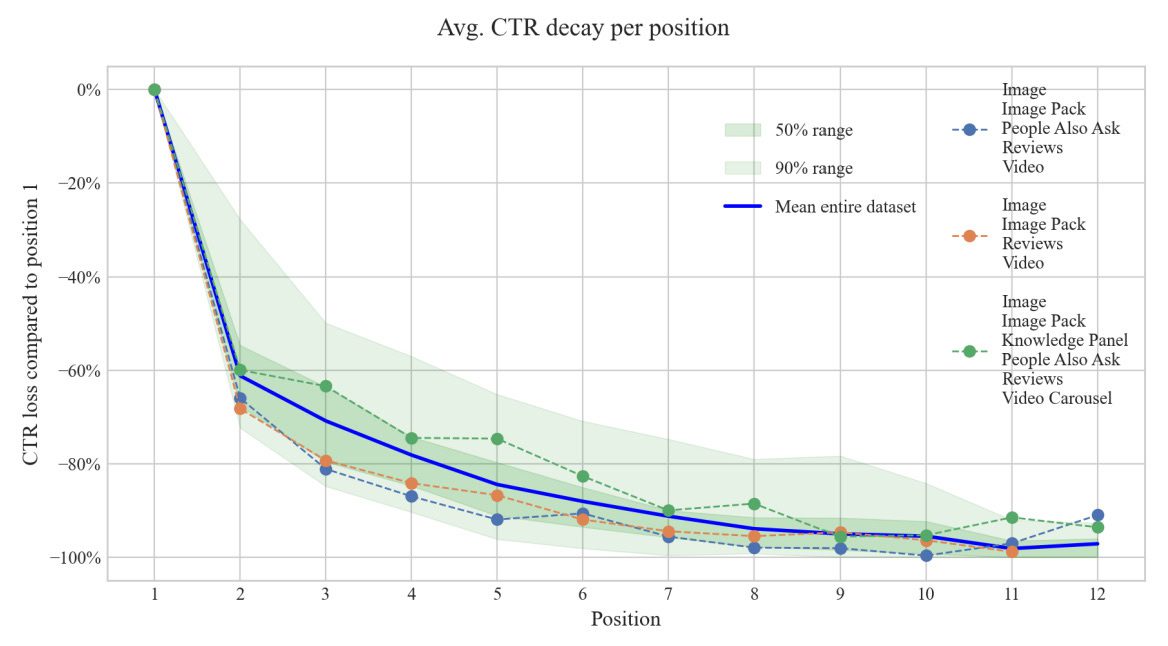
Yelp’s announcement cites an interesting paper from Germany by Fubel et al.: “Beyond Rankings: Exploring the Impact of SERP Features on Organic Click-through Rates,” which highlights the traffic impact of SERP features.
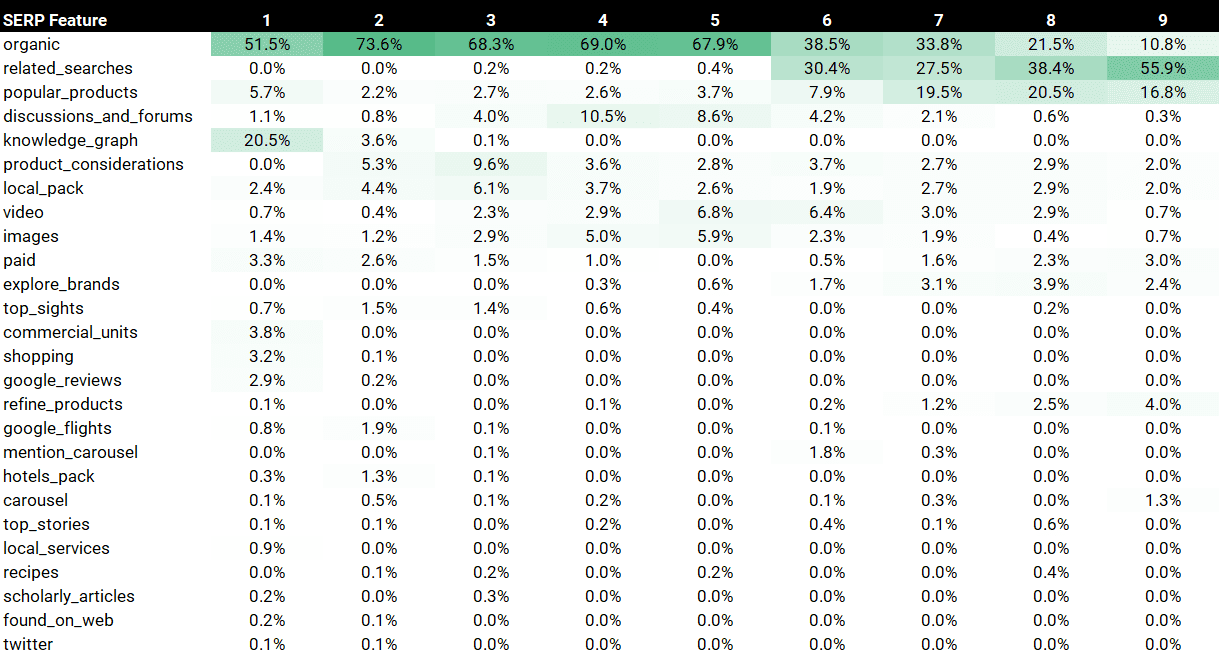
CTR by position based on whether certain SERP features are present or not. (Image Credit: Kevin Indig)
The cliff notes:
Goal: The study sought to find out to what extent SERP features extend or inhibit clicks to organic results.
Method: The researchers compared predicted CTR with actual CTR for SERP features across six million clicks, 24 million impressions, 67,000 keywords, and 43 ecommerce stores from May to August 2022. To reduce noise, they filtered out any result below 20 impressions.
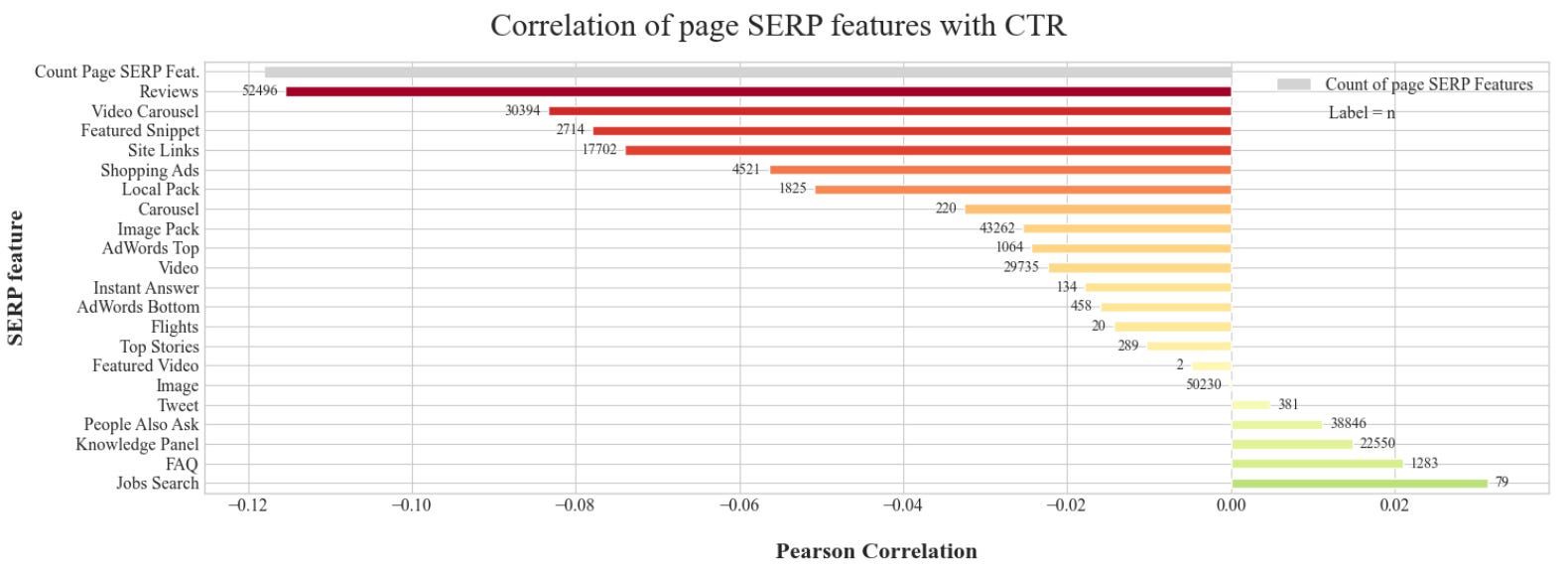
Image Credit: Kevin Indig
Results: The presence of most SERP features hurts CTR. Most SERPs show four to six SERP features.
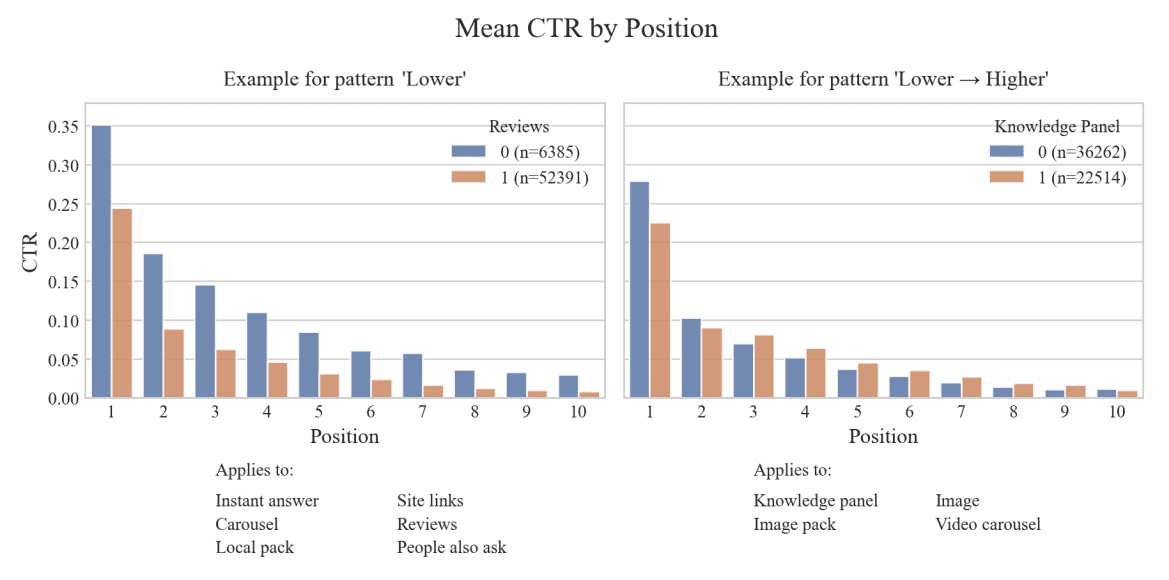
Some SERP features decrease clicks on all web results; others lower clicks on the first three results and raise them for the others. But most SERP features improve CTR for sites linked in them and reduce it for everyone else.
Click distribution when SERP features are present (1) and not (0) based on their position. (Image Credit: Kevin Indig)
It’s refreshing to see SERP features researched scientifically. One challenge of researching SERP features and Google results, in general, is that findings quickly become stale because Google makes so many changes.
SERP layouts can change daily, and Google constantly introduces new SERP features. One example is shopping, where Google introduced free listings and query refinements since the study came out (in 2023).
Some SERP features show up more often in specific positions. (Image Credit: Kevin Indig)
To add to the paper, I conducted my own analysis of 1,000 random keywords across 7,869 results (US) and found overlapping results:
Organic results appear most often in position 2 (73.6%) rather than 1 (51.5%).
Knowledge graphs are the SERP feature most often appearing in position 1, followed by popular products (5.7%).
Discussions & Forums hover mostly around positions 3 to 6.
Video and image carousels often appear in positions 4 to 6.
Related searches or popular products often appear in positions 6 to 9.
Knowledge graphs seem to be the most click-draining SERP feature, with an increased impact on mobile due to the screen real estate they occupy.
Related to findings in the German research paper, searches that return a knowledge graph are hard to monetize in nature because users are exploring a topic. As a result, Google keeps users on the platform until they express more transactional intent.
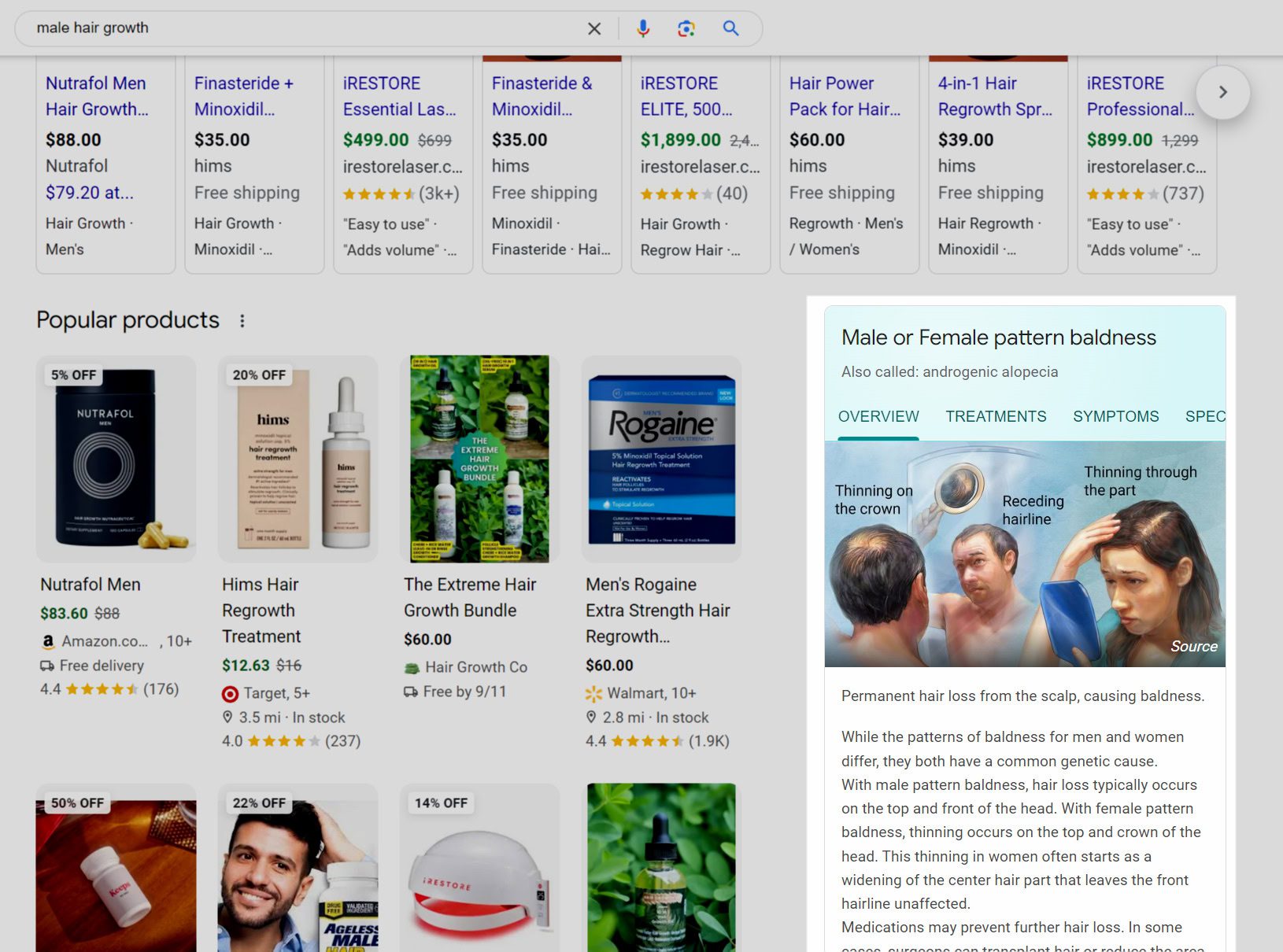
An example is the keyword “male hair growth,” where Google displays ads, organic listings, and a knowledge card.
How much traffic do classic web results get when Google gives the answer away before organic results appear? (Image Credit: Kevin Indig)
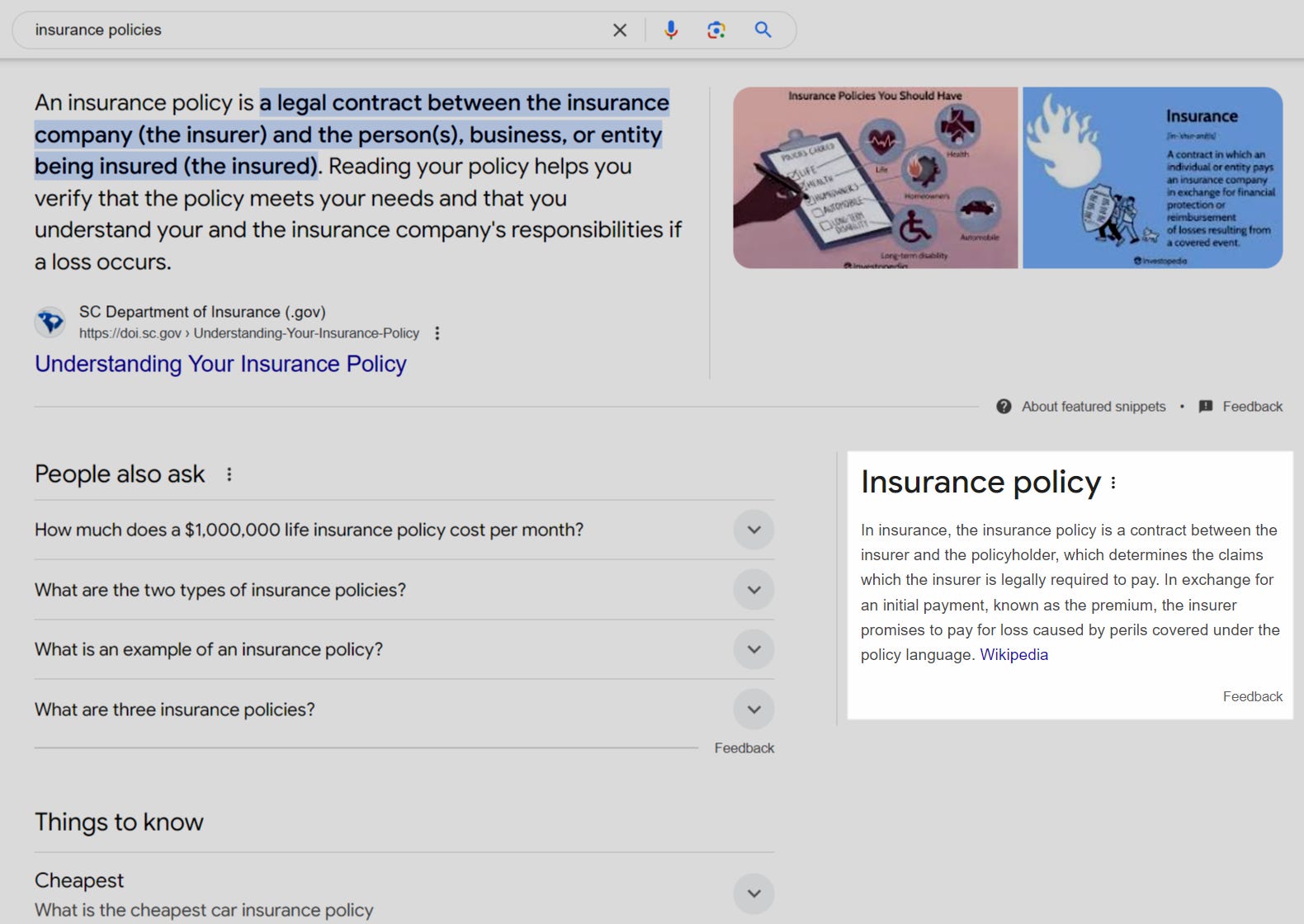
Another example is the keyword “insurance policies,” where Google shows a Featured Snippet and a Knowledge Card.
What do you need the Featured Snippet for when Google gives the answer itself? (Image Credit: Kevin Indig)
The impact is much more severe on mobile, where Google gives the answer and makes many organic results redundant.
Users see the Knowledge Card long before any organic results appear. (Image Credit: Kevin Indig)
Strategically, SERP features cannot replace a No. 1 rank, but they can enhance traffic returns, as long as you’re in the top 10 results. The key to factoring SERP features into your SEO strategy is a) monitoring them and b) prioritizing keywords accordingly.
For monitoring, you need a solution (either a third-party tool or building your own solution with an API) that helps you understand which keywords show what kind of SERP feature over time.
Certain SERP features, like Knowledge Graphs and Local Packs, can significantly lower clicks. All the search volume in the world doesn’t matter if you don’t get the clicks.
For prioritization, you need to prioritize keywords according to the findings in the German research paper and my analysis: target image carousels, free shopping listings, and video carousels.
That said, one SERP feature bears a bigger risk than any other: AI Overviews. In a world where users get direct answers to complex questions from LLMs, there is less space for SERP features, which are most useful for shorter search queries.
Sundar Pichai: “People are using it to Search in entirely new ways, and asking new types of questions, longer and more complex queries, even searching with photos, and getting back the best the web has to offer.”
The impact of AI on search is also the real motivation for the Yelp lawsuit.
Over the past two decades, many services, including content platforms, social networks, and search engines, allowed consumers to trade their personal information – whether given voluntarily or unknowingly – to access services.
This data fuels ad platforms, manifesting in search results, social media ads, and more.
Yet, as we march ever onward (despite the enduring third-party cookie) toward the privacy-first world, consumers will begin to feel the impact of choosing privacy over personalization.
The Illusion Of Free Services
Brands, intentionally or not, created an assumption certain services and content are free. However, this is simply untrue.
What might seem free is actually paid for with non-monetary currency. In the privacy-first era, individuals who choose to withhold their information or not consent to share data will receive less personalized experiences and limits to content.
Brands that don’t communicate the need for consent to their customers may face backlash at decreased quality. On the other hand, brands that aren’t transparent about data collection risk negative brand sentiment and fines.
We’re going to dive into:
Core services people expect for free.
Emerging paid alternatives.
Adoption rates.
While there isn’t a clear answer for everyone, this should hopefully provide a framework to find the best answer for you and your consumers.
Online Services: The Trade-Offs
We’ll focus on online services, avoiding real-world examples where access to benefits might involve data sharing.
Service 1: Searching The Web
“Googling” something is synonymous with finding information online. Google’s primary revenue source is its ad platform, which relies heavily on user data.
Google collects vast amounts of data from user searches, profiles, YouTube habits, Google Wallet transactions, and email content.
Although Google claims not to share or associate this data with individuals, they undeniably have access to it.
Until recently, users had no choice in sharing their information while searching online. Third-party cookies and IP addresses relayed this information, feeding the ad ecosystem.
Google now faces a challenge: its users are accustomed to free services, but without data to fuel ads, alternative payment methods are necessary.
Google offers paid services like larger storage for Gmail and Google Photos and ad-free YouTube subscriptions. However, search result pages still contain ads, needing monetization from searches.
From a consumer perspective, sharing data with Google enhances the user experience.
A profile with decades of data yields highly relevant results with fewer ads. In contrast, searches on incognito or secondary profiles may result in more ads or less relevant results due to limited data.
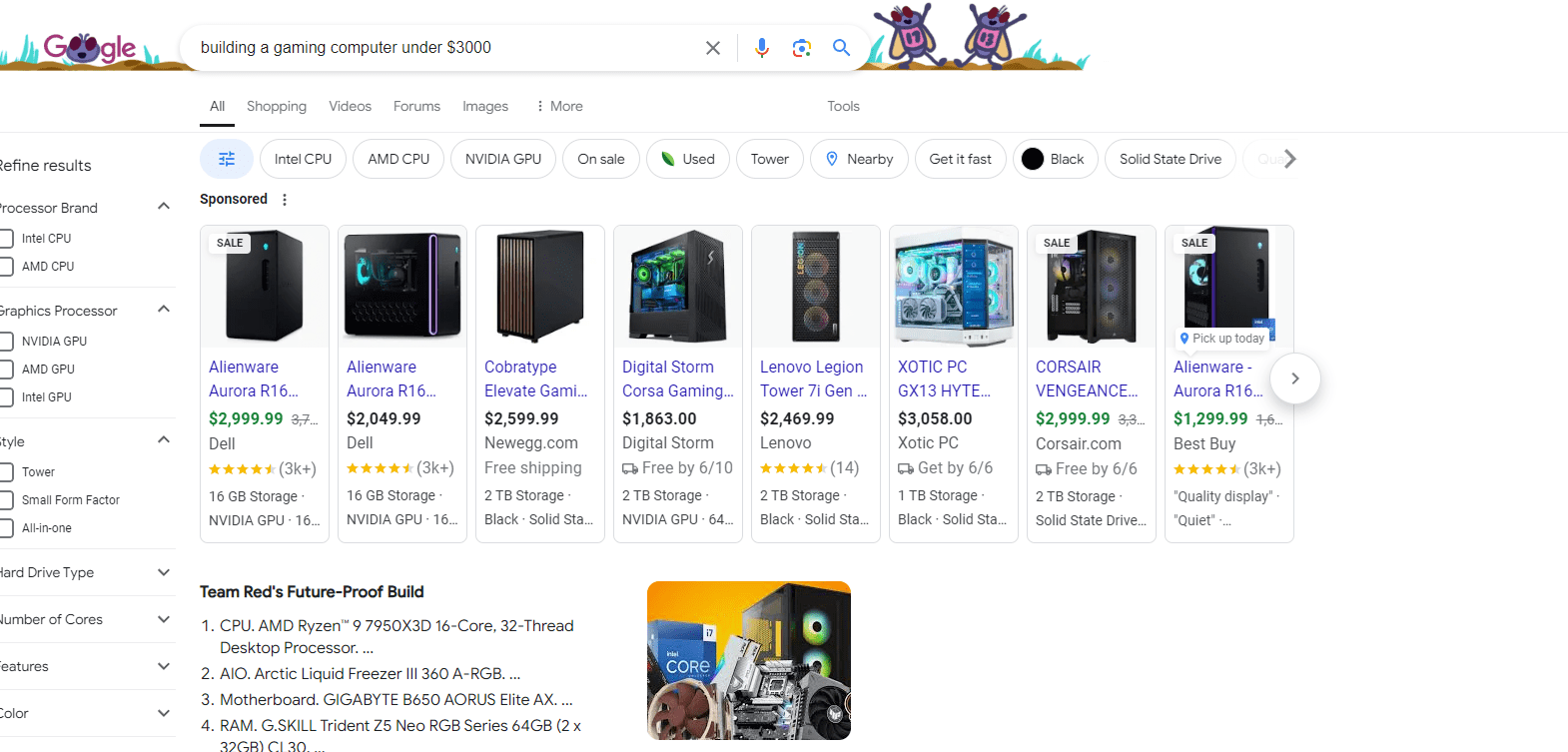
Screenshot from search for [building a gaming computer under $3000], Google, August 2024
In the above example, the results seem to run counter to the search [building a computer for under $3000].
However, because I’m logged into my profile, Google can see what my purchase patterns and content consumption look like.
I’m not the type of person who is going to build a computer. In the end, I bought a great prebuilt computer for $1,500 that happened to be one of the ads shown to me.
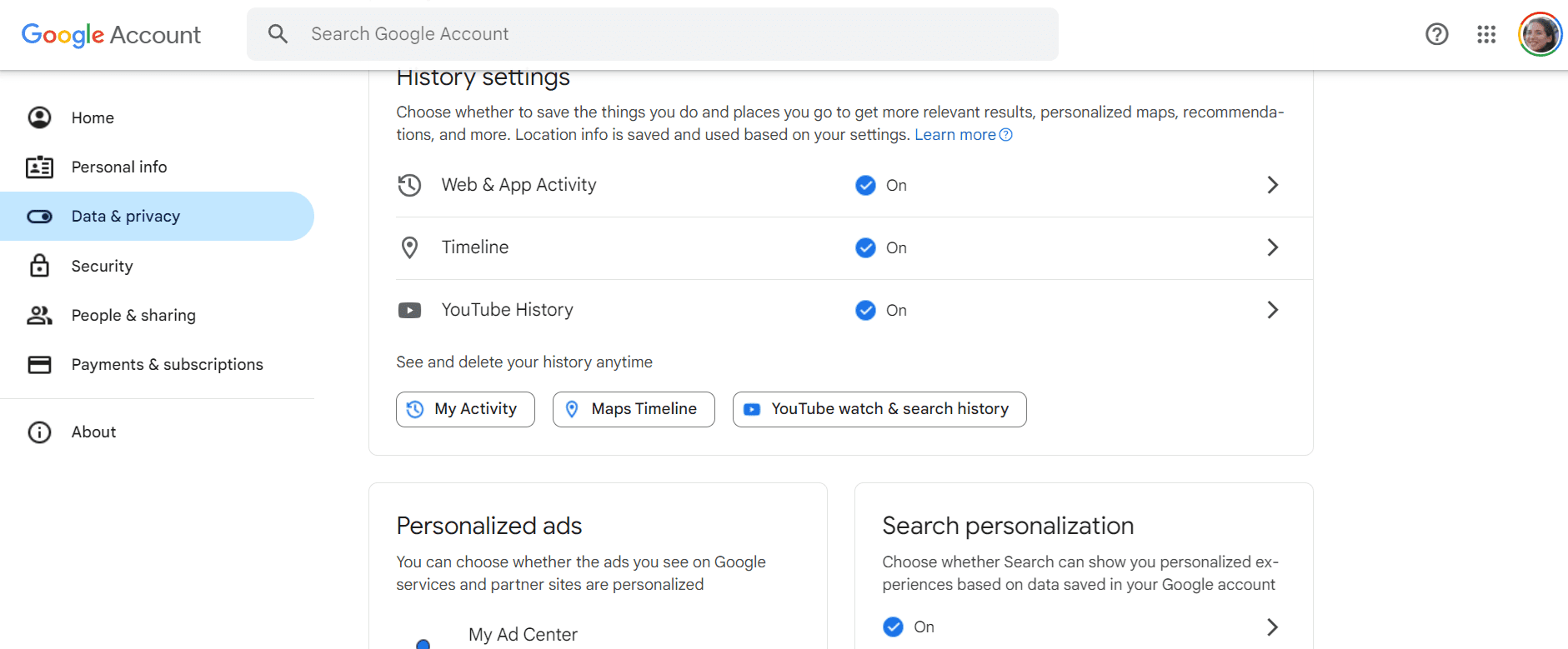
Screenshot from Google, August 2024
Consumers must decide between a better experience by sharing data or a more private, potentially less efficient experience. Testing searches in incognito versus a logged-in profile can highlight the differences.
Service 2: Social Networks
Social networks epitomize the data-for-service trade. Users share personal information with platforms like Meta, Instagram, TikTok, Pinterest, and Snap to connect with friends and family.
However, this data also feeds ad platforms targeting and bidding rules.
Consider what information you’re willing to share. For example, as a dog lover, I see numerous dog-related ads and charitable causes in my feed.
Similarly, searches around weight gain result in ads for supplements and non-alcoholic beverages.
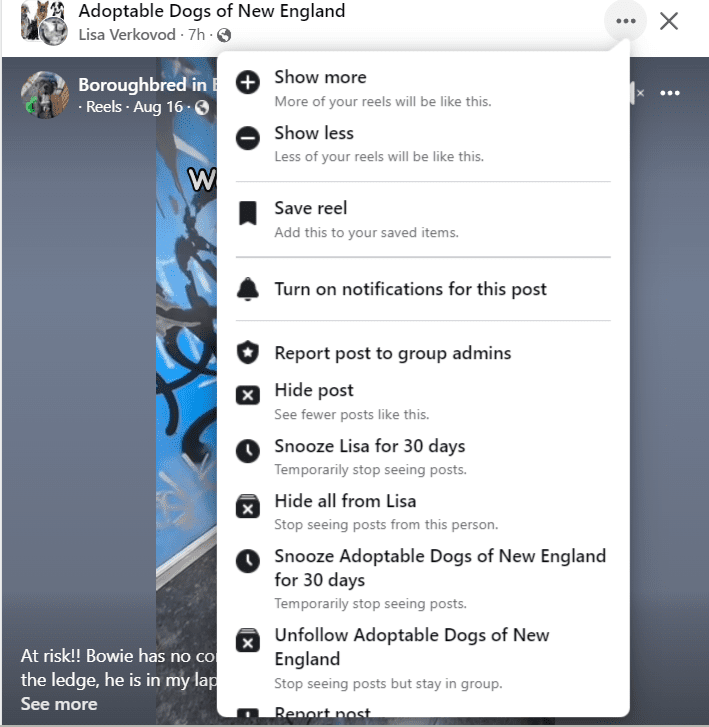
This shows that both on-platform behavior and external signals influence ad targeting. The danger of this is that it’s hard to “fix” the algorithms without directly sharing this input.
Screenshot from Meta, August 2024
If you’re not willing to share which content you want to see more or less of, you risk only getting information from certain content producers. Additionally, ads will be hyper-focused on what seems to be important in your feed.
Social networks primarily monetize through ads, making an ad-free experience impractical for most. Exclusive platforms like Clubhouse or paid services like Discord’s Nitro offer alternatives.
Discord, for instance, allows supporting servers without forcing users to share personal information, contrasting with the personalization of platforms like Facebook and LinkedIn.
Paid Alternatives And Their Adoption
As consumers become more privacy-conscious, alternative paid services are emerging. Let’s examine some of these alternatives and their adoption rates.
Subscription-Based Search Engines
Search engines like DuckDuckGo and Perplexity offer privacy-focused alternatives to Google. DuckDuckGo, for instance, does not track user data and relies on affiliate links and ads based on search terms rather than user profiles.
Perplexity, on the other hand, offers an ad-free subscription model, providing an enhanced search experience without compromising privacy.
While these alternatives are growing in popularity, they still represent a small fraction of the market compared to Google. Privacy-conscious consumers are willing to pay for a better experience, but mainstream adoption remains limited due to the convenience and familiarity of Google.
Premium Social Networks
Exclusive social networks like Clubhouse and Discord Nitro offer ad-free experiences and additional features for a fee. Clubhouse, an audio-based social network, initially gained traction through its invite-only model, creating a sense of exclusivity.
Discord Nitro provides enhanced features such as higher-quality streaming and increased file upload limits.
These premium services cater to niche audiences who value privacy and exclusive content. However, they face challenges in achieving widespread adoption due to the dominance of free platforms like Facebook and Instagram.
Balancing Privacy And Accessibility
As consumers navigate the digital landscape, they face a fundamental choice: share personal data for free services or pay for privacy and quality.
This decision impacts not only their online experience but also the broader economy of digital services.
The Consumer Perspective
From a consumer standpoint, the choice between data and money depends on personal values and priorities. Some users prioritize privacy and are willing to pay for ad-free experiences. Others value convenience and are comfortable sharing data for free access to services.
For instance, privacy-focused individuals may opt for subscription-based search engines and premium social networks.
They are willing to invest in a better experience, even if it means paying a monthly or annual fee. On the other hand, users who prioritize cost savings may continue using free services, accepting the trade-off of targeted ads and data collection.
The Business Perspective
Businesses must adapt to changing consumer preferences and regulatory landscapes. They need to balance monetization strategies, offering both free, ad-supported services and premium, data-free alternatives.
This dual approach allows them to cater to diverse consumer needs while maintaining revenue streams.
For example, Google continues to offer free search services supported by ads but also provides premium options like YouTube Premium and Google One.
Similarly, social networks like Facebook and Instagram rely on ads for revenue but explore new monetization models to address privacy concerns.
The Future Of Digital Payments
The future of digital payments will likely involve a combination of data and money, with consumers having more control over their information.
As technology evolves, new payment models and privacy-enhancing technologies will emerge, shaping the digital economy.
Emerging Trends
Microtransactions: Microtransactions and pay-as-you-go models could enable users to pay for specific services or content without committing to long-term subscriptions. This approach allows for greater flexibility and personalized experiences.
Data Ownership: Consumers may gain more control over their data through data ownership and monetization platforms. These platforms could enable users to decide how their data is used and earn rewards for sharing it with trusted parties.
Enhanced Status Quo: While this isn’t ideal, consumers and content creators may decide that they just don’t want to shift away from the current model, and if enough consumers are willing to share their data, “free” content and services will continue to use ads for monetization.
Final Takeaways
As consumers, we must decide whether to share our information for a better experience or pay for privacy through potential quality lapses or out-of-pocket.
As businesses, determining how to charge for services and valuing customer data is crucial.
By embracing new payment models and privacy-enhancing technologies, we can create a more balanced and equitable digital economy.
This shift will empower consumers to make informed choices and allow businesses to innovate and thrive in an ever-evolving landscape.
Google’s John Mueller responded to a LinkedIn post about the visual impact of favicons in search results, sharing a tip that isn’t officially documented but could improve their visibility.
Favicons
Favicons are small icons that represent a website’s brand that are displayed in browser tabs, bookmarks, browser history and in search engine results pages (SERPs). They improve brand recognition, draws attention to itself and makes it easier to identify a brand when it’s in the search results.
Discussion On LinkedIn
A post in LinkedIn by Mark Williams-Cook (LinkedIn profile) highlighted the value of a good favicon in the search results, speculating that they might make a difference in search results interactions.
A discussion followed in which others observed the value of a favicon that draws attention to itself in the search results and that an eye-catching favicon is useful for SearchGPT.
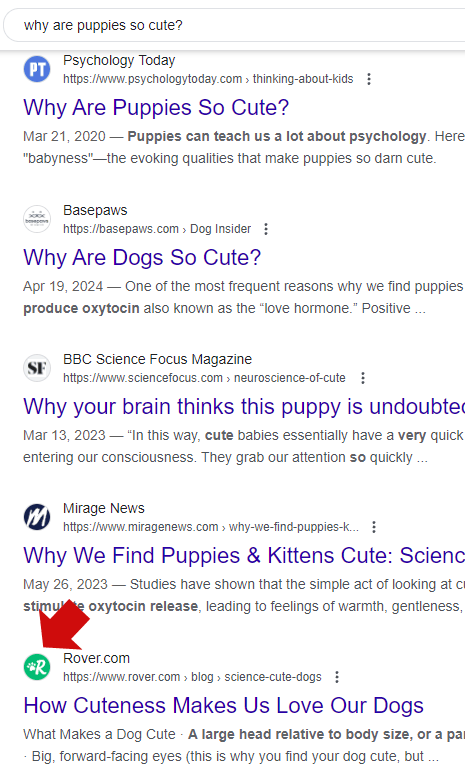
The following screenshot shows how some favicons blend into the search results while two of them stand out, especially the one with the bold color scheme.
Screenshot Of Favicons In The SERPs
A distinctive favicon won’t help a site rank better but as can be seen above it can help the page stand out in the search results.
A Good Tip For Favicons
John Mueller’s observation about favicons mentions something really obvious but is also not mentioned in any of the official documentation about favicons. Mueller simply said that it’s not a bad idea if the favicon looks attractive when cropped into a circle.
This is what Mueller said:
“Round-croppable favicons, for those who like technical SEO.”
Designing a favicon that looks attractive when cropped into a circle something that is obvious in retrospect but easily overlooked. Considering a favicon by how well it appears cropped in a circle suggests the usefulness of testing a favicon to see what it looks like when cropped into a circle or even designing a favicon that is already in a circle so that it fills the entire available space when it’s displayed in the search results (or anywhere else).
None of Google’s documentation on favicons mentions that they are cropped into a circle nor does Google advise that it might be a good idea to design them in a round configuration.
This tip is a small and seemingly obvious one but it can make a big difference.
Summer 2024 marks 30 years since Jeff Bezos started Amazon from his garage. Anyone looking to learn more about Bezos, compete with Amazon, or both can find food for thought in these 11 books — some admiring, some critical — that explain the principles and tactics behind the company’s success.
Though not about ecommerce, Baron’s book offers insight into Jeff Bezos’s leadership style. The author began his eight-year stint as the Post’s executive editor just before Bezos purchased it in 2013. He provides an insider’s view of how reporting decisions were made through tumultuous news cycles.
Evolving from a bookseller to a general retailer put Amazon on a collision course with Walmart. Del Rey chronicles the ongoing battle that has placed billions of dollars and millions of jobs on the line with outsized impacts on consumers, retailers, and the future of shopping.
There’s no disputing Amazon’s influence. This book aims to distill the methods its leaders use to write, collaborate, innovate, and pitch — and present them as tools that others can apply in their own organizations.
Stone, a Bloomberg journalist, revisits the subject of his 2013 bestseller, “The Everything Store,” which chronicled Amazon’s rise from startup to billion-dollar company. This time he explores how the company and its founder transformed from an upstart to a global power.
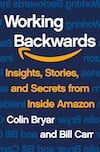
Both authors joined Amazon early on and spent more than a decade as senior executives working closely with Jeff Bezos. They share their experiences to create an exciting story and a practical business guide.
Drawing on extensive research, Shaw compares business titans Jeff Bezos, Elon Musk, and Travis Kalanick “warts and all” to tech trailblazer Steve Jobs, illustrating their impressive achievements and the downsides of the “all in” leadership style.
Dumaine combines a lively history of Amazon’s rise with speculation about where it will go next — advertising, health care, banking? He also delves into how other companies worldwide borrow from Amazon’s model and offers tips for “Amazon-proofing” your business.
This is a compilation of Jeff Bezos’s thoughts on family support, Amazon, Blue Origin, space colonization, leadership, motivation, failure, and success — organized in four thematic sections, with links to sources.
Business analyst Steve Anderson calls Bezos’s annual letters to shareholders a “hidden roadmap” business leaders can follow to make their companies more efficient, powerful, and successful, distilling them into key growth principles such as “Obsess over Customers” and “Promote Ownership.”
A scathing critique of the practices that led to the U.S. Federal Trade Commission filing its antitrust suit against Amazon last year, this book asks whether Amazon’s ecommerce and cloud computing businesses have grown too big to regulate. I included the book in my “10 New Business Books for Summer” roundup. The book is longlisted for the “Financial Times and Schroders Business Book of the Year 2024” award.
YouTube has more than 2.5 billion users, and it is the second most popular social media network worldwide. Yet, only some marketers are making use of this platform.
A recent Social Media Examiner industry report found that only 51% of marketers use YouTube, but 59% plan to increase their use of the platform.
Even though not all marketers use YouTube, they do recognize video is an essential part of marketing and learning. According to Wyzowl, 91% of businesses use video as a key marketing tool. Data suggest that online videos have an audience reach of 92.3% worldwide.
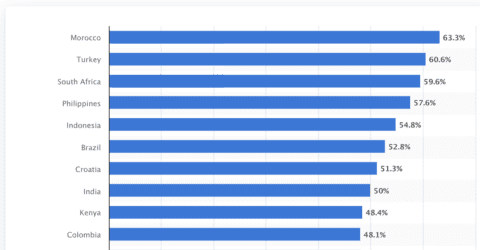
The image below illustrates the percentage of global internet users who viewed online videos for learning purposes during the last week of the fourth quarter of 2023, categorized by region. Morocco leads the way with 63.3%, followed by Turkey and South Africa.
Image from Statista, August 2024
How To Build A Following For A Show
There is no secret formula to being successful when running a live YouTube show, but I want to show what has worked well for us.
I ran three different shows, Turn Digi, Tea Time SEO, and, most recently, SEO Office Hours with Mike Chidzey from Good Signals. The third show has had the most success, and these are some of our learnings:
Engage With Your Audience
SEO Office Hours has two special guests who answer questions along with the host, Mike, and the co-host, me.
During SEO Office Hours, we have a live chat, and we encourage our live audience to ask questions in the chat to our special guests.
Sometimes, we are not as quick to reply as other audience members who answer the questions. This works well as it encourages audience members to get involved with the discussion.
Bring In Guests From All Backgrounds
We have freelancers and entrepreneurs take part in the show. We also have those from agencies and brands.
We have guests calling in from all over the world and, in one episode, including Brazil (so it was quite early for them) to New Zealand, the other time of the day.
The show is on at 9:30 a.m. BST, so that does allow others from the West to join.
However, if you want to run an event and have it open for the US to join, then you need to choose a time in the afternoon (if broadcasting from Europe).
Being part of communities in your sector helps you to get to know others and in turn, invite them to take part in your show.
Answer Questions Our Community Wants Answered
SEO can be overwhelming, and there can sometimes be many solutions to the same problem. Therefore, with SEO Office Hours, we ask people to submit their questions and then join us live to listen to the answers.
We also have a lot of discussion in the chat where other questions are asked. We tend to get through six questions a week and we include them in the transcript of the videos.
Consistency Is Key
When you want to make a difference in anything you do, being consistent is key.
Mike was adamant from the beginning that we do the show every Friday at the same time until at least the end of the year.
That would have been six weeks. By the end of those 6 weeks, we had 16k views and 48 subscribers.
Engagement
Sprout Social recommends that to increase engagement, you need more comments or likes on your video.
However, SEO Office Hours is a live show run via Zoom, so they cannot like or comment when we are recording.
We do not stream directly to YouTube, we upload the video later so audience members will have to come back and watch it and then like/comment.
We have not seen an increase in the number of likes per video, but we have seen more people join us live. In the beginning, we had 4 attendees, and in our most recent episodes, we have had up to 40.
We also have many questions asked from our audience members and guests answer the questions submitted in the chat sometimes before Mike or I are able to ask our special guests.
Have A Dedicated Landing Page
If you are running a live YouTube show, make sure you have a dedicated landing page with all information on how to get involved. Include the sign up on the home page as well.
For SEO Office Hours, we have all the videos of the previous episodes so guests can watch them, they can also read how to submit a question and sign up and where attendees sign up to calendar invites which grows each week – this is something that people naturally share.
Different Ways To Stream To YouTube
Dacast compares some of the best live streaming platforms in their post here. The platform you decide to use is up to you and depends on the objectives of the show.
For example, with SEO Office Hours, Mike did not want it to be too polished or rehearsed – because it isn’t. He wanted it to feel like a regular video call, like the original hangouts that John Mueller used to organize.
He likes the fact he can see everybody, including attendees, if they decide to share their video. Sometimes, attendees will jump on and give context to a question or help with answering a question.
When running a live YouTube show, there are two main options I have used in the past:
Zoom
This is a live video platform where anyone who has registered for the event can attend.
This means you can edit the video before you upload it to YouTube. At SEO Office Hours, we amend the video by taking out the “ums” and “you knows.”
We then upload it to YouTube so everyone can see it.
Streamyard
There are two options: either to run this live and have it streamed directly to your YouTube channel or simply run it live but have it recorded. Then, you can upload it to YouTube at a later date.
There are some online conferences and webinars, and there feels like a real distance between the speakers and attendees, and you are there to listen to what the presenters want to talk about.
Therefore, we went with Zoom, but I recommend using the platform that suits your company and the objectives of your show the most.
Encourage Live Q And A
With SEO Office Hours it’s really the people who submit questions and watch live that make the show.
We are watching the live chat, and the audience’s expressions (sometimes puzzled looks, really engaged, usually lots of nodding) dictate whether we explore a topic further/ something might need clarifying, or move to the next question.
The audience is a mixture of stressed marketing managers, frustrated business owners, and SEO pros who work alone. SEO Office Hours is their chance to see what’s working for others, to bring up the problems they are having, or just to chat with others doing what they do.
For us, running the show, it’s important that the audience feels heard and seen – and that if they have a question, it’s likely we will chat about it. We think Zoom or Google Meet naturally assists with this format.
During the live hour, it’s very rare for attendees to drop out, and that may be because they feel just as much a part of SEO Office Hours as the special guests answering the questions.
How To Manage Those “Awkward” Live Questions/Answers From The Audience (And Sometimes From Guests)
If there are these awkward live questions, you can do one of three things:
Wait for the audience to answer the question.
Ask the person to clarify what they mean.
Answer the question (the host and co-host with special guests).
Sometimes, spam questions are asked, and then if not answered, they are asked again.
Most of the time, in 37 episodes (up until August 11th), we have not had too many awkward live questions.
Where To Find Speakers Even If You Have Not Met Or Been In Touch With Them Before
This was the third time I had run a show and so I contacted some people who had taken part in previous shows. Being part of communities is key to connecting with others and promoting them in the show.
There is never an excuse to have the same type of people speaking at your YouTube show.
If you do not find people outside of your circle, that is fine, but build connections with others or ask former colleagues or friends if they know others who want to be part of your show.
How To Promote
Do not be shy about promoting your show.
Since Good Signals started SEO Office Hours on November 3rd, their LinkedIn followers increased by 560, and their subscribers increased by 251 by the end of July, our 35th episode.
Good Signals has a dedicated landing page with all information (how to submit a question and sign up) where attendees sign up for calendar invites, which grows each week – this is something that people naturally share.
Initially, Mike used to include SEO office hours in the weekly newsletter, and he also used to include it in his email signature.
Along with relevant descriptions, we also tag individual videos on YouTube by relevant topics so they appear for searches and alongside popular relevant videos.
Plus, we run a small Google Ads campaign on YouTube, which means that when people see similar videos, they are shown SEO Office Hours.
We have been lucky to be featured in the SEOFOMO newsletter; thank you, Aleyda Solis.
We were invited to come on the Search off the Record podcast, where Google occasionally interviews guests on its show. We sometimes have Lizzie and John from Google come on SEO Office Hours, too.
Use The Platform That Suits Your Brand The Most
If guests have YouTube channels, they sometimes share directly on the platform with their subscribers. We tend to promote on Linkedin and sometimes Twitter. We do not share the show on Instagram.
We played with the design for the thumbnails for the videos over the first few months.
Without overdesigning, we wanted to create something that people in our networks would recognize – and it seems to have worked. When we promote the shows, the thumbnails stand out.
Be Open To Feedback
We always welcome feedback, and when we receive it from attendees, we make those changes. This means SEO Office Hours continues to improve, and therefore, more people enjoy it.
As a result, these people share it with their network, and we have more exposure.
Don’t Give Up
If, at first, you do not succeed, try a different approach.
This is the third YouTube show I have been part of. We have generated the highest number of views on videos than I have in the past.
However, the experience I gained with the previous shows has helped me with SEO Office Hours.
Most of us do not learn how to run a live YouTube show at university/college or have formal training; we learn about it on the job.
Therefore, learn from others who have been successful, and if your technique is not working, do not give up; try something different.
The 4 Ps of marketing. Marketing mix. Marketing fundamentals.
Whatever you call them, these elements determine your luck at the high-stakes table of e-commerce:
Product.
Price.
Place.
Promotion.
Get these right, and you’ll create a loyal fanbase that you can count on for repeat orders, high lifetime value, and customer advocacy.
Neglect or miscalculate them, and they’ll derail your entire process, have an adverse effect on revenue and margin, and allow competitors to overtake you.
Here’s how to consider each of these principles in the context of ecommerce and paid media.
Product
As in every business, your product is fundamental to ecommerce success. Even the most amazing marketing campaigns can’t compensate for a broken product or lack of product-market fit.
Think of brands that cycle through many advertising agencies over the course of a year.
Chances are they tend to blame poor planning, subpar campaign execution, or some other deficiency common to all those agencies. The most likely solution is that their product just doesn’t resonate with consumers.
Statistically, it’s extremely unlikely for a brand to go through multiple agencies and for all of them to be poor at their craft. When this does happen, it’s usually the agency evaluation process that needs work.
There’s a reason marketers talk about product-market fit over and over.
A product that solves a problem and marketing that puts it in front of the right people are core fundamentals and work like gears in a complex system. Take one out, and the whole process will grind to a halt.
Pricing
Pricing is such an intrinsic part of ecommerce and paid media in general.
If you think people who see your ad aren’t also searching for competitors and doing comparison shopping, your performance numbers will confirm otherwise.
So before you start chasing clicks or even setting budgets, your merchandising play needs to be as accurate as possible.
Consider both absolute pricing and competitiveness to make sure that your product is positioned where you want it to be while still capable of being profitable against your manufacturing and procurement processes.
Google Merchant Center has a price benchmarks feature. It looks at your product feed and shows you how your products compare to other products, brands, and categories of similar natures.
This is highly useful data that can help determine if you’ve priced your products correctly or whether they even fit in the market.
The last thing you want to do is spend thousands on ads only to realize that you got too ambitious or too conservative with your margin.
Additionally, once you’ve started running a campaign in Google Ads, auction insights allow you to see which brands are coming up against you in Search and Shopping auctions.
Use this data to see how your pricing compares to theirs, fine-tune accordingly, and run tactical promotions.
Place
Starting an ecommerce business is not easy – but for those who are able to fund and find initial product-market fit, digital advertising allows brands to bypass the limitations of traditional distribution.
Geography and access to certain distributors become irrelevant when you can sell and ship directly to consumers.
However, this also presents several new challenges:
Platform Management: Ecommerce advertisers have a wealth of options when deciding where they want to advertise. This includes traditional networks like Google, Meta, and Amazon, as well as emerging and niche platforms like TikTok and YouTube. However, choosing the wrong platforms or overextending yourself before you’re ready can cause more harm than good.
Media Mix: Advertising on multiple channels can be advantageous if you have the budget and expertise to do so, even though some brands are predisposed to putting most of their budget in a primary platform. But doing all this when you’re just starting means you’ll have less to spend on campaigns, spreading your efforts too thin and limiting how much data you can acquire. You’ll also need additional people or agencies with expertise managing those different channels in order to get the best returns for your spend.
Performance Measurement: Brick-and-mortar commerce was comparatively straightforward, and advertising and in-store promotions skewed more toward non-linear measurement. Online advertising has made us crave the need to track every dollar spent and every product sold, and draw a line back through each performance metric. But even good conversion tracking is never perfect, and ad platforms are prone to fluctuation and error as they grow more automated.
Attribution Measurement: Knowing which platforms are driving sales is critical to making sure you’re investing in the right places. This is more challenging when you have multiple platforms in your media mix, none of which freely and fully share data with other platforms. Attribution will only get worse over time as the ability to track degrades due to privacy concerns. This imperfection doesn’t mean you shouldn’t have some form of attribution, but treat it as a reference point instead of a source of truth.
Promotion
While good marketing can’t fix a bad product, a good product can make marketing better, easier, and less expensive.
For ecommerce that relies heavily on paid media for promotion, there are two aspects to consider.
Account Management
With paid media, the ad account is the third gear that supports product and marketing.
Decisions like which campaign types to run, how to structure your ad account, running good ad copy and creatives, and using audiences and first-party data to target the right people will all affect your revenue and margin.
Too many brands make the mistake of trying to fix their ad accounts and campaign metrics before their product, pricing, placements, and customer journey.
If you do that in the right order, your challenges around the ad account should largely be limited to ad platform issues, like disapprovals and automation.
Customer Journey
I think of ads as just one component in a wider marketing system – one ingredient in a successful recipe.
You need all the pieces to achieve success, and if you’re neglecting everything that happens before and after the ad click, no hook or campaign is going to save you.
The bulk of ecommerce shopping happens over mobile, which, as of 2023, was valued at $2.2 trillion. If your pages aren’t easy to navigate on smartphones, there’s a good chance you’re not getting all the conversions you could. Are your pages mobile-optimized? Do they load quickly? Do they deliver good experiences during checkout, upsales, cross-sales, etc? If not, fix this.
Trust is a major objection to overcome in any sale, and reviews do a great deal to show why people should trust you. In addition to proving the value of your product with certifications and ratings, use reviews to seal buyer confidence. Your social proof should reflect your target audience, so they feel like others like them have benefited from your product.
With fraud and scams on the rise, online shoppers are becoming more guarded with their payment details. You’ll have to prove that you can be trusted if you want to earn their money. Security validation and third-party payment logos (like PayPal and Apple Pay) go a long way in establishing that you are a real business with good intentions.
The journey begins long before the ad click and continues long after. User-generated content shows people using your product and positions them as the hero, which means prospective customers are more likely to feel the same way. Email marketing can address abandoned carts, communicate shipping status, and make the rest of the journey pleasant.
Does your ad copy tell people what problems you solve creatively? Instead of features like “x milligrams of caffeine,” you might focus on outcomes like “the energy burst you need to be productive until late afternoon.” Be imaginative and help people picture their life after they buy your product.
The Future Of Ecommerce Requires Full-funnel Thinking
Ecommerce might be glamorous and often lucrative, but it’s not easy.
The period when low-cost manufacturing and a frictionless global supply chain made it possible to start a direct-to-consumer brand with minimal investment and hassle is gone.
Between ad platforms becoming increasingly automated and reducing the amount of campaign management required, brands need to focus more on fundamentals and the pre-click and post-click experiences to stay profitable.
It’s important to stop thinking about paid media as the entire package and instead focus on its actual position as one part of a wider marketing strategy.
Whether they know it or not, many ecommerce marketers are programmatic search engine optimizers. It’s one of the hottest SEO tactics in the artificial intelligence era.
Marketers can use what they already know about optimizing product and category pages to attract new visitors.
Programmatic SEO uses data, algorithms, automation, and AI to create hundreds or even thousands of web pages.
Programmatic SEO
You will not likely find “programmatic SEO” in a dictionary. The process uses algorithms, automation, and sometimes AI to create keyword-specific web pages at scale.
The technique aims to rank pages for a vast number of long-tail keywords, driving traffic and topical authority.
Programmatic SEO (pSEO) saves content in a database and displays it on a website using a template. Thus it’s similar to the way ecommerce websites already work.
An online shop keeps product information — e.g., item name, description, picture, price — in a database. Each product detail page uses the same layout or template and loads content from that source.
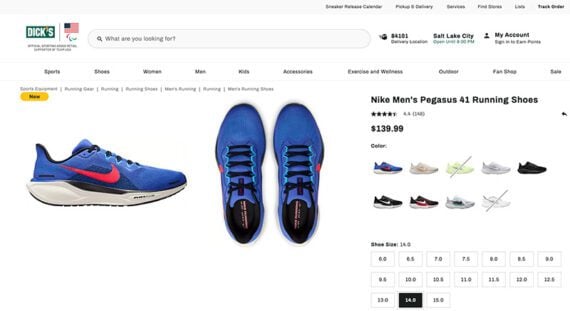
Consider the Dick’s Sporting Goods website. It had 105 Nike men’s running shoes at the time of writing. All are content pages in the pSEO context.
Dick’s Sporting Goods dynamically generates product detail pages, with 105 such pages for Nike men’s running shoes.
Each page shared the same template and targeted a unique long-tail keyword such as “Nike Men’s Pegasus 41 Running Shoes” or “Nike Men’s InfinityRN 4 Running Shoes.”
Every ecommerce platform, content management system, and blogging tool behaves similarly. The pSEO approach applies the concept to content generation and marketing.
Ecommerce pSEO
Imagine a new online store selling shoes. This new shop is unlikely to rank for a stem keyword of “running shoes,” given it would have to compete with retail behemoths like Dick’s Sporting Goods or even manufacturers like Nike.
Instead, the new store might try a content marketing approach to attract folks who might eventually want to buy shoes.
The merchant could do it manually with a series of blog posts or automate it with pSEO.
Keyword Phrase
The first step in the pSEO process is identifying a stem keyword phrase to modify into a long tail. If it focused on trail running, this new shoe seller could choose a phrase such as “national park running trails.”
The phase can be extended with superlatives and locations.
“best national park running trails in Michigan”
“longest national park running trails in Ohio”
“hardest national park running trails in the Pacific Northwest”
“steepest national park running trails near Calexico, California”
Each long-tail phrase will ultimately morph into content to attract a few site visitors each.
Data Source
A page built on the keyword phrase “steepest national park running trails near Calexico, California” will not generate much traffic. It’s not worth the time to write manually.
But pSEO makes creating content easy for hundreds or even thousands of low-difficulty, low-traffic pages.
The first step is a data source.
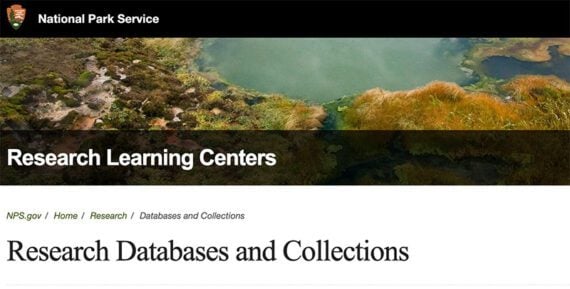
For example, the U.S. National Park Service maintains several databases about parks, trails, usage, public notices, and even native animal species.
Databases from the U.S. National Park Service include much info about trails, usage, animals, and more.
Content Generation
Using the National Park Service data, the shoe shop could set up an automated workflow.
This workflow might require a developer or, in many cases, just Zapier or If This Then That connecting data to a generative AI platform. The genAI would parse the data and add content, such as a page title, a short introduction, the park’s address, and a table of National Park facts — not necessarily an entire blog post.
The key for pSEO is that the content is generated automatically and passed to the shop’s website.
Template
The store requires a page template displaying the running trail information consistently, helpful to shoppers. The page might include products such as the top-selling trail running shoes or an email subscription form.
The template is analogous to a product detail page.
A separate category template could help, too. For example, a page targeting “national park running trails in Michigan” could have sections about the longest, steepest, flattest, busiest, and best-running trails in each region of the state — similar to a pillar or hub in a content marketing topic cluster.
Implementing pSEO
The pSEO process is similar to what ecommerce marketers do already: optimize product detail and category pages. What’s new is automating the workflow and organizing the data.
Each pSEO content page will not likely attract many visitors. But combined, all pSEO pages will.
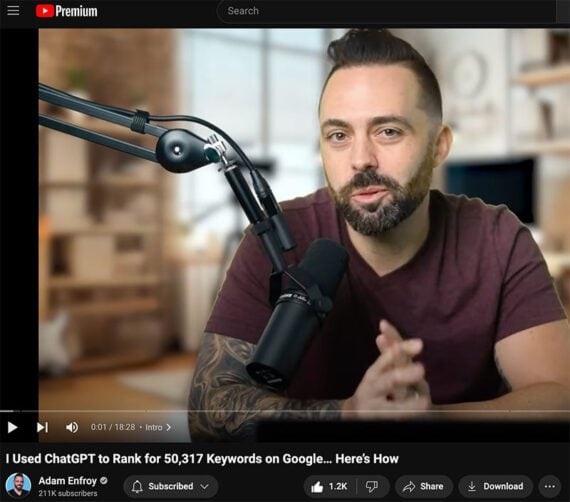
For example, in August 2024 content creator Adam Enfroy published a YouTube video demonstrating how he used this technique to rank for more than 50,000 keyword phrases on Google. Many of the pages Enfroy created received just a few monthly visits but collectively drove a massive increase in traffic.
Content creator Adam Enfroy used pSEO to rank for roughly 50,000 keyword phrases on Google.