Shahzad Chagani runs operations for PE Energy, a Houston, Texas-based supplier of industrial equipment and supplies. The company collects leads online from worldwide B2B buyers and relies on its Columbia-based sales team to convert them into customers.
“Colombia is pretty Westernized,” Chagani told me. “We find a lot of college-educated talent there.”
In our recent conversation, Chagani addressed his backend setup for 100,000 SKUs, the benefits of an offshore sales staff, and more. The entire audio of our discussion is embedded below. The transcript is edited for length and clarity.
Eric Bandholz: Tell us who you are.
Shahzad Chagani: I’m the director of operations for PE Energy in Houston, Texas. We sell industrial equipment and supplies. I’ve been running the company for 10 years. About 80% of our revenue is B2B, with 15% via ecommerce.
We sell parts and equipment for manufacturing, construction, and other industrial uses. Our products weigh as little as one ounce to thousands of pounds. We specialize in American-made items. We have customers worldwide and our own inside sales team to serve them.
We carry about 100,000 SKUs. We don’t white label or make the products ourselves. We do a lot of dropshipping with our suppliers. We mainly specialize in consumable products for repeat orders, such as filters and lubrication. That’s where the highest margins are.
We have feeds from our suppliers that sync into our store, spec sheets, and inventory details. Our website drives a lot of inquiries. Buyers go to the site and then request a quote.
The site uses WordPress and Shopify. It mostly drives leads rather than direct purchases. We have a “request a quote” section on all product pages. We’ll receive those leads and arrange custom pricing depending on the buyer.
We use DataFeedWatch for our inventory control. There are several similar data feed providers. We maintain a single master inventory file that connects to QuickBooks Enterprise, our ERP. Whenever a product is sold or lead times change, DataFeedWatch updates our system — even on Amazon, eBay, and Shopify — to let customers know.
Bandholz: Walk us through your sales training for so many products.
Chagani: It comes down to education and product knowledge to respond meaningfully to quotes. It takes about 90 days to learn our system. All leads come through Zendesk. We have our own customized customer management platform. It has all the price sheets, weights, everything. It also provides allowable discounts depending on the quantities and customer type.
We have seven inside sales members. Most work full-time and are based in Colombia. I find them using LinkedIn Jobs. It’s nice to go back annually and bring everyone together for training. It makes customer service so much better.
They’re all working remotely from different cities in Colombia. The team makes deals on the phone, emails, or even WhatsApp. Our business is global; we communicate by any means necessary.
Colombia is pretty Westernized. We find a lot of college-educated talent there. Their English is awesome. I make sure. It has a big impact on our customers and vendors.
Our hiring process is this. We create a post on LinkedIn Jobs for Colombia. We link from the post to our site to fill out an application. If the applicant looks qualified, I’ll jump on a video call with that person.
People in Columbia and similar countries just want an opportunity.
Bandholz: How are they paid?
Chagani: They’re all hungry and money-driven. We have a commission structure. We use last year’s monthly numbers divided by the number of reps to ensure they hit our overall goal.
The commission for each person is tier-based. Higher tiers earn a higher commission. We pay a base of $7 to $8 per hour. I have reps hitting $2,000 to $6,000 per month on top of their base. They’re so good. Earning $72,000 per year in Colombia is phenomenal.
Bandholz: When do you know to hire a new sales rep?
Chagani: I look at the leads. If customers aren’t being cared for, I’ll find more talent. I keep the LinkedIn Jobs ad running 24/7 at a $4 per day spend.
Bandholz: Where can people follow you or reach out?
Bluehost launched an AI Website Creator that enables users to quickly create professional websites, an evolution of the click and build website builder that makes it easy for anyone to create a WordPress website and benefit from the power and freedom of the open source community.
The importance of what this means for businesses and agencies cannot be overstated because it allows agencies to scale WordPress site creation and puts the ability to create professional WordPress sites within reach of virtually everyone.
Point And Click Website Creation
Bluehost offers an easy website building experience that provides the ease of point and click site creation with the freedom of a the WordPress open source content management system. The heart of this system is called WonderSuite.
WonderSuite is comprised of multiple components, such as a user interface that walks a user through the site creation process with a series of questions that are used as part of the site creation process. There is also a library of patterns, templates, and an easy to configure shopping cart, essentially all the building blocks for creating a site and doing business online quickly and easily.
The new AI Website Creator functionality is the newest addition to the WonderSuite site builder.
AI Website Builder
An AI website builder is the natural evolution of the point and click site creation process. Rather than moving a cursor around on a screen the new way to build a website is with an AI that acts as a designer that responds to what a user’s website needs are.
The AI asks questions and starts building the website using open source WordPress components and plugins. Fonts, professional color schemes, and plugins are all installed as needed, completely automatically. Users can also save custom generated options for future use which should be helpful for agencies that need to scale client website creation.
Ed Jay, President of Newfold Digital, the parent company of Bluehost, commented:
“Efficiency and ease are what WordPress entrepreneurs and professionals need and our team at Bluehost is dedicated to deliver these essentials to all WordPress users across the globe. With AI Website Creator, any user can rely on the Bluehost AI engine to create their personalized website in just minutes. After answering a few simple questions, our AI algorithm leverages our industry leading WordPress experience, features and technology, including all aspects of WonderSuite, to anticipate the website’s needs and ensure high quality outcomes.
The AI Website Creator presents users with multiple fully functional, tailored and customizable website options that provide a powerful but flexible path forward. It even generates images and content aligned with the user’s brief input, expediting the website off the ground and ready for launch.”
Future Of Website Creation
Bluehost’s innovative AI site creator represents the future of how businesses get online and how entrepreneurs who service clients can streamline site creation and scale their business with WordPress.
Read more about Bluehost’s new AI Website Creator:
Many businesses struggle to convert ad clicks into meaningful actions like purchases, sign-ups, or leads. But fear not, because in this article, we’re diving into real-life tips and tactics that can make a tangible difference to your conversion rates.
From refining your keyword selection to crafting compelling ad copies and optimizing your landing pages, we’ll explore practical, actionable tips that have proven to help improve Google Ads conversion rates.
Read on to understand how these strategies will help you turn your clicks into conversions.
1. Implement Proper Conversion Tracking
This first one seems like a no-brainer, but it’s often overlooked by many accounts.
The only way to understand whether your Google Ads campaigns are performing or not performing is to properly set up conversion tracking.
The most common ways Google Ads conversion tracking is implemented is through:
The other key component to proper conversion tracking is identifying what conversions make sense to track.
Oftentimes, brands have one big conversion in mind. For ecommerce, that is likely a purchase or a sale. For B2B companies, it’s likely a lead or a demo signup.
But what about all the other available touchpoints before a customer makes that leap?
Consider tracking “micro” conversions on your sites to really identify the positive impact your PPC campaigns have.
Examples of “micro” conversions to track include:
Email newsletter signups.
Free samples.
Whitepaper download.
Webinar signup.
And more.
Taking a step back from the ins and outs of the platforms helps you hone in through the lens of a consumer. Setting up accurate measurements from the purchase journey can make a big impact on how you structure and optimize your Google Ads campaigns.
2. Optimize Keyword Lists
The second way to help increase Google Ads conversion rates is continuous optimization of keyword lists.
The Google Ads search terms report is a perfect tool for this. Not only can you see what users are searching for, in their own words, that leads to conversions, but you can see what is not converting.
Keep in mind which match types you’re using throughout the keyword optimization process.
Broad match keywords have the biggest leniency when it comes to what types of searches will show for your ad. It also has the largest reach because of its flexible nature.
Turning some of your top-performing Broad match keywords into Exact match can help increase those Quality Scores, which can lead to lower cost per click (CPCs) and better efficiency for your campaigns.
3. Match Ad Copy To Landing Pages
Alright, so you’ve gotten a user to click on your ad. Great!
But you’re finding that not a lot of people are actually purchasing. What gives?
Surely, it must be a problem with the PPC campaigns.
Not always.
Typically, one of the most common reasons users leave a website right after clicking on an ad has to do with a mismatch of expectations.
Simply put, what the user was promised in an ad was not present or prominent on the landing page.
A great way to optimize conversion rates is to ensure the landing page copy is tailored to match your PPC ad copy.
Doing this ensures a relatively seamless user experience, which can help speed up the purchase process.
4. Use Clear Call-To-Actions
If a user isn’t performing the actions you’d expect to after clicking on an ad, it may be time to review your ad copy.
Since the emergence of responsive search ads (RSAs), I’ve seen many redundant headlines and generic call-to-actions (CTAs).
No wonder a user doesn’t know what you want them to do!
When creating CTAs either in ad copy or on the landing page, keep these principles in mind:
Use action-oriented language that clearly communicates what you want them to do.
For landing pages, make sure the CTA button is visually distinct and easily clickable. It helps if a CTA is shown before a user has to scroll down to find it.
Test different CTAs to determine what resonates best with users.
Examples of action-oriented CTA language could sound like:
“Download Now”
“Request A Quote”
“Shop Now”
Try steering away from generic language such as “Learn More” unless you’re truly running a more top-of-funnel (TOF) campaign.
Creating a landing page with desktop top-of-mind should really be revisited, given that mobile traffic has overtaken desktop.
So, what can you do to help increase your conversion rates on mobile?
Use a responsive web design to accommodate different mobile layouts.
Make sure the site speed has fast loading times.
Create any mobile-specific features like CTA placement to make sure it’s easily viewable for users.
Optimize form fills on mobile devices.
6. Experiment With Ad Copy Testing
Ad copy is one of the biggest levers you can control in your PPC campaigns.
Even slight changes or tweaks to a headline or description can have a big impact on CTR and conversion rates.
Having multiple ad copy variants is crucial when trying to understand what resonates most with users.
Part of the beauty of Google’s Responsive Search ads is the number of headline inputs you can have at once. Google’s algorithm then determines the best-performing ad copy combinations to increase conversion rates.
Google Ads also has tools built into the platform for more controlled testing if that is a route you want to take.
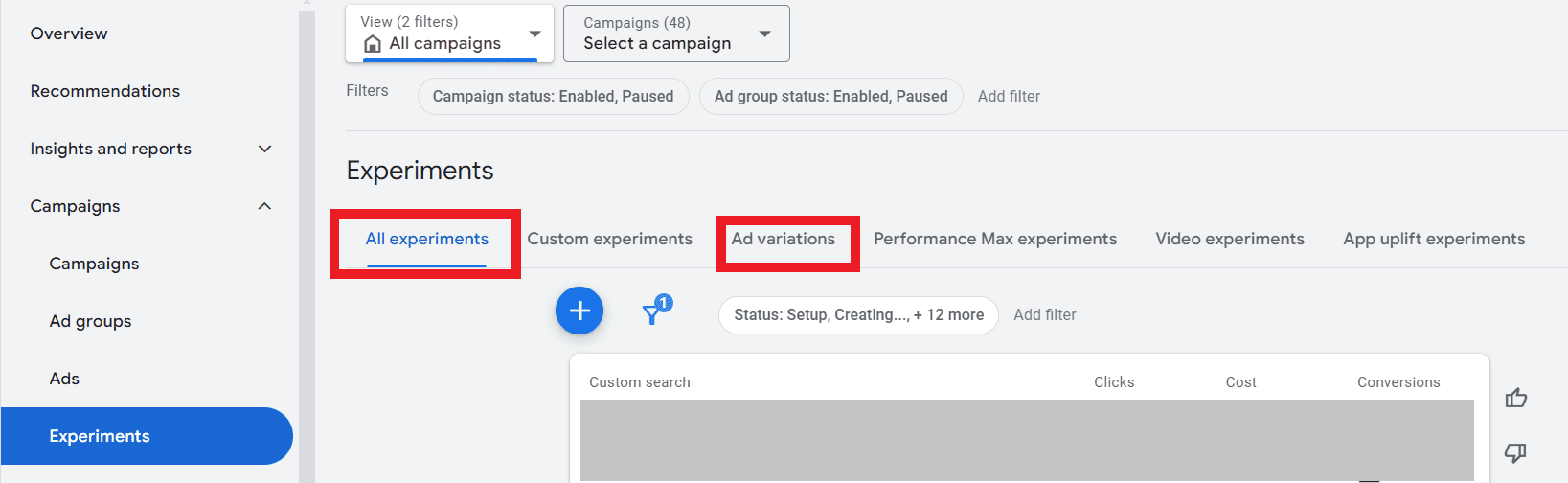
You can create ad variants or create an experiment directly in Google Ads for more precise A/B testing.
Screenshot taken by author, May 2024
It’s also important to test one element at a time to isolate the impact of each change. Testing too many elements at once can muddy up analysis.
7. Utilize Ad Assets
Ad assets are a great way to help influence a click to your website, which can help improve conversion rates.
Assets like callouts, structured snippets, and sitelinks can provide additional detail that couldn’t be shown in headlines or descriptions.
When your Ad Rank is higher, you have a better likelihood of showing ad assets, which helps increase the overall visibility of your ad.
Your ad assets can be customized to fit your campaign goals, and can even show specific promotions, special product features, and social proof like seller ratings.
8. Don’t Be Shy With Negative Keywords
A sound negative keyword strategy is one of the best ways to improve Google Ads conversion rates.
You may be wasting your paid search budget on keywords that aren’t producing conversions.
You may also notice that some broad keywords have gone rogue and are triggering your ads for terms they definitely shouldn’t be showing up for!
As mentioned earlier, the search terms report can help mitigate a lot of these types of keywords.
You can choose to add negative keywords at the following levels:
Ad group.
Campaign.
Negative keyword lists to apply to campaigns.
You also have the ability to add negative keywords as Broad, Phrase, or Exact match.
Alleviating poor-performing keywords allows your budget to optimize for your core keyword sets that lead to conversions.
9. Set Proper Bid Strategies
The type of bid strategy you choose for your Google Ads campaigns can make or break performance.
In recent years, Google has moved towards its fully automated bidding strategies, using machine learning to align performance with the chosen goal and bid strategy.
Currently, Google has five Smart Bidding strategies focused on conversion-based goals:
Target CPA (Cost-Per-Action): Helps increase conversions while targeting a specific CPA.
Target ROAS (Return on Ad Spend): Helps increase conversions while targeting a specific ROAS.
Maximize Conversions: Optimizes for conversions, not focused on a target ROAS outcome, and spends the entire budget.
Maximize Conversion Value: Optimizes for conversion value, not focused on a target ROAS outcome, and spends the entire budget.
Enhanced CPC: A way to automatically adjust your manual bids to try to maximize conversions.
Choosing the right bidding strategy is just one piece of the puzzle.
The inputs of the chosen bid strategy are just as important, where more context is needed to have a successful campaign.
For example, suppose you choose a Target CPA bid strategy for a search campaign and set the target CPA to $50.
However, in that campaign, you notice that your average CPC ranges anywhere from $10-$20.
Suddenly, your impressions go down, and you’re not sure what’s happening!
It could be your bid strategy inputs.
In the example above, if you have high CPCs but set your target CPA to just slightly higher than the CPCs, that means you need to have a stellar conversion rate in order to stay within that $50 CPA threshold.
Additionally, many make the mistake of setting the same target CPA for all campaigns, regardless of Brand or Non-Brand intent.
Most often, Non-Brand keywords will have much higher CPAs than Brand terms, so the inputs should be set accordingly based on performance.
Make sure you set your Target CPA thresholds high enough initially for the campaigns to gather information to meet expectations.
10. Add Audience Segmentation
As keyword match types tend to get looser, there is more emphasis on leveraging audience segmentation to reach the right people.
Using audience segments allows you to tailor your ads towards specific groups or utilize audiences as exclusions so your ads aren’t triggered.
Examples of audience segments within Google Ads include:
Demographics: Can be based on gender, age, household income, education, and other areas.
Interests and behaviors: Based on hobbies, lifestyle choices, website browsing behavior, and purchase history.
Actively researching or planning: Based on a user’s past or recent purchase intent.
Past interactions with your business: Can be based off previous engagements like website visits, add-to-cart, other online interactions, existing customer relationship management (CRM) data, and more.
By segmenting audiences within your PPC campaigns, you can customize ad messaging based on those segments.
This can lead to maximizing relevance and engagement, ultimately increasing conversion rates.
You can also use insights from GA4 to inform your segmentation strategy to identify high-value audience segments.
11. Create A Retargeting Strategy
On average, average e-commerce conversion rates range from 2.5 – 3%.
That means 97% of people leave a website without purchasing. Talk about a missed opportunity!
With a retargeting strategy in place, you have the opportunity to win back those missed customers and turn them into your brand champions.
Retargeting keeps track of website or app visitors who don’t take the desired action you’d like them to. You can create retargeting lists as niche or as broad as you prefer, but keep in mind that audiences must be a certain size before they’re eligible to use.
Examples of utilizing retargeting could be:
Creating segmented lists of users based on certain category pages of a website.
Users who have added an item to their cart but didn’t purchase it.
Users who have viewed at least three to five pages.
These segments can be used to create retargeting campaigns, which show those users ads to help increase the likelihood of them converting. Be sure to set those ad frequencies within the campaign so you don’t annoy your audience, though!
12. Offer Incentives
These days, shoppers are more accustomed to expecting a discount whenever they purchase.
There’s certainly an argument that programming people to buy only during a sale can diminish a product’s value perception.
However, there are strategies that can boost sales and conversion rates without devaluing the product.
If possible, try making the offers more personal towards the user and their behavior.
Additionally, you can set smaller windows of sale times and incorporate real-time purchase behavior so users can see how many people have taken advantage of the sale.
13. Choose The Right Location Settings
One of the easiest ways to waste precious PPC dollars is to set up location targeting wrong.
Google Ads offers multiple ways to geo-target locations within the campaign settings to help reach your goals.
Location targeting allows you to set specific locations for your ads to show, including:
City.
Region.
State.
Country.
Radius.
For example, if you have products that can only be purchased in the United States, you would likely target “United States” within the campaign setting.
Nowadays, it’s not as easy as just choosing “United States” (in this example). This is where advanced settings come in.
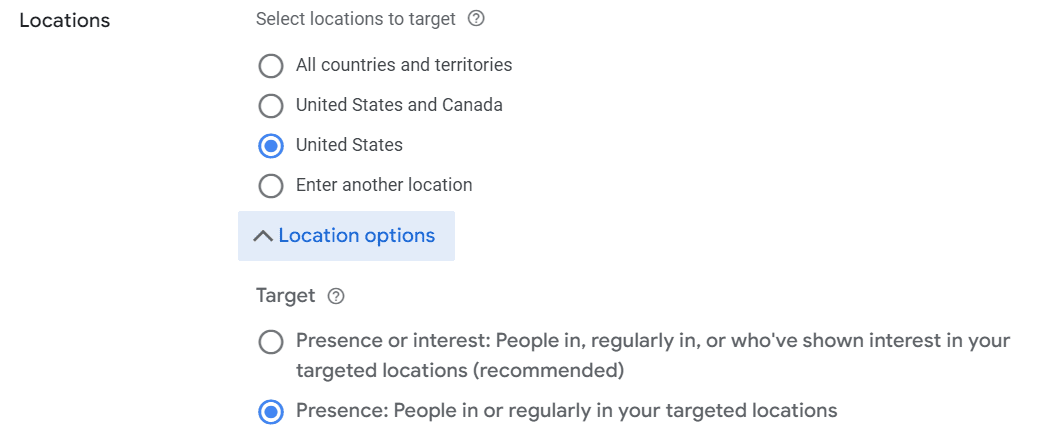
Within the Google campaign settings, you have two location-targeting options:
Presence or interest: People in, regularly in, or who’ve shown interest in your targeted location.
Presence: People in or regularly in your targeted locations.
Screenshot taken by author, May 2024
In the example above, it would make sense to choose “Presence” – otherwise, the campaign could show ads in areas where the products aren’t available.
If users in those countries click on the ad but see they can’t purchase when they get to the website, that is a recipe for poor conversion rates.
14. Use Social Proof To Build Trust
Brands can leverage social proof in their Google Ads campaigns to help boost conversion rates.
The goal of using social proof is to incorporate elements that demonstrate positive sentiment from customers, endorsements, or validation that the customer’s needs will be met.
There are many ways brands can add social proof to their campaigns:
Seller ratings ad asset.
Callout ad assets.
Adding customer reviews and testimonials to the landing page.
Share case studies and success stories on the landing page.
Additionally, strategies like creating limited-time offers with an emphasis on social proof can help boost sales and conversion rates.
This could mean showing in real-time how many customers have taken advantage of the offer, which creates urgency for the customer to act.
Focusing on social proof and validation can build trust, credibility, and confidence among potential customers – ultimately leading to higher conversion rates.
15. Schedule Your Ads Based on Performance
Ad scheduling is an underestimated tool in Google Ads that helps improve conversion rates.
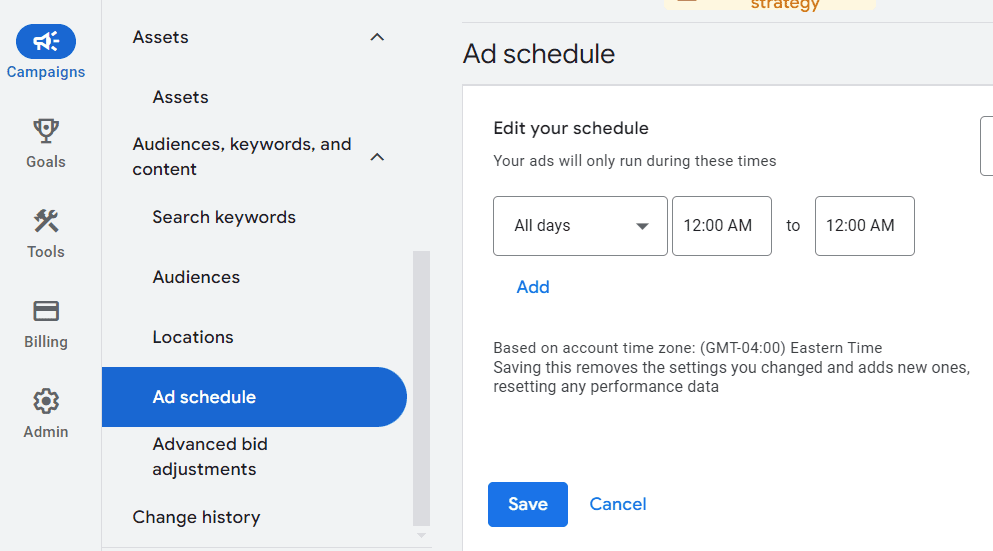
The beauty of ad scheduling is that you can control when your ad will or will not show.
Make sure to have ample budget and schedule ads when potential customers are most actively searching and are more engaged.
This can lead to higher effectiveness of the campaign and increased conversion rates.
For example, if you run a B2B software company, it’s highly unlikely that potential customers are searching in the middle of the night.
Optimize your spend by not showing ads at certain times of the day (such as the middle of the night) or days of the week (like weekends).
Screenshot taken by author, May 2024
If you’re not sure how to start optimizing campaigns by time, consider the following:
Use tools like GA4 to understand when most purchases are happening on the website.
Look for trends like website traffic, conversion times, engagement rates, etc., by time.
Align your ad schedule with peak business operations times, especially if customer service is involved.
Adjust ad schedules around key events like holidays or peak seasonality.
In Summary
There’s no magic bullet in Google Ads that will guarantee high conversion rates.
There are many variables that can add up to the overall performance of a campaign.
Small tweaks and optimizations like the 15 examples above can go a long way in increasing your Google Ads conversion rates.
From refining keyword selections and testing ad copy to improving your landing pages for optimal user experience, these strategies can help maximize the effectiveness of your PPC efforts.
On Tuesday, the FDA asked a panel of experts to weigh in on whether the evidence shows that MDMA, also known as ecstasy, is a safe and efficacious treatment for PTSD. The answer was a resounding no. Just two out of 11 panel members agreed that MDMA-assisted therapy is effective. And only one panel member thought the benefits of the therapy outweighed the risks.
The outcome came as a surprise to many, given that trial results have been positive. And it is also a blow for advocates who have been working to bring psychedelic therapy into mainstream medicine for more than two decades. This isn’t the final decision on MDMA. The FDA has until August 11 to make that ruling. But while the agency is under no obligation to follow the recommendations of its advisory committees, it rarely breaks with their decisions.
Today on The Checkup, let’s unpack the advisory committee’s vote and talk about what it means for the approval of other recreational drugs as therapies.
One of the main stumbling blocks for the committee was the design of the two efficacy studies that have been completed. Trial participants weren’t supposed to know whether they were in the treatment group, but the effects of MDMA make it pretty easy to tell whether you’ve been given a hefty dose, and most correctly guessed which group they had landed in.
In 2021, MIT Technology Review’s Charlotte Jee interviewed an MDMA trial participant named Nathan McGee. “Almost as soon as I said I didn’t think I’d taken it, it kicked in. I mean, I knew,” he told her. “I remember going to the bathroom and looking in the mirror, and seeing my pupils looking like saucers. I was like, ‘Wow, okay.’”
The Multidisciplinary Association for Psychedelic Studies, better known as MAPS, has been working with the FDA to develop MDMA as a treatment since 2001. When the organization met with the FDA in 2016 to hash out the details of its phase III trials, studies to test whether a treatment works, agency officials suggested that MAPS use an active compound for the control group to help mask whether participants had received the drug. But MAPS pushed back, and the trial forged ahead with a placebo.
No surprise, then, that about 90% of those assigned to the MDMA group and 75% of those assigned to the placebo group accurately identified which arm of the study they had landed in. And it wasn’t just participants. Therapists treating the participants also likely knew whether those under their supervision had been given the drug. It’s called “functional unblinding,” and the issue came up at the committee meeting again and again. Here’s why it’s a problem: If a participant strongly believes that MDMA will help their PTSD and they know they’ve received MDMA, this expectation bias could amplify the treatment effect. This is especially a problem when the outcome is based on subjective measures like how a person feels rather than, say, laboratory data.
Another sticking point was the therapy component of the treatment. Lykos Therapeutics (the for-profit spinoff of MAPS) asked the FDA to approve MDMA-assisted therapy: that’s MDMA administered in concert with psychotherapy. Therapists oversaw participants during the three MDMA sessions. But participants also received three therapy sessions before getting the drug, and three therapy sessions afterwards to help them process their experience.
Because the two treatments were administered together, there was no good way to tell how much of the effect was due to MDMA and how much was due to the therapy. What’s more, “the content or approach of these integrated sessions was not standardized in the treatment manuals and was mainly left up to the individual therapist,” said David Millis, a clinical reviewer for the FDA, at the committee meeting.
Several committee members also raised safety concerns. They worried that MDMA’s effects might make people more suggestible and vulnerable to abuse, and they brought up allegations of ethics violations outlined in a recent report from the Institute for Clinical and Economic Review.
Because of these issues and others, most committee members felt compelled to vote against MDMA-assisted therapy. “I felt that the large positive effect was denuded by the significant confounders,” said committee member Maryann Amirshahi, a professor of emergency medicine at Georgetown University School of Medicine, after the vote. “Although I do believe that there was a signal, it just needs to be better studied.”
Whether this decision will be a setback for the entire field remains to be seen. “To make it crystal clear: It isn’t MDMA itself that was rejected per se, but the specific, poor data set provided by Lykos Therapeutics; in my opinion, there is still a strong chance that MDMA, with a properly conducted clinical Phase 3 trial program that addresses those concerns of the FDA advisory committee, will get approved.” wrote Christian Angermayer, founder of ATAI Therapeutics, a company that is also working to develop MDMA as a therapy.
If the FDA denies approval of MDMA therapy, Lykos or another company could conduct additional studies and reapply. Many of the committee members said they believed MDMA does hold promise, but that the studies conducted thus far were inadequate to demonstrate the drug’s safety and efficacy.
Psilocybin is likely to be the next psychedelic therapy considered by the FDA, and in some ways, it might have an easier path to approval. The idea behind MDMA is that it alleviates PTSD by helping facilitate psychotherapy. The therapy is a crucial component of the treatment, which is problematic because the FDA regulates drugs, not psychotherapy. With psilocybin, a therapist is present, but the drug appears to do the heavy lifting. “We are not offering therapy; we are offering psychological support that’s designed for the patient’s safety and well-being,” says Kabir Nath, CEO of Compass Pathways, the company working to bring psilocybin to market. “What we actually find during a six- to eight-hour session is most of it is silent. There’s actually no interaction.”
That could make the approval process more straightforward. “The difficult thing … is that we don’t regulate psychotherapy, and also we don’t really have any say in the design or the implementation of the particular therapy that is going to be used,” said Tiffany Farchione, director of the FDA’s division of psychiatry, at the committee meeting. “This is something unprecedented, so we certainly want to get as many opinions and as much input as we can.”
Sally Adee dives deep into the messy history of electric medicine and what the future might hold for research into electric therapies. “Instead of focusing only on the nervous system—the highway that carries electrical messages between the brain and the body—a growing number of researchers are finding clever ways to electrically manipulate cells elsewhere in the body, such as skin and kidney cells, more directly than ever before,” she writes.
MDMA does seem to have helped some individuals. Nathan McGee, who took the drug as part of a clinical trial, told Charlotte Jee that he “understands what joy is now.”
Researchers are working to design virtual-reality programs that recreate the trippy experience of taking psychedelics. Hana Kiros has the story.
– Finland is poised to become the first country to start administering bird flu vaccine—albeit to a very limited subset of people, including poultry and mink farmers, vets, and scientists who study the virus (Stat)
– What are the most pressing questions about bird flu? They revolve around what’s happening in cows, what’s happening in farm workers, and what’s happening to the virus. (Stat)
– A man in Mexico has died of H5N2, a strain of bird flu that has never before been reported in humans. (CNN)
Biodegradable, squishy sensors injected into the brain hold promise for detecting changes following a head injury or cancer treatment. (Nature)
A synthetic version of a hallucinogenic toad toxin could be a promising treatment for mental-health disorders. (Undark)
Marketing Live is Google’s annual conference to announce new advertising features. This year’s event, on May 21, emphasized AI initiatives. Many changes — from Performance Max to Search — apply to ecommerce companies.
Google announced over 30 updates. In this post, I’ll review the 10 most impactful to merchants.
Ad Updates for Merchants
Ads in AI Overviews
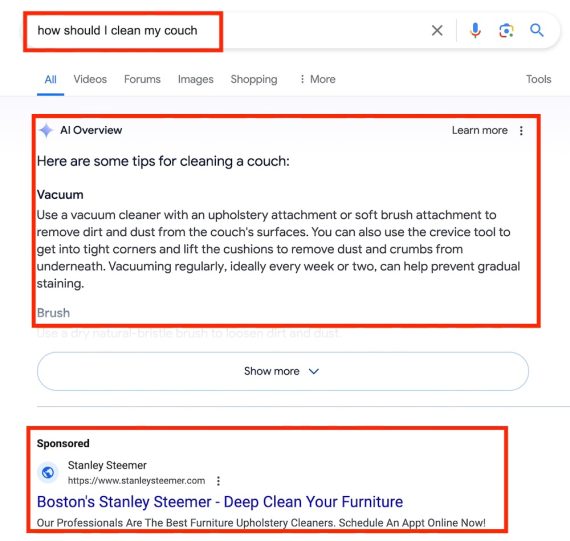
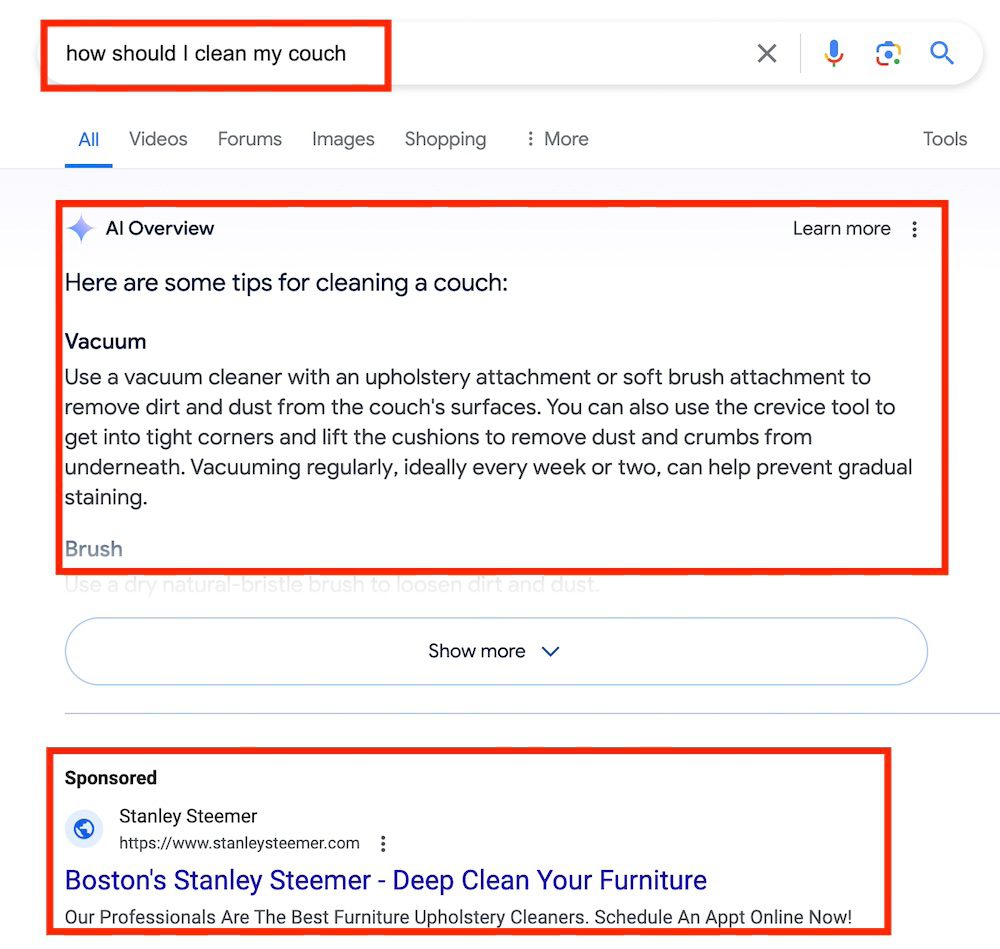
AI Overviews is Google’s response to a query, displayed directly on search results. Google scrapes Overviews from external sites and then inserts limited links to those sources. Google Ads can show above or below Overviews and, soon, in them.
For example, the query “how should I clean my couch” produces an Overview with an ad for cleaning services below it.
The query “how should I clean my couch” produces an AI Overview with a related ad below it. Click image to enlarge.
Shopping ads in visual search
Shopping ads now appear at the top of visual search results. Consumers don’t search by text alone. They may see an item, take a picture, and then search on that image for options to purchase. Google Lens or Circle to Search provides this functionality.
3D images
A coming feature later this year in Shopping ads is 360-degree views. Merchants can provide Google with footwear images, and AI will repurpose them into three-dimensional spins, giving shoppers a more complete look. Likely the feature will roll out to more categories.
Profit optimization
Advertisers can soon optimize Performance Max and Standard Shopping campaigns for profit. The feature is not a new bid type; instead, it uses cart-level conversions and Merchant Center account data to highlight products with higher margins. Advertisers have long maximized profits manually by creating campaigns around specific products. This new feature will make it easier.
Shopping ads by customer type
Many ecommerce stores have separate marketing programs for customers versus prospects. Merchants can now include those promotions in Shopping ads and customize by user type. Google hasn’t explained how, but my guess is via Customer Match. Advertisers can upload customers’ info and show ads to that group. Everyone else is a prospect.
Brand standards
Advertisers can soon upload brand guidelines such as colors and fonts when creating Performance Max and Demand Gen campaigns. Google’s AI would then create images that match the guidelines or produce variants to test. This feature ensures advertisers’ branding is consistent across sites and platforms.
Performance Max asset-level reporting
A common frustration with Performance Max campaigns is the lack of conversion data by asset. Advertisers can see conversion performance at the ad level but not individual assets. Hence Headline 1 could generate more sales than Headline 3, but an advertiser wouldn’t know it. Until now. Asset-level reporting will be invaluable.
YouTube transparency in Performance Max
Performance Max campaigns include YouTube video ads. Advertisers can set account-level YouTube exclusions but cannot view the performance of individual placements. That’s now changing. YouTube advertisers in Performance Max can soon see conversion data by placement and adjust budgets as needed.
Lower lookalike threshold
Google Ads demand generation campaigns resemble those on social media platforms such as Meta and LinkedIn. Such campaigns don’t often drive sales, but they do grow top-of-the-funnel audiences. The critical segment with the Demand Gen type is lookalikes. Advertisers upload a list of customer email addresses, and Google creates a lookalike segment to target, similar to Meta’s program.
The challenge has been Google Ads needs at least 1,000 contacts to create the segment. That’s not always attainable for smaller advertisers. But now, as announced at Marketing Live, Google requires only 100 contacts.
AI Essentials
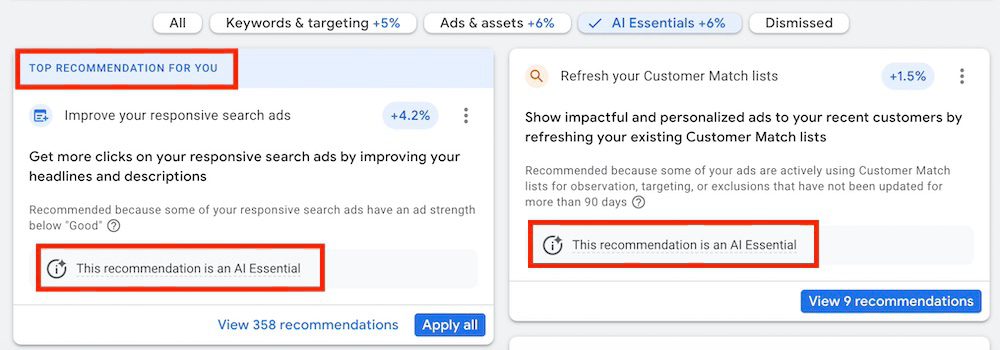
Google Ads recommends optimization tactics in its interface. Many don’t make sense, although they inform Google’s priorities, which include growing advertising revenue. In the example below, Google recommends driving more traffic by updating responsive search ads and customer match lists. But more traffic isn’t always advertisers’ primary goal, although it does produce more revenue for Google.
The “AI Essentials” portion of the recommendations is new. It states where and how advertisers should use Google’s AI. But be wary. Carefully weigh each recommendation.
The new “AI Essentials” recommendations states where and how advertisers should use Google’s AI. Click image to enlarge.
Automattic, the company behind WordPress.com, Jetpack, WooCommerce and more, have announced a new program to woo Agencies into their ecosystem of products with more ways to earn revenue.
This new program could be seen as putting Automattic into direct competition with closed source systems like Wix and Duda but there are clear differences between all three products and services.
Automattic For Agencies
Automattic for Agencies brings together multiple Automattic products into a single service with a dashboard for managing multiple client sites and billing. The program offers a unified locations for managing client sites as well as discounted pricing and revenue sharing opportunities. Aside from the benefits of streamlining the program also offers technical support across all of the Automattic products that are a part of the program. Lastly the program offers agencies managed security and performance improvements.
According to the announcement:
“We worry about site performance and security so you don’t have to. When you connect your sites to the Automattic for Agencies dashboard, you’ll receive instant notifications about updates and alerts, so your sites stay problem-free and your clients stay happy.”
Revenue Share And Discounts
Agencies can now earn a revenue share of the Automattic products used by clients. For example, agencies can earn a 50% revenue share on Jetpack product referrals, including renewals. As part of the program Jetpack also offers discounts on licenses, starting at 10% off for five licenses and to as high as 50% off for 100 licenses.
WordPress.com, the managed WordPress hosting subsidiary of Automattic, is offering a 20% revenue share on new subscriptions and a 50% share on migrations from other hosts.
A tweet from WordPress.com described the new program:
“Agencies, we’ve got some news for you!
Our new referral program is live, and as a referrer of http://WordPress.com’s services, your agency will receive a 20% revenue share on new subscriptions and 50% on new migrations to http://WordPress.com from other hosting providers.”
New Directory For Agencies
A forthcoming benefit of the Autommatic For Agencies program is a business directory that lists agencies that are a part of the program. The benefit of the directory is presumably that it may lead to business referrals to the agencies.
The Jetpack announcement describes the new directory:
“Gain heightened visibility through multiple directory listings across Automattic’s business units. This increased exposure creates more opportunities for potential clients to find and engage with your services, helping you grow your agency’s reach and reputation.”
The WooCommerce announcement describes the directory like this:
“Expand your reach Increase your visibility with partner directory listings across multiple Automattic brands.”
Automattic Affiliate Program
The Automattic for Agencies announcement follows the rollout of a separate affiliate program which offers up to 100% referral bonus for affiliates who refer new hosting clients, with a limit of $300 payout per item, and up to 50% referral bonus for Jetpack plugin subscriptions. The program has a 30 day cookie conversion period which provides affiliates the opportunity to earn referral bonuses on any additional sales within a 30 day period.
I have an extremely confidential piece of information on a particular sheet of paper. This A4-sized paper contains a list of Christmas presents I plan to give to my family members.
To make sure that no one gets access to this information, I have hidden it in my home office, in the cupboard next to my desk. There you find a chunky English dictionary.
When you open the page where “Christmas” is listed, you will find my precious list, carefully folded into two.
But what if my children or my other half comes to look something up in an analogue dictionary? Arguably, the risk is small, but I am not taking any chances. I have a secret language called Japanese.
My family might find that piece of paper, but all they will see will be タータンチェックの野球帽 and 腕時計, which are basically hieroglyphs to them.
Thanks to this, my family enjoys wonderful moments exchanging gifts every Christmas. Just writing about this makes me grin, imagining the surprised faces and a burst of laughter, surrounded by the green scent of the Christmas tree and the obligatory mulled wine.
This motivates me to conceal this highly sensitive information even more!
We will discuss how companies and their marketing department can protect their secrets, and their data, so that they, too, can bring a smile to their customers’ faces.
Understanding Information Security
In some games, you have this “get out of jail card.” With these cards, you can avoid missing out on a round of games. What if I said GDPR has something similar?
It is called data security.
The GDPR provisions for data security are in line with the risk-based approach embedded in law, where risk is minimized, and more flexibility is given to controllers.
If it was encrypted, you do not need to inform your customers that there was a data breach. Not having to inform your customers saves the brand image your marketing department has been building for years.
That is one reason why data security is such an important discipline. Many organizations have a separate security department and a chief information security officer who heads the functional areas.
Those marketers who had security incidents published by news outlets must know how life-saving security colleagues can be in times of need.
Definition Of Information Strategy
The word data security is not found in Article 4 of GDPR, the article where definitions are listed. Instead, the word “security” appears in Article 5, where the basic premises of the data protection law are described.
In other words, data security is one of the main principles of the GDPR, “integrity and confidentiality.”
GDPR expects organizations to ensure the prevention of unauthorized or unlawful processing, accidental loss, destruction, or damage of data as one of the starting points for protecting personal data.
TOMs must be implemented to this end so that the integrity and confidentiality of the data are protected (Article 5(f) GDPR) (legislation.gov.uk, 2016).
Outside Of GDPR, Information Security Is Defined As Follows
Information security is the safeguarding of information and information systems against deliberate and unintentional unauthorized access, disruption, modification, and destruction by external or internal actors. (Gartner, Inc., 2023)
Information security is the technologies, policies, and practices you choose to help you keep data secure. (gov.uk, 2018)
Information security: The protection of information and information systems from unauthorized access, use, disclosure, disruption, modification, or destruction in order to provide confidentiality, integrity, and availability. (NIST, 2023)
Approach To Information Security
Just as marketing professionals created strategic frameworks – 4Ps, 7Ps, 4Cs, and so on – so the school of information security strategy has come up with frameworks: the CIA triad and the Parkerian Hexad.
CIA stands for Confidentiality, Integrity, and Availability.
Donn Parker, a security consultant, later expanded this framework with three more elements, namely Utility, Authenticity, and Possession.
Below is a brief description of the six aspects of the Parkerian Hexad (Bosworth et al, 2009).
Availability
Availability refers to the ability of the organization to access data. When, for instance, there is a loss of power and your marketers cannot access customer data, it is considered an availability problem.
The file is there, so it is not stolen. However, the marketer is temporarily unable to access the particular data.
Utility
Utility of the Parkerian Hexad relates to the problem of losing the usefulness of the data. For instance, if a campaign manager loses the encryption key to the data, the data is still there, and it can be accessed.
However, the data cannot be used because the emails needed for carrying out an email campaign are encrypted so they are useless.
Integrity
Maintaining integrity refers to preventing unauthorized changes to the data.
For instance, if an intern of the marketing department accidentally deletes the field “purchased more than two items” within the dataset, this is an integrity-related security incident.
If the manager of the intern can undo the deletion of the field, then the integrity of the data is intact.
Typically, integrity is maintained by assigning different access rights, such as read-only access for interns and read-and-write access for the marketing manager.
Authenticity
Authenticity relates to the attribution of data or information to the rightful owner or the creator of that data or information.
Imagine a situation where your advertising agency, acting as your data service provider, receives a fake email which instructs them to delete all your customer data.
The agency might think that it is a genuine instruction from your company, and executes the command. This is then an authenticity problem.
Confidentiality
When someone unauthorized gets access to a particular marketing analytic file, confidentiality is being breached.
Possession
The Parkerian Hexad uses the term possession to describe situations where data or information is stolen.
For instance, a malevolent employee of the marketing department downloads all the sales contact information to a mobile device and then deletes them from the network. This is a possession problem.
Risk Management
In addition to understanding the problems you are facing, using the Parkerian Hexad, your organization must know the potential security risks for the business.
Andress suggests a useful and generic five-step risk management process, for a variety of situations (Andress, 2019).
Step 1: Identify Assets
Before your organization can start managing your marketing department’s risks, you need to map out all data assets belonging to your marketing department.
In doing so, all data, some distributed in different systems or entrusted to service providers, must be accounted for.
Once this exercise is completed, your marketing department can determine which data files are the most critical. RoPA, with all processes of personal data mapped out, can be leveraged for this exercise.
Step 2: Identify Threats
For all data files and processes identified in the previous step, potential threats are determined. This may mean holding a brainstorming session with marketers and security and data protection departments to go through the data and processes one by one.
The Parkerian Hexad from the previous section can be a great help in guiding through such sessions. It will also be helpful to identify the most critical data and processes during this exercise.
Step 3: Assess Vulnerabilities
In this step, for each data-use surfaced in Step 2, relevant threats are identified.
In doing so, the context of your organization’s operation, products and services sold, vendor relations as well as the physical location of the company premises are considered.
Step 4: Assess Vulnerabilities
In this step, the threats and vulnerabilities for each data and process are compared and assigned risk levels.
Vulnerabilities with no corresponding threats or threats with no associated vulnerabilities will be seen as not having any risk.
Step 5: Mitigate Risks
For the risks that surfaced in Step 4, measures necessary to prevent them from occurring will be determined during this stage.
Andress identifies three types of controls that can be used for this purpose. The first type of control, logical control, protects the IT environment for processing your customer data, such as password protection and the placing of firewalls.
The second type of control is administrative control, which is usually deployed in the form of corporate security policy, which the organization can enforce. The last type of control is physical control.
As the name suggests, this type of control protects the business premises and makes use of tools such as CCTV, keycard-operated doors, fire alarms, and backup power generators.
With the time, risks may change.
For instance, your marketing department may be physically relocated to a new building, changing the physical security needs, or your company might decide to migrate from a physical server to a cloud-based hosting service, which means your customer data will have to move, too.
Both such situations necessitate a new round of the risk management process to kick off.
In general, it is advisable to revisit the risk management process on a regular interval, say annually, to keep your company on top of all risks your marketing department, and beyond, carry.
Approaching Risk Management With Three Lines Of Defence
Institute of Internal Auditors (IIA) established a risk management model called Three Lines of Defence.
The model requires three internal roles: (1) the governing body, with oversight of the organization, (2) senior management, which takes risk management actions and reports to the governing body, and (3) internal audit, which provides independent assurance, to work together and act as robust protections to the organization (IIA, 2020).
The elements of the Three Lines of Defence are (IIA, 2020):
First Line Of Defence
Manage risks associated with day-to-day operational activities. Senior management has the primary responsibility, and emphasis is put on people and culture.
Marketing managers’ task here is to make sure that their department is aware of data protection risks, including security risks, and are following relevant corporate policies.
Second Line Of Defence
Identify risks in the daily business operation of the business. Security, data protection, and risk management teams carry out monitoring activities.
Senior management, including the CMO, is ultimately accountable for this line of defence. A well-functioning second line of defence requires good cooperation between marketing and security, data protection, and risk management teams.
Practically, it would mean understanding the importance of operational-level auditing and providing input to the security team, even when there are other pressing deadlines and business issues.
Third Line Of Defence
Provide independent assurance on risk management by assessing the first and second lines of defence. Independent corporate internal audit teams usually have this role.
Here, too, the marketing department will be asked to cooperate during audits. Assurance results reported to the governance body inform the strategic business actions for the senior management team.
References
Andress, J (2019) Foundations of information security, No Starch Press, October 2019.
Bosworth, S, Whyne, E and Kabay, M E (2009) Computer Security Handbook, 5th edn, Wiley, chapter 3: Toward a new framework for information security, Donn B Parker
Gartner, Inc. (2023) Information technology: Gartner glossary, www.gartner.com/ en/information-technology/glossary/information-security (archived at https:// perma.cc/JP27-6CAN)
IIA (2020) The Institute of Internal Auditors (IIA), The IIA”s Three Lines model, an update of the Three Lines of Defense, July 2020, www.theiia.org/globalassets/documents/resources/the-iias-three-lines-model-an-update-of-the-three-lines-ofdefense-july-2020/three-lines-model-updated-english.pdf (archived at https://perma.cc/9HX7-AU4H)
legislation.gov.uk (2016) Regulation (EU) 2016/679 of the European Parliament and of the Council, 27 April 2016, www.legislation.gov.uk/eur/2016/679/ contents (archived at https://perma.cc/NVG6-PXBQ)
NIST (2023) National Institute of Standards and Technology, US Department of Commerce, Computer Security Resource Centre, Information Technology Laboratory, Glossary, updated 28 May 2023, https://csrc.nist.gov/glossary/term/ information_security (archived at https://perma.cc/TE3Z-LN94); https://csrc. nist.gov/glossary/term/non_repudiation (archived at https://perma.cc/DJ4A- 44N2)
To read the full book, SEJ readers have an exclusive 25% discount code and free shipping to the US and UK. Use promo code SEJ25 at koganpage.com here.
More resources:
Featured Image: Paulo Bobita/Search Engine Journal
Google published a case study that shows how using structured data and following best practices improved discoverability and brought more search traffic. The case study was about the use of Video structured data but the insights shared are applicable across a range of content types.
The new case study is about an Indonesian publisher called Vidio.
How CDNs Can Cause Indexing Problems
One of the interesting points in the case study is about an issue related to how CDNs can link to image and video files with expiring URLs. The new documentation specifically mentions that it’s important that the CDN uses stable URLs and links to another Google documentation page that goes into more detail.
Google explains that some CDNs use quickly expiring URLs for video and thumbnail files and encourages publishers and SEOs to use just one stable URL for each video. Something interesting to note is that not only does this help Google index the files it also helps Google collect user interest signals.
“Some CDNs use quickly expiring URLs for video and thumbnail files. These URLs may prevent Google from successfully indexing your videos or fetching the video files. This also makes it harder for Google to understand users’ interest in your videos over time.
Use a single unique and stable URL for each video. This allows Google to discover and process the videos consistently, confirm they are still available and collect correct signals on the videos.”
Implementing The Correct Structured Data
Google highlighted the importance of using the correct structured data and validating it with Google’s structured data testing tool.
These are the results of the above work:
“Within a year of implementing VideoObject markup, Vidio saw improvements in impressions and clicks on their video pages. While the number of videos that Vidio published from Q1 2022 to Q1 2023 increased by ~30%, adding VideoObject markup made their videos eligible for display in various places on Google.
This led to an increase of ~3x video impressions and close to 2x video clicks on Google Search. Vidio also used the Search Console video indexing report and performance report, which helped them to identify and fix issues for their entire platform.”
Indexing + Structured Data = More Visibility
The keys to better search performance were ensuring that Google is able to crawl the URLs, which is something that can easily be overlooked in the rush to correlate a drop in rankings to a recent algorithm update. Never rule anything out during a site audit.
Another thing the case study recommends that is important is to assure that the proper structured data is being used. Using the appropriate structured data can help make a webpage qualify for improved search visibility through one of Google’s enhanced search features like featured snippets.
Search is evolving at an incredible pace and new features, formats, and even new search engines are popping up within the space.
Google’s algorithm still prioritizes backlinks when ranking websites. If you want your website to be visible in search results, you must account for backlinks and your backlink profile.
A healthy backlink profile requires a diverse backlink profile.
In this guide, we’ll examine how to build and maintain a diverse backlink profile that powers your website’s search performance.
What Does A Healthy Backlink Profile Look Like?
As Google states in its guidelines, it primarily crawls pages through links from other pages linked to your pages, acquired through promotion and naturally over time.
In practice, a healthy backlink profile can be divided into three main areas: the distribution of link types, the mix of anchor text, and the ratio of followed to nofollowed links.
Let’s look at these areas and how they should look within a healthy backlink profile.
Distribution Of Link Types
One aspect of your backlink profile that needs to be diversified is link types.
It looks unnatural to Google to have predominantly one kind of link in your profile, and it also indicates that you’re not diversifying your content strategy enough.
Some of the various link types you should see in your backlink profile include:
Anchor text links.
Image links.
Redirect links.
Canonical links.
Here is an example of the breakdown of link types at my company, Whatfix (via Semrush):
Screenshot from Semrush, May 2024
Most links should be anchor text links and image links, as these are the most common ways to link on the web, but you should see some of the other types of links as they are picked up naturally over time.
Mix Of Anchor Text
Next, ensure your backlink profile has an appropriate anchor text variance.
Again, if you overoptimize for a specific type of anchor text, it will appear suspicious to search engines like Google and could have negative repercussions.
Here are the various types of anchor text you might find in your backlink profile:
Branded anchor text – Anchor text that is your brand name or includes your brand name.
Empty – Links that have no anchor text.
Naked URLs – Anchor text that is a URL (e.g., www.website.com).
Exact match keyword-rich anchor text – Anchor text that exactly matches the keyword the linked page targets (e.g., blue shoes).
Partial match keyword-rich anchor text – Anchor text that partially or closely matches the keyword the linked page targets (e.g., “comfortable blue footwear options”).
Generic anchor text – Anchor text such as “this website” or “here.”
To maintain a healthy backlink profile, aim for a mix of anchor text within a similar range to this:
Branded anchor text – 35-40%.
Partial match keyword-rich anchor text – 15-20%.
Generic anchor text -10-15%.
Exact match keyword-rich anchor text – 5-10%.
Naked URLs – 5-10%.
Empty – 3-5%.
This distribution of anchor text represents a natural mix of differing anchor texts. It is common for the majority of anchors to be branded or partially branded because most sites that link to your site will default to your brand name when linking. It also makes sense that the following most common anchors would be partial-match keywords or generic anchor text because these are natural choices within the context of a web page.
Exact-match anchor text is rare because it only happens when you are the best resource for a specific term, and the site owner knows your page exists.
Ratio Of Followed Vs. Nofollowed Backlinks
Lastly, you should monitor the ratio of followed vs. nofollowed links pointing to your website.
If you need a refresher on what nofollowed backlinks are or why someone might apply the nofollow tag to a link pointing to your site, check out Google’s guide on how to qualify outbound links to Google.
Nofollow attributes should only be applied to paid links or links pointing to a site the linking site doesn’t trust.
While it is not uncommon or suspicious to have some nofollow links (people misunderstand the purpose of the nofollow attribute all the time), a healthy backlink profile will have far more followed links.
You should aim for a ratio of 80%:20% or 70%:30% in favor of followed links. For example, here is what the followed vs. nofollowed ratio looks like for my company’s backlink profile (according to Ahrefs):
Screenshot from Ahrefs, May 2024
You may see links with other rel attributes, such as UGC or Sponsored.
The “UGC” attribute tags links from user-generated content, while the “Sponsored” attribute tags links from sponsored or paid sources. These attributes are slightly different than the nofollow tag, but they essentially work the same way, letting Google know these links aren’t trusted or endorsed by the linking site. You can simply group these links in with nofollowed links when calculating your ratio.
Importance Of Diversifying Your Backlink Profile
So why is it important to diversify your backlink profile anyway? Well, there are three main reasons you should consider:
Avoiding overoptimization.
Diversifying traffic sources.
And finding new audiences.
Let’s dive into each of these.
Avoiding Overoptimization
First and foremost, diversifying your backlink profile is the best way to protect yourself from overoptimization and the damaging penalties that can come with it.
As SEO pros, our job is to optimize websites to improve performance, but overoptimizing in any facet of our strategy – backlinks, keywords, structure, etc. – can result in penalties that limit visibility within search results.
In the previous section, we covered the elements of a healthy backlink profile. If you stray too far from that model, your site might look suspicious to search engines like Google and you could be handed a manual or algorithmic penalty, suppressing your rankings in search.
Considering how regularly Google updates its search algorithm these days (and how little information surrounds those updates), you could see your performance tank and have no idea why.
This is why it’s so important to keep a watchful eye on your backlink profile and how it’s shaping up.
Diversifying Traffic Sources
Another reason to cultivate a diverse backlink profile is to ensure you’re diversifying your traffic sources.
Google penalties come swiftly and can often be a surprise. If you have all your eggs in that basket when it comes to traffic, your site will suffer badly and might need help to recover.
However, diversifying your traffic sources (search, social, email, etc.) will mitigate risk – similar to a stock portfolio – as you’ll have other traffic sources to provide a steady flow of visitors if another source suddenly dips.
Part of building a diverse backlink profile is acquiring a diverse set of backlinks and backlink types, and this strategy will also help you find differing and varied sources of traffic.
Finding New Audiences
Finally, building a diverse backlink profile is essential, as doing so will also help you discover new audiences.
If you acquire links from the same handful of websites and platforms, you will need help expanding your audience and building awareness for your website.
While it’s important to acquire links from sites that cater to your existing audience, you should also explore ways to build links that can tap into new audiences. The best way to do this is by casting a wide net with various link acquisition tactics and strategies.
A diverse backlink profile indicates a varied approach to SEO and marketing that will help bring new visitors and awareness to your site.
Building A Diverse Backlink Profile
So that you know what a healthy backlink profile looks like and why it’s important to diversify, how do you build diversity into your site’s backlink profile?
This comes down to your link acquisition strategy and the types of backlinks you actively pursue. To guide your strategy, let’s break link building into three main categories:
Foundational links.
Content promotion.
Community involvement.
Here’s how to approach each area.
Foundational Links
Foundational links represent those links that your website simply should have. These are opportunities where a backlink would exist if all sites were known to all site owners.
Some examples of foundational links include:
Mentions – Websites that mention your brand in some way (brand name, product, employees, proprietary data, etc.) on their website but don’t link.
Partners – Websites that belong to real-world partners or companies you connect with offline and should also connect (link) with online.
Associations or groups – Websites for offline associations or groups you belong to where your site should be listed with a link.
Sponsorships – Any events or organizations your company sponsors might have websites that could (and should) link to your site.
Sites that link to competitors – If a website is linking to a competitor, there is a strong chance it would make sense for them to link to your site as well.
These link opportunities should set the foundation for your link acquisition efforts.
As the baseline for your link building strategy, you should start by exhausting these opportunities first to ensure you’re not missing highly relevant links to bolster your backlink profile.
Content Promotion
Next, consider content promotion as a strategy for building a healthy, diverse backlink profile.
Content promotion is much more proactive than the foundational link acquisition mentioned above. You must manifest the opportunity by creating link-worthy content rather than simply capitalizing on an existing opportunity.
Some examples of content promotion for links are:
Digital PR – Digital PR campaigns have numerous benefits and goals beyond link acquisition, but backlinks should be a primary KPI.
Original research – Similar to digital PR, original research should focus on providing valuable data to your audience. Still, you should also make sure any citations or references to your research are correctly linked.
Guest content – Whether regular columns or one-off contributions, providing guest content to websites is still a viable link acquisition strategy – when done right. The best way to gauge your guest content strategy is to ask yourself if you would still write the content for a site without guaranteeing a backlink, knowing you’ll still build authority and get your message in front of a new audience.
Original imagery – Along with research and data, if your company creates original imagery that offers unique value, you should promote those images and ask for citation links.
Content promotion is a viable avenue for building a healthy backlink profile as long as the content you’re promoting is worthy of links.
Community Involvement
Community involvement is the final piece of your link acquisition puzzle when building a diverse backlink profile.
After pursuing all foundational opportunities and manually promoting your content, you should ensure your brand is active and represented in all the spaces and communities where your audience engages.
In terms of backlinks, this could mean:
Wikipedia links – Wikipedia gets over 4 billion monthly visits, so backlinks here can bring significant referral traffic to your site. However, acquiring these links is difficult as these pages are moderated closely, and your site will only be linked if it is legitimately a top resource on the web.
Forums (Reddit, Quora, etc.) – Another great place to get backlinks that drive referral traffic is forums like Reddit and Quora. Again, these forums are strictly moderated, and earning link placements on these sites requires a page that delivers significant and unique value to a specific audience.
Social platforms – Social media platforms and groups represent communities where your brand should be active and engaged. While these strategies are likely handled by other teams outside SEO and focus on different metrics, you should still be intentional about converting these interactions into links when or where possible.
Offline events – While it may seem counterintuitive to think of offline events as a potential source for link acquisition, legitimate link opportunities exist here. After all, most businesses, brands, and people you interact with at these events also have websites, and networking can easily translate to online connections in the form of links.
While most of the link opportunities listed above will have the nofollow link attribute due to the nature of the sites associated with them, they are still valuable additions to your backlink profile as these are powerful, trusted domains.
These links help diversify your traffic sources by bringing substantial referral traffic, and that traffic is highly qualified as these communities share your audience.
How To Avoid Developing A Toxic Backlink Profile
Now that you’re familiar with the link building strategies that can help you cultivate a healthy, diverse backlink profile, let’s discuss what you should avoid.
As mentioned before, if you overoptimize one strategy or link, it can seem suspicious to search engines and cause your site to receive a penalty. So, how do you avoid filling your backlink profile with toxic links?
Remember The “Golden Rule” Of Link Building
One simple way to guide your link acquisition strategy and avoid running afoul of search engines like Google is to follow one “golden rule.”
That rule is to ask yourself: If search engines like Google didn’t exist, and the only way people could navigate the web was through backlinks, would you want your site to have a link on the prospective website?
Thinking this way strips away all the tactical, SEO-focused portions of the equation and only leaves the human elements of linking where two sites are linked because it makes sense and makes the web easier to navigate.
Avoid Private Blog Networks (PBNs)
Another good rule is to avoid looping your site into private blog networks (PBNs). Of course, it’s not always obvious or easy to spot a PBN.
However, there are some common traits or red flags you can look for, such as:
The person offering you a link placement mentions they have a list of domains they can share.
The prospective linking site has little to no traffic and doesn’t appear to have human engagement (blog comments, social media followers, blog views, etc.).
The website features thin content and little investment into user experience (UX) and design.
The website covers generic topics and categories, catering to any and all audiences.
Pages on the site feature numerous external links but only some internal links.
The prospective domain’s backlink profile features overoptimization in any of the previously discussed forms (high-density of exact match anchor text, abnormal ratio of nofollowed links, only one or two link types, etc.).
Again, diversification – in both tactics and strategies – is crucial to building a healthy backlink profile, but steering clear of obvious PBNs and remembering the ‘golden rule’ of link building will go a long way toward keeping your profile free from toxicity.
Evaluating Your Backlink Profile
As you work diligently to build and maintain a diverse, healthy backlink profile, you should also carve out time to evaluate it regularly from a more analytical perspective.
There are two main ways to evaluate the merit of your backlinks: leverage tools to analyze backlinks and compare your backlink profile to the greater competitive landscape.
Leverage Tools To Analyze Backlink Profile
There are a variety of third-party tools you can use to analyze your backlink profile.
These tools can provide helpful insights, such as the total number of backlinks and referring domains. You can use these tools to analyze your full profile, broken down by:
You can also use these tools to track new incoming backlinks, as well as lost backlinks, to help you better understand how your backlink profile is growing.
Some of the best tools for analyzing your backlink profile are:
Many of these tools also have features that estimate how toxic or suspicious your profile might look to search engines, which can help you detect potential issues early.
Compare Your Backlink Profile To The Competitive Landscape
Lastly, you should compare your overall backlink profile to those of your competitors and those competing with your site in the search results.
Again, the previously mentioned tools can help with this analysis – as far as providing you with the raw numbers – but the key areas you should compare are:
Total number of backlinks.
Total number of referring domains.
Breakdown of authority metrics of links (Domain Rating, Domain Authority, Authority Score, etc.).
Authority metrics of competing domains.
Link growth over the last two years.
Comparing your backlink profile to others within your competitive landscape will help you assess where your domain currently stands and provide insight into how far you must go if you’re lagging behind competitors.
It’s worth noting that it’s not as simple as whoever has the most backlinks will perform the best in search.
These numbers are typically solid indicators of how search engines gauge the authority of your competitors’ domains, and you’ll likely find a correlation between strong backlink profiles and strong search performance.
Approach Link Building With A User-First Mindset
The search landscape continues to evolve at a breakneck pace and we could see dramatic shifts in how people search within the next five years (or sooner).
However, at this time, search engines like Google still rely on backlinks as part of their ranking algorithms, and you need to cultivate a strong backlink profile to be visible in search.
Furthermore, if you follow the advice in this article as you build out your profile, you’ll acquire backlinks that benefit your site regardless of search algorithms, futureproofing your traffic sources.
Approach link acquisition like you would any other marketing endeavor – with a customer-first mindset – and over time, you’ll naturally build a healthy, diverse backlink profile.
MIT Technology Review’s What’s Next series looks across industries, trends, and technologies to give you a first look at the future. You can read the rest of them here.
MDMA, sometimes called Molly or ecstasy, has been banned in the United States for more than three decades. Now this potent mind-altering drug is poised to become a badly needed therapy for PTSD.
On June 4, the Food and Drug Administration’s advisory committee will meet to discuss the risks and benefits of MDMA therapy. If the committee votes in favor of the drug, it could be approved to treat PTSD this summer. The approval would represent a momentous achievement for proponents of mind-altering drugs, who have been working toward this goal for decades. And it could help pave the way for FDA approval of other illicit drugs like psilocybin. But the details surrounding how these compounds will make the transition from illicit substances to legitimate therapies are still foggy.
Here’s what to know ahead of the upcoming hearing.
What’s the argument for legitimizing MDMA?
Studies suggest the compound can help treat mental-health disorders like PTSD and depression. Lykos, the company that has been developing MDMA as a therapy, looked at efficacy in two clinical trials that included about 200 people with PTSD. Researchers randomly assigned participants to receive psychotherapy with or without MDMA. The group that received MDMA-assisted therapy had a greater reduction in PTSD symptoms. They were also more likely to respond to treatment, to meet the criteria for PTSD remission, and to lose their diagnosis of PTSD.
But some experts question the validity of the results. With substances like MDMA, study participants almost always know whether they’ve received the drug or a placebo. That can skew the results, especially when the participants and therapists strongly believe a drug is going to help. The Institute for Clinical and Economic Review (ICER), a nonprofit research organization that evaluates the clinical and economic value of drugs, recently rated the evidence for MDMA-assisted therapy as “insufficient.”
In briefing documents published ahead of the June 4 meeting, FDA officials write that the question of approving MDMA “presents a number of complex review issues.”
The ICER report also referenced allegations of misconduct and ethical violations. Lykos (formerly the Multidisciplinary Association for Psychedelic Studies Public Benefit Corporation) acknowledges that ethical violations occurred in one particularly high-profile case. But in a rebuttal to the ICER report, more than 70 researchers involved in the trials wrote that “a number of assertions in the ICER report represent hearsay, and should be weighted accordingly.” Lykos did not respond to an interview request.
At the meeting on the 4th, the FDA has asked experts to discuss whether Lykos has demonstrated that MDMA is effective, whether the drug’s effect lasts, and what role psychotherapy plays. The committee will also discuss safety, including the drug’s potential for abuse and the risk posed by the impairment MDMA causes.
What’s stopping people from using this therapy?
MDMA is illegal. In 1985, the Drug Enforcement Agency grew concerned about growing street use of the drug and added it to its list of Schedule 1 substances—those with a high abuse potential and no accepted medical use.
MDMA boosts the brain’s production of feel-good neurotransmitters, causing a burst of euphoria and good will toward others. But the drug can also cause high blood pressure, memory problems, anxiety, irritability, and confusion. And repeated use can cause lasting changes in the brain.
If the FDA approves MDMA therapy, when will people be able to access it?
That has yet to be determined. It could take months for the DEA to reclassify the drug. After that, it’s up to individual states.
Lykos applied for approval of MDMA-assisted therapy, not just the compound itself. In the clinical trials, MDMA administration happened in the presence of licensed therapists, who then helped patients process their emotions during therapy sessions that lasted for hours.
But regulating therapy isn’t part of the FDA’s purview. The FDA approves drugs; it doesn’t oversee how they’re administered. “The agency has been clear with us,” says Kabir Nath, CEO of Compass Pathways, the company working to bring psilocybin to market. “They don’t want to regulate psychotherapy, because they see that as the practice of medicine, and that’s not their job.”
However, for drugs that carry a risk of serious side effects, the FDA can add a risk evaluation and mitigation strategy to its approval. For MDMA that might include mandating that the health-care professionals who administer the medication have certain certifications or specialized training, or requiring that the drug be dispensed only in licensed facilities.
For example, Spravato, a nasal spray approved in 2019 for depression that works much like ketamine, is available only at a limited number of health-care facilities and must be taken under the observation of a health-care provider. Having safeguards in place for MDMA makes sense, at least at the outset, says Matt Lamkin, an associate professor at the University of Tulsa College of Law who has been following the field closely.: “Given the history, I think it would only take a couple of high-profile bad incidents to potentially set things back.”
What mind-altering drug is next in line for FDA approval?
Psilocybin, a.k.a. the active ingredient in magic mushrooms. This summer Compass Pathways will release the first results from one of its phase 3 trials of psilocybin to treat depression. Results from the other trial will come in the middle of 2025, which—if all goes well—puts the company on track to file for approval in the fall or winter of next year. With the FDA review and the DEA rescheduling, “it’s still kind of two to three years out,” Nath says.
Some states are moving ahead without formal approval. Oregon voters made psilocybin legal in 2020, and the drug is now accessible there at about 20 licensed centers for supervised use. “It’s an adult use program that has a therapeutic element,” says Ismail Ali, director of policy and advocacy at the Multidisciplinary Association for Psychedelic Studies (MAPS).
Colorado voted to legalize psilocybin and some other plant-based psychedelics in 2022, and the state is now working to develop a framework to guide the licensing of facilitators to administer these drugs for therapeutic purposes. More states could follow.
So would FDA approval of these compounds open the door to legal recreational use of psychedelics?
Maybe. The DEA can still prosecute physicians if they’re prescribing drugs outside of their medically accepted uses. But Lamkin does see the lines between recreational use and medical use getting blurry. “What we’re seeing is that the therapeutic uses have recreational side effects and the recreation has therapeutic side effects,” he says. “I’m interested to see how long they can keep the genie in the bottle.”
What’s the status of MDMA therapies elsewhere in the world?
Last summer, Australia became the first country to approve MDMA and psilocybin as medicines to treat psychiatric disorders, but the therapies are not yet widely available. The first clinic opened just a few months ago. The US is poised to become the second country if the FDA greenlights Lykos’s application. Health Canada told the CBC it is watching the FDA’s review of MDMA “with interest.” Europe is lagging a bit behind, but there are some signs of movement. In April, the European Medicines Agency convened a workshop to bring together a variety of stakeholders to discuss a regulatory framework for psychedelics.