Ginny Marvin, Google’s Ads Liaison, responded to clarify the change.
In a statement, Marvin said:
“LSA ranking has evolved over time as we have learned what works best for consumers and advertisers. We’ve seen that proximity of a business’ location is often not a key indicator of relevancy.
For example, the physical location of a home cleaning business matters less to potential customers than whether their home is located within the business’ service area.”
To clarify, LSA ranking has evolved over time as we have learned what works best for consumers and advertisers. We’ve seen that proximity of a business’ location is often not a key indicator of relevancy. For example, the physical location of a home cleaning business matters less…
Marvin confirmed this wasn’t a sudden change but an update to “more accurately reflect these ranking considerations” based on Google’s learnings.
The updated article now states that location relevance factors include:
“…the context of a customer’s search… the service or job a customer is searching for, time of the search, location, and other characteristics.”
Proximity Still A Factor For Service Areas
Google maintains policies requiring service providers to limit their ad targeting to areas they can service from their business locations.
As Marvin cites, Google’s Local Services platform policies state:
“Local Services strives to connect consumers with local service providers. Targeting your ads to areas that are far from your business location and/or that you can’t reasonably serve creates a negative and potentially confusing experience for consumers.”
Why SEJ Cares
By de-emphasizing proximity, Google is giving its ad-serving algorithms the flexibility to surface the most relevant and capable providers.
This allows the results to match user intent better and connect searchers with companies that can realistically service their location.
FAQ
What should businesses do in response to the change in Local Services Ads ranking factors?
With the recent changes to how Google ranks Local Services Ads, businesses should update the service areas listed for their ads to reflect the regions they can realistically provide services. You’ll want to match the service areas to what’s listed on your Google Business Profile.
Companies should also ensure their service offerings and availability information are up-to-date, as these are other key factors that will impact how well their Local service ads rank and show up for relevant local searches.
Why is it important for marketers to understand changes to Local Services Ads ranking?
These changes affect how businesses get matched with potential customers. Google no longer heavily prioritizes closeness when ranking local service ads. Instead, it focuses more on other relevant factors.
Understanding this shift allows businesses to update their local service ad strategies. By optimizing for Google’s new priorities, companies can get their ads in front of the right audience.
Can a business still target areas far from their location with Local Services Ads?
No, Google doesn’t allow businesses to target areas they can’t realistically service.
This is to prevent customers from being matched with providers who are too far away to help them. Businesses can only advertise in areas close to their location or service areas.
ChatGPT announced a new version of ChatGPT that can accept audio, image and text inputs and also generate outputs in audio, image and text. OpenAI is calling the new version of ChatGPT 4o, with the “o” standing for “omni” which is a combining form word that means “all”.
ChatGPT 4o (Omni)
OpenAI described this new version of ChatGPT as a progression toward more natural human and machine interactions which responds to user inputs at the same speed as a human to human conversations. The new version matches ChatGPT 4 Turbo in English and significantly outperforms Turbo in other languages. There is a significant improvement in API performance, increasing in speed and operating 50% less expensively.
The announcement explains:
“As measured on traditional benchmarks, GPT-4o achieves GPT-4 Turbo-level performance on text, reasoning, and coding intelligence, while setting new high watermarks on multilingual, audio, and vision capabilities.”
Advanced Voice Processing
The previous method for communicating with voice involved bridging together three different models to handle transcribing voice inputs to text where the second model (GPT 3.5 or GPT-4) processes it and outputs text and a third model that transcribes the text back into audio. That method is said to lose nuances in the various translations.
OpenAI described the downsides of the previous approach that are (presumably) overcome by the new approach:
“This process means that the main source of intelligence, GPT-4, loses a lot of information—it can’t directly observe tone, multiple speakers, or background noises, and it can’t output laughter, singing, or express emotion.”
The new version doesn’t need three different models because all of the inputs and outputs are handled together in one model for end to end audio input and output. Interestingly, OpenAI states that they haven’t yet explored the full capabilities of the new model or fully understand the limitations of it.
New Guardrails And An Iterative Release
OpenAI GPT 4o features new guardrails and filters to keep it safe and avoid unintended voice outputs for safety. However today’s announcement says that they are only rolling out the capabilities for text and image inputs and text outputs and a limited audio at launch. GPT 4o is available for both free and paid tiers, with Plus users receiving 5 times higher message limits.
Audio capabilities are due for a limited alpha-phase release for ChatGPT Plus and API users within weeks.
The announcement explained:
“We recognize that GPT-4o’s audio modalities present a variety of novel risks. Today we are publicly releasing text and image inputs and text outputs. Over the upcoming weeks and months, we’ll be working on the technical infrastructure, usability via post-training, and safety necessary to release the other modalities. For example, at launch, audio outputs will be limited to a selection of preset voices and will abide by our existing safety policies.”
When dealing with outdated website content, Google has warned against using certain redirects that could be perceived as misleading to users.
The advice came up during a recent episode of Google’s Search Off The Record podcast.
In the episode, Search Relations team members John Mueller and Lizzi Sassman discussed strategies for managing “content decay” – the gradual process of website content becoming obsolete over time.
During the conversation, the two Googlers addressed the practice of using redirects when older content is replaced or updated.
However, they cautioned against specific redirect methods that could be seen as “sneaky.”
When Rel=canonical Becomes “Sneaky”
The redirect method that raised red flags is the incorrect use of rel=canonical tags.
This was brought up during a discussion about linking similar, but not equivalent, content.
Sassman stated:
“… for that case, I wish that there was something where I could tie those things together, because it almost feels like that would be better to just redirect it.
For example, Daniel Weisberg on our team blogged about debugging traffic drops with Search Console in a blog post. And then we worked on that to turn that into documentation and we added content to it. We want people to go look at the new thing, and I would want people to find that new thing in search results as well.
So, to me, like that one, I don’t know why people would need to find the older version forthat, because it’s not like an announcement. It was best practice kind of information.
So, for that, would it be better to do like a rel=canonical situation?”
Mueller immediately raised concerns with Sassman’s proposed use of the rel=canonical tag.
Mueller replied:
“The rel=canonical would be kind of sneaky there because it’s not really the same thing… it’s not equivalent.
I always see rel=canonical as something where you tell search engines ‘these are actually equivalent, and you can pick whichever one you want.
We’re kind of seeing it as like, ‘Well, these are equivalent, but treat this as a redirect,’ which is tricky because they’re like, ‘Ah, they say rel=canonical, but they actually mean something different.’”
What To Do Instead
If you find yourself having to make a similar decision as Sassman, Mueller says this is the correct approach:
“I think either redirecting or not redirecting. It’s like really saying that it’s replaced or keeping both.”
The best way to link a page to a newer, more comprehensive page is with a redirect, not a rel=canonical.
Or you can keep them both up if you feel there’s still value in the older page.
Why SEJ Cares
Using redirects or canonical tags incorrectly can be seen as an attempt to manipulate search rankings, which violates Google’s guidelines and can result in penalties or a decrease in visibility.
Following Google’s recommendations can ensure your site remains in good standing and visitors access the most relevant content.
Listen to the full podcast episode below:
FAQ
What are the issues with using rel=canonical tags for updated content?
Using rel=canonical tags can be misleading if the old and new pages aren’t equivalent.
Google’s John Mueller suggests that rel=canonical implies the pages are identical and a search engine can choose either. Using it to signal a redirect when the content isn’t equivalent is seen as “sneaky” and potentially manipulative.
Rel=canonical should only be used when content is truly equivalent; otherwise, a 301 redirect or maintaining both pages is recommended.
Is it acceptable to keep outdated content accessible to users?
Yes, it’s acceptable to keep outdated content accessible if it still holds value. Google’s John Mueller suggests that you can either redirect outdated content to the updated page or keep both versions of the content live.
If the older content offers valuable information or historical context, it’s worthwhile to keep it accessible along with the updated version.
How should redirects be handled when updating website content?
The correct approach to handling redirects is to use a 301 redirect if the old content has been replaced or is considered obsolete.
A 301 redirect tells search engines—and visitors—that the old page has moved permanently to a new location. Additionally, it allows the transfer of link equity and minimizes negative impact on search rankings.
I don’t know about you, but when I hear the word “networking,” I think of LinkedIn.
LinkedIn is the world’s largest professional networking platform, with more than 1 billion users in more than 200 countries and territories worldwide.
Like many of you, I’ve turned LinkedIn into my go-to digital Rolodex, connecting with colleagues past and present and keeping my contacts up-to-date.
However, like any social network, LinkedIn has its downsides.
With so many people on LinkedIn, it can sometimes feel a bit impersonal, and content in the feed isn’t always hyper-relevant.
On top of this, I’ve noticed an uptick in spam on the platform, with an influx of unsolicited direct messages from people trying to sell me things.
Now, I’m not about to ditch LinkedIn – and I’m not suggesting you should, either.
But there’s a whole other world out there beyond LinkedIn that’s worth exploring for professional networking.
Let’s dive in.
Who Can Benefit From A Networking Platform?
Just about anyone looking to give their professional life a little boost can benefit from a networking platform – whether you’re a new graduate just starting out, a professional seeking growth, a freelancer or entrepreneur hoping to network, or just anyone looking for a professional community.
For digital marketers specifically, networking sites are a treasure trove of insights, trends, and potential partnerships.
While SEO experts might find them useful for finding new tools, swapping strategies, or staying abreast of algorithm changes, social media pros might use them to connect with like-minded individuals or uncover new content approaches.
Basically, anyone who works online can make use of networking platforms to gain industry knowledge, create meaningful connections, and fuel professional growth.
So, whether you aim to boost your personal brand, seek out collaborations, or look for your next big opportunity, these platforms are your go-to.
Without further ado, here are 12 awesome alternatives to LinkedIn to check out in 2024.
1. Meetup
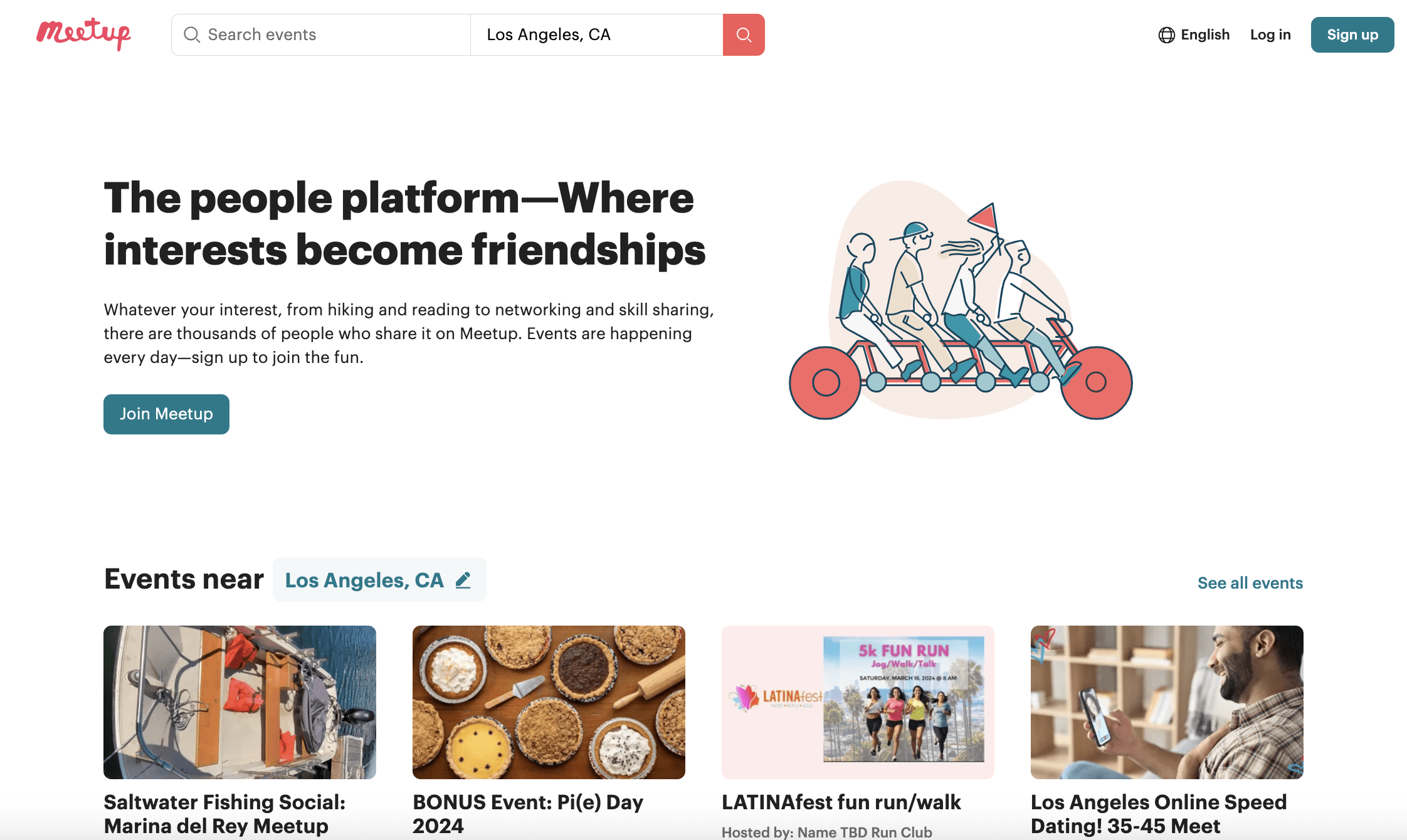
Screenshot from Meetup.com, March 2024
Meetup is a cool platform that allows you to seek out (or create) local meetups with like-minded folks – and it’s a great platform for anyone looking to blend online connections with real-world interactions.
When you register for Meetup, you’ll select your interests (whether personal and/or professional).
From there, Meetup will notify you of any local meetups you might be interested in, as they are created.
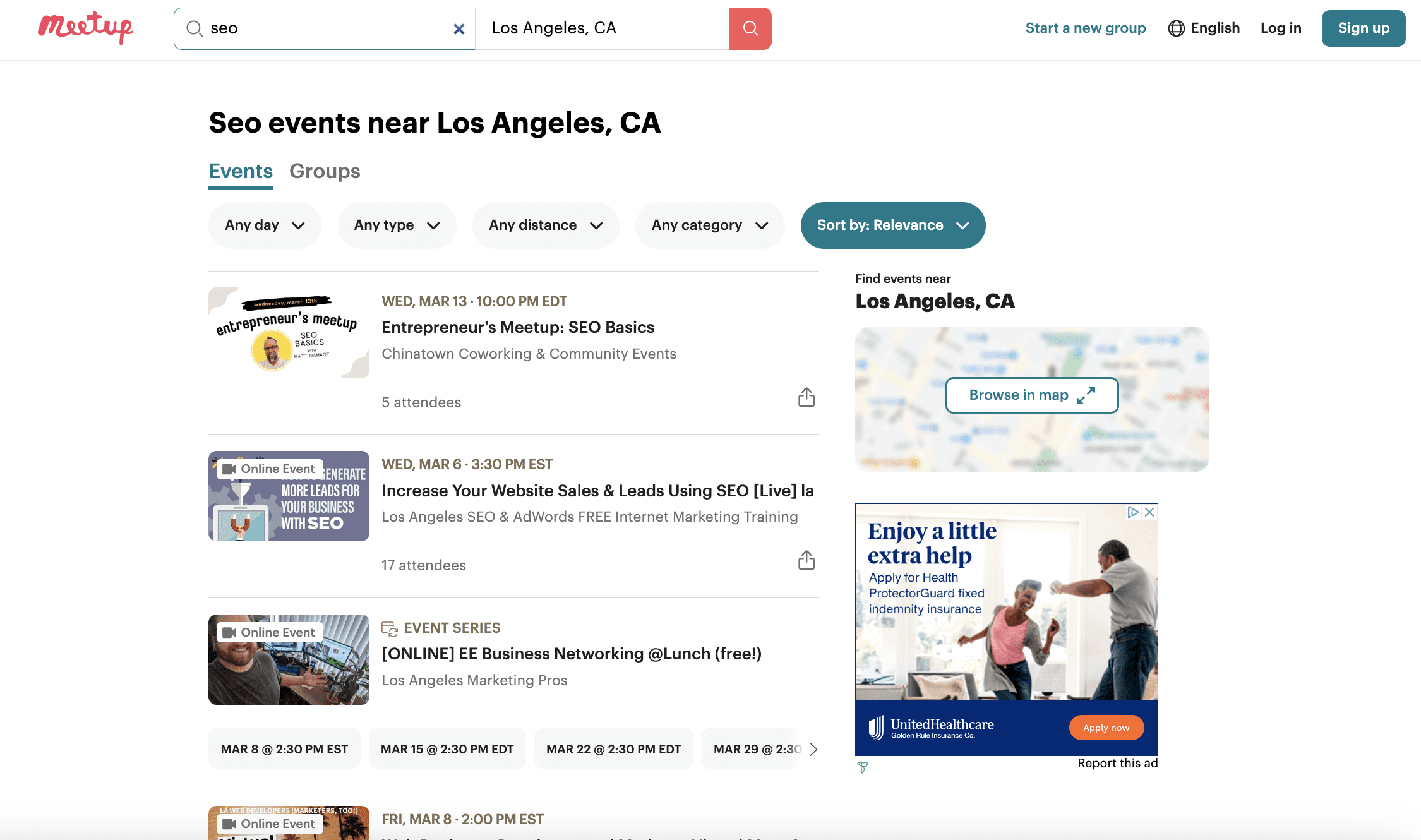
The meetups span a wide variety of topics, from in-depth SEO workshops to social media strategy sessions, not to mention casual networking mixers.
Screenshot from Meetup.com, March 2024
If you don’t see anything that interests you or works with your schedule, you can create your own event. Meetup will notify anyone who has identified your topic as of interest to them.
To be successful, make your Meetup group or event stand out by choosing a catchy title and providing a clear, engaging description that lets people know what to expect and why they might want to join.
Remember, this platform is all about bringing people together, so the more you can offer in terms of learning, networking, or just plain fun, the better.
It’s a great way to bring like-minded people together locally, and a great option if you’re looking to deepen your knowledge, expand your professional network, or just further explore your passions.
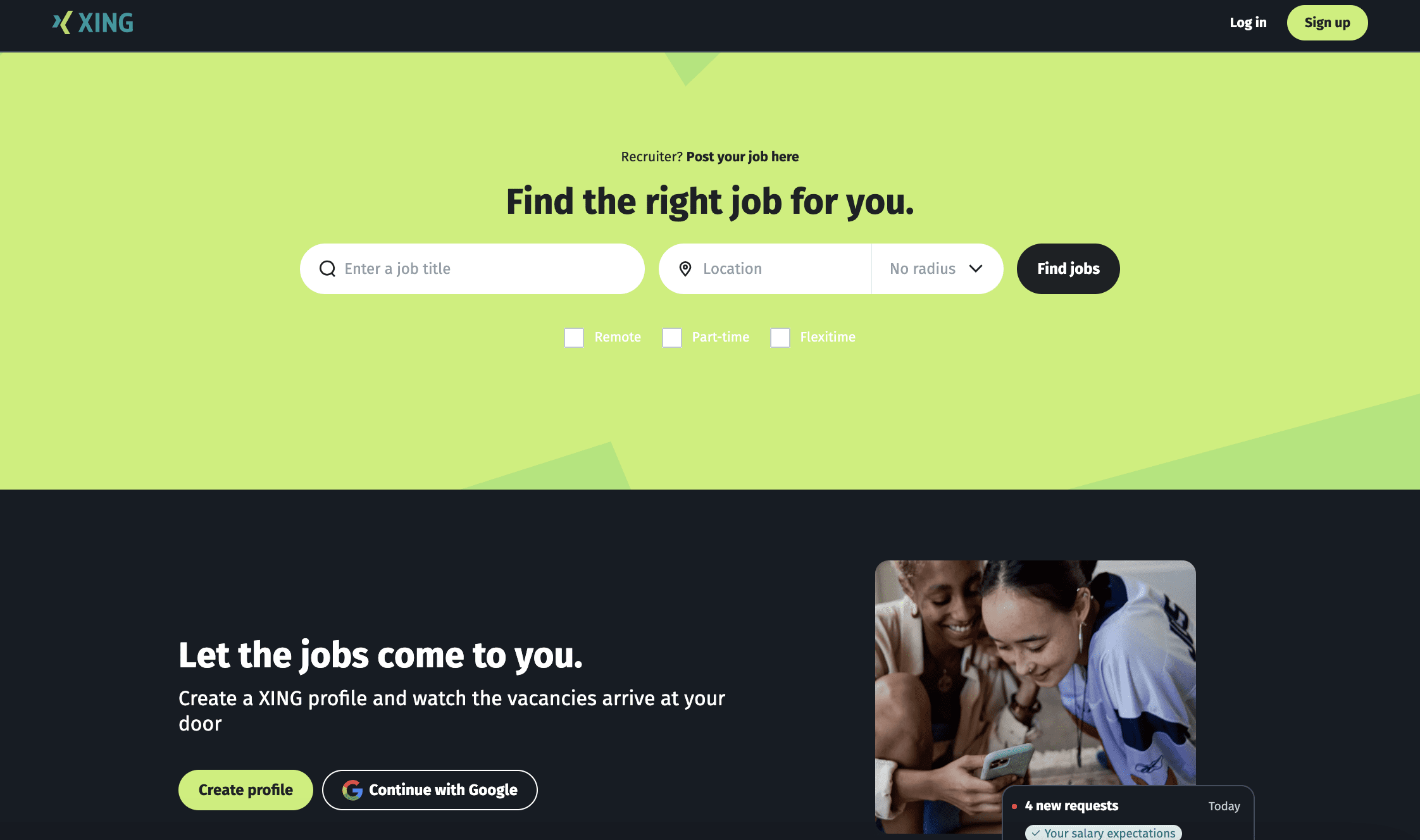
2. XING
Screenshot from Xing.com, March 2024
Think of XING as a kind of Europe’s answer to LinkedIn. The professional network, which boasts over 21 million members, offers a unique space for industry professionals to converge and expand their communities.
Currently, XING is particularly beneficial for those looking to work within European markets or with European countries, as it’s much more prominent in Europe than in the U.S. However, it’s used by people in over 200 countries, so don’t discount its power and potential, no matter where you are.
Upon joining XING, you have the ability to tap into a massive professional network. Join group chats with like-minded professionals to network and share ideas; identify relevant seminars, conferences, and tradeshows you may want to attend; or post jobs, search jobs, and research companies.
With over 20,000 recruiters on the platform, it’s particularly powerful for job seekers.
One unique feature XING offers is its culture compass, which offers insights into the work culture of potential employers. This can be super helpful during the job search phase.
To make the most of the platform, make sure your profile is complete and up-to-date with your skills and experience, actively participate in groups and discussions, utilize job alerts, and leverage the Culture Compass.
It is free to use, but similarly to LinkedIn, a paid premium membership unlocks additional features, such as searching for people with specific qualifications or messaging unknown contacts.
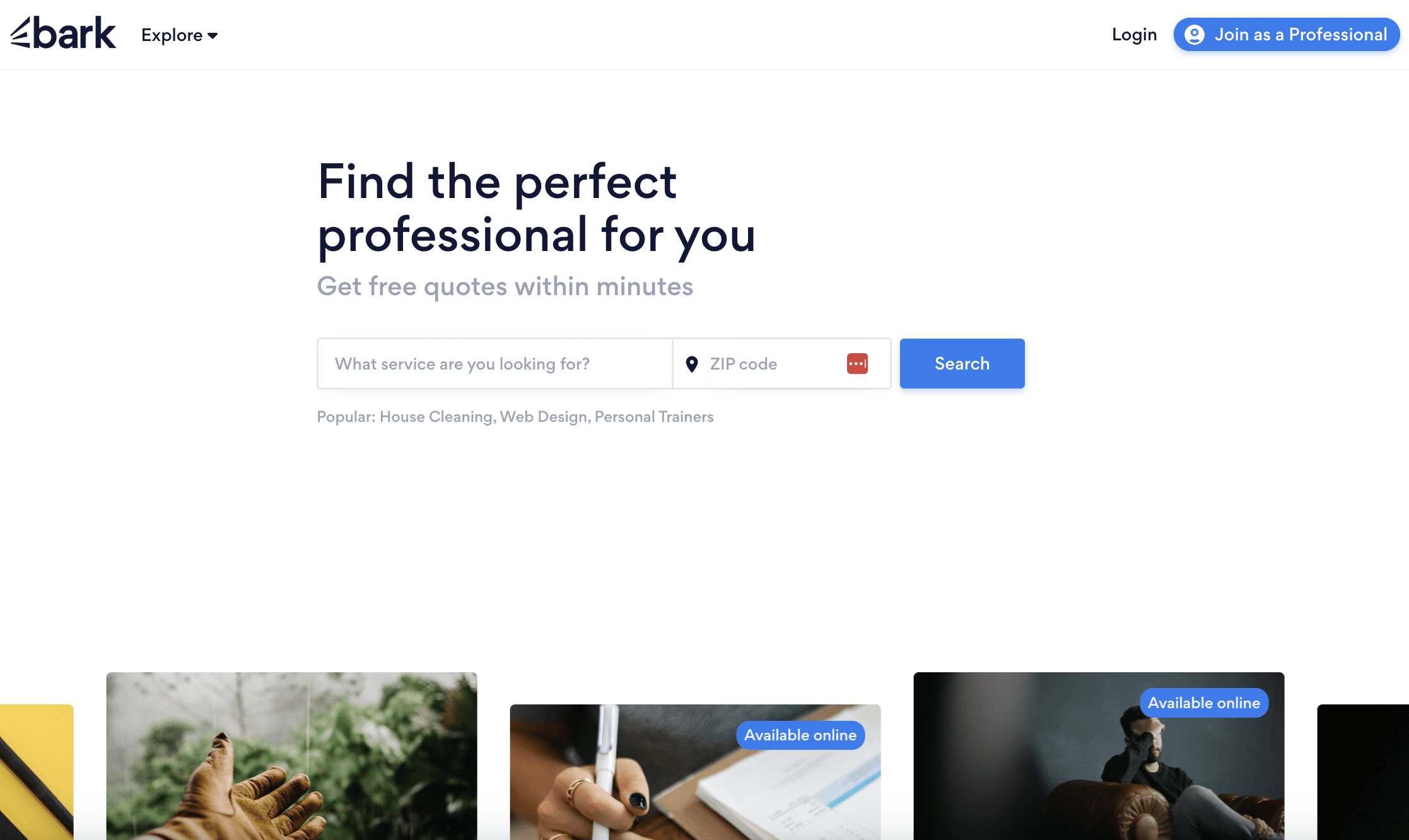
3. Bark
Screenshot from Bark.com, March 2024
Bark, which bills itself as “the Amazon of services,” is designed to connect local professionals with potential clients seeking their services.
It offers a network of over 180,000 active suppliers across eight sectors and connects over 4.5 million buyers and sellers annually.
Are you looking for professional assistance?
Bark will reach out to professionals in your area and circle back with estimates. Even more valuable, if you’re looking to find customers for your business, you can set up your own profile and be paired with prospects who are seeking out similar services.
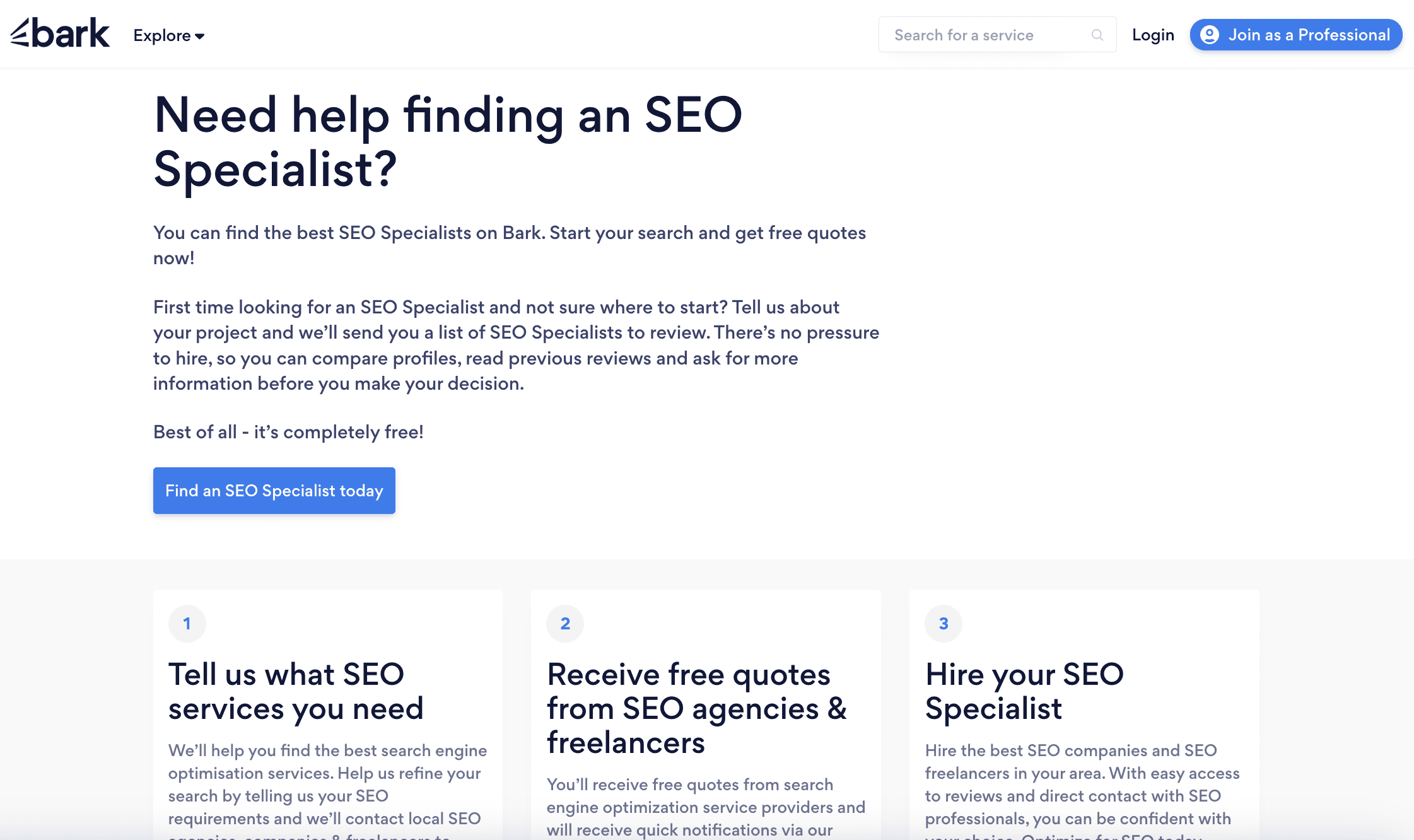
It caters to a broad range of business needs, from accounting to personal training, web design, SEO, house cleaning, and more.
Screenshot from Bark.com, March 2024
It’s free to create a profile and browse leads, but Bark requires you to purchase credits in order to actually contact clients – and the fees vary based on job scale and value.
After you purchase a lead, you can immediately access their contact details.
It’s worth noting that Bark doesn’t vet the professionals on its platform, so be sure to exercise caution and do your due diligence when making connections.
To get the most out of Bark:
Set your lead preferences actively to ensure you only receive notifications for jobs that make sense for your business.
Engage promptly with potential clients once you’ve purchased a lead.
Make sure to maintain a detailed, up-to-date profile.
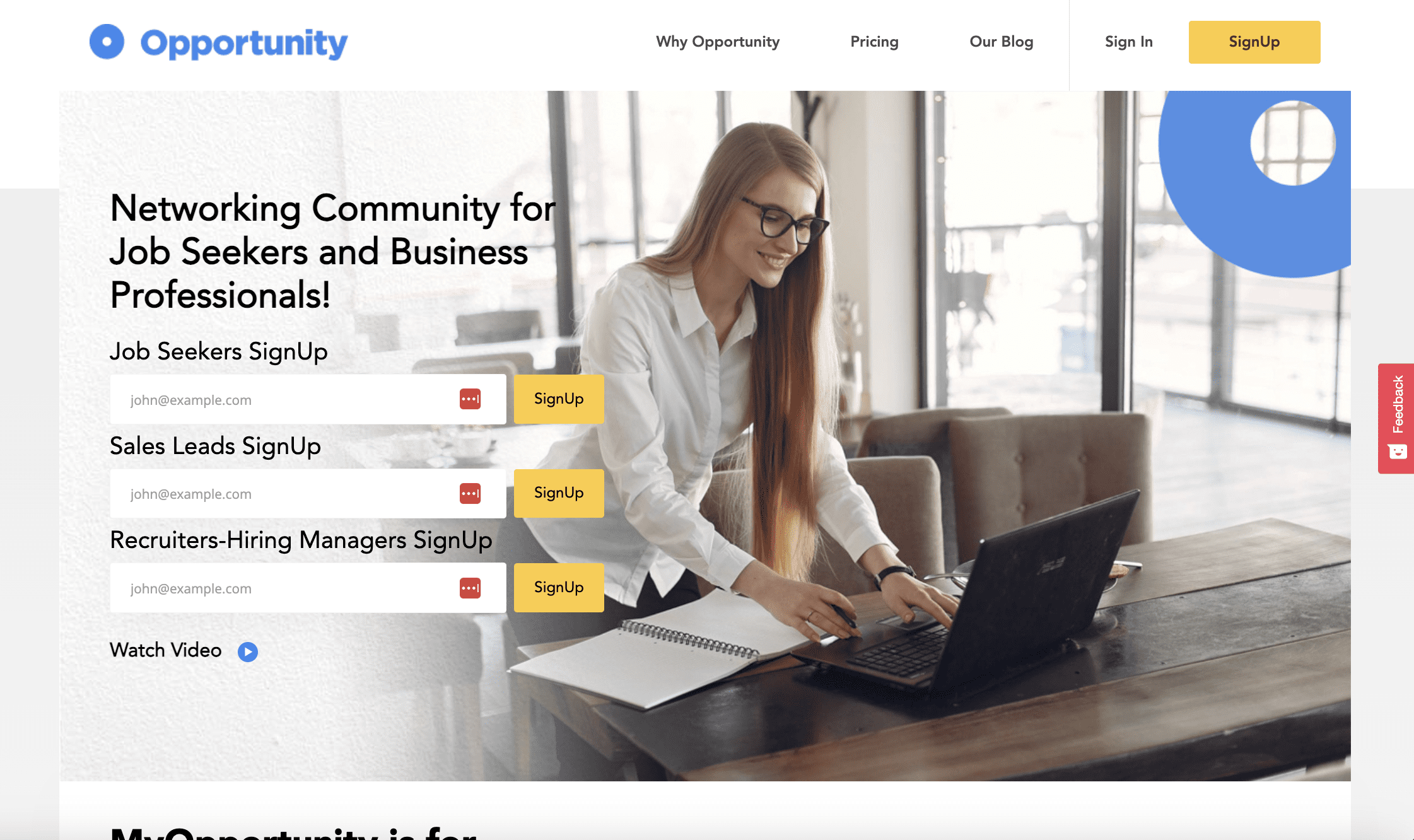
4. Opportunity
Screenshot from MyOpportunity.com, March 2024
Opportunity is a networking site that prides itself on “professional matchmaking” – or connecting people based on their specific professional needs and criteria. It has millions of members in 190+ countries.
It’s particularly effective for those looking to build networks and business relationships, find job opportunities, generate sales leads, or hire talent.
Users can be notified each time someone in their target market indicates that they need what said user offers. Likewise, they can be notified of relevant employment opportunities, or discover other professionals based on their preferences (e.g., age, gender, interests, etc.)
By creating a profile, you can be directly matched with relevant leads. You can choose from one of five profile types in order to streamline your experience:
Build your network and business relationships.
Find jobs and career opportunities.
Meaningful relationships.
Turbo-charge your sales lead generation.
Hire the best talent out there.
The Basic membership is free and offers many core capabilities. Alternatively, you can upgrade to a PRO membership for $29/month, offering features like unlimited messaging, unlimited search radius, and a stronger AI matching algorithm.
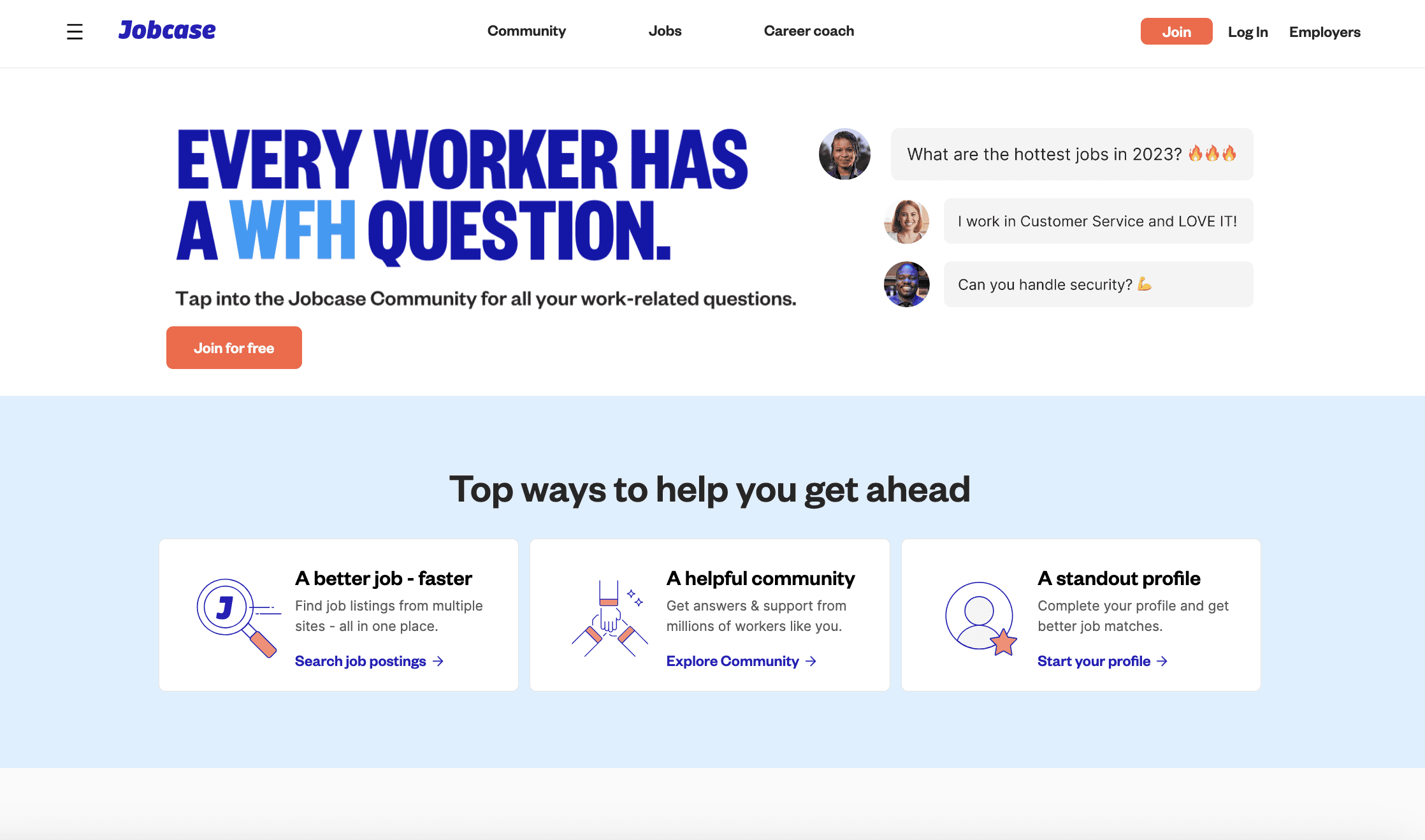
5. Jobcase
Screenshot from Jobcase.com, March 2024
Jobcase describes itself as “an online community dedicated to empowering the world’s workers.”
It’s a pretty unique platform that has been powering over 100 popular job sites since 2009. Because of that, Jobcase has access to a wealth of data about open roles and the companies currently hiring for roles you might be interested in.
So, how does it work?
With Jobcase, you can set up a profile and get access to a huge database of jobs. Plus, you can join groups or peruse the community to participate in discussions. Jobcase boasts over 120 million users, so there are plenty of discussions to join in on!
The site offers community engagement opportunities, as well as tons of resources for job seekers.
To make the most of Jobcase, be sure to actively participate in discussions relevant to your field. Also, seek advice from seasoned experts and regularly update your profile.
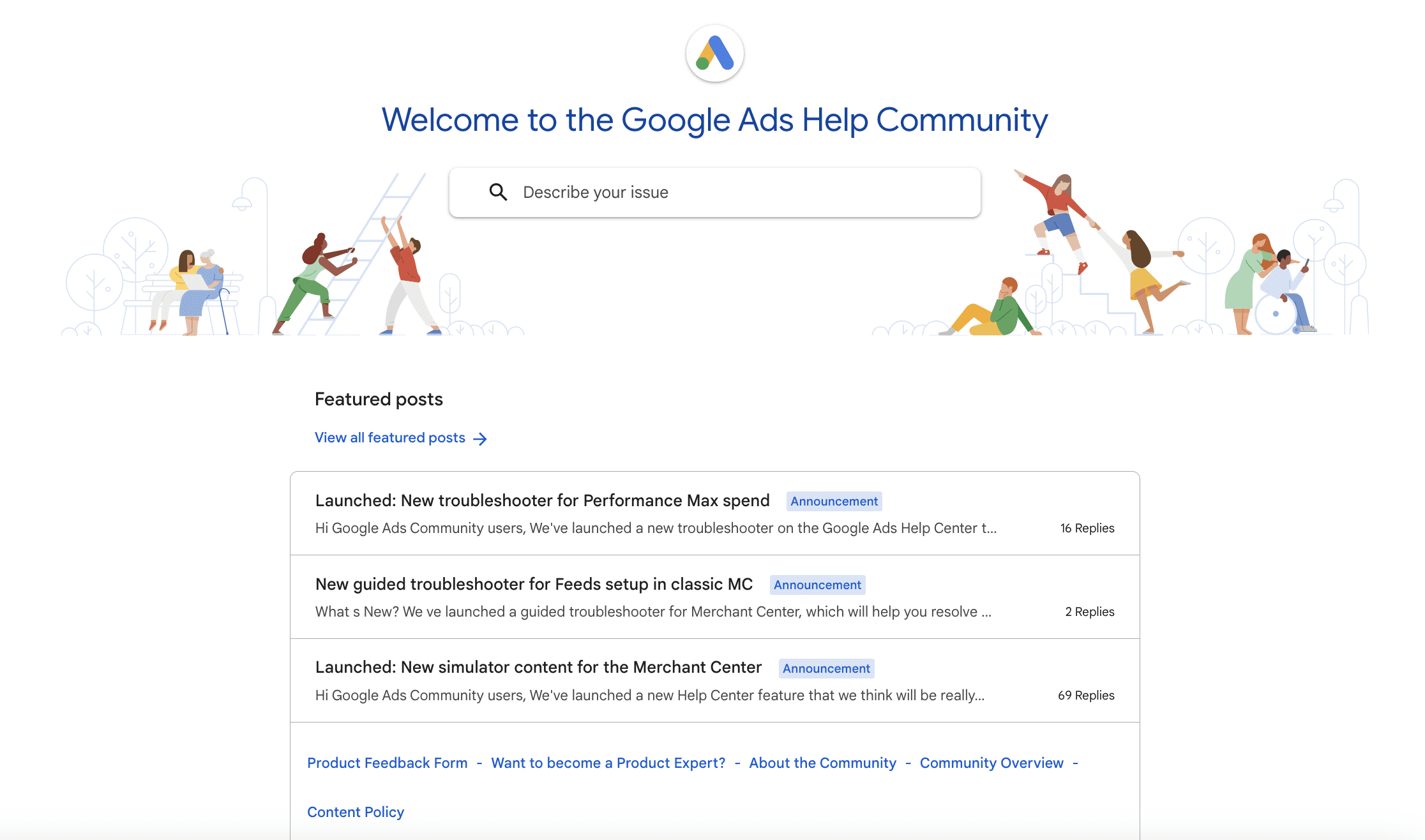
6. Community Forums
Screenshot from support.google.com, March 2024
Some of the most valuable, and yet most often overlooked, networking opportunities are in community forums.
They cater to a diverse audience of professionals depending on your niche and the forum itself – and there’s a forum for almost anything!
And these are just a few examples of the countless community forums out there.
These forums are a great way to ask questions and share your experience with others who are seeking input. The forums stay active and are frequented by many knowledgeable people.
To maximize the potential of community forums, go out of your way to contribute with questions or share your own expertise. Engaging in these spaces can deepen your knowledge and expand your network.
Remember, the key is to provide value and interact genuinely with fellow members.
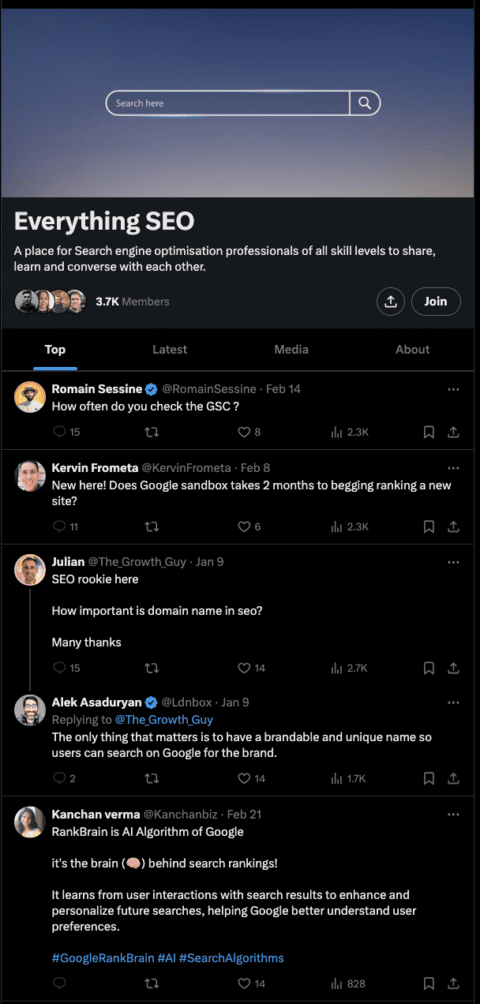
7. X (Twitter)
Believe it or not, some of the best industry networking that I’ve been privileged to stumble upon has come from some really great X (formerly Twitter) communities!
Engaging in industry-specific hashtags, threads, Communities, and Spaces can be a powerful way to network and learn on the platform.
Screenshot from X, March 2024
The especially great thing about these is that they are public, free, active, and can be really supportive.
New members are welcomed, and people are encouraged to share their questions and struggles. Plus, it’s just fun to talk shop with others who get it.
I’ve made a lot of lasting connections on X, which have led to a variety of career opportunities, from speaking at industry events to client referrals and more
Historically, digital marketers could find relevant content on #SEOchat, #SEOtalk, #SEMrushChat, #HootChat, #SproutChat, #socialROI, and #contentwritingchat – just to name a few. It’s also worth looking for Communities and Spaces that center around your areas of interest and expertise.
Stay active, contribute positively, and harness the collaborative spirit of these communities for potential career growth and knowledge exchange.
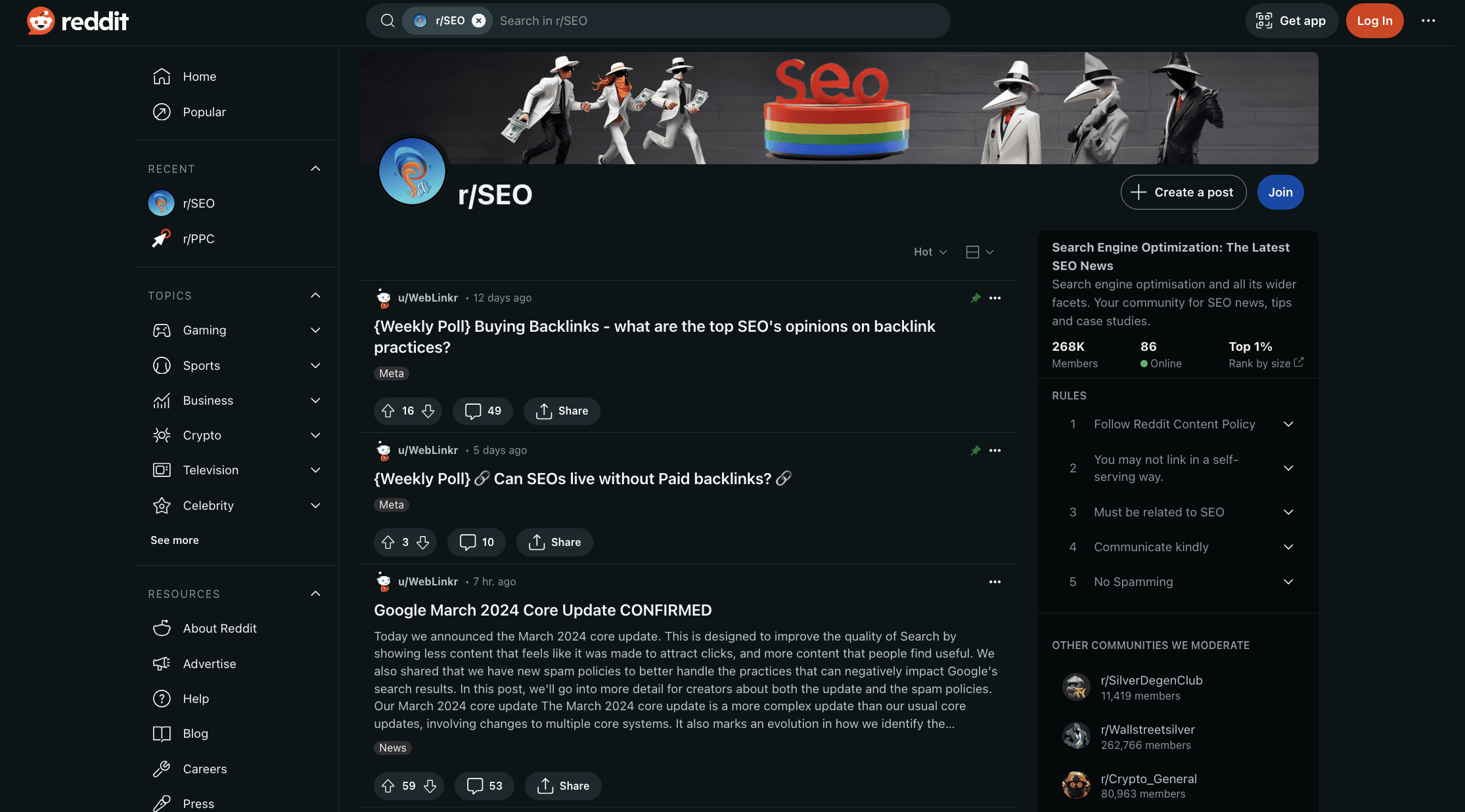
8. Reddit
Screenshot from Reddit.com, March 2024
Although Reddit has a strong reputation for being the source of many-a-meme, it’s also so much more than that.
Reddit hosts over 10,000 active subreddits – a huge span of micro-communities – including r/PPC for paid search and r/SEO for, you guessed it, SEO.
The subreddits are completely free to join and public to peruse – and by signing up for a free Reddit account, you can engage with existing posts or start your own discussions.
In this way, it’s a powerful tool for staying updated with industry trends and connecting with peers.
Success on Reddit is all about engaging with others. Just make sure you’re providing value and following the rules of each subreddit, as Reddit users can be sticklers about that.
9. Slack
Screenshot from Slack, March 2024
Slack has evolved past its role as a simple workplace communication tool; there are now many Slack communities for networking purposes and beyond.
On the other hand, it can be quite distracting. With the exception of Lunchmeet, almost every other networking community in this list is browser-based.
In case you haven’t heard of it, Slack is a messaging app that brings people together in unique private communities to exchange information.
Each community has a mix of public threads, smaller private channels, and the option to DM anyone else in the community.
So, if you find yourself distracted by instant messages and mobile/desktop notifications, Slack might not be the best place for you.
That said, I’m a fan; I’ve joined some great communities, met great people, and even created working relationships – all through Slack.
Communities on Slack can range widely in focus, allowing for targeted networking and discussions in your field of interest.
If you’re interested in finding a Slack community, a quick Google search for [Insert Topic Here’ + Slack Community] usually turns up several options.
It’s also easy and free to create your own Slack community and invite your friends.
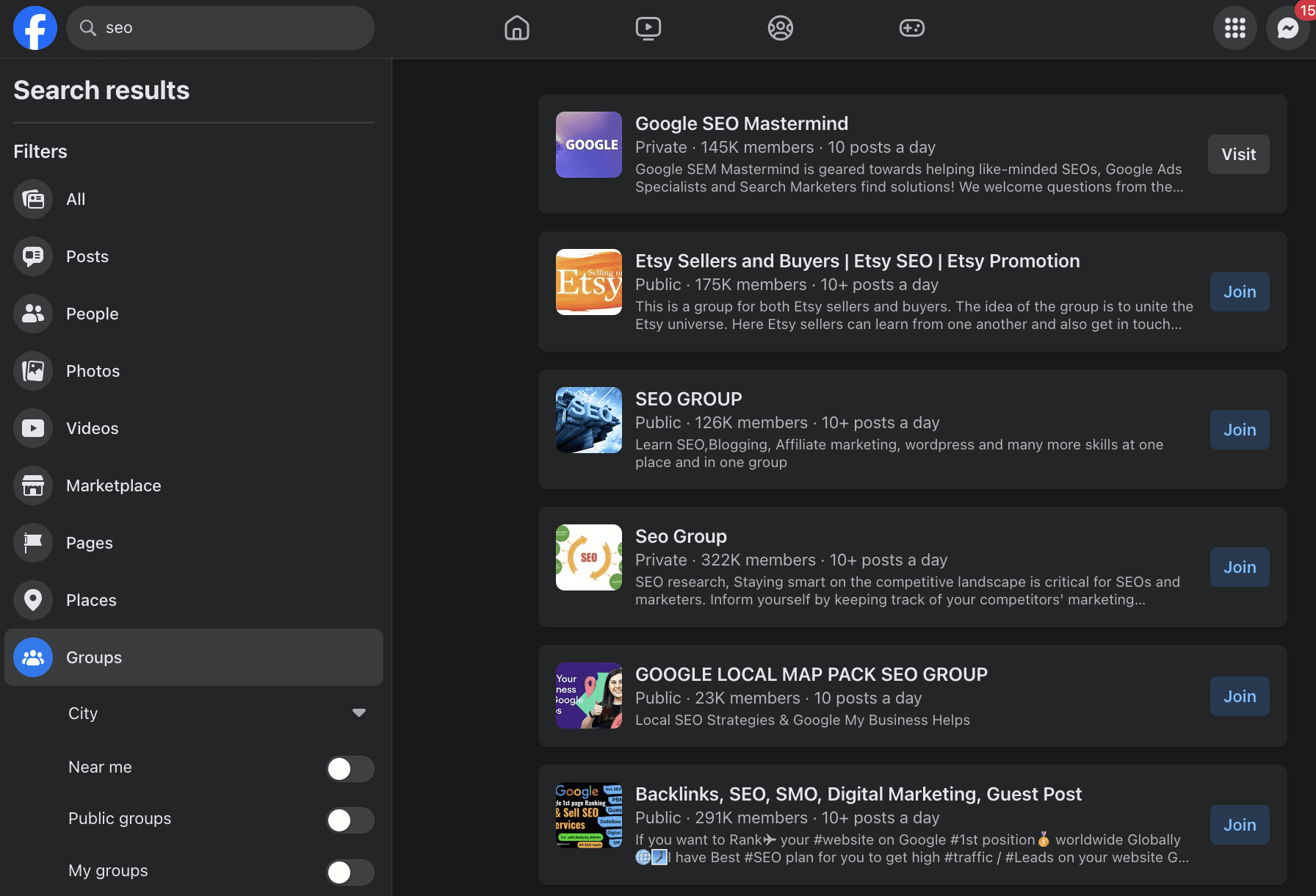
10. Facebook Groups
Screenshot from Facebook.com, March 2024
These days, there are plenty of Facebook groups dedicated to sharing professional knowledge and experiences – some with thousands of active members.
Although Facebook was once considered more of a personal social platform than LinkedIn, it can be a great source for professional networking.
If you’re interested in seeking out a community, you can use Facebook’s search tool to find groups about your topic of interest. You’ll find a mix of large public groups and more intimate private groups.
There are several communities that cater to various aspects of digital marketing from tactical knowledge all the way to running a digital agency.
To make the most of them, spend time actively participating, sharing relevant content, and connecting with other members of the community.
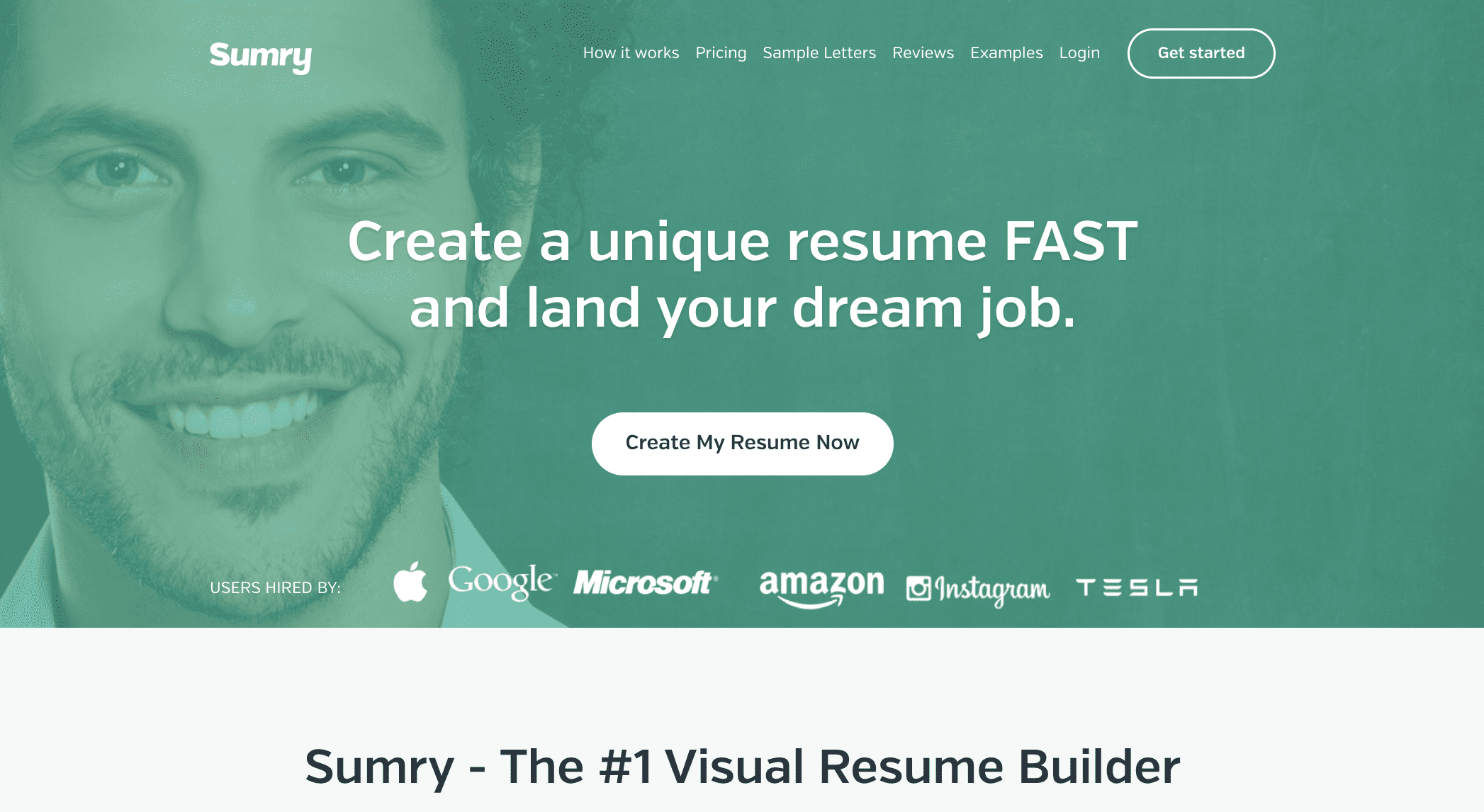
11. Sumry
Screenshot from Sumry.me, March 2024
Sumry is a site that was built to make first impressions easier and bring a more personal side to the job search process. It describes itself as “the human way to get hired.”
It’s a web app that enables you to build innovative, interactive resumes and website portfolios that employers on the site can view.
Sumry allows you to aggregate your certifications, skills, and work experience, as well as testimonials and your full timeline of work experience, and creates a one-page resume and website for you.
What sets Sumry apart is its emphasis on storytelling and crafting a narrative around your personal brand.
For the best results, add depth to your profile with testimonials from former clients or colleagues. Use the platform to build an interesting story about your professional journey rather than just a list of work experiences.
Once you are ready to submit, Sumry makes it easy to apply with one click with a link to your profile and a PDF of your resume.
With the premium version, it also gives users a chance to introduce themselves before submitting an application.
Sumry comes with a 7-day free trial – after that, it’s $79 per year.
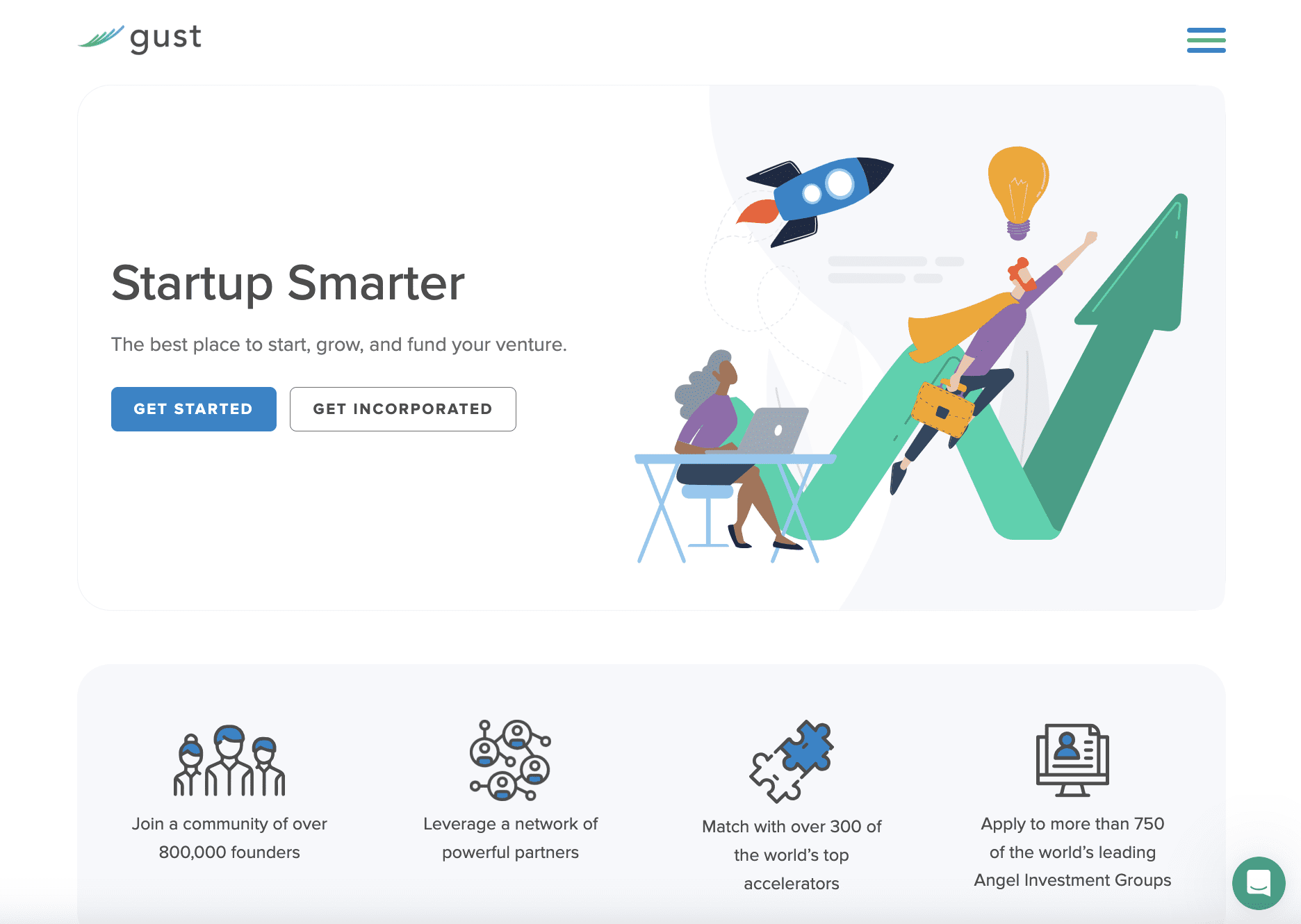
12. Gust.com
Screenshot from Gust.com, March 2024
This one is a little more niche and specific.
Gust is a community focused solely on startups; in fact, it claims to be the world’s largest community of entrepreneurs and early-stage investors.
According to its website, Gust boasts a community of over 800,000 founders and the ability to match with 300+ of the world’s top accelerators.
So, what is Gust?
It’s a global SaaS funding platform that powers the sourcing and management of early-stage investments for startups.
It provides entrepreneurs with tools to help them start, operate, and raise money for companies, enabling them to collaborate with both investors and angel investor networks.
To get the most out of Gust as a networking platform, use its capabilities to rate and review companies, find promising startups, or engage with potential investors and partners. Engage with the community, attend office hours, and participate in expert sessions.
Beyond this, make sure to create a strong public profile for your startup, craft a compelling presentation for investors to review, and provide relevant supporting documentation.
You can get going with a START plan for $450/year.
How To Get The Best Out Of Networking Platforms
LinkedIn might be the largest professional networking platform in the world, but it is far from the only one.
There are plenty of other networking platforms out there that exist to help you make meaningful connections – many of them offering unique features like direct connections with founders, niche community engagement opportunities, and tailored job opportunities.
In fact, some of these alternatives may be more useful to you than LinkedIn, given their focus on catering to specific locations or niches.
To get the most out of networking platforms generally, you should:
Seek out platforms that align with your industry, interests, and professional goals.
Make an effort to actively engage and contribute to discussions to build credibility.
Prioritize providing value to others to establish genuine relationships.
Leverage unique platform features to highlight your skills and interests.
Diversifying your networking approach can help you find new opportunities and communities that resonate with your career objectives, and lead you to richer, more fruitful professional relationships.
When I first got into search marketing (back in 2005), there used to be a Tumblr feed dedicated to poorly set up campaigns that clearly did not have quality assurance (aka QA) checks done.
Dynamic keyword insertion and general broad match were the two fastest ways to end up on that page and one of the quickest ways to ruin your day (possibly even your job or career).
Now, nearly 20 years later, platforms have evolved (or devolved depending on the platform and unit), and the need for proper pre- and post-launch QAs has never been more important.
But with that being said, some operations are still learning the hard way what they did and didn’t remember to check. This goes beyond basic paid search and onto all paid media (search, shopping, PMax, YouTube/video, GDN, and even social and programmatic platforms).
This often leads to competition finding those mistakes (it is a mistake if you don’t QA) and exploiting it for their own gain.
Full transparency: I do it as well. If I find a brand or another agency making a mistake in their work and can exploit it, I absolutely will.
Yes, in the land of digital marketing, especially when it comes to taking down the competition (not as practical to execute, but if possible, so valuable to you), I will wake up and choose violence. Nearly 20 years in digital marketing will do that to a person (especially if six months of the year they have to watch the NY Jets blow it again).
Everyone makes mistakes sometimes in digital marketing, even me. The key is to make sure the person responsible for running the ad campaign knows what is happening, from pre-launch to the live campaign itself.
Let’s delve into some mistakes that have been found, explain how they could’ve been prevented through a standard ongoing QA process, and what you should do in the future to CYA (if you don’t know that acronym, go look it up on Bing).
Some Notable Mistakes
Author Disclaimer: There are literally oodles of different mistakes going on all around us. I will only note the small and large ones I’ve witnessed. For some legal reasons, some brands that were the self-induced victims of these mistakes will be anonymized.
In 2011, I was working for a major holding company ad agency, running media for a credit card company that was trying to sponsor a holiday they created that transpired just after Thanksgiving that encouraged shopping at local, non-large businesses (you can guess who).
My team was short-staffed; Reps for a major search engine with a major video platform (considered the second-largest search engine in the country) offered to assist my team with the video part by running it for us.
We gladly obliged for the help and gave them our targeted keyword and category list for the campaign, and then we gave them the negative keyword and category list. The reps told us they would run it for us, QA it for us, and give us the results.
This was a mistake on our part.
The campaign ran for two weeks, spending around $100,000. But when we got the results from the reps, they were terrible. The video had an incredibly low view rate, a higher-than-normal cost per view, and almost no clicks to the website (we knew it wouldn’t get many, but to get less than 100 from 5+ million impressions was odd).
We got our hands on the data and the settings (it was operated in an account we didn’t initially have access to) and discovered the category target list was missing, the keyword targets had been used as the negative keyword list, and worse, the excluded categories and negative keywords had been used as the targets.
Let’s just say the keywords we pulled from Urban Dictionary around intimacy triggered a concerningly high volume of impressions on a variety of non-brand-safe content.
The rep of that major search engine was informed of the faux pas, and they admitted a minimal prelaunch QA had been done, but not thoroughly – and a post-launch QA was never done.
This resulted in a $150,000 credit (keep in mind we only spent $100,000) back to the credit card company. We never saw or heard from that sales rep again.
In 2019, my agency won some new business for a conglomerate of sports nutrition brands. During the kick-off with the brand, they showed us their YouTube data, which was incredibly impressive in terms of non-skippable video.
We’re talking 45+ second videos, with a view rate exceeding 75% (the industry benchmark was 35%) when they reached the 30-second mark and a cost per view (CPV) of less than $0.04.
They informed us that despite the great metrics, there was little to no evidence of direct or down-funnel sales, and they considered the effort a complete failure. Something didn’t make sense, and they asked me to audit the prior agency’s work.
What I found was concerning.
This brand ran video ads featuring incredibly muscular people wearing next to nothing exercising like they were training for the Hunger Games. The campaign spent around $500,000 over a six-month period.
Upon digging in, I realized there was no content targeting, no age targeting, and absolutely nothing in exclusions.
After writing up an analysis that took an estimated 120 hours to complete, it was determined that 60% of ad spend for these scantily clad adults drinking pre-workout and protein shakes had been shown on children’s content, such as Blues Clues, Coco Melon, Blippi, and any parent’s holy nightmare: Caillou.
The view rate and cost per view were so impressive but generated no sales because the majority of the impressions and views were being served to children ages two to seven.
The prior agency had failed to do a full pre-launch QA, post-launch QA, or even check the data during the flight. This was all taken into consideration, and the brand took the prior agency to court to recover six months of agency fees and media spend (this was settled out of court in the mid-six-figure range).
Screenshot from author, April 2024
Don’t show your workout ads to kids!
Also, if you’re doing retargeting of any sort, know where it shows and has negatives!
Image from The San Diego Union-Tribune, April 2024
Remarketing is great when you’re prepared for it. A more recent scenario I ran into (in 2024) is a brand I have never worked with, but after finding the same mistake three times in six weeks, it is time to call it out.
I’m sorry, Darden Foods digital team. I enjoy the breadsticks at Olive Garden, but this is a simple fix that you still haven’t done.
Recently, on a trip home from skiing, my wife saw a sign for Olive Garden and insisted we pull in for lunch, as she hadn’t been to one in 15 years.
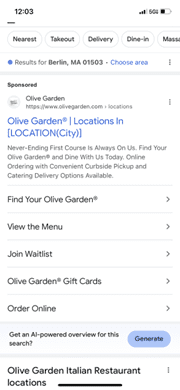
We pulled in, ate, and wondered if there was one near our home for future visits. I pulled out my phone at the table (yes, quite rude, but justified), and searched for [Olive Garden Locations], and got this:
Screenshot of search for [Olive Garden], Google, February 2024
Here again, six weeks later. I mean, come on.
Screenshot of search for [Olive Garden], Google, March 2024
Here, we have a dynamic location insertion put into a search ad (which is normally a great thing to have when set up correctly).
But during the setup, instead of using {}, they used [].
Therefore, it cannot trigger the location; it only triggers [Location(City)], delivering the consumer a poor user experience and not indicating whether or not a location is nearby.
I repeated this search multiple times over six weeks to realize the advertiser never discovered it. I suspect this was uploaded through a bulk sheet, as a manual insertion into the UI, or even the editor has an obvious callout if it is implemented correctly.
Easily Overlooked Future Mistakes
A very common mistake that can be prevented pre-launch but can easily be caught post-launch is one that has been around essentially since the beginning of the industry and lives in both Google Adwords and Bing Ads (it’ll be a cold day in hell before I ever call them Google Ads and Microsoft) and even in Facebook/Instagram (refusing to call it Meta): default settings.
When you first create search campaigns in Google and Bing, some settings are automatically presented to you in a certain way, and you, as an advertiser, must proactively change them (any seasoned search marketer knows this, so this issue is more common with SMBs).
These default search settings include but are not limited to:
Auto-Apply recommendations on (Google and Bing specific).
Dynamic extensions on (Google and Bing specific).
Advantage+ on (Facebook/Instagram specific).
Display Network/Audience Network on (Google and Facebook/Instagram specific, Bing did away with the ability to opt out of their network a couple of years ago).
Search Partner/Search Syndication Networks (Google and Bing specific).
Mobile app placement (Google Display Network specific).
Broad match keywords (Google and Bing specific when you add keywords without a specified match type).
Screenshot from author, April 2024
Google is gonna Google to make that bread off those not paying attention.
And that is just the tip of the iceberg. Just because you don’t have the ideal or approved assets to put in these places doesn’t mean you won’t be accruing traffic and spend here.
Unless you plan to have them enabled, they need to be changed.
Needless to say, in each of these scenarios, pre-, post, and ongoing QA efforts can prevent some of these catastrophes from happening.
I should note that efforts tied to Performance Max, demand generation, and Advantage+ are a bit harder to QA.
But not QAing them is like telling Jenn Shah of RHOSLC that you trust her customer CRM lists are safe and legitimate.
QA To Save the Day
Now that the fear of digital marketing God is in you, let’s calm you down and discuss how not to have a terrible day with the CMO who has seen your ads live.
This will give them and you more confidence and prevent a conversation more painful than the time I put my head in a snowblower (per editor’s request, a photo of that is not included).
There are 3 phases of a QA plan: pre-launch, post-launch, and ongoing (spoiler, the third phase is ongoing, in perpetuity, but is just part pf your basic optimization strategy).
Pre-launch: A standardized checklist that you go through for all settings to make sure elements are set before launch. Includes targeting, exclusions, budgeting, assets, etc.
Post-launch: This is very similar to the pre-launch list, but it includes analysis of initial data to look for anything out of place, such as queries you map to, sites you trigger on, networks, disapproved assets, etc. This should be done somewhere between 24 and 72 hours of launch, after accruing data
Ongoing: This ties directly to your ongoing optimization but is next to it. Think of it as an ongoing post-launch checklist that is repeated at intervals of once a month. This isn’t a formal optimization document or analysis but an ongoing settings check.
The Takeaway
If you’ve read my articles before, you recognize that this isn’t the first time I’ve written about something like this.
However, I’ve witnessed operations/individuals not follow QA protocols, even the most basic ones. Once a mistake is noticed internally and not rectified, it can go up the chain fast and can be as bad as losing one’s job.
But if the general public catches a mistake and calls you out on it, well, an apology press conference and campaign can cost the operation tens of thousands of dollars.
A simple ongoing checklist for the life of the campaign will save you a lot of pain and suffering later. It is part of any solid optimization strategy, so it’s not like you aren’t already doing it.
If you need inspiration on what one should look like, feel free to reach out to me, and I can get you in the right direction.
I’ve twiceaddressed my fondness for Google Ads scripts for automating everyday tasks. Scripts are code snippets that work behind the scenes for functions such as:
Identifying URL errors,
Finding negative keyword conflicts,
Notifying when an account receives no impressions in a certain period.
Scripts free up time for account strategy and critical optimizations. Here are four more of my go-to scripts.
Change History Alerts
What it does. Frequently multiple users have access to a single Google Ads account. It’s easy for one user to miss tweaks by another, requiring constant reviews of change history. For example, someone could alter a setting or pause a keyword, affecting the entire account. “Change History Alerts” shows the change, the date, and the user. I run the script daily.
What to customize.
SPREADSHEET_URL. Create a Google Sheet and paste its URL.
EMAIL_ADDRESSES. Add the email addresses (comma separated) of the report recipients.
IGNORE_USERS. Add the email addresses of users whose changes do not require reporting.
SEND_EMAIL. Set as “true” to receive an alert when someone not on the ignored users list makes a change.
EMAIL_SUBJECT. Keep the default subject line in the notification or update it.
EMAIL_BODY. Keep the default body message in the notification or update it.
PERIOD. The default setting is “yesterday” for daily runs. Change it as needed.
What it does. For years Google didn’t share search queries that triggered ads in Performance Max campaigns. It does now but requires users to dig through the Insights report. “Performance Max Search Terms and Categories” provides this info in an easy-to-read Google Sheet to then segment, filter, and format. Add queries that convert well as keywords in search campaigns. Request as negative keywords queries with many clicks but few conversions.
What to customize.
MINIMP. The minimum impressions for including a search term or category. Larger accounts require a higher threshold to avoid entities with little activity. The script defaults to 10 impressions.
SPREADSHEET_URL. Create a Google Sheet and paste its URL, or leave the field blank and the script will generate a new spreadsheet every time it runs.
REPORTLASTNDAYS. The data lookback window. The default is 30 days.
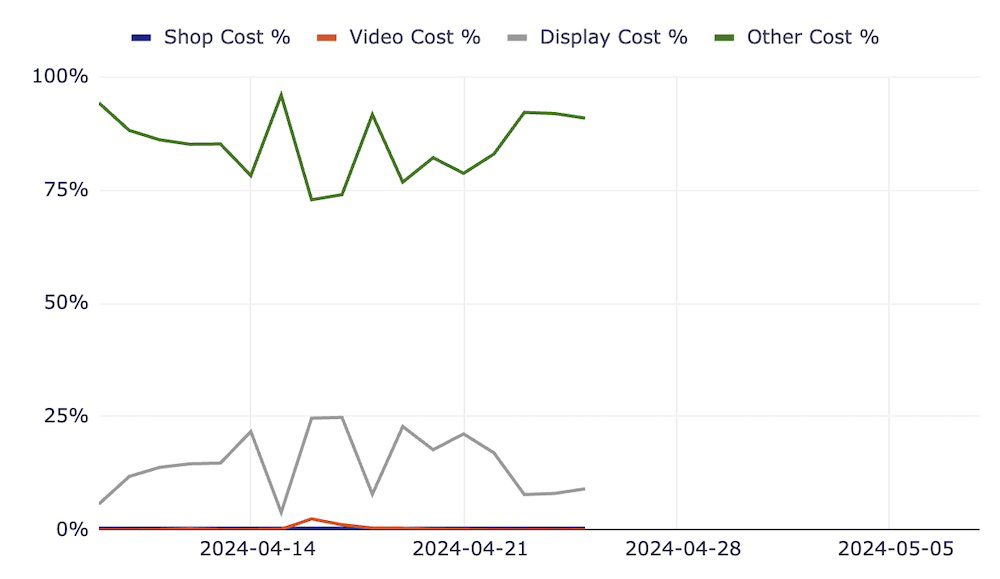
What it does. This script provides the most comprehensive Performance Max data, showing:
Percentage of spend by channel (Shopping, Video, Display, and Search/Other),
Cost and conversion metrics by campaign and network,
Performance by asset group.
Performance Max Insights reports the spend percentage by Shopping, Video, Display, and Search/Other. Click image to enlarge.
Performance Max advertisers have little control over where ads appear and the included products, but this script provides transparency. For example, a retailer with a product feed should expect more Shopping ads. If the spend percentage for Shopping is high, the campaign works as intended. If half goes to Display and is not converting, advertisers should reevaluate Performance Max.
What to customize.
The script default to the last 30 days. The paid version allows for longer date ranges.
What it does. “RSA Checker” finds ad groups without active responsive search ads. Google classifies all newly created ads as RSAs. This script was more impactful during the transition of expanded text ads to RSAs, yet it still has value. I’ll run this script weekly on new accounts to identify ad groups that haven’t transitioned to RSAs. The script will also alert if no RSA is present due to Google rejecting an ad.
What to customize.
CHECKPAUSEDCAMPAIGNS. Set to “true” to check paused campaigns for RSAs.
CHECKPAUSEDADGROUPS. Set to “true” to check paused ad groups for RSAs.
CHECKPAUSEDADS. Set to “true” to check paused ads for RSAs.
ALERTONNEWENTITIESONLY. Set to “false” to receive emails only when new ad groups have no RSAs.
RECIPIENTEMAILS. Add the email address(es) of recipients.
LABELNAME. The label assigned to ad groups without RSAs. The default is “no_rsa_present.”
This article is from The Spark, MIT Technology Review’s weekly climate newsletter. To receive it in your inbox every Wednesday, sign up here.
Tesla, the world’s largest EV maker, laid off its entire charging team last week.
The timing of this move is absolutely baffling. We desperately need many more EV chargers to come online as quickly as possible, and Tesla has been a charging powerhouse. It’s in the midst of opening its charging network to other automakers and establishing its technology as the de facto standard in the US. Now, we’re already seeing new Supercharger sites canceled because of this move.
The charging meltdown at Tesla could slow progress on EVs overall, and ultimately, the whole situation shows why climate technology needs a whole lot more than Tesla.
Tesla first unveiled the Supercharger network in 2012 with six locations in the western US. As of 2024, the company operates over 50,000 Superchargers worldwide. (By the way, I want to note that I briefly interned at Tesla in 2016. I don’t have any ties to or financial interest in the company today.)
The Supercharger network helped make Tesla an EV juggernaut. Fast charging speeds and a navigation system that took the guesswork out of finding charging stations helped ease the transition for people buying their first EVs. Tesla operates more fast chargers than anyone else in the US, and the reliability of those chargers is leagues better than that of competitors. For a long time, this was all exclusive to Tesla drivers.
Over the past year, Tesla has begun cracking open the doors to its charging network. The company made some of its stations available to all EVs, in part to go after incentives designated for private companies building public chargers.
In the US, Tesla has also persuaded other automakers to adopt its charging connector, which it standardized and named the North American Charging Standard. In May 2023, Ford announced a move to adopt the NACS, and nearly every other automaker selling EVs in the US has followed suit.
Tesla “still plans to grow the Supercharger network,” though the focus will shift to maintaining and expanding existing locations rather than adding new ones, according to a post from CEO Elon Musk on the site formerly known as Twitter. (How does the company plan to expand or even maintain existing locations with apparently no dedicated charging team? Your guess is as good as mine. Tesla didn’t respond to a request for comment.)
But the effects from losing the charging team were immediate. Tesla backed out of a handful of leases for upcoming Supercharger locations in New York. In an email, the company told suppliers to hold off on breaking ground on new construction projects.
The move is a concerning one at a crucial time for EV charging infrastructure. Right now, there are nowhere near enough chargers installed in the US to support a shift to electric vehicles. If EVs make up half of new-car sales by the end of the decade, we’ll need roughly 1.2 million public chargers installed by then, according to a 2023 study from the National Renewable Energy Laboratory. Today, the country has 170,000 charging ports available.
In a recent poll, nearly 80% of US adults said that a lack of charging infrastructure is a primary reason for not buying an EV. That was true whether they lived in a city, in the suburbs, or in more rural areas.
In a way, it does make sense that Tesla appears to be uninterested in being the one to build out a public charging network. Chargers are costly to build and maintain, and they might not be all that profitable in the near term.
According to analysis by BNEF, Tesla pulled in about $1.7 billion from charging last year, only about 1.5% of the company’s total revenue. Opening up chargers to vehicles from other automakers could help push revenue from this source up to $7.4 billion annually by the end of the decade. But that’s still a relatively small piece of Tesla’s total potential pie.
Musk seems more interested in pursuing buzzy ideas like robotaxis than doing the difficult and expensive work of providing EV charging as a public service.
Honestly, I think this move is a wake-up call for the EV industry. Tesla has played an undeniable role in bringing EVs to the mainstream. But we’re in a new stage of the game now, one that’s less about sleek sports cars and more about deploying known technologies and keeping them working.
Other companies may step in to help fill the charging gap Tesla is opening. Revel expressed interest in taking over those canceled leases in New York City, for instance. But I wouldn’t hold my breath for a shiny new company to be our charging hero.
Cutting emissions and remaking our economy will require buckling down to deploy and maintain solutions that we already know work, whether that’s in transportation or any other sector. For EV charging, and for climate technology as a whole, we need more than Tesla. Here’s hoping we can get it.
Now read the rest of The Spark
Related reading
Perhaps the single biggest remaining barrier to EV adoption is a lack of charging infrastructure, as I wrote in a newsletter last year.
We need way more chargers to support the number of new EVs that are expected to hit the roads this decade. I dug into how many for a news story last year.
New battery technology could help EV batteries charge even faster. Learn what could be coming next in this story from August.
Another thing
Meat is a major climate problem. Whether solutions come in the form of plant-based alternatives or products grown in the lab, we shouldn’t expect them to solve every problem under the sun, argues my colleague James Temple, in a new essay published this week. Give it a read!
Keeping up with climate
Alternative jet fuels have a corn problem. The crop can be used to make fuels that qualify for tax credits in the US, but critics are skeptical about just how helpful they’ll be in efforts to cut emissions. (MIT Technology Review)
This startup is making fuel from carbon dioxide. Infinium’s Texas facility came online in late 2023, and its synthetic fuels could help clean up aviation and trucking—but only if the price is right. (Bloomberg)
New York City pizza shops are going electric. A citywide ordinance just went into effect that requires wood- and coal-burning ovens to cut their pollution, and many are turning to electric ovens instead of undertaking the costly upgrade. (New York Times)
Building a new energy system happens one project at a time. I loved this list of 10 potentially make-or-break projects that represent the potential future of our grid. (Heatmap)
→ The list includes a new site from Fervo in Utah, expected in 2026. Get the inside look at the company’s technology in this feature story from last year. (MIT Technology Review)
Funding for climate-tech startups in Africa is growing, with businesses raising more than $3.4 billion since 2019. But there’s still a long way to go to help the continent meet its climate goals. (Associated Press)
One very big, and very simple, thing is holding back heat pumps: a lack of workers. We need more people to make and install the appliances, which help cut emissions by using electricity to efficiently heat and cool spaces. (Wired)
→ Heat pumps are booming, and they’re on our list of 2024 Breakthrough Technologies. (MIT Technology Review)
Compressing air and storing it underground could help clean up the grid. Yes, really. Canadian company Hydrostor is close to breaking ground on its first large long-duration energy storage project later this year in Australia. (Inside Climate News)
This article first appeared in The Checkup, MIT Technology Review’s weekly biotech newsletter. To receive it in your inbox every Thursday, and read articles like this first, sign up here.
The human brain is an engineering marvel: 86 billion neurons form some 100 trillion connections to create a network so complex that it is, ironically, mind boggling.
This week scientists published the highest-resolution map yet of one small piece of the brain, a tissue sample one cubic millimeter in size. The resulting data set comprised 1,400 terabytes. (If they were to reconstruct the entire human brain, the data set would be a full zettabyte. That’s a billion terabytes. That’s roughly a year’s worth of all the digital content in the world.)
This map is just one of many that have been in the news in recent years. (I wrote about another brain map last year.) So this week I thought we could walk through some of the ways researchers make these maps and how they hope to use them.
Scientists have been trying to map the brain for as long as they’ve been studying it. One of the most well-known brain maps came from German anatomist Korbinian Brodmann. In the early 1900s, he took sections of the brain that had been stained to highlight their structure and drew maps by hand, with 52 different areas divided according to how the neurons were organized. “He conjectured that they must do different things because the structure of their staining patterns are different,” says Michael Hawrylycz, a computational neuroscientist at the Allen Institute for Brain Science. Updated versions of his maps are still used today.
“With modern technology, we’ve been able to bring a lot more power to the construction,” he says. And over the past couple of decades we’ve seen an explosion of large, richly funded mapping efforts.
BigBrain, which was released in 2013, is a 3D rendering of the brain of a single donor, a 65-year-old woman. To create the atlas, researchers sliced the brain into more than 7,000 sections, took detailed images of each one, and stitched the sections into a three-dimensional reconstruction.
In the Human Connectome Project, researchers scanned 1,200 volunteers in MRI machines to map structural and functional connections in the brain. “They were able to map out what regions were activated in the brain at different times under different activities,” Hawrylycz says.
This kind of noninvasive imaging can provide valuable data, but “Its resolution is extremely coarse,” he adds. “Voxels [think: a 3D pixel] are of the size of a millimeter to three millimeters.”
And there are other projects too. The Synchrotron for Neuroscience—an Asia Pacific Strategic Enterprise, a.k.a. “SYNAPSE,” aims tomap the connections of an entire human brain at a very fine-grain resolution using synchrotron x-ray microscopy. The EBRAINS human brain atlas contains information on anatomy, connectivity, and function.
The work I wrote about last year is part of the $3 billion federally funded Brain Research Through Advancing Innovative Neurotechnologies (BRAIN) Initiative, which launched in 2013. In this project, led by the Allen Institute for Brain Science, which has developed a number of brain atlases, researchers are working to develop a parts list detailing the vast array of cells in the human brain by sequencing single cells to look at gene expression. So far they’ve identified more than 3,000 types of brain cells, and they expect to find many more as they map more of the brain.
The draft map was based on brain tissue from just two donors. In the coming years, the team will add samples from hundreds more.
Mapping the cell types present in the brain seems like a straightforward task, but it’s not. The first stumbling block is deciding how to define a cell type. Seth Ament, a neuroscientist at the University of Maryland, likes to give his neuroscience graduate students a rundown of all the different ways brain cells can be defined: by their morphology, or by the way the cells fire, or by their activity during certain behaviors. But gene expression may be the Rosetta stone brain researchers have been looking for, he says: “If you look at cells from the perspective of just what genes are turned on in them, it corresponds almost one to one to all of those other kinds of properties of cells.” That’s the most remarkable discovery from all the cell atlases, he adds.
I have always assumed the point of all these atlases is to gain a better understanding of the brain. But Jeff Lichtman, a neuroscientist at Harvard University, doesn’t think “understanding” is the right word. He likens trying to understand the human brain to trying to understand New York City. It’s impossible. “There’s millions of things going on simultaneously, and everything is working, interacting, in different ways,” he says. “It’s too complicated.”
But as this latest paper shows, it is possible to describe the human brain in excruciating detail. “Having a satisfactory description means simply that if I look at a brain, I’m no longer surprised,” Lichtman says. That day is a long way off, though. The data Lichtman and his colleagues published this week was full of surprises—and many more are waiting to be uncovered.
Now read the rest of The Checkup
Another thing
The revolutionary AI tool AlphaFold, which predicts proteins’ structures on the basis of their genetic sequence, just got an upgrade, James O’Donnell reports. Now the tool can predict interactions between molecules.
And in 2017, we flagged the Human Cell Atlas project, which aims to categorize all the cells of the human body, as a breakthrough technology. That project is still underway.
All these big, costly efforts to map the brain haven’t exactly led to a breakthrough in our understanding of its function, writes Emily Mullin in this story from 2021.
From around the web
The Apple Watch’s atrial fibrillation (AFib) feature received FDA approval to track heart arrhythmias in clinical trials, making it the first digital health product to be qualified under the agency’s Medical Device Development Tools program. (Stat)
A CRISPR gene therapy improved vision in several people with an inherited form of blindness, according to an interim analysis of a small clinical trial to test the therapy. (CNN)
Long read: The covid vaccine, like all vaccines, can cause side effects. But many people who say they have been harmed by the vaccine feel that their injuries are being ignored. (NYT)
Sam Altman, CEO of OpenAI, dispelled rumors that a new search engine would be announced on Monday, May 13. Recent deals have raised the expectation that OpenAI will announce the integration of real-time content from English, Spanish, and French publications into ChatGPT, complete with links to the original sources.
OpenAI Search Is Not Happening
Many competing search engines have tried and failed to challenge Google as the leading search engine. A new wave of hybrid generative AI search engines is currently trying to knock Google from the top spot with arguably very little success.
Sam Altman is on record saying that creating a search engine to compete against Google is not a viable approach. He suggested that technological disruption was the way to replace Google by changing the search paradigm altogether. The speculation that Altman is going to announce a me-too search engine on Monday never made sense given his recent history of dismissing the concept as a non-starter.
So perhaps it’s not a surprise that he recently ended the speculation by explicitly saying that he will not be announcing a search engine on Monday.
“not gpt-5, not a search engine, but we’ve been hard at work on some new stuff we think people will love! feels like magic to me.”
“New Stuff” May Be Iterative Improvement
It’s quite likely that what’s going to be announced is iterative which means it improves ChatGPT but not replaces it. This fits into how Altman recently expressed his approach with ChatGPT.
He remarked:
“And it does kind of suck to ship a product that you’re embarrassed about, but it’s much better than the alternative. And in this case in particular, where I think we really owe it to society to deploy iteratively.
There could totally be things in the future that would change where we think iterative deployment isn’t such a good strategy, but it does feel like the current best approach that we have and I think we’ve gained a lot from from doing this and… hopefully the larger world has gained something too.”
Improving ChatGPT iteratively is Sam Altman’s preference and recent clues point to what those changes may be.
Recent Deals Contain Clues
OpenAI has been making deals with news media and User Generated Content publishers since December 2023. Mainstream media has reported these deals as being about licensing content for training large language models. But they overlooked a a key detail that we reported on last month which is that these deals give OpenAI access to real-time information that they stated will be used to give attribution to that real-time data in the form of links.
That means that ChatGPT users will gain the ability to access real-time news and to use that information creatively within ChatGPT.
Dotdash Meredith Deal
Dotdash Meredith (DDM) is the publisher of big brand publications such as Better Homes & Gardens, FOOD & WINE, InStyle, Investopedia, and People magazine. The deal that was announced goes way beyond using the content as training data. The deal is explicitly about surfacing the Dotdash Meredith content itself in ChatGPT.
The announcement stated:
“As part of the agreement, OpenAI will display content and links attributed to DDM in relevant ChatGPT responses. …This deal is a testament to the great work OpenAI is doing on both fronts to partner with creators and publishers and ensure a healthy Internet for the future.
Over 200 million Americans each month trust our content to help them make decisions, solve problems, find inspiration, and live fuller lives. This partnership delivers the best, most relevant content right to the heart of ChatGPT.”
A statement from OpenAI gives credibility to the speculation that OpenAI intends to directly show licensed third-party content as part of ChatGPT answers.
OpenAI explained:
“We’re thrilled to partner with Dotdash Meredith to bring its trusted brands to ChatGPT and to explore new approaches in advancing the publishing and marketing industries.”
Something that DDM also gets out of this deal is that OpenAI will enhance DDM’s in-house ad targeting in order show more tightly focused contextual advertising.
Le Monde And Prisa Media Deals
In March 2024 OpenAI announced a deal with two global media companies, Le Monde and Prisa Media. Le Monde is a French news publication and Prisa Media is a Spanish language multimedia company. The interesting aspects of these two deals is that it gives OpenAI access to real-time data in French and Spanish.
Prisa Media is a global Spanish language media company based in Madrid, Spain that is comprised of magazines, newspapers, podcasts, radio stations, and television networks. It’s reach extends from Spain to America. American media companies include publications in the United States, Argentina, Bolivia, Chile, Colombia, Costa Rica, Ecuador, Mexico, and Panama. That is a massive amount of real-time information in addition to a massive audience of millions.
OpenAI explicitly announced that the purpose of this deal was to bring this content directly to ChatGPT users.
The announcement explained:
“We are continually making improvements to ChatGPT and are supporting the essential role of the news industry in delivering real-time, authoritative information to users. …Our partnerships will enable ChatGPT users to engage with Le Monde and Prisa Media’s high-quality content on recent events in ChatGPT, and their content will also contribute to the training of our models.”
That deal is not just about training data. It’s about bringing current events data to ChatGPT users.
The announcement elaborated in more detail:
“…our goal is to enable ChatGPT users around the world to connect with the news in new ways that are interactive and insightful.”
As noted in our April 30th article that revealed that OpenAI will show links in ChatGPT, OpenAI intends to show third party content with links to that content.
OpenAI commented on the purpose of the Le Monde and Prisa Media partnership:
“Over the coming months, ChatGPT users will be able to interact with relevant news content from these publishers through select summaries with attribution and enhanced links to the original articles, giving users the ability to access additional information or related articles from their news sites.”
There are additional deals with other groups like The Financial Times which also stress that this deal will result in a new ChatGPT feature that will allow users to interact with real-time news and current events .
OpenAI’s Monday May 13 Announcement
There are many clues that the announcement on Monday will be that ChatGPT users will gain the ability to interact with content about current events. This fits into the terms of recent deals with news media organizations. There may be other features announced as well but this part is something that there are many clues pointing to.
It’s a hell of a time to have a conscience if you work in tech. The ongoing Israeli assault on Gaza has brought the stakes of Silicon Valley’s military contracts into stark relief. Meanwhile, corporate leadership has embraced a no-politics-in-the-workplace policy enforced at the point of the knife.
Workers are caught in the middle. Do I take a stand and risk my job, my health insurance, my visa, my family’s home? Or do I ignore my suspicion that my work may be contributing to the murder of innocents on the other side of the world?
No one can make that choice for you. But I can say with confidence born of experience that such choices can be more easily made if workers know what exactly the companies they work for are doing with militaries at home and abroad. And I also know this: those same companies themselves will never reveal this information unless they are forced to do so—or someone does it for them.
For those who doubt that workers can make a difference in how trillion-dollar companies pursue their interests, I’m here to remind you that we’ve done it before. In 2017, I played a part in the successful #CancelMaven campaign that got Google to end its participation in Project Maven, a contract with the US Department of Defense to equip US military drones with artificial intelligence. I helped bring to light information that I saw as critically important and within the bounds of what anyone who worked for Google, or used its services, had a right to know. The information I released—about how Google had signed a contract with the DOD to put AI technology in drones and later tried to misrepresent the scope of that contract, which the company’s management had tried to keep from its staff and the general public—was a critical factor in pushing management to cancel the contract. As #CancelMaven became a rallying cry for the company’s staff and customers alike, it became impossible to ignore.
Today a similar movement, organized under the banner of the coalition No Tech for Apartheid, is targeting Project Nimbus, a joint contract between Google and Amazon to provide cloud computing infrastructure and AI capabilities to the Israeli government and military. As of May 10, just over 97,000 people had signed its petition calling for an end to collaboration between Google, Amazon, and the Israeli military. I’m inspired by their efforts and dismayed by Google’s response. Earlier this month the company fired 50 workers it said had been involved in “disruptive activity” demanding transparency and accountability for Project Nimbus. Several were arrested. It was a decided overreach.
Google is very different from the company it was seven years ago, and these firings are proof of that. Googlers today are facing off with a company that, in direct response to those earlier worker movements, has fortified itself against new demands. But every Death Star has its thermal exhaust port, and today Google has the same weakness it did back then: dozens if not hundreds of workers with access to information it wants to keep from becoming public.
Not much is known about the Nimbus contract. It’s worth $1.2 billion and enlists Google and Amazon to provide wholesale cloud infrastructure and AI for the Israeli government and its ministry of defense. Some brave soul leaked a document to Time last month, providing evidence that Google and Israel negotiated an expansion of the contract as recently as March 27 of this year. We also know, from reporting by The Intercept, that Israeli weapons firms are required by government procurement guidelines to buy their cloud services from Google and Amazon.
Leaks alone won’t bring an end to this contract. The #CancelMaven victory required a sustained focus over many months, with regular escalations, coordination with external academics and human rights organizations, and extensive internal organization and discipline. Having worked on the public policy and corporate comms teams at Google for a decade, I understood that its management does not care about one negative news cycle or even a few of them. Management buckled only after we were able to keep up the pressure and escalate our actions (leaking internal emails, reporting new info about the contract, etc.) for over six months.
The No Tech for Apartheid campaign seems to have the necessary ingredients. If a strategically placed insider released information not otherwise known to the public about the Nimbus project, it could really increase the pressure on management to rethink its decision to get into bed with a military that’s currently overseeing mass killings of women and children.
My decision to leak was deeply personal and a long time in the making. It certainly wasn’t a spontaneous response to an op-ed, and I don’t presume to advise anyone currently at Google (or Amazon, Microsoft, Palantir, Anduril, or any of the growing list of companies peddling AI to militaries) to follow my example.
However, if you’ve already decided to put your livelihood and freedom on the line, you should take steps to try to limit your risk. This whistleblower guide is helpful. You may even want to reach out to a lawyer before choosing to share information.
In 2017, Google was nervous about how its military contracts might affect its public image. Back then, the company responded to our actions by defending the nature of the contract, insisting that its Project Maven work was strictly for reconnaissance and not for weapons targeting—conceding implicitly that helping to target drone strikes would be a bad thing. (An aside: Earlier this year the Pentagon confirmed that Project Maven, which is now a Palantir contract, had been used in targeting drone attacks in Yemen, Iraq, and Syria.)
Today’s Google has wrapped its arms around the American flag, for good or ill. Yet despite this embrace of the US military, it doesn’t want to be seen as a company responsible for illegal killings. Today it maintains that the work it is doing as part of Project Nimbus “is not directed at highly sensitive, classified, or military workloads relevant to weapons or intelligence services.” At the same time, it asserts that there is no room for politics at the workplace and has fired those demanding transparency and accountability. This raises a question: If Google is doing nothing sensitive as part of the Nimbus contract, why is it firing workers who are insisting that the company reveal what work the contract actually entails?
As you read this, AI is helping Israel annihilate Palestinians by expanding the list of possible targets beyond anything that could be compiled by a human intelligence effort, according to+972 Magazine. Some Israel Defense Forces insiders are even sounding the alarm, calling it a dangerous “mass assassination program.” The world has not yet grappled with the implications of the proliferation of AI weaponry, but that is the trajectory we are on. It’s clear that absent sufficient backlash, the tech industry will continue to push for military contracts. It’s equally clear that neither national governments nor the UN is currently willing to take a stand.
It will take a movement. A document that clearly demonstrates Silicon Valley’s direct complicity in the assault on Gaza could be the spark. Until then, rest assured that tech companies will continue to make as much money as possible developing the deadliest weapons imaginable.
William Fitzgerald is a founder and partner at the Worker Agency, an advocacy agency in California. Before setting the firm up in 2018, he spent a decade at Google working on its government relation and communications teams.