How to write better blog posts for your Shopify store

Having awesome products is why people would shop in your Shopify store. But there are many options to get people to notice those amazing products. One of those is content marketing, and then specifically blogging. This article will give practical tips on improving your Shopify store’s blog posts.

Table of contents

Main reasons to publish blog posts on Shopify

If we break everything down, your content is what ranks in search engines. Of course, your products can appear in the various shopping sections in Google, but your content helps you attract an audience, build a brand, and get noticed.

Simply put, blogging can improve the SEO of your store or online business. It makes your store more visible to Google as regularly updated blog content encourages search engines to crawl and index your site more frequently. By writing about relevant topics, you automatically expand the range of keywords and phrases for which your Shopify business will rank.

In addition, as you fill your site with highly relevant content, you’re improving the overall quality of it. This provides a platform to engage customers, share valuable information, and respond to their comments and questions. As a result, you’re building a community around your brand, which will help to improve customer loyalty. Blogging on an online store can also increase your reach. People might be more inclined to share your blog content on social media or other outlets where your potential customers are.

Well-written, unique, high-quality, informative articles establish your brand as an industry authority. Blog posts are an amazing outlet to showcase your expertise and share insights on your Shopify site. All of this helps to improve your brand’s reputation.

Blogs improve customer experience

Of course, blogs are excellent for promoting new products, sales, and events. Content marketing through blogging is cost-effective compared to traditional advertising. But it’s not only about sales; it’s about educating users to get them ready to buy.

Blogs can educate customers about your products and industry. Educational content can reduce customer service inquiries by providing answers to common questions. Quality content can subtly influence purchasing decisions by highlighting the benefits and applications of your products. In the end, all of this helps potential customers make informed purchasing decisions.

Blogs give you a lot of options to inform your customers and improve their experience

Shopify blog posts have a long shelf life

If done well, your Shopify blog posts can continue attracting traffic well into the future. Blog posts generate leads long after publication, offering long-term ROI on your online marketing. Ensuring your content is evergreen helps you remain relevant and continues to draw in visitors over time.

Lastly, a well-maintained blog can set your ecommerce site apart from competitors. It can become a competitive advantage if your competitors lack a decent content marketing strategy. Unique and engaging content can be a key differentiator for your brand. Blogging can be a powerful component of your Shopify store’s online marketing strategy.

Here’s how to set up a blog on Shopify.
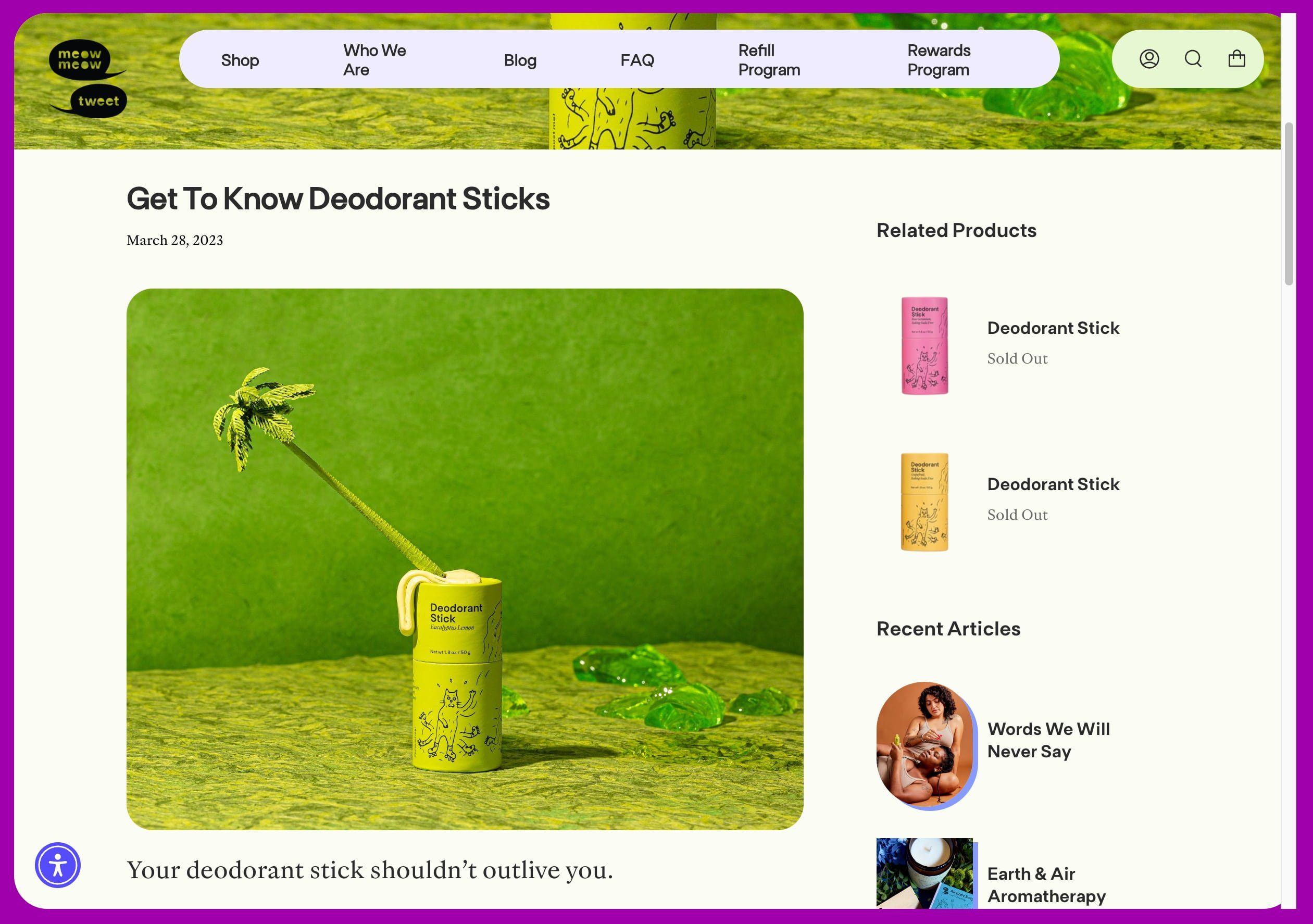
Well-written blog posts can keep bringing in traffic for quite some time

Pitfalls to avoid when starting a Shopify blog

We’ve seen that adding a blog to your online store can significantly enhance your brand’s visibility, customer engagement, and SEO performance. However, some pitfalls can undermine its success. One challenge is keeping a consistent posting schedule. You need it to keep your audience engaged and your SEO in check, but people frequently overlook this.

Another common pitfall is producing irrelevant or low-quality content that doesn’t provide value to your audience. In the end, this could hurt your online business. Additionally, neglecting ecommerce SEO can limit your blog’s visibility and effectiveness.

Tips for writing blog posts that strike a chord

We’ve established that adding a blog to your Shopify store can bring great benefits, but only if you do it well. One of the most important points to consider is content quality. Content quality is what you say and how well you say it. Your writing talent can make or break your Shopify blog posts. These days, it’s enticing to open ChatGPT or Gemini and ask it to write a post for you, but that’s not actual writing.

Know your audience

Understanding your audience is crucial for effective writing. By knowing who you’re writing for, you can tailor your content to their needs, interests, and preferences, making your blogging more engaging and relevant. This involves using language and examples that resonate with them, fostering a deeper connection, and encouraging interactions like comments and shares. Conducting keyword research for your Shopify store is also essential, as it helps address your audience’s specific concerns and challenges, making your writing clearer and more direct.

Eliminating unnecessary jargon and focusing on clarity ensures your message is communicated efficiently. This increases the likelihood of persuading your audience to take action, whether making a purchase or engaging with your brand. Ultimately, this will boost conversions and build loyalty.

Keep your writing clean and to the point

For effective blog content, you should use simplicity, clarity, and brevity as your main guiding principles. Start by clearly understanding the primary message you want to convey. This understanding will guide your writing, helping you stay focused and avoid unnecessary digressions.

Then, plan out what you want to write before you start writing. Outline the main points you want to cover. A structured approach helps organize thoughts and ensures that each paragraph contributes directly to your overall message. Making a mindmap can help you structure your thoughts and make new connections between thinking. Planning makes the writing part so much easier.
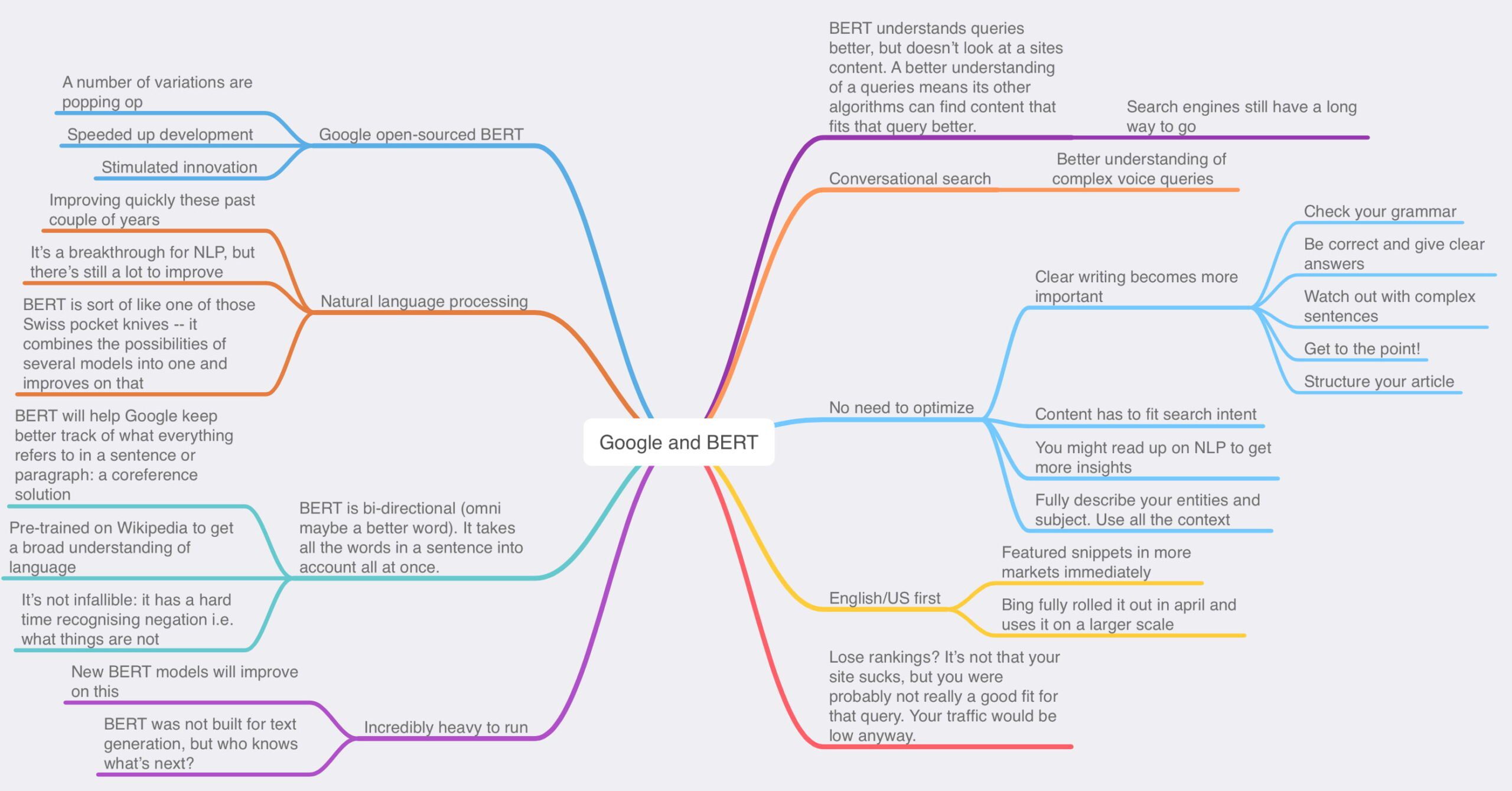
An example of a mindmap explaining the topic of Google BERT for a blog post

Keep it simple

Avoid jargon and complex vocabulary that might confuse your readers. When possible, use everyday language to ensure clarity. Opt for simpler alternatives that make your message clear. As a result, your writings will be accessible to a broad audience.

Be direct and concise by using short sentences and paragraphs. Get to the point quickly by eliminating filler words and redundant phrases that don’t add value to your message.

Don’t forget to write in the active voice instead of the passive voice. Write in the active voice as much as possible. It’s more direct, lively, and clear than the passive voice, making your writing easier to understand.

Make it human and make it your own

As a beginning writer, you’re always searching for your voice. This takes a while to develop. For instance, you might want to infuse your writing with a sense of humanity and uniqueness. Try adopting a conversational tone as if you’re talking to a friend. If it makes sense, don’t shy away from sharing personal anecdotes and experiences that illuminate your points.

Expressing your opinions thoughtfully can add depth to your blogging. You can make your stories more vivid by using descriptive language that taps into the senses. This can make your content more emotionally resonant. Importantly, let your personality and unique voice shine through. Ultimately, this is the authenticity that makes your writing distinctive and relatable.

Develop a tone of voice that fits your brand

Developing a distinct tone of voice for your writing begins with deeply understanding your audience. You’ll also need a clear definition of your brand’s personality and an analytical review of your existing content.

If you want your content to resonate with your readers, you must delve into who they are. You need to identify their interests, values, and the language that speaks to them. This forms your brand’s personality — whether authoritative, playful, inspiring, or something else. Describing your brand in human characteristics helps craft a personal and engaging tone.

Simultaneously, examine your current content to see what performed well. This can provide valuable insights. If you want to find aspects of your tone that resonate with your audience, you should check articles that got much engagement or positive feedback in the past.

Writing is rewriting

Embrace the concept that “writing is rewriting.” Begin by taking a break after your initial draft to gain a fresh perspective, then read your work aloud to catch any awkward phrasing or inconsistencies.

Initially, focus on the overall structure to ensure ideas flow logically. Be prepared to ruthlessly cut anything that doesn’t directly contribute to your main points. Simplify difficult sentences and get feedback from trusted sources for fresh insights.

Revising and refining your work enhances its clarity and impact, but you must know when to stop. But remember that truly great writing comes from a willingness to revisit and improve your initial ideas.

Yoast SEO for Shopify improves your blog posts

Yoast SEO for Shopify has tools to significantly enhance your content’s quality and visibility. This Shopify SEO app aims to help you make your content SEO-friendly and engaging for your customers.

Yoast SEO provides detailed analysis and actionable recommendations for optimizing your content, including product descriptions, blog posts, and web pages. It guides you on where to place your target keywords, how to structure your content for better readability, and what you might be missing regarding SEO best practices.

The readability analysis feature evaluates your content to ensure it’s clear and accessible to your target audience. It checks for sentence length, passive voice usage, and paragraph structure, offering suggestions to make your content easier to read. This improves user experience and increases engagement rates, as readers are likelier to stay on straightforward and engaging pages.

Yoast SEO for Shopify helps you optimize your blog post for readability and SEO

Examples of great blogs on Shopify

Exploring successful blogs on Shopify stores can provide valuable insights and inspiration for your content strategy. Here are some examples that have harnessed the power of blogging to engage their audience, enhance brand awareness, and drive traffic to their stores.

Partake Foods
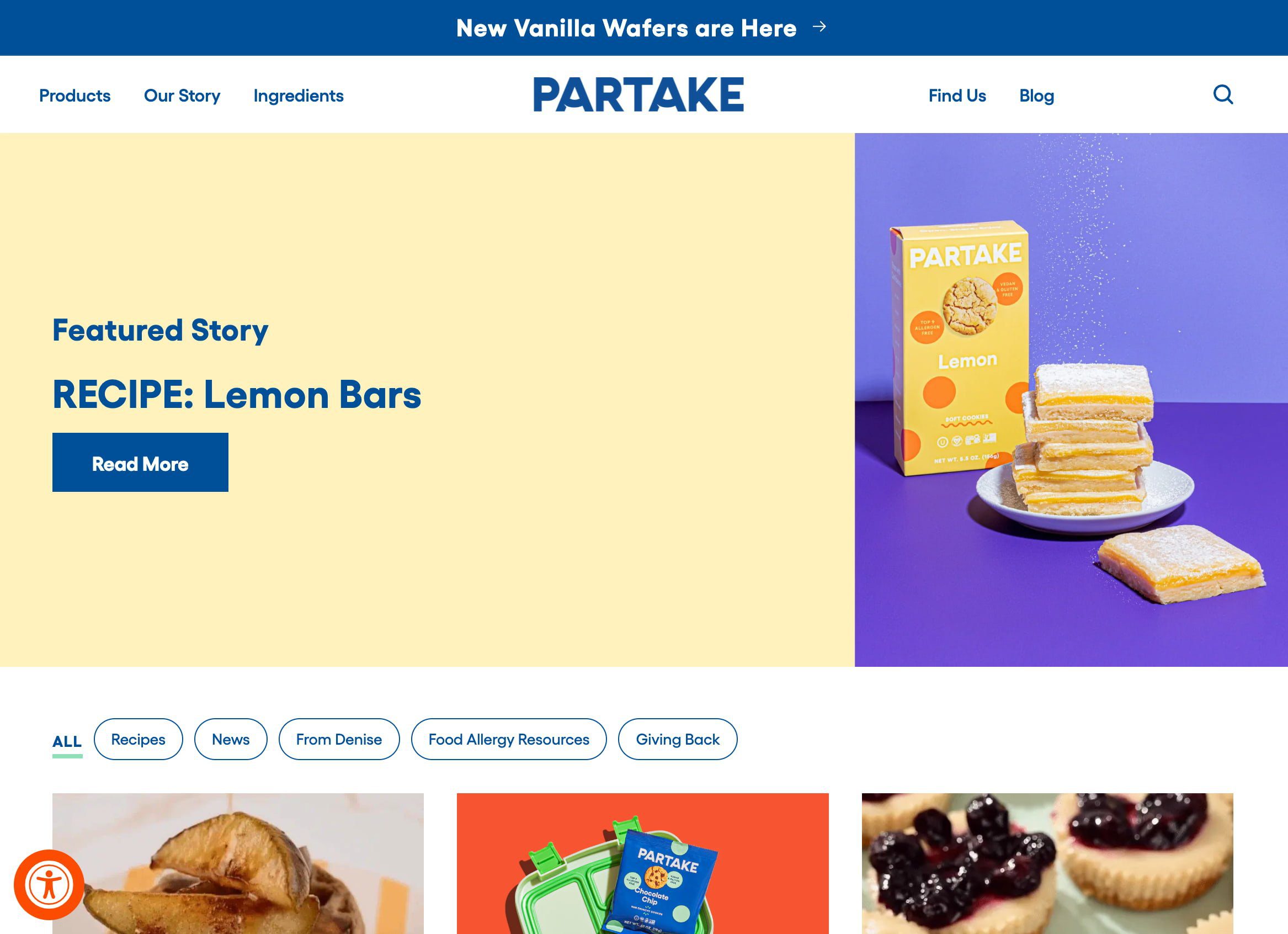
An example of a blog post on the Partake Shopify blog
  • Overview: Partake Foods stands out not just for its allergy-friendly food products but also for its engaging and informative blog. The blog is a resourceful hub where readers can find many recipes, food allergy guides, parenting tips for managing allergies, and insights into an allergy-aware lifestyle. It caters to the needs of parents looking for safe, delicious options for their children with food allergies, but it goes beyond just food.
  • Why it works: The success of the Partake Foods blog lies in its ability to directly address and alleviate the concerns of its core audience—parents navigating the complex world of food allergies. By providing valuable, practical content, Partake Foods positions itself as more than just a food brand; it becomes a trusted ally to families.
  • Source: Partake Foods blog

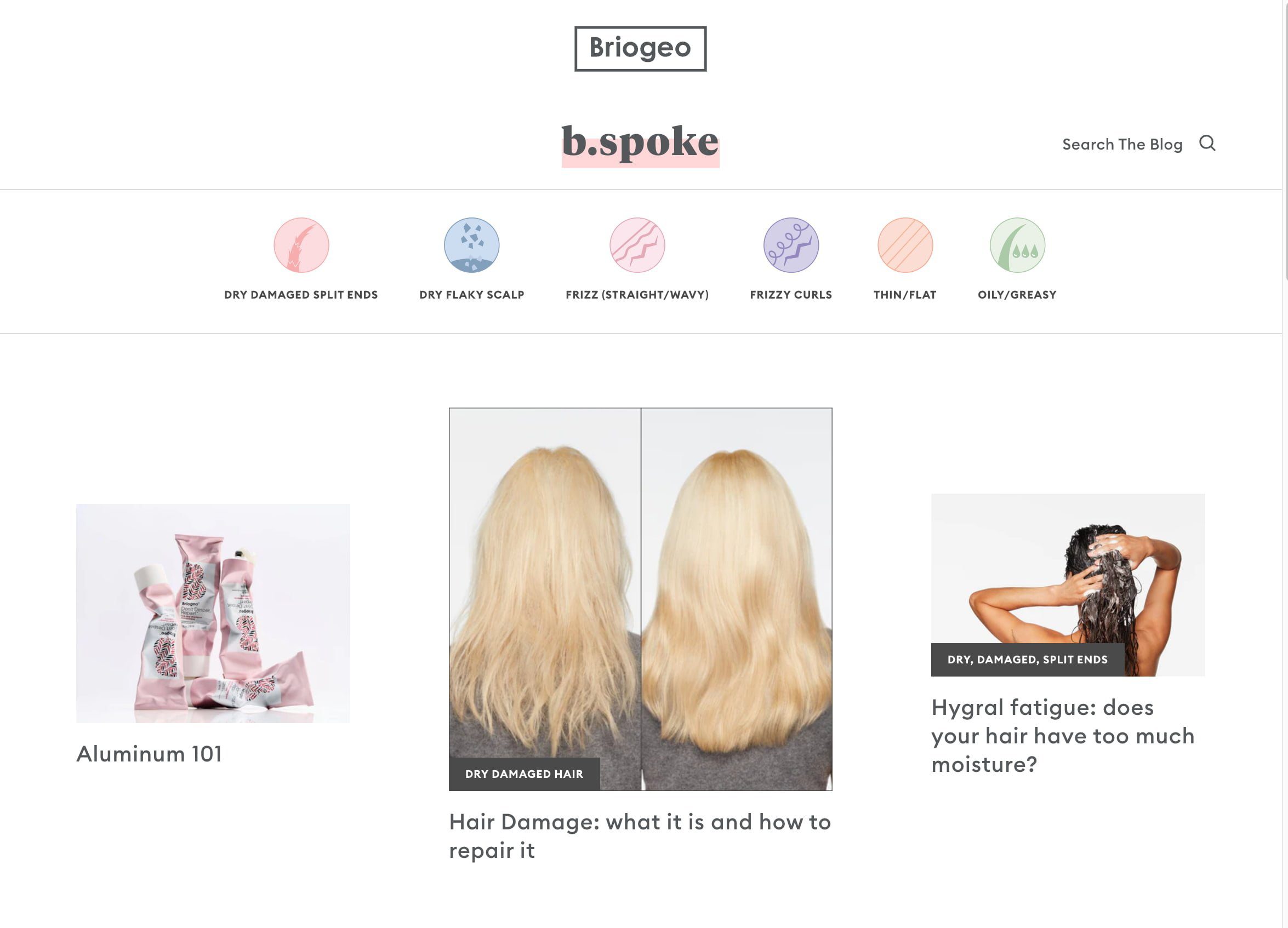
Briogeo

An example of a blog post on the Briogeo Shopify blog
Briogeo has a great blog with loads of useful content
  • Overview: Briogeo, a natural hair care brand, enriches its Shopify store with a blog that serves as a cornerstone for educating and engaging its audience. This blog doesn’t just sell products; it delves into various topics relevant to natural hair care, including detailed guides on hair types, the benefits of specific ingredients, and tutorials on tackling common hair concerns.
  • Why it works: The effectiveness of Briogeo’s blog lies in its educational approach, addressing its audience’s specific needs and questions with information and practical advice. By focusing on the intricacies of natural hair care and the science behind their product formulations, Briogeo establishes itself as an authority in the space.
  • Source: Briogeo blog

Death Wish Coffee
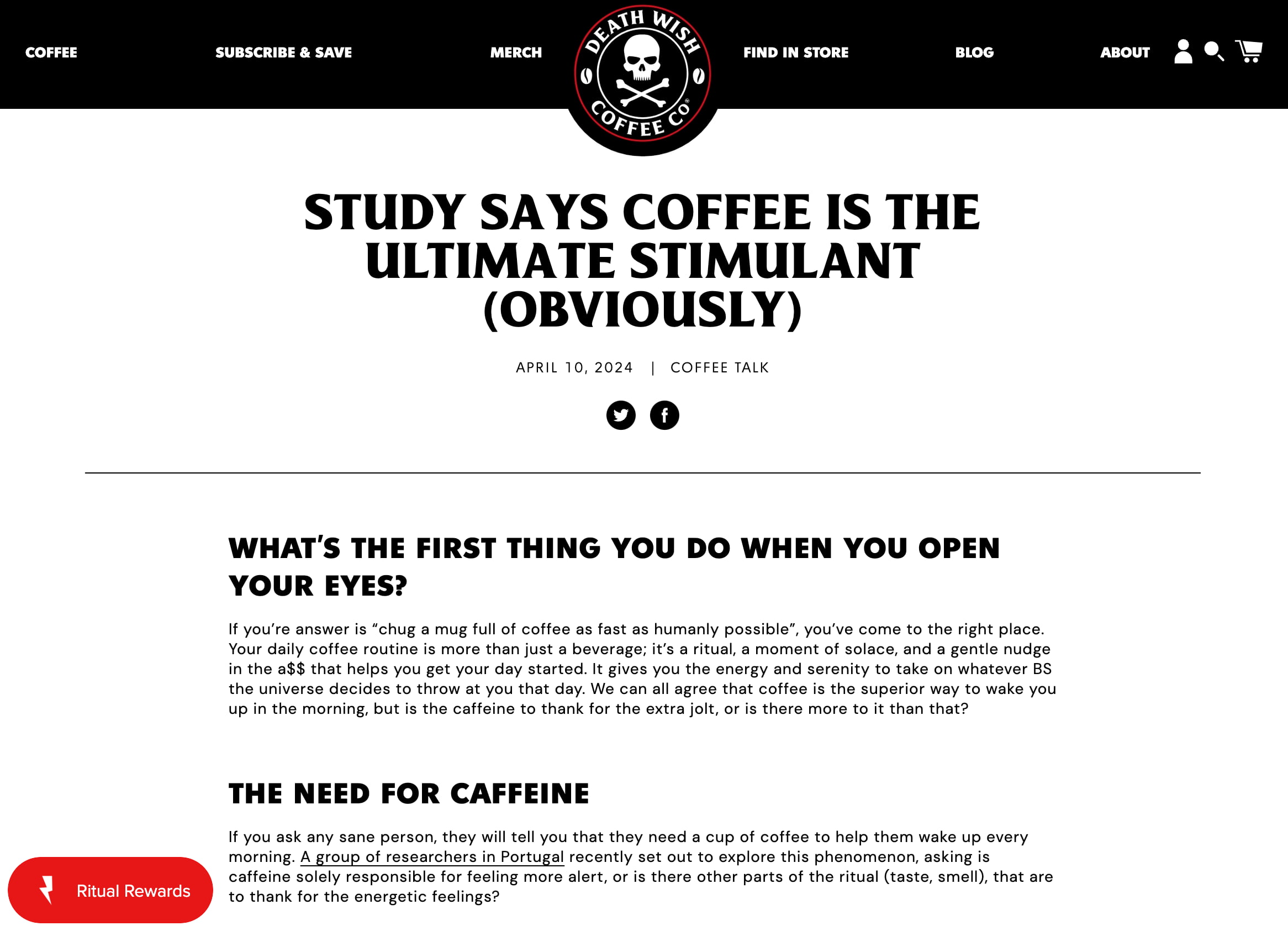
An example of a blog post on the Death Wish Coffee Shopify blog
  • Overview: Known as producing the world’s strongest coffee, Death Wish Coffee’s blog is a treasure trove of coffee culture, brewing tips, and company news. It effectively engages coffee enthusiasts with content ranging from the science behind caffeine to stories of people living life to the fullest, embodying the brand’s adventurous and bold spirit.
  • Why it works: The blog perfectly captures the brand’s essence — intense, passionate about coffee, and a bit rebellious. By sharing content that appeals directly to their target audience’s interests, they promote their products and build a strong community of coffee lovers. The blog serves as a platform to educate readers about their unique value proposition while entertaining and informing them about coffee.
  • Source: Death Wish Coffee blog

BeardBrand

The BeardBrand blog is all about growing and improving beards and mustaches
  • Overview: BeardBrand takes the concept of beard care and elevates it to a lifestyle, which is vividly reflected in their blog. Their content ranges from grooming tips and style advice to deeper dives into the culture of beard-keeping. BeardBrand’s blog is a comprehensive guide for anyone looking to embrace their facial hair, offering insights into grooming techniques, product recommendations, and the philosophy behind growing a beard. It’s not just about selling beard oil or grooming kits; it’s about fostering a community and identity among beard enthusiasts.
  • Why it works: The BeardBrand blog excels because it taps into the lifestyle and ethos of its audience rather than merely focusing on product usage. By addressing the broader culture of beard-keeping and the lifestyle that comes with it, the blog connects on a deeper level with readers who see their beards as an expression of their identity. This connection is further solidified by the blog’s clear, confident, and engaging tone of voice, which mirrors the brand’s ethos of self-care and community.
  • Source: BeardBrand blog

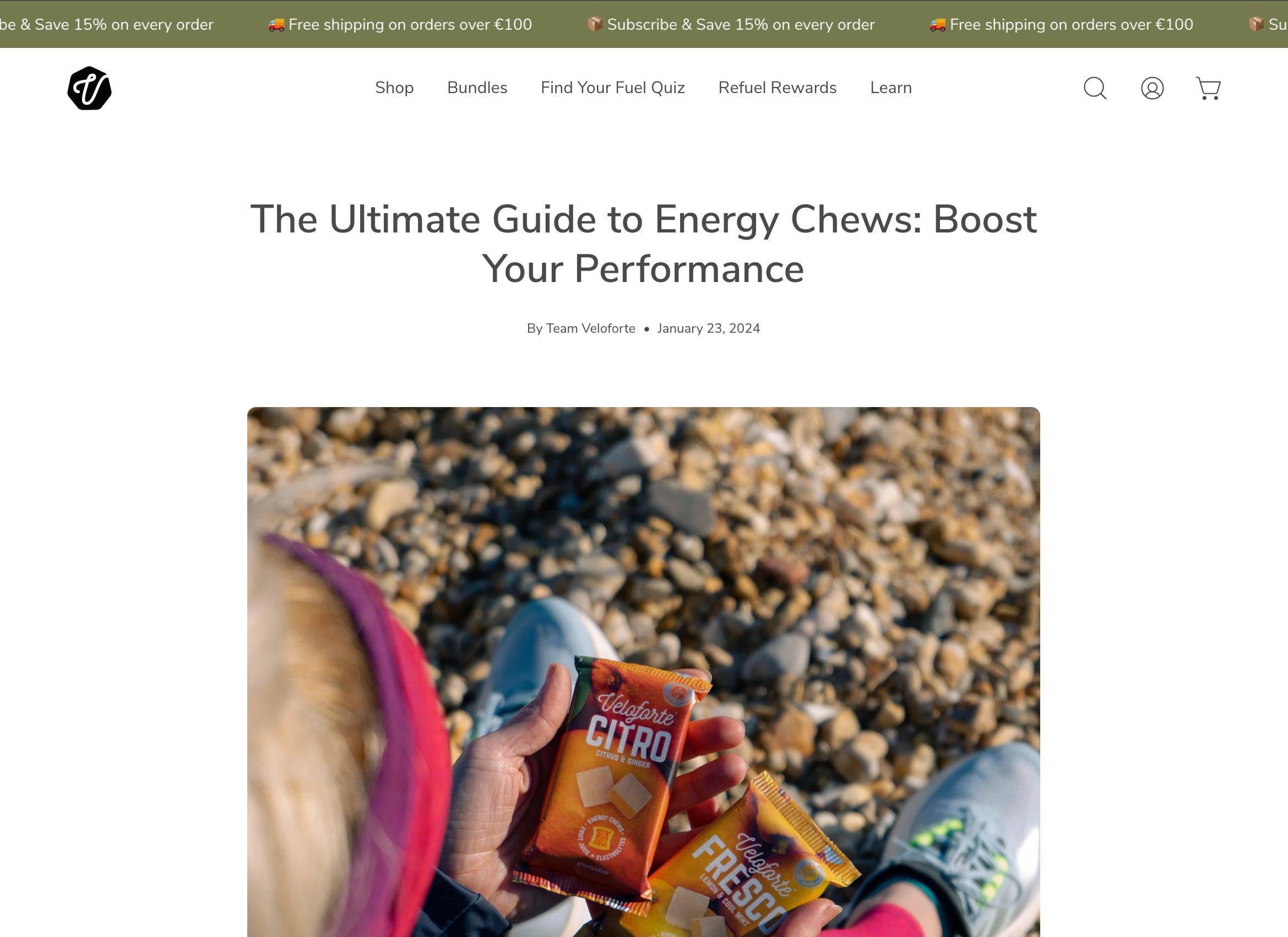
Veloforte

An example of a blog post on the Veloforte Shopify store
  • Overview: VELOFORTE, recognized for its range of natural, performance-enhancing nutrition products, extends its commitment to athlete support through its engaging and informative blog. The blog stands out as a valuable resource for athletes of all levels, offering nutritional advice, endurance training tips, and insights into optimizing performance through natural means.
  • Why it works: The success of VELOFORTE’s blog lies in its precision targeting and expertly crafted content that speaks directly to the needs and interests of endurance athletes. By providing scientifically backed nutrition and training advice, the blog positions VELOFORTE as a thought leader in sports nutrition and deepens trust with its audience. This trust is crucial for a brand whose products are designed to support peak athletic performance.
  • Source: Veloforte blog

Made in Cookware
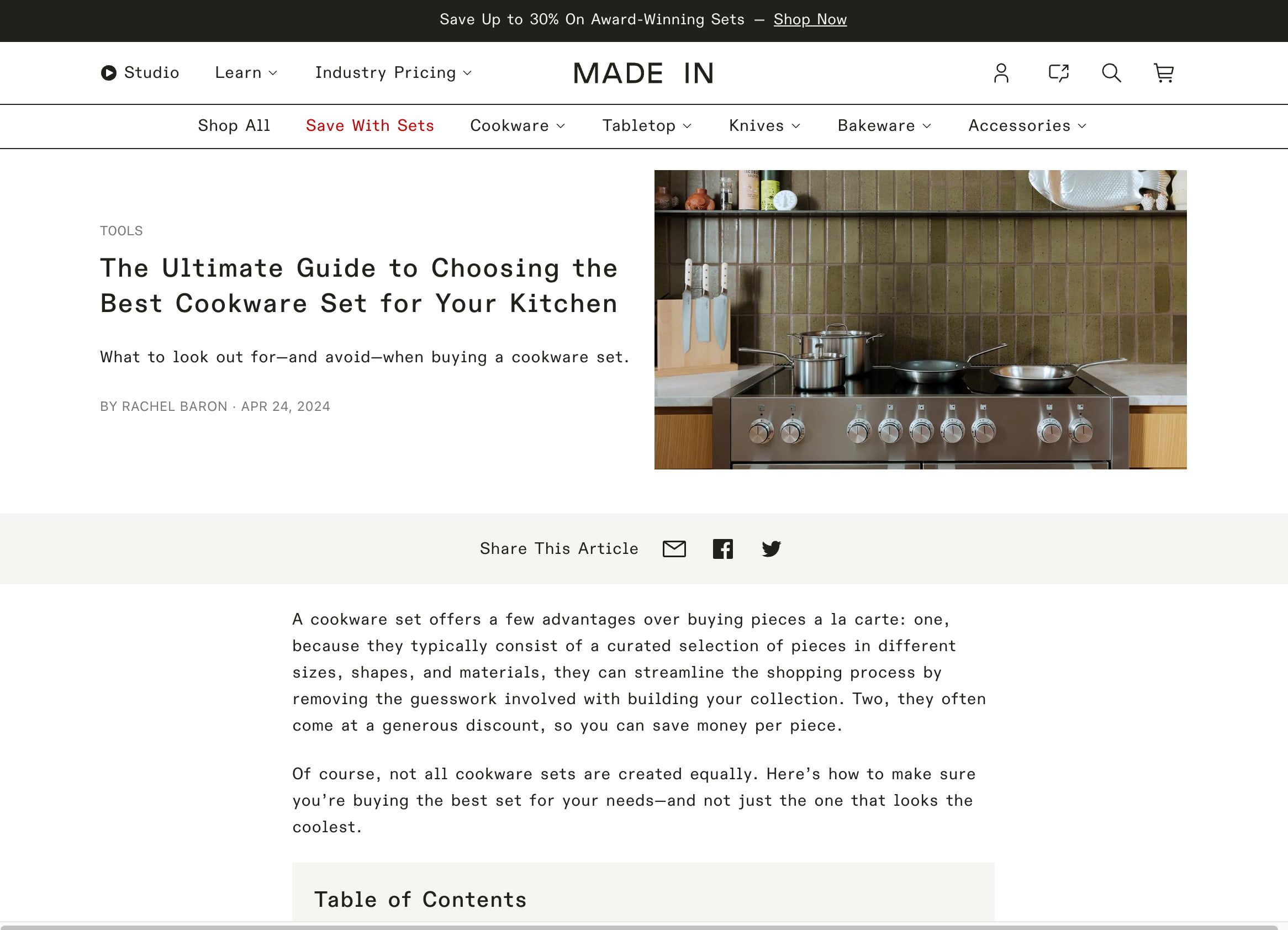
An example of an post on the Made In Cookware Shopify blog
An example of an article on the Made In Cookware Shopify blog
  • Overview: Made In Cookware distinguishes itself through its high-quality kitchen tools and richly informative blog. This platform serves as a culinary hub, offering everything from cooking tips and detailed recipes to chef interviews and insights into the manufacturing processes of their cookware. The blog aims to educate home cooks and culinary enthusiasts, providing information that spans basic cooking techniques and advanced culinary concepts.
  • Why it works: The effectiveness of Made In Cookware’s blog lies in its ability to demystify the cooking process, making gourmet cooking accessible to a broader audience by sharing professional chefs’ secrets and offering guidance on using their products to achieve the best culinary results, Made In positions itself as an ally in the kitchen. This educational approach builds trust with the audience and illustrates the value of investing in quality cookware.
  • Source: Made in Cookware blog

These examples illustrate how diverse Shopify stores use blogging to connect with their audience. These blogs effectively enhance their brand’s online presence and customer engagement through educational content, behind-the-scenes stories, or practical advice. These examples serve as a blueprint for success for anyone looking to boost their Shopify store’s content strategy. Consider integrating similar approaches tailored to your brand’s unique voice and audience needs.

Write awesome, helpful content that builds your brand

Blogging is great as it can help your Shopify store to stand out from the crowd. While adding a blog is easy, writing your content is harder. Make sure to write high-quality content about the topics you know your customers are interested in. Use easy-to-understand language and other writing tips to make your content come alive.

Coming up next!

Google Launches New ‘Saved Comparisons’ Feature For Analytics via @sejournal, @MattGSouthern

Google announced a new tool for Analytics to streamline data comparisons.

The ‘saved comparisons’ feature allows you to save filtered user data segments for rapid side-by-side analysis.

Google states in an announcement:

“We’re launching saved comparisons to help you save time when comparing the user bases you care about.

Learn how you can do that without recreating the comparison every time!”

Google links to a help page that lists several benefits and use cases:

“Comparisons let you evaluate subsets of your data side by side. For example, you could compare data generated by Android devices to data generated by iOS devices.”

“In Google Analytics 4, comparisons take the place of segments in Universal Analytics.”

Saved Comparisons: How They Work

The new comparisons tool allows you to create customized filtered views of Google Analytics data based on dimensions like platform, country, traffic source, and custom audiences.

These dimensions can incorporate multiple conditions using logic operators.

For example, you could generate a comparison separating “Android OR iOS” traffic from web traffic. Or you could combine location data like “Country = Argentina OR Japan” with platform filters.

These customized comparison views can then be saved to the property level in Analytics.

Users with access can quickly apply saved comparisons to any report for efficient analysis without rebuilding filters.

Google’s documentation states:

“As an administrator or editor…you can save comparisons to your Google Analytics 4 property. Saved comparisons enable you and others with access to compare the user bases you care about without needing to recreate the comparisons each time.”

Rollout & Limitations

The saved comparisons feature is rolling out gradually. There’s a limit of 200 saved comparisons per property.

For more advanced filtering needs, such as sequences of user events, Google recommends creating a custom audience first and saving a comparison based on that audience definition.

Some reports may be incompatible if they don’t include the filtered dimensions used in a saved comparison. In that case, the documentation suggests choosing different dimensions or conditions for that report type.

Why SEJ Cares

The ability to create and apply saved comparisons addresses a time-consuming aspect of analytics work.

Analysts must view data through different lenses, segmenting by device, location, traffic source, etc. Manually recreating these filtered comparisons for each report can slow down production.

Any innovation streamlining common tasks is welcome in an arena where data teams are strapped for time.

How This Can Help You

Saved comparisons mean less time getting bogged down in filter recreation and more time for impactful analysis.

Here are a few key ways this could benefit your work:

  • Save time by avoiding constant recreation of filters for common comparisons (e.g. mobile vs desktop, traffic sources, geo locations).
  • Share saved comparisons with colleagues for consistent analysis views.
  • Switch between comprehensive views and isolated comparisons with a single click.
  • Break down conversions, engagement, audience origins, and more by your saved user segments.
  • Use thoughtfully combined conditions to surface targeted segments (e.g. paid traffic for a certain product/location).

The new saved comparisons in Google Analytics may seem like an incremental change. However, simplifying workflows and reducing time spent on mundane tasks can boost productivity in a big way.


Featured Image: wan wei/Shutterstock

LinkedIn Report: AI Skills Now Must-Have For Marketers via @sejournal, @MattGSouthern

A new report by Microsoft and LinkedIn reveals the rapid adoption of AI tools and skills in the marketing industry.

According to the 2024 Work Trend Index Annual Report, which surveyed over 31,000 people across 31 countries, marketing professionals who leverage AI enjoy a competitive advantage.

Employers recognize the efficiency gains AI capabilities provide in marketing roles and increasingly seek applicants with those skills.

Karim R. Lakhani, Chair of the Digital Data Design Institute at Harvard, states in the report:

“Marketers are harnessing the power of AI to work smarter, not just faster. It’s enabling them to focus on higher-value, creative work while automating more routine tasks.”

Here are some highlights from the report illustrating the need to develop an AI skill set to remain competitive.

AI Aptitude: The New Must-Have Skill for Marketers

The survey data reveals a strong preference among business leaders for candidates and employees with AI skills.

A majority, 66%, stated they wouldn’t consider hiring candidates lacking AI proficiency.

Further, 71% expressed a preference for less experienced job seekers with AI skills over more seasoned professionals without that expertise.

This inclination was pronounced in creative fields like marketing and design.

Michael Platt, a neuroscience professor at the Wharton School, states in the report:

“AI is redefining what it means to be a competitive marketer in today’s digital landscape. Professionals who can effectively integrate AI into their work are positioning themselves as invaluable assets to their organizations.”

The report indicates that early-career marketers who develop AI skills could benefit significantly.

77% of leaders reported that employees adept at leveraging AI would be trusted with greater responsibilities earlier in their careers than their peers without AI skills.

The AI Arms Race For Top Marketing Talent

Data from LinkedIn shows that job postings highlighting AI tools and applications have seen a 17% increase in application growth compared to those that don’t mention AI.

Additionally, 54% of early-career employees cited access to AI technologies as a key factor influencing their choice of employer.

Organizations that provide AI training and support for their marketing teams likely have an advantage in attracting top talent.

Why SEJ Cares

The widespread adoption of AI in marketing signifies a shift in the skills and capabilities necessary for succeeding in this rapidly evolving industry.

As AI transforms marketing approaches, professionals who fail to adapt risk being left behind.

The 2024 Work Trend Index Annual Report’s findings are relevant to marketing professionals at all levels. They demonstrate that AI proficiency is necessary for career advancement and job market competitiveness.

Additionally, the report highlights businesses’ role in fostering an AI-driven culture.

Companies investing in AI tools, training, and employee support will be better positioned to attract and retain top talent, drive innovation, and achieve better results.

Read the full report.

How This Can Help You

For marketing professionals to succeed in the AI era, the report suggests:

  • Prioritize developing AI skills through courses, workshops, training programs, and collaborating with AI practitioners to gain hands-on experience.
  • Embrace experimenting with new AI tools and techniques, integrating them into daily workflows to improve efficiency.
  • Share AI knowledge actively with colleagues to foster a culture of knowledge sharing and drive organizational AI adoption.
  • Highlight AI capabilities during job searches by demonstrating the successful use of AI to drive results in previous roles.
  • Choose employers committed to AI adoption that provide access to cutting-edge AI tools and support ongoing learning.

These recommendations can help you future-proof your career and advance in an increasingly competitive field.


Featured Image: eamesBot/Shutterstock

How I learned to stop worrying and love fake meat

Fixing our collective meat problem is one of the trickiest challenges in addressing climate change—and for some baffling reason, the world seems intent on making the task even harder.

The latest example occurred last week, when Florida governor Ron DeSantis signed a law banning the production, sale, and transportation of cultured meat across the Sunshine State. 

“Florida is fighting back against the global elite’s plan to force the world to eat meat grown in a petri dish or bugs to achieve their authoritarian goals,” DeSantis seethed in a statement.

Alternative meat and animal products—be they lab-grown or plant-based—offer a far more sustainable path to mass-producing protein than raising animals for milk or slaughter. Yet again and again, politicians, dietitians, and even the press continue to devise ways to portray these products as controversial, suspect, or substandard. No matter how good they taste or how much they might reduce greenhouse-gas emissions, there’s always some new obstacle standing in the way—in this case, Governor DeSantis, wearing a not-at-all-uncomfortable smile.  

The new law clearly has nothing to do with the creeping threat of authoritarianism (though for more on that, do check out his administration’s crusade to ban books about gay penguins). First and foremost it is an act of political pandering, a way to coddle Florida’s sizable cattle industry, which he goes on to mention in the statement.

Cultured meat is seen as a threat to the livestock industry because animals are only minimally involved in its production. Companies grow cells originally extracted from animals in a nutrient broth and then form them into nuggets, patties or fillets. The US Department of Agriculture has already given its blessing to two companies, Upside Foods and Good Meat, to begin selling cultured chicken products to consumers. Israel recently became the first nation to sign off on a beef version.

It’s still hard to say if cultured meat will get good enough and cheap enough anytime soon to meaningfully reduce our dependence on cattle, chicken, pigs, sheep, goats, and other animals for our protein and our dining pleasure. And it’s sure to take years before we can produce it in ways that generate significantly lower emissions than standard livestock practices today.

But there are high hopes it could become a cleaner and less cruel way of producing meat. It wouldn’t require all the land, food, and energy needed to raise, feed, slaughter, and process animals today. One study found that cultured meat could reduce emissions per kilogram of meat 92% by 2030, even if cattle farming also achieves substantial improvements.

Those sorts of gains are essential if we hope to ease the rising dangers of climate change, because meat, dairy, and cheese production are huge contributors to greenhouse-gas emissions.

DeSantis and politicians in other states that may follow suit, including Alabama and Tennessee, are raising the specter of mandated bug-eating and global-elite string-pulling to turn cultured meat into a cultural issue, and kill the industry in its infancy. 

But, again, it’s always something. I’ve heard a host of other arguments across the political spectrum directed against various alternative protein products, which also include plant-based burgers, cheeses, and milks, or even cricket-derived powders and meal bars. Apparently these meat and dairy alternatives shouldn’t be highly processed, mass-produced, or genetically engineered, nor should they ever be as unhealthy as their animal-based counterparts. 

In effect, we are setting up tests that almost no products can pass, when really all we should ask of alternative proteins is that they be safe, taste good, and cut climate pollution.

The meat of the matter

Here’s the problem. 

Livestock production generates more than 7 billion tons of carbon dioxide, making up 14.5% of the world’s overall climate emissions, according to the United Nations Food and Agriculture Organization.

Beef, milk, and cheese production are, by far, the biggest problems, representing some 65% of the sector’s emissions. We burn down carbon-dense forests to provide cows with lots of grazing land; then they return the favor by burping up staggering amounts of methane, one of the most powerful greenhouse gases. Florida’s cattle population alone, for example, could generate about 180 million pounds of methane every year, as calculated from standard per-animal emissions

In an earlier paper, the World Resources Institute noted that in the average US diet, beef contributed 3% of the calories but almost half the climate pollution from food production. (If you want to take a single action that could meaningfully ease your climate footprint, read that sentence again.)

The added challenge is that the world’s population is both growing and becoming richer, which means more people can afford more meat. 

There are ways to address some of the emissions from livestock production without cultured meat or plant-based burgers, including developing supplements that reduce methane burps and encouraging consumers to simply reduce meat consumption. Even just switching from beef to chicken can make a huge difference.

Let’s clear up one matter, though. I can’t imagine a politician in my lifetime, in the US or most of the world, proposing a ban on meat and expecting to survive the next election. So no, dear reader. No one’s coming for your rib eye. If there’s any attack on personal freedoms and economic liberty here, DeSantis is the one waging it by not allowing Floridians to choose for themselves what they want to eat.

But there is a real problem in need of solving. And the grand hope of companies like Beyond Meat, Upside Foods, Miyoko’s Creamery, and dozens of others is that we can develop meat, milk, and cheese alternatives that are akin to EVs: that is to say, products that are good enough to solve the problem without demanding any sacrifice from consumers or requiring government mandates. (Though subsidies always help.)

The good news is the world is making some real progress in developing substitutes that increasingly taste like, look like, and have (with apologies for the snooty term) the “mouthfeel” of the traditional versions, whether they’ve been developed from animal cells or plants. If they catch on and scale up, it could make a real dent in emissions—with the bonus of reducing animal suffering, environmental damage, and the spillover of animal disease into the human population.

The bad news is we can’t seem to take the wins when we get them. 

The blue cheese blues

For lunch last Friday, I swung by the Butcher’s Son Vegan Delicatessen & Bakery in Berkeley, California, and ordered a vegan Buffalo chicken sandwich with a blue cheese on the side that was developed by Climax Foods, also based in Berkeley.

Late last month, it emerged that the product had, improbably, clinched the cheese category in the blind taste tests of the prestigious Good Food awards, as the Washington Post revealed.

Let’s pause here to note that this is a stunning victory for vegan cheeses, a clear sign that we can use plants to produce top-notch artisanal products, indistinguishable even to the refined palates of expert gourmands. If a product is every bit as tasty and satisfying as the original but can be produced without milking methane-burping animals, that’s a big climate win.

But sadly, that’s not where the story ended.

JAMES TEMPLE

After word leaked out that the blue cheese was a finalist, if not the winner, the Good Food Foundation seems to have added a rule that didn’t exist when the competition began but which disqualified Climax Blue, the Post reported.

I have no special insights into what unfolded behind the scenes. But it reads at least a little as if the competition concocted an excuse to dethrone a vegan cheese that had bested its animal counterparts and left traditionalists aghast. 

That victory might have done wonders to help promote acceptance of the Climax product, if not the wider category. But now the story is the controversy. And that’s a shame. Because the cheese is actually pretty good. 

I’m no professional foodie, but I do have a lifetime of expertise born of stubbornly refusing to eat any salad dressing other than blue cheese. In my own taste test, I can report it looked and tasted like mild blue cheese, which is all it needs to do.

A beef about burgers

Banning a product or changing a cheese contest’s rules after determining the winner are both bad enough. But the reaction to alternative proteins that has left me most befuddled is the media narrative that formed around the latest generation of plant-based burgers soon after they started getting popular a few years ago. Story after story would note, in the tone of a bold truth-teller revealing something new each time: Did you know these newfangled plant-based burgers aren’t actually all that much healthier than the meat variety? 

To which I would scream at my monitor: THAT WAS NEVER THE POINT!

The world has long been perfectly capable of producing plant-based burgers that are better for you, but the problem is that they tend to taste like plants. The actual innovation with the more recent options like Beyond Burger or Impossible Burger is that they look and taste like the real thing but can be produced with a dramatically smaller climate footprint.

That’s a big enough win in itself. 

If I were a health reporter, maybe I’d focus on these issues too. And if health is your personal priority, you should shop for a different plant-based patty (or I might recommend a nice salad, preferably with blue cheese dressing).

But speaking as a climate reporter, expecting a product to ease global warming, taste like a juicy burger, and also be low in salt, fat, and calories is absurd. You may as well ask a startup to conduct sorcery.

More important, making a plant-based burger healthier for us may also come at the cost of having it taste like a burger. Which would make it that much harder to win over consumers beyond the niche of vegetarians and thus have any meaningful impact on emissions. WHICH IS THE POINT!

It’s incredibly difficult to convince consumers to switch brands and change behaviors, even for a product as basic as toothpaste or toilet paper. Food is trickier still, because it’s deeply entwined with local culture, family traditions, festivals and celebrations. Whether we find a novel food product to be yummy or yucky is subjective and highly subject to suggestion. 

And so I’m ending with a plea. Let’s grant ourselves the best shot possible at solving one of the hardest, most urgent problems before us. Treat bans and political posturing with the ridicule they deserve. Reject the argument that any single product must, or can, solve all the problems related to food, health, and the environment.

Give these alternative foods a shot, afford them room to improve, and keep an open mind. 

Though it’s cool if you don’t want to try the crickets.

Deepfakes of your dead loved ones are a booming Chinese business

Once a week, Sun Kai has a video call with his mother. He opens up about work, the pressures he faces as a middle-aged man, and thoughts that he doesn’t even discuss with his wife. His mother will occasionally make a comment, like telling him to take care of himself—he’s her only child. But mostly, she just listens.

That’s because Sun’s mother died five years ago. And the person he’s talking to isn’t actually a person, but a digital replica he made of her—a moving image that can conduct basic conversations. They’ve been talking for a few years now. 

After she died of a sudden illness in 2019, Sun wanted to find a way to keep their connection alive. So he turned to a team at Silicon Intelligence, an AI company based in Nanjing, China, that he cofounded in 2017. He provided them with a photo of her and some audio clips from their WeChat conversations. While the company was mostly focused on audio generation, the staff spent four months researching synthetic tools and generated an avatar with the data Sun provided. Then he was able to see and talk to a digital version of his mom via an app on his phone. 

“My mom didn’t seem very natural, but I still heard the words that she often said: ‘Have you eaten yet?’” Sun recalls of the first interaction. Because generative AI was a nascent technology at the time, the replica of his mom can say only a few pre-written lines. But Sun says that’s what she was like anyway. “She would always repeat those questions over and over again, and it made me very emotional when I heard it,” he says.

There are plenty of people like Sun who want to use AI to preserve, animate, and interact with lost loved ones as they mourn and try to heal. The market is particularly strong in China, where at least half a dozen companies are now offering such technologies and thousands of people have already paid for them. In fact, the avatars are the newest manifestation of a cultural tradition: Chinese people have always taken solace from confiding in the dead. 

The technology isn’t perfect—avatars can still be stiff and robotic—but it’s maturing, and more tools are becoming available through more companies. In turn, the price of “resurrecting” someone—also called creating “digital immortality” in the Chinese industry—has dropped significantly. Now this technology is becoming accessible to the general public. 

Some people question whether interacting with AI replicas of the dead is actually a healthy way to process grief, and it’s not entirely clear what the legal and ethical implications of this technology may be. For now, the idea still makes a lot of people uncomfortable. But as Silicon Intelligence’s other cofounder, CEO Sima Huapeng, says, “Even if only 1% of Chinese people can accept [AI cloning of the dead], that’s still a huge market.” 

AI resurrection

Avatars of the dead are essentially deepfakes: the technologies used to replicate a living person and a dead person aren’t inherently different. Diffusion models generate a realistic avatar that can move and speak. Large language models can be attached to generate conversations. The more data these models ingest about someone’s life—including photos, videos, audio recordings, and texts—the more closely the result will mimic that person, whether dead or alive.

China has proved to be a ripe market for all kinds of digital doubles. For example, the country has a robust e-commerce sector, and consumer brands hire many livestreamers to sell products. Initially, these were real people—but as MIT Technology Review reported last fall—many brands are switching to AI-cloned influencers that can stream 24/7. 

In just the past three years, the Chinese sector developing AI avatars has matured rapidly, says Shen Yang, a professor studying AI and media at Tsinghua University in Beijing, and replicas have improved from minutes-long rendered videos to 3D “live” avatars that can interact with people.  

This year, Sima says, has seen a tipping point, with AI cloning becoming affordable for most individuals. “Last year, it cost about $2,000 to $3,000, but it now only costs a few hundred dollars,” he says. That’s thanks to a price war between Chinese AI companies, which are fighting to meet the thriving demand for digital avatars in other sectors like streaming.

In fact, demand for applications that re-create the dead has also boosted the capabilities of tools that digitally replicate the living. 

Silicon Intelligence offers both services. When Sun and Sima launched the company, they were focused on using text-to-speech technologies to create audio and then using those AI-generated voices in applications such as robocalls.

But after the company replicated Sun’s mother, it pivoted to generating realistic avatars. That decision turned the company into one of the leading Chinese players creating AI-powered influencers. 

Example of the tablet product by Silicon Intelligence. The avatar of the grandma can converse with the user.
SILICON INTELLIGENCE

Its technology has generated avatars for hundreds of thousands of TikTok-like videos and streaming channels, but Sima says more recently it’s seen around 1,000 clients use it to replicate someone who’s passed away. “We started our work on ‘resurrection’ in 2019 and 2020,” he says, but at first people were slow to accept it: “No one wanted to be the first adopters.” 

The quality of the avatars has improved, he says, which has boosted adoption. When the avatar looks increasingly lifelike and gives fewer out-of-character answers, it’s easier for users to treat it as their deceased family member. Plus, the idea is getting popularized through more depictions on Chinese TV. 

Now Silicon Intelligence offers the replication service for a price between several hundred and several thousand dollars. The most basic product comes as an interactive avatar in an app, and the options at the upper end of the range often involve more customization and better hardware components, such as a tablet or a display screen. There are at least a handful more Chinese companies working on the same technology.

A modern twist on tradition

The business in these deepfakes builds on China’s long cultural history of communicating with the dead. 

In Chinese homes, it’s common to put up a portrait of a deceased relative for a few years after the death. Zhang Zewei, founder of a Shanghai-based company called Super Brain, says he and his team wanted to revamp that tradition with an “AI photo frame.” They create avatars of deceased loved ones that are pre-loaded onto an Android tablet, which looks like a photo frame when standing up. Clients can choose a moving image that speaks words drawn from an offline database or from an LLM. 

“In its essence, it’s not much different from a traditional portrait, except that it’s interactive,” Zhang says.

Zhang says the company has made digital replicas for over 1,000 clients since March 2023 and charges $700 to $1,400, depending on the service purchased. The company plans to release an app-only product soon, so that users can access the avatars on their phones, and could further reduce the cost to around $140.

Super Brain demonstrates the app-only version with an avatar of Zhang Zewei answering his own questions.
SUPER BRAIN

The purpose of his products, Zhang says, is therapeutic. “When you really miss someone or need consolation during certain holidays, you can talk to the artificial living and heal your inner wounds,” he says.

And even if that conversation is largely one-sided, that’s in keeping with a strong cultural tradition. Every April during the Qingming festival, Chinese people sweep the tombs of their ancestors, burn joss sticks and fake paper money, and tell them what has happened in the past year. Of course, those conversations have always been one-way. 

But that’s not the case for all Super Brain services. The company also offers deepfaked video calls in which a company employee or a contract therapist pretends to be the relative who passed away. Using DeepFace, an open-source tool that analyzes facial features, the deceased person’s face is reconstructed in 3D and swapped in for the live person’s face with a real-time filter. 

Example of a deepfake video call Super Brain did in July 2023. The face in the top right corner is from the deceased son of the woman.
SUPER BRAIN

At the other end of the call is usually an elderly family member who may not know that the relative has died—and whose family has arranged the conversation as a ruse. 

Jonathan Yang, a Nanjing resident who works in the tech industry, paid for this service in September 2023. His uncle died in a construction accident, but the family hesitated to tell Yang’s grandmother, who is 93 and in poor health. They worried that she wouldn’t survive the devastating news.

So Yang paid $1,350 to commission three deepfaked calls of his dead uncle. He gave Super Brain a handful of photos and videos of his uncle to train the model. Then, on three Chinese holidays, a Super Brain employee video-called Yang’s grandmother and told her, as his uncle, that he was busy working in a faraway city and wouldn’t be able to come back home, even during the Chinese New Year. 

“The effect has met my expectations. My grandma didn’t suspect anything,” Yang says. His family did have mixed opinions about the idea, because some relatives thought maybe she would have wanted to see her son’s body before it was cremated. Still, the whole family got on board in the end, believing the ruse would be best for her health. After all, it’s pretty common for Chinese families to tell “necessary” lies to avoid overwhelming seniors, as depicted in the movie The Farewell

To Yang, a close follower of the AI industry trends, creating replicas of the dead is one of the best applications of the technology. “It best represents the warmth [of AI],” he says. His grandmother’s health has improved, and there may come a day when they finally tell her the truth. By that time, Yang says, he may purchase a digital avatar of his uncle for his grandma to talk to whenever she misses him.

Is AI really good for grief? 

Even as AI cloning technology improves, there are some significant barriers preventing more people from using it to speak with their dead relatives in China. 

On the tech side, there are limitations to what AI models can generate. Most LLMs can handle dominant languages like Mandarin and Cantonese, but they aren’t able to replicate the many niche dialects in China. It’s also challenging—and therefore costly—to replicate body movements and complex facial expressions in 3D models. 

Then there’s the issue of training data. Unlike cloning someone who’s still alive, which often involves asking the person to record body movements or say certain things, posthumous AI replications must rely on whatever videos or photos are already available. And many clients don’t have high-quality data, or enough of it, for the end result to be satisfactory. 

Complicating these technical challenges are myriad ethical questions. Notably, how can someone who is already dead consent to being digitally replicated? For now, companies like Super Brain and Silicon Intelligence rely on the permission of direct family members. But what if family members disagree? And if a digital avatar generates inappropriate answers, who is responsible?

Similar technology caused controversy earlier this year. A company in Ningbo reportedly used AI tools to create videos of deceased celebrities and posted them on social media to speak to their fans. The videos were generated using public data, but without seeking any approval or permission. The result was intense criticism from the celebrities’ families and fans, and the videos were eventually taken down. 

“It’s a new domain that only came about after the popularization of AI: the rights to digital eternity,” says Shen, the Tsinghua professor, who also runs a lab that creates digital replicas of people who have passed away. He believes it should be prohibited to use deepfake technology to replicate living people without their permission. For people who have passed away, all of their immediate living family members must agree beforehand, he says. 

There could be negative effects on clients’ mental health, too. While some people, like Sun, find their conversations with avatars to be therapeutic, not everyone thinks it’s a healthy way to grieve. “The controversy lies in the fact that if we replicate our family members because we miss them, we may constantly stay in the state of mourning and can’t withdraw from it to accept that they have truly passed away,” says Shen. A widowed person who’s in constant conversation with the digital version of their partner might be held back from seeking a new relationship, for instance. 

“When someone passes away, should we replace our real emotions with fictional ones and linger in that emotional state?” Shen asks. Psychologists and philosophers who talked to MIT Technology Review about the impact of grief tech have warned about the danger of doing so. 

Sun Kai, at least, has found the digital avatar of his mom to be a comfort. She’s like a 24/7 confidante on his phone. Even though it’s possible to remake his mother’s avatar with the latest technology, he hasn’t yet done that. “I’m so used to what she looks like and sounds like now,” he says. As years have gone by, the boundary between her avatar and his memory of her has begun to blur. “Sometimes I couldn’t even tell which one is the real her,” he says.

And Sun is still okay with doing most of the talking. “When I’m confiding in her, I’m merely letting off steam. Sometimes you already know the answer to your question, but you still need to say it out loud,” he says. “My conversations with my mom have always been like this throughout the years.” 

But now, unlike before, he gets to talk to her whenever he wants to.

New Ecommerce Tools: May 7, 2024

This installment of our weekly rundown of new products from companies offering services to ecommerce merchants includes updates on operations software, social commerce, post-purchase experiences, digital payments, business-to-business platforms, and the metaverse.

Got an ecommerce product release? Email releases@practicalecommerce.com.

New Tools for Merchants: May 7

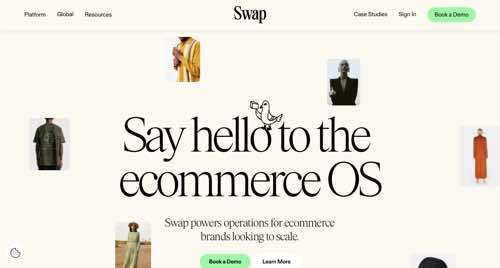
Swap secures $9 million to launch its ecommerce operations platform. Swap, an ecommerce operations platform for direct-to-consumer brands, has announced a $9 million Series A round led by QED Investors, with participation from Cherry Ventures, 9900 Capital, 2100 Ventures, and Ed Hallen, co-founder of Klaviyo. With this capital, Swap will launch Swap Global to unlock new markets with delivery-duty-paid shipping, automated tax remittance, and express customs clearance. Swap will expand its marketing and sales teams while broadening its footprint in the U.K., Europe, and the U.S.

Swap home page.

Swap

TikTok unveils new premium ad offerings. Despite its potential forced selloff in the U.S., TikTok announced (i) new placement options for its native Pulse ad campaigns and (ii) Pulse Custom Lineups with generative AI to curate trending content tailored to a brand’s particular needs. TikTok also added Paramount Global and the NHL to its roster of advertisers.

Amazon is reducing the low-inventory-level fee for FBA merchants. Starting May 15, FBA’s low-inventory fee will not apply to products that have sold less than 20 units in the past seven days. Low-inventory-level fees incurred due to excessive inbounding and processing times caused by Amazon or Amazon-managed services will be credited back to sellers by the 15th day of the following month. For Prime Day 2024, Amazon will provide a four-week exception on low-inventory fees for products included in Prime-exclusive Lightning Deals and Best Deals.

Walmart uses Roblox virtual world to sell physical goods. Walmart now sells physical goods inside Roblox, the gaming platform. In the Walmart Discovered virtual experience (launched in 2023), users can have real-life items shipped directly to their doorsteps. Users entering the experience will see a new storefront showcasing virtual twins of select physical items sold at Walmart stores. Players can then load an ecommerce window inside Roblox, imitating a shopping cart on Walmart’s website.

Roblox home page.

Walmart Discovered on Roblox

Meta introduces AI-powered tools for advertisers on Reels. To help match the creators and brands for campaigns, Meta has launched personalized, machine learning-powered creator recommendations for brands in Instagram’s Creator Marketplace. Meta uses AI-powered software to make Reel ads more engaging. Advertisers can now include external links to new products in Reminder ads to help turn viewers’ interest into purchases.

ParcelLab integrates with Shopify for post-purchase experience. ParcelLab, a global post-purchase customer experience platform, is now live on Shopify. ParcelLab’s Order Tracking App for Shopify, alongside the ParcelLab Engage product suite, gives Shopify merchants instant integration with automatic data exchange to create an embedded tracking page with order data (including split shipments and returns info) while injecting personalized content for customer segments. Shopify merchants can link store data with ParcelLab, accessing its post-purchase experience functionality to enhance engagement.

Mastercard and PrestaShop partner with Click to Pay online payments. Ecommerce platform PrestaShop has partnered with Mastercard to introduce Click to Pay, designed to simplify the online payment experience for consumers across Europe. Click to Pay enables consumers to use payment cards without manually entering card details or remembering passwords. All information is securely centralized in a single profile, facilitating easier management of payment methods.

PrestaShop home page.

PrestaShop

Chase releases new digital products for small businesses. Chase now offers a digital invoicing product for small business clients. The product is available for Chase Business Complete Banking customers at no additional cost. Further, Chase has introduced Customer Insights, a business intelligence platform that provides actionable insights to help owners reach customers and make strategic decisions. The platform is available for customers who use Chase to accept credit card payments.

OroCommerce unveils a brand-aligned platform for B2B ecommerce. OroCommerce, a B2B ecommerce platform, has announced a strategic rebranding, coinciding with the major 6.0 update to the commerce platform. This move unifies the suite of capabilities under the OroCommerce brand, offering a streamlined experience for manufacturers, distributors, and wholesalers. Previously, Oro Inc. marketed its commercial offerings as OroCommerce, OroCRM, and OroMarketplace. The platform now features a new storefront configurator, AI-powered product recommendations, sales enablement tools, enhanced search control, and more.

ChannelEngine enhances its Amazon capabilities with the acquisition of Retail Data Partners. ChannelEngine, a marketplace integration and management software provider, has acquired Retail Data Partners, an Amazon vendor suite developer. With the acquisition, ChannelEngine can manage Amazon vendors and sellers through one platform, providing process automation and deeper insights and using features such as dispute recovery for immediate impact. ChannelEngine is strengthening its first-party selling model functionality, enabling customers to have a scalable hybrid selling strategy on marketplaces.

Brite offers instant payments to Shopware merchants in Europe. Brite Payments has partnered with ecommerce platform Shopware to offer open banking-based instant payments to European businesses. Shopware merchants can now activate Pay by Bank (account-to-account payments), which enables customers to pay instantly from their bank account. The payments will go through the Brite Instant Payments Network. Shopware is one of Europe’s largest open-source ecommerce platforms, with more than 45,000 merchants.

Shopware home page.

Shopware

target.com 2007
Ecommerce Is Going Back In Time & Here’s Why

Ecommerce is always changing but here is one big reason I see as to why.

How can you win in an extremely crowded space like LA traffic at 5 p.m. On a weekday. 


internet is like la traffic

I started building my first website using HTML in the late 90s. but let’s be honest no one wants to hear about me and building some websites. But the reason I brought it up is things were much simpler. We didn’t have the ability to create a lot of functions or fancy movement on websites back then. 

You might ask what this has to do with digital commerce today, well I can tell you. Back then we had one thing and that was extremely slow internet. So, to get a web page to load sometimes felt like ages. Large images were not an option complex design was also not an option. 

Now this affects the user experience dramatically. Our goal back then from the .com boom on was to make sites simple and could load quickly with a slow internet connection DSL.  

Now as Internet speeds increased our desire for cooler looking websites that had cooler functions or in our minds seems cooler took over. I mean there was some wild stuff that was happening in the mid-2000s.

One thing was for certain we still had a slow internet connection compared to nowadays. So the goal back then in e-commerce was to make sure your website loaded quickly and the only way to do that was to make sure that it didn’t have too much complexity. 

Back then we were fighting a slow internet connection or slow server speeds.

In 2007, the U.S. download speed average was 3.5 mbps

In 2022 U.S. internet download speed averages is 109 Mbps

Back then we were fighting a slow internet connection or slow server speeds. Today we are fighting a fast internet connection with extremely fast server speeds, but we are battling extremely short users’ attention spans.

BUT ITS REALLY THE SAME FIGHT!

So, in order to capture users’ imagination, we have to do it within a matter of seconds. So keep these facts in mind when you’re building your website today or you’re looking to optimize your performance today.

THE BIG TAKE AWAY IS LESS IS MORE!

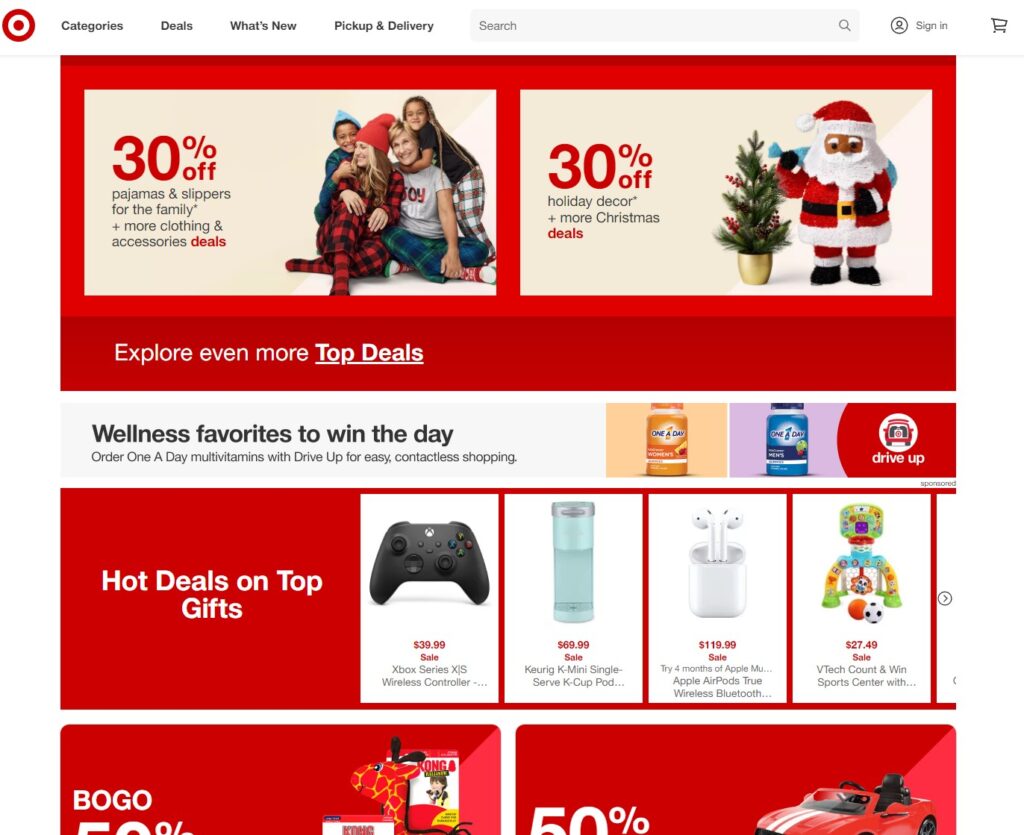
JUST LOOK AT TARGET.COM HOME PAGE IN 2007 COMPARED TO TODAY. THE BIG CHANGE I SEE IS A WHOLE LOT LESS OF EVERYTHING! 

BACK IN 2007

target.com 2007

TODAY

By Jeffry Graham 

Google Launches Fuchsia
Google launches its third major operating system, Fuchsia

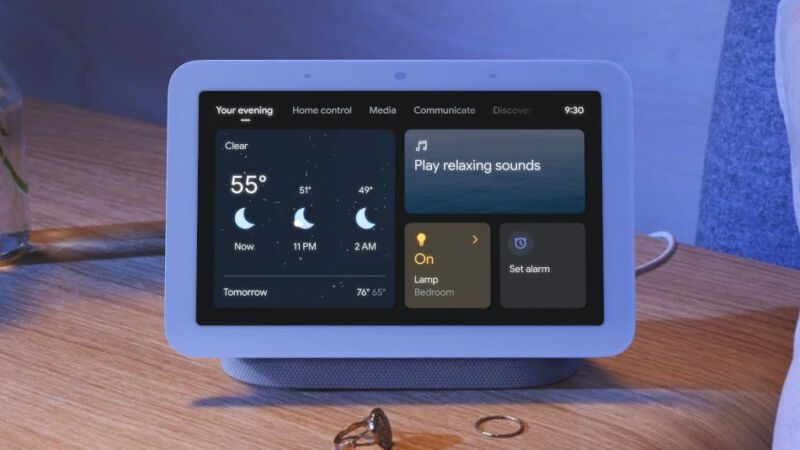
Google is officially rolling out a new operating system, called Fuchsia, to consumers. The release is a bit hard to believe at this point, but Google confirmed the news to 9to5Google, and several members of the Fuchsia team have confirmed it on Twitter. The official launch date was apparently yesterday. Fuchsia is certainly getting a quiet, anti-climactic release, as it’s only being made available to one device, the Google Home Hub, aka the first-generation Nest Hub. There are no expected changes to the UI or functionality of the Home Hub, but Fuchsia is out there. Apparently, Google simply wants to prove out the OS in a consumer environment.

Fuchsia’s one launch device was originally called the Google Home Hub and is a 7-inch smart display that responds to Google Assistant commands. It came out in 2018. The device was renamed the “Nest Hub” in 2019, and it’s only this first-generation device, not the second-generation Nest Hub or Nest Hub Max, that is getting Fuchsia. The Home Hub’s OS has always been an odd duck. When the device was released, Google was pitching a smart display hardware ecosystem to partners based on Android Things, a now-defunct Internet-of-things/kiosk OS. Instead of following the recommendations it gave to hardware partners, Google loaded the Home Hub with its in-house Google Cast Platform instead—and then undercut all its partners on.

Fuchsia has long been a secretive project. We first saw the OS as a pre-alpha smartphone UI that was ported to Android in 2017. In 2018, we got the OS running natively on a Pixelbook. After that, the Fuchsia team stopped doing its work in the open and stripped all UI work out of the public repository.
There’s no blog post or any fanfare at all to mark Fuchsia’s launch. Google’s I/O conference happened last week, and the company didn’t make a peep about Fuchsia there, either. Really, this ultra-quiet, invisible release is the most “Fuchsia” launch possible.

Fuchsia is something very rare in the world of tech: it’s a built-from-scratch operating system that isn’t based on Linux. Fuchsia uses a microkernel called “Zircon” that Google developed in house. Creating an operating system entirely from scratch and bringing it all the way to production sounds like a difficult task, but Google managed to do exactly that over the past six years. Fuchsia’s primary app-development language is Flutter, a cross-platform UI toolkit from Google. Flutter runs on Android, iOS, and the web, so writing Flutter apps today for existing platforms means you’re also writing Fuchsia apps for tomorrow.

The Nest Hub’s switch to Fuchsia is kind of interesting because of how invisible it should be. It will be the first test of this Fuchsia’s future-facing Flutter app support—the Google smart display interface is written in Flutter, so Google can take the existing interface, rip out all the Google Cast guts underneath, and plop the exact same interface code down on top of Fuchsia. Google watchers have long speculated that this was the plan all along. Rather than having a disruptive OS switch, Google could just get coders to write in Flutter and then it could seamlessly swap out the operating system.

So, unless we get lucky, don’t expect a dramatic hands-on post of Fuchsia running on the Nest Hub. It’s likely that there isn’t currently much to see or do with the new operating system, and that’s exactly how Google wants it. Fuchsia is more than just a smart-display operating system, though. An old Bloomberg report from 2018 has absolutely nailed the timing of Fuchsia so far, saying that Google wanted to first ship the OS on connected home devices “within three years”—the report turns three years old in July. The report also laid out the next steps for Fuchsia, including an ambitious expansion to smartphones and laptops by 2023.
Taking over the Nest Hub is one thing—no other team at Google really has a vested interest in the Google Cast OS (you could actually argue that the Cast OS is on the way out, as the latest Chromecast is switching to Android). Moving the OS onto smartphones and laptops is an entirely different thing, though, since the Fuchsia team would crash into the Android and Chrome OS divisions. Now you’re getting into politics.

Like It or Not, Your Website is Your 24 Hours a Day Sales Rep

Like it or not, your company website is your 24 hours a day, 7 days a week sales rep. 

With that in mind, if your website is not an absolute top priority or even worse, an afterthought, an extremely important question to ask yourself: 

WHY?

Your website serves as the face of your business as well as the ambassador of your company. 

Most likely the first contact or engagement with a new customer comes from your website. 

Especially if you are a small business. 

Regardless of your legacy, reputation, or number of years in business, new prospects who are unfamiliar with your business judge you by your web presence. 

This can be a tough pill to swallow, particularly for those in manufacturing

Your website actually plays the role of company sales rep out in the field, 24/7/365.

So how are your sales rep performing?

24 Hour Sales Rep 

Sales Rep

When my wife was in college, she lived across the street from a store called, “We Never Close”. 

A business that never closes certainly is convenient when you need something at 3:30 AM. 

It’s ironic how in college I could stay up until 3:30 AM, now I find myself waking up at 3:30 to start my day. 

Ah, the joys of getting old.

Anyway, a major benefit with eCommerce and a strong online presence, you never close. 

Your website serves as your 24 hours – 7 days a week – 365 days a year sales rep.

Another benefit, a website never calls in sick or takes a vacation. 

However, if your website is not an absolute top priority, you could be severely depriving yourself of new opportunities. 

How do you judge a place of business? 

For example, while searching for a hotel, restaurant, vacation spot or even a new vendor, odds are your first point of contact with a business is on their website. 

Well, let’s say your dream buyer is online conducting a search for the exact product and service that you provide. 

This buyer has a huge problem to solve with an extremely tight deadline. 

Operationally, you have everything in place to hit the ball out of the park and solve this customer’s problem. Right now. 

However, is your website ready for the task? 

Can this dream customer find your website and if they do find it, do they like what they see?

What Impression Does Your “Sales Rep” Make? 

Sales Rep

Click on your website right now. How does it look?

Do you provide valuable information to help a new customer make a buying decision?

Your website plays a critical role and goes far beyond a simple online business card. 

Your website represents YOUR COMPANY. 

When conducting eCommerce workshops, I like to use the example, “your website should allow the viewer to make a buying decision on Saturday night at midnight” (or 3:30 AM for those still able to stay up that late).

Make it a top priority to provide all the necessary information so that a potential customer doesn’t have to wait until you open on Monday morning. 

Just remember, you have ONE chance to make an outstanding 1st impression. 

In other words, you have one chance to make that great first Webpression!

Related article: You Have Only One Chance to Make an Outstanding First Webpression

Let’s put this in perspective. 

Would you allow a salesperson represent your company in a poor fashion? 

Disheveled. Outdated. Uniformed. Unenthused. Bored. Delivering partial or even wrong information.

Furthermore, unable to describe your expertise and product as well as the solutions that you provide. 

Incapable of explaining the company history, mission, processes as well as product capabilities. 

Of course not. 

Nurture your website like it’s the most important representative of your company. 

Simply because it is. 

Related Article: Top 13 Reasons Why Manufacturers Struggle with eCommerce

Is Your “Sales Rep” Found in Search Results? 

Sales rep

A website that cannot be found is the same as the sales rep who never makes a sales call. 

They are hanging at the park feeding pigeons (or some other interesting activity that fails to produce a sale). 

What is the first thing that you do when looking for a new product or service?

Most likely, you rely on your good friend Google.

Well, your potential new customers rely on Google as well.

Therefore, are you coming up on a search for your core capabilities?

In other words, are you attacking your keywords? 

Let’s go to Google right now and type your top capability in the search box. 

Are you anywhere to be found on the first page? 

If the answer is no, hopefully, you are mad. 

Do you see your competitors coming up in the search results? 

If the answer is yes, hopefully, you are now even angrier than before.  

Contact an online marketing specialist immediately. 

Stop being the best-kept secret. 

Make your website a top priority. Now! 

Be found as well as make that Great 1st Webpression! 

Treat your website as one of the most important and valuable employees on your team and give it everything you’ve got. 

Related Article: 25 Blog Topics for Manufacturers Eager to Start Blogging

Wrapping It Up 

Thanks for reading this post. 

For additional info, check out these helpful posts: 

A Minimum Viable Product Helps You “Get in the Game” 

Sometimes you need to leave the sideline and just “GET IN THE GAME!”

A Minimum Viable Product helps you do just that. 

It offers an incredibly powerful strategy to help you “Get in the Game”. Quickly and efficiently. 

Even when not fully prepared or completely ready.

Whether contemplating a new product, a new website or jumping into eCommerce for the first time, preparation is extremely important.

Yet, launching is essential. 

Reid Hoffman, founder of LinkedIn famously declared, If you are not embarrassed by the first version of your product, you’ve launched too late.”

Related Article: 19 Tips for Curing “I Hate Change” (Plus a Healthy Dose of eCommerce)


Minimum Viable Product to Most Valuable Player

Get in the game

How do you convert a Minimum Viable Product into a Most Valuable Player?

First, you must “Get in the Game”. 

For example, when launching a new eCommerce website, you hope and pray that it immediately reaches Most Valuable Player status. 

However, you should be focusing on the Minimum Viable Product when just starting out.

What does it take to push the ball into the end zone with a dream, a business or project?

Persistence. Stamina. Determination. Relentlessness. Consistency. A positive attitude.

You do not need to wait until you have the perfect product.

As the famous line goes, “done is better than perfect.”

In other words, just put it out there.

Especially when it comes to launching a new eCommerce website

When a project seems too massive to accomplish, the risk sets in of “I’m overwhelmed”.

Trying to eat the elephant comes to mind. 

Therefore, nothing happens.

Over-analysis causes paralysis. 

That’s where creating a Minimum Viable Product kicks in, allowing you to “Get in the Game”. 

Eric Ries, author of the New York Times Bestseller, “The Lean Startup” describes developing a Minimum Viable Product as the following:

A core component of Lean Startup methodology is the build-measure-learn feedback loop. The first step is figuring out the problem that needs to be solved and then developing a minimum viable product (MVP) to begin the process of learning as quickly as possible. Once the MVP is established, a startup can work on tuning the engine. This will involve measurement and learning and must include actionable metrics that can demonstrate cause and effect question.


Get in the Game with eCommerce 

eCommerce Checklist

My shtick is preaching the benefits of eCommerce for manufacturers. 

A major benefit of launching a new eCommerce website includes the incredible opportunities available with exploring new markets.  Especially with the low cost of doing so. 

Manufacturing eCommerce Strategies delivers powerful results including the following benefits: 

  1. Open 24/7 = round the clock customer service, sales tool
  2. Find Soulmates
  3. Eliminate the cumbersome RFQ process
  4. No Accounts Receivable 
  5. Low cost marketing and sales strategy
  6. Market Research
  7. Stay in Your Wheelhouse 
  8. Open doors that you never knew existed 
  9. International opportunities
  10. Scale your Proprietary Process

Yet, even with all of the incredible benefits available, many companies find reasons to put off or delay an eCommerce project. 

Tomorrow or maybe next week works better. 

Next week becomes next month or next quarter. 

Sound familiar? 

Related article: eCommerce Checklist: Manufacturing eCommerce Strategies

When is the Perfect Time to Get in the Game?

get-in-the-game

So often a company is looking for the perfect window to launch its eCommerce website. 

However, waiting for the perfect time to launch a business venture such as a new website or eCommerce store is similar to waiting for the perfect time to get married.

What if your significant other tires of waiting and decides to move on? 

Another example includes waiting for that perfect day to start a family.

When such and such happens, then I can finally……….

For example, when I am settled. Secure a good job. Save more money. Create more financial stability.

What if that perfect day never comes and you completely miss the opportunity. 

Waiting for the ideal time to make a major life decision may force that opportunity to vanish.

Launching a new business venture or an eCommerce website is certainly exciting.

Timing means everything, even survival.

However, you simply cannot wait too long. 

Snooze you lose.

You might find yourself standing at the altar all alone. 

Another item on the list of “would have, could have, should have’s”. 

Windows of opportunity close quickly.

Sometimes you need to rip off the band-aid.

Take the plunge. 

Gain the confidence to show that you know what you are doing.

Take a leap of faith.

Have confidence in yourself as well as your idea and abilities.

Trust yourself.

JUST GET IN THE GAME!

get-in-the-game

Remember, if you are not embarrassed by the first attempt, you waited too long. 

Get in the game!

Get on the field. Go out and get dirty. Throw a block. Get knocked down. Learn. Adjust. Keep fighting.

Figure things out.

Create and explore new techniques.

Find weaknesses in your opponent.

Tackle problems.

Get the first down.

Figure out how to find your way into the end zone.

(Don’t you just love all my lame football cliches?)

Partnering with a business coach or an accountability partner who can help you get over the hump.

Furthermore, when launching a new eCommerce website, team up with an incredible eCommerce expert or outstanding web designer. 

Find someone who will challenge you. Someone that you trust impeccably.

Put yourself out of your comfort zone.

No one ever reached Most Valuable Player by watching the game on the sidelines. 

Set specific goals.

Get on the field and enjoy each moment of playing the game. 

A Quick Story on “Get in the Game”

My best friend’s son played his first year of football at the age of 11.

He had an excellent season and made the Allstar team.

Unfortunately, they played another team in Atlanta and suffered defeat. The score was not close. 

The opponent was far superior. More organized. Had played together much longer. Played in a league that faced much stiffer competition.

Yet, my buddy’s son got in the game. He stuck it out. Fought hard. He gave 100%.

My buddy said he could not have been more proud.

His son displayed stamina, determination and a competitive spirit to keep pushing. 

Most importantly, he gave everything he had to just “Get in the Game”. 

Success is found on the field not on the sidelines.

Even when the scoreboard does not agree with your efforts. 

Let’s all do the same and push each other to just “Get in the Game”. 

Wrapping It Up 

Thanks so much for reading this post. 

For additional information, please check out these helpful posts: