WordPress announced wp-playground, a new AI agent skill designed to be used with the Playground CLI so AI agents can run WordPress for testing and check their work as they write code. The skill helps agents test code quickly while they work.
Playground CLI
Playground is a WordPress sandbox that enables users to run a full WordPress site without setting it all up on a traditional server. It is used for testing plugins, creating and adjusting themes, and experimenting safely without affecting a live site.
The new AI agent skill is for use with Playground CLI, which runs locally and requires knowledge of terminal commands, Node.js, and npm to manage local WordPress environments.
The wp-playground skill starts WordPress automatically and determines where generated code should exist inside the installation. The skill then mounts the code into the correct directory, which allows the agent to move directly from generated code to a running the WordPress site without manual setup.
Once WordPress is running, the agent can test behavior and verify results using common tools. In testing, agents interacted with WordPress through tools like curl and Playwright, checked outcomes, applied fixes, and then re-tested using the same environment. This process creates a repeatable loop where the agent can confirm whether a change works before making further changes.
The skill also includes helper scripts that manage startup and shutdown. These scripts reduce the time it takes for WordPress to become ready for testing from about a minute to only a few seconds. The Playground CLI can also log into WP-Admin automatically, which removes another manual step during testing.
The creator of the AI agent skill, Brandon Payton, is quoted explaining how it works:
“AI agents work better when they have a clear feedback loop. That’s why I made the wp-playground skill. It gives agents an easy way to test WordPress code and makes building and experimenting with WordPress a lot more accessible.”
The WordPress AI agent skill release also introduces a new GitHub repository dedicated to hosting WordPress agent skill. Planned ideas include persistent Playground sites tied to a project directory, running commands against existing Playground instances, and Blueprint generation.
For the last couple of years, I’ve been following the progress of a group of individuals who believe death is humanity’s “core problem.” Put simply, they say death is wrong—for everyone. They’ve even said it’s morally wrong.
Vitalism is more than a philosophy, though—it’s a movement for hardcore longevity enthusiasts who want to make real progress in finding treatments that slow or reverse aging. Not just through scientific advances, but by persuading influential people to support their movement, and by changing laws and policies to open up access to experimental drugs.
And they’re starting to make progress.
Vitalism was founded by Adam Gries and Nathan Cheng—two men who united over their shared desire to find ways to extend human lifespan. I first saw Cheng speak back in 2023, at Zuzalu, a pop-up city in Montenegro for people who were interested in life extension and some other technologies. (It was an interesting experience—you can read more about it here.)
Zuzalu was where Gries and Cheng officially launched Vitalism. But I’ve been closely following the longevity scene since 2022. That journey took me to Switzerland, Honduras, and a compound in Berkeley, California, where like-minded longevity enthusiasts shared their dreams of life extension.
It also took me to Washington, DC, where, last year, supporters of lifespan extension presented politicians including Mehmet Oz, who currently leads the Centers for Medicare & Medicaid Services, with their case for changes to laws and policies.
The journey has been fascinating, and at times weird and even surreal. I’ve heard biohacking stories that ended with smoking legs. I’ve been told about a multi-partner relationship that might be made possible through the cryopreservation—and subsequent reanimation—of a man and the multiple wives he’s had throughout his life. I’ve had people tell me to my face that they consider themselves eugenicists, and that they believe that parents should select IVF embryos for their propensity for a long life.
I’ve been shouted at and threatened with legal action. I’ve received barefoot hugs. One interviewee told me I needed Botox. It’s been a ride.
My reporting has also made me realize that the current interest in longevity reaches beyond social media influencers and wellness centers. Longevity clinics are growing in number, and there’s been a glut of documentaries about living longer or even forever.
At the same time, powerful people who influence state laws, giant federal funding budgets, and even national health policy are prioritizing the search for treatments that slow or reverse aging. The longevity community was thrilled when longtime supporter Jim O’Neill was made deputy secretary of health and human services last year. Other members of Trump’s administration, including Oz, have spoken about longevity too. “It seems that now there is the most pro-longevity administration in American history,” Gries told me.
I recently spoke to Alicia Jackson, the new director of ARPA-H. The agency, established in 2022 under Joe Biden’s presidency, funds “breakthrough” biomedical research. And it appears to have a new focus on longevity. Jackson previously founded and led Evernow, a company focused on “health and longevity for every woman.”
“There’s a lot of interesting technologies, but they all kind of come back to the same thing: Could we extend life years?” she told me over a Zoom call a few weeks ago. She added that her agency had “incredible support” from “the very top of HHS.” I asked if she was referring to Jim O’Neill. “Yeah,” she said. She wouldn’t go into the specifics.
Gries is right: There is a lot of support for advances in longevity treatments, and some of it is coming from influential people in positions of power. Perhaps the field really is poised for a breakthrough.
And that’s what makes this field so fascinating to cover. Despite the occasional weirdness.
This article first appeared in The Checkup, MIT Technology Review’s weekly biotech newsletter. To receive it in your inbox every Thursday, and read articles like this first, sign up here.
This is today’s edition of The Download, our weekday newsletter that provides a daily dose of what’s going on in the world of technology.
DHS is using Google and Adobe AI to make videos
The news: The US Department of Homeland Security is using AI video generators from Google and Adobe to make and edit content shared with the public, a new document reveals. The document, released on Wednesday, provides an inventory of which commercial AI tools DHS uses for tasks ranging from generating drafts of documents to managing cybersecurity.
Why it matters: It comes as immigration agencies have flooded social media with content to support President Trump’s mass deportation agenda—some of which appears to be made with AI—and as workers in tech have put pressure on their employers to denounce the agencies’ activities. Read the full story.
—James O’Donnell
How the sometimes-weird world of lifespan extension is gaining influence
—Jessica Hamzelou
For the last couple of years, I’ve been following the progress of a group of individuals who believe death is humanity’s “core problem.” Put simply, they say death is wrong—for everyone. They’ve even said it’s morally wrong.
Vitalism is more than a philosophy, though—it’s a movement for hardcore longevity enthusiasts who want to make real progress in finding treatments that slow or reverse aging. Not just through scientific advances, but by persuading influential people to support their movement, and by changing laws and policies to open up access to experimental drugs. And they’re starting to make progress.
This article first appeared in The Checkup, MIT Technology Review’s weekly biotech newsletter. To receive it in your inbox every Thursday, and read articles like this first, sign up here.
The AI Hype Index: Grok makes porn, and Claude Code nails your job
Separating AI reality from hyped-up fiction isn’t always easy. That’s why we’ve created the AI Hype Index—a simple, at-a-glance summary of everything you need to know about the state of the industry. Take a look at this month’s edition of the index here.
The must-reads
I’ve combed the internet to find you today’s most fun/important/scary/fascinating stories about technology.
1 Capgemini is no longer tracking immigrants for ICE After the French company was queried by the country’s government over the contract. (WP $) + Here’s how the agency typically keeps tabs on its targets. (NYT $) + US senators are pushing for answers about its recent surveillance shopping spree. (404 Media) + ICE’s tactics would get real soldiers killed, apparently. (Wired $)
2 The Pentagon is at loggerheads with Anthropic The AI firm is reportedly worried its tools could be used to spy on Americans. (Reuters) + Generative AI is learning to spy for the US military. (MIT Technology Review)
3 It’s relatively rare for AI chatbots to lead users down harmful paths But when it does, it can have incredibly dangerous consequences. (Ars Technica) + The AI doomers feel undeterred. (MIT Technology Review)
4 GPT-4o’s days are numbered OpenAI says just 0.1% of users are using the model every day. (CNBC) + It’s the second time that it’s tried to turn the sycophantic model off in under a year. (Insider $) + Why GPT-4o’s sudden shutdown left people grieving. (MIT Technology Review)
5 An AI toy company left its chats with kids exposed Anyone with a Gmail account was able to simply access the conversations—no hacking required. (Wired $) + AI toys are all the rage in China—and now they’re appearing on shelves in the US too. (MIT Technology Review)
6 SpaceX could merge with xAI later this year Ahead of a planned blockbuster IPO of Elon Musk’s companies. (Reuters) + The move would be welcome news for Musk fans. (The Information $) + A SpaceX-Tesla merger could also be on the cards. (Bloomberg $)
7 We’re still waiting for a reliable male contraceptive Take a look at the most promising methods so far. (Bloomberg $)
8 AI is bringing traditional Chinese medicine to the masses And it’s got the full backing of the country’s government. (Rest of World)
9 The race back to the Moon is heating up Competition between the US and China is more intense than ever. (Economist $)
10 What did the past really smell like? AI could help scientists to recreate history’s aromas—including mummies and battlefields. (Knowable Magazine)
Quote of the day
“I think the tidal wave is coming and we’re all standing on the beach.”
—Bill Zysblat, a music business manager, tells the Financial Times about the existential threat AI poses to the industry.
One more thing
Therapists are secretly using ChatGPT. Clients are triggered.
Declan would never have found out his therapist was using ChatGPT had it not been for a technical mishap. The connection was patchy during one of their online sessions, so Declan suggested they turn off their video feeds. Instead, his therapist began inadvertently sharing his screen.
For the rest of the session, Declan was privy to a real-time stream of ChatGPT analysis rippling across his therapist’s screen, who was taking what Declan was saying, putting it into ChatGPT, and then parroting its answers.
But Declan is not alone. In fact, a growing number of people are reporting receiving AI-generated communiqués from their therapists. Clients’ trust and privacy are being abandoned in the process. Read the full story.
—Laurie Clarke
We can still have nice things
A place for comfort, fun and distraction to brighten up your day. (Got any ideas? Drop me a line or skeet ’em at me.)
+ Sinkholes are seriously mysterious. Is there a way to stay one step ahead of them? + This beautiful pixel art is super impressive. + Amid the upheaval in their city, residents of Minneapolis recently demonstrated both their resistance and community spirit in the annual Art Sled Rally (thanks Paul!) + How on Earth is Tomb Raider30 years old?!
Civitai—an online marketplace for buying and selling AI-generated content, backed by the venture capital firm Andreessen Horowitz—is letting users buy custom instruction files for generating celebrity deepfakes. Some of these files were specifically designed to make pornographic images banned by the site, a new analysis has found.
The study, from researchers at Stanford and Indiana University, looked at people’s requests for content on the site, called “bounties.” The researchers found that between mid-2023 and the end of 2024, most bounties asked for animated content—but a significant portion were for deepfakes of real people, and 90% of these deepfake requests targeted women. (Their findings have not yet been peer reviewed.)
The debate around deepfakes, as illustrated by the recent backlash to explicit images on the X-owned chatbot Grok, has revolved around what platforms should do to block such content. Civitai’s situation is a little more complicated. Its marketplace includes actual images, videos, and models, but it also lets individuals buy and sell instruction files called LoRAs that can coach mainstream AI models like Stable Diffusion into generating content they were not trained to produce. Users can then combine these files with other tools to make deepfakes that are graphic or sexual. The researchers found that 86% of deepfake requests on Civitai were for LoRAs.
In these bounties, users requested “high quality” models to generate images of public figures like the influencer Charli D’Amelio or the singer Gracie Abrams, often linking to their social media profiles so their images could be grabbed from the web. Some requests specified a desire for models that generated the individual’s entire body, accurately captured their tattoos, or allowed hair color to be changed. Some requests targeted several women in specific niches, like artists who record ASMR videos. One request was for a deepfake of a woman said to be the user’s wife. Anyone on the site could offer up AI models they worked on for the task, and the best submissions received payment—anywhere from $0.50 to $5. And nearly 92% of the deepfake bounties were awarded.
Neither Civitai nor Andreessen Horowitz responded to requests for comment.
It’s possible that people buy these LoRAs to make deepfakes that aren’t sexually explicit (though they’d still violate Civitai’s terms of use, and they’d still be ethically fraught). But Civitai also offers educational resources on how to use external tools to further customize the outputs of image generators—for example, by changing someone’s pose. The site also hosts user-written articles with details on how to instruct models to generate pornography. The researchers found that the amount of porn on the platform has gone up, and that the majority of requests each week are now for NSFW content.
“Not only does Civitai provide the infrastructure that facilitates these issues; they also explicitly teach their users how to utilize them,” says Matthew DeVerna, a postdoctoral researcher at Stanford’s Cyber Policy Center and one of the study’s leaders.
The company used to ban only sexually explicit deepfakes of real people, but in May 2025 it announced it would ban all deepfake content. Nonetheless, countless requests for deepfakes submitted before this ban now remain live on the site, and many of the winning submissions fulfilling those requests remain available for purchase, MIT Technology Review confirmed.
“I believe the approach that they’re trying to take is to sort of do as little as possible, such that they can foster as much—I guess they would call it—creativity on the platform,” DeVerna says.
Users buy LoRAs with the site’s online currency, called Buzz, which is purchased with real money. In May 2025, Civita’s credit card processor cut off the company because of its ongoing problem with nonconsensual content. To pay for explicit content, users must now use gift cards or cryptocurrency to buy Buzz; the company offers a different scrip for non-explicit content.
Civitai automatically tags bounties requesting deepfakes and lists a way for the person featured in the content to manually request its takedown. This system means that Civitai has a reasonably successful way of knowing which bounties are for deepfakes, but it’s still leaving moderation to the general public rather than carrying it out proactively.
A company’s legal liability for what its users do isn’t totally clear. Generally, tech companies have broad legal protections against such liability for their content under Section 230 of the Communications Decency Act, but those protections aren’t limitless. For example, “you cannot knowingly facilitate illegal transactions on your website,” says Ryan Calo, a professor specializing in technology and AI at the University of Washington’s law school. (Calo wasn’t involved in this new study.)
Civitai joined OpenAI, Anthropic, and other AI companies in 2024 in adopting design principles to guard against the creation and spread of AI-generated child sexual abuse material . This move followed a 2023 report from the Stanford Internet Observatory, which found that the vast majority of AI models named in child sexual abuse communities were Stable Diffusion–based models “predominantly obtained via Civitai.”
But adult deepfakes have not gotten the same level of attention from content platforms or the venture capital firms that fund them. “They are not afraid enough of it. They are overly tolerant of it,” Calo says. “Neither law enforcement nor civil courts adequately protect against it. It is night and day.”
Civitai received a $5 million investment from Andreessen Horowitz (a16z) in November 2023. In a video shared by a16z, Civitai cofounder and CEO Justin Maier described his goal of building the main place where people find and share AI models for their own individual purposes. “We’ve aimed to make this space that’s been very, I guess, niche and engineering-heavy more and more approachable to more and more people,” he said.
Civitai is not the only company with a deepfake problem in a16z’s investment portfolio; in February, MIT Technology Reviewfirst reported that another company, Botify AI, was hosting AI companions resembling real actors that stated their age as under 18, engaged in sexually charged conversations, offered “hot photos,” and in some instances described age-of-consent laws as “arbitrary” and “meant to be broken.”
Phillip Jackson’s media company, Future Commerce, focuses on trends and developments in business.
The company surveyed U.S. shoppers during the 2025 holiday season. He says one insight stood out: when AI recommends a product, 77% of respondents leave the platform to buy on the brand’s site.
Phillip first appeared on the podcast in early 2024. In this our latest conversation, he addressed the downsides of optimized ecommerce sites, the outlook of traditional search, and, yes, the rise of autonomous shopping agents.
The entire audio of our conversation is embedded below. The transcript is edited for length and clarity.
Eric Bandholz: Bring us up to date.
Phillip Jackson: Future Commerce is a media company exploring the culture of commerce through newsletters, podcasts, research, and events.
When you and I last spoke, I remember thinking, “I’m made for this.” It felt like everything I’ve learned over my entire career was in one place.
Ecommerce was difficult when I started in 1999. I spent more than a decade working for a direct-to-consumer seller of natural health products. We hand-coded sites in HTML, ran Google AdWords, and scaled multiple brands.
Bandholz: Is it better in 2026?
Jackson: I’ve been saying since around 2019 that we’ve reached the ideal website. We’ve optimized ecommerce experiences to death, and what’s left is efficiency and boredom.
We do a lot of consumer and executive research at Future Commerce. In one study published around 2022, we analyzed about 15 of the world’s highest-traffic ecommerce sites, excluding Amazon. Think brands like Bath & Body Works and Bed Bath & Beyond. We removed logos and navigation, then showed the pages to consumers. Most people couldn’t tell one site from another because they’re functionally identical.
That level of optimization is powerful, but it has a downside: it’s unmemorable. These sites are designed for conversion, not for recall or cultural impact. They’re slippery. You buy, you leave, and nothing sticks.
You see this everywhere in culture. Netflix is a great example. It’s incredible how they use data to maximize completion rates, which is why they release entire seasons at once. The data probably proves it works. But it doesn’t show what’s lost: cultural conversation. Shows released across many weeks remain part of the culture for extended periods.
The same thing has happened in ecommerce and product design. Websites, sport utility vehicles, smartphones, and even electric toothbrushes all converge on the same form.
Many industry folks hope AI will make ecommerce exciting again, but real innovation requires risk, which few companies are willing to take on.
Bandholz: Will marketplaces and AI replace brand websites?
Jackson: There’s a lot packed into that question, and we actually have data around it. On the practical side, the website isn’t going anywhere. Advertisers may shift platforms, and AI-driven discovery is clearly changing behavior, especially among Gen Zs. Generative AI sites have become a trusted source for product and brand discovery.
We researched consumer AI usage before and after the 2025 holidays. One insight stood out. When AI recommends a product, shoppers overwhelmingly prefer to leave the platform and visit the brand’s website. Across two studies, two cohorts, and multiple English-speaking countries, 77% said they would rather click through to the website than buy inside the AI interface.
That challenges the narrative that AI agents will handle all purchasing. I’m bullish on agents long term, but the website remains the center of context, trust, and information for generative engines.
Interestingly, AI may affect physical retail more quickly than digital. In our data, 35% of Gen Zs and 40% of Gen Xs said they’d rather buy based on an AI recommendation than go to a store.
More broadly, old and new systems always coexist. Markets don’t disappear; they evolve. The brands that survive will have durable products, a clear identity, and strong relationships. Almost certainly they will have websites. Everything else is still up for debate.
Bandholz: Will genAI replace traditional search?
Jackson: We’re seeing signs of that shift. However, there are economic questions to answer. What companies win the AI race? Which consumer products become dominant?
Yes, AI is disruptive, but it’s also introducing a new modality in our relationship with digital culture. It isn’t just a search box. It’s a different kind of interaction. I see it as complementary rather than exclusive. Traditional systems don’t vanish overnight; they adapt and coexist. AI changes behavior, but it layers onto existing habits rather than erasing them.
Bandholz: What’s your advice to folks starting in ecommerce?
Jackson: Some level of investment in genAI visibility is non-negotiable. Consumers are increasingly turning to engines like ChatGPT for product recommendations. If you’re not tracking whether your brand shows up there, you should be. It may be the closest thing we have to true organic discovery.
Beyond that, many newer providers aren’t living up to their promised disruption. TikTok Shop, for example, is essentially an affiliate channel. It’s powerful, but it’s not going to change fundamentally how everyone shops.
Bandholz: What major macro trends are you watching?
Jackson: The first is machine autonomy. Every business, from the smallest startup to the largest enterprise, is pushing for more automation and productivity. You see it with self-driving vehicles, delivery robots, and last-mile automation. You also see it in companies, with systems that operate without human intervention. That shift is happening fast.
The second force is human sovereignty, driven by mistrust in institutions. The Edelman Trust Barometer in early 2026 is at a 25-year low. People don’t trust governments, corporations, or systems the way they used to. At the same time, they now have tools to verify claims, build their own worldviews, and take control of decisions.
Healthcare is an example. Individuals can now monitor their own health and interpret data in ways that weren’t possible five years ago.
These two forces — autonomy and sovereignty — can complement each other, but they can also collide. Brands that understand how to navigate both, at any scale, will define the next era of commerce.
Bandholz: How can listeners follow you and reach out?
AI tools produce different brand recommendation lists nearly every time they answer the same question, according to a new report from SparkToro.
The data showed a <1-in-100 chance that ChatGPT or Google>
Rand Fishkin, SparkToro co-founder, conducted the research with Patrick O’Donnell from Gumshoe.ai, an AI tracking startup. The team ran 2,961 prompts across ChatGPT, Claude, and Google Search AI Overviews (with AI Mode used when Overviews didn’t appear) using hundreds of volunteers over November and December.
What The Data Found
The authors tested 12 prompts requesting brand recommendations across categories, including chef’s knives, headphones, cancer care hospitals, digital marketing consultants, and science fiction novels.
Each prompt was run 60-100 times per platform. Nearly every response was unique in three ways: the list of brands presented, the order of recommendations, and the number of items returned.
Fishkin summarized the core finding:
“If you ask an AI tool for brand/product recommendations a hundred times nearly every response will be unique.”
Claude showed slightly higher consistency in producing the same list twice, but was less likely to produce the same ordering. None of the platforms came close to the authors’ definition of reliable repeatability.
The Prompt Variability Problem
The authors also examined how real users write prompts. When 142 participants were asked to write their own prompts about headphones for a traveling family member, almost no two prompts looked similar.
The semantic similarity score across those human-written prompts was 0.081. Fishkin compared the relationship to:
“Kung Pao Chicken and Peanut Butter.”
The prompts shared a core intent but little else.
Despite the prompt diversity, the AI tools returned brands from a relatively consistent consideration set. Bose, Sony, Sennheiser, and Apple appeared in 55-77% of the 994 responses to those varied headphone prompts.
What This Means For AI Visibility Tracking
The findings question the value of “AI ranking position” as a metric. Fishkin wrote: “any tool that gives a ‘ranking position in AI’ is full of baloney.”
However, the data suggests that how often a brand appears across many runs of similar prompts is more consistent. In tight categories like cloud computing providers, top brands appeared in most responses. In broader categories like science fiction novels, the results were more scattered.
This aligns with other reports we’ve covered. In December, Ahrefs published data showing that Google’s AI Mode and AI Overviews cite different sources 87% of the time for the same query. That report focused on a different question: the same platform but with different features. This SparkToro data examines the same platform and prompt, but with different runs.
The pattern across these studies points in the same direction. AI recommendations appear to vary at every level, whether you’re comparing across platforms, across features within a platform, or across repeated queries to the same feature.
Methodology Notes
The research was conducted in partnership with Gumshoe.ai, which sells AI tracking tools. Fishkin disclosed this and noted that his starting hypothesis was that AI tracking would prove “pointless.”
The team published the full methodology and raw data on a public mini-site. Survey respondents used their normal AI tool settings without standardization, which the authors said was intentional to capture real-world variation.
The report is not peer-reviewed academic research. Fishkin acknowledged methodological limitations and called for larger-scale follow-up work.
Looking Ahead
The authors left open questions about how many prompt runs are needed to obtain reliable visibility data and whether API calls yield the same variation as manual prompts.
When assessing AI tracking tools, the findings suggest you should ask providers to demonstrate their methodology. Fishkin wrote:
“Before you spend a dime tracking AI visibility, make sure your provider answers the questions we’ve surfaced here and shows their math.”
On the first episode of the Google Ads Decoded podcast, host Ginny Marvin sat down with Eleanor Stribling, Group Product Manager for Google Analytics.
In the episode, Stribling noted an ambitious two-phase vision for the GA4 platform.
After acknowledging GA4’s rough transition from Universal Analytics, especially for marketers, she shared where the platform is headed over the next few years.
What Stribling Shared on Google Ads Decoded
After discussing the foundations of the importance of data strength, Stribling broke down the vision of GA4 into two timelines.
Over the next year or two, GA4 will focus on becoming a cross-channel, full-funnel measurement platform. She states the goal of this is:
To be that one place where you can really understand the impact of your media with data that makes sense and resonates and that you can take and make a business decision with.
This means moving beyond outdated siloed channel reporting to understand how all your media works together across the complete customer journey.
The longer-term vision she shared looks 3+ years beyond what GA4 is capable of today.
Stribling says GA4 will become a decision-making platform for businesses, essentially a growth engine that translates data into business outcomes.
“Making a world-class analyst available to every single person,” is how Stribling described this vision. AI will be the layer that makes this shift possible.
It will be interesting to see how Google’s vision for this will build out over the next few years. Considering they already have the reporting visualization tool, Looker Studio, my prediction is that there will be better or easier integration into it.
Beyond just better integration with Looker Studio, trying to become a growth engine or decision-making platform sounds like they’re trying to set themselves apart from the competition of other reporting platforms out there today, like Funnel or Power BI.
What’s Coming in the Advertising Workspace
Stribling pointed to the Advertising Workspace in GA4 as an area where marketers will see significant changes over the next year.
Expect improvements to reporting that better illustrate the user journey. Google is also building out budgeting and planning tools that let you upload cost data from other media buys and create spend plans based on your goals.
The platform will also suggest optimizations for in-flight campaigns, offering AI-powered recommendations to help you get closer to your campaign objectives.
Personally, I’m excited to see if they make the Explorer report building any more intuitive for marketers. I think it’s highly under-utilized right now because you’re essentially starting from a blank slate. It takes time, effort, and the right type of mindset to really sit down and try to re-learn an Analytics platform.
Why This Matters & Looking Ahead
GA4’s reputation amongst marketers hasn’t been stellar since it replaced Universal Analytics. In the podcast episode, Marvin reiterated that as a long-time marketer:
The platform felt designed for developers rather than marketers, and the transition left many advertisers frustrated.
Stribling’s comments signal that Google has been listening. Google seems to be heavily investing in making GA4 more accessible, while simultaneously building towards a future where the platform goes beyond its traditional reporting.
The two-phase vision shared is ambitious, particularly the long-term vision of GA4 as a business decision engine. Whether Google will move full steam ahead on this remains up in the air, but it seems that the direction GA4 is going is beyond just a measurement tool.
For now, the practical move for marketers is to keep working on your data strength. This includes auditing your tagging setup, testing the existing AI features that already exist today, and reviewing key conversion and event data.
Welcome to this week’s SEO Pulse: updates affect publisher control over AI features, how AI Overviews process queries, and what AI model tradeoffs mean for content workflows.
Here’s what matters for you and your work.
Google Explores Letting Sites Opt Out Of AI Search Features
Google says it’s exploring updates that could let websites opt out of AI-powered search features. The blog post came the same day the UK’s Competition and Markets Authority opened a consultation on potential new requirements for Google Search.
Key facts: Ron Eden, principal, product management at Google, wrote that the company is “exploring updates to our controls to let sites specifically opt out of Search generative AI features.” Google provided no timeline, technical specifications, or firm commitment.
Why This Matters For SEOs
Publishers and regulators have spent the past year pushing back on AI Overviews. The UK’s Independent Publishers Alliance, Foxglove, and Movement for an Open Web filed a complaint with the CMA last July, asking for the ability to opt out of AI summaries without being removed from search entirely.
A BuzzStream report we covered earlier this month found 79% of top news publishers block at least one AI training bot, and 71% block retrieval bots that affect AI citations. Publishers are already voting with their robots.txt files. Google’s post suggests it’s responding to pressure from the ecosystem by exploring controls it previously didn’t offer.
The practical question is what “opt out of AI search features” would mean technically. It’s unclear whether this would cover AI Overviews, AI Mode, or both, and whether sites would lose visibility in those experiences or only be excluded from summaries.
What People Are Saying
Early reactions on LinkedIn focused on the regulatory context and what this could mean for publishers.
David Skok, CEO & editor-in-chief at The Logic, wrote on LinkedIn:
“For the first time, a major regulator is publicly consulting on a requirement that would allow publishers to opt out of having their content used in Google’s AI Overviews or in training AI models without being removed from general search results.”
He added that the consultation would allow publishers to opt out of AI Overviews “without being removed from general search results.”
Matthew Allsop, the CMA’s principal digital markets adviser, framed it as a “meaningful choice” issue, pointing to measures that would allow publishers to opt out of AI Overviews.
In SEO and publisher discussions, the focus has been on whether any opt-out comes with tradeoffs, and whether Google will provide reporting that shows where content appears across AI surfaces.
Google is making Gemini 3 the default model for AI Overviews globally, in markets where the feature is available. The update also adds a direct path into AI Mode conversations.
Key facts: Robby Stein, VP of Product for Google Search, announced the rollout, saying AI Overviews now reach over 1 billion users. The Gemini 3 upgrade brings the same reasoning capabilities to AI Overviews that powers AI Mode.
Why This Matters For SEOs
The model upgrade and the seamless transition into AI Mode work together. Better reasoning means AI Overviews can handle more complex queries at the top of results. The follow-up prompt means those who want to go deeper can do so without leaving Google’s AI interfaces.
This creates a smoother path that keeps people inside Google’s AI experiences longer. Someone who sees your content cited in an AI Overview might previously have clicked through to your site. Now they can ask a follow-up question and stay in AI Mode, which may reduce click-through opportunities even when your content continues to be cited.
The seamless transition continues the pattern of Google handling more of the search journey within its own surfaces.
Sam Altman Says OpenAI “Screwed Up” GPT-5.2 Writing Quality
Sam Altman said OpenAI “screwed up” GPT-5.2’s writing quality during a developer town hall Monday evening. He said future GPT-5.x versions will address the gap.
Key facts: When asked about user feedback that GPT-5.2 produces writing that’s “unwieldy” and “hard to read” compared to GPT-4.5, Altman was blunt: “I think we just screwed that up.” He explained that OpenAI made a deliberate choice to focus GPT-5.2’s development on technical capabilities, putting “most of our effort in 5.2 into making it super good at intelligence, reasoning, coding, engineering, that kind of thing.”
Why This Matters For SEOs
If you use ChatGPT for content workflows, you may have noticed the change. GPT-5.2 handles complex reasoning tasks better but produces prose that reads more mechanical. Altman confirmed this wasn’t a bug but a tradeoff.
The admission clarifies what to expect from AI writing tools going forward. Model developers are making explicit choices about what to improve. Writing quality competes with coding, reasoning, and other technical benchmarks for development resources.
This means matching the tool to the task. GPT-5.2 might excel at research synthesis, data analysis, and technical documentation, but it can produce awkward prose for blog posts or marketing copy. GPT-4.5 often reads more naturally, even if it couldn’t handle the same complexity.
Altman said future GPT-5.x versions will “hopefully” be much better at writing than 4.5 was, but gave no timeline.
What People Are Saying
On social media, the reaction focused on what the admission reveals about AI development priorities. Some framed it as a transparency win, noting that most companies would have reframed the issue as a design choice rather than acknowledging a mistake. Others pointed to the tension between optimizing for benchmarks versus optimizing for practical writing quality.
Each story this week involves platforms making choices about what to prioritize and who gets to decide.
Google is exploring whether to give publishers more control over AI features, responding to a year of regulatory pressure and ecosystem pushback. The Gemini 3 rollout gives users a smoother AI experience while reducing control over where that journey ends. And Altman’s admission shows that even model development involves tradeoffs between competing capabilities.
This week, the theme is about understanding which levers you can pull. Publisher opt-out controls might eventually let you decide how your content appears in AI search. Model selection lets you match AI tools to specific tasks. But the broader direction of these platforms is outside your control, and the choices they make shape the environment you’re optimizing for.
Top Stories Of The Week:
This week’s coverage focused on three developments worth tracking.
More Resources:
For deeper context on the publisher and AI visibility dynamics behind these stories, check these related pieces.
Welcome to this week’s PPC Pulse. This week’s news is a continuation of last week’s announcements about ChatGPT ads and the Google Ads Decoded podcast.
ChatGPT announced premium-priced ads with limited data. The first episode of the Ads Decoded podcast, hosted by Ginny Marvin, Google’s Ads product liaison, featured Group Product Manager Eleanor Stribling to discuss Google Analytics.
Here’s what matters for advertisers and why.
ChatGPT Ads Reported To Start With $60 CPM Basis
While not directly reported from OpenAI, according to reporting from The Information, ChatGPT ads are slated to start around $60 per 1,000 impressions (CPM). This is roughly 3x higher than your typical Meta CPMs.
Despite the premium pricing from the start, advertisers won’t get the measurement tools they’re used to.
Reporting will be limited to high-level metrics like total impressions and clicks, with no visibility into conversion actions. OpenAI has indicated it may expand measurement capabilities later, but nothing is confirmed.
On the heels of last week’s announcement, ads will roll out in the coming weeks to users on ChatGPT’s Free and Go tiers. They’ll appear at the bottom of responses, only when OpenAI determines there’s a relevant product or service tied to the conversation.
Additionally, it’s been reported that initial buy-in for brands is $1 million ad spend.
Why This Matters For Advertisers
While CPM advertising is nothing new to advertisers, the lack of reporting that comes with a new platform is concerning. Especially when marketing budgets continue to get squeezed, and you’re on the hook for justifying every dollar spent.
While intent signal could prove strong with ChatGPT ads, the lack of measurement means advertisers have no way to prove that value or optimize toward it.
The high CPMs paired with minimal data categorize ChatGPT ads as more of a brand awareness play instead of a performance channel, at least initially.
Brands should be prepared to treat it like early-stage display or OTT advertising. You’re paying for attention and reach, not being able to prove ROI.
Another interesting snippet to ponder about the whole ChatGPT ads test is how they’re framing ad visibility. OpenAI already said that ads won’t influence answers. If it actually sticks to that, the only way to get placement is through genuine relevance to what someone is already trying to accomplish.
That framework is very different from how search and social ads work, and it could mean this platform stays small and selective with its advertisers, rather than becoming broadly accessible.
What PPC Professionals Are Saying
The reactions to the staggering $60 CPM starting point seem to be mixed.
Some marketers like Andrew Lolk, founder of SavvyRevenue, and Collin Slatterly, founder of Taikun Digital, aren’t necessarily phased by that number.
“$60 CPMs for ads in ChatGPT are probably a good deal. These ads are intent based which more akin to Google search and shopping ads than Meta or TV. Someone is asking chatGPT ‘What’s the best supplement for sleep?’ which is exactly how ads on Google are.”
Lolk, in a similar sentiment, provided his initial thoughts on the cost:
“Unpopular opinion: I don’t care what CPM ChatGPT set their ads to. I care about the return on those ads. The CPM is irrelevant. Obviously, the lower CPM, the better it is for advertisers. But before we know what the return is on a $60 CPM, then I will not say it’s good or bad.”
The conversation in the comments of Lolk’s post sparked a good debate, including an opposing viewpoint from Melissa Mackey, head of paid search at Compound Growth Marketing. Mackey mentioned that because ChatGPT ads aren’t set up as a performance channel, she’s “not paying $60 CPM for something with limited data and no conversion tracking.”
On top of the discussion around cost, it appears some marketers like Harrison Jack Hepp, owner of Industrious Marketing LLC, are already being pitched from agencies that have already run ChatGPT ads, which can’t be correct since they haven’t launched yet.
Screenshot from LinkedIn by author, January 2026
First Ads Decoded Episode Focuses On Google Analytics
The first episode of Ads Decoded launched on Jan. 28, 2026, featuring Eleanor Stribling, Group Product Manager at Google Analytics. The conversation laid a few basic foundations on data strength, as well as a candid look into where GA4 is headed in the next few years. If you’ve been frustrated with GA4 since it replaced Universal Analytics, this episode is worth your time.
Stribling didn’t dance around GA4’s rocky reputation. Instead, she acknowledged the transition challenges and spent the episode explaining where Google is taking the platform and why. The conversation covered two separate roadmaps: what’s changing in the next 12-24 months, and what Google is building toward over the next three-plus years.
Data strength came up repeatedly throughout the conversation, which makes sense given how central it is to everything Google is building. Stribling explained why it matters for AI performance and how it creates a competitive advantage for brands that get it right.
The episode also included practical guidance on setting up measurement correctly so the data you’re feeding into these systems is actually useful.
Why This Matters For Advertisers
The timing of this episode is smart. GA4 has been live for a while now, but a lot of advertisers still treat it like a downgrade from Universal Analytics. Marvin said as much during the episode that the platform felt built for developers, not marketers.
What makes this podcast episode useful isn’t just hearing Google’s vision for GA4. It’s hearing a product manager explain why certain decisions were made and what problems they’re actually trying to solve. That context helps when you’re trying to decide whether to invest time learning features that feel half-baked or waiting for something better.
The most actionable takeaway from the episode is to prioritize data strength. If your setup is messy now, the gap between what GA4 can do for you and what it could do for you is only going to widen.
What PPC Professionals Are Saying
The feedback from advertisers on LinkedIn has been overwhelmingly positive. It’s an early indicator of how much this type of communication has been asked for, and Google is providing it.
Susan Wenograd, Mixtape Digital’s senior director, paid media, commented, “Love that you’re doing this!”
John Sargent, Think VEN’s founder & managing director, showed his support, as well as asked a question about AI market share:
Congratulations Ginny! Keen to hear more in the future about AI advertising as well…Gemini going from 5% to >20% market share must be encouraging, but still early days with OpenAI sat at 60%+? How do you foresee this shifting over the next 12 months?
Alexandru Stambari, performance marketing specialist, acknowledged the good Google is doing with this information, while offering his critique on execution:
It’s good to see Google openly acknowledging that data strength is now a hard requirement for AI performance, not a “nice to have.” The focus on Analytics Advisor and transparency around Ads vs Analytics discrepancies is especially valuable for teams trying to scale automation responsibly.
That said, most of these ideas aren’t new for practitioners the real gap is still execution. Without clear implementation standards, CRM alignment, and ownership over data quality, even the best product updates risk staying at the storytelling level rather than driving measurable impact.
Theme Of The Week: Betting On What Advertisers Will Pay For
This week’s announcements are about two very different bets on what advertisers actually value.
ChatGPT is betting that access to high-intent conversations is worth $60 CPMs, even without the performance data advertisers have come to expect. They’re testing whether context and attention alone justify premium pricing when attribution and optimization are off the table.
Google is betting that transparency matters enough to build an entire podcast around it. Instead of launching another ad product or feature, they’re investing in helping advertisers understand what’s already there and what’s coming. It’s a bet that better communication and clearer explanations have value in themselves.
Both are asking advertisers to care about something that isn’t purely performance-driven. ChatGPT wants you to pay more for placement without proof. Google wants you to invest time learning about platform changes instead of just running campaigns.
A click drop in your Google Ads account can feel like the floor just moved under your account.
Not because clicks are considered more of a vanity metric. But because most sites still convert just a small slice of visitors.
Shopify, believe that 2.5-3% is an average benchmark for industry leaders (although not backed with data), whereas a recent study of Shopify sites by Littedata found the average CTR was just 1.4%.
So, when click volume drops, you’re not just losing traffic. You’re losing future conversions you were counting on, and you’re handing extra shots to competitors.
The fix usually is not one magic lever. You need a quick, disciplined diagnosis:
Did you lose eligibility (Quality Score)?
Did you lose reach (impressions)?
Were there disruptions in performance with changes (like testing new ads)?
Or did you get squeezed by competition?
This article walks through the four most common causes, plus what to do next.
What Is CTR?
One of the metric definitions that hasn’t changed over the years in Google Ads is CTR.
CTR is a relatively simple formula: The number of clicks that your ad receives divided by the number of times your ad is shown (clicks ÷ impressions).
While CTR is a simple calculation, this is one of the more vital metrics to help analyze performance.
Think again if you thought CTR could only be used to gauge compelling ad copy.
So, what is the purpose of CTR? Some applications of using CTR include:
Measuring the relevance and quality of ads.
Identifying the competitiveness of keywords and ads.
Analyzing gaps between campaign budgets and keyword bids.
When your CTR is suffering, this has a direct impact on click volume.
Now that CTR has been defined and we have use cases for the metric, you’re probably wondering, “What is a good CTR?”
A recent study from Wordstream by LocaliQ noted that the average CTR for search was 6.66% across all industries.
If your average CTR isn’t stacking up to industry averages, don’t fret! Follow these comprehensive tips to help get your CTR and click volume back up to par.
Why Is My Click Volume Decreasing?
Can’t explain the sudden dip in click performance? Here are some of the common reasons to help identify the cause.
1. Did Your Quality Score Recently Drop?
While the Quality Score metric shouldn’t be considered the “end all be all,” this often underlooked metric may be a root cause of click volume decline.
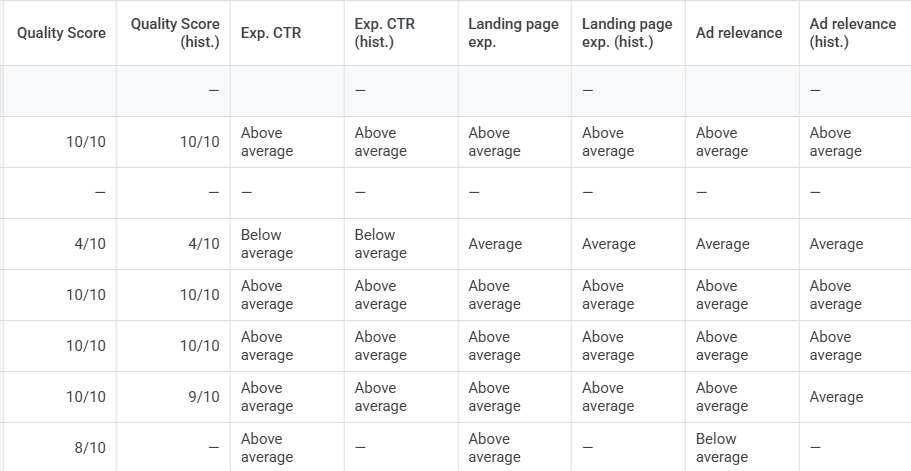
Quality Score measures these key components of your ad:
Expected CTR.
Ad relevance.
Landing page relevance.
Google Ads shows you a relatively detailed view of each of these areas, so you’re not left guessing what you should focus on optimizing.
Screenshot taken from a Google Ads report, January 2026
Quality Score matters because it directly impacts how often your ads are eligible to show. Not only that, but it also affects how much you’re paying per click.
Solution: Optimize Quality Score based on the “grades” Google gives you for your keywords.
Some of these fixes may be easier to implement (such as new ad copy), but if you need to optimize your landing page, that may take time and other resources.
A thorough guide to optimizing Quality Score can be found here.
If your CTR has remained steady but is seeing click volume decrease, the main issue is this: decreased impressions.
There can be multiple factors for a sudden decrease in impressions, but here are the most common:
Seasonality
If you have a seasonal product, you’re naturally going to have dips and peaks in demand.
If searches go down for your particular industry, your keywords’ impressions will also decrease.
Updated Bidding Strategy
If you’ve recently modified your bidding strategy, there could be a misalignment between your daily budget vs. your target ROAS/CPA/CPC goal.
Any significant gaps in expectations here can cause a stark decline in impressions.
For example, if you set your bidding to a $50 CPA goal for competitive keywords but typically see a $150 CPA, this will cause almost instant volatility in impressions.
The way CPA and ROAS strategies work is to throttle impressions to users who are not likely to convert to your goal.
New Negative Keywords
Like many advertisers, you’ve had to tighten up your negative keywords. This is due to Google loosening restrictions on keyword match types.
However, you may have accidentally restricted too much on negative keywords. This can result in lost impressions because of conflicting negatives.
So, what can you do to combat low impressions?
Solution: Aside from any seasonality issues, review your current bidding strategies and ensure the targets are aligned (and realistic) to your performance goals.
Additionally, comb through your negative keyword lists to identify any conflicts that are hindering your ad from showing.
So you’ve written shiny new ad copy and implemented it across the board. You’re excited to see your improved ad copy outperform your previous ads.
But, you’ve discovered the opposite happens, and your click volume plummets.
What gives?
Essentially, any time you make an update to your campaigns, and especially ad copy, you’ve set your campaign back into learning mode. During this time, you may expect to see volatility in performance. You may see CTR drop while Google’s algorithm learns what resonates best with users.
Obviously, this is not ideal for any advertiser. You’ve spent the time to perfect a new copy and are watching it perform worse. So, what can we learn from this scenario?
Solution: A/B test your new ads before pausing all “old” ads. This can help reduce the inevitable performance volatility of pausing all old ads and replacing them with new ones.
Competition isn’t something that you can control. They may have a larger budget or more interesting ad copy than you. All of these items are out of your control.
What you can control is how you respond to competition.
Say your maximum CPC on a keyword is set to $5, but you notice a competitor is consistently showing above you. This most likely means that the competitor is outbidding you.
Solution: If you have the budget capacity, a simple remedy would be to be more aggressive in your bidding strategy. This can help increase impression and click volume as you show up more often.
Read more about how to use Smart Bidding effectively here.
Another example is if a competitor has a better ad copy than you. Say you’re selling a similar product, but a competitor has a promotion while you don’t. Which ad do you think will likely get more clicks?
Most likely, the promotional ad.
Solution: If you are not/cannot run a promotion, review your ad copy to identify how you can stand out from the competition.
Make sure you’re using all relevant ad extensions to help increase ad rank and real estate on the page. Consistently check the Ad Preview Tool to make sure your ad is still the most attractive on the page.
When clicks fall, your job is not to panic. Your job is to isolate the reason quickly, then act with intent. Here’s the simple mental checklist I use when I’m trying to get an account steady again:
If Quality Score slipped, focus on expected CTR, relevance, and landing page alignment before you touch bids.
If impressions dropped, sanity-check budgets, targets, and negative keyword conflicts first.
If new ads underperform, stop the “all at once” swap and move back to controlled testing.
If competitors get louder, tighten your message, improve your offer framing, and make sure assets are fully built out.
Click volume usually comes back when you stop treating it like a mystery and start treating it like a diagnosis. The goal is not “more clicks at any cost.” It’s restoring qualified visibility you can actually convert.