Earlier this week, MIT Technology Review published its annual list of Ten Breakthrough Technologies. As always, it features technologies that made the news last year, and which—for better or worse—stand to make waves in the coming years. They’re the technologies you should really be paying attention to.
This year’s list includes tech that’s set to transform the energy industry, artificial intelligence, space travel—and of course biotech and health. Our breakthrough biotechnologies for 2026 involve editing a baby’s genes and, separately, resurrecting genes from ancient species. We also included a controversial technology that offers parents the chance to screen their embryos for characteristics like height and intelligence. Here’s the story behind our biotech choices.
A base-edited baby!
In August 2024, KJ Muldoon was born with a rare genetic disorder that allowed toxic ammonia to build up in his blood. The disease can be fatal, and KJ was at risk of developing neurological disorders. At the time, his best bet for survival involved waiting for a liver transplant.
Then he was offered an experimental gene therapy—a personalized “base editing” treatment designed to correct the specific genetic “misspellings” responsible for his disease. It seems to have worked! Three doses later, KJ is doing well. He took his first steps in December, shortly before spending his first Christmas at home.
KJ’s story is hugely encouraging. The team behind his treatment is planning a clinical trial for infants with similar disorders caused by different genetic mutations. The team members hope to win regulatory approval on the back of a small trial—a move that could make the expensive treatment (KJ’s cost around $1 million) more accessible, potentially within a few years.
Others are getting in on the action, too. Fyodor Urnov, a gene-editing scientist at the University of California, Berkeley, assisted the team that developed KJ’s treatment. He recently cofounded Aurora Therapeutics, a startup that hopes to develop gene-editing drugs for another disorder called phenylketonuria (PKU). The goal is to obtain regulatory approval for a single drug that can then be adjusted or personalized for individuals without having to go through more clinical trials.
It was a big year for Colossal Biosciences, the biotech company hoping to “de-extinct” animals like the woolly mammoth and the dodo. In March, the company created what it called “woolly mice”—rodents with furry coats and curly whiskers akin to those of woolly mammoths.
The company made an even more dramatic claim the following month, when it announced it had created three dire wolves. These striking snow-white animals were created by making 20 genetic changes to the DNA of gray wolves based on genetic research on ancient dire wolf bones, the company said at the time.
Whether these animals can really be called dire wolves is debatable, to say the least. But the technology behind their creation is undeniably fascinating. We’re talking about the extraction and analysis of ancient DNA, which can then be introduced into cells from other, modern-day species.
Analysis of ancient DNA can reveal all sorts of fascinating insights into human ancestors and other animals. And cloning, another genetic tool used here, has applications not only in attempts to re-create dead pets but also in wildlife conservation efforts. Read more here.
Embryo scoring
IVF involves creating embryos in a lab and, typically, “scoring” them on their likelihood of successful growth before they are transferred to a person’s uterus. So far, so uncontroversial.
Recently, embryo scoring has evolved. Labs can pinch off a couple of cells from an embryo, look at its DNA, and screen for some genetic diseases. That list of diseases is increasing. And now some companies are taking things even further, offering prospective parents the opportunity to select embryos for features like height, eye color, and even IQ.
This is controversial for lots of reasons. For a start, there are many, many factors that contribute to complex traits like IQ (a score that doesn’t capture all aspects of intelligence at any rate). We don’t have a perfect understanding of those factors, or how selecting for one trait might influence another.
Some critics warn of eugenics. And others note that whichever embryo you end up choosing, you can’t control exactly how your baby will turn out (and why should you?!). Still, that hasn’t stopped Nucleus, one of the companies offering these services, from inviting potential customers to have their “best baby.” Read more here.
This article first appeared in The Checkup, MIT Technology Review’s weekly biotech newsletter. To receive it in your inbox every Thursday, and read articles like this first, sign up here.
This is today’s edition of The Download, our weekday newsletter that provides a daily dose of what’s going on in the world of technology.
AI coding is now everywhere. But not everyone is convinced.
Depending who you ask, AI-powered coding is either giving software developers an unprecedented productivity boost or churning out masses of poorly designed code that saps their attention and sets software projects up for serious long term-maintenance problems.
The problem is right now, it’s not easy to know which is true.
As tech giants pour billions into large language models (LLMs), coding has been touted as the technology’s killer app. Executives enamored with the potential are pushing engineers to lean into an AI-powered future. But after speaking to more than 30 developers, technology executives, analysts, and researchers, MIT Technology Review found that the picture is not as straightforward as it might seem. Read the full story.
This story was also part of our Hype Correction package. You can read the rest of the stories here.
The biotech trends to watch for in 2026
Earlier this week, MIT Technology Review published our annual list of Ten Breakthrough Technologies.
This year’s list includes tech that’s set to transform the energy industry, artificial intelligence, space travel—and of course biotech and health. Our breakthrough biotechnologies for 2026 involve editing a baby’s genes and, separately, resurrecting genes from ancient species. We also included a controversial technology that offers parents the chance to screen their embryos for characteristics like height and intelligence. Here’s the story behind our biotech choices.
—Jessica Hamzelou
This story is from The Checkup, our weekly newsletter all about the latest in health and biotech. Sign upto receive it in your inbox every Thursday.
MIT Technology Review Narrated: What’s next for AI in 2026
Our AI writers have made some big bets for the coming year—read our story about the five hot trends to watch, or listen to it on Spotify, Apple, or wherever you get your podcasts.
The must-reads
I’ve combed the internet to find you today’s most fun/important/scary/fascinating stories about technology.
1 Minnesota shows how governing and content creation have merged In another era, we’d have just called this propaganda. (NPR) + MAGA influencers are just straight up lying about what is happening there. (Vox) + Activists are trying to identify individual ICE officers while protecting their own identities. (WP $) + A backlash against ICE is growing in Silicon Valley. (Wired $)
2 There’s probably more child abuse material online now than ever before Of all Big Tech’s failures, this is surely the most appalling. (The Atlantic $) + US investigators are using AI to detect child abuse images made by AI. (MIT Technology Review) + Grok is still being used to undress images of real people. (Quartz)
3 ChatGPT wrote a suicide lullaby for a man who later killed himself This shows it’s “still an unsafe product,” a lawyer representing a family in a tragically similar case said. (Ars Technica) + An AI chatbot told a user how to kill himself—but the company doesn’t want to “censor” it. (MIT Technology Review)
4 Videos emerging from Iran show how bloody the crackdown has become Iranians are finding ways around the internet blackout to show the rest of the world how many of them have been killed. (NBC) + Here’s how they’re getting around the blackout. (NPR)
5 China dominates the global humanoid robot market A new report by analysts found its companies account for over 80% of all deployments. (South China Morning Post) + Just how useful are the latest humanoids, though? (Nature) + Why humanoid robots need their own safety rules. (MIT Technology Review)
6 How is Australia’s social media ban for kids going? It’s mixed—some teens welcome it, but others are finding workarounds. (CNBC)
7 Scientists are finding more objective ways to spot mental illness Biomarkers like voice cadence and heart rate proving pretty reliable for diagnosing conditions like depression. (New Scientist $)
8 The Pebble smartwatch be making a comeback This could be the thing that tempts me back into buying wearables… (Gizmodo)
9 A new video game traps you in an online scam center Can’t see the appeal myself, but… each to their own I guess? (NYT $)
10 Smoke detectors are poised to get a high-tech upgrade And one of the technologies boosting their capabilities is, of course, AI. (BBC)
Quote of the day
“I am very annoyed. I’m very disappointed. I’m seriously frustrated.”
—Pfizer CEO Albert Bourla tells attendees at a healthcare conference this week his feelings about the anti-vaccine agenda Health Secretary Robert F. Kennedy Jr. has been implementing, Bloomberg reports.
One more thing
ARIEL DAVIS
How close are we to genuine “mind reading?”
Technically speaking, neuroscientists have been able to read your mind for decades. It’s not easy, mind you. First, you must lie motionless within a fMRI scanner, perhaps for hours, while you watch films or listen to audiobooks.
If you do elect to endure claustrophobic hours in the scanner, the software will learn to generate a bespoke reconstruction of what you were seeing or listening to, just by analyzing how blood moves through your brain.
More recently, researchers have deployed generative AI tools, like Stable Diffusion and GPT, to create far more realistic, if not entirely accurate, reconstructions of films and podcasts based on neural activity. So how close are we to genuine “mind reading?” Read the full story.
—Grace Huckins
We can still have nice things
A place for comfort, fun and distraction to brighten up your day. (Got any ideas? Drop me a line or skeet ’em at me.)
+ Still keen to do a bit of reflecting on the year behind and the one ahead? This free guide might help! + Turns out British comedian Rik Mayall had some pretty solid life advice. + I want to stay in this house in São Paolo. + If you want to stop doomscrolling, it’s worth looking at your sleep habits. ($)
Chris Harrison says it all started with a single pot on a stove. He and two high school buddies launched Liber & Co., a manufacturer of premium cocktail syrups, with that tiny test batch in 2011 in Austin, Texas.
Fast forward to 2026, and batches are now in 1,500-gallon tanks and sold worldwide to restaurants, bars, and consumers. But the culture remains hands-on, do-it-yourself, and learn-by-doing.
Chris first appeared on the podcast in 2022. In our recent conversation, he shared the company’s origins, sourcing tactics, growth plans, and more. Our entire audio is embedded below. The transcript is edited for clarity and length.
Eric Bandholz: Who are you, and what do you do?
Chris Harrison: I’m a co-founder of Liber & Co. We make premium non-alcoholic cocktail syrups for bars, restaurants, coffee shops, and home consumers. We’re based in Georgetown, Texas, near Austin, and handle almost everything in-house: manufacturing, warehousing, marketing, ecommerce, wholesale, and even international sales.
Our founding team grew up together in the same small Texas town. We’re the same age, went to the same high school, and came from similar blue-collar backgrounds. We didn’t have a big professional network or capital to outsource everything, so if something needed to be done, we learned to do it ourselves.
We’re also food people. You can’t outsource being a foodie or understanding flavor. Even the best chefs are hands-on in the kitchen, tasting, adjusting, and refining. That mindset shaped Liber & Co. from the beginning. We wanted to be close to the product to understand the ingredients, sourcing, and flavor development firsthand. That do-it-yourself culture became part of our identity.
Bandholz: How did you learn production, moving from a kitchen to a manufacturing facility?
Harrison: It’s a long, incremental journey. We relied on research and trial and error. We started with a small stock pot on a stove, then moved to a 25-gallon pan, then a 200-gallon tank, and now we operate multiple 1,500-gallon tanks.
That gradual progression was critical. You can’t attempt too much without putting the business at risk. If we had jumped straight from a kitchen setup to our current scale, we would have made far more expensive mistakes. Iterating step by step gave us time to understand what worked and what didn’t. There aren’t many shortcuts when you’re building something physical.
Our product category also made things harder. Unlike breweries, which often follow well-established scaling paths, there wasn’t a clear blueprint for cocktail syrups. That meant a lot of independent study, testing equipment, ordering samples, and experimenting with processes. We made mistakes along the way, which were part of the learning curve.
Manufacturing your own product limits capacity. You can’t sell more than you can physically make. There’s no co-manufacturer to absorb demand — you are the bottleneck. That was especially true in the early days.
Early on, we did whatever it took to fulfill orders. I spent 18 hours straight in the kitchen more than once to fill large orders for H-E-B, the grocery chain. It was manual work: long days, minimal breaks, and just pushing through. Thirteen years later, we’re grateful we no longer have to operate that way.
Bandholz: How do you find ingredient suppliers?
Harrison: Most of our sourcing has come from research. That includes a lot of Googling, using ChatGPT and Gemini, and contacting suppliers directly. We typically send a detailed request for proposal outlining who we are, what we need, and our product specifications. Then we ask if they can meet those requirements, provide documentation, and send samples. From there, we test and evaluate.
We cast a wide net geographically. With ginger, for example, we looked at suppliers across Africa, China, Vietnam, and Hawaii before ultimately choosing a Peruvian source. Some leads come from word of mouth. Someone might say, “I saw great ginger in Peru.” I’ll track down the producer through Google or LinkedIn. That actually happened.
It takes persistence. My background is in biology, so I enjoy getting into the weeds, so to speak. We also try to maintain backup suppliers. Fresh produce is unpredictable; pineapple crops suffered globally this year, driving up prices. A frozen backup supply helped smooth costs, but sourcing is never easy or guaranteed.
Bandholz: Is frozen produce better than fresh?
Harrison: In many cases, yes, frozen can be better. Farmers can wait until fruit reaches peak ripeness before harvesting. For something like raspberries, they’ll test sugar content the day of harvest using a refractometer. They literally crush the fruit and measure Brix, the dissolved-sugar level. The U.S. Food and Drug Administration even publishes approved Brix ranges for various fruits, such as peaches, pomegranates, and raspberries.
Farmers aim to hit those targets because that’s where flavor, aroma, and sweetness are best. But it comes from ripening on the vine. Once harvested, the fruit must be used immediately or preserved. Freezing is one of the best ways to lock in that peak quality.
Frozen storage requires capital. Cold storage and refrigerated transportation are expensive, but the tradeoff is consistency and quality. The frozen supply chain has expanded significantly. We’re seeing more investment in large-scale frozen facilities across the country. Even in central Texas, companies are building new frozen warehouses. We use one in North Austin.
If you’re serious about sourcing high-quality food ingredients, the frozen cold chain is often the best option.
Plus, we typically purchase small portions. Large companies such as Smucker’s buy in massive bulk. We like buying from cooperatives of many smaller, independent farms. Certain regions grow crops naturally well. For raspberries, that’s the U.S. Pacific Northwest, parts of Washington and Oregon.
Those regions have family-run farms, often third-generation operations, managing anywhere from 20 to 200 acres. Around them are many similar farms, all growing the same crop in the same climate. That creates a strong network effect: consistent weather, shared knowledge, and reliable quality across the region.
Because these farms remain independent, you avoid some of the downsides of large, consolidated operations. There’s less pressure to cut corners, harvest early, or sacrifice quality to maximize margins. In our experience, the cooperative model prioritizes long-term quality and sustainability.
We might buy one or two truckloads of fruit per year — roughly 40,000 to 80,000 pounds. A cooperative, by contrast, may handle 400 or 500 truckloads in a single harvest. Being a small buyer reduces risk. If we relied on a single farm for everything, we’d be far more vulnerable to supply disruptions.
Bandholz: How do you plan to evolve the brand?
Harrison: We don’t feel limited. We’ve explored packaging formats beyond bottles, which we currently use for syrups. Cans are a natural extension for cocktails, mocktails, or even cannabis beverages. From a formulation, sourcing, and food safety perspective, we could make those products. Packaging is often the most expensive part of goods. It can feel like a constraint, but it’s more about investment and logistics than capability.
At our scale, outsourcing packaging formats is possible. Specialized manufacturers can handle canning at scale. The primary considerations are unit economics and lack of control. That’s a philosophical question as much as a business one.
Overall, we see opportunities to grow both vertically and horizontally. We can deepen what we already do with syrups or expand into new formats, product types, and channels. Brand evolution is more about strategy, resources, and willingness to experiment while maintaining quality and authenticity.
Bandholz: Where can people buy your syrups and get in touch?
Just today, OpenAI confirmed it will begin testing advertising in the United States for ChatGPT Free and ChatGPT Go users in the coming weeks, marking the first time ads will appear inside the ChatGPT experience.
The test coincides with the U.S. launch of ChatGPT Go, a low-cost subscription tier priced at $8 per month that has been available internationally since August.
The details reveal a cautious approach, with clear limits on where ads can appear, who will see them, and how they will be separated from ChatGPT’s responses.
Here’s what OpenAI shared, how the tests will work, and why this shift matters for users and advertisers alike.
What OpenAI Is Testing
ChatGPT ads are not being introduced as part of a broader redesign or monetization overhaul. Instead, OpenAI is framing this as a limited test, with narrow placement rules and clear separation from ChatGPT’s core function.
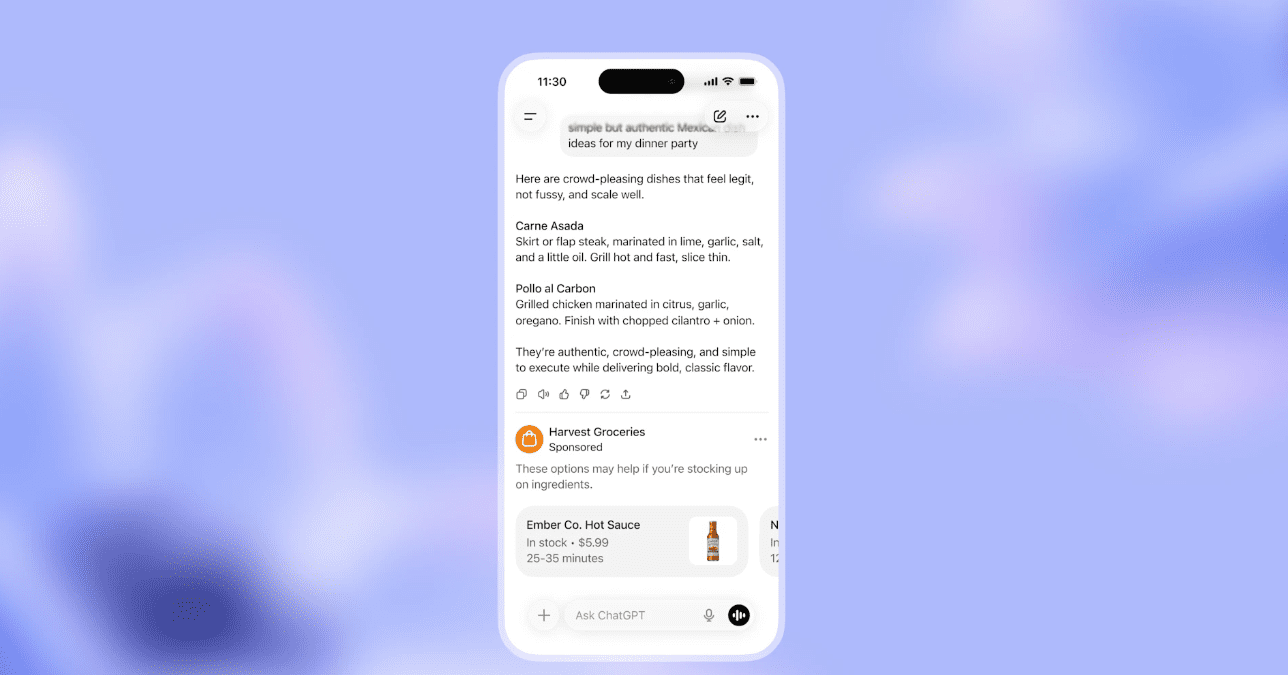
Ads will appear at the bottom of a response, only when there is a relevant sponsored product or service tied to the active conversation. They will be clearly labeled, visually distinct from organic answers, and dismissible.
Users will also be able to see why a particular ad is being shown and turn off ad personalization entirely if they choose.
Just as important is where ads will not appear.
OpenAI stated that ads will not be shown to users under 18 and will not be eligible to run near sensitive or regulated topics, including health, mental health, and politics. Conversations will not be shared with advertisers, and user data will not be sold.
Timing Ad Testing with the Go Tier Launch
The timing of the announcement doesn’t seem accidental.
Alongside the ad testing plans, OpenAI confirmed that ChatGPT Go is now available in the United States.
Priced at $8 per month, Go sits between the free tier and higher-cost subscriptions, offering expanded access to messaging, image generation, file uploads, and memory.
Ads are positioned as a way to support both the free tier and Go users, allowing more people to use ChatGPT with fewer restrictions without forcing an upgrade.
At the same time, OpenAI made it clear that Pro, Business, and Enterprise subscriptions will remain ad-free, reinforcing that paid tiers are still the preferred path for users who want an uninterrupted experience.
Explaining the Guardrails of Early Ad Testing
OpenAI spent as much time explaining what ads will not do as what they will.
The company was explicit that advertising will not influence ChatGPT’s responses. Answers are optimized for usefulness, not commercial outcomes. There is no intent to optimize for time spent, engagement loops, or other metrics commonly associated with ad-driven platforms.
This is a notable departure from how advertising has historically been introduced elsewhere on the internet. Rather than retrofitting ads into an existing product and adjusting incentives later, OpenAI is attempting to define the rules up front.
Whether those rules hold over time is an open question. But the clarity of the initial framework suggests OpenAI understands the risk of getting this wrong.
What Early Ad Formats Tell Us
OpenAI shared two examples of the ad formats it plans to test inside ChatGPT.
In the first example, a ChatGPT response provides recipe ideas for a Mexican dinner party. Below the response, a sponsored product recommendation appears for a grocery item. The ad is clearly labeled and visually separated from the organic answer.
Image credit: openai.com
In the second example, ChatGPT responds to a conversation about traveling to Santa Fe, New Mexico. A sponsored lodging listing appears below the response, labeled as sponsored. The example also shows a follow-up chat screen, indicating that users can continue interacting with ChatGPT after seeing the ad.
Image credit: openai.com
In both examples, the ads appear at the bottom of ChatGPT’s responses and are presented as separate from the main answer. OpenAI stated that these formats are part of its initial ad testing and may change as testing progresses.
Why This Matters for Advertisers
This is not something advertisers can plan for just yet.
There are no announced buying models, no targeting details, no measurement framework, and no indication of when access might expand beyond testing. OpenAI has been clear that this is not an open marketplace at the moment.
Still, the implications are hard to ignore. Ads placed alongside high-intent, problem-solving conversations could eventually represent a different kind of discovery environment. One where usefulness matters more than volume, and where poor creative or loose targeting would feel immediately out of place.
If this becomes a real channel, it is unlikely to reward the same tactics that work in search or social today.
How Marketers Are Reacting So Far
Early industry reaction has been measured, not alarmist.
Most commentary acknowledges that advertising inside ChatGPT was inevitable at this scale.
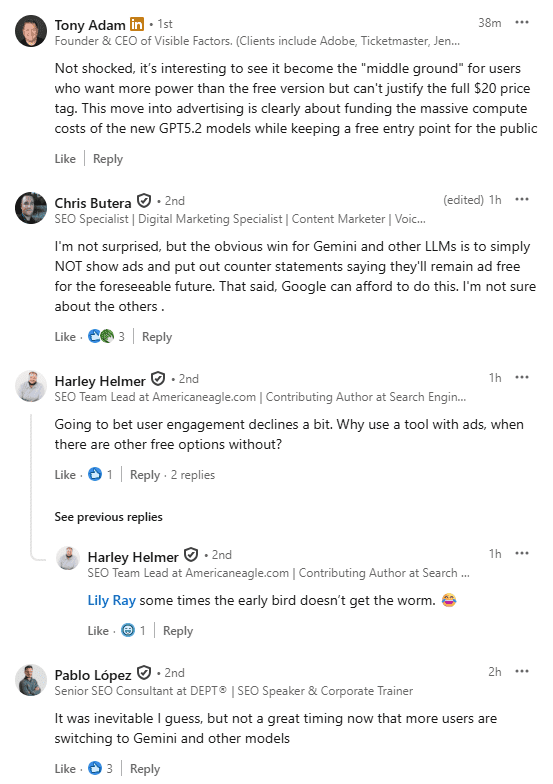
Lily Ray stated her curiosity to “see how this change impacts user experience.”
Most people in the comments of her post are not shocked by this:
There is also skepticism, particularly around whether relevance can be maintained over time without pressure to expand inventory. That skepticism is warranted. History suggests that once ads work, the temptation to scale them follows.
For now, though, this feels less like an ad platform launch and more like OpenAI testing whether ads can exist inside a conversational interface without changing how people trust the product.
The Bigger Signal for AI Platforms
For users, OpenAI is expanding access while trying to preserve the trust that has made ChatGPT widely used. Introducing ads without blurring the line between answers and monetization sets a high bar, especially for a product people rely on for personal and professional tasks.
Outside of ChatGPT itself, this update shows how AI-first products may think about revenue differently than search or social networks. Ads are positioned as a way to support access, not as the product, with paid tiers remaining central.
OpenAI says it will adjust how ads appear based on user feedback once testing begins in the U.S.
For now, this is a limited test rather than a full advertising launch. Whether those boundaries hold will matter, not just for ChatGPT, but for how monetization inside conversational interfaces is expected to work.
In the SEO world, when we talk about how to structure content for AI search, we often default to structured data – Schema.org, JSON-LD, rich results, knowledge graph eligibility – the whole shooting match.
While that layer of markup is still useful in many scenarios, this isn’t another article about how to wrap your content in tags.
Structuring content isn’t the same as structured data
Instead, we’re going deeper into something more fundamental and arguably more important in the age of generative AI: How your content is actually structured on the page and how that influences what large language models (LLMs) extract, understand, and surface in AI-powered search results.
Structured data is optional. Structured writing and formatting are not.
If you want your content to show up in AI Overviews, Perplexity summaries, ChatGPT citations, or any of the increasingly common “direct answer” features driven by LLMs, the architecture of your content matters: Headings. Paragraphs. Lists. Order. Clarity. Consistency.
In this article, I’m unpacking how LLMs interpret content — and what you can do to make sure your message is not just crawled, but understood.
How LLMs Actually Interpret Web Content
Let’s start with the basics.
Unlike traditional search engine crawlers that rely heavily on markup, metadata, and link structures, LLMs interpret content differently.
They don’t scan a page the way a bot does. They ingest it, break it into tokens, and analyze the relationships between words, sentences, and concepts using attention mechanisms.
They’re not looking for a tag or a JSON-LD snippet to tell them what a page is about. They’re looking for semantic clarity: Does this content express a clear idea? Is it coherent? Does it answer a question directly?
LLMs like GPT-4 or Gemini analyze:
The order in which information is presented.
The hierarchy of concepts (which is why headings still matter).
Formatting cues like bullet points, tables, bolded summaries.
Redundancy and reinforcement, which help models determine what’s most important.
This is why poorly structured content – even if it’s keyword-rich and marked up with schema – can fail to show up in AI summaries, while a clear, well-formatted blog post without a single line of JSON-LD might get cited or paraphrased directly.
Why Structure Matters More Than Ever In AI Search
Traditional search was about ranking; AI search is about representation.
When a language model generates a response to a query, it’s pulling from many sources – often sentence by sentence, paragraph by paragraph.
It’s not retrieving a whole page and showing it. It’s building a new answer based on what it can understand.
What gets understood most reliably?
Content that is:
Segmented logically, so each part expresses one idea.
Consistent in tone and terminology.
Presented in a format that lends itself to quick parsing (think FAQs, how-to steps, definition-style intros).
Written with clarity, not cleverness.
AI search engines don’t need schema to pull a step-by-step answer from a blog post.
But, they do need you to label your steps clearly, keep them together, and not bury them in long-winded prose or interrupt them with calls to action, pop-ups, or unrelated tangents.
Clean structure is now a ranking factor – not in the traditional SEO sense, but in the AI citation economy we’re entering.
What LLMs Look For When Parsing Content
Here’s what I’ve observed (both anecdotally and through testing across tools like Perplexity, ChatGPT Browse, Bing Copilot, and Google’s AI Overviews):
Clear Headings And Subheadings: LLMs use heading structure to understand hierarchy. Pages with proper H1–H2–H3 nesting are easier to parse than walls of text or div-heavy templates.
Short, Focused Paragraphs: Long paragraphs bury the lede. LLMs favor self-contained thoughts. Think one idea per paragraph.
Structured Formats (Lists, Tables, FAQs): If you want to get quoted, make it easy to lift your content. Bullets, tables, and Q&A formats are goldmines for answer engines.
Defined Topic Scope At The Top: Put your TL;DR early. Don’t make the model (or the user) scroll through 600 words of brand story before getting to the meat.
Semantic Cues In The Body: Words like “in summary,” “the most important,” “step 1,” and “common mistake” help LLMs identify relevance and structure. There’s a reason so much AI-generated content uses those “giveaway” phrases. It’s not because the model is lazy or formulaic. It’s because it actually knows how to structure information in a way that’s clear, digestible, and effective, which, frankly, is more than can be said for a lot of human writers.
A Real-World Example: Why My Own Article Didn’t Show Up
In December 2024, I wrote a piece about the relevance of schema in AI-first search.
It was structured for clarity, timeliness, and was highly relevant to this conversation, but didn’t show up in my research queries for this article (the one you are presently reading). The reason? I didn’t use the term “LLM” in the title or slug.
All of the articles returned in my search had “LLM” in the title. Mine said “AI Search” but didn’t mention LLMs explicitly.
You might assume that a large language model would understand “AI search” and “LLMs” are conceptually related – and it probably does – but understanding that two things are related and choosing what to return based on the prompt are two different things.
Where does the model get its retrieval logic? From the prompt. It interprets your question literally.
If you say, “Show me articles about LLMs using schema,” it will surface content that directly includes “LLMs” and “schema” – not necessarily content that’s adjacent, related, or semantically similar, especially when it has plenty to choose from that contains the words in the query (a.k.a. the prompt).
So, even though LLMs are smarter than traditional crawlers, retrieval is still rooted in surface-level cues.
This might sound suspiciously like keyword research still matters – and yes, it absolutely does. Not because LLMs are dumb, but because search behavior (even AI search) still depends on how humans phrase things.
The retrieval layer – the layer that decides what’s eligible to be summarized or cited – is still driven by surface-level language cues.
What Research Tells Us About Retrieval
Even recent academic work supports this layered view of retrieval.
A 2023 research paper by Doostmohammadi et al. found that simpler, keyword-matching techniques, like a method called BM25, often led to better results than approaches focused solely on semantic understanding.
The improvement was measured through a drop in perplexity, which tells us how confident or uncertain a language model is when predicting the next word.
In plain terms: Even in systems designed to be smart, clear and literal phrasing still made the answers better.
So, the lesson isn’t just to use the language they’ve been trained to recognize. The real lesson is: If you want your content to be found, understand how AI search works as a system – a chain of prompts, retrieval, and synthesis. Plus, make sure you’re aligned at the retrieval layer.
This isn’t about the limits of AI comprehension. It’s about the precision of retrieval.
Language models are incredibly capable of interpreting nuanced content, but when they’re acting as search agents, they still rely on the specificity of the queries they’re given.
That makes terminology, not just structure, a key part of being found.
How To Structure Content For AI Search
If you want to increase your odds of being cited, summarized, or quoted by AI-driven search engines, it’s time to think less like a writer and more like an information architect – and structure content for AI search accordingly.
That doesn’t mean sacrificing voice or insight, but it does mean presenting ideas in a format that makes them easy to extract, interpret, and reassemble.
Core Techniques For Structuring AI-Friendly Content
Here are some of the most effective structural tactics I recommend:
Use A Logical Heading Hierarchy
Structure your pages with a single clear H1 that sets the context, followed by H2s and H3s that nest logically beneath it.
LLMs, like human readers, rely on this hierarchy to understand the flow and relationship between concepts.
If every heading on your page is an H1, you’re signaling that everything is equally important, which means nothing stands out.
Good heading structure is not just semantic hygiene; it’s a blueprint for comprehension.
Keep Paragraphs Short And Self-Contained
Every paragraph should communicate one idea clearly.
Walls of text don’t just intimidate human readers; they also increase the likelihood that an AI model will extract the wrong part of the answer or skip your content altogether.
This is closely tied to readability metrics like the Flesch Reading Ease score, which rewards shorter sentences and simpler phrasing.
While it may pain those of us who enjoy a good, long, meandering sentence (myself included), clarity and segmentation help both humans and LLMs follow your train of thought without derailing.
Use Lists, Tables, And Predictable Formats
If your content can be turned into a step-by-step guide, numbered list, comparison table, or bulleted breakdown, do it. AI summarizers love structure, so do users.
Frontload Key Insights
Don’t save your best advice or most important definitions for the end.
LLMs tend to prioritize what appears early in the content. Give your thesis, definition, or takeaway up top, then expand on it.
Use Semantic Cues
Signal structure with phrasing like “Step 1,” “In summary,” “Key takeaway,” “Most common mistake,” and “To compare.”
These phrases help LLMs (and readers) identify the role each passage plays.
Avoid Noise
Interruptive pop-ups, modal windows, endless calls-to-action (CTAs), and disjointed carousels can pollute your content.
Even if the user closes them, they’re often still present in the Document Object Model (DOM), and they dilute what the LLM sees.
Think of your content like a transcript: What would it sound like if read aloud? If it’s hard to follow in that format, it might be hard for an LLM to follow, too.
The Role Of Schema: Still Useful, But Not A Magic Bullet
Let’s be clear: Structured data still has value. It helps search engines understand content, populate rich results, and disambiguate similar topics.
However, LLMs don’t require it to understand your content.
If your site is a semantic dumpster fire, schema might save you, but wouldn’t it be better to avoid building a dumpster fire in the first place?
Schema is a helpful boost, not a magic bullet. Prioritize clear structure and communication first, and use markup to reinforce – not rescue – your content.
How Schema Still Supports AI Understanding
That said, Google has recently confirmed at Search Central Live in Madrid that its LLM (Gemini), which powers AI Overviews, does leverage structured data to help understand content more effectively.
In fact, at the event, John Mueller recommends to use structured data because it gives models clearer signals about intent and structure.
That doesn’t contradict the point; it reinforces it. If your content isn’t already structured and understandable, schema can help fill the gaps. It’s a crutch, not a cure.
Schema is a helpful boost, but not a substitute, for structure and clarity.
In AI-driven search environments, we’re seeing content without any structured data show up in citations and summaries because the core content was well-organized, well-written, and easily parsed.
In short:
Use schema when it helps clarify the intent or context.
Don’t rely on it to fix bad content or a disorganized layout.
Prioritize content quality and layout before markup.
The future of content visibility is built on how well you communicate, not just how well you tag.
Conclusion: Structure For Meaning, Not Just For Machines
Optimizing for LLMs doesn’t mean chasing new tools or hacks. It means doubling down on what good communication has always required: clarity, coherence, and structure.
If you want to stay competitive, you’ll need to structure content for AI search just as carefully as you structure it for human readers.
The best-performing content in AI search isn’t necessarily the most optimized. It’s the most understandable. That means:
Anticipating how content will be interpreted, not just indexed.
Giving AI the framework it needs to extract your ideas.
Structuring pages for comprehension, not just compliance.
Anticipating and using the language your audience uses, because LLMs respond literally to prompts and retrieval depends on those exact terms being present.
As search shifts from links to language, we’re entering a new era of content design. One where meaning rises to the top, and the brands that structure for comprehension will rise right along with it.
Welcome to this week’s Pulse. Google is laying more groundwork for agent-led shopping, Google Trends is getting a Gemini helper inside Explore, and Google appears to have responded to a report we covered last week on AI Overviews health queries.
Google introduced the Universal Commerce Protocol as an open standard meant to help AI agents complete shopping tasks across merchants and platforms. The announcement landed around NRF and was framed as agent-based shopping infrastructure, not a consumer feature on its own.
Key facts: This story got attention for two reasons. First, it shows where Google wants AI Mode shopping to go next. Second, it triggered a familiar debate about personalization and pricing after critics connected Google’s “personalized upselling” language to surveillance pricing narratives. Google has pushed back on that framing, saying upselling means showing premium options and that its Direct Offers pilot cannot raise prices.
The question for ecommerce practitioners is which parts of the journey you still influence with classic SEO, which parts come down to feeds and structured data hygiene, and which parts are product decisions made inside Google’s surfaces. UCP doesn’t answer that question yet, but it clarifies the direction.
What SEO Professionals Are Saying
The most useful social commentary this week falls into “consumer risk” versus “plumbing and implementation.”
On the critique side, Lindsay Owens, executive director of Groundwork Collaborative, helped set the tone for the surveillance pricing argument around “personalized upselling.” Lee Hepner, senior legal counsel at the American Economic Liberties Project, posted along similar lines, treating individualized pricing as the bigger policy risk sitting behind these kinds of systems.
On the implementation side, Mani Fazeli, VP of Product at Shopify, described what Shopify sees as the point of UCP. He said it “models the entire shopping journey, not just payments” and that “merchants keep their business critical checkout customizations.”
Heiko Hotz, Generative AI Global Blackbelt at Google Cloud, framed it more bluntly from an agent-builder perspective. “Agents are great at reasoning, but they are terrible at navigating a visual website.” Eric Seufert, analyst and publisher of Mobile Dev Memo, weighed in from an incentives angle, arguing the endgame is keeping discovery, conversion, and optimization economically connected to paid media.
Google Trends is redesigning the Explore page with a Gemini-powered side panel that suggests related terms and makes comparisons easier.
Key facts: Google says the update can “automatically identify and compare relevant trends,” with the ability to compare up to eight terms and see more “top and rising” queries per term. The update is rolling out now.
Why This Matters
Google keeps making Trends more useful for the discovery phase of keyword research.
Trends has always been valuable, but it can be slow when you start with a vague idea and need to find the right comparison terms. The Gemini panel looks designed to reduce that friction. For practitioners who use Trends early in content planning, this could speed up the process of clustering related topics and spotting seasonal patterns.
What People Are Saying
Yossi Matias, vice president and head of Google Research, emphasized the Gemini side panel, which suggests related terms, supports comparisons of up to eight queries, and expands the “top” and “rising” query views.
In the SEO community, the initial framing is that this reduces friction in the Explore workflow by surfacing comparison terms faster, but there hasn’t been much detailed feedback yet beyond first impressions.
Health AI Overviews Face Fresh Scrutiny After Guardian Reporting
After the Guardian published examples of AI Overviews giving misleading or potentially risky guidance on medical queries, Google stopped showing AI Overviews for some health searches.
Key facts: The Guardian’s reporting included examples involving pancreatic cancer diet advice and “normal range” explanations for liver tests that reviewers said lacked context. In follow-up coverage, multiple outlets reported that Google removed AI Overviews for certain medical searches after the reporting circulated. Google’s response leaned on two themes: Some examples were missing context or based on incomplete screenshots, and it says most AI Overviews are supported by reputable sources.
Why This Matters
I wrote about the Guardian investigation earlier this month, and it fits a pattern that keeps resurfacing as AI Overviews expand into sensitive categories. You also have independent data showing medical Your Money or Your Life (YMYL) queries have some of the highest AI Overview exposure rates.
The issue for SEO practitioners is measurement. You can’t easily verify what AI Overviews say about topics you cover, and the summaries can change or disappear between queries. For anyone working in health, finance, or other YMYL categories, the question is whether AI Overviews help or complicate the trust signals you’ve built through traditional content.
What People Are Saying
Patient Information Forum highlighted the investigation and pointed to a quote from Sophie Randall, Director of PIF, saying AI Overviews can put inaccurate health information “at the top of online searches, presenting a risk to people’s health.”
Pancreatic Cancer UK also posted about participating in the investigation and reiterated that one example summary was “incorrect.” Individual commentary from clinicians and researchers shared the Guardian link and framed it as a higher-stakes version of earlier AI Overview failures.
Theme Of The Week: The “Done For You” Layer Keeps Growing
Each story this week shows Google building more layers between the query and the destination.
UCP moves checkout into Google’s surfaces. The Trends update makes discovery more guided inside Google’s tools. And the health reporting shows what happens when AI summaries sit at the top of results for sensitive queries.
For practitioners, the common theme is control. The more Google handles inside its own interfaces, the harder it becomes to measure what you influenced and what happened upstream of your site.
Welcome to this week’s PPC Pulse. This week’s news centers around quite a few Google updates.
Google rolled out campaign total budgets in open beta, introduced a new Direct Offers pilot inside AI Mode, and confirmed several Shopping promotion policy updates taking effect in early 2026.
The updates affect how advertisers manage fixed promotional spend, how offers surface closer to purchase decisions, and which promotion types are eligible across Shopping campaigns. None of these changes fundamentally alter PPC strategy, but they do change how much manual effort is required to execute it.
Here’s what matters for advertisers and how these updates may show up in your accounts.
Google Ads Campaign Total Budgets Enter Open Beta
Google announced that campaign total budgets are now available in open beta for Search, Performance Max, and Shopping campaigns.
Instead of managing spend through daily budgets, advertisers can now set a fixed total budget for a campaign running between three and 90 days. Google will automatically pace spend to utilize the full budget by the end date, adjusting delivery based on demand rather than forcing spend at the beginning or end of the campaign.
This option is designed for short-term initiatives like promotions, seasonal pushes, and limited-time tests. Campaign total budgets are selected during campaign creation under the Budget settings.
Why This Matters For Advertisers
For advertisers running time-bound campaigns, this removes one of the most common operational pain points.
Promotional campaigns often require frequent budget adjustments to stay on pace. Teams check spend daily, increase budgets when delivery lags, and pull back when performance spikes unexpectedly. That process is time-consuming and introduces risk.
Total budgets move that work upstream. Advertisers commit to a spend ceiling upfront and allow the system to manage pacing across the campaign window.
This is especially relevant for:
Retail promotions tied to approved media budgets.
Short-term tests where overspend is not an option.
Teams managing multiple campaigns with limited hands-on time.
That said, total budgets do not guarantee delivery. If demand is limited due to targeting, bids, or inventory, spend may still fall short. Advertisers should monitor early performance signals and be ready to adjust inputs if pacing lags.
What PPC Professionals Are Saying
Early reactions have been largely positive. Jyll Saskin Gales, Google Ads Coach, is “excited to see this launch,” while Sarah Stemen, president at Paid Search Association, emphasized her support if she were still working at a large agency, stating “her media planners would’ve loved this.”
Slight critiques came from Alexandru Stambari, performance marketing specialist at ASBC Moldova, stating:
Yes, this is certainly interesting. However, it would be much more valuable to have the ability in PMax to allocate budget across the placements that are most relevant to us, rather than being limited to YouTube and Search only.
Google Tests Direct Offers Inside AI Mode
Google announced a new pilot called Direct Offers, allowing advertisers to surface exclusive discounts directly within AI Mode experiences.
As more users turn to AI-powered search for product discovery, Google is testing ways to introduce offers at the moment when purchase intent is present but not fully committed.
Advertisers participating in the pilot can set up discounts within their campaign settings. Google’s AI determines when an offer is relevant enough to display based on the query and shopping context. The initial rollout focuses on discounts, with plans to support other value-based incentives such as bundles or free shipping.
Early partners include brands like Petco, e.l.f. Cosmetics, Samsonite, Rugs USA, and Shopify merchants.
Why This Matters For Advertisers
Direct Offers push promotions closer to the point of decision.
In traditional search flows, users often click through to evaluate price, shipping, and discounts on the site itself. Direct Offers reduce that friction by bringing the incentive into the discovery experience.
This pilot also ties into Google’s broader push toward streamlined commerce infrastructure, including its recent announcements around Universal Commerce Protocol (UCP). UCP is designed to standardize how product data, pricing, and checkout signals work across Google surfaces.
Direct Offers appear to be one of the visible layers built on top of that foundation. If Google can reliably combine intent, availability, and incentives within AI-driven results, promotions become part of the buying signal rather than a post-click persuader.
For advertisers, this raises new questions:
How often do offers influence visibility, and not just conversions?
Will discounts become more tightly linked to eligibility?
How can retailers balance promotional pressure with margin control?
This is not an indication that every brand needs to discount. But it does suggest that offer strategy is becoming more intertwined with how AI surfaces commerce results.
What PPC Professionals Are Saying
Early commentary among PPC professionals reflects both interest and practical questions about Direct Offers and how it will work in real accounts.
In her LinkedIn announcement, Ginny Marvin, Ads Product liaison at Google, described Direct Offers as a way for advertisers to present exclusive deals “less like a standard ad and more like a salesperson negotiating a deal on your behalf,” emphasizing that the system uses intent and context signals to decide when to surface offers.
A lot of questions came in around reporting, measurement, and control. Mark Preston, performance director at Herd, asked how much control advertisers will have over the discount, as well as if “context around variables like margin or inventory be layered in i.e. via feeds?” Heidi Sturrock, lead Google strategist at OMG Commerce, asked if advertisers could “see a glimpse of what types of reporting there will be.”
These early reactions suggest that while there is interest in what Direct Offers might enable, PPC professionals are already thinking about the practical mechanics of measuring impact, retaining control, and understanding the conditions under which offers appear.
Allowing common promotional abbreviations such as BOGO, B1G1, MSRP, and MRP.
Support for payment method-based promotions in Brazil.
Subscription-based businesses can now promote discounted plans or free trials by selecting “Subscribe and save” as the eligibility requirement in Merchant Center.
Examples include:
First-month free subscription trials.
Percentage discounts on multi-month subscription plans.
The abbreviation update allows advertisers to use commonly recognized promotional language without triggering policy issues. The payment method promotion update applies only to Brazil and includes incentives like cashback to digital wallets.
Why This Matters For Advertisers
These changes reflect a more practical approach to promotions.
Subscription businesses have historically faced limitations when promoting trials or discounted plans through Shopping. This update brings Shopping policies closer to how modern commerce operates.
The abbreviation support is also meaningful from an execution standpoint. Many advertisers already use these terms across paid social, email, and onsite messaging. Aligning Shopping policies reduces setup friction and approval delays.
For advertisers operating in Brazil, payment method promotions introduce a localized incentive lever worth testing.
None of these changes overhaul Shopping strategy, but they do make promotions easier to implement without workarounds.
Theme Of The Week: Spend Control Moves Upstream
This week’s updates show Google continuing to shift how and when advertisers control spend, particularly for promotions and short-term campaigns.
Total budgets ask advertisers to commit spend upfront while relying on automated pacing. Direct Offers test whether promotions can be injected closer to purchase without manual rules. Promotion policy updates remove friction around how offers are expressed and approved.
In each case, the mechanics are being smoothed out, but the strategic inputs still matter. Budget allocation, offer design, and eligibility choices continue to shape outcomes, even as the platforms handle more of the execution.
Remarketing lists continue to be one of the more dependable tools inside PPC accounts, especially for search campaigns. They give advertisers clearer control over who sees ads, how bids are adjusted, and how messaging aligns with prior brand interaction.
As tracking becomes more constrained and audience signals less granular, first-party data carries more weight in day-to-day performance.
Remarketing allows you to act on what users have already done, rather than relying entirely on inferred intent or broad audience definitions.
Where many accounts fall short is in how those lists are actually applied. Lists get created, added at observation, and then largely ignored.
Without a clear purpose tied to bidding, exclusions, or messaging, remarketing ends up being underutilized.
The strategies below focus on remarketing lists that directly influence PPC decisions. Each example is designed to support how users move through the funnel and how accounts are realistically managed, not how they look in theory.
Top-Of-Funnel & Awareness Remarketing Strategies
These three remarketing strategies cover the basics of top-of-funnel marketing and utilize different campaign types to help leverage your RLSAs.
1. Target Users Who Have Engaged With A Video Campaign And Encourage Them To Take Action
If you’ve tried YouTube Ads in any form and have struggled to determine or quantify success, then this strategy might be for you.
YouTube ads are a great way to gain awareness of a product, service, or brand – but how do you get a new user to take action from that first touchpoint?
Enter in remarketing lists.
Google Ads allows you to create different types of remarketing lists based on your YouTube videos. There are two key requirements for using this list type:
These lists can only be used in other YouTube or Search campaigns – not Display.
Your YouTube channel must be linked to your Google Ads account.
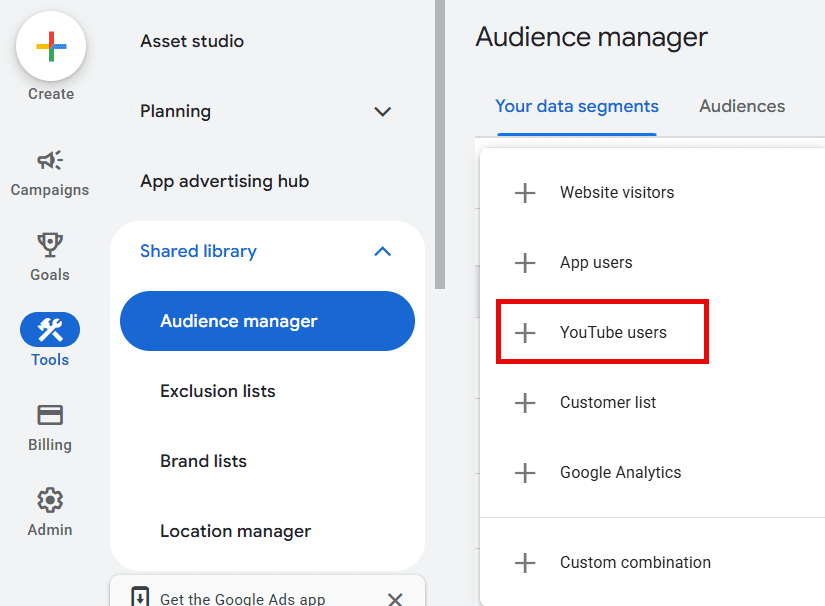
To set up YouTube remarketing lists, navigate to Tools > Shared Library > Audience Manager.
In Audience Manager, hit the “+” button to start segmenting your YouTube remarketing lists.
Screenshot by author, January 2026
From there, Google gives a multitude of options to start leveraging your YouTube video engagement for remarketing. These options include engagement from:
Views to videos.
Subscribes to the channel.
Visits to the channel.
Likes on videos.
Add videos to playlist.
Shares of videos.
Further, you’re able to segment further to make your remarketing lists as specific as possible:
Screenshot by author, January 2026
To leverage these newly created YouTube remarketing lists, try adding them to your existing Search campaigns as “Observation Only” at first to understand if these users are more likely to interact with your campaigns versus someone who hasn’t seen your YouTube videos.
Taking it a step further, you can create new Search campaigns that specifically target these users.
The benefit is that you can provide different messaging to these users who have already interacted with your brand.
2. Exclude Low Quality Or Irrelevant Website Traffic From Search Campaigns
If you’ve run any type of awareness campaign, you’ve likely seen a boost in traffic overall, including irrelevant webpages or low-quality visitors.
What do we constitute as low-quality or irrelevant webpages?
Any page that wouldn’t result in a purchase, such as:
Careers page.
Investors page.
Advertise with us page.
Customer Service page.
Users who stayed on the website for less than one second.
Excluding these types of website visitors from the get-go can help make your remarketing efforts more cost-efficient in the long run.
3. Create Lookalike Audiences From Your Own First-Party Data
Using Google’s affinity audiences or attributes that consider someone at the top of funnel for your product or service can be daunting, especially if you’re a small business or have a limited budget.
It may feel that you don’t have a lot of options to reach new users without paying dearly for it.
But, have you ever thought about using your most valuable assets to build awareness?
Leveraging your own first-party data to create Lookalike audiences gives you more leverage than third-party data, such as Google’s affinity audiences, to reach like-minded people of users who already love your brand.
To create an audience like this, there are a few options to consider:
Create a remarketing list of past purchasers using Google Ads or Google Analytics.
Upload a list of past purchasers to Google Ads.
Depending on the size of these lists, you’ll have the option to create a Lookalike audience and use it for either YouTube, Display, or Search.
The example below shows what a remarketing list based on a completed purchase URL looks like when created in Google Ads:
Screenshot by author, January 2026
I personally like to use Google Analytics when creating remarketing lists because you have many more segmentation or filtering options to be as specific as you need to be.
As a reminder, your site must be tagged and linked with either your Google Analytics property or Google Ads tag.
Consideration Stage Remarketing Strategies
These four remarketing strategies help move the user from the consideration to the purchase phase quicker using different bidding strategies and offers.
4. Increase Bids For Qualified Visitors Of Your Site Who Haven’t Made A Purchase
An easy way to leverage qualified users in your existing Search campaigns is to increase the bid on those users simply.
You don’t need to create separate campaigns for these users if you don’t want to. Segmenting these users and manipulating the bids on them keeps your account management under control.
To use this strategy, you’ll first need to create a remarketing list of users who haven’t made a purchase yet. You can use qualifications only to include people who:
Have made it to the cart checkout.
Visited a certain number of pages.
Spent a certain amount of time on site.
Visited certain categories/high-value product pages.
Once you have created those, it’s time to add them to an existing Search campaign and increase the bid.
What this means is that you’re willing to pay more for their click because they’ve already interacted with your brand in some way.
In your Search campaign, navigate to “Audiences” on the left-hand side.
In this example, I’m setting the audience at the campaign level, but you can set it at the ad group level as well.
Make sure to choose “Observation,” so you’re still able to capture other new users who are researching your brand.
Screenshot by author, January 2026
Once you’ve added your qualified remarketing list, it’s time to increase your bid adjustment.
Still, in the Audiences tab, you’ll see your remarketing list added.
In the columns, you’ll see “Bid Adjustment.” Choose the “pencil” icon to change the bid as you see fit. In this example, I’m going to increase the bid by 15%.
Screenshot by author, January 2026
Once you’ve implemented this change, be sure to continuously check back on the audience performance and determine if bids need to be changed based on performance.
5. Increase Bids For Users Who Have Completed A Micro-Conversion
This strategy is similar to the example above, except for the type of user you want to target.
If a user has completed a micro-conversion of any sort, they’re likely a high-qualified user to make a purchase.
What are examples of a micro-conversion? Depending on your product or service, these could include:
Signing up for emails or newsletters.
Downloading an ebook.
Signing up for a webinar.
Requesting a free sample.
These types of conversions show a user is active in research mode and seriously considering your brand.
By increasing the bid in your search campaigns for these users, you’re saying you’re willing to pay more for their clicks because they’re that much more likely to convert.
The process of setting this strategy up is the same as above, with the exception of creating a remarketing list based on the success of these micro-conversions.
6. Test Maximize Conversion Value With Cart Abandoners
This remarketing strategy would require you to create a separate campaign targeting only cart abandoners.
You may be asking, “Why not just use Maximize Conversion Value for everyone?”
If you’ve ever tested out the Maximize Conversion Value bidding strategy in Google Ads, you’ll know exactly why.
The reasons I don’t recommend using this for all campaigns include:
You can’t set any maximum ceiling values.
Not all users are ready to purchase.
By segmenting a search campaign specifically for cart abandoners, you can test this bidding strategy at a lower threshold – and with the most qualified users who are most likely to make a purchase.
Similar to the above examples, this strategy tells Google that you’re willing to be more flexible in how much you pay for someone to make a purchase.
And what better way to test this than with users who were almost ready to make that purchase?
To set this strategy into motion, you first need to create a remarketing list of “Cart Abandoners.”
This will look different for everyone, but it will likely be URL-based and able to be created in either Google Analytics or Google Ads.
After that list has been created, it’s time to set up your new search campaign.
This campaign can be a duplicate of any other search campaign. Just make sure to exclude your Cart Abandoner list from that existing campaign. We don’t want any crossover here!
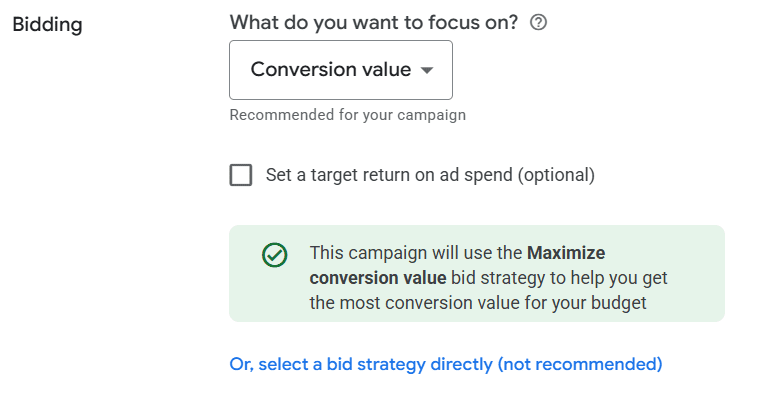
When creating the new campaign, this is where you’ll set the bid strategy to “Maximize Conversion Value” in the settings.
Screenshot by author, January 2026
Google Ads does give you the option to set a target return on ad spend, giving you somewhat control over campaign performance.
Depending on how much flexibility you have in your marketing budget, you can either leave that blank or set a target.
If you do set a target ROAS, make sure not to set it too high right away. Otherwise, the campaign won’t be able to effectively learn.
7. Create Offers Based On The User’s Interaction Timeline
Did you know you can create the same remarketing list of users, but segment them by the number of days?
Say you had a cart abandoner and wanted to move them toward purchase ASAP. You may be willing to give them a higher discount since the purchase was still new in their mind.
If they still haven’t purchased within three days, you may choose to still give them a discount, but not as high as the first offer.
After seven days, you still want them to keep your product top-of-mind, but that discount or offer may change again because they’ve waited so long.
So, how do you go about setting up this strategy?
First, you’ll want to create three different remarketing lists (for this example only).
Create cart abandoner audiences separated out by one day, three days, and seven days.
In Google Ads, you simply change the “membership duration” for each list. An example of where to change that during list creation is below:
Screenshot by author, January 2026
Once these lists are created, I recommend setting up different ad groups for each list. You’ll want different ad groups because the offer will be different for each list.
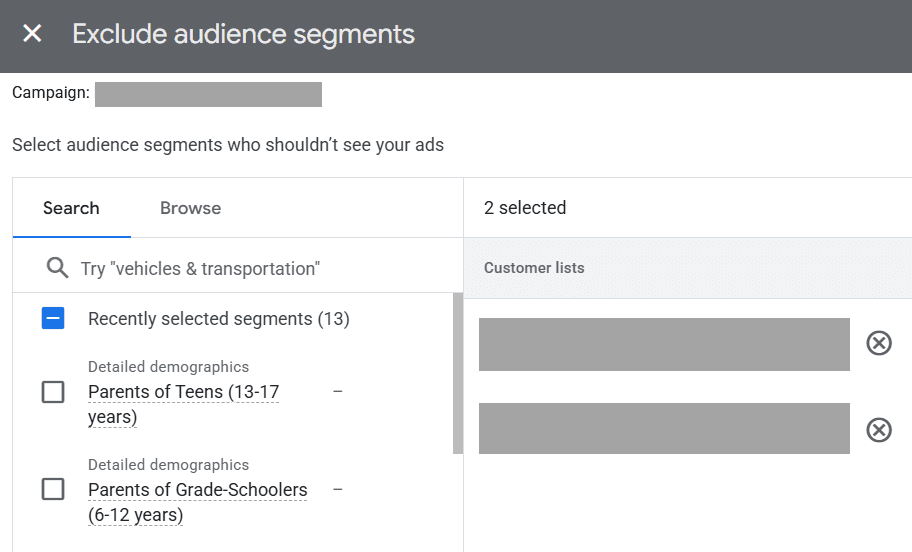
The last crucial piece of targeting cart abandoners is to exclude purchasers from your campaign. You will do this in the “Audiences” tab of your campaign and add your “Purchasers” remarketing list as an exclusion.
Post-Purchase Journey Remarketing Strategies
Once a user has made a purchase, that’s not necessarily the end of their journey!
These remarketing strategies enable past purchasers to become your most valuable asset and opportunities for repeat purchasers to become brand advocates.
8. Cross-Promote Other Products Based On A User’s Purchase Behavior
One of the best ways to create a repeat purchaser is to recommend complementing products based on a user’s purchase.
For example, say you’re a makeup brand, and a user just purchased their first tube of lipstick and mascara from you.
An effective remarketing strategy would include creating lists of past purchasers segmented by product category. This enables you to cross-promote other products and exclude product types they’ve just purchased.
In this example, you may create a remarketing list of users who have bought lipstick or mascara. You can then use that list to remarket products like foundation or eye shadow to encourage a repeat purchase.
These lists and strategies would work well in Dynamic Remarketing Ads or Google Shopping Ads. Because these products are much more visible, you’d want to use those campaign types to your advantage.
9. Exclude Past Purchasers To Maximize Spend Efficiency
As mentioned in strategy No. 7, you’ll want to exclude past purchasers from current acquisition campaigns to maximize spending efficiency.
An example of lazy remarketing is for a user to see an ad for a product they have already purchased.
Not only does that create a bad taste for the user, but that means you’re wasting valuable marketing money on people who have already purchased.
Now, there are certainly times when you’d not want to exclude past purchasers, especially if your product is a repeat purchase.
But, in these examples, your search campaigns are likely going after new users.
To exclude past purchasers, go to Audiences on the left-hand side of your campaign, then find the “Exclusions” table.
Screenshot by author, January 2026
10. Create Brand Advocates From Your Existing High-Value Customers
It’s true when they say that your customers are your best advocates. They have put their trust in you to deliver a high-value product or service that they have come to know and trust.
So, how do you turn them into advocates?
This remarketing strategy still includes utilizing that same past purchaser list. A few different options you could potentially offer past purchasers:
Create a referral program and give discounts to each person who purchases.
Offer discounts based on providing a positive public review.
Just because someone has purchased from you once does not mean they become a loyal customer. Sometimes it takes additional motivation to want to purchase again.
Loyalty or referral discounts are a great way to keep your existing customers coming back to you, as well as utilizing their own referral vehicles to generate new customers.
Creating referral programs is a low-cost and efficient multi-channel awareness strategy that is mutually beneficial for you – the brand and the customer.
Using Remarketing Lists With Intent, Not Just Coverage
Remarketing lists are most effective when they are built to support specific decisions inside your account. That includes how aggressively you bid, who you exclude, and where you shift budget based on user behavior.
Rather than treating remarketing as a single tactic, it works better as a system layered throughout the funnel. Lists tied to meaningful actions, like product views, cart activity, or prior purchases, tend to deliver far more value than broad, catch-all audiences.
As broader targeting becomes less reliable, remarketing offers a level of control that is increasingly hard to replace. When lists are thoughtfully segmented and actively used, they help PPC managers spend more efficiently and act with more confidence.
The real impact of remarketing does not come from how many lists you create. It comes from how intentionally those lists shape your bidding, targeting, and messaging decisions.
Choosing an SEO plugin like Yoast SEO impacts your online presence and future growth.
Yoast offers reliability with over 15 years of experience and millions of active installations, unlike newer competitors.
Innovations such as AI integration and a unified schema graph set Yoast apart from other plugins.
Yoast provides comprehensive support, education, and a multi-platform ecosystem tailored for long-term success.
Trust industry leaders like Microsoft and Spotify who use Yoast SEO to enhance their online visibility.
Estimated reading time: 11 minutes
Selecting an SEO plugin for your WordPress site is one of the most important decisions you’ll make for your online presence. It’s not just about installing software; it’s about choosing a long-term partner that will grow with your business, adapt to changing search algorithms, and support you in the age of AI. While the market offers several options, understanding what truly matters is key. Two of the most popular plugins in the market today are Yoast and Rank Math. Therefore, factors such as reliability, innovation, ecosystem, and trust help you make a choice that will serve your business for years to come.
This guide provides an in-depth comparison of the key differentiating factors between Yoast and Rank Math. We will understand why millions of websites worldwide have made Yoast their trusted comrade in the search business.
What really matters when choosing an SEO plugin
When evaluating WordPress SEO plugins, it’s easy to get distracted by feature lists and flashy interfaces. But experienced marketers, agencies, and business owners know that the best tools are defined by much more than what they promise on paper.
The questions that matter most:
Can you trust this plugin to work reliably as your business scales?
Will the company behind it still be innovating five years from now?
What happens when you need help before a critical deadline?
Does the plugin anticipate future SEO trends, or just react to them?
Is this a tool you install, or an ecosystem that supports your growth and development?
These aren’t trivial questions. Your SEO plugin touches essential pages on your site, influences the content you publish, and directly impacts your ability to be found by potential customers. Choosing poorly can lead to migration headaches, compatibility issues, and lost rankings. Choosing wisely means peace of mind, ongoing innovation, and a solid foundation to build upon.
Why legacy and proven trust matter in SEO plugins
Trust isn’t given. It’s earned. Yoast has defined the WordPress SEO landscape for over 15 years, with more than 13 million active installations and over 850 million downloads. This extensive legacy reflects a consistent track record of innovation, stability, and trust. Brands such as The Guardian, Microsoft, Spotify, and others rely on Yoast SEO as a foundation for their SEO strategies. This depth of experience is invaluable as SEO requires ongoing adaptation to algorithm changes and new technologies.
While Rank Math is an ambitious and feature-rich plugin with a growing user base, its presence in the market is relatively recent. For businesses seeking a proven solution with a long-standing heritage, Yoast’s established positioning offers confidence that the plugin will continue to evolve and provide reliable support for years to come.
Innovation that shapes the industry
Yoast has always been at the forefront of defining what modern SEO looks like. This isn’t a reactive development; it’s proactive innovation that anticipates where search is heading. Both plugins invest in innovation, but Yoast’s leadership in integrating AI and collaboration with Google sets it apart.
AI and Automation
We have introduced an industry-first AI-powered optimization toolset, including:
AI Generate: Creates multiple optimized title and meta description variations instantly, giving you professionally crafted options in seconds instead of struggling for the perfect phrasing.
AI Optimize: Scans your content and provides precise, actionable suggestions to improve keyphrase placement, sentence structure, and readability, teaching you SEO best practices while you write.
AI Summarize: Instantly generates bullet-point summaries of your content, making it more scannable and engaging for readers who skim before diving deep.
AI Brand Insights: This is where Yoast truly separates from the pack. As AI platforms like ChatGPT reshape how people find information, AI Brand Insights tracks how your brand appears in AI-generated responses. You can monitor your AI visibility, compare it against competitors, and ensure AI platforms accurately represent your business.
While Rank Math includes helpful automation features such as AI keyword suggestions, Yoast’s AI integration is more comprehensive and positioned as a core pillar of modern SEO strategy.
Schema markup that search engines can understand
While many plugins output disconnected structured data, Yoast SEO automatically generates a unified semantic graph on every page, linking your organization, content, authors, and products through a single JSON-LD structure that search engines and AI platforms can interpret consistently.
What makes this different
Automatic and invisible: Yoast outputs rich structured data representing your content, business, and relationships without requiring technical configuration. You focus on creating content; Yoast handles the complexity of structured data behind the scenes.
Single unified graph format: Instead of fragmented schema markup, Yoast creates one cohesive graph structure per page, connecting all entities with unique IDs. When plugins output conflicting schema, search engines can’t reliably interpret your site. Yoast’s unified graph ensures consistent interpretation at scale, whether Google, ChatGPT, or any API is reading your content.
Minimal configuration: Choose whether your site represents a person or organization; Yoast handles the rest automatically. Specialized blocks like FAQ and How-To map directly to correct schema types and link into the graph without additional setup.
Why this matters for AI-driven search
As AI platforms increasingly rely on structured data to understand websites, Yoast’s approach of creating a full semantic model of your site positions you for how search and discovery are evolving. The framework scales reliably from 100 to 100,000 pages while maintaining valid entity relationships. For developers, Yoast’s Schema API provides clean filters to extend or customize the graph without breaking its integrity.
Rank Math and other plugins support Schema markup, but Yoast’s unified graph framework represents a fundamentally different approach: automatic generation, consistent entity relationships, and architecture built for scale.
Continuous algorithm adaptation
Search engines make thousands of updates every year. Google alone rolls out over 5,000 algorithm changes annually. Now, as search engines evolve to incorporate AI tooling and platforms like ChatGPT reshape the way people discover information, the SEO landscape is changing faster than ever.
Most website owners can’t possibly track these shifts across traditional search AND emerging AI platforms, let alone understand their implications. Yoast’s dedicated SEO team monitors every significant update, from Google algorithm changes to how AI platforms index and reference content, and proactively adjusts the plugin to ensure your site stays optimized for both traditional and AI-driven discovery.
When you use Yoast, you’re not just getting software. You’re getting a team of experts working behind the scenes to keep your SEO strategy current across the entire discovery ecosystem.
An ecosystem built to support your SEO workflow
Yoast offers an ecosystem beyond the plugin. While Yoast SEO itself is a plugin, Yoast provides a comprehensive ecosystem to support your growth:
24/7 real human expert support available for Yoast SEO Premium users. It ensures that you get fast, knowledgeable help when you need it.
Yoast SEO Academy offers comprehensive SEO education, covering a range of topics from basics to advanced, with accompanying certifications.
A massive knowledge base and community for continuous learning and troubleshooting.
Multi-Platform Support
Your business doesn’t exist on WordPress alone. That’s why Yoast extends beyond a single platform:
Yoast SEO for Shopify: Brings Yoast’s trusted optimization to Shopify stores, helping ecommerce businesses improve product visibility and drive more sales.
Yoast WooCommerce SEO: Specifically designed for WooCommerce stores with automated product schema, smart breadcrumbs, and ecommerce-focused content analysis.
This ecosystem approach means Yoast grows with your business, supporting you across platforms as your needs evolve. Rank Math primarily focuses on the WordPress environment with a strong feature set, but lacks the same breadth of educational resources and multi-platform reach.
Stability and reliability at enterprise-grade scale
Flashy features attract attention. Rock-solid reliability keeps businesses running. Yoast rigorously tests every update for compatibility and performance across different WordPress versions and server configurations. This commitment ensures:
Backward compatibility: Updates maintain existing functionality without requiring extensive reconfiguration
WordPress core integration: Seamless compatibility with new WordPress releases
Performance at any scale: Optimized for sites ranging from personal blogs to high-traffic enterprise installations
With over 15 years in the market and more than 13 million active installations, Yoast has proven its reliability across millions of sites, hosting environments, and various use cases.
Rigorous testing and quality assurance
Yoast maintains strict development standards that prioritize stability above rapid feature deployment. Every update undergoes extensive testing across the latest WordPress versions, most PHP configurations, and common plugin combinations before release.
This disciplined approach means Yoast users rarely experience plugin conflicts, broken updates, or compatibility issues that plague WordPress sites using less mature plugins.
Backward compatibility
Major updates usually shake the functionality of plugins and software. However, Yoast maintains backward compatibility, ensuring that updating your plugin doesn’t suddenly break critical SEO features or require extensive reconfiguration.
WordPress core compatibility
As a plugin deeply integrated with WordPress development, Yoast maintains close relationships with the WordPress core team. This ensures seamless compatibility with new WordPress releases, often supporting new versions on launch day while other plugins scramble to catch up.
Performance optimized for scale
Whether you run a small blog or an enterprise site with millions of pages, Yoast performs efficiently without slowing down your site. The plugin is engineered for performance, using best practices for database queries, resource loading, and caching integration.
Enterprises trust Yoast precisely because it scales reliably. Small teams appreciate that the same plugin powering major corporations works flawlessly on their modest sites, too.
Ready to make a difference with Yoast SEO Premium?
Explore Yoast SEO Premium and the Yoast SEO AI+ package to discover advanced tools built for serious marketers.
Where Yoast takes the lead
While comprehensive feature-by-feature comparisons can be overwhelming, certain capabilities distinguish truly professional SEO plugins from the rest. Here’s where Yoast’s innovation and depth shine through.
AI-powered optimization
Yoast leads the industry in AI integration for SEO optimization:
AI Brand Insights for tracking your presence in AI search platforms
No competing plugin offers this comprehensive AI integration designed specifically for modern SEO workflows.
Schema Graph
Yoast’s Schema implementation creates a complete structured data graph connecting your organization, content, authors, and brand identity. This goes far beyond basic Schema markup, providing search engines with rich context that improves your chances of appearing in knowledge panels, rich results, and AI-generated answers.
Smart internal linking
Yoast SEO Premium includes intelligent internal linking suggestions that analyze your content and recommend relevant pages to link to. This isn’t just a list of posts; it’s context-aware suggestions that strengthen your site architecture and improve crawlability.
Advanced redirect manager
Managing redirects is critical when restructuring sites, changing URLs, or handling broken links. Yoast’s redirect manager offers:
Duplicate content prevention for product variations
Comprehensive crawl settings
Advanced users appreciate Yoast’s granular control over crawl optimization, robots.txt management, and indexation settings, giving technical SEO professionals the precision they need without overwhelming casual users.
Bot blocker for LLM training control
As AI companies scrape the web to train large language models, Yoast gives you control over whether your content is used for AI training via Bot Blocker. This cutting-edge feature addresses a concern most plugins haven’t even acknowledged yet.
Recognized and trusted by industry leaders
The company you keep says a lot about who you are. When the world’s most recognized brands trust Yoast to power their WordPress SEO, it’s a powerful testament to the quality, reliability, and effectiveness of our solutions.
Global brands* using Yoast include:
The Guardian
Microsoft
Spotify
Rolling Stones
Taylor Swift
Facebook
eBay
These organizations have teams of developers, SEO experts, and decision-makers who have evaluated every available option. They chose Yoast, not because it was the newest, but because it was the best.
*Disclaimer: Based on third party data sources.
Industry Recognition:
Global Search Awards Finalist: Recognized among the world’s leading SEO solutions
Yoast isn’t just popular, it’s the default choice for WordPress SEO professionals worldwide.
Understanding what you really need
Before making your final decision, consider what matters most for your specific situation:
If you value reliability and stability: Choose a plugin with a proven track record of consistent updates, compatibility, and performance. Longevity matters because it signals the company will be around to support you for years to come.
If innovation matters to your strategy: Look for a plugin that anticipates SEO trends rather than reacting to them. AI integration, Schema excellence, and algorithm adaptation separate forward-thinking tools from those playing catch-up.
If support is critical: Consider whether you need community forums or access to real SEO experts who can troubleshoot complex issues quickly. When your business relies on organic traffic, response time is crucial.
If education is important: Some plugins provide features; others teach you how to use them effectively. Comprehensive training resources and certifications demonstrate a commitment to your success.
If you’re building for the long term: Think about whether this plugin will grow with your business. Multi-platform support, scalability, and an ecosystem approach ensure that your investment pays dividends for years to come.
Make the choice that drives real growth
Choosing an SEO plugin isn’t about finding the tool with the longest feature list; it’s about finding the one that best suits your needs. It’s about partnering with a company that shares your commitment to long-term growth, innovation, and excellence.
Over 13 million websites trust Yoast SEO because it delivers on these promises:
Reliability: 15+ years of consistent innovation and stability
Trust: Used by global brands and industry leaders
Innovation: Leading the industry in AI integration and Schema excellence
Support: 24/7 access to real SEO professionals
Education: Comprehensive training through Yoast Academy
Ecosystem: Multi-platform support and continuous learning resources
Stability: Enterprise-grade performance at any scale
When you choose Yoast, you’re not just installing a plugin; you’re joining millions of websites that have made the strategic decision to partner with the most trusted name in WordPress SEO.
A smarter analysis in Yoast SEO Premium
Yoast SEO Premium has a smart content analysis that helps you take your content to the next level!
Aman Soni
Yoast has been synonymous with the word digital marketing since the beginning of everything SEO. It has been an ever-present, like an omnipotent, all-knowing SEO plugin, the first one I ever used. Now, I am delighted and also in awe that I work for the very brand which I so revered! I work, read, write, swim, hike and make things happen.
An advisory was published about a vulnerability discovered in the Membership Plugin By StellarWP which exposes sensitive Stripe payment setup data on WordPress sites using the plugin. The flaw enables unauthenticated attackers to launch attacks and is rated 8.2 (High).
Membership Plugin By StellarWP
The Membership Plugin – Restrict Content By StellarWP is used by WordPress sites to manage paid and private content. It enables site owners to restrict access to pages, posts, or other resources so that only logged-in users or paying members can view them and manage what non-paying site visitors can see. The plugin is commonly deployed on membership and subscription-based sites.
Vulnerable to Unauthenticated Attackers
The Wordfence advisory states that the vulnerability can be exploited by unauthenticated attackers, meaning no login or WordPress user account is required to launch an attack. User permission roles do not factor into whether the issue can be triggered, and that’s what makes this particular vulnerability more dangerous because it’s easier to trigger.
What the Vulnerability Is
The issue stems from missing security checks related to Stripe payment handling. Specifically, the plugin failed to properly protect Stripe SetupIntent data.
A Stripe SetupIntent is used during checkout to collect and save a customer’s payment method for future use. Each SetupIntent includes a client_secret value that is intended to be shared during a checkout or account setup flow.
“The Membership Plugin – Restrict Content plugin for WordPress is vulnerable to Missing Authentication in all versions up to, and including, 3.2.16 via the ‘rcp_stripe_create_setup_intent_for_saved_card’ function due to missing capability check.
Additionally, the plugin does not check a user-controlled key, which makes it possible for unauthenticated attackers to leak Stripe SetupIntent client_secret values for any membership.”
According to Stripe’s official documentation, the Setup Intents API is used to set up a payment method for future charges without creating an immediate payment. A SetupIntent includes a client_secret. Stripe’s documentation states that client_secret values should not be stored, logged, or exposed to anyone other than the intended customer.
This is how Stripe’s documentation explains what the purpose is for the Setup Intents API:
“Use the Setup Intents API to set up a payment method for future payments. It’s similar to a payment, but no charge is created.
The goal is to have payment credentials saved and optimized for future payments, meaning the payment method is configured correctly for any scenario. When setting up a card, for example, it may be necessary to authenticate the customer or check the card’s validity with the customer’s bank. Stripe updates the SetupIntent object throughout that process.”
Stripe documentation also explains that client_secret values are used client-side to complete payment-related actions and are intended to be passed securely from the server to the browser. Stripe states that these values should not be stored, logged, or exposed to anyone other than the relevant customer.
This is how Stripe’s documentation explains the client_secret value:
“client_secret The client secret of this Customer Session. Used on the client to set up secure access to the given customer.
The client secret can be used to provide access to customer from your frontend. It should not be stored, logged, or exposed to anyone other than the relevant customer. Make sure that you have TLS enabled on any page that includes the client secret.”
Because the plugin did not enforce the appropriate protections, Stripe SetupIntent client_secret values could be exposed.
What this means in real life is that Stripe payment setup data associated with memberships was accessible beyond its intended scope.
Affected Versions
The vulnerability affects all versions of the plugin up to and including version 3.2.16. Wordfence assigned the issue a CVSS score of 8.2, reflecting the sensitivity of the exposed data and the fact that no authentication is required to trigger the issue.
A score in this range indicates a high-severity vulnerability that can be exploited remotely without special access, increasing the importance of timely updates for sites that rely on the plugin for managing paid memberships or restricted content.
Patch Availability
The plugin has been updated with a patch and is available now. The issue was fixed in version 3.2.17 of the plugin. The update adds missing nonce and permission checks related to Stripe payment handling, addressing the conditions that allowed SetupIntent client_secret values to be exposed. A nonce is a temporary security token that ensures a specific action on a WordPress website was intentionally requested by the user and not by a malicious attacker.
The official Membership Plugin changelog responsibly discloses the updates:
“3.2.17 Security: Added nonce and permission checks for adding Stripe payment methods. 3.2.16 Security: Improved escaping and sanitization for [restrict] and [register_form] shortcode attributes.”
What Site Owners Should Do
Sites using Membership Plugin – Restrict Content should update to version 3.2.17 or newer.
Failure to update the plugin will leave the Stripe SetupIntent client_secret data exposed to unauthenticated attackers.