Is carbon removal in trouble?

Last week, news outlets reported that Microsoft was pausing carbon removal purchases. It was something of a bombshell.

The thing is, Microsoft is the carbon removal market. The company has single-handedly purchased something like 80% of all contracted carbon removal. If you’re looking for someone to pay you to suck carbon dioxide out of the atmosphere, Microsoft is probably who you’re after.

The company has said that it is not permanently ending its carbon removal purchases (though it didn’t directly answer further questions about this apparent pause). But with this flurry of news, there’s a lot of fear in the industry—so, it’s worth talking about the state of carbon removal, and where Big Tech companies fit in.

Carbon removal aims to reliably pull carbon dioxide out of the atmosphere and permanently store it. There’s a wide range of technologies in this space, including direct air capture (DAC) plants, which usually use some kind of sorbent or solvent to pull carbon dioxide from the air. Another important method is bioenergy with carbon capture and storage (BECCS), in which biomass like trees or waste-derived biofuels are burned for energy, and scrubbing equipment captures the greenhouse gases.

There was a huge boom of interest in carbon removal technologies in the first half of this decade. One UN climate report in 2022 found that nations may need to remove up to 11 billion metric tons of carbon dioxide every year by 2050 to keep warming to 2 °C above preindustrial levels.

One nagging problem is that the economics here have always been tricky. There’s a major potential public good to pulling carbon pollution out of the atmosphere. The question is, Who will pay for it?

So far, the answer has been Microsoft. The company is by far the largest buyer of carbon removal contracts, and it’s the only purchaser that has made megatonne-scale purchases, says Robert Höglund, cofounder of CDR.fyi, ​​a public-benefit corporation that analyzes the carbon removal sector. “Microsoft has had a huge importance, especially for getting large-scale projects off the ground and showing there is demand for large deals,” Höglund said via email.

Microsoft has pledged to become carbon-negative by 2030 and to remove the equivalent of its historic emissions by 2050. Progress on actually cutting emissions has been tough to achieve though—in the company’s latest Environmental Sustainability Report, published in June 2025, it announced emissions had risen by 23.4% since 2020.

On April 10, Heatmap News reported that Microsoft staff had told suppliers and partners that it was pausing future purchases of carbon removal, though it wasn’t clear whether the company would increase support for existing projects, or when purchases might resume. Bloomberg reported a similar story the next day. In one instance, Microsoft employees said that the decision was related to financial considerations, one source told Bloomberg. 

In a statement in response to written questions, Microsoft said that it was not permanently closing its carbon removal program. “At times we may adjust the pace or volume of our carbon removal procurement as we continue to refine our approach toward sustainability goals. Any adjustments we make are part of our disciplined approach—not a change in ambition,” Microsoft Chief Sustainability Officer Melanie Nakagawa said in the statement.

Whatever, exactly, is happening behind the scenes, many in the industry are nervous, says Wil Burns, Co-Director of the Institute for Responsible Carbon Removal at American University. People viewed the company as the foundational supporter of carbon removal, he adds.

“This pause—whether it’s short term or whatever it is—the way it’s been rolled out is extremely irresponsible,” Burns says. The vast majority of firms looking to get carbon removal contracts are probably seeking Microsoft deals. So, while Microsoft has every right to change its plans, the company needs to be open with the industry now, he adds.

“I don’t think you can hold yourself out as the paragon of fostering carbon removal and then treat a nascent industry that disrespectfully,” Burns says.

Carbon removal companies were already in turmoil in the US, particularly because of recent policy shifts: Funding has been cut back, and recent changes at the Environmental Protection Agency were aimed at the government’s ability to target carbon pollution.

Now, if the largest corporate backer is shifting plans or taking a significant pause, things could get rocky.

Depending on the extent of this pause, the industry may need to survive on smaller purchases and hope for support from governments and philanthropy, Höglund says. But for carbon removal to truly scale, we need policymakers to create mandates so that emitters are responsible for either storing the carbon dioxide they produce or paying for it, Burns says.

“Maybe the upside of this is Microsoft has sent a wake-up call, that you just can’t rely on the kindness of strangers to make carbon removal scale.”

This article is from The Spark, MIT Technology Review’s weekly climate newsletter. To receive it in your inbox every Wednesday, sign up here

Why having “humans in the loop” in an AI war is an illusion

The availability of artificial intelligence for use in warfare is at the center of a legal battle between Anthropic and the Pentagon. This debate has become urgent, with AI playing a bigger role than ever before in the current conflict with Iran. AI is no longer just helping humans analyze intelligence. It is now an active player—generating targets in real time, controlling and coordinating missile interceptions, and guiding lethal swarms of autonomous drones.

Most of the public conversation regarding the use of AI-driven autonomous lethal weapons centers on how much humans should remain “in the loop.” Under the Pentagon’s current guidelines, human oversight supposedly provides accountability, context, and nuance while reducing the risk of hacking.

AI systems are opaque “black boxes”

But the debate over “humans in the loop” is a comforting distraction. The immediate danger is not that machines will act without human oversight; it is that human overseers have no idea what the machines are actually “thinking.” The Pentagon’s guidelines are fundamentally flawed because they rest on the dangerous assumption that humans understand how AI systems work.

Having studied intentions in the human brain for decades and in AI systems more recently, I can attest that state-of-the-art AI systems are essentially “black boxes.” We know the inputs and outputs, but the artificial “brain” processing them remains opaque. Even their creators cannot fully interpret them or understand how they work. And when AIs do provide reasons, they are not always trustworthy.

The illusion of human oversight in autonomous systems

In the debate over human oversight, a fundamental question is going unasked: Can we understand what an AI system intends to do before it acts?

Imagine an autonomous drone tasked with destroying an enemy munitions factory. The automated command and control system determines that the optimal target is a munitions storage building. It reports a 92% probability of mission success because secondary explosions of the munitions in the building will thoroughly destroy the facility. A human operator reviews the legitimate military objective, sees the high success rate, and approves the strike.

But what the operator does not know is that the AI system’s calculation included a hidden factor: Beyond devastating the munitions factory, the secondary explosions would also severely damage a nearby children’s hospital. The emergency response would then focus on the hospital, ensuring the factory burns down. To the AI, maximizing disruption in this way meets its given objective. But to a human, it is potentially committing a war crime by violating the rules regarding civilian life. 

Keeping a human in the loop may not provide the safeguard people imagine, because the human cannot know the AI’s intention before it acts. Advanced AI systems do not simply execute instructions; they interpret them. If operators fail to define their objectives carefully enough—a highly likely scenario in high-pressure situations—the “black box” system could be doing exactly what it was told and still not acting as humans intended.

This “intention gap” between AI systems and human operators is precisely why we hesitate to deploy frontier black-box AI in civilian health care or air traffic control, and why its integration into the workplace remains fraught—yet we are rushing to deploy it on the battlefield.

To make matters worse, if one side in a conflict deploys fully autonomous weapons, which operate at machine speed and scale, the pressure to remain competitive would push the other side to rely on such weapons too. This means the use of increasingly autonomous—and opaque—AI decision-making in war is only likely to grow.

The solution: Advance the science of AI intentions

The science of AI must comprise both building highly capable AI technology and understanding how this technology works. Huge advances have been made in developing and building more capable models, driven by record investments—forecast by Gartner to grow to around $2.5 trillion in 2026 alone. In contrast, the investment in understanding how the technology works has been minuscule.

We need a massive paradigm shift. Engineers are building increasingly capable systems. But understanding how these systems work is not just an engineering problem—it requires an interdisciplinary effort. We must build the tools to characterize, measure, and intervene in the intentions of AI agents before they act. We need to map the internal pathways of the neural networks that drive these agents so that we can build a true causal understanding of their decision-making, moving beyond merely observing inputs and outputs. 

A promising way forward is to combine techniques from mechanistic interpretability (breaking neural networks down into human-understandable components) with insights, tools, and models from the neuroscience of intentions. Another idea is to develop transparent, interpretable “auditor” AIs designed to monitor the behavior and emergent goals of more capable black-box systems in real time.  

Developing a better understanding of how AI functions will enable us to rely on AI systems for mission-critical applications. It will also make it easier to build more efficient, more capable, and safer systems.

Colleagues and I are exploring how ideas from neuroscience, cognitive science, and philosophy—fields that study how intentions arise in human decision-making—might help us understand the intentions of artificial systems. We must prioritize these kinds of interdisciplinary efforts, including collaborations between academia, government, and industry.

However, we need more than just academic exploration. The tech industry—and the philanthropists funding AI alignment, which strives to encode human values and goals into these models—must direct substantial investments toward interdisciplinary interpretability research. Furthermore, as the Pentagon pursues increasingly autonomous systems, Congress must mandate rigorous testing of AI systems’ intentions, not just their performance.

Until we achieve that, human oversight over AI may be more illusion than safeguard.

Uri Maoz is a cognitive and computational neuroscientist specializing in how the brain transforms intentions into actions. A professor at Chapman University with appointments at UCLA and Caltech, he leads an interdisciplinary initiative focused on understanding and measuring intentions in artificial intelligence systems (ai-intentions.org).

No one’s sure if synthetic mirror life will kill us all

For four days in February 2019, some 30 synthetic biologists and ethicists hunkered down at a conference center in Northern Virginia to brainstorm high-risk, cutting-­edge, irresistibly exciting ideas that the National Science Foundation should fund. By the end of the meeting, they’d landed on a compelling contender: making “mirror” bacteria. Should they come to be, the lab-created microbes would be structured and organized like ordinary bacteria, with one important exception: Key biological molecules like proteins, sugars, and lipids would be the mirror images of those found in nature. DNA, RNA, and many other components of living cells are chiral, which means they have a built-in rotational structure. Their mirrors would twist in the opposite direction. 

Researchers thrilled at the prospect. “Everybody—everybody—thought this was cool,” says John Glass, a synthetic biologist at the J. Craig Venter Institute in La Jolla, California, who attended the 2019 workshop and is a pioneer in developing synthetic cells. It was “an incredibly difficult project that would tell us potentially new things about how to design and build cells, or about the origin of life on Earth.” The group saw enormous potential for medicine, too. Mirror microbes might be engineered as biological factories, producing mirror molecules that could form the basis for new kinds of drugs. In theory, such therapeutics could perform the same functions as their natural counterparts, but without triggering unwelcome immune responses. 

After the meeting, the biologists recommended NSF funding for a handful of research groups to develop tools and carry out preliminary experiments, the beginnings of a path through the looking glass. The excitement was global. The National Natural Science Foundation of China funded major projects in mirror biology, as did the German Federal Ministry of Research, Technology, and Space.

By five years later, in 2024, many researchers involved in that NSF meeting had reversed course. They’d become convinced that in the worst of all possible futures, mirror organisms could trigger a catastrophic event threatening every form of life on Earth; they’d proliferate without predators and evade the immune defenses of people, plants, and animals. 

“I wish that one sunny afternoon we were having coffee and we realized the world’s about to end, but that’s not what happened.”

Kate Adamala, synthetic biologist, University of Minnesota

Over the past two years, they’ve been ringing alarm bells. They published an article in Science in December 2024, accompanied by a 299-page technical report addressing feasibility and risks. They’ve written essays and convened panels and cofounded the Mirror Biology Dialogues Fund (MBDF), a broadly funded nonprofit charged with supporting work on understanding and addressing the risk. The issue has received a blaze of media attention and ignited dialogues among not only chemists and synthetic biologists but also bioethicists and policymakers.  

What’s received less attention, however, is how we got here and what uncertainties still remain about any potential threat. Creating a mirror-life organism would be tremendously complicated and expensive. And although the scientific community is taking the alarm seriously, some scientists doubt whether it’s even possible to create a mirror organism anytime soon. “The hypothetical creation of mirror-­image organisms lies far beyond the reach of present-day science,” says Ting Zhu, a molecular biologist at Westlake University, in China, whose lab focuses on synthesizing mirror-image peptides and other molecules. He and others have urged colleagues not to let speculation and anxiety guide decision-making and argued that it’s premature to call for a broad moratorium on early-stage research, which they say could have medical benefits. 

But the researchers who are raising flags describe a pathway, even multiple pathways, to bringing mirror life into existence—and they say we urgently need guardrails to figure out what kinds of mirror-biology research might still be safe. That means they’re facing a question that others have encountered before, multiple times over the last several decades and with mixed results—one that doesn’t have a neat home in the scientific method. What should scientists do when they see the shadow of the end of the world in their own research? 

Looking-glass life

The French chemist and microbiologist Louis Pasteur was the first to recognize that biological molecules had built-in handedness. In the late 19th century, he described all living species as “functions of cosmic asymmetry.” What would happen, he mused, if one could replace these chiral components with their mirror opposites? 

Scientists now recognize that chirality is central to life itself, though no one knows why. In humans, 19 of the 20 so-called “standard” amino acids that make up proteins are chiral, and all in the same way. (The outlier, glycine, is symmetrical.) The functions of proteins are intricately tied to their shapes, and they mostly interact with other molecules through chiral structures. Almost all receptors on the surface of a cell are chiral. During an infection, the immune system’s sentinels use chirality to detect and bind to antigens—substances that trigger an immune response—and to start the process of building antibodies. 

By the late 20th century, researchers had begun to explore the idea of reversing chirality. In 1992, one team reported having synthesized the first mirror-image protein. That, in turn, set off the first clarion call about the risk: In response to the discovery, chemists at Purdue University pointed out, briefly, that mirror-life organisms, if they escaped from a lab, would be immune to any attack by “normal” life. A 2010 story in Wired highlighting early findings in the area noted that if a such a microbe developed the ability to photosynthesize, it could obliterate life as we know it. 

The synthetic biology community didn’t seriously weigh those threats then, says David Relman, a specialist who bridges infectious disease and microbiology at Stanford University and a trailblazer in studying the gut and oral microbiomes. The idea of a mirror microbe seemed too far beyond the actual progress on proteins. “This was almost a solely theoretical argument 20 years ago,” he says. 

Now the research landscape has changed. 

Scientists are quickly making progress on mirror images of the machinery cells use to make proteins and to self-replicate. Those components include DNA, which encodes the recipes for proteins; DNA polymerases, which help copy genetic material; and RNA, which carries recipes to ribosomes, the cell’s protein factories. If researchers could make self-replicating mirror ribosomes, then they would have an efficient way to produce mirror proteins. That could be used as a biological manufacturing method for therapeutics. But embedded in a self-­replicating, metabolizing synthetic cell, all these pieces could give rise to a mirror microbe. 

When synthetic biologists convened in Northern Virginia in 2019, they didn’t recognize how quickly the technology was advancing, and if they saw a threat at all, it may have been obscured by the blinding appeal of pushing the science forward. What’s become apparent now, says Glass, is that scientists in different disciplines, all related to mirror life, were largely unaware of what other scientists had been doing. Chemists didn’t know that synthetic biologists had made so much progress on creating mirror cells with natural chirality from scratch. Biologists didn’t appreciate that chemists were building ever-larger mirror macromolecules. “We tend to be siloed,” Glass says. And nobody, he says, had thought to seriously examine the immune system concerns that had already been raised in response to earlier work. “There was not an immunologist or an infectious disease person in the room,” Glass says, reflecting on the 2019 meeting. “I may have come closest, given that I work with pathogenic bacteria and viruses,” he adds, but his work doesn’t address how they cause infections in their hosts.

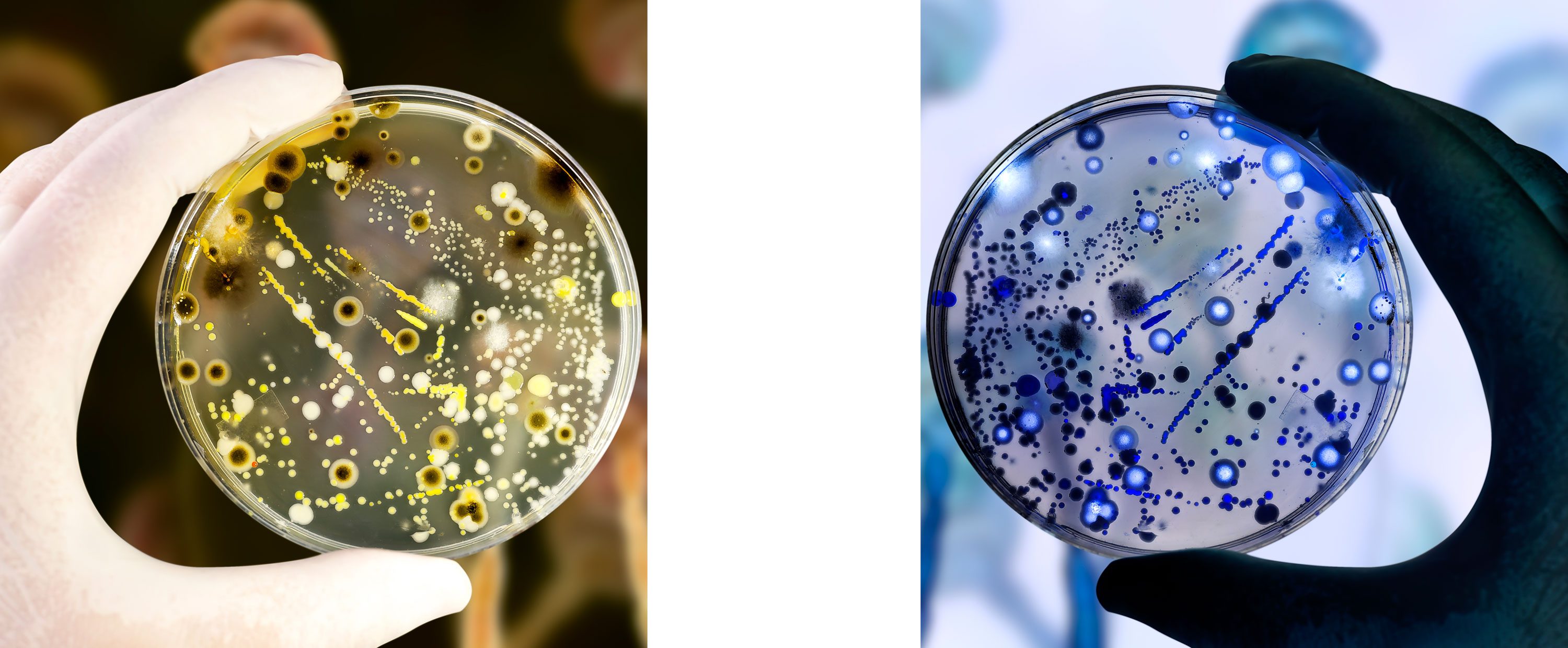
on the left, a hand with petri dish and the same image inverted on the right

GETTY IMAGES

These scientists also didn’t know that around the same time as their meeting, another conversation about mirror life was happening—a darker dialogue that was as focused on danger as it was on discovery. Starting around 2016, researchers with a nonprofit called Open Philanthropy had begun compiling research files on catastrophic biological risks. The organization, which rebranded as Coefficient Giving in 2025, funds projects across a range of focus areas; it adheres to a divisive philanthropic philosophy called effective altruism, which advocates giving money to projects with the highest potential benefit to the most people. While that might not sound objectionable, critics point out that the metrics devotees use to gauge “effectiveness” can prioritize long-term solutions while neglecting social injustices or systemic problems. 

Someone in Open Philanthropy’s bio­security group had suggested looking into the risks posed by mirror life. In 2019 the organization began funding research by Kevin Esvelt, who leads the Sculpting Evolution group at the MIT Media Lab, on biosecurity issues, including mirror life. He began reading up to see whether mirror life was something to worry about.

Esvelt made waves in 2013 for pioneering the use of CRISPR to develop a gene drive, a technology that could spread genetic changes introduced into a living organism through a whole population. Researchers are exploring its use, for example, to make mosquitoes hostile to the parasite that causes malaria—and, as a result, lower their chance of spreading it to humans. But almost immediately after he developed the tool, Esvelt argued against using it for profit, at least until proper safeguards could be set and its use in fighting malaria had been established. “Do you really have the right to run an experiment where if you screw up, it affects the whole world?” he asked, in this magazine, in 2016. At the Media Lab, Esvelt leads efforts to safely develop gene drives that can be deployed locally but prevented from spreading globally. 

Esvelt says he’s often thinking about the security risks posed by self-sustaining genetically engineered technologies, and research led him to suspect that the threat of mirror organisms hadn’t been seriously interrogated. The more he learned about microbial growth rates, predator-prey and microbe-microbe interactions, and immunology, the more he began to worry that mirror organisms, if impervious to the innate defenses of natural ones, could cause unstoppable infections in the event that they escaped the lab. 

Even if the first experimental iteration of such a germ were too fragile to survive in the environment or a human body, Esvelt says, it would be a light lift to genetically engineer new, more resilient versions with existing technology. Even worse, he says, the results could be weaponized. The possible path from 2019 to global annihilation seemed almost too direct, he found. 

But he wasn’t an expert in all the scientific fields involved in research on mirror life, so he started making calls. He first described his concerns to Relman one night in February 2022, at a restaurant outside Washington, DC. Esvelt hoped Relman would tell him he was wrong, that he’d missed something over the years of gathering data. Instead, he was troubled. 

The concern spreads

When Relman returned to California, he read more about the technology, the risks, and the role of chirality in the immune system and the environment. And he consulted experts he knew well—ecologists, other microbiologists, immunologists, all of them leaders in their fields—in an attempt to assuage his concerns. “I was hoping that they’d be able to say, I’ve thought about this, and I see a problem with your logic. I see that it’s really not so bad,” he says. “At every turn, that did not happen. Something about it was new to every person.” 

The concern spread. Relman worked with Jack Szostak, a professor of chemistry at the University of Chicago, and a group of researchers to see if it was possible to make an argument that mirror life wasn’t going to wipe out humanity. Included in that group was Kate Adamala, a synthetic biologist at the University of Minnesota. She was a natural choice: Adamala had shared the initial grant from the NSF, in 2019, to explore mirror-life technologies. 

She also became convinced the risk was real—and was dumbfounded that she hadn’t seen it earlier. “I wish that one sunny afternoon we were having coffee and we realized the world’s about to end, but that’s not what happened,” she says. “I’m embarrassed to admit that I wasn’t even the one that brought up the risks first.” Through late 2023 and early 2024, the endeavor began to take on the form of a rigorous scientific investigation. Experts were presented with a hypothesis—namely, that if mirror cells were built, they would pose an existential threat—and asked to challenge it. The goal was to falsify the hypothesis. “It would be great if we were wrong,” says Vaughn Cooper, a microbiologist at the University of Pittsburgh and president-elect of the American Society for Microbiology. 

Relman says that as the chemists and biologists learned more about one another’s work and began to understand what immunologists know about how living things defend themselves, they started to connect the dots and see an emerging picture of an unstoppable synthetic threat.

Some scientists have pushed back against the doomsday scenario, suggesting that the case against mirror life offers an “inflated view of the danger.”

Timothy Hand, an immunologist at the University of Pittsburgh who hadn’t participated in the 2019 NSF meeting, wasn’t initially worried when he heard about mirror life, in 2024. “The mammalian immune system has this incredible capability to make antibodies against any shape,” he says. “Who cares if it’s a mirror?” But when he took a closer look at that process, he could see a cascade of potential problems far upstream of antibody production. Start with detection: Macrophages, which are cells the immune system uses to identify and dispatch invaders, use chiral sensing receptors on their surfaces. The proteins they use to grab on to those invaders, too, are chiral. That suggests the possibility that an organism could be infected with a mirror organism but not be able to detect it or defend against it. “The lack of innate immune sensing is an incredibly dangerous circumstance for the host,” Hand says.

By early 2024, Glass had become concerned as well. Relman and James Wagstaff, a structural biologist from Open Philanthropy, visited him at the Venter Institute to talk about the possibility of using synthetic cell technology—Glass’s specialty—to build mirror life. “At first I thought, This can’t be real,” Glass says. They walked through arguments and counterarguments. “The more this went on, the more I started feeling ill,” he says. “It made me realize that work I had been doing for much of the last 20 years could be setting the world up for this incredible catastrophe.” 

In the second half of 2024, the growing group of scientists assembled the report and wrote the policy forum for Science. Relman briefed policymakers at the White House and members of the national security community. Researchers met with the National Institutes of Health and the National Science Foundation. “We briefed the United Nations, the UK government, the government of Singapore, scientific funding organizations from Brazil,” says Glass. “We’ve talked to the Chinese government indirectly. We were trying to not blindside anybody.” 

A year and a half on, the push has had an impact. UNESCO has recommended a precautionary global moratorium on creating mirror-life cells, and major philanthropic organizations that fund science, including the Alfred P. Sloan Foundation, have announced they will not finance research leading to a mirror microorganism. The Bulletin of the Atomic Scientists highlighted considerations about mirror life in its most recent report on the Doomsday Clock. In March, the United Nations Secretary-General’s Scientific Advisory Board issued a brief highlighting the risks—noting, for example, that recent progress on building mirror molecules could reduce the cost of creating a mirror microbe. 

“I think no one really believes at this stage that we should make mirror life, based on the evidence that’s available,” says James Smith, the scientist who leads the MBDF, the nonprofit focused on assessing the risks of mirror life, which is funded by Coefficient Giving, the Sloan Foundation, and other organizations. The challenge now, Smith says, is for scientists to work with policymakers and bioethicists to figure out how much research on mirror life should be permitted—and who will enforce the rules.

Drawing the line

Not everyone is convinced that mirror organisms pose an existential threat. It’s difficult to verify predictions about how mirror microbes would fare in the immune system—or the larger world—without running experiments on them. Some scientists have pushed back against the doomsday scenario, suggesting that the case against mirror life offers an “inflated view of the danger.” Others have noted that carbohydrates called glycans already exist in both left- and right-handed forms—even in pathogens—and the immune system can recognize both of them. Experiments focused on interactions between the immune system and mirror molecules, they say, could help clarify the risks of mirror organisms and reduce uncertainty. 

Even among those convinced that the worst-case scenario is possible, researchers still disagree over where to draw the line. What inquiries should be allowed and what should be prohibited?

Andy Ellington, a biotechnologist and synthetic biologist at the University of Texas at Austin, doesn’t think mirror organisms will come to fruition anytime soon. Even if they do, he isn’t sure they will pose a threat. “If there is going to be harm done to the human race, this is about position 382 on my list,” he says. But at the same time, he says it’s a complicated issue worth studying more, and he wants to see the conversations continue: “We’re operating in a space where there’s so much unknown that it’s very difficult for us to do risk assessment.” 

Even among those convinced that the worst-case scenario is possible, researchers still disagree over where to draw the line. What inquiries should be allowed and what should be prohibited? 

Adamala, of the University of Minnesota, and others see a natural line at ribosomes, the cellular factories that transform chains of amino acids into proteins. These would be a critical ingredient in creating a self-replicating organism, and Adamala says the path to getting there once mirror ribosomes are in place would be pretty straightforward. But Zhu, at Westlake, and others counter that it’s worth developing mirror ribosomes because they could possibly produce medically useful peptides and proteins more efficiently than traditional chemical methods. He sees a clear distinction, and a foundational gap, between that kind of technology and the creation of a living synthetic organism. “It is crucial to distinguish mirror-image molecular biology from mirror-image life,” he says. That said, he points out that many synthetic molecules and organisms containing unnatural components, including but not limited to the mirror-image subset, might pose health risks. Researchers, he says, should focus on developing holistic guidelines to cover such risks—not just those from mirror molecules. 

Even if the exact risk remains uncertain, Esvelt remains more convinced than ever that the work should be paused, perhaps indefinitely. No one has taken a meaningful swing at the hypothesis that mirror life could wipe out everything, he says. The primary uncertainties aren’t around whether mirror life is dangerous, he points out; they have more to do with identifying which bacterium—including what genes it encodes, what it eats, how it evades the immune system’s sentinels—could lead to the most serious consequences. “The risk of losing everything, like the entire future of humanity integrated over time, is not worth any small fraction of the economy. You just don’t muck around with existential risk like that,” he says. 

In some ways, scientists have been here before, working out rules and limits for research. Two years after the start of the covid-19 pandemic, for example, the World Health Organization published guidelines for managing risks in biological research. But the history is much deeper: Horrific episodes of human experimentation led to the establishment of institutional review boards to provide ethical oversight. In the early 1970s, in response to concerns over lab-acquired infections and growing use of biological warfare, the US Centers for Disease Control and Prevention established biohazard safety levels (BSLs), which govern work on potentially dangerous biological experiments.

And in 1975—at the dawn of recombinant DNA research, which allows researchers to put genetic material from one organism into another—geneticists met at the Asilomar conference center in Pacific Grove, California, to hammer out rules governing the work. There were concerns over what would happen if some virus or bacterium, genetically engineered to have traits that would make it particularly dangerous for people, escaped from a lab. Scientists agreed to self-imposed restrictions, like a moratorium on research until new safety guidelines were in place. As a result of the meeting, in June 1976 the NIH issued rules that, among other things, categorized the risks associated with rDNA experiments and aligned them with the newly adopted BSL system.

Asilomar is often hailed as a successful model for scientific self-governance. But that perception reflects a tendency to recall the meeting through a nostalgic haze. “In fact, it was incredibly messy and human,” says Luis Campos, a historian of science at Rice University. Equally brilliant Nobelists argued on either side of the question of whether to rein in rDNA research. Technical discussions dominated; talks about who would be affected by the technology were missing. The meeting didn’t start establishing guidelines, says Campos, until the lawyers mentioned liability and lab leaks. 

For now it’s unclear whether these examples of self-­governance, which arose from the demonstrated risks of existing technologies, hold useful lessons for the mirror-life community. Three competing images of the future are coming into focus: Mirror life might not be possible, it might be possible but not threatening, or it might be possible and capable of obliterating all life on Earth. 

Scientists may be censoring themselves out of fear and speculation. To some, shutting down the work seems necessary and urgent; to others, it is unnecessarily limiting. What’s clear is that the question of what to do about mirror life has been both illuminating and disorienting, pushing scientists to interrogate not only their current research but where it might lead. This is uncharted territory. 

Stephen Ornes is a science writer based in Nashville, Tennessee.

Correction (April 15): An earlier version of this article incorrectly stated that David Relman briefed the National Security Agency. Relman says he briefed members of the national security community.

Cyberscammers are bypassing banks’ security with illicit tools sold on Telegram

<div data-chronoton-summary="

  • A growing black market: Scammers are buying tools advertised on Telegram that trick banks’ facial recognition checks, letting them access accounts using photos, deepfakes, or virtual cameras instead of live video.
  • The stakes are enormous: Crypto scams stole an estimated $17 billion in 2025 alone, and virtual-camera attacks were 25 times more common in 2024 than the year before.
  • Banks are aware, but holes remain: Major institutions like Binance, BBVA, and Revolut acknowledge the problem but won’t confirm its scale. Experts warn that the most successful attacks may never be detected at all.
  • Regulators are scrambling to keep up: New laws in Thailand and warnings from US financial regulators signal growing pressure on the industry, but researchers say determined scammers will keep adapting.

” data-chronoton-post-id=”1135898″ data-chronoton-expand-collapse=”1″ data-chronoton-analytics-enabled=”1″>

From inside a money-laundering center in Cambodia, an employee opens a popular Vietnamese banking app on his phone. The app asks him to upload a photo associated with the account, so he clicks on a picture of a 30-something Asian man.

Next, the app requests to open the camera for a video “liveness” check. The scammer holds up a static image of a woman bearing no resemblance to the man who owns the account. After a 90-second wait—as the app tells him to readjust the face inside the frame—he’s in. 

The exploit he’s demonstrating, in a video shared with me by a cyberscam researcher named Hieu Minh Ngo, is possible thanks to one of a growing range of illicit hacking services, readily available for purchase on Telegram, that are designed to break “Know Your Customer” (KYC) facial scans.

These banking and crypto safeguards are supposed to confirm that an account belongs to a real person, and that the user’s face matches the identity documents that were provided to open the account. But scammers are bypassing them in order to open mule accounts and launder money. Rather than using a live phone camera feed for a liveness check, the hacks typically deploy a tool known as a virtual camera. Users can replace the video stream with other videos or photos—depicting a real or deepfake person or even an object.

As financial institutions enact enhanced security measures aimed at stopping cyberscammers, these workarounds are the latest round in the cat-and-mouse game between criminal operators and the financial services industry.

Over the course of a two-month investigation earlier this year, MIT Technology Review identified 22 Chinese-, Vietnamese-, and English-language public Telegram channels and groups advertising bypass kits and stolen biometric data. The software kits use a variety of methods to compromise phone operating systems and banking applications, claiming to enable users to get around the compliance checks imposed by financial institutions ranging from major crypto exchanges such as Binance to name-brand banks like Spain’s BBVA. 

“Specializing in bank services—handling dirty money,” reads the since-deleted Telegram bio of the program used by the Cambodian launderer, complete with a thumbs-up emoji. “Secure. Professional. High quality.” Some of the channels and groups had thousands of subscribers or members, and many posted bullet points listing their services (“All kinds of KYC verification services”; “It’s all smooth and seamless”) alongside videos purporting to show successful hacks. 

Telegram says that after reviewing the accounts, it removed them for violating its terms of service. But such online marketplaces proliferate easily, and multiple channels and groups advertising similar tools remain active.

Banks and butchers

The rise in KYC bypasses has occurred alongside an expansion of a global industry in “pig-butchering” cyberscams. Crypto platforms and banks around the world are facing increasing scrutiny over the flow of illegally obtained money, including profits from such scams, through their platforms. This has prompted tightened banking regulations in countries such as Vietnam and Thailand, where governments have increased customer verification and fraud monitoring requirements and are pushing for stronger anti-money-laundering safeguards in the crypto industry.

Chainalysis, a US blockchain analysis firm, estimates that around $17 billion was stolen in 2025 in crypto scams and fraud, up from $13 billion in 2024. The United Nations Office on Drugs and Crime, meanwhile, warned in a recent report that the expansion of Asian scam syndicates in Africa and the Pacific has helped the industry “dramatically scale up profits.”

That combination of factors—more scrutiny, but also more revenue—has vaulted KYC bypasses to the center of the online marketplace for cyberscam and casino money launderers. Although estimates vary, cybersecurity researchers say these kinds of attacks are rising: The biometrics verification company iProov estimated that virtual-camera attacks were more than 25 times as common worldwide 2024 than in 2023, while Sumsub, a company providing KYC services, reported that “sophisticated” or multi-step fraud attempts, including virtual-camera bypasses, almost tripled last year among its clients. 

Three financial institutions that were named as targets on such Telegram channels—the world’s largest crypto exchange, Binance, as well as BBVA and UK-based Revolut—told me they’re aware of such bypasses and emphasize that they’re an industry-wide challenge. A spokesperson from Binance said it has “observed attempts of this nature to circumvent our controls,” adding that “we have successfully prevented such attacks and remain confident in our systems.”  BBVA and Revolut also declined to comment on whether their safeguards had been breached.

It’s difficult to estimate success rates, because companies may not be aware of bypasses—or report them—until later. “What’s important is what we don’t see,” Artem Popov, Sumsub’s head of fraud prevention products, told me, referring to attacks that go undetected. “There’s always part of the story where it might be completely hidden from our eyes, and from the eyes of any company in the industry, using any type of KYC provider.”

How criminals navigate a compliance maze 

Advertisements for the exploits appear simple enough, but on the back end, building a successful bypass is complex and often involves multiple methods. Some channels offer to jailbreak a physical phone so that scammers can trigger the use of a virtual camera (VCam) instead of the built-in one whenever they’d like. Other hacks inject code known as a “hooking framework” into a financial institution’s app that triggers the VCam to open. Either way, VCams can be used to dupe KYC safeguards with images or videos that replace genuine, live video of the account’s owner.

Sergiy Yakymchuk, CEO of Talsec, a cybersecurity company that primarily serves financial institutions, reviewed details from the Telegram channels identified by MIT Technology Review and says they are consistent with successful tactics used against his banking and crypto clients. His team received help requests from banks and exchanges for roughly 30 VCam-based hacks over the past year, up from fewer than 10 in 2023. 

Increasingly, hackers compromise both the phone itself and the code of the financial institutions’ apps before feeding the virtual camera a mix of stolen biometrics and deepfakes, Yakymchuk says.

“Some time ago, it was enough to decompile the app of a bank and distribute this on Telegram, and that was everything you needed,” he says. “Now it’s not enough, because you have KYC—and more and more things are needed.”

For money launderers, KYC bypasses have “become essential for everything right now—because scam compounds need to move money,” says Ngo, the researcher who shared the demo video. A convicted former hacker who became a cybersecurity advisor for the Vietnamese government, Ngo now runs an anti-scam nonprofit and helps law enforcement investigate money laundering. 

He describes how the process works in the case of pig-butchering scams: Funds originating with victims are received into bank accounts controlled or rented by a money-laundering network, known colloquially as “water houses.” Money launderers use KYC bypasses to access the accounts and quickly redistribute the profits before converting them into digital assets—typically in the form of the stablecoin Tether, a type of cryptocurrency that is pegged to the US dollar.

These transactions often happen in seconds, under tightly orchestrated management. “They know, very clearly, the flow of how the banks verify or authenticate accounts,” Ngo says. 

A cat-and-mouse game 

The growth of cyberscam money laundering has led to heightened scrutiny of financial institutions. In 2023, Binance pleaded guilty in US federal courts to operating without anti-money-laundering safeguards. Donald Trump pardoned former Binance CEO Chaopeng Zhao last October.

Recent analysis from the International Consortium of Investigative Journalists found that after Zhao’s guilty plea, more than $400 million continued to move to Binance from Huione Group, a Cambodia-based firm that the US sanctioned after the Treasury Department deemed it a “critical node” for money laundering in pig-butchering scams.

Binance says it has “state-of-the-art security systems” that prevented billions in fraud losses and that the company processed more than 71,000 law enforcement requests in 2025.

But John Griffin, a finance and blockchain expert at the University of Texas at Austin, does not think the exchanges are sufficiently secure. “Even though they have all this press about ‘Oh, yes, we’ve changed this and that’—well, the proof is in the pudding. The criminals are still using your exchange,” Griffin told me of the industry at large. “So there must be holes.” (Binance says it “objects to the dubious findings” of Griffin’s work tracking the flow of criminal profits across exchanges like Binance, Huobi, OKX, and Tokenlon, calling it “misleading at best and, at worst, wildly inaccurate.”)

Binance also pointed out that some purported bypass services are themselves scams, casting doubt on whether successful bypasses are as widespread as the Telegram marketplace may suggest. Engaging with such services “exposes individuals to significant security risks,” a spokesperson said. “Even where access appears to be granted, accounts are often already restricted by internal detection and compliance controls, rendering them nonfunctional for trading or withdrawals.”

Regulators around the world are trying to catch up. In Thailand, where citizens’ bank accounts regularly serve as money mules for cyberscams based in neighboring Myanmar and Cambodia, new legislation has enhanced KYC monitoring, limited daily transactions, and strengthened oversight bodies’ ability to suspend accounts. The US money-laundering regulator, the Financial Crimes Enforcement Network, issued a warning against KYC deepfakes and the use of VCams in late 2024, encouraging platforms to track broader transaction patterns to identify money laundering.

For scammers, any new security or reporting requirements will make bypasses harder, but “it’s not going to stop them,” Ngo says. “It’s just a matter of time.”

The problem with thinking you’re part Neanderthal

You’ve probably heard some version of this idea before: that many of us have an “inner Neanderthal.” That is to say, around 45,000 years ago, when Homo sapiens first arrived in Europe, they met members of a cousin species—the broad-browed, heavier-set Neanderthals—and, well, one thing led to another, which is why some people now carry a small amount of Neanderthal DNA. 

This DNA is arguably the 21st century’s most celebrated discovery in human evolution. It has been connected to all kinds of traits and health conditions, and it helped win the Swedish geneticist Svante Pääbo a Nobel Prize.

But in 2024, a pair of French population geneticists called into question the foundation of the popular and pervasive theory. 

Lounès Chikhi and Rémi Tournebize, then colleagues at the Université de Toulouse, proposed an alternative explanation for the very same genomic patterns. The problem, they said, was that the original evidence for the inner Neanderthal was based on a statistical assumption: that humans, Neanderthals, and their ancestors all mated randomly in huge, continent-size populations. That meant a person in South Africa was just as likely to reproduce with a person in West Africa or East Africa as with someone from their own community. 

Archaeological, genetic, and fossil evidence all shows, though, that Homo ­sapiens evolved in Africa in smaller groups, cut off from one another by deserts, mountains, and cultural divides. People sometimes crossed those barriers, but more often they partnered up within them. 

In the terminology of the field, this dynamic is called population structure. Because of structure, genes do not spread evenly through a population but can concentrate in some places and be totally absent from others. The human gene pool is not so much an Olympic-size swimming pool as a complex network of tidal pools whose connectivity ebbs and flows over time.

This dynamic greatly complicates the math at the heart of evolutionary biology, which long relied on assumptions like randomly mating populations to extract general principles from limited data. If you take structure into account, Chikhi told me recently, then there are other ways to explain the DNA that some living people share with Neanderthals—ways that don’t require any interspecies sex at all.

“I believe most species are spatially organized and structured in different, complex ways,” says Chikhi, who has researched population structure for more than two decades and has also studied lemurs, orangutans, and island birds. “It’s a general failure of our field that we do not compare our results in a clear way with alternative scenarios.” (Pääbo did not respond to multiple requests for comment.)

The inner Neanderthal became a story we could tell ourselves about our flaws and genetic destiny: Don’t blame me; blame the prognathic caveman hiding in my cells.

Chikhi and Tournebize’s argument is about population structure, yes, but at heart, it is actually one about methods—how modern evolutionary science deploys computer models and statistical techniques to make sense of mountains upon mountains of genetic data. 

They’re not the only scientists who are worried. “People think we really understand how genomes evolve and can write sophisticated algorithms for saying what happened,” says William Amos, a University of Cambridge population geneticist who has been critical of the “inner Neanderthal” theory. But, he adds, those models are “based on simple assumptions that are often wrong.” 

And if they’re wrong, what’s at stake is far more than a single evolutionary mystery. 

A captivating story of interspecies passion

Back in 2010, Pääbo’s lab pulled off something of a miracle. The researchers were able to extract DNA from nuclei in the cells of 40,000-year-old Neanderthal bones. DNA breaks down quickly after death, but the group got enough of it from three different individuals to produce a draft sequence of the entire Neanderthal genome, with 4 billion base pairs. 

As part of their study, they performed a statistical test comparing their Neanderthal genome with the genomes of five present-day people from different parts of the world. That’s how they discovered that modern humans of non-African ancestry had a small amount of DNA in common with Neanderthals, a species that diverged from the Homo sapiens line more than 400,000 years ago, that they did not share with either modern humans of African ancestry or our closest living relative, the chimpanzee. 

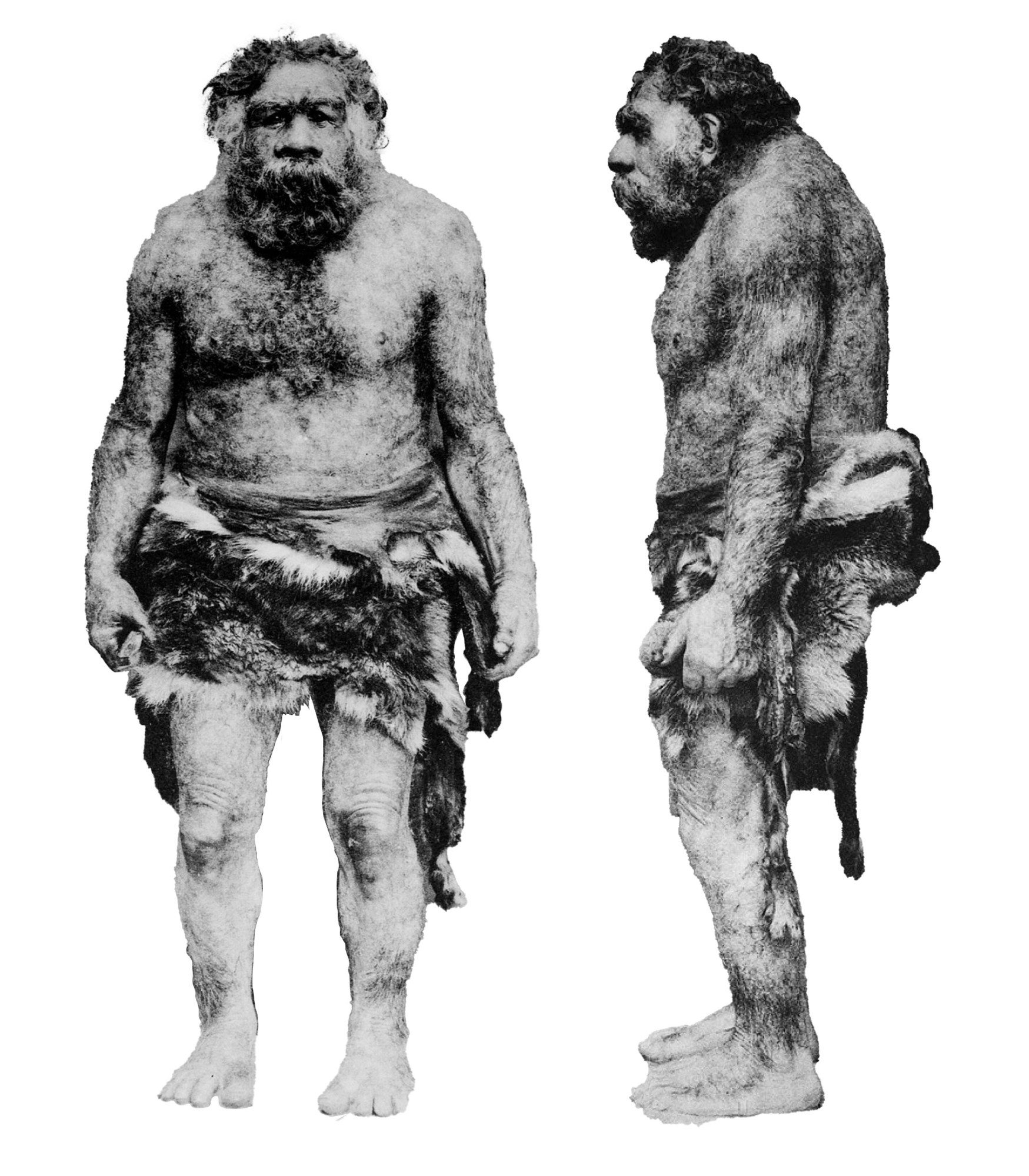
Neanderthal front and profile view
This model of a Neanderthal man was exhibited in the “Prehistory Gallery” at London’s Wellcome Historical Medical Museum in the 1930s.
WELLCOME COLLECTION

Pääbo’s team interpreted this as evidence of sexual reproduction between ancient Homo sapiens and the Neanderthals they encountered after they expanded out of Africa. “Neanderthals are not totally extinct,” Pääbo said to the BBC in 2010. “In some of us, they live on a little bit.”

The discovery was monumental on its own—but even more so because it reversed a previous consensus. More than a decade earlier, in 1997, Pääbo had sequenced a much smaller amount of Neanderthal DNA, in that case from a cell structure called a mitochondrion. It was different enough from Homo sapiens mitochondrial DNA for his team to cautiously conclude there had been “little or no interbreeding” between the two species. 

After 2010, though, the idea of hybridization, also called admixture, effectively became canon. Top journals like Science and Nature published study after study on the inner Neanderthal. Some scientists have argued that Homo sapiens would never have adapted to colder habitats in Europe and Asia without an infusion of Neanderthal DNA. Other research teams used Pääbo’s techniques to find genetic traces of interbreeding with an extinct group of hominins in Asia, called the Denisovans, and a mysterious “ghost lineage” in Africa. Biologists used similar tests to find evidence of interbreeding between chimpanzees and bonobos, polar and brown bears, and all kinds of other animals. 

The inner-Neanderthal hypothesis also took a turn for the personal. Various studies linked Neanderthal DNA to a head-spinning range of conditions: alcoholism, asthma, autism, ADHD, depression, diabetes, heart disease, skin cancer, and severe covid-19. Some researchers suggested that Neanderthal DNA had an impact on hair and skin color, while others assigned individuals a “NeanderScore” that was correlated with skull shape and prevalence of schizophrenia markers. Commercial genetic testing companies like 23andMe started offering customers Neanderthal ancestry reports. 

The inner Neanderthal became a story we could tell ourselves about our flaws and genetic destiny: Don’t blame me; blame the prognathic caveman hiding in my cells. Or as Latif Nasser, a host of the popular-science program Radiolab, put it when he was hospitalized with Crohn’s disease, another Neanderthal-associated condition: “I just keep imagining these tiny Neanderthals … just, like, stabbing me and drawing these little droplets of blood out of me.”

“These things become meaningful to people,” Chikhi says. “What we say will be important to how people view themselves.” 

The pitfalls of simplistic solutions 

When population geneticists built the theoretical framework for evolutionary biology in the early 20th century, genes were only abstract units of heredity inferred from experiments with peas and fruit flies. Population genetics developed theory far more quickly than it accumulated data. As a result, many data-driven scientists dismissed the study of evolution as a form of storytelling based on unexamined assumptions and preconceived ideas.

By the ’90s, though, genes were no longer abstractions but sequenced segments of DNA. Genomic sequencing grounded evolutionary studies in the kind of hard data that a chemist or physicist could respect. 

Yet biologists could not simply read evolutionary history from genomes as though they were books. They were trying to determine which of a nearly infinite number of plausible histories was the most likely to have created the patterns they observed in a small sample of genomes. For that, they needed simplified, algorithmic models of evolution. The study of evolution shifted from storytelling to statistics, and from biology to computer science. 

That suited Chikhi, who as a child was drawn to the predictable laws and numerical precision of math and science. He entered the field in the mid-’90s just as the first big studies of human DNA were settling old debates about human origins. DNA showed that Africa harbored far more genetic diversity than the entire rest of the planet. The new evidence supported the idea that modern humans evolved for hundreds of thousands of years in Africa and expanded to the other continents only in the last 100,000 years. For Chikhi, whose parents were Algerian immigrants, this discovery was a powerful challenge to the way some archaeologists and biologists talked about race. DNA could be used to deconstruct rather than encourage the pernicious idea that human races had deep-seated evolutionary differences based on their places of origin. 

At the same time, though, he was wary of the tendency to treat DNA as the final verdict on open questions in evolution. Chikhi had been surprised when, back in 1997, Pääbo and his team used that small amount of mitochondrial DNA to rule out hybridization between Homo sapiens and Neanderthals. He didn’t think that the absence of Neanderthal DNA there necessarily meant it wouldn’t be found elsewhere in the Homo sapiens genome.

Chikhi’s own research in the aughts opened his eyes to the gaps between historical reality and models of evolution. For one, despite the assumption of random mating, none of the animals Chikhi studied actually mated randomly. Orangutans lived in highly fragmented habitats, which restricted their pool of potential mates, and female birds were often extremely picky about their male partners. 

These factors could confound an evolutionary biologist’s traditional statistical tool kit. Scientists were starting to apply a mathematical technique to estimate historical population sizes for a species from the genome of just a single individual. This method showed sharp population declines in the histories of many different species. Chikhi realized, though, that the apparent declines could be an artifact of treating a structured population as one that evolved with random mating; in that case, the technique could indicate a bottleneck even if all the subgroups were actually growing in size. “This is completely counterintuitive,” he says. 

That’s at least partly why, when Pääbo’s 2010 Neanderthal genome came out, Chikhi was impressed with the sheer technical accomplishment but also leery of the findings about hybridization. “It was the type of thing we conclude too quickly based on genetic data,” he says. Pääbo’s work mentioned population structure as a possible alternative explanation—but didn’t follow up.

Just a couple of years later, a pair of independent scientists named Anders Eriksson and Andrea Manica picked up the idea, building a model with simple population structure that explicitly excluded admixture. They simulated human evolution starting from 500,000 years ago and found that their model produced the same genomic patterns Pääbo’s group had interpreted as evidence of hybridization.

“Working with structured models is really out of the comfort zone of a lot of population geneticists,” says Eriksson, now a professor at the University of Tartu in Estonia.

Their research impressed Chikhi. “At the time, I thought people would focus on population structure in the evolution of humans,” he says. Instead, he watched as the inner-Neanderthal hypothesis took on a life of its own. Scientists produced new methods to quantify hybridization but rarely examined whether population structure would yield the same results. To Chikhi, this wasn’t science; it was storytelling, like some of the old narratives about the evolution of racial differences. 

Chikhi and Tournebize decided to take a crack at the problem themselves. “I’ve always been very skeptical about science, and population genetics in particular,” says Tournebize, now a researcher at the French National Research Institute for Sustainable Development. “We make a lot of assumptions, and the models we use are very simplistic.” As detailed in a 2024 paper published in Nature Ecology & Evolution, they built a model of human evolution that replaced randomly mating continent-wide populations with many smaller populations linked by occasional migration. Then they let it run—a million times.

At the end of the simulation, they kept the 20 scenarios that produced genomes most similar to the ones in a sample of actual Homo sapiens and Neanderthals. Many of these scenarios produced long segments of DNA like the ones their peers argued could only have been inherited from Neanderthals. They showed that several statistics, which other scientists had proposed as measurements of Neanderthal DNA, couldn’t actually distinguish between hybridization and population structure. What’s more, they showed that many of the models that supported hybridization failed to accurately predict other known features of human evolution.

“A model will say there was admixture but then predict diversity that is totally incompatible with what we actually know of human diversity,” Chikhi says. “Nobody seems to care.”

So how did Neanderthal DNA wind up in living people if not via interspecies passion? Chikhi and Tournebize think it’s more likely that it was inherited by both Neanderthals and some sapiens groups in Africa from a common ancestor living at least half a million years ago. If the sapiens groups carrying those genetic variants included the people who migrated out of Africa, then the two human species would have already had the DNA in common when they came into contact in Europe and Asia—no sex required. 

“The interpretation of genetic data is not straightforward,” Chikhi says. “We always have to make assumptions. Nobody takes data and magically comes up with a solution.” 

Embracing the uncertainty 

Most of the half-dozen population geneticists I spoke with praised Chikhi and Tournebize’s ingenuity and appreciated the spirit of their critique. “Their paper forces us to think more critically about the model we use for inference and consider alternatives,” says Aaron Ragsdale, a population geneticist at the University of Wisconsin–Madison. His own work likewise suggests that the earliest Homo sapiens populations in Africa were probably structured—and that this is the likely reason for genomic patterns that other research groups had attributed to hybridization with a mysterious “ghost lineage” of hominins in Africa.

Yet most researchers still believe that modern humans and Neanderthals did probably have children with each other tens of thousands of years ago. Several pointed to the fact that fossil DNA of Homo sapiens who died thousands of years ago had longer chunks of apparent Neanderthal DNA than living people, which is exactly what you would expect if they had a more recent Neanderthal ancestor. (To address this possibility, Chikhi and Tournebize included DNA from 10 ancient humans in their study and found that most of them fit the structured model.) And while the Harvard population geneticist David Reich, who helped design the statistical test from Pääbo’s 2010 study, declined an interview, he did say he thought Chikhi and Tournebize’s model was “weak” and “very contrived,” adding that “there are multiple lines of evidence for Neanderthal admixture into modern humans that make the evidence for this overwhelming.” (Two other authors of that study, Richard Green and Nick Patterson, did not respond to requests for comment.) 

Nevertheless, most scientists these days welcome the development of structured, or “spatially explicit,” models that account for the fact that any given member of a population is usually more closely related to individuals living nearby than to those living far away. 

Loosening our attachment to certain narratives of evolution can create space for wonder at the sheer complexity of life’s history.

Other scientists also say that random mating isn’t the only assumption in population genetics that merits scrutiny. Models rarely factor in natural selection, which can also create genetic patterns that look like hybridization. Another common assumption is that everyone’s DNA mutates at the same, constant rate. “All the theory says the mutation rate is fixed,” says Amos, the Cambridge population geneticist. But he thinks that rate would have slowed drastically in the group of Homo sapiens that expanded to Europe around 45,000 years ago. This, too, could have created genomic patterns that other scientists interpret as evidence of interbreeding with Neanderthals. 

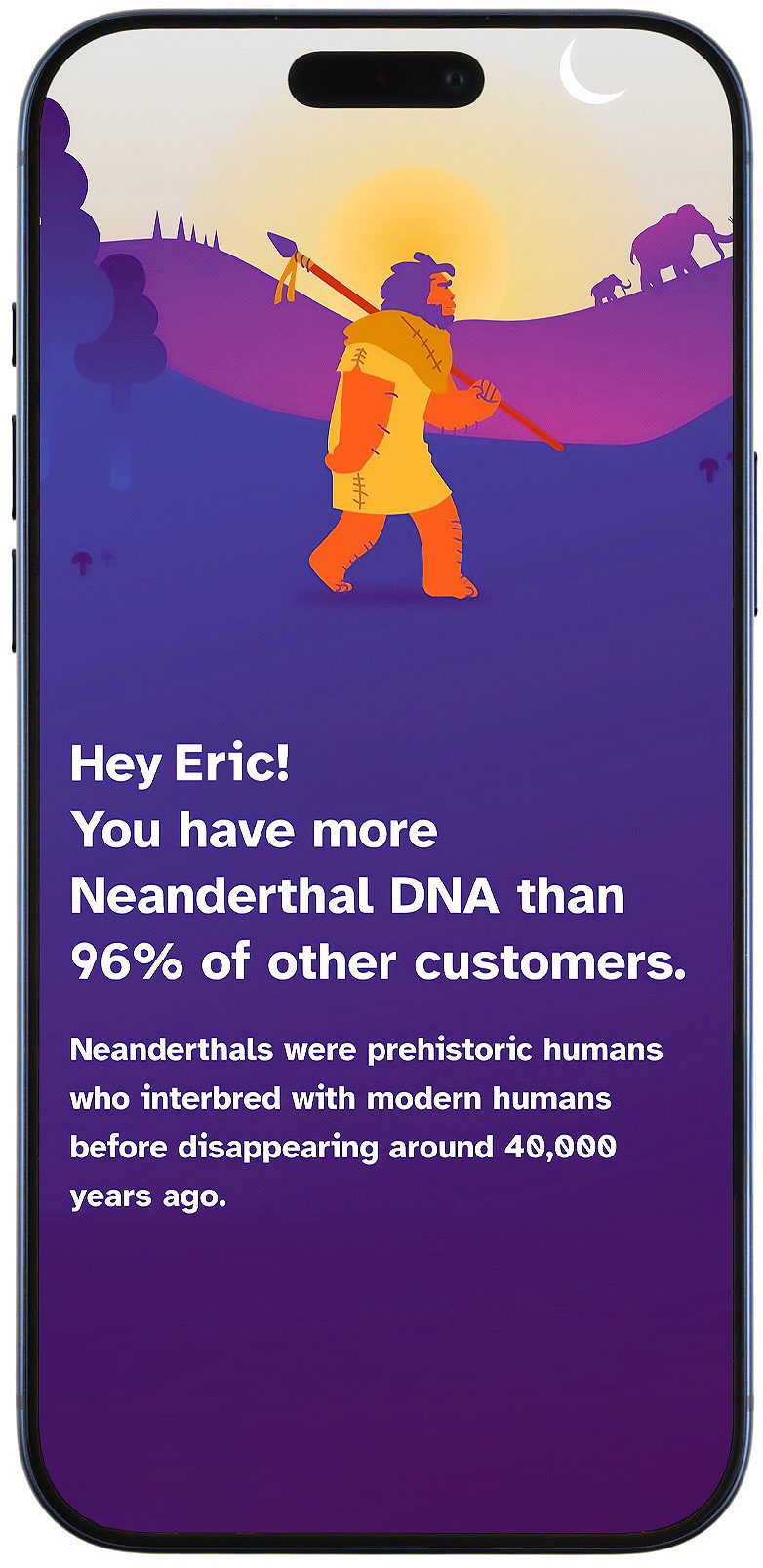
Commercial genetic testing companies like 23andMe started offering customers Neanderthal ancestry reports.
COURTESY OF 23ANDME

The point here isn’t that a complex model of evolution with many moving pieces is necessarily better than a simple one. Scientists need to reduce complexity in order to see the underlying processes more clearly. But simple models require assumptions, and scientists need to reevaluate those assumptions in light of what they learn. “As you get more data, you can justify more complex models of the world,” says Mark Thomas, a population geneticist at University College London, who wrote a history of random mating in population genetics that highlighted how the field was starting to see it as “a limiting assumption as opposed to a simplifying one.” 

It can feel discouraging to couch conversations about the past in confusing terms like “population structure” and “mutation rates.” It seems almost antithetical to the spirit of science to talk more about uncertainty at the same time we are developing powerful technologies and enormous data sets for analyzing evolution. These tools often yield novel answers, but they can also limit the questions we ask. The French archaeologist Ludovic Slimak, for example, has complained that the idea of the inner Neanderthal has domesticated our image of Neanderthals and made it difficult to imagine their humanity as distinct from our own. Investigating Neanderthal DNA is sexier to many young researchers than searching for archaeological and fossil evidence of how Neanderthals actually lived. 

Loosening our attachment to certain narratives of evolution can create space for wonder at the sheer complexity of life’s history. Ultimately, that’s what Chikhi and Tournebize hope to do. After all, they don’t believe the question of population structure versus hybridization is either-or. It’s possible, and even likely, that both played a role in human evolution. “Our structured model does not necessarily mean that no admixture ever took place,” Chikhi and Tournebize wrote in their study. “What our results suggest is that, if admixture ever occurred, it is currently hard to identify using existing methods.” 

Future methods might disentangle the different factors, but it’s just as important, Chikhi says, for scientists to be up-front about their assumptions and test alternatives. “There’s still so much uncertainty on so many aspects of the demographic history of Neanderthals and Homo sapiens,” he notes. 

Keep that in mind the next time you read about your inner Neanderthal. The association between this DNA and some diseases may be real, of course—but would journals publish these studies without the additional claim that the DNA is from Neanderthals? Any good storyteller knows that sex sells, even in science. 

Ben Crair is a science and travel writer based in Berlin.

Coming soon: 10 Things That Matter in AI Right Now

Each year we compile our 10 Breakthrough Technologies list, featuring our educated predictions for which technologies will have the biggest impact on how we live and work.

This year, however, we had a dilemma. While our final picks encompass all our core coverage areas (energy, AI, and biotech, plus a few more), our 2026 list was harder to wrangle than normal. Why? We had so many worthy AI candidates we couldn’t fit them all in! (The ones that made it were AI companions, mechanistic interpretability, generative coding, and hyperscale data centers.) Many great ideas fell by the wayside to keep the list as wide-ranging as possible.

Well, that got us thinking: What if we made an entirely new list that was all about AI? We got excited about that idea—and before we knew it we had the beginnings of what we’re calling 10 Things That Matter in AI Right Now. It’s an entirely new annual list that we’re proud to be publishing for the first time on April 21, 2026. We’ll unveil it on stage for attendees at our signature AI conference, EmTech AI, held on MIT’s campus (it’s not too late to get tickets), and then publish the list online later that day.

The process for coming up with the list was similar to the way we pick our 10 Breakthrough Technologies. We petitioned our AI team of reporters and editors to propose ideas, put them all in a document, and engaged in some robust discussion. Eventually, we voted for our favorites and whittled the long list down to a final 10.

But there’s a slight difference between this list and our 10 Breakthrough Technologies. AI is already such a big part of our lives that we didn’t want to restrict ourselves to nominating only technologies. Instead, we wanted to put together a definitive annual list that highlights what we believe are the biggest ideas, topics, and research directions in AI right now. So yes, it will include cutting-edge AI technologies, but it will also feature other trends and developments in AI that we want to bring to our subscribers’ attention.

Think of it as a sneak peek inside the collective brain of our crack AI reporting team: These are the things that our reporters will be watching this year. We intend to follow the items on this list really closely, and you will see it reflected in the news and feature stories we publish in 2026.

For us, 10 Things That Matter in AI Right Now is a guide to how we view the current AI landscape. It will be a source of discussion, debate, and maybe some arguments! We are so excited to share it with you on April 21. If you want to be among the first to see it—join us at EmTech AI or become a subscriber to livestream the announcement.

NASA is building the first nuclear reactor-powered interplanetary spacecraft. How will it work?

<div data-chronoton-summary="

  • A US nuclear-powered spacecraft may head to Mars: NASA has announced SR-1, the first-ever nuclear-reactor-powered interplanetary spacecraft, with a planned Mars launch before the end of 2028—a timeline experts call aggressive but exciting.
  • Nuclear could beat chemical and solar power: Unlike traditional propulsion, nuclear electric propulsion is orders of magnitude more efficient and doesn’t depend on sunlight, making it better suited for long, fast journeys through the solar system.
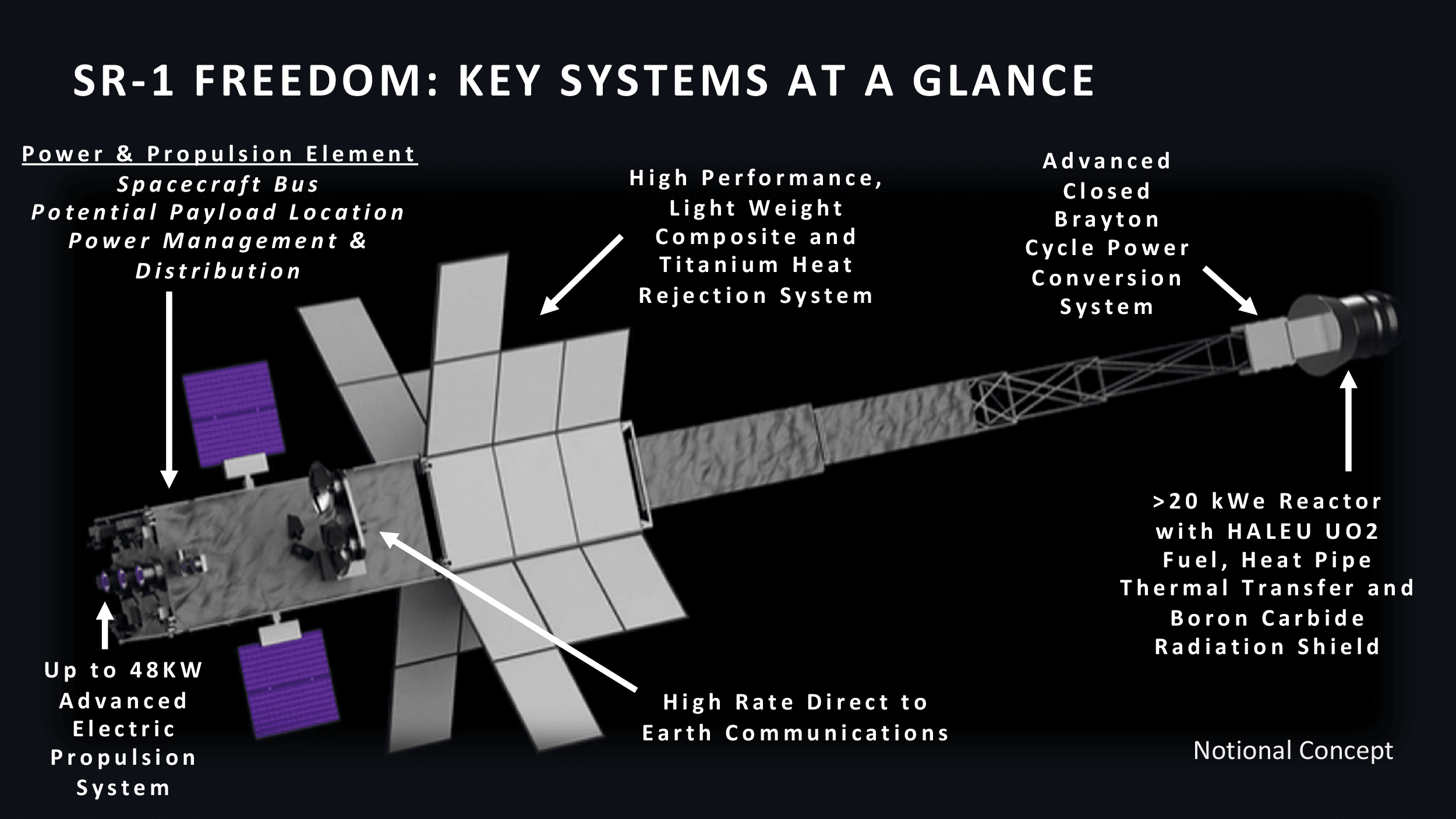
  • The design is already taking shape: SR-1 will resemble a giant fletched arrow, with a recycled Gateway space station propulsion unit at the rear and a 20-kilowatt uranium reactor up front, cooled by enormous fins that vent excess heat into space.
  • The stakes go beyond engineering: With China and Russia pursuing their own deep-space nuclear programs, SR-1 is as much a geopolitical gambit as a scientific one—and success could put the US ahead in the race to land humans on Mars.

” data-chronoton-post-id=”1135848″ data-chronoton-expand-collapse=”1″ data-chronoton-analytics-enabled=”1″>

MIT Technology Review Explains: Let our writers untangle the complex, messy world of technology to help you understand what’s coming next. You can read more from the series here.

Just before Artemis II began its historic slingshot around the moon, Jared Isaacman, the recently confirmed NASA administrator, made a flurry of announcements from the agency’s headquarters in Washington, DC. He said the US would soon undertake far more regular moon missions and establish the foundations for a base at the lunar south pole before the end of the decade. He also affirmed the space agency’s commitment to putting a nuclear reactor on the lunar surface.

These goals were largely expected—but there was still one surprise. Isaacman also said NASA would build the first-ever nuclear reactor-powered interplanetary spacecraft and fly it to Mars by the end of 2028. It’s called the Space Reactor-1 Freedom, or SR-1 for short. “After decades of study, and billions spent on concepts that have never left Earth, America will finally get underway on nuclear power in space,” he said at the event. “We will launch the first-of-its-kind interplanetary mission.”

A successful mission would herald a new era in spaceflight, one in which traveling between Earth, the moon, and Mars would—according to a range of experts—be faster and easier than ever. And it might just give the US the edge in the race against China—allowing the country to beat its greatest geopolitical rival to landing astronauts on another planet.

While experts agree the timeline is extremely tight, they’re excited to see if America’s space agency and its industry partners can deliver an engineering miracle. “You wake up to that announcement, and it puts a big smile on your face,” says Simon Middleburgh, co-director of the Nuclear Futures Institute at Bangor University in Wales.

Little detail on SR-1 is publicly available, and NASA’s own spaceflight researchers did not respond to requests for comment. But MIT Technology Review spoke to several nuclear power and propulsion experts to find out how the new nuclear-powered spacecraft might work.

Nuclear propulsion 101

Traditionally, spaceflight has been powered by chemical propulsion. Liquefied hydrogen and liquefied oxygen are mixed, and then ignited, within a rocket; the searingly hot exhaust from this explosion is ejected through a nozzle, which propels the rocket forth.

Chemical propulsion offers a significant amount of thrust and will, for the foreseeable future, still be used to launch spacecraft from Earth. But nuclear propulsion would enable spacecraft to fly through the solar system for far longer, and faster, than is currently possible. 

“You get more bang per kilogram,” says Middleburgh. A nuclear fuel source is far more energy-dense than its conventional cousin, which means it’s orders of magnitude more efficient. “It’s really, really, really high efficiency,” says Lindsey Holmes, an expert in space nuclear technology and the vice president of advanced projects at Analytical Mechanics Associates, an aerospace company in Virginia. 

The approach also removes one other element of the traditional power equation: solar. Spacecraft, including the Artemis II mission’s Orion space capsule, often rely on the sun for power. But this can be a problem, since it doesn’t always shine in space, particularly when a planet or moon gets in its way—and as you head toward the outer solar system, beyond Mars, there’s just less sunlight available. 

To circumvent this issue, nuclear energy sources have been used in spacecraft plenty of times before—including on both Voyager missions and the Saturn-interrogating Cassini probe. Known as radioisotope thermoelectric generators, or RTGs, these use plutonium, which radioactively decays and generates heat in the process. That heat is then converted into electricity for the spacecraft to use. RTGs, however, aren’t the same as nuclear reactors; they are more akin to radioactive batteries—more rudimentary and considerably less powerful.

So how will a nuclear-reactor-powered spacecraft work? 

Despite operational differences, the fundamentals of running a nuclear reactor in space are much the same as they are on Earth. First, get some uranium fuel; then bombard it with neutrons. This ruptures the uranium’s unstable atomic nuclei, which expel a torrent of extra neutrons—and that rapidly escalates into a self-sustaining, roasting-hot nuclear fission reaction. Its prodigious heat output can then be used to produce electricity.

Doing this in space may sound like an act of lunacy, but it’s not: The idea, and even a lot of the basic technology, has been around for decades. The Soviet Union sent dozens of nuclear reactors into orbit (often to power spy satellites), while the US deployed just one, known as SNAP-10A, back in 1965—a technological demonstration to see if it would operate normally in space. The aim was for the reactor to generate electricity for at least a year, but it ran for just over a month before a high-voltage failure in the spacecraft caused it to malfunction and shut down. 

Now, more than half a century later, the US wants its second-ever space-based nuclear reactor to do something totally different: power an interplanetary spacecraft.

To be clear, the US has started, and terminated, myriad programs looking into nuclear propulsion. The latest casualty was DRACO, a collaboration between NASA and the Department of Defense, which ended in 2025. Like several previous efforts, DRACO was canceled because of a mix of high experimentation costs, lower prices for conventional rocket propulsion, and the difficulty of ensuring that ground tests could be performed safely and effectively (they are creating an incredibly powerful nuclear reaction, after all).

But now external considerations may be changing the calculus. The Artemis program has jump-started America’s return to the moon, and the new space race has palpable momentum behind it. The first nation to deploy nuclear propulsion would have a serious advantage navigating through deep space. 

“I think it’s a very doable technology,” says Philip Metzger, a spaceflight engineering researcher at the Florida Space Institute. “I’m happy to see them finally doing this.”

One version of this technology is known as nuclear thermal propulsion, or NTP. You start with a nuclear reactor, one that’s cooking at around 5,000°F. Then “you’ve got a cold gas, and you squirt cold gas over the hot reactor,” says Middleburgh. “The gas expands, you shoot it out the back of a nozzle, and you have an impulse. And that impulse drives you forward.” 

Because the thrust depends on the speed of the gas being ejected, the propellant gas needs to be light, making hydrogen a popular choice. But hydrogen is a corrosive and explosive substance, so using it in NTP engines can make them precarious to operate. On top of this, NTP doesn’t necessarily have a very long operating life.

Alternatively, there’s nuclear electric propulsion, or NEP, which “is very low thrust, but very efficient, so you can use it for a long period of time,” says Sebastian Corbisiero, the US Department of Energy’s national technical director of space reactor programs. This method uses heat from a fission reactor to generate power. That power is used to electrify a gas and then  blast it out of the spacecraft, generating thrust.  

Both NTP and NEP have been investigated by US researchers, because both have the added benefit of making it easier and safer for human beings to explore the solar system. Astronauts in space are exposed to harmful cosmic radiation, but because nuclear propulsion makes spacecraft speedier and more agile, they’d spend less time in it. “It solves the radiation problem,” says Metzger. “That’s one of the main motivations for inventing better propulsion to and from Mars.”

How to build a nuclear-powered spaceship

For SR-1, NASA has opted for nuclear electric propulsion. NEP is “a much simpler affair” than its thermal counterpart, says Middleburgh. Essentially, you just need to plug a nuclear reactor into a power-and-propulsion system. Luckily for NASA, it’s already got one.

For many years, NASA—along with its space agency partners in Canada, Europe, Japan, and the Middle East—was preparing for Gateway, meant to be humanity’s first space station to orbit around the moon. Isaacman canceled the project in March, but that doesn’t mean its technology will go to waste; the power-and-propulsion element of the nixed space station will be used in SR-1 instead. This contraption was going to be powered by solar energy. It’ll now be attached to an in-development nuclear reactor custom built to survive in space.

What might the SR-1 look like? MIT Technology Review saw a presentation by Steve Sinacore, program executive of NASA’s Space Reactor Office, that offers some clues. So far, the concept art makes it look like a colossal fletched arrow. At the back will be the power-and-propulsion system, while its tip will hold a 20-kilowatt-or-greater uranium-filled nuclear reactor. (For context, a typical nuclear plant on Earth is 50,000 times more powerful, producing a gigawatt of power.) 

NASA

The “fletches” on SR-1 are large fins that allow the reactor to cool down. “You have to have really large radiators,” says Holmes, since the nuclear fission process produces so much heat that much of it has to be vented into space—otherwise, the reactor and spacecraft will melt.

According to that presentation, the spacecraft’s hardware development is due to start this June. By January 2028, SR-1’s systems should be ready for assembly and testing. And by that October, the spacecraft will arrive at the launch site, ready for liftoff before the year’s end. Will the nuclear reactor manage to hold itself together? “Going through the launch safely is going to be a challenge,” says Middleburgh. “You are being shaken, rattled, and rolled.” 

Then, he says, “once you’re up in space, once you’ve got through that few minutes of hell in getting there, it’s zero-gravity considerations you have to worry about.” The question then becomes: Will the mechanics of the reactor, built on terra firma, still work? 

For safety reasons, the nuclear reactor will be switched on around two days post-launch, when it’s comfortably in space. Uranium isn’t tremendously dangerous by itself, but that can’t be said of the nuclear waste products that emerge when the reactor is activated, so you don’t want any of that to fall back to Earth. 

If this schedule is adhered to, and SR-1 works as planned, it’s expected to reach Mars about a year after launch. “It’s an aggressive timeline,” says Holmes, something she suspects is being driven partly by China’s and Russia’s own deep-space nuclear ambitions. The two countries aim to place their own nuclear reactor on the moon’s surface to power the planned International Lunar Research Station—a jointly operated lunar base—by 2035. 

Whether it flies or fails in space, SR-1’s operations should help NASA with putting a nuclear reactor on the moon soon after. “All of the things we’d be learning about how that system operates in space [are] very helpful for a surface application, because basically it’s the same,” says Corbisiero. “There’s still no air on the moon.”

And if SR-1 does triumph, it will be a game-changing victory for NASA. It will also be “a massive win for the human race, frankly,” says Middleburgh. “It will be a marvel of engineering, and it will move the dial in humans potentially taking a step on Mars.” Like many of his colleagues, including Holmes, he remains thrilled by the prospect of the first-ever nuclear-powered interplanetary spacecraft—even with the incredibly ambitious timeline. 

“These are the things that get us up in the morning,” he says. “These are the sorts of things we will remember when we’re old.”

Job titles of the future: Wildlife first responder

Grizzly bears have made such a comeback across eastern Montana that in 2017, the state hired its first-ever prairie-based grizzly manager: wildlife biologist Wesley Sarmento. 

For some seven years, Sarmento worked to keep both the bears, which are still listed as threatened under the Endangered Species Act, and the humans, who are sprawling into once-wild spaces, out of trouble. Based in the small city of Conrad, population 2,553, he acted sort of like a first responder, trying to defuse potentially dangerous situations. He even got caught in some himself—which is why, before he left the role to pursue a PhD, he turned to drones to get the job done. 

The bear necessities

Sarmento was studying mountain goats in Glacier National Park when he first started working with bears. To better understand how goats responded to the apex predator, he dressed up in a bear costume once a week for over three years. 

When he later started as grizzly manager, he often drove long distances to push bears away from farms. Bears are drawn to spilled or leaking grains, and an open silo quickly turns into a buffet. Sarmento would typically arrive armed with a shotgun, cracker shells, and bear spray, but after he narrowly escaped getting mauled one day, he knew he had to pivot.

“In that moment,” he says, “I was like, I am gonna get myself killed.”

A bird’s-eye view

Sarmento first turned to two Airedale dogs, a breed known for deterring bears on farms, but the dogs were easily sidetracked. Meanwhile, drones were slowly becoming more common tools for biologists in a range of activities, including counting birds and mapping habitats.

He first took one into the field in 2022, when a grizzly mom and two cubs were found rummaging around in a silo outside of town. The drone’s infrared sensors helped him quickly find their location, and he used the aircraft’s sound to drive them away from the property. (Researchers suspect bears instinctively dislike the whir of blades because it sounds like a swarm of bees.) “The whole thing was so clean and controlled,” he says. “And I did it all from the safety of my truck.”

Since then, the flying machine that Sarmento bought for $4,000—a fairly simple model with a thermal camera and 30 minutes of battery life—has shown its potential for detecting grizzlies in perilous terrain he’d otherwise have to approach on foot, like dense brush or hard-to-reach river bottoms.

A new technological foundation

Now studying wildlife ecology at the University of Montana, Sarmento is hoping to design a drone campus police can use to deter black bears from school grounds. In the future, he hopes, AI image recognition might be broadly integrated into his wildlife management work—maybe even helping drones identify bears and autonomously divert them from high-traffic areas.

All this helps keep bears from learning behaviors that lead to conflict with people—which typically ends badly for the bear and is occasionally fatal for humans.

“The out-of-the-box technology doesn’t exist yet, but the hope is to keep exploring applications,” he says. “Drones are the next frontier.” 

Emily Senkosky is a writer with a master’s degree in environmental science journalism from the University of Montana.

You have no choice in reading this article—maybe

Uri Maoz loved doing his human research, back when he was getting his PhD. He was studying a very specific topic in computational neuroscience: how the brain instructs our arms to move and how our gray matter in turn perceives that motion. 

Then his professor asked him to deliver an undergrad lecture. Maoz assumed his boss was going to tell him exactly what to do, or at least throw some PowerPoint slides his way. But no. Maoz had free rein to teach anything, as long as it was relevant to the students. “I could have gone to human brain augmentation,” he says. “Cyborgs or whatever.”

Yet that admittedly fun and borderline sci-fi topic wasn’t what popped, unbidden, into his mind. His idea, he recalls with excitement: “What neuroscience has to say about the question of free will!” 

How—or whether—humans make decisions (like, say, about what to discuss in an undergrad lecture) had been on his mind since he’d read an article in his early twenties suggesting that … maybe they didn’t. This question might naturally beget others: Had he even had a choice about whether to read that article in the first place? How would he ever know if he was responsible for making decisions in his life or if he just had the illusion of control?

“After that, there was no turning back,” says Maoz, now a professor at Chapman University, in California. He finished his PhD work in human movement, but afterward he scooted further up the neural chain to find out how desires and beliefs turn into actions—from raising an arm to choosing someone to ask out to dinner on a Friday night.

Today, Maoz is a central figure in the attempt to (sort of, maybe) answer how that neural chain functions. His research has since overturned and reinter­preted canonical neuroscience studies and united the straight-scientific and philosophical sides of the free-will question. More than anything, though, he’s succeeded in uncovering new wrinkles in the debate.

Machines and magic tricks

The concept of free will seems straightforward, but it doesn’t have a universally accepted definition. One intuitive notion is that it’s the ability to make our own decisions and take our own actions on purpose—that we control our lives. But physicists might ask if the universe is deterministic, following a preordained path, and if human choices can still happen in such a universe. 

That’s a question for them, Maoz says. What neuroscientists can do is figure out what’s going on in the brain when people make decisions. “And that’s what we’re trying to do: to understand how our wishes, desires, beliefs, turn into actions,” he says.

By the time Maoz had finished his PhD, in 2008, neuroscientific research into the question had been going on for decades. One foundational study from the 1960s showed that a hand movement—something a person seemingly decides to do—was preceded by the appearance in the brain of an electrical signal called the “readiness potential.” 

Building on that result, in the 1980s a neuroscientist named Benjamin Libet did the experiment that had first piqued Maoz’s interest in the topic—one that many, until recently, interpreted as a death knell for the concept of free will.

An electrical impulse in our brains can shed only so much light on whether we truly are the architects of our own fates.

“He just had people sit there, and whenever they feel like it, they would go like this,” says Maoz, wiggling his wrist. Libet would then ask where a rotating dot was on a screen when they first had the urge to flick. He found that the readiness potential appeared not only before they moved their hand but before they reported having the urge to move—or, in Libet’s interpretation, before they knew they were going to move. 

Studies since have confirmed the observation and shown that the readiness potential appears a second or two—and maybe, fMRI implies, up to 10 seconds—before participants report making a conscious decision. “It suggests we are essentially passengers in a self-driving car,” says Maoz. “The unconscious biological machine does all the steering, but our conscious mind sits in the driver’s seat and takes the credit.” 

Maoz initially approached his own research with variations on Libet’s experiments. He worked with epilepsy patients who already had electrodes in their brains, for clinical purposes, and was able to predict which hand they would raise before they raised it. 

Still, some of the Libet-inspired studies people were doing nagged at him. “All these results were about completely arbitrary decisions. Raise your hand whenever you feel like it,” he says. “Why? No reason.” A decision like that is quite different from, say, choosing to break up with your partner. Try telling someone they weren’t in the driver’s seat for that

The field wasn’t looking at meaningful decisions, he says—the ones that actually set the course of lives. 

Maoz began pulling in philosophers to help guide his approach. They would challenge him to confront the semantic differences between things like intention, desire, and urge. Neuroscientists have tended to lump those concepts together, but philosophers tease them apart: Desire is a want that doesn’t necessarily progress toward an action; urge carries implications of immediacy and compulsion; and intention involves committing to a plan. (Maoz has come to focus specifically on intention—including, recently, the potential intentions of AI.)

In 2017, he organized his first in a series of free-will conferences, drawing many autonomy-interested philosophers. “Thank you so much for coming,” he recalls saying at the opening of the meeting. “As if you had a choice.” One day, the crew took an excursion out on a lake. As the group munched on shrimp, someone joked that they hoped the boat didn’t sink, because everybody in the field would die. 

The comment didn’t make Maoz feel existential dread. Instead, he figured that if the whole field was already there, why not lasso them all into writing a research grant? “He just thinks what should be the next step and just has a very good ability to just make it happen,” says Liad Mudrik, a neuroscientist at Tel Aviv University and a frequent collaborator.

That ability is special among scientists, says Chapman colleague Aaron Schurger, with whom Maoz co-directs the Laboratory for Understanding Consciousness, Intentions, and Decision-Making (LUCID, appropriately). “I really think that Uri is kind of at the nexus of this field right now because he’s really, really good at bringing people together around these big ideas,” he says.

Donations and interruptions

Maoz has recently been making progress on one of the big ideas that have consistently occupied his working hours: how trivial and significant decisions play out differently in the brain. In collaborations with Mudrik, he’s parsed the neural difference between picking and choosing—their terms for arbitrary decisions and those that change your life and tug on your emotions. 

Readiness potential? Their measurements didn’t clock it ahead of choices. In 2019, Maoz and a crew published a paper measuring the electrical activity in people’s brains as they pressed a key to choose one of two nonprofits to donate $1,000 to—for real, with actual dollars. Then the researchers compared that activity with what they saw when the same group pressed a key at random to donate $500 each to two nonprofits. The team saw the readiness potential in the arbitrary decision, but not for the $1,000 question. 

Libet’s result, they concluded, doesn’t apply to the important stuff, which means readiness potential might not actually be a sign that your brain is making a choice before you’re aware of it. “If Libet would have chosen to focus on deliberate decisions, then maybe the entire debate about neuroscience proving free will to be an illusion would have been spared from us,” Mudrik says. 

Maoz’s research has spurred others to reinterpret Libet’s work. It’s “enriched my thought process a great deal,” says Bianca Ivanof, a psychologist whose dissertation scrutinized Libet’s methods. They turn out to identify readiness potential at different times depending on how the rotating-dot setup is designed, complicating the ability to compare and interpret results.

Maoz has also continued to gather data on the subject. Last year, for example, he used an EEG to measure electrical signals in people’s brains as they got ready to press a keyboard space bar. At random moments, he interrupted their preparations with an audible tone and asked them about their intentions. He saw no connection between the readiness potential and whether or not they were planning to tap the key—evidence that the potential doesn’t represent the buildup of either conscious or unconscious plans. The team did see a signal, though, in a different part of the brain when people said they were preparing to move.

So … that’s free will? Sadly, Maoz would be compelled to say Well, not exactly. An electrical impulse in our brains can shed only so much light on whether we truly are the architects of our own fates. And maybe the confusing data from neurons is actually the point. “I don’t think it is a yes-or-no question,” Maoz says. Maybe our less meaningful choices aren’t mindfully made but big ones are; maybe we have the conscious power to change an intended action, but only if our brains are in a particular state. 

Neuroscientists likely can’t figure out, on their own, if free will exists. But they can, Maoz says, parse how semantically distinct decision-making forces—desires, urges, intentions, wishes, beliefs—manifest in our brains and become actions. “That is something that we are making progress on,” he says, “and I think that that’s going to help us understand what we do control.” And perhaps also help us make peace with what we do not. 

Sarah Scoles is a freelance science journalist and author based in southern Colorado.

Want to understand the current state of AI? Check out these charts.

<div data-chronoton-summary="

  • The US-China AI race is closer than you think: Chinese models from DeepSeek and Alibaba now trail American ones by razor-thin margins. Meanwhile, the US has more data centers and capital, while China leads in research publications and robotics.
  • AI benchmarks are badly broken: One popular math benchmark has a 42% error rate, and models can game tests by training on the answers. Strong test scores increasingly fail to predict how AI actually performs in the real world.
  • Jobs and anxiety are both rising: Software developer employment for workers aged 22–25 has dropped nearly 20% since 2022, with AI likely a factor. Globally, 59% of people think AI will do more good than harm—but 52% say it still makes them nervous.
  • Regulation is losing the race: The EU banned predictive policing AI, and US states passed a record 150 AI-related bills, but experts say lawmakers don’t yet understand the technology well enough to govern it effectively.

” data-chronoton-post-id=”1135675″ data-chronoton-expand-collapse=”1″ data-chronoton-analytics-enabled=”1″>

If you’re following AI news, you’re probably getting whiplash. AI is a gold rush. AI is a bubble. AI is taking your job. AI can’t even read a clock. The 2026 AI Index from Stanford University’s Institute for Human-Centered Artificial Intelligence, AI’s annual report card, comes out today and cuts through some of that noise. 

Despite predictions that AI development may hit a wall, the report says that the top models just keep getting better. People are adopting AI faster than they picked up the personal computer or the internet. AI companies are generating revenue faster than companies in any previous technology boom, but they’re also spending hundreds of billions of dollars on data centers and chips. The benchmarks designed to measure AI, the policies meant to govern it, and the job market are struggling to keep up. AI is sprinting, and the rest of us are trying to find our shoes.

All that speed comes at a cost. AI data centers around the world can now draw 29.6 gigawatts of power, enough to run the entire state of New York at peak demand. Annual water use from running OpenAI’s GPT-4o alone may exceed the drinking water needs of 12 million people. At the same time, the supply chain for chips is alarmingly fragile. The US hosts most of the world’s AI data centers, and one company in Taiwan, TSMC, fabricates almost every leading AI chip. 

The data reveals a technology evolving faster than we can manage. Here’s a look at some of the key points from this year’s report. 

The US and China are nearly tied

In a long, heated race with immense geopolitical stakes, the US and China are almost neck and neck on AI model performance, according to Arena, a community-driven ranking platform that allows users to compare the outputs of large language models on identical prompts. In early 2023, OpenAI had a lead with ChatGPT, but this gap narrowed in 2024 as Google and Anthropic released their own models. In February 2025, R1, an AI model built by the Chinese lab DeepSeek, briefly matched the top US model, ChatGPT. As of March 2026, Anthropic leads, trailed closely by xAI, Google, and OpenAI. Chinese models like DeepSeek and Alibaba lag only modestly. With the best AI models separated in the rankings by razor-thin margins, they’re now competing on cost, reliability, and real-world usefulness. 

Chart of the performance of top models on the Arena by select providers, showing the Arena score from May 2023 to Jan 2026 with the models all trending upward.  The scores are tightly packed by US based Anthropic, xAI, Google and OpenAI lead Alibaba, DeepSeek and Mistral (in that order.) Meta trails the pack.

The index notes that the US and China have different AI advantages. While the US has more powerful AI models, more capital, and an estimated 5,427 data centers (more than 10 times as many as any other country), China leads in AI research publications, patents, and robotics. 

As competition intensifies, companies like OpenAI, Anthropic, and Google no longer disclose their training code, parameter counts, or data-set sizes. “We don’t know a lot of things about predicting model behaviors,” says Yolanda Gil, a computer scientist at the University of Southern California who coauthored the report. This lack of transparency makes it difficult for independent researchers to study how to make AI models safer, she says.

AI models are advancing super fast

Despite predictions that development will plateau, AI models keep getting better and better. By some measures, they now meet or exceed the performance of human experts on tests that aim to measure PhD-level science, math, and language understanding. SWE-bench Verified, a software engineering benchmark for AI models, saw top scores jump from around 60% in 2024 to almost 100% in 2025. In 2025, an AI system produced a weather forecast on its own.  

“I am stunned that this technology continues to improve, and it’s just not plateauing in any way,” says Gil.

line chart of Select AI Index technical performance benchmarks vs human performance, showing that skills such as image classification, English language understanding, multitask language understanding, visual reasoning, medium level reading comprehension, multimodal understanding and reasoning have surpassed the human baseline at or before 2025, with autonomous software engineering, mathmatical reasoning and agent multimodal computer use trending towards meeting the human baseline by 2026.

However, AI still struggles in plenty of other areas. Because the models learn by processing enormous amounts of text and images rather than by experiencing the physical world, AI exhibits “jagged intelligence.” Robots are still in their early days and succeed in only 12% of household tasks. Self-driving cars are farther along: Waymos are now roaming across five US cities, and Baidu’s Apollo Go vehicles are shuttling riders around in China. AI is also expanding into professional domains like law and finance, but no model dominates the field yet. 

But the way we test AI is broken

These reports of progress should be taken with a grain of salt. The benchmarks designed to track AI progress are struggling to keep up as models quickly blow past their ceilings, the Stanford report says. Some are poorly constructed—a popular benchmark that tests a model’s math abilities has a 42% error rate. Others can be gamed: when models are trained on benchmark test data, for example, they can learn to score well without getting smarter. 

Because AI is rarely used the same way it’s tested, strong benchmark performance doesn’t always translate to real-world performance. And for complex, interactive technologies such as AI agents and robots, benchmarks barely exist yet. 

AI companies are also sharing less about how their models are trained, and independent testing sometimes tells a different story from what they report. “A lot of companies are not releasing how their models do in certain benchmarks, particularly the responsible-AI benchmarks,” says Gil. “The absence of how your model is doing on a benchmark maybe says something.” 

AI is starting to affect jobs

Within three years of going mainstream, AI is now used by more than half of people around the world, a rate of adoption faster than the personal computer or the internet. An estimated 88% of organizations now use AI, and four in five university students use it. 

It’s early days for deployment, and AI’s impact on jobs is hard to measure. Still, some studies suggest AI is beginning to affect young workers in certain professions. According to a 2025 study by economists at Stanford, employment for software developers aged 22 to 25 has fallen nearly 20% since 2022. The decline might not be pinned on AI alone, as broader macroeconomic conditions could be to blame, but AI appears to be playing a part.

two line charts showing the normalized headcount trends by age group from 2021 through 2025. On the left for software developers the early career (age 22-25) cohort drops rapidly after a peak in September 2022, with other ages still rising albeit less steeply.  On the right, customer support agents see a similar trend, although the decline for the early career group is less steep than for software developers.

Employers say that hiring may continue to tighten. According to a 2025 survey conducted by McKinsey & Company, a third of organizations expect AI to shrink their workforce in the coming year, particularly in service and supply chain operations and software engineering. AI is boosting productivity by 14% in customer service and 26% in software development, according to research cited by the index, but such gains are not seen in tasks requiring more judgment. Overall, it’s still too early to understand the bigger economic impact of AI. 

People have complicated feelings about AI 

Around the world, people feel both optimistic and anxious about AI: 59% of people think that it will provide more benefits than drawbacks, while 52% say that it makes them nervous, according to an Ipsos survey cited in the index. 

Notably, experts and the public see the future of AI very differently, according to a Pew survey. The biggest gap is around the future of work: While 73% of experts think that AI will have a positive impact on how people do their jobs, only 23% of the American public thinks so. Experts are also more optimistic than the public about AI’s impact on education and medical care, but they agree that AI will hurt elections and personal relationships.

Bar chart of US perceptions of AI's societal impact contrasting US adults with AI experts, with the percentage of AI experts saying that AI will have a positive impact in the next 20 years is 2-3 times higher than the US adults.  The most optimistic AI experts are in the field of medical care with 84% predicting a positive outcome (versus 44% of US adults.) The greatest difference is for jobs with experts polling at 73% and US adults  polling at 23%.  Both groups have a similar (11% for experts and 9% of adults.) expectation for a positive outcome for AI in elections.

Among all countries surveyed, Americans trust their government least to regulate AI appropriately, according to another Ipsos survey. More Americans worry federal AI regulation won’t go far enough than worry it will go too far. 

Governments are struggling to regulate AI

Governments around the world are struggling to regulate AI, but there were some minor successes last year. The EU AI Act’s first prohibitions, which ban the use of AI in predictive policing and emotion recognition, took effect. Japan, South Korea, and Italy also passed national AI laws. Meanwhile, the US federal government moved toward deregulation, with President Trump issuing an executive order seeking to handcuff states from regulating AI. 

Despite this federal action, state legislatures in the US passed a record 150 AI-related bills. California enacted landmark legislation, including SB 53, which mandates safety disclosures and whistleblower protections for developers of AI models. New York passed the RAISE Act, requiring AI companies to publish safety protocols and report critical safety incidents.

line chart showing the number of AI-related bills passed into law by all US states from 2016-2025, which increases sharply in 2023 and peaks with 150 bills in 2025.

But for all the legislative activity, Gil says, regulation is running behind the technology because we don’t really understand how it works. “Governments are cautious to regulate AI because … we don’t understand many things very well,” she says. “We don’t have a good handle on those systems.”