How To Host Or Migrate A Website In 2025: Factors That May Break Rankings [+ Checklist] via @sejournal, @inmotionhosting

This post was sponsored by InMotion Hosting. The opinions expressed in this article are the sponsor’s own.

Is your website struggling to maintain visibility in search results despite your SEO efforts?

Are your Core Web Vitals scores inconsistent, no matter how many optimizations you implement?

Have you noticed competitors outranking you even when your content seems superior?

In 2025, hosting isn’t just a backend choice. It’s a ranking signal.

In this guide, you’ll learn how hosting decisions impact your ability to rank, and how to choose (or migrate to) hosting that helps your visibility.

Learn to work with your rankings, not against them, with insights from InMotion Hosting’s enterprise SEO specialists.

Jump Straight To Your Needs

Best For Hosting Type How Easy is Migration?
Growing SMBs VPS Easy: Launch Assist (free)
Enterprise / SaaS Dedicated Very Easy: White-Glove + Managed Service

Don’t know which one you need? Read on.

Hosting Directly Impacts SEO Performance

Your hosting environment is the foundation of your SEO efforts. Poor hosting can undermine even the best content and keyword strategies.

Key Areas That Hosting Impacts

Core Web Vitals

Server response time directly affects Largest Contentful Paint (LCP) and First Input Delay (FID), two critical ranking factors.

Solution: Hosting with NVMe storage and sufficient RAM improves these metrics.

Crawl Budget

Your website’s visibility to search engines can be affected by limited server resources, wrong settings, and firewalls that restrict access.

When search engines encounter these issues, they index fewer pages and visit your site less often.

Solution: Upgrade to a hosting provider that’s built for SEO performance and consistent uptime.

Indexation Success

Proper .htaccess rules for redirects, error handling, and DNS configurations are essential for search engines to index your content effectively.

Many hosting providers limit your ability to change this important file, restricting you from:

– Editing your .htaccess file.

– Installing certain SEO or security plugins.

– Adjusting server settings.

These restrictions can hurt your site’s ability to be indexed and affect your overall SEO performance.

Solution: VPS and dedicated hosting solutions give you full access to these settings.

SERP Stability During Traffic Spikes

If your content goes viral or experiences a temporary surge in traffic, poor hosting can cause your site to crash or slow down significantly. This can lead to drops in your rankings if not addressed right away.

Solution: Using advanced caching mechanisms can help prevent these problems.

Server Security

Google warns users about sites with security issues in Search Console. Warnings like “Social Engineering Detected” can erode user trust and hurt your rankings.

Solution: Web Application Firewalls offer important protection against security threats.

Server Location

The location of your server affects how fast your site loads for different users, which can influence your rankings.

Solution: Find a web host that operates data centers in multiple server locations, such as two in the United States, one in Amsterdam, and, soon, one in Singapore. This helps reduce loading times for users worldwide.

Load Times

Faster-loading pages lead to lower bounce rates, which can improve your SEO. [Server-side optimizations], such as caching and compression, are vital for achieving fast load times.

These factors have always been important, but they are even more critical now that AI plays a role in search engine results.

40 Times Faster Page Speeds with Top Scoring Core Web Vitals with InMotion Hosting UltraStack One. (Source: InMotion Hosting UltraStack One for WordPress )Image created by InMotion Hosting, 2025.

2025 Update: Search Engines Are Prioritizing Hosting & Technical Performance More Than Ever

In 2025, search engines have fully embraced AI-driven results, and with this shift has come an increased emphasis on technical performance signals that only proper hosting can deliver.

How 2025 AI Overview SERPs Affect Your Website’s Technical SEO

Google is doubling down on performance signals. Its systems now place even greater weight on:

  • Uptime: Sites with frequent server errors due to outages experience more ranking fluctuations than in previous years. 99.99% uptime guarantees are now essential.
  • Server-Side Rendering: As JavaScript frameworks become more prevalent, servers that efficiently handle rendering deliver a better user experience and improved Core Web Vitals scores. Server-optimized JS rendering can make a difference.
  • Trust Scores: Servers free of malware with healthy dedicated IP addresses isolated to just your site (rather than shared with potentially malicious sites) receive better crawling and indexing treatment. InMotion Hosting’s security-first approach helps maintain these crucial trust signals.
  • Content Freshness: Server E-Tags and caching policies affect how quickly Google recognizes and indexes new or updated content.
  • TTFB (Time To First Byte): Server location, network stability, and input/output speeds all impact TTFB. Servers equipped with NVMe storage technology excel at I/O speeds, delivering faster data retrieval and improved SERP performance.
Infographic Illustrating How Browser Caching Works (Source: Ultimate Guide to Optimize WordPress Performance )Created by InMotion Hosting. May, 2025

Modern search engines utilize AI models that prioritize sites that deliver consistent, reliable, and fast data. This shift means hosting that can render pages quickly is no longer optional for competitive rankings.

What You Can Do About It (Even If You’re Not Into Technical SEO)

You don’t need to be a server administrator to improve your website’s performance. Here’s what you can do.

1. Choose Faster Hosting

Upgrade from shared hosting to VPS or dedicated hosting with NVMe storage. InMotion Hosting’s plans are specifically designed to boost SEO performance.

2. Use Monitoring Tools

Free tools like UptimeRobot.com, WordPress plugins, or cPanel’s resource monitoring can alert you to performance issues before they affect your rankings.

3. Implement Server-Side Caching

Set up caching with Redis or Memcached using WordPress plugins like W3 Total Cache, or through cPanel.

4. Add a CDN

Content Delivery Networks (CDNs) can enhance global performance without needing server changes. InMotion Hosting makes CDN integration easy.

5. Utilize WordPress Plugins

Use LLMS.txt files to help AI tools crawl your site more effectively.

6. Work with Hosting Providers Who Understand SEO

InMotion Hosting offers managed service packages for thorough server optimization, tailored for optimal SEO performance.

Small Business: VPS Hosting Is Ideal for Reliable Performance on a Budget

VPS hosting is every growing business’s secret SEO weapon.

Imagine two competing local service businesses, both with similar content and backlink profiles, but one uses shared hosting while the other uses a VPS.

When customers search for services, the VPS-hosted site consistently appears higher in results because it loads faster and delivers a smoother user experience.

What Counts as an SMB

Small to medium-sized businesses typically have fewer than 500 employees, annual revenue under $100 million, and websites that receive up to 50,000 monthly visitors.

If your business falls into this category, VPS hosting offers the ideal balance of performance and cost.

What You Get With VPS Hosting

1. Fast Speeds with Less Competition

VPS hosting gives your website dedicated resources, unlike shared hosting where many sites compete for the same resources. InMotion Hosting’s VPS solutions ensure your site runs smoothly with optimal resource allocation.

2. More Control Over SEO

With VPS hosting, you can easily set up caching, SSL, and security features that affect SEO. Full root access enables you to have complete control over your server environment.

3. Affordable for Small Businesses Focused on SEO

VPS hosting provides high-quality performance at a lower cost than dedicated servers, making it a great option for growing businesses.

4. Reliable Uptime

InMotion Hosting’s VPS platform guarantees 99.99% uptime through triple replication across multiple nodes. If one node fails, two copies of your site will keep it running.

5. Better Performance for Core Web Vitals

Dedicated CPU cores and RAM lead to faster loading times and improved Core Web Vitals scores. You can monitor server resources to keep track of performance.

6. Faster Connections

Direct links to major internet networks improve TTFB (Time To First Byte), an important SEO measure.

7. Strong Security Tools

InMotion Hosting provides security measures to protect your site against potential threats that could harm it and negatively impact your search rankings. Their malware prevention systems keep your site safe.

How To Set Up VPS Hosting For Your SEO-Friendly Website

  1. Assess your website’s current performance using tools like Google PageSpeed Insights and Search Console
  2. Choose a VPS plan that matches your traffic volume and resource needs
  3. Work with your provider’s migration team to transfer your site (InMotion Hosting offers Launch Assist for seamless transitions)
  4. Implement server-level caching for optimal performance
  5. Configure your SSL certificate to ensure secure connections
  6. Set up performance monitoring to track improvements
  7. Update DNS settings to point to your new server

Large & Enterprise Businesses: Dedicated Hosting Is Perfect For Scaling SEO

What Counts As An Enterprise Business?

Enterprise businesses typically have complex websites with over 1,000 pages, receive more than 100,000 monthly visitors, operate multiple domains or subdomains, or run resource-intensive applications that serve many concurrent users.

Benefits of Dedicated Hosting

Control Over Server Settings

Dedicated hosting provides you with full control over how your server is configured. This is important for enterprise SEO, which often needs specific settings to work well.

Better Crawlability for Large Websites

More server resources allow search engines to crawl more pages quickly. This helps ensure your content gets indexed on time. Advanced server logs provide insights to help you improve crawl patterns.

Reliable Uptime for Global Users

Enterprise websites need to stay online. Dedicated hosting offers reliable service that meets the expectations of users around the world.

Strong Processing Power for Crawlers

Dedicated CPU resources provide the power needed to handle spikes from search engine crawlers when they index your site. InMotion Hosting uses the latest Intel Xeon processors for better performance.

Multiple Dedicated IP Addresses

Having multiple dedicated IP addresses is important for businesses and SaaS platforms that offer API microservices. IP management tools make it easier to manage these addresses.

Custom Security Controls

You can create specific firewall rules and access lists to manage traffic and protect against bots. DDoS protection systems enhance your security.

Real-Time Server Logs

You can watch for crawl surges and performance issues as they happen with detailed server logs. Log analysis tools help you find opportunities to improve.

Load Balancing for Traffic Management

Load balancing helps spread traffic evenly across resources. This way, you can handle increases in traffic without slowing down performance. InMotion Hosting provides strong load balancing solutions.

Future Scalability

You can use multiple servers and networks to manage traffic and resources as your business grows. Scalable infrastructure planning keeps your performance ready for the future.

Fixed Pricing Plans

You can manage costs effectively as you grow with predictable pricing plans.

How To Migrate To Dedicated Hosting

  1. Conduct a thorough site audit to identify all content and technical requirements.
  2. Document your current configuration, including plugins, settings, and custom code.
  3. Work with InMotion Hosting’s migration specialists to plan the transition
  4. Set up a staging environment to test the new configuration before going live
  5. Configure server settings for optimal SEO performance
  6. Implement monitoring tools to track key metrics during and after migration
  7. Create a detailed redirect map for any URL changes
  8. Roll out the migration during low-traffic periods to minimize impact
  9. Verify indexing status in Google Search Console post-migration

[DOWNLOAD] Website Migration Checklist

Free Website Migration Checklist download from InMotion Hosting – step-by-step guide to smoothly transfer your websiteImage created by InMotion Hosting, May 2025

    Why Shared Hosting Can Kill Your SERP Rankings & Core Web Vitals

    If you’re serious about SEO in 2025, shared hosting is a risk that doesn’t come with rewards.

    Shared Hosting Issues & Risks

    Capped Resource Environments

    Shared hosting plans typically impose strict limits on CPU usage, memory, and connections. These limitations directly impact Core Web Vitals scores and can lead to temporary site suspensions during traffic spikes.

    Resource Competition

    Every website on a shared server competes for the same limited resources.

    This becomes even more problematic with AI bots accessing hundreds of sites simultaneously on a single server.

    Neighbor Problems

    A resource-intensive website on your shared server can degrade performance for all sites, including yours. Isolated hosting environments eliminate this risk.

    Collateral Damage During Outages

    When a shared server becomes overwhelmed, not only does your website go down, but so do connected services like domains and email accounts. InMotion Hosting’s VPS and dedicated solutions provide isolation from these cascading failures.

    Limited Access to Server Logs

    Without detailed server logs, diagnosing and resolving technical SEO issues becomes nearly impossible. Advanced log analysis is essential for optimization.

    Restricted Configuration Access

    Shared hosting typically prevents modifications to server-level configurations that are essential for optimizing technical SEO.

    Inability to Adapt Quickly

    Shared environments limit your ability to implement emerging SEO techniques, particularly those designed to effectively handle AI crawlers. Server-level customization is increasingly important for SEO success.

    In 2025, Reliable Hosting Is a Competitive Advantage

    As search engines place greater emphasis on technical performance, your hosting choice is no longer just an IT decision; it’s a strategic marketing investment.

    InMotion Hosting’s VPS and Dedicated Server solutions are engineered specifically to address the technical SEO challenges of 2025 and beyond. With NVMe-powered storage, optimized server configurations, and 24/7 expert human support, we provide the foundation your site needs to achieve and maintain top rankings.

    Ready to turn your hosting into an SEO advantage? Learn more about our SEO-first hosting solutions designed for performance and scale.


    Image Credits

    Featured Image: Image by Shutterstock. Used with permission.

    In-Post Image: Images by InMotion Hosting. Used with permission.
    A Guide To Enterprise SEO Strategy For SaaS Brands

    The SaaS business model offers incredible scalability as well as profitability – but only when paired with the right marketing growth strategy.

    Knowing that the cost of hosting cloud-based applications decreases as user volume increases, SaaS brands must focus on rapid subscriber growth to stay competitive and bring costs down.

    Many CMOs default to paid acquisition for predictable traffic and conversions, but I have seen that this approach has a critical flaw: the moment ad spend stops, so does the traffic, causing new customer growth to tank.

    Today, there are also longer sales cycles, more choices, and a high customer acquisition cost (CAC). While paid acquisition does play a critical role in pipeline development, it’s not a sustainable long-term growth engine.

    To achieve sustainable, long-term growth, SaaS CMOs must look beyond the short-term wins of paid advertising.

    Consider SEO as not just another marketing channel, but the foundational strategy that builds organic momentum, lowers CAC, and will compound over time.

    I believe that investing in SEO ensures that brands will consistently attract high-intent users, strengthen domain authority, and increase demand generation – without relying on an ever-expanding ad budget.

    For CMOs looking to build a resilient growth engine, investing in SEO means ensuring your brand is consistently visible to the right buyers and decision makers, exactly when they’re searching for solutions like yours.

    The SEO strategies I list below will improve your overall marketing efforts, whether you market your company using PPC, email, or social media.

    With this in mind, I’d like to discuss some of the unique challenges that SaaS CMOs face in the digital space and ways SEO can help them overcome these challenges.

    Then, I’ll provide tips to help you improve your online presence and grow your business.

    Unique Digital Challenges For SaaS Companies

    1. Scaling Growth Efficiently In SaaS

    SaaS CMOs and marketers face a tough challenge in scaling SaaS businesses fast enough and to a comfortable degree in order to offset the cost of hosting their cloud applications.

    To achieve a lower cost of total ownership (TCO), SaaS companies need to build an effective network scale that:

    • Acquires new customers constantly.
    • Retains existing ones.
    • Entices customers to communicate with one another using the software to build a full-fledged network.

    Unfortunately, paid advertising only contributes to the cost of this model and fails to bring on new customers outside of this narrow window of focus.

    Not to mention that SaaS companies take different approaches to pricing and monetization, often choosing between freemium, subscription, or usage-based models to align with customer needs.

    Expansion revenue plays a key role in growth. Upselling encourages customers to move to higher-tier plans, while cross-selling introduces them to other products or services.

    The right combination of these strategies can drive sustainable revenue while keeping customers engaged.

    What’s needed for this is an omnichannel marketing strategy that builds awareness organically and through multiple channels.

    2. Balancing Customer Support & Self-Service Models

    Many SaaS providers use varying business models, including self-service, managed service, and automated service models for customer support.

    These models relate to the amount of support the SaaS vendor provides, greatly affecting the cost of managing and running their platforms.

    SaaS companies now use AI-driven automation and personalization to enhance customer service. AI-powered chatbots handle routine inquiries, providing instant responses and freeing up support teams for more complex requests.

    Personalization at scale ensures that customers receive solutions based on their history, preferences, and behavior, improving satisfaction and retention.

    I have seen how SaaS companies integrate AI into customer service. By doing so, they streamline operations, improve response times, and deliver a better support experience.

    AI-powered automation can also streamline repetitive tasks like email campaigns, lead scoring, and customer segmentation.

    Personalization at scale can improve how your messaging resonates with users and prospects, improving engagement and conversion rates overall.

    But if your SaaS platform has a notoriously high learning curve, such as Salesforce, and you use a self-service model for customer support, you may need to invest heavily in educational materials and tutorials to assist customers as they learn about your additional products and services.

    3. Maximizing LTV: Acquisition Vs. Retention Focus

    While we focus heavily on customer acquisition to grow the network of a SaaS provider, keeping customers on the network is equally important.

    Whether you rely on a one-time purchase or a subscription model, constantly iterating with new products, releases, and continual customer support is critical for maintaining steady growth for your business and improving retention through product stickiness and value-driven marketing.

    For this reason, SaaS companies need to invest in a wide-range marketing strategy that appeals to new and existing customers in different ways, reducing churn through onboarding, engagement, and proactive support.

    4. Protecting & Leveraging Your Brand In Search

    Most of your keywords may be branded, which can be difficult to scale if no one is aware of your software or brand.

    For this reason, a mix of PPC, link building, and high-level content will be critical to growing your brand’s name and people’s affiliation with your products, along with positioning your brand as an authority in the industry.

    5. Aligning SEO With Buyer Journeys & Intent Signals

    Finally, when you’re dealing with branded products and multiple keywords, it can be difficult to decipher intent.

    As we’ll discuss, strategically optimizing your funnel and content around intent will be important for your overall SEO strategy.

    Benefits Of SEO For Sustainable SaaS Growth

    Since SaaS companies rely on building economies of scale to reduce costs and increase profit, a long-term strategy like organic SEO makes the most sense for SaaS businesses.

    Some of the benefits of SEO for SaaS include:

    • Sustainable, Scalable Growth: Building a predictable pipeline of high-intent leads without reliance on paid acquisition.
    • Lower Customer Acquisition Costs (CAC): Reducing dependency on expensive PPC campaigns and improving marketing efficiency.
    • Stronger Brand Authority & Visibility: Dominating search results, positioning your brand as the go-to solution in your industry.
    • Higher Customer Retention & Engagement: Using authoritative content to educate users, improve onboarding, and reduce churn.
    • Enhanced Omnichannel Performance: Improving conversion rates across paid, social, and email by aligning messaging with organic search insights.

    I want to note that high-value content doesn’t just fuel SEO. It also enhances other channels, providing compelling material for nurturing campaigns, retargeting, and demand generation across paid media and email for both acquisition and retention.

    More importantly, SEO isn’t just about ranking – it’s about owning the conversation around your software.

    Strengthening brand visibility in organic search ensures that when decision-makers actively seek solutions, your SaaS brand is front and center in the search engines for long-tail searches.

    So, by establishing yourself as a thought leader and building a loyal customer base using a mix of content and SEO, you can build out a wide-scale network of users that reduce hosting costs and accelerate your growth.

    To get started, let’s discuss seven actionable SEO strategies for CMOs of SaaS brands.

    7 Actionable Ways To Scale SaaS Businesses With SEO

    1. Lay The SEO Foundation For Scalable Growth

    First and foremost, you need to build a user-friendly site where people can download your products, contact customer support, and read content.

    Some technical fundamentals your website needs include:

    Many of these technical factors are binary in Google’s eyes – pass or fail – making them non-negotiable table stakes for achieving high-quality search visibility.

    Once your SEO foundation is in place, securing top rankings for authoritative content becomes significantly easier, while also ensuring visitors stay engaged and receive value once they arrive.

    2. Align SEO Strategy With Customer Insights & Intent

    Next, your team should develop a list of buyer personas you will pursue using multiple conversion tools. Input for buyer personas could be based on the following sources:

    • Sales and marketing teams.
    • Existing analytics sources (e.g., Google Analytics, Google Search Console, or Paid Media Channels).
    • Customer service representatives.
    • Direct feedback from customer surveys and interviews.

    Now, your buyer personas or avatars will differ whether you’re targeting a B2C or B2B space.

    In a B2C space, your buyer persona will be based on several demographic and psychographic inputs, including:

    • Location.
    • Age.
    • Interests.
    • Occupation.
    • Education level.

    For example, if you were selling photo editing software, you would likely create separate avatars for professional and freelance photographers and hobbyists.

    On the other hand, your B2B persona will likely target specific people in an organization, such as managers, key decision-makers, founders, or daily users.

    For example, one marketing campaign and persona may focus on a software solution for sales teams and managers.

    At the same time, another campaign in the SEO space may target SEO managers looking to switch from existing products.

    Once you have a list of buyer personas and avatars, you can create strategic campaigns with actionable solutions that appeal to these personas on both paid and organic channels.

    3. Drive Conversions With Full-Funnel SEO

    As a SaaS CMO, you will likely need to create separate content for separate buyer’s personas, but also for new and existing customers.

    In terms of acquisition, creating specific content at each stage of your individual sales funnel will increase your chances of conversion.

    Awareness

    Create awareness that the user has a problem and that your software can solve it. Common marketing materials include:

    • Blog posts.
    • Guest posts.
    • Press releases.
    • Boosted social media posts.
    • Paid advertisements.

    Interest

    Build interest in your products and find ways to engage with users.

    For example, encouraging users to sign up for your newsletter or email service can be a great way to engage with users over time.

    At this stage, you could send emails to users or hit them with a pop-up advertising a free ebook, case studies, testimonials, white paper, or any other high-level content that speaks to your products while encouraging user-generated content and community engagement.

    Evaluation/Decision

    Engage with users further to push them closer to a conversion. Some common tactics include:

    • Free trials.
    • Limited consultations.
    • Free demos.
    • Free beta testing.

    Purchase And Loyalty

    Once a user has purchased one of your products, continue to engage them with special offers or educational content that improves their user experience and delivers satisfaction.

    Hopefully, at this stage, you can generate strong brand loyalty, encouraging word-of-mouth advertising to grow your network.

    4. Prioritize High-Impact Keywords For Business Growth

    Since the acquisition cost for early-stage SaaS providers is incredibly high, it’s important to curate a strategic organic keyword strategy that brings qualified traffic to your website.

    Some strategies to generate high-converting keywords and to use them appropriately include:

    • Target a list of your highest-converting PPC keywords.
    • Analyze what keywords competitors are bidding on and targeting organically.
    • Optimize for informational keywords (e.g., photo editing software: “How to enhance a photo”).
    • Leverage “integration” related terms if your software works with other products.
    • Focus on benefits (e.g., increase, improvement, automation, etc.).
    • List features (e.g., photo editing, red-eye removal, cropping, etc.).
    • Segment target keywords by intent across your sales funnel (e.g., informational keywords at the top-of-the-funnel and keywords about features/benefits for mid-funnel content).
    • Optimize for lower volume, niche keywords with less competition to carve out market share.

    5. Strengthen Domain Authority With Strategic Content Clusters

    Once you have a list of keywords and an actionable content strategy for your funnel put in place, it’s time to execute.

    Since SaaS products are fairly sophisticated and highly competitive, it’s ideal to follow Google’s E-E-A-T guidelines (experience, expertise, authoritativeness, and trustworthiness) to craft your content.

    In addition, I also recommend creating topic clusters around topics with similar content to reinforce the main topic, generate authority, and answer as many user questions as possible.

    HubSpot is a good example of a blog and SaaS platform that creates highly sophisticated content clusters around its main products, including blogs and user tutorials.

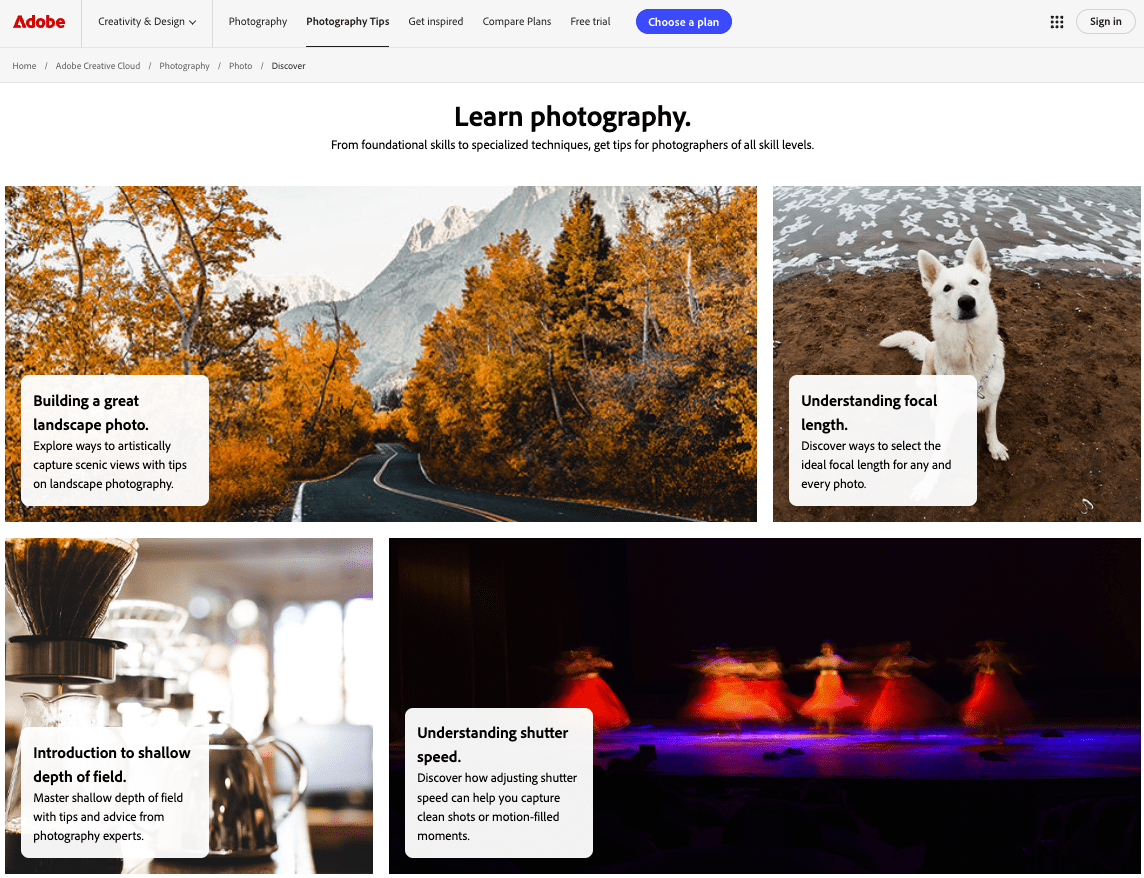
    To create a topic cluster, start with a seed keyword that serves as the main topic, such as “Photography,” and create a series of related topics.

    For example, Adobe provides a series of photography tips designed to educate users about and sell their products, such as Photoshop.

    adobeScreenshot from Adobe, March 2025

    By creating rich resource content, you can build a community of people who come to your brand, not just for products but also for thoughtful advice.

    As a bonus, leverage community forums to further engage and educate users with common troubleshooting concerns with your products.

    6. Leverage Backlinks To Boost Credibility & Rankings

    While backlinks are still a valuable ranking signal, I view backlinks as a more valuable promotion strategy.

    If you follow my content tips above, you will create many linkable assets that naturally accrue backlinks and can be used for promotion to earn more.

    For example, white papers, ebooks, surveys, studies, and tutorials are great resources for educating people and helping them cite information for their own research.

    However, to gain early exposure and build links to content, follow these actionable tips below:

    • Guest post on popular blogs and websites to generate buzz.
    • Promote educational content on paid channels, such as Facebook and Google.
    • Email educational content to relevant people in your industry to build awareness.
    • Contact resource pages for links to your software.
    • Conduct roundup interviews with industry professionals.
    • Promote surveys and studies through press releases or paid channels.

    7. Integrate SEO With Paid, Social & Product-Led Growth

    Finally, combine all of these strategies into an omnichannel strategy.

    Using a mix of PPC for brand exposure, content to build authority, and organic SEO to scale customer acquisition will provide the best strategy to scale an early-stage SaaS business.

    Furthermore, promoting high-level content like a white paper over advertisements, email, social media, and all other channels is a great way to earn exposure, build links, and drive traffic to your site.

    Combine your PPC and SEO keyword research to optimize your funnel and create a consistent marketing strategy that nurtures users from awareness to the decision stage.

    Bottom Line

    SEO and SaaS don’t just sound alike, but they truly do go together!

    While paid advertising is essential for early brand visibility, a strong SEO strategy creates a sustainable path to reduce dependency on paid channels and scale your online presence organically.

    Investing in SEO for enterprise SaaS brands should drive consistent, high-intent traffic while improving overall marketing efficiency and creating long-term ROI.

    More Resources:


    Featured Image: SergeyBitos/Shutterstock

    Wix Shares How To Optimize Enterprise Marketing via @sejournal, @martinibuster

    Search Engine Journal spoke with Paula Ximena Mejia, VP of Enterprise Marketing at Wix, about building high-performing enterprise marketing teams. She shared actionable strategies to achieve marketing goals and identify what holds a team back.

    The discussion focused on multiple topics, including:

    • Telltale signs of misaligned goals and inefficiencies
    • How to overcome resource constraints
    • Stakeholder engagement to improve collaboration
    • Tech audits
    • Best way to use of AI in a marketing team

    Reasons For Inefficiencies In Marketing Teams

    Emailing with Paula about enterprise marketing she made it clear that marketing inefficiencies arise from losing focus of the overall goal. What she describes can happen almost silently and affect the productivity and success of marketing teams without hardly noticing what’s going on.

    Paula shared:

    “Marketing teams frequently encounter inefficiencies because they lose track of the goal. There’s a reason why certain activities are designed and executed but throughout that process, the end goal can be lost. It’s important to eliminate siloed information, bottlenecks in workflows, and challenges in managing limited resources to keep eyes on the prize and end goal.”

    How To Address Misaligned Goals

    Misaligned goals is something that affects marketing teams of all sizes. Over a career spanning over 20 years this is something I’ve seen quite a bit as a consultant for B2B enterprise corporations all the way to smaller offices. It’s easy to be consumed by the process and mistake them for goals.

    I asked Paula what a company can do to avoid misaligned goals and one of things she touched on is pursuing trends that don’t align with broader priorities. She also mentioned “cross-functional collaboration” which is about getting employees that specialize in different areas to work together successfully on the same project.

    She shared:

    “Misaligned goals often emerge from unclear communication or when teams pursue trends that don’t align with broader organizational priorities. To avoid this, managers and team leads should focus on defining clear, measurable objectives that tie directly to business outcomes. It’s the project manager or team leads’ important role to make sure they understand senior leadership goals and establish processes for regular goal alignment by reviewing initiatives across teams and ensuring everyone is on the same page.

    Cross-functional collaboration is key. Engaging stakeholders early in strategy discussions can unify the team’s direction.

    Finally, leverage data analytics to measure progress and refine strategies, ensuring that efforts are always aligned with business goals.”

    Telltale Signs Of Inefficiencies And Misaligned Goals

    Are collaborative inefficiencies and misaligned goals problems that an organization is typically unaware of? Paula shared the warning signs to watch for.

    “Many organizations remain unaware of inefficiencies or misalignments until they manifest as missed deadlines or underperforming campaigns. It’s not uncommon for management to lose touch with some of the more day-to-day challenges so it’s important for them to be in constant communication with their teams about some of the below:

    • Keeping project timelines
    • Number of rounds of revisions which is commonly due to unclear communication
    • And inconsistent messaging across campaigns.

    Additionally, if teams are experiencing burnout or higher-than-average turnover, it’s a clear indication that resource constraints or inefficient processes need to be addressed.”

    Overcoming Resource Restraints

    Resource constraints are a common challenge, there is only so much a team can handle, right? I asked her if there is a framework or steps for helping a team get up and over those challenges.

    Paula advised:

    “Overcoming resource constraints begins with evaluating your team’s current bandwidth, skills, and tools to identify gaps. From there, it’s important to prioritize high-impact projects and delay or eliminate lower-priority tasks to free up resources.

    Structuring your team effectively is another step. Cross-functional teams provide agility, while specialists offer expertise in niche areas, so choose a structure that aligns with your goals.

    Outsourcing can also be a practical solution, allowing you to tap into external expertise without overburdening your team. Conducting a tech audit is essential to ensure your tools are optimized and integrated, eliminating redundancies and automating repetitive tasks.

    Lastly, continuously reviewing and refining team processes helps maintain adaptability and efficiency as market conditions evolve.”

    That last part about a tech audit is an interesting bit of advice. Sometimes there’s a better tool that can make life easier for a marketing team.

    Where Does AI Fit Into Enterprise Marketing?

    Speaking of tools that marketing teams can use, I next asked her how AI fits into a high functioning marketing team. She said that AI use is often a siloed task.

    Paula shared:

    “Marketing teams are still navigating how to leverage AI to its fullest potential. We use it all the time for specific tasks but it’s often a siloed task.

    The main thing I’m looking forward to this year is seeing AI tools that enable better cross collaboration across marketing teams. It’s important to approach AI as a tool that can help, and not use it to replace the human touch and creativity. The key is to strike a balance—use AI to enhance your processes while maintaining critical human judgment.

    As a marketer we’re still the ones in the driver’s seat and we have the responsibility to ensure that AI is being used correctly – and delivering quality.”

    I had recently listened to a podcast she participated in where she talked about AI silos, so I asked her to elaborate on how that affects marketing and for her advice on improving collaboration with teams that are using AI.

    She answered:

    “AI silos occur when individual teams or employees adopt AI tools independently without collaboration or integration. This leads to fragmented processes, duplicated efforts, and inconsistent outputs, all of which undermine marketing efficiency. The impact can prevent teams from leveraging shared insights and can create disjointed campaigns.

    To address this, organizations can centralize their AI strategy by appointing a project owner to oversee its implementation. Standardizing tools and processes ensures consistency, while cross-team training helps employees understand how to use AI collaboratively.

    Establishing regular check-ins to share insights and results can further strengthen teamwork and ensure that AI is driving value across the organization.”

    Advice For Building A High-Functioning Marketing Team

    Misaligned goals happen when teams prioritize trends or their own narrow objectives that may not align with the overall priorities of the project.

    Engaging stakeholders at the start of a project to establish shared objectives is key to keeping the entire team working together toward the same goal. Analytics can help track performance, help identify marketing gaps and identify where to refine a strategy to make it work better.

    Tech audits is a brilliant suggestion because it can improve the ability to reach objectives and milestones. Careful implementation of AI is important to ensure that the team is using it collaboratively instead of in silos.

    There’s a lot more to unpack in that interview, it may be useful to read it twice.

    Featured Image by Shutterstock/Golden Sikorka

    The One Thing SEO Agencies Need To Know About Winning Enterprise Clients via @sejournal, @danielkcheung

    One of the first questions my boss would ask when I was agency-side was “What’s your budget?”

    It’s an innocent enough question and one worth asking, but for enterprise clients, it’s putting the cart before the horse.

    As an agency, managing cash flow is one of the most challenging aspects of the job.

    Asking every lead for their budget is a practical way to plan for scalability. It allows you to compare your revenue runway against capacity and forecast when to scale headcount.

    But here’s the thing: This approach doesn’t work for enterprise clients.

    Here’s why:

    • You don’t understand how we budget internally (and when those conversations take place).
    • You don’t know how we orchestrate quarterly plans.
    • In some cases, we don’t know what we should do apart from knowing “SEO is important.”
    • And because of the above, the dependencies are unknown.

    We’d often get feedback from unsuccessful pitches along the lines of:

    • “You were one of the most technical-oriented pitches; it was clear you know your stuff.”
    • “Your analysis went far deeper than anyone else’s.”
    • “We decided to go with someone else who’s done it before.”

    We’d collectively put in 40-80 hours into a pitch and still lose out.

    So, what went wrong?

    • Was it our positioning?
    • Were we just included in the Request for Proposal (RFP) to make the procurement process seem less biased?
    • Or was it something else?

    The transition from agency-side to client-side opened my eyes to what I didn’t know. Unless you’ve worked in a large organization, you don’t know what you don’t know.

    00Winning an enterprise SEO account is attractive for many reasons:

    • Great for cash flow: Enterprises tend to pay the entire quarter or year’s retainer in full and in advance.
    • Authority: An enterprise client strengthens your agency’s reputation.
    • Broader experience: Working with enterprises exposes your team to large-scale operations.
    • Future opportunities: Having an enterprise client attracts more mid-market and enterprise clients.

    But winning the contract goes beyond a jazzy pitch deck, a well-practiced presentation, and impressive case studies.

    Agencies that win and retain enterprise work have a competitive edge: They understand how enterprise planning and budget cycles work.

    In other words, they have empathy.

    And this is what we’ll cover today so you can waste less time and win more by speaking the language of enterprise SEO.

    We’ll unpack why agencies miss the mark on enterprise RFPs, how enterprise budgets are finalized, and my 3A framework (Audit, Align, Advance) to position yourself as the right partner at the right time.

    Why Agencies Lose Enterprise RFPs

    You’ve poured 40-80 hours into crafting the perfect pitch. Your analysis was deeper than anyone else’s. Your technical expertise shone through.

    The feedback? “You were one of the most knowledgeable agencies we saw.”

    And yet, you didn’t win the deal.

    It’s frustrating, but it often boils down to this: You were the right partner – but you missed the mark on timing or positioning.

    Timing: It’s More Than Just Budget Cycles

    Enterprise budgets are locked in during annual planning cycles, typically in Q3 or Q4 of the prior year.

    If your pitch lands outside of these cycles, there’s no wiggle room for additional funding, no matter how compelling your proposal is.

    However, timing isn’t just about budget. Quarterly planning sessions often dictate tactical shifts based on performance or changing priorities.

    Agencies that fail to align with these rhythms miss the opportunity to position themselves as timely, relevant partners.

    Positioning: Expertise Without Overwhelming

    Winning an enterprise RFP isn’t just about showcasing your technical ability.

    The people evaluating your pitch might include marketers, department heads, procurement specialists, and executives – each with different priorities and levels of SEO knowledge.

    Agencies often stumble when they assume their technical brilliance will speak for itself. Overloading pitches with jargon or overly complex solutions can alienate decision-makers.

    The key to positioning yourself as the right partner is to:

    • Simplify the message: Translate SEO strategies into business outcomes that resonate with different stakeholders.
    • Show empathy: Address challenges in their language, whether that’s return on investment (ROI) for executives or workload reduction for department heads.
    • Build trust: Demonstrate that you’re not just an SEO expert – you’re a partner who understands how to drive their broader goals.

    By understanding these dynamics, you’ll not only craft pitches that resonate – you’ll avoid the frustration of hearing, “We went with someone else who’s done it before.”

    Budget Conversations Happen The Year Prior

    By the time you receive an RFP or Request for Quote (RFQ) from an enterprise, the budget is already set. Enterprises plan meticulously, typically finalizing budgets during Q3 or Q4 for the following fiscal year.

    Every dollar is earmarked, and leadership has already approved how resources will be distributed.

    The Anatomy Of Enterprise Budgeting

    Enterprise SEO budgets don’t exist in a vacuum. They’re part of a broader conversation that aligns product, marketing, and sales goals with tactical activities.

    For example:

    • Product teams: Prioritize new features or site enhancements.
    • Marketing teams: Focus on campaigns and content creation.
    • Sales teams: Push for lead generation and conversion support.

    In-house SEO professionals must advocate for their initiatives by tying SEO outcomes to these larger objectives.

    For agencies, this means stepping into a game that’s already in motion. If your pitch doesn’t align with these pre-established goals and budgets, it’s unlikely to succeed.

    What This Means For You

    Most agencies approach enterprise clients reactively, responding to RFPs after budgets are finalized. This is a missed opportunity.

    To win enterprise clients, you need to:

    • Understand their planning cycles: Engage in Q2 or early Q3 to influence the next budget cycle.
    • Speak to strategic objectives: Show how SEO supports broader product, marketing, and sales goals.
    • Build relationships before the RFP: Regularly connect with key stakeholders to position yourself as a partner – not just a vendor.

    How Quarterly Planning Fits In

    While annual budgets set the high-level framework, enterprises adjust tactics during quarterly planning.

    If your pitch aligns with a new quarterly priority – like shifting focus from content to technical SEO – you can insert yourself into the conversation even mid-year.

    For example, an in-house SEO might discover a drop in organic visibility during Q1 and advocate for technical improvements in Q2. If you’ve positioned yourself as a trusted advisor, you’ll be their first call when an additional budget is freed up.

    How To Win Enterprise Clients: My ‘3A’ Framework

    Audit: Start With A Test Budget To Uncover Hidden Opportunities

    Sometimes, enterprises come to you with a vague sense of urgency: “We know SEO is important, but we’re not sure where to start.” This isn’t a red flag – it’s an opportunity.

    Instead of diving straight into a full proposal, suggest starting with an audit. A test budget for an SEO audit allows you to:

    1. Identify the pain points they haven’t articulated yet.
    2. Highlight quick wins to build immediate trust.
    3. Map the unknown dependencies that could derail a larger project later.

    An audit positions you as a strategic advisor, not just a vendor. It shows that you understand the complexities of their business and want to align your recommendations with their priorities.

    Plus, by starting small, you lower the perceived risk for stakeholders who may be hesitant to commit significant resources right away.

    Here’s how you might pitch it:

    “Before we make any big decisions, let’s start with an audit. This will give us a clear roadmap of what’s working, what’s not, and where the biggest opportunities lie. It’ll also help us figure out how to align with your broader business goals.”

    Plus, you get paid.

    Align: Build Trust And Solve Dependencies Before You Pitch

    Enterprise RFPs often feel like a rush to the finish line: Deliver the pitch, seal the deal, and move on to execution. But rushing the pitch is one of the fastest ways to lose the deal.

    Before you pitch, take the time to:

    • Build trust with key stakeholders. Spend time understanding their challenges, their team dynamics, and their priorities. This is especially important when stakeholders aren’t sure what they need.
    • Solve unknown dependencies. Use conversations, discovery calls, or smaller projects (like the audit) to uncover potential roadblocks, such as IT constraints, compliance requirements, or overlapping vendor responsibilities.
    • Align on the scope of work. Make sure everyone understands what success looks like. If different departments have conflicting expectations, address them now – not after the project has started.

    Delaying the pitch isn’t about dragging your feet. It’s about doing the groundwork to ensure your proposal resonates.

    When you take the time to do this, your pitch becomes less about selling your services and more about demonstrating how you’ll solve their problems.

    Advance: Pitch With Confidence After Achieving Buy-In

    The biggest mistake agencies make is pitching too soon. A great pitch delivered at the wrong time is still a losing pitch.

    To win an enterprise client, wait until you’ve:

    • Mapped dependencies: Understand the internal and external factors that could impact your success, from IT limitations to stakeholder buy-in.
    • Understood the stakeholders: Know who needs to sign off on the project and what their priorities are. Tailor your pitch to address their specific concerns.
    • Aligned with the budget cycle: If you’ve done your homework, you’ll know whether the client has budget allocated – or if you need to position your work as a priority for the next cycle.

    When you pitch, focus on delivering a solution – not just a service. Show them how your expertise fits into their broader goals, aligns with their budget, and resolves the challenges they’ve been grappling with.

    Your pitch should feel like the natural conclusion of all the conversations you’ve had with them so far. It’s not about convincing them. It’s about confirming that you’re the right partner to help them achieve their goals.

    In Closing

    Winning enterprise SEO clients isn’t just about being the most technical or having the best case studies – it’s about timing, trust, and alignment.

    Start small, align early, and always put yourself in their shoes. Empathy wins enterprise SEO.

    More resources:


    Featured Image: PeopleImages.com – Yuri A./Shutterstock

    5 Key Enterprise SEO And AI Trends For 2025

    Artificial intelligence isn’t just influencing search – it’s fundamentally reshaping how users discover information and how search engines deliver results.

    This evolution presents extraordinary opportunities while adding more complexity for enterprise SEO organizations.

    How Enterprise SEO Has Changed

    Organizations are grappling with an environment where AI doesn’t just assist with search – it fundamentally shapes how every marketing function performs.

    To accommodate so many new search developments and the integration of AI applications, almost every enterprise organization will, at some point, have to elevate, restructure, and integrate their SEO departments deeper within their marketing, creative, and branding teams.

    Enterprise SEO is now pivotal to multiple channels and markets. Its integration with generative AI markets alone (not to mention content markets) means its total addressable market (TAM) grows.

    The Evolution Of AI-First Search

    The rapid progression of AI is redefining how organizations approach SEO.

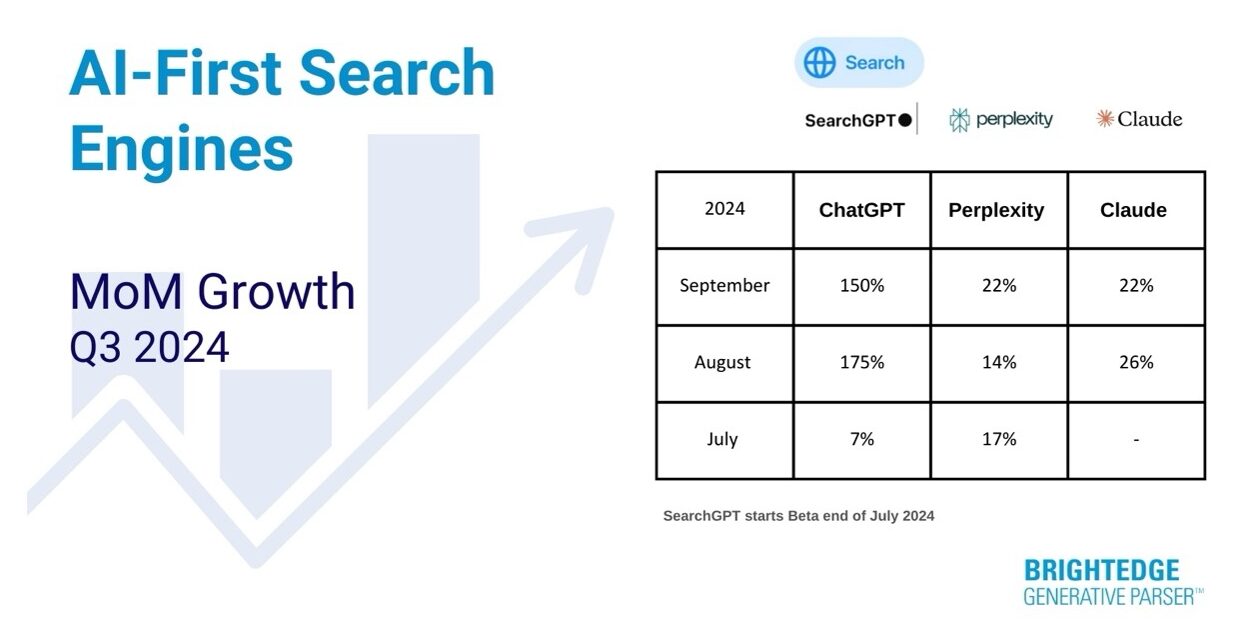
    Its integration into Google AI Overviews and the rise of new AI-first entrants like Perplexity and OpenAI’s ChatGPT Search have fundamentally shifted approaches from basic keyword matching to prioritizing user intent and delivering conversational, synthesized responses.

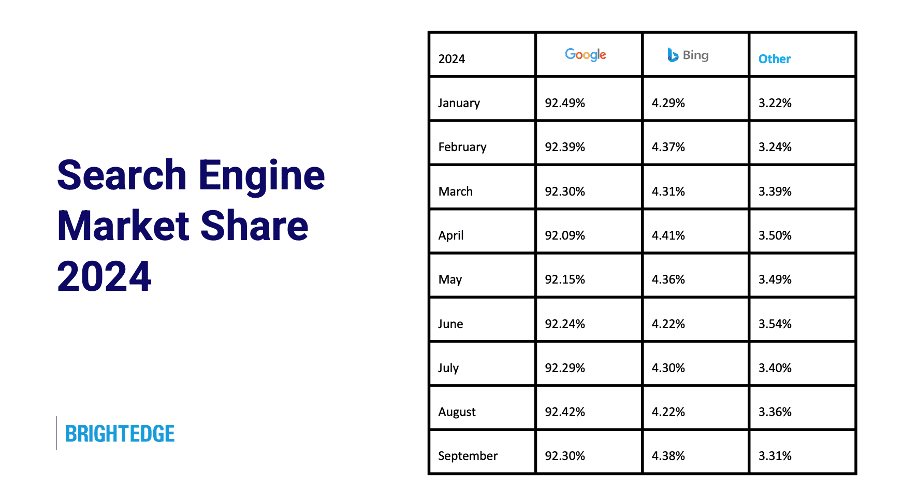
    While Google remains dominant with 92% market share, new entrants are growing at a rapid rate, which is expected to accelerate in 2025 and potentially impact market share.

    Image from BrightEdge, November 2024

    1. Understanding New Search Behaviors: Information And Assistance

    The way users interact with search has fundamentally transformed this year.

    We’ve moved beyond simple keyword queries to complex, contextual interactions that span multiple formats and devices.

    AI chatbots and generative AI are starting to impact search behavior as users expect search engines to understand their intent rather than just their words.

    People are using AI chatbots to find answers to questions while others – like Generation Z – look to social platforms to search.

    They are looking for conversations and new ways to interact in search.

    Critical Changes In Search Patterns

    Modern users are approaching search differently than ever before:

    • Conversational Queries: Natural language searches have increased dramatically.
    • Multi-Step Journeys: Users often conduct multiple related searches to achieve their goals.
    • Cross-Device Behavior: The average user switches between three devices during a single search journey.
    • Format Flexibility: Users freely mix text, voice, and visual search methods.

    In addition, shifts from Google and AI engines will mean organizations have to pivot for some major changes ahead:

    • Multiple platforms, from traditional search to AI-first answer engines and more.
    • Multiple search formats (text, voice, visual).
    • The integration of search and AI and video into multiple device types.
    • Different user journey stages and journeys between engines and AI chatbots.
    • New personalization requirements by engine, user preference, and use case.

    2. The Expanding AI & Search Landscape: Shaping Enterprise SEO’s Future

    We’re witnessing a fundamental shift from traditional keyword-based search to AI-powered discovery systems that understand and anticipate user needs.

    Unlike traditional search engines, AI-driven platforms provide holistic interpretations of user queries, offering detailed answers and anticipating potential follow-up questions.

    They are doing this in three ways:

    • Generative Search Results: Search engines now routinely generate custom responses rather than just linking to existing content. This means enterprises need to optimize not just for visibility but for click value.
    • Multimodal Search Integration: The ability to search using text, images, voice, and even video simultaneously is becoming standard. Enterprises must ensure their content is optimized for all these formats.
    • Real-Time Content Analysis: AI engines can now analyze and understand content in real time, making freshness and authenticity more important than ever.

    These shifts require enterprise SEO marketers to become more involved in creating authoritative, informative, and well-structured content to be found and cited by AI engines.

    This also expands to entrants like You.com, Brave as a privacy engine, and Anthropic’s Claude.

    And do not forget: social media platforms.

    Many platforms, such as Meta, are building AI-powered search engines. In Meta’s case, it is building a search index to complement its Meta AI chatbot and rely less on Google.

    As demographic understanding and targeting become essential, platforms like TikTok, Instagram, and Snap are prime for Gen Z searches and sources of information.

    Learn More: The Rise Of TikTok As A Search Engine

    Devices

    Worldwide, wearable device shipments will reach 537.9 million units by the end of the year. This is another rapidly developing market for enterprise SEO professionals to consider.

    The key to AR/VR, AI glasses, pins, and smart device success lies in consumer comfortability.

    The AI and wearable trend is not just about the device or gadget. It’s about creating a symbiotic relationship between humans and new AI technology – another consideration for 2025.

    Wider Big Tech Ecosystem Relationships

    And let’s not forget that, while there is competition in search, there are also partnerships that enterprise SEO marketers need to keep an eye on.

    Apple Intelligence and ChatGPT will be something to watch as AI and search reach more mobile devices.

    Amazon and Anthropic are making strides, catering to enterprises with their computer-to-computer autonomous digital agent.

    3. Understanding Different Engines And Different Use Cases

    Marketers will face a diverse ecosystem where multiple AI-powered platforms serve different user needs and search intentions.

    AI-driven engines like Google AIO, ChatGPT, and Perplexity have introduced diverse ways of searching for and consuming information.

    Here are the three main ways for the purpose of this article.

    Image from BrightEdge, November 2024

    Google AI Overviews

    Google’s entry into this space with AI Overviews shows how traditional search is evolving.

    These AI summaries appear at the top of search results, giving users quick insights while maintaining access to traditional search features.

    AI Overviews summarize search results for users, often highlighting authoritative sources and presenting concise answers at the top of the search page.

    • Functionality: Google’s AI Overviews provide AI-generated summaries at the top of search results, offering quick insights into products and trends.
    • User Experience: Combines AI-generated summaries with traditional search results, providing users with comprehensive insights and direct links to various retailers and sources.
    • Advantages: Google’s extensive search database, local business information, and real-time index.

    Perplexity

    Its strength lies in how it weaves citations directly into its answers, creating quick summaries that users can trust.

    Think of it as having a research assistant who finds information and shows exactly where it came from. This makes it incredibly useful for comparing different sources and gathering reliable information quickly.

    • Functionality: Perplexity AI is a conversational search engine that uses large language models to answer queries, generating answers using sources from the web and citing links within the text response.
    • User Experience: Delivers concise, AI-generated summaries with citations, aiding users in quick comparisons and information gathering.
    • Advantages: Efficient for obtaining summarized information with citations, making it easier for users to verify sources.

    ChatGPT Search

    Uses Bing’s live index to surface real-time results. It is now integrated into ChatGPT Search; its conversational approach and transparent citations allow users to find relevant, up-to-date information efficiently.

    • Functionality: OpenAI’s ChatGPT Search integrates real-time web search capabilities into its AI chatbot, providing up-to-date information on products, prices, and availability.
    • User Experience: A conversational response with direct links to sources facilitates an engaging user experience.
    • Advantages: Provides personalized assistance and detailed product information, enhancing user decision-making.

    Learn More: AI Agnostic Optimization: Content For Topical Authority And Citations

    4. Maintaining Technical SEO While Building Content For Authority

    While AI and new technologies continue to reshape the search landscape, the fundamental technical principles of SEO remain crucial for success.

    Making Content AI-Readable

    The foundation of effective AI optimization will lie in implementing robust structured data and schema markup.

    These technical elements are a translation layer between your brand, content, and AI systems. With schema markup, you’re essentially providing AI engines with a roadmap to understand:

    • Customer Q&As and help resources.
    • Detailed product specifications and features.
    • User feedback and testimonials.
    • Content creator expertise and qualifications.

    Building Digital Trust And Authority

    Success in AI-powered search requires establishing strong content credibility.

    Modern AI search platforms evaluate authority through multiple lenses – not just traditional metrics like backlinks but also information accuracy and source reliability.

    Establishing Source Credibility

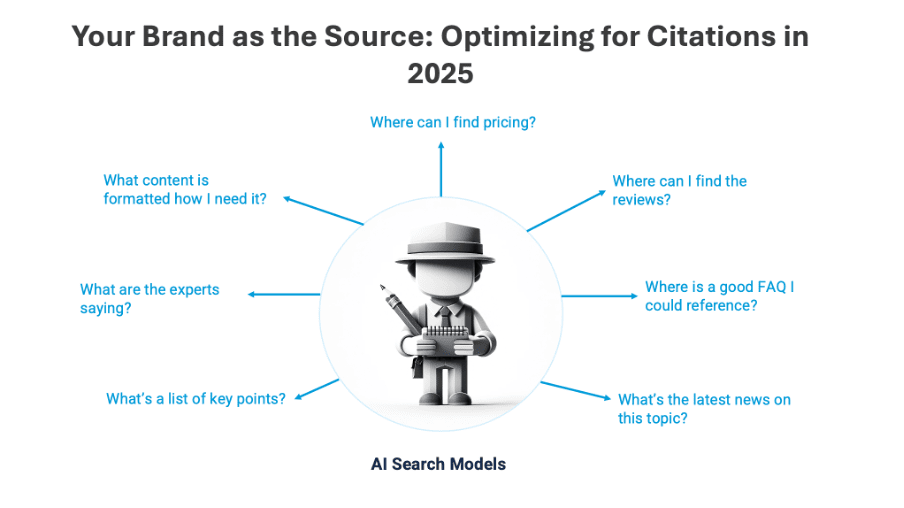
    AI search engines place significant weight on content from verified, authoritative sources. This shift means content creators must focus on building and maintaining their reputation as trusted information providers.

    Image from BrightEdge, November 2024

    Authority Building And Enterprise SEO

    1. Expert-Driven Content Development: Partner with subject matter specialists to create in-depth, authoritative content. Highlight the author’s expertise through detailed biographical information and credentials.
    2. Strategic Link Building: While the role of backlinks has evolved, they remain valuable trust signals. Focus on cultivating relationships that lead to natural link placement from respected industry websites and thought leaders.
    3. Platform Integration: Align your content strategy with established authorities in your field. Whether it’s academic institutions for educational content or recognized medical resources for health information, ensure your material complements and connects with these trusted platforms.

    5. Mastering New Visual Formats: The Rise Of Multimodal Search

    Text-based search is no longer the sole player in the field. Multimodal search, which combines text, voice, image, and video, will become standard practice.

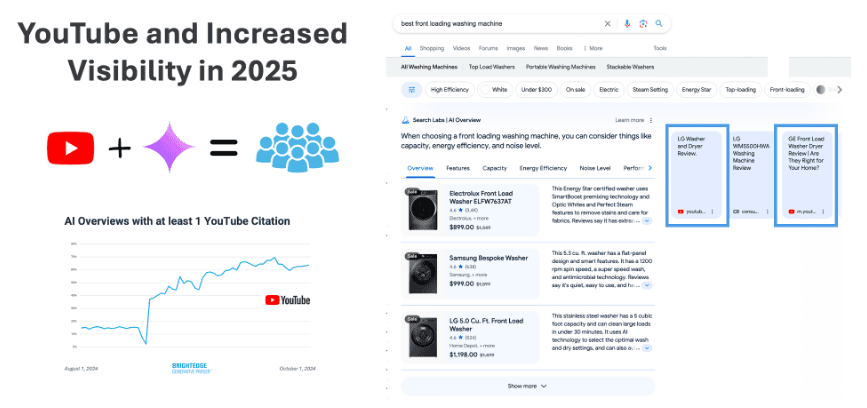
    BrightEdge observed a 121% increase in ecommerce-related YouTube citations for AI Overviews.

    Due to the multimodal nature of generative AI, this means that the AI is capable of “watching” a video and using the content in it to help formulate an answer.

    Unlike traditional search, where transcripts or metadata around a video are necessary to ensure rankings, AI can seamlessly pivot between video and text.

    Image by author (with sources from BrightEdge and Google Search), November 2024

    Enterprises must expand their SEO strategies to include diverse content types and ensure their assets are optimized for video, visual, and voice-activated searches.

    Speak Your Audience’s Language

    As voice-activated searching becomes mainstream, content needs to mirror natural conversation patterns.

    Instead of focusing solely on traditional keyword optimization, craft content that answers questions the way people actually ask them.

    Think about the difference between typing “best Italian restaurants in San Mateo” versus asking, “Where can I find authentic Italian food near me in San Mateo?” Your content should address both.

    Create More Rich Media Experiences

    Get visual with your storytelling and transform your SEO and content strategy by incorporating compelling visual elements that enhance user understanding:

    • Professional photography.
    • Custom graphics that explain complex concepts.
    • Video demonstrations that showcase expertise.

    Make Your Media AI-Friendly For Enterprise SEO Success

    Help AI systems understand and properly index your multimedia content by:

    • Implementing detailed technical markup for videos and images.
    • Creating comprehensive media descriptions that provide context.
    • Ensuring all media elements support and enhance your main message.

    Enterprise SEO Focus On The Now And The Future

    While Google still dominates, marketers should continue to focus on balancing traditional search and AI Overviews while optimizing for high-growth alternative engines.

    While multiple legal trials and cases across the whole search and AI landscape take place, as marketers, we need to focus on the now while always preparing for pivots.

    In 2025, Enterprise SEO professionals need to focus on:

    • Managing enterprise SEO with all marketing disciplines – site-to-brand teams.
    • Internal governance and alignment on the use of AI for SEO and content.
    • Utilizing AI correctly for insights, creation, optimization, and scale automation.
    • CEO and CMO stakeholder management and help guide and understand search and AI changes and their importance to your site(s) and brand performance.
    • All to ensure your brand is cited and sourced as the authority in your domain regardless of the search or AI engine.

    The complexity of modern enterprise SEO will demand a new organizational approach. Success requires seamless integration between SEO, content, technical teams, and AI specialists.

    Monitoring, adapting, and growing are the three “keywords” to have a conversation around.

    More resources:


    Featured Image: tadamichi/Shutterstock

    18 Essential Accessibility Changes To Drive Increased Website Growth via @sejournal, @skynet_lv

    This post was sponsored by “Skynet Technologies USA LLC”.

    Did you know that 1 billion people have not reached you or your customers’ websites yet.

    1 billion potential customers are waiting for businesses to step up and do what’s right.

    Find out if your website is accessible to 1 billion people >>>

    Accessibility isn’t just a compliance checkbox anymore – it’s a growth strategy.

    The demand for scalable, innovative accessibility solutions has skyrocketed.

    And your competition is already making these improvements.

    For agencies, this means an unprecedented opportunity to meet clients’ needs while driving revenue.

    Learn how you can generate additional revenue and boost your clients’ SERP ranking by gaining access to:

    Ready to get started?

    How Accessibility Improvements Can Increase Growth

    The digital economy thrives on inclusion.

    There is a large market of individuals who are not included in modern website usability.

    With over a billion people globally living with disabilities, accessible digital experiences open doors to untapped markets.

    Do Websites Need To Be Accessible?

    The short answer is yes.

    How Does An Accessible Website Drive Traffic?

    Traffic comes from people who have needs. Of course, everyone has needs, including people with disabilities.

    Accessible websites and tools cater to all users, expanding reach to a diverse and often overlooked customer base.

    Global Potential & Unlocking New Audiences

    From a global perspective, the global community of people with disabilities is a market estimated to hold a staggering $13 trillion in spending power.

    By removing barriers and ensuring inclusive digital experiences, you can tap into this 1 billion-person market and drive substantial economic growth.

    Digital accessibility helps to increase employment opportunities, education options, and simple access to various banking and financial services for everybody.

    Boosts User Experience & Engagement 

    Accessibility improvements run parallel with SEO improvements.

    In fact, they often enhance overall website performance, which leads to:

    • Better user experience.
    • Higher rankings.
    • Increased traffic.
    • Higher conversion rates.

    Ensures Your Websites Are Compliant

    Increasing lawsuits against businesses that fail to comply with accessibility regulations have imposed pressure on them to implement accessibility in their digital assets.

    Compliance with ADA, WCAG 2.0, 2.1, 2.2, Section 508, Australian DDA, European EAA EN 301 549, UK Equality Act (EA), Indian RPD Act, Israeli Standard 5568, California Unruh, Ontario AODA, Canada ACA, German BITV, Brazilian Inclusion Law (LBI 13.146/2015), Spain UNE 139803:2012, France RGAA standards, JIS X 8341 (Japan), Italian Stanca Act, Switzerland DDA, Austrian Web Accessibility Act (WZG) guidelines aren’t optional. Accessibility solution partnerships ensure to stay ahead of potential lawsuits while fostering goodwill.

    6 Steps To Boost Your Growth With Accessibility

    1. To drive growth, your agency should prioritize digital accessibility by following WCAG standards, regularly testing with tools like AXE, WAVE, or Skynet Technologies Website Accessibility Checker, and addressing accessibility gaps. Build accessible design frameworks with high-contrast colors, scalable text, and clear navigation.
    2. Integrate assistive technologies such as keyboard navigation, screen reader compatibility, and video accessibility. Focus on responsive design, accessible forms, and inclusive content strategies like descriptive link text, simplified language, and alternative formats.
    3. Providing accessibility training and creating inclusive marketing materials will further support compliance and growth.
    4. To ensure the website thrives, prioritize mobile-first design for responsiveness across all devices, adhere to WCAG accessibility standards, and incorporate keyboard-friendly navigation and alt text for media.
    5. Optimize page speed and core web vitals while using an intuitive interface with clear navigation and effective call-to-action buttons, and use SEO-friendly content with proper keyword optimization and schema markups to boost visibility.
    6. Ensure security with SSL certificates, clear cookie consent banners, and compliance with privacy regulations like GDPR and CCPA. Finally, implement analytics and conversion tracking tools to gather insights and drive long-term growth.

    We know this is a lot.

    If this sounds good to you, let us help you get set up.

    How Can Digital Accessibility Partnerships Supercharge Your Clients’ SEO?

    Partnering for digital accessibility isn’t just about inclusivity — it’s a game-changer for SEO, too!

    Accessible websites are built with cleaner code, smarter structures, and user-friendly features like alt text and clear headings that search engines love.

    Plus, faster load times, mobile-friendly designs, and seamless navigation keep users engaged, reducing bounce rates and boosting rankings. When you focus on making a site accessible to everyone, you’re not just widening your audience—you’re signaling to search engines that the website is high-quality and relevant. It’s a win-win for accessibility and SEO!

    12 Essential Factors To Consider For Successful Accessibility Partnerships

    1. Expertise: Look for a provider with a proven track record in digital accessibility, including knowledge of relevant global website accessibility standards and best practices.
    2. Experience: Consider their experience working with similar industries or organizations.
    3. Tools and technologies: Evaluate their use of automated and manual testing tools to identify and remediate accessibility issues.
    4. Price Flexibility: Explore pricing models that align with both the budget and project requirements. Whether for a single site or multiple sites, the service should be compatible and scalable to meet the needs.
    5. Platform Compatibility: Ensure seamless accessibility integration across various platforms, providing a consistent and accessible experience for all users, regardless of the website environment.
    6. Multi-language support: Enhance user experience with global language support, making websites more inclusive and accessible to a global audience.
    7. Regular check-ins: Schedule regular meetings to discuss project progress, address any issues, and make necessary adjustments.
    8. Clear communication channels: Establish clear communication channels (for example: email, and project management tools) to facilitate efficient collaboration.
    9. Transparent reporting: Request detailed reports on the progress of accessibility testing, remediation efforts, and overall project status.
    10. KPIs to measure success: Review the partner’s historical data, especially those similar projects in terms of scale, complexity, and industry.
    11. Evaluate technical expertise: Assess their proficiency in using various accessibility testing tools and ability to integrate different APIs.
    12. Long-term partnership strategy: Compare previous data with the current one for improvement and optimization process. It is crucial for a long-term partnership that there is a specific interval of review and improvements.

      Scaling Accessibility With Smart Partnerships

      All in One Accessibility®: Simplicity meets efficiency!

      The All in One Accessibility® is an AI-powered accessibility tool that helps organizations to enhance their website accessibility level for ADA, WCAG 2.0, 2.1, 2.2, Section 508, Australian DDA, European EAA EN 301 549, UK Equality Act (EA), Indian RPD Act, Israeli Standard 5568, California Unruh, Ontario AODA, Canada ACA, German BITV, Brazilian Inclusion Law (LBI 13.146/2015), Spain UNE 139803:2012, France RGAA standards, JIS X 8341 (Japan), Italian Stanca Act, Switzerland DDA, Austrian Web Accessibility Act (WZG), and more.

      It is available with features like sign language LIBRAS (Brazilian Portuguese Only) integration, 140+ multilingual support, screen reader, voice navigation, smart language auto-detection and voice customization, talk & type, Google and Adobe Analytics tracking, along with premium add-ons including white label and custom branding, VPAT/ACR reports, manual accessibility audit and remediation, PDF remediation, and many more.

      • Quick Setup: Install the widget to any site with ease—no advanced coding required.
      • Feature-Rich Design: From text resizing and color contrast adjustments to screen reader support, it’s packed with tools that elevate the user experience.
      • Revenue Opportunities: Agencies can resell the solution to clients, adding a high-value service to their offerings while earning attractive commissions through the affiliate program.
      • Reduced development costs: Minimizes the financial impact of accessibility remediation by implementing best practices and quick tools.

      Agency Partnership: Scaling accessibility with ease!

      • Extended Service Offerings: The All in One Accessibility® Agency Partnership allows agencies to offer a powerful accessibility widget – quick accessibility solution into their services, enabling them that are in high demand.
      • White Label: As an agency partner, you can offer All in One Accessibility® under their own brand name.
      • Centralized Management: It simplifies oversight by consolidating accessibility data and reporting, allowing enterprises to manage multiple websites seamlessly.
      • Attractive Revenue Streams: Agencies can resell the widget to clients, earning significant revenue through competitive pricing structures and repeat business opportunities.
      • Boost Client Retention: By addressing accessibility needs proactively, agencies build stronger relationships with clients, fostering long-term loyalty and recurring contracts.
      • Increase Market Reach: Partnering with All in One Accessibility® positions agencies as leaders in inclusivity, attracting businesses looking for reliable accessibility solutions.
      • NO Investment, High Return: With no setup costs, scalable features, and up to 30% commission, the partnership enables agencies to maximize profitability with their clients.

      Affiliate Partnership: A revenue opportunity for everyone!

      The All in One Accessibility® Affiliate Partnership program is for content creators, marketers, accessibility advocates, web professionals, 501 (c) organizations (non-profit), and law firms.

      • Revenue Growth through Referrals: The All in One Accessibility® affiliate partnership allows affiliates to earn competitive commissions by promoting a high-demand accessibility solution, turning referrals into consistent revenue.
      • Expanding Market Reach: Affiliates can tap into a diverse audience of businesses seeking ADA and WCAG compliance, scaling both revenue and the adoption of accessibility solutions.
      • Fostering Accessibility Awareness: By promoting the All in One Accessibility® widget, affiliates play a pivotal role in driving inclusivity, helping more websites become accessible to users with disabilities.
      • Leveraging Trusted Branding: Affiliates benefit from partnering with a reliable and recognized quick accessibility improvement tool, boosting their credibility and marketing impact.
      • Scaling with Zero Investment: With user-friendly promotional resources and a seamless onboarding process, affiliates can maximize returns without any costs.

      Use Accessibility As A Growth Engine

      Endeavoring for strategic partnerships with accessibility solution providers is a win-win for agencies aiming to meet the diverse needs of their clients. These partnerships not only enhance the accessibility of digital assets but also create opportunities for growth, and loyalty, top search engine rankings, boost revenue, improve compliance with legal standards, and make you to contribute into digital accessibility world.

      With Skynet Technologies USA LLC, Transform accessibility from a challenge into a revenue-driving partnership. Let inclusivity power the success.

      Ready to get started? Embarking on a digital accessibility journey is simpler than you think! Take the first step by evaluating the website’s current WCAG compliance with a manual accessibility audit.

      For more information, Reach out hello@skynettechnologies.com.


      Image Credits

      Featured Image: Image by Skynet Technologies. Used with permission.

      What An Enterprise Client Wants From Their SEO Agency via @sejournal, @danielkcheung

      A lasting relationship with an enterprise client is good for business. It gives you authority, it gives your staff exposure to how large organizations work, and there should be a financial element.

      But winning the pitch is just the beginning. Many agencies make the grave mistake of misunderstanding their role in the relationship, and it is this: The relationship is transactional – at least, at first.

      This is what an enterprise client needs from you:

      • Clear, consistent communication.
      • Alignment with business objectives.
      • Flexibility.
      • Integrity.
      • Operational efficiency and responsiveness.
      • Proactive problem-solving.

      In many ways, these six things overlap on a Venn diagram. And when you get it right, we will see you not as an external vendor but as an extension of ourselves.

      1. Clear, Concise Communication

      Enterprise clients don’t just want emails or reports. They want clarity, alignment, and confidence that you’re on the same page.

      If they’re left guessing what’s happening, you’re failing.

      Always ask yourself: What is the message you wish to convey?

      Oftentimes, less is more.

      Instead of a lengthy email, sometimes a 15-minute Teams call will not only address the topic but also the bigger picture and the next steps. But this doesn’t mean long emails don’t have a place—they do.

      Context is everything.

      I get it – it’s purely subjective from one point-of-contact to the next. But that’s the name of the game.

      Be adaptable, and don’t assume. Reach out and ask how your point-of-contact prefers to communicate.

      At the start of every engagement, even when I was agency-side, I would ask for clear directions on ways of working.

      And lastly, before you hit send, ask yourself: Does this have to be mentioned/asked/challenged right now?

      How to do this effectively:

      • Send a pre-read ahead of time. Strive for two business days ahead of time, 24 hours worse case.
      • Include an executive summary at the beginning of every presentation. There is nothing worse than having skim reading a deck full of slides without an executive summary. I’m busy. My boss is busy; their boss is busy. If you’ve made the effort to create a presentation deck, put a TL;DR at the front for us.
      • Sign up to use the same team collaboration app as your client for quick updates. Most people don’t reply to emails immediately. Instant messaging such as Slack or Teams? Completely different rules. Plus, I speak from personal experience that shooting a Slack message in a dedicated channel takes far less mental bandwidth than crafting an email. The best part is that it works both ways, so win-win!

      Here’s the truth: Great communication reduces friction, builds trust, and keeps you in the loop when priorities shift.

      2. Alignment With Business Goals

      Increasing quarter-on-quarter traffic is nice. Rankings are cool. But if you’re not moving the needle on their actual business goals – revenue, customer retention, market share – you’re just noise.

      The biggest lesson I learned when moving agency-side to client-side was this: If your recommendation doesn’t ladder up directly to business goals, then you’re wasting everyone’s time with your research, audits, and recommendations.

      And, as SEO professionals, we default to problem identification mode because that’s how most of us got started. That is, find all the problems related to a particular pillar (e.g., content, technical SEO, off-page) and mistake this list as the strategy.

      This is what I did the first week I started my first enterprise SEO role.

      I fired up Screaming Frog and found all the things.

      But I had no context as to who was responsible for resolving each issue and what their priorities were.

      What may seem like an important SEO activity may not be a business priority.

      How to do this effectively:

      • Transparency goes both ways. Just as an enterprise client expects you to be transparent, you can as well by asking what their strategic pillars are for the quarter or year. To go a step further, get tangible guidance by requesting your point-of-contact what their objectives and key results (OKRs) are. Trust me, they’ll have them because that’s corporate life.
      • Bring the right people along the journey. If you wish to propose adding content, ask your point-of-contact what stakeholders are involved in making this change happen. If you’ve discovered crawling, indexing, and rendering issues, ask who can make changes to robots.txt, to the , and to the frontend stack. Chances are, they’re all separate teams who work in their own silos and backlogs.

      The lesson is this: Your role is not to fix all the things because you simply cannot. Instead, take a minute to understand who’s who because even your point-of-contact is an advocate, not an executioner.

      Why this matters: Clients don’t want SEO in a silo. We want strategies that tie into our biggest priorities.

      Why? Because our performance review and bonuses rely on them. So, speak our language and show us how SEO helps us win.

      3. Flexibility

      Markets change. Leadership changes direction. Enterprise clients want partners who can adapt to their evolving needs without skipping a beat.

      I don’t care that you’ve sunk 80 hours into something I asked you to do. I only care about what is top-of-mind right now.

      It’s nothing personal. I probably feel frustrated, just as you are. But priorities shift, so learn to go with the flow and be an asset instead of a blocker.

      When you’ve got my back, I’ve got yours because we’re in this together.

      The key: Be agile. Show that you’re not just a plan-follower but a partner who can pivot without losing focus on results.

      4. Integrity

      Integrity is the currency of trust. Enterprise clients need to know they can rely on you to tell the truth, even when it’s inconvenient or uncomfortable.

      If there’s a mistake, own it. If timelines slip, address it early. If you think the client’s ask won’t work, say so – and back it up with data or reasoning. The worst thing you can do is over-promise and under-deliver.

      Recently, a vendor blamed their lack of access to a Sharepoint file.

      Perhaps it was true; Sharepoint can be fickle with external vendors. But the fact that this was their explanation when I asked why there was a delay in the delivery disappointed me greatly.

      In my mind, I assumed they were overextended and did not get around to the task.

      There’s a really easy fix to this: Every time your client shares a file with you, open it and see if you have the required access. Don’t wait two weeks later because that’s too late and sends a very bad message.

      Similarly, not all campaigns go to plan. For example, perhaps your digital PR campaign didn’t produce the results you expected. That’s fine.

      The second worst thing you can do is lie about it. The worst thing you can do is buy backlinks to pad the numbers.

      Enterprise search marketers know that there are no guarantees with Google. What my boss, their boss, and their boss expect are learnings.

      What did we learn from this exercise?

      What can we do better next time?

      Did we document what we didn’t plan and why in a wiki so that we don’t make the same investment in something that doesn’t work?

      The flip side of this is to stand up for yourself because I’m not looking for a lackey. Not every idea I come up with is appropriate, and I expect – no, rely on – you to tell the truth even when it’s inconvenient or uncomfortable.

      5. Operational Efficiency And Responsiveness

      Enterprise projects are a symphony of moving parts, and delays in one area can cascade into chaos. Your job is to deliver fast, precise work while minimizing bottlenecks.

      I think most enterprise SEO professionals will agree with me on this – my calendar is full. On some days, it’s literally back-to-back meetings with different stakeholders.

      I don’t have the time or mental bandwidth to hold your hand.

      When I give you a task, speed matters – not just for execution but for acknowledgment. A simple “We’re on it, here’s when you can expect an update” goes a long way in showing you’re reliable.

      Efficiency isn’t just about working quickly – it’s about working smart. Streamline processes, remove redundancies, and bring structure to chaos. Help us feel like we’re in capable hands, no matter how derailed the project gets.

      The play: Deliver fast, precise work, and be responsive. They’ll keep coming back to the agency that gets it done.

      6. Proactive Problem-Solving Without Access To First-Party Data

      Enterprise clients often operate in silos, and as an external agency, you’re rarely handed direct access to our analytics platforms.

      Limited access to first-party data is the norm, but that doesn’t excuse you from identifying issues or presenting solutions.

      The best agencies thrive under constraints. If you don’t have access to first-party data, get creative with proxies. Use publicly available tools, competitive analysis, and trend data to craft recommendations.

      When possible, suggest ways the client can share aggregated insights or anonymized data that protect internal policies while giving you enough to work with.

      Your goal is to demonstrate that you can solve problems without needing to see everything. And if data gaps are creating risks, flag them early.

      Be proactive in suggesting solutions, such as data clean rooms or integrations that can provide the insights you need without breaching compliance.

      Do this instead: Leverage external data sources.

      If there’s one thing I know from working agency-side, it is that you have access to all the tools. So, pull insights from other data sources to identify patterns and opportunities.

      Why this matters: First-party data is a privilege, not a given. By showing that you can deliver value despite limitations, you position yourself as a resilient, resourceful partner who doesn’t let obstacles stand in the way of results.

      The 6 Pillars Of Enterprise SEO Success

      Enterprise clients don’t just want vendors. We want long-term partners because procurement and onboarding are painful.

      Here’s what we value most:

      • Clear communication that aligns and inspires.
      • Strategies tied directly to business outcomes.
      • Agility in the face of shifting priorities.
      • Integrity and transparency in every interaction.
      • Efficiency that respects our time and resources.
      • Creative problem-solving that delivers results, even under constraints.

      Master these six pillars, and you’ll become more than a service provider. You’ll be a partner we fight to keep.

      More resources:


      Featured Image: wee dezign/Shutterstock

      Voice Search Optimization At Scale: A Guide For Enterprise Marketers via @sejournal, @makhyan

      Smartphones put the world at our fingertips. People have questions that need answering, as well as the services or products they need.

      All of these things are just a search away, and now, we’ve seen a cosmic shift from traditional search to voice search and voice assistants.

      Statistically, voice search and assistants are not something that enterprise marketers can ignore because:

      • Almost half of U.S. internet users (48.7%) will use voice assistants, according to eMarketer forecast.
      • 54% of consumers are leaning towards voice technology in the future.
      • 49% of U.S. consumers use voice-enabled searches for local services.

      Voice optimization at scale is what every business should be doing. For enterprises, the challenge is scale due to the wealth of content assets they control.

      In this guide, we’ll take a look at specific tactics and optimizations that will support your voice strategy, including schema markup, keyword research, site speed, FAQs, Google Actions, and more.

      Here’s how to begin optimizing for voice searches, with a focus on enterprises.

      Voice Optimization 101

      Create Content And Voice Search Guidelines

      Marketing teams should sit down with the content team or send guidelines outlining the importance of voice search optimization, incorporating these keywords and protocols to ensure optimization.

      Enterprises should have SEO governance in place already.

      However, you’ll need to revise your existing governance and protocols for voice search. In fact, you want to add entire sections that focus primarily on voice.

      Why?

      Content creators and teams are bound to make mistakes.

      It’s up to your protocols to find issues with content by performing thorough content checks.

      Analyzing content before it’s published should be part of your processes already.

      If it’s not, you can add in:

      • Thorough content review before posting.
      • Optimization analysis.
      • Comparing content to researched keywords and questions.

      Guidelines are a key part of every aspect of enterprise marketing because team members can come and go so often.

      Redefine Your Keyword Research To Incorporate Long-Tail Keywords

      Here’s some good news: Assistants are smarter than ever before. Today’s voice assistants can understand a person’s voice even with:

      • Background noise.
      • Diverse accents.
      • Dialects.

      Hyper-personalization is prominent in the way assistants respond to users, which means enterprises must gather as much data and information about their ideal target market as possible.

      You have to go the extra mile to understand your audience and their needs to optimize for voice.

      For voice assistants, you have to push your SEO further because, instead of simple queries, people are asking complex questions to voice assistants like they would to a friend.

      How?

      Adding in more of the long-tail keywords that have long been neglected on the enterprise level.

      Long-tail keywords often have lower search volumes and are less of a priority for enterprises that target high-value and high-traffic keywords. However, voice search is natural and longer than just one- or two-word phrases.

      Your pages need to answer questions (just like featured snippets do) and should include:

      • How do I use XYZ product?
      • How much do XYZ products cost?
      • How do I fix XYZ problem?
      • Where.
      • Who.
      • What.
      • Etc.

      People using search are asking questions, and you need to answer them. Redefine your keyword research process to include more long-tail keywords and question keywords.

      Create processes and procedures for SEO teams – internal and external – to incorporate questions into your current content creation process.

      Multimodal Search Optimization And The Rise Of Visual Search

      Visual search isn’t exactly new. You take a picture, pop it into Google Lens, and it tries to find a match for you.

      For example, that adorable dog bed that you saw at your friend’s house? You can take a photo and search for the exact item on Google.

      But, at the I/O developer conference in 2024, Google added something new to Google Lens.

      • You shoot a video.
      • Ask questions in the video.
      • Get an answer back.

      Users can take a video of their broken toilet and ask why the flange is stuck and what they need to fix it – all in video format. Google will now analyze the video and respond to you.

      Vision language models (VLMs) are advancing, but enterprises will need to focus on other multimodal searches, too:

      • Text-to-image search.
      • Image-to-text search.
      • Image-to-image search.

      Envision an enterprise for high-end luxury apparel.

      A user uploads an image of a floral pattern and adds the query, [floral dress in this style but with blue roses], and a return query may show your product.

      Clear visuals with the proper description optimization may help the enterprise rank for this type of multimodal visual search.

      Optimize For Site Speed And Mobile Experience

      Voice searches come primarily from mobile and assistant devices.

      Every enterprise must optimize heavily for mobile with:

      • Responsive designs.
      • Fast site speeds.

      Your team should periodically run Google PageSpeed Insights to find issues slowing down your site and to improve load time.

      Multimedia optimization is crucial, especially with the rise of multimodal search. Compressing images and videos, implementing lazy loading, and browser caching are all things that you can begin doing today to improve the mobile experience on your site(s).

      See 10 Enterprise Page Speed Optimizations & Implementation Tips to learn more.

      Optimize For Local Search To Boost Business

      Local and regional optimizations are huge for businesses that operate locally.

      Over 50% of people search for local businesses via voice search.

      For example:

      • Where is the nearest Subway near me?
      • What grocery stores are open nearby?
      • Where is the closest pharmacy?

      You’ll want to review the enterprise’s Google and other local listings.

      Listings should always include the company’s operating hours, short blurbs, and photos.

      Complete listings make it easier for searchers to reach out to your business or visit it in person.

      Terms may include “near me” phrases, or they can be specific, such as [car manufacturers in Detroit].

      One tip crucial to an enterprise’s success when optimizing for local is to account for regional or area slang.

      Your research teams should understand local slang and dialects that may be used in a search.

      For example, [where can I get the best soda in Boston] will change to [where can I get the best pop in Ohio] due to regional slang.

      Internal teams should help you create these distinctions before moving into new markets to help content creation and search engine optimization teams maximize local voice search potential.

      In the last few years, voice assistants have nearly doubled. From your iPhone and Android to Alexa and other platforms, assistants are everywhere.

      Personal preferences are taken into consideration, as well as your location across all three types of searches:

      1. Discovery: Find a plumber in Atlanta, Georgia.
      2. Direct: Call Bill’s 24/7 Plumbing and Septic.
      3. Knowledge: Why is my water turning brown in Atlanta?

      Conversational phrasing must be considered across all enterprise offices to help capture as much local search traffic as possible.

      Enterprises must do more for voice searches than just claim and optimize their listings on Google Business Profile, Apple Business Connect, Yelp, and other local directories.

      You need to focus on long-tail keywords, refine your keyword research even further, and try to add context to your content.

      Master Schema Markup To Add Content Context

      Leveraging schema is crucial to help search engines make sense of an enterprise’s site content. Review and incorporate schema markup guidelines to help boost voice search.

      A few tips that can help you master schema are:

      • Start using Google’s Speakable Schema (beta) for sections of your text that are best for Google Assistant and voice search.
      • Use analytics to help understand keywords and phrases customers are using.
      • Find speakable snippets in new and old content to add schema.
      • Think of your content in a conversational way to enhance context.

      Schema markup, when used properly, can help add context to the content on each site and allow for greater voice search potential.

      Speakable Schema lets you fine-tune your control over how voice assistants highlight your content. For example:

      {
      "@context": "https://schema.org/",
      "@type": "WebPage",
      "name": "Ludwig’s homepage",
      "Speakable":
      {
      "@type": "SpeakableSpecification",
      "cssSelector": ["intro", "summary"]
      },
      "url": "http://www.example.com"
      }

      Using JSON, you can add the speakable structured data to make your intro and summary speakable. You can adjust this for any cssSelector you like.

      Enterprises are also finding greater success with voice when adding structured data for:

      • Product information.
      • Pricing.
      • Availability.

      As an enterprise, a bump of 1% to 2% traffic from search can add significant revenue to your bottom line. Schema.org has examples of how to use schema for ecommerce using microdata, RFDa, structure, and JSON-LD.

      Add FAQ Sections Into Key Pages

      Remember how you need to add questions to your keyword research?

      It can be challenging to find ways to add questions to pages without interrupting the natural flow of your content.

      How can you overcome this? Frequently asked questions.

      FAQs can add immense value to your pages and help you start improving your voice search optimization.

      One way to begin incorporating this is to:

      • Perform a full content audit on the site(s).
      • Identify pages and blogs where you can answer questions.
      • Start adding FAQs to the most important pages and pages with the most potential.

      Since you’re optimizing for voice search, answering questions in conversational tones is crucial.

      Begin The Transition To Conversational Language

      Content creators have heard about tone and consistency for decades.

      “Speak the customer’s language” is often repeated across industries.

      However, when dealing with voice search, a shift toward a conversational tone is emerging.

      As it turns out, the stuffy “business tone” isn’t how most people use their Google Assistant or Amazon Echo.

      You’ll need to ensure content teams are on board with these changes.

      A quick meeting to reinforce conversational tones and maybe an update to briefs sent to writers can help drastically.

      An excellent way to adjust content to be conversational is to have:

      • Editors review all content.
      • Read content aloud.

      Small changes, and if you can add in spoken words and slang, can make a world of difference when trying to create more conversational content.

      While there will always be traditional typed searches, enterprises and marketers should focus on the possibilities that voice search has to offer.

      More Resources:


      Featured Image: fizkes/Shutterstock

      How To Unlock Growth In 30 Days: The Secrets Of Enterprise SEO [Webinar] via @sejournal, @lorenbaker

      For many businesses, feeling overwhelmed by SEO best practices, endless checklists, and heaps of data is all too familiar—especially when competitors seem to be growing faster than ever. As SEO evolves, navigating these challenges is becoming even more complex. 

      Driving sustainable growth as an enterprise brand is even more difficult, with limited resources, small teams, and ever-changing SERP algorithms making it hard to know where to focus your efforts. 

      Without clear results, getting executive buy-in can become a struggle, leaving you wondering if you’re focusing on the right areas.

      On October 30th, join us as we address these issues in our live webinar with seoClarity: How To Unlock Growth In 30 Days: The Secrets Of Enterprise SEO.

      We’ll dive into how top SEOs at some of the world’s most successful traffic-driving websites use real data to align their teams and drive growth—without relying on guesswork.

      Why This Webinar Is a Must-Attend Event

      SEO success isn’t just about following best practices anymore. In this session, you’ll learn how to leverage data-driven insights to cut through the noise and implement changes that deliver real impact.

      In this webinar, we’ll cover:

      Why traditional SEO best practices might be holding you back, and how data can reveal where you should really focus.

      How top companies identify and prioritize optimizations that deliver the biggest impact, so you can fast-track your growth.

      Proven strategies for aligning your team and gaining executive buy-in, to ensure consistent and effective SEO efforts.

      Expert Insights From Chris Sachs and Jeff Smith  

      This session will be led by Chris Sachs and Jeff Smith of seoClarity, breaking down five actionable tactics to help you unlock your growth, and the strategies behind them. Chris and Jeff have worked with over 6,000 enterprise brands, and now they’re ready to share their insights with you, to unlock your full SEO potential. 

      Who Should Attend?  

      This webinar is ideal for:

      – Enterprise SEO professionals looking to achieve meaningful growth using proven methods.

      – Marketing managers seeking to align their team around data-driven strategies and get executive buy-in more easily.

      – Executives who want to understand how SEO can drive measurable results for their brand.

      Live Q&A: Get Your Questions Answered 

      After the presentation, join Chris and Jeff for a live Q&A session, where you’ll have the opportunity to ask specific questions about the tactics shared and how they can be applied to your unique challenges.

      Even if you can’t make it that day, reserve your seat, and we’ll send you a recording so you don’t miss out on these valuable insights.

      Simplifying Google Updates And Communications For C-Level Stakeholders via @sejournal, @TaylorDanRW

      Google updates can cause uncertainty, confusion, and fear amongst non-SEO and non-marketing business stakeholders.

      As an industry, we like to fixate on the winners and losers of any given update, and typically, websites (and categories) that take the larger hits gain more traction and shares.

      As a result, the algorithm update horror stories also tend to end up in C-level inbox circulation more frequently.

      Simplifying Google updates for C-level stakeholders involves focusing on key takeaways, business impact, and actionable insights (where possible).

      Creating Frames Of Reference

      When communicating to wider business stakeholders, creating frames of reference is essential for ensuring that your message is clear, relevant, and resonates with the audience.

      From experience, there are five key elements to creating effective frames of reference for client C-level and non-marketing stakeholders.

       Component Notes
       Contextualize  Start with the big picture and relate ideas to familiar concepts. Make this “real” for who you’re communicating with.
       Use Relevant Data  Present data in terms of ROI, benchmarks, or impact that matters to the audience.
       Simplify Complex Ideas  Break down information, avoid jargon, and use visuals where possible. Keep it simple, as going too complex or complicated with visuals can cause other complications.
       Highlight Impact  Emphasize tangible business outcomes and use scenarios to illustrate effects. (E.g., a reduction in Search visibility in Segment A could lead to an X% decrease in MQLs over Y months based on the current website CVR.)
       Be Consistent  Align with business strategy and reinforce key messages.

      You may also choose to use external, neutral sources that support or validate your communications.

      For example, I tend to use a lot of Search Engine Journal’s coverage of Webmaster Hangouts and point to direct quotes from Googlers.

      Communicating Updates, Even If They Don’t Matter

      Let’s revisit a point I made at the beginning of this article: We can’t assume that we are the client’s sole source of SEO or Google-related news.

      When speaking with the CMOs who helped shape these initial articles, one key issue they highlighted was the lack of clarity around Google updates in their past engagements.

      They specifically mentioned challenges in understanding updates like RankBrain and initiatives like Hidden Gems.

      It’s our responsibility to ensure that our C-level stakeholders are not only informed about changes in the search landscape but also understand how these changes impact them directly.

      This proactive approach helps prevent any confusion or the impression that we’re not adequately addressing and mitigating risks for their organization.

      The impact of these updates can vary greatly across different sectors – some may experience significant ranking shifts, while others might see only minor adjustments.

      Additionally, Google employs systems that, while not typically labeled as “updates,” still play a vital role in shaping search results.

      For instance, RankBrain, an AI system, aids Google in interpreting the intent behind queries, especially those it hasn’t encountered before.

      Meanwhile, initiatives like Hidden Gems are designed to bring lesser-known but high-quality content to the forefront.

      If we don’t make these distinctions for the client stakeholders, we leave them open to interpretation and potential incorrect/contradictory information online or from other vendors.

      The 30,000ft View

      The 30,000ft view in marketing communications refers to a high-level, strategic perspective on how Google updates or changes in the search landscape can potentially affect – or have started to affect – the organization.

      The focus is on the big picture, considering the overarching goals and how

      Key Updates

      Highlight the most important developments and how they affect the overarching business strategy. This could be changes in the market, internal progress, or shifts in priorities.

      Recommended Actions

      Outline the next steps, focusing on what needs to be done, who’s responsible, and how these actions align with activities already in-flight (and planned), and the activities of other marketing channels.

      Implementation Timeline

      Provide a clear timeline with key milestones and deadlines. This also includes a follow-up plan to ensure everything stays on track and any adjustments are made as needed.

      The above can be communicated effectively through DARCI and RAG visuals.

      DARCI and RACI are both frameworks used in project management, but they serve slightly different purposes and offer varying levels of detail.

      DARCI builds on the RACI framework and adds a layer by including a Decision-Maker role.

      • Decision-Maker.
      • Accountable.
      • Responsible.
      • Consulted.
      • Informed.

      This is particularly useful in more complex projects where decision-making is crucial and needs to be clearly defined.

      DARCI is often used in more complex or higher-stakes projects where the clarity of decision-making is critical, while RACI is sufficient for more straightforward tasks.

      In a client/agency environment, the Decision Maker could well be your main point of contact or the client SEO lead, supported by the agency.

      Visual Communications

      Torino Scales

      Organizations like NASA traditionally use the Torino Scale to assess the potential threat of near-Earth objects (NEOs), like asteroids and comets.

      At the April 2024 edition of BrightonSEO, I introduced them as a tool for communicating and assessing the “potential impact hazard” of Google updates, emerging technologies, and changes to legislation…you could visually map anything that you would identify through a PESTLE analysis on a Torino Scale.

      Torino Scales can be a useful, visual tool in communicating potential risk.

      For example, a high rating on this scale would indicate significant potential changes to organic search performance, warranting close attention and possible strategic adjustment.

      As this is a visual aid, you can update it between meetings and provide context in your scheduled stakeholder meetings as to why certain things have been upgraded or downgraded in terms of risk to the business and organic search performance.

      Google Updates Vs. Seasonality

      Seasonality affects most businesses, and sometimes, non-marketing stakeholders can confuse seasonal trends with a decline in organic performance or the adverse effects of a Google update between the periods being compared.

      The only way to resolve this is through education, and by using year-on-year traffic and sales data, you can show consumer and market trends.

      Overlaying data in this way helps educate stakeholdersScreenshot from author, August 2024

      Overlaying data in this way helps educate stakeholders who may not be familiar with the consumer acquisition side of the business or are external consultants with specialisms outside of marketing.

      Showing the average demonstrates anomalies in the data outside of the general seasonality and helps set performance expectations.

      This data also helps educate stakeholders on why certain SEO (and other) marketing activities are being prioritized to reach the highest volume of audience members showing intent.

      Visualizing traffic or revenue data over time, even at a high level, can be invaluable in educating non-marketing stakeholders within the business. In the example I provided earlier, aside from anomalies, there are consistent month-on-month declines in June, July, and October.

      Many industries operate with a certain rhythm, and this visualization helps illustrate that pattern.

      By understanding these natural fluctuations, businesses can avoid misallocating resources to identify root causes when, in reality, the issue may simply be that a smaller percentage of your Total Addressable Market (TAM) is actively buying or converting during those periods.

      Communications Delivery

      Timely, concise, and relevant updates build trust and empower C-level leaders to make well-informed decisions that can drive long-term success for both the client and the agency.

      There are several ways, outside of the standard reporting and account management cadences, that allow you to communicate algorithm updates and other market factors effectively.

      Centralized Wikis

      By consolidating the latest updates, best practices, algorithm changes, and case studies in one easily accessible location, agencies can provide clients with real-time insights into factors that may impact their digital presence.

      These Wikis also then serve a dual purpose, as anyone new to the business (or client) has a repository they can refer to for back history and information that otherwise may have been lost or buried in the BAU comms of the relationship.

      Instant Messengers (IMs)

      I’m not a big fan of normalizing IMs for client communications, as they tend to create single points of failure/stress points on an account.

      To me, they can serve the purpose of delivering a message quickly and effectively, with further information to follow – much like Paul Revere’s Midnight Ride.

      By creating dedicated channels or groups for each client or specific topics, agencies can ensure that relevant information is delivered directly and promptly.

      These updates can then be expanded on through calls, or more comprehensive updates.

      Clear Is Kind, And So Is Brief

      Clear communication is challenging in SEO. You have a lot to cut through — not only the complexities of your work internally but also the messaging that people consume externally.

      Frames of reference play a critical role in ensuring your communication is clear and delivers your intended message. C-level executives and non-marketing stakeholders are a specific audience with unique challenges and intents. You must communicate with them in a way that serves their needs.

      Approach communication as a service that helps key stakeholders make informed decisions. This approach builds trust and helps you advocate for impactful resource allocation.

      More resources: 


      Featured Image: fizkes/Shutterstock