If you’ve read “From Line Item to Leverage” or “Who Owns Web Performance?,” you know I’ve argued that enterprise SEO failures are rarely due to incompetence or lack of effort. The playbook is known. The teams are capable. The opportunity is massive. Yet results often stall or underdeliver.
Why?
Because the real problem isn’t only technical, it’s organizational. The website might be modern, the content fresh, and the SEO team skilled. But underneath the surface, hidden forces are quietly undermining performance: political turf wars, outdated workflows, key performance indicator (KPI) misalignment, and siloed ownership.
These aren’t bugs in the system. They’re features of how many organizations operate. Until we confront them, no amount of tactical SEO or any of the current alphabet soup of AI optimization schemes will produce strategic outcomes.
Across hundreds of enterprise search performance audits, I have found these five forces are the biggest blockers of SEO progress, not crawl errors or content gaps.
Force 1: Structural Silos And The Fallacy Of Distributed Ownership
Many enterprises have convinced themselves that “distributed ownership” is modern and empowering. But when everyone owns the website, no one is accountable for outcomes. Product owns UX. Brand owns messaging. IT owns the CMS. SEO owns … what exactly?
The result is fragmented decision-making and reactive prioritization. Optimization becomes an endless round of ticket submission and compromise. Big problems fall through the cracks because no single person is tasked with connecting the dots.
In “Who Owns Web Performance?,” I broke down the dangers of this model – and the alternative: centralized digital accountability with clear authority to align stakeholders and drive performance.
Force 2: Incentive Misalignment And The KPI Trap
Most enterprise teams aren’t incentivized to care about organic search performance. Developers are measured on delivery speed. Content teams are judged on brand tone. Paid media is chasing return on ad spend (ROAS).
This is the classic KPI trap: When each team optimizes for its success metrics, no one is accountable for shared business outcomes. The result? Collaboration stalls, priorities diverge, and high-impact opportunities like SEO fall through the cracks, not because teams aren’t trying, but because the system pulls them in different directions.
This creates massive opportunity costs. Even when teams want to collaborate, their KPIs pull them in different directions. Without shared goals and visibility, SEO becomes a bottleneck rather than a multiplier.
Force 3: Political Gatekeeping And Departmental Turf Wars
Let’s say the SEO team identifies a technical issue that’s hurting crawlability. They submit a ticket. Nothing happens. Why?
Because the dev team has a different backlog and a different boss.
SEO often finds itself in the middle, lacking the priority, budget, or political capital to push changes through. Decisions are filtered through layers of management that prioritize their own fiefdoms over collective outcomes.
This isn’t personal. It’s structural. But it kills velocity.
We need executive air cover. Someone who sees digital performance as a cross-functional mandate that directly impacts the bottom line, and not a side hustle for marketing.
Force 4: Change Aversion Masquerading As Process
How often have you heard this: “That’s not how we do things?”
It sounds like a process, but it’s really fear. Fear of change, fear of accountability, fear of being wrong.
Enterprise inertia is real. Established brands often cling to workflows that were optimized for a different era – print, events, old-school PR. SEO’s iterative, fast-moving nature clashes with these cycles. That friction slows everything down.
If your content takes six weeks to publish and two months to update a template, you’re not playing the same game as Google.
Force 5: The Devaluation Of Web As A Strategic Channel
Too many executive teams still view the website as a marketing brochure. Something the CMO owns and the IT team maintains.
But as argued in “Closing the Digital Performance Gap,” the website is now a strategic revenue engine, support channel, and trust platform. It’s the digital front door and the only channel you fully control.
When leadership doesn’t treat it that way, performance suffers. Investments are piecemeal. Priorities are reactive. And talent leaves because they’re stuck defending the basics.
Case In Point: When All 5 Forces Collide
At Hreflang Builder, I worked with a large CPG company that had identified a $25 million monthly cross-market cannibalization problem across more than a dozen brands. The culprit? Poor implementation of hreflang elements. Due to different content management systems and web structures, hreflang XML sitemaps were the only option for them.
They had tried to solve the cannibalization problem, but the organization’s decentralized structure made it nearly impossible. Regional development teams, a patchwork of digital agencies, and siloed market ownership meant no one had end-to-end control.
The internal process was a nightmare: 60+ days to make a simple XML sitemap change, with hreflang page alternates maintained manually in Excel files. One-third of the URLs were invalid. Markets weren’t notified of new pages. Updates require submitting support tickets to an already backlogged IT queue.
Let’s connect the dots:
Silos (Force 1): Each region wanted its own solution, even though this was a global requirement. No one entity owned the problem.
KPI Misalignment (Force 2): Despite measurable cannibalization, SEO fixes weren’t prioritized because they didn’t map to short-term KPIs.
Political Turf Wars (Force 3): IT didn’t want to license an external solution nor take responsibility for building an internal solution. The global SEO team wanted a commercial solution. Local teams demanded local control or their agency to manage it.
Change Aversion (Force 4): Those managing the manual spreadsheet process resisted change. “It works well enough,” they argued, despite overwhelming evidence that it didn’t.
Web Devaluation (Force 5): Even with $25 million in monthly loss, there was no executive mandate or budget to solve it. Management views this as a Google issue, not a business problem.
Everyone acknowledged the cannibalization. Everyone intuitively knew the external solution was cheaper than the losses. But no one wanted to cede control to a centralized fix. This is what happens when no one owns the whole picture.
Why This Matters: These Forces Compound
Each of these forces is dangerous on its own. But together, they form a silent killer of enterprise SEO:
The SEO team lacks authority.
Other teams lack incentive.
Decisions are slow and political.
Execution is trapped in a legacy process.
And the web isn’t treated as strategic.
In the era of AI-powered search, these organizational flaws are no longer just speed bumps; they’re structural liabilities. AI Overviews and generative engines reward sites that are fast to update, intensely structured, and unified in message. When SEO is hindered by bureaucratic lag, misaligned priorities, or outdated processes, you not only lose rankings but also become invisible in the results entirely.
Web effectiveness now demands real-time coordination across content, data, tech, and performance. That’s not possible when decisions are stuck in silos and SEO is treated as a reactive service ticket.
And here’s the shift no one’s talking about: SEO’s value isn’t just in rankings, it’s in data structure, discoverability, and serving the buyer’s journey. Generative search surfaces answers. If your content isn’t connected, structured, and licensed, or can’t answer fundamental questions, it will be skipped.
Even internal site search, untouched by AI results, is often neglected. We’ve helped clients unlock millions in value by optimizing internal search data, which is frequently the clearest signal of what users want but can’t find.
In this new world, treating SEO as a patchwork of technical fixes is organizational malpractice. It’s time to treat it like the infrastructure for digital visibility it truly is.
A Better Path Forward
Fixing this doesn’t require heroics. It requires leadership.
Executives must:
Designate accountable ownership of web performance.
Align KPIs across content, dev, and marketing teams.
Fund SEO as infrastructure, not just a channel.
Remove structural bottlenecks and reframe SEO as a strategy.
Govern with outcomes, not outputs.
This is a mindset shift as well as an organizational shift. Organizations need to move from just optimizing pages to redesigning the organizational systems that enable performance.
Because the real search problem isn’t the algorithm, it’s the org chart.
What if your SEO strategy could predict what customers want before they even search?
The shift from keyword-centric to behavior-driven SEO is important. When you understand why people search, not just what they search for, your content naturally becomes more relevant and your performance more sustainable.
Google processes over 5 trillion searches annually, and many of those queries are completely new. This means traditional keyword research tools miss a massive chunk of actual search behavior. Your customers use language that feels natural to them, not how marketers think they should search.
Here’s how to tap into real customer behavior to build an SEO strategy that actually converts.
Why Customer Behavior Trumps Keyword Volume
Your customers aren’t randomly clicking through Google results; they’re following predictable patterns based on intent, device, and context. Understanding these behaviors is the difference between traffic that bounces and traffic that converts.
Consider this scenario: Two people search for [project management software]. Person A searches at 9 A.M. on desktop, spends 8 minutes reading comparison articles, then bookmarks three vendor pages. Person B searches at 6 P.M. on mobile, skims for 30 seconds, then closes the tab.
Same keyword, completely different intent and behavior. Person A is researching for their team; Person B probably got distracted during a meeting and needs a quick answer.
When you analyze “project management software” in the SERPs today, Google reveals three distinct user intents:
Screenshot by author, August 2025
Comparison seekers want comprehensive feature-by-feature analysis of multiple tools.
Budget-conscious users specifically need free options and pricing information.
Tool researchers are investigating specific platforms like Trello or Microsoft Project.
This split intent validates creating separate content pieces rather than trying to serve everyone with one page. You might develop:
“15 Best Project Management Software Tools Compared (2025)”
“Free Project Management Software: 8 Tools That Don’t Cost a Dime”
Individual tool reviews like “Trello Review: Features, Pricing & Best Use Cases”
Each piece targets the same root keyword but serves a specific behavioral intent that Google is already rewarding with page one rankings.
The Psychology Behind Search Patterns
Search behavior follows cognitive patterns that smart marketers can leverage. Anchoring bias means the first piece of information users see heavily influences their decisions. If your search snippet promises “complete guide,” but your page starts with a sales pitch, you’ve broken their mental model.
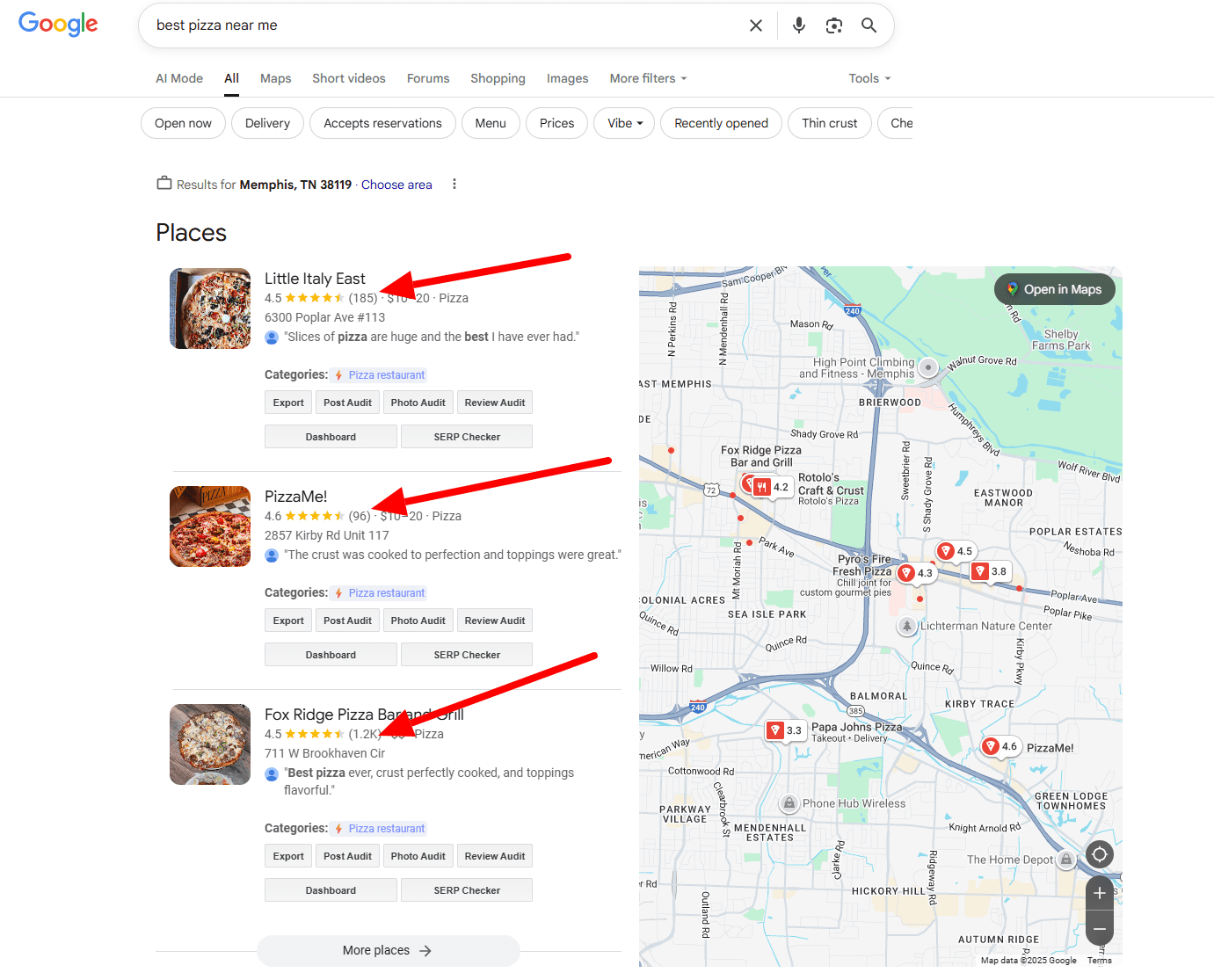
Social proof bias drives local search behavior especially hard. When someone searches [best pizza near me], they’re not just looking for pizza; they’re probably also looking for validation that others think it’s good, too. Your content should acknowledge this psychological need.
Screenshot from search for [best pizza near me], Google, August 2025
Understanding these patterns helps you create content that feels intuitive rather than forced.
How To Collect Customer Behavior Data That Actually Matters
The best behavior insights come from combining quantitative data with qualitative feedback. Here’s a systematic approach:
Start With Your Existing Analytics
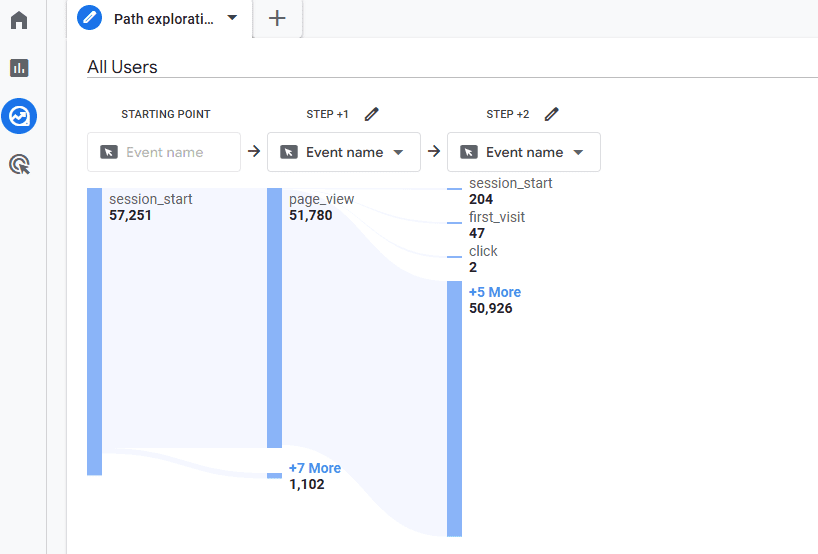
Google Analytics 4 Path Exploration shows how users navigate your site. Look for patterns like:
Which blog posts lead to product page visits.
Where users drop off in your conversion funnel.
What content keeps visitors engaged the longest.
Screenshot from support.google.com, August 2025
Google Search Console can reveal the gap between what you optimize for and what people actually search. Export your query data monthly and look for:
Pro tip: Sort queries by impressions, not clicks. High-impression, low-click queries (aside from highlighting a dominance of SERP features, or AI Overview summaries) often reveal content gaps where you’re visible but not compelling.
Add Heat Mapping And Session Recording
Tools like Hotjar or Microsoft Clarity (free) show you where users actually click, scroll, and abandon pages.
I once worked with an ecommerce client whose heatmaps revealed users repeatedly clicking on product images that weren’t linked to detail pages. We added those links and saw a 23% increase in product page visits within two weeks.
Mine Your Customer Service Data
Your support team handles the questions your website doesn’t answer. Export tickets from the past quarter and categorize them by topic. Common support questions often represent high-value, low-competition search opportunities.
If you’re getting 20 tickets per month about “how to integrate with Slack,” that’s content your competitors probably aren’t creating yet.
Listen To Social Conversations
Monitor industry hashtags, Reddit threads, and LinkedIn discussions in your space. Social media language is usually more casual and authentic than what people type into search; it’s where people complain about real problems using the exact words they’ll later search for solutions.
Reddit is particularly valuable because users share unfiltered frustrations and solution requests. Tools like GummySearch help you cut through Reddit’s noise by surfacing curated content themes like “Pain & Anger” and “Solution Requests” within your target audience communities.
Instead of manually scrolling through thousands of posts, you get direct access to the exact language your customers use when they’re frustrated.
Screenshot from GummySearch by author, August 2025
These authentic conversations reveal content opportunities that traditional keyword research misses.
When someone posts “I can’t believe there’s still no simple way to sync data between these platforms,” that frustration will likely become search queries like “easy data sync tools” or “simple platform integration” within weeks.
Translating Insights Into SEO Opportunities
Raw data means nothing until you turn it into actionable content strategies. Here’s how to connect behavior patterns to search opportunities:
Map Content To Customer Journey Stages
Your behavior data reveals different intent patterns that map to specific journey stages:
Awareness Stage
Consideration Stage
Decision Stage
Broad, educational searches
Comparison and evaluation searches
Specific product/vendor searches
“Why do small businesses need CRM software?”
“HubSpot vs. Salesforce for small teams”
“HubSpot pricing plans 2025”
Focus on educational content with minimal promotional elements
Create detailed comparisons with pros/cons
Optimize for conversion with clear CTAs
Internal links should guide toward mid-funnel content
Include pricing, features, and use case scenarios
Address common objections directly
Identify Content Gaps Through Competitor Analysis
Use Ahrefs or Semrush to analyze competitor content, then cross-reference with your customer behavior data. Look for topics where:
Competitors rank well, but their content doesn’t match user intent.
You have unique customer insights they’re missing.
Your support data reveals questions they don’t address.
For example, if competitor articles about “email marketing automation” focus on features but your customer interviews reveal people struggle with setup, create implementation-focused content instead.
Optimize For Behavior-Based Keywords
Traditional keyword research starts with seed terms and expands outward. Behavior-driven research starts with customer language and searches for gaps.
Instead of: “Best email marketing software”
Try: “Easy email marketing setup for non-technical founders”
The second phrase has lower search volume but higher intent alignment. Someone searching for [easy setup] has different needs than someone searching for [best software].
Create Dynamic Content Formats
Your analytics reveal format preferences by device, time, and topic:
Mobile users during commute hours: Scannable lists and quick tips.
Desktop users during work hours: Detailed guides and tutorials.
Weekend browsers: Visual content and case studies.
Don’t create one piece of content and hope it works everywhere. Adapt format to behavior patterns.
Measuring What Actually Moves The Needle
Behavior-driven SEO requires different success metrics than traditional approaches. Rankings matter less than engagement and conversion alignment.
Track Engagement Quality, Not Just Quantity
Traditional SEO celebrates traffic volume, but behavior-driven strategies focus on how well that traffic matches customer intent.
Average session duration becomes a strong indicator of content relevance. When someone spends 8 minutes reading your guide instead of bouncing in 30 seconds, you’ve aligned content with search intent. The key is tracking improvements over time rather than hitting arbitrary benchmarks.
Bounce rate tells a different story when you segment by traffic source. A high bounce rate might be terrible for targeted organic traffic, but completely normal for broad brand searches.
Compare your targeted organic bounce rate against your own baseline rather than industry averages. If you’re seeing consistent improvement month over month, your content is becoming more aligned with user expectations.
Pages per session reveals engagement depth and site navigation effectiveness. Users who visit multiple pages during a session are actively exploring your content ecosystem, suggesting strong topical authority and effective internal linking strategy.
Goal completion rates vary dramatically by industry and funnel complexity, so focus on your own conversion trends rather than external benchmarks. A B2B software company’s “good” conversion rate looks completely different from an ecommerce site’s performance.
Monitor Search Query Evolution
Your target keywords evolve as customer language changes, industry trends shift, and new problems emerge. Set up monthly Search Console exports to track these patterns systematically. New long-tail variations often appear before keyword tools catch them.
Seasonal language shifts reveal opportunities that competitors miss. B2B software searches change dramatically between the Q4 budget planning season and the Q1 implementation periods. Ecommerce terms shift from “best products” in research phases to “deals” and “discounts” during purchase windows.
Pay attention to emerging competitor terms appearing in your query data. When people start searching for “[competitor name] alternative” or “[your product] vs. [new competitor],” you’re seeing market shifts in real-time.
A/B Test Based On Behavior Insights
Your behavior data generates testing hypotheses that go far beyond traditional “red vs. blue button” experiments. Test different content depths for mobile and desktop users; mobile visitors often prefer scannable summaries, while desktop users engage with comprehensive guides. Experiment with heading structures based on user scanning patterns revealed in your heatmap data.
I recently helped a SaaS client test two versions of their pricing page. Version A used traditional feature comparisons organized by product tier. Version B addressed specific use cases revealed through customer interviews, such as scenarios like “growing startup needs better lead tracking” and “enterprise team wants advanced reporting.”
Version B increased conversions by 34% because it matched how customers actually think about solutions rather than how the product team organized features.
Set Up Feedback Loops
Customer behavior evolves constantly, so your measurement strategy needs systematic review cycles.
Create a monthly rhythm where Week 1 focuses on analyzing Search Console and Analytics data for new patterns. Week 2 involves reviewing customer service tickets and social media mentions for emerging language trends. Week 3 is for testing new content approaches based on fresh insights, while Week 4 handles planning next month’s content calendar around discovered opportunities.
This cycle keeps you responsive to behavior changes rather than reactive to ranking drops. Economic shifts, social trends, and industry developments all impact search patterns faster than traditional SEO tools can track them.
The Bottom Line
Behavior-driven SEO isn’t about abandoning keywords; it’s about understanding the humans behind every search query. When you align your content strategy with actual customer actions and intentions, engagement improves naturally and conversions follow.
Start by really listening to your customers through data, support interactions, and direct feedback. Your most successful content will come from solving real problems using language your audience actually uses.
Your customers are already telling you what they want; you just need to pay attention.
Turn insights into smarter conversions and higher ROI.
AI is changing how customers convert. Are your landing pages and CRO strategies keeping up?
Each missed lead is lost revenue.
Relying on traditional tactics is no longer enough.
Join Laura Beussman, CMO of CallRail, and Ryan Johnson, CPO of CallRail, for a live webinar where you’ll learn how top marketing leaders are using AI to prioritize leads, optimize funnels, and drive measurable growth.
How to spot funnel drop-off points that are costing revenue.
CRO tactics to make your marketing funnel work smarter, not harder.
How to identify the exact messaging that boosts conversions and ROI.
Why Attend
This webinar will give you the tools to capture more leads, surface actionable insights from interactions, remove friction slowing conversions, and automate your CRO playbook for ongoing growth.
Register now to gain actionable strategies for faster, smarter conversions with AI.
🛑 Can’t attend live? Register anyway, and we’ll send you the full recording.
Last week OpenAI released Sora, a TikTok-style app that presents an endless feed of exclusively AI-generated videos, each up to 10 seconds long. The app allows you to create a “cameo” of yourself—a hyperrealistic avatar that mimics your appearance and voice—and insert other peoples’ cameos into your own videos (depending on what permissions they set).
To some people who believed earnestly in OpenAI’s promise to build AI that benefits all of humanity, the app is a punchline. A former OpenAI researcher who left to build an AI-for-science startup referred to Sora as an “infinite AI tiktok slop machine.”
That hasn’t stopped it from soaring to the top spot on Apple’s US App Store. After I downloaded the app, I quickly learned what types of videos are, at least currently, performing well: bodycam-style footage of police pulling over pets or various trademarked characters, including SpongeBob and Scooby Doo; deepfake memes of Martin Luther King Jr. talking about Xbox; and endless variations of Jesus Christ navigating our modern world.
Just as quickly, I had a bunch of questions about what’s coming next for Sora. Here’s what I’ve learned so far.
Can it last?
OpenAI is betting that a sizable number of people will want to spend time on an app in which you can suspend your concerns about whether what you’re looking at is fake and indulge in a stream of raw AI. One reviewer put it this way: “It’s comforting because you know that everything you’re scrolling through isn’t real, where other platforms you sometimes have to guess if it’s real or fake. Here, there is no guessing, it’s all AI, all the time.”
This may sound like hell to some. But judging by Sora’s popularity, lots of people want it.
So what’s drawing these people in? There are two explanations. One is that Sora is a flash-in-the-pan gimmick, with people lining up to gawk at what cutting-edge AI can create now (in my experience, this is interesting for about five minutes). The second, which OpenAI is betting on, is that we’re witnessing a genuine shift in what type of content can draw eyeballs, and that users will stay with Sora because it allows a level of fantastical creativity not possible in any other app.
There are a few decisions down the pike that may shape how many people stick around: how OpenAI decides to implement ads, what limits it sets for copyrighted content (see below), and what algorithms it cooks up to decide who sees what.
Can OpenAI afford it?
OpenAI is not profitable, but that’s not particularly strange given how Silicon Valley operates. What is peculiar, though, is that the company is investing in a platform for generating video, which is the most energy-intensive (and therefore expensive) form of AI we have. The energy it takes dwarfs the amount required to create images or answer text questions via ChatGPT.
This isn’t news to OpenAI, which has joined a half-trillion-dollar project to build data centers and new power plants. But Sora—which currently allows you to generate AI videos, for free, without limits—raises the stakes: How much will it cost the company?
OpenAI is making moves toward monetizing things (you can now buy products directly through ChatGPT, for example). On October 3, its CEO, Sam Altman, wrote in a blog post that “we are going to have to somehow make money for video generation,” but he didn’t get into specifics. One can imagine personalized ads and more in-app purchases.
Still, it’s concerning to imagine the mountain of emissions might result if Sora becomes popular. Altman has accurately described the emissions burden of one query to ChatGPT as impossibly small. What he has not quantified is what that figure is for a 10-second video generated by Sora. It’s only a matter of time until AI and climate researchers start demanding it.
How many lawsuits are coming?
Sora is awash in copyrighted and trademarked characters. It allows you to easily deepfake deceased celebrities. Its videos use copyrighted music.
Last week, the Wall Street Journalreported that OpenAI has sent letters to copyright holders notifying them that they’ll have to opt out of the Sora platform if they don’t want their material included, which is not how these things usually work. The law on how AI companies should handle copyrighted material is far from settled, and it’d be reasonable to expect lawsuits challenging this.
In last week’s blog post, Altman wrote that OpenAI is “hearing from a lot of rightsholders” who want more control over how their characters are used in Sora. He says that the company plans to give those parties more “granular control” over their characters. Still, “there may be some edge cases of generations that get through that shouldn’t,” he wrote.
But another issue is the ease with which you can use the cameos of real people. People can restrict who can use their cameo, but what limits will there be for what these cameos can be made to do in Sora videos?
This is apparently already an issue OpenAI is being forced to respond to. The head of Sora, Bill Peebles, posted on October 5 that users can now restrict how their cameo can be used—preventing it from appearing in political videos or saying certain words, for example. How well will this work? Is it only a matter of time until someone’s cameo is used for something nefarious, explicit, illegal, or at least creepy, sparking a lawsuit alleging that OpenAI is responsible?
Overall, we haven’t seen what full-scale Sora looks like yet (OpenAI is still doling out access to the app via invite codes). When we do, I think it will serve as a grim test: Can AI create videos so fine-tuned for endless engagement that they’ll outcompete “real” videos for our attention? In the end, Sora isn’t just testing OpenAI’s technology—it’s testing us, and how much of our reality we’re willing to trade for an infinite scroll of simulation.
BOX ELDER COUNTY, Utah – On a bright afternoon in August, the shore on the North Arm of the Great Salt Lake looks like something out of a science fiction film set in a scorching alien world. The desert sun is blinding as it reflects off the white salt that gathers and crunches underfoot like snow at the water’s edge. In a part of the lake too shallow for boats, bacteria have turned the water a Pepto-Bismol pink. The landscape all around is ringed with jagged red mountains and brown brush. The only obvious sign of people is the salt-encrusted hose running from the water’s edge to a makeshift encampment of shipping containers and trucks a few hundred feet away.
This otherworldly scene is the test site for a company called Lilac Solutions, which is developing a technology it says will shake up the United States’ efforts to pry control over the global supply of lithium, the so-called “white gold” needed for electric vehicles and batteries, away from China. Before tearing down its demonstration facility to make way for its first commercial plant, due online next year, the company invited me to be the first journalist to tour its outpost in this remote area, a roughly two-hour drive from Salt Lake City.
The startup is in a race to commercialize a new way to extract lithium from rocks, called direct lithium extraction (DLE). This approach is designed to reduce the environmental damage caused by the two most common traditional methods of mining lithium: hard-rock mining and brining.
Australia, the world’s top producer of lithium, uses the first approach, scraping rocks laden with lithium out of the earth so they can be chemically processed into industrial-grade versions of the metal. Chile, the second-largest lithium source, uses the second: It floods areas of its sun-soaked Atacama Desert with water. This results in ponds rich in dissolved lithium, which are then allowed to dry off, leaving behind lithium salts that can be harvested and processed elsewhere.
An intake hose, used to pump water to Lilac Solutions’ demonstration site, snakes into the pink-hued Great Salt Lake.
ALEXANDER KAUFMAN
The range of methods known as DLE use lithium brine too, but instead of water-intensive evaporation, they all involve advanced chemical or physical filtering processes that selectively separate out lithium ions. While DLE has yet to take off, its reduced need for water and land has made it a prime focus for companies and governments looking to ramp up production to meet the growing demand for lithium as electric vehicles take off and even bigger batteries are increasingly used to back up power grids. China, which processes more than two-thirds of the world’s mined lithium, is developing its own DLE to increase domestic production of the raw material. New approaches are still being researched, but nearly a dozen companies are actively looking to commercialize DLE technology now, and some industrial giants already offer basic off-the-shelf hardware.
In August, Lilac completed its most advanced test yet of its technology, which the company says doesn’t just require far less water than traditional lithium extraction—it uses a fraction of what other DLE approaches demand.
The company uses proprietary beads to draw lithium ions from water and says its process can extract lithium using a tenth as much water as the alumina sorbent technology that dominates the DLE industry. Lilac also highlights its all-American supply chain. Technology originally developed by Koch Industries, for example, uses some Chinese-made components. Lilac’s beads are manufactured at the company’s plant in Nevada.
Lilac says the beads are particularly well suited to extracting lithium where concentrations are low.That doesn’t mean they could be deployed just anywhere—there won’t be lithium extraction on the Hudson River anytime soon. But Lilac’s tech could offer significant advantages over what’s currently on the market. And forgoing plans to become a major producer itself could enable the company to seize a decent slice of global production by appealing to lithium miners companies looking for the best equipment, says Milo McBride, a researcher at the Carnegie Endowment for International Peace who authored a recent report on DLE.
If everything pans out, the pilot plant Lilac builds next to prove its technology at commercial scale could significantly increase domestic supply at a moment when the nation’s largest proposed lithium project, the controversial hard-rock Thacker Pass mine in Nevada, has faced fresh uncertainty. At the beginning of October, the Trump administration renegotiated a federal loan worth more than $2 billion to secure a 5% ownership stake for the US government.
The blue tank on the left filters the brine from the Great Salt Lake to remove large particles before pumping the lithium-rich water into the ion-exchange systems located in the shipping containers.
ALEXANDER KAUFMAN
Despite bipartisan government support, the prospect of opening a deep gash in an unspoiled stretch of Nevada landscape has drawn fierce opposition from conservationists and lawsuits from ranchers and Native American tribes who say the Thacker Pass project would destroy the underground freshwater reservoirs on which they depend. Water shortages in the parched West have also made it difficult to plan on using additional evaporation ponds, the other traditional way of extracting lithium.
Lilac is not the only company in the US pushing for DLE. In California’s Salton Sea, developers such as EnergySource Minerals are looking to build a geothermal power plant to power a DLE facility pulling lithium from the inland desert lake. And energy giants such as Exxon Mobil, Chevron, and Occidental Petroleum are racing to develop an area in southwestern Arkansas called the Smackover region, where researchers with the US Geological Survey have found as much as 19 million metric tons of untapped lithium in salty underground water. In between, both geographically and strategically, is Lilac: It’s looking to develop new technology like the California companies but sell its hardware to the energy giants in Arkansas.
The Great Salt Lake isn’t an obvious place to develop a lithium mine. The Salton Sea boasts lithium concentrations of just under 200 parts per million. Argentina, where Lilac has another test facility, has resources of above 700 parts per million.
Here on the Great Salt Lake? “It’s 70 parts per million,” Raef Sully, Lilac’s Australia-born chief executive, tells me. “So if you had a football stadium with 45,000 seats, this would be three people.”
For Lilac, this is actually a feature of the location. “It’s a very, very good demonstration of the capability of our technology,” Sully says. Showing that Lilac’s hardware can extract lithium at high purity levels from a brine with low concentration, he says, proves its versatility. That wasn’t the reason Lilac selected the site, though. “Utah is a mining friendly state,” says Elizabeth Pond, the vice president of communications. And though the lake water has low concentrations of lithium, extracting the brine simply calls for running a hose into the water, whereas other locations would require digging a well at great cost.
When I accompanied Sully to the test site during my tour, our route following unpaved county roads lined with fields of wild sunflowers. The facility itself is little more than an assortment of converted shipping containers and two mobile trailers, one to serve as the main office and the other as a field laboratory to test samples. It’s off the grid, relying on diesel generators that the company says will be replaced with propane units once this location is converted to a permanent facility but could eventually be swapped for geothermal technology tapping into a hot rock resource located nearby. (Solar panels, Sully clarifies, couldn’t supply the 24-7 power supply the facility will need.) But it depends on its connection to the Great Salt Lake via that lengthy hose.
Hardened salt and impurities are encrusted on metal mesh that keeps larger materials out of Lilac’s water intake system.
ALEXANDER KAUFMAN
Pumped uphill, the lake water passes through a series of filters to remove solids until it ends up in a vessel filled with the company’s specially designed ceramic beads, made from a patented material that attracts lithium ions from the water. Once saturated, the beads are put through an acid wash to remove the lithium. The remaining brine is then repeatedly tested and, once deemed safe to release back into the lake, pumped back down to the shore through an outgoing tube in the hose. The lithium solution, meanwhile, is stockpiled in tanks on site before shipping off to a processing plant to be turned into battery-grade lithium carbonate, which is a white powder.
“As a technology provider in the long term, if we’re going to have decades of lithium demand, they want to position their technology as something that can tap a bunch of markets,” McBride says. “To have a technology that can potentially economically recover different types of resources in different types of environments is an enticing proposition.”
This testing ground won’t stay this way for long. During my visit, Lilac’s crew was starting to pack up the location after completing its demonstration testing. The results the company shared exclusively with me suggest a smashing success, particularly for such low-grade brine with numerous impurities: Lilac’s equipment recovered 87% of the available lithium, on average, with a purity rate of 99.97%.
The next step will be to clear the area to make way for construction of Lilac’s first permanent commercial facility at the same site. To meet the stipulations of Utah state permits for the new plant, the company had to cease all operations at the demonstration project. If everything goes according to plan, Lilac’s first US facility will begin commercial production in the second half of 2027. The company has lined up about two-thirds of its funding for the project. That could make the plant the first new commercial source of lithium in the US to come online in years, and the first DLE facility ever.
Once it’s fully online, the project should produce 5,000 tons per year—doubling annual US production of lithium. But a full-scale plant using Lilac’s technology would produce between three and five times that amount.
There are some potential snags. Utah regulators this year started cracking down on mineral companies pumping water from the Great Salt Lake, which is shrinking amid worsening droughts. (Lilac says it’s largely immune to the restrictions since it returns the water to the lake.) While the relatively low concentrations of lithium in the water make for a good test case, full-scale commercial production would likely prove far more economical in a place with more of the metal.
Wild sunflowers line the unpaved county roads that cut through ranching land en route to Lilac Solutions’ remote demonstration site.
ALEXANDER KAUFMAN
“The Great Salt Lake is probably the worst possible place to be doing this, because there are real challenges around pulling water from the lake,” says Ashley Zumwalt-Forbes, a mining engineer who previously served as the deputy director of battery minerals at the Department of Energy. “But if it’s just being used as a trial for the technology, that makes sense.”
What makes Lilac stand out among its peers is that it has no plans to design and manufacture its own DLE equipment and produce actual lithium. Lilac wants instead to sell its technology to others. The pilot plant is just intended to test and debut its hardware. Sully tells me it’s being built under a separate limited-liability corporation to make a potential sale easier if it’s successful.
It’s an unusual play in the lithium industry. Once most companies see success with their technology, “they go crazy and think they can vertically integrate and at the same time be a miner and an energy producer,” Kwasi Ampofo, the head of minerals and metals at the energy consultancy BloombergNEF, tells me.
“Lilac is trying to be a technology vendor,” he says. “I wonder why a lot more people aren’t choosing that route.”
If things work out the right way, Sully says, Lilac could become the vendor of choice to projects like the oil-backed sites in the Smackover and beyond.
“We think our technology is the next generation,” he says. “And if we end up working with an Exxon or a Chevron or a Rio Tinto, we want to be the DLE technology provider in their lithium project.”
This is today’s edition of The Download, our weekday newsletter that provides a daily dose of what’s going on in the world of technology.
This company is planning a lithium empire from the shores of the Great Salt Lake
On a bright afternoon in August, the shore of Utah’s Great Salt Lake looks like something out of a science fiction film set in a scorching alien world.
This otherworldly scene is the test site for a company called Lilac Solutions, which is developing a technology it says will shake up the United States’ efforts to pry control over the global supply of lithium, the so-called “white gold” needed for electric vehicles and batteries, away from China.
The startup is in a race to commercialize a new, less environmentally-damaging way to extract lithium from rocks. If everything pans out, it could significantly increase domestic supply at a crucial moment for the nation’s lithium extraction industry. Read the full story.
—Alexander C. Kaufman
The three big unanswered questions about Sora
Last week OpenAI released Sora, a TikTok-style app that presents an endless feed of exclusively AI-generated videos, each up to 10 seconds long. The app allows you to create a “cameo” of yourself—a hyperrealistic avatar that mimics your appearance and voice—and insert other peoples’ cameos into your own videos (depending on what permissions they set).
In the days since, it soared to the top spot on Apple’s US App Store. But its explosive growth raises a bunch of questions: can its popularity last? Can OpenAI afford it? And how soon until we start seeing lawsuits over its use of copyrighted content? Here’s what we’ve learned so far.
This story originally appeared in The Algorithm, our weekly newsletter about the latest in AI. To get stories like this in your inbox first, sign up here.
—James O’Donnell
2025 climate tech companies to watch: HiNa Battery Technology and its effort to commercialize salt cells
Over the next few decades the world will need a lot more batteries to power electric cars and keep grids stable. Today most battery cells are made with lithium, so the mineral is expected to be in hyper demand. But a new technology has come on the scene, potentially disrupting the global battery industry.
For decades, research of sodium-ion cell technology was abandoned due to the huge commercial success of lithium-ion cells. Now, HiNa Battery Technology is working to bring sodium back to the limelight—and to the mass market. Read the full story.
—You Xiaoying
HiNa Battery Technology is one of our 10 climate tech companies to watch—our annual list of some of the most promising climate tech firms on the planet. Check out the rest of the list here.
The must-reads
I’ve combed the internet to find you today’s most fun/important/scary/fascinating stories about technology.
1 OpenAI has signed a major chip deal It will collaborate with AMD in a challenge to Nvidia’s dominance. (WSJ $) + The multi-billion dollar deal will play out over five years. (FT $) + Just two weeks ago, OpenAI agreed a deal with Nvidia. (CNN) + The data center boom in the desert. (MIT Technology Review)
2 Google lost a US Supreme Court bid The justices denied Google’s bid to pause changes to its app store. (Bloomberg $) + It’s part of the lawsuit Epic Games brought against the tech giant. (Reuters) + The dispute remains unsolved, so it may be handed back to the justices. (NYT $)
3 You can now use some apps directly within ChatGPT It’s all part of OpenAI’s ambitions to make it a one-stop-shop for all your needs. (The Verge) + Sam Altman wants it to become your primary digital portal. (The Information $)
4 Deloitte used AI to generate a report for the Australian government Unfortunately, it was littered with hallucinated mistakes. (Ars Technica)
5 The Nobel prize for medicine has been awarded to three immunity researchers The trio discovered an immune cell that helps stop the immune system attacking itself. (New Scientist $)
6 Russians are using AI to create video memorials of their war dead A burgeoning industry has sprung up, and practitioners will generate clips for $30. (WP $) + Deepfakes of your dead loved ones are a booming Chinese business. (MIT Technology Review)
7 The dream of greener air travel is starting to die Hydrogen-powered planes are years away. So what now? (FT $) + How new technologies could clean up air travel. (MIT Technology Review)
8 How job hunters are trying to trick AI résumé-checkers Inserting sneaky hidden prompts is becoming commonplace. (NYT $)
9 The creator of the Friend AI pendant doesn’t care if you hate it The backlash to its provocative ads is all part of the plan, apparently. (The Atlantic $)
10 Taylor Swift’s fans really don’t like AI They’ve accused the singer’s new videos, which appear to be AI-generated, of looking cheap and sloppy. (NY Mag $) + AI text is out, moving pictures are in. (Economist $)
Quote of the day
“When AI videos are just as good as normal videos, I wonder what that will do to YouTube and how it will impact the millions of creators currently making content for a living… scary times.”
—YouTuber Jimmy Donaldson, aka MrBeast, reflects on AI videos infiltrating the internet, TechCrunch reports.
One more thing
The case against humans in space Elon Musk and Jeff Bezos are bitter rivals in the commercial space race, but they agree on one thing: Settling space is an existential imperative. Space is the place. The final frontier. It is our human destiny to transcend our home world and expand our civilization to extraterrestrial vistas.
This belief has been mainstream for decades, but its rise has been positively meteoric in this new gilded age of astropreneurs.
But as visions of giant orbital stations and Martian cities dance in our heads, a case against human space colonization has found its footing in a number of recent books, from doubts about the practical feasibility of off-Earth communities, to realism about the harsh environment of space and the enormous tax it would exact on the human body. Read the full story.
Kids have always played with and talked to stuffed animals. But now their toys can talk back, thanks to a wave of companies that are fitting children’s playthings with chatbots and voice assistants.
It’s a trend that has particularly taken off in China: A recent report by the Shenzhen Toy Industry Association and JD.com predicts that the sector will surpass ¥100 billion ($14 billion) by 2030, growing faster than almost any other branch of consumer AI. According to the Chinese corporation registration database Qichamao, there are over 1,500 AI toy companies operating in China as of October 2025.
One of the latest entrants to the market is a toy called BubblePal, a device the size of a Ping-Pong ball that clips onto a child’s favorite stuffed animal and makes it “talk.” The gadget comes with a smartphone app that lets parents switch between 39 characters, from Disney’s Elsa to the Chinese cartoon classic Nezha. It costs $149, and 200,000 units have been sold since it launched last summer. It’s made by the Chinese company Haivivi and runs on DeepSeek’s large language models.
Other companies are approaching the market differently. FoloToy, another Chinese startup, allows parents to customize a bear, bunny, or cactus toy by training it to speak with their own voice and speech pattern. FoloToy reported selling more than 20,000 of its AI-equipped plush toys in the first quarter of 2025, nearly equaling its total sales for 2024, and it projects sales of 300,000 units this year.
But Chinese AI toy companies have their sights set beyond the nation’s borders. BubblePal was launched in the US in December 2024 and is now also available in Canada and the UK. And FoloToy is now sold in more than 10 countries, including the US, UK, Canada, Brazil, Germany, and Thailand. Rui Ma, a China tech analyst at AlphaWatch.AI, says that AI devices for children make particular sense in China, where there is already a well-established market for kid-focused educational electronics—a market that does not exist to the same extent globally. FoloToy’s CEO, Kong Miaomiao, told the Chinese outlet Baijing Chuhai that outside China, his firm is still just “reaching early adopters who are curious about AI.”
China’s AI toy boom builds on decades of consumer electronics designed specifically for children. As early as the 1990s, companies such as BBK popularized devices like electronic dictionaries and “study machines,” marketed to parents as educational aids. These toy-electronics hybrids read aloud, tell interactive stories, and simulate the role of a playmate.
The competition is heating up, however—US companies have also started to develop and sell AI toys. The musician Grimes helped to create Grok, a plush toy that chats with kids and adapts to their personality. Toy giant Mattel is working with OpenAI to bring conversational AI to brands like Barbie and Hot Wheels, with the first products expected to be announced later this year.
However, reviews from parents who’ve bought AI toys in China are mixed. Although many appreciate the fact they are screen-free and come with strict parental controls, some parents say their AI capabilities can be glitchy, leading children to tire of them easily.
Penny Huang, based in Beijing, bought a BubblePal for her five-year-old daughter, who is cared for mostly by grandparents. Huang hoped that the toy could make her less lonely and reduce her constant requests to play with adults’ smartphones. But the novelty wore off quickly.
“The responses are too long and wordy. My daughter quickly loses patience,” says Huang, “It [the role-play] doesn’t feel immersive—just a voice that sometimes sounds out of place.”
Another parent who uses BubblePal, Hongyi Li, found the voice recognition lagging: “Children’s speech is fragmented and unclear. The toy frequently interrupts my kid or misunderstands what she says. It also still requires pressing a button to interact, which can be hard for toddlers.”
Huang recently listed her BubblePal for sale on Xianyu, a secondhand marketplace. “This is just like one of the many toys that my daughter plays for five minutes then gets tired of,” she says. “She wants to play with my phone more than anything else.”
The US Department of Energy appears poised to terminate funding for a pair of large carbon-sucking factories that were originally set to receive more than $1 billion in government grants, according to a department-issued list of projects obtained by MIT Technology Review and circulating among federal agencies.
One of the projects is the South Texas Direct Air Capture Hub, a facility that Occidental Petroleum’s 1PointFive subsidiary planned to develop in Kleberg County, Texas. The other is Project Cypress in Louisiana, a collaboration between Battelle, Climeworks, and Heirloom.
The list features a “latest status” column, which includes the word “terminate” next to the roughly $50 million award amounts for each project. Those line up with the initial tranche of Department of Energy (DOE) funding for each development. According to the original announcement in 2023, the projects could have received $500 million or more in total grants as they proceeded.
It’s not clear if the termination of the initial grants would mean the full funding would also be canceled.
“It could mean nothing,” says Erin Burns, executive director of Carbon180, a nonprofit that advocates for the removal and reuse of carbon dioxide. “It could mean there’s a renegotiation of the awards. Or it could mean they’re entirely cut. But the uncertainty certainly doesn’t help projects.”
A DOE spokesman stressed that no final decision has been made.
“It is incorrect to suggest those two projects have been terminated and we are unable to verify any lists provided by anonymous sources,” Ben Dietderich, the department’s press secretary, said in an email, adding: “The Department continues to conduct an individualized and thorough review of financial awards made by the previous administration.”
Last week, the DOE announced it would terminate about $7.5 billion dollars in grants for more than 200 projects, stating that they “did not adequately advance the nation’s energy needs, were not economically viable, and would not provide a positive return on investment of taxpayer dollars.”
Battelle and 1PointFive didn’t respond to inquiries from MIT Technology Review.
“Market rumors have surfaced, and Climeworks is prepared for all scenarios,” Christoph Gebald, one of the company’s co-CEOs, said in a statement. He added later: “The need for DAC is growing as the world falls short of its climate goals and we’re working to achieve the gigaton capacity that will be needed.”
“We aren’t aware of a decision from DOE and continue to productively engage with the administration in a project review,” Heirloom said in a statement.
The rising dangers of climate change have driven the development of the direct-air capture industry in recent years.
Climate models have found that the world may need to suck down billions of tons of carbon dioxide per year by around midcentury, on top of dramatic emissions cuts, to prevent the planet from warming past 2˚ C.
Carbon-sucking direct-air factories are considered one of the most reliable ways of drawing the greenhouse gas out of the atmosphere, but they also remain one of the most expensive and energy-intensive methods.
Under former President Joe Biden, the US began providing increasingly generous grants, subsidies and other forms of support to help scale up the nascent sector.
The grants now in question were allocated under the DOE’s Regional Direct Air Capture Hubs program, which was funded through the Bipartisan Infrastructure Law. The goal was to set up several major carbon removal clusters across the US, each capable of sucking down and sequestering at least a million tons of the greenhouse gas per year.
“Today’s news that a decision to cancel lawfully designated funding for the [direct-air-capture projects] could come soon risks handing a win to competitors abroad and undermines the commitments made to businesses, communities, and leaders in Louisiana and South Texas,” said Giana Amador of the Carbon Removal Alliance and Ben Rubin of the Carbon Business Council in a joint statement.
This story was updated to include additional quotes, a response from the Department of Energy and added context on the development of the carbon removal sector.
Last week OpenAI launched “Instant Checkout” for ChatGPT, a feature allowing consumers to buy products without leaving the platform.
The feature, which utilizes Stripe’s Agentic Commerce Protocol to facilitate AI transactions, is available for Etsy merchants and soon for Shopify. An open-source version allows any merchant or developer to build custom integrations.
OpenAI’s application form is for merchants not on Etsy or Shopify who want to “1) integrate their products into ChatGPT Search results and 2) enable Instant Checkout in ChatGPT via the Agentic Commerce Protocol.”
AI ‘Rankings’
The shift to AI shopping is ominous. Ecommerce merchants who rely on traditional organic search traffic will almost certainly lose traffic. Merchants with clean, comprehensive product data that’s easily digested by AI agents could slow the decline, if not benefit.
Will ChatGPT prioritize products from merchants that have enabled Instant Checkout? OpenAI’s announcement seems to hint that it might:
When ranking multiple merchants that sell the same product, ChatGPT considers factors like availability, price, quality, whether a merchant is the primary seller, and whether Instant Checkout is enabled, to optimize the user experience.
Thus early ChatGPT merchants may have a competitive advantage.
How to optimize for generative engines? Product data alone may not elevate visibility. Remember that ChatGPT doesn’t rely solely on keywords. The context of conversations is key.
A prompt may not initially request product recommendations. For instance, a user may start by seeking solutions for ankle pain from running. The ensuing dialogue may include buying running shoes with better ankle support.
Other details may come up. Does the user live in a rainy state and thus require waterproof shoes? Does the user run on trails or flat surfaces?
Addressing every possible scenario via product data is seemingly impossible, yet merchants should address as many use cases as practical while encouraging off-site discussions in Reddit and elsewhere for context.
Product Feeds
ChatGPT’s product feed specifications allow 150 characters for the product’s title and 5,000 for its description.
Populate all product feed fields and available characters. The more info it has, the better ChatGPT can surface your product for various prompts. For example, a product’s “weight” field can elevate visibility when consumers seek lightweight goods.
ChatGPT’s feed specs include unique fields to keep in mind:
“related_product_ID” for “basket-building recommendations and cross-sell opportunities.” Instant Checkout allows only single-product purchases, but OpenAI says multiple-product buying is coming. The related products field could eventually help ChatGPT recommend more of your products and associate similar items.
“q_and_a.” This field has no character limit — seemingly perfect for additional information. In my testing, AI agents can easily fetch data from question-and-answer formats.
“popularity_score” can convey your most sought-after goods. ChatGPT does not explain the field’s impact. But it’s the Wild West for generative engine optimization, and who knows? An item’s popularity may help it stand out.
We worked together again to bring you this week’s Growth Memo: a study that provides crucial insights and validation into the behaviors of people as they interact with Google’s AI Mode.
Since neither Google nor OpenAI (or anyone else) provides user data for their AI (Search) products, we’re filling a crucial gap.
We captured screen recordings and think-aloud sessions via remote study. The 250 unique tasks collected provide a robust data set for our analysis. (The complete methodology is provided at the end of this memo, including details about the seven search tasks.)
And you might be surprised by some of the findings. We were.
This is a longer post, so grab a drink and settle in.
Image Credit: Kevin Indig
Executive Summary
Our new usability study of Google’s AI Mode reveals how profoundly this feature changes user behavior.
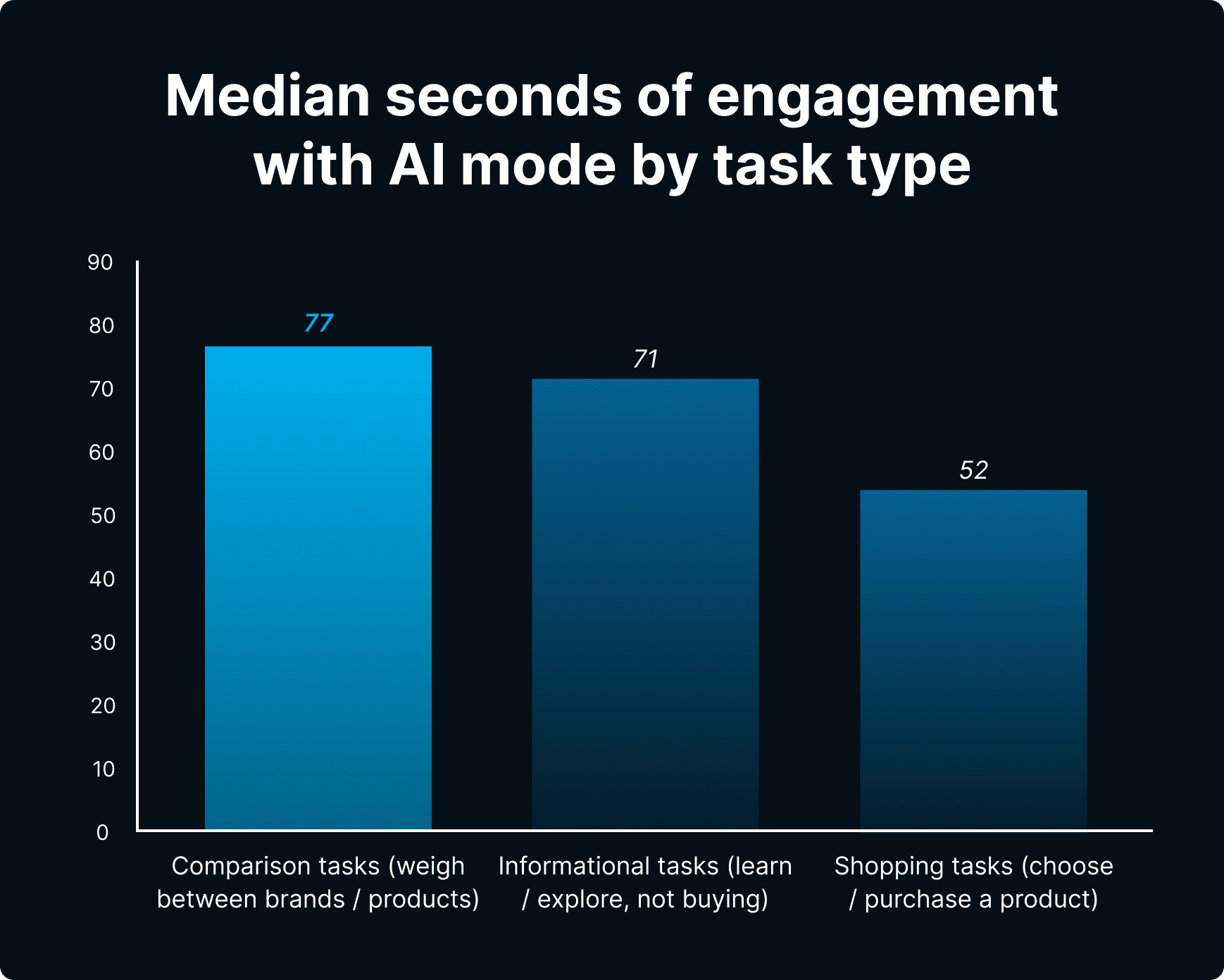
AI Mode holds attention and keeps users inside. In roughly three‑quarters of the total user sessions, users never left the AI Mode pane – and 88 % of users’ first interactions were with the AI‑generated text. Engagement was high: The median time by task type was roughly 52-77 seconds.
Clicks are rare and mostly transactional. The median number of external clicks per task was zero. Yep. You read that right. Ze-ro. And 77.6% of sessions had zero external visits.
People skim but still make decisions in AI Mode. Over half of the tasks were classified as “skimmed quickly,” where users glance at the AI‑generated summary, form an opinion, and move on.
AI Mode delivers “site types” that match intent. It’s not just about meeting search query or prompt intents; AI Mode is citing sources that fit specific site categories (like marketplaces vs review sites vs brands).
Visibility, not traffic, is the emerging currency. Participants made their brand judgments directly from AI Mode outputs.
TL;DR? These are the core findings from this study:
AI Mode is sticky.
Clicks are reserved for transactions.
AI Mode matches site type with intent.
Product previews act like mini product detail pages (aka PDPs).
But before we dig in, a quick shout-out here to the team behind this study.
Together with Eric Van Buskirk’s team at Clickstream Solutions, I conducted the first broad usability study of Google’s AI Mode that uncovers not only crucial insights into how people interact with the hybrid search/AI chat engine, but also what kinds of branded sites AI Mode surfaces and when.
I want to highlight that Eric Van Buskirk was the research director. While we collaborated closely on shaping the research questions, areas of focus, and methodology, Eric managed the team, oversaw the study execution, and delivered the findings. Afterward, we worked side by side to interpret the data.
Click data is a great first pass for analysis on what’s happening in AI Mode, but with this usability study specifically, we essentially looked “over the shoulder” of real-life users as they completed tasks, which resulted in a robust collection of data to pull insights from.
Boost your skills with Growth Memo’s weekly expert insights. Subscribe for free!
Google’s own Sundar Pichai has been crystal clear: AI Mode isn’t a toy; it’s a proving ground for what the core search experience will look like in the future.
On the Lex Fridman podcast, Pichai said (bolding mine):
“Our current plan is AI Mode is going to be there as a separate tab for people who really want to experience that… But as features work, we’ll keep migrating it to the main page…” [1]
Google has argued these new AI-focused features are designed to point users to the web, but in practice, our data shows that users stick around and make decisions without clicking out. In theory, this could not only impact click-outs to organic results and citations, but also reduce external clicks to ads.
Right now, according to Similarweb data, usage of the AI Mode tab on Google.com in the US has slightly dipped and now sits at just over 1%.
Google AIOs are now seen by more than 1.5 billion searchers every month, and they sit front and center. But engagement is falling. Users are spending less time on Google and clicking less pages.
But as Google rolls AI Mode out more broadly, it brings the biggest shift to Search (the biggest customer acquisition channel there is) ever.
Traditional SEO is highly effective in the new AI world, but if AI Mode really becomes the default, there is a chance we need to rethink our arsenal of tactics.
Preparing for the future of search means treating AI Mode as the destination (not the doorway), and figuring out how to show up there in ways that actually matter to real user behavior.
With this study, I sought out to discover and validate actual user behaviors within the AI Mode experience when undertaking a variety of tasks with differing search intents.
1. AI Mode Is Sticky
Image Credit: Kevin Indig
Key Stats
People read first and usually stay inside the AI Mode experience. Here’s what we found:
The majority of sessions had zero external visits: meaning, they didn’t leave AI Mode (at all).
~88% of users’ first interaction* within the feature was with the AI Mode text.
Typical user engagement within AI Mode is roughly 50 to 80 seconds per task.
These three stats define the AI Mode search surface: It holds attention and resolves many tasks without sending traffic.
*Here’s what I mean by “interaction:”
An “interaction” within the user tasks = the participant meaningfully engaged with AI Mode after it loaded.
What counts as an interaction: Reading or scrolling the AI Mode body for more than a quick glance, including scanning a result block like the Shopping Pack or Right Pane, opening a merchant card, clicking an inline link, link icon, or image pack.
What doesn’t count as an interaction: Brief eye flicks, cursor passes, or hesitation before engaging.
Users are in AI Mode to read – not necessarily to browse or search – with ~88% of sessions interacting with the output’s text first and spending one minute or more within the AI Mode experience.
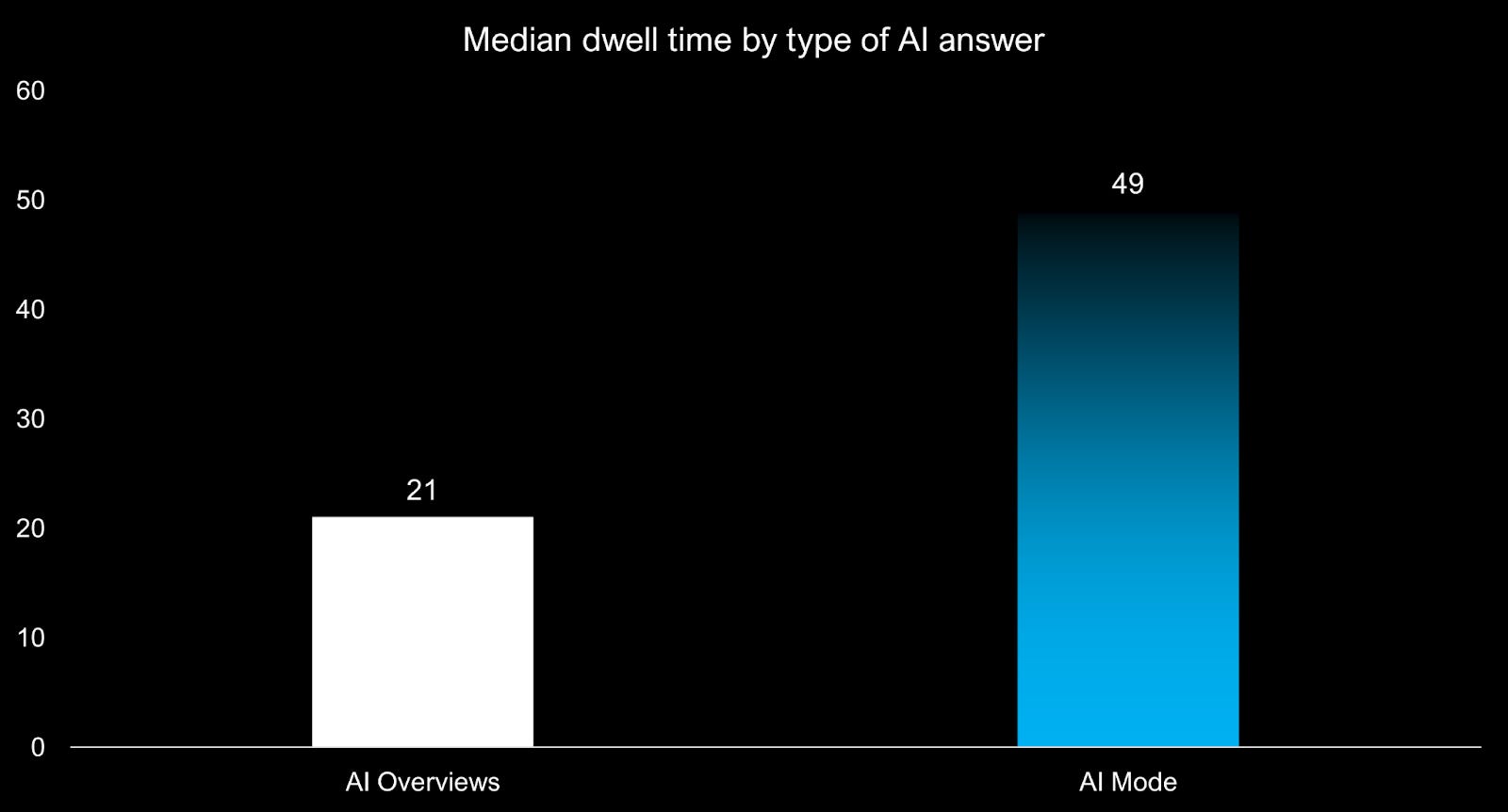
Plus, it’s interesting to see that users spend more than double the time in AI Mode compared to AIOs.
The overall engagement is much stronger.
Image Credit: Kevin Indig
Why It Matters
Treat the AI Mode panel like the primary reading surface, not a teaser for blue links.
AI Mode is a contained experience where sending clicks to websites is a low priority and giving users the best answer is the highest one.
As a result, it completely changes the value chain for content creators, companies, and publishers.
Insight
Why do other sources and/or AI Mode research analyses say that users don’t return to the AI Mode feature very often?
My theory here is that, because AI mode is a separate search experience (at least, for now), it’s not as visible as AIOs.
As AI Mode adoption increases with Google bringing Gemini (and AI Mode) into the browser, I expect our study findings to scale.
2. Clicks Are Reserved For Transactions
While clicks are scarce, purchase intent is not.
Participants in the study only clicked out when the task demanded it (e.g., “put an item in your shopping cart”) or if they browsed around a bit.
However, the browsing clicks were so few that we can safely assume AI Mode only leads to click-outs when users want to purchase.
Even prompts with a comparison and informational intent tend to keep users inside the feature.
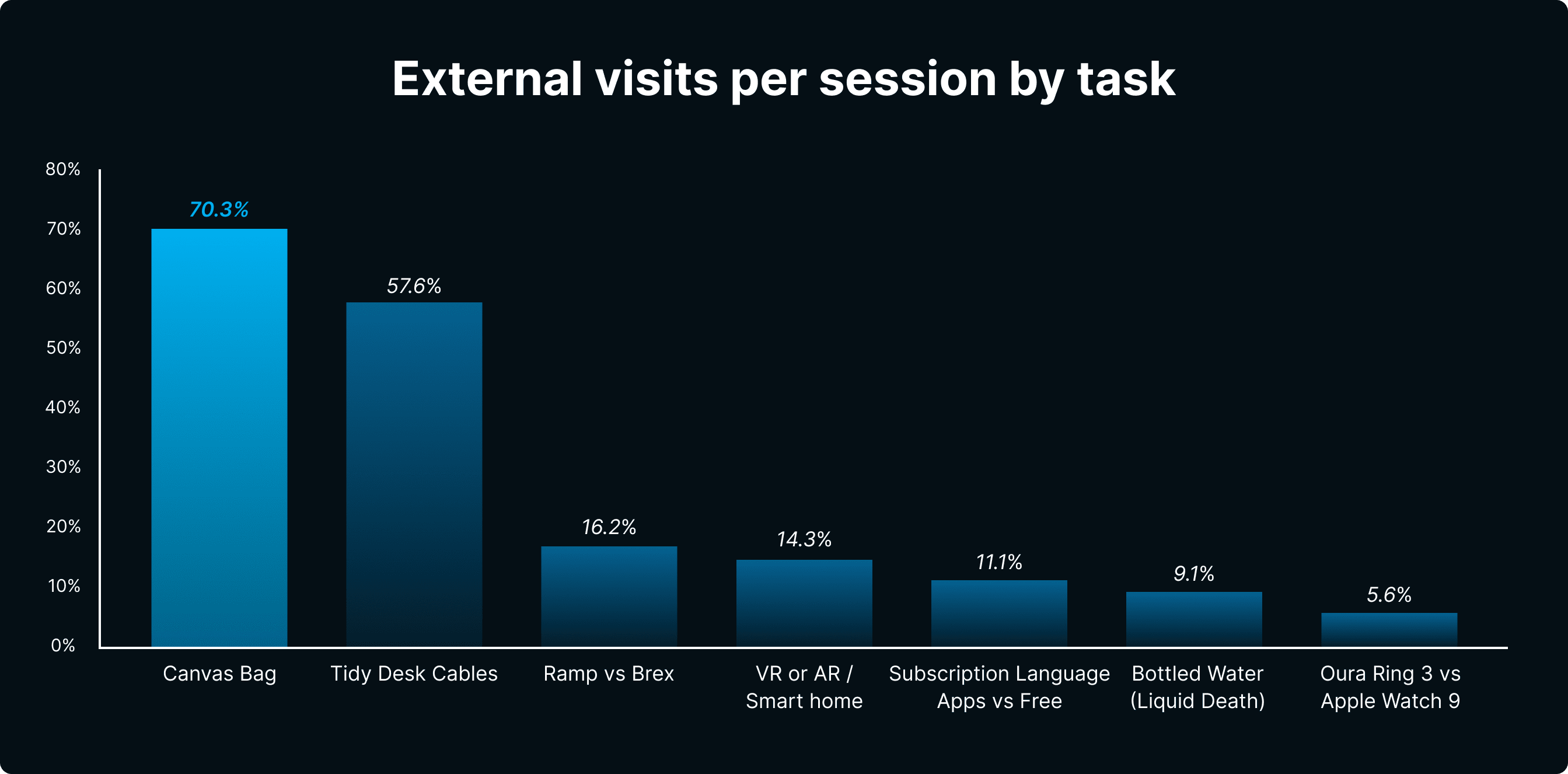
Shopping prompts like [canvas bag] and [tidy desk cables] drive the highest AI Mode exit share.
Comparison prompts like [Oura vs Apple Watch] show the lowest exit share of the tasks.
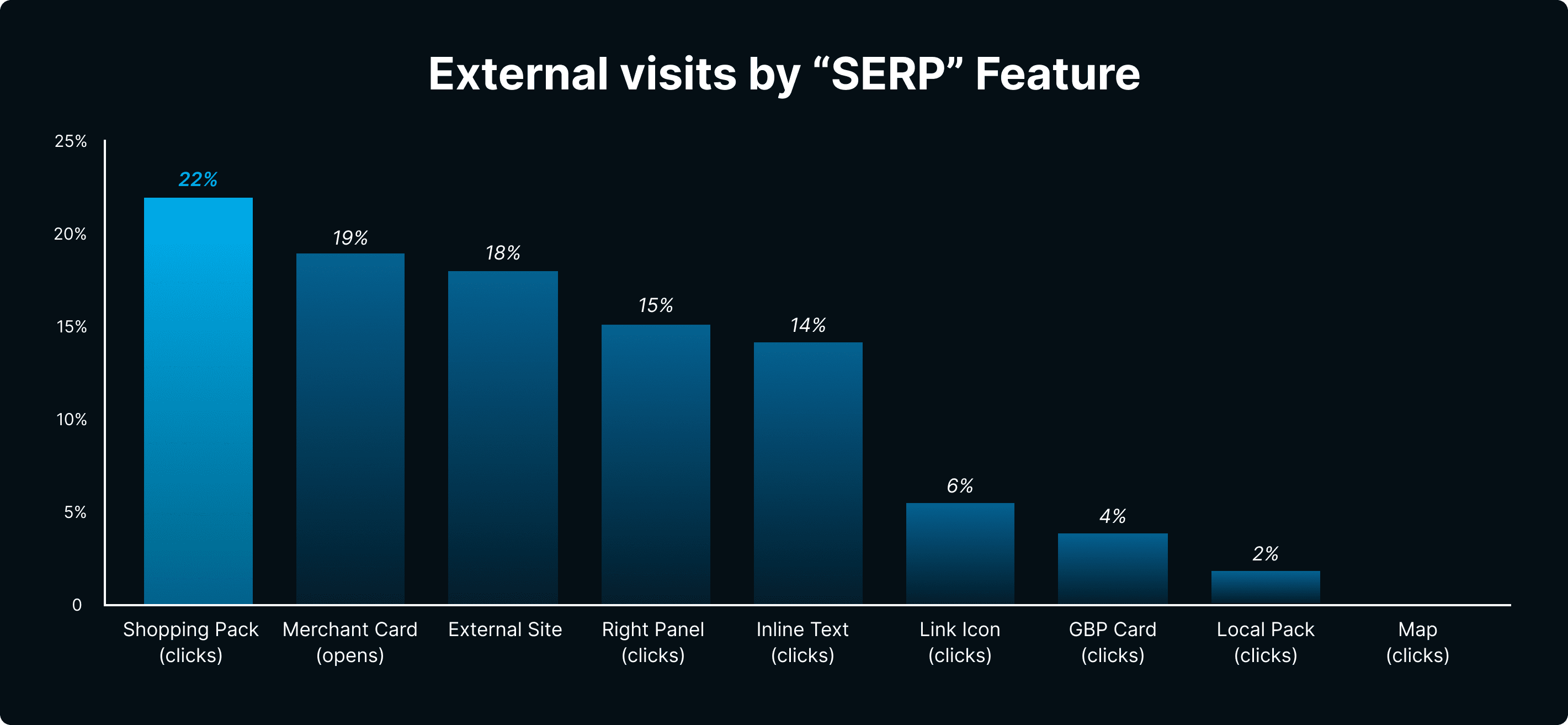
When participants were encouraged to take action (“put an item in your shopping cart” or “find a product”), the majority of clicks went to shopping features like Shopping Packs or Merchant Cards.
Image Credit: Kevin Indig
18% of exits were caused by users exiting AI Mode and going directly to another site, making it much harder to reverse engineer what drove these visits in the first place.
Study transcripts confirm that participants often share out loud that they’ll “go to the seller’s page,” or “find the product on Amazon/ebay” for product searches.
Even when comparing products, whether software or physical goods, users barely click out.
Image Credit: Kevin Indig
In plain terms, AI mode eats up all TOFU and MOFU clicks. Users discover products and form opinions about them in AI Mode.
Key Stats
Out of 250 valid tasks, the median number of external clicks was zero!
The prompt task of [canvas bag] had 44 external clicks, and [tidy desk cables] had 31 clicks, accounting for two-thirds of all external clicks in this study.
Comparison tasks like [Oura Ring vs Apple Watch] or [Ramp vs Brex] had very few clicks (≤6 total across all tasks).
Here’s what’s interesting…
In the AIOs Overviews usability study, we found desktop users click out ~10.6% of the time compared to practically 0% in AI Mode.
However, AIOs have organic search results and SERP Features below them. (People click out less in AIOs, but they click on organic results and SERP features more often.)
Zero-Clicks
AI Overviews: 93%*
AI Mode: ~100%
*Keep in mind that participants of the AIO usability study clicked on regular organic search results. The 93% relates to zero clicks within the AI Overview.
On desktop, AI Mode produces roughly double the in-panel clickouts compared to the AIO panel. On AIO SERPs, total clickouts can still happen via organic results below the panel, so the page-level rate will sit between the AIO-panel figure and the classic baseline.
An important note here from Eric Van Kirk, the director of this study: When comparing the AI Mode and AI Overview study, we’re not exactly comparing apples to apples. In this study, participants were given tasks that would prompt them to leave AI Mode in 2/7 questions, and that accounts for the majority of outbound clicks (which were fewer than three external clicks). On the other hand, for the AIO study, the most transactional question was “Find a portable charger for phones under $15. Search as you typically would.” They were not told to “put it in a shopping cart.” However, the insights gathered regarding user behavior from this AI Mode study – and the pattern that users don’t feel the need to click out of AI Mode to make additional decisions – still stands as a solid finding.
The bigger picture here is that AIOs are like a fact sheet that steers users to sites eventually, but AI Mode is a closed experience that rarely has users clicking out.
What makes AI Mode (and ChatGPT, by the way) tricky is when users abandon the experience and go directly to websites. It messes with attribution models and our ability to understand what influences conversions.
3. AI Mode Matches Site Type With Intent
In the study, we assess what types of sites AI Mode shows for our seven tasks.
Subscription language apps vs free: pcmag.com, nytimes.com, usatoday.com.
Bottled Water (Liquid Death): reddit.com, liquiddeath.com, youtube.com.
Ramp vs Brex: nerdwallet.com, kruzeconsulting.com, airwallex.com.
Oura Ring 3 vs Apple Watch 9: ouraring.com, zdnet.com.
VR arcade or smart home: sandboxvr.com, business.google.com, yodobashi.com.
Companies need to understand the playing field. While classic SEO allowed basically any site to be visible for any user intent, AI Mode has strict rules:
Brands beat marketplaces when users know what product they want.
Marketplaces are preferred when options are broad or generic.
Review sites appear for comparisons.
Opinions highlight Reddit and publishers.
Google itself is most visible for local intent, and sometimes shopping.
As SEOs, we need to consider how Google classifies our site based on its page templates, reputation, and user engagement. But most importantly, we need to monitor prompts in AI Mode and look at the site mix to understand where we can play.
Sites can’t and won’t be visible for all types of queries in a topic anymore; you’ll need to filter your strategy by the intent that aligns with your site type because AI Mode only shows certain sites (like review sites or brands) for specific types of intent.
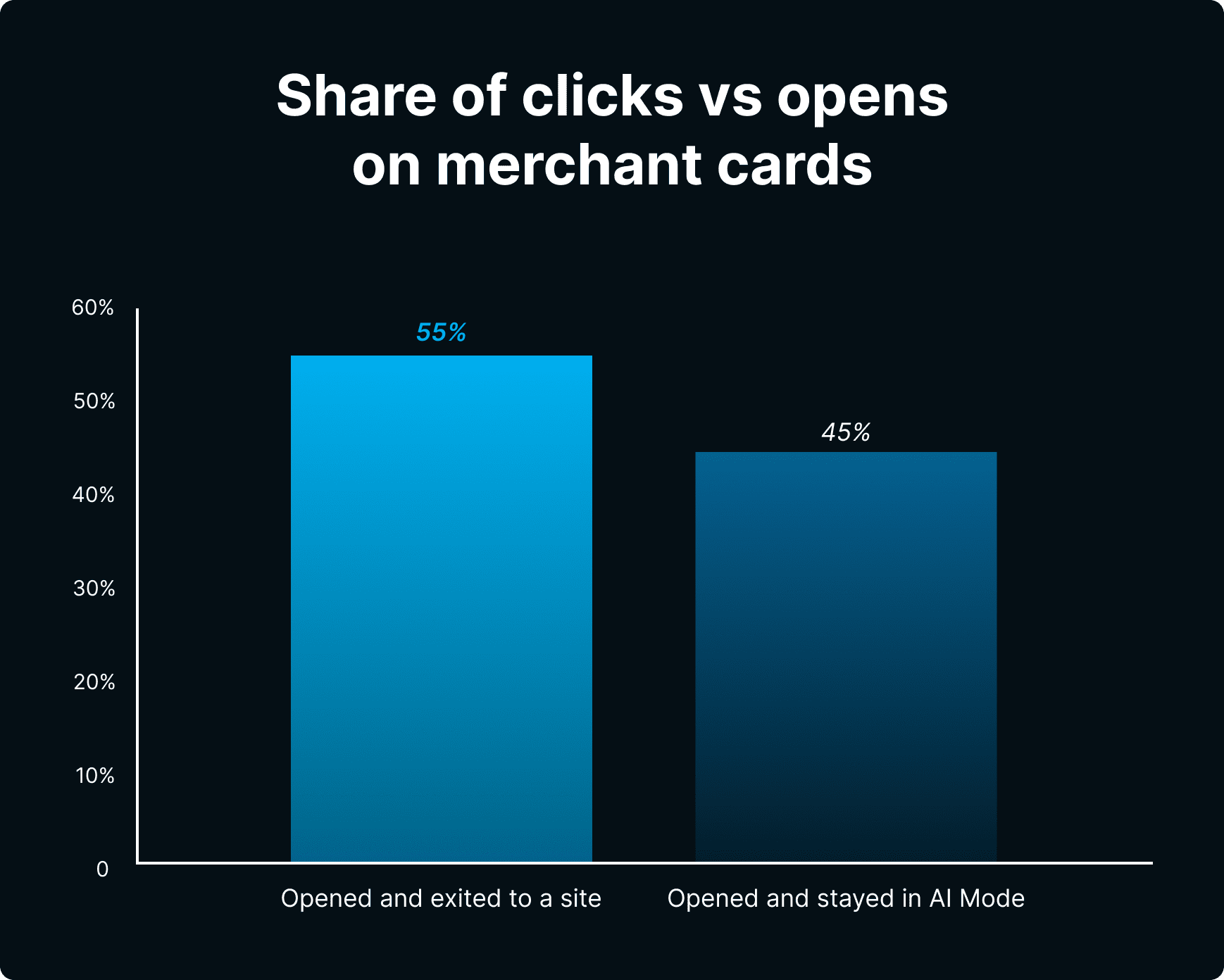
Product previews show up in about 25% of the AI Mode sessions, get ~9 seconds of attention, and people usually open only one.
Then? 45% stop there. Many opens are quick spec checks, not a clickout.
Image Credit: Kevin Indig
You can easily see how some product recommendations by AI Mode and on-site experiences are quite frustrating to users.
The post-click experience is critical: classic best practices like reviews have a big impact on making the most out of the few clicks we still get.
See this example:
“It looks like it has a lot of positive reviews. That’s one thing I would look at if I was going to buy this bag. So this would be the one I would choose.”
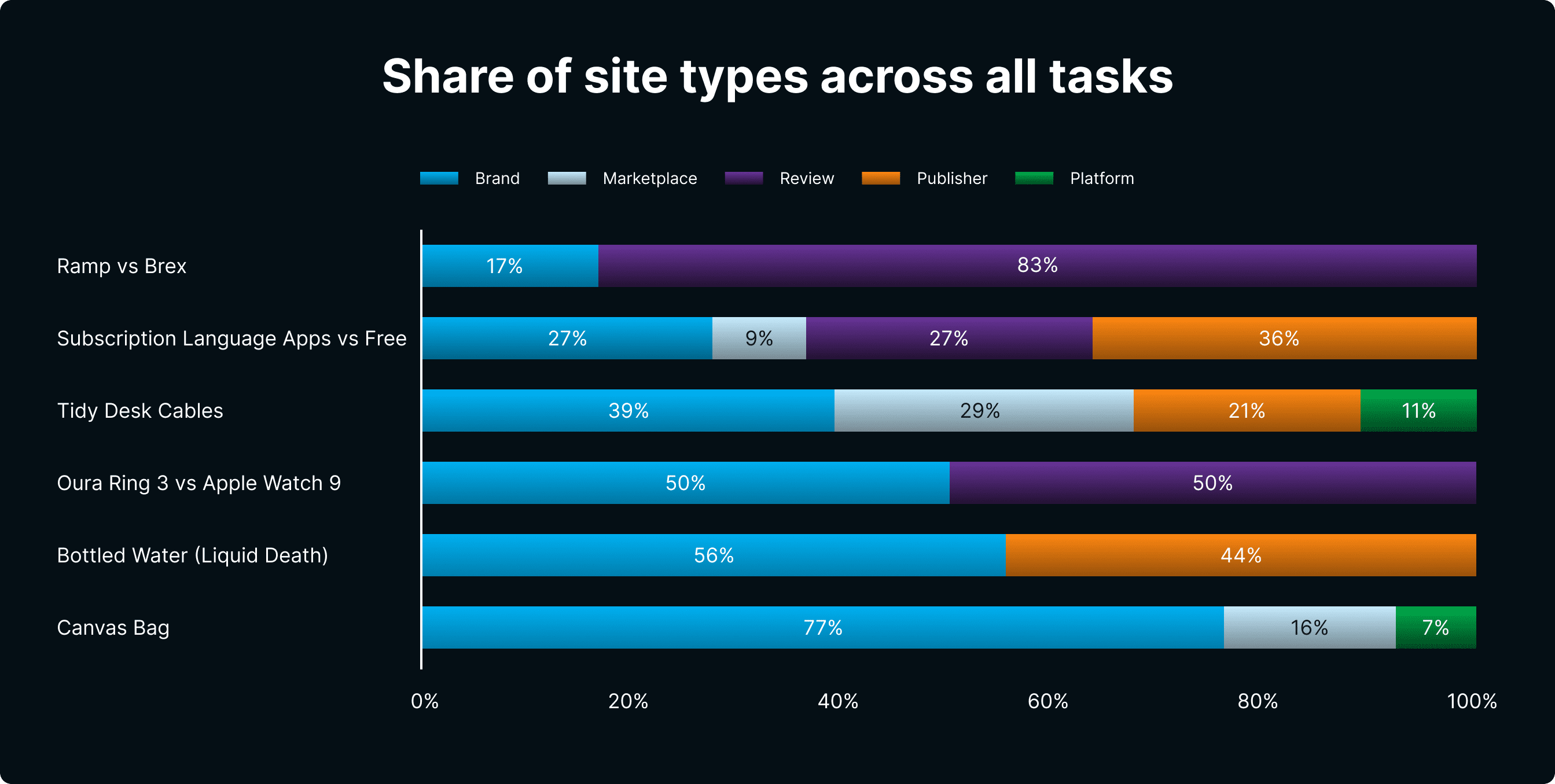
In shopping tasks, we found that brand sites take the majority of exits.
In comparison tasks, we discovered that review sites dominate. For reputation checks (like a prompt for [Liquid Death]), exits to brands and publishers were split.
For transactional intent prompts: Brands absorb most exits when the task is to buy one item now. [Canvas Bag] shows a strong tilt to brand PDPs.
For reputation intent prompts: Brand sites appear alongside publishers. A prompt for [Liquid Death] splits between liquiddeath.com and Reddit/YouTube/Eater.
For comparison prompts: Brands take a back seat. [Ramp vs Brex] exits go mostly to review sites like NerdWallet and Kruze.
Given users can now directly checkout on ChatGPT and AI Mode, shopping-related tasks might send even fewer clicks out.[2, 3]
Therefore, AI Mode becomes a completely closed experience where even shopping intent is fulfilled right in the app.
Clicks are scarce. Influence is plentiful.
The data gives us a reality check: If users continue to adopt the new way of Googling, AI Mode will reshape search behavior in ways SEOs can’t afford to ignore.
Strategy shifts from “get the click” to “earn the citation.”
Comparisons are for trust, not traffic. They reduce exits because users feel informed inside the panel.
Merchants should optimize for decisive exits. Give prices, availability, and proof above the fold to convert the few exits you do get.
You’ll need to earn citations that answer the task, then win the few, high-intent exits that remain.
But our study doesn’t end here.
Today’s results reveal core insights into how people interact with AI Mode. We’ll unpack more to consider with Part 2 dropping next week.
But for those who love to dig into details, the methodology of the study is included below.
Methodology
Study Design And Objective
We conducted a mixed-methods usability study to quantify how Google’s new AI Mode changes searcher behavior. Each participant completed seven live Google search prompts via the AI Mode feature. This design allows us to observe both the mechanics of interaction (scrolls, clicks, dwell, trust) and the qualitative reasoning participants voiced while completing tasks.
The tasks:
What do people say about Liquid Death, the beverage company? Do their drinks appeal to you?
Imagine you’re going to buy a sleep tracker and the only two available are the Oura Ring 3 or the Apple Watch 9. Which would you choose, and why?
You’re getting insights about the perks of a Ramp credit card vs. a Brex Card for small businesses. Which one seems better? What would make a business switch from another card: fee detail, eligibility fine print, or rewards?
In the “Ask anything” box in AI Mode, enter “Help me purchase a waterproof canvas bag.” Select one that best fits your needs and you would buy (for example, a camera bag, tote bag, duffel bag, etc.).
Proceed to the seller’s page. Click to add to the shopping cart and complete this task without going further.
Compare subscription language apps to free language apps. Would you pay, and in what situation? Which product would you choose?
Suppose you are visiting a friend in a large city and want to go to either: 1. A virtual reality arcade OR 2. A smart home showroom. What’s the name of the city you’re visiting?
1. Suppose you work at a small desk and your cables are a mess. 2. In the “Ask anything” box in AI Mode, enter: “The device cables are cluttering up my desk space. What can I buy today to help?” 3. Then choose the one product you think would be the best solution. Put it in the shopping cart on the external website and end this task.
Thirty-seven English-speaking U.S. adults were recruited via Prolific between Aug. 20 and Sept. 1, 2025 (including participants in a small group who did pilot studies).*
Eligibility required a ≥ 95% Prolific approval rate, a Chromium-based browser, and a functioning microphone. Participants visited AI Mode and performed tasks remotely via their desktop computer; invalid sessions were excluded for technical failure or non-compliance. The final dataset contains over 250 valid task records across 37 participants.
*Pilot studies are conducted first in remote usability testing to identify and fix technical issues – like screen-sharing, task setup, or recording problems – before the main study begins. They help refine task wording, timing, and instructions to ensure participants interpret them correctly. Most importantly, pilot sessions confirm that the data collected will actually answer the research questions and that the methodology works smoothly in a real-world remote setting.
Sessions ran in UXtweak’s Remote unmoderated mode. Participants read a task prompt, clicked to Google.com/aimode, prompted AI Mode, and spoke their thoughts aloud while interacting with AI Mode. They were given the following directions: “Think aloud and briefly explain what draws your attention as you review the information. Speak aloud and hover your mouse to indicate where you find the information you are looking for.” Each participant completed seven task types designed to cover diverse intent categories, including comparison, transactional, and informational scenarios.
UXtweak recorded full-screen video, cursor paths, scroll events, and audio. Sessions averaged 20-25 minutes. Incentives were competitive. Raw recordings, transcripts, and event logs were exported for coding and analysis.
Three trained coders reviewed each video in parallel. A row was logged for UI elements that held attention for ~5 seconds or longer. Variables captured included:
Structural: Fields describing the setup, metadata, or structure of the study – not user behavior; include data like participant-ID, task-ID, device, query, order of UI elements clicked or visited during the task, type of site clicked (e.g., social, community, brand, platform), domain name of the external site visited, and more.
Feature: Fields describing UI elements or interface components that appeared or were available to the participant. Examples include UI element type, including shopping carousels, merchant cards, right panel, link icons, map embed, local pack, GMB card, merchant packs, and merchant cards.
Engagement: Fields that capture active user interaction, attention, or time investment. Includes reading and attention, chat and question behavior, along with click and interaction behavior.
Outcome: Fields representing user results, annotator evaluations, or interpretation of behavior. Annotator comments, effort rating, where info was found.
Coders also marked qualitative themes (e.g., “speed,” “skepticism,” “trust in citations”) to support RAG-based retrieval. The research director spot-checked ~10% of videos to validate consistency.
Annotations were exported to Python/pandas 2.2. Placeholder codes (‘999=Not Applicable’, ‘998=Not Observable’) were removed, and categorical variables (e.g., appearances, clicks, sentiment) were normalized. Dwell times and other time metrics were trimmed for extreme outliers. After cleaning, ~250 valid task-level rows remained.
Our retrieval-augmented generation (RAG) pipeline enabled three stages of analysis:
Data readiness (ingestion): We flattened every participant’s seven tasks into individual rows, cleaned coded values, and standardized time, click, and other metrics. Transcripts were retained so that structured data (such as dwell time) could be associated with what users actually said. Goal: create a clean, unified dataset that connects behavior with reasoning.
Relevance filtering (retrieval): We used structured fields and annotations to isolate patterns, such as users who left AI Mode, clicked a merchant card, or showed hesitation. We then searched the transcripts for themes such as trust, convenience, or frustration. Goal: combine behavior and sentiment to reveal real user intent.
Interpretation (quant + qual synthesis): For each group, we calculated descriptive stats (dwell, clicks, trust) and paired them with transcript evidence. That’s how we surfaced insights like: “external-site tasks showed higher satisfaction but more CTA confusion.” Goal: link what people did with what they felt inside AI Mode.
This pipeline allowed us to query the dataset hyperspecifically – e.g., “all participants who scrolled >50% in AI Mode but expressed distrust” – and link quantitative outcomes with qualitative reasoning.
In plain terms: We can pull up just the right group of participants or moments, like “all the people who didn’t trust AIO” or “everyone who scrolled more than 50%.”
We summarized user behavior using descriptive and inferential statistics across 250 valid task records. Each metric included the count, mean, median, standard deviation, standard error, and 95% confidence interval. Categorical outcomes, such as whether participants left AI Mode or clicked a merchant card, were reported as proportions.
Analyses covered more than 50 structured and behavioral fields – from device type and dwell time to UI interactions, sentiment. Confidence measures were derived from a JSON analysis of user sentiment via transcripts of all users.
Each task was annotated by a trained coder and spot-checked for consistency across annotators. Coder-level distributions were compared to confirm stable labeling patterns and internal consistency.
Thirty-seven participants completed seven tasks each, resulting in approximately 250 valid tasks. At that scale, proportions around 50% carry a margin of error of about six percentage points, giving the dataset enough precision to detect meaningful directional differences.
Sample size is smaller than our AI Overviews study (37 vs. 69 participants) and is meant to learn about U.S.-based users (all participants were living in the U.S.). All queries took place within AI Mode, meaning we did not directly compare AI vs non-AI conditions. Think-aloud may inflate dwell times slightly. RAG-driven coding is only as strong as its annotation inputs, though heavy spot-checks confirmed reliability.
Participants gave informed consent. Recordings were encrypted and anonymized; no personally identifying data were retained. The study conforms to Prolific’s ethics policy and UXtweak TOS.
Featured Image: Paulo Bobita/Search Engine Journal