Hostinger Makes WordPress Agentic Web-Ready via @sejournal, @martinibuster

Hostinger announced a new AI-agent optimization feature that makes any WordPress website AI-agent-friendly, optimizing websites to provide the best experience for humans using AI agents to compare products, plan vacations, and perform other tasks that are part of a user’s information and consumer journey.

Agentic Web

The Agentic Web is a new reality of the Internet based on reducing friction for Agentic AI. Agentic AI refers to AI bots that go out into the web to complete tasks on behalf of humans.

The original version of the web was optimized as a platform for interactions with people. The Agentic Web is optimized for interactions with AI agents. What makes the Agentic Web possible is a collection of protocols and standards that make it easy for a person’s AI agent to crawl and complete tasks on websites.

Consumers are increasingly relying on AI for their information needs, and this includes product research. Just as websites had to become mobile-friendly to keep up with how users were consuming information, informational and e-commerce websites also need to begin considering how to capture that audience comprised of AI agents working on behalf of consumers.

Hostinger’s Web2Agent

Hostinger announced a new feature called Web2Agent. Web2Agent makes WordPress websites Agentic AI friendly with a single click. Web2Agent also works on Hostinger’s proprietary website builder.

According to Hostinger:

“Web2Agent is an experimental feature developed and operated by Hostinger. It transforms your website into a fully AI-compatible agent that can be easily discovered, understood, and accessed by AI tools. It currently works best with Claude, Cursor and tools supporting MCP protocol and we’re working on integrating it with ChatGPT, Gemini, and other autonomous AI agents.

As the internet shifts toward an agent-driven future, this feature helps position your website as a first-class participant in that ecosystem – intelligent, accessible, and interoperable.”

Enabling Web2Agent makes websites ready for interaction with AI while also respecting robots.txt and conforming to LLMs.txt.

Hostinger explains that it currently works with the MCP protocol and with any other tools and apps that connect to that protocol. It will be adding more protocols in the near future.

Read more at Hostinger:

AI is making standard websites outdated – here’s how to keep up

Brave Introduces Ask Brave, A Unified AI Search Interface via @sejournal, @MattGSouthern

Brave is rolling out Ask Brave, a unified search tool that combines AI chat features with regular search results.

It’s accessible on all browsers via the Brave Search homepage.

Ask Brave offers detailed answers, along with interactive elements like videos, webpages, and product listings, all within a single interface.

What’s ‘Ask Brave?’

Ask Brave builds on the company’s existing AI Answers feature, which Brave claims produces over 15 million responses daily.

The initial AI summarization tool was launched in 2023 as “Summarizer,” then renamed “Answer with AI,” and is now called “AI Answers.”

Josep M. Pujol, Chief of Search at Brave, says:

While AI Answers give our users quick summaries, Ask Brave provides longer answers, follow-ups, and a chat mode enhanced with Deep Research, and most importantly, contextually relevant enrichments such as videos, news articles, products, businesses, shopping, and more – in the right place, at the right time. Search makes it possible, LLMs glue it together. We anticipate that Ask Brave will generate millions more daily AI-powered answers with this powerful combination of search and chat, and look forward to deploying more useful AI-powered search tools for our users.

The company positions Ask Brave as a solution to a common frustration: switching between traditional search interfaces and chat tools. You can now access both from one entry point.

Grounded In Search

Brave reports Ask Brave achieves 94.9% accuracy on SimpleQA, using grounding tech with its Search API.

It taps into over 35 billion webpages to base responses on web info, reportedly reducing hallucinations and irrelevant results.

The Deep Research mode issues queries and analyzes thousands of pages to identify and address blind spots, Brave says.

Privacy

Brave affirms that Ask Brave follows its privacy-first policy.

Questions and chats aren’t used for training purposes. Conversations are encrypted, automatically deleted after 24 hours of inactivity, and IP addresses aren’t stored.

How To Use It

There are several ways to access Ask Brave:

  • Include double question marks (“??”) in queries when Brave Search is your default engine.
  • Click the “Ask” button on search.brave.com.
  • Choose the “Ask” tab on search results pages to switch traditional results to chat mode.
  • Directly set the homepage to the Ask Brave interface.

Broader Context

Brave claims Brave Search is the third-largest independent global search engine, handling about 1.5 billion monthly queries. The Brave browser reports over 97 million monthly active users worldwide, according to the company.

The launch lands as major search engines continue integrating AI into core experiences. Google has rolled out AI Mode across Search, while Microsoft has integrated Copilot into Bing and Edge.

Brave also offers a Search API that provides real-time data to AI language models.


Featured Image: bangla press/shutterstock

Google Launches New Small-Business Resource Hub via @sejournal, @MattGSouthern

Google has launched a small-business resource hub, positioning it as a single starting point for setup, advertising, measurement, and support.

The page pulls together direct entry points for Business Profile, Merchant Center, Google Ads and YouTube Ads, plus a clear “get started” path into Google Analytics.

It also spotlights Workspace’s AI features and links beginner training and help resources in one place.

What’s In It?

The hub serves as a gateway to Google’s small-business tools.

You can claim a Business Profile, list products in Merchant Center, launch Google Ads or YouTube Ads, and activate Analytics.

The layout makes it easier to move a client from “claim your profile” to “list products” to “launch ads” without hopping sites.

Screenshot from: business.google.com/us/essentials/, September 2025.

How It Helps

For agencies and consultants, the practical use is straightforward: you can send new clients to a single URL for onboarding instead of assembling links across multiple Google properties.

It’s a navigational layer over tools you already use. What’s actually new is the packaging and emphasis.

Google has offered “Google for Small Business” destinations before, but this refresh lives on business.google.com, reflects today’s ads lineup, and puts AI-assisted workflows and starter website options in view.

That makes it more useful as a canonical link you can include in proposals, kickoff emails, and checklists.

Looking Ahead

The test for marketers is whether Google continues to keep this page fresh with the latest product updates, new partner offers, and up-to-date guides.

If it does, it can make onboarding smoother for small teams and give you more time to focus on strategy instead of worrying about URL management.


Featured Image: IB Photography/Shutterstock

The Impact Of AI Overviews & How Publishers Need To Adapt via @sejournal, @MattGSouthern

Google rolled out AI Overviews to all U.S. users in May 2024. Since then, publishers have reported significant traffic losses, with some seeing click-through rates drop by as much as 89%. The question isn’t whether AI Overviews impact traffic, but how much damage they’re doing to specific content types.

Search (including Google Discover and traditional Google Search) consistently accounts for between 20% and 40% of referral traffic to most major publishers, making it their largest external traffic source. When DMG Media, which owns MailOnline and Metro, reports nearly 90% declines for certain searches, it’s a stark warning for traditional publishing.

After more than a year of AI Overviews (and Search Generative Experience), we have extensive data from publishers, researchers, and industry analysts. This article pulls together findings from multiple studies covering hundreds of thousands of keywords, tens of thousands of user searches, and real-world publisher experiences.

The evidence spans from Pew Research’s 46% average decline to DMG Media’s 89% worst-case scenarios. Educational platforms like Chegg report a 49% decline. But branded searches are actually increasing for some, suggesting there are survival strategies for those who adapt.

This article explains what’s really happening and why, including the types of content that face the biggest changes and which are staying relatively stable. You’ll understand why Google says clicks are “higher quality” even as publishers see traffic declines, and you’ll see what changes might make sense based on real data rather than guesses.

AI Overviews are the biggest change to search since featured snippets were introduced in 2014. They’re affecting the kinds of content publishers produce, and they’re increasing zero-click searches, which now make up 69% of all queries, according to Similarweb.

Whether your business relies on search traffic or you’re just watching industry trends, these patterns are significantly impacting digital marketing.

What we’re seeing is a new era in search and a change that is reshaping how online information is shared and how users interact with it.

AI Overview Studies: The Overwhelming Evidence

Google’s AI Overviews (AIO) have impacted traffic across most verticals and altered search behavior.

The feature, which was first introduced as Search Generative Experience (SGE) announced at Google I/O in May 2023, now appears in over 200 countries and 40 languages following a May 2025 expansion.

Independent research conducted throughout 2024 and 2025 shows click-through rate reductions ranging from 34% to 46% when AI summaries appear on search results pages.

Evidence from a variety of independent studies outlines the impact of AIO and shows a range of effects depending on the type of content and how it’s measured:

Reduced Click Through Rates – Pew Research Center

A study by Pew Research Center provides a rigorous analysis. By tracking 68,000 real search queries, researchers found that users clicked on results 8% of the time when AI summaries appeared, compared to 15% without them. That’s a 46.7% relative reduction.

Pew’s study tracked actual user behavior, rather than relying on estimates or keyword tools, validating publisher concerns.

Google questioned Pew’s methodology, claiming that the analysis period overlapped with algorithm testing unrelated to AI Overviews. However, the decline and its connection to AI Overview presence suggest a notable relationship, even if other factors played a role.

Position One Eroded – Ahrefs

Ahrefs’ analysis found that position one click-through rates dropped for informational keywords triggering AI Overviews.

Ryan Law, Director of Content Marketing at Ahrefs, stated on LinkedIn:

“AI Overviews reduce clicks by 34.5%. Google says being featured in an AI Overview leads to higher click-through rates… Logic disagrees, and now, so does our data.”

Law’s observation gets to the heart of a major contradiction: Google says appearing in AI Overviews helps publishers, but the math of fewer clicks suggests this is just corporate doublespeak to appease content creators.

His post garnered over 8,200 reactions, indicating widespread industry agreement with these findings.

More Zero-Click Searches – Similarweb

According to Similarweb data, zero-click searches increased from 56% to 69% between May 2024 and May 2025. While this captures trends beyond AI Overviews, the timing aligns with the rollout.

Zero-click searches work because they meet user needs. For example, when someone searches for “weather today” or a stock price, getting an instant answer without clicking is helpful. The issue comes when zero-click searches creep into areas where publishers used to offer in-depth content.

Stuart Forrest, global director of SEO digital publishing at Bauer Media, confirms the trend, telling the BBC:

“We’re definitely moving into the era of lower clicks and lower referral traffic for publishers.”

Forrest’s admitting to this new reality shows that the industry as a whole is coming to terms with the end of the golden age of search traffic. Not with a dramatic impact, but with a steady decline in clicks as AI meets users’ needs before they ever leave Google’s ecosystem.

Search Traffic Decline – Digital Content Next

An analysis by Digital Content Next found a 10% overall search traffic decline among member publishers between May and June.

Although modest compared to DMG’s worst-case scenarios, this represents millions of lost visits across major publishers.

AIO Placement Volatility – Authoritas

An Authoritas report finds that AI Overview placements are more volatile than organic ones. Over a two- to three-month period, about 70% of the pages cited in AI Overviews changed, and these changes weren’t linked to traditional organic rankings.

This volatility is why some sites experience sudden traffic drops even when their blue-link rankings seem stable.

Click-Based Economy Collapse For News Publishers – DMG Media

A statement from DMG Media to the UK’s Competition and Markets Authority reveals click-through rates dropped by as much as 89% when AI Overviews appeared for their content.

Although this figure represents a worst-case scenario rather than an average, it highlights the potential for traffic losses for certain search types.

Additionally, there are differences in how AI Overviews affect click-through rates depending on the device type.

The Daily Mail’s desktop CTR dropped from 25.23% to 2.79% when an AI Overview surfaced above a visible link (-89%), with mobile traffic declining by 87%; U.S. figures were similar.

These numbers indicate we’re facing more than just a temporary adjustment period. We’re witnessing a structural collapse of the click-based economy that has supported digital publishing since the early 2000s. With traffic declines approaching 90%, we’ve gone beyond optimization tactics and into existential crisis mode territory.

The submission to regulatory authorities suggests they’re confident in these numbers, despite their magnitude.

Educational Site Disruption – Chegg

Educational platforms are experiencing disruption from AI Overviews.

Learning platform Chegg reported a 49% decline in non-subscriber traffic between January 2024 and January 2025 in company statements accompanying their February antitrust lawsuit.

The decline coincided with AI Overviews answering homework and study questions that previously drove traffic to educational sites. Chegg’s lawsuit alleges that Google used content from educational publishers to train AI systems that now compete directly with those publishers.

Chegg’s case is a warning sign for educational content creators: If AI systems can successfully replace structured learning platforms, what’s the future for smaller publishers?

Reduced Visibility For Top Ranking Sites – Advanced Web Ranking

AI Overviews are dense and tall, impacting the visibility of organic results.

Advanced Web Ranking found that across 8,000 keywords, AI Overviews average around 169 words and include about seven links when expanded.

Once expanded, the first organic result often appears about 1,674px down the page. That’s well below the fold on most screens, reducing visibility for even top-ranked pages.

Branded Searches: The Surprising Exception

While most query types are seeing traffic declines, branded searches show the opposite trend. According to Amsive’s research, branded queries with AI Overviews see an 18% increase in click-through rate.

Several related factors likely contribute to this brand advantage. When AI Overviews mention specific brands, it conveys authority and credibility in ways that generic content can’t replicate.

People seeing their preferred brand in an AI Overview may be more likely to click through to the official site. Additionally, AI Overviews for branded searches often include rich information like store hours, contact details, and direct links, making it easier for users to find what they need.

This pattern has strategic implications as companies that have invested in brand building have a strong defense against AI disruption. The 18% increase in branded terms versus a 34-46% decrease in generic terms (as shown above) creates a performance gap that will likely impact marketing budgets.

The brand advantage extends beyond direct brand searches. Queries combining brand names with product categories show smaller traffic declines than purely generic searches. This suggests that even partial brand recognition provides some protection against AI Overview disruption. Companies with strong brands can leverage this by ensuring their brand appears naturally in relevant conversations and content.

This brand premium creates a two-tier internet, where established brands flourish while smaller content creators struggle financially. The impact on information diversity and market competition is troubling.

Google’s Defense: Stable Traffic, Better Quality

Google maintains a consistent three-part defense of AI Overviews:

  • Increased search usage.
  • Improved click quality.
  • Stable overall traffic.

The company frames AI Overviews as enhancing rather than replacing traditional search, though this narrative faces increasing skepticism from publishers experiencing traffic declines.

The company’s blog post from May, introducing the global expansion, stated:

“AI Overviews is driving over 10% increase in usage of Google for the types of queries that show AI Overviews. This means that once people use AI Overviews, they are coming to do more of these types of queries.”

Although this statistic shows a rise in Google Search engagement, it’s sparked intense debate and skepticism in the search and publishing worlds. Many experts agree that a 10% boost in AI Overview-driven searches could be due to changes in user behavior, but also warn that higher search volumes don’t automatically mean more traffic for content publishers.

A number of LinkedIn industry voices have publicly pushed back on Google’s 10% usage increase narrative. For example, Devansh Parashar writes:

“Google’s claim that AI Overviews have driven 10% more searches masks a troubling trend. Data from independent research firms, such as Pew, show that a majority of users do not click beyond the AI Overview— a figure that suggests Google’s LLM layer is quietly eating the web’s traffic pie.”

Similarly, Trevin Shirey points out concerns about the gap between increased engagement with search queries and the actual traffic publishers see:

“Although Google reports a surge in usage, many publishers are experiencing declines in organic click-through rates. This signals a silent crisis where users get quick answers from AI, but publishers are left behind.”

Google’s claim about increased usage needs to be read carefully. The increase is only for certain types of queries that show AI overviews, not overall search volume.

If users have to make multiple searches to find information they could have gotten in one click, their overall usage might go up, but their satisfaction could actually decrease.

In an August blog post, Google’s head of search, Liz Reid, claimed the volume of clicks from Google search to websites had been “relatively stable” year-over-year.

Reid also asserted that click quality had improved:

“With AI Overviews, people are searching more and asking new questions that are often longer and more complex. In addition, with AI Overviews people are seeing more links on the page than before. More queries and more links mean more opportunities for websites to surface and get clicked.”

A Google spokesperson told the BBC:

“More than any other company, Google prioritises sending traffic to the web, and we continue to send billions of clicks to websites every day.”

Google’s developer documentation states:

“We’ve seen that when people click from search results pages with AI Overviews, these clicks are higher quality (meaning, users are more likely to spend more time on the site).”

Publishers are understandably concerned and question the differences between Google’s description of stability and the actual data showing otherwise.

Jason Kint, CEO of Digital Content Next, notes:

“Since Google rolled out AI Overviews in your search results, median year-over-year referral traffic from Google Search to premium publishers down 10%.”

Kint’s data shatters Google’s carefully crafted image of stability, exposing what many publishers already suspect: The search giant’s promises are increasingly at odds with the realities reflected in their analytics dashboards and revenue reports.

The argument that higher-quality clicks are more valuable doesn’t provide much comfort when revenue is falling short. Even if engagement increases, losing such a large portion of clicks is a serious challenge for many ad-supported businesses.

Echoing these concerns, SEO Lead Jeff Domansky states:

“For publishers, AI Overviews are a direct hit to traffic and revenue models built around clicks and pageviews.”

Although Google claims that AI Overview clicks are of higher quality, many industry experts are skeptical.

Lily Ray, Vice President, SEO Strategy & Research at Amsive, highlights the lack of quality control on Google’s end:

“Since Google’s AI Overviews were launched, I (and many others) have shared dozens of examples of spam, misinformation, and inaccurate, biased, or incomplete results appearing in live AI Overview responses.”

And SEO specialist Barry Adams raises concerns about the quality and sustainability:

“Google’s AI Overviews are terrible at quoting the right sources… There is nothing intelligent about LLMs. They’re advanced word predictors, and using them for any purpose that requires a basis in verifiable facts – like search queries – is fundamentally wrong.”

Adams highlights a philosophical contradiction in AI Overviews: By relying on probabilistic language models to answer factual questions, Google may be misaligning technology with user needs.

This range of voices highlights a growing disconnect between Google’s hopeful engagement claims and the tough realities many publishers are facing as their referral traffic and revenue decrease.

Google hasn’t provided specific metrics defining “higher quality.” Publishers can’t verify these claims without access to comparative engagement data from AI Overview versus traditional search traffic.

Legal Challenges Mount

Publishers are seeking relief through regulatory and legal channels. In July, the Independent Publishers Alliance, tech justice nonprofit Foxglove, and the campaign group Movement for an Open Web filed a complaint with the UK’s Competition and Markets Authority. They claim that Google AI Overviews misuse publisher content, causing harm to newspapers.

The complaint urges the CMA to impose temporary measures that prevent Google from using publisher content in AI-generated responses without compensation.

It’s still unclear whether courts and regulators, which often move at a slow pace, can take action quickly enough to help publishers before market forces make any potential solutions irrelevant. A classic example of regulation trying to keep up with technological advancements.

The rapid growth of AI Overviews suggests that market realities may outstrip legal solutions.

Publisher Adaptations: Beyond Google Dependence

With threats looming, publishers are rushing to cut their reliance on Google. David Higgerson shares Reach’s approach in a statement to the BBC:

“We need to go and find where audiences are elsewhere and build relationships with them there. We’ve got millions of people who receive our alerts on WhatsApp. We’ve built newsletters.”

Instead of creating content for Google discovery, publishers need to develop direct relationships. Email newsletters, mobile apps, and podcast subscriptions provide traffic sources that aren’t affected by AI Overview disruptions.

Stuart Forrest stresses the importance of quality as a key differentiator:

“We need to make sure that it’s us being cited and not our rivals. Things like writing good quality content… it’s amazing the number of publishers that just give up on that.”

However, quality alone may not be enough if users never leave Google’s search results page. Publishers also need to master AI Overview optimization and understand how to make the most of remaining click opportunities.

Higgerson notes:

“Google doesn’t give us a manual on how to do it. We have to run tests and optimise copy in a way that doesn’t damage the primary purpose of the content.”

Another path that’s emerging is content licensing. Following News Corp and The Atlantic partnering with OpenAI, more publishers are exploring direct licensing relationships. These deals typically provide upfront payments and ongoing royalties for content usage in AI training, though terms remain confidential.

What We Don’t Know

There are still many uncertainties. The long-term trajectory of AI Mode, for example, could alter current patterns.

AI Mode

Google’s AI Mode may pose an even bigger threat than AI Overviews. This new interface displays search results in a conversational format instead of 10 blue links. Searchers have a back-and-forth with AI, with occasional reference links thrown in.

For publishers already struggling with AI-powered overviews, AI Mode could wipe out the rest of their traffic.

International Impact

The international effects outside English-language markets remain unmeasured. Since AI Overviews are available in over 200 countries and 40 languages, the impact likely varies by market. Factors like cultural differences in search behavior, language complexity, local competition dynamics, and varying digital literacy levels could lead to vastly different outcomes.

Most current research focuses on English-language markets in developed economies.

Content Creation

The feedback loop between AI Overviews and content creation could reshape what content gets produced and how information flows online.

If publishers stop creating certain types of content due to traffic losses, will AI Overview quality suffer as training data becomes stale?

Looking Ahead: Expanded AI Features

Google intends to continue expanding AI features despite mounting publisher concerns and legal challenges.

The company’s roadmap includes AI Mode international expansion and enhanced interactive features, including voice-activated AI conversations and multi-turn query refinement. Publishers should prepare for continued evolution rather than expecting stability in search traffic patterns.

Regulatory intervention may force greater transparency in the coming months. The Independent Publishers Alliance’s EU complaint requests detailed impact assessments and content usage documentation.

These proceedings could establish precedents affecting how AI systems can use publisher content.

Final Thoughts

The question isn’t whether AI Overviews affect traffic. Evidence overwhelmingly confirms they do. The question is how publishers adapt business models while maintaining sustainable operations.

The web is at a turning point, where the core agreement is being rewritten by the platforms that once promoted the open internet. Publishers who don’t acknowledge this change are jeopardizing their relevance in an AI-driven future.

Those who understand the impact, invest in brand building, and diversify traffic sources will be best positioned for success.

More Resources:


Featured Image: Roman Samborskyi/Shutterstock

Black Friday Strategies For 2025: Learning From Last Year’s Winning Tactics via @sejournal, @gregjarboe

Black Friday 2024 rewrote the playbook for holiday retail, setting new sales records, ushering in mobile-first shopping, and unleashing bold, creative campaigns from leading brands. With the 2025 planning window about to close, brands must analyze the critical data, emerging trends, and strategic lessons learned from last year to build effective campaigns that maximize reach, engagement, and revenue.

Below, discover the stats and strategies shaping this year’s Black Friday – and examine the innovative approaches of Amazon, Walmart, and Target to inspire your brand’s success.

Record-Breaking Sales: The New Holiday Landscape

Black Friday 2024 was nothing short of historic. U.S. online spending surged to $10.8 billion, marking a 10.2% increase over 2023, while global sales soared to $74.4 billion in just 24 hours – a year-over-year gain of 5%. Cyber Monday followed suit, hitting $13.3 billion in online sales, up $0.9 billion from the previous year, and driving the overall Cyber Week total to $241.4 billion.

This growth is driven by a combination of shifting consumer behaviors, expanded shopping timelines, and elevated digital experiences. But while overall spending is up, signals of caution in consumer sentiment suggest 2025 may see strong – if more moderate – expansion. According to NRF forecasts, holiday sales growth is expected to land between 2.7% and 3.7% this year, a step down from the boom in 2023–2024.

Key Data Highlights

  • 87.3 million U.S. consumers shopped online on Black Friday 2024.
  • 81.7 million visited physical stores, underscoring the persistent relevance of in-person shopping – even as online dominates.
  • Mobile purchases comprised 69% of global Black Friday spending and 57% on Cyber Monday.
  • Buy Now, Pay Later (BNPL) spending hit $686 million on Black Friday alone and $18.2 billion for the season, up nearly 9% year-over-year.

Market Trends: The Era Of Mobile, Social Video, And Early Shopping

Mobile-First Shopping

Digital’s dominance was overwhelming in 2024. The majority of Black Friday’s action has shifted to mobile devices, forcing brands to rethink the digital shopping experience from the ground up. Mobile optimization is no longer optional – every touchpoint, from landing pages to checkout, must be frictionless and designed for mobile screens.

The Rise Of Social Video And Live Commerce

Social video emerged as one of the most compelling drivers of traffic and conversion. Short-form, vertical video formats – think Instagram Reels, TikTok, and YouTube Shorts –proved highly effective at reaching mobile-first audiences. Leading brands leaned into shoppable videos, influencer partnerships, and real-time live shopping events to create urgency and authentic engagement.

Strategic tactics include:

  • Leveraging in-app shopping directly from video content.
  • Integrating polls, quizzes, and interactive features.
  • Harnessing influencer and user-generated content (UGC) for social proof.
  • Hosting live streams to humanize the brand and create urgency.

Extended Promotions: The Multi-Week Holiday

Holiday shopping is no longer a one-day rush. In 2024, nearly two-thirds of consumers started shopping before Black Friday, with many beginning as early as June or August. The trend towards extended promotional periods means that brands must capture attention early and sustain momentum through Cyber Week rather than concentrating efforts on a single moment.

Supporting data:

  • 32% of shoppers planned to start between July and October.
  • 92% researched products well in advance of the holidays.

Changing Consumer Behaviors: Caution, Value, And Big-Ticket Shopping

While online spending and average order values climbed in 2024, consumer caution emerged. Economic uncertainty, inflation, and tariffs are driving buyers to hunt for authentic deals, focus on higher-value purchases when deep discounts are available, and rely on BNPL options for larger buys.

  • 75% of consumers say they’ll spend the same or more in 2025, but discretionary categories like apparel are cooling, with higher growth forecasted for electronics, toys, and experiences.
  • Toys experienced a 680% surge in Cyber Monday sales compared to October averages.

Generational Divide

While Millennials, Gen X, and Boomers are poised to maintain or boost their spend, Gen Z may pull back due to heightened economic pressures. Brands must refine their segmentation and message accordingly.

The Black Friday Campaigns: Amazon, Walmart, And Target

Some of the most valuable lessons for 2025 come directly from the creative marketing strategies deployed by major retailers.

Amazon: Storytelling, Discovery, And 5-Star Ratings

Amazon’s “5-Star Theatre” campaign, starring Adam Driver, exemplified the move away from pure price messaging. Instead, it drew shoppers into a narrative of product discovery and elevated everyday products via dramatic storytelling.

Emphasizing the expansive selection and the importance of customer reviews, Amazon positioned itself as the ultimate holiday shopping destination – not just a place for deals, but a one-stop discovery platform.

 Strategic features:

  • Extended 12-day promotional calendar, capturing early and late shoppers.
  • 60%+ of holiday sales through independent sellers, boosting marketplace growth.
  • Significant investments in AI-powered shopping assistants to enhance conversion rates.
  • Strong focus on mobile commerce, reporting nearly 55% of purchases from phones or tablets.

Walmart: Entertainment, “Deals Of Desire,” And Marketplace Growth

With its episodic “Deals of Desire” mini-series, Walmart turned deal-hunting into entertainment. The campaign’s soap opera vibe – filled with drama, humor, and nostalgia – created memorable experiences, using thematic storytelling and celebrity partnerships (e.g., “Mean Girls” reunion) to connect with broad audiences and drive both online and in-store traffic.

Notable tactics:

Target: Simplicity, Clarity, And Social Influence

Target’s “Black Friday Deals” campaign cut through ad clutter with a direct, transparent promise: great deals, presented simply and boldly. The campaign championed clarity, leveraging Target’s reputation for curated selections and an omnichannel approach (online, in-store, and convenient pickup options). Target also used exclusive merchandise, like a Taylor Swift book, to boost store traffic and foster intentional, budget-conscious purchases.

Critical success factors:

  • Large jump in in-store traffic (+17% year-over-year), even as basket sizes became more restrained.
  • Heavy investment in influencer marketing, with micro- and macro-influencers driving brand awareness.
  • Extended pre-event promotions (e.g., Circle Week) to sustain engagement, with deal-driven consumer behavior dominating non-promotional periods.

Tactical Playbook For 2025: Actionable Steps

Winning Black Friday in 2025 requires starting early and sustaining promotions well beyond the traditional shopping window.

Brands should launch teasers as early as October – or even sooner – and use countdown timers and flash deals to build urgency. Extending offers into Cyber Week ensures that cautious, value-driven buyers have multiple opportunities to engage, while pre-Black Friday content with deal countdowns primes audiences for action.

Success will hinge on mobile-first, social-driven experiences.

Every aspect of digital commerce, from site speed to checkout design, must be optimized for mobile. Social platforms like TikTok, Instagram Reels, and YouTube Shorts should serve as the primary stage for vertical, shoppable video content. Interactive tools such as polls, quizzes, and live streams can deepen engagement, while keeping shoppers entertained and invested.

Influencer and user-generated content (UGC) will remain essential for authenticity and reach.

Integrated influencer campaigns – ranging from niche creators to broader personalities – can deliver credible product storytelling. At the same time, encouraging customers to share their own experiences with branded hashtags and spotlighting top submissions helps strengthen trust and build powerful social proof.

Artificial intelligence offers another critical edge.

AI-driven chatbots, personalized recommendation engines, and targeted messaging can create individualized shopping journeys that boost conversion. Personalized videos, demographic-based segmentation, and behavioral targeting allow campaigns to resonate across generations. Promoting BNPL options alongside transparent, value-focused deal messaging makes bigger-ticket items more accessible and appealing.

Finally, economic pressures mean brands must emphasize genuine value.

Shoppers in 2025 will reward authenticity, gravitating toward clear savings rather than inflated discounts. Careful inventory planning is crucial, with stronger focus on proven categories like electronics, toys, beauty, and experiences. Messaging should adapt to highlight budget-conscious solutions, experience-based gifts, and flexible payment options – all while maintaining trust and loyalty.

Market Outlook: Anticipated Shifts For Black Friday 2025

  • Sales growth should remain strong but more measured, with NRF projecting a 2.7 to 3.7% rise.
  • Mobile and social commerce will drive the lion’s share of purchases, especially among Gen Z and Millennials.
  • Value-driven and cautious shopping will dominate, shaping the communication and promotional tactics brands deploy.
  • Experiences over possessions: Expect spending on restaurants, travel, and entertainment gifts to grow, especially among Millennials and Gen X.
  • Consumers will shop early and over longer stretches, moving away from single-day shopping frenzies.

Conclusion: Building Your 2025 Black Friday Strategy

Black Friday is no longer a single point in time – it’s a season, a landscape, and an ongoing digital battleground. The strongest brands will start early, focus relentlessly on mobile and social video, and build authentic narratives that cut through the noise. By learning from the dramatic successes (and stumbles) of Amazon, Walmart, and Target – while harnessing AI, influencer power, and real-time interactivity – brands can not only capture sales but foster lasting loyalty and multi-channel engagement.

Data-driven, creative, and mobile-first strategies will be the signature of Black Friday 2025’s winners. Start planning now and let the lessons of 2024’s record-breaking weekend power your next campaign.

More Resources:


Featured Image: Roman Samborskyi/Shutterstock

Go beyond CTR with 6 AI-powered SEO discoverability metrics

Thanks to AI-generated answers, CTRs are failing fast, and even page-one rankings no longer guarantee clicks. Google’s top organic results saw a 32% CTR drop after AI Overviews launched, plummeting from 28% to 19%. Position #2 fared even worse, with a 39% decline. Meanwhile, 60% of searches in 2024 ended without clicks; also, the projections show zero-click searches could surpass 70% by 2025. What does this mean for measuring success?

Table of contents

Key takeaways

  • AI-generated answers are drastically reducing CTRs, with top rankings seeing significant declines in clicks.
  • Traditional SEO metrics are no longer sufficient; marketers should adopt AI-powered SEO metrics to measure influence and visibility.
  • Six new metrics, including AI brand mention rate and semantic relevance score, provide insights into AI-driven search success.
  • Businesses must optimize for Generative Engine Optimization (GEO) by ensuring content clarity and authority for AI responses.
  • Tracking AI visibility and implementing structured data are essential for maintaining brand relevance in an AI-first search landscape.

The era of measuring SEO success purely through traffic metrics is coming to a standstill. AI systems like ChatGPT, Perplexity, and Google’s AI Overviews and AI Mode deliver instant answers; therefore, brand visibility increasingly happens without clicks. Marketers will turn to AI-enabled discoverability metrics that capture actual influence. 

This guide explains why it’s important to go beyond CTR. It reveals six AI metrics that predict success in AI-driven search, plus strategies to measure and optimize your visibility when clicks disappear. 

How does this disrupt traditional SEO? 

Google’s AI Overviews (and similar features on Bing, etc.) generate a concise, multi-sentence answer at the top of the results page. These summaries cite source links, pulling content from high-ranking pages and knowledge panels. To the user, this is convenient: you get an instant answer without scrolling.  

For marketers, however, it means the user’s query can be resolved on-page. From the publisher’s standpoint, these overviews satisfy search intent without generating a click, effectively extending the trend of zero-click searches. In other words, the page may be used (quoted in the answer) but not clicked.  

AI Overviews significantly accelerate zero-click behavior. A finding suggests that zero-click searches jumped from ~24% to 27% year-on-year in early 2025. A Bain survey reports that about 60% of searches end without users clicking through to another site. 

In practice, organic listing CTRs are under siege. Top-ranked pages are losing share because AI answers capture attention. We see that Google’s new summarization features are faster and more convenient, which might mean that these become the default way people search, shifting discovery away from traditional blue links. 

Evidence of a drastic CTA decline

Multiple independent studies show massive CTR drops wherever AI summaries appear. Recent industry data paints a stark picture of CTR decline across prominent search positions:   

Position  2024 CTR  2025 CTR  Decline 
28.0%  19.0%  -32% 
20.8%  12.6%  -39% 
3-5 Average  15.2%  12.5%  -18% 

This data, compiled from over 200,000 keywords across 30+ websites, coincides directly with Google’s aggressive AI Overview expansion. From just 10,000 triggering keywords in August 2024, AI Overviews now appear for over 172,000 queries by May 2025. In practical terms, a top-ranking page that used to draw nearly three out of 100 searchers now gets under one.

Paid search is hit, too. In one study, paid CTR roughly halved in queries with AI Overviews: dropping from 21.27% without an AIO to 9.87%. In other words, even ads share the fate of organic results, AI answers grab a lot of the click-through “real estate.”  

These shifts mean many queries that once sent healthy website traffic now keep users on the SERP. In short, AI Overviews are dragging down CTRs significantly across positions and query types. 

AI Overviews are the zero-click accelerator 

Google’s AI Overviews represent more than a UI change because they reshape user search behavior. When AI Overviews appear:  

  • Organic CTR drops 70% (from 2.94% in the previous year to 0.84% in 2025)  
  • Paid CTR falls 54% (from 21.27% to 9.87%)  
  • Featured content gets answered directly without requiring website visits  

Major publishers report even more dramatic impacts. MailOnline found that CTRs plummeted to under 5% on desktop and 7% on mobile when AI Overviews were present, a blow to traffic-dependent business models.  

These drops aren’t limited to one sector. Industries heavily reliant on informational queries (health, science, how-to guides, etc.) report the biggest hit. For instance, Semrush notes that sites in health and science categories see the most AI Overview inclusion and significant organic traffic losses.  

AI Overviews primarily trigger informational and long-tail queries (definitions, tutorials, general knowledge), precisely the traffic that blogs, knowledge bases, and affiliate sites depend on.  

The evidence is clear. Zero-click search is rapidly rising, and organic CTRs are falling wherever AI-powered answers are available. 

What CTRs miss in the AI search era? 

Traditional CTR metrics miss a big part of the picture: invisible brand exposure. Your brand may be mentioned in AI responses without generating a single click, highlighted in knowledge panels without direct attribution, or recommended through voice search on smart devices. Even AI-generated summaries from platforms like ChatGPT, Claude, Perplexity, and Gemini draw on your content. These shape user perception without leaving a measurable trail. 

The false correlation problem  

High CTR no longer equals high visibility in AI systems. Consider this example:  

  • Brand A ranks #1 organically, receives 500 monthly clicks  
  • Brand B gets cited in 50 AI Overview responses, receives 50 clicks  
  • Traditional metrics favor Brand A, but Brand B influences thousands more users through AI  

This disconnect means businesses optimizing solely for CTR may miss massive audience reach in AI environments.  

These numbers confirm the trend. A large (and growing) chunk of search queries never leads to an external click, instead being resolved by AI/Google. This doesn’t mean all organic traffic is lost; many queries (mainly transactional, local, or brand-specific) still send clicks, but the landscape is clearly shifting toward answering directly. 

Six AI LLM optimization metrics

With traditional click metrics weakening, SEO must evolve. CTRs and ranks still matter, but they’re incomplete indicators now. We must measure how content performs within AI-generated answers, even when no one clicks. As Cyberclick observed, your content might be “cited, referenced, or sourced by AI systems”, which they call zero-click visibility, yet none of that shows up in Google Search Console or analytics. In other words, your page could be the knowledge behind an answer, building authority, without any direct traffic trace.  

To account for this, experts recommend new AI metrics: 

1. AI brand mention rate 

Definition: Frequency of brand appearances in AI-generated responses across major platforms (ChatGPT, Claude, Perplexity, Google AI Overviews).

This metric is critical because it has the strongest correlation with AI Overview visibility. The top 25% of brands receive over 169 monthly AI mentions, compared to just 14 for the next tier. Meanwhile, 26% of brands have zero AI mentions at all, revealing massive gaps and untapped opportunities in brand visibility. 

How to measure:

  • Manual query testing across LLM platforms using brand-related searches  
  • Custom monitoring scripts to track brand mentions in AI responses  
  • Competitive benchmarking against industry leaders  

Optimization tactics:  

  • Create quotable, cite-worthy statistics and insights that AI systems prefer  
  • Build topical authority through comprehensive content coverage  
  • Increase web mentions across trusted, high-authority sources  
  • Develop thought leadership content that positions your brand as an expert source  

Pro tip: Yoast AI Brand Insights can help track and optimize your brand’s visibility across AI platforms, giving you actionable data to improve mention frequency and context. 

2. Semantic relevance score 

Definition: Measurement of content alignment with search intent through vector embeddings rather than keyword matching  

This metric is critical because AI systems rely on semantic similarity rather than exact keyword matches when selecting content. It predicts the likelihood of being included in AI-generated answers across different platforms and measures how accurately content aligns with queries beyond surface-level optimization. 

How to measure:  

  • OpenAI Embedding API for content-query similarity scoring  
  • Go Fish Digital’s Embedding Relevance Score tool for automated analysis  
  • A/B testing content variations to identify the highest-scoring approaches  
  • Topic clustering analysis to understand semantic relationships  

Optimization tactics:  

  • Focus on comprehensive topic coverage rather than keyword density  
  • Use entity-based content strategies that connect related concepts  
  • Optimize for question-answer formats that AI systems prefer  
  • Create contextually rich content that covers user intent fully  

Advanced strategy: Implement structured content hierarchies using clear H2/H3 sections that mirror how AI systems process information for responses. 

3. Structured data implementation score 

Definition: Percentage of pages with proper schema markup and AI-readable formatting  

This is critical because AI systems strongly favor structured, machine-readable data over plain text. Schema markup improves AI comprehension, boosts the chances of being cited, and enables rich snippet appearances that reinforce visibility alongside AI Overviews. 

How to measure:  

  • Schema markup validation tools to audit implementation coverage  
  • Percentage of key pages with relevant structured data types  
  • Rich snippet appearance tracking across target queries  
  • Technical SEO audits focusing on markup completeness  

Optimization tactics:  

  • Implement FAQ and HowTo schemas for informational content  
  • Use comprehensive schema types (Organization, Product, Service, Review)  
  • Create clean, markdown-friendly content formats that AI can easily parse  
  • Optimize internal linking structure to support entity relationships  

Note: Yoast SEO Premium includes advanced schema implementation features that can automate much of this optimization process.  

4. Citation quality index 

Definition: Quality weighting of attributed mentions and source links in AI responses  

This index is critical because it fuels both traffic and trust within AI recommendation systems. Quality citations strengthen brand authority in LLM training, while linked references deliver three times more value than unlinked mentions. 

How to measure:

  • Track citations with proper source attribution across AI platforms  
  • Monitor the authority scores of sites that cite your content  
  • Measure click-through rates from AI citations when available  
  • Assess citation context quality (positive, neutral, negative sentiment)  

Optimization tactics:  

  • Create authoritative, research-backed content that merits citation  
  • Build relationships with industry publications and thought leaders  
  • Optimize content for “cite sources” inclusion with clear attribution  
  • Develop proprietary data and insights that become go-to industry references  

Advanced tracking: Use tools like Brand24 or Mention.com to monitor unlinked brand citations that may influence AI training without generating trackable links.  

5. Query match coverage 

Definition: Breadth of related queries where your content appears in AI responses  

Query match coverage is essential because AI systems favor comprehensive topical coverage over a narrow focus. And broader query coverage indicates higher entity authority. It also predicts inclusion across multiple AI response types and platforms  

How to measure:  

  • Topic clustering analysis to map query coverage  
  • Competitive content gap analysis to identify opportunities  
  • Query coverage mapping across your content portfolio  
  • AI response monitoring for related search terms  

Optimization tactics:  

  • Create pillar or cornerstone content with comprehensive topic coverage  
  • Answer related questions thoroughly within single content pieces  
  • Build content clusters around core topics using internal linking  
  • Develop FAQ sections that address query variations  

Content strategy: Use tools like Yoast’s content optimization features to ensure your content covers topics comprehensively for AI visibility.  

6. AI positioning score  

Definition: Average placement position of your brand/content within AI-generated responses  

AI positioning score matters because earlier placement in AI responses gets far more attention. First-position mentions see up to three times higher engagement, and strong positioning directly boosts perceived brand authority. 

How to measure:  

  • Track the mention position across AI responses manually  
  • Calculate the average placement across multiple queries over time  
  • Monitor position trends to identify optimization success  
  • Benchmark positioning against direct competitors  

Optimization tactics:

  • Optimize content for primary source citation by AI systems  
  • Build first-party research and proprietary data that AI prefers  
  • Create definitive resources that become category authorities  
  • Focus on expertise signals (author credentials, source authors) 

Why CTR still matters (and how to optimize it) 

Even as AI visibility metrics rise in importance, CTR still plays a crucial role. Clicks directly drive conversions and sales, making them essential for revenue. A strong CTR also signals clear content-query alignment, which boosts overall visibility. Over time, pages with consistently higher CTR often gain better placement in AI-generated citations, which creates an advantage. 

CTR optimization in the AI era

Write for click-desire, not just keywords

Today, writing for click desire is more important than ever. Instead of focusing only on keywords, craft curiosity-driven headlines that promise insights users won’t find in AI summaries. Pair these with benefit-focused meta descriptions that highlight exclusive value, and tease proprietary data or tools that can only be accessed on your site. 

Enhanced SERP presentation

Equally important is how your content presents itself in the SERPs. Comprehensive schema markup can unlock rich snippets, while optimized title tags and emotionally engaging meta descriptions help your results stand out. Structured snippets are also powerful for showcasing your unique selling propositions directly on the results page. 

Mobile optimization

Finally, mobile optimization ensures that once users click, they stay engaged. Fast page load speeds provide immediate satisfaction, while scannable content structures make information easy to digest on smaller screens. Queries here often carry higher intent, making them a valuable source of qualified clicks.

The bigger picture: Generative SEO (GEO/AEO) 

Traditional SEO is shifting fast. With AI-driven search platforms like Google’s AI Overviews, ChatGPT, and Perplexity shaping results, businesses now need to optimize for Generative Engine Optimization (GEO) or Answer Engine Optimization (AEO). 

In simple terms: Instead of fighting for clicks on SERPs, the new goal is to have your content chosen as trusted source material in AI-generated answers. 

What GEO/AEO means for your content 

AI-powered search engines “read” and select content differently from Google’s classic algorithm. They prioritize: 

  • Clarity & structure → short, factual sentences 
  • Explicit answers → direct responses to common queries 
  • Scannable formats → helpful headings, bullet lists, and one idea per paragraph 
  • E-E-A-T compliance → expertise, authoritativeness, trustworthiness 
  • Credible sources → supported by citations 

How Yoast helps you optimize for GEO 

The Yoast SEO plugin includes features designed for this new search reality: 

  • llms.txt generation → creates a “map” for AI assistants, highlighting your key content in plain text 
  • Readability checks → sentence length and reading ease tools help you write concise, AI-friendly content 
  • Green lights, simplified → signals that your content is structured for both humans and AI systems 

Want more? Learn how to optimize content for LLMs, and read all about our new llms.txt SEO feature. 

The role of branding in GEO 

Here’s what many miss: AI Overviews strip away logos, design, and slogans. All that remains is text. That means your brand identity must live in your words. 

To stand out in AI-generated answers: 

  • Use brand-specific language and stories 
  • Strengthen authority with schema markup and citations 
  • Make sure your brand’s voice and expertise come through clearly 

This is where AI Brand Insights comes in. This feature will: 

  1. Track how AI assistants mention your brand. 
  2. Show how your business is represented in AI-generated answers. 
  3. Help refine your brand narrative in the age of AI search. 

In short: GEO isn’t about SERP position alone; it’s about what AI “knows” and shows about your brand. 

See how visible your brand is in AI search

Track mentions, sentiment, and AI visibility. With Yoast AI Brand Insights, you can start monitoring and growing your brand.

Essential takeaways 

  1. CTRs remain essential but insufficient for measuring true search success 
  2. AI brand mentions and citation quality predict long-term visibility better than traditional rankings
  3. Structured data and semantic optimization determine inclusion in the AI-generated responses
  4. Multi-platform visibility tracking is essential as search behavior fragments across AI tools

Ready to optimize visibility in AI search? 

The transformation to AI-powered search is already here. Early adopters who implement comprehensive AI visibility measurement today will establish competitive advantages that build over time.  

Start tracking your AI mentions immediately using the frameworks outlined above. Audit your content for AI-friendliness and implement structured data optimization. Most importantly, build authority through comprehensive topic coverage and citation-worthy insights that position your brand as an industry authority across traditional search and AI platforms.  

The brands that thrive in the next decade will not be those with the highest CTRs; they will be the ones that understand how to build influence and visibility in an AI-first search world.  

👉 [Join the waitlist for AI Brand Insights] and be among the first to shape how AI sees your brand. 

New Google Postmaster Tools to Focus on Compliance

Email marketers lose access to two top deliverability indicators on September 30, 2025, when Google deprecates the venerable version 1 of its Postmaster Tools.

The two soon-to-be-gone reports are the IP and Domain Reputation charts. Each offered marketers a simple indication of whether Gmail was labeling messages as spam.

Favored Signals

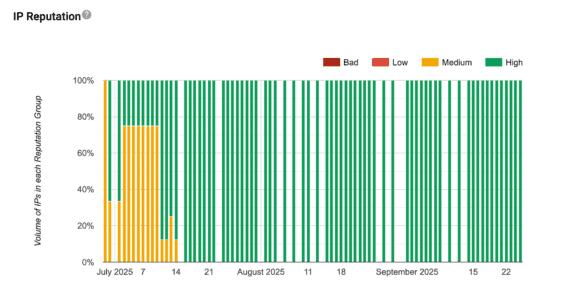
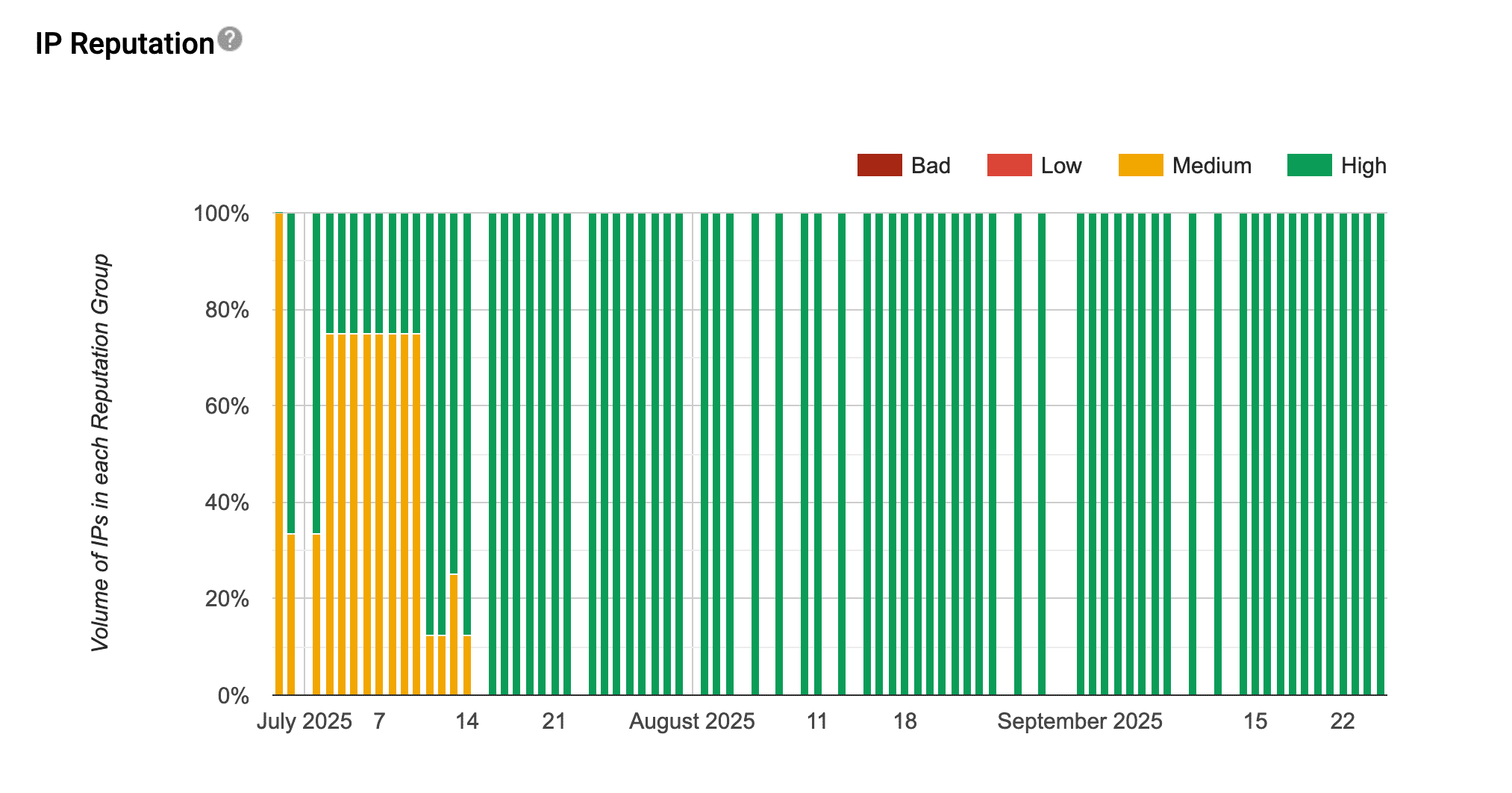
The IP Reputation chart displayed red, yellow, and green bars, similar to a traffic light, visually indicating whether a sending IP address was well-regarded or not.

Both charts — IP and Domain Reputation — provided uncomplicated email deliverability indicators. If their IP and domain reputation were both “High” in Google Postmaster Tools, senders knew their messages reached Gmail inboxes.

Screenshot of an IP Reputation chart.

The IP Reputation chart was similar to a traffic light. Green is good.

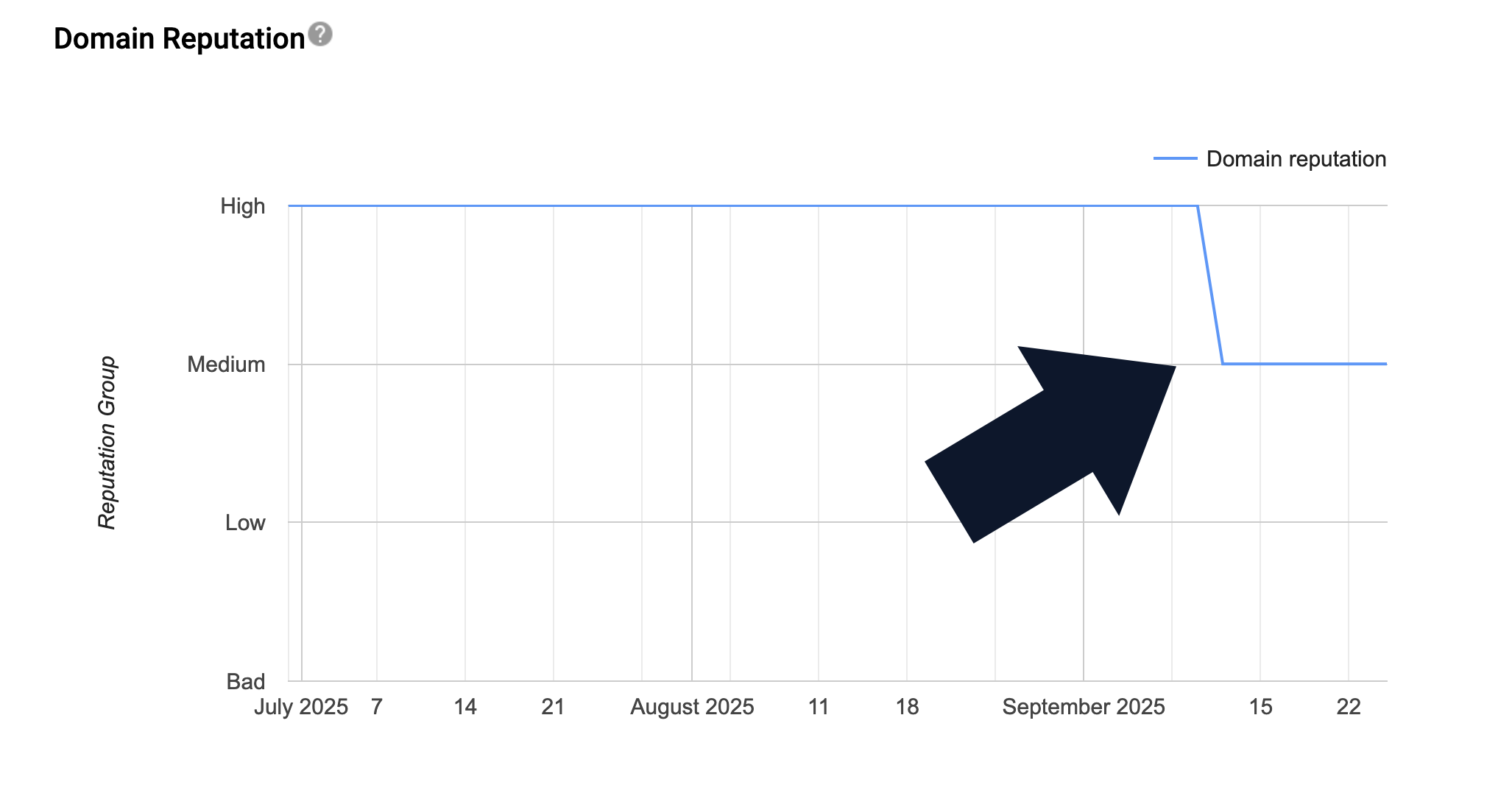
Unfortunately, simplicity sometimes led to complexity. For example, how can a sender restore its domain reputation if it dropped from high to medium?

Finding the answer in Postmaster Tools v1 required visiting other reports such as Authenticated Traffic, Encrypted Traffic, and Spam Rate. A marketer could use the varying tables and charts to hypothesize and then take action.

Identifying an issue was relatively complicated, but experienced email deliverability professionals could usually discover and correct the problem.

Screenshot of a Domain Reputation chart show reputation dropping from high to medium

A simple interface works well when everything is going smoothly, but what if the domain reputation drops from high to medium? What was the cause?

Compliance Status

In March 2024, Google released version 2 of Postmaster Tools, the first significant change in nearly a decade.

Version 2 included the Compliance Status dashboard, which provides a simple green or red check to indicate whether a sending domain meets Gmail’s email sender guidelines.

“Compliance status” is not as clear as IP and domain reputation, but the dashboard was a helpful start when, say, open and click rates declined. Email deliverability pros could usually discover and correct problems, such as a slow unsubscribe process.

Understanding Compliance

When the IP and domain reputation charts go away on September 30, email marketers will need to understand the Compliance Status dashboard.

One way to approach this report is to categorize it into technical checks and behavioral aspects.

Technical

Six of the Compliance Status report’s requirements focus on a domain’s technical setup: either it complies or not. Green means “meets requirement.”

  • SPF and DKIM authentication implemented. Sender Policy Framework (SPF) and DomainKeys Identified Mail (DKIM) prevent spammers from sending unauthenticated messages.
  • “From:” header matches SPF and DKIM. An email “From:” header tells the recipient who sent the message. The requirement is to align that header with SPF and DKIM records.
  • DMARC authentication implemented. Domain-based Message Authentication, Reporting, and Conformance (DMARC) instructs email servers on how to handle SPF or DKIM failures.
  • TLS encryption. The sender employs the Transport Layer Security (TLS) cryptographic protocol to protect message content.
  • Forward and reverse DNS records implemented. The sending IP address must have a PTR (reverse DNS) record that resolves to a hostname, and that hostname must have a matching forward DNS (A or AAAA) record pointing back to the same IP.
  • One-click unsubscribe implemented. Recipients can easily unsubscribe from the list.

Non-compliance with any of these requirements impacts email deliverability. In Postmaster Tools v1, the errors might have generated a “medium” for domain reputation. In v2, they are clearer.

Behavioral

The remaining two compliance requirements affecting bulk email senders, such as ecommerce marketers, are related to behaviors.

  • User-reported spam rate below 0.3%. A passing score is fewer than 0.3% of recipients. The best senders, however, are below 0.1%
  • Honor unsubscribes in 48 hours or fewer. Recipients who click an unsubscribe link should stop receiving messages from that specific sending address.

The first of these requirements measures subscribers’ behavior. How many labeled the message as spam?

The second has a technical aspect, but is also dependent on the sender’s practices. For example, a common problem with honoring an unsubscribe is the use of a single sending address.

Imagine a merchant with an email newsletter (content marketing), a promotional list (email marketing), and transactional email automations. If all use the same sending address — e.g., email@example.com — a recipient could unsubscribe from one list but still receive the other two. Gmail would conclude the sender did not honor the unsubscribe.

Screenshot of unsubscribe status on Postmaster Tools

Knowing that a domain is non-compliant helps to identify what steps to take to correct the issue.

In short, the depreciation of Postmaster Tools v1 marks the end of an era of sorts. Many email marketers have grown accustomed to logging in and seeing a simple color-coded bar for “Domain Reputation” and “IP Reputation.”

The new version reflects recipient interactions and objective sending standards.

The Download: shoplifter-chasing drones, and Trump’s TikTok deal

Shoplifters in the US could soon be chased down by drones

The news: Flock Safety, whose drones were once reserved for police departments, is now offering them for private-sector security, the company has announced. Potential customers include businesses trying to curb shoplifting. 

How it works: If the security team at a store sees shoplifters leave, they can activate a camera-equipped drone. “The drone follows the people. The people get in a car. You click a button and you track the vehicle with the drone, and the drone just follows the car,” says Keith Kauffman, a former police chief who now directs Flock’s drone program. The video feed of that drone might go to the company’s security team, but it could also be automatically transmitted directly to police departments. 

The response: Flock’s expansion into private-sector security is “a logical step, but in the wrong direction,” says Rebecca Williams, senior strategist for the ACLU’s privacy and data governance unit. Read the full story

—James O’Donnell 

Read more of our stories about the latest in drone tech:

+ Why you’re about to see a lot more drones over America’s skies.

+ Meet Serhii “Flash” Beskrestnov, the radio-obsessed civilian shaping Ukraine’s drone defense. His work could help to determine the future of Ukraine, and wars far beyond it.

+ We examined four big trends that show what’s next for drone technology.

+ The defense tech startup Epirus has developed a cutting-edge, cost-efficient drone zapper that’s sparking the interest of the US military. Read our story about how it could change the future of war.

The must-reads

I’ve combed the internet to find you today’s most fun/important/scary/fascinating stories about technology.

1 TikTok US is being valued at $14 billion by Trump’s deal
That’s shockingly low for a fast-growing social media company. (FT $) 
+ The deal is basically just Trump giving TikTok to his friends. (Vox $)
+ Here’s what the sale means for you. (WP $)

2 Microsoft has stopped letting Israel use its technology for surveillance
The system was used to collect millions of Palestinian civilians’ phone calls every day. (The Guardian)

3 There are more robots working in China than the rest of the world combined
It’s a trend that’ll further cement its status as the world’s leading manufacturer. (NYT $)
+ China’s EV giants are betting big on humanoid robots. (MIT Technology Review)

4 The inside story of what happened when DOGE came to town
If anything, this is even more grim and chaotic than you might imagine. (Wired $)

5 Instagram’s teen safety features are flawed
Researchers tested 47 of these features, and found that only 8 were fully effective. (Reuters $)
+ There’s growing concern among lawmakers about the risks of kids forming bonds with chatbots. (MIT Technology Review)

6 Brazil’s judicial system is adopting AI with gusto
The trouble is that rather than reducing the amount of work for judges and lawyers, AI seems to be increasing it. (Rest of World)
+ Meet the early-adopter judges using AI. (MIT Technology Review)

7 Amazon is refunding $1.5 billion to Prime subscribers
The deal with the FTC lets it avoid a trial over claims it tricked consumers into signing up. (WP $)

8 These women are in love with AI 
Like it or not, these sorts of romances are becoming more common. (Slate $)
+ It’s surprisingly easy to stumble into a relationship with an AI chatbot. (MIT Technology Review

9 Scientists are improving how we measure nothing
Researchers are developing a vacuum-measurement tool that could unlock exciting new possibilities for science. (IEEE Spectrum)
+ This quantum radar could image buried objects. (MIT Technology Review)

10 Why does everything online feel so icky? 😬
Most of us will go to extreme lengths to avoid awkwardness IRL. On social media, it’s another matter entirely… (Vox $)
+ China’s government has had enough of everyone being negative on its internet. (BBC)

Quote of the day

“AI machines—in quite a literal sense—appear to be saving the US economy right now. In the absence of tech-related spending, the US would be close to, or in, recession this year.”

—George Saravelos, global head of FX research at Deutsche Bank, warns that the AI boom is unsustainable in a note to clients, Fortune reports.

One more thing

Headshots of Open AI executives Mark Chen and Jakub Pachocki

COURTESY OF OPENAI

The two people shaping the future of OpenAI’s research

—Will Douglas Heaven

For the past couple of years, OpenAI has felt like a one-man brand. With his showbiz style and fundraising glitz, CEO Sam Altman overshadows all other big names on the firm’s roster.

But Altman is not the one building the technology on which its reputation rests. That responsibility falls to OpenAI’s twin heads of research—chief research officer Mark Chen and chief scientist Jakub Pachocki. Between them, they share the role of making sure OpenAI stays one step ahead of powerhouse rivals like Google.

I recently sat down with Chen and Pachocki for an exclusive conversation which covered everything from how they manage the inherent tension between research and product, to what they really mean when they talk about AGI, and what happened to OpenAI’s superalignment team. Read the full story.

We can still have nice things

+ Wherever you are, this website helps you discover the most interesting bars nearby. 
+ Take a tour of Norway’s lighthouses.
+ Inside London’s flourishing underground rave scene.
+ Meaningful changes rarely occur instantly. Here’s how they do happen.

US investigators are using AI to detect child abuse images made by AI

Generative AI has enabled the production of child sexual abuse images to skyrocket. Now the leading investigator of child exploitation in the US is experimenting with using AI to distinguish AI-generated images from material depicting real victims, according to a new government filing.

The Department of Homeland Security’s Cyber Crimes Center, which investigates child exploitation across international borders, has awarded a $150,000 contract to San Francisco–based Hive AI for its software, which can identify whether a piece of content was AI-generated.

The filing, posted on September 19, is heavily redacted and Hive cofounder and CEO Kevin Guo told MIT Technology Review that he could not discuss the details of the contract, but confirmed it involves use of the company’s AI detection algorithms for child sexual abuse material (CSAM).

The filing quotes data from the National Center for Missing and Exploited Children that reported a 1,325% increase in incidents involving generative AI in 2024. “The sheer volume of digital content circulating online necessitates the use of automated tools to process and analyze data efficiently,” the filing reads.

The first priority of child exploitation investigators is to find and stop any abuse currently happening, but the flood of AI-generated CSAM has made it difficult for investigators to know whether images depict a real victim currently at risk. A tool that could successfully flag real victims would be a massive help when they try to prioritize cases.

Identifying AI-generated images “ensures that investigative resources are focused on cases involving real victims, maximizing the program’s impact and safeguarding vulnerable individuals,” the filing reads.

Hive AI offers AI tools that create videos and images, as well as a range of content moderation tools that can flag violence, spam, and sexual material and even identify celebrities. In December, MIT Technology Review reported that the company was selling its deepfake-detection technology to the US military. 

For detecting CSAM, Hive offers a tool created with Thorn, a child safety nonprofit, which companies can integrate into their platforms. This tool uses a “hashing” system, which assigns unique IDs to content known by investigators to be CSAM, and blocks that material from being uploaded. This tool, and others like it, have become a standard line of defense for tech companies. 

But these tools simply identify a piece of content as CSAM; they don’t detect whether it was generated by AI. Hive has created a separate tool that determines whether images in general were AI-generated. Though it is not trained specifically to work on CSAM, according to Guo, it doesn’t need to be.

“There’s some underlying combination of pixels in this image that we can identify” as AI-generated, he says. “It can be generalizable.” 

This tool, Guo says, is what the Cyber Crimes Center will be using to evaluate CSAM. He adds that Hive benchmarks its detection tools for each specific use case its customers have in mind.

The National Center for Missing and Exploited Children, which participates in efforts to stop the spread of CSAM, did not respond to requests for comment on the effectiveness of such detection models in time for publication. 

In its filing, the government justifies awarding the contract to Hive without a competitive bidding process. Though parts of this justification are redacted, it primarily references two points also found in a Hive presentation slide deck. One involves a 2024 study from the University of Chicago, which found that Hive’s AI detection tool outranked four other detectors in identifying AI-generated art. The other is its contract with the Pentagon for identifying deepfakes. The trial will last three months. 

CFO Shifts to Menswear, Egyptian Roots

In 2020, Karim Abed was the chief financial officer for a Texas-based home builder. The job paid well, he says, but he yearned to launch his own business and reconnect with his Egyptian heritage.

Fast forward to 2025, and that business is WYR, a men’s apparel brand utilizing Giza cotton, the storied fabric, and small Egypt-based factories. The company is thriving.

In our recent conversation, Karim addressed WYR’s initial struggles, subsequent growth, and, yes, the benefits of Egyptian cotton and craftspeople.

Our entire audio is embedded below. The transcript is condensed and edited for quality.

Eric Bandholz: Tell us who you are and what you do.

Karim Abed: I’m the founder of WYR, a men’s premium clothing brand launched in 2020. My girlfriend, now my wife, suggested WYR, shorthand for “what you’d rather” wear. I loved the simplicity and stuck with it.

Before WYR, I spent nearly a decade in Texas working in finance, eventually as the chief financial officer for a real estate division of a home builder. It was financially rewarding, but I wanted to create something of my own.

I eventually decided on clothing because of family connections in Egypt. I hoped to reconnect with my culture and heritage while producing quality items — shirts, pants, boxers — using Egyptian cotton, a renowned product.

In January 2020, just before the pandemic, I traveled to Egypt with fabric samples and refined patterns that I had worked on for six months, and I launched in July of that year.

I learned from mistakes. I kept my finance job to fund the business, so I could afford to lose a few bucks. We lost a good amount of money in the first and second years. Covid unexpectedly helped by letting me work from home and focus on WYR after hours.

Bandholz: When did you commit fully to the apparel company?

Abed: We sold only 1,000 units in the first six months and generated only $20,000 in revenue during the first year. Once I refined our selling proposition — premium Giza cotton, precise fit, great reviews — sales exploded. Revenue jumped to nearly $1 million in year two. That growth gave me the confidence to go full-time.

Many apparel brands order from large factories, often in Eastern Europe. I chose a different path. I source in Egypt and work with small artisan-run workshops instead of big manufacturers. A craftsman with 35 years’ experience leads our main facility. He still sews and manages a 15-person team.

Partnering with these artisans ensures meticulous quality and allows for custom details such as curved hems, unique stitching, and tailored armholes that large factories wouldn’t accommodate. We provide them enough business to focus solely on WYR.

To maintain standards, we added our own quality control team to these small factories. This hands-on approach lets us preserve the craftsmanship and fit that define our brand while scaling production responsibly.

All told, we utilize six factories, depending on demand. Each specializes in a skill. For example, one focuses on chinos because it has the right machinery for twill cotton, while another handles our curved hems, which require precise stitching. We match each product to the facility best suited for that craft.

This network took months to build. Through my wife’s family connections, I met an experienced production manager who joined our team. He helped us test numerous small workshops, dropping those that didn’t meet standards and adding new ones as needed.

Today, we have eight staff members in Egypt, including managers for quality control, inventory, and production. We also maintain a small warehouse. We operate lean, producing on an as-needed basis. Owning our yarn allows us to stay flexible and keep a tight inventory while ensuring consistent quality.

Bandholz: What’s the difference between Egyptian and Giza cotton?

Abed: Giza is a specific, long-staple strain of Egyptian cotton, graded by location and fiber type. It’s rare and government-regulated. Most “Egyptian cotton” products aren’t truly Giza. We secure production by reserving about 10 tons of yarn from a trusted textile mill and verifying it ourselves.

Consumers may think a t-shirt is machine-made start to finish, but for us, skilled labor is critical. Drawing and layering patterns, precise cutting, and careful sewing all affect the final quality. Every step — from picking the cotton to spinning, dyeing, and sewing — happens in Egypt.

Our cotton is expensive. It’s the highest input cost for our shirts. Cheaper alternatives are available in countries such as China, Bangladesh, and India. China, in particular, excels at synthetic athletic fabrics. But for authentic Giza cotton quality, Egypt is unmatched.

Bandholz: You’ve succeeded with apparel, a competitive industry.

Abed: The challenge was convincing consumers — who can’t feel our shirts online — of their value. We relied heavily on ads with quick, attention-grabbing messages about our fit, Giza cotton fabric, and simple, logo-free style. That built enough trust and reviews to drive repeat purchases, which remain our biggest growth engine.

Going viral isn’t realistic for minimalist basics. Our appeal is understated comfort and timeless quality, not flashy logos. Instead, we focus on steady customer acquisition and retention.

Early on, I hired several marketing agencies, but none cared as much as I did. With my finance and analytical background, I realized I could manage most of it myself. Now I handle ad strategy with one team member, outsourcing only content creation. For promotions such as Black Friday, we plan campaigns, drop the creative into our ads, and closely monitor performance.

Bandholz: How do you find content creators?

Abed: We produce podcast episodes in-house. Agencies create humorous ads, and our customers generate reviews and testimonials. I find creators on Instagram who match our minimalist vibe, then invite them to make authentic posts.

Surprisingly, simple flat-lay photos — just a well-styled shirt and pants — perform exceptionally well, although they’re difficult to shoot, so we outsource some of that work. The key is constant iteration and diverse creative sources to keep ads fresh.

I prefer creators who genuinely like our shirts, rather than those chasing paychecks. Some accept products in exchange for content. I avoid expensive “pay-to-play” deals because audiences can sense inauthenticity.

We briefly tried a large public relations agency for exposure, but it felt out of brand. I’d rather grow grassroots than pay athletes or influencers five-figure sums for sponsorships. Authenticity matters more than big-name endorsements.

Bandholz: What’s your next growth stage?

Abed: We intend to scale carefully. Having a single factory focused solely on us would be excellent. I’ve even toyed with opening my own facility, but that’s an entirely different business.

In a perfect world, I’d own every part of the supply chain, from production to selling. That gives customers the highest value and ensures the best quality. But I also value my life outside of work and want time with my family.

I’m not a fan of the “grow first, profit later” mindset. Some founders run losses for years before turning cash flow positive. I believe a business should prove itself within two or three years. Scaling takes steps. You can’t jump overnight from selling 200,000 shirts annually to 2 million. The supply chain must expand methodically to maintain quality.

Bandholz: Where can people buy your shirts or reach out?

Abed: Our site is Wyrwear.com. We’re also on Instagram. I’m on LinkedIn.