8 Emerging Trends CMOs Need To Watch: What’s Next In Content Marketing via @sejournal, @rio_seo

Content marketers’ patience and performance are being tested as AI infiltrates every tech stack, which has been both a blessing and a curse.

Creating content has never been simpler, given the rise of AI, upending content creation, distribution, and discovery.

At the same time, writing original content has never been more paramount, given the vast amount of AI-generated content being written and misinformation spreading like wildfire.

In turn, audiences tune out the noise, demand well-written content, and are less forgiving when brands misstep.

For chief marketing officers (CMOs), this window in time is ripe for the taking.

Those who evolve fast, rethink foundational content marketing strategies, and invest in authentic, relevant, and human-first content will win attention.

For those who don’t, they risk taking themselves out of the game and being left in the dust.

In this post, we’ll explore the top eight trends defining the next era of content marketing and how forward-thinking CMOs are stepping up to keep up with the swift pace.

1. Use AI To Assist

Generative AI is no longer a tool to test out; it’s an integral part of every marketing strategy, irrespective of organization size or industry.

A study spanning 17 diverse industries found nearly three-quarters (73%) of respondents say their companies use Generative AI to help create text, images, videos, or other content types.

The same study found that only 17% of marketers aren’t using AI at all, a number that will likely shrink in the months to come.

A separate report stated that the majority of marketers (88%) believe AI software saves their company time and money.

While AI has been and will continue to be used to generate content, the quality of that content may not match that of human writers.

A study published in Nature found that when generative AI software only uses content created by other AI, its responses start to decline in quality.

For example, after the first two prompts, the answers weren’t quality and missed the mark, only getting worse by the fifth attempt.

By the ninth consecutive query, the responses became completely nonsensical and unrelated to the original query’s intent.

CMOs must ensure content writers aren’t leveraging AI-generated content to draft content but rather use it as a tool that helps writers co-create content with purpose and editorial rigor.

CMO Action Plan For AI-Assisted Content Creation:

  • Develop AI-human content workflows: Use AI for research, drafts, and metadata. Humans should be used for drafting, ensuring the brand’s tone of voice shines throughout, and fact-checking.
  • Audit existing content to ensure it meets brand quality standards. Prioritize updating or replacing low-value content.
  • Clearly disclose when and how AI tools are used to foster trust with your target audience.
  • Monitor and audit content consistently to ensure no AI-generated content falls through the cracks.

→ Read more: AI Agnostic Optimization: Content For Topical Authority And Citations

2. Write For Semantic Search

Search looks entirely different from what it did a few years ago.

What was once ruled by ten blue links has now adapted to shifts in user behavior, favoring semantically rich results that answer queries without users having to even click through to learn more.

AI-powered engines (like Google AI Mode) now parse through conversational queries and extract the most relevant information, displaying it as a summary at the top of the SERPs.

To adapt to this shift in how Google and other search engines prioritize and rank content, CMOs should reshape their content strategies to structure content around topic clusters and frequently asked questions.

And, if you’re not already using schema markup, now is the time to make it clear to search engine crawlers what your content is all about.

Schema markup can help search engines understand the context and boost your chances of appearing in featured snippets. The more visible your content is, the better your chance of winning clicks and attention.

CMO Action Plan For Writing For Semantic Search:

  • Redesign landing pages (if needed) around FAQ-driven, intent-focused headings.
  • Implement relevant structured data, such as FAQPage, HowTo, and Q&A markup, which might enhance your visibility.
  • Keep a pulse on SERP changes by consistently monitoring where your content stands; repurpose or refresh pages that are losing visibility.

→ Read more: How LLMs Interpret Content: How To Structure Information For AI Search

3. Create Short-Form Videos

Video marketing hasn’t shown any signs of slowing down.

For marketers, video marketing has proven to be a successful endeavor; 93% of marketers say video marketing has given them a good ROI, and 96% of video marketers say video has helped them increase brand awareness.

The same study reported that 84% of video marketers say video has directly increased sales, while 84% say video has helped keep visitors engaged on their website longer.

As social media platforms, like TikTok grow in popularity, so too does the need for diverse content types.

It comes as no surprise that short-form video comes in as the top content format delivering ROI in 2025, followed closely behind by live-streamed video.

Undoubtedly, videos are capturing attention, and CMOs should continue to invest in video to build brand awareness, diversify content, and meet evolving consumer expectations.

CMO Action Plan For Creating More Short-Form Videos:

  • Develop a repository of short-form clips (30–90 seconds). These clips can be anything from customer testimonials, product demos, teaser videos, video ads, and more.
  • Repurpose long-form content – webinars, whitepapers – into bite-sized assets to extend your content’s lifetime.
  • Distribute video via LinkedIn, TikTok, and YouTube Shorts, and embed in emails and site pages. Share your video wherever applicable (you’ve already put the hard work in; it’s time to get the most out of it!).

→ Read more: 7 Creative Ways To Leverage Video In Marketing

4. Optimize For Voice And Visual Search Discovery

The rise of voice and visual search is growing. More customers than ever are seeking products by sharing screenshots or using voice assistants to search for businesses.

Given the influx of smart assistants, image-based queries, and platform recommendations, businesses can no longer ignore investing in rich metadata and optimized visuals.

For images specifically, businesses should ensure files are saved and uploaded with a name that’s relevant to the image.

Additionally, you’ll want to add descriptive alt-text to every photo on your website to ensure search bots are able to crawl your photos correctly or in the case where a user isn’t able to see the image on your landing page. It’s also critical to ensure images are fast-loading and don’t delay the page speed.

In the case of voice search, conversational content is now a must. Write your content in a way consumers speak. Incorporate long-tail keyword phrases within your content and answer frequently asked questions.

CMOs should play a key role in cross-functional efforts to ensure content is optimized, compliant, and providing the best user experience.

CMO Action Plan For Improving Voice And Image Search Visibility:

  • Add descriptive, keyword-rich alt-text for all images.
  • Don’t neglect mobile performance and ensure fast load speeds for visual content-heavy pages.
  • Include voice-format answers in your content. For example, a restaurant may want to address common questions it receives, such as “Do you serve brunch?” or “Are gluten-free options available?”.

→ Read more: 12 Important Image SEO Tips You Need To Know

5. Create Interactive Experiences

Third-party cookies may be a thing of the past, but brands still need to capture first-party data.

First-party data powers personalization, however this type of data must be captured in a compliant way. That’s where interactive content comes into play: quizzes, calculators, polls, and more can encourage browsers to share their personal data with your business.

In fact, a study from HubSpot revealed interactive content sees the fourth-highest ROI compared to other marketing initiatives. In the first place (66%) were product-related videos, second (55%) were trendy videos, and third (53%) were funny videos.

CMOs should encourage their teams to integrate an ecosystem of experiences to collect data and personalize future interactions.

By doing so, businesses are better poised to achieve better segmentation, stronger nurture workflows, and foster greater trust with their target audience.

CMO Action Plan For Creating More Interactive Experiences:

  • Add interactive tools such as gated lead generation engines.
  • Ensure lead capture forms connect appropriately to customer relationship management (CRM) tech for tailored follow-up.
  • Collaborate across marketing, CX, and analytics to operationalize first-party insights, ensuring insights are shared across teams.

→ Read more: Interactive Content: 10 Types To Engage Your Audience

6. Tap Into Micro‑Communities

Micro-communities are on the rise, and search engines are paying close attention to this trend.

Consider the last time you conducted a search on Google. One of the top results for your query was likely a link to a Reddit post about the same topic.

Savvy brands turn to Reddit to engage in authentic and meaningful conversations, and even create their own micro-communities.

A vast majority (88%) of Gen X, Millennial, and Gen Z U.S. consumers engage with niche groups based on shared values or interests.

This number continues to grow with time, making micro-communities a prime area to focus marketing efforts.

Authentic dialogue and communication are essential to effectively connect with your target audience.

Consider that users frequent online communities as a place to explore and connect with like-minded individuals, not to be met with spammy sales strategies.

CMOs should map and engage niche communities that align with brand values and develop user-generated content initiatives to engage in softer sales techniques that elevate customer experiences.

CMO Action Plan For Tapping Into Micro-Communities:

  • Identify a few key niche communities (forums, Facebook groups, subreddits, niche LinkedIn pods).
  • Start by observing user behavior in these groups and then engaging in real, natural conversations.
  • Share user-generated content (UGC) – reviews, stories, testimonials – from real users to build trust and credibility.

→ Read more: AMA Recap: Reddit Leadership On Leveraging The Platform For Business Success

7. Go Beyond Google

The search experience has become fragmented. Google still holds significant dominance in the search engine marketplace, but generative AI services are gaining traction.

With search results becoming more volatile, many SEO professionals wonder what works these days.

Content must be amplified for maximum reach, with distribution across a vast array of channels like social, community, earned, and email.

This isn’t limited to just written content. Short-form videos can be shared across Reels and Shorts, on LinkedIn, paid placement in niche newsletters, and more to help diversify reach.

A multi-channel strategy reduces dependency on any single platform.

CMOs should invest in and focus on a multi-channel strategy. By doing so, businesses are better set up for the success of appearing in organic search results and for AI-generated results.

New channel experiments can help your business test what’s working and what’s not, and tracking performance across each channel can inform ongoing strategy.

CMO Action Plan For Improving Content Reach:

  • Launch content distribution campaigns across video, social, email, community, and earned/paid channels.
  • Build relationships with niche newsletters and podcasts for earned coverage.
  • Use performance dashboards to monitor channel-specific key performance indicators (KPIs) and adjust efforts where needed.

→ Read more: The Future Of Content Distribution: Leveraging Multi-Channel Strategies For Maximum Reach

8. Create A Strategic Budget

Content marketing investment is a top priority for many businesses.

It continues to prove the effort is worth the spend, with nearly half (46%) of B2B marketers increasing their marketing budgets in 2025 and over two-thirds (61%) spending more on video.

AI has also been added as a line item in many budgets, given that AI in marketing is now a $57.99  billion market, and 56% of marketers say their company is taking an active role in implementing and using AI.

CMOs must have a firm understanding of what works well for their business and what doesn’t, strategically allocating resources to what moves the needle, whether that’s video, interactive content, community engagement, paid ads, or more.

Clear return on investment (ROI) models and transparent budget allocation will highlight content as a profit center, not a sunk cost. It will also paint a clearer picture to leadership to showcase how your team’s efforts are driving revenue.

CMO Action Plan To Create A Strategic Budget:

  • Create a framework for how you’ll reflect content’s ROI by including KPIs for lead quality, closed revenue, and engagement.
  • Consider budget allocations for emerging technologies like AI and interactive content.
  • Track and report ROI on at least a quarterly basis. Adjust content marketing tactics based on outcomes.

→ Read more: CMOs, The Time Is Now To Assign An AI Leader

Final Takeaways: Leading The Next Wave

To thrive in a rapidly changing industry, CMOs must become strategic futurists, rooted in testing, tracking, and tackling new endeavors that align with shifts in consumer behavior.

As the face of the marketing teams, CMOs must lead the change they wish to see, equipping teams with the right tools and technology to make that change happen.

CMOs will act as the guiding light for handling marketing ethically, from responsible AI usage to properly disclosing AI and scaling human-first, value-driven content initiatives.

They’ll diversify distribution, ensuring content marketers’ hard work is getting the chance to shine across a variety of channels. They’ll also provide editorial oversight, especially over larger content pieces like “State of” reports.

Lastly, and perhaps most importantly, they’ll rigorously track ROI and invest with intention. They’ll see what’s working well and pivot quickly when something isn’t proving its value.

ROI will remain top of mind, ensuring each and every marketing effort drives the company forward.

CMOs who embrace the aforementioned changes now will elevate content from a marketing function to a strategic growth engine, one that builds lasting trust with customers, leads to corporate longevity, and improves the marketing team’s job satisfaction.

More Resources:


Featured Image: Roman Samborskyi/Shutterstock

GPT-5 is here. Now what?

At long last, OpenAI has released GPT-5. The new system abandons the distinction between OpenAI’s flagship models and its o series of reasoning models, automatically routing user queries to a fast nonreasoning model or a slower reasoning version. It is now available to everyone through the ChatGPT web interface—though nonpaying users may need to wait a few days to gain full access to the new capabilities. 

It’s tempting to compare GPT-5 with its explicit predecessor, GPT-4, but the more illuminating juxtaposition is with o1, OpenAI’s first reasoning model, which was released last year. In contrast to GPT-5’s broad release, o1 was initially available only to Plus and Team subscribers. Those users got access to a completely new kind of language model—one that would “reason” through its answers by generating additional text before providing a final response, enabling it to solve much more challenging problems than its nonreasoning counterparts.

Whereas o1 was a major technological advancement, GPT-5 is, above all else, a refined product. During a press briefing, Sam Altman compared GPT-5 to Apple’s Retina displays, and it’s an apt analogy, though perhaps not in the way that he intended. Much like an unprecedentedly crisp screen, GPT-5 will furnish a more pleasant and seamless user experience. That’s not nothing, but it falls far short of the transformative AI future that Altman has spent much of the past year hyping. In the briefing, Altman called GPT-5 “a significant step along the path to AGI,” or artificial general intelligence, and maybe he’s right—but if so, it’s a very small step.

Take the demo of the model’s abilities that OpenAI showed to MIT Technology Review in advance of its release. Yann Dubois, a post-training lead at OpenAI, asked GPT-5 to design a web application that would help his partner learn French so that she could communicate more easily with his family. The model did an admirable job of following his instructions and created an appealing, user-friendly app. But when I gave GPT-4o an almost identical prompt, it produced an app with exactly the same functionality. The only difference is that it wasn’t as aesthetically pleasing.

Some of the other user-experience improvements are more substantial. Having the model rather than the user choose whether to apply reasoning to each query removes a major pain point, especially for users who don’t follow LLM advancements closely. 

And, according to Altman, GPT-5 reasons much faster than the o-series models. The fact that OpenAI is releasing it to nonpaying users suggests that it’s also less expensive for the company to run. That’s a big deal: Running powerful models cheaply and quickly is a tough problem, and solving it is key to reducing AI’s environmental impact

OpenAI has also taken steps to mitigate hallucinations, which have been a persistent headache. OpenAI’s evaluations suggest that GPT-5 models are substantially less likely to make incorrect claims than their predecessor models, o3 and GPT-4o. If that advancement holds up to scrutiny, it could help pave the way for more reliable and trustworthy agents. “Hallucination can cause real safety and security issues,” says Dawn Song, a professor of computer science at UC Berkeley. For example, an agent that hallucinates software packages could download malicious code to a user’s device.

GPT-5 has achieved the state of the art on several benchmarks, including a test of agentic abilities and the coding evaluations SWE-Bench and Aider Polyglot. But according to Clémentine Fourrier, an AI researcher at the company HuggingFace, those evaluations are nearing saturation, which means that current models have achieved close to maximal performance. 

“It’s basically like looking at the performance of a high schooler on middle-grade problems,” she says. “If the high schooler fails, it tells you something, but if it succeeds, it doesn’t tell you a lot.” Fourrier said she would be impressed if the system achieved a score of 80% or 85% on SWE-Bench—but it only managed a 74.9%. 

Ultimately, the headline message from OpenAI is that GPT-5 feels better to use. “The vibes of this model are really good, and I think that people are really going to feel that, especially average people who haven’t been spending their time thinking about models,” said Nick Turley, the head of ChatGPT.

Vibes alone, however, won’t bring about the automated future that Altman has promised. Reasoning felt like a major step forward on the way to AGI. We’re still waiting for the next one.

New Ecommerce Tools: August 7, 2025

Every week we publish a handpicked list of new products and services from vendors to ecommerce merchants. This installment covers AI-powered commerce platforms, embedded financial services, cross-border payment solutions, logistics optimization, marketplace incentives, and simplified transaction processes.

Got an ecommerce product release? Email releases@practicalecommerce.com.

New Tools for Merchants

Wix launches financial services for merchants. Wix has launched Wix Checking and Wix Capital to help clients manage cash flow and fund growth. Wix Checking, powered by Unit, a platform for embedded finance, gives users an integrated business checking account. By syncing automatically with Wix Payments, Wix Checking removes the need for external banking tools and manual reconciliations. Wix has also introduced Wix Capital, allowing clients to request a cash advance in exchange for a fixed fee and a percentage of future sales.

Home page of Wix

Wix

Prepping for the holidays, Walmart Marketplace offers seller incentives. Walmart Marketplace will now waive referral fees to sellers on popular items. Plus, the company is waiving peak season storage fees from October 1 through December 31 for sellers using Walmart Fulfillment Services. Now through October 1, first-time users of Multichannel (shipping) Solutions get a 30% discount. Also, WFS has expanded international transport options with the addition of two ports in Vietnam: Ho Chi Minh City and Hai Phong.

BigCommerce rebrands parent company to Commerce, unifying BigCommerce, Feedonomics, and Makeswift. BigCommerce has rebranded its parent company from BigCommerce Holdings, Inc. to Commerce.com, Inc., unifying BigCommerce, Feedonomics, and Makeswift for an era of agentic AI. Commerce will focus on providing merchants with data infrastructure and intelligent storefronts. Commerce also unveiled the company’s vision for powering agentic agents, where AI acts on behalf of consumers to research, recommend, and even transact.

BigCommerce and Feedonomics deepen partnership with Google Cloud. BigCommerce and Feedonomics, a data feed platform, have announced a deepened partnership with Google Cloud. Feedonomics Surface will deliver AI-enriched product data directly to Google Merchant Center, boosting visibility across sales channels. Using Feedonomics’ new Google Cloud with Gemini features, merchants can automatically enrich product catalogs. By combining BigCommerce’s Model Context Protocol with Google’s Agent Development Kit, developers can build commerce-aware merchant agents.

Blockchain fintech OwlTing introduces OwlPay Stablecoin Checkout. OwlTing Group, a global blockchain fintech company, has launched OwlPay Stablecoin Checkout, an API-embedded stablecoin function set to go live this month. Designed for global enterprises in mobility, hospitality, ecommerce, and gaming sectors, OwlPay Stablecoin Checkout enables seamless USD to USDC conversions, allowing businesses to accept stablecoin payments and settle in USD through their own platforms or leverage the built-in feature on the user interface of the OwlPay Payment B2B tool.

Home page of OwlTing

OwlTing

Rakuten launches Rakuten AI. Rakuten, a Japan-based ecommerce marketplace and online services company, has launched Rakuten AI, an AI agent to enhance user experiences and streamline interactions across the Rakuten ecosystem, including shopping, lifestyle, fintech, travel, education, work, wellness, and entertainment. The initial rollout integrates Rakuten AI into Rakuten Link, a communication app for Rakuten Mobile subscribers, and offers Rakuten AI as a web app in beta. Rakuten AI is free to use in all its forms.

Octup raises $12 million for 3PL operations. Octup, a real-time AI operations platform for third-party logistics providers, has closed a $12 million seed round co-led by Shine Capital and JAL Ventures. Octup’s platform provides real-time analytics for warehouse operations, including automated billing, labor tracking, and service-level-agreement management, while also offering client-facing portals with self-service reporting capabilities. With this funding, Octup plans to accelerate AI-powered forecasting and exception management development. The company also plans to expand its presence in North America.

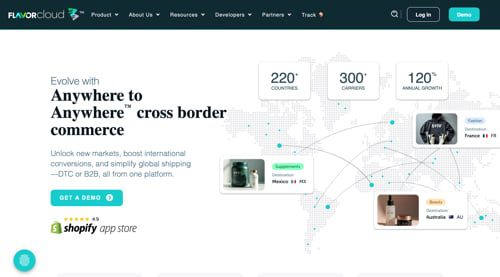
FlavorCloud launches Localized Market Pricing. FlavorCloud, a provider of cross-border shipping solutions, has launched Localized Market Pricing, a recommendations and analytics tool that enables Shopify sellers to display fully landed costs, including duties, taxes, shipping, and fees, as a part of SKU-level pricing. The platform can adjust pricing based on actual landed costs, allowing retailers to choose whether to absorb or pass on cost changes. Price updates are automatic, triggered by schedules or specific events.

Home page of FlavorCloud

FlavorCloud

Amazon introduces star-only ratings. Amazon has launched a simplified experience to provide feedback on sellers. Customers can now provide star ratings without (or with) written feedback. Customers will be required to select a reason before they can submit any rating below four stars. According to Amazon, the new process will help sellers collect more ratings faster and may lead to an increase in the average seller ratings.

Splitit and Antom partner on cross-border card-linked installments for merchants. Splitit, an embedded white-label platform enabling card-linked installment payments, and Antom, a provider of merchant payment and digitization services under Ant International, have announced a strategic partnership. Splitit will integrate its installment technology into Antom’s checkout experience worldwide. Customers can split purchases into monthly payments directly at checkout, using existing credit cards, streamlining cross-border commerce and international payment processing.

eBay debuts Secure Purchase checkout for vehicle transactions. eBay has announced the availability of Secure Purchase, simplifying vehicle transactions by managing payment, financing, registration, ownership transfer, and transport. Both the buyer and seller verify their identity and provide basic information about the vehicle. The buyer selects financing, transportation, protection, and insurance preferences in a few clicks. The seller uploads photos of the title, vehicle identification number, and odometer readings. Buyer and seller digitally sign the required documents, then transfer funds to initiate registration and title transfer.

AstroPay launches platform to embed global financial services. AstroPay, a digital wallet provider, has rolled out a platform allowing companies to build and launch their own global financial products using the same infrastructure that powers AstroPay’s consumer wallet. Businesses can leverage AstroPay’s connections to multiple local and international payment schemes, along with its multicurrency wallet, card issuing capabilities, and regulatory compliance framework across jurisdictions. Current support includes accounts in Brazil, Argentina, and Europe.

Home page of AstroPay

AstroPay

Google Cautions Businesses Against Generic Keyword Domains via @sejournal, @MattGSouthern

Google’s John Mueller says small businesses may be hurting their search visibility by choosing generic keyword domains instead of building distinctive brand names.

Speaking on a recent episode of Search Off the Record, Mueller and fellow Search Advocate Martin Splitt discussed common challenges for photography websites.

During the conversation, Mueller noted that many small business owners fall into a “generic domain” trap that can make it harder to connect the business name with its work.

Why Keyword Domains Can Be a Problem

The topic came up when Splitt mentioned that his photography site uses a German term for “underwater photo” as its domain. Mueller responded:

“I see a lot of small businesses make the mistake of taking a generic term and calling it their brand.”

He explained that businesses choosing keyword-rich domains often end up competing with directories, aggregators, and other established sites targeting the same phrases.

Even if the domain name exactly matches a service, there’s little room to stand out in search.

The Advantage Of A Distinct Brand

Mueller contrasted this with using a unique business name:

“If your brand were Martin Splitt Photos then people would be able to find you immediately.”

When customers search for a brand they remember, competition drops. Mentions and links from other websites also become clearer signals to search engines, reducing the chance of confusion with similarly named businesses.

Lost Opportunities For Word-of-Mouth

Relying on a generic keyword domain can also make offline marketing less effective.

If a potential client hears about a business at an event but can’t remember its exact generic name, finding it later becomes more difficult.

Mueller noted:

“If you’ve built up a reputation as being kind of this underwater photography guy and they remember your name, it’s a lot easier to find you with a clear brand name.”

Why This Matters

For service providers like photographers, event planners, or contractors, including the service and location in a domain name can feel like a shortcut to local rankings.

Mueller’s advice suggests otherwise: location targeting can be achieved through content, structured data, and Google Business Profile optimization, without giving up a distinctive brand.

Looking Ahead

While Mueller didn’t recommend immediate rebrands for existing sites, he made it clear that unique, brandable domains give small businesses a defensible advantage in search and marketing.

For those still choosing a domain, the long-term benefits of memorability and differentiation can outweigh any short-term keyword gains.

Listen to the full podcast episode below:


Featured Image: Roman Samborskyi/Shutterstock

Google: Unique Image Landing Pages Can Help Boost Search Visibility via @sejournal, @MattGSouthern

Google’s John Mueller says giving each image its own landing page can help it appear in image search, while gallery setups may limit visibility.

  • Google recommends unique landing pages for important images instead of JavaScript-only galleries or URL fragments.
  • Responsive images and modern formats improve user experience but aren’t direct ranking factors.
  • Auditing your site’s image URLs could reveal search visibility gains you’re currently missing.
How To Stay Visible in AI Search [Webinar] via @sejournal, @lorenbaker

AI search is here. Are you ready for the new rules?

The SEO game has changed. Traditional strategies are no longer enough, and some brands are getting lost in the shift to AI-powered search results.

Join Wayne Cichanski on August 20, 2025 for an exclusive webinar sponsored by iQuanti. Learn how to adapt your SEO strategy and site architecture for AI-driven queries and remain competitive in this new search era.

In this session, you’ll discover:

  • Why user experience, schema, and site architecture are now just as important as keywords
  • Practical steps to remain visible and competitive in evolving search results
  • How to position your brand for discovery in AI-driven queries, not just rankings

Why this session is essential:

With generative AI reshaping search results across platforms like Google, Bing, and ChatGPT, it is crucial to rethink how your content is structured and how people interact with your brand in AI search. Do not get left behind. Optimize for AI-driven search now.

Register today for actionable insights and a roadmap to success in the AI search era. If you cannot attend live, do not worry. Sign up anyway and we will send you the full recording.

OpenAI Launches GPT-5 In ChatGPT To All Users via @sejournal, @MattGSouthern

OpenAI has released GPT-5, now the default model in ChatGPT for all users, including those on the free tier.

The new model is positioned as OpenAI’s most capable and reliable system to date. OpenAI emphasizes a stronger focus on accuracy, instruction following, and long-form reasoning.

Available Now To All ChatGPT Users

For the first time, OpenAI is making its latest flagship model available to free users.

GPT-5 is rolling out now to Free, Plus, Pro, and Team accounts, with support for Enterprise and Education expected next week.

Free-tier access includes basic usage of GPT-5, with requests routed to a smaller “GPT-5 mini” variant once limits are reached.

Paid subscribers receive higher usage limits, and Pro users gain access to GPT-5 Pro, a version designed for more complex, resource-intensive tasks.

Accuracy, Reasoning, and Transparency Take Priority

According to OpenAI, GPT-5 significantly reduces hallucinated facts and is more likely to admit when it lacks the context to provide a reliable answer.

Evaluations show GPT-5 produces 45% fewer factual errors than GPT-4o, with up to 80% fewer errors when deeper reasoning is enabled.

The model also performs better on benchmarks tied to real-world problem-solving, such as coding, legal analysis, and health-related queries.

What’s Changed in the System

Rather than a single model, GPT-5 acts as a dynamic system that automatically decides whether to respond quickly or think more deeply, depending on prompt complexity.

Users can also request explicit reasoning with natural language prompts like “think hard about this.”

Other updates include:

  • A redesigned safety system that favors partially helpful answers over blanket refusals
  • Reduced sycophantic responses and more honest communication about limitations
  • Improvements in coding performance, including front-end UI generation and debugging
  • Support for multimodal input, including charts and images

Looking Ahead

GPT-5 is positioned less as a revolutionary jump and more as an effort to build trust through accuracy, reliability, and broader access.

For SEOs and digital marketers who rely on AI tools for drafting, analysis, or ideation, GPT-5’s improvements may help reduce the time spent verifying or correcting outputs.


Featured Image: JarTee/Shutterstock

Google Expands Performance Max Controls and Reporting via @sejournal, @brookeosmundson

Google Ads just dropped another wave of updates to Performance Max today.

For those who’ve been asking for better audience targeting, clearer reporting on new customer acquisition, and more transparency around auto-generated assets, these updates will feel like long-overdue upgrades.

Let’s break down what’s new, why it matters, and how advertisers should respond.

What’s New in Performance Max

Google has announced three core areas of updates for Performance Max campaigns:

  1. Expanded audience and campaign controls
  2. Improved new customer acquisition reporting and diagnostics
  3. More granular creative reporting and AI-powered asset recommendations

Most are either rolling out now or available broadly, with some elements in beta. Let’s walk through the details.

Expanded Controls Over Audience Targeting and Search Inventory

Performance Max has long leaned on automation, sometimes at the expense of control. Google is slowly changing that, and this release continues that shift.

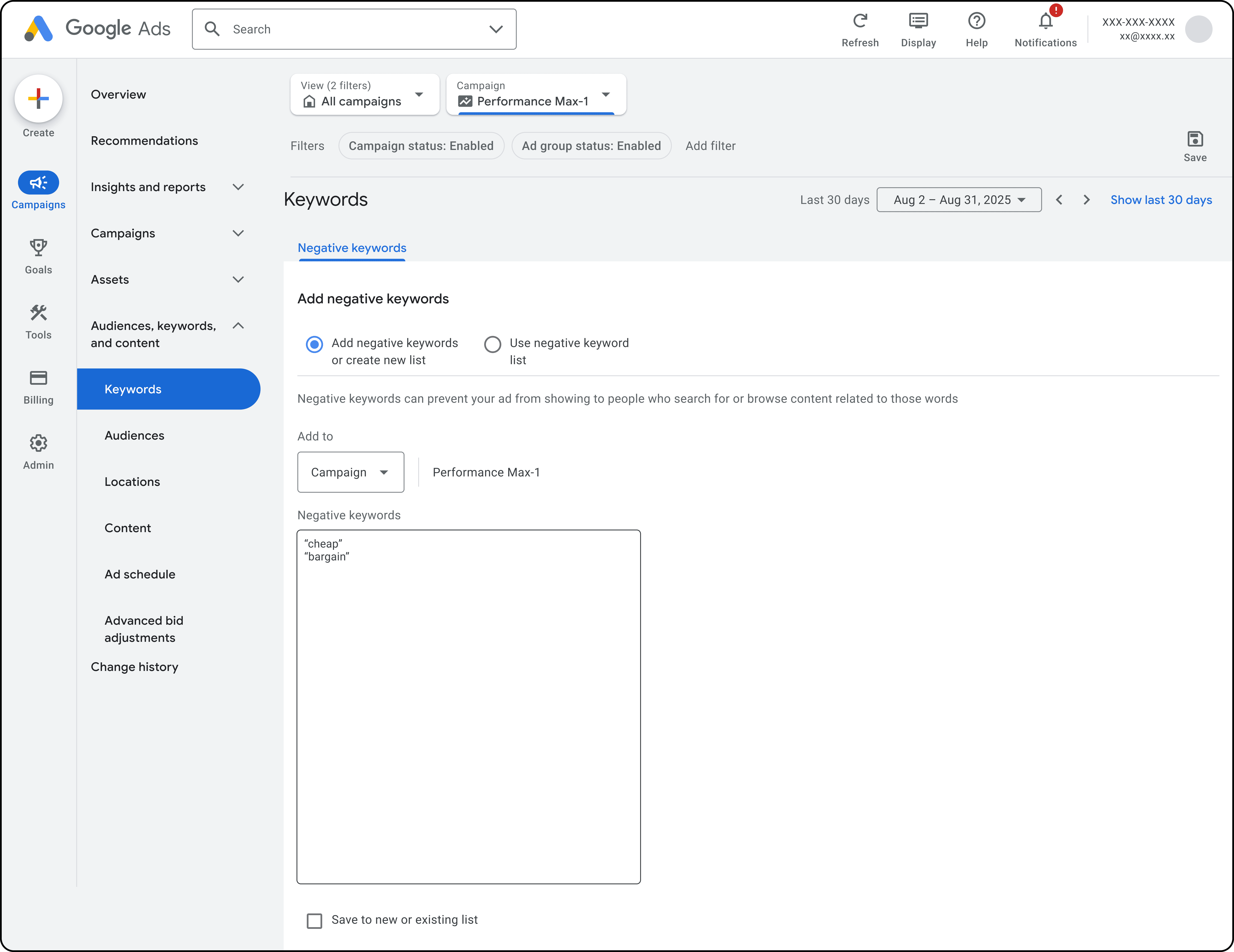
Campaign-Level Negative Keyword Lists

Advertisers can now apply negative keyword lists across Performance Max campaigns. Previously, campaign-level negatives had to be managed individually, which created friction for accounts with dozens of asset groups.

With this update, advertisers can centralize keyword exclusions. For example, excluding terms like “cheap” or “free” across multiple luxury or premium product campaigns.

Campaign-level negative keyword lists in Performance Max.Image credit: Google, August 2025

You still have the option to apply unique negative keywords to individual campaigns, but this rollout makes managing brand suitability far more scalable.

More Search Themes per Asset Group

Google has doubled the search theme limit from 25 to 50 per asset group. This matters for brands that want to influence where their Performance Max ads show up in Search, without leaning on historical keyword builds.

By expanding your search theme input, you’re giving Google more information to better match your ads to queries. It also helps widen your eligible inventory while staying relevant.

Device and Demographic Targeting Updates

You can now fully control which device types your Performance Max campaigns appear on, something that was previously only partially available.

For example, a gaming company can restrict campaigns to mobile devices, or a B2B advertiser can exclude tablets entirely.

Age targeting is now also available, allowing advertisers to exclude or target specific age ranges.

Google is also testing gender-based demographic targeting in beta. These controls bring Performance Max closer in line with what’s long been possible in Search, Display, and YouTube campaigns.

New Customer Acquisition Reporting Gets Smarter

One of the most frustrating parts of new customer acquisition bidding has been the vague “Unknown” label in reporting. That’s changing with today’s updates in Performance Max reporting.

No More “Unknown” Conversions

In lifecycle reporting for new vs. returning customers, Google previously bucketed a portion of conversions as “Unknown”. This left advertisers with limited visibility into actual performance.

Google has now improved the backend logic that determines if a user is new or existing, meaning those “Unknown” labels should be gone moving forward.

This matters for two key reasons:

  • You can now get a more accurate read on how many new customers you’re acquiring.
  • Bidding strategies that rely on new customer signals will become more effective as the data improves.

For even more precision, Google encourages advertisers to update their conversion tracking tags to include the new customer acquisition parameter. This signals to Google whether a conversion is from a new or returning customer, based on first-party data.

New Goal Diagnostics and Recommendations

Alongside the reporting improvements, Google has added new diagnostics that surface goal-related issues in Performance Max.

These include broken or missing conversion tags, goal misconfigurations, or other tracking issues that could be holding back performance.

The diagnostics come with actionable recommendations to help advertisers resolve the problem. While this might not be the most glamorous update, it will save time and frustration during campaign setup and troubleshooting.

Creative Reporting and Asset Control Get a Boost

Asset transparency in Performance Max has been a long-standing pain point. While things have improved in the last year, these new changes go further.

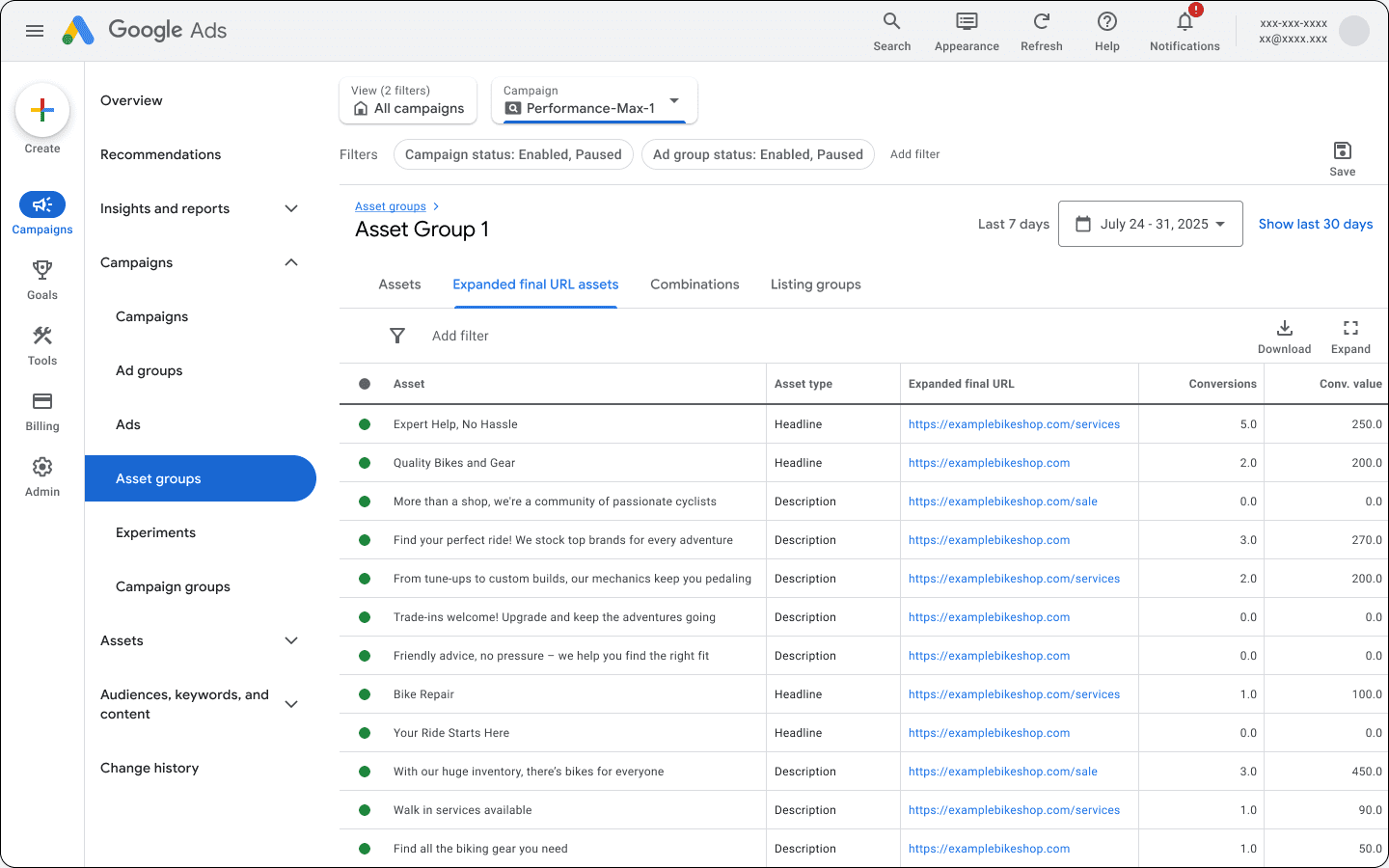
Final URL Expansion Asset Reporting

Advertisers can now view reporting for assets generated through Final URL Expansion (FUE). This is Google’s feature that dynamically creates assets based on landing page content.

You’ll be able to see what text and visuals were created through FUE and how they performed.

Expanded Final URL reporting in Google AdsImage credit: Google, August 2025

More importantly, if you don’t like what Google created, you now have the ability to remove those assets from your campaign.

This is a big win for brands concerned about creative consistency, especially when it comes to legal language or brand tone. While FUE can be useful for scale, it hasn’t always produced on-brand results. So, this added visibility is a welcome change.

AI-Powered Creative Recommendations

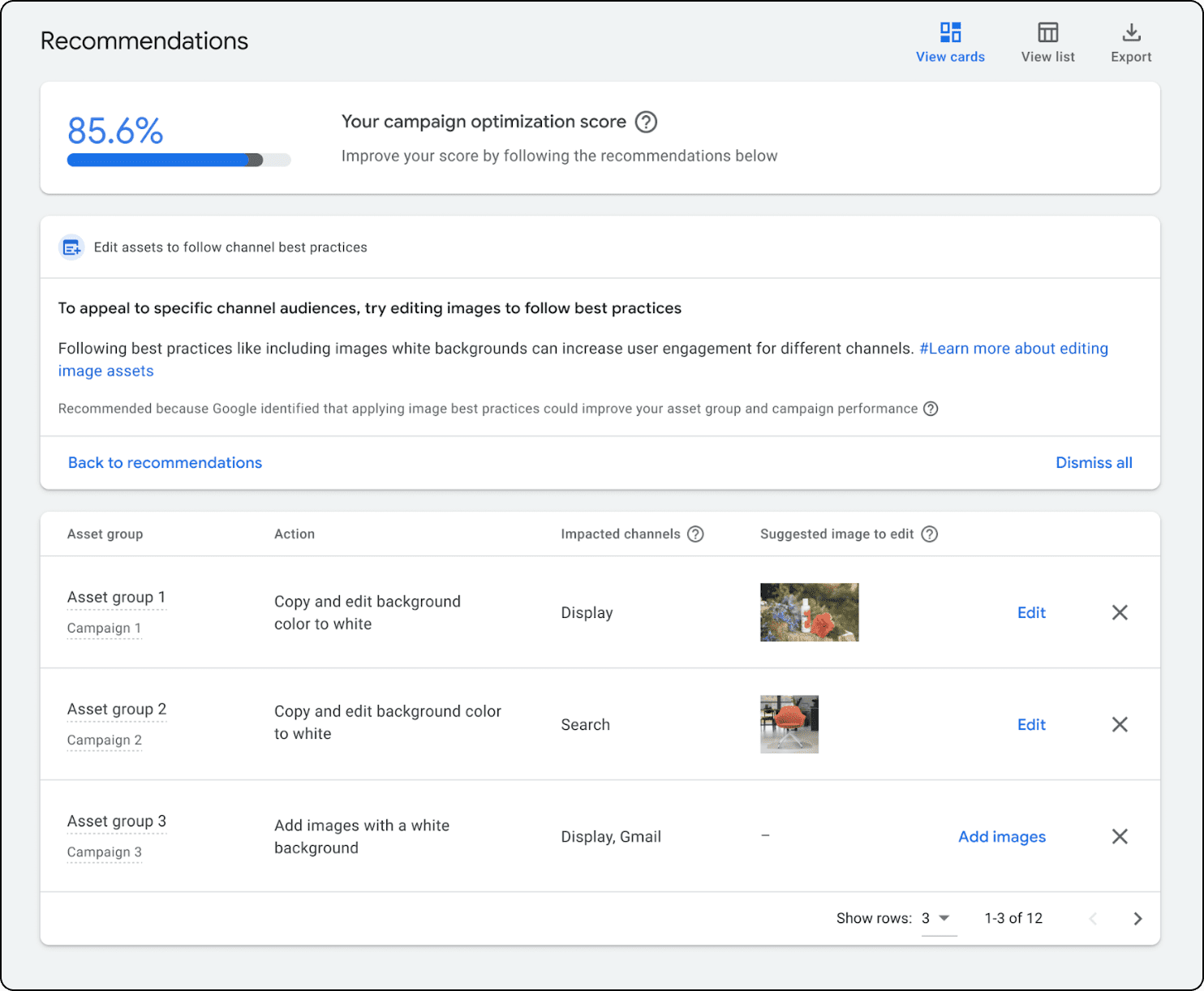
Performance Max will now generate image-specific recommendations to help you improve performance. These suggestions will include both what types of visuals to add and how to optimize existing ones for better performance on various channels (like YouTube vs. Discover).

New creative asset recommendations in Google AdsImage credit: Google, August 2025

Best of all, these recommendations link directly into the built-in AI-powered image editor in Google Ads, so you can make changes right inside the platform without needing to re-upload or redesign assets elsewhere.

It’s clear Google wants advertisers to take a more active role in creative strategy, even inside an automated campaign structure.

Wrapping Up

Google is clearly listening to advertisers’ calls for more transparency and control. These updates to Performance Max mark another step toward striking a better balance between scale and strategy.

While not every advertiser will need to use every new feature, the option to do so means there’s more room to tailor Performance Max campaigns to your business goals, creative preferences, and customer insights.

Whether you’re looking to fine-tune audience reach, fix tracking issues, or clean up your creative assets, there’s something in this update that’s worth your attention.

Cohorts, Clusters, And The Coming AI Ad System via @sejournal, @DuaneForrester

The funnel didn’t disappear. It went invisible.

Marketers spent decades perfecting the funnel: awareness, consideration, conversion. We built personas. We mapped content to stages. We watched users click, scroll, bounce, convert. Everything was visible.

But GenAI doesn’t show its hand.

The funnel still exists, it’s just hidden inside the model. Every time someone prompts ChatGPT or Perplexity, they reveal their place in a decision journey.

Not by filling out a form or triggering a pixel, but through the prompt fingerprint embedded in their question.

That’s the new funnel. You’re still being evaluated. Still being chosen. But the targeting is now invisible, inferred, and dynamic.

And most marketers have no idea it’s happening. In fairness, I think only the cohort portion of this is actively happening today.

The ad system I explore here is purely theoretical (though Google appears to be working in a similar direction currently, and its rollout could be realistic, soon – links below).

TL;DR: This article doesn’t just explain how I think GenAI is reshaping audience targeting; it introduces three new concepts I think you’ll need to understand the next evolution of paid media: Prompt Fingerprints, Embedding Fingerprints, and Intent Vector Bidding. 

The funnel isn’t gone. It’s embedded. And it’s about to start building and placing ads on its own.

About the terminology: 

Prompt Fingerprint and Intent Vector Bidding, I believe, are net-new terms for our industry, coined here to describe how future LLM-based systems could group users and auction ad space.

Conceptually, Intent Vector Bidding aligns with work already being done behind the scenes at Google (and I’m sure elsewhere), though I don’t believe they use this phrase. 

Embedding Fingerprint draws from AI research but is reframed here as a brand-side construct to power targeting and retrieval inside GenAI systems.

This article was written over the last three weeks of July, and I was happy to find an article on August 4 talking about the concepts I’m exploring for a future paid ads bidding system.

Coincidental, but validating. The link to that article is below.

Image credit: Duane Forrester

What Cohort Targeting Used To Be

In the pre-AI era, cohort targeting was built around observable behaviors.

  • Retargeting audiences built from cookies and pixels.
  • Segments shaped by demographics, location, and device.
  • Lookalikes trained on customer traits and CRM lists.

We mapped campaigns to persona types and funnel stages. A 42-year-old dad in Ohio was mid-funnel if he clicked a product video. An 18-year-old in Mumbai was top-funnel if he downloaded an ebook.

These were guesses, good ones, often, but still blunt instruments. And they were built on identifiers that don’t necessarily survive the GenAI shift.

Prompts Are The New Personas

Large language models don’t need to know who you are. They don’t really need to track you. They don’t care where you came from. They only care what you ask, and how you ask it.

Every prompt is vectorized. That means it’s turned into a mathematical representation of meaning, called an embedding. These vectors capture everything the model can glean from your input:

  • Topical domain.
  • Familiarity and depth.
  • Sentiment and urgency.
  • Stage of intent.

LLMs use this signal to group prompts with similar meaning, even if they come from completely different types of people.

And that’s how new cohorts can form. Not from identity. From intent.

Right now, most marketers are still optimizing for keywords, and missing the bigger picture. Keywords describe what someone is searching for. Prompt fingerprints describe why and how.

Someone asking “quietest portable generator for camping” isn’t just looking for a product, they’re signaling lifestyle priorities (minimal noise, portability, outdoor use) and stage (comparison shopping).

That single prompt tells the model far more than any demographic profile ever could.

And crucially, that person is joining a cohort of other prompters asking similar questions in similar ways. If your content isn’t semantically aligned with that group, it’s not just less visible. It’s excluded.

New Concept: Prompt Fingerprint

A unique embedding signature derived from a user’s language, structure, and inferred intent within a prompt. This fingerprint is your new persona.

It’s what the model actually sees and what it uses to determine which answers (and potentially which ads) you receive. (More on those ads later!)

When Context Creates The Cohort

Let’s say the Toronto Maple Leafs just won the Stanley Cup (hey, a guy can dream, right?!). Across the city, thousands of people start prompting:

  • “Where to celebrate in Toronto tonight?”
  • “Best bars near Scotiabank Arena open late?”
  • “Leaf’s victory parade time and location?”

None of these users knows each other. Some are teenagers, others are retirees. Some are local, others are visiting. Some are hardcore fans, some just like to party. But to the model, they’re now a momentary cohort; a group connected by real-time context, not long-term traits.

This is a fundamental break from everything digital marketers are used to. We’ve always grouped people by identity: age, interests, behavior, psychographics. But LLMs group people by situational similarity.

That creates new marketing opportunities and new blind spots.

Imagine you sell travel gear. A major snowstorm is forecast to slam into the Northeast U.S.

Within hours, prompts spike around early departures, snowproof duffel bags, and waterproof boots. A travel-stress cohort forms: people trying to escape before the storm hits. They’re not a segment you planned for. They’re a moment the system saw before you did.

If your content or product is aligned with that moment, you need a system that detects, matches, and delivers immediately. That’s what makes system-embedded ad tech essential.

You’re not buying audiences anymore. You’re buying alignment with the now, with a moment in time.

And this part is real today.

While the inner workings of commercial GenAI systems remain opaque, cluster-like behavior is often visible within a single platform session.

When you ask a string of similar questions in one ChatGPT or Gemini session, you may encounter repeated phrasing, brand mentions, or answer structure. That consistency suggests the model is grouping prompts by embedded meaning, not demographics or declared traits.

I cannot find studies or examples of this behavior being recorded, so please drop a comment if you have a source for such data. I keep hearing about it, but cannot find dedicated data.

Looking Forward

Entire classes of micro-cohorts may form and disappear within hours. To reach them, you’ll need AI-powered, system-embedded ad systems that can:

  • Detect the cohort’s emergence through real-time prompt patterns.
  • Generate ads aligned with the cohort’s immediate need.
  • Place and optimize those ads before the window closes.

Humans can’t move at that speed. AI can. And it has to because the opportunity vanishes with the context.

Sidebar: What I Think Is Real Vs. What I Think Is Coming

  • Prompt Fingerprints – Live Today: Every GenAI system turns your prompt into a vector embedding. It’s already the foundation of how models interpret meaning.
  • Cohort Clustering by Prompt Similarity – Active Now: You can observe this in tools like ChatGPT and Gemini. Similar prompts return similar answers, meaning the system is clustering users based on shared intent.
  • Embedding Fingerprints – Possible Today: If brands structure their content for vectorization, they can create an embedding signature that aligns with relevant prompts. Most don’t yet.
  • Intent Vector Bidding – Emerging Theory: Almost in the market today. Given current ad platform trends, this kind of bidding system is likely being explored widely across platforms.

Why Old-School Personas Will Work Less Effectively

Age. Income. ZIP code. None of that maps cleanly in vector space.

In the GenAI era, two people with radically different demographics might prompt in nearly identical ways and be served the same answers as a result.

It’s not about who you are. It’s about how your question fits into the model’s understanding of the world.

The classic marketing persona is much less reliable as a targeting unit. I’m suggesting the new unit is the Prompt Fingerprint, and marketers who ignore that shift may find themselves omitted from the conversation entirely.

The Funnel Is Still There — You Just Can’t See It

Here’s the thing: LLMs do understand funnel stages.

They just don’t label them the way marketers do. They infer them from phrasing, specificity, and structure.

  • TOFU: “Best folding kayaks for beginners”
  • MOFU: “Oru Inlet vs. Tucktec comparison”
  • BOFU: “Oru kayak discount codes July 2025”

These are prompt-level indicators of funnel stage. And if your content doesn’t align with how those prompts are formed, it likely won’t get retrieved.

Want to stay visible? Start mapping your content to the language patterns of funnel-stage prompts, not just to topics or keywords.

Embedding Fingerprints: The New Targeting Payload

It’s not just prompts that get vectorized. Your content does, too.

Every product page, blog post, or ad you write forms its own Embedding Fingerprint, a vector signature that reflects what your message actually means in the model’s understanding.

Repurposed Concept: Embedding Fingerprint

Originally used in machine learning to describe the vector signature of a piece of data, this concept is reframed here for content strategy.

An embedding fingerprint becomes the reusable vector signature tied to a brand, product, or message – a semantic identity that determines cohort alignment in GenAI systems.

If your content’s fingerprint aligns closely with a user’s prompt fingerprint, it’s more likely to be retrieved. If not, it’s effectively invisible, no matter how “optimized” it may be in traditional terms.

Intent Vector Bidding: A Possible New Advertising Paradigm

So, what happens when GenAI systems all start monetizing this behavior?

You could get a new kind of auction. One where the bid isn’t for a keyword or a user profile, per se, but for alignment.

New Concept: Intent Vector Bidding

A real-time ad bidding mechanism where placement is determined by alignment between a user’s prompt intent vector and an advertiser’s content vector.

To be clear: this is not live today in any public, commercial ad platform that I am aware of. But I think it’s well within reach. Models already understand alignment. Prompt clustering is already happening.

What’s missing is the infrastructure to let advertisers fully plug in. And you can bet the major players (OpenAI, Google, Meta, Microsoft, Amazon, etc.) are already thinking this way. Google is already looking at this openly.

We’ve Been Heading Here All Along

The shift toward LLM-native ad platforms might sound radical, but in reality, we’ve been headed this way for over a decade.

Step by step, platform by platform, advertisers have been ceding control to automation, often without realizing they were walking toward full autonomy.

Before we trace the path, please keep in mind that while I do have some background in the paid ad world, it’s much less than many of you.

I’m attempting to keep my date ranges and tech evolutions accurate, and I believe they are, but others may have a different view.

My point here isn’t historical accuracy, it’s to demonstrate a continual, directional progression, not nail down on which day of which year did Google do X.

And, I’ll add, maybe I’m entirely off base with my thinking here, but it’s still been interesting to map all this out, especially since Google has already been digging in on a similar concept.

1. From Manual Control To Rule-Based Efficiency

  • Early 2000s – 2015

In the early days of search and display, marketers controlled everything: keyword targeting, match types, ad copy, placements, and bidding.

Power users lived inside tools like AdWords Editor, manually optimizing bids by time of day, device type, and conversion rate.

Automation started small, with rule-based scripts for bid adjustments, budget caps, and geo-targeting refinements. You were still the pilot, just with some helpful instruments.

2. From Rule-Based Logic To AI-Guided Bidding

  • 2015 – 2018

Then came Smart Bidding.

Google introduced Target CPA, Target ROAS, and Enhanced CPC: bid strategies powered by machine learning models that ingested real-time auction data (device, time, location, conversion likelihood) and made granular decisions on your behalf.

Marketers set the goal, but the system chose the path. Control shifted from how to what result you want. This was a foundational step toward AI-defined outcomes.

3. From AI-Guided Bidding To Creative Automation

  • 2018 – 2023

Next came the automation of the message itself.

Responsive Search Ads let advertisers upload multiple headlines and descriptions and Google handled the permutations and combinations.

Meta and TikTok adopted similar dynamic creative formats.

Then Google launched Performance Max (2021), a turning point that eliminated keywords entirely.

  • You provide assets and conversion goals.
  • The system decides where and when to show your ads, whether across Search, YouTube, Display, Gmail, Maps, and more.
  • Targeting becomes opaque. Placement is more invisible. Strategy becomes trust.

You’re no longer steering the vehicle. You’re defining the destination and expecting the algorithm gets you there efficiently.

4. From Creative Automation To Generative Execution

  • 2023–2025

The model doesn’t just optimize messages anymore; it writes them.

  • Meta’s AI Sandbox generates headlines and CTAs from a prompt.
  • TikTok’s Creative Assistant produces hook-driven video scripts on demand.
  • Third-party tools and GPT-based agents build full ad campaigns, including copy and targeting.
  • Google’s Veo 3 and Veo 3 Fast now live on Vertex AI, generate polished ads and social clips from text or image-to-video inputs, optimized for rapid iteration and programmatic use.

This isn’t sci-fi. It’s what’s coming to market today.

5. What Comes Next – And Why It’s Inevitable

The final leap is where you don’t submit an ad, you instead submit your business.

A fully LLM-native ad platform would:

  • Accept your brand’s value propositions, certifications, product specs, creative assets, brand guidelines, company vision statements, and guardrails.
  • Monitor emergent cohorts in real time based on prompt clusters and conversation spikes.
  • Inject your brand into those moments if, and only if, your business’s vector aligns with the cohort’s intent.
  • Charge you automatically for participation in that alignment.

You wouldn’t target. You wouldn’t build campaigns. You’d just feed the system and monitor how well it performs as a semantic extension of your business.

The ad platform becomes a meaning-based proxy for your company, an intent-aware agent acting on your behalf.

That’s not speculative science fiction. It’s a natural endpoint of the road we’re already on, I believe. Performance Max removed the steering wheel. Generative AI threw out the copywriter. Prompt-aligned retrieval will take care of the rest.

Building The LLM-Native Ad Platform

This is a theoretical suggestion of what could be our future for paid ads within AI-generated answer systems.

To make Intent Vector Bidding real at scale, the underlying ad platform will have to evolve dramatically. I don’t see this as a plug-in bolted onto legacy PPC infrastructure.

It will be a fully native layer inside LLM-based systems, one that replaces both creative generation and ad placement management.

Here’s how it could work:

1. Advertiser Input Shifts From Campaigns To Data Feeds

Instead of building ads manually, businesses upload:

  • Targeted keywords, concepts, and product entities.
  • Multimedia assets: images, videos, audio clips.
  • Credentials: certifications, affiliations, licenses.
  • Brand guidelines: tone, voice, claims to avoid.
  • Business limitations: geography, availability, compliance.
  • Structured value props and pricing tiers.

2. The System Becomes The Creative + Placement Engine

The LLM:

  • Detects emerging prompt cohorts.
  • Matches intent vectors to advertiser fingerprints.
  • Constructs and injects ads on the fly, using aligned assets and messaging.
  • Adjusts tone and detail based on prompt stage (TOFU vs BOFU).

3. Billing Becomes Automated And Embedded

  • Accounts are pre-funded or credit-card linked.
  • Ad spend is triggered by real-time participation in retrieval or output injection.
  • No ad reps. No auctions you manage. Just vector-aligned outcomes billed per engagement, view, or inclusion.
  • Ad creation and placement become a single-price-point item as the system manages all, in real time.

If you want some more thoughts on this concept, or one that’s closely related, Cindy Krum was recently on Shelley Walsh’s IMHO show, where she talked about whether she thinks Google will put ads inside Gemini’s answers, and it was an interesting discussion.

You should give it a listen. And this report on Google suggests this is not only here now, but expanding.

The Human Role Doesn’t Disappear – It Evolves

Marketers and ad teams won’t be eliminated. Instead, they’ll become the data stewards and strategic interpreters of the system.

  • Expectation setting: Clients will need help understanding why their content shows up (or doesn’t) in GenAI outputs.
  • Data maintenance: The system is only as good as the assets you feed it, and relevance and freshness matter.
  • Governance and constraints: Humans will define ethical limits, messaging boundaries, and exclusions.
  • Training and iteration: AI ad visibility will rely on live outputs and observed responses, not static dashboards. You’ll tune prompts, inputs, and outputs based on what the system retrieves and how often it surfaces your content.

In this model, the ad strategist becomes part translator, part data curator, part retrieval mechanic.

And the ad platform? It becomes autonomous, context-driven, and functionally invisible, until you realize your product’s already been included in the buyer’s decision … and you’ve been billed accordingly.

A Closer Look: Intent Vector Bidding In Action

Imagine you’re an outdoor gear brand and there’s a sudden heatwave hitting the Pacific Northwest. Across Oregon and Washington, people begin prompting:

  • “Best ultralight tents for summer hiking”
  • “Camping gear for extreme heat”
  • “Stay cool while backpacking in July”

The model recognizes a spike in semantically similar prompts and data from news sources, etc. A heatwave cohort forms.

At the same time, your brand has a product page and ad copy about breathable mesh tents and high-vent airflow systems.

If your content has been vectorized (or if your system embeds an ad payload with a strong Embedding Fingerprint), it’s eligible to enter the auction.

But this isn’t a bid based on demographic data or historical retargeting. It’s based on how closely your product vector aligns with the live cohort’s prompt vectors.

The LLM chooses the most semantically aligned match. The better your alignment, the more likely your product is included in the AI’s answer, or inserted into the contextual ad slot within the response.

No campaign setup. No segmented audience targeting. Just semantic match at machine speed. This is where creative, product, and performance converge, and that convergence rewrites what it means to “win” in modern advertising.

What Marketers Can Do Right Now

There’s no dashboard that will tell you which Prompt Fingerprints you’re aligned with. That’s the hard part.

But you can start by thinking like a model until tools start to develop features that allow you to model your Prompt Fingerprint.

Start with:

  • Simulated prompt testing: Use GPT-4 (or Gemini or any other) to generate sample queries by funnel stage and see what brands get retrieved.
  • Create content for multi-cohort resonance: for example, a camping blog that aligns with both eco-conscious minimalists and adventure-seeking parents.
  • Build your own prompt libraries: Classify by intent stage, specificity, and phrasing. Use these to guide creative briefs, content chunking, and SEO.
  • Track AI summaries: In platforms like Perplexity, Gemini, and ChatGPT, your brand might influence answers even when you’re not explicitly mentioned. Your goal is to become the attributed source, not just a silent contributor.

In this new, genAI version of search, you’re no longer optimizing for page views. You’re optimizing for retrievability by semantic proximity.

The Rise Of The Prompt-Native Brand

Some brands will begin designing entire messaging strategies around prompt behavior. These prompt-native brands won’t wait for traffic to arrive. They’ll engineer their content to surf the wave of prompt clusters as they form.

  • Product copy structured to match MOFU queries.
  • Comparison pages written in prompt-first language.
  • AI ad copy tuned by cohort spike detection.

And eventually, new brands will emerge that never even needed a traditional website. Their entire presence will exist in AI conversations.

Built, tuned, and served directly into LLMs via vector-aligned content and Intent Vector Bids.

Wrapping Up

This is the next funnel, and it’s not a page. It’s a probability field. The funnel didn’t disappear. It just went invisible.

In traditional marketing, we mapped clear stages (awareness, interest, decision) and built content to match. That funnel still exists. But now it lives inside the model. It’s inferred, not declared. It’s shaped by prompts, not click paths.

And if your content doesn’t align with what the model sees in that moment, you’re missing in the retrieval.

More Resources:


This post was originally published on Duane Forrester Decodes.


Featured Image: NicoElNino/Shutterstock

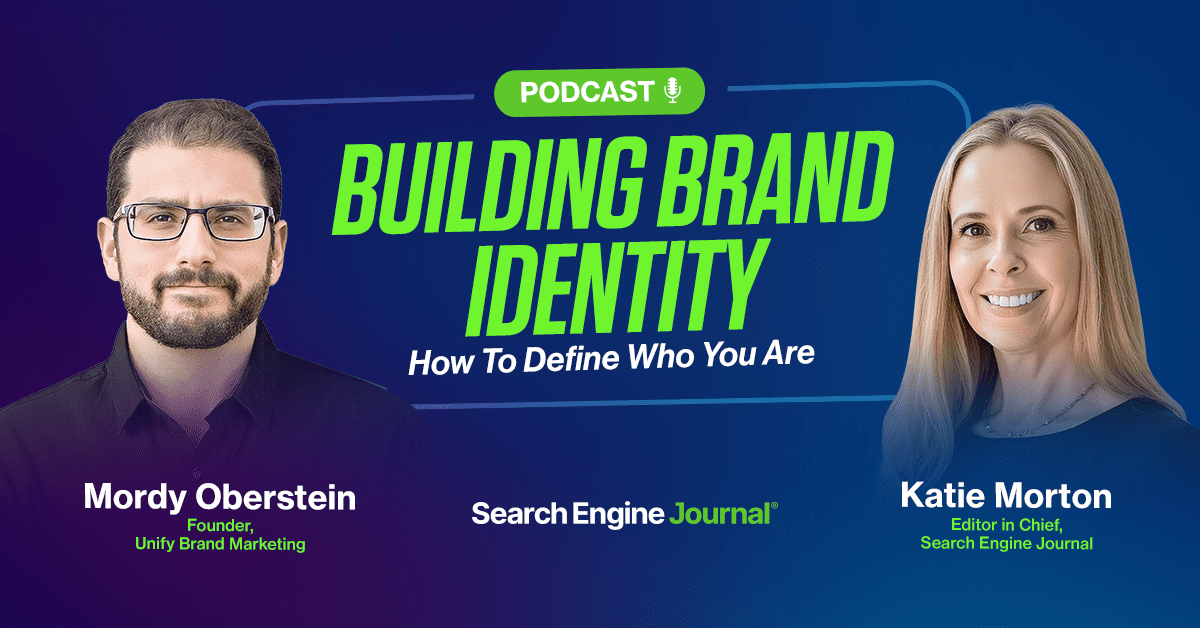
Building Brand Identity: How To Define Who You Are

Brand identity is the foundation of your business, from the conceptualization of your services and products all the way to marketing.

Before you can create an effective marketing, SEO, content strategy, or even a business strategy, you need to know who you are as a brand. It’s a step many marketers and business leaders overlook, but it’s the one that makes everything else work.

This episode breaks down why identity is the starting point for your business to have impact.

Editor-in-Chief of Search Engine Journal, Katie Morton, sits down with Mordy Oberstein, founder of Unify Brand Marketing, to discuss how to develop a true brand identity so your marketing strategy has something solid to stand on.

Watch the video or read the full transcript below.

Editor’s note: The following transcript has been edited for clarity, brevity, and adherence to our editorial guidelines.

Katie Morton: Hey everybody, it is I, Katie Morton, Editor-in-Chief of Search Engine Journal, and today I’m sitting down with Mordy Oberstein, founder of Unify Brand Marketing. Mordy, talk to me. What’s going on?

Mordy Oberstein: Episode three! It’s a thing now. I can’t believe we’ve made it this far. Counting episodes has become a bit of a challenge, though. We might even be on number four.

Katie: Counting is definitely hard! But let’s dive in.

Why Brand Identity Matters

Mordy: Last time, we talked about brand development and the stages of brand development. The first stage of brand development is developing brand identity. So, for the sake of continuity, which is important for branding, let’s talk about how you develop brand identity this time.

Katie: That sounds fantastic. How does one develop brand identity?

Mordy: Before we get into the “how,” let’s talk about why brand identity is so essential. Identity is the foundation of everything your brand or company does. You can’t create a marketing, SEO, or content strategy without first knowing who you are. Everyone skips this step—but it’s crucial.

Also, identity is the thing that allows your audience to connect to you. There has to be a point of connection for marketing to actually be effective. And people can’t connect unless there’s a “you” to connect with.

How To Build Brand Identity

Mordy: And that, in turn, also gives you a lot of focus where brands generally go off the rails is when they start focusing on the wrong things. It’s usually because of a lack of brand identity. So, how do you actually build identity?

The first thing to understand is that identity is not a fake thing. It’s not some make-believe concept like, “Oh, brand identity, it’s a fabrication.” No, identity is a real, living, breathing thing. And because of that, it has to be tied to what you actually do, what your offering really is. There’s no way to put lipstick on a pig.

The second thing I’ll say, before we dive deeper, is that brand identity has nothing to do with your company culture. If you think, “Oh, our identity is our company culture,” you’re doing it wrong. I know that’s a hot take.

The goal of identity is to create something authentic that your audience can connect with. And it needs to have depth for that connection to happen. To have depth, there has to be almost a therapeutic process that goes on. What you’re basically engaging in therapy for your brand.

Engage In Brand “Therapy”

Mordy: What I do with clients (and what you should do internally with your own team) is tap into who you actually are and what you actually want. It’s a process of asking: Why do you do the things you do?

You need to sit down with your team and have a session where you talk about:

  • Why you do what you do.
  • How you see your industry and niche.
  • How you view your product or service.
  • How you see your space and your audience.
  • What you want for your audience, not just practically, but meaningfully.

It’s not about what your audience gets in a practical sense. It’s about the outcome for their lives in a meaningful way.

During this process, you need to take notes like a therapist. As you’re having these discussions, ask yourself: What’s landing? What’s meaningful about this? What feels like something to chew on? Listen for the things that resonate – both in what you’re saying and what your team is saying.

From Reflection To Action: Formalizing Your Brand Identity

The next step is to formalize all of that into a pathway to showcase it. You take everything you discussed, all these concepts, ideas, and meaningful points, and try to concretize them into one unified (no pun intended) concept for yourself.

This means prioritizing. You can’t focus on everything. You have to take some of the meaningful things you talked about and say, “Okay, this is secondary.” You need to decide which points will be your primary focus.

Once you have a centralized concept of who you are, what you do, and why it’s meaningful and once it’s really clear to you – the next step is execution.

Because communication about who you are isn’t in the tagline on your homepage. It’s the nonverbal stuff. It’s latent. It’s everything you do. All the content you create, the activities you engage in should all signal and speak to who you are.

Integrating Identity Into Marketing Strategy

Mordy: This is where you start integrating all the work you did in those sessions into your actual marketing strategy.

It’s a three-step process:

  1. Sit down and have deep discussions to discover what’s meaningful.
  2. Prioritize: Decide which meaningful things you’re going to focus on.
  3. Integrate: Unify those concepts into your brand actions and strategies.

Does that make sense?

Katie: So no competitive analysis at this stage?

Mordy: I would encourage you not to look at your competitors yet. All you’re trying to do is figure out…take away the idea of brand for a second, take away the company. If someone asks you who you are, you don’t answer by thinking about your competition.

Instead, you ask yourself: What’s really meaningful to me? What do I really want? What do I want people to know? What do I like to focus on? All those kind of questions and you start pulling that out.

Katie: Exactly. Authenticity should naturally help differentiate you. It should, right?

MordyAnd that’s another thing, by the way, which is a great point that you bring up. It’s technically possible that you could find an identity of who you are that’s really meaningful, that has a layer of depth, that’s not the surface-level nonsense that a lot of brands fall into. It can be super clear to you, and it can be difficult to differentiate. It could be the exact same thing as another brand, but that’s a very, very unlikely thing. It’s a technical possibility, but I don’t think it’s an existential possibility.

Katie: That makes sense. If you think of a brand as an individual human, no two humans are alike. So neither should two brands be alike.

Mordy: Exactly. If you’re doing this exercise correctly, you’ll naturally create differentiation. And if you feel like you’re not, it means you haven’t dug deep enough yet.

Brand Identity Guides Real-World Implications

Katie: Full disclosure: We actually went through this brand identity exercise with Mordy at Search Engine Journal. It was extremely helpful, and like you said, it also trickled into real world actions. It’s helping to inform some of our product strategy and other things we’re planning on doing in the real world. This branding exercise is not just empty calories, so to speak.

Mordy: Thanks for saying that. That’s awesome.

If your marketing team isn’t getting traction and feels stuck, it’s often because you’re not tapped into who you actually are. But once you are, you feel very much not stuck. You get clarity: “Here’s where our product should go. We shouldn’t go that way; we should go this way.”

It’s where you see companies go off the rails with AI, for example. They just jump on every AI thing because they don’t know who they are. They don’t have the ability to say, “That’s not us.” Or, “Yes, we should get into AI, but it should be done in a way that reflects who we are.”

This identity work also gives you focus, traction, and momentum when you’re feeling stuck. We talked about this last time: knowing who you are is very important for figuring out who you’re for.

Katie: Right. That’s a good point. So it can help target your audience as well, who do you want to help? The other thing I found it’s motivating just from a work ethic standpoint, if you feel like you’re burned out or you’re spinning your wheels or you don’t know why you do what you do, it gives you sort of a North star to really connect with other human beings, with your customer, who are you trying to serve and why?

What is that intrinsic motivation that helps you get out of bed in the morning?

Mordy: It’s super meaningful. From a practical point of view, when teams or companies talk about needing an “internal vision,” what they really mean is they need an internal identity that can be communicated across teams. That’s what I feel you’re actually trying to say.

Aligning Brand Identity: A Picture Frame Business Example

Mordy: Let me give you a weird example. Let’s say I make picture frames. That’s my business: I sell picture frames.

If your identity is just, “We’re about making cheap picture frames,” that’s not meaningful. But if you start asking why you’re doing this, you might discover something deeper. Maybe you and your team really value cherishing memories. That’s your motivation. So, your product, the frame, is a way to help people cherish their memories by displaying them.

Half my pictures are still on my phone. They are not cherished. Print them, put them in a nice frame, display them, cherish those memories. But if you say you’re all about cherishing memories and then sell flimsy, garbage frames, that would be a misalignment.

Another company might say, “We want to add artistic flair to your pictures.” Their identity is about art and design. Two totally different companies doing totally different things with their brand identity. And it’s based on who they actually are, and their products should align.

Sometimes you’ll combine concepts. Maybe you believe in cherishing memories, but you also feel that an artistic frame enhances that experience. So, your core concept becomes: “We help you cherish memories by giving them artistic design that highlights how special they are.”

So that would be taking two concepts and unifying them together to create one core concept that speaks of both aspects of who you actually are. You can do five different things with this, it all depends on who you are in reality.

Katie: I can imagine, too, that you could build entire product lines from that concept. Maybe you serve different customer segments, or maybe it’s one customer who wants variety.

Mordy: Your whole product line should be informed by that decision. If you’re saying, “Cherishing the memory means giving it a really fancy frame,” then your products need to align with that. Imagine you bought a Monet…you wouldn’t put it in a cheap poster board frame. You’d give it a beautiful frame that reflects its value. Your memories are paintings; your pictures are memories.

Your products need to align. You’d create product lines of artistic frames to match your identity. If your products don’t reflect who you are, then either that’s not your identity, or you need to change your product to match it.

Brand Identity Drives Motivation

Katie: That makes sense. As a painter, so I can relate to this example. When I don’t know why I’m creating, I stop. The times that I am aligned with this exercise of figuring out who I am and who I’m trying to connect with, and the identity behind why I would be a painter, I’m so much more motivated to show up and paint.

Any time I get lost in the grind of the work week, it often makes me not paint, because I have different identities at different times, as we all do as human beings. Sometimes my work identity will take over. If the painter identity is weak or ill-defined, I can literally go years without painting.

So to bring it back to the concrete reality of what we’re talking about, the same happens in business. It’s so easy to get off track because people have so many priorities shoved at them all the time. So it’s really easy for businesses to become idea generators. If you don’t have those north star KPIs rooted in our brand identity, it’s so easy to go chase shiny things.

Mordy: …they’re all over the place. Businesses ask, “Why should I do this? Shouldn’t I focus on conversions, revenue, traffic?” But defining your identity helps you do that. You’ll target the right people with the right message and avoid wasting time and money on products, marketing, or content that don’t align with who you are.

When you’re confused, you try everything. You waste a ton of time, resources, and money. But if you sit down for a few hours, clarify your identity, you’ll know, “We need to do this, and not that.”

Mordy: Also, identity evolves over time, just like people. Your brand, who you are, why you do what you do, it changes. That’s normal. But it always needs to be clear to you.

People are creatures of meaning. If you can’t attach meaning to what you do, your audience won’t be able to connect or resonate. You’ll face an uphill battle trying to convince people to spend money with you. On top of that, your team won’t have buy-in. You, as the owner or CEO, might be motivated, but your team needs something meaningful to connect with.

That’s why it’s critical to communicate your identity across the entire organization. Don’t stop at the C-suite or the marketing team. Start having real conversations about this with every team member.

Quick Note On ICPs And Personas

Katie: I have one last question for you, Mordy. The idea of the ICP, how much does that factor into this particular step? How would you categorize that part of this discussion in terms of the ICP and the brand identity?

Mordy: That’s a hard question, it’s a whole topic in itself. I don’t like profiling like that. I like intent-based marketing over persona-based marketing.

Katie: Not to open a can of worms late in the discussion, but talk to me briefly about intent-based versus profiling.

Mordy: I’m more interested in why people do things than which person does which thing. Generally, when you’re more intent-focused, you open up more opportunities. But when you’re persona-focused, you sometimes end up with blinders on.

That’s not to say there’s no room for persona-based marketing. There is. But going back to your question about the ICP (kind of a hot take) shouldn’t be part of this process until you’ve figured out who you are.

Should your ICP, your Ideal Customer Profile, influence who you actually are? Does it change who you are? Think of it like going on a date. Should who the other person is influence who you are as a person? That’s not a recipe for success. You are who you are.

Of course, we’re all multifaceted people, but fundamentally, you are who you are. And because of that, you decide who you should engage with, whether that’s Customer X or Customer Y. Not the other way around.

Final Thoughts

Katie: Let me just add one thing. Let’s say someone is flexible as a brand or as a dater. Imagine a scenario where someone has aspirations, whether in business or relationships. Someone who’s an inexperienced business owner who wants to target a high-value customer, but doesn’t yet have the experience to offer real value.

In that case, you have two options. One is to accept where you are, get back down into your league, and serve the customers you’re best equipped to serve right now. The other option is to level up. Get educated. Improve yourself. If you’re aiming for a target that’s currently out of your league, there are steps you can take within reason to grow into that.

But that’s a whole other business development conversation. For the purposes of this branding exercise, it’s about authenticity and being realistic. It’s about knowing where you can truly add value. And at the heart of it, it always comes back to: Who are you? Like you said, it ties back to brand development.

Mordy: To kind of end off with a very simple example, again, if you micro-level this, it all becomes much easier to see. Let’s say there are two groups I want to hang out with. Group A likes baseball games. Group B prefers the ballet or symphony. Both groups seem cool, but I love baseball. That’s my thing. So I should hang out with the baseball crowd.

I’m not a fancy person. I don’t enjoy the symphony. If you do, that’s awesome, more power to you. But it’s not me. I’m not going to force myself into that crowd. Instead, I’ll lean into the baseball group. I’ll amplify that aspect of myself. I’ll get the jersey, the gear to show them I’m part of their group. Because I actually am.

I’m not faking it. I’m just trying to amplify what I actually am to show you that’s who I am. That’s the difference. One is you’re faking it in order to show people like, “Oh, here we go, this is who I am.” Not you at all.

The other way is, this is who I am, and I’m going to try to communicate that to you by all the things I’m going to do. And I might purposely and consciously try to do things or signal to you that “I’m part of your group. I fit in. Love me.”

Katie: That’s amazing. And just from a business standpoint, when it comes to SEO and acquiring customers and traffic, it’s so important to focus on your niche. You’re not going to be all things to all people, especially now when AI is answering all the basic questions.

You need to double down on who you are and speak authentically to your niche. Stop trying to appeal to too many people. The days of the open web firehose of traffic are done. So adjust and adapt.

Mordy: If you’re for everyone, you’re for no one.

Katie: Exactly. Alright, Mordy, we’re at time. Thank you so much for sitting down with me today. I’m looking forward to the next one.

For a free consultation with Mordy, head over to unifybrandmarketing.com.

And we’re at searchenginejournal.com for more content and discussions. Mordy is also a contributor at Search Engine Journal, and any final thoughts?

Mordy: Yeah, come check out the free consultation. And check out the SEJ content.

Katie: Awesome. Until next time. Bye.

Mordy: Bye.

More resources: 


Featured Image: Paolo Bobita/Search Engine Journal