Google has released an open-source Model Context Protocol (MCP) server that lets you analyze Google Analytics data using large language models like Gemini.
Announced by Matt Landers, Head of Developer Relations for Google Analytics, the tool serves as a bridge between LLMs and analytics data.
Instead of navigating traditional report interfaces, you can ask questions in plain English and receive responses instantly.
A Shift From Traditional Reports
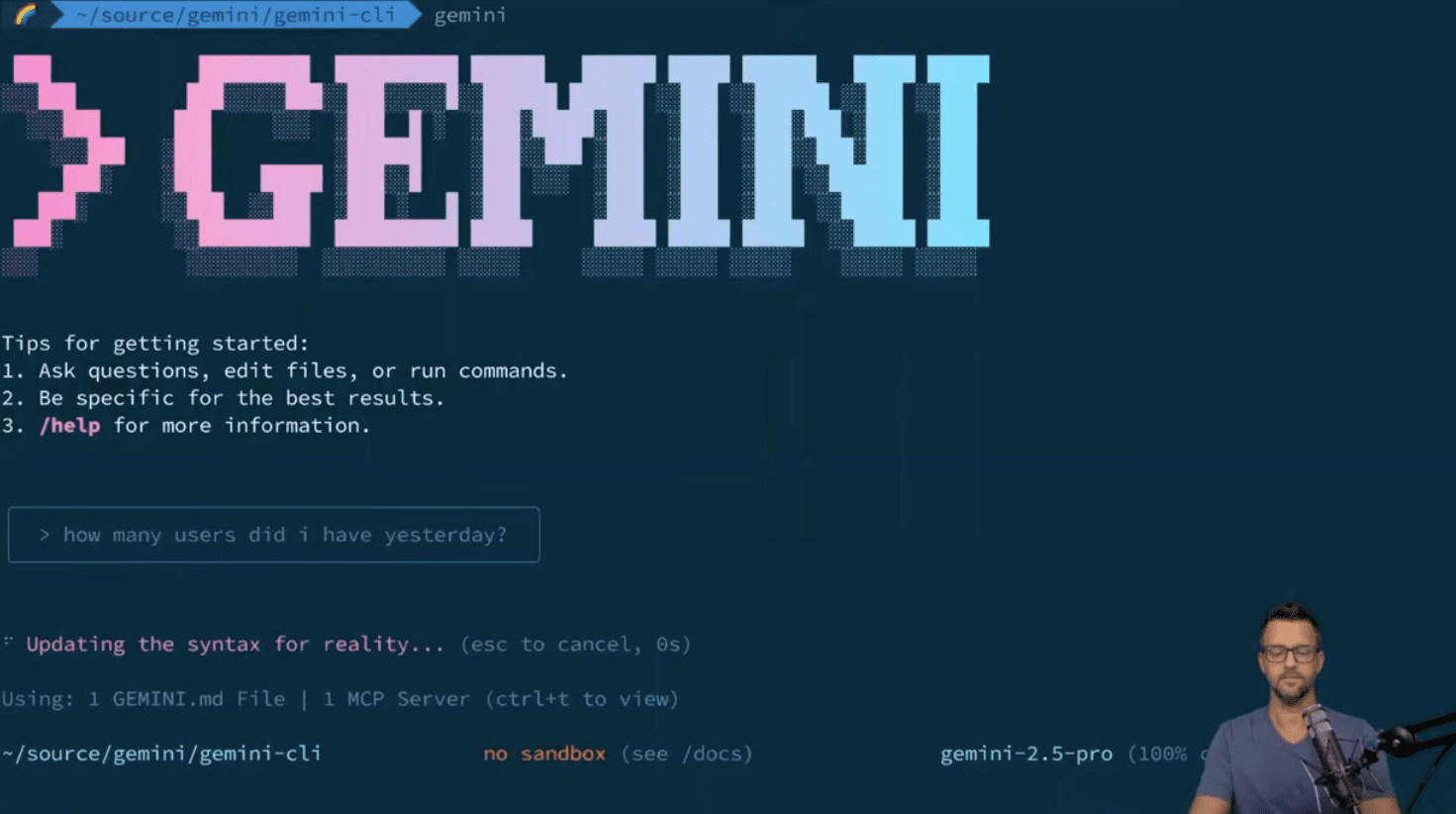
The MCP server offers an alternative to digging through menus or configuring reports manually. You can type queries like “How many users did I have yesterday?” and get the answer you need.
Screenshot from: YouTube.com/GoogleAnalytics, July 2025.
In a demo, Landers used the Gemini CLI to retrieve analytics data. The CLI, or Command Line Interface, is a simple text-based tool you run in a terminal window.
Instead of clicking through menus or dashboards, you type out questions or commands, and the system responds in plain language. It’s like chatting with Gemini, but from your desktop or laptop terminal.
When asked about user counts from the previous day, the system returned the correct total. It also handled follow-up questions, showing how it can refine queries based on context without requiring additional technical setup.
You can watch the full demo in the video below:
What You Can Do With It
The server uses the Google Analytics Admin API and Data API to support a range of capabilities.
According to the project documentation, you can:
Retrieve account and property information
Run core and real-time reports
Access standard and custom dimensions and metrics
Get links to connected Google Ads accounts
Receive hints for setting date ranges and filters
To set it up, you’ll need Python, access to a Google Cloud project with specific APIs enabled, and Application Default Credentials that include read-only access to your Google Analytics account.
Real-World Use Cases
The server is especially helpful in more advanced scenarios.
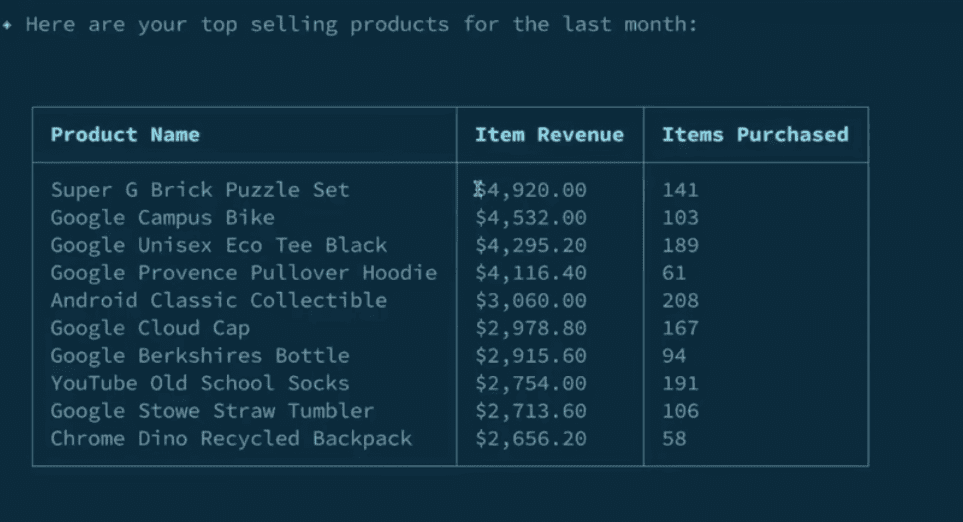
In the demo, Landers asked for a report on top-selling products over the past month. The system returned results sorted by item revenue, then re-sorted them by units sold after a follow-up prompt.
Screenshot from: YouTube.com/GoogleAnalytics, July 2025.
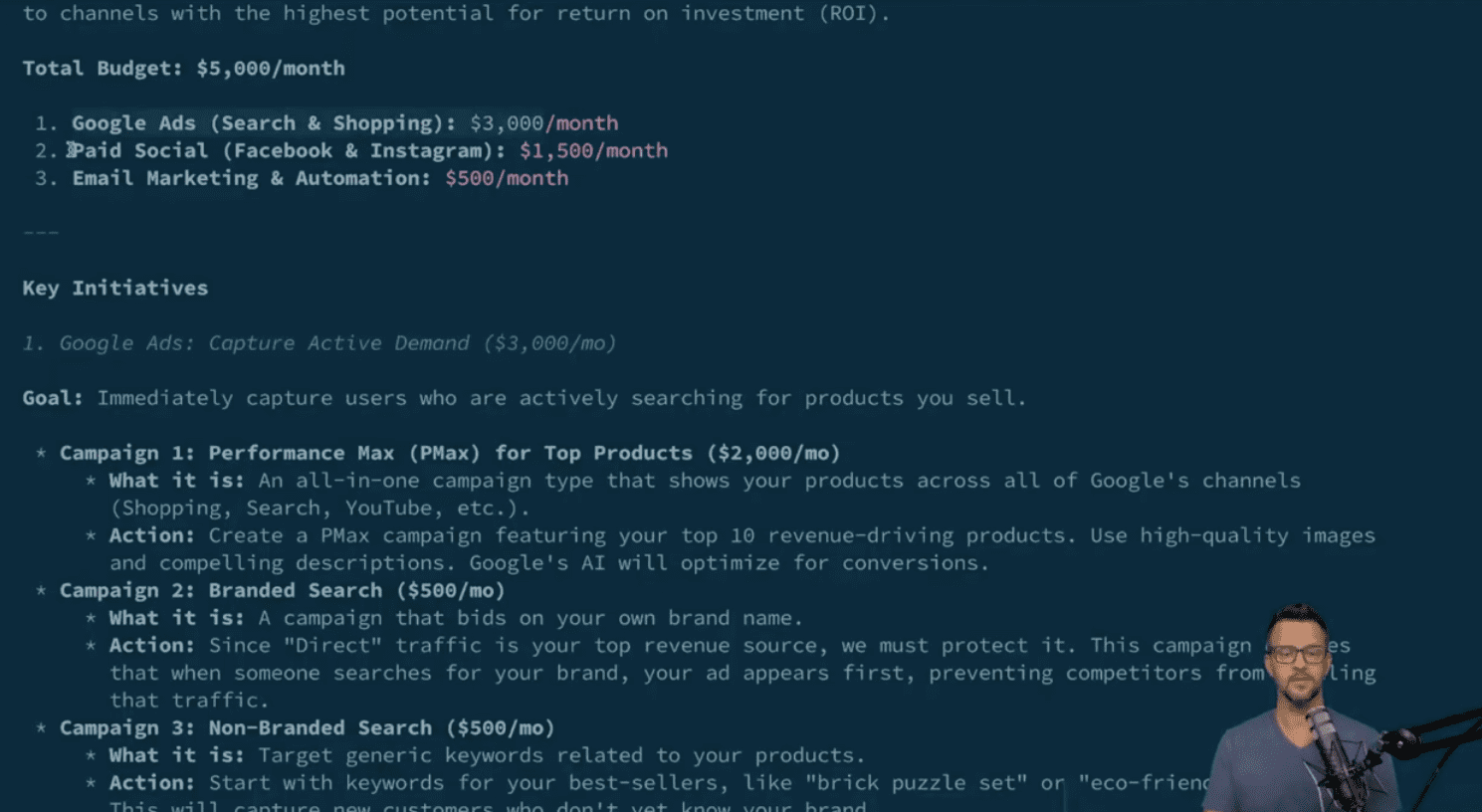
Later, he entered a hypothetical scenario: a $5,000 monthly marketing budget and a goal to increase revenue.
The system generated multiple reports, which revealed that direct and organic search had driven over $419,000 in revenue. It then suggested a plan with specific budget allocations across Google Ads, paid social, and email marketing, each backed by performance data.
Screenshot from: YouTube.com/GoogleAnalytics, July 2025.
How To Set It Up
You can install the server from GitHub using a tool called pipx, which lets you run Python-based applications in isolated environments. Once installed, you’ll connect it to Gemini CLI by adding the server to your Gemini settings file.
Setup steps include:
Enabling the necessary Google APIs in your Cloud project
Configuring Application Default Credentials with read-only access to your Google Analytics account
(Optional) Setting environment variables to manage credentials more consistently across different environments
The server works with any MCP-compatible client, but Google highlights full support for Gemini CLI.
To help you get started, the documentation includes sample prompts for tasks like checking property stats, exploring user behavior, or analyzing performance trends.
Looking Ahead
Google says it’s continuing to develop the project and is encouraging feedback through GitHub and Discord.
While it’s still experimental, the MCP server gives you a hands-on way to explore what natural language analytics might look like in the future.
If you’re on a marketing team, this could help you get answers faster, without requiring dashboards or custom reports. And if you’re a developer, you might find ways to build tools that automate parts of your workflow or make analytics more accessible to others.
The full setup guide, source code, and updates are available on the Google Analytics MCP GitHub repository.
Search Central Live Deep Dive Asia Pacific 2025 brings together SEOs from across the region for three days of insight, networking, and practical advice.
Held at the Carlton Hotel Bangkok Sukhumvit, the event features an impressive speaker lineup alongside structured networking breaks.
Attendees have the chance to meet familiar faces, connect with global SEO leaders, and share ideas on the latest trends shaping our industry.
The conference is split over three days, with each day covering a key part of Google’s processes: crawling, indexing, and serving.
Some of the practical tips that emerged from day one:
Keep building human‑focused content. Google’s models favor natural, expert writing above all.
Optimize for multiple modalities. Make sure images have descriptive alt text, videos have transcripts, and voice search is supported by conversational language.
Monitor crawl budget. Fix 5XX errors promptly and streamline your site’s structure to guide Googlebot efficiently.
Use Search Console recommendations. Non‑expert site owners can benefit from the guided suggestions feature to improve usability and performance.
Stay flexible. Long‑held traffic trends may shift as AI features grow. Past success does not equal future success.
A Pivotal Moment For Search
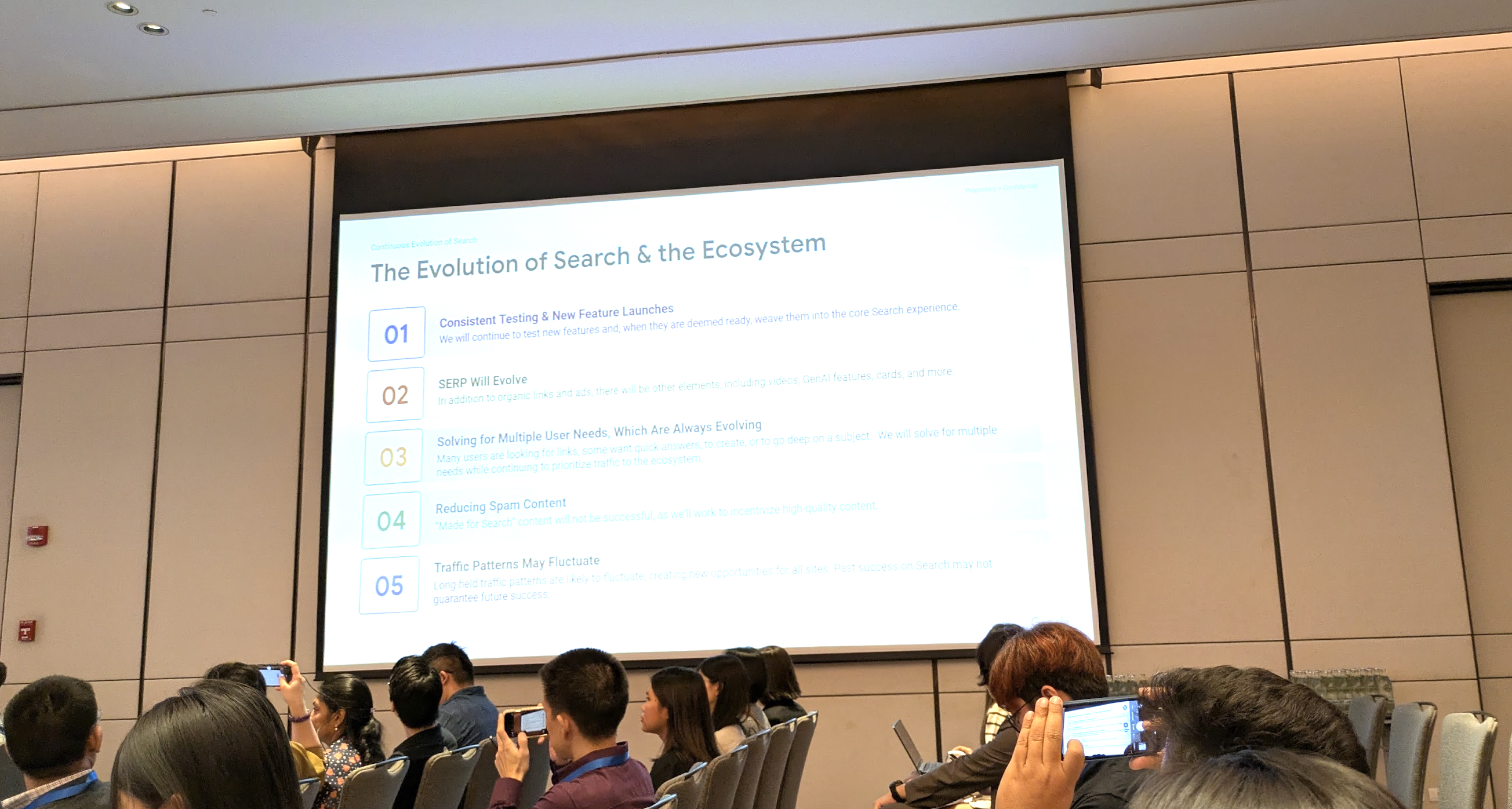
Mike Jittivanich, director of marketing for South East Asia and South Asia Frontier, set the tone in his keynote by declaring that we’ve reached a pivotal moment in search. He identified three forces at work:
AI innovation that rivals past major shifts such as mobile and social media.
Evolving user consumption patterns, as people expect faster, more conversational ways to find information.
Changing habits of younger generations, who interact with search differently from their parents.
This trio of drivers underlines that past success no longer guarantees future success in search.
As Liz Reid, VP of Search at Google, has put it, “Search is never a solved problem.”
Image from author, July 2025
New formats, from AI Overviews to multimodal queries, must be woven alongside traditional blue links in a way that keeps pace with user expectations.
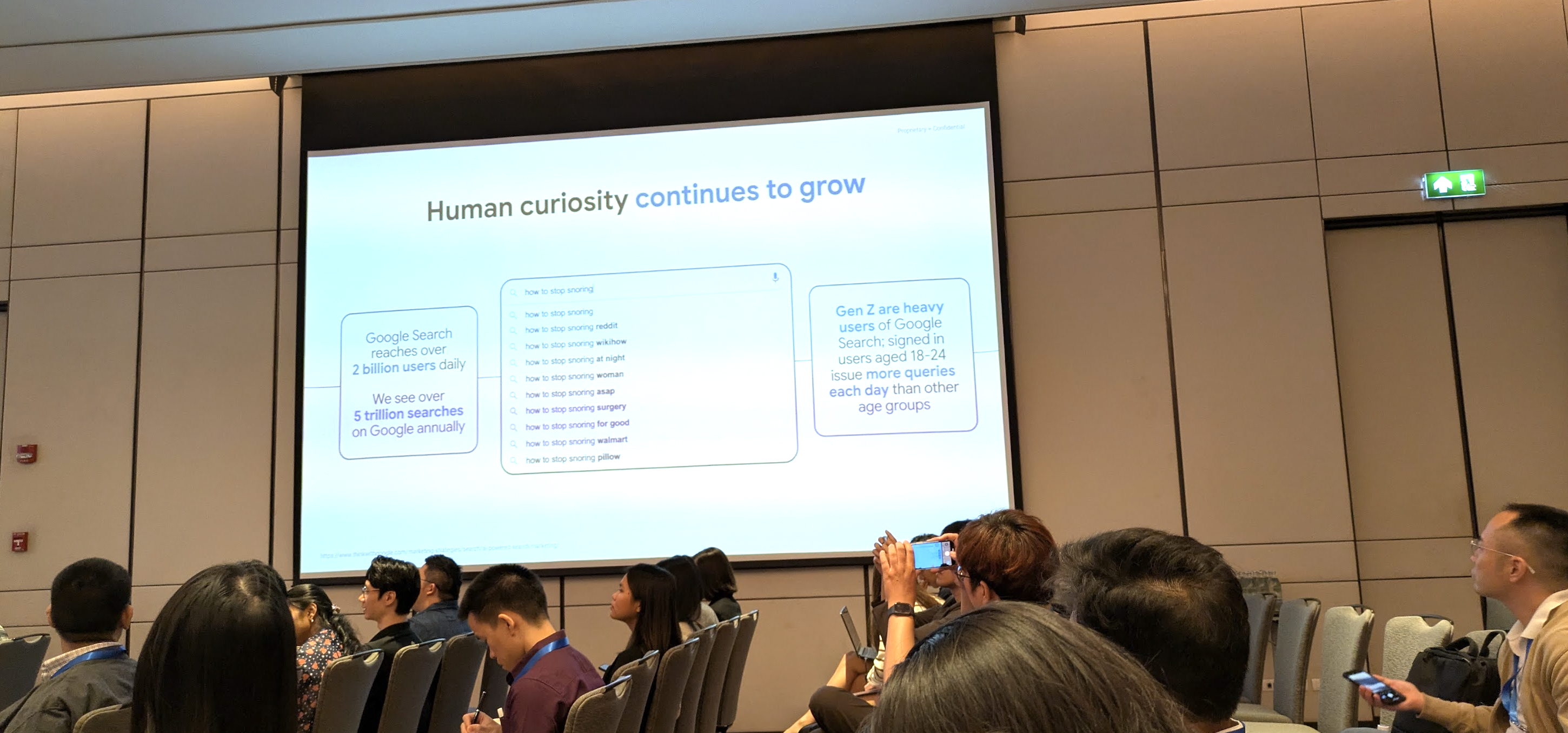
Gen Z: The Fastest‑Growing Search Demographic
One of the most eye-opening statistics came from a session on generational trends: Gen Z (aged 18-24) is the fastest-growing group of searchers.
Image from author, July 2025
Lens usage alone grew 65% year‑on‑year, with over 100 billion Lens searches so far in 2025. Remarkably, 1 in 5 searches via Lens now carries commercial intent.
Younger users are also more likely to initiate searches in non-traditional ways.
Roughly 10% of their journeys begin with Circle to Search or other AI‑powered experiences, rather than typing into a search box. For SEOs, this means optimizing for image and voice queries is no longer optional.
Why Human‑Centered Content Wins
Across several talks, speakers emphasized that Google’s machine‑learning ranking algorithms learn from content created by humans for humans.
These models understand natural language patterns and reward authentic, informative writing.
In contrast, AI‑generated text occupies its own space in the index, and Google’s ranking systems are not trained on that portion. Gary Illyes explained that:
Our algorithms train on the highest‑quality content in the index, which is clearly human‑created.
For your site, the takeaway is clear: Keep focusing on well‑researched, engaging content.
SEO fundamentals, like clear structure, relevant keywords, and solid internal linking, remain vital.
There is no separate checklist for AI features. If you’re doing traditional SEO well, you’ll naturally be eligible for AI Overviews and AI Mode features.
AI In Crawling And Indexing
Two sessions shed light on how AI is touching the crawling and indexing process:
AI Crawl Impact: Sites are seeing increased crawl rates as Googlebot adapts to new AI‑powered features. However, a higher crawl rate does not automatically boost ranking.
Status Codes and Crawl Budget: Only server errors (5XX) consume crawl budget; 1XX and 4XX codes do not affect it, though 4XX can influence scheduling and prioritization.
Cherry Prommawin explained that crawl budget is the product of crawl rate limit (how fast Googlebot can crawl) and crawl demand (how much it wants to crawl).
If your site has broken links or slow responses, it may slow down the overall crawling process.
Google Search Is Evolving In Two Ways
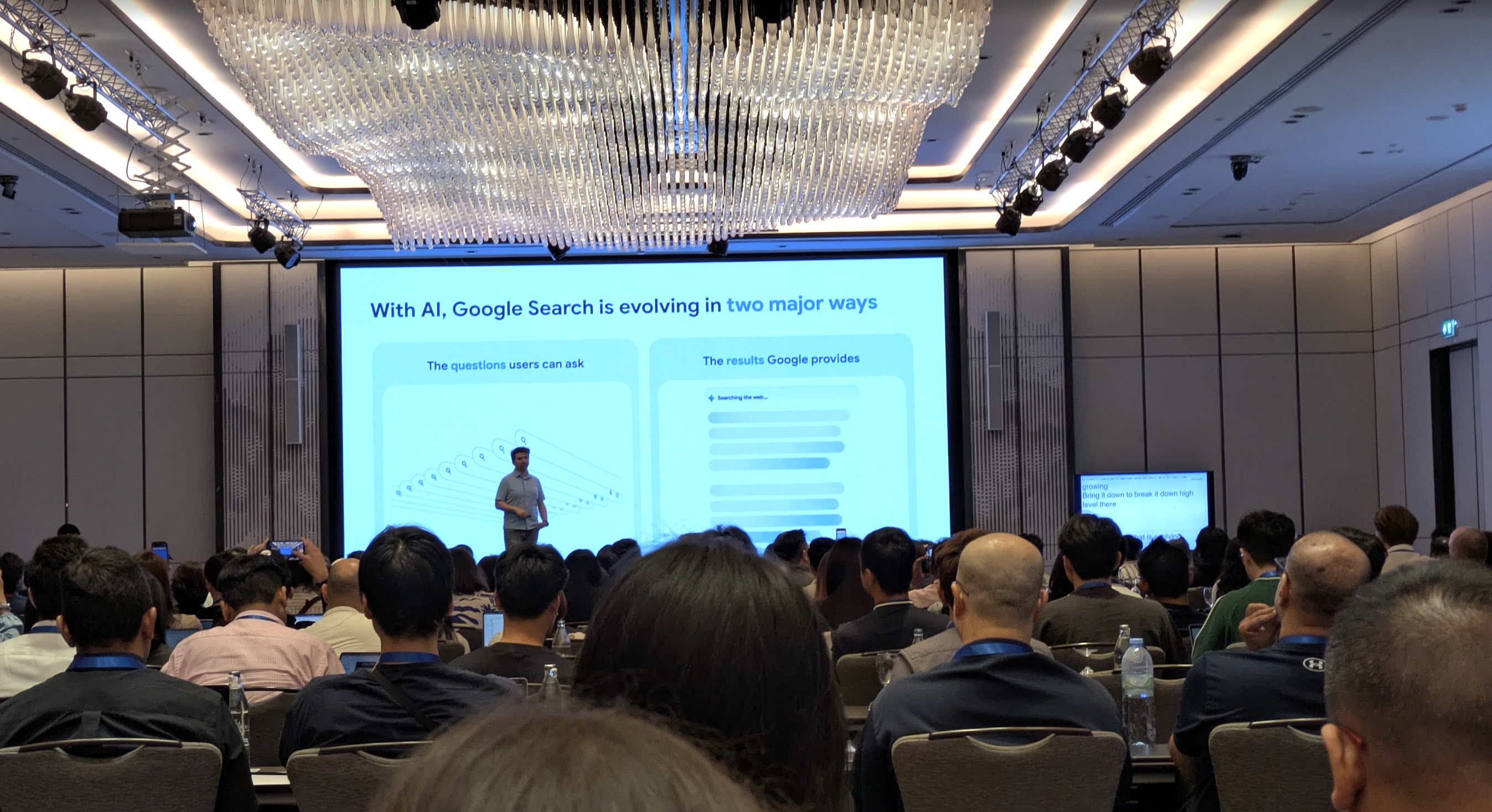
Google Search is evolving along two main focus points: the types of queries users can pose and the range of answers Google can deliver.
The Questions Users Can Ask
Queries are becoming longer and more conversational. Searches of five or more words are growing at 1.5X the rate of shorter queries.
Beyond text, users now routinely turn to voice, images, and Circle to Search: For Gen Z, about 10% of journeys start with these AI-powered entry points.
The Results Google Can Provide
AI Overviews can generate balanced summaries when there’s no single “right” answer, while AI Mode offers end‑to‑end generative experiences for shopping, meal planning, and multi‑modal queries.
Google is bringing DeepMind’s reasoning models into Search to power these richer, more nuanced results, blending text, images, and action‑oriented guidance in a single interface.
Image from author, July 2025
LLMs.txt & Robots.txt
Gary Illyes and Amir Taboul discussed Google’s stance on robots.txt and the IETF working group’s proposed LLMs.txt standard.
Much like meta keywords of old, LLMs.txt is not a Google initiative and not seen as beneficial, or something they’re looking to adopt.
Google’s view is that robots.txt remains the primary voluntary standard for controlling crawlers. If you choose to block AI‑specific bots, you can do so in robots.txt, but know that not all AI crawlers will obey it.
AI Features As Extensions Of Search
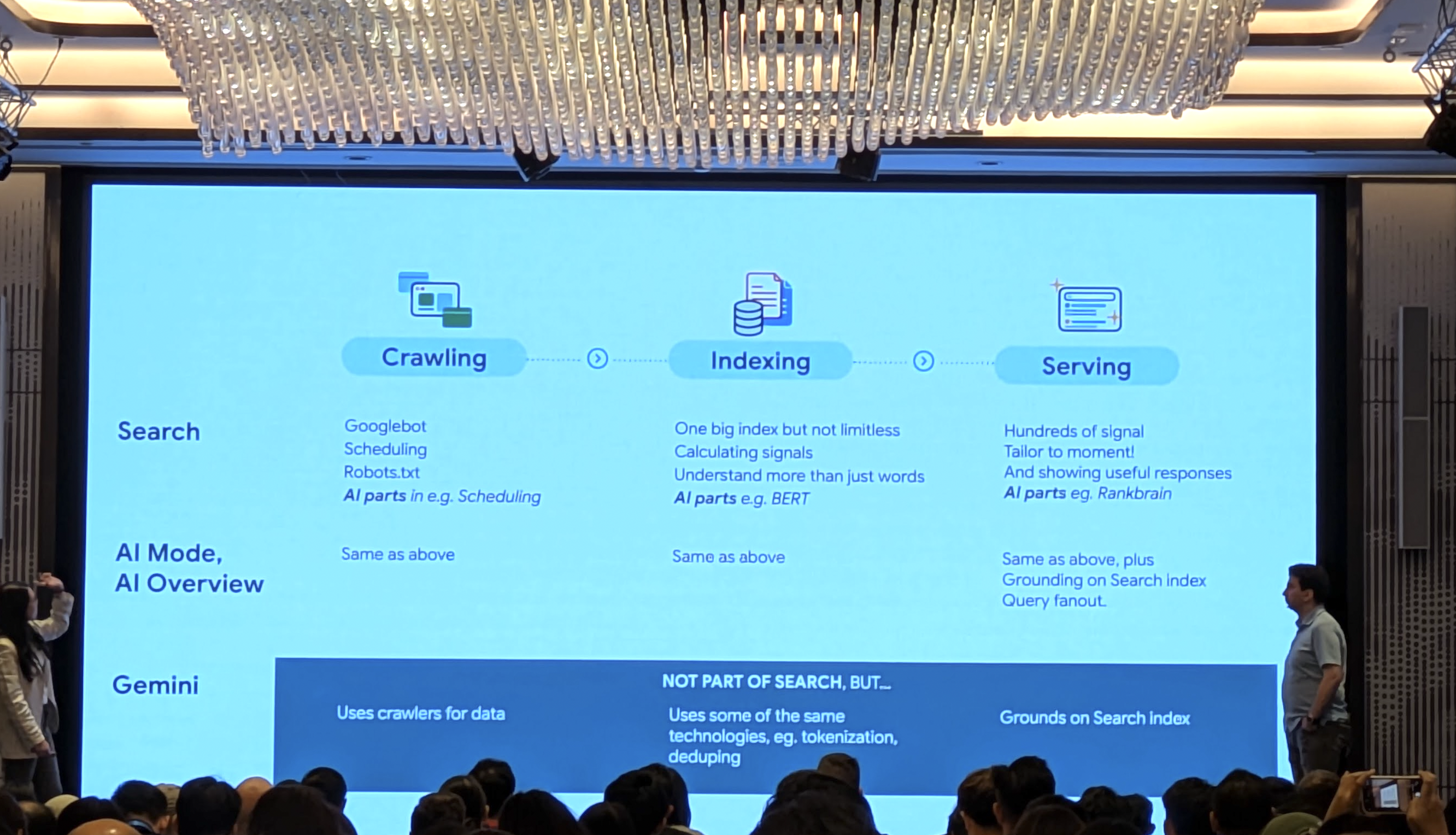
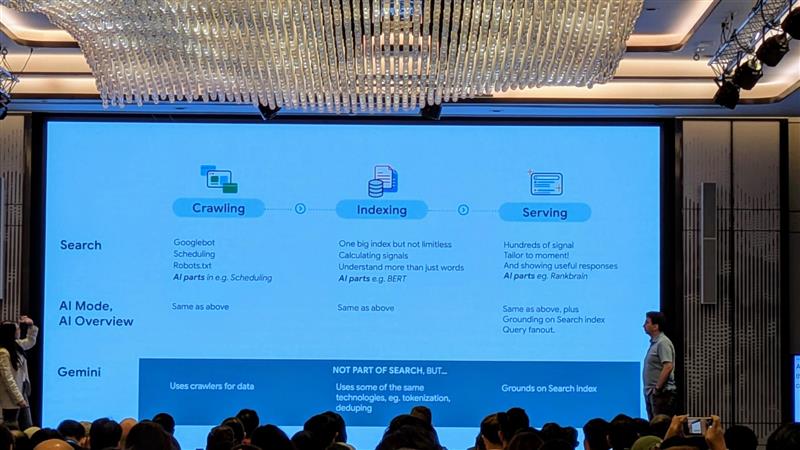
AI Mode and AI Overviews rely on the exact same crawling, indexing, and serving infrastructure as traditional Search.
Googlebot handles both blue‑link results and AI features, while other crawlers in the same system feed Gemini and large language models (LLMs).
Image from author, July 2025
Every page still undergoes HTML parsing, rendering, deduplication, and statistical models, such as BERT, for understanding and spam detection when it’s time to serve results. The same query‑interpretation pipelines and ranking signals, such as RankBrain, MUM, and other ML models, order information for both classic blue links and AI‑powered answers.
AI Mode and AI Overviews are simply new front-end features built on the familiar Search foundations that SEOs have been optimizing for all along.
Making The Most Of Google Search Console
Finally, Daniel Waisberg led a session on effectively utilizing Search Console in this new era.
Waisberg described Search Console as the bridge between Google’s infrastructure (crawling, indexing, serving) and your site. Key points that came from these sessions included:
Data latency: Finalized data in Search Console is typically two days old, based on the Pacific time zone. Partial and near-final data sit behind the scenes and may differ by up to 1%.
Feature lifecycle: New enhancements progress from user need to available data, then through design and development, to testing and launch.
Recommendations feature: This tool is aimed at users who are not data experts, suggesting actionable improvements without overwhelming them.
By understanding how Search Console presents data, you can diagnose crawl issues, track performance, and identify opportunities for AI-driven features.
That’s it for the end of day one. Watch out tomorrow for our coverage of day two at Google Search Central Live, with more Google insights to come.
In a recent SEO Office Hours video, Google addressed whether businesses can show different product prices to users in different U.S. states, and what that means for search visibility.
The key point: Google only indexes one version of a product page, even if users in different locations see different prices.
Google Search Advocate John Mueller stated in the video:
“Google will only see one version of your page. It won’t crawl the page from different locations within the U.S., so we wouldn’t necessarily recognize that there are different prices there.”
How Google Handles Location-Based Pricing
Google confirmed it doesn’t have a mechanism for indexing multiple prices for the same product based on a U.S. state.
However, you can reflect regional cost differences by using the shipping and tax fields in structured data.
Mueller continued:
“Usually the price difference is based on what it actually costs to ship this product to a different state. So with those two fields, maybe you could do that.”
For example, you might show a base price on the page, while adjusting the final cost through shipping or tax settings depending on the buyer’s location.
When Different Products Make More Sense
If you need Google to recognize distinct prices for the same item depending on state-specific factors, Google recommends treating them as separate products entirely.
Mueller added:
“You would essentially want to make different products in your structured data and on your website. For example, one product for California specifically, maybe it’s made with regards to specific regulations in California.”
In other words, rather than dynamically changing prices for one listing, consider listing two separate products with different pricing and unique product identifiers.
Key Takeaway
Google’s infrastructure currently doesn’t support state-specific price indexing for a single product listing.
Instead, businesses will need to adapt within the existing framework. That means using structured data fields for shipping and tax, or publishing distinct listings for state variants when necessary.
Marketers tend to prioritize top-of-funnel awareness and bottom-funnel conversion efforts.
Yet, the mid-funnel stage is where prospects actively weigh options and is crucial for sustained growth and profitability.
Overlooking this critical stage can reduce revenue potential. Using AI-driven paid media for nurturing and retargeting can bridge this gap, converting high-quality leads into profitable customers.
Importance Of Mid-Funnel Engagement
Prospects in the mid-funnel have already expressed interest and are ready to move to action.
They are conducting detailed comparisons, attending webinars, downloading whitepapers, and critically evaluating their choices.
Despite this intense engagement, advertisers often overlook this critical phase, causing leads to drop off.
The lack of personalized campaigns and ad copy further undermines mid-funnel marketing. It’s important now for marketers to reassess their strategies to better engage prospects.
Understanding The Customer Journey: Top-, Mid-, And Bottom-Funnel Behaviors
Retargeting (website visitors, video viewers, content downloads.
Custom Intent, In-Market audiences.
Dynamic Search Ads (for specific solution pages).
Google Shopping (for products being compared).
Focus on lead capture.
Bottom-Funnel (Decision/ Purchase)
“I’m ready to buy, need to choose who from.”
Making a final decision, seeking confirmation, or a specific offer.
Transactional keywords:
“buy [product name]”
“[product name] pricing”
“demo”
“get a quote”
“deal on [product]”
“sign up for [service]”
Call-to-action and urgency.
Offer direct value, limited-time deals, or compelling reasons to choose now.
Focus on immediate conversion.
Highly targeted exact match keywords.
Remarketing to cart abandoners or demo form abandoners.
Competitor Conquesting (very specific terms)
Google Shopping (specific prod SKUs).
PMax with strong final URLs.
Lead Form Assets.
Focus on direct sales.
Mid-Funnel Potential
In the “consideration” phase, advertisers now have new ways to engage, segment, and nurture mid-funnel audiences with AI and innovative PPC targeting tactics.
Here are three AI-powered mid-funnel tactics to integrate into the paid search plan.
1. AI-Driven Prospect Targeting
This tactic uses AI to analyze huge amounts of user data signals to identify which specific prospects are most likely to take action (convert) at mid-funnel.
The ad platforms may look at past website interactions to demographic signals to predict who are the most qualified new customers.
Smart Bidding and targeting tools allow advertisers to focus ad budget and messaging on the most effective, hot leads.
In one example, Google Ads segments out new customers, calling it the “New customer acquisition goal.” This lifecycle goal prioritizes bidding to reach and acquire new customers.
Key Advantages:
Maximizes budget efficiency: Uses AI to identify high-intent prospects within your paid ad campaigns.
Improves overall conversion rates: By prioritizing higher-intent leads, you naturally see a better chance of converting them into valuable customers down the line.
PPC Features Supporting This Tactic:
Performance Max(Google Ads and Microsoft Ads): This powerful campaign type leverages AI across all channels (search, display, email, etc) to find converting customers. It prioritizes users showing high-value signals, optimizing your bids and placements to capture them.
Smart Bidding Strategies (Target CPA, Target ROAS): While often used for bottom-funnel sales, these can be set to optimize for mid-funnel conversions. The AI learns which users are more likely to complete these specific actions and bids accordingly.
Custom Segments (Audience Manager): Combine your valuable first-party data (like customer lists of qualified leads) with Google’s audience signals to create highly targeted segments. AI can then optimize towards these prequalified groups.
2. Dynamic Ad Creative
AI automation can generate personalized ad creatives in real-time, enhancing relevance and engagement.
This means prospects see ads that are custom for their specific interests and previous interactions, in real-time, making the ads feel more relevant and personal.
Key Advantages:
Ad relevance: Ads feel personal and directly address the user’s observed interests, grabbing attention and increasing engagement.
Reduces ad fatigue: Users see varied, interesting ads instead of the same old creative repeatedly, preventing boredom and annoyance, which keeps them engaged longer.
Improves engagement metrics: You’ll see higher click-through rates (CTRs) and potentially better ad quality scores because the ads are well-matched to user intent.
PPC Features Supporting This Tactic:
Responsive Search Ads (RSAs) and Responsive Display Ads (RDAs): You provide multiple headlines, descriptions, and images. Google’s AI then mixes and matches these assets in real-time to find the best-performing combinations for each unique search query or individual users based on their search query, device, location, and other signals.
Dynamic Retargeting/Remarketing Ads: For ecommerce, these ads automatically showcase products a user viewed on your site. For B2B, they can dynamically display relevant content, case studies, or solutions based on specific pages visited on your website.
Google Ads’ Asset Library and AI-Driven Creative Suggestions: These tools help you generate a wide variety of diverse assets, then utilize them effectively to create countless ad variations.
3. Value-Based Bidding For Mid-Funnel Conversions
Shift your focus from conversion volume to conversion value with AI-powered bidding strategies that prioritize high-value leads.
Advertisers can assign a higher monetary value to actions that signify greater intent or higher potential lifetime value, like a demo request vs. a download.
The AI then prioritizes bids and focuses the budget on acquiring more valuable leads.
Key Advantages:
Optimizes for profitability, not just volume: Ensures your ad spend is directed towards acquiring profitable leads.
Improves budget allocation: AI intelligently allocates bids based on anticipated lead quality and potential revenue, not just the number of conversions, leading to more efficient spending.
Aligns PPC directly with business key performance indicators (KPIs): This strategy directly ties your ad performance to revenue goals and bottom-line impact. By focusing on value, PPC becomes a clear contributor, proving its worth directly.
PPC Features Supporting This Tactic:
Target ROAS (Return On Ad Spend) for Lead Generation: While often seen in ecommerce, an advanced use case is to apply it to lead generation campaigns. By assigning monetary values to different lead types, you tell the system the ROAS you want, and AI bids to meet it.
Maximize Conversion Value Bidding: This bidding strategy tells the AI to get the highest possible total conversion value within your budget. This requires a proper setup where you assign different values to each mid-funnel conversion action in your account. Without those values, the system can’t differentiate between the worth of different conversions.
Offline Conversion Import: This is a secret weapon! By importing your customer relationship management (CRM) data information about which leads converted to sales into your ad platforms, you teach the AI which mid-funnel actions are most likely to result in a high-value closed deal, allowing it to optimize bids efficiently.
Ready To Make The Mid-Funnel A Strategic Priority?
Rethink your approach to the mid-funnel, where valuable engagement opportunities often go untapped.
By using AI-driven strategies like those discussed, you can reconnect with high-intent prospects and guide them toward conversion.
For CMOs and senior marketers, optimizing the mid-funnel is a strategic opportunity to grow the customer acquisition pipeline.
These features draw on the same ranking signals and data sources as traditional Search.
They all run on Google’s core indexing and ranking engine without requiring a standalone platform. Adding an AI component is simply a matter of introducing extra interpretation layers.
Gary Illyes emphasized that both AI-driven tools and classic Search services share a single, unified infrastructure. This underlying infrastructure handles indexing, ranking, and serving for all result types.
AI Mode and AI Overviews are just features of Search, and built on the same Search infrastructure.
Deploying new AI capabilities means integrating additional models into the same system. Circle to Search and Lens simply add their query-understanding modules on top.
Crawling
All the AI Overviews and AI Mode features rely on the same crawler that powers Googlebot. This crawler visits pages, follows links, and gathers fresh content.
Gemini is treated as a separate system within Google’s crawler ecosystem and uses its own bots within Google’s ecosystem to feed data into its models.
Indexing
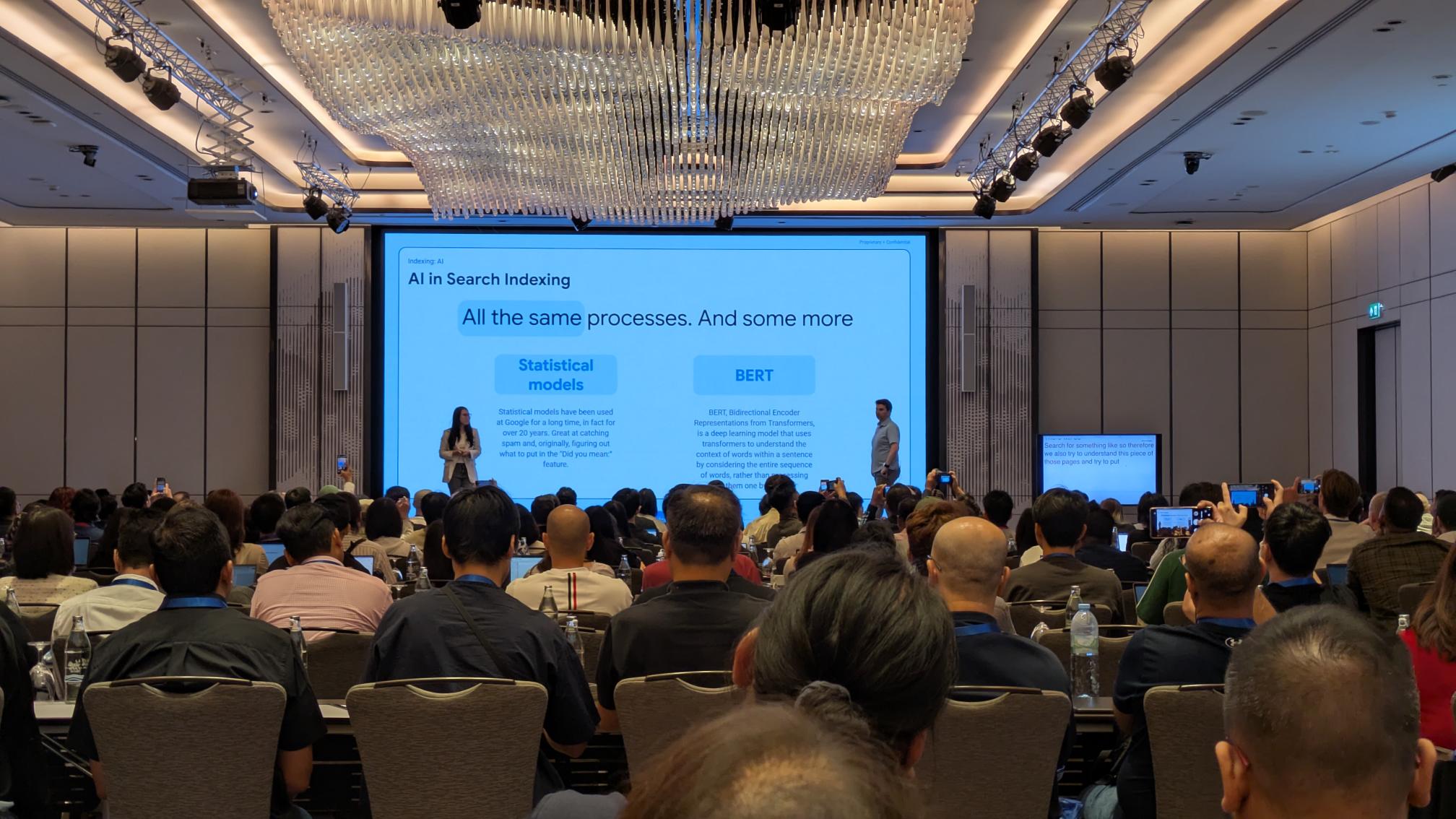
In AI Search, the core indexing process mirrors the methods used for traditional search. Pages that have been crawled are analyzed and organized into the index, then statistical models and BERT are applied to refine that data.
These statistical models have been in use for more than 20 years and were first created to support the “did you mean” feature and help catch spam.
BERT adds a deeper understanding of natural language to the mix.
Photo taken by author, Search Central Live Deep Dive Asia Pacific, July 2025
Serving
Once the index is built, the system must interpret each user query. It looks for stop words, identifies key terms, and breaks the query into meaningful parts.
The ranking phase then orders hundreds of potential results based on various signals. Different formats, such as text, images, and video, carry different weightings.
RankBrain applies machine learning to adjust those signals while MUM brings a multimodal, multitask approach to understanding complex queries and matching them with the best possible answers.
What This Means: Use The Same Principles From SEO
Given the tight integration of AI features with standard Search, creating distinct GEO or AEO programs may duplicate existing efforts.
As SEOs, we should be able to apply existing optimization practices to both AI Search and “traditional” Search products. Focusing on how AI enhancements fit into current workflows lets teams leverage their expertise.
Spreading resources to build separate frameworks could pull attention away from higher-impact tasks.
Cherry Prommawin and Gary Illyes concluded their session by reinforcing that AI is another feature in the Search product.
SEO professionals can continue to refine their strategies using the same principles that guide traditional search engine optimization.
Pew Research Center tracked real web browsing behavior and confirmed what many publishers and SEOs have claimed: AI Overviews does not send traffic back to websites. The results show that the damage caused by AI summaries to the web ecosystem is as bad as or worse than is commonly understood.
Methodology
The Pew Research study tracked over 900 adults who consented to installing an online browsing tracker to record their browsing behavior in the month of March 2025. The dataset contains 68,879 unique Google search queries, and a total of 12,593 queries triggered an AI summary.
Confirmed: Google AI Search Is Eroding Referral Traffic
The tracked user data confirms publisher complaints about a drop in referral traffic caused by AI search results. Google users who encounter an AI search result are less likely to click on a link and visit a website than users who see only a standard search result.
Only 8% of users who encountered an AI summary clicked a link (in the AI summary or the standard search results) to visit a website. Users who only saw a standard search result tended to click to visit a website 15% of the time, nearly twice as many as users who viewed an AI summary.
Users rarely click a link within an AI summary. Only 1% of users clicked an AI summary link and visited a website.
AI Summaries Cause Less Web Engagement
In a recent interview, Google’s CEO Sundar Pichai pushed back on the notion that AI summaries have a negative impact on the web ecosystem. He said that the fact that there is more content being created on the web than at any other time is proof that the web ecosystem is thriving. He said that
“So, generally there are more web pages… I think people are producing a lot of content, and I see consumers consuming a lot of content. We see it in our products.”
Pichai also insisted that people are consuming content across multiple forms of content (video, images, text) and that publishers today should be presenting content within more than just one format.
However, contrary to what Google’s CEO said, AI is not encouraging users to consume more content, it’s having the opposite effect. The Pew research data shows that AI summaries cause users to engage less with web content.
According to the research findings:
Users End Their Browsing Session
“Google users are more likely to end their browsing session entirely after visiting a search page with an AI summary than on pages without a summary.
This happened on 26% of pages with an AI summary, compared with 16% of pages with only traditional search results.”
Users Refrain From Clicking On Traditional Search Links
It also says that users tended to not click on a traditional search result when faced with an AI summary:
“Users who encountered an AI summary clicked on a traditional search result link in 8% of all visits. Those who did not encounter an AI summary clicked on a search result nearly twice as often (15% of visits).”
Only 1% Click Citation Links In AI Summaries
Users who see an AI summary overwhelmingly do not click the citations to the websites that the AI summary links to.
The report shows:
“Google users who encountered an AI summary also rarely clicked on a link in the summary itself. This occurred in just 1% of all visits to pages with such a summary.”
This confirms what publishers and SEOs have been saying to Google over and over again: Google AI Overviews robs publishers of referral traffic. Rob is a strong word but given the context that Google is using web content to “synthesize” an answer to a search query that does not result in a referral click, the word “rob” is what inevitably comes to mind to a publisher or SEO who worked hard to create the content.
Another startling fact shared in research is that almost 66% of users either browsed somewhere else on Google or completely bailed on Google without clicking a link to visit a website. In other words, nearly 66% of Google’s users do not click a link to visit the web ecosystem.
The report explains:
“…the largest share of Google searches in our study resulted in the user either browsing elsewhere on Google or leaving the site entirely without clicking a link in the search results. Around two-thirds of all searches resulted in one of these actions.”
Wikipedia, YouTube And Reddit Dominate Google Searches
Google has been holding publisher events and Search Central Live events all around the world to listen to publisher feedback and to promise that Google will work harder to surface a greater variety of content. I know that the Googlers at these events are not lying, but those promises of surfacing more high-quality content are subverted by the grim facts presented in the Pew research of actual users.
One of the biggest complaints is that Reddit and Wikipedia dominate the search results. The research validates publisher and SEO concerns because it shows that not only are Reddit and Wikipedia the most commonly cited websites, but Google’s own YouTube ranks among the top three most cited web destinations.
The report explains:
“The most frequently cited sources in both Google AI summaries and standard search results are Wikipedia, YouTube and Reddit. These three sites are the most commonly linked sources in AI summaries and standard search results alike.
Collectively, they accounted for 15% of the sources that were listed in the AI summaries we examined. They made up a similar share (17%) of the sources listed in standard search results.”
The report also shows:
“Wikipedia links are somewhat more common in AI summaries than in standard search pages”
“YouTube links are somewhat more common in standard search results than in AI summaries.”
These Are The Facts
Pew Research’s study of over 68,000 search queries from the browsing habits of over 900 adults reveals that Google’s AI summaries sharply reduce clicks to websites, with just 8% of users clicking any link and only 1% engaging with citations in AI answers.
Users encountering AI summaries are more likely to end their sessions or stay within Google’s ecosystem rather than visiting independent websites. This confirms publisher and SEO concerns that AI-driven search erodes web traffic and concentrates attention on a few dominant platforms like Wikipedia, Reddit, and YouTube.
These are the facts. They show that SEOs and publishers are right that AI Overviews is siphoning traffic out of the web ecosystem.
As generative search becomes the default for tools like ChatGPT, Gemini, and Claude, fewer people are clicking through to traditional search results. If your content isn’t part of their training data or grounding sources, it’s effectively invisible.
And that means one thing: you’re no longer just optimizing for humans or search engines. You’re optimizing for machines that summarize the internet.
Introducing Generative Engine Optimization (GEO)
In this tactical webinar, we’ll break down what it takes to get your brand cited, linked, and quoted in AI-generated content, intentionally.
Ways to increase your AIO (AI Overview) brand presence.
Proven SEO & GEO workflows you can copy today.
Learn How To Influence LLMs
This isn’t theory. We’ll walk through the specific strategies SEOs and marketers are using right now to shape what language models say, and don’t say, about their brands.
Expect insights on:
How foundational training data is gathered (and how you might influence it).
Which formats and language structures improve your chances of being cited.
This is for SEOs, content strategists, and marketing leads who want to stay relevant as AI redefines the playing field.
Why This Webinar Is A Must-Attend
Whether you’re refining your search strategy or trying to future-proof your brand visibility, this session offers high-ROI insights you can apply immediately.
✅ Actionable examples
✅ Real-world GEO workflows
✅ Early looks at emerging standards like MCP, A2A, and llms.txt
📍 Designed for experienced marketers ready to lead change.
Reserve Your Spot Or Get The Recording
🛑 Can’t make it live? No problem. Register anyway, and we’ll send you the full recording so you don’t miss a thing.
Last month I gave a talk at SXSW London called “Five things you need to know about AI”—my personal picks for the five most important ideas in AI right now.
I aimed the talk at a general audience, and it serves as a quick tour of how I’m thinking about AI in 2025. I’m sharing it here in case you’re interested. I think the talk has something for everyone. There’s some fun stuff in there. I even make jokes!
The video is now available (thank you, SXSW London). Below is a quick look at my top five. Let me know if you would have picked different ones!
1. Generative AI is now so good it’s scary.
Maybe you think that’s obvious. But I am constantly having to check my assumptions about how fast this technology is progressing—and it’s my job to keep up.
A few months ago, my colleague—and your regular Algorithm writer—James O’Donnell shared 10 music tracks with the MIT Technology Review editorial team and challenged us to pick which ones had been produced using generative AI and which had been made by people. Pretty much everybody did worse than chance.
My point here? Whether you think AI is the best thing to happen to us or the worst, do not underestimate it. It’s good, and it’s getting better.
2. Hallucination is a feature, not a bug.
Let’s not forget the fails. When AI makes up stuff, we call it hallucination. Think of customer service bots offering nonexistent refunds, lawyers submitting briefs filled with nonexistent cases, or RFK Jr.’s government department publishing a report that cites nonexistent academic papers.
You’ll hear a lot of talk that makes hallucination sound like it’s a problem we need to fix. The more accurate way to think about hallucination is that this is exactly what generative AI does—what it’s meant to do—all the time. Generative models are trained to make things up.
What’s remarkable is not that they make up nonsense, but that the nonsense they make up so often matches reality. Why does this matter? First, we need to be aware of what this technology can and can’t do. But also: Don’t hold out for a future version that doesn’t hallucinate.
3. AI is power hungry and getting hungrier.
You’ve probably heard that AI is power hungry. But a lot of that reputation comes from the amount of electricity it takes to train these giant models, though giant models only get trained every so often.
What’s changed is that these models are now being used by hundreds of millions of people every day. And while using a model takes far less energy than training one, the energy costs ramp up massively with those kinds of user numbers.
ChatGPT, for example, has 400 million weekly users. That makes it the fifth-most-visited website in the world, just after Instagram and ahead of X. Other chatbots are catching up.
The truth is we’ve been in the dark about exactly how much energy it takes to fuel this boom because none of the major companies building this technology have shared much information about it.
That’s starting to change, however. Several of my colleagues spent months working with researchers to crunch the numbers for some open source versions of this tech. (Do check out what they found.)
4. Nobody knows exactly how large language models work.
Sure, we know how to build them. We know how to make them work really well—see no. 1 on this list.
But how they do what they do is still an unsolved mystery. It’s like these things have arrived from outer space and scientists are poking and prodding them from the outside to figure out what they really are.
It’s incredible to think that never before has a mass-market technology used by billions of people been so little understood.
Why does that matter? Well, until we understand them better we won’t know exactly what they can and can’t do. We won’t know how to control their behavior. We won’t fully understand hallucinations.
5. AGI doesn’t mean anything.
Not long ago, talk of AGI was fringe, and mainstream researchers were embarrassed to bring it up. But as AI has got better and far more lucrative, serious people are happy to insist they’re about to create it. Whatever it is.
AGI—or artificial general intelligence—has come to mean something like: AI that can match the performance of humans on a wide range of cognitive tasks.
But what does that mean? How do we measure performance? Which humans? How wide a range of tasks? And performance on cognitive tasks is just another way of saying intelligence—so the definition is circular anyway.
There’s this absolute faith in the progress of AI. It’s gotten better in the past, so it will continue to get better. But there is zero evidence that this will actually play out.
So where does that leave us? We are building machines that are getting very good at mimicking some of the things people do, but the technology still has serious flaws. And we’re only just figuring out how it actually works.
Here’s how I think about AI: We have built machines with humanlike behavior, but we haven’t shrugged off the habit of imagining a humanlike mind behind them. This leads to exaggerated assumptions about what AI can do and plays into the wider culture wars between techno-optimists and techno-skeptics.
It’s right to be amazed by this technology. It’s also right to be skeptical of many of the things said about it. It’s still very early days, and it’s all up for grabs.
This story originally appeared in The Algorithm, our weekly newsletter on AI. To get stories like this in your inbox first, sign up here.
A beam of energy hit the slab of rock, which quickly began to glow. Pieces cracked off, sparks ricocheted, and dust whirled around under a blast of air.
From inside a modified trailer, I peeked through the window as a millimeter-wave drilling rig attached to an unassuming box truck melted a hole into a piece of basalt in less than two minutes. After the test was over, I stepped out of the trailer into the Houston heat. I could see a ring of black, glassy material stamped into the slab fragments, evidence of where the rock had melted.
This rock-melting drilling technology from the geothermal startup Quaise is certainly unconventional. The company hopes it’s the key to unlocking geothermal energy and making it feasible anywhere.
Geothermal power tends to work best in those parts of the world that have the right geology and heat close to the surface. Iceland and the western US, for example, are hot spots for this always-available renewable energy source because they have all the necessary ingredients. But by digging deep enough, companies could theoretically tap into the Earth’s heat from anywhere on the globe.
That’s a difficult task, though. In some places, accessing temperatures high enough to efficiently generate electricity would require drilling miles and miles beneath the surface. Often, that would mean going through very hard rock, like granite.
Quaise’s proposed solution is a new mode of drilling that eschews the traditional technique of scraping into rock with a hard drill bit. Instead, the company plans to use a gyrotron, a device that emits high-frequency electromagnetic radiation. Today, the fusion power industry uses gyrotrons to heat plasma to 100 million °C, but Quaise plans to use them to blast, melt, and vaporize rock. This could, in theory, make drilling faster and more economical, allowing for geothermal energy to be accessed anywhere.
Since Quaise’s founding in 2018, the company has demonstrated that its systems work in the controlled conditions of the laboratory, and it has started trials in a semi-controlled environment, including the backyard of its Houston headquarters. Now these efforts are leaving the lab, and the team is taking gyrotron drilling technology to a quarry to test it in real-world conditions.
Some experts caution that reinventing drilling won’t be as simple, or as fast, as Quaise’s leadership hopes. The startup is also attempting to raise a large funding round this year, at a time when economic uncertainty is slowing investment and the US climate technology industry is in a difficult spot politically because of policies like tariffs and a slowdown in government support. Quaise’s big idea aims to accelerate an old source of renewable energy. This make-or-break moment might determine how far that idea can go.
Blasting through
Rough calculations from the geothermal industry suggest that enough energy is stored inside the Earth to meet our energy demands for tens or even hundreds of thousands of years, says Matthew Houde, cofounder and chief of staff at Quaise. After that, other sources like fusion should be available, “assuming we continue going on that long, so to speak,” he quips.
“We want to be able to scale this style of geothermal beyond the locations where we’re able to readily access those temperatures today with conventional drilling,” Houde says. The key, he adds, is simply going deep enough: “If we can scale those depths to 10 to 20 kilometers, then we can enable super-hot geothermal to be worldwide accessible.”
Though that’s technically possible, there are few examples of humans drilling close to this depth. One research project that began in 1970 in the former Soviet Union reached just over 12 kilometers, but it took nearly 20 years and was incredibly expensive.
Quaise hopes to speed up drilling and cut its cost, Houde says. The company’s goal is to drill through rock at a rate of between three and five meters per hour of steady operation.
One key factor slowing down many operations that drill through hard rocks like granite is nonproductive time. For example, equipment frequently needs to be brought all the way back up to the surface for repairs or to replace drill bits.
Quaise’s key to potentially changing that is its gyrotron. The device emits millimeter waves, beams of energy with wavelengths that fall between microwaves and infrared waves. It’s a bit like a laser, but the beam is not visible to the human eye.
Quaise’s goal is to heat up the target rock, effectively drilling it away. The gyrotron beams waves at a target rock via a waveguide, a hollow metal tube that directs the energy to the right spot. (One of the company’s main technological challenges is to avoid accidentally making plasma, an ionized, superheated state of matter, as it can waste energy and damage key equipment like the waveguide.)
Here’s how it works in practice: When Quaise’s rig is drilling a hole, the tip of the waveguide is positioned a foot or so away from the rock it’s targeting. The gyrotron lets out a burst of millimeter waves for about a minute. They travel down the waveguide and hit the target rock, which heats up and then cracks, melts, or even vaporizes.
Then the beam stops, and the drill bit at the end of the waveguide is lowered to the surface of the rock, rotating and scraping off broken shards and melted bits of rock as it descends. A steady blast of air carries the debris up to the surface, and the process repeats. The energy in the millimeter waves does the hard work, and the scraping and compressed air help remove the fractured or melted material away.
This system is what I saw in action at the company’s Houston headquarters. The drilling rig in the yard is a small setup, something like what a construction company might use to drill micro piles for a foundation or what researchers would use to take geological samples. In total, the gyrotron has a power of 100 kilowatts. A cooling system helps the superconducting magnet in the gyrotron reach the necessary temperature (about -200 °C), and a filtration system catches the debris that sloughs off samples.
CASEY CROWNHART
Soon after my visit, this backyard setup was packed up and shipped to central Texas to be used for further field testing in a rock quarry. The company announced in July that it had used that rig to drill a 100-meter-deep hole at that field test site.
Quaise isn’t the first to develop nonmechanical drilling, says Roland Horne, head of the geothermal program at Stanford University. “Burning holes in rocks is impressive. However, that’s not the whole of what’s involved in drilling,” he says. The operation will need to be able to survive the high temperatures and pressures at the bottom of wells as they’re drilled, he says.
So far, the company has found success drilling holes into columns of rock inside metal casings, as well as the quarry in its field trials. But there’s a long road between drilling into predictable material in a relatively predictable environment and creating a miles-deep geothermal well.
Rocky roads
In April, Quaise fully integrated its second 100-kilowatt gyrotron onto an oil and gas rig owned by the company’s investor and technology partner Nabors. This rig is the sort that would typically be used for training or engineering development, and it’s set up along with a row of other rigs at the Nabors headquarters, just across town from the Quaise lab. At 182 feet high, the top is visible above the office building from the parking lot.
When I visited in April, the company was still completing initial tests, using special thermal paper and firing short blasts to test the setup. In May the company tested this integrated rig, drilling a hole four inches in diameter and 30 feet deep. Another test in June reached a depth of 40 feet. These holes were drilled into columns of basalt that had been lowered into the ground as a test material.
While the company tests its 100-kilowatt systems at the rig and the quarry, the next step is an even larger system, which features a gyrotron that’s 10 times more powerful. This one-megawatt system will drill larger holes, over eight inches across, and represents the commercial-scale version of the company’s technology. Drilling tests are set to begin with this larger drill in 2026.
The one-megawatt system actually needs a little over three megawatts of power overall, including the energy needed to run support equipment like cooling systems and the compressor that blows air into the hole, carrying the rock dust back up to the surface. That power demand is similar to what an oil and gas rig requires today.
Quaise is in the process of setting up a pilot plant in Oregon, basically on the side of a volcano, says Trenton Cladouhos, the company’s vice president of geothermal resource development. This project will use conventional drilling, and its main purpose is to show that Quaise can build and run a geothermal plant, Cladouhos says.
The company is building an exploration well this year and plans to begin drilling production wells (those that can eventually be used to generate electricity) in 2026. That pilot project will reach about 20 megawatts of power with the first few wells, operating on rock that’s around 350 °C. The company plans to have it operational as early as 2028.
Quaise’s strategy with the Oregon project is to show that it can use super-hot rocks to produce geothermal power efficiently, says CEO Carlos Araque. After it fires up the plant and begins producing electricity, the company can go back in and deepen the holes with millimeter-wave drilling in the future, he adds.
A drilling test shows Quaise’s millimeter-wave technology drilling into a piece of granite.
QUAISE
Araque says the company already has some customers lined up for the energy it’ll produce, though he declined to name them, saying only that one was a big tech company, and there’s a utility involved as well.
But the startup will need more capital to finish this project and complete its testing with the larger, one-megawatt gyrotron. And uncertainty is floating around in climate tech, given the Trump administration’s tariffs and rollback of financial support for climate tech (though geothermal has been relatively unscathed).
Quaise still has some technical barriers to overcome before it begins building commercial power plants.
One potential hurdle: drilling in different directions. Right now, millimeter-wave drilling can go in a straight line, straight down. Developing a geothermal plant like the one at the Oregon site will likely require what’s called directional drilling, the ability to drill in directions other than vertical.
And the company will likely face challenges as it transitions from lab testing to field trials. One key challenge for geothermal technology companies attempting to operate at this depth will be keeping wells functional for a long time to keep a power plant operating, says Jefferson Tester, a professor at Cornell University and an expert in geothermal energy.
Quaise’s technology is very aspirational, Tester says, and it can be difficult for new ideas in geothermal to compete economically. “It’s eventually all about cost,” he says. And companies with ambitious ideas run the risk that their investors will run out of patience before they can develop their technology enough to make it onto the grid.
“There’s a lot more to learn—I mean, we’re reinventing drilling,” says Steve Jeske, a project manager at Quaise. “It seems like it shouldn’t work, but it does.”
This is today’s edition of The Download, our weekday newsletter that provides a daily dose of what’s going on in the world of technology.
This startup wants to use beams of energy to drill geothermal wells
Geothermal startup Quaise certainly has an unconventional approach when it comes to destroying rocks: it uses a new form of drilling technology to melt holes through them. The company hopes it’s the key to unlocking geothermal energy and making it feasible anywhere.
Quaise’s technology could theoretically be used to tap into the Earth’s heat from anywhere on the globe. But some experts caution that reinventing drilling won’t be as simple, or as fast, as Quaise’s leadership hopes. Read the full story.
—Casey Crownhart
Five things you need to know about AI right now
—Will Douglas Heaven, senior editor for AI
Last month I gave a talk at SXSW London called “Five things you need to know about AI”—my personal picks for the five most important ideas in AI right now.
I aimed the talk at a general audience, and it serves as a quick tour of how I’m thinking about AI in 2025. There’s some fun stuff in there. I even make jokes!
This story originally appeared in The Algorithm, our weekly newsletter on AI. To get stories like this in your inbox first, sign up here.
Why it’s so hard to make welfare AI fair
There are plenty of stories about AI that’s caused harm when deployed in sensitive situations, and in many of those cases, the systems were developed without much concern to what it meant to be fair or how to implement fairness.
But the city of Amsterdam spent a lot of time and money to try to create ethical AI—in fact, it followed every recommendation in the responsible AI playbook. But when it deployed it in the real world, it still couldn’t remove biases. So why did Amsterdam fail? And more importantly: Can this ever be done right?
Join our editor Amanda Silverman, investigative reporter Eileen Guo and Gabriel Geiger, an investigative reporter from Lighthouse Reports, for a subscriber-only Roundtables conversation at 1pm ET on Wednesday July 30 to explore if algorithms can ever be fair. Register here!
The must-reads
I’ve combed the internet to find you today’s most fun/important/scary/fascinating stories about technology.
1 America’s grand data center ambitions aren’t being realized A major partnership between SoftBank and OpenAI hasn’t got off to a flying start. (WSJ $) + The setback hasn’t stopped OpenAI opening its first DC office. (Semafor)
2 OpenAI is partnering with the UK government In a bid to increase its public services’ productivity and to drive economic growth. (BBC) + It all sounds pretty vague. (Engadget)
3 The battle for AI math supremacy is heating up Google and OpenAI went head to head in a math competition—but only one played by the rules. (Axios)+ The International Math Olympiad poses a unique challenge to AI models. (Ars Technica) + What’s next for AI and math. (MIT Technology Review)
4 Mark Zuckerberg’s secretive Hawaiian compound is getting bigger The multi-billionaire is sinking millions of dollars into the project. (Wired $)
5 India’s back offices are meeting global demand for AI expertise New ‘capability centers’ could help to improve the country’s technological prospects. (FT $) + The founder of Infosys believes the future of AI will be more democratic. (Rest of World) + Inside India’s scramble for AI independence. (MIT Technology Review)
6 A crime-tracking app will share videos with the NYPD Public safety agencies will have access to footage shared on Citizen. (The Verge) + AI was supposed to make police bodycams better. What happened? (MIT Technology Review)
7 China has a problem with competition: there’s too much of it Its government is making strides to crack down on price wars within sectors. (NYT $) + China’s Xiaomi is making waves across the world. (Economist $)
8 The metaverse is a tobacco marketer’s playground Fed up of legal constraints, they’re already operating in unregulated spaces. (The Guardian) + Welcome to the oldest part of the metaverse. (MIT Technology Review)
9 How AI is shaking up physics Models are suggesting outlandish ideas that actually work. (Quanta Magazine)
10 Tesla has opened a diner that resembles a spaceship It’s technically a drive-thru that happens to sell Tesla merch. (TechCrunch)
Quote of the day
“If you can pick off the individuals for $100 million each and they’re good, it’s actually a bargain.”
—Entrepreneur Laszlo Bock tells Insider why he thinks the eye-watering sums Meta is reportedly offering top AI engineers is money well spent.
One more thing
The world’s first industrial-scale plant for green steel promises a cleaner future
As of 2023, nearly 2 billion metric tons of steel were being produced annually, enough to cover Manhattan in a layer more than 13 feet thick.
Making this metal produces a huge amount of carbon dioxide. Overall, steelmaking accounts for around 8% of the world’s carbon emissions—one of the largest industrial emitters and far more than such sources as aviation.
A handful of groups and companies are now making serious progress toward low- or zero-emission steel. Among them, the Swedish company Stegra stands out. The startup is currently building the first industrial-scale plant in the world to make green steel. But can it deliver on its promises? Read the full story.
—Douglas Main
We can still have nice things
A place for comfort, fun and distraction to brighten up your day. (Got any ideas? Drop me a line or skeet ’em at me.)
+ Spoiler haters look away now: these are the best movie endings of all. + 27 years on, this bop from the Godzilla soundtrack still sounds like the future. + Inside the race to preserve the very first color photographs for generations to come. + Origami space planes sound very cool.

 Screenshot from: YouTube.com/GoogleAnalytics, July 2025.
 Screenshot from: YouTube.com/GoogleAnalytics, July 2025.
 Screenshot from: YouTube.com/GoogleAnalytics, July 2025.