New Ecommerce Tools: July 23, 2025

Every week we publish a handpicked list of new products and services from vendors to ecommerce merchants. This installment includes updates on affiliate marketing, AI agents, marketplace platforms, ad networks, WordPress features, and recurring payments.

Got an ecommerce product release? Email releases@practicalecommerce.com.

New Tools for Merchants

Amazon debuts AWS Marketplace category to simplify AI agent adoption. Amazon Web Services has unveiled “AI Agents and Tools” in AWS Marketplace, which allows customers to discover, buy, deploy, and manage AI tools from leading providers. According to Amazon, customers using AI Agents and Tools gain access to ready-to-integrate solutions for developing AI strategies with services that specialize in building, maintaining, and scaling agents.
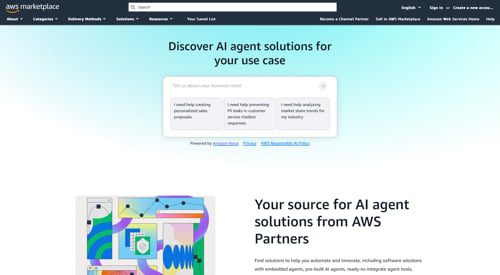
Home page of AWS Marketplace

AWS Marketplace

Rokt acquires Canal to bolster ecommerce offering. Rokt, an ecommerce post-purchase platform, is acquiring the marketplace platform Canal. According to Rokt, the acquisition enables Rokt’s ecommerce partners to broaden their product range by tapping into a curated network of third-party inventory from direct-to-consumer brands, without taking on production, logistics, or inventory management. Rokt says its acquisition enables brands to acquire customers through a premium, performance-driven distribution channel — an extension of Rokt Ads — by presenting their products in shoppable, contextually relevant formats during the ecommerce transaction.

Mirakl and Criteo partner on retail media for third-party sellers. Criteo, an AI-powered advertising platform for brands, retailers, and media owners, has integrated with Mirakl ads, a retail media solution. The partnership intends to serve third-party sellers and mid-to-long-tail advertisers seeking to invest in retail media but are outside the usual sales and media management channels. The integration provides advertisers with self-service tools and automated campaign management, enabling them to scale their retail media efforts across multiple marketplace platforms.

Cimulate launches CommerceGPT, an AI-native context engine. Cimulate has introduced CommerceGPT, an AI-native platform built for agentic commerce. CommerceGPT is a product discovery infrastructure, built for the shift from human to agentic shopping experiences. The launch also introduces the Cimulate MCP Server, which supports an emergent interface for agent-to-agent commerce. Merchants can build agents that “talk” to answer engine agents and can get products surfaced in ChatGPT, Perplexity, and Claude.
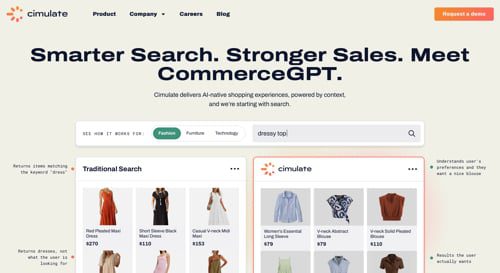
Home page of Cimulate

Cimulate

2Performant launches BusinessLeague app on Shopify for affiliate marketing. 2Performant, an affiliate marketing platform, has launched its BusinessLeague app on the Shopify App Store to enable affiliate program integration for Shopify merchants across Europe. According to 2Performant, store owners can launch an affiliate program through BusinessLeague with just a few clicks. The platform connects merchants with performance-based marketers through a gamified affiliate program. Merchants gain access to key performance indicators, including clicks, sales, and conversion rates, with user leaderboards helping them identify effective growth partners.

Payabl expands platform with SEPA direct debit for businesses. Payabl, a U.K.-based financial technology company, has launched SEPA direct debit capabilities within its payment services for businesses. According to Payabl, the launch will facilitate the automatic collection of recurring euro payments for companies operating across the 36 countries of the Single Euro Payment Area. The functionality allows merchants to accept recurring payments from customers through Payabl’s gateway. The SEPA direct debit service also offers the ability to automate outgoing payments, including real-time notifications and approval workflows, per Payabl.

Pietra launches AI Assistants for ecommerce businesses. Pietra, an ecommerce operations platform, has launched AI Assistants, an operating system for entrepreneurs. According to Pietra, AI Assistance (i) automates sourcing, fulfillment, marketing, analytics and more, (ii) generates brand names, logos, packaging, product designs, ads, and social content, (iii) provides tailored go-to-market strategies, ads campaigns, influencer outreach, marketing calendars, and an AI coach to guide growth accross Amazon, Shopify, and TikTok Shop.
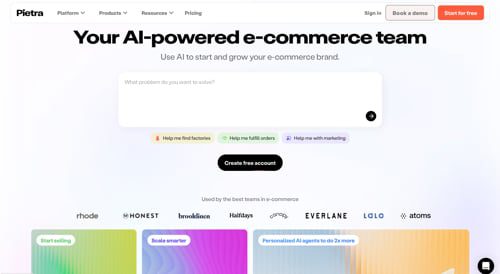
Home page of Pietra

Pietra

Amazon adds Fee Explainer tool. Amazon has launched a Fee Explainer tool to help merchants better understand charges to their selling accounts. For each fee type, the tool provides a definition, relevant attributes or variables, and the calculation to explain the amount. The tool covers the following fee types: subscription, referral, variable closing, fixed closing, refund administration, customer return, high-return rate processing, removal, and disposal. Amazon plans to add explainers for other fee types this year.

Edge Conversion releases custom AI systems for small businesses. Edge Conversion, an AI automation agency, has released a suite of AI systems to simplify operations for service-based and online businesses. The systems automate critical functions, such as lead generation, customer communication, and proposal creation. When a lead responds, AI-driven response systems instantly follow up to keep the conversation going. When a lead is ready to buy, dynamic proposal generators deliver client-ready quotes. Edge Conversion also offers systems for intake, onboarding, hiring, and customer-management optimization.

WP Engine launches AI toolkit for WordPress. WP Engine, a provider of tools for WordPress sites, has launched an AI toolkit. According to WP Engine, the toolkit makes advanced AI capabilities accessible to the WordPress community at scale, featuring smart search, recommendations, and a managed vector database with an open-source chatbot framework. Merchants can activate the toolkit’s features without coding, technical knowledge, or third-party tools.

Vivid and Adyen enable instant payments for SMBs in Europe. Adyen, a payment processing platform, and Vivid, a digital banking service, are launching a tool for small to medium-sized businesses in the E.U. to accept card payments (online and point of sale) and instantly access the funds. Vivid and Adyen aim to streamline the payment process for SMBs, catering to the demand for swift, flexible payment solutions.
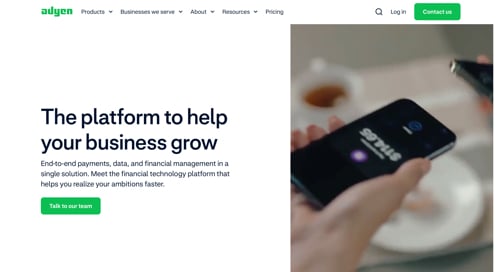
Home page of Ayden

Adyen

Google: AI Overviews Drive 10% More Queries, Per Q2 Earnings via @sejournal, @MattGSouthern

New data from Google’s Q2 2025 earnings call suggests that AI features in Search are driving higher engagement.

Google reported that AI Overviews contribute to more than 10% additional queries for the types of searches where they appear.

With AI Overviews now reaching 2 billion monthly users, this is a notable shift from the early speculation that AI would reduce the need to search.

AI Features Linked to Higher Query Volume

Google reported $54.2 billion in Search revenue for Q2, marking a 12% increase year-over-year.

CEO Sundar Pichai noted that both overall and commercial query volumes are up compared to the same period last year.

Pichai said during the earnings call:

“We are also seeing that our AI features cause users to search more as they learn that Search can meet more of their needs. That’s especially true for younger users.”

He added:

“We see AI powering an expansion in how people are searching for and accessing information, unlocking completely new kinds of questions you can ask Google.”

This is the first quarter where Google has quantified how AI Overviews impact behavior, rather than just reporting usage growth.

More Visual, Conversational Search Activity

Google highlighted continued growth in visual and multi-modal search, especially among younger demographics. The company pointed to increased use of Lens and Circle to Search, often in combination with AI Overviews.

AI Mode, Google’s conversational interface, now has over 100 million monthly active users across the U.S. and India. The company plans to expand its capabilities with features like Deep Search and personalized results.

Language Model Activity Is Accelerating

In a stat that received little attention, Google disclosed it now processes more than 980 trillion tokens per month across its products. That figure has doubled since May.

Pichai stated:

“At I/O in May, we announced that we processed 480 trillion monthly tokens across our surfaces. Since then we have doubled that number.”

The rise in token volume shows how quickly AI is being used across Google products like Search, Workspace, and Cloud.

Enterprise AI Spending Continues to Climb

Google Cloud posted $13.6 billion in revenue for the quarter, up 32% year-over-year.

Adoption of AI tools is a major driver:

  • Over 85,000 enterprises are now building with Gemini
  • Deal volume is increasing, with as many billion-dollar contracts signed in the first half of 2025 as in all of last year
  • Gemini usage has grown 35 times compared to a year ago

To support growth across AI and Cloud, Alphabet raised its projected capital expenditures for 2025 to $85 billion.

What You Should Know as a Search Marketer

Google’s data challenges the idea that AI-generated answers are replacing search. Instead, features like AI Overviews appear to prompt follow-up queries and enable new types of searches.

Here are a few areas to watch:

  • Complex queries may become more common as users gain confidence in AI
  • Multi-modal search is growing, especially on mobile
  • Visibility in AI Overviews is increasingly important for content strategies
  • Traditional keyword targeting may need to adapt to conversational phrasing

Looking Ahead

With Google now attributing a 10% increase in queries to AI Overviews, the way people interact with search is shifting.

For marketers, that shift isn’t theoretical, it’s already in progress. Search behavior is leaning toward more complex, visual, and conversational inputs. If your strategy still assumes a static SERP, it may already be out of date.

Keep an eye on how these AI experiences roll out beyond the U.S., and watch how query patterns change in the months ahead.


Featured Image: bluestork/shutterstock

Google Makes It Easier To Talk To Your Analytics Data With AI via @sejournal, @MattGSouthern

Google has released an open-source Model Context Protocol (MCP) server that lets you analyze Google Analytics data using large language models like Gemini.

Announced by Matt Landers, Head of Developer Relations for Google Analytics, the tool serves as a bridge between LLMs and analytics data.

Instead of navigating traditional report interfaces, you can ask questions in plain English and receive responses instantly.

A Shift From Traditional Reports

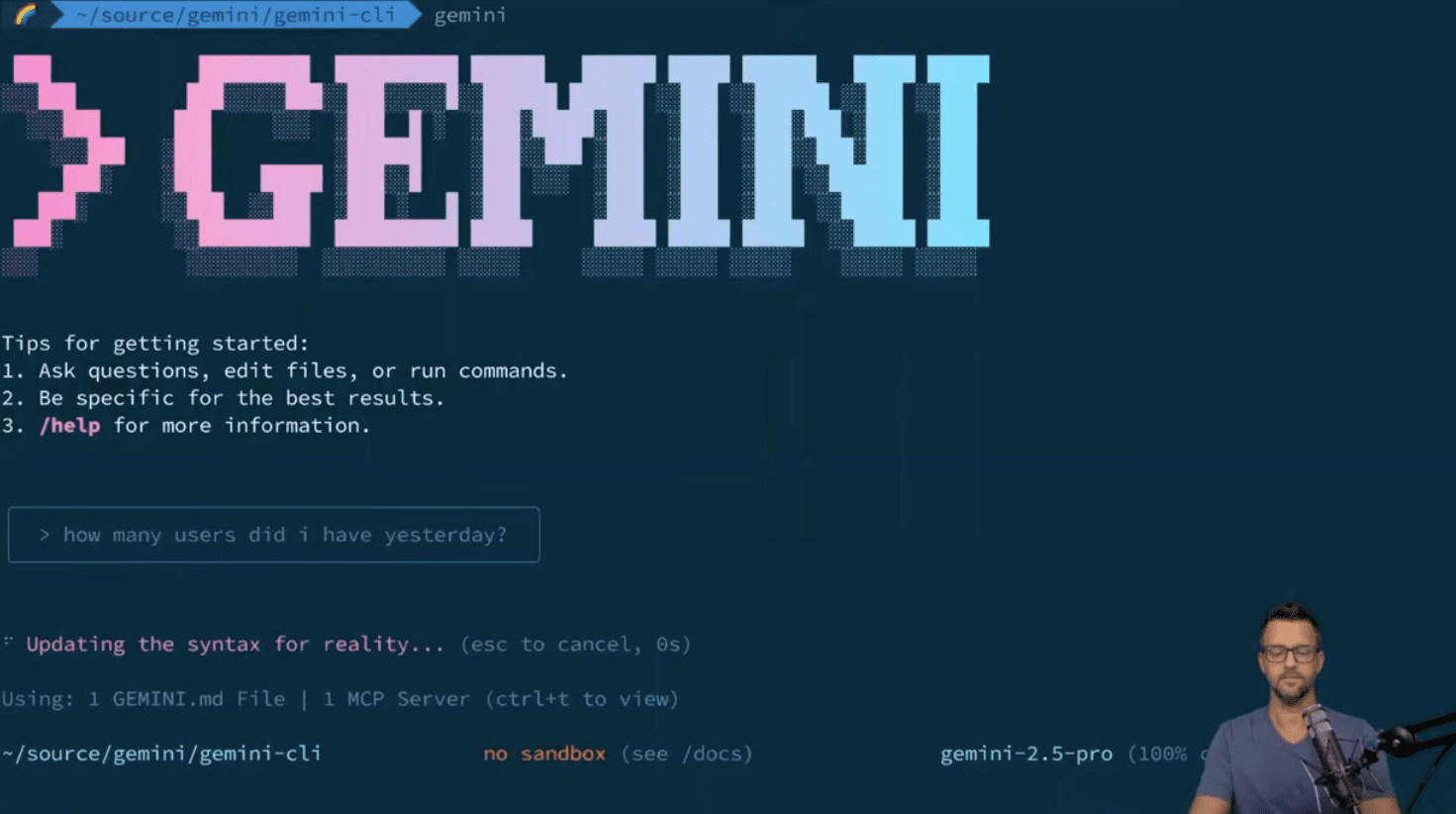
The MCP server offers an alternative to digging through menus or configuring reports manually. You can type queries like “How many users did I have yesterday?” and get the answer you need.

Screenshot from: YouTube.com/GoogleAnalytics, July 2025.

In a demo, Landers used the Gemini CLI to retrieve analytics data. The CLI, or Command Line Interface, is a simple text-based tool you run in a terminal window.

Instead of clicking through menus or dashboards, you type out questions or commands, and the system responds in plain language. It’s like chatting with Gemini, but from your desktop or laptop terminal.

When asked about user counts from the previous day, the system returned the correct total. It also handled follow-up questions, showing how it can refine queries based on context without requiring additional technical setup.

You can watch the full demo in the video below:

What You Can Do With It

The server uses the Google Analytics Admin API and Data API to support a range of capabilities.

According to the project documentation, you can:

  • Retrieve account and property information
  • Run core and real-time reports
  • Access standard and custom dimensions and metrics
  • Get links to connected Google Ads accounts
  • Receive hints for setting date ranges and filters

To set it up, you’ll need Python, access to a Google Cloud project with specific APIs enabled, and Application Default Credentials that include read-only access to your Google Analytics account.

Real-World Use Cases

The server is especially helpful in more advanced scenarios.

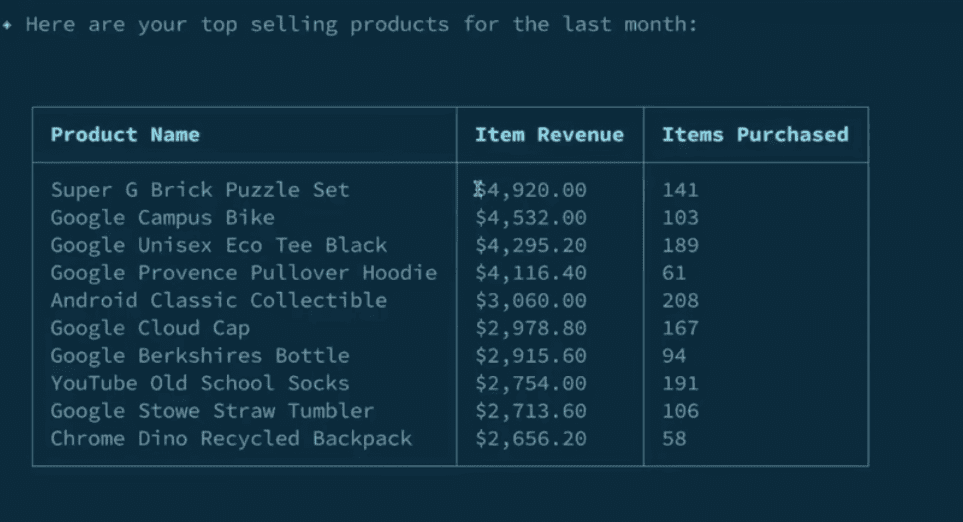
In the demo, Landers asked for a report on top-selling products over the past month. The system returned results sorted by item revenue, then re-sorted them by units sold after a follow-up prompt.

Screenshot from: YouTube.com/GoogleAnalytics, July 2025.

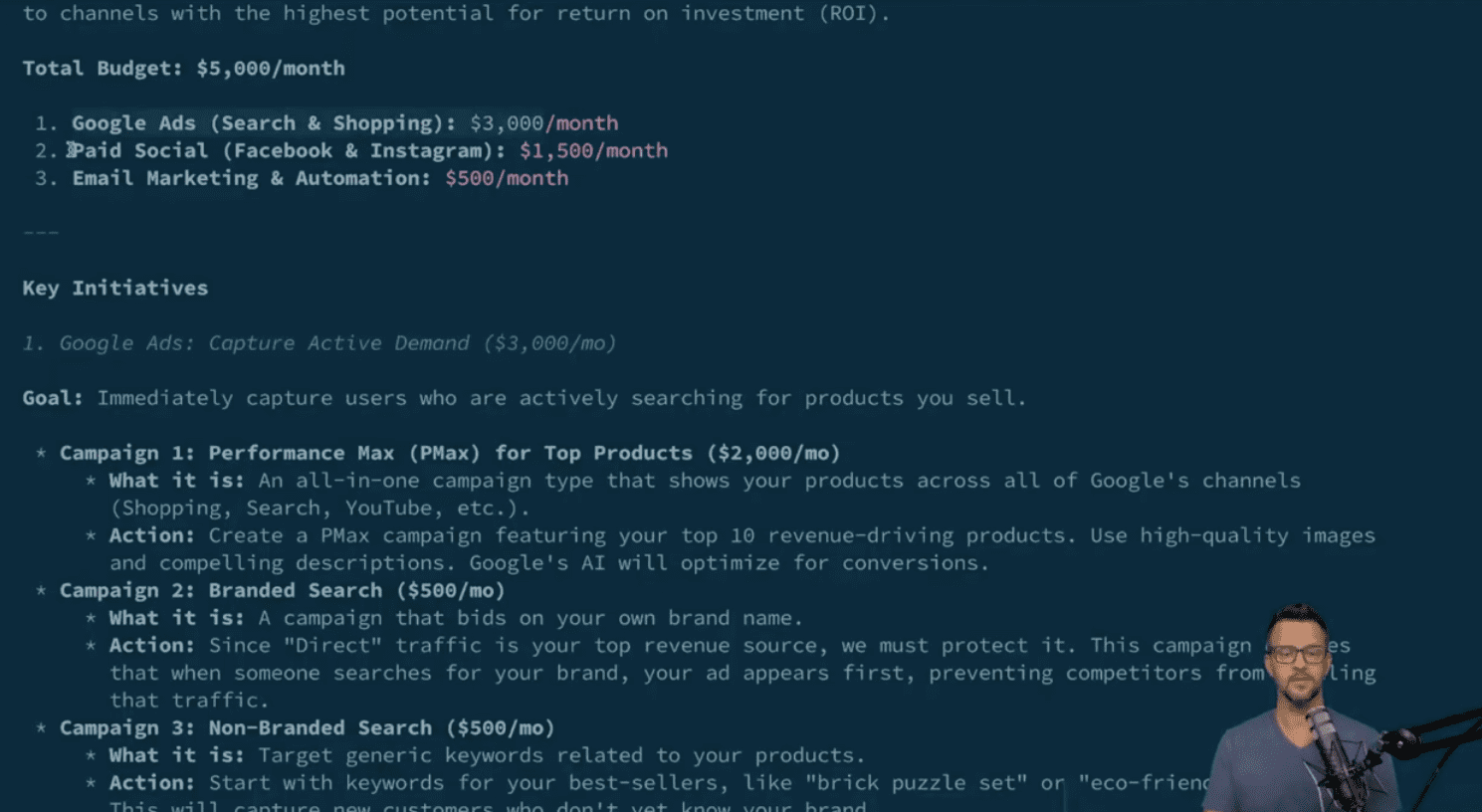
Later, he entered a hypothetical scenario: a $5,000 monthly marketing budget and a goal to increase revenue.

The system generated multiple reports, which revealed that direct and organic search had driven over $419,000 in revenue. It then suggested a plan with specific budget allocations across Google Ads, paid social, and email marketing, each backed by performance data.

Screenshot from: YouTube.com/GoogleAnalytics, July 2025.

How To Set It Up

You can install the server from GitHub using a tool called pipx, which lets you run Python-based applications in isolated environments. Once installed, you’ll connect it to Gemini CLI by adding the server to your Gemini settings file.

Setup steps include:

  • Enabling the necessary Google APIs in your Cloud project
  • Configuring Application Default Credentials with read-only access to your Google Analytics account
  • (Optional) Setting environment variables to manage credentials more consistently across different environments

The server works with any MCP-compatible client, but Google highlights full support for Gemini CLI.

To help you get started, the documentation includes sample prompts for tasks like checking property stats, exploring user behavior, or analyzing performance trends.

Looking Ahead

Google says it’s continuing to develop the project and is encouraging feedback through GitHub and Discord.

While it’s still experimental, the MCP server gives you a hands-on way to explore what natural language analytics might look like in the future.

If you’re on a marketing team, this could help you get answers faster, without requiring dashboards or custom reports. And if you’re a developer, you might find ways to build tools that automate parts of your workflow or make analytics more accessible to others.

The full setup guide, source code, and updates are available on the Google Analytics MCP GitHub repository.


Featured Image: Mijansk786/Shutterstock

Google Search Central APAC 2025: Everything From Day 1 via @sejournal, @TaylorDanRW

Search Central Live Deep Dive Asia Pacific 2025 brings together SEOs from across the region for three days of insight, networking, and practical advice.

Held at the Carlton Hotel Bangkok Sukhumvit, the event features an impressive speaker lineup alongside structured networking breaks.

Attendees have the chance to meet familiar faces, connect with global SEO leaders, and share ideas on the latest trends shaping our industry.

The conference is split over three days, with each day covering a key part of Google’s processes: crawling, indexing, and serving.

Some of the practical tips that emerged from day one:

  1. Keep building human‑focused content. Google’s models favor natural, expert writing above all.
  2. Optimize for multiple modalities. Make sure images have descriptive alt text, videos have transcripts, and voice search is supported by conversational language.
  3. Monitor crawl budget. Fix 5XX errors promptly and streamline your site’s structure to guide Googlebot efficiently.
  4. Use Search Console recommendations. Non‑expert site owners can benefit from the guided suggestions feature to improve usability and performance.
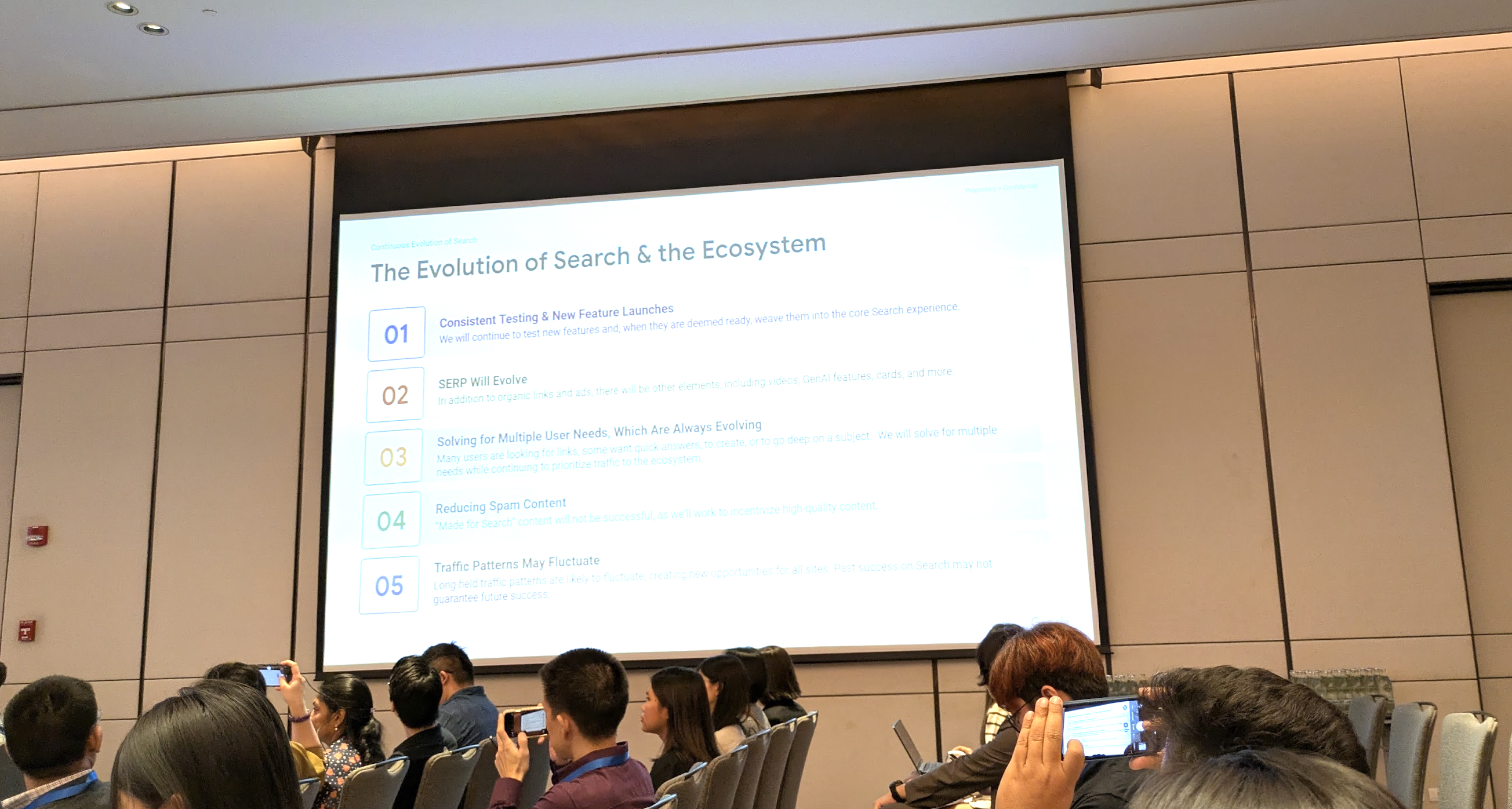
  5. Stay flexible. Long‑held traffic trends may shift as AI features grow. Past success does not equal future success.

A Pivotal Moment For Search

Mike Jittivanich, director of marketing for South East Asia and South Asia Frontier, set the tone in his keynote by declaring that we’ve reached a pivotal moment in search. He identified three forces at work:

  1. AI innovation that rivals past major shifts such as mobile and social media.
  2. Evolving user consumption patterns, as people expect faster, more conversational ways to find information.
  3. Changing habits of younger generations, who interact with search differently from their parents.

This trio of drivers underlines that past success no longer guarantees future success in search.

As Liz Reid, VP of Search at Google, has put it, “Search is never a solved problem.”

Image from author, July 2025

New formats, from AI Overviews to multimodal queries, must be woven alongside traditional blue links in a way that keeps pace with user expectations.

Gen Z: The Fastest‑Growing Search Demographic

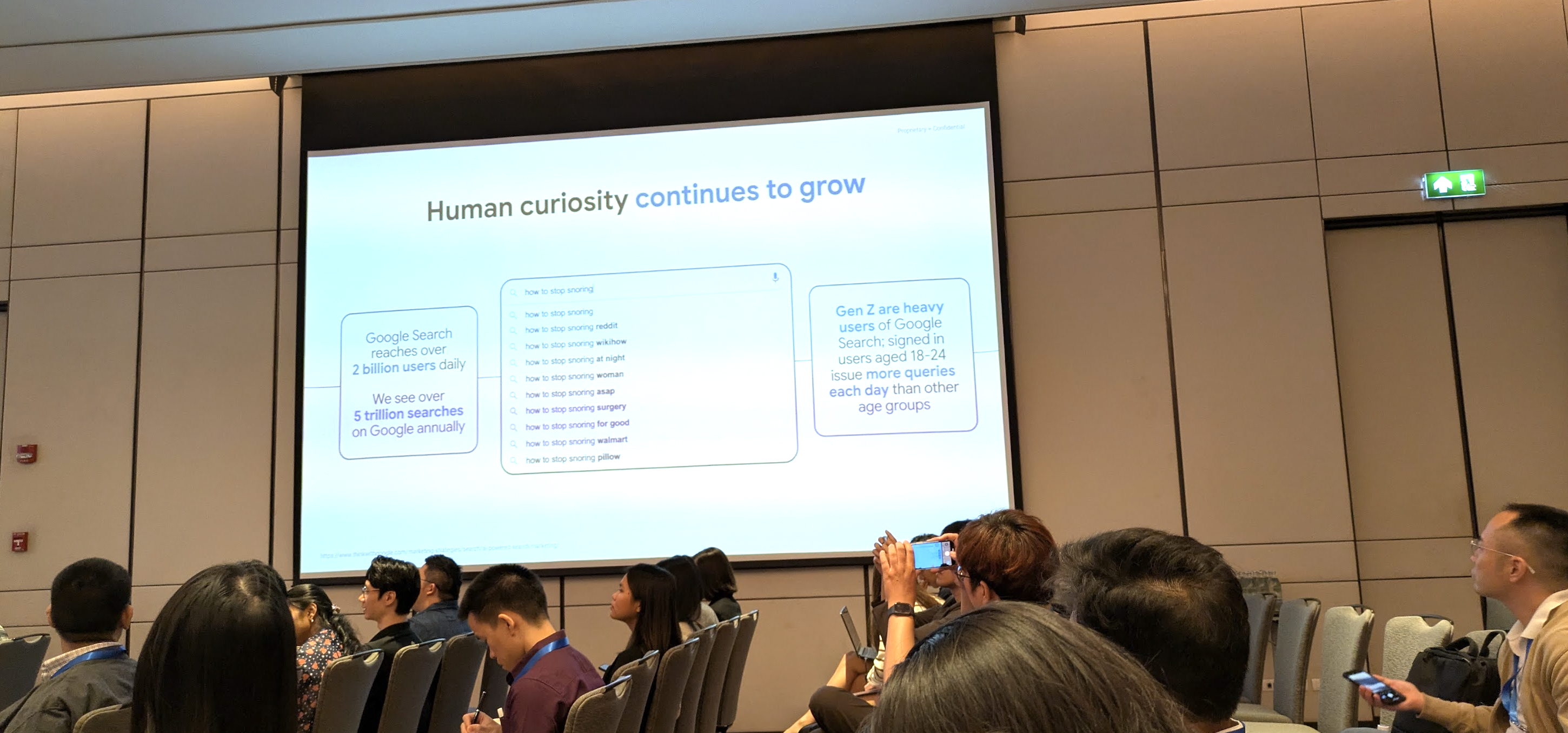
One of the most eye-opening statistics came from a session on generational trends: Gen Z (aged 18-24) is the fastest-growing group of searchers.

Image from author, July 2025

Lens usage alone grew 65% year‑on‑year, with over 100 billion Lens searches so far in 2025. Remarkably, 1 in 5 searches via Lens now carries commercial intent.

Younger users are also more likely to initiate searches in non-traditional ways.

Roughly 10% of their journeys begin with Circle to Search or other AI‑powered experiences, rather than typing into a search box. For SEOs, this means optimizing for image and voice queries is no longer optional.

Why Human‑Centered Content Wins

Across several talks, speakers emphasized that Google’s machine‑learning ranking algorithms learn from content created by humans for humans.

These models understand natural language patterns and reward authentic, informative writing.

In contrast, AI‑generated text occupies its own space in the index, and Google’s ranking systems are not trained on that portion. Gary Illyes explained that:

Our algorithms train on the highest‑quality content in the index, which is clearly human‑created.

For your site, the takeaway is clear: Keep focusing on well‑researched, engaging content.

SEO fundamentals, like clear structure, relevant keywords, and solid internal linking, remain vital.

There is no separate checklist for AI features. If you’re doing traditional SEO well, you’ll naturally be eligible for AI Overviews and AI Mode features.

AI In Crawling And Indexing

Two sessions shed light on how AI is touching the crawling and indexing process:

  • AI Crawl Impact: Sites are seeing increased crawl rates as Googlebot adapts to new AI‑powered features. However, a higher crawl rate does not automatically boost ranking.
  • Status Codes and Crawl Budget: Only server errors (5XX) consume crawl budget; 1XX and 4XX codes do not affect it, though 4XX can influence scheduling and prioritization.

Cherry Prommawin explained that crawl budget is the product of crawl rate limit (how fast Googlebot can crawl) and crawl demand (how much it wants to crawl).

If your site has broken links or slow responses, it may slow down the overall crawling process.

Google Search Is Evolving In Two Ways

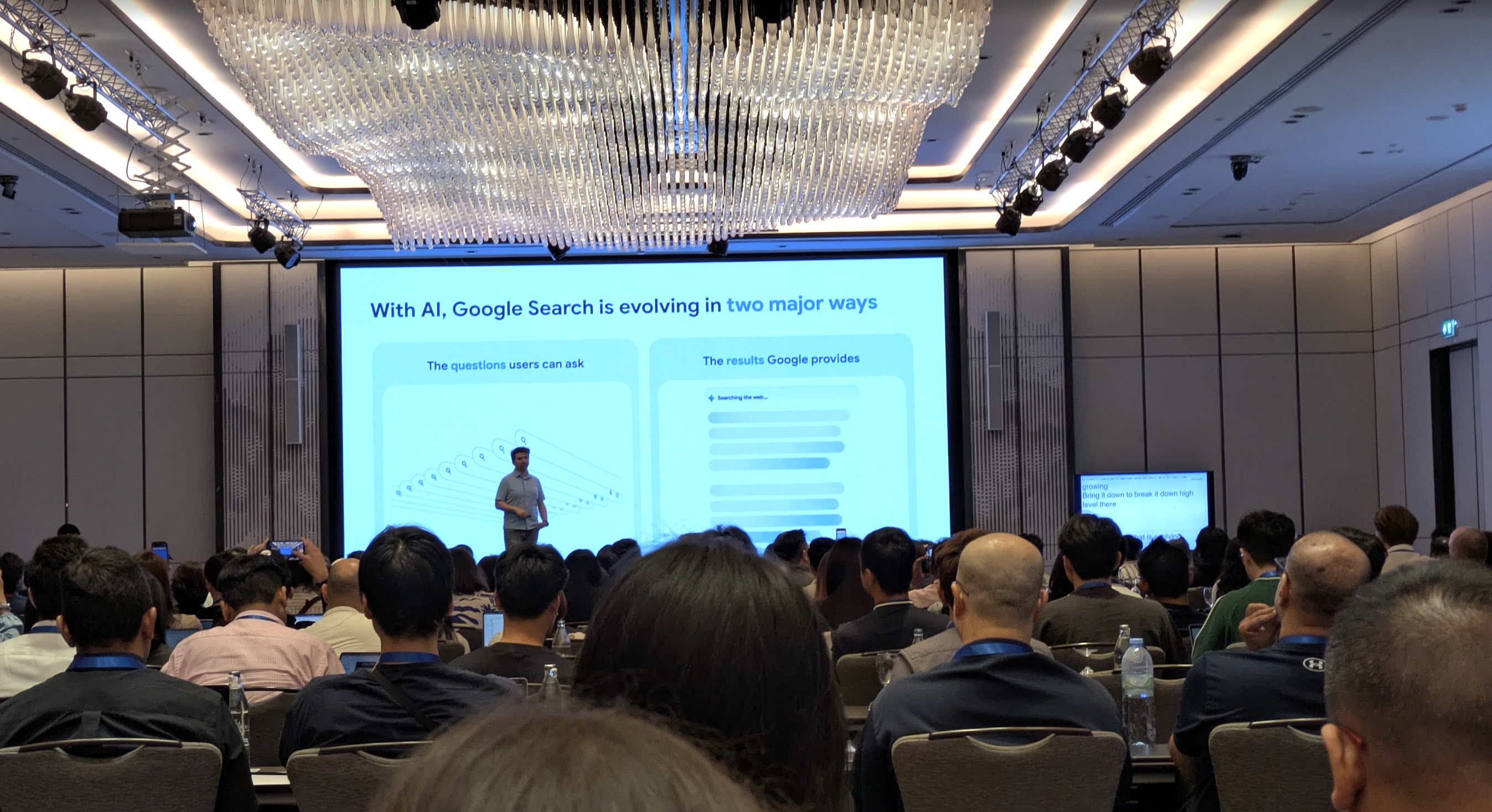
Google Search is evolving along two main focus points: the types of queries users can pose and the range of answers Google can deliver.

The Questions Users Can Ask

Queries are becoming longer and more conversational. Searches of five or more words are growing at 1.5X the rate of shorter queries.

Beyond text, users now routinely turn to voice, images, and Circle to Search: For Gen Z, about 10% of journeys start with these AI-powered entry points.

The Results Google Can Provide

AI Overviews can generate balanced summaries when there’s no single “right” answer, while AI Mode offers end‑to‑end generative experiences for shopping, meal planning, and multi‑modal queries.

Google is bringing DeepMind’s reasoning models into Search to power these richer, more nuanced results, blending text, images, and action‑oriented guidance in a single interface.

Image from author, July 2025

LLMs.txt & Robots.txt

Gary Illyes and Amir Taboul discussed Google’s stance on robots.txt and the IETF working group’s proposed LLMs.txt standard.

Much like meta keywords of old, LLMs.txt is not a Google initiative and not seen as beneficial, or something they’re looking to adopt.

Google’s view is that robots.txt remains the primary voluntary standard for controlling crawlers. If you choose to block AI‑specific bots, you can do so in robots.txt, but know that not all AI crawlers will obey it.

AI Features As Extensions Of Search

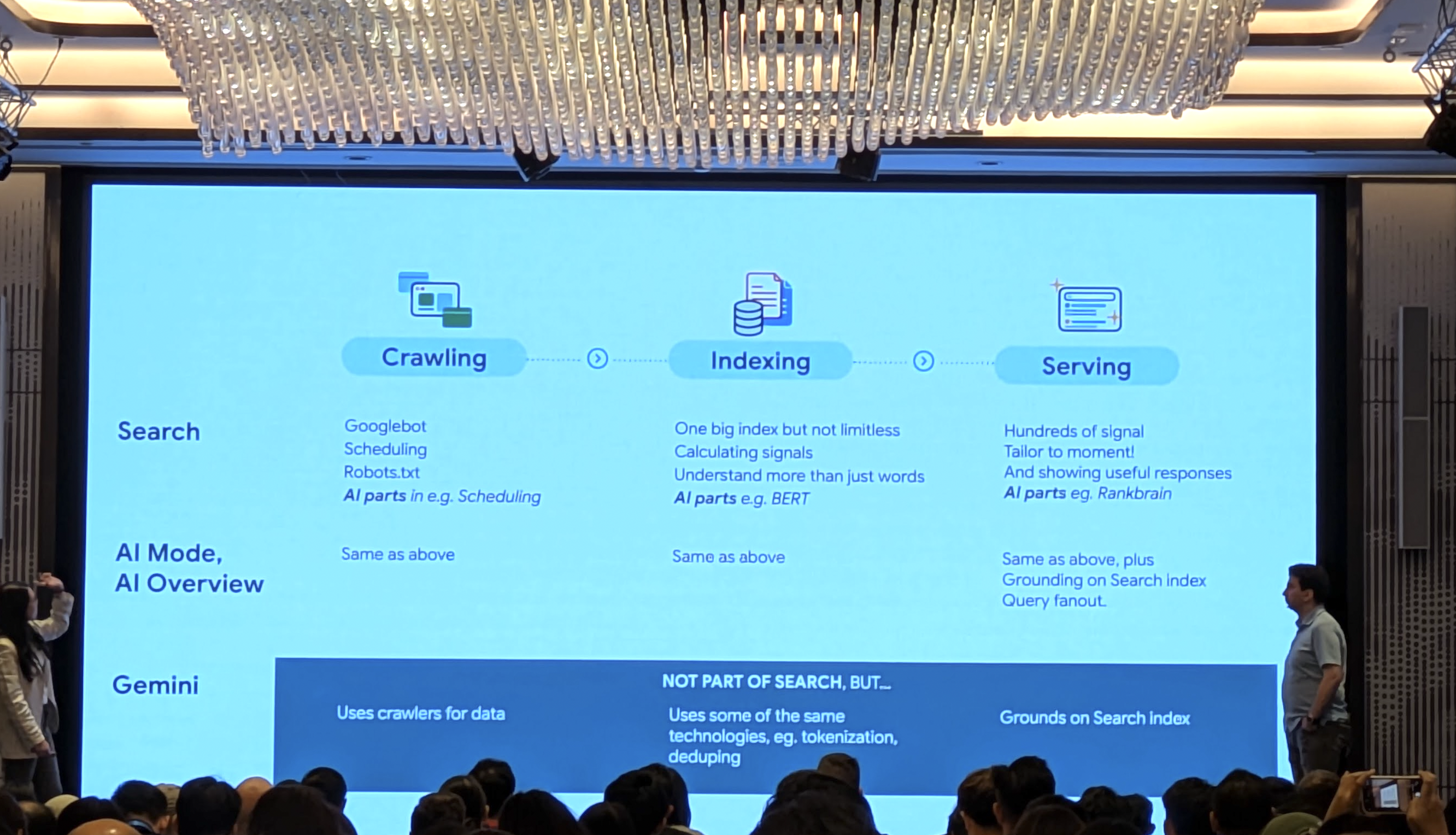
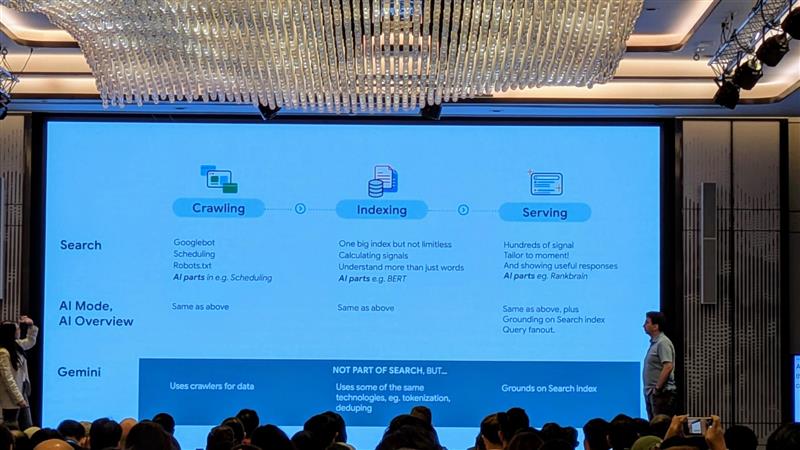
AI Mode and AI Overviews rely on the exact same crawling, indexing, and serving infrastructure as traditional Search.

Googlebot handles both blue‑link results and AI features, while other crawlers in the same system feed Gemini and large language models (LLMs).

Image from author, July 2025

Every page still undergoes HTML parsing, rendering, deduplication, and statistical models, such as BERT, for understanding and spam detection when it’s time to serve results. The same query‑interpretation pipelines and ranking signals, such as RankBrain, MUM, and other ML models, order information for both classic blue links and AI‑powered answers.

AI Mode and AI Overviews are simply new front-end features built on the familiar Search foundations that SEOs have been optimizing for all along.

Making The Most Of Google Search Console

Finally, Daniel Waisberg led a session on effectively utilizing Search Console in this new era.

Waisberg described Search Console as the bridge between Google’s infrastructure (crawling, indexing, serving) and your site. Key points that came from these sessions included:

  • Data latency: Finalized data in Search Console is typically two days old, based on the Pacific time zone. Partial and near-final data sit behind the scenes and may differ by up to 1%.
  • Feature lifecycle: New enhancements progress from user need to available data, then through design and development, to testing and launch.
  • Recommendations feature: This tool is aimed at users who are not data experts, suggesting actionable improvements without overwhelming them.

By understanding how Search Console presents data, you can diagnose crawl issues, track performance, and identify opportunities for AI-driven features.

That’s it for the end of day one. Watch out tomorrow for our coverage of day two at Google Search Central Live, with more Google insights to come.

More Resources:


Featured Image: Dan Taylor/SALT.agency

Google Shares SEO Guidance For State-Specific Product Pricing via @sejournal, @MattGSouthern

In a recent SEO Office Hours video, Google addressed whether businesses can show different product prices to users in different U.S. states, and what that means for search visibility.

The key point: Google only indexes one version of a product page, even if users in different locations see different prices.

Google Search Advocate John Mueller stated in the video:

“Google will only see one version of your page. It won’t crawl the page from different locations within the U.S., so we wouldn’t necessarily recognize that there are different prices there.”

How Google Handles Location-Based Pricing

Google confirmed it doesn’t have a mechanism for indexing multiple prices for the same product based on a U.S. state.

However, you can reflect regional cost differences by using the shipping and tax fields in structured data.

Mueller continued:

“Usually the price difference is based on what it actually costs to ship this product to a different state. So with those two fields, maybe you could do that.”

For example, you might show a base price on the page, while adjusting the final cost through shipping or tax settings depending on the buyer’s location.

When Different Products Make More Sense

If you need Google to recognize distinct prices for the same item depending on state-specific factors, Google recommends treating them as separate products entirely.

Mueller added:

“You would essentially want to make different products in your structured data and on your website. For example, one product for California specifically, maybe it’s made with regards to specific regulations in California.”

In other words, rather than dynamically changing prices for one listing, consider listing two separate products with different pricing and unique product identifiers.

Key Takeaway

Google’s infrastructure currently doesn’t support state-specific price indexing for a single product listing.

Instead, businesses will need to adapt within the existing framework. That means using structured data fields for shipping and tax, or publishing distinct listings for state variants when necessary.

Hear Mueller’s full response in the video below:

Don’t Overlook Mid-Funnel Prospects: AI PPC Strategies For Business Growth via @sejournal, @LisaRocksSEM

Marketers tend to prioritize top-of-funnel awareness and bottom-funnel conversion efforts.

Yet, the mid-funnel stage is where prospects actively weigh options and is crucial for sustained growth and profitability.

Overlooking this critical stage can reduce revenue potential. Using AI-driven paid media for nurturing and retargeting can bridge this gap, converting high-quality leads into profitable customers.

Importance Of Mid-Funnel Engagement

Prospects in the mid-funnel have already expressed interest and are ready to move to action.

They are conducting detailed comparisons, attending webinars, downloading whitepapers, and critically evaluating their choices.

Despite this intense engagement, advertisers often overlook this critical phase, causing leads to drop off.

Common challenges at this stage include generic content that fails to resonate and intrusive retargeting campaigns.

The lack of personalized campaigns and ad copy further undermines mid-funnel marketing. It’s important now for marketers to reassess their strategies to better engage prospects.

Understanding The Customer Journey: Top-, Mid-, And Bottom-Funnel Behaviors

To effectively target prospects, we have to understand their journey through the marketing funnel.

As we explore AI’s impact on the mid-funnel, let’s first look at how prospect behaviors evolve from awareness to conversion.

For PPC strategists and chief marketing officers, aligning paid media tactics with each funnel stage is key to maximizing AI’s potential in campaigns.

To illustrate how PPC strategies should evolve with the prospect’s mindset, consider the following breakdown of PPC tactics for each funnel stage.

Funnel Stage Prospect Mindset & Goal (PPC Lens) Common PPC Keyword/Query Types Key PPC Ad Focus Core PPC Tactics & Ad Formats
Top-Funnel (Awareness) “I have a problem or need.”

  • Seeking general information
Informational keywords:

  • “how to solve problem”
  • “what is”
  • “benefits of”
  • Educate and inform.
  • Position your brand as a helpful resource.
  • Highlight helpful content.
  • Broad match keywords
  • Display Network ads (interest, affinity audiences).
  • YouTube.
  • General search campaigns.
Mid-Funnel (Consideration/ Evaluation) “I understand my problem and am looking for solutions.”

  • Comparing options, detailed info on specific solutions.
Comparison keywords:

  • “compare [product A] vs. [product B]”
  • “best product category for [a specific need]”
  • “[product name] reviews”
  • “alternative to [competitor]”
  • pricing
  • Features and benefits.
  • Demonstrate unique value, highlight differentiators.
  • Offer solutions to specific pain points.
  • Exact/phrase match keywords.
  • Retargeting (website visitors, video viewers, content downloads.
  • Custom Intent, In-Market audiences.
  • Dynamic Search Ads (for specific solution pages).
  • Google Shopping (for products being compared).
  • Focus on lead capture.
Bottom-Funnel (Decision/ Purchase) “I’m ready to buy, need to choose who from.”

  • Making a final decision, seeking confirmation, or a specific offer.
Transactional keywords:

  • “buy [product name]”
  • “[product name] pricing”
  • “demo”
  • “get a quote”
  • “deal on [product]”
  • “sign up for [service]”
  • Call-to-action and urgency.
  • Offer direct value, limited-time deals, or compelling reasons to choose now.
  • Focus on immediate conversion.
  • Highly targeted exact match keywords.
  • Remarketing to cart abandoners or demo form abandoners.
  • Competitor Conquesting (very specific terms)
  • Google Shopping (specific prod SKUs).
  • PMax with strong final URLs.
  • Lead Form Assets.
  • Focus on direct sales.

Mid-Funnel Potential

In the “consideration” phase, advertisers now have new ways to engage, segment, and nurture mid-funnel audiences with AI and innovative PPC targeting tactics.

Here are three AI-powered mid-funnel tactics to integrate into the paid search plan.

1. AI-Driven Prospect Targeting

This tactic uses AI to analyze huge amounts of user data signals to identify which specific prospects are most likely to take action (convert) at mid-funnel.

The ad platforms may look at past website interactions to demographic signals to predict who are the most qualified new customers.

Smart Bidding and targeting tools allow advertisers to focus ad budget and messaging on the most effective, hot leads.

In one example, Google Ads segments out new customers, calling it the “New customer acquisition goal.” This lifecycle goal prioritizes bidding to reach and acquire new customers.

Key Advantages:

  • Maximizes budget efficiency: Uses AI to identify high-intent prospects within your paid ad campaigns.
  • Improves overall conversion rates: By prioritizing higher-intent leads, you naturally see a better chance of converting them into valuable customers down the line.

PPC Features Supporting This Tactic:

  • Performance Max (Google Ads and Microsoft Ads): This powerful campaign type leverages AI across all channels (search, display, email, etc) to find converting customers. It prioritizes users showing high-value signals, optimizing your bids and placements to capture them.
  • Smart Bidding Strategies (Target CPA, Target ROAS): While often used for bottom-funnel sales, these can be set to optimize for mid-funnel conversions. The AI learns which users are more likely to complete these specific actions and bids accordingly.
  • Custom Segments (Audience Manager): Combine your valuable first-party data (like customer lists of qualified leads) with Google’s audience signals to create highly targeted segments. AI can then optimize towards these prequalified groups.

2. Dynamic Ad Creative

AI automation can generate personalized ad creatives in real-time, enhancing relevance and engagement.

This means prospects see ads that are custom for their specific interests and previous interactions, in real-time, making the ads feel more relevant and personal.

Key Advantages:

  • Ad relevance: Ads feel personal and directly address the user’s observed interests, grabbing attention and increasing engagement.
  • Reduces ad fatigue: Users see varied, interesting ads instead of the same old creative repeatedly, preventing boredom and annoyance, which keeps them engaged longer.
  • Improves engagement metrics: You’ll see higher click-through rates (CTRs) and potentially better ad quality scores because the ads are well-matched to user intent.

PPC Features Supporting This Tactic:

  • Responsive Search Ads (RSAs) and Responsive Display Ads (RDAs): You provide multiple headlines, descriptions, and images. Google’s AI then mixes and matches these assets in real-time to find the best-performing combinations for each unique search query or individual users based on their search query, device, location, and other signals.
  • Dynamic Retargeting/Remarketing Ads: For ecommerce, these ads automatically showcase products a user viewed on your site. For B2B, they can dynamically display relevant content, case studies, or solutions based on specific pages visited on your website.
  • Google Ads’ Asset Library and AI-Driven Creative Suggestions: These tools help you generate a wide variety of diverse assets, then utilize them effectively to create countless ad variations.

3. Value-Based Bidding For Mid-Funnel Conversions

Shift your focus from conversion volume to conversion value with AI-powered bidding strategies that prioritize high-value leads.

Advertisers can assign a higher monetary value to actions that signify greater intent or higher potential lifetime value, like a demo request vs. a download.

The AI then prioritizes bids and focuses the budget on acquiring more valuable leads.

Key Advantages:

  • Optimizes for profitability, not just volume: Ensures your ad spend is directed towards acquiring profitable leads.
  • Improves budget allocation: AI intelligently allocates bids based on anticipated lead quality and potential revenue, not just the number of conversions, leading to more efficient spending.
  • Aligns PPC directly with business key performance indicators (KPIs): This strategy directly ties your ad performance to revenue goals and bottom-line impact. By focusing on value, PPC becomes a clear contributor, proving its worth directly.

PPC Features Supporting This Tactic:

  • Target ROAS (Return On Ad Spend) for Lead Generation: While often seen in ecommerce, an advanced use case is to apply it to lead generation campaigns. By assigning monetary values to different lead types, you tell the system the ROAS you want, and AI bids to meet it.
  • Maximize Conversion Value Bidding: This bidding strategy tells the AI to get the highest possible total conversion value within your budget. This requires a proper setup where you assign different values to each mid-funnel conversion action in your account. Without those values, the system can’t differentiate between the worth of different conversions.
  • Offline Conversion Import: This is a secret weapon! By importing your customer relationship management (CRM) data information about which leads converted to sales into your ad platforms, you teach the AI which mid-funnel actions are most likely to result in a high-value closed deal, allowing it to optimize bids efficiently.

Ready To Make The Mid-Funnel A Strategic Priority?

Rethink your approach to the mid-funnel, where valuable engagement opportunities often go untapped.

By using AI-driven strategies like those discussed, you can reconnect with high-intent prospects and guide them toward conversion.

For CMOs and senior marketers, optimizing the mid-funnel is a strategic opportunity to grow the customer acquisition pipeline.

More Resources:


Featured Image: N Universe/Shutterstock

Do We Need A Separate Framework For GEO/AEO? Google Says Probably Not via @sejournal, @TaylorDanRW

At Google Search Central Live Deep Dive Asia Pacific 2025, Cherry Prommawin and Gary Illyes led a session on how AI fits into Search.

They asked whether we need separate frameworks for Generative Engine Optimization (GEO) and Answer Engine Optimization (AEO).

Their insights suggest that GEO and AEO do not require wholly new disciplines.

Photo taken by author, Search Central Live Deep Dive Asia Pacific, July 2025

AI Features Are Just Features

Cherry Prommawin explained that AI Mode, AI Overviews, Circle to Search, and Lens behave like featured snippets or knowledge panels.

These features draw on the same ranking signals and data sources as traditional Search.

They all run on Google’s core indexing and ranking engine without requiring a standalone platform. Adding an AI component is simply a matter of introducing extra interpretation layers.

Gary Illyes emphasized that both AI-driven tools and classic Search services share a single, unified infrastructure. This underlying infrastructure handles indexing, ranking, and serving for all result types.

AI Mode and AI Overviews are just features of Search, and built on the same Search infrastructure.

Deploying new AI capabilities means integrating additional models into the same system. Circle to Search and Lens simply add their query-understanding modules on top.

Crawling

All the AI Overviews and AI Mode features rely on the same crawler that powers Googlebot. This crawler visits pages, follows links, and gathers fresh content.

Gemini is treated as a separate system within Google’s crawler ecosystem and uses its own bots within Google’s ecosystem to feed data into its models.

Indexing

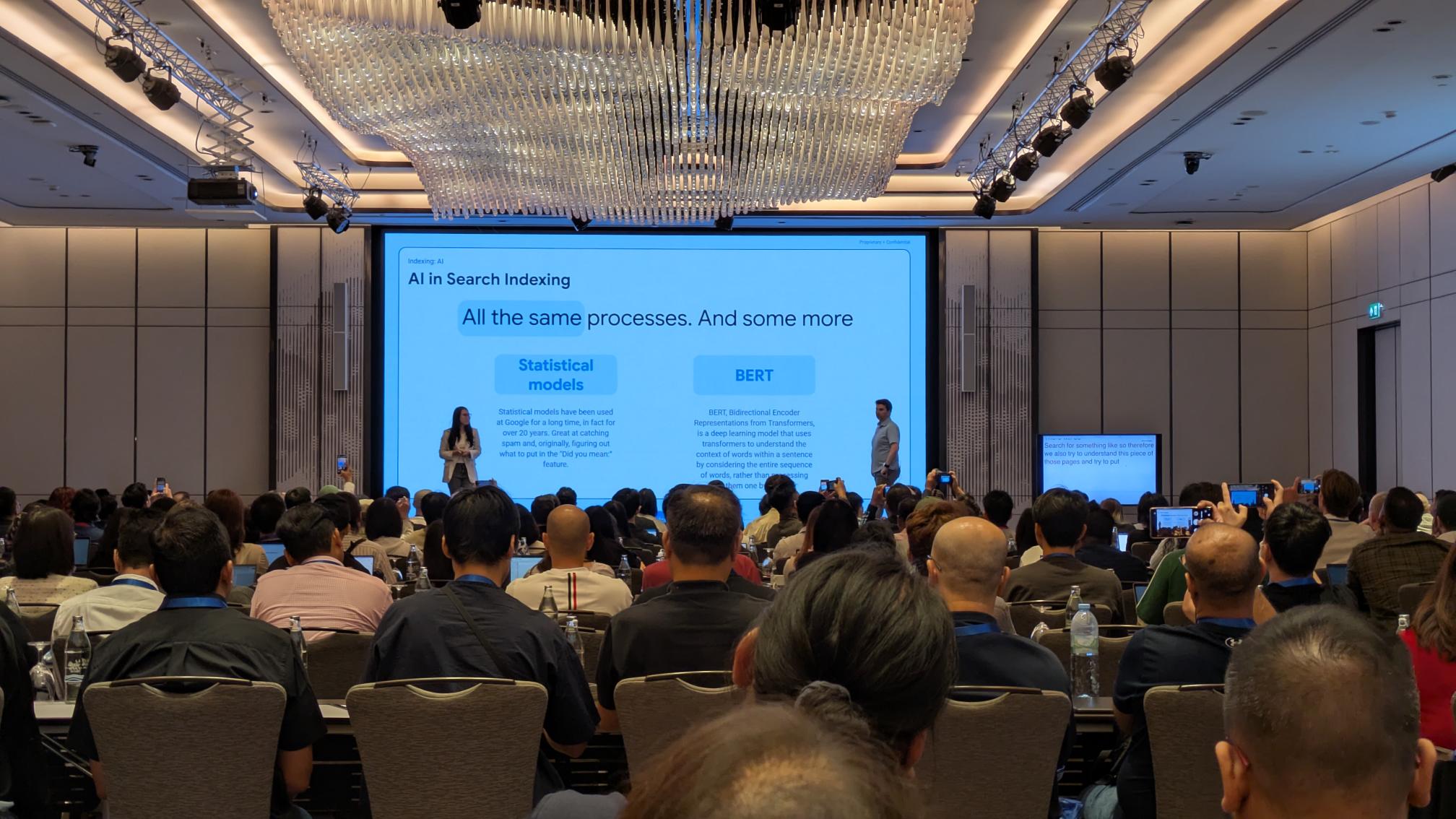
In AI Search, the core indexing process mirrors the methods used for traditional search. Pages that have been crawled are analyzed and organized into the index, then statistical models and BERT are applied to refine that data.

These statistical models have been in use for more than 20 years and were first created to support the “did you mean” feature and help catch spam.

BERT adds a deeper understanding of natural language to the mix.

Photo taken by author, Search Central Live Deep Dive Asia Pacific, July 2025

Serving

Once the index is built, the system must interpret each user query. It looks for stop words, identifies key terms, and breaks the query into meaningful parts.

The ranking phase then orders hundreds of potential results based on various signals. Different formats, such as text, images, and video, carry different weightings.

RankBrain applies machine learning to adjust those signals while MUM brings a multimodal, multitask approach to understanding complex queries and matching them with the best possible answers.

What This Means: Use The Same Principles From SEO

Given the tight integration of AI features with standard Search, creating distinct GEO or AEO programs may duplicate existing efforts.

As SEOs, we should be able to apply existing optimization practices to both AI Search and “traditional” Search products. Focusing on how AI enhancements fit into current workflows lets teams leverage their expertise.

Spreading resources to build separate frameworks could pull attention away from higher-impact tasks.

Cherry Prommawin and Gary Illyes concluded their session by reinforcing that AI is another feature in the Search product.

SEO professionals can continue to refine their strategies using the same principles that guide traditional search engine optimization.

More Resources:


Featured Image taken by author

Pew Research Confirms Google AI Overviews Is Eroding Web Ecosystem via @sejournal, @martinibuster

Pew Research Center tracked real web browsing behavior and confirmed what many publishers and SEOs have claimed: AI Overviews does not send traffic back to websites. The results show that the damage caused by AI summaries to the web ecosystem is as bad as or worse than is commonly understood.

Methodology

The Pew Research study tracked over 900 adults who consented to installing an online browsing tracker to record their browsing behavior in the month of March 2025. The dataset contains 68,879 unique Google search queries, and a total of 12,593 queries triggered an AI summary.

Confirmed: Google AI Search Is Eroding Referral Traffic

The tracked user data confirms publisher complaints about a drop in referral traffic caused by AI search results. Google users who encounter an AI search result are less likely to click on a link and visit a website than users who see only a standard search result.

Only 8% of users who encountered an AI summary clicked a link (in the AI summary or the standard search results) to visit a website. Users who only saw a standard search result tended to click to visit a website 15% of the time, nearly twice as many as users who viewed an AI summary.

Users rarely click a link within an AI summary. Only 1% of users clicked an AI summary link and visited a website.

AI Summaries Cause Less Web Engagement

In a recent interview, Google’s CEO Sundar Pichai pushed back on the notion that AI summaries have a negative impact on the web ecosystem. He said that the fact that there is more content being created on the web than at any other time is proof that the web ecosystem is thriving. He said that

“So, generally there are more web pages… I think people are producing a lot of content, and I see consumers consuming a lot of content. We see it in our products.”

Pichai also insisted that people are consuming content across multiple forms of content (video, images, text) and that publishers today should be presenting content within more than just one format.

However, contrary to what Google’s CEO said, AI is not encouraging users to consume more content, it’s having the opposite effect. The Pew research data shows that AI summaries cause users to engage less with web content.

According to the research findings:

Users End Their Browsing Session

“Google users are more likely to end their browsing session entirely after visiting a search page with an AI summary than on pages without a summary.

This happened on 26% of pages with an AI summary, compared with 16% of pages with only traditional search results.”

Users Refrain From Clicking On Traditional Search Links

It also says that users tended to not click on a traditional search result when faced with an AI summary:

“Users who encountered an AI summary clicked on a traditional search result link in 8% of all visits. Those who did not encounter an AI summary clicked on a search result nearly twice as often (15% of visits).”

Only 1% Click Citation Links In AI Summaries

Users who see an AI summary overwhelmingly do not click the citations to the websites that the AI summary links to.

The report shows:

“Google users who encountered an AI summary also rarely clicked on a link in the summary itself. This occurred in just 1% of all visits to pages with such a summary.”

This confirms what publishers and SEOs have been saying to Google over and over again: Google AI Overviews robs publishers of referral traffic. Rob is a strong word but given the context that Google is using web content to “synthesize” an answer to a search query that does not result in a referral click, the word “rob” is what inevitably comes to mind to a publisher or SEO who worked hard to create the content.

Another startling fact shared in research is that almost 66% of users either browsed somewhere else on Google or completely bailed on Google without clicking a link to visit a website. In other words, nearly 66% of Google’s users do not click a link to visit the web ecosystem.

The report explains:

“…the largest share of Google searches in our study resulted in the user either browsing elsewhere on Google or leaving the site entirely without clicking a link in the search results. Around two-thirds of all searches resulted in one of these actions.”

Wikipedia, YouTube And Reddit Dominate Google Searches

Google has been holding publisher events and Search Central Live events all around the world to listen to publisher feedback and to promise that Google will work harder to surface a greater variety of content. I know that the Googlers at these events are not lying, but those promises of surfacing more high-quality content are subverted by the grim facts presented in the Pew research of actual users.

One of the biggest complaints is that Reddit and Wikipedia dominate the search results. The research validates publisher and SEO concerns because it shows that not only are Reddit and Wikipedia the most commonly cited websites, but Google’s own YouTube ranks among the top three most cited web destinations.

The report explains:

“The most frequently cited sources in both Google AI summaries and standard search results are Wikipedia, YouTube and Reddit. These three sites are the most commonly linked sources in AI summaries and standard search results alike.

Collectively, they accounted for 15% of the sources that were listed in the AI summaries we examined. They made up a similar share (17%) of the sources listed in standard search results.”

The report also shows:

  • “Wikipedia links are somewhat more common in AI summaries than in standard search pages”
  • “YouTube links are somewhat more common in standard search results than in AI summaries.”

These Are The Facts

Pew Research’s study of over 68,000 search queries from the browsing habits of over 900 adults reveals that Google’s AI summaries sharply reduce clicks to websites, with just 8% of users clicking any link and only 1% engaging with citations in AI answers.

Users encountering AI summaries are more likely to end their sessions or stay within Google’s ecosystem rather than visiting independent websites. This confirms publisher and SEO concerns that AI-driven search erodes web traffic and concentrates attention on a few dominant platforms like Wikipedia, Reddit, and YouTube.

These are the facts. They show that SEOs and publishers are right that AI Overviews is siphoning traffic out of the web ecosystem.

Featured Image by Shutterstock/Asier Romero

AI Search is Here: Make Sure Your Brand Stands Out In The New Era Of SEO [Webinar] via @sejournal, @lorenbaker

Wish you could control what AI says about your brand?

You’re not alone. 

As generative search becomes the default for tools like ChatGPT, Gemini, and Claude, fewer people are clicking through to traditional search results. If your content isn’t part of their training data or grounding sources, it’s effectively invisible.

And that means one thing: you’re no longer just optimizing for humans or search engines. You’re optimizing for machines that summarize the internet.

Introducing Generative Engine Optimization (GEO)

In this tactical webinar, we’ll break down what it takes to get your brand cited, linked, and quoted in AI-generated content, intentionally.

You’ll discover:

  • How to show up in AI search results.
  • Ways to increase your AIO (AI Overview) brand presence.
  • Proven SEO & GEO workflows you can copy today.

Learn How To Influence LLMs

This isn’t theory. We’ll walk through the specific strategies SEOs and marketers are using right now to shape what language models say, and don’t say, about their brands.

Expect insights on:

  • How foundational training data is gathered (and how you might influence it).
  • The role of search and retrieval-based answers (RAG) in real-time LLM responses.
  • What makes content “quotable” to machines, and what gets ignored.

Stay Visible As AI Search Becomes The Default

AI search isn’t coming. It’s here. And it’s rewriting how visibility works.

In this session, you’ll learn:

  • Why traditional SEO tactics still matter (especially for citation).
  • How query fanout and grounding shape which documents LLMs pull from.
  • Which formats and language structures improve your chances of being cited.

This is for SEOs, content strategists, and marketing leads who want to stay relevant as AI redefines the playing field.

Why This Webinar Is A Must-Attend

Whether you’re refining your search strategy or trying to future-proof your brand visibility, this session offers high-ROI insights you can apply immediately.

✅ Actionable examples

✅ Real-world GEO workflows

✅ Early looks at emerging standards like MCP, A2A, and llms.txt

📍 Designed for experienced marketers ready to lead change.

Reserve Your Spot Or Get The Recording

🛑 Can’t make it live? No problem. Register anyway, and we’ll send you the full recording so you don’t miss a thing.

Five things you need to know about AI right now

Last month I gave a talk at SXSW London called “Five things you need to know about AI”—my personal picks for the five most important ideas in AI right now. 

I aimed the talk at a general audience, and it serves as a quick tour of how I’m thinking about AI in 2025. I’m sharing it here in case you’re interested. I think the talk has something for everyone. There’s some fun stuff in there. I even make jokes!

The video is now available (thank you, SXSW London). Below is a quick look at my top five. Let me know if you would have picked different ones!

1. Generative AI is now so good it’s scary.

Maybe you think that’s obvious. But I am constantly having to check my assumptions about how fast this technology is progressing—and it’s my job to keep up. 

A few months ago, my colleague—and your regular Algorithm writer—James O’Donnell shared 10 music tracks with the MIT Technology Review editorial team and challenged us to pick which ones had been produced using generative AI and which had been made by people. Pretty much everybody did worse than chance.

What’s happening with music is happening across media, from code to robotics to protein synthesis to video. Just look at what people are doing with new video-generation tools like Google DeepMind’s Veo 3. And this technology is being put into everything.

My point here? Whether you think AI is the best thing to happen to us or the worst, do not underestimate it. It’s good, and it’s getting better.

2. Hallucination is a feature, not a bug.

Let’s not forget the fails. When AI makes up stuff, we call it hallucination. Think of customer service bots offering nonexistent refunds, lawyers submitting briefs filled with nonexistent cases, or RFK Jr.’s government department publishing a report that cites nonexistent academic papers. 

You’ll hear a lot of talk that makes hallucination sound like it’s a problem we need to fix. The more accurate way to think about hallucination is that this is exactly what generative AI does—what it’s meant to do—all the time. Generative models are trained to make things up.

What’s remarkable is not that they make up nonsense, but that the nonsense they make up so often matches reality. Why does this matter? First, we need to be aware of what this technology can and can’t do. But also: Don’t hold out for a future version that doesn’t hallucinate.

3. AI is power hungry and getting hungrier.

You’ve probably heard that AI is power hungry. But a lot of that reputation comes from the amount of electricity it takes to train these giant models, though giant models only get trained every so often.

What’s changed is that these models are now being used by hundreds of millions of people every day. And while using a model takes far less energy than training one, the energy costs ramp up massively with those kinds of user numbers. 

ChatGPT, for example, has 400 million weekly users. That makes it the fifth-most-visited website in the world, just after Instagram and ahead of X. Other chatbots are catching up. 

So it’s no surprise that tech companies are racing to build new data centers in the desert and revamp power grids.

The truth is we’ve been in the dark about exactly how much energy it takes to fuel this boom because none of the major companies building this technology have shared much information about it. 

That’s starting to change, however. Several of my colleagues spent months working with researchers to crunch the numbers for some open source versions of this tech. (Do check out what they found.)

4. Nobody knows exactly how large language models work.

Sure, we know how to build them. We know how to make them work really well—see no. 1 on this list.

But how they do what they do is still an unsolved mystery. It’s like these things have arrived from outer space and scientists are poking and prodding them from the outside to figure out what they really are.

It’s incredible to think that never before has a mass-market technology used by billions of people been so little understood.

Why does that matter? Well, until we understand them better we won’t know exactly what they can and can’t do. We won’t know how to control their behavior. We won’t fully understand hallucinations.

5. AGI doesn’t mean anything.

Not long ago, talk of AGI was fringe, and mainstream researchers were embarrassed to bring it up. But as AI has got better and far more lucrative, serious people are happy to insist they’re about to create it. Whatever it is.

AGI—or artificial general intelligence—has come to mean something like: AI that can match the performance of humans on a wide range of cognitive tasks.

But what does that mean? How do we measure performance? Which humans? How wide a range of tasks? And performance on cognitive tasks is just another way of saying intelligence—so the definition is circular anyway.

Essentially, when people refer to AGI they now tend to just mean AI, but better than what we have today.

There’s this absolute faith in the progress of AI. It’s gotten better in the past, so it will continue to get better. But there is zero evidence that this will actually play out. 

So where does that leave us? We are building machines that are getting very good at mimicking some of the things people do, but the technology still has serious flaws. And we’re only just figuring out how it actually works.

Here’s how I think about AI: We have built machines with humanlike behavior, but we haven’t shrugged off the habit of imagining a humanlike mind behind them. This leads to exaggerated assumptions about what AI can do and plays into the wider culture wars between techno-optimists and techno-skeptics.

It’s right to be amazed by this technology. It’s also right to be skeptical of many of the things said about it. It’s still very early days, and it’s all up for grabs.

This story originally appeared in The Algorithm, our weekly newsletter on AI. To get stories like this in your inbox first, sign up here.