A growing form of revenue-based financing can fund the marketing push or inventory boost for ecommerce merchants to capture growth opportunities. But “merchant cash advances” are often expensive and not suited to every business.
Ecommerce companies experience highs and lows. Merchant cash advances tend to work better when merchants are on the upswing.
A merchant cash advance (MCA) is a loan, a lump-sum payment, that the borrower agrees to repay through a fixed percentage of revenue.
According to Aidan Corbett, CEO of Wayflyer, an MCA and term-loan provider, three characteristics distinguish MCAs from other types of financing:
Aligned outcomes between the lender and merchant,
Revenue-based repayment,
Speed and ease of approval.
Each can be beneficial, but with trade-offs.
Wayflyer offers merchant cash advances, as do Shopify Capital, Stripe Capital, and others.
Aligned incentives
MCAs differ from a traditional lender-borrower dynamic. The provider’s repayment depends on the merchant’s revenue performance. Both have a shared interest in success.
“I’m being careful not to say borrower and lender,” Corbett said, emphasizing that both sides benefit only if the merchant performs well.
In the United States, MCAs are typically unsecured and unregulated. If a business fails outright, the company providing the advance may lose its investment. MCA funders look for healthy, growing businesses.
The idea of aligned outcomes is a newer trend. Past MCAs resembled payday loans, but the best 2025 offerings emphasize a partnership model aimed at sustainable growth with transparent fees.
Revenue-based repayment
Borrowers repay MCAs through a share of daily or weekly sales, not fixed monthly payments. The share varies but is typically 10% to 25% according to published reports.
Corbett gave the example of an ecommerce company receiving a $100,000 advance. The repayment might total $106,000, with the $6,000 difference representing the provider’s fee. If daily sales are strong, the repayment is quick. If sales dip, the repayments slow down.
This structure is appealing to ecommerce shops with predictable, growing revenue. But it also means that repayment can begin before the business reaps the monetary benefit of the borrowed capital, especially for inventory or long-term marketing campaigns.
Fast approval
MCAs are fast. Ecommerce businesses can qualify within days after providing sales history and a plan for using the funds. There is typically no collateral requirement and no formal credit check.
Corbett said Wayflyer looks for growing brands with a broad product mix and high reorder rates. Stores with strong and consistent return on ad spend and efficient customer acquisition tactics are also favorable candidates.
MCA Use Case
Consider an ecommerce company selling home organization products with steady, year-round revenue. The company recently launched a new line of modular storage kits. Initial customer response is strong. Conversion rates are up, and test campaigns are returning a 4:1 ROAS.
A home improvement blog with more than 500,000 readers offers the business a two-week premium ad placement. The channel that has worked well for the merchant, but the $30,000 ad buy is time-sensitive, and the company doesn’t have the cash on hand.
A traditional loan won’t arrive in time. Instead, the founder uses a $30,000 MCA, agreeing to repay $36,000 via daily deductions from revenue.
The estimated boost in customer acquisition and long-term customer value more than offsets the financing cost.
It’s a good use case. The MCA funds a specific, high-return opportunity with relatively predictable payback.
Costs
MCA fees — “factor rates”— can be high. For instance, a factor rate of 1.2 on a $50,000 advance means the merchant owes $60,000 in total, regardless of the repayment period. A six-month payback can exceed 24% effective annual interest.
Still, Corbett said the MCA market for ecommerce has grown more competitive, and some providers now offer rates comparable to term loans, particularly for strong companies.
He advises merchants to shop around, avoid excessive origination fees, and never take an MCA with exorbitant effective interest. Fast money should not outweigh sound financial planning.
Dependency
MCAs can reduce cash flow before earnings materialize. Because repayments are tied to revenue, not profit, they can erode margins quickly.
Consider an ecommerce store with a 35% gross margin. If customer acquisition costs are 10%, payment processing fees are 2%, and the MCA repayment rate is 20%, the business retains just a 3% margin.
That razor-thin gross profit makes it difficult to self-fund growth or even cover operating expenses. The merchant may then rely on successive MCAs, falling into a cycle of borrowing.
Nonetheless, used strategically, MCAs can fund timely opportunities for growth. Thanks to Wayflyer, Shopify Capital, Stripe Capital, and similar firms, MCAs are increasingly common and beneficial.
This week, two new leaders at the US Food and Drug Administration announced plans to limit access to covid vaccines, arguing that there is not much evidence to support the value of annual shots in healthy people. New vaccines will be made available only to the people who are most vulnerable—namely, those over 65 and others with conditions that make them more susceptible to severe disease.
Anyone else will have to wait. Covid vaccines will soon be required to go through more rigorous trials to ensure that they really are beneficial for people who aren’t at high risk.
The plans have been met with fear and anger in some quarters. But they weren’t all that shocking to me. In the UK, where I live, covid boosters have been offered only to vulnerable groups for a while now. And the immunologists I spoke to agree: The plans make sense.
They are still controversial. Covid hasn’t gone away. And while most people are thought to have some level of immunity to the virus, some of us still stand to get very sick if infected. The threat of long covid lingers, too. Given that people respond differently to both the virus and the vaccine, perhaps individuals should be able to choose whether they get a vaccine or not.
But while many of us have benefited hugely from covid vaccinations in the past, there are questions over how useful continuing annual booster doses might be. That’s the argument being made by FDA head Marty Makary and Vinay Prasad, director of the agency’s Center for Biologics Evaluation and Research.
Makary and Prasad’s plans, which were outlined in the New England Journal of Medicine on Tuesday, don’t include such inflammatory language or unfounded claims, thankfully. In fact, they seem pretty measured: Annual covid booster shots will continue to be approved for vulnerable people but will have to be shown to benefit others before people outside the approved groups can access them.
There are still concerns being raised, though. Let’s address a few of the biggest ones.
Shouldn’t I get an annual covid booster alongside my flu vaccine?
At the moment, a lot of people in the US opt to get a covid vaccination around the time they get their annual flu jab. Each year, a flu vaccine is developed to protect against what scientists predict will be the dominant strain of virus circulating come flu season, which tends to run from October through March.
But covid doesn’t seem to stick to the same seasonal patterns, says Susanna Dunachie, a clinical doctor and professor of infectious diseases at the University of Oxford in the UK. “We seem to be getting waves of covid year-round,” she says.
And an annual shot might not offer the best protection against covid anyway, says Fikadu Tafesse, an immunologist and virologist at Oregon Health & Science University in Portland. His own research suggests that leaving more than a year between booster doses could enhance their effectiveness. “One year is really a random time,” he says. It might be better to wait five or 10 years between doses instead, he adds.
“If you are at risk [of a serious covid infection] you may actually need [a dose] every six months,” says Tafesse. “But for healthy individuals, it’s a very different conversation.”
What about children—shouldn’t we be protecting them?
There are reports that pediatricians are concerned about the impact on children, some of whom can develop serious cases of covid. “If we have safe and effective vaccines that prevent illness, we think they should be available,” James Campbell, vice chair of the committee on infectious diseases at the American Academy of Pediatrics, told STAT.
This question has been on my mind for a while. My two young children, who were born in the UK, have never been eligible for a covid vaccine in this country. I found this incredibly distressing when the virus started tearing through child-care centers—especially given that at the time, the US was vaccinating babies from the age of six months.
My kids were eventually offered a vaccine in the US, when we temporarily moved there a couple of years ago. But by that point, the equation had changed. They’d both had covid by then. I had a better idea of the general risks of the virus to children. I turned it down.
“Of course there are children with health problems who should definitely have it,” says Dunachie. “But for healthy children in healthy households, the benefits probably are quite marginal.”
Shouldn’t healthy people get vaccinated to help protect more vulnerable members of society?
It’s a good argument, says Tafesse. Research suggests that people who are vaccinated against covid-19 are less likely to end up transmitting the infection to the people around them. The degree of protection is not entirely clear, particularly with less-studied—and more contagious—variants of the virus and targeted vaccines. The safest approach is to encourage those at high risk to get the vaccine themselves, says Tafesse.
If the vaccines are safe, shouldn’t I be able to choose to get one?
Tafesse doesn’t buy this argument. “I know they are safe, but even if they’re safe, why do I need to get one?” People should know if they are likely to benefit from a drug they are taking, he says.
Having said that, the cost-benefit calculation will differ between individuals. Even a “mild” covid infection can leave some people bed-bound for a week. For them, it might make total sense to get the vaccine.
Dunachie thinks people should be able to make their own decisions. “Giving people a top-up whether they need it or not is a safe thing to do,” she says.
It is still not entirely clear who will be able to access covid vaccinations under the new plans, and how. Makary and Prasad’s piece includes a list of “medical conditions that increase a person’s risk of severe covid-19,” which includes several disorders, pregnancy, and “physical inactivity.” It covers a lot of people; research suggests that around 25% of Americans are physically inactive.
But I find myself agreeing with Dunachie. Yes, we need up-to-date evidence to support the use of any drugs. But taking vaccines away from people who have experience with them and feel they could benefit from them doesn’t feel like the ideal way to go about it.
This article first appeared in The Checkup, MIT Technology Review’s weekly biotech newsletter. To receive it in your inbox every Thursday, and read articles like this first, sign up here.
Since the Chinese biophysicist He Jiankui was released from prison in 2022, he has sought to make a scientific comeback and to repair his reputation after a three-year incarceration for illegally creating the world’s first gene-edited children.
While he has bounced between cities, jobs, and meetings with investors, one area of visible success on his comeback trail has been his X.com account, @Jiankui_He, which has become his main way of spreading his ideas to the world. Starting in September 2022, when he joined the platform, the account stuck to the scientist’s main themes, including promisinga more careful approach to his dream of creating more gene-edited children. “I will do it, only after society has accepted it,” he posted in August 2024. He also shared mundane images of his daily life, including golf games and his family.
Last month, in reply to MIT Technology Review’s questions about who was responsible for the account’s transformation into a font of clever memes, He emailed us back: “It’s thanks to Cathy Tie.”
You may not be familiar with Tie, but she’s no stranger to the public spotlight. A former Thiel fellow, she is a partner in the attention-grabbing Los Angeles Project, which promised to create glow-in-the-dark pets. Over the past several weeks, though, the 29-year-old Canadian entrepreneur has started to get more and more attention as the new wife to (and apparent social media mastermind behind) He Jiankui. On April 15, He announced a new venture, Cathy Medicine, that would take up his mission of editing human embryos to create people resistant to diseases like Alzheimer’s or cancer. Just a few days later, on April 18, He and Tie announced that they had married, posting pictures of themselves in traditional Chinese wedding attire.
But now Tie says that just a month after she married “the most controversial scientist in the world,” her plans to relocate from Los Angeles to Beijing to be with He are in disarray; she says she’s been denied entry to China and the two “may never see each other again,” as He’s passport is being held by Chinese authorities and he can’t leave the country.
Reached by phone in Manila, Tie said authorities in the Philippines had intercepted her during a layover on May 17 and told her she couldn’t board a plane to China, where she was born and where she says she has a valid 10-year visa. She claims they didn’t say why but told her she is likely “on a watch list.” (MIT Technology Review could not independently confirm Tie’s account.)
“While I’m concerned about my marriage, I am more concerned about what this means for humanity and the future of science,” Tie posted to her own X account.
A match made in gene-editing heaven
The romance between He and Tie has been playing out in public over the past several weeks through a series of reveals on He’s X feed, which had already started going viral late last year thanks to his style of posting awkward selfies alongside maxims about the untapped potential of heritable gene editing, which involves changing people’s DNA when they’re just embryos in an IVF dish.
“Human [sic] will no longer be controlled by Darwin’s evolution,” He wrote in March. That post, which showed him standing in an empty lab, gazing into the distance, garnered 9.7 million views. And then, a week later, he collected 13.3 million for this one: “Ethics is holding back scientific innovation and progress.”
In April, the feed started to change even more drastically.
This shift coincided with the development of his romance with Tie. Tie told us she has visited China three times this year, including a three-week stint in April when she and He got married after a whirlwind romance. She bought him a silver wedding ring made up of intertwined DNA strands.
The odd behavior on He’s X feed and the sudden marriage have left followers wondering if they are watching a love story, a new kind of business venture, or performance art. It might be all three.
A wedding photo posted by Tie on the Chinese social media platform Rednote shows the couple sitting at a table in a banquet hall, with a small number of guests. MIT Technology Review has been able to identify several people who attended: Cai Xilei, He’s criminal attorney; Liu Haiyan, an investor and former business partner of He; and Darren Zhu, an artist and Thiel fellow who is making a “speculative” documentary about the biophysicist that will blur the boundaries of fiction and reality.
In the phone interview, Tie declined to say if she and He are legally married. She also confirmed she celebrated a wedding less than one year ago with someone else in California, in July of 2024, but said they broke up after a few months; she also declined to describe the legal status of that marriage. In the phone call, Tie emphasized that her relationship with He is genuine: “I wouldn’t marry him if I wasn’t in love with him.”
An up-and-comer
Years before Tie got into a relationship with He, she was getting plenty of attention in her own right.She became a Thiel fellow in 2015, when she was just 18. That program, started by the billionaire Peter Thiel, gave her a grant of $100,000 to drop out of the University of Toronto and start a gene testing company, Ranomics.
Soon, she began appearing on the entrepreneur circuit as a “wunderkind” who was featured on a Forbes “30 Under 30” list in 2018 and presented as an up-and-coming venture capitalist on CNN that same year. In 2020, she started her second company, Locke Bio, which focuses on online telemedicine.
Like Thiel, Tie has staked out contrarian positions. She’s called mainstream genomics a scam and described entrepreneurship as a way to escape the hidebound practices of academia and bioethics. “Starting companies is my preferred form of art,” she posted in 2022, linking to an interview on CNBC.
By February 2025, Tie was ready to announce another new venture: the Los Angeles Project, a stealth company she had incorporated in 2023 under her legal name, Cheng Cheng Tie. The company, started with the Texas-based biohacker and artist Josie Zayner, says it will try to modify animal embryos; one goal is to make fluorescent glow-in-the-dark rabbits as pets.
The Los Angeles Project revels in explicitly transgressive aims for embryo editing, including a plan to add horn genes to horse embryos to make a unicorn. That’s consistent with Zayner’s past stunts, which include injecting herself with CRISPR during a livestream. “This is a company that should not exist,” Zayner said in announcing the newly public project.
Although the Los Angeles Project has only a tiny staff with uncertain qualifications, it did raise $1 million from the 1517 Fund, a venture group that supports “dropouts” and whose managers previously ran the Thiel Fellowship.
Asked for his assessment of Tie, Michael Gibson, a 1517 partner, said in an email that he thinks Tie is “not just exceptional, but profoundly exceptional.” He sent along a list of observations he’d jotted down about Tie before funding her company, which approvingly noted her “hyper-fluent competence” and “low need for social approval,” adding: “Thoughts & actions routinely unconventional.”
A comeback story
He first gained notoriety in 2018, when he and coworkers at the Southern University of Science & Technology in Shenzhen injected the CRISPR gene editor into several viable human embryos and then transferred these into volunteers, leading to the birth of three girls who he claimed would be resistant to HIV. A subsequent Chinese investigation found he’d practiced medicine illegally while “pursuing fame and fortune.” A court later sentenced him to three years in prison.
He has never apologized for his experiments, except to say he acted “too quickly” and to express regret for the trouble he’d caused his former wife and two daughters. (According to a leaked WeChat post by his ex-wife, she divorced him in 2024 “because of a major fault on his side.”)
Since his release from prison, He has sought to restart his research and convince people that he should be recognized as the “Chinese Darwin,” not “China’sFrankenstein,” as the press once dubbed him.
But his comeback has been bumpy. He lost a position at Wuchang University of Technology, a small private university in Hubei province, after some negative press. In February 2024, He posted that his application for funding from the Muscular Dystrophy Association was rejected. Last September, he even posted pictures of his torn shirt—which he said was the result of an assault by jealous rivals.
One area of clear success, though, was the growing reach of his X profile, which today has ballooned to more than 130,000 followers. And as his public profile rose, some started encouraging He to find ways to cash in. Andrew Hessel, a futurist and synthetic biologist active in US ethics debates, says he tried to get He invited to give a TED Talk. “His story is unique, and I wanted to see his story get more widespread attention, if only as a cautionary tale,” Hessel says. “I think he is a lightning rod for a generation of people working in life sciences.”
Later, Hessel says, he sent him information on how to join X’s revenue-sharing program. “I said, ‘You have a powerful voice. Have you looked into monetization?’” Hessel says.
By last fall, He was also welcoming visitors to what he called a new lab in Beijing. One person who took him up on the offer was Steve Hsu, a Michigan State physics professor who has started several genetics companies and was visiting Beijing.
They ended up talking for hours. Hsu says that He expressed a desire to move to the US and start a company, and that he shared his idea for conducting a clinical trial of embryo editing in South Africa, possibly for the prevention of HIV.
Hsu says he later arranged an invitation for He to give a lecture in the United States. “You are a little radioactive, but things are opening up,” Hsu told him. But He declined the offer because the Chinese government is holding his passport—a common tactic it uses to restrict the movement of sensitive or high-profile figures—and won’t return it to him. “He doesn’t even know why. He literally doesn’t know,” says Hsu. “According to the law, they should give it back to him.”
A curious triangle
Despite any plans by He and Tie to advance the idea, creating designer babies is currently illegal in most of the world, including China and the US. Some experts, however, fret that forbidding the technology will only drive it underground and make it attractive to biohackers or scientists outside the mainstream.
That’s one reason Tie’s simultaneous connection to two notable biotech renegades—He and Zayner—is worth watching. “There is clearly a triangle forming in some way,” says Hessel.
With Tie stuck outside China and He being kept inside the country, their new gene-editing venture, Cathy Medicine, faces an uncertain future. Tie posted previously on Rednote that she was “helping Dr. He open up the U.S. market” and was planning to return to the US with him for scientific research. But when we spoke on the phone, she declined to disclose their next steps and said their predicament means the project is “out of the window now.”
Even as the couple remain separated, their social media game is stronger than ever. As she waited in Manila, Tie sought help from friends, followers, and the entire internet. She blasted out a tweet to “crypto people,” calling them “too pussy to stand up for things when it matters.” Within hours, someone had created a memecoin called $GENE as a way for the public to support the couple.
This is today’s edition of The Download, our weekday newsletter that provides a daily dose of what’s going on in the world of technology.
Meet Cathy Tie, Bride of “China’s Frankenstein”
Since the Chinese biophysicist He Jiankui was released from prison in 2022, he has sought to make a scientific comeback and to repair his reputation after a three-year incarceration for illegally creating the world’s first gene-edited children.
One area of visible success on his come-back trail has been his X.com account. Over the past few years, his account has evolved from sharing mundane images of his daily life to spreading outrageous, antagonistic messages. This has left observers unsure what to take seriously.
Last month, in reply to MIT Technology Review’s questions about who was responsible for the account’s transformation into a font of clever memes, He emailed us back: “It’s thanks to Cathy Tie.”
Tie is no stranger to the public spotlight. A former Thiel fellow, she is a partner in a project which promised to create glow-in-the-dark pets. Over the past several weeks, though, the Canadian entrepreneur has started to get more and more attention as the new wife to He Jiankui. Read the full story.
—Caiwei Chen & Antonio Regalado
Anthropic’s new hybrid AI model can work on tasks autonomously for hours at a time
Anthropic has announced two new AI models that it claims represent a major step toward making AI agents truly useful.
AI agents trained on Claude Opus 4, the company’s most powerful model to date, raise the bar for what such systems are capable of by tackling difficult tasks over extended periods of time and responding more usefully to user instructions, the company says.
They’ve achieved some impressive results: Opus 4 created a guide for the video game Pokémon Red while playing it for more than 24 hours straight. The company’s previously most powerful model was capable of playing for just 45 minutes. Read the full story.
—Rhiannon Williams
The FDA plans to limit access to covid vaccines. Here’s why that’s not all bad.
This week, two new leaders at the US Food and Drug Administration announced plans to limit access to covid vaccines, arguing that there is not much evidence to support the value of annual shots in healthy people. New vaccines will be made available only to the people who are most vulnerable—namely, those over 65 and others with conditions that make them more susceptible to severe disease.
The plans have been met with fear and anger in some quarters. But they weren’t all that shocking to me. In the UK, where I live, covid boosters have been offered only to vulnerable groups for a while now. And the immunologists I spoke to agree: The plans make sense. Read the full story.
—Jessica Hamzelou
This article first appeared in The Checkup, MIT Technology Review’s weekly biotech newsletter. To receive it in your inbox every Thursday, and read articles like this first, sign up here.
The must-reads
I’ve combed the internet to find you today’s most fun/important/scary/fascinating stories about technology.
1 Thousands of Americans are facing extreme weather But help from the federal government may never arrive. (Slate $) + States struck by tornadoes and floods are begging the Trump administration for aid. (Scientific American $)
2 Spain’s grid operator has accused power plants of not doing their job It claims they failed to control the system’s voltage shortly before the blackout. (FT $) + Did solar power cause Spain’s blackout? (MIT Technology Review)
3 Google is facing a DoJ probe over its AI chatbot deal It will probe whether Google’s deal with Character.AI gives it an unfair advantage. (Bloomberg $) + It may not lead to enforcement action, though. (Reuters)
4 DOGE isn’t bad news for everyone These smaller US government IT contractors say it’s good for business—for now. (WSJ $) + It appears that DOGE used a Meta AI model to review staff emails, not Grok. (Wired $) + Can AI help DOGE slash government budgets? It’s complex. (MIT Technology Review) 5 Google’s new shopping tool adds breasts to minors Try it On distorts uploaded photos to clothing models’ proportions, even when they’re children. (The Atlantic $) + It feels like this could have easily been avoided. (Axios) + An AI companion site is hosting sexually charged conversations with underage celebrity bots. (MIT Technology Review)
6 Apple is reportedly planning a smart glasses product launch By the end of next year. (Bloomberg $) + It’s playing catchup with Meta and Google, among others. (Engadget) + What’s next for smart glasses. (MIT Technology Review)
7 What it’s like to live in Elon Musk’s corner of Texas Complete with an ugly bust and furious locals. (The Guardian) + West Lake Hills residents are pushing back against his giant fences. (Architectural Digest $)
8 Our solar system may contain a hidden ninth planet A possible dwarf planet has been spotted orbiting beyond Neptune. (New Scientist $)
9 Wikipedia does swag now How else will you let everyone know you love the open web? (Fast Company $)
10 One of the last good apps is shutting down Mozilla is closing Pocket, its article-saving app, and the internet is worse for it. (404 Media) + Parent company Mozilla said the way people use the web has changed. (The Verge)
Quote of the day
“This is like the Mount Everest of corruption.”
—Senator Jeff Merkley protests outside Donald Trump’s exclusive dinner for the highest-paying customers of his personal cryptocurrency, the New York Times reports.
One more thing
The iPad was meant to revolutionize accessibility. What happened?
On April 3, 2010, Steve Jobs debuted the iPad. What for most people was basically a more convenient form factor was something far more consequential for non-speakers: a life-changing revolution in access to a portable, powerful communication device for just a few hundred dollars.
But a piece of hardware, however impressively designed and engineered, is only as valuable as what a person can do with it. After the iPad’s release, the flood of new, easy-to-use augmentative and alternative communication apps that users were in desperate need of never came.
Today, there are only around half a dozen apps, each retailing for $200 to $300, that ask users to select from menus of crudely drawn icons to produce text and synthesized speech. It’s a depressingly slow pace of development for such an essential human function. Read the full story.
—Julie Kim
We can still have nice things
A place for comfort, fun and distraction to brighten up your day. (Got any ideas? Drop me a line or skeet ’em at me.)
As a kid, Brett Curry was fascinated by TV commercials. Now the owner of OMG Commerce, an ecommerce marketing agency, he says YouTube ads are similar. “A good TV ad often makes a good YouTube ad,” he told me.
I asked for details. What’s a good YouTube ad strategy for ecommerce? How much should an advertiser spend? Which products work the best?
Brett addressed those questions and more in our recent conversation. Our entire audio is embedded below. The transcript is edited for length and clarity.
Eric Bandholz: Give us a rundown of what you do.
Brett Curry: I’m the founder of OMG Commerce, a marketing agency. We’re a team of about 50, specializing in helping ecommerce brands grow profitably. That means acquiring customers at an acceptable cost and increasing revenue and margin. I launched the business in 2010.
Our team includes strategists and channel specialists. We have a full Amazon department with brand managers and ad experts. On the direct-to-consumer side, we focus primarily on Google and YouTube with support for Meta. Strategists oversee performance across channels, ensuring data flows between platforms such as Amazon and Google to drive smarter decisions and sustainable growth.
I’m a long-time marketing enthusiast. As a kid, I was fascinated by TV commercials — especially infomercials like the Ginsu knives. I even tried to convince my parents to buy a set. That early interest led me to a marketing degree, and I started an agency right out of college. I love helping brands promote their products by telling great stories and profitably connecting with the right audience.
Bandholz: What causes client-agency relationships to fail?
Curry: The responsibility falls on both the client and the agency, though the greater weight is on us as the agency. Clients hire agencies to deliver results. When relationships break down, it’s almost always due to poor communication or misaligned expectations.
Clients are sometimes quietly frustrated but don’t express it, hoping things improve. Other times, our team will make recommendations repeatedly, and the client dismisses them. That signals either that the idea isn’t solid, or we’re not presenting it clearly or with data.
Another common issue is when agencies obsess over platform-specific metrics such as return on ad spend or cost per click, while brand owners want to know, “Is this making me money?” They care about business results, not whether we used YouTube or Meta.
I reminded my team this week that if I’m a business owner spending money on marketing, I want to know how much I’ll make from the investment, not the click-through rate or platform ROAS — real return. We’ll miss the mark if we don’t align our metrics with client goals.
Bandholz: How does an ecommerce brand successfully advertise on YouTube?
Curry: YouTube blends the best of search, TV, and digital video. It’s the second-largest search engine and the most-streamed app on connected TVs — more than Netflix and Hulu.
Many core marketing principles apply. A good TV ad often makes a good YouTube ad, though YouTube has nuances. It’s more complex and harder to measure than other platforms. Meta might be simpler for brands just starting with video, but YouTube is highly incremental — it brings in new customers when done right.
Success on YouTube depends on three components: creative, audience, and measurement. You need compelling creative, precise targeting, and a solid plan for tracking results. We explored YouTube early because I found it fun and promising. We’ve developed a formula over time that works.
I’ve always leaned toward direct response. Even in brand-building campaigns, I want a clear call to action — whether that’s sending people to Amazon, Walmart, or a website. YouTube requires a different creative approach depending on the viewer’s device — mobile, desktop, or increasingly, connected TV, which now accounts for over half of YouTube views.
We’ve found CTV especially effective. We recently won a Google Agency Excellence Award for an eight-week YouTube campaign driving Arctic coolers and tumblers into Walmart stores. CTV was the top-performing channel.
As for ad structure, 60 to 90 seconds is the sweet spot, but up to 3 minutes can perform for conversion-focused campaigns. Unlike Meta or TikTok, YouTube ads must do all the work — hook the viewer, overcome objections, show the product, offer social proof, and close with a call-to-action.
Voiceover is critical. High production value helps, but mixing in user-generated content or influencer clips can boost relatability. Just don’t assume what works on Meta will translate directly to YouTube, though your best Meta ad might provide an excellent hook for YouTube.
Bandholz: What’s an optimal spend for each YouTube ad?
Curry: When testing, the goal is to spend enough to get meaningful data without going overboard. Typically, we recommend $100 to $1,000 a day. If you’re okay learning slowly, spend on the lower end. But $500 to $1,000 per day is ideal for quicker insights. The first couple of weeks are usually rough — conversions come in slowly, especially since YouTube is more view-based than click-based.
We track both micro and purchase conversions to better feed the algorithm. Usually, by the end of the first month, we’ve identified combinations of creative, audience, and bidding that show promise.
One of our favorite targeting methods is Custom Intent. Because Google owns YouTube, you can target people based on what they’ve searched on Google. So, for Beardbrand, your company, it’s not just beard-related keywords — you might also target searches that signal a high-spending D2C customer.
Over time, patterns emerge. You’ll discover which audiences and creatives perform, and by month three, you’ll likely have clarity on your winners and can confidently scale from there.
Eric Bandholz: What types of products and price points perform best on YouTube?
Brett Curry: YouTube works best for visually demonstrable products with a unique hook. Think wrinkle-free dress shirts made of athletic fabric, titanium sunglasses that open bottles — anything that makes someone stop and watch. A great story or differentiator is key.
In terms of pricing, YouTube tends to favor products with customer acquisition costs between $50 and $150. A cost-per-acquisition goal below $50 may not be viable on YouTube — unless you have a killer front-end offer backed by strong upsells or continuity. For example, an intro offer under $30 can work if you make up for the profit on the backend.
For products priced below $30, such as our client Native Deodorant, YouTube can still work, especially if you’re aiming for mass distribution. Native used YouTube to build traction, then scaled into retail like CVS and Walmart, and now they’re everywhere. You can also drive low CPAs with organic YouTube content amplified by ads, but that takes time to build. Otherwise, search-based platforms on Google or Amazon might fit better for sub-$30 products with tighter margins.
Sales copy without a brand messaging framework is like a house without a foundation. It might look pretty, but it’s not going to get the job done.
Just “winging it” isn’t going to cut it. You need a purpose. You need a plan. And you need excellent brand messaging.
As a marketing copywriter, I’ve compiled years of testing what works and what doesn’t – and I can tell you, mastering your message holds the key to your campaign performance, whether it’s an ad, email, or social post.
Here’s how to apply your brand messaging to sales copy, increasing sales, engagement, and customer loyalty.
First Step: Master Your Brand Message
Before you can think about how to apply your messaging to your sales copy, you need to actually define your messaging. That is, what your brand stands for, who it’s trying to reach, and how you position your brand in your market.
Mastering your message is its own process, which is why I developed a complete framework to follow.
Conducting market research to understand your customers’ needs and goals.
Articulating your brand’s purpose and key differentiators.
Identifying the platforms your audience uses most.
Defining what you sell, why it matters, and how you sell it.
While those steps can be a lot to take in, they set the foundation for creating a powerful, cohesive brand message. Then (and only then) can you put these insights into action.
Apply Brand Messaging To Sales Copy
Once you feel confident in your brand positioning and core messaging, you’re ready to get writing.
The following steps will help you apply your brand messaging in a meaningful way, resulting in better sales copy, results, and performance.
1. Create A Brand Guidebook
Using the insights and data you gathered during your market research, create a brand guidebook that puts some parameters around what you say (or don’t say) as a brand.
A brand guidebook is also the place to recap your brand story, key services offered (and benefits of each), audience profiles, and brand vision statement.
Consolidating this information in one place gives your company one source of truth for referencing your brand messaging.
It will serve as the reference point for all sales copy, whether written by you, your team, or a copywriter, ensuring consistency across every platform.
I really love this example from the Colorado School of Mines (an unlikely place), as it clearly articulates the school’s personality, story pillars, brand tenets, and tone of voice.
2. Weave Audience Insights Into Copy
Use the insights you gathered from your market research to craft sales copy that resonates with how your audience talks, searches, and buys.
If you have key phrases you can pull from your audience research, that’s best. You will want to weave these phrases, whether pertaining to their needs, pain points, purchasing habits, etc., into your brand copy.
For example, your research reveals that your audience often searches for “affordable” skincare and products for “sensitive skin.”
In your web copy, you could describe your products as being “suited for sensitive skin” and an “affordable alternative to luxury skincare brands.”
That way, you use the exact terms your prospective customers use to search for products like yours.
There might be other ways to weave these insights into your messaging, like:
Blog post: “Discover the best affordable skincare for sensitive skin that’s not only gentle but also packed with natural, anti-aging ingredients.”
Social media update: “Tired of breaking out from harsh skin care products? Try our gentle moisturizer – perfect for sensitive skin!”
Video script: “Are you looking for affordable skincare that works with your sensitive skin? In today’s video, we’re going to show you how our lightweight moisturizer can help you achieve radiant without any irritation.”
As you can see, while the content type and topic differ, the core messaging remains the same. The messaging connects exactly to what your audience told you they care about. This establishes a thread of consistency, from user to product to value to point of sale.
Whether you’re writing a blog post, creating a social media update, or producing a video, your audience is always at the center of your message.
3. Highlight Features And Benefits
Know the features and benefits of every product you offer so you can talk about them the exact same way, no matter where you’re advertising.
The features tell your audience what your product is, while the benefits show them why it’s valuable. This is a matter of consistency as well as just a great sales technique.
For example, one of your products is a reusable, stainless steel water bottle. You could talk about the features and benefits in this way:
Feature: “Double-walled insulation keeps drinks hot or cold for up to 12 hours.”
Benefit: “Your coffee stays hot during long commutes, and your water stays cold on hot summer days. No need to constantly reheat or re-chill!”
Eventually, writing about your products (in alignment with your brand messaging) will become second nature. Your audience will become familiar with it as well.
Consider documenting these details in a brand guidebook, as this will help your team write copy that’s always on point, always accurate, and always on brand.
4. Maintain Your Competitive Edge (Positioning)
Once you nail down what makes your brand different from your competitors, make sure you incorporate this into your sales copy.
The “difference” you highlight should always be consistent. Don’t jump around trying different value statements for size; this will only confuse your audience and muddy your message.
For example, if the standout feature of your digital marketing agency is that every client receives a clear, multi-step action plan to implement your recommendations, make that the focal point of your messaging.
Every other agency is going to call their services “data-driven,” “comprehensive,” “effective,” etc.
Do something different by highlighting what truly matters to your audience: the actionable roadmap they’ll come away with after working with you.
Here’s how this might show up in your sales copy:
Website copy: “Get a step-by-step action plan tailored to your business. You’ll come away with a clear path to results.”
Social media: “Most marketing audits leave you with a pile of data and no clear next steps. We do things differently. Every client walks away with a customized action plan, ready to implement.”
Ad: “A great marketing strategy isn’t just about analysis – it’s about execution. That’s why we don’t stop at recommendations. We provide a multi-step action plan so you can confidently move forward.”
No matter the platform, use copy to reinforce what makes your brand different (with consistency). Every piece of copy is an opportunity to showcase this differentiation and emphasize why you’re the best choice.
5. Change The Topic, Not The Message
The focus of your ad might change (e.g., a story, client testimonial, video, etc.), but the message should be the same.
How you talk about your products/services, the value you bring to the market, and why that matters to your audience should remain consistent. The experience should feel familiar and very “you.” This helps establish a strong, cohesive identity that your audience can depend on.
It might help to think about it this way: If you know your audience is struggling with X, and the value you offer is Y, what is the Z (solution) that helps them solve their problem?
Using the previous example of moisturizing skincare, here’s how this might look in your sales copy:
Text ad: “The Science of Hydration: Why Your Moisturizer Might Not Be Working,” where you discuss the ingredients that lock in moisture and soothe irritation.
Social media post: “Not all hydration is created equal. If your skincare isn’t reducing irritation, it’s time for a formula that truly works.”
Email: Subject: “Got dry skin in winter?”; Body: “Say goodbye to irritation with our dermatologist-approved hydration formula.”
Even though the format is different, the core brand message stays the same: We offer a restorative moisturizer that’s hydrating, affordable, and suited for sensitive skin.
6. Keep A Consistent Call To Action
One thing we haven’t really talked about here is the messaging behind your call to action (CTA).
These refer to the terms you use to compel users to make a purchase, subscribe to a list, like a post, follow your channel, etc.
Each brand has its preferred CTAs and behaviors it wants prospective customers to take.
CTAs can tie in closely to your brand messaging as well. A compelling CTA reinforces your core message and ensures that every interaction with your audience leads to meaningful engagement.
Instead of generic phrases like “Click Here” or “Learn More,” your CTAs should reflect your brand’s voice and typical path to purchase.
Here are a few examples:
For a marketing consultancy that focuses on actionable strategies: “Get Your Custom Marketing Roadmap Now” (Instead of “Sign Up” or “Book a Call”).
For a skincare brand that emphasizes hydration for sensitive skin: “Find Your Perfect Moisturizer” (Instead of “Shop Now”).
For a business coach who helps entrepreneurs scale efficiently: “Let’s Build Your 7-Figure Strategy” (Instead of “Learn More”).
Not only are these CTAs more interesting than the generic alternatives, but they also connect to the unique desires of each respective audience.
Followers of the marketing consultant want an action plan, and they’re told the next step to take in order to get it.
Followers of the skincare brand want hydrating products, so they’re told where to go to buy a moisturizer – clear, consistent, on-brand, and compelling.
CTAs offer a creative place to use messaging to drive action. The better you connect your CTAs to what makes the most sense for your audience, the more likely you will see your conversion rates soar.
Messaging Makes All The Difference
When it comes to sales copy, alignment with your brand messaging and audience interests makes all the difference.
Before you can start applying brand messaging to sales copy, you need to understand what your brand represents and how it differs from the competition.
Trust me, evoking a familiar feeling with your audience and showing up online with consistency will help foster more brand visibility, trust, and ultimately, high-yield results.
On March 29, 2025, the New York Yankees hit a franchise record nine home runs in one game versus the Milwaukee Brewers.
To accomplish this feat, they used a bat that will probably change baseball forever (or not).
They provided Google with the opportunity to oversell its AI abilities, hoping that no one would be familiar with baseball, torpedo bats, and Google Search – all at the same time.
I am that person.
The Background Google Didn’t Tell You
That same day, I was sitting at the very desk I am writing this article on, ordering my groceries online and watching Nestor Cortes pitch against his former team, the New York Yankees.
Cortes, a personal favorite of mine (and of all Yankees fans), picked up right where he left off in 2024 … giving up home runs (he gave a grand slam to the Dodgers in the World Series that I am still hurting from) – dinger (that’s a word for a home run) after dinger.
As I was watching the Yankees crush Cortes (my 7-year-old was on cloud nine), I noticed one of the players’ bats was oddly shaped (that player was Austin Wells, note this for later). I thought it must have been my eyes, but then, player after player, it was the same thing.
The shape of the bat was different. What the Yankees did was custom-load the bulk of the wood of the bat to where the player (per advanced analytics) makes contact most often (so that when they did make contact, it would be harder). Not every player, but a good chunk of the lineup, was using these bats.
You do marketing, not baseball. Why do you care?
Because, as the Yankees hit a franchise record number of home runs in this game, the entire baseball world went bonkers.
Is this bat legal? What is this thing? Who is using it? Since when?
If you are in the baseball world, you know this was an absolutely huge story.
If you’re not familiar with baseball, the term “torpedo bat” sounds entirely obscure and obtuse, which is what Google was counting on when it used this example at Google I/O 2025 to show how advanced its AI abilities are.
What Did Google Say Exactly?
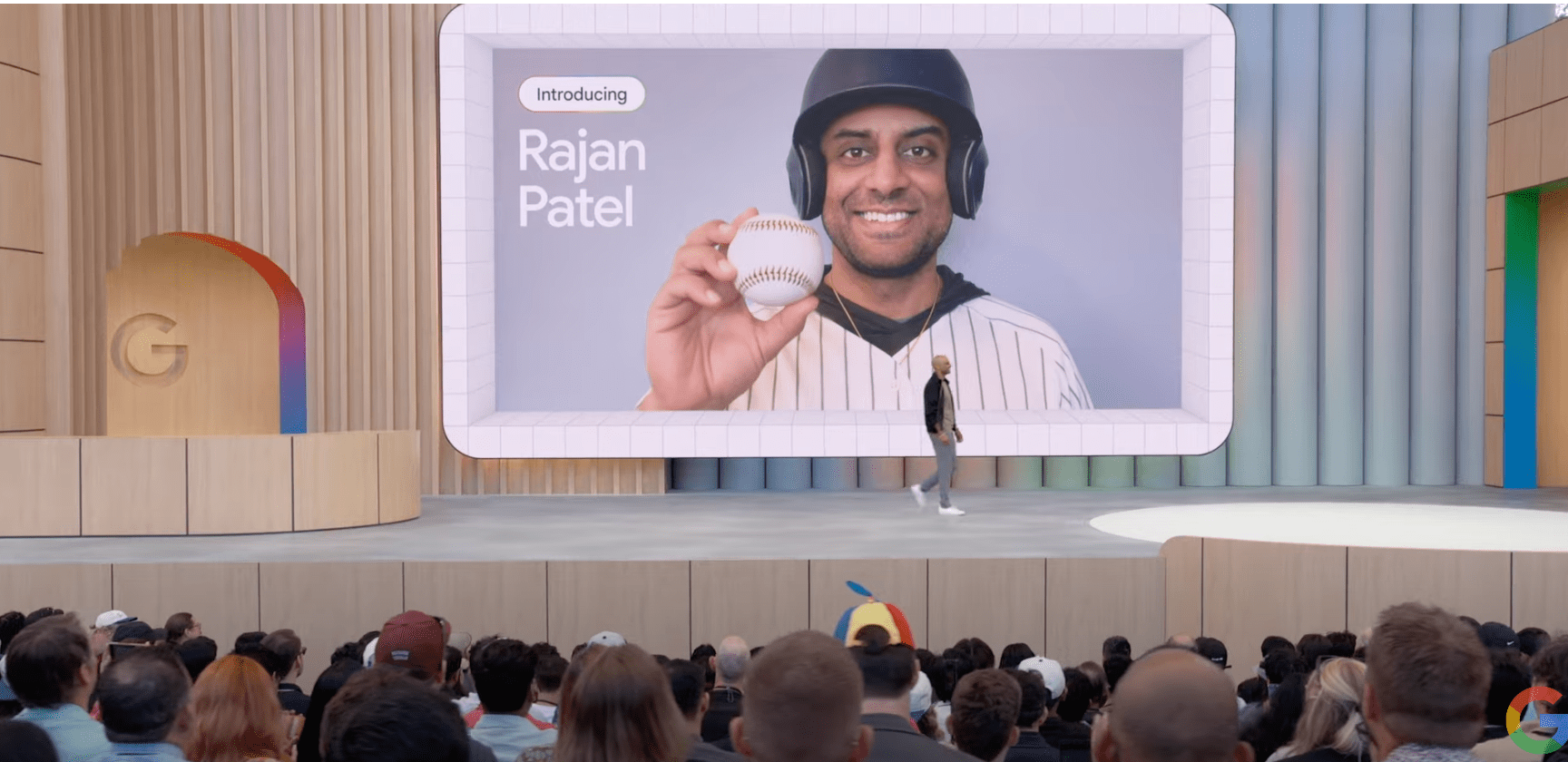
Rajan Patel, who is the VP of Search Engineering at Google, got on stage at Google I/O and said he was a huge baseball fan.
Screenshot from Google I/O 2025 livestream, May 2025
So what?
Rajan used a query related to baseball to show how Google’s AI Mode was analyzing complex data.
Specifically, he ran the following query (prompt?): “Show the batting average and OBP for this season and last for notable players who currently use a torpedo bat.”
It seems really complex, which is exactly how Rajan packaged this to the audience, saying: “Think about it, there are so many parts to that question.”
It does seem like a really niche sort of topic that you’d have to have very specific knowledge about.
It’s got multiple layers to it. It’s got data and acronyms wrapped up in it. It’s got everything you need to think that this is a seriously complex question that only advanced AI could answer. It’s even asking for two years’ worth of data.
The reality is that you could find this information out in three very easy searches and never even have to click on a website to do it.
Shall we?
Why What Google Said Is Not ‘Advanced’
This whole “torpedo bats” thing seems extremely niche, which is, again, from an optics and perception point of view, this is exactly what Google wants you to think.
In reality, as I mentioned, this was a hot story in baseball for a good while.
Moreover, the question of who uses these bats was a big deal. People thought, initially, that these players were cheating.
It was a semi-scandal, which means there is a ton of content from big-name websites that specifically lists which players are using the type of bat.
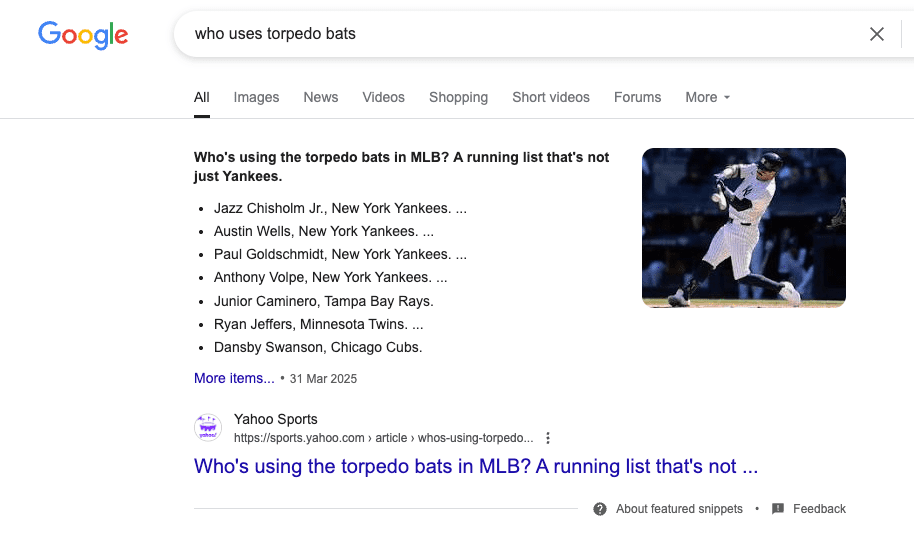
Here you go, it’s right in the featured snippet:
Screenshot from search for [who uses torpedo bats], Google, May 2025
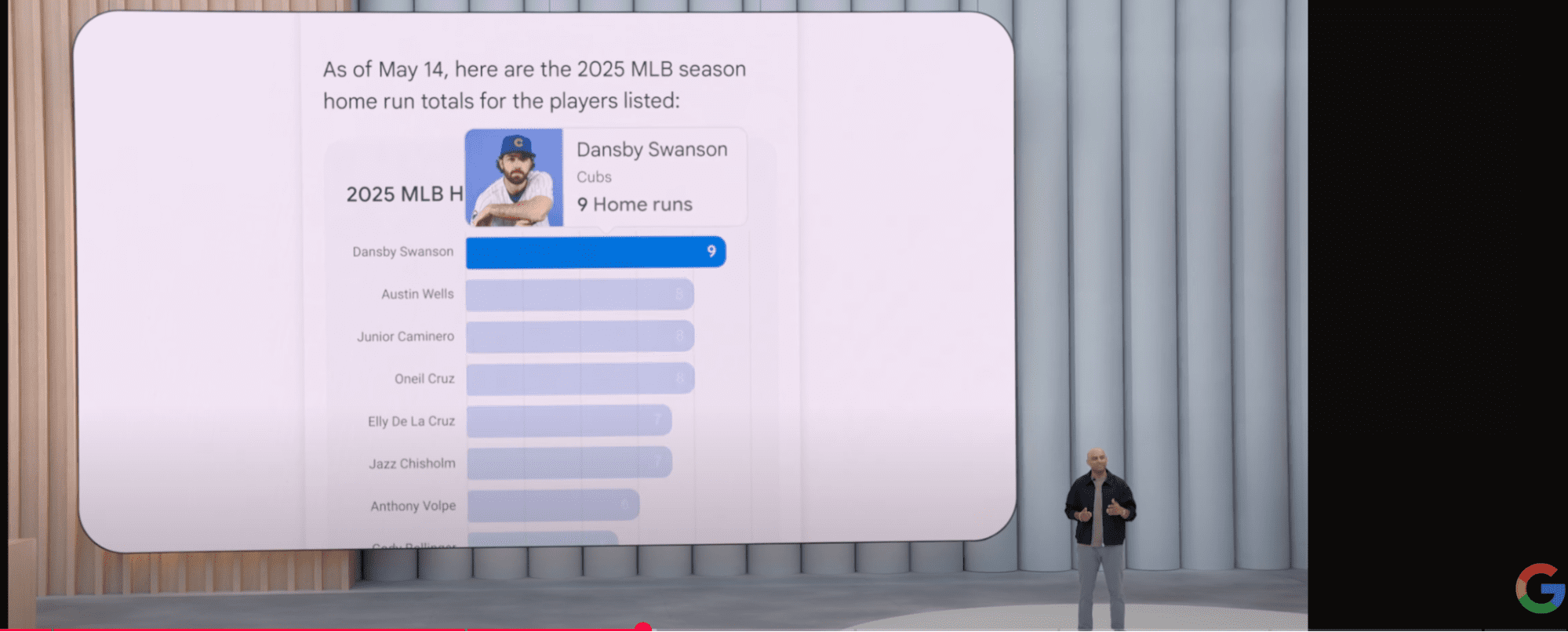
The last player mentioned above, Dansby Swanson, is who Google featured in its talk:
Screenshot from Google I/O 2025 livestream, May 2025
Compare the list Google shows to the one from Yahoo Sports.
Four out of the seven on Google lists are right there in the featured snippet (Austin Wells, Jazz Chisolm [Jr.], Anthony Volpe, and Dansby Swanson).
For the record, three out of those four play for the Yankees, and Wells was the first person we saw use the bat type in 2025 (some players experimented using it in 2024).
Not hard information to access. It’s right there – so are the players who are “notable.”
Rajan makes a point of saying Google needs to know who the notable players are to answer this “complex” question. Meaning, he portrayed this as being “complex.”
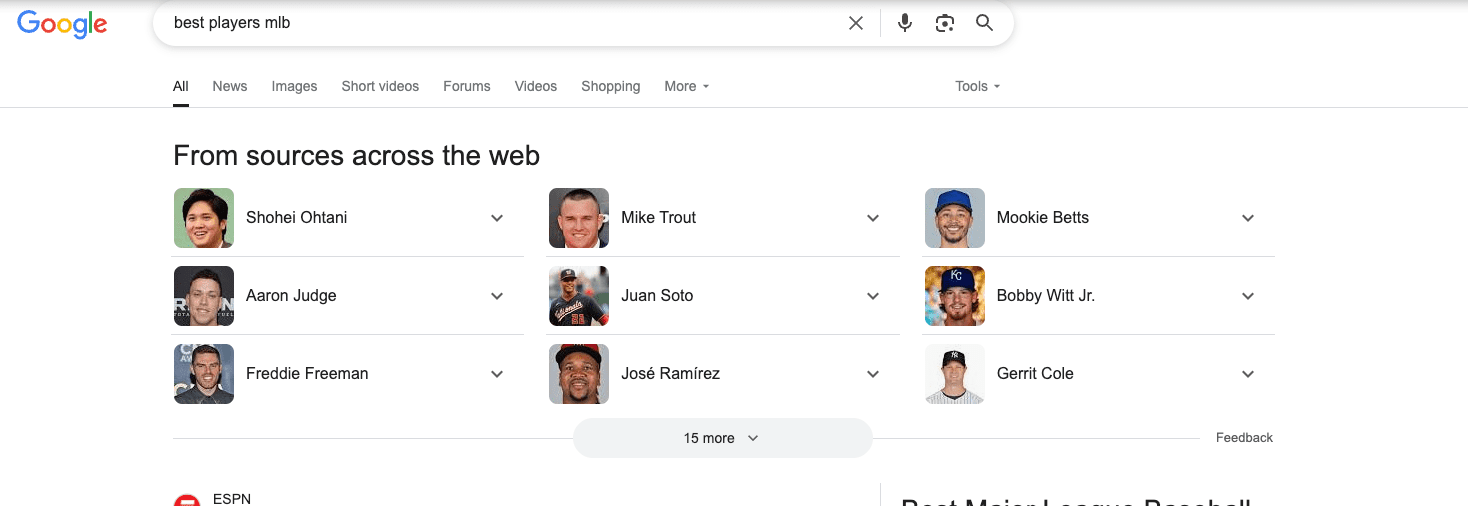
Screenshot from search for [best players mlb], Google, May 2025
Boop. Carousel of the best MLB players in the league right now (pretty good list too!)
So, the complex thing that Google’s AI Mode had to do was pull information from a Yahoo Sports page (or wherever) and combine that with information it’s been using in the Knowledge Graph for years?
If that’s hard for Google and complex for AI, then we have problems.
There were, in essence, three parts to Google’s “query” here:
Answering who in the league uses a torpedo bat.
Identifying notable current players.
Pulling the stats (this year’s and last year’s) of these notable players using this new bat.
The data part seems complex. Stats? Current stats? Seems like a lot.
There are two things you need to know:
The first thing is that baseball is famous for its stats. Fans and teams have been tracking stats for 100 years – number of home runs, batting averages, earned run averages, runs batted in, strikeout walks, doubles, and triples (we haven’t even gotten into spin rates and launch angles).
That’s correct, baseball teams track how many times the ball spun between when the pitcher threw the ball and when the catcher caught the ball.
Today, the league is dominated by advanced analytics.
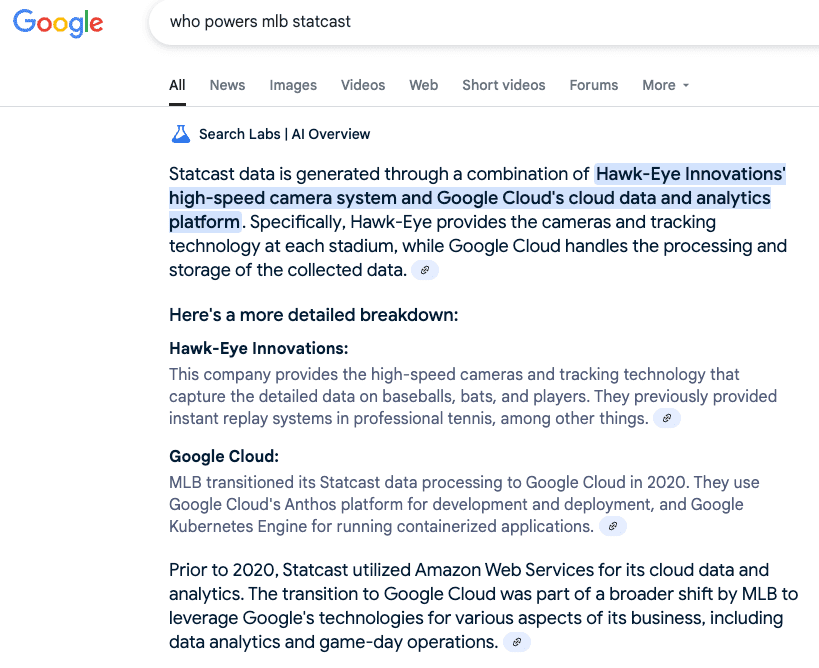
Guess who powers it all?
I bet you guessed, Google.
Screenshot from search for [who powers mlb statcast], Google, May 2025
The second thing you need to know is that Google has been collecting stats on specific players in its Knowledge Graph for a good while.
Forget that the stats on specific players can be found on dozens upon dozens of websites; Google itself collects them.
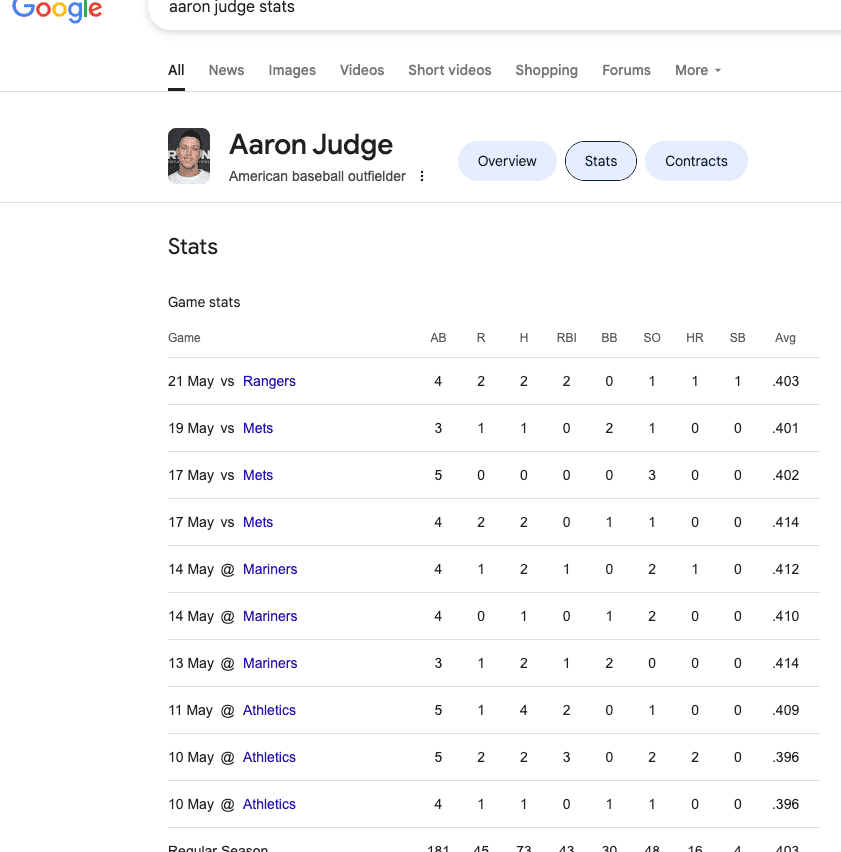
Here’s a search for the league’s best player (no, he does not use a torpedo bat):
Screenshot from search for [aaron judge stats], Google, May 2025
Did you notice the stats? Of course, you did; it’s a tab in the Knowledge Panel.
It’s information that might seem incredibly vast or complex, but it’s literally stored by Google.
What I’m saying is, Google created a “complex” scenario that was nothing more than combining two things it stores in the Knowledge Graph with one thing that is spread all over the web (i.e., the list of players using this type of bat).
Is that really that complex for Google, or was it engineered to look complex for the optics?
What Is The Best Way To Talk About AI Products?
I love the graphs. Taking the data and the information and creating a custom graph with AI?
Love that. That’s amazing. That’s so useful.
Google, you don’t need to oversell it; it’s awesome without you doing that.
Google is not going to listen to me (it will read this article, but it will not listen to my advice). I’m not writing this for Google.
I am writing this for you. If you are a small or a medium-sized marketing team and you’re looking at how Google and other big brands market their AI products as a beacon for your own marketing … don’t.
Don’t feel you have to. Decide on your own what is the best way to talk about AI products.
Is the best way really to overstate the complexity? To try to “package” something as more than it really is?
I get the temptation, but people are not stupid. They will start to see through the smoke and mirrors.
It may take them time. It may take them more time than you might think – but it will happen.
I’ll end with a personal story.
My wife is a nurse. She was recently sent to a seminar where they talked about “what’s happening with all the AI stuff.”
My wife came home and was taken aback by what’s going on out there and how people are using AI, as well as how good the AI was (or wasn’t).
My wife is now a thousand times more skeptical about AI.
What happens if you’re following what these brands are doing and oversell AI when your target audience eventually has the experience my wife did?
Modern SEO is all about data. Rankings can change overnight, user behavior as well, and search engines increasingly use AI to power the search results. To be able to respond, your decisions should be dictated by real, measurable insights. This article offers a practical way to turn SEO data into actionable insights.
Table of contents
The role of data in modern SEO
The search landscape is more complex than ever, so you need all the help you can get. By analyzing data, SEOs and business owners can learn and understand what works and what doesn’t. Metrics from tools like Google Analytics and Search Console provide glimpses of how visitors behave, keyword usage, and page performance. Using data to make decisions takes the guesswork out of the SEO work.
Good data gives you a clear picture of user engagement. For instance, tracking engagement time, engagement rates, and click-through rates will reveal whether content meets audience needs. These are crucial data insights that uncover gaps that might hinder performance. Data-driven insights help you understand what to focus on and what to prioritize.
Data doesn’t just identify issues, but also opportunities. Trends in keyword performance or a shift in traffic sources can lead to new content ideas or a new market to target. This is data-driven marketing, as you are making decisions based on evidence instead of hunches. These insights will lead to strategies focused on real user behaviors, which should lead to better results.
The goal isn’t to find interesting stats — it’s to find what you can do next. In SEO and AI-driven search, the data that matters is the data that leads to action: fix this page, shift that content, change how you’re showing up. If your insights don’t lead to decisions, they’re just noise.
Carolyn Shelby – Principal SEO at Yoast
A Yoast example
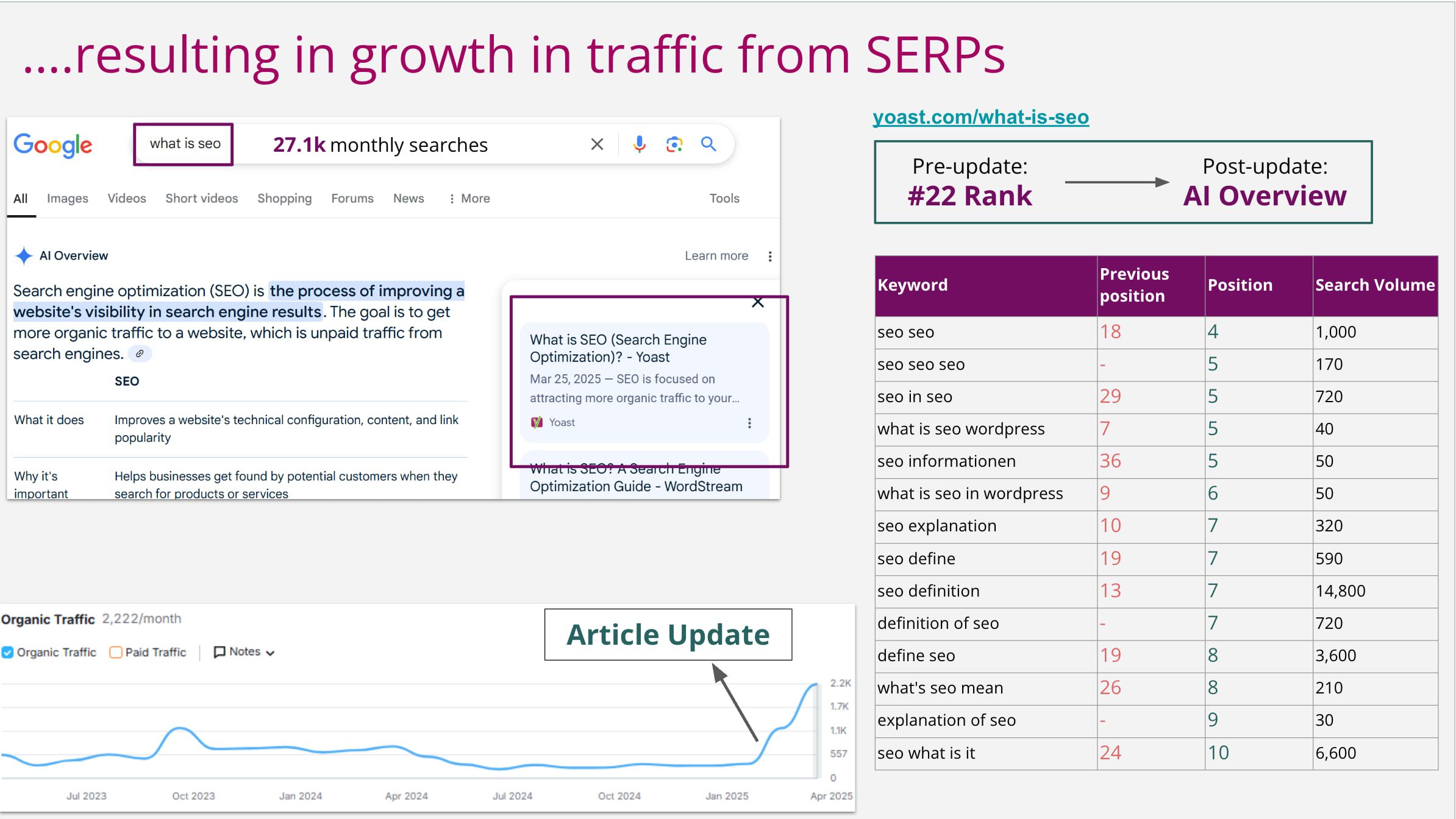
Let’s take a simple example from Yoast. We noticed one of our articles (What is SEO?) was gradually losing traffic and slipping in the rankings for key terms. The content hadn’t been updated for a while, so we took a closer look. We analyzed the search results and compared our article with those from competitors. We looked at intent, structures, relevance, and freshness. It was easy to see that our article lacked depth and context in key areas.
We wrote a good brief for the article and detailed the work needed. Then, we rewrote sections, updated examples, improved internal linking, and made it generally easier to read. We also added new custom graphics and on-topic expert quotes from our in-house Principal SEO, Alex Moss.
After republishing, the article quickly regained visibility. Plus, it climbed back towards the top of the search results, which brought in extra traffic. This was a clear reminder for us; when data shows a drop, improving the quality of the content backed by a good analysis can still win.
And an example of going from data to actionable insights to results
Turning data into insights
You need a process to quickly and systematically turn raw data into valuable insights. Eventually, you’ll get these insights once you ask the right SEO questions, gather the data, analyze it, and plan accordingly.
Start with your goals, then ask: what’s holding us back? Actionable insights live in the gap between where you are and where you’re trying to go. That gap is different for every site and that’s what makes good analysis so powerful.
Carolyn Shelby – Principal SEO at Yoast
Step 1: What do you want to know?
Start by writing down the SEO questions you want answered. Do you want to improve performance, get more organic traffic, or better engagement? Analyze a traffic drop? For instance, an online store owner might want to understand why certain product pages don’t convert as well as expected. Thinking these things through before you start digging into the data makes it easier to focus on the metrics that matter.
Step 2: Gather the relevant data
Collect the data you need using tools like Google Analytics, Semrush, Wincher, Ahrefs, or other platforms that can power your data-driven SEO strategy. If you’d like to investigate a product page with subpar performance, you’ll look at page views, click-through rates, average engagement times, and engagement rates in GA4. Data like this should give you an idea to find and address the issues.
Step 3: Analyze and spot trends
Dive into the data and try to spot patterns and trends. For example, an educational site might notice that articles on a particular topic get a lot of traffic but low engagement. Digging deeper might find that the titles of the articles attract visitors, but for some reason, the content doesn’t keep them interested. Trends like these help turn that data into insights that you can act upon. You can also use things like segmentation to find differences between groups of people from specific regions, who could engage wildly differently with your content.
Step 4: Turn findings into actions
Once you’ve pinpointed the issues, it’s time to decide what you want to do. For instance, if you’ve found that an article has a low engagement rate because of the time it takes to load the page, you could fix the images and scripts on the page. Or, if you find that some keywords get traffic, but no conversions, you might need to improve the CTA on the page. Or it might be a search intent mismatch to fix. This is the thing that turns the insights from data into actionable insights.
This is a nicely structured way of getting the insights needed to inform your data-driven SEO strategy. You can use every piece of information you find to improve your work as you go. This will not only help you understand the data but also make it easier to make the improvements needed to reach your SEO and business goals.
An example: Addressing brand performance in LLMs
For this example, think of a tech publisher named Digital Mosaic. It’s a reputable source for in-depth news from the tech industry. Recently, their marketing team noticed something off. Users interacting with AI search engines and large language models (LLMs) like Google Gemini or ChatGPT rarely saw mentions of the Digital Mosaic brand. In other words, even when asked for the latest tech insights, the AI-driven sources and answers often omitted Digital Mosaic in favor of other options.
After finding the issue, the team started analyzing data from various analytics platforms, brand mention trackers, and user surveys. They found their SEO and content work was pretty good, but the content was not properly optimized to help LLMs surface it. The data showed that their content lacked the language and brand signals needed to help LLMs understand the brand’s authority.
When they found this, the teams got to work to improve how LLMs perceive their content:
Improving brand signals
The content team added clearer brand signals to their content, and each post received better metadata and structured data. The goal was to clearly tie the brand to the content to help LLMs recognize the sources.
Changes in content
Next, the team restructured certain articles to include branded segments, such as “Digital Mosaic Exclusive Analysis” or “Today’s Tech Insights by Digital Mosaic”. This makes the brand more visible to users and gives LLMs a chance to associate the content with the brand, coming from a trusted source.
Investing in partnerships and collaboration
The publisher set up a series of collaborations with well-known tech influencers and other outlets. They made co-branded content and were mentioned in many podcasts and webinars. This helped improve the brand’s presence in online conversations. LLMs love to look for what’s available on third-party sites about brands while generating responses.
Rinse and repeat
The team reviewed the changes’ performance to see if the LLMs would improve brand mentions. They used AI tools, like AI brand monitoring tools, to monitor and simulate the LLM outputs to see if the work was effective. Based on their findings, they would fine-tune their work and continue to improve performance.
Within a few months, the results were encouraging. LLMs were increasingly showing content from and mentioning Digital Mosaic, and the brand’s footprint in LLMs was steadily improving. This did not just help visibility and increase the brand’s authority in the industry, but also led to a new source of traffic from AI search interfaces.
This fictional example shows how a publisher can use data insights to overcome a very specific challenge. Mixing traditional SEO solutions with new technologies helped Digital Mosaic turn data into actionable insights. Not only did it help the brand’s visibility right now, but it also prepared it for the AI-powered future.
You need the right tools to turn data into actionable insights. This will be a mix of the tools we all know and love, and more specific ones to understand user behavior and site performance.
We all start with Google Analytics 4 and Search Console. GA4 tracks many metrics, including user engagement, event counts, and traffic sources. Properly set up, it gives you a good overview of how users use your site. Search Console shows how your site performs in the SERPs, including keyword rankings, indexing status, and crawl errors.
Tools like Ahrefs and Semrush provide information about backlinks, rankings, and search trends. These search marketing tools also have many features for competitive analysis and keyword research. You’ll get a big database of historical data, so you can spot and interpret trends over time. This data helps you with your data-driven marketing on all fronts.
Looker Studio is a great tool to tie various data sources together and build dashboards
Advanced techniques and technologies
The are so many options to dive ever-deeper into your data to find the insights you need. Beyond the basics, you can use:
Segmentation: It could help to break up your data into specific audience segments. For instance, you could look at visitor behavior based on demographics, location, or the type of device they use. Segmenting data helps you understand why certain groups behave differently. For instance, if mobile users show lower engagement than desktop users, there might be something wrong with your mobile site.
Trend analysis: Don’t just focus on looking at data for a specific day. It’s often better to look at metrics over different time periods. Look at the monthly or quarterly performance. This gives you an idea of the long-term impact of changes.
Build dashboards to visualize data: Make a dashboard with data from various sources. Use tools like Looker Studio to combine Google data with SEO tools like Semrush and Ahrefs. This will give you reports that will show all key data at a glance. A dashboard makes it easier to understand data and communicate it with other team members or management.
Big data: Big data is becoming increasingly important for data-driven SEO. Huge data sets can provide insights that smaller sets can overlook. They allow you to examine user behavior, search trends, and site performance at scale. With machine learning and automation, you can use big data to get better and faster results to inform your SEO strategy.
Iterative optimization and reporting
SEO is an ongoing process, and you’ll have to adjust course regularly. Don’t treat your site’s performance as a snapshot, but as something dynamic that evolves over time. Regularly looking at your data keeps you on top of things, from changes in user behavior to emerging search trends.
Make it a routine
Schedule when you review data. This might be daily checks for urgent work or weekly to track short-term changes. For long-term trends, do monthly or quarterly deep dives. Route analysis helps you spot patterns that might not be so obvious at first glance.
Test and experiment
With an iterative optimization approach, you test what works. For example, you could A/B test different page layouts, CTA buttons, or various meta titles. You might also try different content formats to see what gets more engagement. These tests will get you the data and insights needed to make the most of your SEO work.
Feedback loop
A true feedback loop helps validate your improvements. After turning data into actionable insights, implement the changes in your content or technical SEO work. Keep updating your data to see if you need to refine your strategy. If a new tactic works, adopt it as a standard practice. But if it doesn’t work as intended, find out why and try a variation of it. Measuring trial and error and adopting your tactics makes you flexible and responsive.
Internet marketing tools like Wincher give key data points about your content’s performance
Towards a data-driven SEO strategy
Using the knowledge you gain from turning data into actionable insights can greatly improve your SEO performance. Be sure to structure the data-gathering process: ask the right questions, collect the right data, analyze the trends, and create a system that turns those insights into action.
What you change on your site isn’t even that important; it might be updating metadata, improving content, or diving into technical SEO aspects. If only what you do is the correct answer to the questions you wanted to have answered.
Every insight can lead to big improvements in rankings and user engagement. Use this data-driven marketing approach to make the right decisions that will keep your SEO strategy effective in the future.
Edwin is an experienced strategic content specialist. Before joining Yoast, he worked for a top-tier web design magazine, where he developed a keen understanding of how to create great content.
This week, we published Power Hungry, a package all about AI and energy. At the center of this package is the most comprehensive look yet at AI’s growing power demand, if I do say so myself.
This data-heavy story is the result of over six months of reporting by me and my colleague James O’Donnell (and the work of many others on our team). Over that time, with the help of leading researchers, we quantified the energy and emissions impacts of individual queries to AI models and tallied what it all adds up to, both right now and for the years ahead.
There’s a lot of data to dig through, and I hope you’ll take the time to explore the whole story. But in the meantime, here are three of my biggest takeaways from working on this project.
1. The energy demands of AI are anything but constant.
If you’ve heard estimates of AI’s toll, it’s probably a single number associated with a query, likely to OpenAI’s ChatGPT. One popular estimate is that writing an email with ChatGPT uses 500 milliliters (or roughly a bottle) of water. But as we started reporting, I was surprised to learn just how much the details of a query can affect its energy demand. No two queries are the same—for several reasons, including their complexity and the particulars of the model being queried.
One key caveat here is that we don’t know much about “closed source” models—for these, companies hold back the details of how they work. (OpenAI’s ChatGPT and Google’s Gemini are examples.) Instead, we worked with researchers who measured the energy it takes to run open-source AI models, for which the source code is publicly available.
But using open-source models, it’s possible to directly measure the energy used to respond to a query rather than just guess. We worked with researchers who generated text, images, and video and measured the energy required for the chips the models are based on to perform the task.
Even just within the text responses, there was a pretty large range of energy needs. A complicated travel itinerary consumed nearly 10 times as much energy as a simple request for a few jokes, for example. An even bigger difference comes from the size of the model used. Larger models with more parameters used up to 70 times more energy than smaller ones for the same prompts.
As you might imagine, there’s also a big difference between text, images, or video. Videos generally took hundreds of times more energy to generate than text responses.
2. What’s powering the grid will greatly affect the climate toll of AI’s energy use.
As the resident climate reporter on this project, I was excited to take the expected energy toll and translate it into an expected emissions burden.
Powering a data center with a nuclear reactor or a whole bunch of solar panels and batteries will not affect our planet the same way as burning mountains of coal. To quantify this idea, we used a figure called carbon intensity, a measure of how dirty a unit of electricity is on a given grid.
We found that the same exact query, with the same exact energy demand, will have a very different climate impact depending on what the data center is powered by, and that depends on the location and the time of day. For example, querying a data center in West Virginia could cause nearly twice the emissions of querying one in California, according to calculations based on average data from 2024.
This point shows why it matters where tech giants are building data centers, what the grid looks like in their chosen locations, and how that might change with more demand from the new infrastructure.
3. There is still so much that we don’t know when it comes to AI and energy.
Our reporting resulted in estimates that are some of the most specific and comprehensive out there. But ultimately, we still have no idea what many of the biggest, most influential models are adding up to in terms of energy and emissions. None of the companies we reached out to were willing to provide numbers during our reporting. Not one.
Adding up our estimates can only go so far, in part because AI is increasingly everywhere. While today you might generally have to go to a dedicated site and type in questions, in the future AI could be stitched into the fabric of our interactions with technology. (See my colleague Will Douglas Heaven’s new story on Google’s I/O showcase: “By putting AI into everything, Google wants to make it invisible.”)
AI could be one of the major forces that shape our society, our work, and our power grid. Knowing more about its consequences could be crucial to planning our future.
In 2003, engineers from Germany and Switzerland began building a bridge across the Rhine River simultaneously from both sides. Months into construction, they found that the two sides did not meet. The German side hovered 54 centimeters above the Swiss side.
The misalignment occurred because the German engineers had measured elevation with a historic level of the North Sea as its zero point, while the Swiss ones had used the Mediterranean Sea, which was 27 centimeters lower. We may speak colloquially of elevations with respect to “sea level,” but Earth’s seas are actually not level. “The sea level is varying from location to location,” says Laura Sanchez, a geodesist at the Technical University of Munich in Germany. (Geodesists study our planet’s shape, orientation, and gravitational field.) While the two teams knew about the 27-centimeter difference, they mixed up which side was higher. Ultimately, Germany lowered its side to complete the bridge.
To prevent such costly construction errors, in 2015 scientists in the International Association of Geodesy voted to adopt the International Height Reference Frame, or IHRF, a worldwide standard for elevation. It’s the third-dimensional counterpart to latitude and longitude, says Sanchez, who helps coordinate the standardization effort.
Now, a decade after its adoption, geodesists are looking to update the standard—by using the most precise clock ever to fly in space.
That clock, called the Atomic Clock Ensemble in Space, or ACES, launched into orbit from Florida last month, bound for the International Space Station. ACES, which was built by the European Space Agency, consists of two connected atomic clocks, one containing cesium atoms and the other containing hydrogen, combined to produce a single set of ticks with higher precision than either clock alone.
Pendulum clocks are only accurate to about a second per day, as the rate at which a pendulum swings can vary with humidity, temperature, and the weight of extra dust. Atomic clocks in current GPS satellites will lose or gain a second on average every 3,000 years. ACES, on the other hand, “will not lose or gain a second in 300 million years,” says Luigi Cacciapuoti, an ESA physicist who helped build and launch the device. (In 2022, China installed a potentially stabler clock on its space station, but the Chinese government has not publicly shared the clock’s performance after launch, according to Cacciapuoti.)
From space, ACES will link to some of the most accurate clocks on Earth to create a synchronized clock network, which will support its main purpose: to perform tests of fundamental physics.
But it’s of special interest for geodesists because it can be used to make gravitational measurements that will help establish a more precise zero point from which to measure elevation across the world.
Alignment over this “zero point” (basically where you stick the end of the tape measure to measure elevation) is important for international collaboration. It makes it easier, for example, to monitor and compare sea-level changes around the world. It is especially useful for building infrastructure involving flowing water, such as dams and canals. In 2020, the international height standard even resolved a long-standing dispute between China and Nepal over Mount Everest’s height. For years, China said the mountain was 8,844.43 meters; Nepal measured it at 8,848. Using the IHRF, the two countries finally agreed that the mountain was 8,848.86 meters.
A worker performs tests on ACES at a cleanroom at the Kennedy Space Center in Florida.
ESA-T. PEIGNIER
To create a standard zero point, geodesists create a model of Earth known as a geoid. Every point on the surface of this lumpy, potato-shaped model experiences the same gravity, which means that if you dug a canal at the height of the geoid, the water within the canal would be level and would not flow. Distance from the geoid establishes a global system for altitude.
However, the current model lacks precision, particularly in Africa and South America, says Sanchez. Today’s geoid has been built using instruments that directly measure Earth’s gravity. These have been carried on satellites, which excel at getting a global but low-resolution view, and have also been used to get finer details via expensive ground- and airplane-based surveys. But geodesists have not had the funding to survey Africa and South America as extensively as other parts of the world, particularly in difficult terrain such as the Amazon rainforest and Sahara Desert.
To understand the discrepancy in precision, imagine a bridge that spans Africa from the Mediterranean coast to Cape Town, South Africa. If it’s built using the current geoid, the two ends of the bridge will be misaligned by tens of centimeters. In comparison, you’d be off by at most five centimeters if you were building a bridge spanning North America.
To improve the geoid’s precision, geodesists want to create a worldwide network of clocks, synchronized from space. The idea works according to Einstein’s theory of general relativity, which states that the stronger the gravitational field, the more slowly time passes. The 2014 sci-fi movie Interstellar illustrates an extreme version of this so-called time dilation: Two astronauts spend a few hours in extreme gravity near a black hole to return to a shipmate who has aged more than two decades. Similarly, Earth’s gravity grows weaker the higher in elevation you are. Your feet, for example, experience slightly stronger gravity than your head when you’re standing. Assuming you live to be about 80 years old, over a lifetime your head will age tens of billionths of a second more than your feet.
A clock network would allow geodesists to compare the ticking of clocks all over the world. They could then use the variations in time to map Earth’s gravitational field much more precisely, and consequently create a more precise geoid. The most accurate clocks today are precise enough to measure variations in time that map onto centimeter-level differences in elevation.
“We want to have the accuracy level at the one-centimeter or sub-centimeter level,” says Jürgen Müller, a geodesist at Leibniz University Hannover in Germany. Specifically, geodesists would use the clock measurements to validate their geoid model, which they currently do with ground- and plane-based surveying techniques. They think that a clock network should be considerably less expensive.
ACES is just a first step. It is capable of measuring altitudes at various points around Earth with 10-centimeter precision, says Cacciapuoti. But the point of ACES is to prototype the clock network. It will demonstrate the optical and microwave technology needed to use a clock in space to connect some of the most advanced ground-based clocks together. In the next year or so, Müller plans to use ACES to connect to clocks on the ground, starting with three in Germany. Müller’s team could then make more precise measurements at the location of those clocks.
These early studies will pave the way for work connecting even more precise clocks than ACES to the network, ultimately leading to an improved geoid. The best clocks today are some 50 times more precise than ACES. “The exciting thing is that clocks are getting even stabler,” says Michael Bevis, a geodesist at Ohio State University, who was not involved with the project. A more precise geoid would allow engineers, for example, to build a canal with better control of its depth and flow, he says. However, he points out that in order for geodesists to take advantage of the clocks’ precision, they will also have to improve their mathematical models of Earth’s gravitational field.
Even starting to build this clock network has required decades of dedicated work by scientists and engineers. It took ESA three decades to make a clock as small as ACES that is suitable for space, says Cacciapuoti. This meant miniaturizing a clock the size of a laboratory into the size of a small fridge. “It was a huge engineering effort,” says Cacciapuoti, who has been working on the project since he began at ESA 20 years ago.
Geodesists expect they’ll need at least another decade to develop the clock network and launch more clocks into space. One possibility would be to slot the clocks onto GPS satellites. The timeline depends on the success of the ACES mission and the willingness of government agencies to invest, says Sanchez. But whatever the specifics, mapping the world takes time.