Job titles of the future: Pandemic oracle

Officially, Conor Browne is a biorisk consultant. Based in Belfast, Northern Ireland, he has advanced degrees in security studies and medical and business ethics, along with United Nations certifications in counterterrorism and conflict resolution. He’s worked on teams with NATO’s Science for Peace and Security Programme and with the UN High Commissioner for Refugees, analyzing how diseases affect migration and border security.

Early in the emergence of SARS-CoV-2, international energy conglomerates seeking expert guidance on navigating the potential turmoil in markets and transportation became his main clients. Having studied the 2002 SARS outbreak, he predicted the exponential spread of the new airborne virus. He forecast the epidemic’s broadscale impact and its implications for business so accurately that he has come to be seen as a pandemic oracle. 

Browne produces independent research reports and works directly with companies of all sizes. One of his niches is consulting on new diagnostic toolsfor example, in his work with RAIsonance, a startup using machine learning to analyze cough sounds correlated with tuberculosis and covid-19. For multinational corporations, he models threats such as the possibility of avian influenza spreading from human to human. He builds most- and least-likely scenarios for how the global business community might react to an H5N1 outbreak in China or the US. “I never want to be right,” he says of worst-case predictions. 

Navigating uncertainty

Biorisk consultants are often trained in fields related to epidemiology, security, and counterterrorism. Browne also studied psychology to understand how humans respond to disaster. In times of increasing geopolitical volatility, he says, biomedical risk assessment must include sociopolitical forecasting.

Demand for this type of crisis planning exploded in the corporate world in the aftermath of 9/11. Executives learned to create contingency plans for loss of personnel and infrastructure as a result of terrorism, pandemics, and natural disasters. And resilience planning proved crucial early in the covid-19 pandemic, as business leaders were forced to adjust to supply chain disruptions and the realities of remote work. 

Network effects

By adding nuanced qualitative analysis to hard data, Browne creates proprietary guidance that clients can act on. “I give businesses an idea of what is coming, and what they do with that information is up to them,” he says. “I basically tell the future.”

Britta Shoot is a freelance journalist focusing on pandemics, protests, and how people occupy space. 

The Debrief: Power and energy

It may sound bluntly obvious, but energy is power. Those who can produce it, especially lots of it, get to exert authority in all sorts of ways. It brings revenue and enables manufacturing, data processing, transportation, and military might. Energy resources are arguably a nation’s most important asset. Look at Russia, or Saudi Arabia, or China, or Canada, or Qatar, or—for that matter—the US. For all these nations, energy production plays key roles in their economies and their outsize global status. (Qatar, for example, has a population roughly the size of metro Portland, Oregon.) 

The US has always been a nation of energy and industry. It was a major producer of coal, which fed the Industrial Revolution. World War II was won in large part by the energy production in the United States—which fueled both manufacturing of the war machine at home and its ships, planes, and tanks in the Pacific and Europe. Throughout its history, the country has found strength in energy production. 

Yet in many ways right now the US seems to be forgetting those lessons. It is moving backward in terms of its clean-­energy strategy, especially when it comes to powering the grid, in ways that will affect the nation for decades to come—even as China and others are surging forward. And that retreat is taking place just as electricity demand and usage are growing again after being flat for nearly two decades. That growth, according to the US Energy Information Administration, is “coming from the commercial sector, which includes data centers, and the industrial sector, which includes manufacturing establishments.” 

As MIT Technology Review has extensively reported, energy demand from data centers is set to soar, not plateau, as AI inhales ever more electricity from the grid. As my colleagues James O’Donnell and Casey Crownhart reported, by 2028 the share of US electricity going to power data centers may triple. (For the full report, see technologyreview.com/energy-ai.)

Both manufacturing and data centers are obviously priorities for the US writ large and the Trump administration in particular. Given those priorities, it’s surprising to see the administration and Congress making moves that would both decrease our potential energy supply and increase demand by lowering efficiency. 

This will be most true for electricity generation. The administration’s proposed budget, still being considered as we went to press, would roll back tax credits for wind, solar, and other forms of clean energy. In households, they would hit credits for rooftop solar panels and residential energy efficiency programs. Simultaneously, the US is trying to roll back efficiency standards for household appliances. These standards are key to keeping consumer electricity prices down by decreasing demand. 

In short, what most analysts are expecting is more strain on the grid, which means prices will go up for everyone. Meanwhile, rollbacks to the Inflation Reduction Act and to credits for advanced manufacturing mean that fewer future-facing energy sources will be built. 

This is just belligerently shortsighted. 

That’s especially true because as the US takes steps to make energy less abundant and more expensive, China—our ostensible chief international antagonist—is moving in exactly the opposite direction. The country has made massive strides in renewable energy generation, hitting its goals six years ahead of schedule. In fact, China is now producing so much clean energy that its carbon dioxide emissions are declining as a result.

This issue is about power, in all its forms. Yet whether you’re talking about the ability to act or the act of providing electricity, power comes from energy. So when it comes to energy, we need “ands,” not “ors.” We need nuclear and solar and wind and hydropower and hydrogen and geothermal and batteries on the grid. And we need efficiency. And yes, we even need oil and gas in the mid term while we ramp up cleaner sources. That is the way to maintain and increase our prosperity, and the only way we can possibly head off some of the worst consequences of climate change.

The AI Hype Index: AI-powered toys are coming

Separating AI reality from hyped-up fiction isn’t always easy. That’s why we’ve created the AI Hype Index—a simple, at-a-glance summary of everything you need to know about the state of the industry.

AI agents might be the toast of the AI industry, but they’re still not that reliable. That’s why Yoshua Bengio, one of the world’s leading AI experts, is creating his own nonprofit dedicated to guarding against deceptive agents. Not only can they mislead you, but new research suggests that the weaker an AI model powering an agent is, the less likely it is to be able to negotiate you a good deal online. Elsewhere, OpenAI has inked a deal with toymaker Mattel to develop “age-appropriate” AI-infused products. What could possibly go wrong?

The Bank Secrecy Act is failing everyone. It’s time to rethink financial surveillance.

The US is on the brink of enacting rules for digital assets, with growing bipartisan momentum to modernize our financial system. But amid all the talk about innovation and global competitiveness, one issue has been glaringly absent: financial privacy. As we build the digital infrastructure of the 21st century, we need to talk about not just what’s possible but what’s acceptable. That means confronting the expanding surveillance powers quietly embedded in our financial system, which today can track nearly every transaction without a warrant.

Many Americans may associate financial surveillance with authoritarian regimes. Yet because of a Nixon-era law called the Bank Secrecy Act (BSA) and the digitization of finance over the past half-century, financial privacy is under increasingly serious threat here at home. Most Americans don’t realize they live under an expansive surveillance regime that likely violates their constitutional rights. Every purchase, deposit, and transaction, from the smallest Venmo payment for a coffee to a large hospital bill, creates a data point in a system that watches you—even if you’ve done nothing wrong.

As a former federal prosecutor, I care deeply about giving law enforcement the tools it needs to keep us safe. But the status quo doesn’t make us safer. It creates a false sense of security while quietly and permanently eroding the constitutional rights of millions of Americans.

When Congress enacted the BSA in 1970, cash was king and organized crime was the target. The law created a scheme whereby, ever since, banks have been required to keep certain records on their customers and turn them over to law enforcement upon request. Unlike a search warrant, which must be issued by a judge or magistrate upon a showing of probable cause that a crime was committed and that specific evidence of that crime exists in the place to be searched, this power is exercised with no checks or balances. A prosecutor can “cut a subpoena”—demanding all your bank records for the past 10 years—with no judicial oversight or limitation on scope, and at no cost to the government. The burden falls entirely on the bank. In contrast, a proper search warrant must be narrowly tailored, with probable cause and judicial authorization.

In United States v. Miller (1976), the Supreme Court upheld the BSA, reasoning that citizens have no “legitimate expectation of privacy” about information shared with third parties, like banks. Thus began the third-party doctrine, enabling law enforcement to access financial records without a warrant. The BSA has been amended several times over the years (most notoriously in 2001 as a part of the Patriot Act), imposing an ever-growing list of recordkeeping obligations on an ever-growing list of financial institutions. Today, it is virtually inescapable for everyday Americans.

In the 1970s, when the BSA was enacted, banking and noncash payments were conducted predominantly through physical means: writing checks, visiting bank branches, and using passbooks. For cash transactions, the BSA required reporting of transactions over the kingly sum of $10,000, a figure that was not pegged to inflation and remains the same today. And given the nature of banking services and the technology available at the time, individuals conducted just a handful of noncash payments per month. Today, consumers make at least one payment or banking transaction a day, and just an estimated 16% of those are in cash

Meanwhile, emerging technologies further expand the footprint of financial data. Add to this the massive pools of personal information already collected by technology platforms—location history, search activity, communications metadata—and you create a world where financial surveillance can be linked to virtually every aspect of your identity, movement, and behavior.

Nor does the BSA actually appear to be effective at achieving its aims. In fiscal year 2024, financial institutions filed about 4.7 million Suspicious Activity Reports (SARs) and over 20 million currency transaction reports. Instead of stopping major crime, the system floods law enforcement with low-value information, overwhelming agents and obscuring real threats. Mass surveillance often reduces effectiveness by drowning law enforcement in noise. But while it doesn’t stop hackers, the BSA creates a trove of permanent info on everyone.

Worse still, the incentives are misaligned and asymmetrical. To avoid liability, financial institutions are required to report anything remotely suspicious. If they fail to file a SAR, they risk serious penalties—even indictment. But they face no consequences for overreporting. The vast overcollection of data is the unsurprising result. These practices, developed under regulations, require clearer guardrails so that executive branch actors can more safely outsource surveillance duties to private institutions.

But courts have recognized that constitutional privacy must evolve alongside technology. In 2012, the Supreme Court ruled in United States v. Jones that attaching a GPS tracker to a vehicle for prolonged surveillance constituted a search restricted by the Fourth Amendment. Justice Sonia Sotomayor, in a notable concurrence, argued that the third-party doctrine was ill suited to an era when individuals “reveal a great deal of information about themselves to third parties” merely by participating in daily life.

This legal evolution continued in 2018, when the Supreme Court held in Carpenter v. United States that accessing historical cell-phone location records held by a third party required a warrant, recognizing that “seismic shifts in digital technology” necessitate stronger protections and warning that “the fact that such information is gathered by a third party does not make it any less deserving of Fourth Amendment protection.”

The logic of Carpenter applies directly to the mass of financial records being collected today. Just as tracking a person’s phone over time reveals the “whole of their physical movements,” tracking a person’s financial life exposes travel, daily patterns, medical treatments, political affiliations, and personal associations. In many ways, because of the velocity and digital nature of today’s digital payments, financial data is among the most personal and revealing data there is—and therefore deserves the highest level of constitutional protection.

Though Miller remains formally intact, the writing is on the wall: Indiscriminate financial surveillance such as what we have today is fundamentally at odds with the Fourth Amendment in the digital age.

Technological innovations over the past several decades have brought incredible convenience to economic life. Now our privacy standards must catch up. With Congress considering landmark legislation on digital assets, it’s an important moment to consider what kind of financial system we want—not just in terms of efficiency and access, but in terms of freedom. Rather than striking down the BSA in its entirety, policymakers should narrow its reach, particularly around the bulk collection and warrantless sharing of Americans’ financial data.

Financial surveillance shouldn’t be the price of participation in modern life. The systems we build now will shape what freedom looks like for the next century. It’s time to treat financial privacy like what it is: a cornerstone of democracy, and a right worth fighting for.

Katie Haun is the CEO and founder of Haun Ventures, a venture capital firm focused on frontier technologies. She is a former federal prosecutor who created the US Justice Department’s first cryptocurrency task force. She led investigations into the Mt. Gox hack and the corrupt agents on the Silk Road task force. She clerked for US Supreme Court Justice Anthony Kennedy and is an honors graduate of Stanford Law School.

The Download: Introducing the Power issue

This is today’s edition of The Download, our weekday newsletter that provides a daily dose of what’s going on in the world of technology.

Introducing: the Power issue

Energy is power. Those who can produce it, especially lots of it, get to exert authority in all sorts of ways. 

The world is increasingly powered by both tangible electricity and intangible intelligence. Plus billionaires. The latest issue of MIT Technology Review explores those intersections, in all their forms. 

Here’s just a taster of what you can expect from our latest issue:

+ Are we ready to hand AI agents the keys? We’re starting to give AI agents real autonomy, and we’re not prepared for what could happen next. Read the full story.

+ In Nebraska, a publicly owned electricity distribution system is an effective lens through which to examine the grid of the near future.

+ Cases of cancer, heart disease, and respiratory illnesses are on the rise in the area surrounding Puerto Rico’s only coal-fired power station. So why has it just been given permission to stay open for at least another seven years? Read the full story.

+ How AI is shaking up urban planning and helping make cities better.

+ Tech billionaires are making a risky bet with humanity’s future. They say they want to save humanity by creating superintelligent AI—but a new book argues that they’re steering humanity in a dangerous direction.

The Bank Secrecy Act is failing everyone. It’s time to rethink financial surveillance.

—Katie Haun is the CEO and founder of Haun Ventures, a venture capital firm focused on frontier technologies.

The US is on the brink of enacting rules for digital assets, with growing bipartisan momentum to modernize its financial system. But amid all the talk about innovation and global competitiveness, one issue has been glaringly absent: financial privacy.

As we build the digital infrastructure of the 21st century, we need to talk about not just what’s possible but what’s acceptable. That means confronting the expanding surveillance powers quietly embedded in our financial system, which today can track nearly every transaction without a warrant. Read the full story.

The must-reads

I’ve combed the internet to find you today’s most fun/important/scary/fascinating stories about technology.

1 Copyrighted books are fair use for AI training
According to a federal court in the US. (WP $)
+ The court compared the way AI learns to how humans consume books. (WSJ $)
+ But pirating is still illegal, apparently. (404 Media)

2 Recruiters are drowning in AI-generated résumés
Fake identities, agent-led applications, and identical résumés abound. (NYT $)

3 Extreme heat in the US is a growing threat
Alaska recently issued its first-ever heat advisory. (Vox)
+ And the heatwave is only going to intensify. (The Guardian)
+ Here’s how much heat your body can take. (MIT Technology Review)

4 Big Balls no longer works for DOGE
One of the department’s most prominent hires has resigned. (Wired $)
+ What will he do next? (NYT $)
+ DOGE’s tech takeover threatens the safety and stability of our critical data. (MIT Technology Review)

5 One of America’s best hackers is a bot
It’s the first time an AI has topped a hacking leaderboard by reputation. (Bloomberg $)
+ Cyberattacks by AI agents are coming. (MIT Technology Review)

6 Way fewer people are dying of heart attacks in the US
But deaths from chronic heart conditions are on the up. (New Scientist $)

7 TikTok’s moderators have had enough
Groups are unionizing across the world to push for better treatment. (Rest of World)
+ How an undercover content moderator polices the metaverse. (MIT Technology Review)

8 Donald Trump’s social media use is even more erratic than usual
He keeps signing off “thank you for your attention to this matter!” (The Atlantic $)
+ He’s also misspelling his name as ‘Donakd.’ (Fast Company $)

9 Finally, a use for your old smartphone
It could have a second life as a teeny tiny data center. (IEEE Spectrum)

10 AI models don’t understand Gen Alpha slang
Let him cook! (404 Media)
+ That’s not stopping youngsters from using models as advisors, though. (Fast Company $)

Quote of the day

“Humans are wired to bond, and when we feel seen and soothed—even by a machine—we connect.”

—Psychiatrist Nina Vasan explains why humans may end up falling in love with AI systems to the Wall Street Journal.

One more thing

How Wi-Fi sensing became usable tech

Wi-Fi sensing is a tantalizing concept: that the same routers bringing you the internet could also detect your movements. But, as a way to monitor health, it’s mostly been eclipsed by other technologies, like ultra-wideband radar. 

Despite that, Wi-Fi sensing hasn’t gone away. Instead, it has quietly become available in millions of homes, supported by leading internet service providers, smart-home companies, and chip manufacturers. 

Soon it could be invisibly monitoring our day-to-day movements for all sorts of surprising—and sometimes alarming—purposes. Read the full story

—Meg Duff

We can still have nice things

A place for comfort, fun and distraction to brighten up your day. (Got any ideas? Drop me a line or skeet ’em at me.)

+  How to keep your cool in a heatwave.
+ Roblox fans can’t get enough of, err, gardening.
+ Kate Moss, you are the reigning queen of festival fashion.
+ A couple of intrepid brown bears managed to escape from a wildlife park in the UK—to consume a week’s worth of honey 🐻🍯

Google’s new AI will help researchers understand how our genes work

When scientists first sequenced the human genome in 2003, they revealed the full set of DNA instructions that make a person. But we still didn’t know what all those 3 billion genetic letters actually do. 

Now Google’s DeepMind division says it’s made a leap in trying to understand the code with AlphaGenome, an AI model that predicts what effects small changes in DNA will have on an array of molecular processes, such as whether a gene’s activity will go up or down. It’s just the sort of question biologists regularly assess in lab experiments.

“We have, for the first time, created a single model that unifies many different challenges that come with understanding the genome,” says Pushmeet Kohli, a vice president for research at DeepMind.

Five years ago, the Google AI division released AlphaFold, a technology for predicting the 3D shape of proteins. That work was honored with a Nobel Prize last year and spawned a drug-discovery spinout, Isomorphic Labs, and a boom of companies that hope AI will be able to propose new drugs.

AlphaGenome is an attempt to further smooth biologists’ work by answering basic questions about how changing DNA letters alters gene activity and, eventually, how genetic mutations affect our health. 

“We have these 3 billion letters of DNA that make up a human genome, but every person is slightly different, and we don’t fully understand what those differences do,” says Caleb Lareau, a computational biologist at Memorial Sloan Kettering Cancer Center who has had early access to AlphaGenome. “This is the most powerful tool to date to model that.”

Google says AlphaGenome will be free for noncommercial users and plans to release full details of the model in the future. According to Kohli, the company is exploring ways to “enable use of this model by commercial entities” such as biotech companies. 

Lareau says AlphaGenome will allow certain types of experiments now done in the lab to be carried out virtually, on a computer. For instance, studies of people who’ve donated their DNA for research often turn up thousands of genetic differences, each slightly raising or lowering the chance a person gets a disease such as Alzheimer’s.

Lareau says DeepMind’s software could be used to quickly make predictions about how each of those variants works at a molecular level, something that would otherwise require time-consuming lab experiments. “You’ll get this list of gene variants, but then I want to understand which of those are actually doing something, and where can I intervene,” he says. “This system pushes us closer to a good first guess about what any variant will be doing when we observe it in a human.”

Don’t expect AlphaGenome to predict very much about individual people, however. It offers clues to nitty-gritty molecular details of gene activity, not 23andMe-type revelations of a person’s traits or ancestry. 

“We haven’t designed or validated AlphaGenome for personal genome prediction, a known challenge for AI models,” Google said in a statement.

Underlying the AI system is the so-called transformer architecture invented at Google that also powers large language models like GPT-4. This one was trained on troves of experimental data produced by public scientific projects.

Lareau says the system will not broadly change how his lab works day to day but could permit new types of research. For instance, sometimes doctors encounter patients with ultra-rare cancers, bristling with unfamiliar mutations. AlphaGenome could suggest which of those mutations are really causing the root problem, possibly pointing to a treatment.

“A hallmark of cancer is that specific mutations in DNA make the wrong genes express in the wrong context,” says Julien Gagneur, a professor of computational medicine at the Technical University of Munich. “This type of tool is instrumental in narrowing down which ones mess up proper gene expression.” 

The same approach could apply to patients with rare genetic disease, many of whom never learn the source of their condition, even if their DNA has been decoded. “We can obtain their genomes, but we are clueless as to which genetic alterations cause the disease,” says Gagneur. He thinks AlphaGenome could give medical scientists a new way to diagnose such cases. 

Eventually, some researchers aspire to use AI to design entire genomes from the ground up and create new life forms. Others think the models will be used to create a fully virtual laboratory for drug studies. “My dream would be to simulate a virtual cell,” Demis Hassabis, CEO of Google DeepMind, said this year. 

Kohli calls AlphaGenome a “milestone” on the road to that kind of system. “AlphaGenome may not model the whole cell in its entirety … but it’s starting to sort of shed light on the broader semantics of DNA,” he says.

Attribution Models for Ecommerce

My company helps merchants analyze and optimize marketing data. Clients’ most frequent questions involve attribution. What’s the source of truth? What drove the purchase? What prompted the visit to my site?

Let’s start with attribution tracking in Google Analytics.

Google Analytics

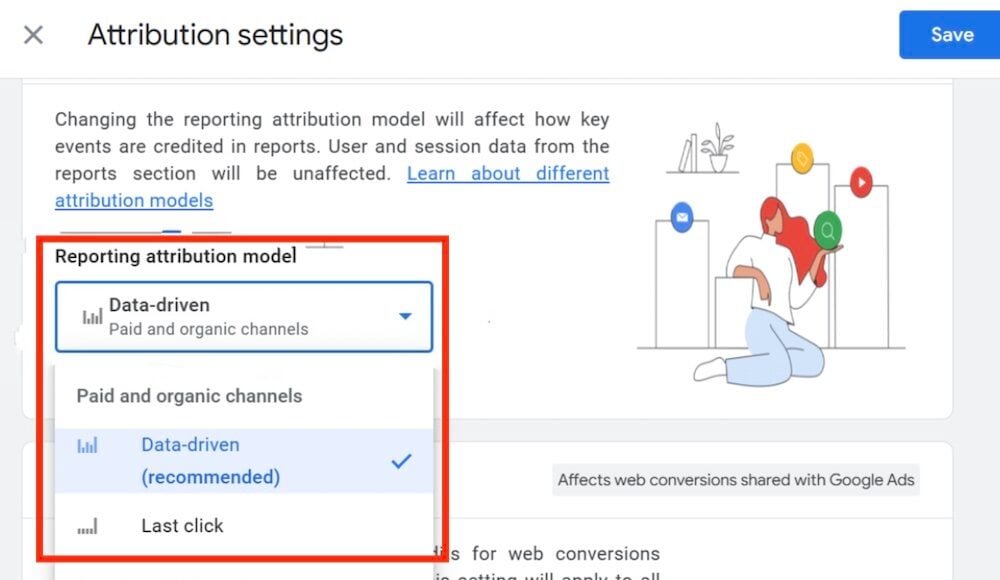
Google Analytics 4 now offers just two methods for attributing conversions:

  • “Data-driven” uses machine learning to distribute attribution across multiple sources based on users’ previous behavior, excluding direct traffic, although it appears to skew toward Google-owned channels.

Google Analytics 4 offers two methods for attributing conversions: “Data-driven” and “Last click.”

GA4 offers multiple attribution windows, depending on a business’s sales cycle. Some products require no research and are typically purchased in minutes. Others are complex and need much consideration. I typically set the window at 30, 60, or 90 days.

Rarely does an ecommerce platform’s conversion attribution reports match Google Analytics. Here’s why.

  • Technical errors, such as incorrect installation of pixels on Google or Meta ads, and mistakes with UTM parameters.
  • Privacy rules and regulations complicate tracking. Examples include the E.U.’s GDPR and cookie restrictions.
  • Non-digital promotions, such as ads on TV, print, radio, and billboards, do not appear in GA4.
  • Multiple touches. A consumer may see a product or brand offline, search for it on Google, click on a paid listing, and then abandon the journey. Later, the product may appear in the shopper’s Instagram feed, prompting the conversion. No attribution scenario can pinpoint the source(s), as it varies by shopper.
  • Repeat purchases. Some returning customers go directly to a website, while others respond to ads.

Despite the differences, Google Analytics remains the most-used attribution tool. It’s free, with an ecosystem of users, consultants, and resources. It’s a good choice for advertisers on Google-owned platforms, although it also captures referrals from other sources.

Other Methods

Still, merchants have other attribution options.

Ecommerce platforms. Shopify, for example, offers multiple attribution models — last click, last non-direct click, and first click — and multiple windows. Most platforms, including Shopify, show just one source per sale. Merchants with few marketing channels and single touchpoints can usually rely on their platform’s reporting.

Third-party tools. Segment, Adobe Analytics, and others utilize regression models for multi-touch attribution, similar to GA4’s Data-driven method of assigning a value to each source by channel or campaign. Third-party tools do the math but cost money. They are not as accurate as one would hope, in my experience.

Marketing platforms. Most marketing channels offer built-in reporting for performance tracking on that platform. Advertisers can monitor, for example, the creative, body text, and audience targeting. But in-platform reports are not ideal when contrasting, say, Google versus Meta.

Simplified approach. An easy-to-implement method is to compare daily sales from your ecommerce platform with GA4’s Data-Driven conversion attribution reports. Then assess GA4’s values to establish the source of truth. Apply over- or under-reporting in GA4 as a percentage to arrive at a return on investment per channel. Perhaps a TV ad or a brand campaign generated a sales boost. Neither would appear in GA4. While not exact, this simplified approach can provide a more accurate reflection of a channel’s impact on revenue.

Here’s an example. My firm just analyzed sales attributions for an ecommerce health food client. We found (i) a strong sales correlation with both Google Ads and email marketing, (ii) a moderate correlation with Instagram ads, and (iii) a weak to non-existent correlation with sales and TikTok Ads. However, we did see success with retargeting ads on TikTok.

No Perfect Model

I know of no perfect conversion attribution platform or technique. The purchase journeys of modern shoppers are too complex and varied. But we can consistently gauge the impact of a channel or campaign by establishing the right process for a merchant’s products, marketing tactics, and tech setup.

Google’s ‘srsltid’ Parameter Appears In Organic URLs, Creating Confusion via @sejournal, @MattGSouthern

Google’s srsltid parameter, originally meant for product tracking, is now showing on blog pages and homepages, creating confusion among SEO pros.

Per a recent Reddit thread, people are seeing the parameter attached not just to product pages, but also to blog posts, category listings, and homepages.

Google Search Advocate John Mueller responded saying, “it doesn’t cause any problems for search.”  However, it may still raise more questions than it answers.

Here’s what you need to know.

What Is the srsltid Parameter Supposed to Do?

The srsltid parameter is part of Merchant Center auto-tagging. It’s designed to help merchants track conversions from organic listings connected to their product feeds.

When enabled, the parameter is appended to URLs shown in search results, allowing for better attribution of downstream behavior.

A post on Google’s Search Central community forum clarifies that these URLs aren’t indexed.

As Product Expert Barry Hunter (not affiliated with Google) explained:

“The URLs with srsltid are NOT really indexed. The param is added dynamically at runtime. That’s why they don’t show as indexed in Search Console… but they may appear in search results.”

While it’s true the URLs aren’t indexed, they’re showing up in indexed pages reported by third-party tools.

Why SEO Pros Are Confused

Despite Google’s assurances, the real-world impact of srsltid is causing confusion for these reasons:

  • Inflated URL counts: Tools often treat URLs with unique parameters as separate pages. This inflates site page counts and can obscure crawl reports or site audits.
  • Data fragmentation: Without filtering, analytics platforms like GA4 split traffic between canonical and parameterized URLs, making it harder to measure performance accurately.
  • Loss of visibility in Search Console: As documented in a study by Oncrawl, sites saw clicks and impressions for srsltid URLs drop to zero around September, even though those pages still appeared in search results.
  • Unexpected reach: The parameter is appearing on pages beyond product listings, including static pages, blogs, and category hubs.

Oncrawl’s analysis also found that Googlebot crawled 0.14% of pages with the srsltid parameter, suggesting minimal crawling impact.

Can Anything Be Done?

Google hasn’t indicated any rollback or revision to how srsltid works in organic results. But you do have a few options depending on how you’re affected.

Option 1: Disable Auto-Tagging

You can turn off Merchant Center auto-tagging by navigating to Tools and settings > Conversion settings > Automatic tagging. Switching to UTM parameters can provide greater control over traffic attribution.

Option 2: Keep Auto-Tagging, Filter Accordingly

If you need to keep auto-tagging active:

  • Ensure all affected pages have correct canonical tags.
  • Configure caching systems to ignore srsltid as a cache key.
  • Update your analytics filters to exclude or consolidate srsltid traffic.

Blocking the parameter in robots.txt won’t prevent the URLs from appearing in search results, as they’re added dynamically and not crawled directly.

What This Means

The srsltid parameter may not affect rankings, but its indirect impact on analytics and reporting is being felt.

When performance reporting shifts without explanation, SEO pros need to provide answers. Understanding how srsltid functions work, and how it doesn’t, helps mitigate confusion.

Staying informed, filtering correctly, and communicating with stakeholders are the best options for navigating this issue.


Featured Image: Roman Samborskyi/Shutterstock

The 30 Most-Subscribed YouTube Individuals (Q2 2025) via @sejournal, @theshelleywalsh

In Q2 2025, MrBeast has retained his top spot as the most-subscribed YouTube individual on the social media platform.

After MrBeast overtook PewDiePie in late 2022 to shake up the top-most subscribed on YouTube leaderboard, there has been even more movement in the second quarter of 2025.

At the beginning of YouTube, it was a long journey for individuals to reach 100 million subscribers, but now MrBeast is the first individual YouTuber to crack 200 million subscribers.

On YouTube, way back in 2006, Judson Laipply was the first recorded individual to have the most subscribers, with mere thousands.

In the same year, Brookers was the first channel and individual to reach 10,000 subscribers – and that was a big deal.

Today, MrBeast is the most-subscribed individual, just above T-Series – an Indian record label and film studio that was once the number one most-subscribed channel on YouTube.

T-Series was the first channel to reach 100 million subscribers in 2019 and the first to reach 200 million in 2021.

While T-Series held twice as many subscribers as the top individual YouTuber last year, it has now been overtaken by the most popular content creator.

Being an influencer is big business.

Who Is The No. 1 Most Subscribed YouTuber?

As of June 2025, MrBeast is the most-subscribed YouTuber, with 399 million subscribers.

Kid-friendly content channel Like Nastya is now the second most-subscribed YouTube individual with 128 million subscribers.

PewDiePie has retained third place with 110 million.

The Top 30 Most-Subscribed YouTubers, June 2025

Channel Videos Language Subscribers (In Millions)
1 MrBeast 874 English 399
2 Like Nastya 952 English 128
3 PewDiePie 4,820 English 110
4 김프로KIMPRO 3,200 Korean 106
5 Alan’s Universe 1,370 English 92.7
6 A4 1,000 Russian 80.8
7 Justin Bieber 249 English 75.4
8 UR · Cristiano 102 European Portuguese 75.2
9 KL BRO Biju Rithvik 3,100 Hindi 72.8
10 Mark Rober 212 English 68.5
11 Fede Vigevani 1,510 Spanish 67.3
12 Topper Guild 1,170 English 65.8
13 EminemMusic 198 English 65
14 Alejo Igoa 1,190 Spanish 64.5
15 ISSEI / いっせい 3,630 Japanese 61.5
16 Taylor Swift 285 English 61
17 PANDA BOI 1,180 Multilingual 58.6
18 Zhong 1,950 English 58.3
19 Marshmello 534 English 57.9
20 Acharya Prashant 13,700 Hindi 56.7
21 Ed Sheeran 607 English 56.4
22 Mikecrack 2,120 Spanish 56.4
23 Ariana Grande 229 English 56.1
24 Billie Eilish 161 English 55.8
25 Bispo Bruno Leonardo 7,530 Portuguese 55.5
26 Jess No Limit 2,680 Indonesian 54.2
27 JuegaGerman 2,310 Spanish 53.4
28 Alfredo Larin 1,900 Spanish 52.8
29 LUCCAS TOON – LUCCAS NETO 3,200 Portugese 52.1
30 BETER BÖCÜK 1,900 Turkish 51.5

*Data Sources (SocialBlade, YouTube), June 2025

Please note that this is a list of the most subscribed individuals, not the most subscribed channels. It excludes “brand” channels that don’t focus on an individual personality, artist, or influencer.

Who Are The Top 10 Most-Subscribed YouTubers?

The list of the top 30 most-subscribed individuals features many successful music artists but has a majority of native YouTube influencers.

With the channel becoming an integral part of marketing and distribution for music artists, it’s no surprise that top artists feature highly.

Justin Bieber, the top individual artist, leveraged YouTube from an early age to gain mainstream attention on his own terms.

MrBeast has over 323.6 million more subscribers than Bieber, which highlights just how much attention the channel can achieve – and that, today, being a YouTube influencer is the same as being a traditional celebrity.

To get a better understanding of who all the influencers are, we’ve included a summary of the top 10 most-subscribed YouTuber influencers below.

1. MrBeast

U.S.-based Jimmy Donaldson started MrBeast as MrBeast6000 in 2012 when he was only 13.

He also holds five other channels, including Beast Reacts, MrBeast 2, Beast Philanthropy, and MrBeast 3 (inactive). MrBeast Gaming also sits in the top 100, with just under 47.5 million subscribers.

MrBeast’s early videos include counting to 10,000 non-stop (a 44-hour stunt), which quickly went viral but is now best known for videos that involve elaborate stunts, charity donations, or cash giveaways.

In one video, he gave away $1 million and has done several big philanthropic stunts, such as “I Built 100 Wells in Africa” and “I Rescued 100 Abandoned Dogs.”

When reaching the 200-million subscriber milestone in October 2023, MrBeast took to X (Twitter) to say how stunned his 13-year-old self would be and that he planned to continue making content for decades.

When he reached 300 million subscribers in July 2024, he posted on X (Twitter) to say he remembered freaking out when he hit 300 subscribers 11 years ago.

In his usual philanthropic style, he also gave away a private island for his 100-million subscriber milestone, which is probably part of the reason he originally took the top position from PewDiePie in December 2022.

Jimmy Donaldson’s channel brings in between $600 and $ 700 million a year, but his mother is the person who looks after his bank accounts.

He still resides in his hometown of Greenville, North Carolina, and employs many local people in the production of his videos.

2. Like Nastya

Anastasia Sergeyevna Radzinskaya is the only individual child YouTuber on the list. She was born in January 2014 and is the youngest influencer with the most followers, now overtaking PewDiePie by 18 million to take the No. 2 spot.

It’s worth noting that another channel, Vlad and Niki, is very popular with 140 million subscribers – but as a duo rather than an individual, they aren’t included in this list. Despite being featured in last year’s rankings, Ryan’s World has now fallen out of the rankings.

Although Radzinskaya was born in Russia, she has since moved to the U.S., and her videos are produced in English. The channel is for children and covers educational entertainment and vlogging.

Some of her success is down to the channel being dubbed in several languages, enabling her to reach a wide audience.

Radzinskaya’s parents help her manage the Like Nastya channel, but she is the face and star of the show.

3. PewDiePie

PewDiePie, otherwise known as Felix Arvid Ulf Kjellberg, held the most-subscribed position on YouTube for nearly 10 years until 2022. He was the original YouTube influencer who crossed over from online to be famous offline.

Swedish Kjellberg registered PewDiePie in 2010, and started out with play-by-plays of video games – a genre known as “Let’s Play.” It only took three years for him to be the most-subscribed channel on YouTube, and he was the highest-earning YouTuber in 2016.

Alongside “Let’s Play” content, PewDiePie has also experimented with comedy, commentary, music, and shows.

Following the rising success of his channel, Kjellberg also released his own game and published a book.

In 2022, his content shifted more towards lifestyle content after moving to Japan, with another shift in 2023 as he became a father. These changes to the types of videos PewDiePie produces could be the reason for his slightly waning subscriber count.

4. 김프로KIMPRO

KIMPRO (real name: Kim Dong-jun) is a South Korean content creator who is best known for his comedic and financial content. His two sisters often appear as guest stars in his videos.

His channel exploded in popularity in recent years, thanks primarily to his comedy clips. Meanwhile, his TikTok account, kimpro828, gained a massive following of 4.3 million followers in recent years.

He started in August 2022, which makes these numbers all the more impressive. Using special effects, viewers are drawn to his mix of viral recreations, including mukbangs, vlogs, challenges, and video reactions.

Though all of his content is in Korean, his relatable comedy has earned him a large and loyal subscriber base. His success demonstrates that niche content, particularly when made entertaining, can compete with the gaming and music genres on YouTube.

5. Alan’s Universe

Alan Chikin Chow is an American content creator, actor, and producer who became famous for his simple yet comedic sketches and bold storytelling.

His channel, “Alan’s Universe,” is a high school collective series. His videos feature himself and his classmates as recurring main characters, facing bullies and winning with the power of love. This theme has resonated with younger audiences.

His success has been largely driven by YouTube Shorts, where his high-quality production and positive energy align well with viewer expectations.

Alan has also appeared in TV shows and commercial ads, and he continues to bridge the gap between social media and traditional entertainment.

He has partnered up with streaming platform, Roku, and his series has been available since March 24, 2025, bringing his universe to new platforms and broader audiences.

6. A4

Belarusian content creator Vladislav Andreyevich Bumaga, known online as Vlad A4 or simply A4, holds the position of one of the most popular Russian-speaking YouTubers.

He created his channel back in 2014, with A4 being a play on his last name, Bumaga, meaning “paper.”

In 2016, he released a video called “24 Hours in a Trampoline Centre,” which took his subscriber count from 200,000 to his first 1 million.

Now, with just over 80.8 million subscribers, he continues to upload a wide variety of challenges and vlog content featuring his friends, as well as promoting his branded products.

7. Justin Bieber

Canadian Justin Bieber is the musical artist with the most followers on YouTube. He joined YouTube in 2007 and, after coming second in a local singing competition, began posting himself performing song covers.

After his channel started to grow, he got the attention of his now manager and his record label. In 2008, he signed a recording contract.

Bieber continued to focus on his YouTube channel and growing his followers, known as “Beliebers.”

This most likely contributed to his early and continued success. He continues to post videos on YouTube alongside his music videos and promotional content, although his last upload was now over two years ago.

8. UR · Cristiano

No surprises here – Cristiano Ronaldo was already the most legendary footballer possibly of all time, way before YouTube.

Being very social savvy, he has cultivated a massive following across social platforms, and YouTube is no exception.

His channel features a mix of personal highlights, behind-the-scenes training footage, interviews, commentaries, and sponsored content. Additionally, his collaboration with the number one most subscribed YouTuber, Mr. Beast, amassed 59 million views.

While he is not a traditional vlogger or influencer, Ronaldo’s global fan base ensures that any content he posts gets millions of views.

As a newcomer in this top 10 list, he demonstrates the power of celebrity, and that in itself can drive subscriber numbers, even with infrequent uploads.

9. KL BRO Biju Rithvik

KL BRO Biju Rithvik is an Indian content creator from Kerala, featuring his daily life. The channel features family-friendly short films and skits.

They are a family-centered content that features relatable and silly moments, resonating with a wide audience in India.

The rise of YouTube Shorts in India has played a significant role in its massive growth, with each Short amassing millions of views. YouTube CEO Neal Mohan notes the milestone for Shorts in India:

“YouTube is number one in reach and watch time in India. And we just passed a huge milestone. Shorts, which we first launched in India, now have trillions of views here.”

10. Mark Rober

Science can be fun and suitable for everyone, as former NASA engineer turned YouTuber Mark Rober proves with his spot on this top 10 list.

As the current founder of Crunchlabs, a STEM subscription box and learning platform for kids and adults. His science-focused videos do combine education with entertainment.

From jumping on a moving train (a la Tom Cruise) and building his own indoor rollercoaster to glitterbombs for car thieves, each video documents and explains how the engineering works.

Not to mention, every project is unique, with a step-by-step process that makes it accessible for aspirants to do the same.

With high-quality production, he says he leans heavily on his community to support his initiatives. Back in 2019, he partnered up with MrBeast for his #TeamTrees project to help raise $20 million for 20 million trees.

Why YouTubers Are Significantly Influential For Online Marketers

Achieving a most-subscribed status on YouTube cements you as an influencer and enables you to make serious income.

Not only can YouTubers earn from ads on the videos, but they are also in demand as brand ambassadors for product placements, product reviews, and product collaborations.

Mere mentions of products and brands by an influencer can drive traffic and sales for brands.

Smart influencers use the exposure to diversify into many mainstream areas of collaboration and business to supplement their income and ensure longevity.

Much like top-level sports stars have always been in demand as brand ambassadors, influencers can be used for brand alignment.

Influencer marketing doesn’t have to be just for the big brands; influencers with only a few thousand engaged followers can help spread messages.

And for smaller brands, elevated exposure on social media can be a major benefit.

More Resources:


Featured Image: Roman Samborskyi/Shutterstock

Query Fan-Out via @sejournal, @Kevin_Indig

Boost your skills with Growth Memo’s weekly expert insights. Subscribe for free!

Today’s Memo is all about query fan-out – a foundational concept behind AI Mode that’s quietly rewriting the rules of SEO.

You’ve probably heard the term. Maybe you’ve seen it in Google’s AI Mode announcementAleyda Solis’ write-up, or Mike King’s deep dive.

But why is it really that revolutionary? And how does it impact the way we approach search strategy going forward? You might already be “optimizing” for it and not even be aware!

That’s what we’re digging into today.

Plus: I’ve built an intent classifier tool for premium subscribers to help you group prompts and questions by user intent in seconds – coming later this week (still need to iron out a few kinks).

In this issue, we’ll cover:

  • What query fan-out is.
  • How it powers AI Mode, Deep Search, and conversational search.
  • Why optimizing for “one query, one answer” is no longer enough.
  • Tactical ways to align your content ecosystem with fan-out behavior.

Let’s get into it.

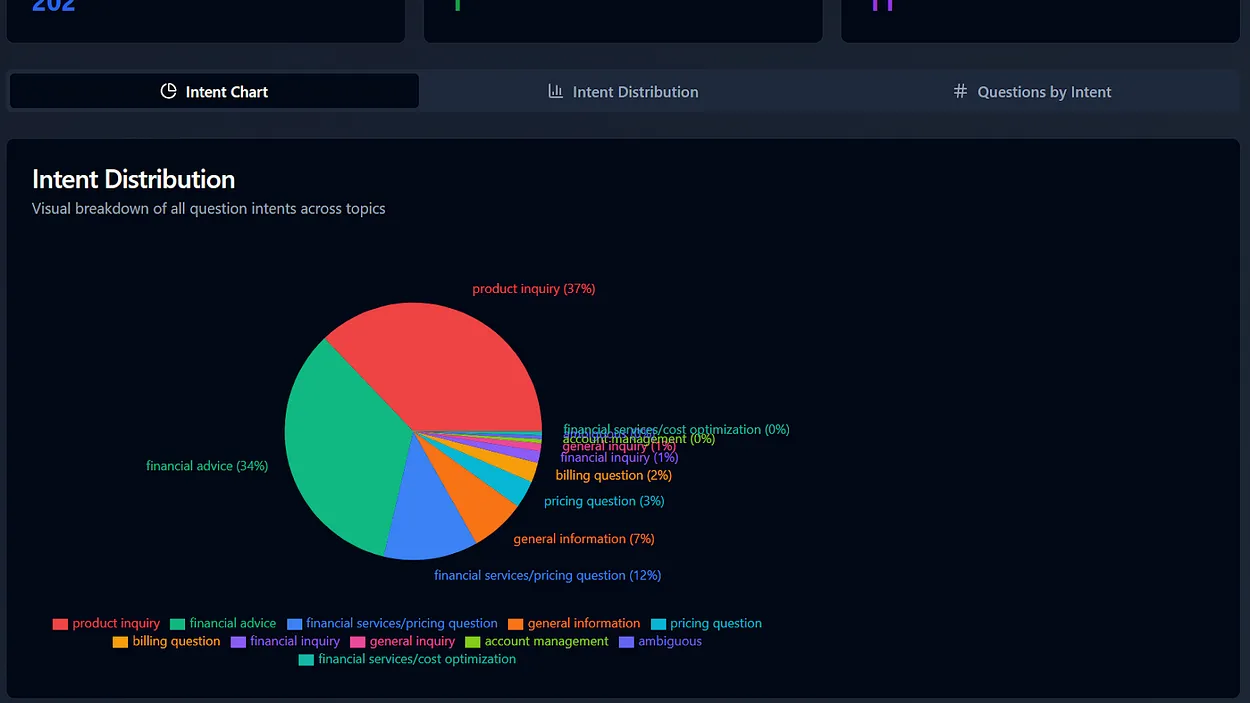
Image Credit: Kevin Indig

What Is Query Fan-Out And Why Are You Hearing So Much About It Right Now?

Query fan-out is how Google’s AI Mode takes a single search and expands it into many related questions behind the scenes.

It can pull in a wider range of content that might answer more of your true intent, not just your exact words.

You’re hearing about it now because Google’s new AI Overviews and “AI Mode” rely on this process, which could change what content shows up in “search” results.

Query fan-out isn’t just another marketing buzzword. It’s how AI Mode works.

It’s crucial to start understanding this concept because it’s very likely that AI Mode will become the default search experience over the next few years. (I expect it will be once Google figures out how to monetize it appropriately.)

This is why I think AI Mode could become the search standard:

On the Lex Fridman podcast, Sundar Pichai said AI Mode will slowly creep more into the main search experience:

Lex Fridman: “Do you see a trajectory in the possible future where AI Mode completely replaces the 10 blue links plus AI Overview?”

Sundar Pichai: “Our current plan is AI Mode is going to be there as a separate tab for people who really want to experience that, but it’s not yet at the level there, our main search pages. But as features work, we will keep migrating it to the main page, and so you can view it as a continuum.”

He also said that pointing at the web is a main design principle:

Lex Fridman: “And the idea that AI mode will still take you to the web to human-created web?”

Sundar Pichai: “Yes, that’s going to be a core design principle for us.”

However, if AI Overviews are any indication, you shouldn’t expect much traffic to come through AI Mode results. CTR losses can top 50%.

And according to Semrush and Ahrefs, ~15% of queries show AI Overviews.

But the actual number is likely much higher, since we’re not accounting for the ultra-long-tail, conversational-style prompts that searchers are using more and more.

Even though AI Mode covers only a bit over 1% of queries right now – as mentioned in The New Normal – it’s likely going to be the natural extension of every AI Overview.

Understanding Query Fan-Out To Better Optimize Your Content Just Makes Sense

Important note here: I don’t want to pretend that I know how to “optimize” for query fan-out.

And query fan-out is a concept, not a practice or tactic for optimization.

With that in mind, understanding how query fan-out works is important because people are using longer prompts to conversationally search.

And therefore, in conversational search, a single prompt covers many user intents.

Let’s take a look at this example from Deep SEO:

Deep Search performs tens to hundreds of searches to compile a report. I’ve tried prompts for purchase decisions. When I asked for “the best hybrid family car with 7 seats in the price range of $50,000 to $80,000”, Deep Research browsed through 41 search results and reasoned its way through the content.
[…]

The report took 10 minutes to put together but probably saved a human hours of research and at least 41 clicks. Clicks that could’ve gone to Google ads.

In my search for a hybrid family car, the Deep Search function understood multiple search journeys, multiple intents, and synthesized what would have been multiple pages of classic SEO results into one piece of content.

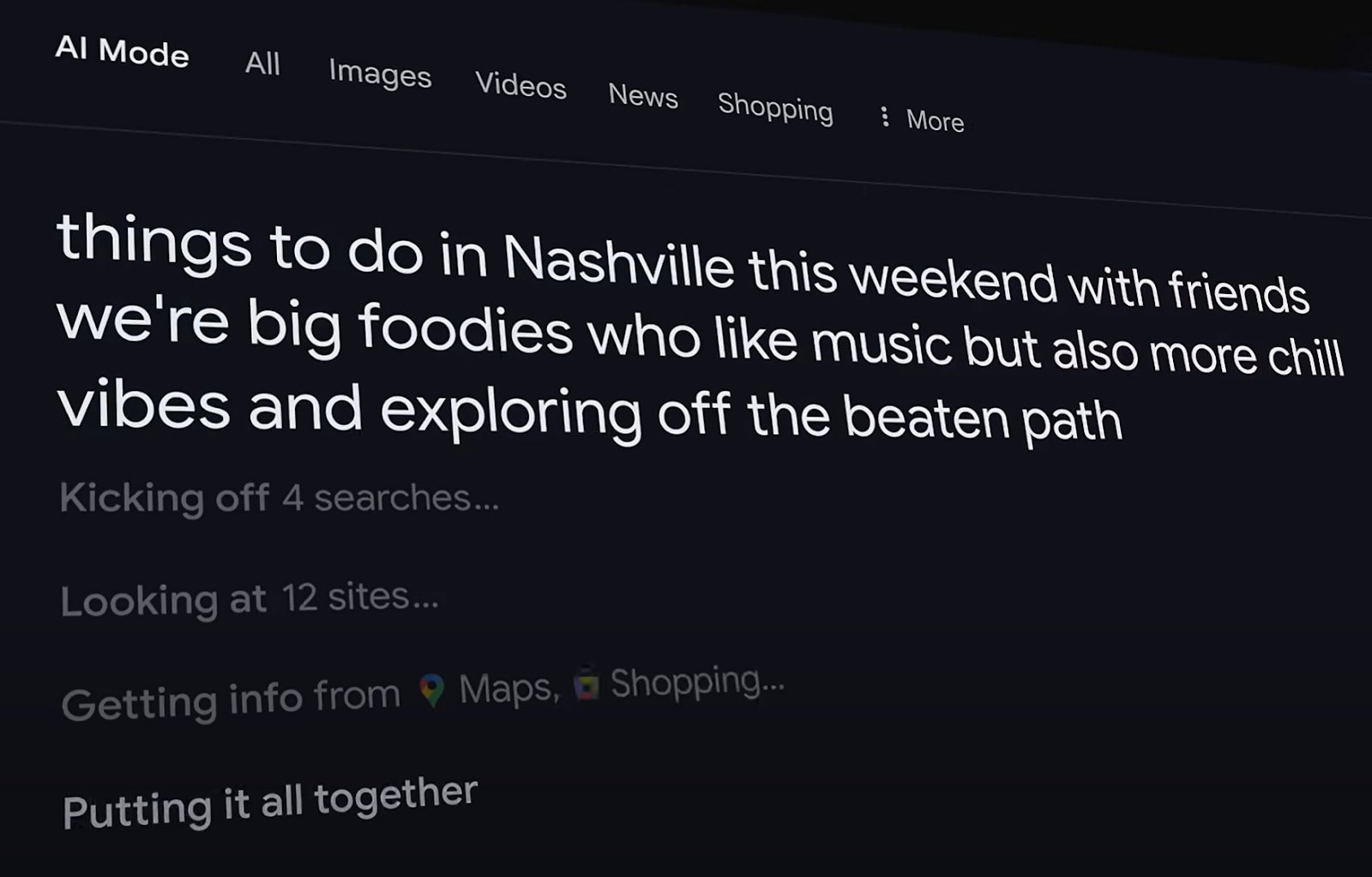
And check out this example from Google’s own marketing material:

Image Credit: Kevin Indig

This Deep Search kicked off four searches, but I’ve seen examples of 30 and more.

This is exactly why understanding query fan-out is important.

AI-based conversational search is no longer matching a single query to a single result.

It’s fanning out into dozens of related searches, intents, and content types to synthesize an answer that bypasses traditional SEO pathways entirely.

The Mechanics Behind Query Fan-out

Here’s my understanding of how query fan-out works based on the wonderful research by Mike King, as well as Google’s announcement and documentation:

  1. In classic Search, Google returns one ranked list for a query. In AI Mode, Gemini explodes your prompt into a swarm of sub-queries – each aimed at a different facet of what you might really care about. Example: “Best sneakers for walking” turns into best sneakers for men, walking shoes for trails, shoes for humid weather, sock-liner durability in walking shoes, and so on.
  2. Those sub-queries fire simultaneously into the live web index, the Knowledge Graph, Shopping graph, Maps, YouTube, etc. The system is basically running a distributed computing job on your behalf.
  3. Instead of treating a web page as one big answer, AI Mode lifts the most relevant passages, tables, or images from each source. Think “needle-picking” rather than “stack-ranking.” So, rather than a search engine saying “this whole page is the best match,” it’s more like “this sentence from site A, that chart from site B, and this paragraph from site C” are the most relevant parts.
  4. Google keeps a running “session memory” – a user embedding distilled from your past searches, location, and preferences. That vector nudges which sub-queries get generated and how answers are framed.
  5. If the first batch doesn’t fill every gap, the model loops and issues more granular sub-queries, pulls new passages, and stitches them into the draft until coverage looks complete. All this in a few seconds.
  6. Finally, Gemini fuses everything into one answer and matches it to citations. Deep Search (“AI Mode on steroids”) can run hundreds of these sub-queries and spit out a fully cited report in minutes.

Keep in mind, entities are the backbone of how Google understands and expands meaning. And they’re central to how query fan out works.

Take a query like “how to reduce anxiety naturally.” Google doesn’t just match this phrase to pages with that exact wording.

Instead, it identifies entities like “anxiety,” “natural remedies,” “sleep,” “exercise,” and “diet.”

From there, query fan-out kicks in and might generate related sub-queries, refining based on prior searches of the user:

  • “Does magnesium help with anxiety?”
  • “Breathing techniques for stress”
  • “Best herbal teas for calming nerves”
  • “How sleep affects anxiety levels”

These aren’t just keyword rewrites. They’re semantically and contextually related ideas built from known entities and their relationships.

So, if your content doesn’t go beyond the primary query to cover supporting entity relationships, you risk being invisible in the new AI-driven SERP.

Entity coverage is what enables your content to show up across that full semantic spread.

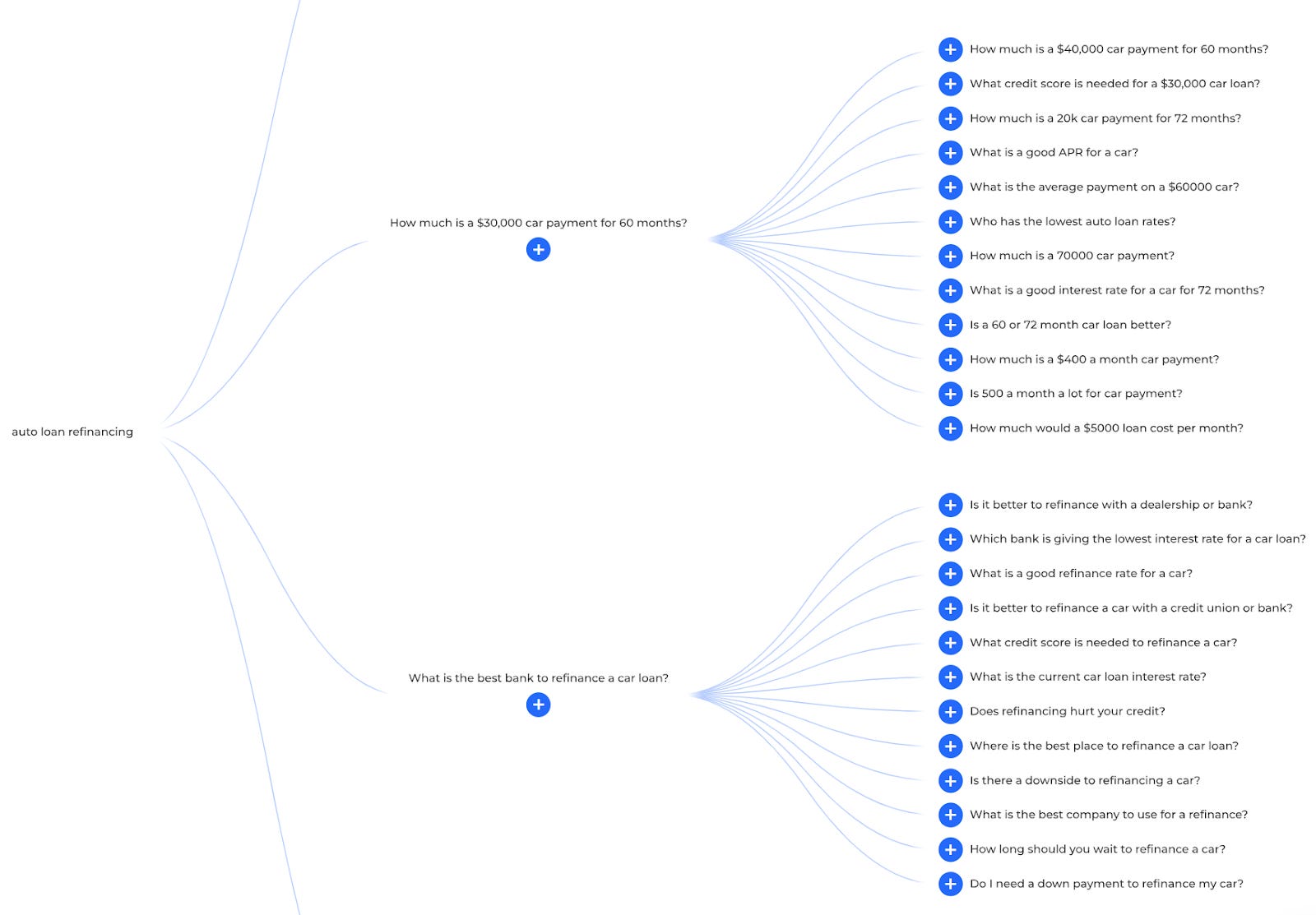
Here’s a good way to visualize this is the relationship between questions, topics, and entity expansion (from alsoasked.com):

Image Credit: Kevin Indig

If this all reminds you strongly of the concept of user intent, your instincts are well-tuned.

Even though query fan-out sounds cool and looks innovative, there is little difference to how we should already be targeting topics instead of keywords via entity-rich content. (And we all should’ve been doing this for a while now.)

Interjection from Amanda here: I’d argue that this kind of process (or a similar one) has been going on behind the scenes in classic SEO results for a while … although, unfortunately, I don’t have concrete proof. Just strong pattern recognition from spending way too much time in the SERPs testing things out. 😆

Back in 2018-2019, I noticed this pattern happening often with in-depth, entity-rich content pieces ranking – and performing well – for multiple related intents in search. The more entity-rich a content piece was, and the more the content tackled the “next natural need” of the searcher, the more engagement + dwell time increased while also concluding the search journey…

And the more the content did those things, the more the content was visible to our target audience in classic rankings … and the longer it held that visibility or ranking despite algorithm changes or competitor content updates.

Implementable SEO Moves Related To Query Fan-Out Mechanics

When you keep query fan-out in mind, there are a few practical steps you can take to shape your content and optimization work more effectively.

But before you give it a scan, I need to reiterate what was mentioned earlier: I’m not going to claim I have a clear-cut way to “optimize” for Google’s AI Mode query fan-out process – it’s just too new.

Instead, this list will help you optimize your content ecosystem to fully address the multifaceted needs behind your target user’s search goal.

Because optimizing for conversational search starts with one simple shift: addressing searcher needs from multiple angles and making sure they can find those multiple angles across your site … not just one query at a time.

1. Passage-first authoring.

  • Write in 40-60-word blocks, each answering one micro-question.
  • Lead with the answer, then detail – mirrors how AI selects snippets.

2. Semantically-rich headings.

  • Avoid generic headings and subheadings (“Overview”). Embed entities and modifiers the AI may spin into sub-queries (e.g., “Battery life of EV SUVs in winter”).

3. Outbound credibility hooks.

  • Cite peer-reviewed, governmental, or high-authority sources; Google’s LLM favors passages that have citations and sources for grounding claims.

4. Clustered architecture.

  • Build hub pages that summarize and deep-link to spokes. Fan-out often surfaces mixed-depth URLs; tight clusters raise the odds that a sibling page is chosen.

5. Contextual jump links (“fraggles” or “anchor links”).

  • For long-form, use internal jump links within body copy, not just in the TOC. These help LLMs and search bots zero in on the most relevant entities, sections, and micro-answers across the page. They also improve UX. (Credit to Cindy Krum’s “fraggles” concept.)

6. Freshness pings.

  • Update time-sensitive stats often. Even a minor line edit plus a new date encourages recrawl and qualifies the page for “live web” sub-queries.

How To Optimize For Intent Coverage – A Key Component Of Query Fan-Out

Google’s AI Mode and the query fan-out process mirror how humans think – breaking a question into parts and piecing together the best information to solve a need.

People don’t search in a silo – when they search, they’re searching from a perspective, a history, and with emotions and multiple questions/concerns attached.

But as an industry, we have long focused on single queries, intents, or topic clusters to guide our optimization. Sure, this is useful, but it’s a narrow lens.

And it overlooks the bigger picture: Optimizing your content ecosystem to fully address the broader, multi-faceted needs behind a person’s goal.

We know Google’s AI Mode draws from:

  • Related queries.
  • Related user intents.
  • Related and connected entities.
  • Reformatting/rephrasing of the prompt.
  • Comparison.
  • Personalization: Search history, emails, etc.

So, here’s my step-by-step (unproven) concept:

  1. Prompts are questions.
  2. But just covering questions is not enough, we need to create content for their underlying user intent.
  3. If we can classify a large number of questions around a topic, we can increase our chances of being visible when AI Mode fans out.

Here’s a step-by-step guide:

  1. Collect questions for a topic from:
    • Customer interviews (the best source, in my experience).
    • Semrush’s Keyword Magic Tool.
    • Ahrefs’ Keyword Ideas.
    • Reddit (e.g., via Gummysearch).
    • YouTube (VidIQ).
    • Mike King’s excellent Qforia tool.
  2. Group your collection of questions by user intents.
  3. Match each intent to a piece of content or specific passage on your site.
  4. Use search tools and test actual conversations with LLMs to see who ranks at the top for the intent.
  5. Compare your content/passage against the top-referred content pieces.
  6. Ensure your content is entity-rich and includes those sweet, sweet information gainz.

Not only do paid subscribers get more content, more data, and more insights, but they also get the intent classifier tool I built to help save you some time on this work I’ve listed out above (coming to premium subscribers later this week).

If you’ve been doing SEO pre-AI-search era, it’s likely you’ve already been doing some version of this work.

The key thing to remember is to group questions and queries by intent – and optimize for intents across your core topics.

Think through what would’ve been a “search journey” or “content journey” for your user in classic search, and recognize that’s now happening all at once in one chat session.

The biggest mindset shift you’ll likely need to make is thinking about queries as prompts vs. searches.

And those prompts? They’re inputted by users in a variety of ways or semantic structures. That’s why an understanding of entities plays a key part.

But before you jump, I need to emphasize a core factor to creating content with query fan-out in mind: Make sure you do the work to take your collected questions that you plan on targeting and group them by intent.

This is a crucial first step.

To help you do that, I’ve created an intent classifier tool that premium subscribers will get in their inbox later this week. It’s simple to use, and you can drop your collected list of questions to group by intent in a matter of minutes.


Featured Image: Paulo Bobita/Search Engine Journal