Roundtables: Brain-Computer Interfaces: From Promise to Product

Recorded on April 23, 2025

Brain-Computer Interfaces: From Promise to Product

Speakers: David Rotman, editor at large, and Antonio Regalado, senior editor for biomedicine.

Brain-computer interfaces (BCIs) have been crowned the 11th Breakthrough Technology of 2025 by MIT Technology Review‘s readers. BCIs are electrodes implanted into the brain to send neural commands to computers, primarily to assist paralyzed people. Hear from MIT Technology Review editor at large David Rotman and senior editor for biomedicine Antonio Regalado as they explore the past, present, and future of BCIs.

Related Coverage

SMB Ads Unchanged by Google Antitrust Ruling

Google’s recent advertising antitrust loss is much ado about nothing for small- and medium-sized businesses.

On April 17, 2025, U.S. District Judge Leonie Brinkema found that Google had “willfully acquired and maintained monopoly power” in two digital advertising markets: display ad servers and ad exchanges.

Google offers these technologies in Ad Manager, its advertising management platform, once called DoubleClick for Publishers. Ad servers enable advertisers to upload ads and show them on third-party websites. Google’s ad exchange, AdX, is a marketplace where advertisers and publishers buy and sell inventory.

Significance

The loss is significant for Google. It marks the third time the U.S. Department of Justice has won an antitrust ruling in district court against Alphabet, Google’s parent company. The cases are at various appeal phases and include a $700 million fine for alleged Play Store violations, the potential divestiture of Chrome for monopolizing “queries on the internet,” i.e., search, and now for ad tech.

It is also significant because Google Ad Manager — the ad server and AdX — is far and away the most popular advertising platform for enterprise-level publishers such as NBCUniversal, Disney, and Hearst.

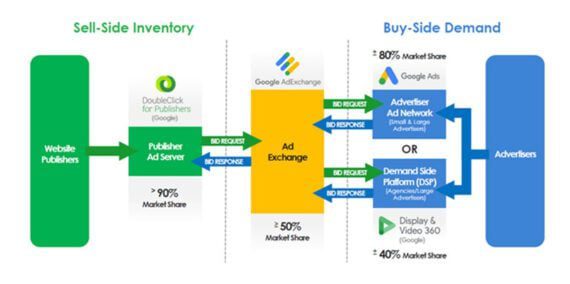
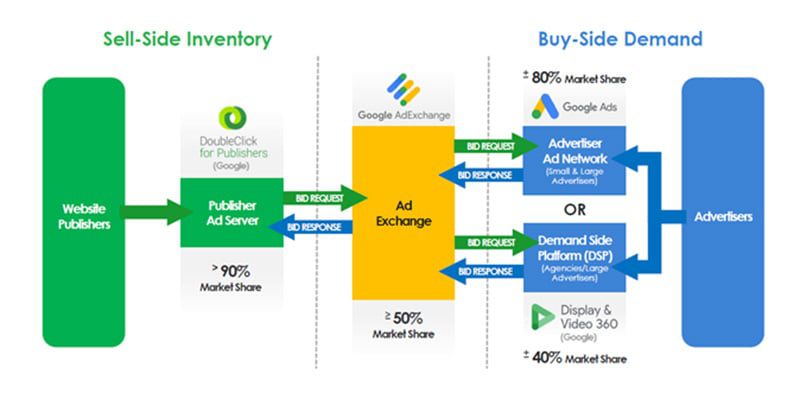
Illustration from the DOJ of Google's ad business

This illustration from the DOJ’s filing against Google shows the three parts of Google’s ad business: ad servers on the left, the ad exchange in the middle, and ad buying tools on the right. Click image to enlarge.

In fact, according to the 2023 DOJ filing that initiated the case, Google had a 90% share of the ad server market and a 50% share for AdX.

Thus it’s not surprising that many in the industry predict seismic changes in how digital display ads are bought, sold, and served.

Little Change for SMBs

Despite the hubbub, there are at least three reasons this ad-focused antitrust case will have a minimal impact on smaller brands, including retail, direct-to-consumer, and B2B.

Google’s appeal

Google will almost certainly appeal the ruling, which could take months or years and prevent meaningful changes to Ad Manager or digital advertising generally.

During the appeal, Google’s lawyers have a strong argument.

The DOJ had initially claimed that Google had a complete ad tech monopoly over ad servers, ad exchanges, and the tools used for buying ads. But the court did not agree, stating that Google did not control the online ad buying despite the dominance of Google Ads.

Hence the very advertising tool many ecommerce SMBs use (Google Ads) is not included in the ruling and likely won’t change much, even if Google loses other aspects of the case.

Multiple platforms

Rarely does an ecommerce marketing team depend solely on Google Ads for paid traffic. Most invest in Google Ads, Meta Ads, and others, such as X, Reddit, and Pinterest.

Thus any court-mandated changes to Google Ads (via an Ad Manager ruling) would represent only a portion of most advertisers’ activities.

Moreover, Google announced on April 22, 2025, that Chrome will not include a “user choice” prompt for third-party cookies. The proposed prompt had been part of the company’s Privacy Sandbox initiative. European Union regulators had expressed concerns that the Privacy Sandbox would give Google a monopoly over ad targeting.

Third-party tracking cookies remain largely functional in Chrome.

Unbroken

The courts could force Google to sell its ad-serving capabilities or AdX — or not.

The very publishers the court sought to protect are dependent on a stable and predictable supply of advertisers. Any rapid or destructive change to the ad tech status quo would significantly harm these companies.

Many industry observers predict a legal outcome of fines and rules. The rules might transfer some control to Ad Manager’s competitors and require Google to share its ad technology.

So, again, Google’s antitrust outcome won’t likely change how SMBs buy ads.

Ad prices won’t fluctuate much either. Some reports have stated AdX charges a 30% fee per transaction. Yet all ad exchanges impose fees, often 50% or more.

In short, don’t expect a drop in ad prices.

7 AI Terms Microsoft Wants You to Know In 2025 via @sejournal, @MattGSouthern

Microsoft released its 2025 Annual Work Trend Index this week.

The report claims this is the year companies will move beyond AI experiments and rebuild their core operations around AI.

Microsoft also introduced several new terms that it believes will shape the future of the workplace.

Let’s look at what Microsoft wants to add to your work vocabulary. Remember, Microsoft has invested heavily in AI, so they have good reasons to make these concepts seem normal.

The Microsoft AI Dictionary

1. The “Frontier Firm”

Microsoft says “Frontier Firms” are organizations built around on-demand AI, human-agent teams, and employees who act as “agent bosses.”

The report claims 71% of workers at these AI-forward companies say their organizations are thriving. That’s much higher than the global average of just 37%.

2. “Intelligence on Tap”

This refers to AI that’s easily accessible whenever needed. Microsoft calls it “abundant, affordable, and scalable on-demand.”

The company suggests AI is now a resource that isn’t limited by staff size or expertise but can be purchased and used as needed, conveniently through Microsoft’s products.

3. “The Capacity Gap”

This term refers to the growing disparity between what businesses require and what humans can provide.

Microsoft’s research indicates that 53% of leaders believe productivity must increase, while 80% of workers report a lack of time or energy to complete their work. They suggest that AI tools can fill this gap.

4. “Work Charts”

Forget traditional org charts. Microsoft envisions more flexible “Work Charts” that adapt to business needs by leveraging both human workers and AI.

These structures focus on results rather than rigid hierarchies. They allow companies to use the best mix of human and AI workers for each task.

5. “Human-Agent Ratio”

This term refers to the balance between AI agents and human workers required for optimal results.

Microsoft suggests that leaders need to determine the number of AI agents required for specific roles and the number of humans who should guide those agents. This essentially redefines how companies staff their teams.

6. “Agent Boss”

Perhaps the most interesting term is that of an “agent boss,” someone who builds, assigns tasks to, and manages AI agents to boost their impact and advance their career.

Microsoft predicts that within five years, teams will be training (41%) and managing (36%) AI agents as a regular part of their jobs.

7. “Digital Labor”

This is Microsoft’s preferred term for AI-powered work automation. Microsoft positions AI not as a replacement for humans, but as an addition to the workforce.

The report states that 82% of leaders plan to use digital labor to expand their workforce within the next year and a half.

However, this shift towards AI-powered work automation raises important questions about job displacement, the need for retraining, and the ethical use of AI.

These considerations are crucial as we navigate this new era of work.

Behind the Terminology

These terms reveal Microsoft’s vision for embedding AI deeper into workplace operations, with its products leading the way.

The company also announced updates to Microsoft 365 Copilot, including:

  • New Researcher and Analyst agents
  • An AI image generator
  • Copilot Notebooks
  • Enhanced search functions

Jared Spataro, Microsoft’s CMO of AI at Work, states in the report:

“2025 will be remembered as the year the Frontier Firm was born — the moment companies moved beyond experimenting with AI and began rebuilding around it.”

Looking Ahead

While Microsoft’s terms may or may not stick, the trends it describes are already changing digital marketing.

Whether you embrace the title “agent boss” or not, knowing how to use AI tools while maintaining human creativity will likely become essential in the changing marketing workforce.

Will Microsoft’s vision of “Frontier Firms” happen exactly as they describe? Time and the number of people who adopt these ideas will tell.


Featured Image: Drawlab19/Shutterstock

Google’s Martin Splitt Explains How To Find & Remove Noindex Tags via @sejournal, @MattGSouthern

Google’s Search Relations team has released a new SEO Office Hours video with Martin Splitt.

He tackles a common problem many website owners face: unwanted noindex tags that keep pages out of search results.

In the video, Splitt helps a user named Balant who couldn’t remove a noindex tag from their website. Balant wanted their page to be public, but the tag prevented this.

Where Unwanted Noindex Tags Come From

Splitt listed several places where unwanted noindex tags might be hiding:

“Make sure that it’s not in the source code, it’s not coming from JavaScript, it’s not coming from a third-party JavaScript.”

Splitt pointed out that A/B testing tools often cause this problem. These tools sometimes add noindex tags to test versions of your pages without you realizing it.

CDN & Cache Problems

If you use a Content Delivery Network (CDN), Splitt warned that old cached versions might still have noindex tags even after you remove them from your site.

Splitt explained:

“If you had a noindex in and you’re using a CDN, it might be that the cache hasn’t updated yet.”

Check Your CMS Settings & Plugins

Splitt explained that your Content Management System (CMS) settings might be adding noindex tags without you knowing.

He said:

“If you’re using a CMS, there might be settings or plugins for SEO, and there might be something like ‘allow search engines to index this content’ or ‘to access this content,’ and you want to make sure that’s set.”

Splitt added that settings labeled as “disallow search engines” should be unchecked if you want your content to appear in search results.

See the full video:

Debugging Process for Persistent Noindex Issues

If you’re dealing with stubborn noindex problems, Splitt suggests checking these places in order:

  1. Check your HTML source code directly
  2. Look at JavaScript files that might add meta tags
  3. Review third-party scripts, especially testing tools
  4. Check if your CDN cache needs updating
  5. Look at your CMS settings and SEO plugins

What This Means For SEO Professionals

Google’s advice shows why thorough technical SEO checks are essential. Modern websites are complex with dynamic content and third-party tools, so finding technical SEO problems takes deeper digging.

SEO professionals should regularly crawl their sites with tools that process JavaScript. This practice provides a deeper understanding of how search engines interpret your pages, going beyond the basic HTML and revealing the true visibility of your content.

Google keeps covering these basic technical issues in its videos, suggesting that even well-designed websites often struggle with indexing problems.

If your pages aren’t showing up in search results, use Google’s URL Inspection tool in the Search Console. This shows you how Google sees your page and whether any noindex tags exist.

Google Quietly Ends COVID-Era Structured Data Support via @sejournal, @martinibuster

Google announced that it is dropping support for the 2020 COVID-era Special Announcements structured data type and completely phasing it out by July 31, 2025. The announcement was posted on the SpecialAnnouncement structured data documentation.

SpecialAnnouncement Structured Data

This structured data type was adopted by Google in April 2020 as a way to announce a wide range of information related to the COVID pandemic. It was specifically for COVID related announcements and it never evolved beyond pandemic related purposes although Google did allow the use of this structured data for local businesses to announce new store hours as a way to communicate to Google that data while not necessarily showing a rich result.
Interestingly, this structured data was released as a “beta” feature, meaning that it was a live test subject to changes and was never integrated as an official structured data, remaining a beta feature to the end.

There were two ways to submit a special announcement notice, by structured data and Google Search console.

Users who continue to use the Special Announcement structured data will have no negative effect by keeping it on their site but it will have no effect on Google Search.

Read Google’s special announcement about the deprecation of the SpecialAnnouncement structured data here:

Special announcement (SpecialAnnouncement) structured data (BETA)

Featured Image by Shutterstock/Blinx

The CMO’s Guide To Winning In AI Search With Ahrefs [Webinar] via @sejournal, @lorenbaker

What happens when no one clicks, but your business still needs to grow?

In the age of AI answer engines and fewer clicks, your brand can’t afford to be invisible.

It’s time to rethink how people find, remember, and trust your brand online.

Join us for “The CMO’s Guide to Winning in AI Search with Ahrefs.” A powerful strategy session designed to help you stay visible, profitable, and one step ahead in 2025.

Why This Webinar Is A Must-Attend Event:

AI-first search is changing the rules. We’re giving you the roadmap to adapt and thrive.

In this session, you’ll learn how to:

  • Track the right brand awareness metrics that connect visibility to profit.
  • Increase your presence in AI Overviews, SERPs, and AI-generated answers.
  • Automate smart AI marketing tactics to grow across multiple platforms.

Featuring Andrei Țiț, Product Marketer at Ahrefs, who’ll guide you through proven techniques for standing out even when clicks are harder to come by.

Why You Can’t Miss This:

This isn’t just about SEO anymore. It’s about building a brand that people seek out, no matter how they search.

Live Q&A: Stick around after the demo to get your questions answered directly by Andrei.

Can’t make it live? Register anyway, and we’ll send you the recording.

Let’s future-proof your brand strategy together.

Wix Announces Adaptive Content For Driving Higher Sales & Engagement via @sejournal, @martinibuster

Wix announced a new feature that enables businesses to create personalized content for visitors, increasing relevance and opportunities for higher sales and lead generation. The feature integrates AI into the workflow, making it easier for publishers to deliver advanced personalized experiences to returning customers.

Relevance = Higher Sales

It’s commonly known that site visitors who visit a site that’s an exact match for the keywords used in a search tend to convert at a higher rate than visitors that to a site that has less relevant  content. A website experience that’s directly relevant to site visitors contributes to higher conversion rates. Being able to optimize factors that contribute to relevance to site visitors is an innovative and useful way to deploy technology.

The new feature is easily configurable and offers simulations of what the adaptive content may look like so that Wix users can preview what their site visitors will see.

Muly Gelman, Senior Product Manager at Wix Personalize shared:

“Website personalization is now essential for delivering the relevant, engaging experiences today’s consumers expect. This application highlights how we can move beyond using AI to generate website content but leverage AI to dynamically adapt and personalize the live website experience for each visitor in real-time, empowering businesses to connect more effectively with their customers.

As a result, businesses can deliver engaging, personalized experiences that resonate with their audience, ultimately driving higher engagement rates and creating greater monetization opportunities.”

The new adaptive content feature complements their new Automation Builder and the Wix Functions feature.

Featured Image by Shutterstock/chainarong06

How To Onboard Digital Marketing Talent According To Agency Leaders

Effective onboarding of digital marketing talent is key to setting the foundations for a positive employee experience.

It’s also vital for accelerating productivity, boosting employee retention, and cultivating a positive company culture.

When done right, it leads to more engaged and profitable staff in the long run.

Solid and thorough inductions also help new employees understand the company culture, responsibilities, and nuanced team dynamics. More importantly, they can also serve to bridge any skill gaps and set the stage for success.

With all of this considered,  you’d naturally think that onboarding would be a top priority for all founders.  Sadly, this is often not the case.

Poor Onboarding Or Lack Thereof Is Killing Your Retention

Last year I placed 70 candidates in new roles. Seven quit of their own accord before their probation was up. Of these, all of them but one attributed a poor onboarding process to their early departure.

  • Three had never met their manager in person, not even once.
  • Two cited feeling isolated and removed from the rest of the business, despite working in the office.
  • Three had commented about trying but being unable to meet every stakeholder in the business to understand their motivations.
  • One reported not having a single proper conversation with their manager about key performance indicators (KPIs).

Historical Resentment Combined With Poor Communications

Nobody intentionally onboards staff poorly.

It often happens when there’s a rush to get the new hire started fast, usually because of bad planning and a long recruitment process, which translates to: “We needed you yesterday, so just jump in.”

This urgency can create a stressful environment for new staff.

Existing team members who might have taken the slack in their absence may quickly start offloading responsibilities, potentially overwhelming the employee.

Businesses that don’t address this early on end up with a high turnover.

So, How Can Agencies Improve Their Onboarding Process?

I spoke to various agency founders and directors across the UK, the U.S., Australia, and Dubai and I asked them for their insights and advice about onboarding.

Here’s what they recommend:

Observation And Shadowing Are Vital

Zoe Blogg, the Director of Operations at independent SEO & Content Marketing agency, Reboot, says:  “It’s about immersion. Our process is designed to give new hires time to truly absorb how we work before they’re expected to contribute. In the first two weeks, we encourage new team members – especially at a senior level – to focus on listening, observing, and understanding our culture, processes, and workflows before making any major changes or suggestions.”

Supporting the idea that early collaboration and involvement are key, Kristi Hoyle of Kaizen actively encourages new starters to sit in on ideation sessions and client strategy meetings, even with teams they won’t directly work with. The ultimate aim is to gradually ease them into the agency.

Phil Dukarsky, SEO lead at Dubai-based SEO Sherpa, leverages a buddy system to ensure that new starters are given the best introduction. Effectively, somebody from the same department is chosen to take this person under their wing and induct them into the department and the wider business.

Emma Welland, founder of paid media agency House of Performance, emphasizes a similar approach with a twist: “We assign everyone a mentor as well as a manager to make sure they have multiple people to check in with and speak to from day one.” They also make sure new employees have time with the founders on a weekly basis to ask questions and get extra support.

Use The Right Tool Kit

I’ve spoken to many digital agency founders and hiring managers, and many have their own nuanced tool stack to ensure that their onboarding is on point.

Zoe Blogg was the first to recommend ClickUp as a project management platform that has been adopted by businesses all over the world.

She explains: “We use the tool to centralise everything from training materials to role-specific onboarding tasks.”

“A key feature we leverage is a dedicated ‘sandbox’ space, where new team members can test ideas, experiment with workflows, and familiarise themselves with our systems in a low-pressure environment before making live changes,” she shares.

Systems like this provide central spaces for new employees to get to grips with existing workflows and ways of working very early on, so they’re not in the dark. This also offers them the chance to ask questions and even make suggestions for improvements, making them feel valued early on.

Kristi Hoyle of Kaizen Search uses ClickUp in combination with Notion, another project management tool, to centralize all learning resources, induction documents, and educational resources.

Vervaunt was the only agency that cited Asana as a key onboarding tool.

Bethan Rainford, the company’s general manager, shares: “We use Asana across Vervaunt and have a comprehensive on-boarding flow which all new starters enroll within.”

Tools For Positive And Negative Feedback

Kaizen Search is an agency that takes considerable steps to continuously improve its employee experiences.

It uses 15Five, a performance management tool that enables new starters to record confidential feedback on their onboarding experience, helping the agency record any shortcomings or needs for improvement.

Emma Welland takes a similar proactive approach to this at House of Performance: “We ask every new joiner for feedback on the joining process, so we can evolve it.” She expects their process to be even more advanced over the next 12 months.

This is actually worlds apart from some of the experiences I’ve been told about.

Of the seven people who left their roles before probation, only one was even given an exit interview with an opportunity to give their feedback, while the rest were never asked what had gone wrong.

In fact, some of the hiring managers refused to acknowledge any feedback given by the employees.

CharlieHR

Zoe shares that CharlieHR helps them make the heavy administrative side of onboarding more efficient.

It also gives new starters immediate access to key information early on, such as company benefits, perks, and policies. “This removes the logistical friction and allows them to focus on integrating into the team”, says Blogg.

Jen Wlodyka, who heads up the talent team at London and Hertfordshire-based Distinctly Digital, also praises the tool for its ability to schedule performance reviews and ensure that detailed feedback is created and distributed privately and timely. This is vital for keeping staff happy and loyal.

Breathe HR

Breathe is another solid tool for onboarding.

Olivia Royce, the operations director at ecommerce SEO agency NOVOS, explains, “We rely on tools such as ClickUp for task management, BreatheHR for HR processes, and Assembly for fostering team connections. Cybersecurity training during the first week equips our team to handle IT security.”

Jen Wlodyka also stresses the importance of having the right tools for success.

She points to Slack and their bespoke intranet as vital for smooth communication from the start. Both platforms serve as the company’s centralised hub for policy documents, internal communication between teams, and regular company updates, making new starters feel included right away.

Onboarding Shouldn’t Stop After 2-4 Weeks

Many agencies and brands see onboarding as a short, 30-day process, but that’s not enough. Here’s what the best agencies are doing in that respect:

Rolling Inductions

Zoe Blog from Reboot addresses this head-on as she tells us, “We recognise that onboarding is more than your ‘first month’. That’s why we have rolling induction slots in the calendar, so if someone wants a refresher or misses a session, they can easily join again. This ensures that information isn’t just received once and forgotten – it’s reinforced in a way that makes it stick.”

The 30/60/90-Day Approach

The ecommerce-focused agency NOVOS adopts a structured approach to onboarding.

Its 1-30-60-90-day plan aligns with probation periods and breaks the process into clear milestones: a structure for day 1, week 1, and months 1, 2, and 3.

Olivia Royce, the company’s operations director, explains, “We have a clear onboarding process in our task management system which outlines who is responsible for what during the onboarding process.”

This structured approach consists of a comprehensive introduction to the company and its mission, vision, and values, and helps set personalized KPIs that match the employee’s development areas for the first three months.

Bethan Rainford from Vervaunt outlines their ongoing approach that ensures onboarding doesn’t end after probation: “At the end of a probationary period, we have a tradition of ‘end of probation presentation’.”

They started this when they were a team of five, and now at 65, it still continues.

She goes on to explain the process: “The employee presents back to the full team on a topic they are passionate about or a key project they have worked on during their initial time here. We’ve always found this to be a really rewarding and supportive way for new team members to close up on their probation, and the support and encouragement from the wider team is always really lovely to see.”

Onboarding Should Start Before Day One

Kristi Hoyle from Kaizen Search explains that their onboarding actually starts before an employee even steps foot in the office: “Our process begins two weeks before their official start date to ensure employees feel informed, prepared, and welcomed.”

She breaks this down in detail:

Pre-Start Preparation

Hoyle describes how 14 weeks prior to starting, new hires are given a comprehensive welcome deck they’re encouraged to look over in detail.

The document includes key company information, details on benefits and key policies, a full organization structure chart, short bios and photos of everybody in the company, and a comprehensive outline of what to expect from day one, including training schedules and full immersion sessions.

Emma Welland shares a similar philosophy: “When we bring new people into House of Performance, we make sure our onboarding starts before they walk through the door, whether that is inviting them to any company events we have in the lead-up to their start date or a simple email answering all those little questions such as ‘what should I wear?’, ‘who am I working with’, ‘where do I get lunch on my first day’, etc.”

As Hoyle points out, this proactive approach ensures new hires arrive feeling comfortable, informed, and excited for their first day. She then goes on to outline the full and detailed itinerary.

Day 1 Experience

“On their first day, new employees receive an HR onboarding session introducing them to our core systems, including 15Five, Breathe HR, and ClickUp. We aim to align new starter dates where possible to deliver these sessions efficiently in group settings. New joiners also enjoy a welcome lunch with their manager and buddy to foster early connections,” she explains.

Similarly, at House of Performance, they always start new joiners at 10 a.m., when the rest of the company is already in the office and set up. This creates a smooth entry, avoiding the common situation of arriving on time only to find that managers aren’t there.

Welland goes on to say: “We always go out for lunch on the first day, and try and ensure there is some social event in their first few weeks so they can start building relationships (an integral part of account management life!).”

First Week Focus

Hoyle goes on to say that the first seven days are centred around training, with new joiners gradually taking on client tasks designed as learning exercises.

This structured approach allows them to contribute early without pressure, ensuring mistakes are treated as learning opportunities with full support from their line manager and buddy.

New starters also have a values session with the CEO to better understand the behaviors expected of them and the culture they are trying to build from the start.

Check-Ins And Progress Tracking

Midway through onboarding, Hoyle and the directors at Kaizen conduct a formal HR check-in to assess how the role aligns with expectations and identify any points of friction.

Monthly probation check-ins track progress against probation goals to ensure success.

Refreshingly, this agency views probation as a two-way process, using this time to gather feedback and make adjustments where needed.

Jennifer Wlodyka also advocates for regular check-ins, stating that they prioritize ongoing support with daily check-ins throughout the onboarding process and weekly meetings with their managers. And they don’t stop there!

New starters are also invited to monthly reviews for the first six months, giving them the opportunity to share their thoughts about the process, too.

Top Tips For A Smooth And Effective Onboarding

In my experience as a former marketer, hiring manager, and now a recruiter for the space, I recommend the following:

  • Take the time to map your onboarding process carefully and tailor it to the size you are currently at – it’s not a one-size-fits-all.
  • Certain tasks can be automated using the key management tools cited above.
  • Speak to new starters and ask them for feedback early on, during, and after their onboarding to keep improving.
  • Don’t let one single person handle onboarding. Get the whole team involved so new hires feel truly welcomed.
  • Encourage the entire business to partake in onboarding in some way by involving reps from every department. This will display a genuine desire to make new starters feel at home.
  • Take it slow. Onboarding can feel overwhelming for new members of staff, so spread it out. The NOVOS 30/60/90 day approach is a prime example of how it’s a marathon and not a sprint.

Olivia Royce sums it up: ”When it comes to onboarding digital marketing talent, effective onboarding serves as the launchpad for success.”

Emma Welland explains the emotional aspect perfectly: “I fundamentally believe a good onboarding is judged by how you make someone feel. For us, making sure expectations are clear from day one, is a big part of this. We want people to feel comfortable asking questions (there are no silly questions) and getting involved.”

A well-structured onboarding process, tailored to individual roles and supported by the right technology, empowers digital marketing talent.

By investing in onboarding, agencies and companies can nurture talent and drive remarkable outcomes in the fast-moving digital world.

More Resources:


Featured Image: insta_photos/Shutterstock

Is WordPress The Right Choice For eCommerce Websites? via @sejournal, @atuljindal01

WordPress is a popular choice when it comes to building ecommerce websites. Currently, over 4 million live stores are powered by WooCommerce, which runs on the WordPress platform.

The platform offers countless benefits for online sellers. So, it’s easy to see why so many ecommerce merchants choose WordPress for their business.

But, is it really the best choice for your business?

Let’s review some of WordPress’s pros and cons before making that decision.

WordPress For Ecommerce

Many big brand, successful ecommerce websites run on WordPress. But, should you trust WordPress’s capabilities to run an online store?

WordPress has some very obvious benefits for ecommerce sellers, but that’s not to say there are no downsides. You have to keep both the benefits and the downsides in mind before deciding whether or not you want to move forward with WordPress.

The Benefits

WordPress has a tight-knit, supportive community and lots of help available for whoever needs it.

The platform also empowers its users with powerful performance-tracking insights and optimization opportunities, which are not the only benefits of using WordPress for ecommerce.

There are more:

No Transaction Costs

If you are building an ecommerce store, you will be making some transactions on the website.

Some website builders and ecommerce platforms keep a percentage of every transaction that happens on the website as a fee. WordPress does not do that.

When using WordPress, you only have to pay the payment processing fee to your payment gateway provider. The website builder won’t charge anything.

This may make selling online using WordPress more cost-effective, especially for smaller businesses.

Besides that, WordPress also integrates seamlessly with numerous payment gateways apart from the most popular ones. You can use PayPal and Stripe, but WordPress also supports other, less popular, regional payment gateways.

WordPress Is Free

There’s no monthly subscription involved when it comes to WordPress.

You have to pay for the hosting, domain, and added functionality, but getting started is free.

This is unlike other platforms, which have a flat fee that you have to pay upfront before you can even get a feel for the platform.

Enhanced Customization

Your website needs to be visually appealing and stand out from the crowd. This will help you reinforce your unique brand identity and deliver a more memorable experience.

Unfortunately, many ecommerce platforms offer cookie-cutter websites that have the same layout and visual look and feel. This can make it harder for your brand to stand out and be unique.

WordPress, however, has thousands of themes that allow you to customize your site according to your business’s unique personality.

When you build a WordPress website, you also get access to the source code. This enables you to take your customization beyond simply adjusting the theme and transform every aspect of the website. The only requirement: development expertise.

WordPress also has thousands and thousands of plugins. These plugins can help you not just customize your website however you want, but also offer functionality that boosts the experience your business delivers online.

Website Ownership

Lots of hard work and resources have gone into launching your ecommerce store. You want to keep it under your ownership and wish to reserve the right to move it whenever you want to.

With WordPress, this is possible.

You have complete ownership of the website you build using WordPress. This includes the website content, as well as all its data and files, and you can use them as you please.

Flexibility In Hosting Options

Many popular ecommerce platforms provide managed hosting, which is great, but it can get problematic when your business grows or your priorities and goals evolve.

WordPress offers hosting as well, but it also allows you to buy hosting from third-party providers, so you can host your website wherever you want.

This flexibility in hosting options allows you to switch hosting providers as your business grows.

Not being tied to one hosting provider also allows you to take your website elsewhere if performance drops because of server issues on the host’s side.

Scalability

Your ecommerce business will eventually grow. It will attract more traffic and you’ll make more sales, so you need a website that can grow with you and support your plans.

With numerous plugins and hosting flexibility, WordPress offers the scalability you need when running a fast-growing business.

SEO-Friendly

About 33% of all traffic to ecommerce websites comes from organic searches. You know what this means: You cannot skip SEO when optimizing your website.

As amazing as your SEO strategy may be, it needs your ecommerce platforms support it.

The good thing about WordPress is that it has features and plugins to support your SEO efforts and boost its outcomes.

Marketing Integrations

SEO is just one part of your marketing strategy. There are other tactics you need to implement to maintain your growth trajectory.

WordPress supports numerous marketing integrations to help your email and social media marketing efforts.

It also has plugins for customer engagement and social proof to make sure your ecommerce store has everything it needs to generate value.

The Downsides

As amazing as WordPress may be for ecommerce, it has some downsides that you need to know before deciding whether you want to use it for your ecommerce store.

WordPress Is Not Very User-Friendly

Getting started on WordPress is free. It may be simple, too. However, running a successful ecommerce store on WordPress requires technical expertise.

There’s a learning curve involved in doing anything more than logging into WordPress to get started.

Support is available, and you can easily access hundreds of tutorials and help blogs, but learning to build a WordPress website from scratch with online tutorials requires time and effort.

Needs Regular Updates

WordPress’s core software, as well as the plugins, all get frequent updates. In most cases, you have to install these updates manually to make sure your website is up-to-date.

Failing to follow these updates can make your website more vulnerable to threats and increase the risk of it getting hacked or ransomed.

If you own or manage a WordPress website, you will have to spend time tracking all these updates and installing them promptly to avoid the risk of exploitation.

Securing The Website Is Your Responsibility

WordPress’s popularity and the large number of themes and plugins an average website uses make WordPress websites more vulnerable to security breaches.

While WordPress has a security team that constantly checks for security vulnerabilities in the core software and releases patches and updates, you have to install these updates on time to secure your website and avoid the risk of hacking.

Nearly 70% of WordPress websites run the latest version of the software, so 30% are at risk of vulnerabilities.

Manually tracking updates all the time and installing them is labor-intensive. That is why many business owners fall short and end up running a website that is more at risk of an attack.

Plugins Can Create Problems

WordPress plugins help you customize your website and offer enhanced functionalities, but they also have their own set of problems.

For one, installing too many plugins can bloat the code of your website and slow it down. In the ecommerce world, every second that your website fails to load properly means missed business.

Second, just like the core software, plugins also get security patches and updates that need to be installed.

Falling short on this end can lead to plugins introducing backdoor pathways into your website that malicious actors can exploit.

Even if you are all caught up on the updates, the plugins, unless thoroughly vetted before download, can be sketchy and make your website more vulnerable to attacks.

Plugins were responsible for 97% of all new security vulnerabilities in WordPress websites.

WordPress Is Not An Ecommerce Platform

WordPress is a content management system. It can support ecommerce websites, but it is not built to do that.

Other ecommerce platforms like Shopify and BigCommerce are built to help you sell online.

This is why WordPress may have some limitations when it comes to ecommerce, especially if compared with other big ecommerce players.

That’s not to say WordPress can’t do ecommerce. It can. You’ll just have to research and add a variety of plugins and manage the website well to maximize your chances of success.

WordPress Vs. Shopify And BigCommerce

Shopify and BigCommerce are also popular choices for building ecommerce websites.

How does WordPress fare against them? Is it better? Is it worse?

The truth is Shopify and BigCommerce are both managed platforms. They are designed to help people with no coding knowledge build and launch their ecommerce websites easily.

This is why, while WordPress may have a learning curve, Shopify and BigCommerce are both more user-friendly and easier to use.

However, WordPress still leads in customization and flexibility. Shopify and BigCommerce both have themes and apps with upgraded functionality and visual appeal, but they are limited compared to WordPress.

Final Word

WordPress has all that you need to build an ecommerce store. It supports payment gateways, has no transaction fee, and offers many plugins, but all of these benefits come with some downsides.

Managing a WordPress website can be time-consuming. There may be a learning curve involved, and if you slack on updates, your website may develop security vulnerabilities.

So, the choice between WordPress and some other managed ecommerce platform comes down to your business, goals, and priorities.

If you have the technical expertise and resources to dedicate to managing, maintaining, and updating a WordPress site, it may be a good option for you.

If you want a platform that makes building and running an ecommerce platform a breeze, you may want to look into other options.

More Resources:


Featured Image: SofikoS/Shutterstock

Building better cities

Clara Brenner, MBA ’12, arrived in Cambridge on the lookout for a business partner. She wanted to start her own ­company—and never have to deal with a boss again. She would go it alone if she had to, but she hoped to find someone whose skills would complement her own.

It’s a common MBA tale. Many people attend business school with hopes of finding the one. Building that relationship is so important to a company’s foundation that it’s been described in romantic terms: Networking is akin to dating around, and some view settling down with a business partner as a marriage of sorts.

Brenner didn’t have to look for long. She met her match—Julie Lein, MBA ’12—soon after arriving at Sloan more than a decade ago. But their first encounter wasn’t exactly auspicious. In fact, their relationship began with an expletive.

Lein was sitting at a card table in a hallway in E52, glumly selling tickets to a fashion show featuring work-­appropriate clothes for women—at that time, the marquee event for Sloan’s Women in Management Club, and one that both Lein and Brenner thought was patently absurd. 

Lein had no interest in attending, but she wanted to support the club’s mission of boosting women in business. “She looked very miserable,” says Brenner. Lein asked if she wanted to buy a ticket, Brenner recalls, and “I think I said, ‘F*** no.’” 

“We both bonded over the fact that this was such a stupid idea,” says Lein. (The fashion show has since been retired, in part thanks to Lein and Brenner’s lobbying.)                             

Today, the two run the Urban Innovation Fund, a San Francisco–based venture capital firm that has raised $212 million since 2016 and invested in 64 startups addressing the most pressing problems facing cities. It has supported businesses like Electriphi, a provider of EV charging and fleet management software, which was acquired by one of the biggest names in the auto industry. And it funds companies focused on helping kids learn to code, providing virtual tutoring services, offering financing for affordable housing, and more. The companies in its portfolio have a total value of $5.3 billion, and at least eight have been acquired thus far.                             

Though Brenner and Lein hit it off quickly, they weren’t an obvious fit as business partners. Brenner arrived at Sloan after weathering an early career in commercial real estate just after the 2008 financial crash. She hoped to start her own company in that industry. Lein, on the other hand, had worked in political polling and consulting. She initially planned to get an advanced policy degree, until a mentor suggested an MBA. She hoped to start her own political polling firm after graduation. 

Ultimately, though, their instant kinship became more important than their subject matter expertise. Brenner, says Lein, is “methodical” and organized, while she “just goes and executes” without overthinking. Their relationship—in business, and still as close friends—is rooted in trust and a commitment to realizing the vision they’ve created together.

“We were able to see that … our skills and style were very complementary, and we just were able to do things better and faster together,” says Brenner. 


In 2012, the two teamed up to run Sloan’s second Women in Management Conference, which they had helped found the year before. It was then, they say, that they knew they would work together after graduation. 

Still, they had trouble agreeing on the type of venture that made the most sense. Their initial talks involved a tug-of-war over whose area of expertise would win—real estate or policy. 

But in the summer of 2011, they’d both happened to land internships at companies focused on challenges in cities—companies that would now be called “urban-tech startups,” says Brenner, though that term was not used at the time. The overlap was fortuitous: When they compared notes, they agreed that it made sense to investigate the potential for companies in that emerging space. Lyft was just getting its start, as was Airbnb. After exploring the idea further, the two concluded there was some “there” there.

“We felt like all these companies had a lot in common,” says Brenner. “They were solving very interesting community challenges in cities, but in a very scalable, nontraditional way.” They were also working in highly regulated areas that VC firms were often hesitant to touch, even though these companies were attracting significant attention. 

To Brenner and Lein, some of that attention was the wrong kind; companies like Uber were making what they saw as obvious missteps that were landing in the news. “No one was helping [these companies] with, like, ‘You should hire a lobbyist’ or ‘You should have a policy team,’” says Brenner.

The two saw an opportunity to fund businesses that could make a measurable positive impact on urban life—and to help them navigate regulatory and policy environments as they grew from startups to huge companies. 

Upon graduating in 2012, they launched Tumml, an accelerator program for such startups. The name was drawn from the Yiddish word tummler, often used by Brenner’s grandmother to describe someone who inspires others to action. 

At the time, Brenner says, “world-­positive investing” was “not cool at all” among funders because it was perceived as yielding lower returns, even though growing numbers of tech companies were touting their efforts to improve society. In another unusual move, the partners structured their startup accelerator as a nonprofit evergreen fund, allowing them to invest in companies continuously without setting a fixed end date. By the end of their third year, they were supporting 38 startups. 

Tumml found success by offering money, mentorship, and guidance, but the pair realized that relying solely on fickle philanthropic funding meant the model had a ceiling. To expand their work, they retired Tumml and launched the Urban Innovation Fund in 2016 with $24.5 million in initial investments. While Tumml had offered relatively small checks and support to companies at the earliest stages, UIF would allow Brenner and Lein to supercharge their funding and involvement. 

Their focus has remained on startups tackling urban problems in areas such as public health, education, and transportation. The types of companies they look for are those that drive economic vitality in cities, make urban areas more livable, or make cities more sustainable. As Tumml did, UIF provides not just funding but also consistent support in navigating regulatory challenges.

“It’s a very, very small subset of companies that can both work on a problem that, at least in our minds, really matters and be an enormous business.”

And, like Tumml, UIF has taken on industries or companies that other investors may see as risky. When it was raising its first fund, Lein remembers, they pitched a large institution on its vision, which includes investing in companies that work on climate and energy. The organization, burned by the money it lost when the first cleantech bubble burst, was extremely wary—it wasn’t interested in a fund that emphasized those areas. But Lein and Brenner pressed on. Today, climate tech remains one of the fund’s largest areas, accounting for more than a sixth of its portfolio of 64 companies (see “Urban innovation in action,” at right). In addition to Electriphi, they have invested in Public Grid, a company that gives households access to affordable clean energy, and Optiwatt, an app that helps EV drivers schedule charging at times of day when it is cheaper or cleaner.                             

“They took risks in areas, [including] mobility and transportation, where other people might not play because of policy and regulation risk. And they were willing to think about the public-private partnerships and what might be needed,” says Rachel Sheinbein, MBA ’04, SM ’04, a Bay Area–based angel investor who has worked with the Urban Innovation Fund on investments. “They weren’t afraid to take that on.”

Lein and Brenner have also invested in health companies like Cleancard, which is working to provide at-home testing for cancers, and startups creating workflow tools, like KarmaSuite, which has built software to help nonprofits track grants. 

Meanwhile, they have cast a wide net and built a portfolio rich in companies that happen to be led by entrepreneurs from underrepresented groups: Three-quarters of the companies in UIF’s current portfolio were founded by women or people of color, and nearly 60% include an immigrant on their founding team.  

When it comes to selecting companies, Brenner says, they make “very calculated decisions” based in part on regulatory factors that may affect profits. But they’re still looking for the huge returns that drive other investors. 

“It’s a very, very small subset of companies that can both work on a problem that, at least in our minds, really matters and be an enormous business,” she says. “Those are really the companies that we’re looking for.”

One of the most obvious examples of that winning combination is Electriphi. When Brenner and Lein invested in the company, in 2019, the Biden administration hadn’t mandated the electrification of federal auto fleets, and the Inflation Reduction Act, which included financial incentives for clean energy, hadn’t yet been drafted. And California had yet to announce its intention to completely phase out gas-powered cars. “It was not a hot space,” says Brenner.

But after meeting with Electriphi’s team, both Brenner and Lein felt there was something there. The partners tracked the startup for months, saw it achieving its goals, and ended up offering it the largest investment, by several orders of magnitude, that their fund had ever made. Less than two years later, Ford acquired it for an undisclosed sum. 

“When we were originally talking about Electriphi, a lot of people were like, ‘Eh, it’s going to take too long for fleets to transition, and we don’t want to make a bet at this time,’” Sheinbein recalls. But she says the partners at Urban Innovation Fund were willing to take on an investment that other people were “still a little bit hesitant” about. Sheinbein also invested in the startup. 

Clara Brenner and Julie Lein.

GABRIELA HASBUN

Impact investing has now taken root in the building where Lein and Brenner first met. What was once an often overlooked investing area, says Bill Aulet, SM ’94, managing director of the Martin Trust Center for MIT Entrepreneurship, is now a core element of how Sloan teaches entrepreneurship.

Aulet sees Urban Innovation Fund’s social-enterprise investing strategy as very viable in the current market. “Will it outperform cryptocurrency? Not right now,” he says, but he adds that many people want to put their money toward companies with the potential to improve the world. 

Lein, who worked as Aulet’s teaching assistant at Sloan for a class now known as Entrepreneurship 101, helped establish the mold at Sloan for a social-impact entrepreneur—that is, someone who sees doing good as a critical objective, not just a marketing strategy.

“Entrepreneurs don’t just have to found startups,” says Aulet. “You can also be what we call an entrepreneurship amplifier,” which he defines as “someone who helps entrepreneurship thrive.”

When they make investments, VCs tend to prioritize such things as the need for a company’s products and the size of its potential market. Brenner and Lein say they pay the most attention to the team when deciding whether to make a bet: Do they work together well? Are they obsessive about accomplishing their goals? Those who have watched UIF grow say Brenner and Lein’s partnership fits that profile itself. 

“I can just tell when a team really respects each other and [each] sees the value in the other one’s brain,” says Sheinbein. For Lein and Brenner, she says, their “mutual respect and admiration for each other” is obvious. 

“We went to Sloan, we spent a bunch of money, but we found each other,” says Lein. 

“We couldn’t agree on a new urban-tech startup to start,” she adds, so instead, they built an ecosystem of them—all in the name of improving cities for the people who live there.