How creativity became the reigning value of our time

Americans don’t agree on much these days. Yet even at a time when consensus reality seems to be on the verge of collapse, there remains at least one quintessentially modern value we can all still get behind: creativity. 

We teach it, measure it, envy it, cultivate it, and endlessly worry about its death. And why wouldn’t we? Most of us are taught from a young age that creativity is the key to everything from finding personal fulfillment to achieving career success to solving the world’s thorniest problems. Over the years, we’ve built creative industries, creative spaces, and creative cities and populated them with an entire class of people known simply as “creatives.” We read thousands of books and articles each year that teach us how to unleash, unlock, foster, boost, and hack our own personal creativity. Then we read even more to learn how to manage and protect this precious resource. 

Given how much we obsess over it, the concept of creativity can feel like something that has always existed, a thing philosophers and artists have pondered and debated throughout the ages. While it’s a reasonable assumption, it’s one that turns out to be very wrong. As Samuel Franklin explains in his recent book, The Cult of Creativity, the first known written use of creativity didn’t actually occur until 1875, “making it an infant as far as words go.” What’s more, he writes, before about 1950, “there were approximately zero articles, books, essays, treatises, odes, classes, encyclopedia entries, or anything of the sort dealing explicitly with the subject of ‘creativity.’”

This raises some obvious questions. How exactly did we go from never talking about creativity to always talking about it? What, if anything, distinguishes creativity from other, older words, like ingenuity, cleverness, imagination, and artistry? Maybe most important: How did everyone from kindergarten teachers to mayors, CEOs, designers, engineers, activists, and starving artists come to believe that creativity isn’t just good—personally, socially, economically—but the answer to all life’s problems?

Thankfully, Franklin offers some potential answers in his book. A historian and design researcher at the Delft University of Technology in the Netherlands, he argues that the concept of creativity as we now know it emerged during the post–World War II era in America as a kind of cultural salve—a way to ease the tensions and anxieties caused by increasing conformity, bureaucracy, and suburbanization.

“Typically defined as a kind of trait or process vaguely associated with artists and geniuses but theoretically possessed by anyone and applicable to any field, [creativity] provided a way to unleash individualism within order,” he writes, “and revive the spirit of the lone inventor within the maze of the modern corporation.”

Brainstorming, a new method for encouraging creative thinking, swept corporate America in the 1950s. A response to pressure for new products and new ways of marketing them, as well as a panic over conformity, it inspired passionate debate about whether true creativity should be an individual affair or could be systematized for corporate use.
INSTITUTE OF PERSONALITY AND SOCIAL RESEARCH, UNIVERSITY OF CALIFORNIA, BERKELEY/THE MONACELLI PRESS

I spoke to Franklin about why we continue to be so fascinated by creativity, how Silicon Valley became the supposed epicenter of it, and what role, if any, technologies like AI might have in reshaping our relationship with it. 

I’m curious what your personal relationship to creativity was growing up. What made you want to write a book about it?

Like a lot of kids, I grew up thinking that creativity was this inherently good thing. For me—and I imagine for a lot of other people who, like me, weren’t particularly athletic or good at math and science—being creative meant you at least had some future in this world, even if it wasn’t clear what that future would entail. By the time I got into college and beyond, the conventional wisdom among the TED Talk register of thinkers—people like Daniel Pink and Richard Florida—was that creativity was actually the most important trait to have for the future. Basically, the creative people were going to inherit the Earth, and society desperately needed them if we were going to solve all of these compounding problems in the world. 

On the one hand, as someone who liked to think of himself as creative, it was hard not to be flattered by this. On the other hand, it all seemed overhyped to me. What was being sold as the triumph of the creative class wasn’t actually resulting in a more inclusive or creative world order. What’s more, some of the values embedded in what I call the cult of creativity seemed increasingly problematic—specifically, the focus on self-­realization, doing what you love, and following your passion. Don’t get me wrong—it’s a beautiful vision, and I saw it work out for some people. But I also started to feel like it was just a cover for what was, economically speaking, a pretty bad turn of events for many people.  

Staff members at the University of California’s Institute of Personality Assessment and Research simulate a situational procedure involving group interaction, called the Bingo Test. Researchers of the 1950s hoped to learn how factors in people’s lives and environments shaped their creative aptitude.
INSTITUTE OF PERSONALITY AND SOCIAL RESEARCH, UNIVERSITY OF CALIFORNIA, BERKELEY/THE MONACELLI PRESS

Nowadays, it’s quite common to bash the “follow your passion,” “hustle culture” idea. But back when I started this project, the whole move-fast-and-break-things, disrupter, innovation-economy stuff was very much unquestioned. In a way, the idea for the book came from recognizing that creativity was playing this really interesting role in connecting two worlds: this world of innovation and entrepreneurship and this more soulful, bohemian side of our culture. I wanted to better understand the history of that relationship.

When did you start thinking about creativity as a kind of cultone that we’re all a part of? 

Similar to something like the “cult of domesticity,” it was a way of describing a historical moment in which an idea or value system achieves a kind of broad, uncritical acceptance. I was finding that everyone was selling stuff based on the idea that it boosted your creativity, whether it was a new office layout, a new kind of urban design, or the “Try these five simple tricks” type of thing. 

You start to realize that nobody is bothering to ask, “Hey, uh, why do we all need to be creative again? What even is this thing, creativity?” It had become this unimpeachable value that no one, regardless of what side of the political spectrum they fell on, would even think to question. That, to me, was really unusual, and I think it signaled that something interesting was happening.

Your book highlights midcentury efforts by psychologists to turn creativity into a quantifiable mental trait and the “creative person” into an identifiable type. How did that play out? 

The short answer is: not very well. To study anything, you of course need to agree on what it is you’re looking at. Ultimately, I think these groups of psychologists were frustrated in their attempts to come up with scientific criteria that defined a creative person. One technique was to go find people who were already eminent in fields that were deemed creative—writers like Truman Capote and Norman Mailer, architects like Louis Kahn and Eero Saarinen—and just give them a battery of cognitive and psychoanalytic tests and then write up the results. This was mostly done by an outfit called the Institute of Personality Assessment and Research (IPAR) at Berkeley. Frank Barron and Don MacKinnon were the two biggest researchers in that group.

Another way psychologists went about it was to say, all right, that’s not going to be practical for coming up with a good scientific standard. We need numbers, and lots and lots of people to certify these creative criteria. This group of psychologists theorized that something called “divergent thinking” was a major component of creative accomplishment. You’ve heard of the brick test, where you’re asked to come up with many creative uses for a brick in a given amount of time? They basically gave a version of that test to Army officers, schoolchildren, rank-and-file engineers at General Electric, all kinds of people. It’s tests like those that ultimately became stand-ins for what it means to be “creative.”

Are they still used? 

When you see a headline about AI making people more creative, or actually being more creative than humans, the tests they are basing that assertion on are almost always some version of a divergent thinking test. It’s highly problematic for a number of reasons. Chief among them is the fact that these tests have never been shown to have predictive value—that’s to say, a third grader, a 21-year-old, or a 35-year-old who does really well on divergent thinking tests doesn’t seem to have any greater likelihood of being successful in creative pursuits. The whole point of developing these tests in the first place was to both identify and predict creative people. None of them have been shown to do that. 

Reading your book, I was struck by how vague and, at times, contradictory the concept of “creativity” was from the beginning. You characterize that as “a feature, not a bug.” How so?

Ask any creativity expert today what they mean by “creativity,” and they’ll tell you it’s the ability to generate something new and useful. That something could be an idea, a product, an academic paper—whatever. But the focus on novelty has remained an aspect of creativity from the beginning. It’s also what distinguishes it from other similar words, like imagination or cleverness. But you’re right: Creativity is a flexible enough concept to be used in all sorts of ways and to mean all sorts of things, many of them contradictory. I think I write in the book that the term may not be precise, but that it’s vague in precise and meaningful ways. It can be both playful and practical, artsy and technological, exceptional and pedestrian. That was and remains a big part of its appeal. 

The question of “Can machines be ‘truly creative’?” is not that interesting, but the questions of “Can they be wise, honest, caring?” are more important if we’re going to be welcoming [AI] into our lives as advisors and assistants.

Is that emphasis on novelty and utility a part of why Silicon Valley likes to think of itself as the new nexus for creativity?

Absolutely. The two criteria go together. In techno-solutionist, hypercapitalist milieus like Silicon Valley, novelty isn’t any good if it’s not useful (or at least marketable), and utility isn’t any good (or marketable) unless it’s also novel. That’s why they’re often dismissive of boring-but-important things like craft, infrastructure, maintenance, and incremental improvement, and why they support art—which is traditionally defined by its resistance to utility—only insofar as it’s useful as inspiration for practical technologies.

At the same time, Silicon Valley loves to wrap itself in “creativity” because of all the artsy and individualist connotations. It has very self-consciously tried to distance itself from the image of the buttoned-down engineer working for a large R&D lab of a brick-and-mortar manufacturing corporation and instead raise up the idea of a rebellious counterculture type tinkering in a garage making weightless products and experiences. That, I think, has saved it from a lot of public scrutiny.

Up until recently, we’ve tended to think of creativity as a human trait, maybe with a few exceptions from the rest of the animal world. Is AI changing that?

When people started defining creativity in the ’50s, the threat of computers automating white-collar work was already underway. They were basically saying, okay, rational and analytical thinking is no longer ours alone. What can we do that the computers can never do? And the assumption was that humans alone could be “truly creative.” For a long time, computers didn’t do much to really press the issue on what that actually meant. Now they’re pressing the issue. Can they do art and poetry? Yes. Can they generate novel products that also make sense or work? Sure.

I think that’s by design. The kinds of LLMs that Silicon Valley companies have put forward are meant to appear “creative” in those conventional senses. Now, whether or not their products are meaningful or wise in a deeper sense, that’s another question. If we’re talking about art, I happen to think embodiment is an important element. Nerve endings, hormones, social instincts, morality, intellectual honesty—those are not things essential to “creativity” necessarily, but they are essential to putting things out into the world that are good, and maybe even beautiful in a certain antiquated sense. That’s why I think the question of “Can machines be ‘truly creative’?” is not that interesting, but the questions of “Can they be wise, honest, caring?” are more important if we’re going to be welcoming them into our lives as advisors and assistants. 

This interview is based on two conversations and has been edited and condensed for clarity.

Bryan Gardiner is a writer based in Oakland, California.

Longevity clinics around the world are selling unproven treatments

The quest for long, healthy life—and even immortality—is probably almost as old as humans are, but it’s never been hotter than it is right now. Today my newsfeed is full of claims about diets, exercise routines, and supplements that will help me live longer.

A lot of it is marketing fluff, of course. It should be fairly obvious that a healthy, plant-rich diet and moderate exercise will help keep you in good shape. And no drugs or supplements have yet been proved to extend human lifespan.

The growing field of longevity medicine is apparently aiming for something in between these two ends of the wellness spectrum. By combining the established tools of clinical medicine (think blood tests and scans) with some more experimental ones (tests that measure your biological age), these clinics promise to help their clients improve their health and longevity.

But a survey of longevity clinics around the world, carried out by an organization that publishes updates and research on the industry, is revealing a messier picture. In reality, these clinics—most of which cater only to the very wealthy—vary wildly in their offerings.

Today, the number of longevity clinics is thought to be somewhere in the hundreds. The proponents of these clinics say they represent the future of medicine. “We can write new rules on how we treat patients,” Eric Verdin, who directs the Buck Institute for Research on Aging, said at a professional meeting last year.

Phil Newman, who runs Longevity.Technology, a company that tracks the longevity industry, says he knows of 320 longevity clinics operating around the world. Some operate multiple centers on an international scale, while others involve a single “practitioner” incorporating some element of “longevity” into the treatments offered, he says. To get a better idea of what these offerings might be, Newman and his colleagues conducted a survey of 82 clinics around the world, including the US, Australia, Brazil, and multiple countries in Europe and Asia.

Some of the results are not all that surprising. Three-quarters of the clinics said that most of their clients were Gen Xers, aged between 44 and 59. This makes sense—anecdotally, it’s around this age that many people start to feel the effects of aging. And research suggests that waves of molecular changes associated with aging hit us in our 40s and again in our 60s. (Longevity influencers Bryan Johnson, Andrew Huberman, and Peter Attia all fall into this age group too.)

And I wasn’t surprised to see that plenty of clinics are offering aesthetic treatments, focusing more on how old their clients look. Of the clinics surveyed, 28% said they offered Botox injections, 35% offered hair loss treatments, and 38% offered “facial rejuvenation procedures.”  “The distinction between longevity medicine and aesthetic medicine remains blurred,” Andrea Maier of the National University of Singapore, and cofounder of a private longevity clinic, wrote in a commentary on the report.

Maier is also former president of the Healthy Longevity Medicine Society, an organization that was set up with the aim of establishing clinical standards and credibility for longevity clinics. Other results from the survey underline how much of a challenge this will be; many clinics are still offering unproven treatments. Over a third of the clinics said they offered stem-cell treatments, for example. There is no evidence that those treatments will help people live longer—and they are not without risk, either.

I was a little surprised to see that most of the clinics are also offering prescription medicines off label. In other words, drugs that have been approved for specific medical issues are apparently being prescribed for aging instead. This is also not without risks—all medicines have side effects. And, again, none of them have been proved to slow or reverse human aging.

And these prescriptions are coming from certified medical doctors. More than 80% of clinics reported that their practice was overseen by a medical doctor with more than 10 years of clinical experience.

It was also a little surprising to learn that despite their high fees, most of these clinics are not making a profit. For clients, the annual costs of attending a longevity clinic range between $10,000 and $150,000, according to Fountain Life, a company with clinics in Florida and Prague. But only 39% of the surveyed clinics said they were turning a profit and 30% said they were “approaching breaking even,” while 16% said they were operating at a loss.

Proponents of longevity clinics have high hopes for the field. They see longevity medicine as nothing short of a revolution—a move away from reactive treatments and toward proactive health maintenance. But these survey results show just how far they have to go.

This article first appeared in The Checkup, MIT Technology Review’s weekly biotech newsletter. To receive it in your inbox every Thursday, and read articles like this first, sign up here.

The world’s biggest space-based radar will measure Earth’s forests from orbit

Forests are the second-largest carbon sink on the planet, after the oceans. To understand exactly how much carbon they trap, the European Space Agency and Airbus have built a satellite called Biomass that will use a long-prohibited band of the radio spectrum to see below the treetops around the world. It will lift off from French Guiana toward the end of April and will boast the largest space-based radar in history, though it will soon be tied in orbit by the US-India NISAR imaging satellite, due to launch later this year.

Roughly half of a tree’s dry mass is made of carbon, so getting a good measure of how much a forest weighs can tell you how much carbon dioxide it’s taken from the atmosphere. But scientists have no way of measuring that mass directly. 

“To measure biomass, you need to cut the tree down and weigh it, which is why we use indirect measuring systems,” says Klaus Scipal, manager of the Biomass mission. 

These indirect systems rely on a combination of field sampling—foresters roaming among the trees to measure their height and diameter—and remote sensing technologies like lidar scanners, which can be flown over the forests on airplanes or drones and used to measure treetop height along lines of flight. This approach has worked well in North America and Europe, which have well-established forest management systems in place. “People know every tree there, take lots of measurements,” Scipal says. 

But most of the world’s trees are in less-mapped places, like the Amazon jungle, where less than 20% of the forest has been studied in depth on the ground. To get a sense of the biomass in those remote, mostly inaccessible areas, space-based forest sensing is the only feasible option. The problem is, the satellites we currently have in orbit are not equipped for monitoring trees. 

Tropical forests seen from space look like green plush carpets, because all we can see are the treetops; from imagery like this, we can’t tell how high or thick the trees are. Radars we have on satellites like Sentinel 1 use short radio wavelengths like those in the C band, which fall between 3.9 and 7.5 centimeters. These bounce off the leaves and smaller branches and can’t penetrate the forest all the way to the ground. 

This is why for the Biomass mission ESA went with P-band radar. P-band radio waves, which are about 10 times longer in wavelength, can see bigger branches and the trunks of trees, where most of their mass is stored. But fitting a P-band radar system on a satellite isn’t easy. The first problem is the size. 

“Radar systems scale with wavelengths—the longer the wavelength, the bigger your antennas need to be. You need bigger structures,” says Scipal. To enable it to carry the P-band radar, Airbus engineers had to make the Biomass satellite two meters wide, two meters thick, and four meters tall. The antenna for the radar is 12 meters in diameter. It sits on a long, multi-joint boom, and Airbus engineers had to fold it like a giant umbrella to fit it into the Vega C rocket that will lift it into orbit. The unfolding procedure alone is going to take several days once the satellite gets to space. 

Sheer size, though, is just one reason we have generally avoided sending P-band radars to space. Operating such radar systems in space is banned by International Telecommunication Union regulations, and for a good reason: interference. 

workers moving the BIOMASS satellite in a clean space
Workers roll the BIOMASS satellite out into a cleanroom to be inspected before the launch
ESA-CNES-ARIANESPACE/OPTIQUE VIDéO DU CSG–S. MARTIN

“The primary frequency allocation in P band is for huge SOTR [single-object-tracking radars] Americans use to detect incoming intercontinental ballistic missiles. That was, of course, a problem for us,” Scipal says. To get an exemption from the ban on space-based P-band radars, ESA had to agree to several limitations, the most painful of which was turning the Biomass radar off over North America and Europe to avoid interfering with SOTR coverage.

“This was a pity. It’s a European mission, so we wanted to do observations in Europe,” Scipal says. The rest of the world, though, is fair game.

The Biomass mission is scheduled to last five years. Calibration of the radar and other systems is going to take the first five months. After that, Biomass will enter its tomography phase, gathering data to create detailed biomass maps of the forests in India, Australia, Siberia, South America, Africa—everywhere but North America and Europe. “Tomography will work like a CT scan in a hospital. We will take images of each area from various different positions and create the 3D map of the forests,” Scipal says. 

Getting full, global coverage is expected to take 18 months. Then, for the rest of the mission, Biomass will switch to a different measurement method, capturing one full global map every nine months to measure how the condition of our forests changes over time. 

“The scientific goal here is to really understand the role of forests in the global carbon cycle. The main interest is the tropics because it’s the densest forest which is under the biggest threat of deforestation and the one we know the least about,” Scipal says.

Biomass is going to provide hectare-scale-resolution 3D maps of those tropical forests, including everything from the tree heights to ground topography—something we’ve never had before. But there are limits to what it can do. 

“One drawback is that we won’t get insights into seasonal deviations in forest throughout the year because of the time it takes for Biomass to do global coverage,” says Irena Hajnsek, a professor of Earth observation at ETH Zurich, who is not involved in the Biomass mission. And Biomass is still going to leave some of our questions about carbon sinks unanswered.

“In all our estimations of climate change, we know how much carbon is in the atmosphere, but we do not know so much about how much carbon is stored on land,” says Hajnsek. Biomass will have its limits, she says, since significant amounts of carbon are trapped in the soil in permafrost areas, which the mission won’t be able to measure.

“But we’re going to learn how much carbon is stored in the forests and also how much of it is getting released due to disturbances like deforestation or fires,” she says. “And that is going to be a huge contribution.”

This spa’s water is heated by bitcoin mining

At first glance, the Bathhouse spa in Brooklyn looks not so different from other high-end spas. What sets it apart is out of sight: a closet full of cryptocurrency-­mining computers that not only generate bitcoins but also heat the spa’s pools, marble hammams, and showers. 

When cofounder Jason Goodman opened Bathhouse’s first location in Williamsburg in 2019, he used conventional pool heaters. But after diving deep into the world of bitcoin, he realized he could fit cryptocurrency mining seamlessly into his business. That’s because the process, where special computers (called miners) make trillions of guesses per second to try to land on the string of numbers that will earn a bitcoin, consumes tremendous amounts of electricitywhich in turn produces plenty of heat that usually goes to waste. 

 “I thought, ‘That’s interestingwe need heat,’” Goodman says of Bathhouse. Mining facilities typically use fans or water to cool their computers. And pools of water, of course, are a prominent feature of the spa. 

It takes six miners, each roughly the size of an Xbox One console, to maintain a hot tub at 104 °F. At Bathhouse’s  Williamsburg location, miners hum away quietly inside two large tanks, tucked in a storage closet among liquor bottles and teas. To keep them cool and quiet, the units are immersed directly in non-conductive oil, which absorbs the heat they give off and is pumped through tubes beneath Bathhouse’s hot tubs and hammams. 

Mining boilers, which cool the computers by pumping in cold water that comes back out at 170 °F, are now also being used at the site. A thermal battery stores excess heat for future use. 

Goodman says his spas aren’t saving energy by using bitcoin miners for heat, but they’re also not using any more than they would with conventional water heating. “I’m just inserting miners into that chain,” he says. 

Goodman isn’t the only one to see the potential in heating with crypto. In Finland, Marathon Digital Holdings turned fleets of bitcoin miners into a district heating system to warm the homes of 80,000 residents. HeatCore, an integrated energy service provider, has used bitcoin mining to heat a commercial office building in China and to keep pools at a constant temperature for fish farming. This year it will begin a pilot project to heat seawater for desalination. On a smaller scale, bitcoin fans who also want some extra warmth can buy miners that double as space heaters. 

Crypto enthusiasts like Goodman think much more of this is comingespecially under the Trump administration, which has announced plans to create a bitcoin reserve. This prospect alarms environmentalists. 

The energy required for a single bitcoin transaction varies, but as of mid-March it was equivalent to the energy consumed by an average US household over 47.2 days, according to the Bitcoin Energy Consumption Index, run by the economist Alex de Vries. 

Among the various cryptocurrencies, bitcoin mining gobbles up the most energy by far. De Vries points out that others, like ethereum, have eliminated mining and implemented less energy-­intensive algorithms. But bitcoin users resist any change to their currency, so de Vries is doubtful a shift away from mining will happen anytime soon. 

One key barrier to using bitcoin for heating, de Vries says, is that the heat can only be transported short distances before it dissipates. “I see this as something that is extremely niche,” he says. “It’s just not competitive, and you can’t make it work at a large scale.” 

The more renewable sources that are added to electric grids to replace fossil fuels, the cleaner crypto mining will become. But even if bitcoin is powered by renewable energy, “that doesn’t make it sustainable,” says Kaveh Madani, director of the United Nations University Institute for Water, Environment, and Health. Mining burns through valuable resources that could otherwise be used to meet existing energy needs, Madani says. 

For Goodman, relaxing into bitcoin-heated water is a completely justifiable use of energy. It soothes the muscles, calms the mind, and challenges current economic structures, all at the same time. 

Carrie Klein is a freelance journalist based in New York City.

Ecommerce Investor on Turnaround Tactics

Mehtab Bhogal is the co-founder of Karta Ventures, a Canada-based acquirer of troubled ecommerce businesses. The firm seeks companies with “issues,” such as unpaid taxes, regulatory problems, and founder disputes.

He says buying distressed companies is like salvaging a crashed car. “What are the parts worth?” he asks.

Mehtab and I recently spoke. He addressed identifying hidden value, turnaround tactics, seller concerns, and more.

The entire audio of our conversation is embedded below. The transcript is edited for clarity and length.

Eric Bandholz: Give us a quick rundown.

Mehtab Bhogal: I’m the co-founder of Karta Ventures. We invest in consumer brands in distressed situations, such as tax issues, regulatory problems, founder disputes, things like that. We move fast and write checks quickly. Our portfolio ranges from a direct-to-consumer succulent plant farm to traditional apparel companies.

Early on, we invested in companies with both income statement and balance sheet problems. Now, I prefer one or the other. We focus on size. We will shrink a company if necessary. An optimal size for us is scaling businesses down to $15-$20 million in annual D2C revenue if we’re buying them outright.

For example, we looked at a retailer once that had peaked at $110 million, was doing $70 million, but we believed it operated most profitably at $30–$40 million in revenue.

Bandholz: How do you find the right deals?

Bhogal: In 2018, when we began, we sent cold emails to over 2,000 companies. We used BuiltWith to analyze tech stacks and backends to estimate revenue. From there, we targeted businesses generating a few million annually. Most of our deal flow now comes from word of mouth, especially since other investors tend to avoid turnarounds.

We also invest in profitable companies with big projects. One company needed help building a new manufacturing facility, which we’re good at. If there’s value to unlock, we’re interested.

Buying distressed companies is like salvaging a crashed car: What are the parts worth, and what could a skilled mechanic do with them? We sometimes acquire the right to buy equity before full diligence. That lets us move quickly, cut costs, and create breathing room while we dig deeper. We often reduce expenses by six to seven figures within a week or so. Meanwhile, we gain insights, and the existing management determines if they want to work with us.

Bandholz: How can you make those cuts in a single week?

Bhogal: It’s all about context. We can usually tell whether growth came from good marketing or a great product.

For example, I know a founder doing 30% net margins on $30-40 million in annual revenue. He has no idea what he’s doing on the ecommerce side. But his product is incredible — strong patents, hard to copy, perfect market fit. That’s why it works.

We’ve developed pattern recognition from working with many companies. We spot inefficiencies quickly, such as bloated teams, sloppy ad accounts, and underutilized staff. For instance, if a company needs only four raw materials, why does it have an entire supply chain team?

Or why does a CFO at a $20 million company have a huge support staff?

Founders are sometimes great at marketing but weak at finance or operations. I can log into a Google Ads account and quickly see if targeting and spend are optimized. That’s the type of stuff we jump on fast.

Bandholz: Is your goal to flip a business or hold it?

Bhogal: It depends. Sometimes we buy the business outright; other times we invest as minority shareholders with no control — both models work for us.

Take the succulent plant business we invested in back in 2018. We helped restructure debt, acquired a farm to integrate vertically, and began growing and shipping plants ourselves from Riverside, California. We’ve held that position and won’t exit unless the founder wants to. That was our agreement — get our cash out in one to two years and go from there.

Other founders want to optimize and sell in 6-12 months. That works too. The key is alignment: Everyone should have the same end goal and roadmap. If those are in place, things rarely go wrong.

Bandholz: What’s your daily focus, researching deals or operating businesses?

Bhogal: We’re hands-on. We teach teams how to manage recurring tasks. But for one-off strategic decisions, such as evaluating whether to use a 3PL or in-house fulfillment, we’re directly involved. The same goes for setting up manufacturing or optimizing marketing. We’ve performed those analyses so many times that we can quickly run the numbers.

We don’t want to be in the weeds long-term, but we’ll dive in initially to gain clarity and speed things up. We want the company to operate without needing our daily involvement. But we’re very engaged for the first few months.

Bandholz: How should founders evaluate debt financing?

Bhogal: First, understand the deal. Model your payments and liabilities. Know if there’s a personal guarantee, if the loan is secured, and what happens if revenue dips. Research lenders on PACER to review their legal history — some are reputable, others not so much. Ecommerce lenders, in particular, can be volatile. Many raised venture money and spent it recklessly.

Ask yourself: Where is this lender getting its money? Is it sustainable, or will its problems become yours in a downturn? In uncertain consumer markets, flexibility matters. We’d rather pay more for a dependable, traditional lender than risk a deal that could backfire if the economy shifts.

Bandholz: Where can people contact you?

Bhogal: Our site is KartaVentures.com. I’m on X and LinkedIn.

Competitor Analysis In Local SEO And How To Gain An Edge via @sejournal, @JRiddall

In every community, multiple businesses and business types vie for prominence within a limited geographic radius.

As such, when it comes to online visibility and local SEO, competitor analysis isn’t just a best practice – it’s a necessity.

Understanding and responding to your rivals’ strategies, strengths, and weaknesses is the cornerstone of a winning local SEO campaign.

For SEO professionals, this means going beyond surface-level observations and diving deep into data to uncover actionable insights.

Let’s explore how to conduct a thorough competitor analysis and leverage any findings to gain an edge in local organic search, drive targeted traffic, and improve the bottom line.

Identifying Your Local Online Competition

Before you can analyze your competition, you need to identify them.

A business you consider a competitor offline may or may not be a competitor online, which will determine whether or not you can learn and apply anything from how their web presence is structured.

Furthermore, at a local level – and depending on the service or product – you may very well find large players like big box stores or ecommerce offerings appearing in the search results.

Here, too, there may not be much to be learned from a tactical perspective, but you do need to understand what and who you are up against in order to develop strategies for any given keyword or topic.

Understanding who the competition is and how far ahead they may or may not be will help you determine where to focus your attention.

A good starting point for any SEO strategy is from a position of strength.

In other words, those areas where your business has established some authority and visibility relative to your competitors.

If you have limited to no authority or visibility, it may be worthwhile focusing your attention elsewhere and considering paid search or social advertising strategies to bridge the gap.

A simple incognito Google search for your primary keywords in your target location will display a list of relevant businesses along with local directories and industry-specific websites, which all represent competition for your customers’ attention.

Alternatively, SEO tools like Ahrefs or Semrush will call out domains/websites, i.e., competitors found to be ranking for the same keywords your domain does.

These tools provide a wealth of content and keyword gap information, which will be used for much of the analysis outlined below.

Key Areas Of Local SEO Competitor Analysis

1. On-Page SEO Analysis

Any effective competitor analysis will naturally begin with a review of competitors’ websites to see “how” they may be able to outrank you and/or what they may be trying to rank for.

Examine the primary website content of any competitors outranking your website, focusing on relevant local keywords you want to be found for.

What keywords do they use in their titles, page headings, and link anchor text. These are presumably the keywords they have optimized for.

Keep in mind that when reviewing a competitive website or content, the assumption is that it was created and published with SEO in mind. However, this may not always be the case, so don’t be surprised if your competitor’s pages are not optimized; rather, look at this as an opportunity.

Are there pages for specific neighborhoods or landmarks? In other words, are your competitors looking to target customers in areas where you are or are not?

Analyze their structured data/schema markup, which helps search engines understand the context of their content.

Tools like Google’s Structured Data Testing Tool can help with this. Structured data is also an important consideration in optimizing for AI Search, a topic we’ll leave for another day.

Assess their website’s user experience and mobile-friendliness by running a Google PageSpeed Insights report on any of the competition’s ranking pages, along with the same on your own, to see what gaps exist.

Google prioritizes mobile-first indexing, so it goes without saying that a mobile-friendly website is essential for local SEO.

2. Google Business Profile (GBP) Optimization

A survey of SEO professionals by Brightlocal found that GBP optimization is the most valuable local SEO service, followed by creating content and web design.

For many businesses, their GBP is as (if not more) important than their website.

As such, reviewing your competitors’ GBP can reveal how often you need to post content or how many reviews you need to compete.

Your competitors’ GBP is a treasure trove of information. Analyze their chosen categories, keyword usage in business descriptions, the quality and quantity of photos and posts, and their engagement in the Q&A section.

Pay close attention to their posting frequency. Are they regularly sharing updates, offers, and events?

According to Google, “Businesses that add photos to their Business Profiles receive 42% more requests for directions on Google Maps, and 35% more clicks through to their websites than businesses that don’t.”

3. Local Citation Analysis

Your business name, address, and phone number (NAP) appearing in citations help strengthen local SEO as they confirm your geographic relevance to Google.

Local directory submission still very much matters when it comes to establishing local authority and visibility.

Here, too, you can conduct an incognito search and review local directories, or you can use tools like Whitespark or BrightLocal to identify where your competitors are listed.

Focus on the consistency and accuracy of their NAP information. Inconsistent citations can confuse search engines and negatively impact rankings.

A study by Moz found citation accuracy is a key factor in local search rankings.

4. Local Link Building Analysis

Similar to citations, obtaining links from relevant, local sources such as local blogs, newspapers, and chambers of commerce is highly valuable as backlinks have the effect of validating both the localness and service/product focus of a business.

Building relationships with local influencers and businesses can also help you acquire high-quality local backlinks.

Use tools like Ahrefs or Semrush to analyze your competitors’ backlink profiles. Identify their link sources and assess the quality of those links to see if it would be worthwhile to pursue the same.

Review your competitors’ websites to see if they’ve established local partnerships, and then see if those partners have linked to or mentioned them on their sites.

5. Review And Reputation Analysis

Reviews are a critical factor in terms of establishing customer trust and, by extension, local search authority and rankings.

Effective reputation management can significantly impact local SEO performance.

Analyze the volume, sentiment, and recency of your competitors’ Google, Yelp, or local/industry directory reviews.

Pay attention to how quickly and how your competition responds to reviews, both positive and negative.

6. Local Content Strategy

Content is still king, and a well-planned and effective content marketing strategy can set a local business apart.

Creating and sharing relevant, high-quality content that your customers and prospects want to read, like, and share is key to providing expertise while building authority and trust.

In fact, it can be argued that creating content that will answer all of your customers’ questions about selecting, purchasing, and using your products and services is the basis of modern SEO, local or otherwise.

Analyze the types of content your competitors are producing. Are they creating blog posts about local events, neighborhood guides, or customer success stories?

Identify content gaps and opportunities to create unique and valuable content for your local audience.

Leveraging local news and events can create very relevant content.

Expanded Strategies To Gain An Edge Through Competitor Analysis

Identify Gaps And Opportunities

This is the foundational step in leveraging the competitive analysis you’ve done.

Your competitor analysis should reveal where your rivals are falling short. These gaps represent opportunities for you to excel and surpass them.

Don’t just note the gaps; prioritize them. Which weaknesses, if addressed, will yield the most significant impact on your local SEO?

Consider factors like search volume for related keywords and the potential for increased customer engagement.

For example, if you note your competitors have not taken advantage of certain sub-categories in their Google Business Profile, ensure you do and key on those sub-categories with content like blog posts, images, or videos you create and share via GBP posts and elsewhere.

Reverse Engineering Successful Strategies

Reverse engineering what your competitors have done doesn’t mean blindly copying their website, content, or campaigns.

It’s about understanding why their strategies work and adapting them to your unique business. Again, be sure to select your true online competitors validated by performance data.

Analyze the elements of their successful strategies. Is it their content, their link-building tactics, their GBP optimization, or something else?

Once you identify the key components that appear to be boosting their presence relative to yours, brainstorm ways to improve upon what they and you are doing. Focus on adding value and differentiation.

For example, a local fitness studio might observe a competitor’s blog posts on “healthy meal prep” generating significant engagement on social media.

It analyzes the competitor’s content, noting the use of high-quality images, easy-to-follow recipes, and local ingredient recommendations.

It then creates its own blog posts on the same topic, but it also includes video tutorials, printable shopping lists, and interviews with local nutritionists, providing a more comprehensive and engaging experience.

Hyperlocal Content Creation

As discussed, content built to resonate with your local audience is essential for local SEO. It can be the difference between you and your competition in terms of both organic search ranking and engagement with your customer base.

Go beyond generic content. Focus on creating content specific to your target location. This could include neighborhood guides, local event calendars, or interviews with like-minded local business owners.

The goal is to establish your business as the trusted source of local information, particularly in areas where you have unique expertise and experience.

As an example, a local bookstore creates a blog series called “Neighborhood Spotlight,” featuring interviews with residents about their reading habits and favorite books or magazines.

It also creates a “Local Author” section on its website, showcasing books by writers from the area.

Local stories about neighbors can be of real interest to residents of a community and can initiate conversations about the business both online and off.

Another example could be a local hardware store or plumber creating, publishing, and sharing “how to” videos on their website, YouTube, and GBP centered around local weather conditions.

In a northern community, one such video might be titled “How to prepare your pipes for a winter freeze in [town name],” while in the south, it becomes “How to guard against flooding in [town name] during hurricane season.”

Building Local Relationships

Networking and partnering with other local businesses and influencers can significantly boost your local authority and visibility.

You may notice thriving local businesses or competitors in your area leveraging these types of partnerships, and if so, this should be a clear signal for doing the same.

If not, this becomes an important opportunity to differentiate your business.

Building relationships takes time and effort, but they will certainly pay off if properly planned and nurtured.

Participate in local events, join local business associations, and collaborate with other like-minded businesses on joint promotions.

The goal is to create a network of local connections that can amplify your reach, credibility, and trust.

A local coffee shop partners with a nearby bakery to offer a “coffee and pastry” combo deal. The shop also collaborates with a local artist to display their artwork, creating a unique and engaging atmosphere.

All three businesses benefit from increased exposure to each other’s customer base.

In another example, a local clothing boutique sees a competitor gain traction from partnering with and supporting a local community organization.

It then looks to establish similar relationships but ensures the return on investment (ROI) of each partnership by co-creating content, running events, and providing unique, branded promotional codes and URLs for tracking engagement and sales.

Monitoring And Adapting

Local SEO is an ongoing process. You need to regularly monitor your competitors, identify any new entrants or tactics, and adapt your strategies as needed.

Track key metrics, such as keyword rankings, organic website traffic, content publishing/sharing, and review volume. The tools noted above can help you do so on a scheduled basis.

Turning Competitor Insights Into Local SEO Success

Competitor analysis is an indispensable component of any successful local SEO strategy.

By properly identifying the competition and understanding your rivals’ strengths and weaknesses, you can identify opportunities to improve your local search visibility and stave off any threats as they arise.

Remember, SEO is a continuous process that requires ongoing monitoring and adaptation.

By leveraging the tools and strategies outlined here, you can work towards gaining and maintaining an edge.

More Resources:


Featured Image: HZ Creations/Shutterstock

A Google Gemini model now has a “dial” to adjust how much it reasons

Google DeepMind’s latest update to a top Gemini AI model includes a dial to control how much the system “thinks” through a response. The new feature is ostensibly designed to save money for developers, but it also concedes a problem: Reasoning models, the tech world’s new obsession, are prone to overthinking, burning money and energy in the process.

Since 2019, there have been a couple of tried and true ways to make an AI model more powerful. One was to make it bigger by using more training data, and the other was to give it better feedback on what constitutes a good answer. But toward the end of last year, Google DeepMind and other AI companies turned to a third method: reasoning.

“We’ve been really pushing on ‘thinking,’” says Jack Rae, a principal research scientist at DeepMind. Such models, which are built to work through problems logically and spend more time arriving at an answer, rose to prominence earlier this year with the launch of the DeepSeek R1 model. They’re attractive to AI companies because they can make an existing model better by training it to approach a problem pragmatically. That way, the companies can avoid having to build a new model from scratch. 

When the AI model dedicates more time (and energy) to a query, it costs more to run. Leaderboards of reasoning models show that one task can cost upwards of $200 to complete. The promise is that this extra time and money help reasoning models do better at handling challenging tasks, like analyzing code or gathering information from lots of documents. 

“The more you can iterate over certain hypotheses and thoughts,” says Google DeepMind chief technical officer Koray Kavukcuoglu, the more “it’s going to find the right thing.”

This isn’t true in all cases, though. “The model overthinks,” says Tulsee Doshi, who leads the product team at Gemini, referring specifically to Gemini Flash 2.5, the model released today that includes a slider for developers to dial back how much it thinks. “For simple prompts, the model does think more than it needs to.” 

When a model spends longer than necessary on a problem, it makes the model expensive to run for developers and worsens AI’s environmental footprint.

Nathan Habib, an engineer at Hugging Face who has studied the proliferation of such reasoning models, says overthinking is abundant. In the rush to show off smarter AI, companies are reaching for reasoning models like hammers even where there’s no nail in sight, Habib says. Indeed, when OpenAI announced a new model in February, it said it would be the company’s last nonreasoning model. 

The performance gain is “undeniable” for certain tasks, Habib says, but not for many others where people normally use AI. Even when reasoning is used for the right problem, things can go awry. Habib showed me an example of a leading reasoning model that was asked to work through an organic chemistry problem. It started out okay, but halfway through its reasoning process the model’s responses started resembling a meltdown: It sputtered “Wait, but …” hundreds of times. It ended up taking far longer than a nonreasoning model would spend on one task. Kate Olszewska, who works on evaluating Gemini models at DeepMind, says Google’s models can also get stuck in loops.

Google’s new “reasoning” dial is one attempt to solve that problem. For now, it’s built not for the consumer version of Gemini but for developers who are making apps. Developers can set a budget for how much computing power the model should spend on a certain problem, the idea being to turn down the dial if the task shouldn’t involve much reasoning at all. Outputs from the model are about six times more expensive to generate when reasoning is turned on.

Another reason for this flexibility is that it’s not yet clear when more reasoning will be required to get a better answer.

“It’s really hard to draw a boundary on, like, what’s the perfect task right now for thinking?” Rae says. 

Obvious tasks include coding (developers might paste hundreds of lines of code into the model and then ask for help), or generating expert-level research reports. The dial would be turned way up for these, and developers might find the expense worth it. But more testing and feedback from developers will be needed to find out when medium or low settings are good enough.

Habib says the amount of investment in reasoning models is a sign that the old paradigm for how to make models better is changing. “Scaling laws are being replaced,” he says. 

Instead, companies are betting that the best responses will come from longer thinking times rather than bigger models. It’s been clear for several years that AI companies are spending more money on inferencing—when models are actually “pinged” to generate an answer for something—than on training, and this spending will accelerate as reasoning models take off. Inferencing is also responsible for a growing share of emissions.

(While on the subject of models that “reason” or “think”: an AI model cannot perform these acts in the way we normally use such words when talking about humans. I asked Rae why the company uses anthropomorphic language like this. “It’s allowed us to have a simple name,” he says, “and people have an intuitive sense of what it should mean.” Kavukcuoglu says that Google is not trying to mimic any particular human cognitive process in its models.)

Even if reasoning models continue to dominate, Google DeepMind isn’t the only game in town. When the results from DeepSeek began circulating in December and January, it triggered a nearly $1 trillion dip in the stock market because it promised that powerful reasoning models could be had for cheap. The model is referred to as “open weight”—in other words, its internal settings, called weights, are made publicly available, allowing developers to run it on their own rather than paying to access proprietary models from Google or OpenAI. (The term “open source” is reserved for models that disclose the data they were trained on.) 

So why use proprietary models from Google when open ones like DeepSeek are performing so well? Kavukcuoglu says that coding, math, and finance are cases where “there’s high expectation from the model to be very accurate, to be very precise, and to be able to understand really complex situations,” and he expects models that deliver on that, open or not, to win out. In DeepMind’s view, this reasoning will be the foundation of future AI models that act on your behalf and solve problems for you.

“Reasoning is the key capability that builds up intelligence,” he says. “The moment the model starts thinking, the agency of the model has started.”

This story was updated to clarify the problem of “overthinking.

New Ecommerce Tools: April 17, 2025

We publish a rundown each week of new products from companies offering services to ecommerce merchants. This installment includes updates on tools to reduce tariff exposure, influencer marketing, installment payments, shipping, logistics platforms, and conversational AI for customer service.

Got an ecommerce product release? Email releases@practicalecommerce.com.

New Tools for Merchants

PolyAI unveils Agent Studio with generative AI for customer service. PolyAI, a provider of AI agents for enterprise customer service, has launched its latest version of Agent Studio, a voice-first omnichannel platform for conversational AI. The platform offers safety features while providing new agent control and self-service capabilities. Users can provide feedback on agent behavior, knowledge, and speech recognition performance to train models to react best for their customers. Analytics confirm tuning choices and deliver deep-dive conversational review.

Web page for PolyAI Agent Studio

PolyAI Agent Studio

Swap launches service for tariff reduction. Swap, a backend connector of operating systems, has unveiled Clear by Swap Global, a tariff reduction service. According to Swap, the service partners with brands to reduce exposure to tariffs through leveraging a B2B2C model and provides customers 2-day delivery from U.K. and E.U. warehouses. Partners utilize a streamlined invoicing platform and end-to-end setup to ensure all U.S. operations are structured for customs, tax, and legal compliance.

eBay releases simplified mobile selling tool with Magical Listing AI technology. eBay has simplified the listing experience, integrating its Magical Listing technology with a guided, mobile-friendly flow to improve the ease, speed, and quality of listing creation. The new experience starts with photos and a title and leverages AI automation, maximizing image match and inference capabilities to suggest product details and suitable categories, so sellers can review and approve content and list more quickly.

Sprout Social launches AI-powered updates to its influencer marketing platform. Sprout Social, a social media management platform, has released its updated influencer marketing tool. Sprout Social Influencer Marketing features a refreshed design, AI-driven natural language discovery, and data analysis. Updated features include AI-powered creator search, Creator Lists, Brand Fit Score, and customizable brand safety reporting. Sprout’s search is now topic-led to match how networks serve content, enabling brands to identify creators to foster partnerships quickly.

Home page of Sprout Social

Sprout Social

iDenfy launches a know-your-customer identity plugin for Shopify. iDenfy, an identity verification provider, has introduced its new “Know Your Customer” tool for Shopify merchants. According to iDenfy, the app is a no-code solution for merchants who don’t want to build an ID verification tool from scratch. iDenfy’s integration provides businesses with an automated verification system that ensures compliance while reducing fraud risks, helping save time and money on integration and management.

Affirm and Shopify accelerate global expansion of Shop Pay Installments. Affirm, a buy-now, pay-later network, and Shopify are accelerating the international expansion plans of Shop Pay Installments, exclusively powered by Affirm. Shop Pay Installments will become available to Shopify merchants in Canada and the U.K. this summer, with cross-border commerce capabilities between the U.S., Canada, and the U.K. to follow. The companies will expand to Australia and Western Europe next, starting with France, Germany, and The Netherlands.

Temu and PlentyOne partner to streamline global expansion for sellers. China-based marketplace Temu has reached a collaborative agreement with PlentyOne, an ecommerce enterprise resource planning provider, to help sellers expand into international markets. With the implementation of PlentyOne’s marketplace infrastructure, Temu’s vendors can improve their efficiency across operational facets such as inventory management and order fulfillment while exploring new avenues for global market expansion. Vendors within the PlentyOne network gain access to Temu’s marketing and logistics capabilities.

Home page of PlentyOne

PlentyOne

UPS introduces Ground Saver and Ground with Freight Pricing. UPS has introduced two ground shipping options: Ground Saver and Ground with Freight Pricing. Ground Saver is an economical shipping option that takes a day or two longer than regular UPS Ground service. Ground with Freight Pricing is for businesses with shipments over 150 pounds looking for small package reliability while saving money compared to traditional less-than-truckload carriers, with no additional costs for lift-gate, inside delivery, or pallet weight.

Warp launches FlowSkip, unifying B2B and D2C freight. Warp, a middle-mile logistics provider, has launched FlowSkip, a freight service combining B2B and D2C shipments through a shared cross-dock and truck network. According to Warp, by leveraging zone-skip routing and real-time orchestration, FlowSkip improves speed, reduces costs, and unlocks efficiencies. For D2C shipments, FlowSkip utilizes zone-skip trucks to bypass legacy parcel sortation networks. Retailers and apparel brands use FlowSkip to streamline store replenishment and wholesale less-than-truckload orders.

JD.com launches retail platform Joybuy in London. China-based ecommerce giant JD.com has launched its retail platform, Joybuy, in London as part of its international expansion. Joybuy provides a range of products, including daily essentials, beauty items, electronics, and home goods from domestic and global brands. Joybuy features promotions such as discounts, free shipping, and options for same-day or next-day delivery. The platform is undergoing a soft launch with select users while it recruits merchants.

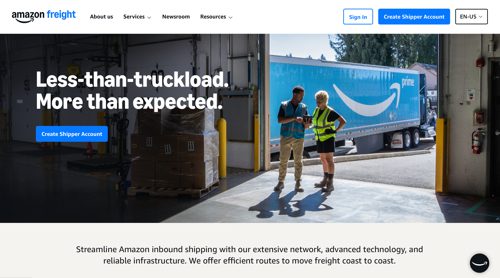
Amazon Freight launches less-than-truckload inbound shipping. Amazon Freight is now offering less-than-truckload services to customers shipping inbound to Amazon’s facilities. Businesses with shipments that won’t fill an entire trailer can book a portion, depending on the space they need. Like Amazon Freight FTL (full truckload), Freight’s LTL inbound offering utilizes the Amazon network, including 60,000 trailers and advanced tech capabilities. Access LTL and FTL via the self-service portal.

Home page for Amazon Freight

Amazon Freight

Charts: Grocery Trends in Europe 2025

Retail grocery volume will grow modestly in Northern and Southern Europe through 2030 while declining in Central and Eastern regions. That’s according to a new report by McKinsey & Company titled “The State of Grocery Retail Europe 2025.”

In 2025 McKinsey surveyed approximately 14,500 consumers across 13 countries in Europe. According to the report, 42% of Gen Z consumers and 37% of Millennials buy ready-to-eat meals at least weekly.

Additionally, respondents across all age categories plan to purchase fewer environmentally sustainable grocery products (locally sourced and socially responsible) in 2025 compared to 2024.

The McKinsey report cites the desire for consolidation and scale among retail grocers as driving an increasing number of merger and acquisition deals since 2021.

SEOFOMO Survey Shows How Ecommerce SEOs Use AI In 2025 via @sejournal, @martinibuster

Aleyda Solis’ SEOFOMO published a survey of ecommerce owners and SEOs that indicates a wide range of uses of AI, reflecting popular SEO tactics and novel ways to increase productivity, but also reveals that a significant number of the respondents have yet to fully adopt the technology because they are still figuring out how it best fits into their workflow. Very few of the survey respondents said they were not considering AI.

The survey responses showed that there are five popular category uses for AI:

  1. Content
  2. Analysis & Research
  3. Technical SEO
  4. User Experience & Conversion Rate Optimization
  5. Generate Client Documentation, Education & Learning

Content Creation

The survey respondents used AI for important reasons like product listing and descriptions, as well as for scaling meta descriptions, titles, and alt text. Other uses include creating content outlines, grammar checks and other assistive uses of AI.

But some also used it for blog content, landing pages, and for generating FAQ content. There’s no details of how extensively AI was used for blog content but a case could be made against using it for fully generating main content with AI (if that’s how some people are using it) because of Google’s recent cautionary guidance about extensive use of AI for main content.
Google’s Danny Sullivan at the recent Search Central NYC event cautioned about low effort content lacking in originality.

The other reported uses of AI was for grammar checking and clarity which are excellent ways to use AI. Care should be used even for these purposes because AI has a style that can get injected into the content even for something as simple as checking for grammar.

Another interesting use of AI is for revising content so that it matches a company’s “brand voice” which is checking for word choices, tone, and even sentence structure.

Lastly, the ecommerce survey respondents reported using AI for brainstorming content ideas which is another excellent way to use AI.

Analysis & Research

The part about keyword analysis is interesting because the report lists keyword research and clustering as one of the uses. Clustering keywords according to similarity is a good practice because it’s somewhat repetitive and spammy to write pages of content about related things, one page for each keyword phrase when one strong page that represents the entire topic is enough.

Focusing on keywords for SEO has been around longer than Google, and even Google itself has evolved from using keywords as a way to understand content to also incorporating an understanding of queries and content as topics.This is seen in the fact that Google uses core topicality systems as part of its ranking algorithm. So it’s somewhat curious that topicality research wasn’t mentioned as one of the uses, unless keyword clustering is considered part of that. Nevertheless, data analysis is a great use of AI.

Technical SEO

Technical SEO is a fantastic application of AI because that’s all about automating repetitive SEO tasks but also for assisting on making decisions about what to do. There’s lots of ways to do this, including by uploading a set of guidelines and/or charts and asking AI to analyze for specific things. Apps like Screaming Frog allow integration with OpenAI, so it’s leaving money and time on the table to not be investigating all the ways AI can integrate with tools as well as just asking it to analyze data.https://www.screamingfrog.co.uk/seo-spider/tutorials/how-to-crawl-with-chatgpt/

For example, one of the uses reported in the survey was for generating an internal linking strategy.

User Experience (UX) & Conversion Rate Optimization (CRO)

Another way ecommerce store owners are using AI is for improving the user experience and CRO.

The survey reports:

  • “AI-powered product recommendations
  • Chatbots for product discovery or customer support
  • CRO/UX audits based on user behavior”

Training & Education

Lastly, an increasing number of the ecommerce respondents reported using AI for generating training documentation for internal use and for creating customer documentation.

The survey reports:

“Less common but growing:

  • Learning how AI tools function
  • Using AI to create training material or SEO learning resources”

Not Using AI Or Limited Use

What was surprising is the amount of SEOs that are not using AI in a meaningful way. 31% of respondents said they are not using AI but are planning to, 3% of the survey respondents were digging their heels into the ground and flatly refusing to use AI in any way, while an additional 4% answered that they weren’t sure.

That makes a full 37% that aren’t using AI in any meaningful way. Looked at another way, 31% of respondents were getting ready to adopt AI into their workflow. Many managed WordPress hosting companies are integrating AI into their WordPress builder workflow as are some WordPress builders. AI can be integrated via WordPress SEO plugins as well. Wix has already integrated AI into their customer workflow through their proprietary Astro chatbot and companies like Shopify are also planning meaningful and useful ways to integrate AI.

The SEOFOMO survey makes it clear that AI is a significant part of the SEO and ecommerce workflow. Those who don’t use AI shouldn’t feel like they have to. But if you’re unsure how to integrate it, one way to think about it is to ask: what kinds of tasks would you hand off to an intern? Those are the kinds of tasks that AI excels at, enabling one worker to produce at a level five times greater than they could without using AI.

Read the SEOFOMO in ecommerce survey results:

The SEOFOMO Ecommerce SEO in 2025 Survey Results

Featured Image by Shutterstock/tete_escape