Gen AI Nears Hyper-Personalization at Scale

Ecommerce marketers have long dreamed of delivering the perfect marketing message to a specific shopper at the ideal time to close a sale.

Even 20 years ago, marketers could set up “business rules” — if this, then that — or divide shoppers into segments to deliver custom messages or recommendations.

What’s changed is the emergence of generative artificial intelligence, which has dramatically expanded personalization by automating and scaling labor-intensive or impractical tasks.

Hyper-Personalization

Combine generative AI with heaps of real-time data and a delivery mechanism — email, text, chat — and you get hyper-personalization.

A marketing team can now develop an outline detailing the company’s key selling points, brand differentiators, and tone of voice. AI can then produce unique and optimized messages per shopper.

What’s more, the software to hyper-personalize those messages is becoming affordable for even small and mid-sized merchants.

Illustration of a person in front of a computer with screen illustrations in the background

Mix shopper data with generative AI, and marketers may be on the verge of hyper-personalized messages.

3 Problems Solved

Consider the example that sparked this article.

Backstroke, a generative AI email platform, has announced a tool that produces complete ecommerce marketing emails, including layout, images, copy, subject lines, and preheaders.

Although it doesn’t achieve real-time individualization, the new tool addresses three of the top problems associated with hyper-personalization.

Data capture

Hyper-personalization requires lots of data.

Ecommerce marketing teams typically have access to first- or even third-party shopper demographics and behavioral information but lack the technical skills, time, or money to use it in a meaningful way.

Backstroke, for example, has a deep integration with Klaviyo, one of the best email service providers for ecommerce data collection. Blueshift provides similar services and similarly integrates with Shopify and Magento.

Both Backstroke and Blueshift recognize that ecommerce marketers need help gathering the shopper data that hyper-personalization requires. Before it can generate personalized emails, AI must know what’s important to shoppers.

Data comprehension and use

Another common problem with hyper-personalization is understanding and employing the shopper data once collected. Backstroke, Blueshift, and other generative AI companies organize shoppers into groups or develop individual shopper profiles.

Think of it this way. Marketers can manually create many email segments — by gender, repeat customers, lapsed buyers, and more. An industrious lifecycle marketer might manually maintain 20 such segments. Yet AI can generate 10 times as many.

Thus Backstroke, Blueshift, and the like can constantly refine change segments as the AI learns more about shoppers and their buying intent.

Content creation

Finally, the words and images needed for hyper-personalization are a hurdle.

Imagine an ecommerce lifecycle marketer composing, testing, and optimizing email sequences of three messages each for 10 shopper segments. That’s 30 messages to compose. Testing subject lines could require three variations per message — 90 emails all told.

Before long, maintaining and optimizing the messages becomes unmanageable. And it’s one of the hyper-personalization problems generative AI platforms are addressing. Instead of maintaining 90 or 900 message versions, marketers might instead provide a framework for AI, which then produces and optimizes the entire campaign.

AI for SMBs

As of October 2024, sending unique messages at scale to each customer or prospect is not possible. But the rapid growth of generative AI means such hyper-personalization is on the verge. Innovations in machine learning and data processing are steadily enhancing AI’s ability to tailor messages to individuals, promising more precise and effective marketing.

What’s more, the cost of using AI is declining. Likely, SMB ecommerce merchants can soon access personalization tools once accessible only to enterprise sellers.

How Compression Can Be Used To Detect Low Quality Pages via @sejournal, @martinibuster

The concept of Compressibility as a quality signal is not widely known, but SEOs should be aware of it. Search engines can use web page compressibility to identify duplicate pages, doorway pages with similar content, and pages with repetitive keywords, making it useful knowledge for SEO.

Although the following research paper demonstrates a successful use of on-page features for detecting spam, the deliberate lack of transparency by search engines makes it difficult to say with certainty if search engines are applying this or similar techniques.

What Is Compressibility?

In computing, compressibility refers to how much a file (data) can be reduced in size while retaining essential information, typically to maximize storage space or to allow more data to be transmitted over the Internet.

TL/DR Of Compression

Compression replaces repeated words and phrases with shorter references, reducing the file size by significant margins. Search engines typically compress indexed web pages to maximize storage space, reduce bandwidth, and improve retrieval speed, among other reasons.

This is a simplified explanation of how compression works:

  • Identify Patterns:
    A compression algorithm scans the text to find repeated words, patterns and phrases
  • Shorter Codes Take Up Less Space:
    The codes and symbols use less storage space then the original words and phrases, which results in a smaller file size.
  • Shorter References Use Less Bits:
    The “code” that essentially symbolizes the replaced words and phrases uses less data than the originals.

A bonus effect of using compression is that it can also be used to identify duplicate pages, doorway pages with similar content, and pages with repetitive keywords.

Research Paper About Detecting Spam

This research paper is significant because it was authored by distinguished computer scientists known for breakthroughs in AI, distributed computing, information retrieval, and other fields.

Marc Najork

One of the co-authors of the research paper is Marc Najork, a prominent research scientist who currently holds the title of Distinguished Research Scientist at Google DeepMind. He’s a co-author of the papers for TW-BERT, has contributed research for increasing the accuracy of using implicit user feedback like clicks, and worked on creating improved AI-based information retrieval (DSI++: Updating Transformer Memory with New Documents), among many other major breakthroughs in information retrieval.

Dennis Fetterly

Another of the co-authors is Dennis Fetterly, currently a software engineer at Google. He is listed as a co-inventor in a patent for a ranking algorithm that uses links, and is known for his research in distributed computing and information retrieval.

Those are just two of the distinguished researchers listed as co-authors of the 2006 Microsoft research paper about identifying spam through on-page content features. Among the several on-page content features the research paper analyzes is compressibility, which they discovered can be used as a classifier for indicating that a web page is spammy.

Detecting Spam Web Pages Through Content Analysis

Although the research paper was authored in 2006, its findings remain relevant to today.

Then, as now, people attempted to rank hundreds or thousands of location-based web pages that were essentially duplicate content aside from city, region, or state names. Then, as now, SEOs often created web pages for search engines by excessively repeating keywords within titles, meta descriptions, headings, internal anchor text, and within the content to improve rankings.

Section 4.6 of the research paper explains:

“Some search engines give higher weight to pages containing the query keywords several times. For example, for a given query term, a page that contains it ten times may be higher ranked than a page that contains it only once. To take advantage of such engines, some spam pages replicate their content several times in an attempt to rank higher.”

The research paper explains that search engines compress web pages and use the compressed version to reference the original web page. They note that excessive amounts of redundant words results in a higher level of compressibility. So they set about testing if there’s a correlation between a high level of compressibility and spam.

They write:

“Our approach in this section to locating redundant content within a page is to compress the page; to save space and disk time, search engines often compress web pages after indexing them, but before adding them to a page cache.

…We measure the redundancy of web pages by the compression ratio, the size of the uncompressed page divided by the size of the compressed page. We used GZIP …to compress pages, a fast and effective compression algorithm.”

High Compressibility Correlates To Spam

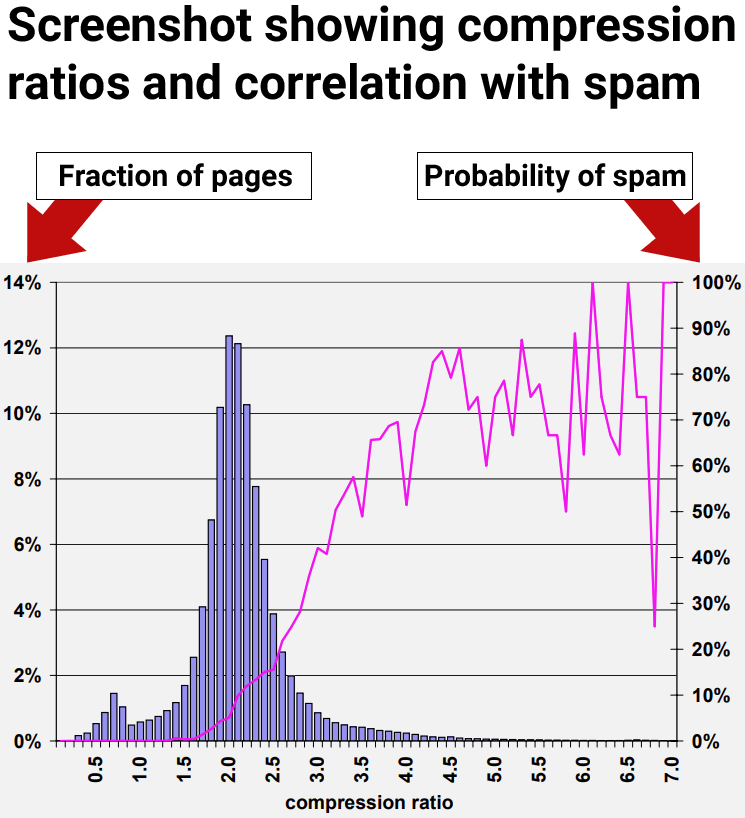
The results of the research showed that web pages with at least a compression ratio of 4.0 tended to be low quality web pages, spam. However, the highest rates of compressibility became less consistent because there were fewer data points, making it harder to interpret.

Figure 9: Prevalence of spam relative to compressibility of page.

Graph shows link between high compression levels and the likelihood that those pages are spam.

The researchers concluded:

“70% of all sampled pages with a compression ratio of at least 4.0 were judged to be spam.”

But they also discovered that using the compression ratio by itself still resulted in false positives, where non-spam pages were incorrectly identified as spam:

“The compression ratio heuristic described in Section 4.6 fared best, correctly identifying 660 (27.9%) of the spam pages in our collection, while misidentifying 2, 068 (12.0%) of all judged pages.

Using all of the aforementioned features, the classification accuracy after the ten-fold cross validation process is encouraging:

95.4% of our judged pages were classified correctly, while 4.6% were classified incorrectly.

More specifically, for the spam class 1, 940 out of the 2, 364 pages, were classified correctly. For the non-spam class, 14, 440 out of the 14,804 pages were classified correctly. Consequently, 788 pages were classified incorrectly.”

The next section describes an interesting discovery about how to increase the accuracy of using on-page signals for identifying spam.

Insight Into Quality Rankings

The research paper examined multiple on-page signals, including compressibility. They discovered that each individual signal (classifier) was able to find some spam but that relying on any one signal on its own resulted in flagging non-spam pages for spam, which are commonly referred to as false positive.

The researchers made an important discovery that everyone interested in SEO should know, which is that using multiple classifiers increased the accuracy of detecting spam and decreased the likelihood of false positives. Just as important, the compressibility signal only identifies one kind of spam but not the full range of spam.

The takeaway is that compressibility is a good way to identify one kind of spam but there are other kinds of spam that aren’t caught with this one signal. Other kinds of spam were not caught with the compressibility signal.

This is the part that every SEO and publisher should be aware of:

“In the previous section, we presented a number of heuristics for assaying spam web pages. That is, we measured several characteristics of web pages, and found ranges of those characteristics which correlated with a page being spam. Nevertheless, when used individually, no technique uncovers most of the spam in our data set without flagging many non-spam pages as spam.

For example, considering the compression ratio heuristic described in Section 4.6, one of our most promising methods, the average probability of spam for ratios of 4.2 and higher is 72%. But only about 1.5% of all pages fall in this range. This number is far below the 13.8% of spam pages that we identified in our data set.”

So, even though compressibility was one of the better signals for identifying spam, it still was unable to uncover the full range of spam within the dataset the researchers used to test the signals.

Combining Multiple Signals

The above results indicated that individual signals of low quality are less accurate. So they tested using multiple signals. What they discovered was that combining multiple on-page signals for detecting spam resulted in a better accuracy rate with less pages misclassified as spam.

The researchers explained that they tested the use of multiple signals:

“One way of combining our heuristic methods is to view the spam detection problem as a classification problem. In this case, we want to create a classification model (or classifier) which, given a web page, will use the page’s features jointly in order to (correctly, we hope) classify it in one of two classes: spam and non-spam.”

These are their conclusions about using multiple signals:

“We have studied various aspects of content-based spam on the web using a real-world data set from the MSNSearch crawler. We have presented a number of heuristic methods for detecting content based spam. Some of our spam detection methods are more effective than others, however when used in isolation our methods may not identify all of the spam pages. For this reason, we combined our spam-detection methods to create a highly accurate C4.5 classifier. Our classifier can correctly identify 86.2% of all spam pages, while flagging very few legitimate pages as spam.”

Key Insight:

Misidentifying “very few legitimate pages as spam” was a significant breakthrough. The important insight that everyone involved with SEO should take away from this is that one signal by itself can result in false positives. Using multiple signals increases the accuracy.

What this means is that SEO tests of isolated ranking or quality signals will not yield reliable results that can be trusted for making strategy or business decisions.

Takeaways

We don’t know for certain if compressibility is used at the search engines but it’s an easy to use signal that combined with others could be used to catch simple kinds of spam like thousands of city name doorway pages with similar content. Yet even if the search engines don’t use this signal, it does show how easy it is to catch that kind of search engine manipulation and that it’s something search engines are well able to handle today.

Here are the key points of this article to keep in mind:

  • Doorway pages with duplicate content is easy to catch because they compress at a higher ratio than normal web pages.
  • Groups of web pages with a compression ratio above 4.0 were predominantly spam.
  • Negative quality signals used by themselves to catch spam can lead to false positives.
  • In this particular test, they discovered that on-page negative quality signals only catch specific types of spam.
  • When used alone, the compressibility signal only catches redundancy-type spam, fails to detect other forms of spam, and leads to false positives.
  • Combing quality signals improves spam detection accuracy and reduces false positives.
  • Search engines today have a higher accuracy of spam detection with the use of AI like Spam Brain.

Read the research paper, which is linked from the Google Scholar page of Marc Najork:

Detecting spam web pages through content analysis

Featured Image by Shutterstock/pathdoc

Kids are learning how to make their own little language models

“This new AI technology—it’s very interesting to learn how it works and understand it more,” says 10-year-old Luca, a young AI model maker.

Luca is one of the first kids to try Little Language Models, a new application from Manuj and Shruti Dhariwal, two PhD researchers at MIT’s Media Lab, that helps children understand how AI models work—by getting to build small-scale versions themselves. 

The program is a way to introduce the complex concepts that make modern AI models work without droning on about them in a theoretical lecture. Instead, kids can see and build a visualization of the concepts in practice, which helps them get to grips with them.

“What does it mean to have children see themselves as being builders of AI technologies and not just users?” says Shruti.

The program starts out by using a pair of dice to demonstrate probabilistic thinking, a system of decision-making that accounts for uncertainty. Probabilistic thinking underlies the LLMs of today, which predict the most likely next word in a sentence. By teaching a concept like it, the program can help to demystify the workings of LLMs for kids and assist them in understanding that sometimes the model’s choices are not perfect but the result of a series of probabilities. 

Students can modify each side of the dice to whatever variable they want. And then they can change how likely each side is to come up when you roll them. Luca thinks it would be “really cool” to incorporate this feature into the design of a Pokémon-like game he is working on. But it can also demonstrate some crucial realities about AI.

Let’s say a teacher wanted to educate students about how bias comes up in AI models. The kids could be told to create a pair of dice and then set each side to a hand of a different skin color. At first, they could set the probability of a white hand at 100%, reflecting a hypothetical situation where there are only images of white people in the data set. When the AI is asked to generate a visual, it produces only white hands.

Then the teacher can have the kids increase the percentage of other skin colors, simulating a more diverse data set. The AI model now produces hands of varying skin colors.

“It was interesting using Little Language Models, because it makes AI into something small [where the students] can grasp what’s going on,” says Helen Mastico, a middle school librarian in Quincy, Massachusetts, who taught a group of eighth graders to use the program.

“You start to see, ‘Oh, this is how bias creeps in,’” says Shruti. “It provides a rich context for educators to start talking about and for kids to imagine, basically, how these things scale to really big levels.”

They plan for the tool to be used around the world. Students will be able to upload their own data, monitored by their teacher. “[Students] can also add their own sounds, images, and backdrops that represent their culture,” says Manuj. 

The Dhariwals have also implemented a tool where kids can play around with more advanced concepts like Markov chains, where a preceding variable influences what comes after it. For example, a child could build an AI that creates random houses made from Lego bricks. The child can dictate that if the AI uses a red brick first, the percentage of yellow brick coming next is set much higher.

“The best way to support young people as creative learners is through helping them work on projects based on their passions,” says the Dhariwals’ PhD advisor Mitch Resnick, co-creator of Scratch, the most famous program in the world for teaching kids to code. “And that’s what Little Language Models does. It lets children take these new ideas and put them to use in creative ways.”

Little Language Models may fill a hole in the current educational landscape. “There is a real lack of playful resources and tools that teach children about data literacy and about AI concepts creatively,” says Emma Callow, a learning experience designer who works with educators and schools on implementing new ways to teach kids about technology. “Schools are more worried about safety, rather than the potential to use AI. But it is progressing in schools, and people are starting to kind of use it,” she says. “There is a space for education to change.”

Little Language Models is rolling out on the Dhariwals’ online education platform, coco.build, in mid-November, and they’re trialing the program at various schools over the next month. 

Luca’s mom, Diana, hopes the chance to experiment with it will serve him well. “It’s experiences like this that will teach him about AI from a very young age and help him use it in a wiser way,” she says.

4x Founder Debuts Ecommerce Intel Tool

In late 2020 I interviewed a developer who had launched a Shopify app to send manual text messages to cart abandoners. Eighteen months later we spoke again, this time to discuss his sale of that company and purchase of another, an app for creating upsells in a Shopify checkout.

By early 2023 he had sold the second company and launched a third one, a coupon-leak recovery app.

And that brings me to my fourth conversation with Dennis Hegstad. He has shut down the coupon-leak business and started his fourth, a data provider for the ecommerce industry called Internet Research Unit. What, exactly, is Internet Research Unit? I asked him that question and more when we recently spoke.

The entire audio of our conversation is embedded below. The transcript is edited for clarity and length.

Eric Bandholz: Give us an update on what’s happening in your world.

Dennis Hegstad: In 2021, I sold LiveRecover, our SMS app for Shopify. That was our first exit in ecommerce. Then I sold another app, OrderBump, just 100 days after buying it in 2022. That sale was pretty much luck.

In 2023 I launched Vigilance, a coupon-code leak protection app, but that business failed. Shopify updated its checkout system, ultimately killing Vigilance, so we shut it down. We offered to return the investors’ money, but they said, “Try something else.” That’s when we started building Internet Research Unit earlier this year. Those same Vigilance investors are part of it.

Bandholz: What’s Internet Research Unit?

Hegstad: It’s a data platform for the ecommerce industry. Our primary users are brand owners, agencies, app developers, and financiers. Brands can track competitors’ revenue, units sold, popular SKUs, app stacks, and more. They can set up alerts to track competitors’ sales or app usage changes to guide product launches or strategic decisions. Agencies and app developers can use the data for lead generation — tracking which brands use specific services or technologies, such as Klaviyo, and which don’t. Financiers can assess trends or identify struggling companies they might want to invest in or acquire.

Our product is high-end, priced around $500 a month, so it’s not for beginners. It’s aimed at established companies who want to fine-tune their strategies.

Our data is public; brands cannot hide it from our platform. We can track compliance-related issues, like price manipulation or accessibility compliance, so companies can address potential problems before they lead to lawsuits.

We have ways of accurately estimating sales and breaking it down by SKU. For example, if a brand sells leggings, we can report which colors and sizes are selling best. That way, competitors can focus on high-performing products.

Bandholz: The front-end design of your software apps, including Internet Research Unit, is terrific. What’s your design philosophy?

Hegstad: We don’t use professional designers on the site. My co-founder and I handle design and prioritize aesthetics. Stripe pioneered the trend of beautifully designed SaaS platforms, and we follow that approach. Software should feel exciting to use, not boring or outdated.

We aim for a cyberpunk vibe with Internet Research Unit — something that feels futuristic and appeals to tech-savvy users. We even started selling a bit of merchandise — shirts and hats — with designs inspired by this aesthetic. We did hire a designer to create cyberpunk-inspired shirt art. One says “anti-algorithm” because we feel like everyone’s life is ruled by algorithms these days. It’s a fun way to rebel against that.

We’ve considered other branded products, such as ZYN-style [nicotine-pouch] cans with USB drives inside. But we’re focused on growing the software business before diving deep into merchandise. If the software performs well, we might reinvest some of the profits into the brand side.

Bandholz: Is the platform fully built?

Hegstad: There’s more to come. We launched in March, and we’ve slowly onboarded users. In November, we’ll open it to the public. We want to add funding data so our users can find brands that have raised capital but are underperforming. That would help venture capitalists or merger and acquisition teams identify struggling companies that need help.

We’re not trying to shoot for the stars. We want to build something fun and keep it going. Reaching $5 million in annual revenue would be great. We love the business — it feels challenging, and there’s much to learn.

Bandholz: Where can people support you?

Hegstad: Our website is InternetResearchUnit.com. You can also find me on LinkedIn and X.

11 Tips For How To Find Great Writers via @sejournal, @seocopychick

Great content is the backbone of any successful SEO strategy.

Content provides information to users, facilitates ranking in the organic search results, and can be a significant driver in attracting backlinks to your website.

But how and where one sources such amazing content depends on a few factors. For one, you can write your own content, if you have the skills and time to do so.

On the other hand, you could hire a professional writer to craft content for you, but you need to know where to look!

Need an excellent writer? Consider these top tips on how and where to find experienced content writers.

1. Assess Your Content Needs

The first step to finding a great writer is to determine what type of writer you need. Believe it or not, there are many different kinds of copywriters and content writers (yes, they’re different), and they bring different specialties to the table.

Is your goal to craft SEO-friendly content that ranks in search engines? You’ll need a writer who understands on-page SEO best practices and the nuances of keyword usage.

Is your goal to drive conversions from a landing page on your website? You’ll need a direct-response copywriter skilled in sales copywriting and buyer psychology.

Also, these writers may advertise their services on different platforms, so it’s important to consider your needs early on so you know where to look!

Content Writers Vs. Copywriters

If you are looking for a writer who specializes in long-form, SEO-friendly content, you’ll want to find a content writer. Some examples of content writers include:

  • Blog writers – when your goal is to drive organic traffic, build brand awareness, and engage readers.
  • Article writers – when you need in-depth articles (for websites, magazines, or online publications) that educate readers on specific topics.
  • SEO writers – if you want to improve your website visibility and organic traffic to webpages.
  • Technical writers – for writing manuals, how-to guides, software documentation, and white papers.
  • Social media content writers – when you need short-form content for social media platforms like Instagram, X (Twitter), Facebook, or LinkedIn.

Now, if you are looking for a writer specializing in persuasive writing that compels people to take action (like buy a product or sign up for a service, you’ll want a copywriter.

Some examples of copywriters include:

  • Direct response copywriters – who specialize in writing sales letters, email campaigns, landing pages, and ads that inspire action
  • Sales copywriters – when you need product descriptions, sales pages, or promotional materials
  • Email copywriters – who write email sequences for marketing campaigns, newsletters, and product launches
  • Brand copywriters – who specialize in writing content that conveys your brand’s voice, tone, and values to build your brand identity (may include website copy, slogans, or ads)

Some content writers and copywriters offer several services. For example, it’s common to find a content writer who does blog writing, article writing, and SEO content.

However, copywriters and content writers are notably different in what they aim to achieve – sales vs. traffic, respectively.

Consider what you are trying to accomplish with your content and search for a writer with that skill set.

2. Browse Reputable Writer Directories And Platforms

Now, it’s time to find a writer. Easier said than done, right? Business owners are spoiled for choice when it comes to the number of freelancer websites available, but not all are created equal.

Ask Your Professional Network

Before venturing to a freelancer website, I suggest asking your professional network whether they know of any writers they might recommend.

Not only will you then get a referral from someone who can vouch for the writer’s services, but you’ll save a ton of time in your search.

Reach Out To Your Network

I highly recommend reaching out to your existing network to find writers who have a track record of proven results.

A referral from someone within your industry is even better. Ask them about their experience working with the writer and what results they generated.

Niche Facebook Groups

Facebook is a great source of freelance writers, especially within niche-specific Facebook Groups.

For example, if you’re looking for a travel writer, look for groups like the Association of Travel Writers or Travel Writers Exchange.

Many Facebook Groups also allow you to post jobs to find writers for hire.

LinkedIn Search

LinkedIn is a popular professional networking site that allows you to search for consultants, brands, and freelancers.

Simply use the LinkedIn search bar to find a “writer,” “copywriter,” “SEO writer,” etc.

You’ll see individuals who rank at the top for these keywords. Be sure to check out their portfolio and recommendations.

College Job Boards

Many university students are looking for part-time jobs and contract opportunities.

Check out your local university or college websites to see if they have a job board, then post the requirements of the role.

Content Agencies

Content marketing agencies specialize in content strategy and content writing, often for a variety of platforms.

While their rates may be more expensive than working with a freelance writer, you can often trust that there’s a higher degree of quality control.

You may also be able to source content for social media, email, and your website – all in one place.

Writer Directories

Writer directories like Compose.ly and blcklst.com allow writers to publish their portfolios, post their rates, and apply for jobs.

Some sites allow you to post an open role, while others allow you to contact the writers directly. Again, look for writers with an active portfolio and, ideally, client testimonials.

3. Request Content Examples

Once you’ve found a writer (or several) that you’d like to work with, it’s time to request more information.

Hiring a writer is a financial commitment, so do your due diligence to assess their portfolio and skills.

Always ask for examples of their work – particularly work related to your niche.

Unfortunately, stealing content examples is common practice online, so you don’t always know what you are getting; if they can send you an example with their name in the byline, that’s a safer bet.

Human Writers Vs. AI Content

The prevalence of AI-generated content has been on the rise. With tools like ChatGPT and contents.ai, it’s easy for businesses to turn to this fast, cheaper form of content.

But there is a lot of personality, uniqueness, and quality lost in AI content.

For one, AI content lacks the history of lived human experience to tell stories, provide relatable examples, and solve modern problems in your content.

Human writers are able to empathize with your readers and buyers, incorporating this sentiment and psychology into the content.

Also, with AI content, you’re at risk of generating material that’s identical to other pieces of content that are on the web.

This can hurt your brand and your SEO. Human writers are able to craft a unique story that’s specific to your brand voice and audience.

AI content has its place – such as in content planning and drafts – but should not be the basis of your entire content strategy.

While cheap, AI content can end up costing you in terms of brand visibility, user trust, and conversions.

4. Interview The Candidates

When “chatting” with a writer, a lot can be lost in translation via email or messenger. It’s always best to get on a live call to assess whether the candidate is a good fit for your brand and needs.

Just as much as you are looking for a writer with the right skills, you want to be sure they are a good character fit. Communication is important throughout the entire content planning and writing process.

Here are some questions to ask during your writer interview:

  • What types of writing do you specialize in?
  • Do you have experience in our industry?
  • How do you approach research for a topic you’re unfamiliar with?
  • How do you incorporate SEO best practices into your content writing (if applicable)?
  • Do you have experience working with content calendars, marketing teams, or campaign strategies?
  • What is your preferred workflow (e.g., strategy provided by client, first draft approval, round one revision, final approval)?
  • What’s your average turnaround time for a [type of content]?

These questions will give you a better understanding of the writer’s skills, style, and approach to writing, helping you find the right fit for your needs.

5. Look For Case Studies And Reviews

Whether you’re using your referral network, social media, or writer directories to find writers, look for their case studies or client reviews.

Many professional writers will have a website where they showcase their work and/or recommendations on LinkedIn or social media.

This “social proof” will make it evident what kind of results they have been able to generate for their clients.

6. Assess Their SEO Knowledge

If your goal is to grow your traffic, you’ll want a writer who understands SEO and how to incorporate it into their content.

They may not be an SEO expert, but they should know on-page best practices, such as keyword usage in the page title, heading structure and hierarchy, and the importance of internal linking.

It’s appropriate to ask them a few questions about their expertise and to request examples of SEO content. If they have case studies that showcase measurable results, even better.

7. Ask How They Measure Success

On the topic of results, you should ask writer candidates how they measure the success of their content.

Though many factors go into content performance – not all of which they will have control over – it’s still a fair question to assess their approach to content writing.

For example, if they are an SEO writer, do they measure success by organic traffic and reduced bounce rate? Do they tend to look at the number and position of keyword rankings? A great SEO writer will pay attention to these metrics.

Similarly, if they are a sales copywriter, do they track conversions? How do they determine what makes their copy successful? Do they make updates to the copy to improve performance?

Not only will this consideration get you thinking about how you quantify results, but it will also help you identify a writer who is results-driven.

8. Understand Their Pricing Structure

There are many different types of pricing structures writers may use to charge for content.

The most common is price-per-word, where the writer provides a set cost per each word of content written.

Freelance writers can charge anywhere from $0.05 to $2.00 per word, depending on their experience.

Another common approach is cost per page/post. This is where the writer typically determines an approximate content length and set cost.

For example, a short blog post may cost around $150, whereas a long blog post may cost $300+. This option is great if you want the costs to be predictable.

Be sure to discuss the writer’s preferred pricing structure and rates before you start on a project. Ideally, get your agreement set in writing so there is no confusion over the terms.

9. Know What’s Provided In Their Services

Some SEO writers only include the content and the H1 and H2 tags. Others include all on-page SEO.

Even further, some provide keyword research or content planning. For any writer, ask what their services include and what needs to be provided by you.

Do they need you to do the keyword research and create the blog strategy? Get clear about that from the beginning.

You should also ask whether edits and/or rewrites are included. Complete rewrites are rare; don’t expect most writers to write an entirely new piece without compensation.

Typically, writers offer one to two rounds of edits, or a refund if they miss the mark.

10. Discuss Your Expectations

Hiring a writer is like any other professional relationship in that you need to discuss your expectations at the start.

Know what’s expected of you, make sure they know what’s expected of them, and outline a clear process when it comes to creating content together.

Note that some writers offer refunds, while others do not. Discuss this at the beginning (and get it in writing) before you find yourself in a pickle.

11. Know That Great Content Is An Investment

With all this talk about pricing and payment terms, you may be wondering, “How much does great content cost?”

Unfortunately, the answer isn’t simple. Writers’ rates vary based on their industry expertise, years of experience, the results they have generated for clients, their location, and a range of other factors.

But what remains true is that you get what you pay for. Don’t expect high-quality sales copy from a “cheap” AI content service. Don’t expect high conversions on sales pages written by a novice versus an expert.

When it comes to driving results, you’ll want a content writer or copywriter who understands the nuances of SEO and buyer psychology.

They likely have years of experience and a proven track record of delivering results for clients. And they likely aren’t cheap.

Consider what it’s worth to your business to have interesting, original, high-converting content. Do you want to pay pennies for basic copy? Or do you want content that will bring a return on investment (ROI)?

Final Thoughts

While there are mixed opinions on what constitutes “great” content and how much great content costs, it remains true that human writers are the source of the best content around.

Able to empathize with buyers’ experiences and craft unique stories, human writers are more equipped than AI to create content that resonates with an audience.

Finding the best writer for your brand depends on the type of content you need and the return you aim to generate from your content.

Your content “budget” should, then, be based on your willingness to invest in content that will achieve the results you want.

I recommend researching your options and outlining clear expectations with your writer from the beginning. That is the path to a positive writer-client relationship and great content for your brand.

More resources: 


Featured Image: Roman Samborskyi/Shutterstock

New Google Trends SEO Documentation via @sejournal, @martinibuster

Google Search Central published new documentation on Google Trends, explaining how to use it for search marketing. This guide serves as an easy to understand introduction for newcomers and a helpful refresher for experienced search marketers and publishers.

The new guide has six sections:

  1. About Google Trends
  2. Tutorial on monitoring trends
  3. How to do keyword research with the tool
  4. How to prioritize content with Trends data
  5. How to use Google Trends for competitor research
  6. How to use Google Trends for analyzing brand awareness and sentiment

The section about monitoring trends advises there are two kinds of rising trends, general and specific trends, which can be useful for developing content to publish on a site.

Using the Explore tool, you can leave the search box empty and view the current rising trends worldwide or use a drop down menu to focus on trends in a specific country. Users can further filter rising trends by time periods, categories and the type of search. The results show rising trends by topic and by keywords.

To search for specific trends users just need to enter the specific queries and then filter them by country, time, categories and type of search.

The section called Content Calendar describes how to use Google Trends to understand which content topics to prioritize.

Google explains:

“Google Trends can be helpful not only to get ideas on what to write, but also to prioritize when to publish it. To help you better prioritize which topics to focus on, try to find seasonal trends in the data. With that information, you can plan ahead to have high quality content available on your site a little before people are searching for it, so that when they do, your content is ready for them.”

Read the new Google Trends documentation:

Get started with Google Trends

Featured Image by Shutterstock/Luis Molinero

GMOs could reboot chestnut trees

Under a slice-of-heaven sky, 150 acres of rolling green hills stretch off into the distance. About a dozen people—tree enthusiasts, conservationists, research biologists, biotech entrepreneurs, and a venture capitalist in long socks and a floppy hat—have driven to this rural spot in New York state on a perfect late-July day. 

We are here to see more than 2,500 transgenic chestnut seedlings at a seed farm belonging to American Castanea, a new biotech startup. The sprouts, no higher than our knees, are samples of likely the first genetically modified trees to be considered for federal regulatory approval as a tool for ecological restoration. American Castanea’s founders, and all the others here today, hope that the American chestnut (Castanea dentata) will be the first tree species ever brought back from functional extinction—but, ideally, not the last.

Living as long as a thousand years, the American chestnut tree once dominated parts of the Eastern forest canopy, with many Native American nations relying on them for food. But by 1950, the tree had largely succumbed to a fungal blight probably introduced by Japanese chestnuts. “Now after hard work, great ideas, and decades of innovation, we have a tree and a science platform designed to make restoration possible,” American Castanea cofounder Michael Bloom told the people squinting in the sun.

As recently as last year, it seemed the 35-year effort to revive the American chestnut might grind to a halt. Now, federal regulatory approval is expected soon. And there’s millions of dollars in new funding coming in from private investors and the federal government. One conservation nonprofit is in discussions with American Castanea to plant up to a million of its chestnuts per year as soon as they’re ready and approved. 

Nothing like this has ever been tried before. But the self-­proclaimed “nutheads” believe the reintroduction of a GMO, blight-resistant American chestnut at scale could also become a model for how environmentalists can redeploy trees in general: restoring forests and shifting food production, all to combat climate change and biodiversity loss. 

“It’s a hard time to be a tree,” says Leigh Greenwood, director of the forest pest and pathogen program at the Nature Conservancy, which has been supportive of the GMO chestnut’s regulatory application. “But there’s some really interesting promise and hope.”  

Four billion trees dead 

“Charismatic megafauna” is the scientific term for species, like pandas and blue whales, that draw a disproportionate amount of love and, thus, resources. The nearly vanished American chestnut may be the most charismatic tree east of the Rockies. Because of its historical importance, fast growth, and abundant productivity of both nuts and timber, it’s drawn an exceptional amount of interest among biologists, conservationists, and a new crop of farmers. 

Trees that die back from blight occasionally resprout. Volunteer groups like the American Chestnut Cooperators’ Foundation have been working for decades to gather and crossbreed wild trees in the hopes of nudging along natural resistance to the blight. Meanwhile, the State University of New York’s College of Environmental Science and Forestry (ESF), with the support of a different group, the American Chestnut Foundation (TACF), has been pursuing genetic engineering in its labs and on its 44 wooded acres outside Syracuse. 

When ESF biologist Bill Powell and his colleagues began working with chestnut embryonic cells in 1989, it took them a decade just to optimize the growing process to make research practical. After that, researchers in the small lab inserted a wheat gene in embryos that inactivated oxalic acid, the toxin produced by the blight fungus. Gathering results on these transgenic trees takes time, because each generation has to grow for a few years before it produces the most useful data. But they eventually created a promising line, named Darling-58 after Herb Darling, a New York construction magnate who funded this research through TACF. Darling-58 was not perfect, and results varied from tree to tree and site to site. But eventually, the data showed slower infections and smaller cankers, the bulbous growths produced by the blight. 

In 2020, Darling-58 became, in all likelihood, the first genetically modified forest tree to be submitted for federal regulatory approval to the US Department of Agriculture’s Animal and Plant Health Inspection Service, the EPA, and the FDA to determine the safety of introducing it in the wild. 

“It’s a hard time to be a tree. But there’s some really interesting promise and hope.”

It is this genetically engineered strain of chestnut that American Castanea, too, is now planting and propagating in New York state, under a nonexclusive commercial license from ESF. They want to sell these trees, pending approval. And then they want to keep going, engineering ever-better chestnuts, and selling them first to enthusiasts, then to farmers, and finally to conservationists for timber, reforestation, maybe even carbon capture. 

To aid the effort, the company is looking for extraordinary wild specimens. In early 2024, it purchased an orchard that had been lovingly cultivated for three decades by a conservationist. The windy hilltop spot houses hundreds of trees, collected like stray kittens from a dozen states throughout the chestnut’s natural range. 

Most of the trees are homely and sickly with blight. They have bulging cankers, “flagging” branches sporting yellow and brown leaves, or green shoots that burst each season from their large root systems only to flop over and die back. “They make me a little sad,” admits Andrew Serazin, cofounder of American Castanea. But a few have shot up as tall as 40 feet, with only a few cankers. All these specimens have been sampled and are being analyzed. They will become the basis of a chestnut gene database that’s as complete as American Castanea can make it. 

From there, the plan is: Apply bioinformatics and AI techniques to correlate genetic signatures with specific traits. Borrow techniques developed in the cannabis industry for seedling production, cloning, and growth acceleration in high-intensity light chambers—none of which have yet been yet applied at this scale to forest trees. Develop several diverse, improved new strains of chestnut that are blight-resistant and optimized for different uses like forest restoration, nut production, and timber. Then produce seedlings at a scale previously unknown. The hope is to accelerate restoration, cutting down the time it would take resistant strains of the tree to propagate in the wild. “Tree growth takes a long time. We need to bend the curve of something that’s like a 30-year problem,” says Serazin.

The breadtree revival

The chestnut has not disappeared from the US: In fact, Americans eat some 33 million pounds of the nuts a year. These are European and Asian varieties, mostly imported. But some companies are looking to expand the cultivation of the nuts domestically. 

Among those leading the quest is a company called Breadtree Farms in upstate New York, named for a traditional nickname for the chestnut. In March, it won a $2 million grant from the USDA to build the largest organic chestnut processing facility in the US. It will be up to eight times larger than needed for its own 250 acres of trees. The company is dedicated to scaling the regional industry. “We have a list of over 100 growers that are, and will be, planting chestnut trees,” says Russell Wallack, Breadtree’s young cofounder.

Chestnuts have a nutritional profile similar to brown rice; they’re high in carbohydrates and lower in fat than other nuts. And unlike other nut trees, the chestnut “masts”—produces a large crop—every year, making it far more prolific.

That makes it a good candidate for an alternative form of agriculture dubbed agroforestry, which incorporates more trees into food cultivation. Food, agriculture, and land use together account for about one-quarter of greenhouse-gas emissions. Adding trees, whether as windbreaks between fields or as crops, could lower the sector’s carbon footprint.

Many different trees can be used this way. But Joe Fargione, science director for the Nature Conservancy’s North America region, says the chestnut is a standout candidate. “It’s great from a climate perspective, and there’s a lot of farmers that are excited about it,” he says. “Chestnuts end up being big trees that store a lot of CO2 and have a product that can be very prolific. They have the potential to pay for themselves. We want not just environmental sustainability but economic sustainability.”

The passion for chestnut revival connects the foresters and the farmers. Farmers aren’t waiting for the GMO trees to get federal approval. They are planting existing Chinese varieties, and hybrids between American and Chinese chestnuts, which thrive in the East. Still, Fargione says that if nut cultivation is going to scale up, farmers will need reliable seed stock of genetically improved trees. 

A Tennessee family poses at the base of a chestnut tree, circa 1920. A deadly fungus nearly drove the once mighty species extinct by 1940.
NEGATIVES OF GREAT SMOKY MOUNTAINS NATIONAL PARK

On the other hand, those foreign orchard varieties would be considered invasives if planted in the wild. And they wouldn’t feed wildlife in the same way, says Sara Fern Fitzsimmons, chief conservation officer of the American Chestnut Foundation. “Wild turkeys prefer American chestnuts,” she says. “And the blue jay—since the American chestnut is smaller, he can fit more in his crop,” a food storage area inside a bird’s throat. For forest restoration you need American chestnuts or something as close to them as possible. That’s where the genetic engineering and crossbreeding projects will be crucial. But that path has been full of pitfalls.

Switched at birth

In late 2023, a biologist at the University of New England discovered evidence that Darling-58 was not what people thought it was. For nearly 10 years, all the data that ESF had painstakingly gathered on the strain actually pertained to a different line, Darling-54, which has its wheat gene in a different place on the genome. The promising results were all still there. The trees had simply been mislabeled that entire time. 

 A few weeks later, in December 2023, the American Chestnut Foundation suddenly announced it was withdrawing its support of ESF’s Darling tree research, citing the 54-58 mix-up, as well as what it called “disappointing performance results” for 54. 

But Andy Newhouse, director of the American Chestnut Project at SUNY ESF, says the mislabeling is not a deal-breaker. The research doesn’t “need to start from scratch,” he says. “This is correcting the record, making sure we have the appropriate label on it, and moving forward.” Newhouse says the regulatory application is ongoing (the USDA and FDA declined to comment on a pending regulatory application; the EPA did not respond to requests for comment). 

Newhouse defends the documented blight response of the trees that, we now know, are actually Darling-54.

And besides, he says, they’ve got a potentially better strain coming: the DarWin. The “Win” stands for “wound-inducible.” In these trees, the anti-blight action turns on—is induced—only when the tree’s bark is wounded, working something like an animal’s immune response. This could be more efficient than continuously expressing the anti-blight gene, the way Darling-54 does. So DarWin trees might reserve more of their energy to grow and produce nuts. 

The DarWin trees are about three years old, meaning data is still being collected. And if the Darling trees are approved for safety, it should smooth the path for a much faster approval of the DarWin trees, Newhouse says.

There was another reason, though, that TACF dropped its support of the Darling regulatory petition. In a FAQ on its website, the foundation said it was “surprised and concerned” that ESF had made a licensing deal for the Darling and DarWin trees—potentially worth millions—with a for-profit company: American Castanea.

TACF said it had been supporting the project under the assumption that the results would be available, for free, to anyone, in the “public commons.” Commercialization, it says, could make the trees more expensive for anyone who might want to plant them. Fitzsimmons wouldn’t comment further. 

The biotech boys

American Castanea’s Andrew Serazin is a Rhodes scholar whose scientific background is in tropical disease research. He rose in the ranks in global philanthropy, running million-­dollar grant competitions for the Gates Foundation, funding projects like vitamin-­enhanced “golden rice” and HIV vaccines. 

He was president of the Templeton World Charity Foundation in 2020 when it gave a “transformational” $3.2 million grant to SUNY ESF’s chestnut project. Serazin became convinced that the chestnut could be the seed of something much, much bigger. It didn’t hurt that he had a sentimental chestnut connection through his wife’s family farm in West Virginia, which dates back to the time of George Washington. 

With pests and pathogens threatening so many different species, “there’s a huge potential for there to be precision management of forests using all of the same capabilities we’ve used in human medicine,” he says. 

For that, Serazin was convinced, they needed money. Real money. Venture capital money. “I mean, really, there’s only one system that we know about that works the best for this kind of innovation, and that’s using incentives for companies to bring together these resources,” he says. 

Serazin teamed up with his friend Michael Bloom, an entrepreneur who’s sold two previous companies. They incorporated American Castanea for certification as a public benefit corporation in Delaware, pledging to balance profit with purpose and adhere to a high degree of transparency on social and environmental impact. They went to “impact investors” to sell the vision. That was part of what was going on at the seed farm on that July day; the company has $4 million in seed financing and wants to raise $7 million to $10 million more next year. 

What he’s offering investors, Serazin says, isn’t quick returns but a chance to “participate in the once-in-a-lifetime opportunity to bring back a tree species from functional extinction, and participate in this great American story.” 

What they’re proposing, over the next several decades or more, is no less than replanting the entire Eastern forest with a variety of genetically superior breeds, on the scale of millions of trees. 

It sounds, at first blush, like a sci-fi terraforming scenario. On the other hand, Leigh Greenwood, at the Nature Conservancy, says every species group of tree in the woods is threatened by climate change. Pathogens are emerging in new territories, trees are stressed by extreme weather, and the coldest winter temperatures, which used to reliably kill off all manner of forest insects and diseases at the edges of their habitats, are getting milder.

Besides chestnut blight, there’s Dutch elm disease, the emerald ash borer, butternut canker, oak wilt, and white pine blister rust. The southern pine beetle now ranges as far north as Massachusetts because of milder winters. The spongy (formerly gypsy) moth is a champion defoliator, munching enough leaves “to make an entire forest look naked in June,” says Greenwood. A new nematode that attacks leaves and buds, previously unknown to science, has emerged near the Great Lakes in the last decade. Sick and dying trees stop sequestering carbon and storing water, are prone to wildfire, and can take entire ecosystems down with them. 

“Invasive species are moving faster than biological time,” Greenwood says. “What we have to do is speed up the host trees, their natural selection. And that is an enormous task that only in very recent times have we really developed the tools in order to figure out how the heck we’re going to do that.” 

By “recent tools,” Greenwood means, more or less, what American Castanea is trying: genetic analysis and advanced horticultural techniques that allow resistant trees to be propagated and introduced into the wild more quickly. 

Greenwood is quick to say that the Nature Conservancy also supports the American Chestnut Cooperators’ Foundation, which crossbreeds wild American chestnuts for blight resistance. They are a small, all-volunteer organization with no university affiliation. They mail their crossbred chestnuts out to hobbyist landowners all over the country, and president Ed Greenwell tells me they don’t really know exactly how many are growing out there—maybe 5,000, maybe more. He has seen some that are big and healthy, he says. “We have many trees of 40-plus years of age.” 

What they don’t have is a sense of urgency. “We’re self-funded, so we could do our breeding as we choose,” says Greenwell. “Our method is tried and true, and we have no pressure to take shortcuts, like genetic modification, which theoretically could have shortened the time to get trees back in the woods.” 

The whole idea of a GMO forest tests our concept of what “nature” is. And that may just be a marker of where we are at this point in the Anthropocene.

Greenwell is not the only one to object to GMO chestnuts. In 2023, Joey Owle, then the secretary of agriculture and natural resources for the Eastern Band of Cherokee Indians, told Grist magazine that while the group was open to introducing transgenic trees on its land if necessary, it was the “last option that we would like to pursue.”

Greenwood led the writing of an expert letter, something like an amicus brief, in support of SUNY ESF’s regulatory petition for the Darling tree. She takes such objections seriously. “If we do not address the human dimensions of change, no matter how good the biological, chemical designs are,” she says, “those changes will fail.” 

That July day out at the seed farm, sitting under a tent with plates of pork barbecue, the scientists, conservationists, and businesspeople started debating how deep these GMO objections really run. Serazin said he believes that what people really hate is corporate monopoly, not the technology per se. “It’s really about the exertion of power and capital,” he said. He’s hoping that by incorporating as a public benefit corporation and making the trees widely available to conservation groups and responsible forest product and nut producers, he can convince people that American Castanea’s heart is in the right place. 

Still, others pointed out, the whole idea of a GMO forest tests our concept of what “nature” is. And that may just be a marker of where we are at this point in the Anthropocene—it’s hard to envision a future where any living creature in the ecological web can remain untouched by humans. 

That responsibility may connect us more to the past than we realize. For centuries, Native people like the Haudenosaunee Nation practiced intentional land management to improve habitat for the chestnut. When the Europeans began clearing land for farming and timber, the fast-growing tree was able to claim proportionately even more space for itself. It turns out the forest those colonists embraced—the forest dominated by chestnut trees—was no true accident of nature. It was a product of a relationship between people and chestnuts. One that continues to evolve today. 

Anya Kamenetz is a freelance reporter who writes the Substack newsletter The Golden Hour.

Introducing: The AI Hype Index

There’s no denying that the AI industry moves fast. Each week brings a bold new announcement, product release, or lofty claim that pushes the bounds of what we previously thought was possible. Separating AI fact from hyped-up fiction isn’t always easy. That’s why we’ve created the AI Hype Index—a simple, at-a-glance summary of everything you need to know about the state of the industry.

Our first index is a white-knuckle ride that ranges from the outright depressing—rising numbers of sexually explicit deepfakes; the complete lack of rules governing Elon Musk’s Grok AI model—to the bizarre, including AI-powered dating wingmen and startup Friend’s dorky intelligent-jewelry line. 

But it’s not all a horror show—at least not entirely. AI is being used for more wholesome endeavors, too, like simulating the classic video game Doom without a traditional gaming engine. Elsewhere, AI models have gotten so good at table tennis they can now beat beginner-level human opponents. They’re also giving us essential insight into the secret names monkeys use to communicate with one another. Because while AI may be a lot of things, it’s never boring. 

Why agriculture is a tough climate problem to solve

This article is from The Spark, MIT Technology Review’s weekly climate newsletter. To receive it in your inbox every Wednesday, sign up here.

As a climate reporter, I’m all too aware of the greenhouse-gas emissions that come from food production. And yet, I’m not a vegan, and I do enjoy a good cheeseburger (at least on occasion). 

It’s a real problem, from a climate perspective at least, that burgers taste good, and so do chicken sandwiches and cheese and just about anything that has butter in it. It can be hard to persuade people to change their eating habits, especially since food is tied up in our social lives and our cultures. 

We could all stand to make some choices that could reduce the emissions associated with the food on our plates. But the longer I write about agriculture and climate, the more I think we’re also going to need to innovate around people’s love for burgers—and fix our food system not just in the kitchen, but on the farm. 

If we lump in everything it takes to get food grown, processed, and transported to us, agriculture accounts for between 20% and 35% of annual global greenhouse-gas emissions. (The range is huge because estimates can vary in what they include and how they account for things like land use, the impact of which is tricky to measure.) 

So when it came time to put together our list of 15 Climate Tech Companies to Watch, which we released earlier this month, we knew we wanted to represent the massive challenge that is our food system. 

We ended up choosing two companies in agriculture for this year’s list, Pivot Bio and Rumin8. My colleague James Temple and I spoke with leaders from both these businesses at our recent Roundtables online event, and it was fascinating to hear from them about the problems they’re trying to solve and how they’re doing it. 

Pivot Bio is using microbes to help disrupt the fertilizer industry. Today, applying nitrogen-based fertilizers to fields is basically like putting gas into a leaky gas tank, as Pivot cofounder Karsten Temme put it at the event. 

Plants rely on nitrogen to grow, but they fail to take up a lot of the nitrogen in fertilizers applied in the field. Since fertilizer requires a ton of energy to produce and can wind up emitting powerful greenhouse gases if plants don’t use it, that’s a real problem.

Pivot Bio uses microbes to help get nitrogen from the air into plants, and the company’s current generation of products can help farmers cut fertilizer use by 25%. 

Rumin8 has its sights set on cattle, making supplements that help them emit less methane, a powerful greenhouse gas. Cows have a complicated digestive system that involves multiple stomachs and a whole lot of microbes that help them digest food. Those microbes produce methane that the cows then burp up. “It’s really rude of them,” quipped Matt Callahan, Rumin8’s cofounder and counsel, at the event. 

In part because of the powerful warming effects of methane, beef is among the worst foods for the climate. Beef can account for up to 10 times more greenhouse-gas emissions than poultry, for example. 

Rumin8 makes an additive that can go into the food or water supply of dairy and beef cattle that can help reduce the methane they burp up. The chemical basically helps the cows use that gas as energy instead, so it can boost their growth—a big benefit to farmers. The company has seen methane reductions as high as 90%, depending on how the cow is getting the supplement (effects aren’t as strong for beef cattle, which often don’t have as close contact with farmers and may not get as strong a dose of the supplement over time as dairy cattle do). 

My big takeaway from our discussion, and from researching and picking the companies on our list this year, is that there’s a huge range of work being done to cut emissions from agriculture on the product side. That’s crucial, because I’m personally skeptical that a significant chunk of the world is going to quickly and voluntarily give up all the tasty but emissions-intensive foods that they’re used to. 

That’s not to say individual choices can’t make a difference. I love beans and lentils as much as the next girl, and we could all stand to make choices that cut down our individual climate impact. And it doesn’t have to be all or nothing. Anyone can choose to eat a little bit less beef specifically, and fewer meat and animal products in general (which tend to be more emissions-intensive than plant-based options). Another great strategy is to focus on cutting down your food waste, which not only reduces emissions but also saves you money. 

But with appetites and budgets for beef and other emissions-intensive foods continuing to grow worldwide, I think we’re also going to need to see a whole lot of innovation that helps lower the emissions of existing food products that we all know and love, including beef. 

There’s no one magic solution that’s going to solve our climate problem in agriculture. The key is going to be both shifting diets through individual and community action and adopting new, lower-emissions options that companies bring to the table. 


Now read the rest of The Spark

Related reading

If you missed our Rountables event “Producing Climate-Friendly Food,” you can check out the recording here. And for more details on the businesses we mentioned, read our profiles on Pivot Bio and Rumin8 from our 2024 list of 15 Climate Tech Companies to Watch. 

There are also some fascinating climate stories from the new, food-focused issue of our print magazine: 

grid of batteries, part of an electric car driving down the road, a flame and an inset of PyroThin aerogels

STEPHANIE ARNETT/MIT TECHNOLOGY REVIEW | ASPEN AEROGEL (PYROTHIN,) AUDI (EV)

Another thing

As more EVs hit the roads, there’s a growing concern about battery fires, which are a relatively rare but dangerous occurrence. 

Aspen Aerogels is making super-light materials that can help suppress battery fires, and the company just got a huge boost from the US Department of Energy. Read more about the $670.6 million loan and the details of the technology in my latest story

Keeping up with climate  

Hurricane Milton disrupted the supply of fresh drinking water, so a Florida hospital deployed a machine to harvest it out of the air. (Wired

There may be a huge supply of lithium in an underground brine reservoir in Arkansas. Using this source of the crucial battery metal will require companies to scale up new ways of extracting it. (New York Times)

There’s been a flurry of new deals between Big Tech and the nuclear industry, but Amazon is going one step further with its latest announcement. The company is supporting development of a new project rather than just agreeing to step in once electricity is ready. (Heatmap)
→ Here’s why Microsoft is getting involved in a plan to revive a nuclear reactor at Three Mile Island. (MIT Technology Review)

Japan’s most popular rice is in danger because of rising temperatures. Koshihikari rice has a low tolerance for heat, and scientists are racing to breed new varieties that can handle a changing climate. (New York Times)

There are some pretty straightforward solutions that could slash methane emissions from landfills, including requiring more sites to install gas-capture systems. Landfills are the third-largest source of the powerful greenhouse gas. (Canary Media)

Heat pump sales have slowed in the US and stalled in Europe. The technology is struggling in part because of high interest rates, increasing costs, and misinformation about the appliances. (Washington Post)
→ Here’s everything you need to know about how heat pumps work. (MIT Technology Review)

The Download: the AI Hype Index, and spotting machine-written text

This is today’s edition of The Download, our weekday newsletter that provides a daily dose of what’s going on in the world of technology.

Introducing: The AI Hype Index

There’s no denying that the AI industry moves fast. Each week brings a bold new announcement, product release, or lofty claim that pushes the bounds of what we previously thought was possible. Separating AI fact from hyped-up fiction isn’t always easy. That’s why we’ve created the AI Hype Index—a simple, at-a-glance summary of everything you need to know about the state of the industry. Take a look at what made the cut.

The inaugural AI Hype Index makes an appearance in the latest print issue of MIT Technology Review, which is all about the weird and wonderful world of food. If you don’t already, subscribe to receive future copies once they land.

Google DeepMind is making its AI text watermark open source

What’s new: Google DeepMind has developed a tool for identifying AI-generated text and is making it available open source. The tool, called SynthID, is part of a larger family of watermarking tools for generative AI outputs. 

Why it matters: Watermarks have emerged as an important tool to help people determine when something is AI generated, which could help counter harms such as misinformation. But they’re not an all-purpose solution. Read the full story.

—Melissa Heikkilä

Why agriculture is a tough climate problem to solve

It’s a real problem, from a climate perspective at least, that burgers taste good, and so do chicken sandwiches and cheese and just about anything that has butter in it. It’s often very hard to persuade people to change their eating habits.

We could all stand to make some choices that could reduce the emissions associated with the food on our plates. But we’re also going to need to innovate around people’s love for burgers—and fix our food system not just in the kitchen, but on the farm. 

Our climate team James Temple and Casey Crownhart spoke with leaders from agricultural companies Pivot Bio and Rumin8 at our recent Roundtables online event, to hear from them about the problems they’re trying to solve and how they’re doing it. Read the full story.

This story is from The Spark, our weekly climate and energy newsletter. Sign up to receive it in your inbox every Wednesday.

The must-reads

I’ve combed the internet to find you today’s most fun/important/scary/fascinating stories about technology.

1 Russia is conducting a viral disinformation campaign to smear Kamala Harris
Microsoft researchers fear they’re encouraging violent protests after election day. (AP News)
+ Donald Trump and Harris are duking it out on TikTok for the Gen Z vote. (FT $)
+ Marjorie Taylor Greene has been spreading falsehoods about voting machines. (NYT $)

2 Scientific racism is widespread in AI search engine results
Debunked eugenics claims are surfacing on Google, Microsoft and Perplexity’s engines (Wired $)
+ Perplexity wants to ink deals with news publishers in the wake of a legal case. (WSJ $)
+ Why Google’s AI Overviews gets things wrong. (MIT Technology Review)

3 The Federal Aviation Administration has officially approved air taxis 
It’s the first new aircraft category to get the green light in close to 80 years. (WP $)

4 Apple is dramatically cutting production of its Vision Pro headset
And it could cease assembly altogether from next month. (The Information $)
+ Apple recently announced its first film specifically for the device. (Variety $)

5 Nvidia has launched a new Hindi language AI model 
Business is booming for the chip giant in India, which is hungry for AI. (Reuters)
+ This company is building AI for African languages. (MIT Technology Review)

6 China’s Great Firewall now extends to space
Its satellite-delivered broadband will come with a side order of censorship. (IEEE Spectrum)
+ Hong Kong is safe from China’s Great Firewall—for now. (MIT Technology Review)

7 California has a plan for its wood waste
But the well-intentioned projects are up against a major problem.(Bloomberg $)
+ Saving nature doesn’t appear to be a national priority for the USA. (Vox)
+ The quest to build wildfire-resistant homes. (MIT Technology Review)

8 Goodbye passwords, hello passcodes
They’re more secure, sure, but are they easier to remember? (Vox)
+ The end of passwords. (MIT Technology Review)

9 These robots are grape-picking pros 🍇
The harvest window is very short, and machines could help. (Economist $)

10 Vinted is looking to sell more than just clothes
Watch your back, eBay. (FT $)

Quote of the day

“It’s like when an artist has the concept of a painting in their mind, but it can’t be realized unless they have the paints and brushes to make it.”

—G Dan Hutcheson, vice chair of consultancy firm TechInsights, explains why the global semiconductor industry is so reliant on advanced design software to create the latest and greatest chips the Financial Times.

The big story

These artificial snowdrifts protect seal pups from climate change

April 2024

For millennia, during Finland’s blistering winters, wind drove snow into meters-high snowbanks along Lake Saimaa’s shoreline, offering prime real estate from which seals carved cave-like dens to shelter from the elements and raise newborns.

But in recent decades, these snowdrifts have failed to form in sufficient numbers, as climate change has brought warming temperatures and rain in place of snow, decimating the seal population.

For the last 11 years, humans have stepped in to construct what nature can no longer reliably provide. Human-made snowdrifts, built using handheld snowplows, now house 90% of seal pups. They are the latest in a raft of measures that have brought Saimaa’s seals back from the brink of extinction. Read the full story.

—Matthew Ponsford

We can still have nice things

A place for comfort, fun and distraction to brighten up your day. (Got any ideas? Drop me a line or tweet ’em at me.)

+ Unhappy with clutter in your home? It’s time to pull off an interior optical illusion.
+ Take care of your zippers, and your zippers will take care of you.
+ Don’t be swayed by electronic dupes—they’re rarely worth the savings.
+ Wait: don’t unsend that message!