An implantable sensor could prevent opioid deaths

The most effective way to prevent death when someone has overdosed on opioids is to administer a drug called naloxone: It binds to opioid receptors, sometimes restoring normal breathing in minutes. But people often don’t receive it in time if at all, especially if they overdose while they are alone.

Now mechanical engineer Giovanni Traverso and colleagues at MIT and Brigham and Women’s Hospital have developed an implant that can inject naloxone into the subcutaneous tissue when it finds that an overdose has occurred. In a study, the researchers showed that the device reversed overdoses in animals 96% of the time. They hope it could ultimately save lives in high-risk populations, such as people who have already survived an overdose.

The device includes a reservoir that can hold up to 10 milligrams of naloxone, along with sensors that can detect heart rate, breathing rate, blood pressure, and oxygen saturation. After measuring these signals in animals during an overdose of fentanyl, the researchers developed an algorithm that can spot an overdose and calculate when to release the drug. A key advantage over wearable sensors some others have tried to develop is that people don’t have to remember to wear it. 

“The most challenging aspect of developing an engineering solution to prevent overdose mortality is simultaneously addressing patient adherence and willingness to adopt new technology, combating stigma, minimizing false positive detections, and ensuring the rapid delivery of antidotes,” says the paper’s lead author, Hen-Wei Huang, a former MIT visiting scientist and an assistant professor of electrical and electronic engineering at Nanyang Technological University in Singapore. “Our proposed solution tackles these unmet needs.”

The researchers hope to test the device in humans within three to five years. They are now working on miniaturizing it further and optimizing the onboard battery, which currently can provide power for about two weeks.

How fasting helps and harms the gut

Intermittent fasting can delay the onset of some age-related diseases and lengthen lifespan. In part, MIT researchers have found, that’s because it boosts intestinal stem cells’ ability to regenerate, which helps the intestine recover from injuries or inflammation. A new mouse study by the same researchers now sheds further light on how this mechanism works, suggesting that the regeneration happens not when the animals are actually fasting, but when they begin eating again. Yet the research also points to an unsettling downside.

The researchers followed one group of mice as they fasted for 24 hours and another group as they fasted for 24 hours and then ate as much as they wanted for 24 hours. A control group did not fast at all. When they analyzed the intestinal stem cells’ ability to proliferate at different points in time (including at the end of a fast and 24 hours after refeeding) they found that fasting itself reduces proliferation but refeeding after fasting increases proliferation. 

In addition, the researchers found that the regeneration was due in part to activation of a cellular signaling pathway known as mTOR, which causes cells to produce more protein; this protein synthesis is essential for stem cells to proliferate. And they showed that mTOR activation led to production of large quantities of polyamines, small molecules that help cells grow and divide.

Another finding, though, was that if a cancer-causing gene was turned on during the refeeding stage, the mice were much more likely to develop precancerous polyps than if the gene was turned on during the fast. Cancer-linked mutations that occurred during refeeding were also much more likely to produce polyps than mutations that occurred in mice that did not undergo the cycle of fasting and refeeding. “Having more stem-cell activity is good for regeneration, but too much of a good thing over time can have less favorable consequences,” says Omer Yilmaz, an associate professor of biology and the senior author of the study.

The effects of fasting are much more complex in humans than in mice, Yilmaz says, but the work does suggest that “if you’re unlucky and you’re refeeding after a fasting, and you get exposed to a mutagen, like a charred steak or something, you might actually be increasing your chances of developing a lesion that can go on to give rise to cancer.”

Still, Yilmaz says the regenerative benefits of fasting could be significant for people who undergo radiation treatment, which can damage the intestinal lining, or for those with other types of intestinal injury. His lab is now studying whether polyamine supplements could help stimulate this kind of regeneration, without the need to fast.

Why collagen lasts

Collagen, a protein prevalent in bones and connective tissue, has been discovered in dinosaur fossils as old as 195 million years—even though the normal half-life of the peptide bonds that hold proteins together is about 500 years.

A new study from MIT offers an explanation for collagen’s longevity: A special atomic-level interaction prevents water from breaking the peptide bonds through a process called hydrolysis.

The most abundant protein in animals, collagen is fibrous, made from long strands of protein that intertwine to form a tough triple helix. “Collagen is the scaffold that holds us together,” says chemistry professor Ron Raines, the study’s senior author. 

Peptide bonds are formed between a carbon atom from one amino acid and a nitrogen atom of the adjacent amino acid. The carbon atom also forms a double bond with an oxygen atom, creating a molecular structure called a carbonyl group. This carbonyl oxygen has a pair of electrons that don’t form bonds with any other atoms but can be shared with the carbonyl group of a neighboring peptide bond.

Because this pair of electrons is being inserted into those peptide bonds, water molecules can’t also get into the structure to disrupt the bond.

“Collagen is all triple helices, from one end to the other,” Raines says. “There’s no weak link, and that’s why I think it has survived.

Charts: Global Cybersecurity Trends Q4 2024

PwC’s new “2025 Global Digital Trust Insights” survey gathered responses from 4,042 business and tech executives across 77 countries. The goal was to identify the challenges organizations encounter toward achieving cyber resilience.

Survey respondents are most concerned about the threats they are least prepared to handle. The top four cyber risks include cloud-related attacks, hack-and-leak incidents, third-party breaches, and attacks on connected devices.

According to the survey, security executives feel significantly less assured than CEOs about their ability to meet these compliance requirements.

In addition, businesses are increasingly recognizing cybersecurity as a crucial factor for gaining a competitive edge. The data show that 57% of executives point to customer trust, and 49% highlight brand integrity and loyalty as key areas where cybersecurity has a strong influence.

Moreover, the survey results reveal that many organizations miss opportunities by not integrating their security executives into critical projects. Less than half of CEOs report that their security officers are meaningfully involved in strategic planning for cyber investments, board-level reporting, and overseeing technology rollouts.

How Page Performance Hurts UX & How You Can Fix It via @sejournal, @DebugBear

This post was sponsored by DebugBear. The opinions expressed in this article are the sponsor’s own.

From a user’s perspective, a slow website can be incredibly frustrating, creating a poor experience. But the impact of sluggish load times goes deeper than just user frustration.

Poor page performance affects search rankings, overall site engagement, E-E-A-T, and conversion rates that results in abandoned sessions, lost sales, and damaged trust.

Even if Google’s Core Web Vitals (CWV) Report is all green.

Sure, Chrome UX (CrUX) and Google’s CWV reports can indicate there’s an issue, but that’s it. They don’t provide you with enough details to identify, troubleshoot, and fix the issue.

And fixing these issues are vital to your digital success.

Core Web Vitals - DebugBear Page Performance ToolImage from DebugBear, October 2024

This article explores why slow websites are bad for user experience (UX), the challenges that cause them, and how advanced page performance tools can help fix these issues in ways that basic tools can’t.

UX, Brand Perception & Beyond

While often at the bottom of a technical SEO checklist, site speed is critical for UX. Sites that load in once second convert 2.5 to 3 times more than sites that require five seconds to load.

And yet, today, an estimated 14% of B2C ecommerce websites require five seconds or more to load.

These numbers become even more pronounced for mobile users, for whom pages load 70.9% slower. Mobile users have 31% fewer pageviews and an average of 4.8% higher bounce rate per session.

According to a recent Google study, 53% of mobile users will abandon a page if it takes more than three seconds to load.

Poor page experience can negatively other aspects of your site, too:

  • Search Rankings – Google includes page experience, of which CWV and page performance is a factor, when ranking web pages.
  • User Trust – Poor performing pages fail to meet a potential customer’s expectations. They are often perceived by users as the brand inconveniencing them, introducing stress, negative emotions, and a loss of a sense of control to the buying process. Slower pages can also cause users to forget information gained from previous pages, reducing the effectiveness of advertising, copy, and branding campaigns between clicks.
  • User Retention – Site visitors who experience slow load times may never return, reducing retention rates and customer loyalty.

Why Basic Page Performance Tools Don’t Fully Solve The Problem

Tools like Google PageSpeed Insights or Lighthouse give valuable insights into how your website performs, but they can often be limited. They tell you that there’s an issue but often fall short of explaining what caused it or how to fix it.

Google’s Chrome User Experience Report (CrUX) and Core Web Vitals have become essential in tracking website performance and user experience.

These metrics—Largest Contentful Paint (LCP), First Input Delay (FID), and Cumulative Layout Shift (CLS)—offer valuable insights into how users perceive a website’s speed and stability.

However, CrUX and Core Web Vitals only tell part of the story. They indicate that a problem exists but don’t show the root cause or offer an immediate path for improvement.

For instance, your LCP might be poor, but without deeper page speed analysis, you wouldn’t know whether it’s due to an unoptimized image, a slow server response, or third-party scripts.

Page Performance Broken Down By Geolocation - DebugBearImage from DebugBear, October 2024

Here’s where DebugBear stands out. DebugBear digs deeper, offering more granular data and unique features that basic tools don’t provide.

Continuous Monitoring and Historical Data – Many speed testing tools only offer snapshots of performance data. DebugBear, on the other hand, allows for continuous monitoring over time, providing an ongoing view of your site’s performance. This is crucial for detecting issues that crop up unexpectedly or tracking the effectiveness of your optimizations.

Granular Breakdown by Device, Location, and Browser – Basic tools often provide aggregated data, which hides the differences between user experiences across various devices, countries, and network conditions. DebugBear lets you drill down to see how performance varies, allowing you to optimize for specific user segments.

Pinpointing Content Elements Causing Delays – One of DebugBear’s standout features is its ability to show exactly which content elements—images, scripts, or third-party code—are slowing down your website. Rather than wasting hours digging through code and experimenting with trial and error, DebugBear highlights the specific elements causing delays, allowing for targeted, efficient fixes.

Why You Need Continuous Page Speed Testing

One of the biggest pitfalls in web performance optimization is relying on single-point speed tests.

Page Performance Breakdown - Content Elements in DebugBearImage from DebugBear, October 2024

Running a one-time test may give you a snapshot of performance at that moment, but it doesn’t account for fluctuations caused by different factors, such as traffic spikes, varying user devices, or changes to site content.

Without continuous testing, you risk spending hours (or even days) trying to identify the root cause of performance issues.

DebugBear solves this problem by continuously tracking page speed across different devices and geographies, offering detailed reports that can be easily shared with team members or stakeholders.

If a performance dip occurs, DebugBear provides the data necessary to quickly identify and rectify the issue, saving you from the endless trial-and-error process of manual debugging.

Without tools like DebugBear, you’re left with only a high-level view of your website’s performance.

This means hours of trying to guess the underlying issues based on broad metrics, with no real insight into what’s dragging a site down.

Different Users Experience Performance Differently

Not all users experience your website’s performance in the same way.

Device type, geographic location, and network speed can significantly affect load times and interaction delays.

For example, a user on a fast fiberoptic connection in the U.S. may have a completely different experience than someone on a slower mobile network in India.

This variance in user experience can be hidden in aggregate data, leading you to believe your site is performing well when a significant portion of your audience is actually struggling with slow speeds.

Here’s why breaking down performance data by device, country, and browser matters:

  • Device-Specific Optimizations – Some elements, like large images or animations, may perform well on desktop but drag down speeds on mobile.
  • Geographic Performance Variations – International users may experience slower speeds due to server location or network conditions. DebugBear can highlight these differences and help you optimize your content delivery network (CDN) strategy.
  • Browser Differences – Different browsers may handle elements like JavaScript and CSS in different ways, impacting performance. DebugBear’s breakdown by browser ensures you’re not overlooking these subtleties.

Without this granular insight, you risk alienating segments of your audience and overlooking key areas for optimization.

And troubleshooting these issues becomes and expensive nightmare.

Just ask SiteCare.

WordPress web development and optimization service provider SiteCare uses DebugBear to quickly troubleshoot a full range of WordPress sites, solve performance issues faster, and monitor them for changes, providing high quality service to its clients, saving thousands of hours and dollars every year.

DebugBear offers these breakdowns, providing a clear view of how your website performs for all users, not just a select few.

Real User Monitoring: The Key To Accurate Performance Insights

In addition to synthetic testing (which mimics user interactions), real user monitoring (RUM) is another powerful feature technical SEOs and marketing teams will find valuable.

While synthetic tests offer valuable controlled insights, they don’t always reflect the real-world experiences of your users.

RUM captures data from actual users as they interact with your site, providing real-time, accurate insights into what’s working and what isn’t.

For instance, real user monitoring can help you:

  • Identify performance issues unique to specific user segments.
  • Detect trends that may not be visible in synthetic tests, such as network issues or slow third-party scripts.
  • Measure the actual experience users are having on your website, not just the theoretical one.

Without real user monitoring, you might miss critical issues that only surface under specific conditions, like a heavy user load or slow mobile networks.

If you’re not using continuous page speed testing and in-depth reports, you’re flying blind.

You may see an overall decline in performance without understanding why, or you could miss opportunities for optimization that only reveal themselves under specific conditions.

The result?

Wasted time, frustrated users, lost conversions, and a website that doesn’t perform up to its potential.

DebugBear solves this by offering both continuous monitoring and granular breakdowns, making it easier to troubleshoot issues quickly and accurately.

With detailed reports, you’ll know exactly what to fix and where to focus your optimization efforts, significantly cutting down on the time spent searching for problems.


Image Credits

Featured Image: Image by Shutterstock. Used with permission.

In-Post Images: Images by DebugBear. Used with permission.

seo enhancements
How to write conversational content

People nowadays are uninterested in cold and business-like pieces of content. They want something authentic. They want conversations with people. That’s partly why Reddit is grabbing top spots in the search results because people know they’ll be reading something authentic. Hence why it’s smart to create more conversational content. But how do you do that? Read this blog to find out!

What is conversational content?

Plain and simple, it’s writing like you’re talking with someone. Not to someone. You’re not lecturing. You’re having a conversation with your audience. Though I’d suggest that you leave out the ‘ums’ and ‘ahs’ and multiple uses of ‘like’ or other filler words, because those can be a bit, uh, distracting or annoying in a text.

For language purists: That also means letting go of some of the more formal writing conventions, like never starting sentences with ‘and’ or ‘but’.

Why conversational content?

As mentioned in the intro, people don’t want to read cold and dry texts. You probably don’t want to read some textbook answer that goes: ‘Conversational content is the art of writing in the way one might talk to other humans’. You, and many others, want to feel like you’re reading something written by another person. And one way to achieve this feeling is to create conversational content.

Because when you write like you’re holding a conversation, chances are that your audience will want to talk back. Or in beautiful marketing terms: engage with your content.

How to start?

You now know the what and the why. Let’s look at how to start writing conversational content. Easiest way? Write a new blog post. Pick a topic that you’re interested in and that fits with your company or content strategy, then write like you’re talking with your audience! I know, I know, it’s not as easy as that. So here are some tips.

I’m writing this post…

Let’s get a quick tip out of the way: write in the first person. So, use I-sentences, like I’ve been doing so far. 

Speaking generally might come across as more professional, sure, but that’s not what you want. If you want to sound authentic, like a human, then you should let go of the generalized statements. No more “Our Product is Great and A Life Saver”. Instead, you can write: “I’ve used Our Product for my own small business, and this is how it’s helped me”. 

… And you’re reading it

Don’t forget to address the other side of the conversation. You. The reader. Address them like you would if you were having a conversation with someone. Don’t say “people” as much. Try to use “you” instead. 

For example, instead of writing “People want more connection”, write “You probably want more connection”. See? Way more personal when you’re getting addressed.

Ask questions

Do you like it when people ask you questions? Probably, right? As with any good conversation, it’s nice to ask questions. They make the other person feel heard and addressed. So use that in your content writing. Ask people questions, and you’ll see that they’ll feel more engaged already.

Don’t use difficult words

Unless! Ha, there’s always an unless. If you know your audience really well, and you’re sure they’ll understand this or that difficult word, then go ahead. Generally speaking, however, even experts like content that’s easy to understand. 

So, no difficult words. You will only equivocate your readers! Worse, some might see it as a diatribe, and accuse you of being dilatory (see how annoying it is when you don’t know half the words? If you do know them, kudos to you!). The short of it: if people lose focus or interest in your content, or simply don’t understand, there’s no way they’re going to engage with it.

Keep it short, okay?

Think about it: if you talk with someone, are you using sentences that are three paragraphs long? Probably not. Which means that as you write, you should keep your sentences short too. Plus, this will make your content easier to read, which is great for readability!

Pssht, if you have the Yoast SEO plugin, it will check if your sentences are too long. If they are, the plugin highlights them for you. This makes it easier to rewrite them!

Emphasize your words

With italics! It sounds almost like a slogan. But yes, it can help with making your writing sound more natural. Why? Because you emphasize words when you speak too. Sometimes it can even change the meaning of your sentence. 

For example (a very Dutch example, because if you live in the Netherlands, your bike will get stolen one day. It’s the circle of life): “I didn’t say he had stolen my bike,” means you really didn’t say that. But if you say, “I didn’t say he had stolen my bike,” you want to emphasize that it wasn’t him, but someone else.

Do not write ‘do not’

I’m a big fan of contractions. Grammar contractions, that is. They make a text sound so much more natural. Because let’s be honest, do you say “I do not want another coffee” or do you say “I don’t want another coffee?” Probably the second one, right?

Using don’t and I’m and you’re etc. will sound so much more natural to readers. Which means your content will sound more like a conversation too.

You’re a person, so write like one

Does that sound threatening? I do mean this in the nicest way possible! In order to write good conversational content, you have to ‘let go’ a little. The professional in you needs to take a step back and make space for your personality to shine through. Because if you can make your writing sound like you, it’ll sound so much more natural.

It all comes back to the “people don’t want impersonal and business-like content anymore”. They want to read content made by people. So let your own personality shine through. Make a little joke. Heck, use silly words like ‘delulu’ instead of delusional every once in a while (just make sure your text is still readable to everyone). Just be you.

Add examples and anecdotes

Another great way that will help you write like a person is to add examples. Personal examples, to be exact. It doesn’t have to be long. You don’t have to let us know every detail about your life, but sharing about your personal experiences can help make a piece of writing feel more personal. 

Keep the conversation going

Okay, you’ve written a post or piece of conversational content. People are engaging, maybe even commenting! Don’t let the conversation end there. Reply to them. Use their point of view, their insights and questions, and perhaps create another piece of content. Build on the conversation. Keep it going!

What kind of content works for conversational content?

Finally, before you pour your heart and soul (and personality) into your content, let’s look at what kind of content works. 

An easy one is opinionated pieces. Has something interesting happened in your area of expertise? Write content about it, and give your opinion. Add to the conversation with your voice. 

But really, any piece of content can become conversational if you write it like that—if you use your own voice and personality, and make it yours. Look at this post! Technically, it’s a how-to. Those can be very dry. You’re just giving information, after all. But I’ve used the conversational content tips to make it, well, interesting. I hope I did a good job. 

Let me know if I did 🙂 And good luck with writing!

Coming up next!

Wrong Direction: Google’s Leadership Shakeup Long Time Coming via @sejournal, @Kevin_Indig

Google CEO Sundar Pichai finally took action and made significant leadership changes.

Prabhakar Raghavan, who ran Google Search, Ads, Commerce, Geo, Assistant, and Payments, now reports to Pichai as Chief Technologist and hands the Search reins over to Nick Fox.

Pichai announced, “He’ll return to his computer science roots and take on the role of Chief Technologist,” which is Latin for “He messed up, so we’re giving him a role that saves face but has no direct impact on our core business.”

This move is a demotion for Raghavan, most likely as the result of a long series of fumbles across Search and AI.

Unless for personal reasons, who would voluntarily step away from Google’s most important position to “go back to their roots”? It doesn’t track.

The Raghavan era marks one of the hardest periods for Google, leaving behind five areas of struggle:

Monopoly

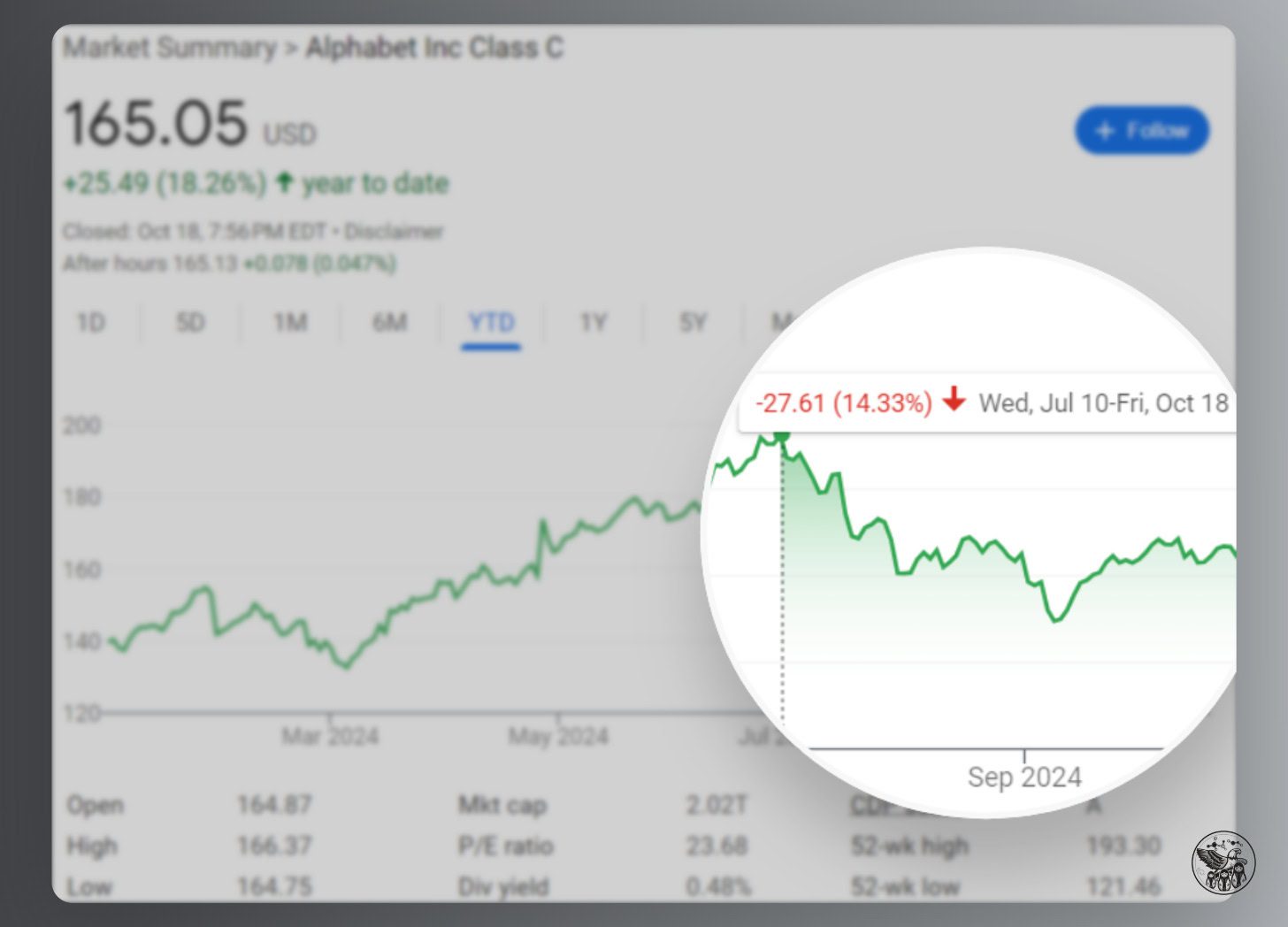
Google’s stock dropped 14% since its all-time high on July 10, in large part because the DOJ revealed that it would take aggressive action against Google.

Market Share: Alphabet Inc.Image Credit: Kevin Indig

After it was originally assumed that the DOJ sought to prevent Google from making exclusive deals with distributors like Apple, a new possible outcome floating around is to break Google up by detaching Chrome, the Play Store, and Android:

Behavioral and structural remedies that would prevent Google from using products such as Chrome, Play, and Android to advantage Google search and Google search-related products and features.

The DOJ even considers forcing Google to share rank data with competitors:

Barring Google from collecting sensitive user data, requiring it to make search results and indexes available to rivals, letting websites opt out of their content being used to train AI products and making Google report to a “court-appointed technical committee” are also on the table.

Realistically, the chances of these remedies actually coming into effect are low:

  1. It will take years for the court and Google to go through several hoops of appeal.
  2. There’s even a chance that a Trump presidency would veto aggressive remedies.
  3. Precedents like the case against Microsoft show that the actual remedies are not as severe (Microsoft was ruled to split into two companies but found a settlement).

However, the reputation damage from exposed emails and statements during the lawsuits and bad press marks a turnaround from Google’s polished image.

And, there is a chance that the DOJ will follow through, which could weaken Google’s position in Search.

Search

Search has been heading in the wrong direction. Raghavan’s legacy is too many Reddit results, too many ads, unhelpful results, and cluttered SERPs.

Google search for [is google going downhill]Image Credit: Kevin Indig

In Free Content, I wrote about a study from Germany that showed how hard it is for Google to get spammy results out of search results.

Google’s Helpful Content Update sought to mitigate overoptimized search results but caused so much collateral damage that the industry revolted against Google until it released an update to the algorithm that specifically aimed to reestablish the search visibility for small and independent sites.

However, the effect was much smaller than expected, with many affected sites only regaining a fraction of their lost traffic.

An underlying problem with search results quality is the unclear direction or algorithm updates and untransparent and fuzzy guidance of “creating helpful content.”

In that same vein, it also became clear in 2024 that Google reacted to bad press and punished sites like Causal or Forbes, which were called out publicly for questionable practices.

Lars Lofgren uncovered a company within Forbes that also seems to create content on other sites and drives millions in revenue. Shortly after, Google seems to have taken at least some action against the site.

Google’s reactions show how important reputation is for the company.

Brand might be Google’s biggest moat, maybe even bigger than all the data it captures, as we can see at the fact of Google not losing market share in Europe after smartphone manufacturers were forced to show users choice screens for browsers and search engines.

From 2 Internets:

However, most users still choose Google despite randomized choices for other search engines since the search engine market share distribution in the EU remains unchanged.

AI

Artificial intelligence terraforms the tech world. Despite Google having invented most parts of the engine, it’s not driving the car. OpenAI is.

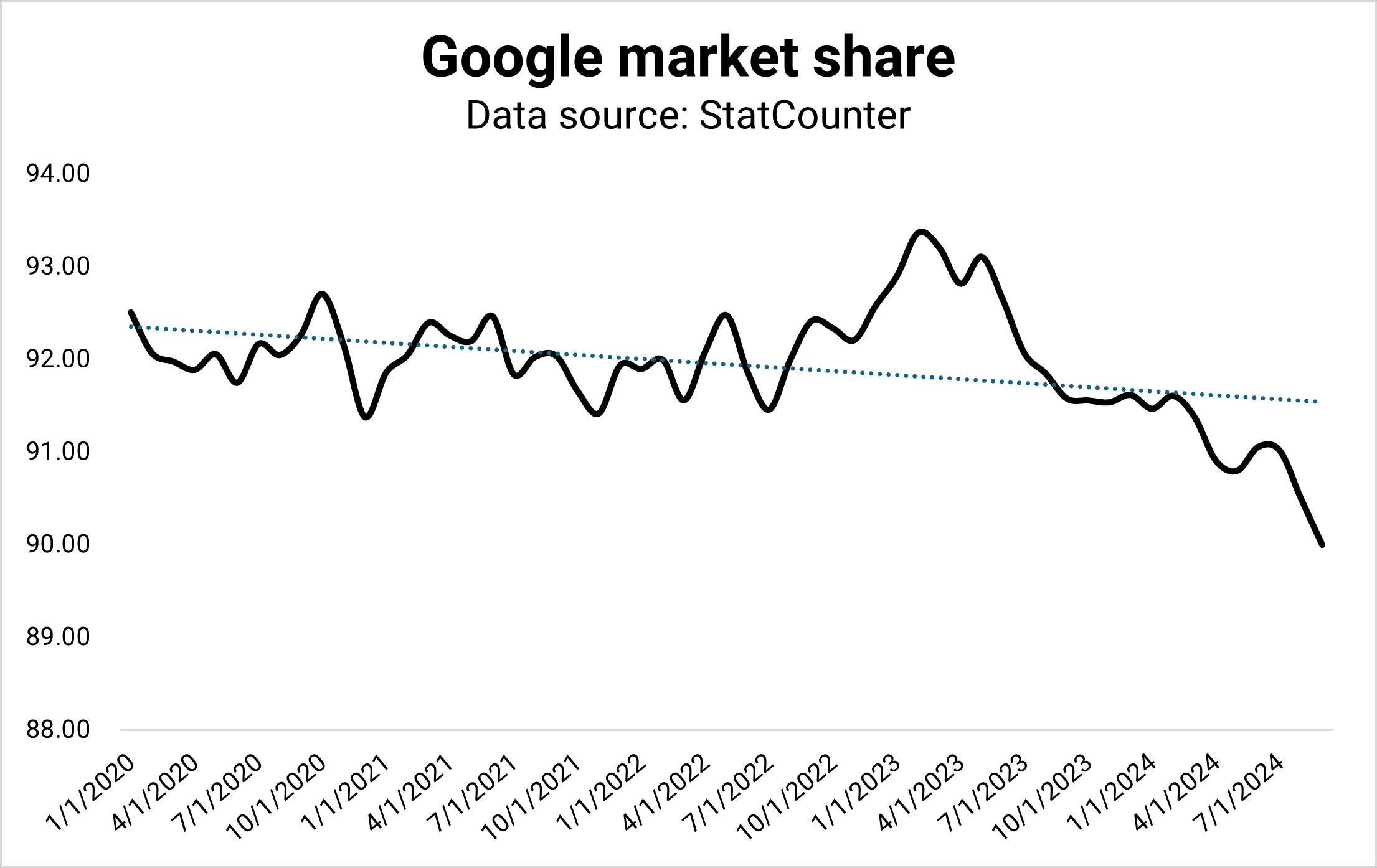
According to StatCounter, Google’s market share dropped to 90% for the first time since the drop to 88% in 2013. The drop could be the result of many reasons, and it could revert.

However, it could also mark a shift from Search to generative AI. I don’t see Google giving away market share to Bing or DuckDuckGo but ChatGPT, Perplexity, and Microsoft Copilot.

Google market shareImage Credit: Kevin Indig

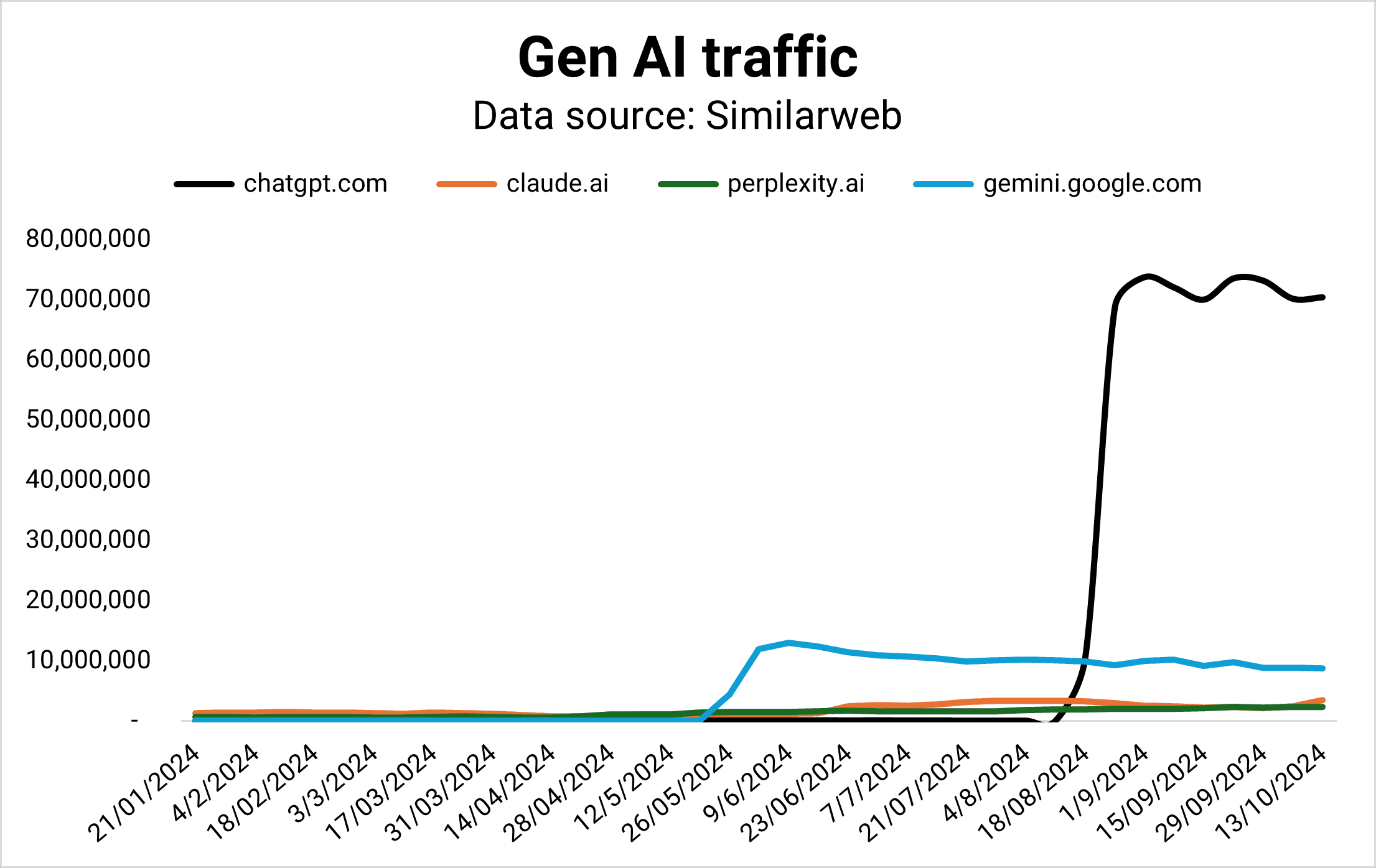
While Google maintains a 90% market share in Search, it doesn’t lead in the market of the future: Gen AI.

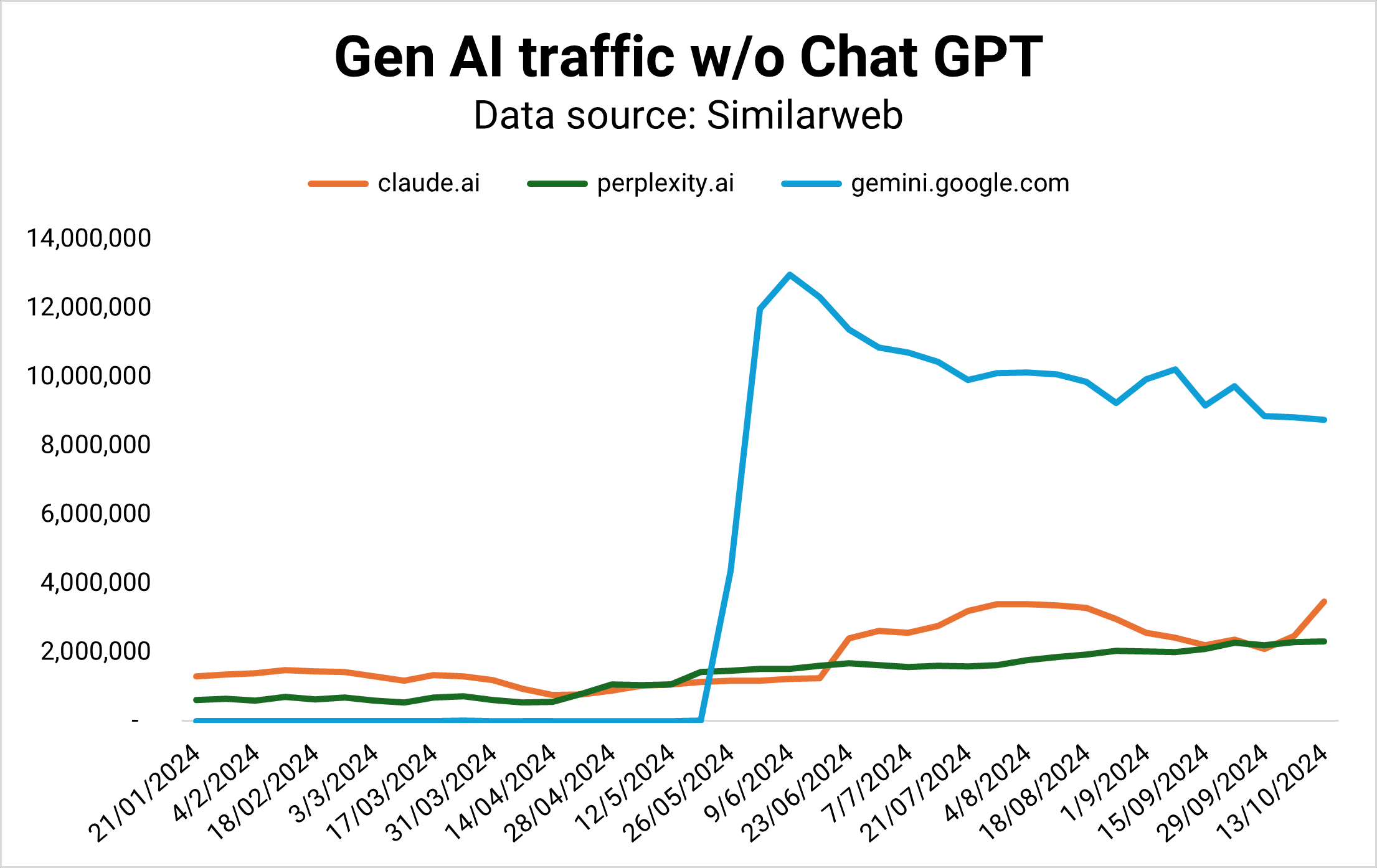
Gemini was supposed to be Google’s horse in the AI race, but its market share is flattening while Claude and Perplexity are gaining ground – fast.

Gen AI TrafficOpenAI is currently winning the Gen AI competition by traffic (Image Credit: Kevin Indig)
Taking Chat GPT out of the picture, we can see that Gemini is stagnating (Image Credit: Kevin Indig)

In 2024, Perplexity answered as many queries per month as it did in the whole year of 2023. The number is still small compared to Google, but the trend is growing.

A series of painful fumbles – from diverse Nazi pictures to fake demo videos and misinformation – mark Google’s chase to keep up with the competition.

From The Big Disconnect:

Then there are fumbled AI product launches. Google’s first reaction to ChatGPT’s stunning success was a stunning failure. The introduction of Bard in February 2023 cost Alphabet $100 billion in market value due to false facts in the announcement.

In December 2023, an impressive demo of Gemini turned into a PR disaster when it turned out to be fake.

In March 2024, Alphabet’s shares dropped by -5% when it turned out Gemini delivered heavily biased and obscure historical images.

Google wants to get AI right so badly that it’s willing to cut corners. Not something you’d expect from the company that invented the underlying LLM technology (Transformers) in the first place.

Former CEO Eric Schmidt’s opinion about the cause of Google’s struggles didn’t help the situation:

“Google decided that work life balance and going home early and working from home was more important than winning. And the reason startups work is because the people work like hell.”

Google’s AI Overviews are the antithesis of the classic search model. Early referral traffic data from gen AI like ChatGPT, Gemini, and Perplexity shows a tiny amount of users clicking through to sites.

If that’s any indication of what we can expect from AI Overviews, Google is turning from a click distributor to an engagement platform.

Advertising

The big question for Google shareholders is how well the company can navigate advertising in the new LLM search world.

Ads can be complementary to search results. But, when users get the answer directly, sponsored results distract from the experience. The old ad format might not fit the new mold. Google has to figure this out but has not yet delivered an innovative approach.

AI transforms digital advertising across creative + copy, matching/targeting, and spend optimization.

However, with more AI Overviews answering questions in the search results, users might need fewer queries to solve problems overall, shrinking the ad market for Google.

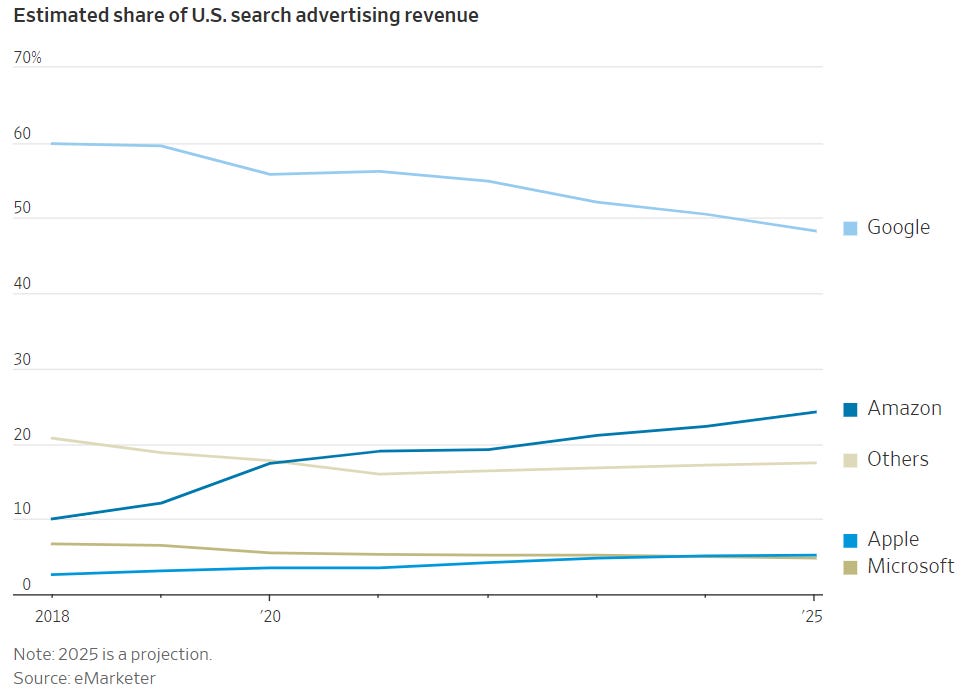
Google is projected to hit an all-time low of less than 50% of available ad dollars next year. Strong challengers like Amazon and TikTok and long-term rivals like Meta are grabbing market share.

Google is projected to hit less than 50% ad revenue market share in 2025Google is projected to hit less than 50% ad revenue market share in 2025 (source) (Image Credit: Kevin Indig)

Google announced a new shopping experience with little to do with a classic search engine.

The reimagined ecommerce experience shows how hard Google wants to compete with Amazon, which faces more competition from TikTok.

As a result, TikTok is competing not only with Google in search but also with ecommerce.

The focus on ecommerce indicates the opportunity for Google to make money from high-intent searches when users don’t need to click through to sites anymore for answers.

But Google wasn’t able to ever kick Amazon off the throne, leaving it exposed for commercial queries.

We can only hope that Prabhakar’s departure leads to a better Google Search. Nick Fox, who will succeed Raghavan, might not be the change agent we seek.

In an email thread with then Head of Search Ben Gomes from 2019, Fox seems open to taking on revenue goals but also not an advocate for it.

To Ben Gomes’ concern:

“…I think we are getting too involved with ads for the good of the product and company…”

Fox responds:

“Given that (a) we’re responsible for Search, (b) Search is the revenue engine of the company, and (c) revenue is weak, it seems like this is our new reality of our jobs?”

However, I question how important Fox is for the future of search anyway. The more important person is Demis Hassabis, founder and CEO of Deep Mind.

Every leadership change brings with it an opportunity to move to a better formation.

With Raghavan’s “promotion” come two important shifts: Gemini moving under Deep Mind, and Assistant moving to the devices team.

Hassabis is the person we need to watch because he now runs Gemini and with it, the quality and volume of AIO answers.

On the talking track, Hassabis stresses the need for responsible use of AI.

How that manifests remains to be seen.


US Weighs Google Breakup in Historic Big Tech Antitrust Case

US plan to break up Google’s search dominance threatens profit engine, AI growth

What to know about our August 2024 core update

Forbes Marketplace: The Parasite SEO Company Trying to Devour Its Host

Former CEO Eric Schmidt explains why Google fumbled its lead in AI [YouTube Video] 

Google Shopping’s getting a big transformation

X (Twitter) Post

Link


Featured Image: Paulo Bobita/Search Engine Journal

Beyond SEO: Why Search Data Is Powerful Market Intelligence Data via @sejournal, @torylynne

Marketers work with search data every day, but we’re greatly underutilizing its potential.

Let me explain.

Search data can tell us all kinds of things about markets, audiences, behavior, and preferences. It’s a source of intelligence that informs smarter, better, more timely business decisions beyond SEO.

In this article, I’ll introduce you to a different way of looking at “search data.”

We’ll talk about sources, which data to pull, and how to use it to arrive at powerful insights quickly.

What Is Search Data?

Search data is any data collected when a user searches a public website by entering a query string to find relevant information (products, information, or answers) from a library of different content (website pages, media) published from different sources (websites, creators).

When people conduct this type of search, they take direct action driven by a need. Put more simply, search data is “active demand.”

Looking at search behavior at scale unlocks a new way of gauging demand for whole industries, specific verticals, unique topics, individual brands, and beyond. This process is known as digital market intelligence.

What Is Digital Market Intelligence?

Digital market intelligence collects and analyzes thousands to (sometimes) millions of digital data points – from public, ethically sourced data – to get to the kind of insights that would traditionally require qualitative surveying.

Except that it’s a lot faster than surveying, and often, it’s more accurate because:

  • The data reflects real behavior from real people who are free from survey bias or influence.
  • It collects vast data sets in mere days (versus weeks or even months), ensuring timeliness and relevance.
  • Data sets contain significantly more data representing huge swaths of the population (versus a small survey sample).
What is digital marketing intelligence?Image from Gray Dot Co, October 2024

Search data is one of the primary inputs in digital market intelligence because it provides an abundance of real user behavior data at an extremely low cost.

Note: DMI is most effective when looking at established industries with a meaningful digital footprint – it doesn’t work for everything!

Where Do We Get The Data?

When most of us think of “search data,” we think of Google data. And make no mistake, that’s a huge piece of the puzzle. Google is still a giant in the search game!

But more and more, people are looking outside of Google for information. In fact, some data sources name TikTok as the world’s largest search engine for Gen-Z users — not Google.

So, when we talk about search data, we’re still talking about Google and other search engines.

But we’re also stepping out of the silo and acknowledging that sources like YouTube, Pinterest, TikTok, etc. are sources where users exhibit active demand.

The datasets from each are extremely valuable for digital market intelligence because we can tap into them at a marginal cost via APIs, platform-specific reporting tools, and third-party tools.

(For a lot cheaper than traditional consumer insights work!)

  • Google Search Console.
  • Google Ads.
  • Youtube API.
  • Google Trends.
  • Third-party tools like Semrush or Ahrefs.
  • Pinterest.
  • TikTok.
Where to get DMI Demand dataImage from Gray Dot Co, October 2024

Which Search Data Is Meaningful?

Now that we’ve established where we’re actually sourcing the data, what are we pulling?

Metrics we work with day in and day out are the raw inputs for calculations that answer big business questions:

Search Metrics for DMI measurementImage from Gray Dot Co, October 2024
  • Keyword volume quantifies how often people actively look for products, information, or brands at any given time.
  • Hashtag volume measures how much of the content landscape is saturated by a given topic or brand.
  • Keyword intent identifies where people are in the customer journey, plus common behavior and language at different funnel stages.
  • Competitor research compares demand for brands apples-to-apples, plus how much demand each captures in the landscape.
  • Historical trends create a clear snapshot of shifts in demand to illustrate the trendline for any topic area over time.

What Can Search Data Tell Us About The Market?

Digital market intelligence can answer a lot of the questions marketing teams and even business leaders run into regularly.

Let’s take a look at some of the most common and illustrate how DMI can yield quick insights using search data.

Did The Market Grow Or Shrink YoY?

This is basically an exercise in summing active demand for the search terms that apply to your business or industry.

In a classic consumer insights sense, the size of the market is generally referred to as the Total Addressable Market.

To quantify TAM using search data, calculate the total keyword volume for the year across relevant search terms. You can source and export keyword volume at scale by using a third-party tool such as Semrush or Ahrefs.

Once you have your TAM total for both years, compare them to quantify the YoY difference. In terms of a calculation, it would look something like this:

[Total volume: Relevant keywords in year A] - [Total volume: Relevant keywords in year B] = YoY change in market size

Is An External Factor Having An Impact?

Your business tactics could drive a jump or drop in performance, but it could be something that’s out of your control altogether.

Leadership will want to know whether it’s the “tide” or something the “boat” (your marketing team) is doing.

Sometimes, the quickest and easiest way to tell is to turn to search data — specifically our often-overlooked friend, Google Trends.

For the sake of example, let’s take a look at a simple case of an external factor driving increased demand for a service. Specifically, did the Olympics drive an increase in the demand for gymnastics lessons?

We know that the Olympics took place between Jul. 26 and Aug. 11, 2024. Now, we need to know how searches for “gymnastics lessons” in this window compare to other periods of time outside of the Olympics.

Screenshot of Google Trends, looking at the changes over time for interest in gymnastics classes during the OlympicsScreenshot from Google Trends, September 2024

It’s clear from the data that there was a significant increase in interest in gymnastics lessons during the Olympic window.

We see a much smaller increase during the window of the 2020 Olympics (Jul. 23 – Aug. 8, 2021), but we can probably attribute this to COVID-19 and related restrictions/behaviors.

This type of insight isn’t just valuable for gauging whether the industry tide affected performance.

It’s also invaluable for determining when to lean into specific products, information, or trends through levers such as increasing paid spend, launching social campaigns, or shifting the overall marketing mix to meet the moment.

How Does Demand For Our Brand Compare?

Search data allows us to compare active demand for Brand A to active demand for Brand B to answer this age-old question.

For this exercise, pull keyword volumes for any queries that contain Brand A’s name in the string. Then, do the same for Brand B over the same window of time.

Add the keyword volume for each respective brand to come up with the brand total. Then, calculate the difference to understand how they stack up.

[Total volume: Brand A branded KWs over X months] - [Total volume: Brand B branded KWs over X months] = Difference in active brand demand

Are We Visible Enough To Drive Awareness?

The search landscape is one big conversation. “Share of voice” can tell you how much of the conversation the brand is actually participating in.

This measurement takes the total keyword volume a brand is competing for as a percentage of the total volume of possible, relevant keyword opportunities for the brand.

Since only 0.44% of users visit the second page of search results, start by identifying keywords where a brand ranks on page one (either traditional placement, featured snippet, or AI Overviews). Because if it’s not on page one, a brand isn’t actually competing in most cases.

Calculate the aggregate volume for these keywords, divide it by the total volume across all relevant keyword opportunities (regardless of ranking), and multiply by 100.

( Brand-eligible keyword volume] / [Landscape keyword volume] ) x 100 = [% Share of Voice]

It Starts With A Simple Shift In Perspective

Looking at familiar numbers in new ways starts to unlock business-critical narratives.

And it doesn’t stop with search data!

Data from social media platforms and forum sites hold their own unique opportunities to understand markets even more through the lenses of engagement and consumer behavior.

Step one is making the mental shift from search data to demand data.

It’s a subtle shift that can take us out of our siloed way of looking at data. Breaking down those walls is the key to making digital market intelligence work for you.

Go forth and find those illuminating answers — at the speed of modern business.

More resources: 


Featured Image: ImageFlow/Shutterstock

Google’s Answer on Ideal Content Length for SEO via @sejournal, @martinibuster

Google’s John Mueller answered a question on LinkedIn about the ideal content length for performing well on Google. Participants in the discussion pressed for specifics, raised concerns about being SERP-blocked by Reddit, and suggested that Search Console should offer content feedback. Mueller’s response challenged SEOs to rethink their approach to content.

What’s The Best Length Of Content For SEO?

Of course, the underlying problem is the question itself which is asking what should be done in order to make better content for Google, which is the opposite of what Google’s algorithms are set up to identify.

Yet, there is some merit to the question because maybe some people are new to publishing and don’t really understand what the best length is for content. On the other hand, publishing content that’s so long that it veers off topic is a mistake that many people, regardless of experience level, commonly make.

This is the question asked:

“Hi John, is there an ideal content length that performs better on Google search results? Should we focus on creating longer, in-depth articles, or can short-form content rank just as well if it’s concise and valuable?”

There are a lot of ideas about how to make content so it’s understandable if someone is confused about it.

Mueller’s Answer Is Questioned

Google’s John Mueller answered the question and it was a good answer. However others had concerns about the ranking choices that Google makes that can block good content from ranking.

Mueller answered:

“There is no universally ideal content length. Focus on bringing unique value to the web overall, which doesn’t mean just adding more words.”

Mueller’s suggestion to focus on bringing “unique value” with published content is good advice. Adding unique value doesn’t necessarily mean adding more images, more content, less content, more graphs, or step-by-steps. All of those things could be helpful but only if it’s relevant to a user and their query.

Yet, as someone pointed out in that discussion, a site with good content could still lose out in the SERPs due to Google’s “preference” for showing sites like Reddit.

A person with the user name SEOBot _ wrote that Google should offer more information and feedback about what “unique value” content means in relation to their own content. While it might seem strange that a publisher is unclear about what constitutes “unique value” content, the question calls attention to the confusion that some publishers feel about how sites are ranked by Google.

This is  the follow up question asked by that person:

“…do you have any example of content on the website that follows this and is able to get the Google love. “Focus on bringing unique value to the web overall, which doesn’t mean just adding more words.” This is a very vague and unrealistic ask if the GSC can start pinpointing this content/section as not making any sense or not adding any value.

We really eager to learn and know how the content is actually generating value to the web. If all the value is being generated by top publishers/brands then what exactly the small publishers/niche site owners suppose to write to survive?”

Mueller responded:

“SEOBot _ If you’re looking for a mechanical recipe for how to make something useful, that will be futile – that’s just not how it works, neither online nor offline. When you think about the real-world businesses near you that are doing well, do you primarily think about which numbers they focus on, or do you think about the products / services that they provide?”

What Mueller seems to be saying is that focusing on site visitors, not Google, is the way to understand what “unique value” content is.

I recently presented at a search marketing conference on the topic of seven things publishers can focus on to improve their content. There’s a lot to say about optimizing content but really, publishers and SEOs can get pretty far by taking Mueller’s advice about thinking about how you would approach selling to people in an actual store or focusing on writing for people (like I’m doing right now).

Others joined the conversation to essentially ask the same thing, looking for specifics on what Google is looking for in content. Mueller had said all there is to say about it.

Mueller advised:

“If you count the words in best seller books, average the count, and then write the same number of words in your own book, will it become a best seller? If you make a phone that has the same dimensions as a popular smartphone, will you sell as many as they do? I love spreadsheets, but numbers aren’t everything. “

Takeaway

If everything a person has learned about SEO centers around strategies for keywords, worrying about “entities” and whether articles are interlinked with the right anchor text then what Mueller is saying will sound confusing. I’ve been doing SEO for 25 years and I remember a time where SEO was about creating content and links for Google. But this isn’t 2004, it’s 2024 and we’ve reached a time with SEO where it’s increasingly not about creating content for Google.

Read the discussion here:

Hi John, is there an ideal content length that performs better on Google search results?

Featured Image by Shutterstock/Roman Samborskyi

These companies are creating food out of thin air

Dried cells—it’s what’s for dinner. At least that’s what a new crop of biotech startups, armed with carbon-guzzling bacteria and plenty of capital, are hoping to convince us. Their claims sound too good to be true: They say they can make food out of thin air.

But that’s exactly how certain soil-dwelling bacteria work. In nature, these “autotrophic” microbes survive on a meager diet of oxygen, nitrogen, carbon dioxide, and water vapor drawn directly from the atmosphere. In the lab, they do the same, eating up waste carbon and reproducing so enthusiastically that their populations swell to fill massive fermentation tanks. Siphoned off and dehydrated, that bacterial biomass becomes a protein-rich powder that’s chock-full of nutrients and essentially infinitely renewable. 

Lisa Dyson is the founder of one of these startups, Air Protein. When she talks about the inspiration for her company, she often cites NASA research from the 1960s. Back then the agency, hoping to keep astronauts satiated on long-haul space journeys, explored the idea of growing bacterial cuisine on board before concluding, ultimately, that astronauts might not find it psychologically palatable. “Earth is actually like a spaceship,” Dyson explained in a 2016 TED Talk. “We have limited space and limited resources, and on Earth, we really do need to figure out how to recycle our carbon better.” Could these bacteria be the answer?

For now, the answer is a definite maybe. Some 25 companies worldwide have already taken up the challenge, hoping to turn abundant carbon dioxide into nutritious “air protein.” The ultimate goal of the people who work at these companies is to engineer a food source far lower in emissions than conventional farming—perhaps even one that could disrupt agriculture altogether. To do that, they’ll need to overcome some very real challenges. They’ll need to scale up production of their protein to compete commercially, and do it in a way that doesn’t create more emissions or other environmental issues. Even trickier: They’ll need to surmount the ick people may experience when contemplating a bacteria-based meal. 

Some of these companies are focused on industrial animal feed, fish meal, and pet food—products with slimmer profit margins but less exacting consumers and fewer regulatory hurdles. Human food, however, is where the real money—and impact—is. That’s why several companies, like Dyson’s Air Protein, are focused on it. In 2023 Air Protein opened its first “air farm” in San Leandro, California, a hub for the commercial food production industry, and announced a strategic development agreement with one of the largest agricultural commodity traders in the world, ADM, to collaborate on research and development and build an even larger, commercial-­scale plant. The company’s “Air Chicken” (which, to be clear, is not actual chicken) is slowly making its way toward grocery store shelves and dinner tables. But that’s only the beginning. Other companies are making progress at harnessing bacteria to spin air into protein, too—and someday soon, these microbial protein patties could be as common as veggie burgers. 

An alternative to alternative proteins

The environmental case for microbial protein is clear enough; it’s a simple calculus of arable land, energy, and mouths to feed. The global demand for protein is already at an all-time high, and with the population expected to grow to 9.7 billion by 2050, traditional agriculture will have a hard time keeping up, especially as it battles climate change, soil degradation, and disease. A growing global middle class is expected to raise levels of meat consumption, but factory-farmed meat is one of the leading drivers of greenhouse-­gas emissions. Although protein-rich alternatives like soy are far more sustainable, most of the soy grown in the world is destined for use as animal feed—not for human consumption. 

In contrast, bacterial “crops” convert carbon dioxide directly into protein, in a process that uses much less land and water. Microbial protein “farms” could operate year-round anywhere renewable electricity is cheap—even in places like Chile’s Atacama Desert, where farming is nearly impossible. That would take the strain off agricultural land—and potentially even give us the chance to return it to the wild. 

 “We are liberating food production from the constraints of agriculture,” Juha-Pekka Pitkänen, cofounder and CTO of the Finnish startup Solar Foods, explained in a recent company video. In April 2024 Solar Foods opened a demonstration factory in Vantaa, a short train ride from the Helsinki airport. It’s here, at Factory 01, that the company hopes to produce enough of its goldenrod-yellow protein powder, Solein, to prove itself viable—some 160 metric tons a year. 

Like Air Protein, Solar Foods begins its production process with naturally occurring hydrogen-­oxidizing bacteria that metabolize carbon dioxide, the way plants do. In sterile bioreactors similar to the fermentation vats used in the brewing industry, the bacteria flourish in water on a steady diet of CO2, hydrogen, and a few additional nutrients, like nitrogen, calcium, phosphorus, and potassium. As they multiply, the bacteria thicken the water into a slurry, which is continuously siphoned off and dehydrated, creating a protein-rich powder that can be used as an ingredient in alternative meats, dairy products, and snacks.

“We are liberating food production from the constraints of agriculture.”

Juha-Pekka Pitkänen, Solar Foods

As Pitkänen explains, his research team at Finland’s state-owned VTT Technical Research Centre knew these microorganisms existed in the wild. To find a viable candidate, they narrowed down the natural conditions where one might be found, and then—as is the Finnish way—put on some hiking boots and got out there. “In Finland, you don’t have to go very far to find nature,” he says, shrugging. “You can find something useful in a ditch.”

Still, not just any old ditch bacteria would do. Their target needed to both consume carbon dioxide and continue to thrive even after it was isolated from the microbial community it coexisted with, or competed against, in nature. “We were looking for a pacifist microorganism,” Pitkänen says. “It’s quite rare.” In a wet soil-dwelling bacterium of the genus Xanthobacter,they found their match: a nontoxic, lab-friendly microbe palatable enoughto slip into myriad food preparations.

At Solar Foods’ annual summer company party this year, their in-house chef served a bright-yellow lasagna made with Solein. The powder, Pitkänen says, makes an excellent flour for fresh pasta dough and works surprisingly well as a cream replacement in ice cream. It’s rich in carotenoids, so it can taste “carroty,” and it’s full of B12 and bioavailable iron, which makes it great for vegetarians. But the product isn’t a plug-and-play replacement for milk, eggs, or even meat. Rather, it’s an ingredient like any other, competing on nutritional value, cost, and texture. The company’s main competition, Pitkänen told me, isn’t other novel proteins—it’s soy meal. 

“In the last 10 years, the whole alternative-protein landscape has changed dramatically,” says Hannah Lester, an EU-based regulatory consultant to the novel-food industry. Soy patties and bean burgers are now ubiquitous to the point of being passé; today’s cutting-edge alternative proteins are cultivated from animal cells and coaxed from specially designed microorganisms using techniques originally developed to produce vaccines and other pharmaceuticals. “Molecular farmers” tend fields of bright-pink soybeans whose genetic makeup has been doctored so that they contain proteins identical to ones pigs make. “It’s really coming to the point where companies are utilizing the most incredible technology to produce food,” she says.

A fermentation process by any other name

The space Air Protein and Solar Foods occupy is so new that language hasn’t quite coalesced around it. Some in the alternative-protein industry evocatively call it “cellular agriculture,” but it’s also referred to as “gas fermentation,” emphasizing the process, and “biomass fermentation,” emphasizing the end product. These terms are distinct from “precision fermentation,” which refers to another buzzy bioprocess that employs genetically modified yeasts, other fungi, and bacteria to produce proteins indistinguishable from their animal-­derived counterparts. Precision fermentation isn’t a new technique: The US Food and Drug Administration approved its use to produce insulin in 1982, and 80% of the rennet used in cheese is now made this way, avoiding the need to harvest the enzymes from the stomach lining of calves. 

Rather than coaxing microorganisms to produce the animal-­derived proteins we’re already familiar with, companies like Air Protein and Solar Foods are proposing that we skip the intermediary and simply eat the microbes themselves, dried into a powder. Microbial biomass made with these new fermentation technologies is fibrous, vitamin-rich, and versatile. More important, these bacteria eat carbon, require very little land and water, and need no fossil-fuel-derived fertilizers. According to a life-cycle analysis produced by the University of Helsinki and the Natural Resources Institute Finland, microbial protein is between 53% and 100% more efficient to produce than animal protein.

Of course, that’s a wide range. Finland’s electricity mix favors renewables like hydropower and wind; in a country more reliant on fossil fuels, the environmental impact of making Solein, or any microbial protein, could be much higher. Growing microbes in bulk means creating the perfect conditions for them to thrive—and, as with any industrial production process, that requires factories, equipment, and power to run the entire system. It also requires a generous supply of elements like carbon dioxide and hydrogen. 

white cloud hovering over a sugar cone on blue sky background

ERIC MONGEON/MIT TECHNOLOGY REVIEW

Nearly all the world’s human-made hydrogen, a key element in the bacterial diet, comes from fossil-fuel production, and “green” hydrogen, which Solar Foods uses in its demonstration factory, comes from using renewable-powered electrolysis to split water, still an uncommon process. According to David Tze, CEO of the microbial-protein company NovoNutrients, which is currently working to branch out from industrial fish meal to human food, the segment of the microbial-protein industry powered by hydrogen is likely to set up shop wherever hydrogen is cheapest.

Carbon sources for this technology are likewise varied. If a company wants to use captured waste carbon, it will need to broker relationships with industries to connect its protein factories with those sources. Another alternative, sourcing carbon drawn from the atmosphere using direct air capture, or DAC, is still new, energy intensive, and expensive. For the time being, Air Protein uses the same commercially available carbon dioxide used in sparkling water, and while Solar Foods uses DAC for about 15% of the carbon it needs at its demonstration factory, the rest is sourced commercially. Both companies hope to adjust their carbon sources as they scale, and as DAC becomes more commercially available. 

Even if the bacteria were fed a diet of entirely captured carbon, they wouldn’t be permanently removing it from the atmosphere, since we release carbon when we digest food. Still, Tze says, “we’re giving a second life to CO2, and allowing it to add so much more positive value to the economy.” More important, the bacteria-based products drastically reduce the emissions footprint of protein. According to a 2016 study by the World Resources Institute, producing a single ton of beef creates around 2,400 metric tons of greenhouse-gas emissions. For plant-based sources of protein, like pulses, the number is much less than 300—but for microbial proteins it may ultimately be in the single digits. “If someone can eat a bite of our product instead of a bite of anything else,” Tze says, “it could be one or three orders of magnitude difference.”

Of course, none of this works if microbial protein remains a niche industry, or if the product is too expensive for the average consumer. Even running at capacity, Solar Foods’ demonstration factory can only produce enough protein to provide the entire population of Finland with one meal a year. From a business standpoint, Pitkänen says, that’s good news: There’s plenty of room to grow. But if they hope to make a dent in the long-term sustainability of our food systems, companies like Solar Foods and Air Protein will need to scale up by orders of magnitude too. It remains to be seen if they will be able to meet that challenge—and if consumers will be ready. 

Even though both the process (fermentation) and the material (living microorganisms) are as natural as the world and as old as time, the idea of whipping air and microbes together to make dinner will strike many people as unthinkably weird. Food is cultural, after all—and especially in the US, protein is political. In interviews, Dyson takes pains to call the bacteria behind Air Protein’s process “cultures,” emphasizing the connection to traditional fermented foods like yogurt, beer, or miso. On the Solar Foods website, chic people drink yellow Solein smoothies at tasteful Nordic tables. No bacteria are pictured.

Solar Foods is still awaiting final regulatory approval in the EU and the US, but Solein is already for sale in Singapore, where it’s been whipped into chocolate gelato and hazelnut-­strawberry snack bars. If Singaporeans took issue with eating powdered bacteria, they made little show of it. When it comes to food biotechnology, the most progressive countries in the world are those with the least arable land. Singapore, which imports nearly everything, hopes to meet 30% of its own nutritional needs by 2030. Israel, a semi-arid country with limited landmass, has invested heavily in biomanufacturing, as has the Netherlands, where farmland has been heavily depleted by chemical fertilizers. But even in less constrained countries, “agriculture is on its knees because of climate change,” says Lester, the regulatory expert. “At some point, sadly, we’re just not going to be able to produce food in the traditional way. We do need alternatives. We need government support. We need fundamental policy change in how we fund food.”

This sentiment seems to be resonating in the United States. In September 2022, President Joe Biden signed an executive order to advance biomanufacturing by expanding training, streamlining regulation, and bolstering federal investment in biotechnology R&D, specifically citing “boost[ing] sustainable biomass production” as a key objective. In 2021, the Defense Advanced Research Projects Agency launched the Cornucopia program, asking four research teams—one of which includes Dyson’s company, Air Protein—to create a complete nutrition system, small enough to fit on a Humvee, that can harvest nitrogen and carbon from the air and use it to produce microbial rations in the form of shakes, bars, gels, and jerky. Microbial protein may never be deployed on long-haul space trips as NASA dreams, but it seems that the government is betting it could keep us alive on Spaceship Earth—that is, if the crew doesn’t reject it outright.

Claire L. Evans is a writer and musician exploring ecology, technology, and culture.