The demand for new and improved infrastructure across the world is not being met. The Asian Development Bank has estimated that in Asia alone, roughly $1.7 trillion needs to be invested annually through to 2030 just to sustain economic growth and offset the effects of climate change. Globally, that figure has been put at $15 trillion.
In the US, for example, it is no secret that the country’s highways, railways and bridges are in need of updating. But similar to many other sectors, there are significant shortages in skilled workers and resources, which delays all-important repairs and maintenance and harms efficiency.
This infrastructure gap – the difference between funding and construction – is vast. And while governments and companies everywhere are feeling the strain of constructing an energy efficient and sustainable built environment, it’s proving more than humans can do alone. To redress this imbalance, many organizations are turning to various forms of AI, including large language models (LLMs) and machine learning (ML). Collectively, they are not yet able to fix all current infrastructure problems but they are already helping to reduce costs, risks, and increase efficiency.
Overcoming resource constraints
A shortage of skilled engineering and construction labor is a major problem. In the US, it is estimated that there will be a 33% shortfall in the supply of new talent by 2031, with unfilled positions in software, industrial, civil and electrical engineering. Germany reported a shortage of 320,000 science, technology, engineering, and mathematics (STEM) specialists in 2022 and another engineering powerhouse, Japan, has forecast a deficit of more than 700,000 engineers by 2030. Considering the duration of most engineering projects (repairing a broken gas pipeline for example, can take decades), the demand for qualified engineers will only continue to outstrip supply unless something is done.
Immigration and visa restrictions for international engineering students, and a lack of retention in formative STEM jobs, exert additional constraints. Plus, there is the issue of task duplication which is something AI can do with ease.
Julien Moutte, CTO of Bentley Systems explains, “There’s a massive amount of work that engineers have to do that is tedious and repetitive. Between 30% to 50% of their time is spent just compressing 3D models into 2D PDF formats. If that work can be done by AI-powered tools, they can recover half their working time which could then be invested in performing higher value tasks.”
With guidance, AI can automate the same drawings hundreds of times. Training engineers to ask the right questions and use AI optimally will ease the burden and stress of repetition.
However, this is not without challenges. Users of ChatGPT, or other LLMs, know the pitfalls of AI hallucinations, where the model can logically predict a sequence of words but without contextual understanding of what the words mean. This can lead to nonsensical outputs, but in engineering, hallucinations can sometimes be altogether more risky. “If a recommendation was made by AI, it needs to be validated,” says Moutte. “Is that recommendation safe? Does it respect the laws of physics? And it’s a waste of time for the engineers to have to review all these things.”
But this can be offset by having existing company tools and products running simulations and validating the designs using established engineering rules and design codes which again relieves the burden of having the engineers having to do the validating themselves.
Improving resource efficiency
An estimated 30% of building materials, such as steel and concrete, are wasted on a typical construction site in the United States and United Kingdom, with the majority ending up in landfills, although countries such as Germany and The Netherlands have recently implemented recycling measures. This, and the rising cost of raw materials, is putting pressure on companies to think of solutions to improve construction efficiency and sustainability.
AI can provide solutions to both of these issues during the design and construction phases. Digital twins can help workers spot deviations in product quality even and provide the insights needed to minimize waste and energy output and crucially, save money.
Machine learning models use real-time data from field statistics and process variables to flag off-spec materials, product deviations and excess energy usage, such as machinery and transportation for construction site workers. Engineers can then anticipate the gaps and streamline the processes, making large-scale overall improvements for each project which can be replicated in the future.
“Being able to anticipate and reduce that waste with that visual awareness, with the application of AI to make sure that you are optimizing those processes and those designs and the resources that you need to construct that infrastructure is massive,” says Moutte.
He continues, “The big game changer is going to be around sustainability because we need to create infrastructure with more sustainable and efficient designs, and there’s a lot of room for improvement.” And an important part of this will be how AI can help create new materials and models to reduce waste.
Human and AI partnership
AI might never be entirely error-free, but for the time being, human intervention can catch mistakes. Although there may be some concern in the construction sector that AI will replace humans, there are elements to any construction project that only people can do.
AI lacks the critical thinking and problem-solving that humans excel at, so additional training for engineers to supervise and maintain the automated systems is key so that each side can work together optimally. Skilled workers have creativity and intuition, as well as customer service expertise, while AI is not yet capable of such novel solutions.
With the engineers implementing appropriate guardrails and frameworks, AI can contribute the bulk of automation and repetition to projects, thereby creating a symbiotic and optimal relationship between humans and machines.
“Engineers have been designing impressive buildings for decades already, where they are not doing all the design manually. You need to make sure that those structures are validated first by engineering principles, physical rules, local codes, and the rest. So we have all the tools to be able to validate those designs,” explains Moutte.
As AI advances alongside human care and control, it can help futureproof the construction process where every step is bolstered by the strengths of both sides. By addressing the concerns of the construction industry – costs, sustainability, waste and task repetition – and upskilling engineers to manage AI to address these at the design and implementation stage, the construction sector looks set to be less riddled with potholes.
“We’ve already seen how AI can be used to create new materials and reduce waste,” explains Moutte. “As we move to 2050, I believe engineers will need those AI capabilities to create the best possible designs and I’m looking forward to releasing some of those AI-enabled features in our products.”
This content was produced by Insights, the custom content arm of MIT Technology Review. It was not written by MIT Technology Review’s editorial staff.
Google has periodically updated its core algorithm for several years now. Unlike the Panda and Penguin updates a decade ago, core updates have no defined recovery tactics, at least Google will not reveal them.
No site is safe from a Google update; ranking fluctuations are normal. Current Google search guidelines are vague and subjective — “helpful content” and “better usability” are hard to define and do not translate into an actionable strategy.
Yet some sites are impacted more than others. I’ve seen sites that went from thousands of clicks per day to 10.
I’ve analyzed hundreds of sites and their histories with Google updates. Here’s what makes sites the most vulnerable.
Dependence on a Few Pages
Losing traffic is probable if your site relies on two or three pages ranking for high-search-volume keywords,
Diversifying your ranking profile with long-tail keywords is critical. Long-tail queries send fewer clicks, but losing rankings on a few won’t materially impact your overall search visibility.
To achieve this:
Don’t limit your strategy to high-search-volume keywords. In my tests, popular SEO platforms detect only about a third of ranking keywords.
Create content based on what your followers, readers, and customers discuss — not keywords. Focusing on keywords for editorial decisions leads to fragile ranking profiles.
Create descriptive, longer titles, especially for product pages. It will help rank for longer-tail queries.
Stale or Weak Backlink Profile
According to Google’s leaked algorithm documentation, “the freshness” of a link is a huge factor. SEO practitioners have long known that a site cannot maintain rankings without acquiring fresh backlinks.
Sites impacted by last year’s “helpful content” updates had weaker backlink profiles than those that maintained or increased rankings, even with similar themes and content quality.
Certainly content, site speed, and clicks and user experience are key ranking factors. But strong backlink profiles appear to be paramount.
Few or No Brand Signals
I explained last year how to tell if Google recognizes a site as a brand. I always check branding when analyzing sites with big traffic losses. In most cases, an impacted site does not appear to be an entity.
Becoming a recognizable brand is not easy. It takes a lot of time, but it is essential for consistent search visibility. Here are a few strategies for small and midsize businesses.
Collaborate with other brands and nonprofits, especially if Google recognizes them as brands. Being associated with entities is the most powerful way to become one.
Get nominated for industry awards or speak at conferences — anything to associate with other entities is helpful.
Invest in viral marketing and social media ads. Both increase branded search, which is a huge signal to Google.
The hype around the metaverse may have cooled, but immersive virtual experiences remain in the early stages with consumers. For brands and merchants, metaverse platforms are worth following as opportunities in these new economies unfold.
Here is a guide to promising virtual worlds for merchants and brands to explore in the year ahead. Some are accessible through virtual reality headsets; others offer social and gaming platforms with virtual lands and digital currencies. All are immersive, drawing consumers into a new realm.
Roblox is an immersive platform for creating, playing, and connecting through experiences built by a community of creators. It claims nearly 80 million daily users. Recent platform improvements include an expanded marketplace with dynamic pricing, subscriptions within experiences, a rights manager, video ads, and an enhanced ads manager.
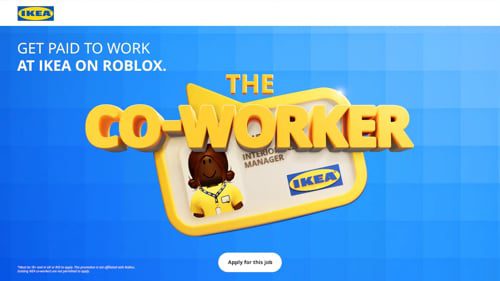
Roblox has also made the most progress in developing ecommerce initiatives with brands and merchants. Recently, Ikea opened a store on Roblox and created The Co-Worker Game to promote it and find employees to staff it. Walmart has launched ecommerce experiences within its Discovered world, allowing users to try out virtual items on their avatars and then purchase through a virtual laptop to access Walmart.com. Shopify is integrating its Checkout solution into Roblox, with a larger launch in early 2025. Developers, creators, and brands on Shopify can sell physical items directly within their Roblox games without leaving that platform.
Meta Horizon Worlds is an immersive social experience for exploring, playing, and creating. A Meta product where users can log in with their Facebook accounts, Horizon Worlds is accessible via Meta Quest VR headsets in all 23 countries where those headsets are sold and supported by Meta.
Meta continues to develop the platform. Last year, the company released a series of quality VR games. This summer, Horizon Worlds hosted a concert with Sabrina Carpenter. Meta has tested mixed reality in Horizon Worlds (with plans to make it more widely available).
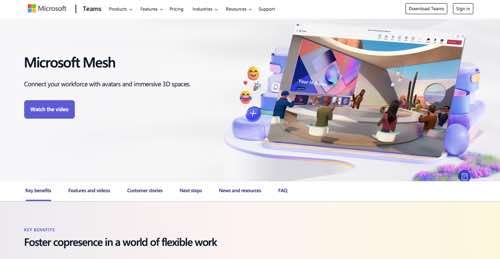
Microsoft Mesh is an immersive three-dimensional environment for people to collaborate using Microsoft Teams, a PC, or a Meta headset. Mesh helps users feel that virtual meetings and events are more like face-to-face connections, with or without a headset. The 3D environments are also customizable, with games such as tossing bean bags and icebreaker questions.
Earlier this year Mesh launched its 3D meetings inside Teams. Mesh event hosts can now see attendees’ raised hands and reactions in all rooms across multi-room events (i.e., events exceeding 16 attendees.)
The Sandbox, launched as a 2D-pixel art game in 2012, is now a 3D environment for world-building games to empower global artists, storytellers, and designers to create, publish, own, and monetize unique content via blockchain technology. Virtual concerts, art exhibitions, and conferences can be attended from anywhere, featuring artists such as Snoop Dogg, DeadMau5, Blondish, and Elvis in The Sandbox. Brands such as Gucci and Adidas are hosting immersive shopping experiences in The Sandbox, with virtual fashion shows, showrooms, and stores. The Sandbox states it has partnered with and assisted more than 200 brands to develop their own worlds.
The Sandbox recently launched its Alpha Season 4. The 10-week in-platform event features over 100 unique experiences, 50 hours of new gameplay, and collaborations with 40 brands alongside user-generated content. Additionally, The Sandbox is offering a reward pool exceeding $2.5 million in value, paid out in Sand, the platform’s native token.
Decentraland is a virtual 3D world where users buy virtual plots of land as non-fungible tokens using the Mana cryptocurrency, which is based on the Ethereum blockchain. Users can also create and sell wearables. Digital fashion shows, competitions, and themed events are key social activities. Established brands and fashion labels, including Samsung, Adidas, Miller Lite, Dolce & Gabbana, Tommy Hilfiger, and Perry Ellis, have purchased properties or participated.
Decentraland’s upgraded desktop client enters public beta on October 22 with enhancements to its graphics and performance, resulting in faster frame rates and reduced loading times for the virtual world. The upgrade will allow greater avatar density, allowing over 200 avatars in the same place, enhancing the social aspect of the world. The platform also plans to introduce features such as quests and badges to track player progress and promote social engagement. The platform will host a three-day music festival in November to test its new capabilities.
Fortnite, launched in 2017, is a metaverse platform developed by Epic Games. It supports six game modes: Battle Royale, Save the World, Lego Fortnite, Fortnite Creative, Rocket Racing, and Fortnite Festival. All modes are cross-platform compatible, requiring an Epic Games account to save between platforms. In addition, the modes utilize the Unreal Editor for Fortnite, allowing players to edit worlds using Fortnite assets.
Fortnite has hosted a series of successful collaborations with brands and artists, including Lego, Marvel, the NFL, Eminem, and Travis Scott. Earlier this year, Disney announced a multiyear project with Epic Games to build a games and entertainment universe of Disney stories and experiences, along with Disney’s $1.5 billion investment for an equity stake in the developer. The new universe will offer many opportunities for consumers to play, watch, shop, and engage with content, characters, and stories from Disney, Pixar, Marvel, Star Wars, Avatar, and more. Players, gamers, and fans can create their own stories and experiences, express their fandom, and share content.
Somnium Space is an open-source virtual reality world running on the Ethereum blockchain. Users can discover and purchase land parcels on the main or parallel worlds to build and create a business office, an art gallery, an event hall, a place to socialize, a virtual portfolio to display work, and more. Accessible from VR, PC, and the web, Somnium Space is an alternate reality to connect with friends, customers, and even fans.
Somnium Space recently began taking orders for its next-generation VR headset, Somnium VR1, which claims the widest undistorted field view of any consumer headset. Somnium Space is also testing a Live Forever Mode to immortalize individuals through AI-powered avatars that replicate voice, mannerisms, and movement with just 30 minutes of observation. The mode is intended to enable interactions with mirrored avatars of deceased loved ones.
The Readyverse is a pending interactive digital world that will bring the Ready Player One movie and fiction series franchise to the metaverse in Web3 (i.e., a decentralized web). The project is from the metaverse-focused Readyverse Studios in partnership with Warner Bros. Discovery. Additional brands and franchises joining The Readyverse will launch in late 2024.
Readyverse Studio recently launched Promptopia, combining multiplayer gameplay with real-time AI asset generation. It allows users to build, share, and play in a world shaped by their own ideas, built inside the Readyverse.
Nvidia Omniverse is a platform of APIs, SDKs, and services that enable developers to integrate Universal Scene Description (OpenUSD) and RTX rendering technologies (variable shading and textures), powering 3D product configurators to enhance customers’ shopping experiences. Earlier this year, Nvidia debuted a new omniverse-based workflow integrated with Apple Vision Pro, displaying Nvidia’s RTX cloud renderings in real-time, blending 3D photorealistic environments with the physical world.
Bandwagon Labs, the tech division of Asia-based media company Bandwagon, partnered with McDonald’s Singapore to launch My Happy Place. This in-app experience uses Bw.land, Bandwagon’s lightweight metaverse with Web3 capabilities. McDonald’s world combines virtual entertainment through Build-A-Burger and Wheel Of Deals with tangible rewards, enabling users to redeem real-life deals and prizes. The partnership enables McDonald’s to have full control over its virtual environment. Users can access the McDonald’s app without signing in with their digital wallet. The launch follows last year’s collaboration, launching 2,000 Grimace NFTs as limited edition collectibles.
“When you link your Hotel Center to Google Ads, Google will automatically enrich existing Search ad formats with prices, images, and more to help drive better performance.”
New Capabilities
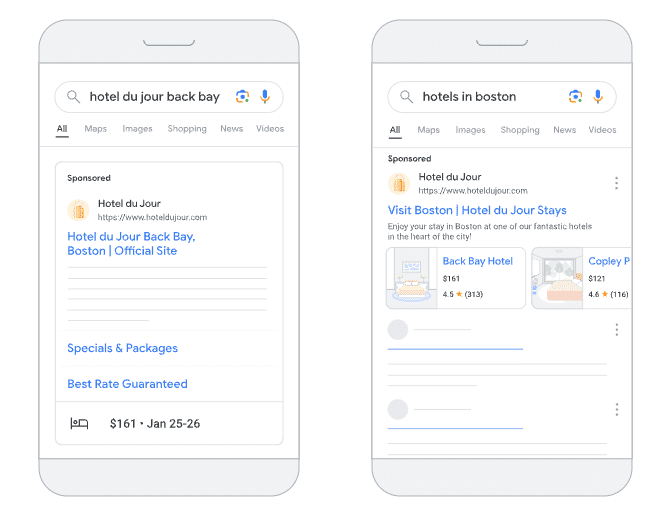
The expanded feature lets hotel advertisers display the following information in their ads:
Hotel details
Current pricing
Available dates
Customer ratings
Property images
Google notes that advertisers can:
“Use the same feed data already available in Hotel Center and used by travel advertisers in hotel campaigns to enhance more ad types.”
The hotel price and landing page are automatically sourced from your Hotel Center feed, with selections based on ad relevance, creative, and query.
Multiple designs are available as part of Travel Feeds in Search Ads.
Google provided some examples. Note, these are mockups only.
Screenshot from support.google.com, October 2024.
Potential Impact
According to Google’s internal data, advertisers using the full range of available formats have observed up to a 20% increase in click-through rates.
However, individual results may vary, and these figures have not been independently verified.
Implementation
Google will automatically display Travel Feeds in Search Ads after you Link your Hotel Center feed to a Google Ads account.
You can set feed sharing controls at the account and campaign levels.
Key points:
If you need a Hotel Center account, refer to Google’s Hotels starter guide.
Create subset feeds to link specific properties.
Use URL parameters to track clicks from travel ads.
Availability
Advertisers must have a Hotel Center account with a price accuracy rating of at least “Poor ” to use Travel Feeds in Search Ads.
The feature is currently available in 21 countries and supports 12 languages.
Looking Ahead
The expansion of Travel Feeds in Search Ads represents one of several recent changes to travel-related search results.
Google plans to test the Travel Feeds feature beyond hotels.
In the coming months, Google will include other travel-related categories such as attractions, car rentals, and events.
Google has announced the retirement of the sitelinks search box feature.
This change, set to take effect on November 21, marks the end of a tool that has been part of Google Search for over a decade.
We’re saying bye to the sitelinks search box in Google Search results starting Nov 21, 2024, as usage has dropped. This doesn’t affect rankings or other sitelinks. The corresponding markup doesn’t need to be removed, but won’t be used by Google.https://t.co/RocxcjyXi4pic.twitter.com/sJO3stqdKJ
The sitelinks search box, introduced in 2014, allowed users to perform site-specific searches directly from Google’s search results page.
It appeared above the sitelinks for certain websites, usually when searching for a company by name.
Declining Usage
Google cites declining usage as the reason for this decision, stating:
“Over time, we’ve noticed that usage has dropped.”
Potential Impact
Google affirms that removing the sitelinks search box won’t affect search rankings or the display of other sitelinks.
This change is purely visual and doesn’t impact a site’s position in search results.
Implementation
This update will be rolled out globally, affecting search results in all languages and countries.
Google has confirmed that the change won’t be listed in the Search status dashboard, indicating that it’s not considered a significant algorithmic update.
Search Console & Rich Results Test
Following the removal of the sitelinks search box, Google plans to update the following tools:
The Search Console rich results report for sitelinks search box will be removed.
The Rich Results Test will no longer highlight the related markup.
Structured Data Considerations
While you can remove the sitelinks search box structured data from their sites, Google says that’s unnecessary.
Unsupported structured data won’t cause issues in Search or trigger errors in Search Console reports.
It’s worth noting that the ‘WebSite’ structured data, also used for site names, continues to be supported.
Historical Context
The sitelinks search box was initially announced in September 2014 as an improvement to help users find specific website content more easily.
It supported features like autocomplete and allowed websites to implement schema markup for better integration with their own search pages.
Looking Ahead
Website owners and SEO professionals should take note of this update, though no immediate action is required.
If you’ve been paying attention to the chatter in the SEO space recently, you might have noticed that “brand marketing” has become cool again.
Due to the Google “leaks,” many SEO pros have come to the conclusion that building a strong digital presence will yield SEO results.
Also, water … is wet.
Leaks, floods, and drips aside, there are better reasons why you should be focused on brand marketing right now.
Allow me to explain. [Warning: This post contains excessive amounts of snark.]
Building The Case For Brand Marketing
I’m not going to do the whole “5 reasons why you should focus on brand in 2024.” It would be off-brand for me.
What I would like to do, if you’ll indulge me, is first build up the case by looking at where the ecosystem we call the web is currently at.
I’m less focused on “the benefits” of the brand and more concerned about why the ecosystem itself demands a focus on this type of marketing.
It’s less a matter of “you’ll get X, Y, and Z” by focusing on the brand and more a matter of why you’ll be out of sync with your potential audience as a whole.
The Web Is Moving To Be More Conversational
The internet has become more conversational, and it’s only going to get more conversational.
One of my soapbox points is that content is one of the most quickly changing things on the planet. What we consume, how we consume it, and what we expect out of it are rapidly and constantly changing, and the consequences are often underappreciated.
My classic example of this was the first televised US presidential debate, which took place in 1960 and pitted John F. Kennedy against Richard Nixon.
If you listened to the debate on the radio, you tended to think Nixon won. Those who watched on TV tended to think JFK won.
Why? Well, Richard Nixon comes off as Richard Nixon, and JFK, well looks like JFK. I’m being a bit facetious, but it is true. Nixon famously looked pale, had a five o’clock shadow, and didn’t look directly at the camera.
The evolution of content has extremely understated consequences.
Like in 1960, we are at one of those pivotal moments in the history of content.
Think of the internet like TV commercials. Over time, what once resonated becomes campy and sem, if not downright, spammy.
Could you imagine Coca-Cola running and trying to sell its product using its 1980s Max Headroom “Catch the Wave” commercial?
Try selling my kids a sugar-infused breakfast cereal using a TV commercial from the 1950s. Good luck.
It’s not because those commercials are “bad.” It’s because the language and tone that resonates changes over time.
It’s a simple enough point … unless we’re talking about web content. For some reason, we feel web content and its consumption trends should eternally stay the same.
We write the same kind of content in pretty much the same way and balk at any changes.
But that doesn’t change the reality.
The content we create doesn’t speak to users. It’s not positioned correctly. The tone is off. The goals that support the creation of content, to begin with, are distorted. And more. There are a lot of problems – and to me, they all begin with content not being conversational.
In fact, I will go so far as to say Google should stop saying, “Write for your users,” and should start saying, “Have conversations with your users.”
We all think we’re “writing for our users” – I mean, who else are we trying to lure and convert?
It’s very easy to fool yourself into thinking you are “writing for your users.” It’s harder to convince yourself you are having some sort of dialogue with your users – which is what I think Google really means anyway.
All this said, what do I mean by content not being conversational and how do I know it’s even a problem?
What I Mean By Content Not Being Conversational
It’s not hard to see that we are not engaging our users in a conversation or dialogue.
All you need to do is head over to your nearest landing page and have a look at the language.
How much of it is just the company throwing out jargon or borderline nonsense?
Here’s what I came across in literally less than five minutes of digging around:
Screenshot from author, July 2024
Is it really without limits? Can I literally do whatever I want without any limitations whatsoever? I don’t get it – are we talking about God or graphic design software?
Is the below really a new way to run high-velocity sales? Does it literally refine the entire process like no one else is doing or has done before? Or is the company just saying this and spitting out whatever they think will drive conversions?
Screenshot from author, July 2024
You see this all the time in PPC ads:
Screenshot from search for [buy accounting software], Google, July 2024
No nuance. It is the best accounting software, and I should trust that it is without any form of qualification.
This kind of copy, while it may have worked in the past, doesn’t (and if it does now, it won’t in the relatively near future).
This kind doesn’t actually talk to users in a real way. It actually treats the user like an idiot.
The average web user is far more savvy than they once were, far more mature, and far more skeptical.
Not taking a more genuine approach is starting to catch up with brands.
How Do I Know Not Being Conversational Is Even A Problem?
Greenwashing.
It’s when a company claims to be more environmentally conscious than it is. It’s spin and PR nonsense.
Companies thought they could pull a fast one on unsuspecting users. However, folks are now savvier and are catching on to brands positioning themselves as being “green” when, in reality, they might not be (or at least to the extent advertised).
You cannot get away with it anymore (and you never should have tried). The only thing that works is being genuine.
If your product is not actually “the best,” then don’t say it is – or, in fact, realize there is no “best” or “ultimate” or “fastest” or whatever. There is only what meets the needs of users in what way. That’s fancy talk for “pain points.”
Being genuine means talking to your audience and not at your audience. It’s having a dialogue with them.
Going the “traditional” route with your language is the equivalent of marketing language greenwashing … and it applies to your informational content, too.
Perhaps nothing epitomizes this more than the falling stock of influencer marketing. Study after study shows that younger users are far less likely to purchase something because an influencer is associated with it.
Influencer marketing, as we mostly know it, is a facade pretending it’s not a facade. Do you think Patrick Mahomes really eats Chicken McNuggets or has a strong preference to use State Farm for his insurance needs?
All influencer marketing is just a digital marketing version of a celebrity in a TV commercial.
Do you think whatever TikTok influencer really prefers Capital One or even knows that it’s not a geographical reference?
While the idea of “influencers” seemed like a viable idea at the onset it’s fundamentally not sustainable because it’s fundamentally fraudulent. (For the record, “community” marketing is something else entirely. While it might rely on “influencers” within a community, it is far more genuine.)
It seems that folks have caught on to the idea that maybe this influencer being paid to say or do whatever is not actually an accurate reflection of reality (much like social media influencers themselves, to be honest).
A 2023 Drum article quotes one study as saying upwards of 80% of users say a brand’s use of influencers does not impact them one way or the other.
For the record, there are other studies that indicate that influencer marketing is a viable option. I agree, but I think it needs to be qualified. Just paying an influencer to say good things about your brand is not authentic.
There are authentic ways to work with communities and influential folks within them. That tends to happen more with micro or nano influencers.
Again, it’s rocket science. Everyone knows the influencer is only saying the things they are saying because they’re being paid to. It’s relatively meaningless in a vast majority of cases.
It shows how much savvier the current web user is relative to the past, and it’s supported by where folks are heading and what they are trusting … themselves (DTA, am I right?).
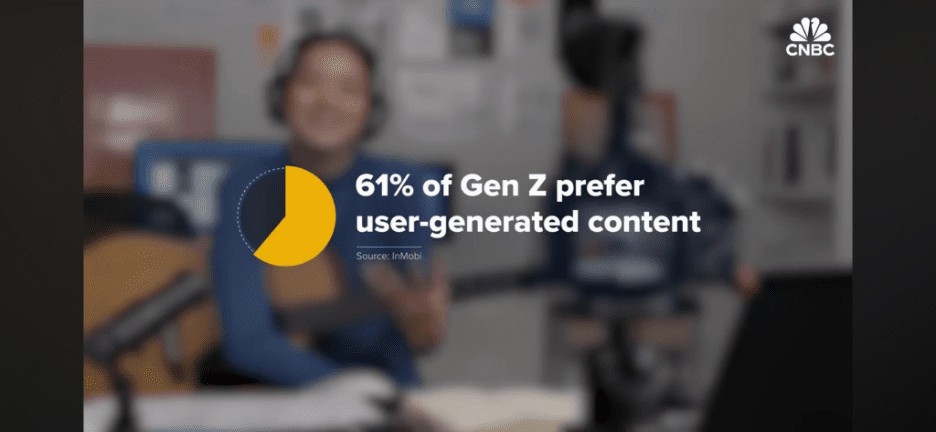
A seemingly endless number of studies show users looking toward user-generated content. CNBC was quoted as saying, “61% of Gen Z prefer user-generated content.”
Image from CNBC, July 2024
Which brings me to my next point.
Informational Content Is Just As Bad & Reddit On The SERP Proves It
Up until this point, I’ve been focused on the nature of commercial content and the demand for conversational content.
The same concept applies to informational content, just for a slightly different reason.
Informational content on the web might not be as opaque as commercial content, but it is entirely sterile and stoic.
By sterile and stoic I mean content that doesn’t actually speak to the user. It takes a topic, breaks the topic down into various subtopics, and simply presents the information, and does so without ever discussing the context of the readers themselves.
No one has more data on emerging content consumption trends than Google and its ability to analyze user behavior in a variety of ways. And what has Google done for informational and commercial queries alike? Plastered the search engine results page with user-generated content.
The proliferation of Reddit on the SERP should tell you everything you need to know about the state of informational content and beyond.
All you need to do is head to the Google SERP and take a look at all of the Reddit results strewn all over the place, from different SERP features to the organic results themselves.
And while SEO pros may be upset about the abundance of Reddit (and rightfully so in my opinion), we have no one to blame but ourselves.
Do you really think Google wants to rank Reddit here, there, and everywhere? I personally don’t. I think Google would much rather have a diverse set of experience-based content to rank.
Regardless of your feelings about Reddit on the SERP, users’ inclination to prefer content created by other users tells you one thing: People are looking to move past all the facades and want something transparent that speaks to them—not at them.
Think about content like dress codes in the office. In the 1950s (at least in the US), it would be unheard of to show up to the office with anything but a suit and tie or a dress.
Just like professional dress codes have become less formal, so has content become “less formal” too.
And it’s a relatively recent development on both fronts. In fact, I would actually argue that office dress codes are a good representation of “where we are at” in terms of how and what we consume in terms of content via-a-vis formality.
While more traditional marketing language might have been acceptable and effective just a few years ago – it’s not any longer (at least not to the extent). We are less formal as a people, which means speaking to each other is also less formal. That has to spill over to web content at some point, and it has.
The AI Of It All
The rise of AI-written content accentuates all of this. When everything starts to sound the same having an actual voice comes more into focus. As AI conversion evolves, users are going to want to know that what they are consuming is “real.”
Much like a paid influencer, AI-written content doesn’t offer an authentic experience. And if we can see one theme in what users are looking for, it is an authentic experience.
I know someone is reading and thinking, “But AI is conversational!”
I would not confuse the fact that AI can reply back to you in an informal way as being an actual conversation or dialogue with another actual lifeform.
I have many relatives who will chew my ear off for hours on end as I nod away – that is not (much to their surprise) a conversation. Inputting prompts in reply back to an LLM and then having that LLM respond is not a conversation. (I feel like it’s insane that I have to say that.)
A real dialogue has to be based on empathy and the coming together of two distinct entities. This is what I mean by conversational. The dialogue has to be based on understanding the user’s pain points and meeting them.
AI not only doesn’t do that – but it dilutes that very concept. AI is content creation inherently devoid of understanding the “other.”
AI-generated content is the exact opposite of empathetic content. It is no wonder that it will drive a greater demand for something that is more connective (i.e., conversational content).
The rise of AI-generated content will inevitably lead to a greater demand for more conversational content simply because it is human nature to yearn for connection and existentially disdain void.
When you couple together the growing impatience with stale and stoic content aligned with the facade of much of the web’s commercial content with the rise of AI, it’s the perfect storm for a shirt in user demand.
A More Conversational Internet Is More Autonomous Internet
What’s this got to do with brand marketing? We’re getting there. One more step.
Users looking for more authentic web experiences point to people not wanting to be sold to. Skepticism and distrust are triggered by being urged to make a purchase.
Rather than being induced to click by some clever headline or urged to make a purchase by some influencer, people want to make their own decisions.
They’re looking for real advice. They’re looking for real information to have real needs met. And then they’re looking to be left alone to use that information to their liking.
It’s not an accident that Google added an “E” to E-E-A-T for “experience.” It wants quality raters to evaluate a page from an experience perspective because it has determined this is what users are looking for.
When your entire modus operandi is to seek out authentic information and experiences, the last thing you’re looking for is to be coerced. The last thing you want is to feel pushed into something.
The quest for authenticity in experience-based information is entirely about being able to make a well-informed, autonomous decision.
Urging users to click and convert with all sorts of marketing language and over-emphasis is antithetical to this mindset. Using language that feels slightly manipulative is antithetical to this mindset.
Trying to create spin and putting up a marketing facade (such as with classic influencer marketing) is antithetical to this mindset.
You can’t have Michael Jordan jumping over Spike Lee in a commercial to sell shoes anymore. It’s not real, and it’s not authentic. It’s fantastical. It’s fake.
You also can’t “drive” conversions by telling users you’ve developed a “new,” “revolutionary,” or “ultimate” solution for them. It’s not real, and it’s not authentic. It’s fantastical. It’s fake.
You have to create an environment where the user feels empowered and uncoerced.
How do you then go about targeting growth and revenue, all while allowing the user to feel autonomous and unsolicited?
Brand marketing.
Brand Is Your Best Friend In An Autonomous Web Scenario
I know there is going to be a tremendous amount of resistance to what I am about to say.
In fact, most companies will balk at my conception of things. For SaaS, it’s probably borderline heretical (I think startup SaaS brands often lag behind consumer trends more than anyone).
If user autonomy is the fundamental brick on the house the ecosystem is built on, then being top of mind is the cement that holds your marketing efficacy together.
What’s the opposite of pushing for clicks and conversions? Allowing the user to come to you at their own time and at their own speed.
Being top of mind is more important than it ever was because it aligns with the underlying psychological profile driving web experiences.
There is a direct equation between the consumer demand for autonomy in the buying journey and brand marketing. Creating the right associations and developing the right positioning with genuine differentiation is of the utmost importance if you want to align with how users think – and, more importantly, feel about the web.
If I had to put in a more “performance-focused” mindset, direct traffic is the future of the web. Get them to come to you on their own terms.
It works for both parties. You’re less susceptible to relying on whatever platform’s funky algorithm (whether it be social or search, it all kind of feels like a mess right now). At the same time, your users don’t feel like you’re overselling, pushing clicks, and otherwise nudging them to convert.
They’re coming to you because they found out about you, liked what they saw or heard, and decided to pursue the possibility of buying from you at their own pace.
Moreover, the brand allows you to connect. Again, in an AI world, the drive for connection will only increase. Brand is the intersection of your identity and your audience’s.
It is an associative connection, and it allows your audience to understand that there is a “you” behind the product or service you are offering.
This is the power of branding in the modern web.
What Kind Of Brand Marketing?
What kind of branding creates autonomy? Education-focused brand marketing.
Brand marketing can mean a lot of things to a lot of different people. Often, on the digital stage, it means pushing the value of your product across the web.
I am not saying that this doesn’t have value or that it shouldn’t be done, etc. I am saying this is product marketing disguised as brand marketing.
90% of your brand marketing should hardly (if at all) push your product (beyond maybe a mention or something subtle of that ilk).
Brand marketing is about fostering an identity (either of a product, service, or the company as a whole) and using that identity to create messaging that positions the said product, service, or company in a certain way, thereby establishing a connection with your target audience.
The associations you build and the sentiment towards your brand that you establish should, hopefully, result in your audience seeing you as a relevant solution. But this is associative, and that’s important to remember.
The kind of branding I am talking about is focused on adding value to your audience’s life. Note that I didn’t say offering value via your product or service to their lives. First comes the value, and then comes the value from your product.
You can’t push the product in what might be called “branding” without first establishing a brand that showcases concern for the user and their life context independent of any “ask” (such as making a purchase).
You wouldn’t ask your neighbor for a cup of sugar before saying, “Hi, good morning. How are you?”
You shouldn’t ask your consumers to open their wallets and fork over money before establishing a real connection.
Yet, this is pretty much the internet as we know it.
A Note On Performance Marketing
I am not advocating you should not use performance-based marketing tactics to increase your reach and sales and whatnot. Performance-based marketing can be a powerful force for growth and revenue expansion.
What I am advocating for is performance sitting within a broader branding context. There has to be a balance between the two (and I don’t think it is an even balance).
With that cliffhanger, perhaps I’ll explore the balance between brand and performance at another time.
A study by The College Investor finds significant inaccuracies in Google’s AI-generated summaries for finance queries.
Out of 100 personal finance searches, 43% had misleading or incorrect information.
Key Findings
The study evaluated AI overviews across various financial topics, including banking, credit, investing, taxes, and student loans.
The results showed:
57% of AI overviews were accurate
43% contained misleading or inaccurate information
12% were completely incorrect
31% were either misleading or missing crucial details
Areas of Concern
Researchers noted that the AI struggled most with nuanced financial topics, such as taxes, investing, and student loans.
Some of the most concerning issues included:
Outdated information on student loan repayment plans
Incorrect details about IRA contribution limits
Misleading statements regarding 529 college savings plans
Inaccurate tax information that could potentially lead to penalties if followed
The AI handled basic financial concepts well but overlooked important exceptions and recent policy changes.
There are notable patterns in the queries Google’s AI got right versus those it got wrong.
Here are common themes.
Queries Google AI Got Right
Basic definitions and explanations: For example, “What is a wire transfer?” and “How does a credit card work?”
Simple, straightforward questions: Such as “Do I have to pay back student loans?”
Recent trending topics: Like “What was the Chase Glitch?”
General insurance questions: For instance, “When should I get life insurance?”
Queries Google AI Got Wrong
Complex tax topics: For example, “Can you use a 529 plan for a Roth IRA?” and “Does owning your house in an LLC help with taxes?”
Nuanced financial products: Such as “Is an IUL better than a 401k?”
Time-sensitive information: Like outdated student loan repayment plans or savings account rates.
State-specific financial rules: For instance, misrepresenting California’s 529 plan rules.
Questions requiring context-dependent answers: Such as “Can I file as independent for FAFSA?”
Queries about financial limits or thresholds: For example, incorrect IRA contribution limits.
Complex student loan topics: Particularly around forgiveness programs and repayment plans.
Investment comparisons: Like “Are annuities better than CDs?”
What This Means
Google’s AI performs well at giving straightforward answers to factual queries.
On the other hand, it struggles with nuanced understanding, up-to-date information, and consideration of multiple factors.
This suggests that the AI can handle basic financial literacy topics, but it’s unreliable for complex financial decisions or advice.
Potential Impact
Robert Farrington, founder of The College Investor, expressed concern about the findings, stating:
“If Google continues to present bad or misinformation about money topics to searchers, not only could it hurt their personal finances, but it could weaken already poor financial literacy in the United States.”
The study noted that following AI guidance could result in tax penalties or financial harm to consumers.
The College Investor believes Google should disable these AI-generated overviews for finance-related queries, especially those concerning taxes and investments.
Looking Ahead
Searchers must exercise caution when relying on AI-generated summaries for financial decisions.
When questioned about instances of misinformation, Google has previously stated, “the vast majority of AI Overviews provide high-quality information.”
The complete study, including detailed examples and methodology, is available on The College Investor’s website.
Google alone processes over 100 billion searches a month. So, if you get your strategy right, the potential to reach new customers through search is immense.
But here’s the catch: Search algorithms are always changing. The recent introduction of generative AI directly in search has shaken up how users interact with search engines.
What that means for SEO is that you can’t just set it and forget it – your SEO strategy needs to adapt to these changes to stay competitive.
In this guide, we’ll walk you through the steps for creating an effective SEO strategy that aligns with both search engine algorithms and user expectations.
1. Align SEO With Business Goals & Define KPIs
It’s crucial to align your SEO strategy with your overall business goals and define the key performance indicators (KPIs) that will help you measure success.
Knowing where you want to go and how you’ll measure progress ensures that your SEO efforts are focused and effective.
Your SEO goals should support your business objectives, whether that’s increasing brand awareness, driving more traffic, generating leads, or boosting sales.
During this planning phase, you’ll want to define your KPIs.
This is how you’ll measure the success of your implementations and figure out what’s working for you and where you need to make adjustments.
Average engagement time on page and bounce rate. (Bounce rate is not a universal metric for everyone, but is 100% dependent upon the events you set up).
Keep in mind that these are internal SEO KPIs that you can track in analytics.
Higher-level executives may be more interested in overall business impact, such as SEO-supported attribution and how SEO contributes to the customer journey.
It’s also important to convey that SEO is a long-term strategy that may take time to show significant results.
2. Set Realistic Expectations
One of the most common mistakes people unfamiliar with SEO make is expecting overnight results.
SEO is not a direct response style of marketing, and not all SEO strategies result in an immediate outcome.
Because of the variables involved with competition, inbound links, and the content itself, it’s nearly impossible to provide a definite timeframe.
You need to go into the process with an understanding that SEO takes time, and the more competitive the keywords you’re going after, the longer it will take to climb to the top.
This needs to be conveyed to stakeholders from the start to ensure expectations are realistic and to establish consistent, accurate data that earns trust.
SEO can be part of the entire customer journey.
Someone might find your site via organic search, then later see a paid ad, and finally make a purchase. Or they might see an ad first, then search for your brand and find you organically.
This is where multi-touch attribution comes into play. Using multi-touch attribution tracking tools like Triple Whale can help you understand how different channels contribute to conversions.
3. Conduct SEO Audit
Now that you’ve aligned your SEO strategy with your business goals and set the right expectations, it’s time to understand where you currently stand.
An SEO audit serves as the roadmap that will guide you throughout the entire optimization process and allows you to benchmark against your current site.
You need to examine a variety of aspects, including:
Domain name, age, history, etc.
On-page SEO factors like headlines, keyword & topical targeting, and user engagement.
Content organization, content quality, and the quality of your images (no one trusts stock photography).
Once you have a clear understanding of your current SEO status, it’s time to plan your timeframe and allocate budgets and resources.
This is yet another area of life where you get what you pay for. If you’re looking for fast and cheap, you’re not going to get the results you would by investing more time and money.
Obviously, your budget and timeframe will depend on your company’s unique situation, but if you want good results, be prepared to invest accordingly.
Search engine rankings are determined by an algorithm that evaluates a variety of factors to decide how well a website answers a particular search query. And a huge part of that is the use of keywords.
From single words to complex phrases, keywords tell search engines what your content is about. But adding keywords isn’t quite as simple as just plugging in the name of the product or service you want to sell.
You need to do research to ensure keyword optimization and avoid cannibalization, and that means considering the following:
Search Intent
Words often have multiple meanings, which makes it crucial to consider search intent, so you don’t attract an audience that was searching for something else.
For example, if you sell hats, ranking highly for ‘bowler’ will attract users looking for 10-pin bowling in the U.S., or in the UK about cricket and not someone shopping for a bowler hat.
Relevant Keywords
Once you’ve identified the search intent of your target audience, you can determine which keywords are relevant to them.
By aligning your keywords with search intent, you can produce relevant content and increase your chances of ranking higher in SERPs. Besides ranking high, it will also improve user satisfaction and increase conversion rate.
Keyword Research Tools
The brainstorming process is a great place to start keyword research, but to ensure you’re attracting the right audience and proving your value to search engines, you should utilize a research tool.
They can provide valuable data, such as search volume and competition level, and suggest related keywords you might not have considered.
Search Volume
By using keyword research tools, one of the most important metrics to look for is the search volume.
Ideally, you should target relevant keywords with the highest search volumes. However, it is important to assess the competition around that search term.
If you are going to compete with large and well-established brands and you are just starting, perhaps it is a better idea to choose long-tail keywords with less search volume but less competition.
They tend to be longer and are more likely to be used by people with specific stages in the conversion funnel, helping you reach users who are ready to convert.
An example of this would be [vegetarian restaurants in San Antonio], which would most likely be used by someone with a craving for a plant-based meal.
Lastly, remember that tools provide aggregate data of the same search terms with measurable search volumes, which they obtain from different data providers.
Often, there are long-tail searches that users perform, which are the same but formulated differently, and tools may report them as zero search volume due to negligible search volumes.
This phenomenon is likely to increase as highly intelligent AI assistants are integrated into mobile phones, and users are more likely to perform unique voice searches on the same issue.
If a certain problem is relevant to your specific industry and you know it, but tools report zero search volume, it is worth covering it and offering a solution.
You may find you have decent and highly targeted traffic that converts.
5. Define Your Most Valuable Pages
Every team needs an MVP, and in the case of your website, that’s your most valuable pages.
These pages are the ones that do the bulk of the heavy lifting for you.
For non-ecommerce sites, these are usually things like your home page, your services pages, or any pages with demos or other offers.
These pages are also likely MVPs for ecommerce sites, but will also be joined by category and/or product-level pages.
To find which pages are your site’s most important ones, you should consider what your organization is known for.
What verticals do you compete in? What pain points do you solve? Define these or add more based on the high-level keywords you came up with in the previous step.
Once you’ve identified the category and product pages that bring in the most visitors, you’ll be able to focus your strategy on improving them and increasing your organic traffic.
Here is an example from one of the websites I work on, showing how it looks and highlighting the importance of updating outdated content.
An example of content decay: updating content helped regain organic traffic.
Please note that you should refrain from using automatic updates with AI chatbots, as it is one of the most dangerous, spammy SEO tactics that can result in a complete loss of organic traffic.
Read our guide to learn content decay strategies you can implement to keep your organic traffic growing.
7. Optimize For User Experience
Don’t overlook the importance of how your site is structured, both technically and in terms of how users interface with it.
The best content and keyword strategy in the world won’t lead to a single sale if your site is constantly broken or is so frustrating to use that people close your page in disappointment.
You should carefully consider your site’s architecture and user experiences to ensure people are taking the desired actions.
With mobile traffic being 62.15% of total web traffic (and 77% of retail website traffic), optimizing for mobile is even more critical.
If you didn’t have any competition, there would be no need for SEO. But as long as other companies are manufacturing refrigerators, Frigidaire needs to find ways to differentiate itself.
You need to have an idea of what others in your industry are doing so you can position yourself for the best results.
You need to figure out where you’re being outranked and find ways to turn the tables.
You should know which keywords are most competitive and where you have opportunities by performing content gap analysis.
You should understand your competitor’s backlinking and site structure so that you can optimize your own site for the best possible search ranking.
And remember, AI chatbots are your competitor, too, where users can get answers directly without visiting a website.
This means that some of the traffic you might have received in the past could now be staying in the chatbot.
To compete, you need to offer something AI can’t: unique insights, personal experiences, and authoritative content that stands out.
Consider how AI presents information and find ways to differentiate your content. Focus on building your brand authority and providing value that AI chatbots can’t replicate.
Learn more about how to perform this analysis and develop a template for it by reading this piece.
9. Establishing Brand Authority And Link Building
All the points we covered so far are essential for success in SEO, but they are not enough.
You can achieve success by merely improving your website, and if you aim for your brand to exist only in Google Search, you will likely not be able to rank and achieve success.
It’s not such an easy thing to get right, and that is where most companies struggle and why SEO is hard.
To build brand authority, you need the following steps:
Build an email newsletter list.
Share valuable research and insights others want to link to.
Attend conferences relevant to your field and sponsor them if you have enough resources.
Seek opportunities for interviews or speak at conferences.
Host webinars or live sessions to share knowledge and interact with your audience in real time.
Participate in online discussions with your industry community on different platforms such as Linkedin, Twitter, Reddit, or other platforms specific to your industry.
Collaborate with experts in your industry to contribute to your content.
Invite influencers to try your products or services and share their experiences.
Offer effective support to your customers.
Even if you get unlinked brand mentions, it is a step forward in building brand awareness.
Think of for a moment if one reads your unlinked brand mention on a reputable website (or on a TV show) and performs a Google search to find your brand.
However, in the age of AI, another benefit of unlinked brand mentions is that chatbots – which are trained on content across the web – may surface your brand name to users when they perform tasks or research.
10. Integrate SEO Into Your Workflows
SEO doesn’t exist in a vacuum – it impacts many other parts of your organization, including marketing, sales, and IT.
If you’re looking for the budget to perform SEO, you may find some of your employees are already well-qualified to help.
For example, your sales team probably knows which products people are most interested in.
Enlisting them in your SEO strategy development will help with lead generation and finding new targets who are already qualified.
Similarly, SEO can tell your marketing team what types of content resonate best, so they can fine-tune their campaigns. And your copywriters and graphic designers can develop the type of content that will help you shoot up the rankings.
Your IT team probably already has control over your website.
Your SEO strategy should be designed around their expertise, to ensure website design and structure, development cycles, data structure, and core principles are all aligned.
Evaluate your existing software, technology, and personnel, as there’s a good chance you have some of the pieces already in place.
If you need to scale production up, you may find the budget already in place in existing departments.
If you’re an external SEO agency or consultant, it’s crucial to establish strong communication channels with the company’s personnel who are responsible for implementing SEO recommendations and making decisions.
Read our guide on best practices for establishing effective communication between SEO teams in enterprise companies.
11. Align Your SEO Strategy With Your Customer Funnel
At the end of the day, sales are the name of the game. Without customers, there’s no revenue, and that means no business.
To aid in the sales process, your SEO strategy should align with your customer funnel.
Sometimes described as the customer journey, your sales funnel is a summation of the touchpoints customers have with your company as they go from awareness to post-purchase.
SEO fits neatly with every stage of this cycle:
Awareness: In the modern world, many customers first hear about your business online through a Google search, for example. Well-written blog posts are a great way to increase your awareness and increase your brand recognition.
Interest: This is where customers start doing research. And what better place to do research than your website? In-depth guides and ebooks will be a great match for satisfying users’ interests.
Decision: The customer wants to buy and is deciding between you and the competition. Case studies or testimonials could be the thing that sways them.
Purchase: Having a search engine-optimized point of sale makes it easy for people to buy, and optimized product pages are what can move the needle.
Post-purchase: Once you’ve acquired customers, think of ways to retain them by publishing support articles or offering loyalty programs.
12. Report And Measure
Finally, you need to define what success looks like for each KPI measure and report the progress you’re making.
There are a variety of both paid and free tools available that you can use to measure and track conversions, and compare them weekly, monthly, or by another timeframe of your choosing.
Simply find one that works for your budget and needs.
For a guide on how to create impactful reports that generate quality insights, read our guide here.
Conclusion
No one ever said SEO was easy, at least not anyone who has done it. But it’s a vital part of any modern organization’s business plan.
However, with a solid strategy, a willingness to learn, and a little old-fashioned elbow grease, even a complete beginner can send their website to the top of the SERP.
In this piece, we’ve given you 12 steps to take to get your SEO strategy off the ground. But of course, this is just the start.
You need a unique plan that will work for your industry and your needs.
Luckily, Search Engine Journal can help with this, too.
Download our ebook on SEO strategy with a full-year blueprint for an easy-to-follow 12-month plan you can use to develop a solid strategy, track your progress, and adjust to changing situations.
For many businesses, feeling overwhelmed by SEO best practices, endless checklists, and heaps of data is all too familiar—especially when competitors seem to be growing faster than ever. As SEO evolves, navigating these challenges is becoming even more complex.
Driving sustainable growth as an enterprise brand is even more difficult, with limited resources, small teams, and ever-changing SERP algorithms making it hard to know where to focus your efforts.
Without clear results, getting executive buy-in can become a struggle, leaving you wondering if you’re focusing on the right areas.
We’ll dive into how top SEOs at some of the world’s most successful traffic-driving websites use real data to align their teams and drive growth—without relying on guesswork.
Why This Webinar Is a Must-Attend Event
SEO success isn’t just about following best practices anymore. In this session, you’ll learn how to leverage data-driven insights to cut through the noise and implement changes that deliver real impact.
In this webinar, we’ll cover:
– Why traditional SEO best practices might be holding you back, and how data can reveal where you should really focus.
– How top companies identify and prioritize optimizations that deliver the biggest impact, so you can fast-track your growth.
– Proven strategies for aligning your team and gaining executive buy-in, to ensure consistent and effective SEO efforts.
Expert Insights From Chris Sachs and Jeff Smith
This session will be led by Chris Sachs and Jeff Smith of seoClarity, breaking down five actionable tactics to help you unlock your growth, and the strategies behind them. Chris and Jeff have worked with over 6,000 enterprise brands, and now they’re ready to share their insights with you, to unlock your full SEO potential.
Who Should Attend?
This webinar is ideal for:
– Enterprise SEO professionals looking to achieve meaningful growth using proven methods.
– Marketing managers seeking to align their team around data-driven strategies and get executive buy-in more easily.
– Executives who want to understand how SEO can drive measurable results for their brand.
Live Q&A: Get Your Questions Answered
After the presentation, join Chris and Jeff for a live Q&A session, where you’ll have the opportunity to ask specific questions about the tactics shared and how they can be applied to your unique challenges.
Even if you can’t make it that day, reserve your seat, and we’ll send you a recording so you don’t miss out on these valuable insights.
Entertainment viewing habits have changed dramatically in recent years, leading search ad platforms to introduce connected TV (CTV) video ad opportunities alongside standard video and display ads.
Both Google Ads and Microsoft Ads provide advertisers with convenient access to a wide range of inventory and scale through their platforms.
What’s especially useful is that CTV ads can be managed within the same platform as search PPC ads, making it easy for advertisers to streamline their campaigns.
This means advertisers can get started with CTV ads with minimal hassle, reducing management complexity and costs.
First, What Are CTV Video Ads?
CTV ads are video ads that play on connected TV devices. These TVs can connect to the internet and stream content from apps like Netflix, Hulu, and YouTube.
Unlike traditional TV ads, which air during regular programming, CTV ads are shown while you’re watching your favorite streaming shows or movies.
CTV ads are basically the modern version of TV commercials, which are adapted for the streaming world.
Advertisers should pay attention to CTV ads because they offer a unique opportunity to engage audiences in a way that traditional TV advertising can’t match.
As streaming services continue to dominate the entertainment landscape, CTV ads allow advertisers to reach viewers who have cut the cord from cable and are consuming content on internet-connected devices.
The time people spend on streaming platforms is increasing, so CTV ads provide a direct and effective way to connect with engaged, attentive audiences in a variety of viewing environments.
In addition, the ad platforms help make CTV ads accessible to advertisers who found traditional TV out of reach.
The flexibility and data-driven approach of ad placements have become a powerful tool for maximizing advertising efforts as part of a well-rounded digital marketing strategy.
CTV Ad Campaign Purpose And Goals
CTV ads are most often used for brand awareness and upper-funnel goals.
These ads enhance brand recognition and visibility, expanding ad touch points across viewing platforms.
While their primary objective is to raise brand awareness, CTV ads can also support other stages of the marketing funnel to connect with potential customers.
Audiences can be targeted during their consideration and decision-making stages with messages and content designed to nurture leads and drive conversions.
Key Features Of CTV Video Ads
To fully understand why CTV ads are such a powerful strategy for advertisers, it’s important to highlight the key features that set them apart from traditional TV ads.
Targeted Advertising
Unlike traditional TV ads, CTV video ads can be targeted to specific audiences, similar to search ads and social media ads.
This means advertisers can customize their messages based on factors like age, interests, viewing behavior, and even location. This precision makes the ads more relevant and engaging for viewers.
Unskippable Formats
Many CTV ads are unskippable on TV screens, ensuring that the entire message reaches the viewer. This is a significant advantage over other video ad formats, where users can skip the ad after a few seconds.
Cross-Device Reach
Ads aren’t just limited to TV screens. They are also displayed on other devices, such as smartphones, tablets, and computers. This multi-device reach allows advertisers to connect with viewers wherever they watch TV.
Measurable Impact
One of the key benefits of CTV ads is the ability to measure their effectiveness.
Advertisers can track metrics like ad completion rates, viewer engagement, and even business outcomes (site visits, sales, leads), gaining insights into how well the campaigns perform. Recent data suggests business outcomes have now become the primary success metric.
Even for seasoned PPC advertisers, diving into CTV ads can feel overwhelming at first.
The transition from search campaigns to video-based formats introduces new creative requirements and targeting options.
But don’t let the unfamiliarity hold you back. While the CTV setup process isn’t entirely intuitive, this article will guide you through the basics.
By leveraging the tools and strategies you already use in search ads, you’ll unlock new opportunities with CTV ads.
Google CTV Ads
Platforms
Google offers CTV ads in two ways. One is through the standard ad platform and the other is Display & Video 360 (DV360).
Google Ads (Standard Platform)
Google Ads primarily offers access to YouTube and a select group of CTV apps and publishers that partner with Google.
In the CTV space, Google Ads primarily focuses on delivering video ads through YouTube.
The YouTube app is available on devices such as smart TVs, game consoles, and streaming devices (Roku, Amazon Fire).
Ideal as a starting point for CTV campaigns, especially if you’re focused on YouTube and a few other platforms.
Display & Video 360 (DV360)
DV360 provides access to a much broader range of inventory, including premium CTV networks, programmatic TV, and a wider array of third-party apps and platforms.
It is designed for more complex, cross-channel campaign management. It allows for integrated planning, buying, and optimization across different media types, including video, display, audio, and native ads.
DV360 is ideal for larger advertisers or agencies that are handling more advanced digital strategies.
Networks
YouTube Ecosystem
YouTube ads and YouTube TV ads are both part of YouTube’s ecosystem, and advertisers purchase both through the Google Ads platform.
However, while the buying process is the same, Google places the ads based on the type of content:
YouTube Ads: Shown across YouTube’s main platform, including on YouTube Home, video watch pages, and in search results. These ads target users watching regular YouTube content (user-generated and professional videos) and can be skippable, non-skippable, or bumper ads.
YouTube TV Ads: These ads are shown specifically on YouTube TV’s live streaming service. Similar to traditional TV ads, they appear during live broadcasts and on-demand content from major networks and cable channels.
Google TV Ads
Google TV ads are purchased through the Google Ads platform, just like YouTube ads. This allows for managing and measuring campaigns all in one place.
However, they are shown on smart TVs through the Google TV platform. It acts as an operating system for smart TVs and streaming devices that consolidates content into one easy-to-use interface.
Access to content from various streaming services (like Netflix, Hulu, and Disney+) across over 125 channels.
Ads appear as in-stream video ads.
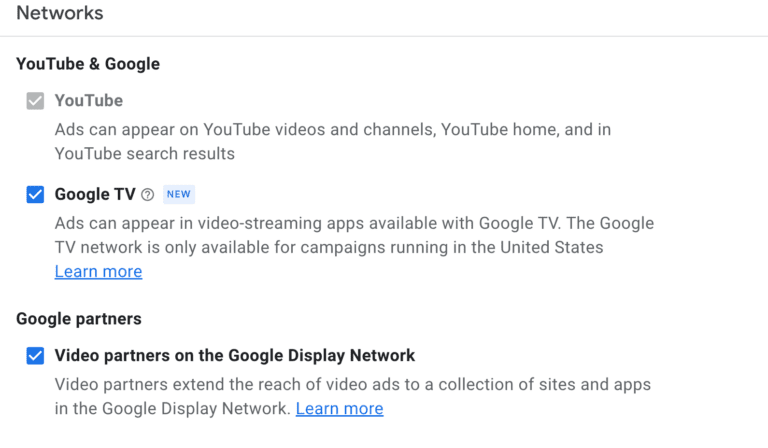
Note that when selecting the networks, YouTube must also be selected to access placements on Google TV.
This means, there is currently no way to target only Google TV.
Screenshot by author, October 2024
Looking strictly at CTV, YouTube TV has a massive opportunity for audience reach.
Google reported YouTube TV has surpassed 8 million subscribers, solidifying its position as the largest live TV streaming service in the U.S.
On the other hand, Google TV does not have a direct subscriber count like YouTube TV because it functions primarily as a content aggregation platform, offering a dashboard to access movies and TV shows from various streaming services.
According to Google, in the U.S., 60% of households now watch free, ad-supported streaming services and channels. Google TV and other retail Android TV OS devices will have 20.1 million addressable monthly active devices in the U.S. in 2023.
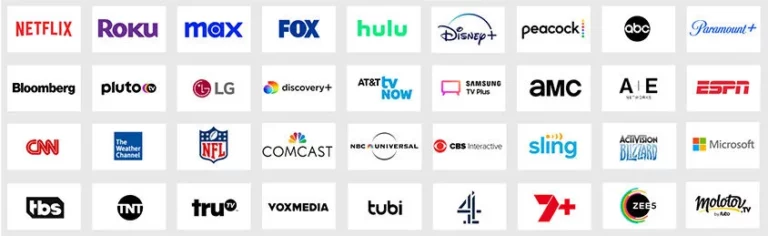
Various streaming services where Google TV ads are served:
YouTube.
Netflix.
Hulu.
Disney+.
Roku.
Paramount+.
Peacock.
Amazon Prime Video.
HBO Max.
Tubi.
Pluto TV.
Vudu.
Sling TV.
Apple TV.
Discovery+.
Audiences
A major power play here is Google’s CTV ad’s access to world-class audience targeting.
In contrast to traditional TV ads, which rely on broad, regional airings with limited customization, Google Ads allow for precise audience targeting.
Advertisers can tap into a variety of options to reach specific viewers:
Interests/detailed demographics: In-market, affinity, life events.
Custom: Custom combinations, remarketing, customer match lists.
Content: Keywords, topics, placements.
Ad formats
Although Google provides a range of video ad formats for YouTube, only a select few are available for Google TV/CTV.
These formats are short, unskippable, and designed to fit seamlessly into the streaming experience.
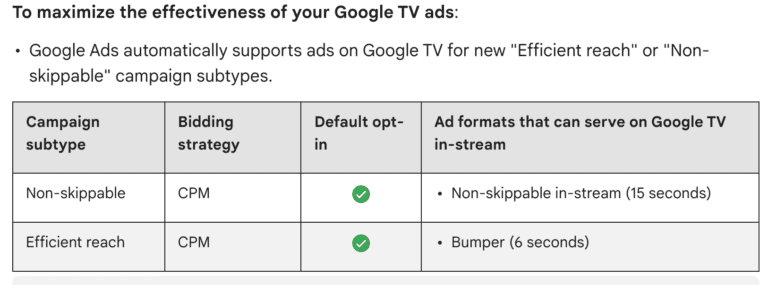
To access CTV ad placements, the “non-skippable” or “efficient reach” campaign subtypes must be selected in the campaign set-up.
Screenshot by author, October 2024
Bid Strategy
With Google TV ads, the only available bidding strategy is cost-per-thousand impressions (CPM).
This means you’re paying based on how many times your ad is viewed, not on clicks, which helps focus on maximizing reach.
Your Target CPM is the average amount you’re willing to spend for every thousand impressions. Google Ads then optimizes bids around this target to help you get the most unique views possible.
Google Summary
For most advertisers, Google Ads is a solid choice for CTV campaigns, especially if you’re focused on YouTube and a few select platforms.
It’s user-friendly and set up for targeting and reach. The user experience is familiar if you are a regular advertiser.
However, there may be volume issues if the platform favors serving on YouTube over Google TV.
The key to utilizing Google Ads in the CTV realm is leveraging YouTube’s extensive reach across these devices and platforms to engage viewers with impactful video content.
How To Target CTV With Google – Step By Step
Google Ads Standard Platform
To access Google TV settings in campaign creation, the campaign must be a video reach, non-skippable format.
Step-by-step selections:
New campaign.
Choose your objective: Awareness and consideration.
Select a campaign type: Video > Select a campaign subtype: Video reach > Select campaign subtype: Non-skippable reach or efficient reach.
Ad formats: Select from multi-ad formats.
Bid strategy: Pre-selected depending on the campaign subtype.
Additional settings: Devices, operating systems, advanced targeting for mobile phones and tablets.
Select frequency capping > Select ad schedule > Select audiences.
Create video ads: Provide the URL of the YouTube-hosted video to use as the ad.
Bid is pre-set at CPM.
Create campaign!
Microsoft CTV Ads
Platforms
Both Microsoft Ads platforms below cater to video advertising but target different environments and user behaviors.
Microsoft Ads (Standard Platform)
Offers a streamlined approach to CTV advertising through the standard ad platform.
Advertisers gain exclusive access to Netflix and a large video marketplace with 860+ CTV publishers, including major names like Disney+, Roku, Hulu, and more.
Setting up campaigns is straightforward and quick, requiring few clicks and no setup fees.
Microsoft Invest
Enterprise-level Demand-Side Platform (DSP) with a broader approach to video advertising across all screens, including CTV buying.
Designed for larger advertisers and agencies with significant ad budgets, looking to manage extensive video advertising campaigns.
A good fit for those with complex strategies and the need for advanced targeting and performance analytics.
Here, advertisers can access Netflix placements through guaranteed programmatic buys.
Smaller businesses or those with limited budgets may find it less accessible due to its enterprise-level features and focus.
Networks
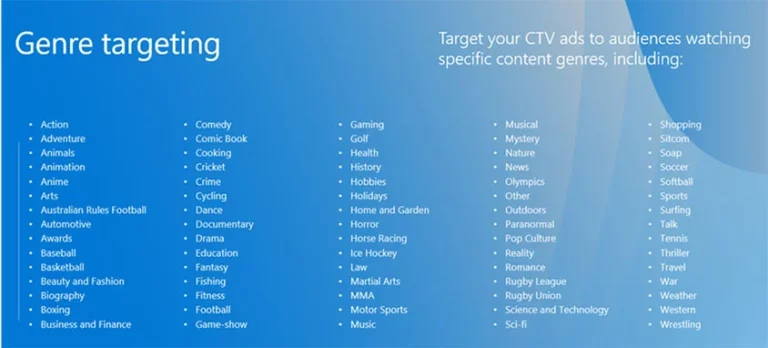
Microsoft Ads CTV ads appear on a wide range of content on popular streaming platforms and connected TV apps, including services like Hulu and Roku.
This broad network is not Microsoft-owned or branded. Some premium networks and streaming platforms where the ads are served:
Netflix.
Roku.
Hulu.
Max.
Fox.
Disney+.
Peacock.
Paramount+.
LG Channels.
Discovery+.
Samsung TV Plus.
Pluto TV.
Tubi.
Vudu.
Amazon Fire TV.
Apple TV.
Sling TV.
Showtime.
YouTube TV.
Crackle.
Screenshot by author, October 2024
Audience
Microsoft CTV ads provide powerful audience-targeting capabilities that are far beyond what traditional TV ads can offer.
Microsoft CTV ads use millions of first-party data points and advanced tools to reach audiences.
This level of precise targeting supports campaigns that are more efficient and more impactful than traditional TV ads.
Advertisers can leverage the following targeting for their campaigns:
Demographics: Key demographic factors such as age, gender, etc.
Genre Targeting: Align ads with specific content genres like action, comedy, business, or sports.
In-Market Audiences: Users actively researching or planning to buy products or services similar to advertisers.
Similar Audiences: Expands reach by targeting people who exhibit behaviors and interests similar to those of the existing audience.
Customer Match: Advertisers use their own customer data (such as email lists) to match to known users on Microsoft and subsequently target ads to them.
Remarketing: Re-engage people who have interacted previously with the brand.
Note: Microsoft provides a real-time audience meter on the right side of the set-up page. This instant feedback indicates if the targeting becomes too narrow, warning the campaign cannot be saved.
Screenshot by author, October 2024
Ad Formats
Video ads are responsive, meaning their format adjusts automatically to fit the experience of the CTV streaming service or page where they appear. The placement of the CTV ads depends on both the video quality and bid.
Both online video ads and CTV ads can run on desktop, tablet, and mobile devices. For outstream video campaigns, placements are available only on desktop and tablet.
Online Video Ads: Play across devices within web content, including websites and apps, engaging users while they browse. They may appear in instream and outstream placements on the Microsoft Advertising Network. Instream placements include ads that appear while people stream media online.
Outstream-Only Video Ads: They appear outside of traditional video content, such as within articles or social feeds, and integrate naturally into page content.
Creating CTV ads is simple – just provide:
A destination URL.
The video to upload.
Also available are AI-generated “recommended videos” that pull text and images from your final URL to create a video ad using predefined templates.
Screenshot by author, October 2024
Bid Strategy
Microsoft Advertising uses cost-per-completed view (CPCV), optimizing bids based on the price the advertiser is willing to pay per completed video view.
With automated bidding, bids are adjusted automatically to meet performance goals. CPCV should typically range between $0.01 and $0.20. for CTV ads here.
Screenshot by author, October 2024
Microsoft Results
According to Microsoft and Roku internal data, recent research shows that using CTV ads on the Microsoft Ads platform leads to some notable results.
Advertisers see an 18% increase in click-through rates for audience ads, along with a 9% lift in brand searches from users who were exposed to these ads.
Advertisers can access custom measurement solutions and brand lift studies at no extra cost while running these ads.
How To Target CTV With Microsoft – Step By Step
Microsoft Ads Standard Platform
Step-by-step selections:
New campaign.
Choose your goal: Brand awareness > Select a campaign type: Connected TV (CTV).
Enter budget.
Bid strategy: Cost per completed view (CPCV).
Enter bid and frequency capping > Enter locations.
Netflix terms and conditions: Includes video quality and other restrictions.
Enter age, if applicable > Enter gender, if applicable.
Select audiences.
Genre, if applicable.
Enter ad schedule.
Ad: Add videos and the Final URL
Save!
Top Takeaways
Integrating CTV ads into digital strategy is an effective way to grow reach and enhance overall performance, all with simpler ad management than ever before.
Today, we takeaway:
Simplified Management: CTV ads can be managed within the same platform as search PPC ads, streamlining campaigns and reducing costs.
Enhanced Audience Targeting: Ads provide precise targeting for reaching engaged viewers across streaming platforms, making ads more relevant and impactful.
Growing Opportunity: With the shift toward streaming services, CTV ads are a valuable way to reach cord-cutters and expand the campaign’s reach.