7 Mistakes Ecommerce Retailers Make When Advertising With Google Shopping via @sejournal, @brookeosmundson

Google Shopping can be a goldmine for many ecommerce retailers.

But, it also comes with the risk of losing money if not managed properly.

Even seasoned PPC advertisers can make easy mistakes that can drain the budget and lose campaign effectiveness.

However, making mistakes is a necessary part of any learning process. Each misstep can provide valuable insights to better optimize your Google Shopping campaigns.

In this article, we’ll review seven common mistakes ecommerce retailers make with Google Shopping and how you can turn those pitfalls into opportunities for growth.

1. Poor Product Feed Quality

The foundation for any successful Google Shopping campaign is undoubtedly the quality of a product feed.

Better data quality leads to better campaign outcomes.

However, many retailers overlook the importance of feed quality, which can lead to issues like:

  • Missing or incorrect product information.
  • Poorly written descriptions.
  • Lack of relevant keywords.

A poor product feed can result in low ad relevance and a poor-performing campaign.

So, where does one start to ensure a solid product feed?

The first priority of your product feed should be the title attribute. Some key items to consider when optimizing product titles include:

  • Use top-performing keywords at the beginning of the title.
  • Avoid using the brand name in the title if it doesn’t perform.
  • Use descriptive words.
  • Embrace the title character limit for maximum communication about the product.

It’s important to regularly audit your Google Shopping product feed to ensure all information is accurate, complete, and optimized for your top-performing keywords.

Google Merchant Center also includes diagnostics tools to identify any errors to fix.

Additionally, leveraging feed management tools can help automate and enhance the feed optimization process.

2. Ignoring Negative Keywords

While Google Shopping campaigns don’t have a keyword bidding component, they certainly have a negative keyword component.

For that reason, many retailers forget the importance of having a negative keyword strategy in their Shopping campaigns.

Ignoring the use of negative keywords is an easy gateway to wasted advertising spend on irrelevant searches. This can lead to reducing the overall campaign efficiency and return on investment (ROI).

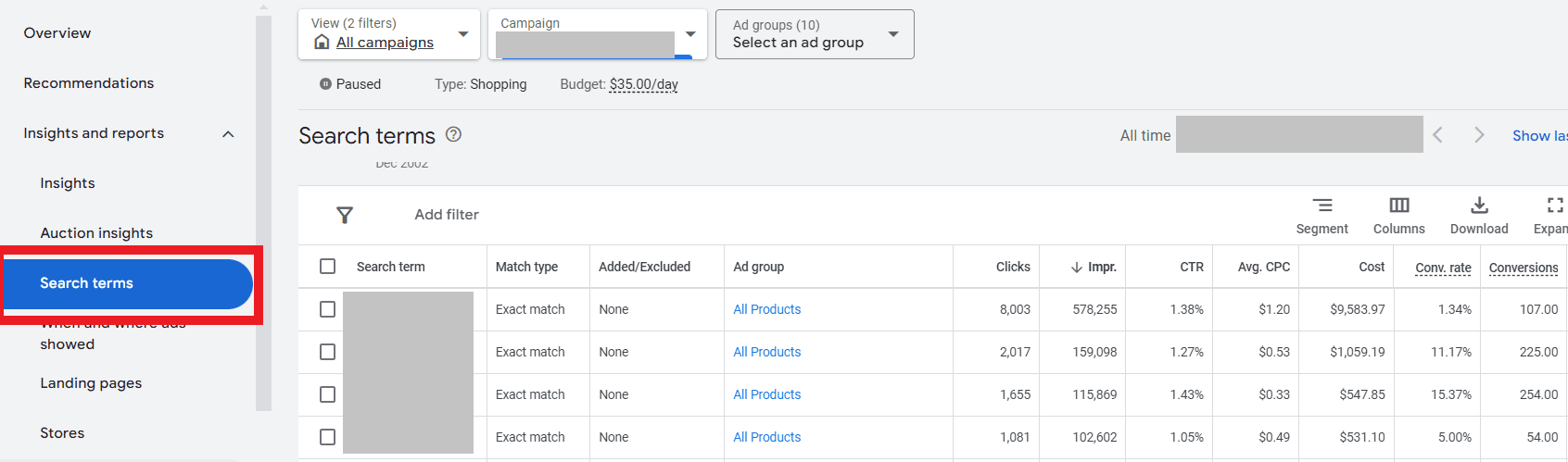
To combat this potential wasted ad spend, start by reviewing the search terms report regularly to identify and add any negative keywords.

In your Google Shopping campaign, navigate to Insights and reports > Search terms.

Google Shopping <span class=

From there, you can review what search terms triggered your products and how they performed.

If you find any irrelevant terms triggering your ads, you can add them as a negative – or better yet, create a negative keywords list to easily add to in the future.

This helps refine your targeting by showing your ads on more relevant searches, reducing wasted ad spend on non-converting traffic.

3. Inadequate Bid Management

Bid management is another critical component of a successful Google Shopping ads strategy.

However, many PPC managers will set bids once and then forget about them, instead of adjusting them based on performance data.

This hands-off approach can lead to underbidding or overbidding, and both scenarios can hurt your campaign’s ROI.

Another common mistake is using a “one size fits all” bid strategy, where you set the same bid amount or bid strategy across all products and campaigns.

To start optimizing your Google Shopping bid strategy, utilize automated bid strategies like:

  • Target return on ad spend (ROAS).
  • Target cost per action (CPA).
  • Maximize Conversion Value.

These Smart Bidding strategies help optimize your bids in real time, looking at factors like device, location, time of day, audience segments, and more.

Additionally, make sure that your daily budget aligns with your Smart Bidding strategy to ensure you’re not over- or under-bidding in any particular campaign.

For example, if you have a daily budget of $50 but are using a Target CPA bid strategy with a goal of $25, you’ll likely need to increase the daily budget significantly to give the algorithm a chance to learn more by serving more ad impressions.

4. Not Optimizing Images

With Google Shopping ads, the product image is likely the first thing to catch the user’s attention.

Most ecommerce retailers use the standard images from the official manufacturer’s website.

But wait, why would that be a bad thing?

Well, to start, this means everyone will see the same image across a variety of brands, making it extremely difficult to stand out from your competitors.

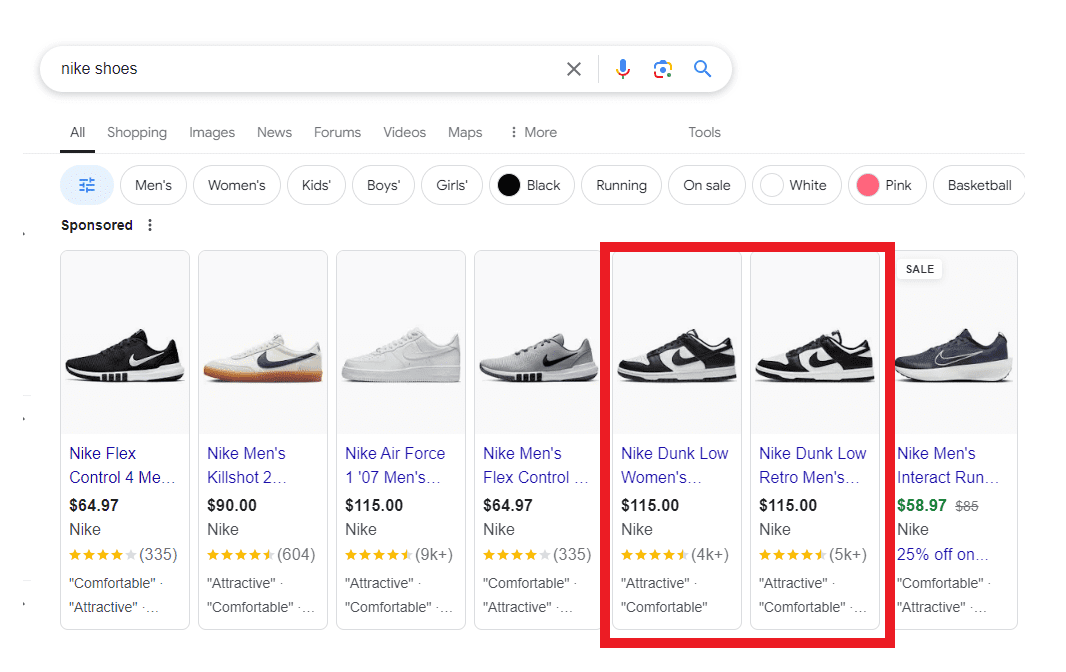
For example, when was the last time you searched for “Nike shoes” and got a barrage of Shopping ads for the same shoes, just different retailers?

Example of a Google search with the query of 'Nike shoes' showing Shopping ad examples.Screenshot taken by author, July 2024.

If you’re used to using the same stock images, try taking advantage of some of the recent tools announced by Google at this year’s Google Marketing Live.

For example, advertisers can use Product Studio later this year, which instantly turns static images into eye-catching videos.

Additionally, you can use the new generative AI tools like their AI-powered image editing for product images from your Google Merchant Center feed.

Lastly, try A/B testing the standard stock photos against lifestyle images featuring the product to understand what resonates better with users.

5. Misunderstanding Campaign Types & Structure

As with any other campaign type, the structure can make or break your performance.

With Google Shopping, there are essentially three different options when creating a campaign:

  • Performance Max (with a feed).
  • Performance Max (feed-only).
  • Standard Shopping.

Both campaign types have their pros and cons when it comes to Google Shopping. The key is to understand the differences in features, functionality, and amount of control in order to choose the right campaign type for your goals.

In a regular Performance Max campaign, you have the option to add a feed as an asset, among many other assets like headlines, descriptions, images, etc.

This essentially means your Google Shopping ads can show across many types of Google inventory, not just on the Google Shopping network.

Now, feed-only Performance Max campaigns and Standard Shopping campaigns both focus on only showing ads on the Google Shopping network.

Next, let’s talk about the structure of your campaigns.

It may be tempting to lump everything into an “All Products” ad group and call it a day.

This mistake can cost you a lot of wasted ad dollars if not monitored closely.

If you’ve taken the steps to have a well-organized and clean product feed, don’t let that work go to waste!

A well-structured product feed will make your Google Shopping campaigns run much smoother by giving you control of how and when certain products are triggered.

If you’re unsure where to start, try grouping your products by their category. This allows for greater control over the ad listings.

Additionally, if you know you have low-margin products or products you want to avoid completely from showing, make sure to exclude those when setting up your campaign.

6. Overlooking Competitive Pricing

Google Shopping is a highly competitive channel, especially when it comes to pricing and its effect on ad performance.

Retailers who ignore their competitors’ pricing strategies may find their ads less appealing to customers, which leads to lower click-through rates and conversions.

For retailers who sell items in minimum quantities, it may be about lowering your prices. It may also be about analyzing how your feed is structured by showing the “price per quantity.”

For example, when searching for ‘wedding invitations,’ the Shopping results come back with different brands with vastly different price points:

A search query for 'wedding invitations' on Google Search with Shopping ads results.Screenshot taken by author, July 2024

It’s clear that from this example, some brands show the price for a minimum of 30 (in the first example).

Other brands in the middle look to show the price per individual invitation.

When regularly analyzing your Shopping listings compared to others in the auction, it may be worth adjusting your price feed structure to stay competitive and remain attractive to active shoppers.

7. Not Using Merchant Promotions

In this economy, it’s no secret that almost everyone is looking for a deal when shopping.

If you actively run promotions on your website, make sure to take advantage of Merchant Promotions and promotion assets in Google Ads.

Running Merchant Promotions will help make your product listing more attractive to shoppers, which could lead to higher click-thru rates and better ROI.

In this example, the Shopping ads shown when searching for ‘king bed comforter set’ showed two listings that were using Merchant Promotions.

Google search query of 'king bed comforter sets' with Google Shopping ads results.Screenshot taken by author, July 2024

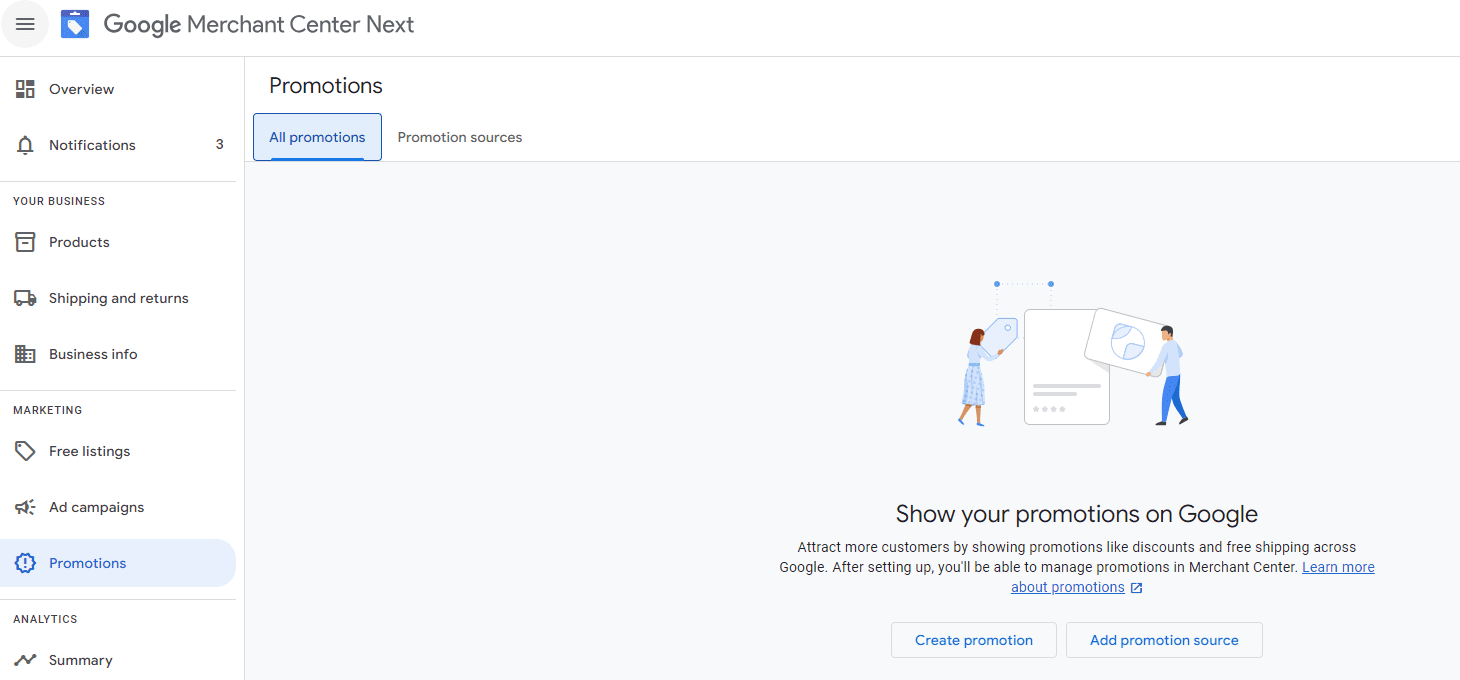
To set up a promotion, navigate to Promotions on the left-hand side of your Google Merchant Center platform. Then, click Create promotion:

How to set up merchant promotionsScreenshot taken by author, July 2024

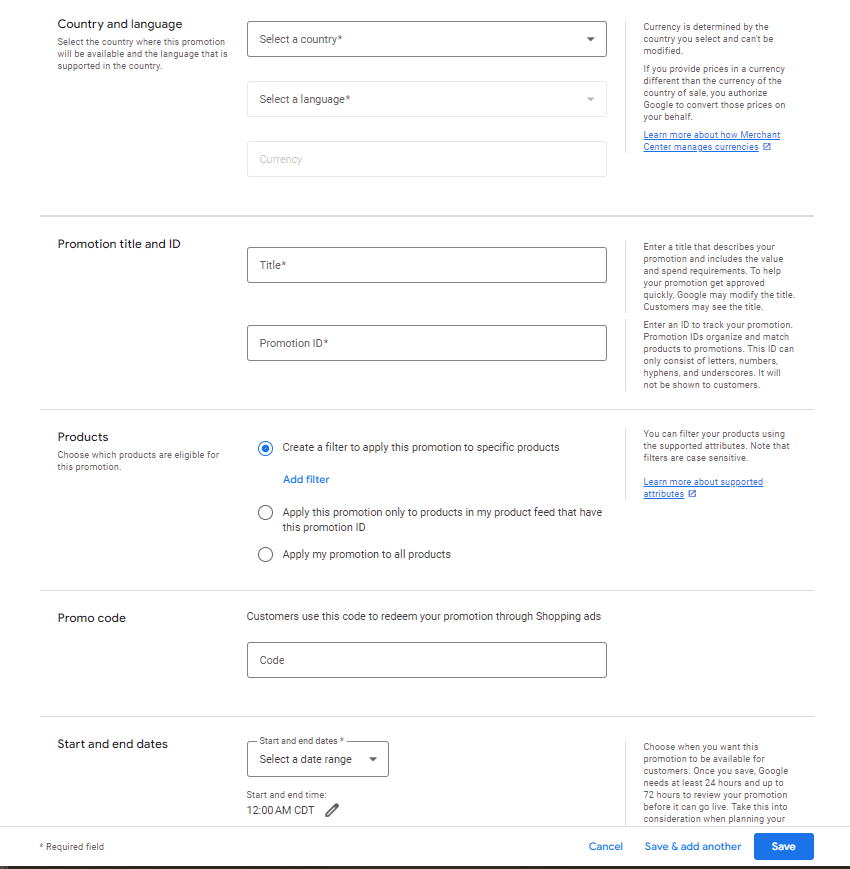
From there, you’ll enter the required information in order to save the promotion. After saving, the promotion can take up to 15 minutes to be visible to shoppers.

The required fields include:

  • Country.
  • Language.
  • Promotion Title.
  • Promotion ID.
  • Start and end dates.

The use of promo code is optional, where you can add it in if necessary for users to enter in order to redeem the sale.

Merchant Promotions setupScreenshot taken by author, July 2024
Later this year, Google also announced the rollout of a new way to tailor promotions in Shopping, like member-only exclusives or special pricing.

Additionally, Google announced on the same day that advertisers will be able to feature ‘first order’ promotions for new customers, which will be available in both Performance Max and Standard Shopping campaigns.

Continually Refine Your Google Shopping Campaigns

Avoiding these common Google Shopping mistakes can save you significant time, money, and headaches, as well as enhance campaign performance.

By focusing on things like product feed quality, bid management, negative keywords, and more, you can be on your way to driving better results and achieving a better ROI.

Remember, every mistake is an opportunity to learn and refine your strategy.

Stay proactive and continuously optimize, and you’ll turn your Google Shopping campaigns into a well-oiled machine and power revenue driver for your ecommerce business.

More resources: 


Featured Image: ulkerdesign/Shutterstock

When Search Isn’t Search Anymore, But It Is Still Search via @sejournal, @jonkagan

If you talk to any paid search marketing old-timer (someone with 10+ years of experience) and ask them what has changed within the search industry, they will likely give you a straightforward reply:

Literally everything.

Without dating myself, I can say that when I started in this space, Yahoo was the bigger ad platform than Google, AskJeeves was a standalone platform (and still had Jeeves), AOL was still a standalone ad platform, and there were fewer match types.

More importantly, we relied on keywords and manually written search ads (25-35-35 – if you know this reference, congratulations, you’re old).

Targeting was limited to geography, the search network, and not much else.

Search Is Not Just Search Anymore

Today, the odds are that half your “search” campaigns don’t even have keywords, ads are bigger (and can be AI-generated), the targeting ability is incredible, and the options of what you can do seem infinite.

But at the same time, you have less transparency, and the levers you pull are more directional than definitive (because let’s face it, odds are you aren’t doing much manual CPC bidding anymore).

In addition, the concept of paid search has changed. Where once it was a keyword and text ad-focused association, it has shifted to more of a platform term that even exceeds ads showing on search engines.

Think of it like this:

  • Search marketing in 2005: Yahoo and Google text ads triggered by keywords you bid on. As well as accidentally showing in GDN (back then called the Google Content Network).
  • Search marketing in 2024: Bing (because I refuse to call it Microsoft) and Google text ads triggered by keywords you bid on, as well as:
  • Product feeds showing your catalog in search engines and social media are triggered by behavior or queries you don’t bid on.
  • An “all-in-one” ad unit that optimizes all sorts of ad placements to a single goal (Performance Max).
  • Email ad units that are tied to ad placements on a mobile app feed and video views.
  • Video ads showing for whatever it feels, with some guidance based on behavior.
  • Bidding ads in a social media platform the way you used to bid on search ads 20 years ago, and so on.

The industry and the concept of search marketing over the past 20 years are night and day. In reality, it isn’t so much search marketing but biddable media.

However, it is still powered by a single thing: people searching for things.

Now cue: “But Jon, you just said search marketing isn’t search anymore, so how do people searching for things power the space?”

To which I reply:

“Shut up and listen. If you still run basic search and/or shopping ads, then that is people searching for things. The rest is audience-based targeting, meaning someone took multiple actions on the internet to get themselves categorized into audiences. The vast majority of the time, that behavior is search. The part that goes out the window most often is the recency of them doing that.”

Search Vs. Biddable Media

As the industry evolves, the thought of search marketing becomes a subset of a concept that emerged 10 or so years ago, known as biddable media.

Biddable media is fairly straightforward conceptually: If you are advertising online, on a platform that requires you to enter an auction for your ad to show, then you are doing biddable media.

Search is the function of biddable media for:

  • Triggering of ads in the search engine results page (SERP).
  • Managing non-keyword ads that show in SERP (Performance Max, Shopping, etc).
  • Creating keyword-based audience targets on non-keyword-based ad units (Microsoft Audience Network (MSAN), Google Display Network (GDN), YouTube, Performance Max, Demand Generation, etc.).

Traditional search management is also the lifeblood of strategy and approach to biddable media:

  • Manual bidding.
  • Target cost per acquisition (TCPA)/target return on ad spend (TROAS)/Max Clicks.
  • Bid modification for targets, seasonality, device, etc.

Net-net: Search has started to become an antiquated term. In reality, search is biddable media, which is not just search but a search style of management that is across many more ad units and platforms.

I know; this is as clear as how Jenn Shah of Real Housewives of Salt Lake City made all her money before she got arrested.

What Is The Scope Of “Search” Now?

First, let me comfort all “search” marketers with this: “Your job didn’t go away with this paradigm shift (if it had, it would’ve been 5-10 years ago, and you likely wouldn’t be reading this article).”

But now, those “search” marketers just became much more valuable.

With a little additional learning, they’ve become the Jack/Jane of all trades in the digital marketing space (except for fixed rate managed service buys, which are typically CTV/Streaming or non-programmatic display efforts or affiliate; they don’t fall in this concept).

Their working knowledge of paid search management has become a working knowledge of biddable media.

In a less roundabout way of saying it, your paid search skills are applicable to all forms of paid media that require a strategy and an auction.

So, the scope of your job is more than just Google and Bing search; it also includes managing other media channels, similar to how you would manage paid search.

Biddable Media Formats Using Search Management StrategiesBiddable Media Formats Using Search Management Strategies, screenshots by author, July 2024

How Do We Adapt Our Skill Sets?

Adapting your skill set depends on if it even needs to be adapted.

You may already be adapted to manage other platforms and don’t even realize it. If you’ve been doing any of the following, you’re already most of the way there:

  • Running a Performance Max campaign.
  • Intentionally running a Google GDN, YouTube, or Bing Audience Network campaign (a true standalone campaign with proper ad units).
  • Building and utilizing audience targets and remarketing lists.
  • Deciding a specific bid strategy, setting it up, and adjusting it based on performance (TROAS, Max Conversions, TCPA, CPM, Max Clicks w/ CPC, etc.).
  • A/B testing (landing page, creative, bid strategy).

If you’re doing most or all of the above (or have in the past), stop reading this article; you’re fine; go watch my beloved NY Jets disappoint their fan base by burning through another quarterback.

If you aren’t doing more than half of these, but you are managing paid search, the learning curve isn’t difficult.

Anyone who follows me on X (Twitter) knows I rarely give Google kudos for much of anything. Still, its certification process is incredibly helpful (not so much the certifications themselves, but the tutorials).

Those give you the basics of understanding GDN, Performance Max, Shopping YouTube, Demand Generation (fka Discover), and other elements. You already know paid search, which is the most difficult element to learn.

Then, it is merely applying those skills to other platforms.

Don’t believe me? Here is a handy little equivalency chart:

  • Non-Skippable YouTube targeted to TV that shows on YouTube TV and Google TV = (similar) to CTV placements bought programmatically.
  • GDN/Audience ads = Display placements bought programmatically.
  • Performance Max = (similar) multi-ad unit social placements (i.e., Meta/Linkedin).
  • Google/Bing Shopping = (similar) social shopping placement and retail media placements. (i.e., Roundel/Walmart/Amazon/Pinterest) via a product feed.

Here are also some examples of hands-on management being similar among platforms:

  • Google and Bing search strategies and most assets are the same as each other.
  • YouTube CPM/Non-Skippable bid strategies are the same as CTV efforts on TradeDesk.
  • Google/Bing Max Click bid strategies at the campaign level are the same as optimizing Meta campaigns to Link Clicks or Landing Page Views.
  • Geotargeting in Google (which in my mind is some of the most impressive), can largely be replicated in Meta, GroundTruth, TradeDesk, SimpliFi, and more.
  • Remarketing lists are roughly designed the same way across all platforms (Google Analytics does have a leg up, I will admit), but all it requires is a platform site pixel to be deployed.
  • CRM/Customer Lists can be uploaded to nearly every platform (some restrictions apply in verticals around healthcare, financial services, and a few others).
  • Video creative (the raw file), are interchangeable between Linkedin, YouTube, Meta, Criteo, Bing, and many more.

The similarities go on:

1 Creative Across 3 Platforms (Google, TTD, Meta)1 Creative Across 3 Platforms (Google, TTD, Meta) screenshots by author, July 2024

Not to mention, between A.I. strategies (which is a fancy way of saying “bid rules”) and platform transparency (hey, Performance Max, you can sit this statement out), the management approach between the platforms on the similar ad units is nearly identical.

Not to mention, providing the non-text units are sized correctly, you can frequently utilize creative files across platforms and save yourself (and/or your creative team) some precious time.

Search Beyond Just Search Provides New Insight

My favorite part about multi-channel biddable media is its give-and-take between platforms.

Strong-performing paid search text ads are carried into social ads (RSA ads easily fit into Meta Headline + Primary Text + Description).

Engagement with display based on placement helps me decide where to target my CTV/Video creative. (High CTR on sports websites means I will focus my videos on sports content/games.)

Search Query reports give me a better sense of what people are actually searching for, which I can correlate to in-market audiences for targeting. Observational search audiences and demographics help me shape my audience segments.

The same audience build can be used across platforms, for example this customer list uploadScreenshot from author, July 2024

The same audience build can be used across platforms, for example, this customer list upload.

Your overarching bid management skillset helps you further develop each channel.

Am I Even A Search Marketer Anymore?

Short answer: Yes, you still manage search-based ad units (otherwise, you wouldn’t be reading this article).

Long answer: Sort of. But in reality, you’re a multi-purpose digital marketer who, in addition to managing search-based ad placements that they have control over, also has the working skillset to manage programmatic display, programmatic video/CTV, social, digital out-of-home (DOOH), programmatic audio, retail media (excluding affiliate), as well paid search (but don’t get cocky and say SEO, because that is definitely not a transferable skillset in this situation).

The Takeaway

Whether you realize it or not, you’ve become a digital marketing Swiss Army Knife, able to manage multiple media channels (and countless ad types), all because you know paid search.

This means you need to stop thinking that “search” marketing is about keywords triggering text ads and start thinking of it as a “search” skillset that can be deployed anywhere.

It takes a little practice and some getting used to, but it has become one of the most valuable skill sets in paid media.

More resources:


Featured Image: ra2 studio/Shutterstock

Google Advises Caution With AI Generated Answers via @sejournal, @martinibuster

Google’s Gary Illyes cautioned about the use of Large Language Models (LLMs), affirming the importance of checking authoritative sources before accepting any answers from an LLM. His answer was given in the context of a question, but curiously, he didn’t publish what that question was.

LLM Answer Engines

Based on what Gary Illyes said, it’s clear that the context of his recommendation is the use of AI for answering queries. The statement comes in the wake of OpenAI’s announcement of SearchGPT that they are testing an AI Search Engine prototype. It may be that his statement is not related to that announcement and is just a coincidence.

Gary first explained how LLMs craft answers to questions and mentions how a technique called “grounding” can improve the accuracy of the AI generated answers but that it’s not 100% perfect, that mistakes still slip through. Grounding is a way to connect a database of facts, knowledge, and web pages to an LLM. The goal is to ground the AI generated answers to authoritative facts.

This is what Gary posted:

“Based on their training data LLMs find the most suitable words, phrases, and sentences that align with a prompt’s context and meaning.

This allows them to generate relevant and coherent responses. But not necessarily factually correct ones. YOU, the user of these LLMs, still need to validate the answers based on what you know about the topic you asked the LLM about or based on additional reading on resources that are authoritative for your query.

Grounding can help create more factually correct responses, sure, but it’s not perfect; it doesn’t replace your brain. The internet is full of intended and unintended misinformation, and you wouldn’t believe everything you read online, so why would you LLM responses?

Alas. This post is also online and I might be an LLM. Eh, you do you.”

AI Generated Content And Answers

Gary’s LinkedIn post is a reminder that LLMs generate answers that are contextually relevant to the questions that are asked but that contextual relevance isn’t necessarily factually accurate.

Authoritativeness and trustworthiness is an important quality of the kind of content Google tries to rank. Therefore it is in publishers best interest to consistently fact check content, especially AI generated content, in order to avoid inadvertently becoming less authoritative. The need to verify facts also holds true for those who use generative AI for answers.

Read Gary’s LinkedIn Post:

Answering something from my inbox here

Featured Image by Shutterstock/Roman Samborskyi

5 Automated And AI-Driven Workflows To Scale Enterprise SEO via @sejournal, @seomeetsdesign

That’s where Ahrefs’ in-built AI translator may be a better fit for your project, solving both problems in one go:

GIF from Ahrefs Keywords Explorer, July 2024

It offers automatic translations for 40+ languages and dialects in 180+ countries, with more coming soon.

However, the biggest benefit is that you’ll get a handful of alternative translations to select from, giving you greater insight into the nuances of how people search in local markets.

For example, there are over a dozen ways to say ‘popcorn’ across all Spanish-speaking countries and dialects. The AI translator is able to detect the most popular variation in each country.

Screenshot from Ahrefs Keywords Explorer, July 2024

This, my friends, is quality international SEO on steroids.

2.   Identify The Dominant Search Intent Of Any Keyword

Search intent is the internal motivator that leads someone to look for something online. It’s the reason why they’re looking and the expectations they have about what they’d like to find.

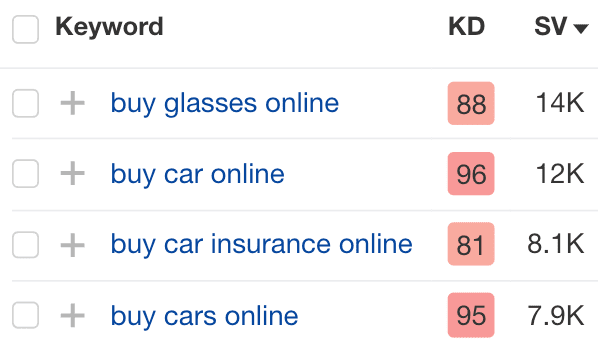
The intent behind many keywords is often obvious. For example, it’s not rocket science to infer that people expect to purchase a product when searching any of these terms:

Screenshot from Ahrefs Keywords Explorer, July 2024

However, there are many keywords where the intent isn’t quite so clear-cut.

For instance, take the keyword “waterbed.” We could try to guess its intent, or we could use AI to analyze the top-ranking pages and give us a breakdown of the type of content most users seem to be looking for.

Gif from Ahrefs Keywords Explorer, July 2024

For this particular keyword, 89% of results skew toward purchase intent. So, it makes sense to create or optimize a product page for this term.

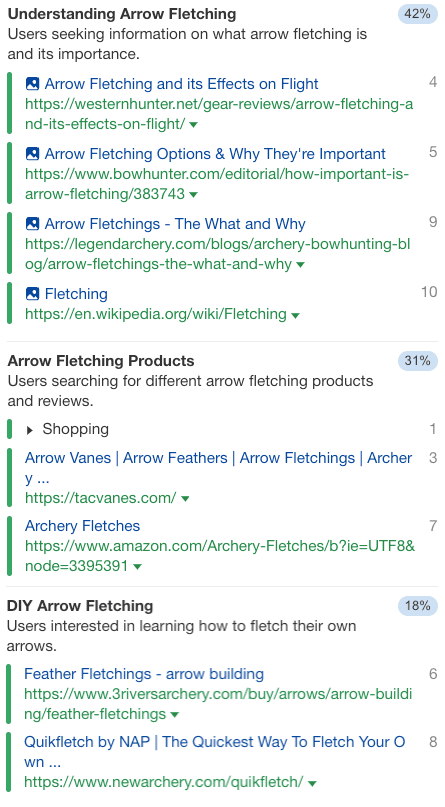
For the keyword “arrow fletchings,” there is a mix of different types of content ranking, like informational posts, product pages, and how-to guides.

Screenshot from Ahrefs Identify Intents, July 2024

If your brand or product lent itself to one of the popular content types, that’s what you could plan in your content calendar.

Or, you could use the data here to outline a piece of content that covers all the dominant intents in a similar proportion to what’s already ranking:

  • ~40% providing information and answers to common questions.
  • ~30% providing information on fletching products and where to buy them.
  • ~20% providing a process for a reader to make their own fletchings.
  • And so on.

For enterprises, the value of outsourcing this to AI is simple. If you guess and get it wrong, you’ll have to allocate your limited SEO funds toward fixing the mistake instead of working on new content.

It’s better to have data on your side confirming the intent of any keyword before you publish content with an intent misalignment, let alone rolling it out over multiple websites or languages!

3.   Easily Identify Missing Topics Within Your Content

Topical gap analysis is very important in modern SEO. We’ve evolved well beyond the times when simply adding keywords to your content was enough to make it rank.

However, it’s not always quick or easy to identify missing topics within your content. Generative AI can help plug gaps beyond what most content-scoring tools can identify.

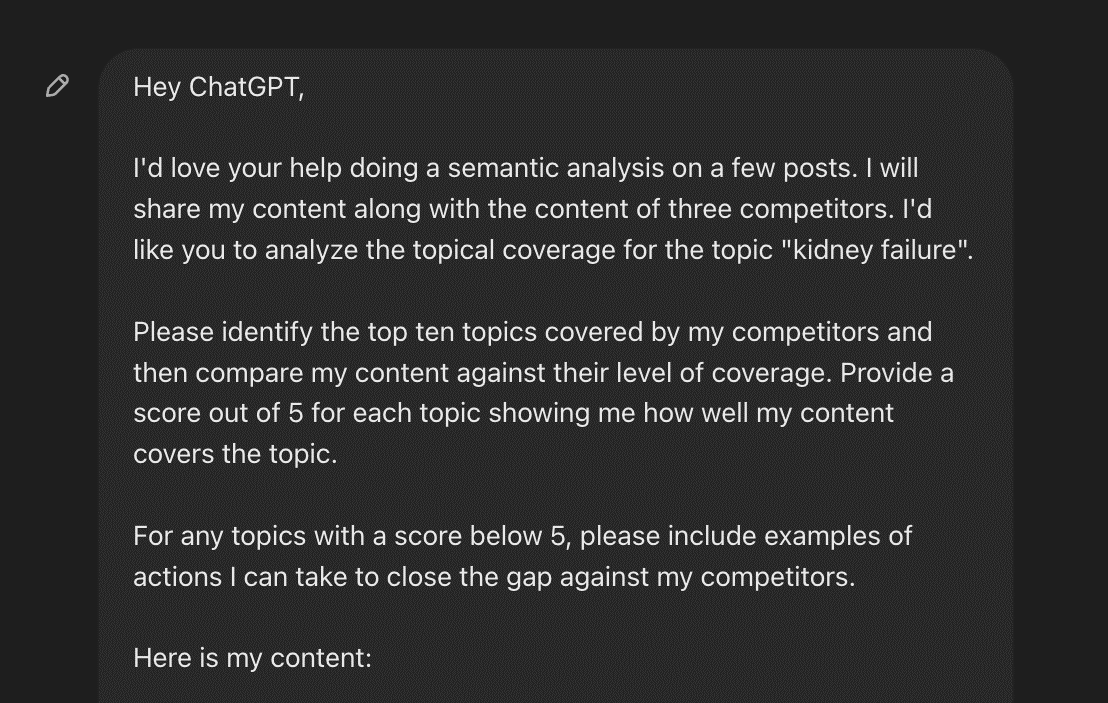
For example, ChatGPT can analyze your text against competitors’ to find missing topics you can include. You could prompt it to do something like the following:

Screenshot from ChatGPT, July 2024

SIDENOTE. You’ll need to add your content and competitors’ content to complete the prompt.

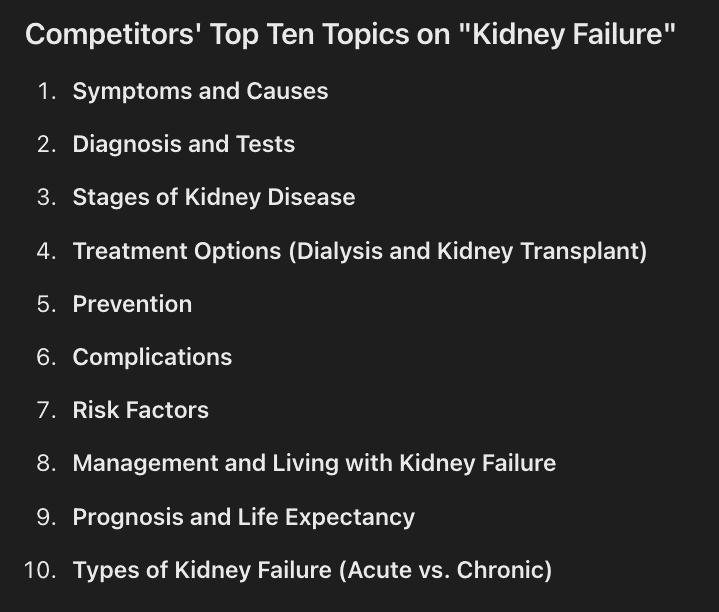
Here’s an example of the list of topics it identifies:

Screenshot from ChatGPT, July 2024

And the scores and analysis it can provide for your content:

Screenshot from ChatGPT, July 2024

This goes well beyond adding words and entities, like what most content scoring tools suggest.

The scores on many of these tools can easily be manipulated, providing higher scores the more you add certain terms; even if, from a conceptual standpoint, your content doesn’t do a good job of covering a topic.

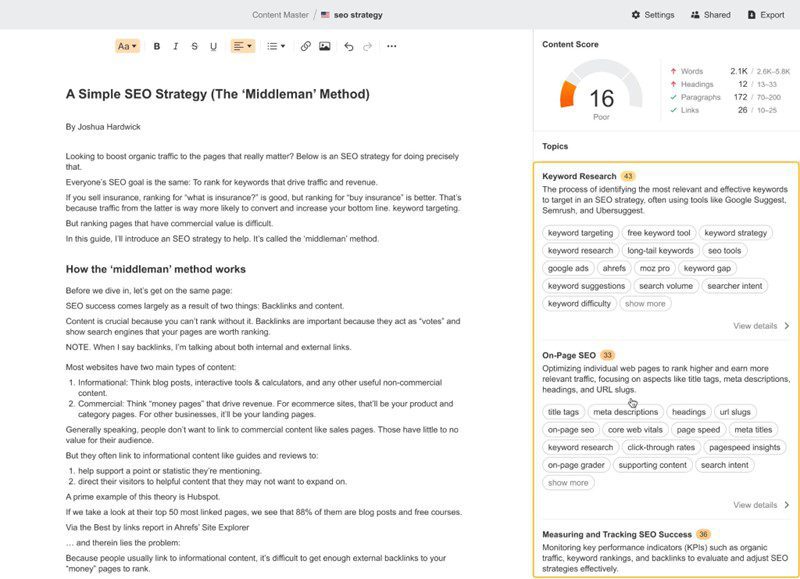
If you want the detailed analysis offered by ChatGPT but available in bulk and near-instantly… then good news. We’re working on Content Master, a content grading solution that automates topic gap analysis.

I can’t reveal too much about this yet, but it has a big USP compared to most existing content optimization tools: its content score is based on topic coverage—not just keywords.

Screenshot from Ahrefs Content Master, July 2024

You can’t just lazily copy and paste related keywords or entities into the content to improve the score.

If you rely on a pool of freelancers to create content at scale for your enterprise company, this tool will provide you with peace of mind that they aren’t taking any shortcuts.

4.   Update Search Engines With Changes On Your Website As They Happen

Have you ever made a critical change on your website, but search engines haven’t picked up on it for ages? There’s now a fix for that.

If you aren’t already aware of IndexNow, it’s time to check it out.

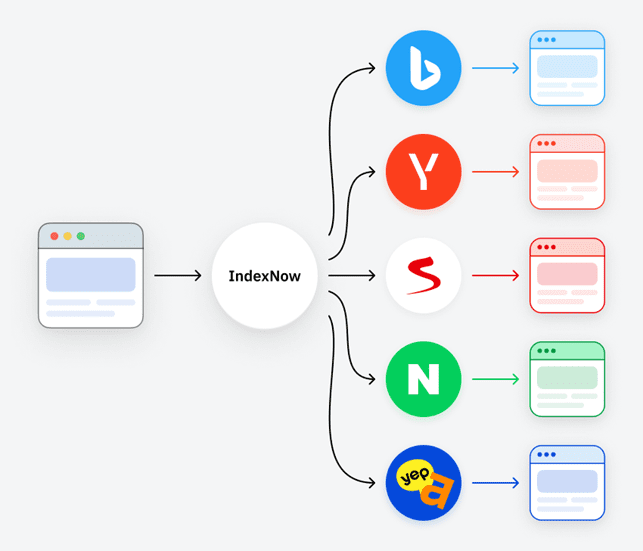
It tells participating search engines when a change, any change, has been made on a website. If you add, update, remove, or redirect pages, participating search engines can pick up on the changes faster.

Not all search engines have adopted this yet, including Google. However, Microsoft Bing, Yandex, Naver, Seznam.cz, and Yep all have. Once one partner is pinged, all the information is shared with the other partners making it very valuable for international organizations:

Most content management systems and delivery networks already use IndexNow and will ping search engines automatically for you. However, since many enterprise websites are built on custom ERP platforms or tech stacks, it’s worth looking into whether this is happening for the website you’re managing or not.

You could partner with the dev team to implement the free IndexNow API. Ask them to try these steps as shared by Bing if your website tech stack doesn’t already use IndexNow:

  1. Get your free IndexNow API key
  2. Place the key in your site’s root directory as a .txt file
  3. Submit your key as a URL parameter
  4. Track URL discoveries by search engines

You could also use Ahrefs instead of involving developers. You can easily connect your IndexNow API directly within Site Audit and configure your desired settings.

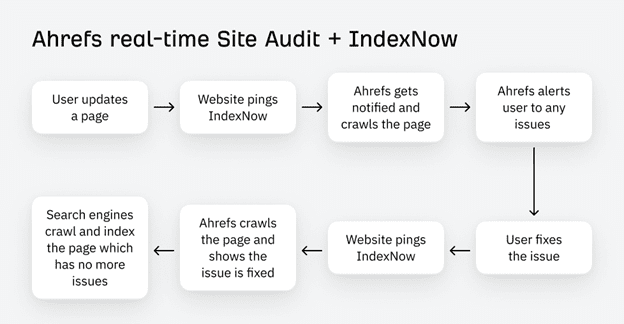
Here’s a quick snapshot of how IndexNow works with Ahrefs:

In short, it’s an actual real-time monitoring and alerting system, a dream come true for technical SEOs worldwide. Check out Patrick Stox’s update for all the details.

Paired with our always-on crawler, no matter what changes you’re making, you can trust search engines will be notified of any changes you want, automatically. It’s the indexing shortcut you’ve been looking for.

5.   Automatically Fix Common Technical SEO Issues

Creative SEO professionals get stuff done with or without support from other departments. Unfortunately, in many enterprise organizations, relationships between the SEO team and devs can be tenuous, affecting how many technical fixes are implemented on a website.

If you’re a savvy in-house SEO, you’ll love this new enterprise feature we’re about to drop. It’s called Patches.

It’s designed to automatically fix common technical issues with the click of a button. You will be able to launch these fixes directly from our platform using Cloudflare workers or JavaScript snippets.

Picture this:

  1. You run a technical SEO crawl.
  2. You identify key issues to fix across one page, a subset of pages, or all affected pages.
  3. With the click of a button, you fix the issue across your selected pages.
  4. Then you instantly re-crawl these pages to check the fixes are working as expected.

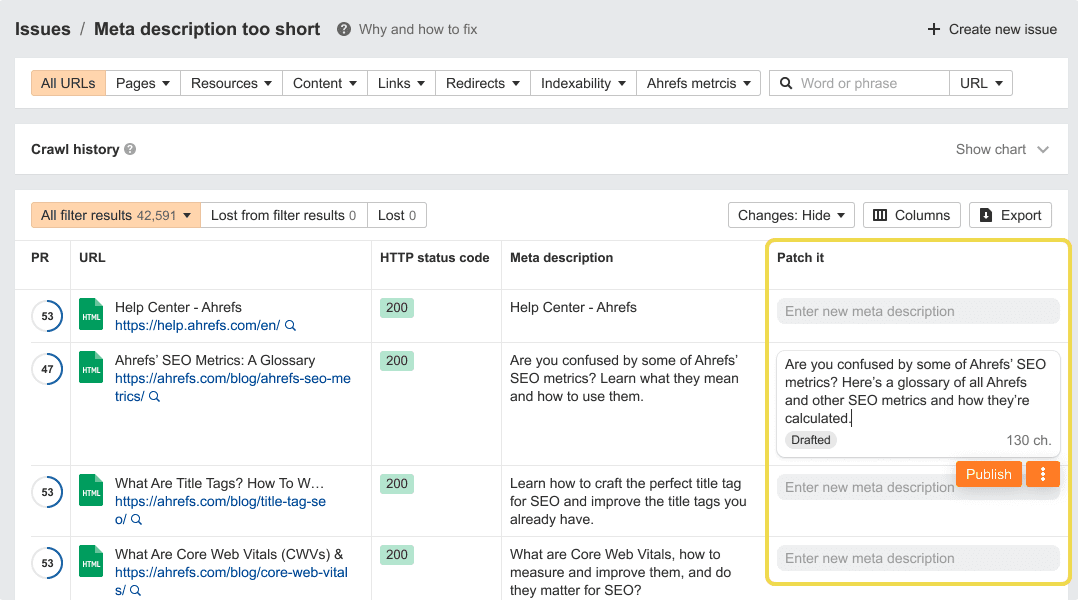
For example, you can make page-level fixes for pesky issues like re-writing page titles, descriptions, and headings:

Screenshot from Ahrefs Site Audit, July 2024

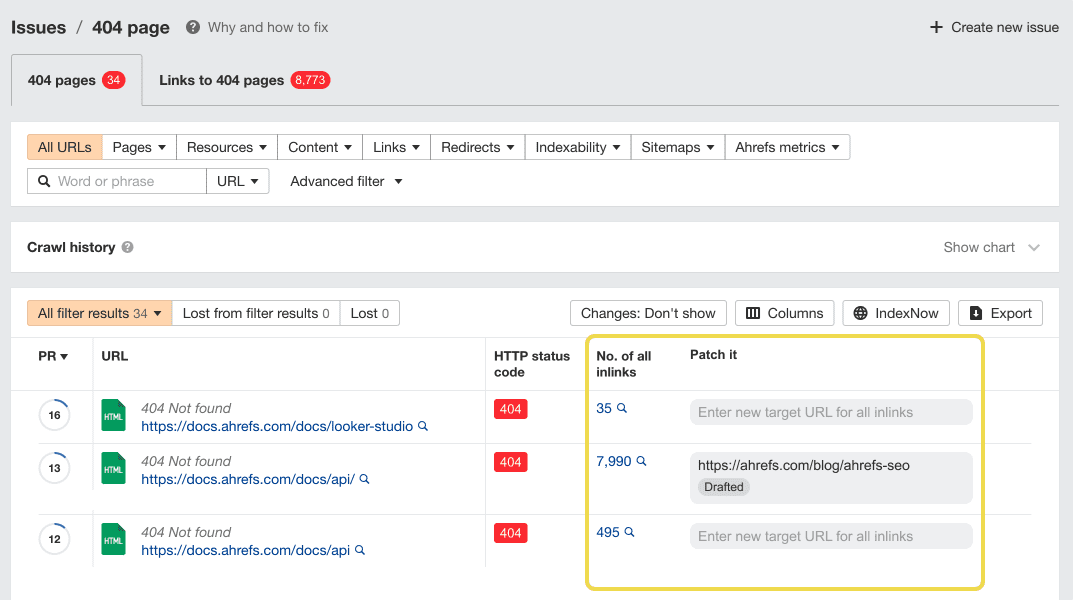
You can also make site-wide fixes. For example, fixing internal links to broken pages can be challenging without support from developers on large sites. With Patches, you’ll be able to roll out automatic fixes for issues like this yourself:

Screenshot from Ahrefs Site Audit, July 2024

As we grow this tool, we plan to automate over 95% of technical fixes via JavaScript snippets or Cloudflare workers, so you don’t have to rely on developers as much as you may right now. We’re also integrating AI to help you speed up the process of fixing fiddly tasks even more.

Get More Buy-In For Enterprise SEO With These Workflows

Now, as exciting and helpful as these workflows may be for you, the key is to get your boss and your boss’ boss on board.

If you’re ever having trouble getting buy-in for SEO projects or budgets for new initiatives, try using the cost savings you can pass as leverage.

For instance, you can show how, usually, three engineers would dedicate five sprints to fixing a particular issue, costing the company illions of dollars—millions, billions, bajillions, whatever it is. But with your proposed solution, you can reduce costs and free up the engineers’ time to work on high-value tasks.

You can also share the Ultimate Enterprise SEO Playbook with them. It’s designed to show executives how your team is strategically valuable and can solve many other challenges within the organization.

Google’s Cookie Reversal Raises Questions

Google announced on July 22, 2024, that it would not remove third-party tracking cookies from the Chrome browser after all, leaving many advertisers to wonder, “What now?”

“We are proposing an updated approach [to tracking cookie depreciation] that elevates user choice,” wrote Anthony Chavez, Google’s Privacy Sandbox vice president. “Instead of deprecating third-party cookies, we would introduce a new experience in Chrome that lets people make an informed choice that applies across their web browsing.”

Google announced its “new path” for cookies on July 22.

Privacy advocates have warned for decades about the tiny bits of code we lovingly call cookies since, when placed in a web browser, they could track individuals across websites, Google search queries, location, and other behaviors.

Yet third-party or tracking cookies have legitimate uses for cross-site personalization, targeted advertising, and website analytics.

Regardless, all this data collection means Google, Criteo, and others know loads about nearly every person online, making “internet privacy” a thin veneer.

Thus Google has promised for roughly five years to remove tracking cookies, but no more. The reversal has advertisers and industry observers questioning the future.

Here are five aspects to monitor.

Will Regulators Approve?

Google’s plan to keep cookies and its Privacy Sandbox must still pass regulatory muster.

Simon Poulton, executive vice president of innovation and growth at Tinuiti, a marketing firm, wrote to Practical Ecommerce in an email that regulatory approval was the “elephant in the room” when discussing Google’s decision.

Google faces scrutiny from governmental agencies interested in consumer privacy while also negotiating with agencies that rely on cookies and fear their elimination enhances Google’s own ad platform.

This latter group includes the U.K.’s Competition and Markets Authority (CMA), which is investigating Google’s Privacy Sandbox. The CMA was concerned that ad targeting via the Sandbox (Topics API, for example) extended Google’s dominance in the digital advertising industry.

Referring to a briefing Tinuiti released in April of this year, Poulton wrote, “As part of our coverage, we noted that privacy and competition are in direct, insoluble tension.”

“We went so far as to suggest that Google would be unable to move on an absolute deprecation (and transition to the Privacy Sandbox) under the current circumstances,” continued Poulton.

Given Google’s announcement, this seems to have been the case.

For its part, the CMA noted on its website, “The CMA will now work closely with the [Information Commissioner’s Office] to carefully consider Google’s new approach to Privacy Sandbox.”

Thus Chrome, third-party cookies, and the Privacy Sandbox can likely proceed as Google’s Chavez proposes, but there’s no certainty.

Does Google Benefit?

The CMA and others have argued that Google’s Privacy Sandbox would have strengthened the company’s position in the ad business since targeting would rely on its technology.

“The fear is that Google’s new [Sandbox] framework might limit competition by making it more challenging for other companies to operate effectively in the ad space,” wrote Piotr Korzeniowski, CEO of Piwik Pro, an analytics platform, in an email.

But others argue that tracking cookies fuel Google’s existing ad business.

So which is it?

“Google is in a precarious position to own the most popular browser, advertising network, and many more ‘most popular’ digital products and services,” wrote Korzeniowski.

Hence Google’s decision to keep cookies and still move forward with the Privacy Sandbox presumably wasn’t so much about what benefited its own ad business as taking a balanced approach for its entire company, customers, and regulators.

Industry Preference?

Assume that all the various regulatory bodies, whether focused on privacy or competition, approve of Google’s “new path for Privacy Sandbox on the web.” Will industry participants such as Tinuiti and Piwik Pro choose cookies or the Sandbox?

“As privacy awareness increases, more users are expected to opt out of cookies, especially with more stringent regulations, clearer opt-out mechanisms, and rising consumer awareness of the topic,” Korzeniowski added. “Google’s plan to integrate the consent mechanism into browsers is a bold move. However, they did not plan this without ensuring it wouldn’t significantly impact their data collection and advertising business. I bet they will keep opt-ins above 70% because of how they design the mechanism.”

Walled Gardens

Third-party tracking differs from first-party. For example, TikTok does not require a tracking cookie to know what interests visitors; it has first-party data.

Tinuiti’s Poulton wrote, “Keep in mind that [third-party] cookies have no bearing on search or social (or any walled garden) tracking or advertising performance. So, while this is big news, I constantly remind folks that many advertisers on Meta, Amazon, and Google-owned platforms would not see any impact from [third-party] cookie deprecation, anyway.”

One could argue that even those platforms benefit from third-party data, but Instagram and Facebook advertisers, for example, are not likely impacted much in the near term.

However, eliminating tracking cookies would disrupt many others, such as services that place ads on publisher websites, email messages, and streaming videos.

Advertisers

The final takeaway from Google’s cookie announcement is that digital advertising is changing: We could have both cookies and the Sandbox. What worked five years ago may not now or in the future.

What won’t change is the value of first-party data. That’s what advertisers should focus on in this new advertising era.

The race to clean up heavy-duty trucks

This article is from The Spark, MIT Technology Review’s weekly climate newsletter. To receive it in your inbox every Wednesday, sign up here.

Truckers have to transport massive loads long distances, every single day, under intense time pressure—and they rely on the semi-trucks they drive to get the job done. Their diesel engines spew not only greenhouse gas emissions that cause climate change, but also nitrogen oxide, which can be extremely harmful for human health.

Cleaning up trucking, especially the biggest trucks, presents a massive challenge. That’s why some companies are trying to ease the industry into change. For my most recent story, I took a look at Range Energy, a startup that’s adding batteries to the trailers of semi-trucks. If the electrified trailers are attached to diesel trucks, they can improve the fuel economy. If they’re added to zero-emissions vehicles powered by batteries or hydrogen, they could boost range and efficiency. 

During my reporting, I learned more about what’s holding back progress in trucking and how experts are thinking about a few different technologies that could help.

The entire transportation sector is slowly shifting toward electrification: EVs are hitting the road in increasing numbers, making up 18% of sales of new passenger vehicles in 2023

Trucks may very well follow suit—nearly 350 models of zero-emissions medium- and heavy-duty trucks are already available worldwide, according to data from CALSTART. “I do see a lot of strength and demand in the battery electric space in particular,” says Stephanie Ly, senior manager for e-mobility strategy and manufacturing engagement at the World Resources Institute.

But battery-powered trucks will pose a few major challenges as they take to the roads. First, and perhaps most crucially, is their cost. Battery-powered trucks, especially big models like semi-trucks, will be significantly more expensive than diesel versions today.

There may be good news on this front: When you consider the cost of refueling and maintenance, it’s looking like electric trucks could soon compete with diesel. By 2030, the total cost of ownership of a battery electric long-haul truck will likely be lower than that of a diesel one in the US, according to a 2023 report from the International Council on Clean Transportation. The report looked at a number of states including California, Georgia, and New York, and found that the relatively high upfront cost for electric trucks are balanced out by lower operating expenses. 

Another significant challenge for battery-powered trucking is weight: The larger the vehicle, the bigger the battery. That could be a problem given current regulations, which typically limit the weight of a rig both for safety reasons and to prevent wear and tear on roads (in the US, it’s 80,000 pounds). Operators tend to want to maximize the amount of goods they can carry in each load, so the added weight of a battery might not be welcome.

Finally, there’s the question of how far trucks can go, and how often they’ll need to stop. Time is money for truck drivers and fleet operators. Batteries will need to pack more energy into a smaller space so that trucks can have a long enough range to run their routes. Charging is another huge piece here—if drivers do need to stop to charge their trucks, they’ll need much more powerful chargers to enable them to top off quickly. That could present challenges for the grid, and operators might need to upgrade infrastructure in certain places to allow the huge amounts of power that would be needed for fast charging of massive batteries. 

All these challenges for battery electric trucks add up. “What companies are really looking for is something they can swap out,” says Thomas Walker, transportation technology manager at the Clean Air Task Force. And right now, he says, we’re just not quite in a spot where batteries are a clean and obvious switch.

That’s why some experts say we should keep our options open when it comes to technologies for future heavy-duty trucks, and that includes hydrogen. 

Batteries are currently beating out hydrogen in the race to clean up transportation, as I covered in a story earlier this year. For most vehicles and most people, batteries simply make more sense than hydrogen, for reasons that include everything from available infrastructure to fueling cost. 

But heavy-duty trucks are a different beast: Heavier vehicles, bigger batteries, higher power charging, and longer distances might tip the balance in favor of hydrogen. (There are some big “ifs” here, including whether hydrogen prices will get low enough to make hydrogen-powered vehicles economical.) 

For a sector as tough to decarbonize as heavy-duty trucking, we need all the help we can get. As Walker puts it, “It’s key that you start off with a lot of options and then narrow it down, rather than trying to pick which one’s going to win, because we really don’t know.”


Now read the rest of The Spark

Related reading

To learn more about Range Energy and how its electrified trailers could help transform trucking in the near future, check out my latest story here

Hydrogen is losing the race to power cleaner cars, but heavy-duty trucks might represent a glimmer of hope for the technology. Dig into why in my story from earlier this year

Getting the grid ready for fleets of electric trucks is going to be a big challenge. But for some short-distance vehicles in certain areas, we may actually be good to go already, as I reported in 2021

Urban Sky Microballoon pictured shortly after deployment near Breckenridge, Colorado.
COURTESY URBAN SKY

Two more things

Spotting wildfires early and keeping track of them can be tough. Now one company wants to monitor blazes using high-altitude balloons. Next month in Colorado, Urban Sky is deploying balloons that are about as big as vans, and they’ll be keeping watch using much finer resolution than what’s possible with satellites without a human pilot. Read more about fire-tracking balloons in this story from Sarah Scoles

A new forecasting model attempts to marry conventional techniques with AI to better predict the weather. The model from Google uses physics to work out larger atmospheric forces, then tags in AI for the smaller stuff. Check out the details in the latest from my colleague James O’Donnell

Keeping up with climate  

Small rocky nodules in the deep sea might be a previously undiscovered source of oxygen. They contain metals such as lithium and are a potential target for deep-sea mining efforts. (Nature)

→ Polymetallic nodules are roughly the size and shape of potatoes, and they may be the future of mining for renewable energy. (MIT Technology Review)

A 350-foot-long blade from a wind turbine off the coast of Massachusetts broke off last week, and hunks of fiberglass have been washing up on local beaches. The incident is a setback for a struggling offshore wind industry, and we’re still not entirely sure what happened. (Heatmap News)

A new report shows that low-emissions steel- and iron-making processes are on the rise. But coal-powered operations are still growing too, threatening progress in the industry. (Canary Media)

Sunday, July 21, was likely the world’s hottest day in recorded history (so far). It edged out a record set just last year. (The Guardian)

Plastic forks, cups, and single-use packages are sometimes stamped with nice-sounding labels like “compostable,” “biodegradable,” or just “Earth-friendly.” But that doesn’t mean you can stick the items in your backyard compost pile—these marketing terms are basically the Wild West. (Washington Post)

While EVs are indisputably better than gas-powered cars in terms of climate emissions, they are heavier, meaning they wear through tires faster. The resulting particulate pollution presents a new challenge, one a startup company is trying to address with new tires designed for electric vehicles. (Canary Media)

Public fast chargers are popping up nearly everywhere in the US—at this pace, they’ll outnumber gas stations by 2030. And deployment is only expected to speed up. (Bloomberg)

PsiQuantum plans to build the biggest quantum computing facility in the US

The quantum computing firm PsiQuantum is partnering with the state of Illinois to build the largest US-based quantum computing facility, the company announced today. 

The firm, which has headquarters in California, says it aims to house a quantum computer containing up to 1 million quantum bits, or qubits, within the next 10 years. At the moment, the largest quantum computers have around 1,000 qubits. 

Quantum computers promise to do a wide range of tasks, from drug discovery to cryptography, at record-breaking speeds. Companies are using different approaches to build the systems and working hard to scale them up. Both Google and IBM, for example, make the qubits out of superconducting material. IonQ makes qubits by trapping ions using electromagnetic fields. PsiQuantum is building qubits from photons.  

A major benefit of photonic quantum computing is the ability to operate at higher temperatures than superconducting systems. “Photons don’t feel heat and they don’t feel electromagnetic interference,” says Pete Shadbolt, PsiQuantum’s cofounder and chief scientific officer. This imperturbability makes the technology easier and cheaper to test in the lab, Shadbolt says. 

It also reduces the cooling requirements, which should make the technology more energy efficient and easier to scale up. PsiQuantum’s computer can’t be operated at room temperature, because it needs superconducting detectors to locate photons and perform error correction. But those sensors only need to be cooled to a few degrees Kelvin, or a little under -450 °F. While that’s an icy temperature, it is still easier to achieve than what’s required for superconducting systems, which demand cryogenic cooling. 

The company has opted not to build small-scale quantum computers (such as IBM’s Condor, which uses a little over 1,100 qubits). Instead it is aiming to manufacture and test what it calls “intermediate systems.” These include chips, cabinets, and superconducting photon detectors. PsiQuantum says it is targeting these larger-scale systems in part because smaller devices are unable to adequately correct errors and operate at a realistic price point.  

Getting smaller-scale systems to do useful work has been an area of active research. But “just in the last few years, we’ve seen people waking up to the fact that small systems are not going to be useful,” says Shadbolt. In order to adequately correct the inevitable errors, he says, “you have to build a big system with about a million qubits.” The approach conserves resources, he says, because the company doesn’t spend time piecing together smaller systems. But skipping over them makes PsiQuantum’s technology difficult to compare to what’s already on the market. 

The company won’t share details about the exact timeline of the Illinois project, which will include a collaboration with the University of Chicago, and several other Illinois universities. It does say it is hoping to break ground on a similar facility in Brisbane, Australia, next year and hopes that facility, which will house its own large-scale quantum computer, will be fully operational by 2027. “We expect Chicago to follow thereafter in terms of the site being operational,” the company said in a statement. 

“It’s all or nothing [with PsiQuantum], which doesn’t mean it’s invalid,” says Christopher Monroe, a computer scientist at Duke University and ex-IonQ employee. “It’s just hard to measure progress along the way, so it’s a very risky kind of investment.”

Significant hurdles lie ahead. Building the infrastructure for this facility, particularly for the cooling system, will be the slowest and most expensive aspect of the construction. And when the facility is finally constructed, there will need to be improvements in the quantum algorithms run on the computers. Shadbolt says the current algorithms are far too expensive and resource intensive. 

The sheer complexity of the construction project might seem daunting. “This could be the most complex quantum optical electronic system humans have ever built, and that’s hard,” says Shadbolt. “We take comfort in the fact that it resembles a supercomputer or a data center, and we’re building it using the same fabs, the same contract manufacturers, and the same engineers.”

Correction: we have updated the story to reflect that the partnership is only with the state of Illinois and its universities, and not a national lab

Update: we added comments from Christopher Monroe

How our genome is like a generative AI model

This article first appeared in The Checkup, MIT Technology Review’s weekly biotech newsletter. To receive it in your inbox every Thursday, and read articles like this first, sign up here.

What does the genome do? You might have heard that it is a blueprint for an organism. Or that it’s a bit like a recipe. But building an organism is much more complex than constructing a house or baking a cake.

This week I came across an idea for a new way to think about the genome—one that borrows from the field of artificial intelligence. Two researchers are arguing that we should think about it as being more like a generative model, a form of AI that can generate new things.

You might be familiar with such AI tools—they’re the ones that can create text, images, or even films from various prompts. Do our genomes really work in the same way? It’s a fascinating idea. Let’s explore.

When I was at school, I was taught that the genome is essentially a code for an organism. It contains the instructions needed to make the various proteins we need to build our cells and tissues and keep them working. It made sense to me to think of the human genome as being something like a program for a human being.

But this metaphor falls apart once you start to poke at it, says Kevin Mitchell, a neurogeneticist at Trinity College in Dublin, Ireland, who has spent a lot of time thinking about how the genome works.

A computer program is essentially a sequence of steps, each controlling a specific part of development. In human terms, this would be like having a set of instructions to start by building a brain, then a head, and then a neck, and so on. That’s just not how things work.

Another popular metaphor likens the genome to a blueprint for the body. But a blueprint is essentially a plan for what a structure should look like when it is fully built, with each part of the diagram representing a bit of the final product. Our genomes don’t work this way either.

It’s not as if you’ve got a gene for an elbow and a gene for an eyebrow. Multiple genes are involved in the development of multiple body parts. The functions of genes can overlap, and the same genes can work differently depending on when and where they are active. It’s far more complicated than a blueprint.

Then there’s the recipe metaphor. In some ways, this is more accurate than the analogy of a blueprint or program. It might be helpful to think about our genes as a set of ingredients and instructions, and to bear in mind that the final product is also at the mercy of variations in the temperature of the oven or the type of baking dish used, for example. Identical twins are born with the same DNA, after all, but they are often quite different by the time they’re adults.

But the recipe metaphor is too vague, says Mitchell. Instead, he and his colleague Nick Cheney at the University of Vermont are borrowing concepts from AI to capture what the genome does. Mitchell points to generative AI models like Midjourney and DALL-E, both of which can generate images from text prompts. These models work by capturing elements of existing images to create new ones.

Say you write a prompt for an image of a horse. The models have been trained on a huge number of images of horses, and these images are essentially compressed to allow the models to capture certain elements of what you might call “horsiness.” The AI can then construct a new image that contains these elements.

We can think about genetic data in a similar way. According to this model, we might consider evolution to be the training data. The genome is the compressed data—the set of information that can be used to create the new organism. It contains the elements we need, but there’s plenty of scope for variation. (There are lots more details about the various aspects of the model in the paper, which has not yet been peer-reviewed.)

Mitchell thinks it’s important to get our metaphors in order when we think about the genome. New technologies are allowing scientists to probe ever deeper into our genes and the roles they play. They can now study how all the genes are expressed in a single cell, for example, and how this varies across every cell in an embryo.

“We need to have a conceptual framework that will allow us to make sense of that,” says Mitchell. He hopes that the concept will aid the development of mathematical models that might help us better understand the intricate relationships between genes and the organisms they end up being part of—in other words, exactly how components of our genome contribute to our development.


Now read the rest of The Checkup

Read more from MIT Technology Review’s archive:

Last year, researchers built a new human genome reference designed to capture the diversity among us. They called it the “pangenome,” as Antonio Regalado reported.

Generative AI has taken the world by storm. Will Douglas Heaven explored six big questions that will determine the future of the technology.

A Disney director tried to use AI to generate a soundtrack in the style of Hans Zimmer. It wasn’t as good as the real thing, as Melissa Heikkilä found.

Melissa has also reported on how much energy it takes to create an image using generative AI. Turns out it’s about the same as charging your phone. 

What is AI? No one can agree, as Will found in his recent deep dive on the topic.

From around the web

Evidence from more than 1,400 rape cases in Maryland, some from as far back as 1977, are set to be processed by the end of the year, thanks to a new law. The state still has more than 6,000 untested rape kits. (ProPublica)

How well is your brain aging? A new tool has been designed to capture a person’s brain age based on an MRI scan, and which accounts for the possible effects of traumatic brain injuries. (NeuroImage)

Iran has reported the country’s first locally acquired cases of dengue, a viral infection spread by mosquitoes. There are concerns it could spread. (WHO)

IVF is expensive, and add-ons like endometrial scratching (which literally involves scratching the lining of the uterus) are not supported by strong evidence. Is the fertility industry profiting from vulnerability? (The Lancet)

Up to 2 million Americans are getting their supply of weight loss drugs like Wegovy or Zepbound from compounding pharmacies. They’re a fraction of the price of brand-name Big Pharma drugs, but there are some safety concerns. (KFF Health News)

The Download: AI’s math solutions, and brewing beer with sunlight

This is today’s edition of The Download, our weekday newsletter that provides a daily dose of what’s going on in the world of technology.

Google DeepMind’s new AI systems can now solve complex math problems

AI models can easily generate essays and other types of text. However, they’re nowhere near as good at solving math problems, which tend to involve logical reasoning—something that’s beyond the capabilities of most current AI systems.

But that may finally be changing. Google DeepMind says it has trained two specialized AI systems to solve complex math problems involving advanced reasoning. The systems worked together to successfully solve four out of six problems from this year’s International Mathematical Olympiad, a  prestigious competition for high school students.

They won the equivalent of a silver medal, marking the first time any AI system has ever achieved such a high success rate on these kinds of problems. Read the full story.

—Rhiannon Williams

Why the US is still trying to make mirror-magnified solar energy work

The US is continuing its decades-long effort to commercialize a technology that converts sunlight into heat, funding a series of new projects using that energy to brew beer, produce low-carbon fuels, or keep grids running.

The Department of Energy has announced it is putting $33 million into nine pilot projects based on concentrating solar thermal power, MIT Technology Review can report exclusively. The technology uses large arrays of mirrors to concentrate sunlight onto a receiver, where it’s used to heat up molten salt, ceramic particles, or other materials that can store that energy for extended periods. 

But early commercial efforts to produce clean electricity based on this technology have been bedeviled by high costs, low output, and other challenges. Read the full story.

—James Temple

“Copyright traps” could tell writers if an AI has scraped their work

Since the beginning of the generative AI boom, content creators have argued that their work has been scraped into AI models without their consent. But until now, it has been difficult to know whether specific text has actually been used in a training data set. 

Now they have a new way to prove it: “copyright traps” developed by a team at Imperial College London, pieces of hidden text that allow writers and publishers to subtly mark their work in order to later detect whether it has been used in AI models or not. Read the full story.

—Melissa Heikkilä

How our genome is like a generative AI model

What does the genome do? You might have heard that it is a blueprint for an organism. Or that it’s a bit like a recipe. But building an organism is much more complex than constructing a house or baking a cake.

This week I came across an idea for a new way to think about the genome—one that borrows from the field of artificial intelligence. Two researchers are arguing that we should think about it as being more like a generative model, a form of AI that can generate new things.

You might be familiar with such AI tools—they’re the ones that can create text, images, or even films from various prompts. But do our genomes really work in the same way? Read the full story.

—Jessica Hamzelou

This story is from The Checkup, our weekly health and biotech newsletter. Sign up to receive it in your inbox every Thursday.

The must-reads

I’ve combed the internet to find you today’s most fun/important/scary/fascinating stories about technology.

1 OpenAI’s search engine is here
And it’s already getting stuff wrong. (The Atlantic $)
+ SearchGPT will eventually be folded into ChatGPT. (WP $)
+ Its launch is a clear threat to Google’s long-held search engine dominance. (Wired $)
+ Why you shouldn’t trust AI search engines. (MIT Technology Review)

2 The chip industry’s workers are demanding better treatment
As the sector’s profits soar, its employees aren’t seeing the benefits. (WSJ $)

3 What studying the human brain can teach us about AI
Trying to understand why AI does the things it does is key to controlling it. (Vox)
+ What is AI? (MIT Technology Review)

4 Russia is throttling access to YouTube
It’s looking as though a total ban is imminent. (Bloomberg $)

5 Robots are finally becoming more useful
And it’s all thanks to AI. (FT $)
+ Is robotics about to have its own ChatGPT moment? (MIT Technology Review)

6 Voice actors are striking against video game companies
They claim the firms have learnt nothing from the prior strikes against film and TV. (NYT $)
+ They want studios to seek actors’ consent for using their voices with AI. (Bloomberg $)

7 Identifying all of Mexico’s dead bodies is a forensic crisis
Scientists are doing their best to harness tech to their cause. (New Yorker $)
+ The mothers of Mexico’s missing are using social media to search for mass graves. (MIT Technology Review)

8 New Jersey is angling to become a major AI hub
Bruce Springsteen’s hometown wants a slice of those hefty new tax credits. (Wired $)
+ The $100 billion bet that a postindustrial US city can reinvent itself as a high-tech hub. (MIT Technology Review)

9 Mexico’s delivery workers are sick of food orders
It’s less waiting around, and fewer irate customers. (Rest of World)

10 How to find serenity in a plant-identifying app
Take a minute to step outside and smell the roses. (The Guardian)

Quote of the day

“Just hug your IT folks.”

—Jerry Leever, an IT director at accounting, tax and advisory firm GHJ, explains to the Washington Post what it was like attempting to handle last week’s CrowdStrike meltdown. 

The big story

Bright LEDs could spell the end of dark skies

August 2022

Scientists have known for years that light pollution is growing and can harm both humans and wildlife. In people, increased exposure to light at night disrupts sleep cycles and has been linked to cancer and cardiovascular disease, while wildlife suffers from interruption to their reproductive patterns, and increased danger.

Astronomers, policymakers, and lighting professionals are all working to find ways to reduce light pollution. Many of them advocate installing light-emitting diodes, or LEDs, in outdoor fixtures such as city streetlights, mainly for their ability to direct light to a targeted area.

But the high initial investment and durability of modern LEDs mean cities need to get the transition right the first time or potentially face decades of consequences. Read the full story.

—Shel Evergreen

We can still have nice things

A place for comfort, fun and distraction to brighten up your day. (Got any ideas? Drop me a line or tweet ’em at me.)

+ Lady Gaga! Celine Dion! Snoop Dogg! It’s safe to say tonight’s Paris Olympics opening ceremony is going to be suitably bonkers.
+ Although nothing is ever going to top London 2012’s opening.
+ Candace Bushnell, you will never not be fabulous.
+ Who doesn’t love a good Kubrick stare?

Controversial CRISPR scientist promises “no more gene-edited babies” until society comes around

He Jiankui, the Chinese biophysicist whose controversial 2018 experiment led to the birth of three gene-edited children, says he’s returned to work on the concept of altering the DNA of people at conception, but with a difference. 

This time around, he says, he will restrict his research to animals and nonviable human embryos. He will not try to create a pregnancy, at least until society comes to accept his vision for “genetic vaccines” against common diseases.

“There will be no more gene-edited babies. There will be no more pregnancies,” he said during an online roundtable discussion hosted by MIT Technology Review, during which He answered questions from biomedicine editor Antonio Regalado, editor in chief Mat Honan, and our subscribers.

During the interview, He defended his past research and said the “only regret” he had was the difficulties he had caused to his wife and two daughters. He spent three years in prison after a court found him guilty of breaking regulations, but since his release in 2022 he has sought to stage a scientific comeback.

He says he currently has a private lab in the city of Sanya, in Hainan province, where he works on gene therapy for rare disease as well as laboratory tests to determine how, one day, babies could be born resistant to ever developing Alzheimer’s disease.

The Chinese scientist said he’s receiving financial support from individuals in the US and China, and from Chinese companies, and has received an offer to form a research company in Silicon Valley. He declined to name his investors.

Read the full transcript of the event below.

Mat Honan: Hello, everybody. Thanks for joining us today. My name is Mat Honan. I’m the editor in chief here at MIT Technology Review. I’m really thrilled to host what’s going to be, I think, a great discussion today. I’m joined by Antonio Regalado, our senior editor for biomedicine, and He Jiankui, who goes by the name JK. 

JK is a biophysicist, He’s based in China, and JK used CRISPR to edit the genes of human embryos, which ultimately resulted in the first children born whose DNA had been tailored using gene editing. Welcome to you both.

To our audience tuning in today, I wanted to let you know if you’ve got questions for us, please do ask them in the chat window. We’ve got a packed discussion planned, but we will get to as many of those as we can throughout. Antonio, I think I’m going to start with you, if we can. You’re the one who broke this story six years ago. Why don’t you set the stage for what we’re going to be talking about here today, and why it’s important.

Antonio Regalado: Mat, thank you.

The subject is genome editing. Of course, it’s a technology for changing the DNA inside of individual cells, including embryos. It’s hard to overstate its importance. I put it up there with the invention of the transistor and artificial intelligence.

And why do I think so? Well, genome editing gives humans control, or at least the ability to try and direct the very processes that brought us about as a species. So it’s that profound.

Getting to JK’s story. In 2018 we had a scoop—he might call it a leak—in which we described his experiment, which, as Mat said, was to edit human embryos to delete a particular gene called CCR5 with the goal of rendering the children, of which there were three, immune to HIV, which their fathers had and which is a source of stigma in China. So that was the project.

Of course our story set off, you know, immediate chaos. Voices were raised all over the world—many critical, a few in support. But one of the consequences was that JK and his team, the parents and the doctors, did not have the ability to tell their own story—in JK’s case because he was, in fact, detained and has completed a term in prison. So we’re happy to have him here to answer my questions and those of our subscribers. JK, thank you for being here. 

Several people, including Professor Michael Waitzkin of Duke University, would like to know what the situation is with the three children. What do you know about their health, and where is this information coming from?

He Jiankui: Lulu, Nana, and the third gene-edited baby—they were healthy and are living a normal, peaceful, undisturbed life. They are as happy as any other people, any other children in kindergarten. I have maintained a constant connection with their parents.

Antonio Regalado: I see. JK, on X, you recently made a comment about one of the parents—now a single mother—who you said you were supporting financially. What can you tell us about that situation? What kind of obligations do you have to these children, and are you able to meet those obligations?

He Jiankui: So the third genetic baby—the parents divorced, so the girl is with her mother. You know, a single mother, a single-parent family—life is not easy. So in the last two years, I’m providing some financial support, but I’m not sure it’s the right thing to do or whether it’s ethical, because I’m a scientist or a doctor, and she is a volunteer or patient. For scientists or doctors to provide financial support to the volunteer or patient—it correct? Is it the right thing to do, and is it ethical? That’s something I’m not sure of. So I have this question, actually.

Antonio Regalado: Interesting. Well, there’s a lot of ethical dilemmas here, and one of them is about your publications, the scientific publications which you prepared and which describe the experiment. So a two-part question for you. 

First of all, setting the ethics aside, some people who criticized your experiment still want to know the result. They would like to know if it worked. Are the children resistant to HIV or not? So part one of the question is: Are you able to make a measurement on their blood, or is anybody able to make a measurement that would show if the experiment worked? And second part of the question: Do you intend to publish your paper, including as a preprint or as a white paper?

He Jiankui: So I always believe that scientific research must be open and transparent, so I am willing to publish my papers, which I wrote six years ago.

It was rejected by Nature, for some reason. But even today, I would say that I’m willing to publish these two papers in a peer-reviewed journal. It has to be peer-reviewed; that is the standard way to publish in a paper.

The other thing is whether the baby is resistant to HIV. Actually, several years ago, when we designed the experiment, we already collected the [umbilical] cord blood when they were born. We collected cord blood from the babies, and our original experiment design was to challenge the cord blood with the HIV virus to see whether they are actually resistant to HIV. But this experiment never happened, because when the news broke out, there has been no way to do any experiment since then. 

I would say I am happy to share my results to the whole world.

Mat Honan: Thanks, Antonio. Let me start with a question from a reader, Karen Jones. She asks, with so much controversy around breaking the law in China, she wanted to know about your credibility. And it reminds me of something that I’m curious about myself. What are the professional consequences of your work? Are you still able to work in China? Are you still able to do experiments with CRISPR?

He Jiankui: Yes, I continue my research in the lab. I have a lab in Sanya [Hainan province], and also previously a lab in Wuhan.

My current work is on gene editing to cure genetic disease such as Duchenne muscular dystrophy and several other genetic diseases. And all this is done by somatic gene therapy, which means this is not working on human embryos.

Mat Honan: I think that leads [to] a question that we have from another reader, Sophie, who wanted to know if you plan to do more gene editing in humans.

He Jiankui: So I have proposed a research project using human embryo gene editing to prevent Alzheimer’s disease. I posted this proposal last year on Twitter. So my goal is we’re going to test the embryo gene editing in mice and monkeys, and in human nonviable embryos. Again, it’s nonviable embryos. There will be no more gene-edited babies. There will be no more pregnancies. We’re going to stop at human nonviable embryos. So our goal is to see if we could prevent Alzheimer’s for offspring or the next generation, because Alzheimer’s has no cure currently.

Mat Honan: I see. And then my last question before I move it back to Antonio. I’m curious if you plan to continue working in China, or if you think that you will ultimately relocate somewhere else. Do you plan to do this work elsewhere? 

He Jiankui: Some investors from Silicon Valley proposed to invest in me to start a company in the United States, with research done both in the United States and in China. This is a very interesting proposal, and I am considering it. I would be happy to work in the United States if there’s good opportunity.

Mat Honan: Let me just remind our readers—if you do have questions, you could put them in the chat and we will try to get to them. But in the meantime, Antonio, back over to you, please.

Antonio Regalado: Definitely, I’m curious about what your plans are. Yesterday Stat News reported some of the answers to today’s questions. They said that you have established yourself in the province of Hainan in China. So what kind of facility do you have there? Do you have a lab, or are you doing research? And where is the financial support coming from?

He Jiankui: So here I have an independent private research lab with a few people. We get funding from both the United States and also from China to support me to carry on the research on the gene therapy for Duchenne muscular dystrophy, for high cholesterol, and some other genetic diseases. 

Antonio Regalado: Could you be more specific about where the funding is coming from? I mean, who is funding you, or what types of people are funding this research? 

He Jiankui:  There are people in the United States who made a donation to me. I’m not going to disclose the name and amount. Also the Chinese people, including some companies, are providing funding to me.

Antonio Regalado: I wonder if you could sketch out for us—I know people are interested—where you think all this [is] going to lead. With a long enough time frame—10 years, 20 years, 30 years—do you think the technology will be in use to change embryos, and how will it be used? What is the larger plan that you see?

He Jiankui: I would say in 50 years, like in 2074, embryo gene editing will be as common as IVF babies to prevent all the genetic disease we know today. So the babies born at that time will be free of genetic disease.

Antonio Regalado: You’re working on Alzheimer’s. This is a gene variant that was described in 2012 by deCode Genetics. This is one of these variants that is protective—it would protect against Alzheimer’s. Strictly speaking, it’s not a genetic disease. So what about the role of protective variants, or what could be called improvements to health?

He Jiankui: Well, I decided to do Alzheimer’s disease because my mother has Alzheimer’s. So I’m going to have Alzheimer’s too, and maybe my daughter and my granddaughter. So I want to do something to change it. 

There’s no cure for Alzheimer’s today. I don’t know for how many years that will be true. But what we can do is: Since some people in Europe are at a very low risk [for] Alzheimer’s, why don’t we just make some modifications so our next generation also have this protective allele, so they have a low risk of Alzheimer’s or maybe are free of Alzheimer’s. That’s my goal.

Antonio Regalado: Well, a couple of questions. Will any country permit this? I mean, genome editing, producing genome-edited children, was made formally illegal in China, I think in 2021. And it’s prohibited in the United States in another way. So where can you go, or where will you go to further this technology?

He Jiankui:  I believe society will eventually accept that embryo gene editing is a good thing because it improves human health. So I’m waiting for society to accept that. My current research is not doing any gene-edited baby or any pregnancy. What I do is a basic research in mice, monkeys, or human nonviable embryos. We only do basic research, but I’m certain that one day society will accept embryo gene editing.

Mat Honan: That raises a question for me. We’re talking about HIV or Alzheimer’s, but there are other aspects of this as well. You could be doing something where you’re optimizing for intelligence or optimizing for physical performance. And I’m curious where you think this leads, and if you think that there is a moral issue around, say, parents who are allowed to effectively design their children by editing their genes.

He Jiankui: Well, I advise you to read the paper I published in 2018 in the CRISPR Journal. It’s my personal thinking of the ethical guidelines for embryo gene editing. It was retracted by the CRISPR Journal. But I proposed that the embryo gene editing should only be used for disease. It should never be used for a nontherapeutic purpose, like making people smarter, stronger, or beautiful.

Mat Honan:  Do you not think that becomes inevitable, though, if gene-editing embryos becomes common?

He Jiankui: Society will decide that. 

Mat Honan: Moving on: You said that you were only working with animals or with nonviable embryos. Are there other people who you think are working with human embryos, with viable human embryos, or that you know of, or have heard about, continuing with that kind of work?

He Jiankui: Well, I don’t know yet. Actually, many scientists are keeping their distance from me. But there are people from somewhere, an island in Honduras or maybe some small East European country, inviting me to do that. And I refused. I refused. I will only do research in the United States and China or other major countries.

Mat Honan: So the short answer is, that sounded almost like a yes to me? You think that it is happening? Is that correct?

He Jiankui: I’m not answering that. 

Mat Honan: Okay, fair enough. I’m going to move on to some reader questions here while we have the time. You mentioned basically having society come around to seeing that this is necessary work. Ravi asks: What type of regulatory framework do you believe is necessary to ensure responsible development and applications of this technology? You had mentioned limiting to therapeutic purposes. Are there other frameworks you think should be in place?

He Jiankui: I’m not answering this question.

Mat Honan: What you think should be in place in terms of regulation?

He Jiankui: Well, there are a lot of regulations. I personally comply with all the laws, regulations, and international ethics for my work. 

Mat Honan: I see. Go ahead, Antonio. 

Antonio Regalado: Let me just jump in with a related question. You talked about offers of funding from the United States, from Silicon Valley—offers of funding to support you. Is that to create a company, and how would accepting investment from entrepreneurs to start a company change public perception about the technology?

He Jiankui: Well, it was designed as a company registered in the United States and headquartered in the United States.

Antonio Regalado: But do you think that starting a company will make people more enthusiastic or interested in this technology?

He Jiankui: Well, for me, I would certainly be more happy to get an offer from the United States [if it came] from a university or research institution. I would be happy for that, but it’s not happening. But, well, a company started doing some basic research, and that’s also a good contribution.

Antonio Regalado: Getting back to the initial experiment—obviously, it’s been criticized a great deal. And I am just wondering, looking back, which of those criticisms do you accept? Which do you disagree with? Do you have regrets about the experiment?

He Jiankui: The only regret I have is to my family, my wife and my two daughters. In the last few years, they are living in a very difficult situation. I won’t let that happen again.

Antonio Regalado: The technology is viewed as controversial. I’m talking about embryo editing. So it’s a little bit surprising to me that you would return to it. Surprising and interesting. So why is it that you have decided to pursue this vision, this project, despite the problems? I mean, you’re still working on it. What is your motivation?

He Jiankui: Our stance is always for us to do something to benefit mankind.

Antonio Regalado: Speaking of mankind, or humankind, I did have a question about evolution. The gene edits that you made to CCR5 and now are working on to another gene in Alzheimer’s—these are natural mutations that occur in some populations, you mentioned in Europe. They’ve been discovered through population genetics. Studies of a large number of people can find these genetic variations that are protective, or believed to be protective, against disease. In the natural course of evolution, those might spread, right? But it would take hundreds of thousands of years. So with gene editing, you can introduce such a change into an embryo, I guess, in a matter of minutes.

So the question I have is: Is this an evolutionary project? Is it human technology being used to take over from evolution?

He Jiankui: I’m not interested in evolution. Evolution takes thousands of years. I only care about the people surrounding me—my family, and also the patients who would come to find me. What I want to do is help those people, help people in this living world. I’m not interested in evolution.

Antonio Regalado: Mat, any other question from the audience you’d like to throw in?

Mat Honan: Yeah, let me get to one from Rez, who’s asking: What do you see as the major hurdles in advancing CRISPR to more general health-care use cases? What do you see as the big barriers there?

He Jiankui:  If you’re talking about somatic gene therapy, the bottleneck, of course, is delivery. Without breakthroughs in delivery technology, somatic gene therapy is heading toward a dead end. For the embryo gene editing, the bottleneck, of course, is: How long will it take people to accept new technology? Because as humans, we are always conservative. We are always worried about the new things, and it takes time for people to accept new technology. 

Mat Honan: I wanted to get a question from Robert that goes back to our earlier discussion here, which is: What was your initial motivation to take this step with the three children?

He Jiankui: So several years ago, I went to a village in the center of China where more than 30% of people are infected with HIV. Back to the 1990s, many years ago, people sold blood, and it did something [spread HIV]. When I was there, I saw that there’s a very small kindergarten, only designed for the children of HIV patients. Why did that happen? Other public schools won’t take them. I felt that there’s a kind of discrimination to these children. And what I want to do is to do something to change it. If the HIV patient—if their children are not just free from but actually immune to HIV, then it will help them to go back to the society. For me, it’s just like a vaccine. It’s one vaccine to protect them for a lifetime. 

Mat Honan: I see we’re running short on time here, and I do want to try to get to some more of our reader questions. I know Antonio has a last one as well. If you do have questions, please put them in the chat. And from Joseph, he wants to know: You say that you think that the society will come around. What do you think will be the first types of embryo DNA edits that would be acceptable to the medical community or to society at large?

He Jiankui: Very recently, a patient flew here to visit me in my office. They are a couple, they are over 40 years old. They want to have a baby and already did IVF. They have embryos, but the embryos have a problem with a chromosome. So this embryo is not good. So one thing, apparently, we could do to help them is to correct the chromosome problem so they can have a healthy embryo, so they can have children. We’re not creating any immunity to anything—it’s just to restore the health of the embryo. And I believe that would be a good start.

Mat Honan: Thank you, JK. Antonio, back over to you. 

Antonio Regalado:  JK, I’m curious about your relationship to the government in China, the central government. You were punished, but on the other hand, you’re free to continue to talk about science and do research. Does the government support you and your ideas? Are you a member of the political party? Have you been offered membership? What is your relationship to the government?

He Jiankui: Next question.

Antonio Regalado: Next question? Okay. Interesting. We’ll have to postpone that one for another day.

Mat, anything else? I think we’re coming up against time, and I’m wondering if we have reader questions. I have one here that I could ask, which is about the new technologies in CRISPR. People want to know where this technology is going, in terms of the methods. You used CRISPR to delete a gene. But CRISPR itself is constantly being improved. There are new tools. So in your lab, in your experiments, what gene-editing technology are you employing?

He Jiankui:  So six years ago, we were using the original CRISPR-Cas9 invented by Jennifer Doudna. But today, we are moving on to base editing, invented by David Liu. The base editing, it’s safe in embryos. It won’t cut the DNA or break it—just small changes. So we no longer use CRISPR-Cas9. We’re using base editing.

Antonio Regalado: And can you tell me the nature of the genetic change that you’re experimenting with or would like to make in these cells to make them resistant to Alzheimer’s? How big a change are you making with this base editor, or trying to make with it?

He Jiankui: So to make people protected against Alzheimer’s, we just need a single base change in the whole human 3 billion letters of DNA. We just change one letter of it to protect people from Alzheimer’s.

Antonio Regalado: And how soon do you think that this could be in use? I mean, it sounds interesting. If I had a child, I might want them to be immune to Alzheimer’s. So this is quite an interesting proposal. What is the time frame in years—if it works in the lab—before it could be implemented in IVF clinics?

He Jiankui: I would say there’s the basic research that could be finished in two years. I won’t move on to the human trial. That’s not my role. It’s determined by society whether to accept it or not. And that’s the ethical side. 

Antonio Regalado: A last question on this from a reader. The question is: How do you prove the benefits? Of course, you can make a genetic change. You can even create a person with a genetic change. But if it’s for Alzheimer’s, it’s going to take 70 years before you know and can prove the results. So how can you prove its medical benefit? Or how can you predict the medical benefit?

He Jiankui: So one thing is that we can observe it in the natural world. There are already thousands of people with this mutation. It helps them against Alzheimer’s. It naturally exists in the population, in humans, so that’s a natural human experiment. And also we could do it in mice. We could use Alzheimer’s model mice and then to modulate DNA to see the results.

You might argue that it takes many years to develop Alzheimer’s, but in society, we’ve done a lot with the HPV vaccine against certain women’s cancers. Cancer takes many years to happen, but they take the HPV vaccine at age eight or seven.

Mat Honan: Thank you so much. JK and Antonio, we are slightly past time here, and I’m going to go ahead and wrap it up. Thank you very much for joining us today, to both of you. And I also want to thank all of our subscribers who tuned in today. I do hope that we see you again next month at our Roundtable in August. It’s our subscriber-only series. And I hope you enjoyed today. Thanks, everybody. 

Antonio Regalado: Thank you, JK.

He Jiankui: Thank you.