Content marketers seeking article or video ideas in August 2024 can commemorate the National Basketball Association and Alfred Hitchcock or recognize parents, celebrants, and challenge seekers.
Content marketing is the act of creating, publishing, and promoting content to attract, engage, and retain customers. It works because articles, videos, or podcasts are a low-risk way for shoppers to engage with a business and, in turn, create a sense of reciprocity that leads them to purchase.
The only trouble is that marketers require a steady stream of topics. Fortunately, what follows are five content marketing ideas your company can use in August 2024.
NBA Turns 75
The NBA is celebrating its 75th anniversary in August 2024.
The National Basketball Association turns 75 on August 3, 2024, creating an opportunity for content marketers to connect one of America’s most popular sports to their brands and products.
Invented in 1891 at Springfield College in Massachusetts, basketball quickly gained popularity, so much so that by 1946 two rival leagues had emerged: the National Basketball League and the Basketball Association of America.
After a few teams — including the forerunner to the Lakers — left the NBL for the BAA in 1948, merger talks began. The result was the NBA, launched in August 1949 by combining the 17 teams from the two leagues.
Content marketers at ecommerce shops, physical-store chains, and direct-to-consumer brands could write about the history of the NBA, basketball as a sport, or “hoops” culture.
For example, the DTC brand TruHeight makes nutritional gummies and capsules, protein shakes, sleep aids, and other products aimed at healthy growth and development in teens and children. The brand could extend its mission by publishing a series of articles about basketball’s fitness benefits.
Happy Birthday, Alfred Hitchcock
Master director Alfred Hitchcock was born in August 1899.
Born on August 13, 1899, in London, England, Alfred Hitchcock would become one of the film industry’s most celebrated directors. The “Master of Suspense” was best known for the “Rear Window” (1954), “Vertigo” (1958), and “Psycho” (1960).
Celebrating Hitchcock’s birthday via content marketing could help stores with products related to the film or entertainment industry. But other online merchants might benefit, too.
An apparel brand could focus on fashion in Hitchcock’s movies. A home decor shop could address their set designs, and a pet supply company could release a modern critique of “The Birds” (1963).
Parent-focused Back-to-school
How about a back-to-school sale for parents?
The back-to-school shopping season is among the retail industry’s high holidays. Parents buy everything from pencils and pants to computers and cars for their kindergarten to college-aged students.
Unfortunately for merchants, most of those purchases will come at discounted prices. According to the National Retail Federation, roughly 68% of back-to-school shoppers in 2024 will purchase on-sale items.
An alternative approach could be to target “back-to-school” content at parents. Here are some example article titles.
Sporting goods store: “Fitness Routines for Parents with School-aged Kids”
Shop selling organizers: “25 Decluttering Tips while the Kids Are in School”
Kitchen gadget shop: “Meal Prep Hacks for Busy Parents”
Labor Day Planning Guides
Williams-Sonoma uses recipes to promote Labor Day.
Content marketing is especially effective when it is useful or helpful. A business builds connections with shoppers when it helps them learn a skill or overcome a problem.
Labor Day falls on Monday — September 2 in 2024. Many consumers will enjoy the long weekend by camping, taking a road trip, or hosting a party.
Marketers can offer helpful content that improves, simplifies, or organizes those experiences — while connecting with products available for purchase.
For example, Williams-Sonoma published a recipe set called “A Labor Day Cookout to Remember.” The recipes describe a three-course meal with bruschetta, grilled chicken, and blueberry-lavender cheesecake for dessert.
Most of the individual recipes recommend William-Sonoma products, such as a food thermometer for grilling and a set of stackable bowls.
Issue a Challenge
Take a play from the fitness industry’s book and issue a challenge in August.
In 2019, entrepreneur and podcaster Andy Frisella challenged his audience to participate in a “transformative mental toughness program” called the “Hard 75 Challenge.”
Over 75 days, participants obey a set of rules without exceptions or compromises. This includes a daily regimen of two 45-minute workouts, a strict diet, drinking a gallon of water, and reading at least 10 pages of a motivational book.
In August 2024, content marketers can borrow Frisella’s idea and challenge customers on topics related to businesses’ products or services. Here are some example challenges.
Sustainable living for retailers selling recycled products or eco-friendly items.
Backyard makeover for shops focused on plants, gardening supplies, power tools, and outdoor furniture.
Healthy cooking for stores offering kitchen equipment or food box subscriptions.
The challenges could be contests, too, with participants generating social media posts for additional exposure.
This is an excerpt from the B2B Lead Generation ebook, which draws on SEJ’s internal expertise in delivering leads across multiple media types.
What, exactly, do you need to create a sustainable and scalable lead generation strategy with content?
It starts with an exceptional piece of content that the leads want – your “lead magnet” – but it doesn’t end there. Modern content marketing requires resources.
Without a content marketing plan and the ability to execute it, you’ll quickly exhaust your audience pool, and the leads will dry up. The good news is you don’t have to do all of this internally, but you need to assess the best use of your resources.
Let’s start with a map of all the pieces required.
Assets & Bandwidth
The four major components of successful lead generation with content are:
Understanding your available market audience and captive audience size.
Consistently creating high-quality, hyper-relevant inbound content and the research behind it to reach existing and new audiences.
Consistently maintaining a high volume of lead-generating content required for the audience and individual people within that audience.
Consistently testing and improving your content.
Market & Audience Research
Research goes into every step of content creation. First, to create a “lead magnet,” you need to be super dialed in on your audience’s specific challenges and immediate needs that you can solve.
You need to understand what a model of success looks like for them and provide a resource that gets them at least part of the way toward that success.
It’s a bit of a mind-bender. You must think backward and then forward at the same time. Before you can understand your audience, you need to understand what their audience is asking of them and get fully immersed in that consumer’s journey to your customer – and how that creates a need that applies to you.
When you provide a solution for your target audience, why is your target audience there? What is their audience asking of them?
Why does their audience need their solution, and why does that create a need for your solution?
You must think about all of those layers to provide the best content for them to solve their problem for their audience.
You have to create a whole experience of total immersion to create a remarkable lead generation strategy.
And you have to do this often. One lead magnet, solving one specific problem, gives you a lifespan of leads. But content becomes out of date, and the needs of your customers – and their customers – change.
The knowledge you need to create lead magnets isn’t a matter of a one-time research project. It’s the culmination of constant analysis and regular direct touchpoints with audience members.
You also need to know where you are now and where you can reasonably get to in terms of your audience size. Do you have an audience currently? How large is it? Do you have a plan to grow your audience?
While you absolutely can generate leads with direct tactics like ads, to do it with content marketing, you need an audience first.
The first step is knowing your current marketable audience. Then, develop a plan to expand it with your own content marketing efforts and partnerships that expose new audiences to your brand.
And, of course, you need to develop a distribution plan for your lead magnet content to put it in front of your current marketable audience and new audiences who might be interested.
Audience research moves you toward planning content. As a business trying to generate leads, you need supporting content for each step of the process.
First, there’s the organic strategy that comes with building an audience. Here’s where the deep understanding of audiences really starts to matter.
Content that adds value for free creates trust and goodwill. It’s the kind of long-term thinking that allows you to generate leads from your own audiences and also creates leads passively from people growing to recognize and trust your voice.
Then, there’s all the supporting content that lead magnets need to thrive: landing pages, email copy, supporting articles, social media posts, ads, etc. All of these content pieces must also be carefully targeted toward the direct problems your audiences face, as well as the specific words and phrases that drive interest and action.
More than that, you need to understand what channels and platforms audience members with specific problems use. Your supporting content must be optimized for that channel and fulfill the expectations that users of that channel generally have in addition to the problems you address.
Creating Lead Magnets
Now, we come to the lead magnets themselves, which need to be exceptionally helpful.
An underwhelming experience with lead magnet content can turn a lead off. If you fail to uphold your end of the deal – providing a path to a specific definition of success in exchange for personal information – then you’ll struggle to convert leads.
Success could look like:
“With this resource, I can perform a difficult task more efficiently or easily.”
“With this resource, I learned something new, and I can use this knowledge directly to solve a problem.”
“I can use this resource as a reference that will save me time or energy.”
“I can use the data in this resource to build or change my approach to a problem.”
“This resource changed my perspective and assumptions about a topic I already know something about, and I can take this innovation back to my team to discuss a new approach.”
To build a content resource that meets one or more of these goals, you need deep and expert knowledge of not just the subject matter and your products, but also, how to be useful.
You need to know how to teach someone something or persuade someone into considering new perspectives. You need to know what information matters and why.
You need to be a leader in:
Knowledge of the subject matter.
The craft of content, teaching, and curating impactful information.
Empathy for your audience and the ability to approach problems from their point of view.
Then, there are the technical skills that go into data analysis, the design skills that go into laying out a document, visual assets, and much more.
One person might possess all of these skills. They might likely exist disparately among different people on your team, in which case you need to align them.
Very likely, you’ll need to find external partners to supplement one or more of these skills.
Testing & Optimization
Often, when content isn’t performing as well as a business wants, its answer is to put more money behind it in terms of distribution, for example, more ads.
That’s because it’s somewhat rare for a business to have the resources to keep content updated as frequently as it should be.
But if there’s a problem with the content, that’s what needs to be assessed. More distribution might get more eyes on content, but if the content is outdated or not quite the right answer, this will be a failing strategy.
Continually testing, updating, and producing new content can be a massive resource sink. Not only does every piece of the content puzzle need refinement – from organic intent analysis to CTA testing – but you also need consistent new and updated content to scale a lead generation strategy.
Updating and producing new organic content helps grow your marketable audience. And new lead magnets that solve specific problems create new opportunities to turn readers and subscribers into leads.
The “updating” part of this is critical. Many businesses focus on making new assets but not maintaining old ones. You should apply the insights that new research gives you about your audience to existing content.
But, again, we return to the problem of assets and bandwidth.
Many businesses simply don’t have the resources to deploy the knowledge and time required to do it right.
Building content teams involves a mix of internal stakeholders and external partnerships. Even here at SEJ, where inbound traffic is our bread and butter, we use strategic distribution partnerships to expand our marketable audience. You can’t do it all on your own.
The great thing about a specialist distribution partner is they can help you build the knowledge and research you need to create stronger content efforts internally.
Publishers and influencers thrive on acutely understanding and serving the needs of their audiences. They’re a direct line not just to your audiences themselves, but also to:
Up-to-date analysis on trends your audience cares about.
Insights on the exact language your audience does and doesn’t respond to.
The tone and content types that resonate with your audience.
Deep understanding of your audience’s problems and anxieties and how they want to be helped.
But there are all kinds of external partners you can work with to fill gaps in your team, from content production to testing and research.
Don’t ignore the insight and knowledge you gain from working with external specialists, whether they’re helping you with distribution or creating the actual content assets.
Take everything you learn back to your team so that when you’re able to expand your resources, you have knowledge to build on.
The toughest thing about content marketing and lead generation is that all of these aspects flow into one another at different points. A sale could happen before someone even becomes a lead.
A lead could spend months in your “lead nurturing” (more later) flow before finally converting. And people can drop out of this process and never think about you again at any point.
Keep testing, perform new audience research, and relentlessly improve your value. That’s when you’ll start delivering exceptional leads to your sales teams through content marketing.
Successful SEO content should act as a guide – not just around your website, but for users on their specific journey to answers and solutions.
Visitors to your website arrive with different intentions and levels of awareness.
Some may be casually browsing your site for the first time, others might be actively researching your products or services, and others may be on the verge of making a purchase.
So, what should you do to ensure your website caters to these diverse goals and needs? And how should you use content to facilitate the journey from early-stage prospect to repeat customer?
The answer: content mapping.
In this post, we’ll cover the importance of content mapping for SEO and explain how to develop a content strategy that helps transform visitors into customers.
Let’s dive in.
What Is Content Mapping?
Content mapping is the process of aligning content with the specific needs of your target audience at various stages of the buyer’s journey.
It involves defining your audience, understanding what content they need at different phases of the decision-making process, and delivering that content to guide them from initial awareness to a purchase decision (and beyond).
In other words, content planning is about organizing your site so that the right content reaches the right user at the right time.
Why Is Content Mapping Important For SEO?
Creating a content map can bolster your SEO efforts in multiple ways. Here are the key reasons content mapping matters for SEO.
Better Content Relevance And Targeting
Google aims to surface the most relevant results it can find for users’ search queries.
Content mapping helps increase your content’s relevance by aligning it with the search intentions of your target audience at different stages of the buying journey.
Increased User Engagement
Relevant content that directly addresses the goals and needs of visitors is also more engaging.
Better engagement means longer session durations, lower bounce rates, and more frequent interactions – all of which signal to Google that your site is a quality source of content worth ranking prominently in its search results.
Improved Keyword Optimization
Content mapping involves identifying the keywords your prospects use along the buyer’s journey.
Once you know which keywords people use at various stages of the customer lifecycle, you can incorporate those terms into the appropriate pages on your website.
Targeting a broad range of keywords lets you cater to a broader range of user intentions and boosts your organic visibility.
Structured Content Delivery
A well-planned content map helps create a clear and organized content architecture for your site.
A logical site structure improves user experience and makes it easier for search engines to crawl and index your pages correctly.
Moreover, strategic linking between thematically-related content can enhance your site’s authority for particular topics.
Support For Content Updates
A content map provides a complete overview of your site’s content, laying out the relationship between different pieces of content and their respective stages in the buyer’s journey.
With a map in hand, it’s easier to see which parts of your site are outdated or underperforming and to spot new opportunities to develop more content.
Now, let’s break down the content mapping process.
1. Define Your Buyer Personas
The first step is to develop a clear understanding of your various customer segments.
The better you understand your ideal customers’ needs, goals, motivations, and objections, the easier it will be to create content that serves them.
The goal here is to create buyer personas (or customer avatars) that represent your target audience.
Start by gathering as much information as possible on your existing customers through surveys, interviews, customer service data, and website analytics.
Look for demographic data such as age, location, income level, and psychographic data, including personal interests, buying preferences, and lifestyle choices. Learn the challenges that lead them to seek products and services like yours.
Once you’ve collected this data, it’s time to build out your buyer personas. Each persona should be detailed and specific, like this:
Buyer Persona: “Digital Marketer Dan”
Demographics: Age 32, lives in San Francisco, single, masters in marketing.
Professional role: Senior digital marketing manager at a tech startup.
Goal: To increase brand awareness and lead generation through innovative digital strategies.
Challenges: Struggles with limited budget and resources; needs tools that maximize ROI.
Behavioral traits: Highly active on LinkedIn, relies on industry blogs and webinars for ongoing education.
Decision factors: Prioritizes cost-effective software and tools with strong user support.
Preferred content types: Enjoys in-depth guides, case studies, and free webinars.
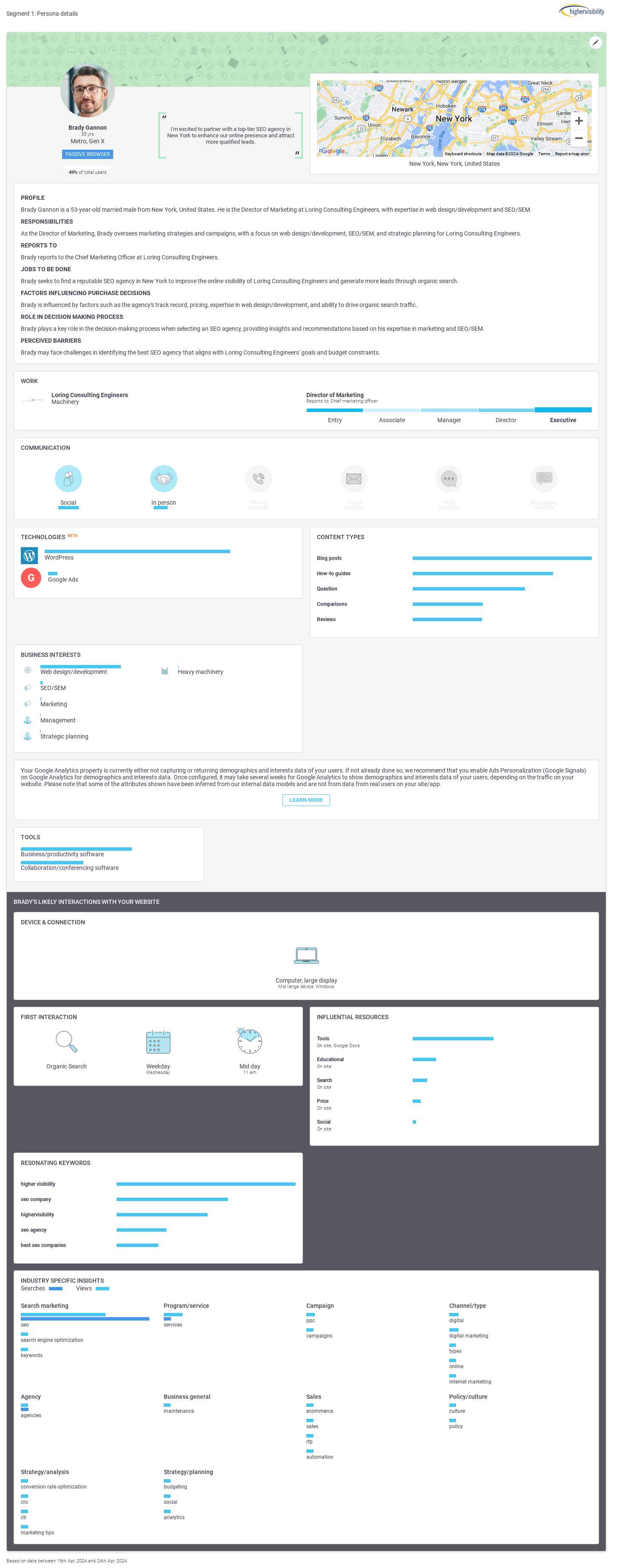
Here is a sample buyer persona we developed for my agency, HigherVisibility:
Screenshot from author, May 2024
2. Map Out The Buyer’s Journey
The next step is to map out the customer journey for each of your personas. This will guide you in creating content that meets the needs of different personas at every stage of the decision-making process.
Typically, the customer journey is made up of three main phases:
Awareness: Here, the persona first becomes aware of a problem or need. For example, “Digital Marketer Dan” realizes he needs to improve his digital marketing ROI. He heads to Google for ideas and clicks through to one of your blog’s educational posts discussing various digital marketing strategies.
Consideration: At this point, your persona will be evaluating different solutions to their more fundamental problem. For example, Dan has realized that his team needs a new digital marketing platform to optimize campaigns more effectively. Now, he’s researching the features and benefits of different tools to see which solution can best meet his needs. To get a better sense of what your company offers, Dan reads through a few of your comparison guides and watches your product demonstration videos.
Decision: In this final phase, your persona has considered their options and is primed to make a buying decision. For example, Dan is now almost ready to buy. To alleviate any last-minute concerns, he reads through positive feedback from other customers on your testimonials page and then finally reaches for his bank card.
3. Map Existing Content To Different Stages Of The Buyer’s Journey
Now, it’s time to categorize your existing content according to where it fits into the customer journey.
A common approach here is to separate content into three buckets:
Top of the funnel (TOFU): This content caters to visitors in the awareness stage. The goal here isn’t to make a sales pitch. Instead, it’s about providing useful information, establishing your brand as a trustworthy source of insights, and raising awareness that your solution exists. TOFU content includes blog posts, infographics, and educational videos about topics within the remit of your brand.
Middle of the funnel (MOFU): This content caters to those in the consideration stage. It delves deeper into the benefits and features of your solution, showing visitors how it can help address their problems. Examples include webinars, case studies, and product overviews.
Bottom of the funnel (BOFU): This content is designed to help purchase-ready visitors commit to a final decision. Since users are now familiar with what you can offer them, the goal is to address any lingering objections or questions standing in the way of a sale. BOFU content includes special offers, free trials, shipping and refund policy pages, customer reviews, and testimonials.
4. Optimize Existing Pages For The Right Keywords
After identifying where each page fits into the customer journey, you’ll need to ensure those pages are optimized for the appropriate keywords.
But before you get started, we recommend you first refresh and expand your current keyword list to make it as up-to-date and comprehensive as possible.
The aim is to build a complete picture of the type of queries people use when searching for TOFU, MOFU, and BOFU content related to your business. Be sure to include search intent and search volume data in your list.
Once your new keyword list is ready, make sure each page is optimized for a relevant primary keyword if it isn’t already.
Here are some best practices to keep in mind when optimizing your content for keywords:
Match pages with keyword intent. Only assign a keyword to a page that genuinely addresses the search intent underlying that term. If you don’t yet have a page for a given keyword, you can add it to your content calendar (see Step 6).
Update meta tags. Adjust the title tags, meta descriptions, and header tags to include your target keyword and any close variants. This not only helps Google understand the page’s relevance but can also encourage more click-throughs from the search results.
Add keywords to the content. Integrate your target keyword into your content, especially the introduction, conclusion, and headers. All keyword placements should appear natural to the reader. Also, avoid cramming your text with keywords – keyword stuffing is considered spam by search engines and can damage your SEO efforts.
Avoid keyword cannibalization. When two or more pages from the same website target the same term, search engines have difficulty determining which page to rank. This can dilute the ranking potential of all the competing pages. So, try to make sure that no two pages target the same primary keyword.
Internal links are the routes your users take from one page to another. Not only are they essential for site navigation, but they also help distribute link equity (ranking power) from high-authority pages to lower-authority ones.
However, since your website’s ultimate goal is to generate conversions, each page should contain links that direct users to the next step along the buyer’s journey.
For example, suppose your business sells and installs smart home technology.
Your blog post about “Improving Home Security” (TOFU) might contain an in-text link to a related comparison guide about “The Best Smart Home Security Systems of 2024” (MOFU). Likewise, the comparison guide might contain a link directing readers to your testimonials page (BOFU).
6. Identify Content Gaps To Inform Your Editorial Calendar
The next step is to identify opportunities to create new content or add to existing content.
After expanding your keyword list in Step 4, you will most likely find several relevant keywords for which you don’t currently have content. These keywords can form the basis of your new content calendar.
When deciding which keywords to prioritize in your production schedule, keep the following in mind:
Marketing goals: What is your primary marketing goal? If it’s to generate more traffic and brand awareness, targeting TOFU keywords should be your priority. If the aim is to maximize sales conversion rates, targeting BOFU keywords might be a better option.
Relevance to your audience: Prioritize keywords that reflect your core audience’s needs. Ask whether there are any topics or questions your buyer personas are likely to have that your content doesn’t currently address.
Search volume and competition: High-volume keywords are typically harder to rank for. Consider creating content clusters to increase your site’s authority for specific topics. Content clusters involve a central “pillar” page providing an overview of the main topic, which links to multiple “cluster” pieces covering related sub-topics in more depth.
Final Thoughts
Creating a content map is a powerful strategy for any business looking to increase their organic visibility and maximize their website’s ability to attract qualified visitors and convert them into customers.
By understanding and addressing the various needs of your audience throughout the buyer’s journey, you can position your brand as a valuable source of information and guide visitors from initial awareness to making a purchasing decision.
Building a content map requires careful planning and attention to detail. You should treat it as a living document that evolves with your audience’s needs and business goals.
Regularly reviewing and updating your content map will ensure it remains relevant and effective in guiding your content strategy.
This July offers plenty of content topics thanks to Independence Day and the Summer Olympics in Paris. But even less apparent ideas — must-have items, humor, giveaways, junk food — can make for compelling content.
Content marketing involves creating, publishing, and promoting articles, videos, and podcasts to attract, engage, and retain customers. It is crucial for search engine optimization, social media marketing, and more.
Unfortunately, coming up with new content topics month in and month out can be a task. What follows are five ideas for July 2024.
Summer Product Tutorials
In many ways, July in the Northern Hemisphere is summer itself.
Celebrations such as U.S. Independence Day on July 4, with picnics, parades, fireworks displays, and community events, make us all feel like summer has arrived.
The weather calls us outdoors, making July an excellent time to publish summer product tutorials, showing shoppers how to use your business’s items to work or play in the sun.
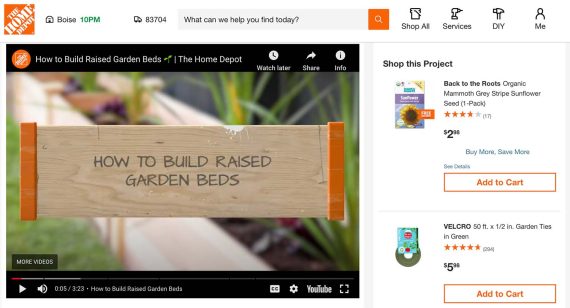
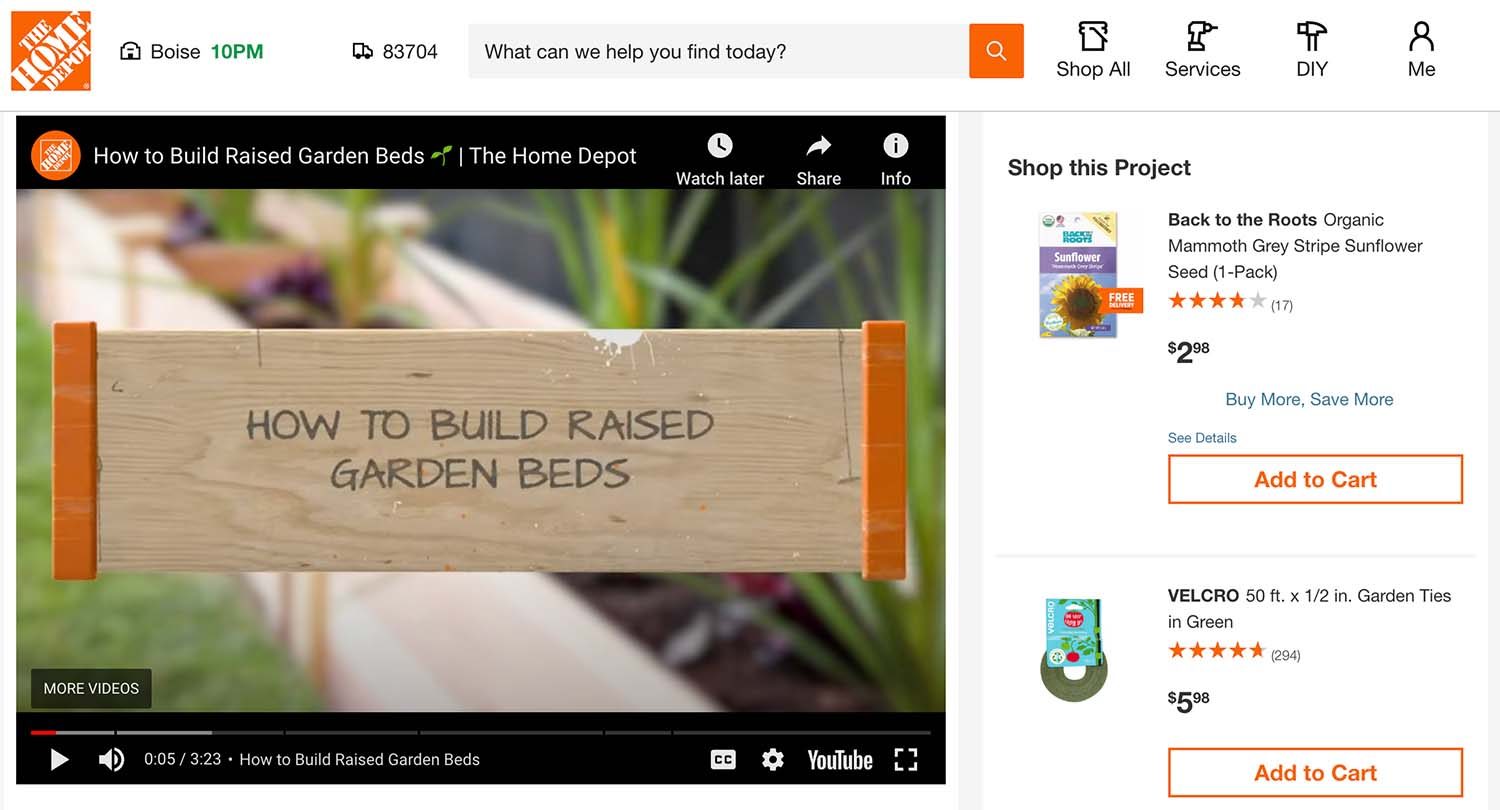
The Home Depot sells products to build raised garden beds, as explained in this tutorial.
Consider The Home Depot. The company’s ecommerce site has a do-it-yourself project section, complete with video tutorials explaining a project and the products. Examples include the building of garden beds, playground equipment, and more.
This concept could work for many products.
Must-have Items
Not every product needs a tutorial. Knowing how to use Velcro from The Home Depot in a garden project might be helpful, but instructions are not required for everyday items.
Mr. Porter addresses why its sneakers are a must-have.
Take shoes, for example. Content marketers could try a “must-have” article or video, such as the article from clothier Mr. Porter, “5 Must-Have Sneakers For Stepping Out In Style This Summer.”
A must-have article puts an editorial spin on product recommendations. The Mr. Porter article starts with a brief introduction, making the case for summertime sneakers.
“Summer dressing is all about fun and experimentation. It’s about trying new things and breaking out of the style comfort zone we’ve been stuck in through winter.”
Each of the five recommendations includes vivid descriptions and photography, emphasizing the shoe’s design elements and versatility. That’s critical, given that the prices are upwards of $990 a pair.
“10 Must-have Dresses for Stylish Summer Soirees.”
International Joke Day
July 1, 2024, is International Joke Day. This pseudo-holiday reminds us to celebrate humor and laughter. It encourages folks to share jokes, puns, and funny stories with friends, family, and even strangers.
Tell a few jokes on July 1.
Jokes are prime, entertainment-focused content marketing. Consider assembling jokes endemic to your industry or products. Then publish them in a blog post, newsletters, and social media.
Jokes are an exception to avoiding AI-generated content. Here are five ChatGPT-produced jokes (with minor edits) for this article.
In our store, we sell emotions — mainly frustration and impatience.
I tried to buy a camouflage shirt online but couldn’t find it.
I ordered a chicken and an egg from Amazon. I’ll let you know which comes first.
I bought a belt online. It was a waist of money.
Why don’t online shoppers get lost? They follow their carts.
National Give Something Away Day
The goal of ecommerce content marketing is to sell products. But too much selling can be counterproductive. An exception could be National Give Something Away Day on July 15, 2024, when marketers can combine charity giving with a sales promotion.
Use National Give Something Away Day for charitable giving.
Here is the idea.
Identify a charity that makes sense for your business.
Connect with the charity for a sales-based contribution, such as 5% of revenue on July 15.
Interview folks at the charity about their work and impact.
Produce an article, video, or podcast of the interview.
Run ads and public-relations campaigns to promote the event.
Junk Food Day
Content can promote junk food or discourage it.
National Junk Food Day on July 21, 2024, allows content marketers to praise the fun of junk food or the opposite, healthy eating.
Content about healthy eating and lifestyles could include:
Power equipment retailer’s newsletter: “Healthy Lunchbox Tips for Construction Pros.”
Kitchen shop’s blog: “From Junk to Joy: Transform Meals with Healthy Ingredients.”
Apparel brand’s podcast: “Dress for Success: 10 Nutritious Tips for a Busy Lifestyle.”
Conversely, content marketing could praise the temporary enjoyment of junk food. Here are more examples.
Power equipment retailer: “Break Time Bliss. 35 Junk Food Picks for Hardworking Builders.”
Kitchen shop’s blog: “15 Forbidden Meals for National Junk Food Day.”
Apparel brand’s podcast: “Stylish Snacks for National Junk Food Day.”
Joe Pulizzi is the author of seven books on content marketing, host of two podcasts, and a popular speaker. He’s the founder of multiple content-marketing businesses, including The Tilt (website, newsletter, publishing services) and the annual Content Entrepreneur Expo.
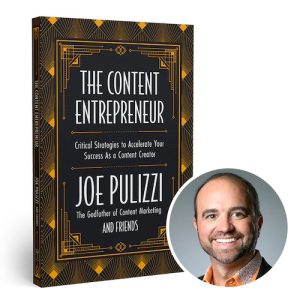
His latest book, “The Content Entrepreneur,” is a 40-chapter guide from 33 seasoned content marketers. Topics include choosing a content niche, technology and platforms, audience-building, revenue channels, and long-term growth. The book is available in hardcover ($45), paperback ($25), and as an ebook ($10).
I asked Pulizzi about the book, the industry, authorship, and more.
Practical Ecommerce: What’s a content entrepreneur?
Joe Pulizzi: A content entrepreneur is a mini media company. This means first building an audience that knows, likes, and trusts you. What are the members’ pain points? What keeps them up at night? If you solve their challenges consistently, you’ll be a content entrepreneur in no time. Produce a compelling newsletter, podcast, or YouTube show. Then monetize.
It’s different from launching a product — the content is the product, but you can’t make money until you build the right audience.
An entrepreneur’s life has crazy ups and downs — tremendous successes and incredible failures on the same day.
Joe Pulizzi, publisher of “The Content Entrepreneur”
Pulizzi: My VIP group from Content Entrepreneur Expo wanted to collaborate on a project. We believed a resource was needed for content entrepreneurs. We met at CEX 2023 and assembled 33 authors to create the book, which we launched before CEX 2024 in early May.
Collaboration among 33 contributors is incredibly difficult. I wouldn’t recommend it. Luckily, we have a group of content pros who know their areas well. Most are authors in their own right. A fantastic editorial and project management team through Tilt Publishing made it happen.
PEC: You’ve now published seven books since 2008 on content marketing.
Pulizzi: The book business has changed. Most authors assume they must publish and sell through external channels. That’s no longer the case.
Affordable technology can create amazing book experiences without a traditional publisher and sell directly from authors’ websites. Why create an audience and send members elsewhere to buy the book? It makes no sense.
I created Tilt Publishing to help authors create excellent books and then sell them directly to subscribers, fans, and followers. It’s essential for long-term success.
Tilt Publishing is a hybrid — not a traditional publisher but not a vanity (custom) press, either. We assist with the backend editing, design, and distribution. Authors no longer need publishers for credibility.
Yet books remain vital. The data doesn’t lie. In 2023, almost 1 billion books were sold worldwide.
A nonfiction book is a content entrepreneur’s mission statement. What do I stand for? What do I believe?
Pulizzi: Innovative companies will continue focusing on building or buying their own audiences. Ads will never go away. They serve a purpose and still work. But why rent when you can own? To own, you need to tell a compelling story. If you do it well, you can dominate your industry. It’s not a bad place.
AI-powered search results and the oft-postponed demise of third-party advertising cookies could lead ecommerce marketers toward alternative forms of content marketing.
Ecommerce shops depend on website visitors for sales — no shoppers, no orders. Two concerning trends have the potential to pinch stores’ site traffic.
Dual Challenges
The first challenge is familiar. Soon, web browsers will eliminate the advertising cookies that track shoppers across websites.
Cookies help advertising networks learn about consumers to show them relevant ads, i.e., ads they are likely to click. More relevant ads, in turn, lead to lower costs per click, better return on advertising spend, and more sales.
As tracking cookies disappear, advertising networks will lose signal, meaning ads may become less effective and, therefore, more expensive. The impact of this signal loss could be similar to Apple’s change in 2021 in how it tracked consumers across mobile apps, making social media ads relatively less effective. Ecommerce marketers may have to spend more to get paid traffic.
Organic traffic could also be a problem. Since May 14, 2024, Google’s AI Overview feature has been available for many web searches. Bing has a similar feature, Copilot, and some in the industry believe these search summaries will dramatically reduce organic site traffic to many websites. Research firm Gartner estimated that organic traffic could fall by 25% within two years.
Ecommerce marketers must find a way to offset reduced paid and organic visits. Alternative content marketing methods are one possible solution.
AI search summaries could reduce the amount of organic search traffic to websites.
Content Alternatives
For many marketers, content marketing is synonymous with search engine optimization. These folks think of blog posts and even product detail content as a way to rank in search engines.
However, a broad view of content marketing may open folks to benefits beyond organic search, focusing instead on three alternatives.
Editorial newsletters
For many, email newsletters are the new blogs and a significant traffic source.
Consider, for example, an online garden supply shop.
This shop could start a “Gardening This Week” newsletter. Every Thursday, it sends an email broadcast with five gardening tips, three curated from the web. The other two link back to the garden shop’s own blog — the one that once received much organic search traffic. The shop could “sponsor” its own newsletter and include a link to a product.
This newsletter would have at least three positive impacts.
Featuring a single “sponsored” product in the editorial context can drive sales.
Podcasts
In 2017, an Idaho-based farm and ranch retailer (where I was director of marketing and ecommerce) started an editorial podcast that would eventually run for 191 episodes.
The show was available on top podcasting platforms and broadcast on three local radio stations. At its peak, it reached 800,000 monthly listeners. Whenever the podcast mentioned a product, sales of that item increased.
Circa 2024, monitoring podcast performance has gotten easier, and using a podcast for content marketing could help ecommerce marketers with both traffic and sales.
Here’s how.
Imagine an online wine retailer starting a podcast interviewing sommeliers, winemakers, and industry experts.
Episodes would appear on popular podcast platforms and social media sites such as YouTube. The host would encourage listeners to visit the shop’s website and also offer a discount code for a wine mentioned in the interview.
On YouTube, the episode description would include links directly to the wine merchant’s website and the weekly offer.
Courses
Some merchants sell products that require assembly or use instructions. This presents an opportunity to teach customers via courses, a form of content marketing.
Think about an online store selling knitting supplies. The shop could launch a comprehensive knitting course, teaching the fundamentals of holding a needle and following advanced patterns. The course could reside on the shop’s website, on YouTube as a playlist, and on a dedicated portal such as Skillshare.
In each lesson, the instructor could include a materials list with links directly to the shop.
Mitigating
Marketing performance is never certain. Some of that uncertainty now concerns advertising effectiveness and organic search traffic. Marketers interested in mitigating these challenges could try alternative forms of content such as newsletters, podcasts, and courses.
If you’re looking to breathe new life into your brand and generate more interest in your target audience, here are the top 10 skills and strategies you’ll need.
1. Know Your Audience And Target Them Effectively
Ask anyone about content and content marketing, and chances are that audience targeting is one of the first suggestions.
But what does audience targeting actually mean? And why is it an essential content marketing skill?
First, understand who your audience is, what their day is like, their priorities, and what they’re doing or intending to do while they consume content.
Then, use that information to craft content that counts on a platform and in a format that suits your audience.
The content is photo-centric. The page has few distractions, and the storytelling and text are dense and chunked.
The topics range from stories of shoemakers, care tips, and all the insider info a lover of bespoke and top-of-the-line men’s shoes, shoe designer, or shoemaker could want to know about the objects of their obsessions.
These features tell us a lot about the blog’s readers.
Shoe Snob Blog readers are likely visual, busy, and view reading the blog’s content as almost a secret pleasure they indulge in while waiting in line for an expensive coffee.
The blog doesn’t have content on saving money, getting things for less, building shoes more cheaply, or reviews of shoes you’d find in your local department store.
Why? That’s not what the blog’s target audience is interested in. In fact, those topics would likely chase readers away.
For Justin FitzPatrick, the blog’s author, it’s about the luxury, the emotional connection and passion for the brands, and the smaller details most of us wouldn’t likely notice about a man’s dress shoe – in language that matches the audience’s expertise.
You might be tempted to skip audience exploration and targeting to this degree, particularly if you’re a B2B brand or sell something non-visual like insurance.
But this could be a fatal mistake for your content marketing.
Even if you’re selling to another company, that company is driven and shaped by humans you’ll need to get attention from.
2. Understand How Brand Strategy Influences Content
Content and content marketing could do more harm than good if they fail to blend seamlessly with a brand strategy.
So, if you’re looking to build content marketing skills, ensure you understand how brand strategy influences effective content.
Solid brand-driven content strategies consist of six core elements when it comes to content:
Brand foundations – What matters to the company, such as the image it wishes to project, etc.
Audience discovery and brand position – How the brand fits within the market.
Keywords and language – How the company wants people to find its brand, and what language it will use.
Content creation – Any content strategy must be manageable, affordable, sustainable, scalable, and effective.
Organization – Utilizing an editorial and publishing calendar and post-publishing tracking and measurement to maintain and guide your content strategy.
3. Consider SEO, Search, And Search Engines
SEO and search are essential for getting found, gaining traffic, building authority, and overall growth.
If you want your content marketing to work, you can’t afford to avoid this content marketing skill because you’re not an expert.
Users make 1.2 trillion searches on Google per year.
93% of all web traffic comes from a search engine.
46% of searches are made to look for something local.
In January 2023, searches for phrases that included “gifts” increased 45%, while searches that included “presents” increased 15% over 2022. This equated to $47 billion in the two weeks following Christmas.
So, search is growing and becoming more important – not declining.
If you want to take advantage of search traffic, you need to ensure you’re considering several aspects of SEO when developing your content marketing skills, including:
Site structure, website performance, and analytics.
4. Humanize Your Content
Once you get started with content marketing, you’ll realize pretty quickly that AI-generated content is highly problematic.
You need to follow basic SEO formulas to have your content rank, another formula to make it interesting and catchy for readers, and how to maximize the usability of your content.
However, you also need to ensure you stand out from the crowd and surpass your competitors.
To make your content more human-friendly, learn how to:
Create content that supports a user journey rather than search engines or sections of a funnel.
Utilize customer communications and social channels to understand and connect with your audience. Then, use it to market your content.
Make use of internal experts. Not only is looking in-house a way to make excellent content more affordable, but audiences also love to see your brand’s passion for what it does.
Take a smart angle, get personal, and have an attitude. Personality and branding are vital, but so is the information you provide. Ensure it is something of value to your readers, and don’t be afraid to tell stories to build emotional connections.
Stories make content emotionally engaging but also make it possible for readers to experience what it would be like if they purchased your product or service.
Want to strengthen your content marketing with storytelling?
Create relatable, believable content. To do this, know your audience, understand their experiences, and create content that aligns with this knowledge.
Have a clear message. Like an ad, every story or piece of content needs a goal and a clear message you want to convey to your audience.
Choose the right type of story. Do you need to make an emotional connection? Compel a reader to act? Convey values, a feature, or a concept? Build community?
Select the right platform and medium. If you want to share several statistics, video might not be the best option. Selling vacations? YouTube or TikTok might perform better than Reddit or a blog.
Know where to start and stop. Your content needs to appear at the right point in the customer journey and push readers to the next step. What should readers do next?
Organize and structure. Plan your content ahead of time. Make sure your stories have an arc, make sense, and take readers or views through an experience.
6. Do Your Research
The best content provides an audience with information or a look at something they normally don’t have access to.
To find this information, you must be prepared for deep research – and that means a lot more than just finding a statistic.
Find the original source or study. Ensure the number you’ve found is still relevant and accurate. Consider the source of the statistic and how they arrived at that number. What did the study not consider when finding their statistic?
To build additional authority, you may consider interviewing the source of a statistic or a subject area expert.
7. Improve Your Interviewing Skills
While it helps if you deeply understand the subject matter, it isn’t all lost if you’re new to the topic.
In fact, being a newbie to a topic can have advantages because you can see the topic with a fresh perspective.
One thing you must be knowledgeable about, however, is interviews. Interviewing is an essential content marketing skill.
Here are some tips:
Prepare
Arrive at the interview with an understanding of the topic. Know the pains and challenges individuals interested in the topic face.
Understand your priorities for your readers, the industry, and the individual you’re interviewing.
Have a list of questions that are thoughtful and organized, and work toward answering a single question or reaching a specific goal.
Set Interview Goal
Are you trying to get tips from an expert? A day in the life of? Solve or bring light to a certain issue? Make a human connection?
Choose a goal for your interview, organize it into an outline, and remove any question or information that doesn’t help you move toward that goal.
Be Personable And Make The Interviewee Comfortable
Awkward silences, a lack of rapport, nervousness, and other social aspects can interfere with an otherwise excellent interview and affect the information you collect.
You may want to consider using cognitive interview techniques, which have been adapted from criminal investigation for journalism.
Record Your Conversation
As humans, our brains prioritize stimuli to determine what is important and what we should pay attention to and remember.
This attentional filtering becomes more severe when you’re making notes, thinking about the technical aspects of an interview, and nervous. As a result, it’s easy to miss important details or implications.
So, save some time and improve your accuracy and insights into the information provided during the interview by making a recording that you can refer to as often as necessary.
Be Precise And Ask For Clarification
Some people love raisins in cinnamon buns. Others do not. And just like the raisins debate, how you define a word or concept may vary greatly from someone else.
So, if the information you collect during an interview seems vague, or you’re unsure of something the interviewee says, ask.
The worst thing you can do is assume that it isn’t true or deliberately influence the meaning of someone’s words.
8. Measure And Track Everything
Measuring something is generally easy. The difficult part of measurement and tracking is measuring and tracking the right things.
SEJ’s annual State of SEO Report reveals that SEO professionals often have a mismatch between their goals, the methods and strategies they use to reach them, and the variables they measure.
Content marketers and marketing are no exception.
Let’s say you want to use content marketing to increase conversions. So, you create a video for your hot tub company.
In this instance, tracking and analyzing traffic data to the video would be a mistake. Those numbers are only part of the story.
Instead, track clicks and use traffic data to better understand who clicks through to your content and where viewers go after they consume it.
And this is vital: Don’t stop your analysis at the click.
Every visit from a viewer is only one step in a larger journey – and this journey matters.
Returning to the previous example, your video might have generated fewer clicks and conversions overall.
Dig a little deeper, however, and you might discover that those few conversions were of much higher value than average, and the viewers return to your site more often than your average site viewer.
In this instance, while traffic numbers might make it look like your video failed, analysis of the customer journey reveals that your video was actually a big success, attracting a more qualified, valuable, and engaged audience.
9. Repackage Content With Purpose
You invest a lot of resources in creating amazing content. Don’t simply publish it in one format and waste the rest of its potential.
By planning, you can collect images, video footage, sound bites, expert quotes, and everything you’ll need to share and market your content in various ways to maximize your return on investment (ROI).
But refrain from repackaging content with the sole purpose of spreading it everywhere. Carefully plan your content to appear when and where you need to.
As explained in the video above, Search Engine Journal uses the data gathered for its State of SEO Report to create:
White paper reports.
Podcast.
Articles on data not included in the main reports.
Infographics.
Carousels for social media.
Video clips.
Some of these are released before the main report is published to help spread the word and generate interest while sharing interesting insights about the SEO industry.
Then, when the report is released, it is followed by additional content to help generate interest, links, and findings.
Therefore, instead of a week of interest, the reports generate traffic and attention while informing readers for months without significantly increasing the original investment.
10. Stand Out While Blending In
One of the more common pieces of advice is to copy successful content and do what others are doing.
Makes sense, right?
After all, SEO, good writing, and other skills all have best practices you need to follow. Your audience also has preferences, expectations, and requirements.
Your content needs to look like everyone else’s to some degree.
But here’s the problem with this advice: No one stands out if everyone does things the same way.
Therefore, learning how to blend in while standing out is an essential skill for content marketing.
So, instead of mimicking or copying successful content, collect several examples that have worked on a specific platform or for a specific audience and investigate to find out why they’re effective.
Then, you can use these insights to create and test your own content that allows you to stand out, be unique, and fulfill the needs of your target audience.
Conclusion
Effective marketing is more than choosing the right topic or quality writing.
By strengthening and utilizing these 10 content marketing skills, your content will help you generate the right traffic and connect with your audience in a way that will have you dominating the competition.
Marketers take note: If you want to execute a strong, seamless content strategy, you need a content calendar.
Content calendars aren’t just about organizing your upcoming posts; they also help ensure that your content aligns with your strategic goals and maximizes your resources efficiently.
Whether you’re managing multiple social platforms or experimenting with various content types, a content calendar provides you with the blueprint for consistent, impactful content creation.
In this article, we’ve rounded up the top 9 content calendar templates, each designed to streamline content planning and boost productivity.
From simple spreadsheets to more complex solutions, we’ve compiled a range of templates to suit your needs.
Let’s dive in.
What Is A Content Calendar?
Before jumping into the best content calendar templates, let’s start with the basics.
A content calendar is a fundamentally a time-management system tailored for content creation. It helps you organize your workflow into manageable weekly or daily blocks, enabling you to maintain a clear and structured approach to producing content.
It also gives you a bird’s-eye view of your content strategy, allowing you to understand what you have in the pipeline and when and where it will be published.
This way, you can align your content with upcoming events, marketing campaigns, product releases, etc., to ensure each piece of content meets your audience where they are and serves its intended purpose.
A content calendar is an indispensable tool for social media marketers, bloggers, freelancers, and content creators. With a content calendar, you can consistently produce high-quality content, which is key to building an engaged community.
While some people prefer to use specialized software for their content calendar needs, it’s possible to start with something as simple as an Excel sheet.
Here, we’ll highlight some existing content calendar templates that you can easily leverage and adapt to your brand’s needs to get started.
Why Should I Use A Content Calendar?
Whether you’re the only content specialist in your in-house ecommerce company or an agency social media manager, a content calendar makes you better organized with your campaigns.
It’s also a helpful tool for collaborating with multiple teammates, as it can help inform them of what’s needed and when.
Why? At a glance, it’s easy to understand what went live, along with the copy and asset used. Sort your posts by social platform and assign some color coding. Usually, each tab is marked by month.
Because you can see the bigger picture (at least a month in advance), you can map out themes and daily social posts ahead of schedule, plan well-researched infographics with your designer, and track how your posts are doing.
You’re better equipped to craft your message to your target audience, keeping their wants and needs in mind when the seasonal trends come and go.
You can plan around holidays and significant world events, from Valentine’s Day to Pride Month or any national event relevant to your brand values.
Plus, by planning ahead, you’re less likely to commit a faux pas – as the content will be brainstormed, briefed, approved, and published before crunch time. It’s a protective measure.
Without further ado, here are our picks (most of them are free!).
Top 9 Content Calendar Templates For 2024
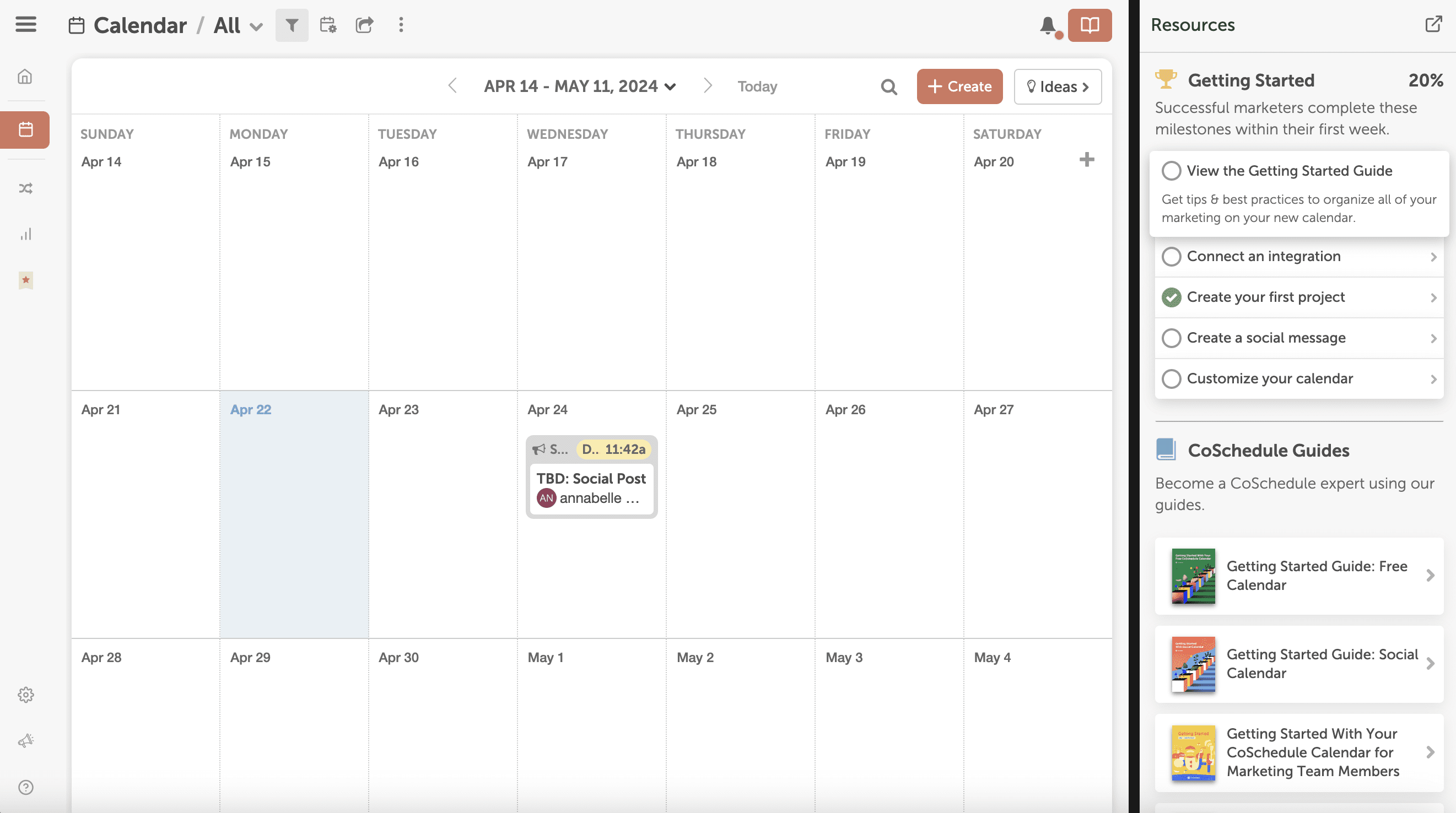
1. CoSchedule Marketing Calendar Template
Screenshot from CoSchedule.com, April 2024
If you’re running a WordPress blog, CoSchedule may be your best bet.
It truly shines in content marketing with its user-friendly interface and AI-driven features, such as the AI Social Assistant, which can help you draft social messages to enhance engagement and save time.
The intuitive calendar is easy to use. It has 15 seamless integrations, including WordPress, TikTok, Instagram, Facebook, Mailchimp, and more.
The Bluesky and Google Business Profile integrations can help streamline your content management across different platforms, while functionalities like the TikTok Slideshow Scheduling feature allow for dynamic content creation directly from your calendar interface.
We recommend this one if you manage your blog and social media. It’s a great choice for individual and small to medium-sized marketing teams looking for a straightforward, efficient way to manage their content.
Cost: Free plan offers a social calendar with up to three users and two social profiles. Paid options start at $19/month for additional users, social profiles, and more advanced features.
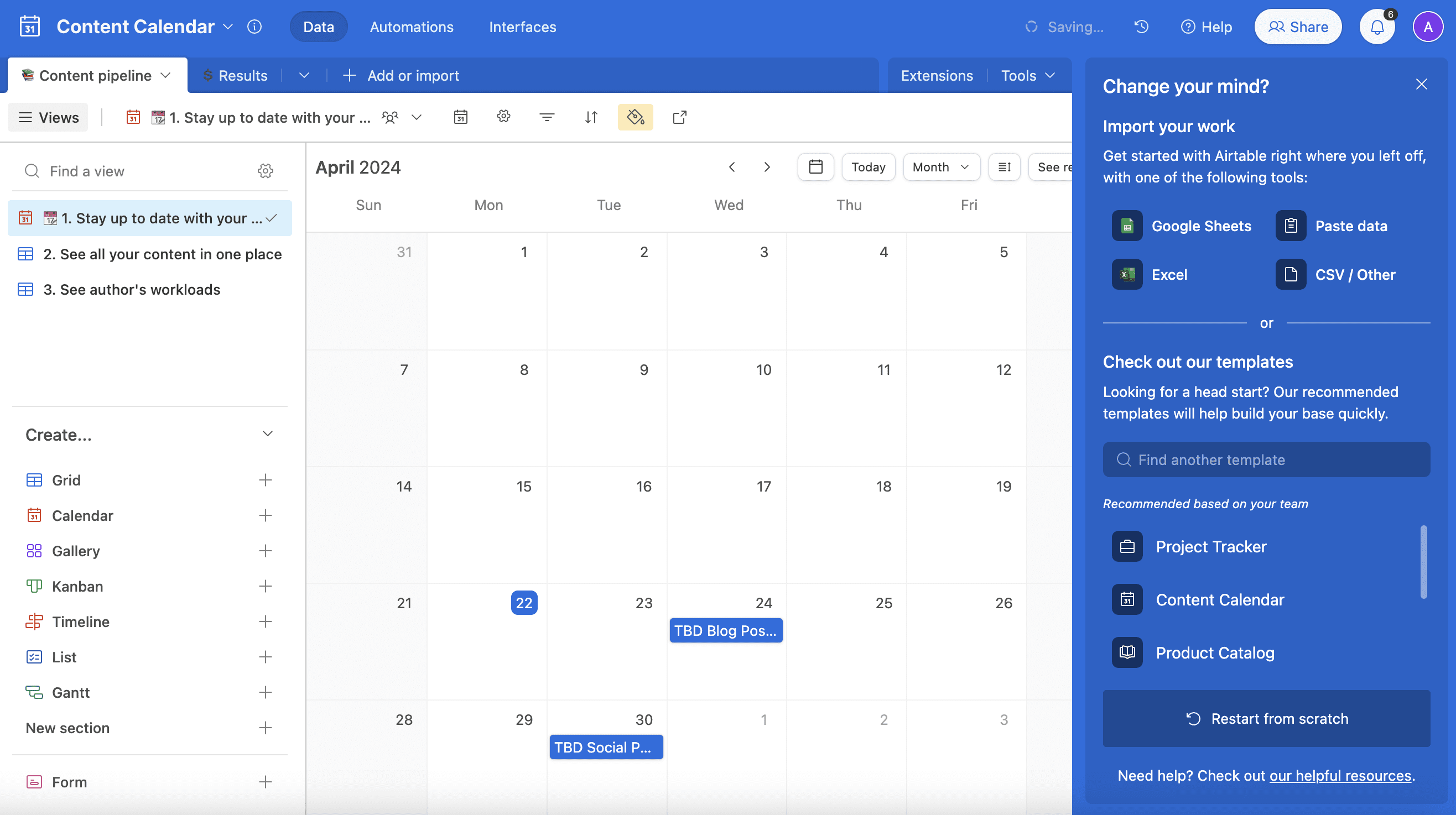
2. Airtable Content Calendar Template
Screenshot from Airtable.com, April 2024
If you’re managing a content calendar in Google Sheets, Excel, or CSV files and looking to upgrade, Airtable is an excellent choice.
Airtable simplifies content management with its robust automation features for reminders and task tracking, which are perfect for those who prefer not to juggle complex spreadsheet formulas.
The platform supports multiple data fields for important content management, such as Title, Writer, Due Date, Status, and Image, and allows for easy customization to suit your specific workflow needs.
Airtable’s straightforward content calendar template enables you to manage everything from social media content to blog posts and more, providing a clear overview of author workloads, ideas in the pipeline, and key results essential for any content strategy.
You can assign tasks, track deadlines with multiple calendar views (including a grid, kanban, or calendar format), and send reminders through built-in alerts to make sure everyone is staying on track.
Cost: A free version is available; more advanced features are included in the paid plans, which are tailored to team size and specific needs.
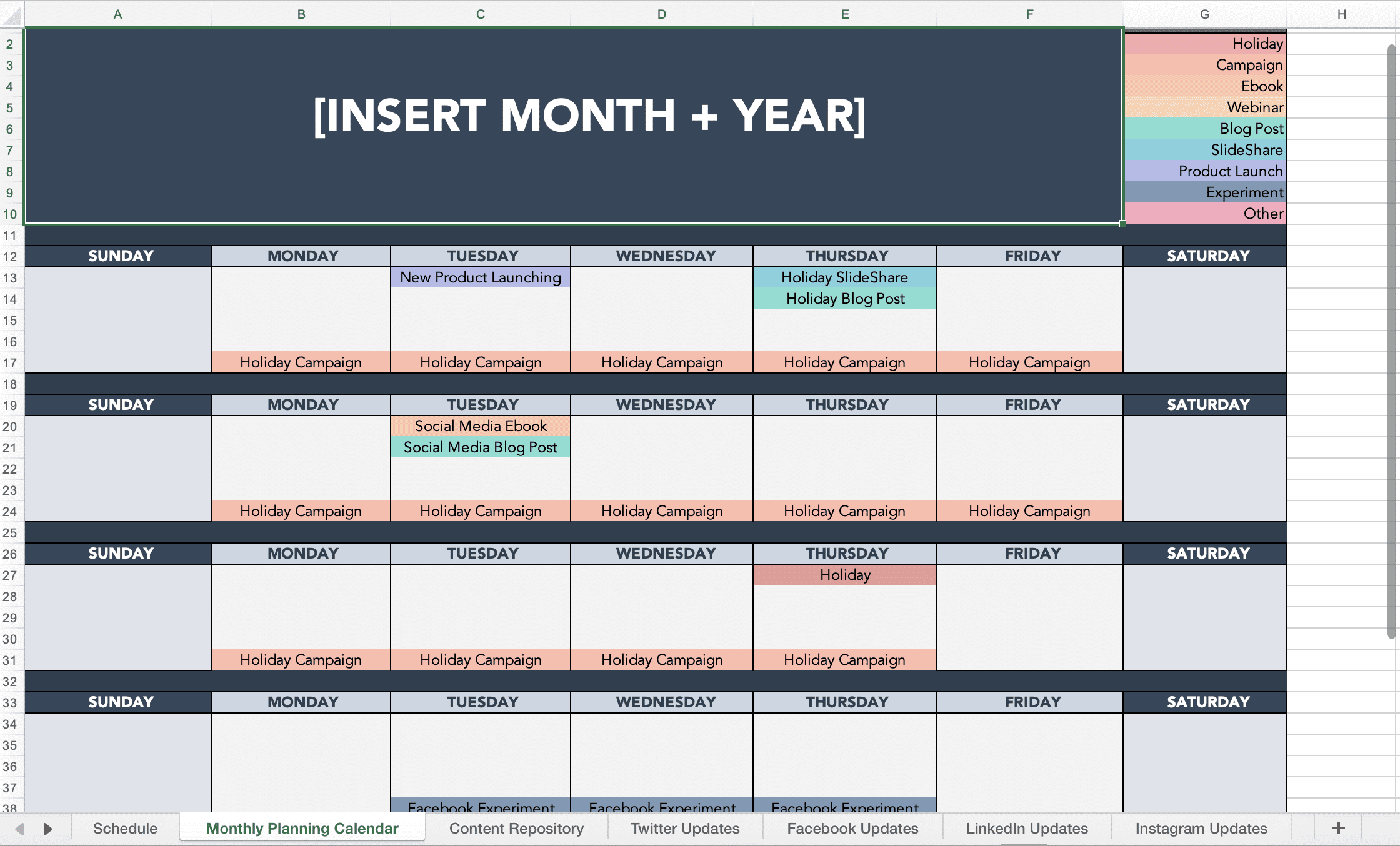
3. HubSpot Social Media Content Calendar Template
Screenshot from HubSpot.com, April 2024
Excel geeks, rejoice!
HubSpot’s free Social Media Content Calendar is pretty flexible. Just insert the month + year into the Monthly Planning Calendar tab, and adjust the template to suit your brand.
The template is structured with several tabs dedicated to various platforms, including Facebook, LinkedIn, Instagram, X (Twitter), and Pinterest, ensuring you can manage updates across your social channels with precision.
Each tab is thoughtfully designed, providing examples of how to best engage with your audience on each platform.
There is also a Content Repository tab to help you track all the content you’re producing, which is invaluable for organizing and reusing your existing content.
It even comes with a comprehensive starter guide PDF that helps you understand how to make the most of the template.
It’s more for social media than blog posts, so we recommend this one for social media specialists in startups and in-house social media managers for ecommerce brands – though it could be tailored to fit a variety of needs.
Cost: Free – just download the template.
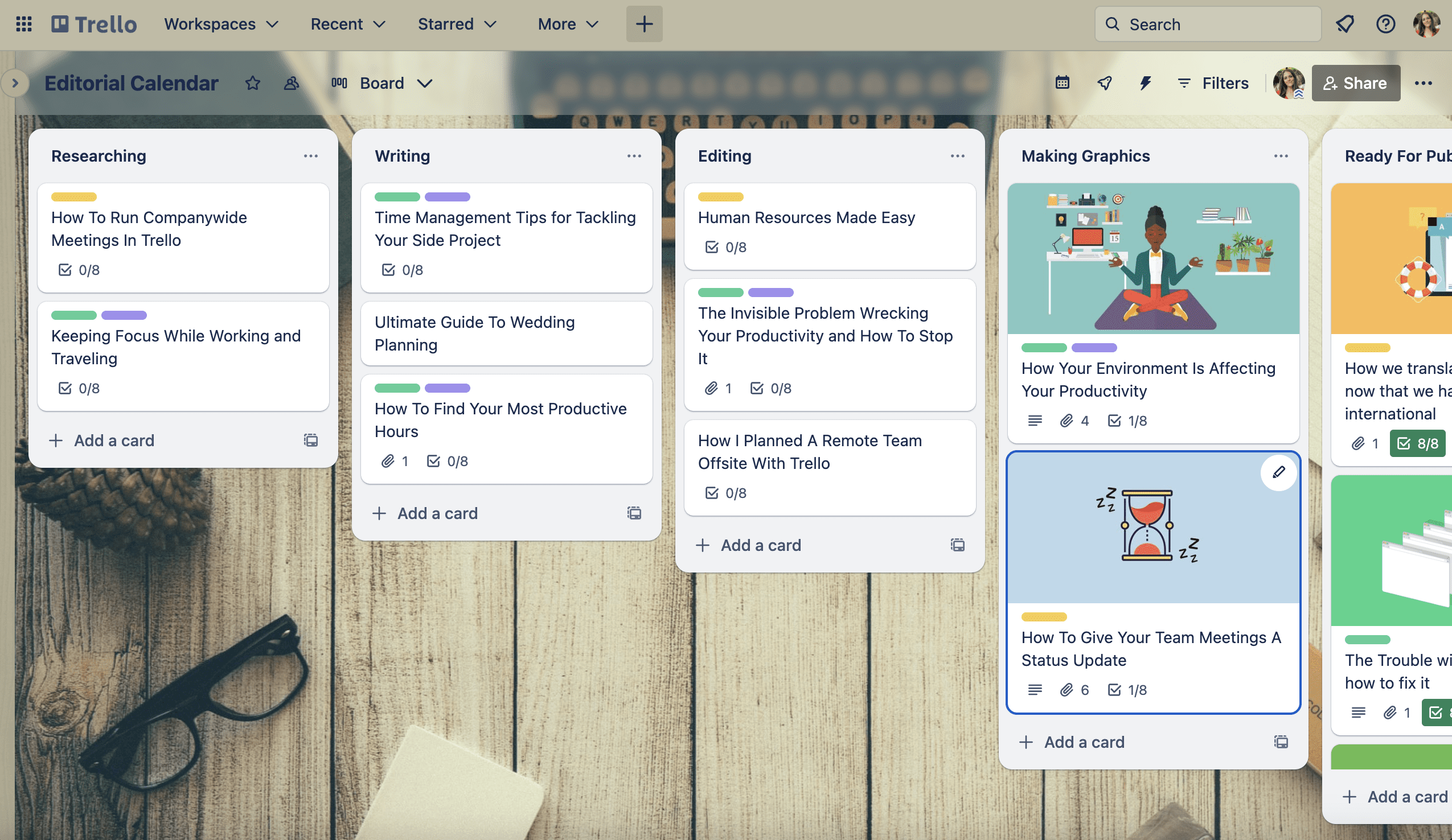
4. Trello Editorial Content Calendar Template
Screenshot from Trello.com, April 2024
A popular project management tool, Trello is an ideal content calendar choice for massive teams already on an Agile framework and using similar products (Jira, Confluence, etc.).
The drag-and-drop functionality is easy to use. One glance, and you know what the task status is.
Trello offers a specialized free editorial content calendar template that’s ideal for seamlessly managing the entire lifecycle of blog posts and social media content.
Using the template, you can visually track each piece of content from conception to publication. You can manage drafts, coordinate illustrations, and attach necessary assets directly to each Trello card dedicated to specific content pieces.
The template enhances team collaboration by enabling you to add editors, designers, and social media managers to cards, ensuring that all stakeholders are kept up-to-date.
You’ll also find checklists to ensure all steps are completed, filterable card labels, and a calendar view to give you a clear perspective on your publishing pipeline, making it a powerful tool for large teams focused on detailed content planning and execution.
Cost: Free – sign up and download the template.
5. Hootsuite Social Media Content Calendar Template
Screenshot from Hootsuite.com, April 2024
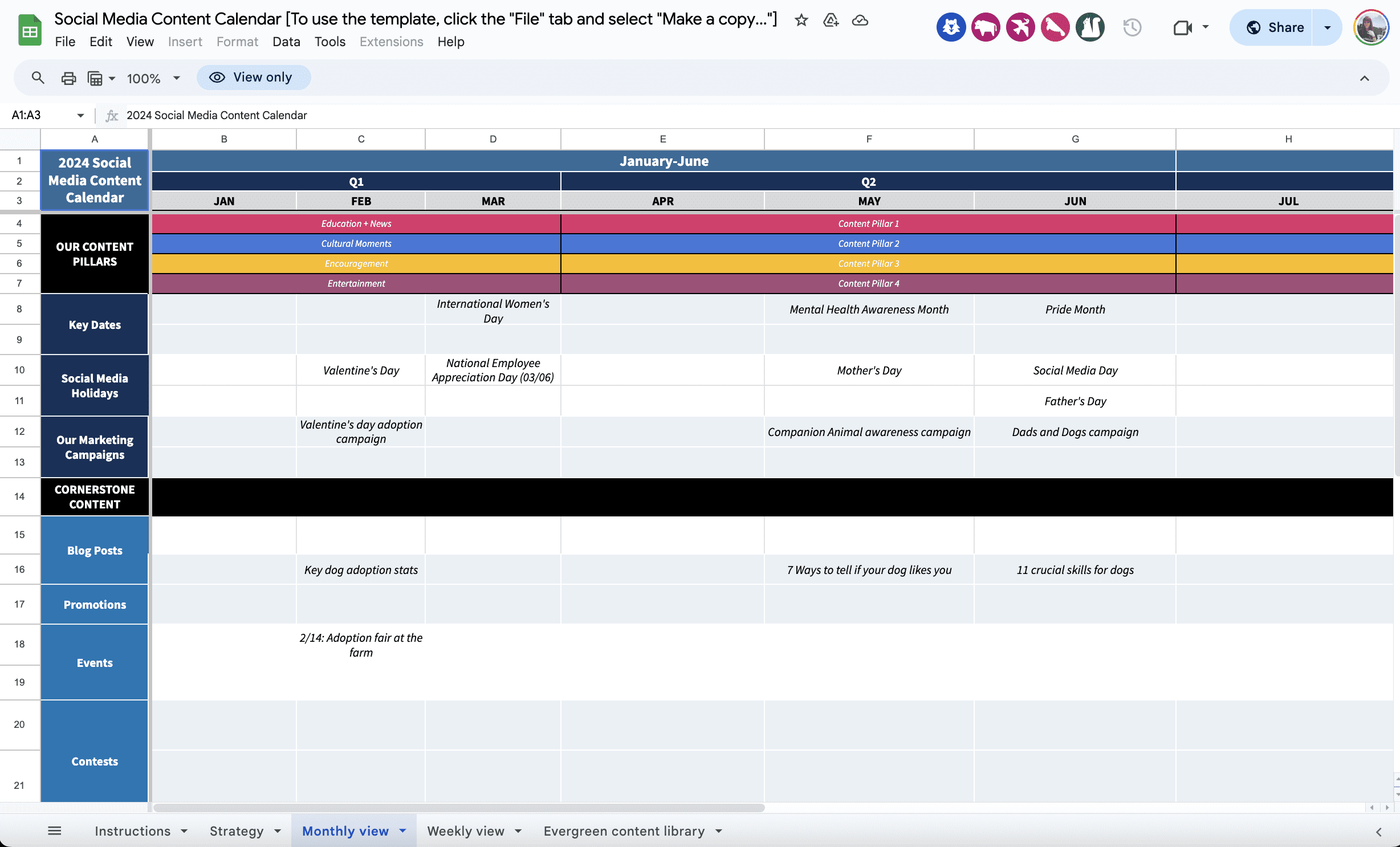
Similar to HubSpot’s template, Hootsuite has a downloadable, free Google Sheet spreadsheet with five tabs: Instructions, Strategy, Monthly View, Weekly View, and Evergreen Content Library – for Instagram, Facebook, X (Twitter), LinkedIn, and any other platform you might want to add.
The weekly view is a fairly unique feature that you don’t see in every template.
The Instructions tab provides tips on using the template, while the Strategy tab helps you plan your overall strategy – including your business goals, social goals, content pillars, pieces, and tactics. Like HubSpot’s template, Hootsuite’s evergreen content tab enables you to build a library of content to revisit when needed.
It even lists key dates of interest available throughout the year for each month – such as events like Black Friday and Small Business Saturday (USA) – to help you stay on top of important marketing moments.
The simple-to-use template is customizable yet ideal for Excel pros who don’t want to use a paid tool and the extra features that come with it. It’s ideal for businesses of all sizes and is a practical choice for teams looking to optimize their workflows without investing in premium tools.
Cost: Free to download by filling out a lead generation form.
6. Adobe Express Content Scheduler
Screenshot from Adobe.com, April 2024
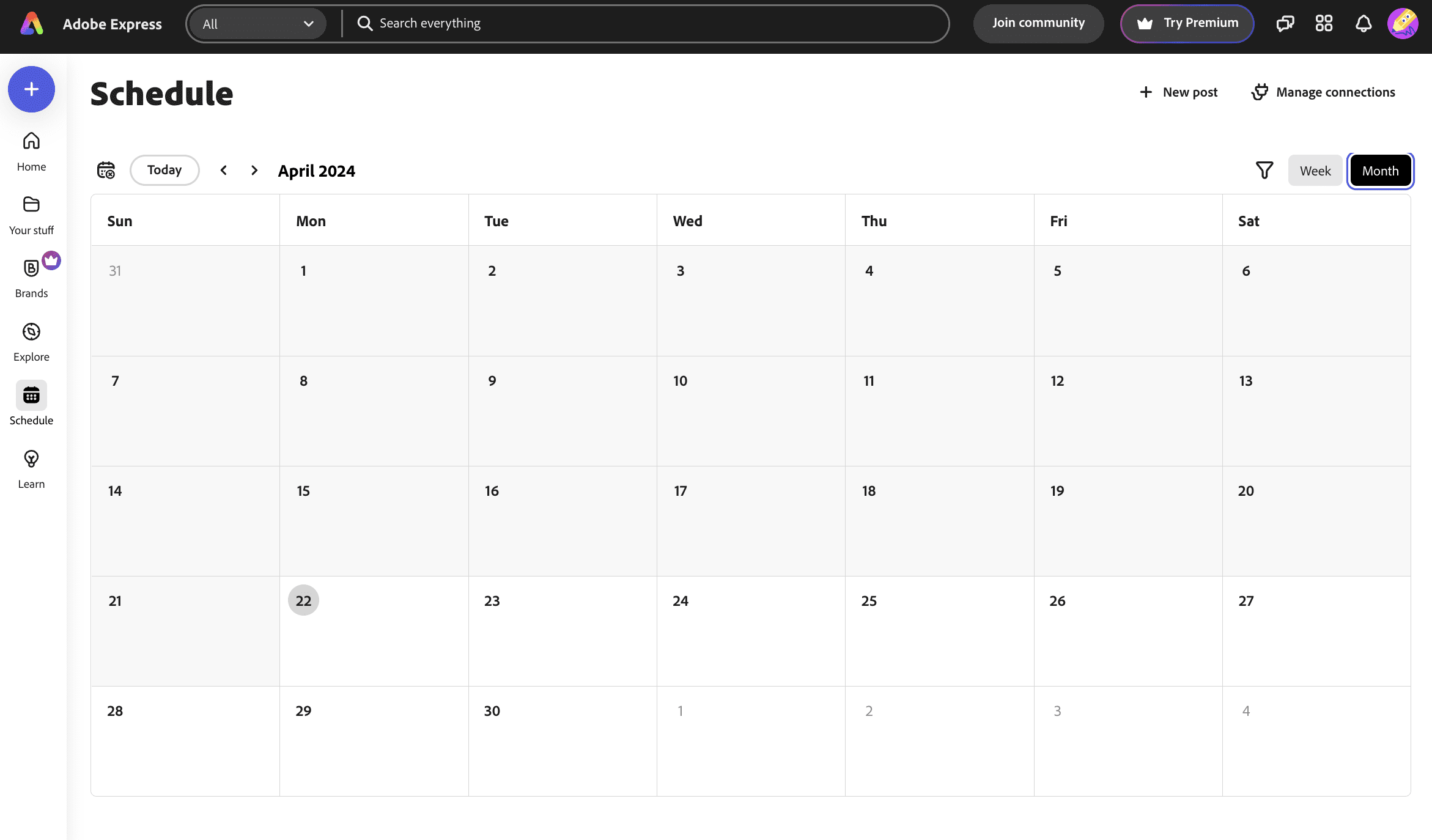
Adobe Express’s free content scheduler is a great free tool for taking control of your social media planning and publishing process.
It provides a visually oriented interface where posts are prominently displayed in a large format for easy readability of captions and clear viewing of images.
It also has color-coding and labeling rows to help you stay organized, allowing you to categorize posts and note important campaign details or team communications.
You can connect your social accounts directly to the content scheduler and schedule them in advance or publish them with the click of a button. Users can also save ideas as unscheduled posts, create draft posts, and easily rearrange content using the drag-and-drop functionality.
Adobe Express also offers a plethora of templates and materials to help you create and edit content in-platform.
Cost: Free to use, with more advanced features available for those who sign up for Adobe’s Premium and Teams paid tiers.
7. Small Business Trends Social Media Calendar Template
Screenshot from SmallBizTrends.com, April 2024
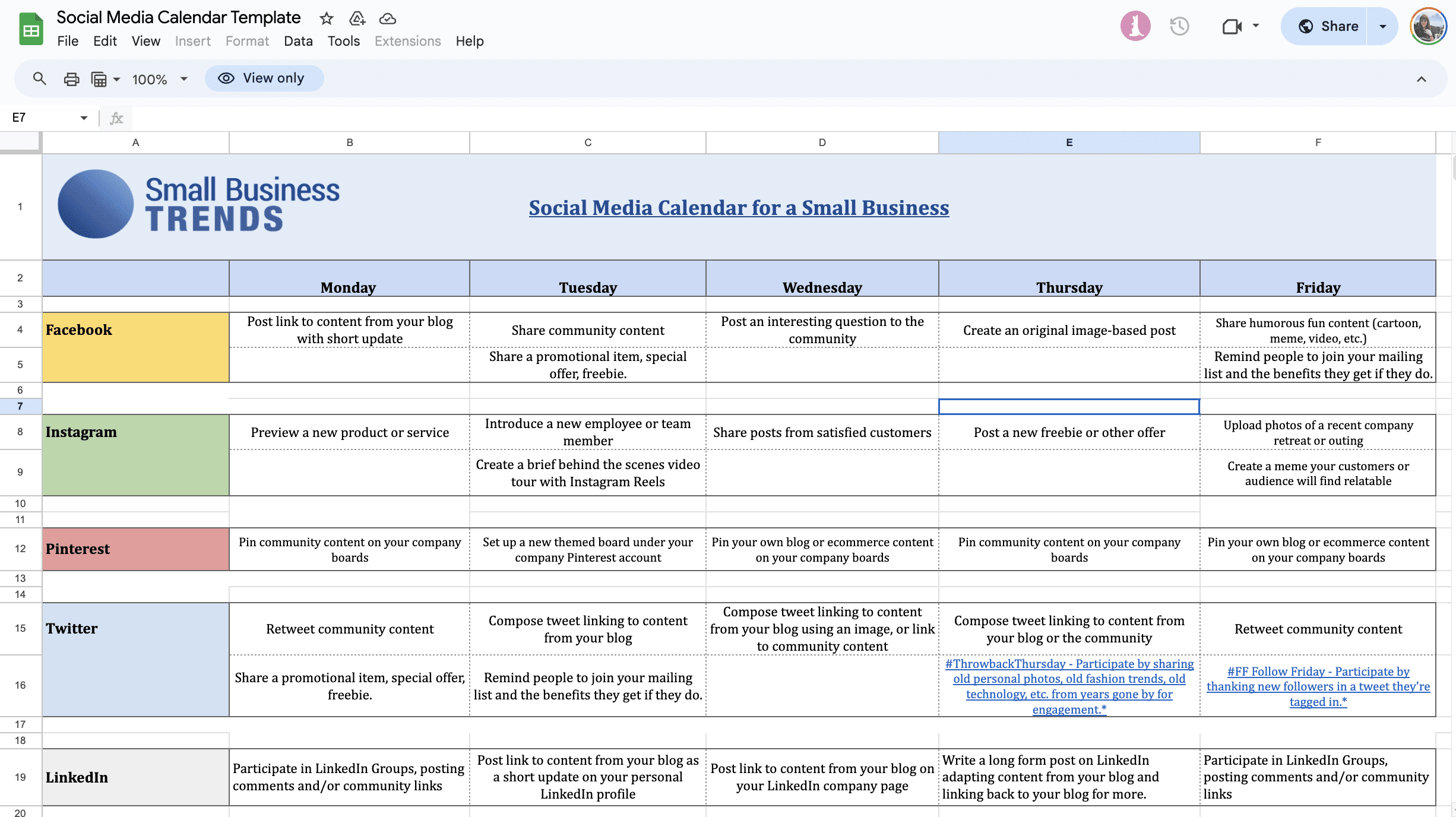
The content calendar template from Small Business Trends is tailored specifically for – you guessed it – small businesses!
It draws from the company’s effective marketing strategies to help you streamline your social media and marketing efforts. It is available for download in various formats, including Word, Excel, and PDF, making it customizable for your business’s needs.
The template itself is fairly straightforward. It features a Monday to Friday overview of content across Facebook, Instagram, Pinterest, X (Twitter), LinkedIn, and TikTok, as well as a section for “All Platforms.”
It’s plug-and-play, meaning you would simply enter your plans for each channel, each day (and duplicate them week over week).
What we love about this template is that Small Business Trends offers suggestions throughout for what you might do that day. For example, “Share posts from satisfied customers” on Instagram on Wednesday, or “Have an unveiling of your latest product or service” on TikTok on Monday.
While not exhaustive, it’s a nice touch to help provide inspiration, especially for individuals and small businesses just getting started. We like this template for its simplicity and low learning curve.
Cost: Free.
8. Backlinko Content Calendar Template
Screenshot from Backlinko.com, April 2024
Backlinko offers a versatile, free content calendar template that’s a practical tool for both individuals and small teams looking to enhance their content production efforts.
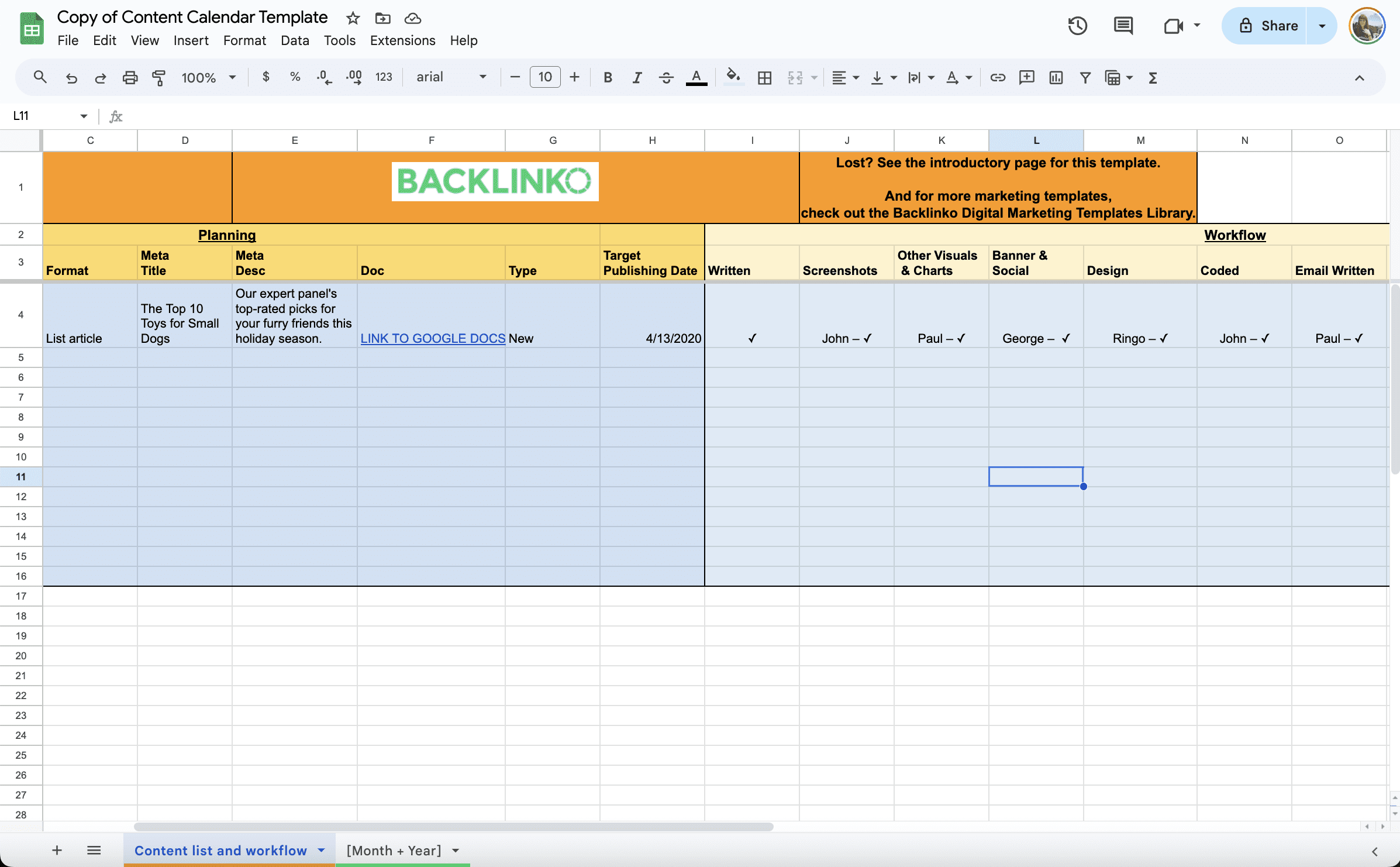
Available as an Excel spreadsheet or a Google sheet, the template features two main components: a basic monthly calendar view and a more detailed content list and workflow sheet.
The monthly view offers a clean slate for basic scheduling, while the workflow tab is meticulously designed to guide users through the various stages of content creation (from drafting to publishing), making it particularly useful for managing multiple pieces simultaneously.
This is where the real strength of Backlinko’s template lies. The step-by-step guide to content development in the workflow tab covers everything from meta descriptions to design, email marketing, and more, ensuring everyone on your team stays on track with each piece of content.
Cost: Free.
9. Monday.com Content Calendar Template
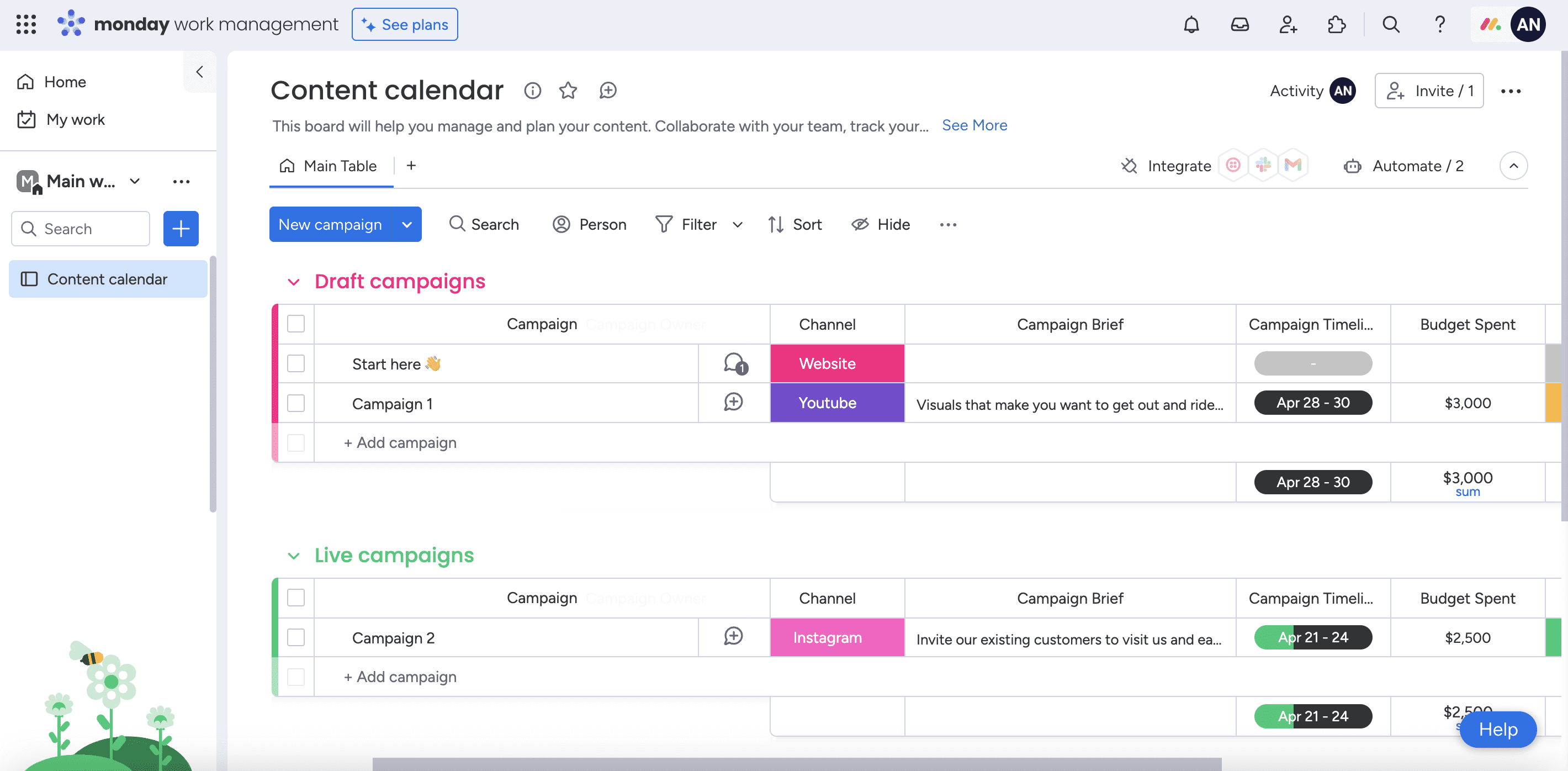
Screenshot from Monday.com, April 2024
The Monday.com content calendar template is a nice option for teams that want to consolidate their content creation and distribution pipeline.
Simply dive into its versatile dashboard, and customize the template to align perfectly with your team’s operational flow.
Designed to support a ton of content types and phases – from the initial brainstorming to the final publishing stages – Monday.com’s template ensures every piece of content is tracked and managed efficiently across platforms.
It features a centralized content management system that allows users to assign tasks to essential team members such as writers, designers, and editors.
You have multiple viewing options, such as Gantt, calendar, Kanban, and form views. It also allows you to integrate with tools like Google Drive, Adobe Creative Cloud, and Dropbox.
In addition, you can access built-in automation for reminders and notifications to keep everyone on track.
This one is ideal for both small-scale projects and larger content operations, with its focus on efficiency and scalability.
Cost: Free – just sign up and get started.
How A Content Calendar Can Improve Your Content Planning
Effective content planning is crucial for elevating your marketing strategy.
If you want to take control of your marketing strategy and create impactful content that resonates with its target audience, a content calendar is for you.
As this article highlights, creating a content calendar doesn’t have to be complicated or arduous – especially when plenty of intuitive and powerful templates are already in place to get you started.
Explore our top picks, find your match, and set the stage for a year of impactful content creation. Happy planning!
Content marketing as a method of attracting, engaging, and retaining customers pre-dates the term itself. And even now, emerging technologies could change it again.
The most cited example of early content marketing is John Deere’s “The Furrow” magazine, launched in 1895. This “Journal for the American Farmer” published actionable agricultural articles, offering farmers practical advice on farming techniques, crop management, and machinery maintenance.
Reciprocity
For John Deere, “The Furrow” was better than advertising in a sense because the company owned it and thus the relationship with readers.
John Deere delivered real value thanks to the useful, informative, and entertaining articles. So much so that by 1912, the magazine had 4 million subscribers.
In turn, real value produces a sense of reciprocity. The reader recognized the John Deere company as an expert and felt obligated to the brand. This obligation extended to buying John Deere products marketed in “The Furrow.”
This is content marketing’s aim: attract, engage, and retain customers. And by the way, “The Furrow” is still published in print and online in 2024.
“The Furrow” is a prominent early example of content marketing.
Another example of content marketing comes from the consumer package goods industry. Cereal boxes and candy often include comic strips, stories, historical or scientific anecdotes, and prizes.
A child might like General Mills Lucky Charms cereal for its rainbow colors and the entertaining box.
Youtility
Content marketing advanced after 2013 when marketing guru Jay Baer released his book, “Youtility: Why Smart Marketing Is about Help, Not Hype.”
The book’s guiding principle prioritized creating useful content, not exclusively promotional.
The result was many marketers focused on being helpful rather than selling. As the distance between content and revenue increased, these marketers sought new performance metrics.
Content marketers circa 2024 are again looking for ways to drive sales from content. This renewed effort manifests in many ways, including live streams, voice and video, generative artificial intelligence, and augmented and virtual reality.
Each has the potential to attract, engage, and retain customers.
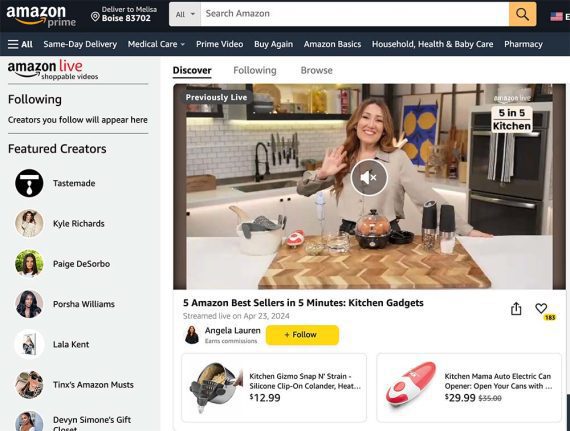
Take, for example, ecommerce live streaming. It engages potential customers with real-time product showcases and permits the host to answer questions and assist with buying decisions.
Amazon Live is one of many platforms that allows merchants or creators to live stream shoppable videos.
The live stream itself may be recorded and edited into social media posts. The shoppers’ questions are potential on-site FAQs. One could even say that ecommerce live streaming is a more complete version of content marketing.
Thus ecommerce marketers should seek ways to integrate emerging content types. Don’t leave articles behind. Instead, add to them.
2. AI Can Help You Save Time On Manually Reviewing Calls
Listening to and analyzing phone calls manually can be time-consuming and inefficient for agencies.
However, it’s an important part of understanding the customer experience and sales team performance.
With AI-powered call analysis tools, you get quality, keyword-tagged transcriptions with near-human-level accuracy.
Not only can this technology help you save over 50% of the time spent listening to phone calls, but it can also help you deliver actionable recommendations to clients and drive better results.
Conversation Intelligence, for instance, is trained on over 1.1M hours of voice data and enables real-time analysis for instantaneous results.
This advanced tool provides opportunities for you to improve your strategy through the following granular insights:
Spotting disparities in the industry-specific lingo your sales team uses, compared to the lingo your prospects are using to describe their business challenges and goals.
Identifying trends or gaps in your service offerings based on what your prospects are asking for.
Identifying frequently asked questions and other important topics to address through content marketing.
Setting goals for lead qualification — not just the quantity of leads generated for your business.
Conversational AI is perfectly suited to summarize the content of long conversations – however, the call summaries still require a human to read them and determine the main takeaways.
But if you work in a bustling small business, it’s unlikely you’d have the bandwidth for tasks such as call transcription, summaries, keyword spotting, or trend analysis.
Rather than displacing human labor, conversational AI is assisting businesses in taking on tasks that may have been overlooked and leveraging data that would otherwise remain untapped.
3. AI Can Help You Lower Cost Per Lead / Save Money On Tools & Ad Spend
Ever wonder why certain campaigns take off while others fall flat? It’s all in the data!
Even failed campaigns can offer invaluable insights into your client’s audience and messaging.
But if you can’t spot the underperformers quickly enough, you risk wasting your ad budget on ineffective tactics.
The quicker you can identify what’s working and what’s not, the quicker you can pivot and adjust your marketing strategy.
Make a bigger impact in less time: AI-powered technology creates a force multiplier within your agency, allowing you to make more of an impact with the same level of inputs you’re already using.
Unlock actionable insights from call data: AI is revolutionizing the way companies leverage call data by enabling them to gain insights at scale. As a result, businesses can increase their ROI and deliver greater value to their clients by analyzing hundreds of calls efficiently.
Foster alignment with data-driven strategies: By analyzing customer conversations with AI, businesses can align their marketing strategy with data-driven recommendations, enhancing overall coherence. Additionally, the ability to create triggers based on specific phrases enables automated analysis and reporting, further streamlining the alignment process.
Drive effectiveness with rapid insights: Leveraging Conversation Intelligence enables agencies to deliver better insights faster, increase conversion rates, refine keyword strategies, and develop robust reporting capabilities.
4. AI Can Help You Improve Overall Agency Efficiency
Are you spending too much valuable time on tasks that produce minimal results?
Many agencies find themselves bogged down by routine, administrative tasks that don’t contribute much to their bottom line.
But with AI automation, agencies can streamline their operations and redirect their energy towards more strategic endeavors.
From email scheduling and social media posting to data entry and report generation, AI can handle a wide array of tasks with precision and efficiency – giving you time to focus on high-impact activities that drive growth and deliver tangible results.
Ways Your Business Can Benefit From Automation
Automatically transcribe your calls to boost close rates: See how your team is handling difficult objections and ensure that they’re delivering your businessʼ value proposition in an effective manner.
Score calls based on quality and opportunity: Take the time-consuming work out of scoring your calls and determine which campaigns drive the best calls to your business.
Classify calls by your set criteria: Qualify, score, tag, or assign a value to the leads that meet your criteria, automatically.
Automatically redact sensitive information: Protect your customers by removing billing or personal information. Keep your data safe and secure through complete HIPAA compliance.
Monitor your teamsʼ performance: Use Conversation Intelligence as a valuable sales training tool to ensure your team doesn’t miss any key messaging marks.
Know your customersʼ needs: Identify conversation trends in your phone calls and stay privy to evolving customer needs.
Improve your digital marketing strategy: Use AI-powered insights to inform your digital marketing strategy and boost your online presence.
By automating mundane tasks, agencies can optimize workflows, increase productivity, and improve efficiency across the board.
Looking for 5 – 7? Download The Full Guide
Rather than fearing AI, the future belongs to those who embrace it.
By strategically combining human creativity with artificial intelligence, you can unlock capabilities that transcend what either could achieve alone.
Want to discover even more ways to level up your agency with AI?