What Are Good Google Ads Benchmarks In 2025? [STUDY] via @sejournal, @brookeosmundson

Keeping up-to-date on industry Google Ads benchmarks is crucial to help answer questions you might get from clients or exec such as:

  • “Is this a good CTR?”
  • “Why is our CPA so high?”
  • “What’s a good conversion rate, anyway?”

Questions like these come up all the time, especially when budgets are tight and performance dips even slightly.

But unless you’ve got fresh benchmark data on hand, these conversations are usually filled with guesswork, vague assurances, or worse, outdated reports that no longer reflect how competitive today’s ad landscape really is.

Wordstream by LocaliQ recently updated its Search Advertising benchmarks for 2025, compiling real data from thousands of Google and Microsoft Ads campaigns across 20 verticals.

The data consists of data points from thousands of campaigns in both Google and Microsoft Ads for some of the top industries. Some of the top industries include:

  • Arts & Entertainment.
  • Automotive.
  • Education.
  • Finance & Insurance.
  • Health & Fitness.
  • Home Improvement.
  • Shopping & Retail.
  • Travel.

While these benchmarks are a starting point, it’s important to note that many factors go into setting benchmarks that are attainable for your business.

We hope this data is useful for you to help level-set expectations and goals for your business, and get a sense of how you stack up to the competition.

In this report, you’ll find benchmarks for Search campaigns in Google & Microsoft Ads for:

  • Click-through rate (CTR).
  • Average cost-per-click (CPC).
  • Conversion rate (CVR).
  • Cost per lead (CPL).

Let’s dig into the data.

Average Click-Through Rate In Google & Microsoft Ads By Industry

Average CTR by IndustryData from LocaliQ benchmark report, June 2025

The average click-through rate for Google & Microsoft Ads across all industries averaged out to 6.66% over the last 12 months.

Compared to when the company first started gathering data in 2015, the average CTR for search ads was minimal at 1.35%.

The business category that boasted the highest CTR was Arts & Entertainment, with an astounding 13.10% CTR.

At the other end of the spectrum was Dentists and Dental Services at a 5.44% CTR.

The CTR metric should be analyzed as only one indicator of performance, not the end-all-be-all when trying to determine if your ads are doing well.

The widespread in CTR performance is influenced by:

  • Your competition (Is the SERP saturated?).
  • Your bidding strategy.
  • Your position on the results page.
  • Your ad copy relevancy.
  • Your audience targeting.

High CTR doesn’t always mean high performance, though. Sometimes it just means your ad is click-worthy, not necessarily that it’s converting. That’s why CTR should be viewed as one piece of the puzzle, not the whole picture.

If your CTR is low compared to your industry average, tools like Google’s Quality Score can help pinpoint the problem areas, from poor ad relevance to weak expected click-through rate.

Average Cost-Per-Click In Google & Microsoft Ads By Industry

Average CPC by IndustryData from LocaliQ benchmark report, June 2025

The average cost-per-click for Google and Microsoft Ads across all industries over the past 12 months averaged $5.26.

While the Attorneys and Legal Services showcased one of the lowest CTR categories, it also boasted the highest average CPC. In 2025, the average CPC for this industry came in at $8.58.

This average is unsurprising, given the higher-than-average cost of acquiring a customer.

On the lower end of the spectrum, the Arts & Entertainment industry had the lowest average CPC at $1.60.

Similar to analyzing the CTR metric, average CPC is just one performance indicator.

For example, your ads may show a low average CPC and a low CTR. This could mean your bids aren’t high enough to be competitive in the market, and you may want to consider raising bids.

On the other hand, if you have a higher-than-average CPC, you’ll want to monitor these more closely to ensure you can prove your return on ad spend/investment.

Average Conversion Rates In Google & Microsoft Ads By Industry

Average Conversion Rate by IndustryData from LocaliQ benchmark report, June 2025

The average conversion rate across all industries for Google and Microsoft Ads in the last twelve months was 7.52%.

The average conversion rate is calculated from the number of leads/sales you get divided by the number of clicks from your ad.

When looking at the data from 2025, the average conversion rate varied highly across industries.

On the high end of performance, Automotive had the highest conversion rate at 14.67%, followed by Animals and Pets at 13.07%.

The industries that had the lowest conversion rate included:

  • Finance & Insurance: 2.55%
  • Furniture: 2.73%
  • Real Estate: 3.28%

When looking at these industries and the products they sell, these conversion rates make sense.

Furniture is a high-ticket item for many customers. Users do a lot of research online before making a purchase. Not only that, but because of the price tag, many customers end up purchasing in stores instead of online.

While the conversion rate may be low in this particular industry, it’s more important than ever to be able to measure offline conversions, such as in-store visits or purchases.

In the apparel industry, new brands seem to pop up every day.

If you do a simple search for Nike sneakers, the number of sellers and resellers for these types of products has skyrocketed in recent years.

The amount of competition can directly contribute to a low (or high) conversion rate.

Average Cost Per Lead In Google & Microsoft Ads By Industry

Average Cost Per Lead by IndustryData from LocaliQ benchmark report, June 2025

The average cost per lead across all industries for Google and Microsoft Ads in the last twelve months was $70.11.

The average cost per lead is a core KPI that advertisers should keep a pulse on when analyzing performance.

It remains one of the most scrutinized metrics by marketing and finance teams alike.

It’s no surprise that certain industries have a much higher CPL compared to other industries. Some of the factors that can influence CPL include:

  • Average CPC.
  • Average CTR (this influences your CPC).
  • Audience targeting.
  • Conversion rate.
  • The type of product/service you’re selling.

On average, the CPL across all industries reported was $70.11.

The Attorneys and Legal Services industry had the highest CPL out of all industries at a whopping $131.63.

However, while the CPL may be high, many businesses in that industry find that well worth the investment, considering their return on each individual they represent.

Those industries with lower-priced products and services likely have a lower CPL goal.

The industries that showed the lowest CPL in 2025 were Automotive Repair, Services & Parts at $28.50, followed by Arts & Entertainment and Restaurants & Food at $30.27.

Compared to last year’s data, 13 out of the 23 industries reported an increase in CPL.

Average Google Ads Cost Per Lead by YearData from LocaliQ benchmark report, June 2025

While the last few years have seen such a large fluctuation in CPL due to the record inflation and economic instability, the year-over-year changes in CPL have mellowed out a bit.

Summary

Benchmark reports are exactly that: benchmarks. They’re not scorecards, and they don’t account for your specific brand, audience, goals, or tech stack.

So, if your numbers don’t perfectly align with the averages, it doesn’t mean you’re underperforming.

If you’re looking to make progress in the second half of the year, try following the tips below:

  • Make sure your goals are aligned with your industry’s actual buying journey.
  • Explore alternative platforms like Microsoft Ads to diversify CPC risk.
  • Prioritize ad relevance and landing page experience.
  • Improve tracking for offline conversions where applicable.
  • Don’t forget to test (and retest) your keyword and bidding strategy.
  • Don’t forget about the mobile experience!

Make sure to check out Wordstream by LocaliQ’s full report on benchmarks and tips to improve your campaigns.

More Resources:


Featured Image: Roman Samborskyi/Shutterstock

How AI Detects Customer Hesitation (And Converts It Into Sales) via @sejournal, @purnavirji

Yesterday, I had hiking boots in my cart. Size selected, reviews read, I was even picturing myself on the trail. Then I hesitated. “Will these pinch my wide feet?” Three clicks later, I bounced.

These types of hesitations cost businesses millions.

We’ve gotten excellent at grabbing attention and driving traffic. But success comes down to attention coupled with intention.

The real challenge is optimizing for the micro-moments that determine conversions. Those moments where a finger hovers over “buy.” Eyes flick to the return policy. And then, that dreaded tab back to your competitor.

An essential skill for today’s marketers is conversion design, where we decode hesitation as a behavioral signal.

How do you guide attention toward action? How do you eliminate the friction that causes hesitation? AI can help us spot and solve for these in a way that we haven’t been able to previously.

78% of organizations now use AI in at least one business function according to McKinsey’s 2025 State of AI research, yet most aren’t applying it where it matters most: the critical seconds when attention converts to action.

Understanding The Hesitation Moment

Your visitors have done their research. They’re on your product page, comparing options, genuinely considering a purchase. Then doubt creeps in:

“Will this integration work with our current setup?”

“Is this jacket too warm for Seattle?”

“Can I trust this company with a project this important?”

These small but significant moments determine whether someone converts or walks away. Behavioral science calls this “ambiguity aversion,” our brain’s tendency to avoid uncertain outcomes.

AI is now giving us visibility into these hesitation patterns that were invisible before. Let’s look at how leading brands are responding.

Retail: Removing Size Uncertainty

A Fortune 100 retailer analyzed cart abandonment and discovered shoppers were lingering over size charts before dropping off.

Instead of simply displaying standard measurements, they built a system that detects hesitation patterns and immediately surfaces:

  • Photos of real customers with height/weight stats wearing that exact item.
  • One-click connection to a live sizing consultant.
  • 90-day wear reviews showing how fit changed over time.

This resulted in 22% fewer returns and 37% higher conversion rates [Source: Anonymized client data].

Lululemon: AI-Powered Customer Segmentation

Google’s recent case study on Lululemon shows how the activewear brand used AI to address hesitation at scale.

Instead of treating all visitors the same, Lululemon’s AI identifies where customers are in their decision journey and adjusts messaging accordingly.

Their approach included:

The results showed a substantial reduction in customer acquisition costs, increased new customer revenue from 6% to 15%, and an 8% boost in return on ad spend (ROAS). The strategy was so effective that it earned top honors at the Google Search Honours Awards in Canada.

B2B: Enterprise Software Hesitation

In B2B, hesitation moments are different but no less critical. Enterprise buyers often get stuck on three key concerns:

  • Integration compatibility: “Will this work with our existing systems?”
  • ROI justification:How do I prove value to leadership?
  • Implementation risk: “What if this disrupts our operations?”

Smart B2B companies use AI to detect these hesitation patterns:

  • When someone spends 60+ seconds on pricing pages, especially toggling between tiers.
  • Downloads technical specs, then immediately visits competitor comparison pages.
  • Views implementation timelines multiple times without requesting a demo.

Leading SaaS platforms can trigger personalized responses based on these signals, such as custom ROI calculators, implementation case studies from similar companies, or direct connection to technical specialists.

Microsoft’s Conversational AI In Action

Microsoft’s data shows the power of AI in addressing customer hesitation in real-time. Their recent analysis reveals:

  • AI-powered ads deliver 25% higher relevance compared to traditional search ads.
  • Copilot ad conversions increased by 1.3x across all ad types since the November 2024 relaunch.
  • 40% of users say well-placed AI-powered ads enhance their online experience.

AI is well beyond automating existing processes to now anticipating uncertainty and responding in real time.

The Hesitation-To-Action Framework

Here’s how to start optimizing for hesitation reduction:

1. Identify Hesitation Moments

Use tools like:

  • Heatmaps to see where users pause or hover, e.g., Users hover over “compatibility” but don’t click. Add clarity to product specs.
  • Session recordings to watch actual user behavior, e.g., A user toggles pricing tiers, then exits, indicating confusion or doubt.
  • Behavioral tracking to identify patterns before drop-off, e.g., Users who view the return policy are 2x more likely to abandon cart.
  • Sales call logs to find commonly asked questions and concerns, e.g., “How long does onboarding take?” Add a visual onboarding timeline.

2. Create Confidence Content

Address uncertainty directly:

  • Technical specifications for B2B concerns, e.g., “Compare to Your Stack” chart.
  • Social proof from similar customers, e.g., Quotes from similar customers with similar concerns.
  • Transparent information about potential drawbacks, e.g., “Who This Isn’t Right For” section to builds trust (Sometimes, showing a drawback increases trust more than another benefit).
  • Comparison tools that highlight advantages, e.g., “Compare us to [Competitor X]” chart, to keep people on site.

3. Deploy Behavioral Triggers

Implement AI-powered responses:

  • Dynamic content that adapts based on user behavior, e.g., Lingers on “Team Plan” pricing tier? Show a testimonial from a similar-sized company.
  • Personalized chat prompts triggered by hesitation signals, e.g., Toggles pricing three times? Prompt: “Want help calculating ROI for your team size?”
  • Targeted offers that address specific concerns, e.g., Returning visitor? “Still deciding? Here’s 10% off.”
  • Smart recommendations based on similar customer patterns, e.g., Read three CRM blog posts? Show a case study on CRM integration.

4. Test And Optimize

Microsoft emphasizes the importance of continuous testing. 85% of marketers using generative AI report improved productivity across content and ad creation.

Start small:

  • Choose one campaign or conversion point to optimize, e.g., Demo sign-ups underperforming? Test new headline and CTA.
  • Test AI-generated variations of copy and creative, e.g., Speed vs. security vs. ROI messaging.
  • Monitor real-time insights to refine approaches, e.g., “See how it works” gets more clicks than “Get Started.”
  • Scale successful tactics across other touchpoints, e.g., Winning copy gets rolled into LinkedIn ads and webinar invites.

5. Solve For The Measurement Challenge

Lululemon’s success came from implementing what they called a “measurement trifecta by blending marketing mix modeling (MMM), experiments, and attribution to gain a more holistic view of performance.”

This comprehensive approach revealed:

  • How different activities influenced sales over time.
  • Which touchpoints were most effective in the customer journey.
  • Where hesitation was occurring and being resolved.

The Strategic Shift For Search And Social

SEO

AI Overviews (AIO) are changing how content gets discovered. It’s important to anticipate doubts before they form, structure answers for AI extraction, and prove claims with third-party data.

Create content that addresses hesitation at different stages of the buying journey. Your product pages need to rank and convert uncertain visitors into confident customers.

Paid Search

Use AI to detect behavioral signals that indicate hesitation. Adjust landing pages, ad copy, and bidding strategies based on where users are in their decision process.

Track micro-conversions that indicate reduced hesitation, such as time spent with size charts, clicks on customer reviews, and interactions with chat.

Social Media

  • Share case studies and video testimonials addressing common concerns.
  • Post behind-the-scenes content showing actual product usage.
  • Share first-party data and statistics as proof points.
  • Use polls to identify hesitation points in your audience.
  • Use sentiment analysis to identify hesitation in comments and messages.
  • Test dynamic ad content and AI-generated social copy variations.

Closing The Attention To Intention Gap

Traffic is just the beginning.

For high impact, you need to earn trust in the seconds that matter most. AI gives us the power to see hesitation in real time and resolve it before it becomes regret.

Success often comes down to these micro-moments, these seconds when someone hovers between interest and action.

Master those micro-moments and everything else follows.

More Resources:


Featured Image: fizkes/Shutterstock

WordPress Co-Founder Mullenweg’s Reaction To FAIR Project via @sejournal, @martinibuster

The Linux Foundation recently announced the FAIR Package Manager project, an open-source, distributed WordPress plugin and theme repository that decentralizes control of the repository. A distributed theme and plugin repository became a priority for many in the WordPress community after Matt Mullenweg took control of certain paid premium plugins and created free versions from them, in addition to removing access to the free versions of the original plugins.

The Linux announcement, made on Friday, June 6, came during the middle of WordCamp Europe, all but assuring that it would be a topic of discussion at the three-day conference.

According to the Linus foundation announcement:

“…The FAIR Package Manager project paves the way for the stability and growth of open source content management, giving contributors and businesses additional options governed by a neutral community…”

It was inevitable that Matt Mullenweg would be asked about it and that’s what happened, twice. Mullenweg was gracious about answering the questions but he was also understandably cautious about it, given that it had only been less than 24 hours since the FAIR project had been announced.

Initial Reaction To Project FAIR

The first question was asked early in the question and answer period, where Mullenweg was asked how he sees such initiatives coexisting with WordPress and asking what he sees as the ideal outcome.

Mullenweg expressed cautious optimism, praising the open source nature of WordPress by saying that that’s the point of open source, that it can coexist with everything. But he also was reluctant to say much more. He did seem a little annoyed that the FAIR project was created “in secret.” I don’t know the extent of whether the FAIR project was created in secret but it did seem as if the Linux foundation essentially ambushed WordPress and WordCampe with their announcement.

Mullenweg answered:

“…I think that’s part of the beauty that something like this can be written with the APIs that WordPress has. I don’t know if I want to comment too much further on it just because kind of just found out about it last night, there hasn’t been that much time. There’s a lot of code and uh and complexities.

You know, I do wish if the team did want to collaborate or the team says we want to be transparent and everything. But it did sort of drop as a surprise. It was worked on in secret for six months. But we can work past that and look at it. “

Do Users Want A Federated Repository?

Mullenweg next turned the question away from what he might think about it and asked if this is something that WordPress users would want. He also explained the immensity of the undertaking a decentralized system for the repository.

He continued his answer:

“I do think things we need to keep in mind are, you know, what are users asking for?

What are the challenges they’re facing around finding the right things, knowing it’s secure, getting updates? You know the stats around how many sites that are hacked are from out of date plugins. Those are things that are top of my mind for the plugin directory and so the trust and safety elements of that for the.org directory.

…So we’re now up to 72,000 plugins and themes. This is about 3.2 terabytes, like zip files. That’s not counting all the SVN history and everything like that. So there’s a there’s a lot of data there, which also we need to make sure, like if 500 mirrors are set up and they’re all sucking down the directory like, that could DDOS us.”

About twenty minutes later someone else stepped up and asked the question again, sharing about her long history with WordPress and her opinion of why the FAIR project may be useful.

She said:

“I’ve been contributing to the communication team for 14 years and contributing to plug in review team for a couple of years and my whole work in documentation was serving the user every decision we made we made was to serve user. And in plugin review team we also include plugin authors So everything we do we do for plugin authors and users to make their lives easier and better.”

Next she offered an explanation of why she thinks the FAIR project is good for plugin authors and users:

“So the Fair project is actually federated and independent repository of trusted plugins and teams. And it is under the Linux Foundation. So that means a lot when it’s under the Linux foundation.

And what it means for users and plugin authors and team authors is actually making their lives easier and better, more secure. It makes all the products more discoverable and also developers can choose their source. Where are they using their supply chain from.

But also, it is helping WordPress.org because these are mirrors so it will reduce the load from WordPress.org for every update and all of that.

…I don’t know if you trust me, but it seemed to me that this aligns with the idea of having users and developers first in mind. Would you as wordpress.org consider collaborating with this project?”

Mullenweg’s answer was cautious in tone, giving the impression that he didn’t know much about the FAIR project aside from the public announcement made by the Linux Foundation.

He answered:

“Of course we consider everything, but even in what you said, I think there’s a lot of challenges to it. So for example, right now, a supply chain attack needs to breach wordpress.org which has never been hacked.”

At this point loud laughter rang out in the hall, catching Mullenweg by surprise.

He then continued, offering an idea of the complexity of a federated theme and plugin repository:

“The… now all of a sudden there is N places that could potentially be compromised that you know there’s ways to do that, many ways. There’s N places with uptime issues.

And… it makes it much more difficult for, I don’t know if it’s actually better for WordPress.org, because it makes it much more difficult to do things like rollouts, phased rollouts, or let’s say we get plugin authors the ability to ship to 5% of users and then see what happens, which means we also need things being checked back and then we can roll out to the rest, which is something that I’ve heard a ton of plugin authors ask for.

It will break all the analytics and stats that we provide and also that we internally …use to make decisions, for example which versions of PHP we support…

So I think that it’s uh a big part of why WordPress is where it is today is because of the infrastructure and the sort of feedback loop that we get from wordpress.org.

Also, the trust that we’re able to engender by having that be a resource. When you look at marketplaces, people aren’t asking necessarily for I want it to be downloaded from more locations.

  • They’re asking for how do I know this is trustworthy?
  • How do I know these reviews are real?
  • Who’s moderating?
  • Who’s checking the IP’s on these different reviews?
  • What’s the plug in rating?
  • What’s the compatibility for it?
  • How does it, compatible with my other plugins?

These are things I’m hearing from users, not I need it hosted in a different place. This is one example.

And again, I don’t want to get too far into it because I want to read the code. I want to dive more into it. I want colleagues to look at it. So, I think it’s kind of premature, less than 24 hours in to say like we’re going to …this or not.”

At this point Mullenweg praised the fact that people were being constructive rather than arguing.

He continued:

“But I do think it’s awesome that people are shipping code versus just arguing or talking or writing blog posts. I think that’s a pretty productive way to sort of channel possible disagreements or anything, and then we can see how it looks. Might be a super niche thing that a few people use, maybe one or two hosts or it might be something that maybe there’s something in there that becomes …popular.”

Then he returned to listing things that still need to be looked into, trying to give an idea of how complex creating a decentralized repository is.

Mullenweg continued:

“Like something that we probably need to do in the plug and review is something about these admin banners right, now how is that enforced in a distributed FAIR system?”

Mullenweg then asked the person asking the question how she would solve all of those problems to which she answered that she’s not the smartest person in the room but that this is something to be collaborated on and then she tossed off a joking remark that maybe they can ask ChatGPT, which drew laughter and applause, breaking the tension of the moment and ending the question on a light note.

Watch the question and answer session in about the 8 hour mark of the video:

Google’s Local Job Type Algorithm Detailed In Research Paper via @sejournal, @martinibuster

Google published a research paper describing how it extracts “services offered” information from local business sites to add it to business profiles in Google Maps and Search. The algorithm describes specific relevance factors and confirms that the system has been successfully in use for a year.

What makes this research paper especially notable is that one of the authors is Marc Najork, a distinguished research scientist at Google who is associated with many milestones in information retrieval, natural language processing, and artificial intelligence.

The purpose of this system is to make it easier for users to find local businesses that provide the services they are looking for. The paper was published in 2024 (according to the Internet Archive) and is dated 2023.

The research paper explains:

“…to reduce user effort, we developed and deployed a pipeline to automatically extract the job types from business websites. For example, if a web page owned by a plumbing business states: “we provide toilet installation and faucet repair service”, our pipeline outputs toilet installation and faucet repair as the job types for this business.”

Developing A Local Search System

The first step for creating a system for crawling and extracting job type information was to create training data from scratch. They selected billions of home pages that are listed in Google business profiles and extracted job type information from tables and formatted lists on home pages or pages that were one click away from the home pages. This job type data became the seed set of job types.

The extracted job type data was used as search queries, augmented with query expansion (synonyms) to expand the list of job types to include all possible variations of job type keyword phrases.

Second Step: Fixing A Relevance Problem

Google’s researchers applied their system on the billions of pages and it didn’t work as intended because many pages had job type phrases that were not describing services offered.

The research paper explains:

“We found that many pages mention job type names for other purposes like giving life tips. For example, a web page that teaches readers to deal with bed bugs might contain a sentence like a solution is to call home cleaning services if you find bed bugs in your home. They usually provide services like bed bug control. Though this page mentions multiple job type names, the page is not provided by a home cleaning business.”

Limiting the crawling and indexing to identifying job type keyword phrases resulted in false positives. The solution was to incorporate sentences that surrounded the keyword phrases so that they could better understand the context of the job type keyword phrases.

The success of using surrounding text is explained:

“As shown in Table 2, JobModelSurround performs significantly better than JobModel, which suggests that the surrounding words could indeed explain the intent of the seed job type mentions. This successfully improves the semantic understanding without processing the entire text of each page, keeping our models efficient.”

SEO Insight
The described local search algorithm is purposely excluding all information on the page and zeroing in on job type keyword phrases and surrounding words and phrases around those keywords. This shows the importance of how the words around important keyword phrases can provide context for the keyword phrases and make it easier for Google’s crawlers to understand what the page is about without having to process the entire web page.

SEO Insight
Another insight is that Google is not indexing the entire web page for the limited purpose of identifying job type keyword phrases. The algorithm is hunting for the keyword phrase and surrounding keyword phrases.

SEO Insight
The concept of analyzing only a part of a page is similar to Google’s Centerpiece Annotation where a section of content is identified as the main topic of the page. I’m not saying these are related. I’m just pointing out one feature out of many where a Google algorithm zeroes in on just a section of a page.

The System Uses BERT

Google used the BERT language model to classify whether phrases extracted from business websites describe actual job types. BERT was fine-tuned on labeled examples and given additional context such as website structure, URL patterns, and business category to improve precision without sacrificing scalability.

The Extraction System Can Be Generalized To Other Contexts

An interesting finding detailed by the research paper is that the system they developed can be used in areas (domains) other than local businesses, such as “expertise finding, legal and medical information extraction.”

They write:

“The lessons we shared in developing the largescale extraction pipeline from scratch can generalize to other information extraction or machine learning tasks. They have direct applications to domain-specific extraction tasks, exemplified by expertise finding, legal and medical information extraction.

Three most important lessons are:

(1) utilizing the data properties such as structured content could alleviate the cold start problem of data annotation;

(2) formulating the task as a retrieval problem could help researchers and practitioners deal with a large dataset;

(3) the context information could improve the model quality without sacrificing its scalability.”

Job Type Extract Is A Success

The research paper says that their system is a success, it has a high level of precision (accuracy) and that it is scalable. The research paper says that it has already been in use for a year. The research is dated 2023 but according to the Internet Archive (Wayback Machine), it was published sometime in July 2024.

The researchers write:

“Our pipeline is executed periodically to keep the extracted content up-to-date. It is currently deployed in production, and the output job types are surfaced to millions of Google Search and Maps users.”

Takeaways

  • Google’s Algorithm That Extracts Job Types from Webpages
    Google developed an algorithm that extracts “job types” (i.e., services offered) from business websites to display in Google Maps and Search.
  • Pipeline Extracts From Unstructured Content
    Instead of relying on structured HTML elements, the algorithm reads free-text content, making it effective even when services are buried in paragraphs.
  • Contextual Relevance Is Important
    The system evaluates surrounding words to confirm that service-related terms are actually relevant to the business, improving accuracy.
  • Model Generalization Potential
    The approach can be applied to other fields like legal or medical information extraction, showing how it can be applied to other kinds of knowledge.
  • High Accuracy and Scalability
    The system has been deployed for over a year and delivers scalable, high-precision results across billions of webpages.

Google published a research paper about an algorithm that automatically extracts service descriptions from local business websites by analyzing keyword phrases and their surrounding context, enabling more accurate and up-to-date listings in Google Maps and Search. This technique avoids dependence on HTML structure and can be adapted for use in other industries where extracting information from unstructured text is needed.

Read the research paper abstract and download the PDF version here:

Job Type Extraction for Service Businesses

Featured Image by Shutterstock/ViDI Studio

Can One Person Run a Billion-Dollar Store?

Eduardo Samayoa believes a solo entrepreneur could someday run a billion-dollar ecommerce company. Not with hustle. With AI.

For most folks, the idea of an individual (or even a small team) managing a massive online shop sounds outrageous. Yet AI tools are not just helping ecommerce operators work faster. They are changing who can use the tools and at what scale.

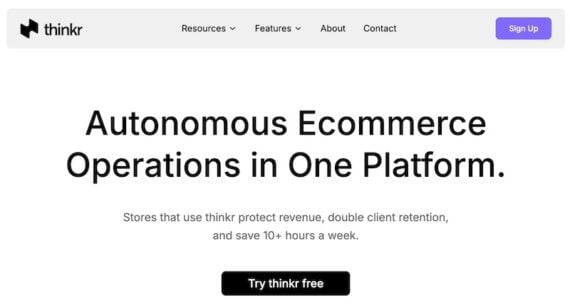
Today, AI agents are automating work that once required entire departments, according to Samayoa, who is the co-founder and CEO of Thinkr, a Shopify-centric AI platform.

Home page of Thinkr

Thinkr is an AI platform for Shopify-powered stores.

AI Growth

While artificial intelligence has existed for many years, the current AI boom emerged on November 30, 2022. That was when OpenAI released ChatGPT.

From generating basic text such as ecommerce product descriptions, AI tools have expanded to all forms of analysis, content, and, most recently, agentic-based automation.

Samayoa’s Thinkr, for example, could recommend discounting several products to boost sales and deplete aging inventory. The tool makes this recommendation to the store’s staff and, if approved, executes the plan, updating pricing in Shopify.

A store staff member clicked one button, and the AI agent did all of the work.

Other unrelated AI tools recommend and execute on advertising budgets.

Prerequisites

Merely asking ChatGPT, Gemini, Claude, or any other generative AI to analyze a store’s sales patterns and update pricing won’t work. An AI tool needs data sources and application programming interfaces.

Samayoa noted that Thinkr is connected to Shopify’s API, meaning it can access a store’s sales history and implement operational changes.

Thinkr also integrates with Google and Meta, enhancing its understanding of a shop’s analytics and advertising performance while expanding the operations it can perform.

Similarly, Shopify’s own AI tools — collectively called Shopify Magic — can access a shop’s sales history and execute all sorts of approved tasks.

According to Samayoa, AI platforms that operate a store require context, a history of its operations, to make effective recommendations. Hence the tools likely work best for established businesses with at least $200,000 in annual sales.

Do It for You

The purpose of AI operations platforms is to make and implement recommendations. The platforms do it for you.

This could mean completing complex tasks in combination. For example, an AI operations platform might:

  • Recognize an upcoming retail holiday, such as Father’s Day.
  • Plan a Father’s Day promotion based on previous campaign data.
  • Build and publish the promotional landing page.
  • Generate advertising assets.
  • Set up a Meta Ads campaign.
  • Generate and schedule promotional email messages.
  • Launch the promotion after a one-click approval.
  • Report on the campaign’s performance.

The solo entrepreneur remains in charge, but the AI handles everything else.

Sidekick (part of Shopify Magic) can update themes and pages. Thinkr could plan the Father’s Day promotion and perform some of its tasks thanks to integrations with Meta and Klaviyo.

In a sense, operational AI has just launched and could someday have its own November 30, 2022.

Innovate?

Ecommerce, while competitive, has enabled solo entrepreneurs and small businesses to thrive. Virtual assistants, agencies, and low-cost offshore talent enhance the capabilities, as do platforms such as Shopify and Amazon.

AI operations platforms will likely extend this trend, making it possible for one person to manage massive operations as Samayoa predicted. Given its explosive growth and trajectory, AI platforms could soon lead product development, customer service, marketing, financial forecasting, and most day-to-day operations.

Although some aspects — accountability, decision-making, emotional intelligence — will remain human endeavors even as AI takes on more tasks.

A final consideration is whether operational AI platforms can innovate. Early on, AI could be a significant advantage, but could widespread adoption eventually homogenize ecommerce operations? Would that be bad or good?

Why doctors should look for ways to prescribe hope

This week, I’ve been thinking about the powerful connection between mind and body. Some new research suggests that people with heart conditions have better outcomes when they are more hopeful and optimistic. Hopelessness, on the other hand, is associated with a significantly higher risk of death.

The findings build upon decades of fascinating research into the phenomenon of the placebo effect. Our beliefs and expectations about a medicine (or a sham treatment) can change the way it works. The placebo effect’s “evil twin,” the nocebo effect, is just as powerful—negative thinking has been linked to real symptoms.

Researchers are still trying to understand the connection between body and mind, and how our thoughts can influence our physiology. In the meantime, many are developing ways to harness it in hospital settings. Is it possible for a doctor to prescribe hope?

Alexander Montasem, a lecturer in psychology at the University of Liverpool, is trying to find an answer to that question. In his latest study, Montasem and his colleagues focused on people with cardiovascular disease.

The team reviewed all published research into the link between hope and heart health outcomes in such individuals. Hope is a pretty tricky thing to nail down, but these studies use questionnaires to try to do that. In one popular questionnaire, hope is defined as “a positive motivational state” based on having agency and plans to meet personal goals.

Montasem’s team found 12 studies that fit the bill. All told, these studies included over 5,000 people. And together, they found that high hopefulness was associated with better health outcomes: less angina, less post-stroke fatigue, a higher quality of life, and a lower risk of death. The team presented its work at the British Cardiovascular Society meeting in Manchester earlier this week.

When I read the results, it immediately got me thinking about the placebo effect. A placebo is a “sham” treatment—an inert substance like a sugar pill or saline injection that does not contain any medicine. And yet hundreds of studies have shown that such treatments can have remarkable effects.

They can ease the symptoms of pain, migraine, Parkinson’s disease, depression, anxiety, and a host of other disorders. The way a placebo is delivered can influence its effectiveness, and so can its color, shape, and price. Expensive placebos seem to be more effective. And placebos can even work when people know they are just placebos.

And then there’s the nocebo effect. If you expect to feel worse after taking something, you are much more likely to. The nocebo effect can increase the risk of pain, gastrointestinal symptoms, flu-like symptoms, and more.  

It’s obvious our thoughts and beliefs can play an enormous role in our health and well-being. What’s less clear is exactly how it happens. Scientists have made some progress—there’s evidence that a range of brain chemicals, including the body’s own opioids, are involved in both the placebo and nocebo effects. But the exact mechanisms remain something of a mystery.

In the meantime, researchers are working on ways to harness the power of positive thinking. There have been long-running debates over whether it is ever ethical for a doctor to deceive patients to make them feel better. But I’m firmly of the belief that doctors have a duty to be honest with their patients.

A more ethical approach might be to find ways to build patients’ hope, says Montasem. Not by exaggerating the likely benefit of a drug or by sugar-coating a prognosis, but perhaps by helping them work on their goals, agency, and general outlook on life.

Some early research suggests that this approach can help. Laurie McLouth at the University of Kentucky and her colleagues found that a series of discussions about values, goals, and strategies to achieve those goals improved hope among people being treated for advanced lung cancer.

Montasem now plans to review all the published work in this area and design a new approach to increasing hope. Any approach might have to be tailored to an individual, he adds. Some people might be more responsive to a more spiritual or religious way of thinking about their lives, for example.

These approaches could also be helpful for all of us, even outside clinical settings. I asked Montasem if he had any advice for people who want to have a positive outlook on life more generally. He told me that it’s important to have personal goals, along with a plan to achieve them. His own goals center on advancing his research, helping patients, and spending time with his family. “Materialistic goals aren’t as beneficial for your wellbeing,” he adds.

Since we spoke, I’ve been thinking over my own goals. I’ve realized that my first is to come up with a list of goals. And I plan to do it soon. “The minute we give up [on pursuing] our goals, we start falling into hopelessness,” he says.

This article first appeared in The Checkup, MIT Technology Review’s weekly biotech newsletter. To receive it in your inbox every Thursday, and read articles like this first, sign up here.

Inside the race to find GPS alternatives

Later this month, an inconspicuous 150-kilogram satellite is set to launch into space aboard the SpaceX Transporter 14 mission. Once in orbit, it will test super-accurate next-generation satnav technology designed to make up for the shortcomings of the US Global Positioning System (GPS). 

The satellite is the first of a planned constellation called Pulsar, which is being developed by California-based Xona Space Systems. The company ultimately plans to have a constellation of 258 satellites in low Earth orbit. Although these satellites will operate much like those used to create GPS, they will orbit about 12,000 miles closer to Earth’s surface, beaming down a much stronger signal that’s more accurate—and harder to jam. 

“Just because of this shorter distance, we will put down signals that will be approximately a hundred times stronger than the GPS signal,” says Tyler Reid, chief technology officer and cofounder of Xona. “That means the reach of jammers will be much smaller against our system, but we will also be able to reach deeper into indoor locations, penetrating through multiple walls.”

A satnav system for the 21st century

The first GPS system went live in 1993. In the decades since, it has become one of the foundational technologies that the world depends on. The precise positioning, navigation, and timing (PNT) signals beamed by its  satellites underpin much more than Google Maps in your phone. They guide drill heads at offshore oil rigs, time-stamp financial transactions, and help sync power grids all over the world.

But despite the system’s indispensable nature, the GPS signal is easily suppressed or disrupted by everything from space weather to 5G cell towers to phone-size jammers worth a few tens of dollars. The problem has been whispered about among experts for years, but it has really come to the fore in the last three years, since Russia invaded Ukraine. The boom in drone warfare that came to characterize that war also triggered a race to develop technology for thwarting drone attacks by jamming the GPS signals they need to navigate—or spoofing the signal, creating convincing but fake positioning data. 

The crucial problem is one of distance: The GPS constellation, which consists of 24 satellites plus a handful of spares, orbits 12,550 miles (20,200 kilometers) above Earth, in a region known as medium Earth orbit. By the time their signals get all the way down to ground-based receivers, they are so faint that they can easily be overridden by jammers.

Other existing Global Navigation Satellite System constellations, such as Europe’s Galileo, Russia’s GLONASS, and China’s Beidou, have similar architectures and experience the same problems.

But when Reid and cofounder Brian Manning founded Xona Space Systems in 2019, they didn’t think about jamming and spoofing. Their goal was to make autonomous driving ready for prime time. 

assembled GPS unit on a wheeled stand in a clean room
Xona Space System’s completed Pulsar-0 satellite is launching this June.
AEROSPACELAB

Dozens of robocars from Uber and Waymo were already cruising American freeways at that time, equipped with expensive suites of sensors like high-resolution cameras and lidar. The engineers figured a more precise satellite navigation system could reduce the need for those sensors, making it possible to create a safe autonomous vehicle affordable enough to go mainstream. One day, cars might even be able to share their positioning data with one another, Reid says. But they knew that GPS was nowhere near accurate enough to keep self-driving cars within the lane lines and away from other objects on the road. That is especially true in densely built-up urban environments that provide many chances for signals to bounce off walls, creating errors.

“GPS has the superpower of being a ubiquitous system that works the same anywhere in the world,” Reid says. “But it’s a system that was designed primarily to support military missions, virtually to enable them to drop five bombs in the same bowl. But this meter-level accuracy is not enough to guide machines where they need to go and share that physical space with humans safely.”

Reid and Manning began to think about how to build a space-based PNT system that would do what GPS does but better, with accuracy of three inches (10 centimeters) or less and ironclad reliability in all sorts of challenging conditions.

The easiest way to do that is to bring the satellites closer to Earth so that data reaches receivers in real time without inaccuracy-causing delays. The stronger signal of satellites in low Earth orbit is more resistant to disruptions of all sorts. 

When GPS was conceived, none of that was possible. Constellations in low Earth orbit—altitudes up to 1,200 miles (2,000 km)—require hundreds of satellites to provide constant coverage over the entire globe. For a long time, space technology was too bulky and expensive to make such large constellations viable. Over the past decade, however, smaller electronics and lower launch costs have changed the equation.

“In 2019, when we started, the ecosystem of low Earth orbit was really exploding,” Reid says. “We could see things like Starlink, OneWeb, and other constellations take off.”

Matter of urgency

In the few years since Xona launched, concerns about GPS’s vulnerability have begun to grow amid rising geopolitical tensions. As a result, finding a reliable replacement has become a matter of strategic importance. 

In Ukraine especially, GPS jamming and spoofing have become so common that prized US precision munitions such as the High Mobility Artillery Rocket System became effectively blind. Makers of first-person-view drones, which came to symbolize the war, had to refocus on AI-driven autonomous navigation to keep those drones in the game. 

The problem quickly spilled beyond Ukraine. Countries bordering Russia, such as Finland and Estonia, complained that the increasing prevalence of GPS jamming and spoofing was affecting commercial flights and ships in the region.

But Clémence Poirier, a space security researcher at ETH Zurich, says that the problem of GPS disruption isn’t limited to the vicinity of war zones.

“Basic jammers are very cheap and super easily accessible to everyone online,” Poirier says. “Even with the simplest ones, which can be the size of your phone, you can disrupt GPS signals in [an] area of a hundred or more meters.”

In 2013, a truck driver using such a device to conceal his location from his boss accidently disrupted GPS signals around the Newark airport in New Jersey. In 2022, the Dallas Fort Worth International Airport reported a 24-hour GPS outage, which prompted a temporary closure of one of its runways. The source of the interference was never identified. That same year, Denver International Airport experienced a 33-hour GPS disruption. 

Race to securing PNT

“Xona is a promising solution to enhance the resilience of GPS-dependent critical infrastructures and mitigate the threat of GPS jamming and spoofing,” Poirier says. But, she adds, there is no “magic wand,” and a “variety of different approaches will be needed” to solve the problem.

And indeed, Xona is not the only company hoping to provide a backup for the indispensable yet increasingly vulnerable GPS. Companies such as Anello Photonics, based in Santa Clara, California, and Sydney-based Advanced Navigation are testing terrestrial solutions: inertial navigation devices that are small and affordable enough for use beyond high-end military tech. These systems rely on gyroscopes and accelerometers to deduce a vehicle’s position from its own motions. 

When integrated into PNT receivers, these technologies can help detect GPS spoofing and take over for the duration of the interference. Inertial navigation has been around for decades, but recent advances in photonic technologies and microelectromechanical systems have brought it into the mainstream.

The French aerospace and defense conglomerate Safran is developing a system that distributes PNT data via  optical-fiber networks, which form the backbone of the global internet infrastructure. But the allure of space remains strong: The ability to reach any place at any time is what turned GPS from an obscure military system into a piece of taken-for-granted infrastructure that most people today can hardly live without.

And Xona could have some space-based competition. Virginia-based TrustPoint is currently raising funds to build its own low-Earth-orbit PNT constellation, and some have proposed that signals from SpaceX’s Starlink could be repurposed to provide PNT services as well.

Xona hopes to secure its spot in the market by designing its signal to be compatible with that of GPS, allowing manufacturers of GPS receivers to easily slot the new constellation into existing tech. 

Although it will take at least until 2030 for the entire constellation to be up and running, Reid says Xona’s system will provide a valuable addition to the existing GPS infrastructure as soon as 16 of its satellites are in orbit. 

The upcoming launch comes three years after a demonstration mission known as Huginn tested the basics of the technology. The new satellite, called Pulsar-0, will be used to see how well the system can resist jamming or spoofing.

Xona plans to launch an additional four spacecraft next year and hopes to have most of the constellation deployed by 2030. 

Pro Tennis Player Pivots to Ecommerce

For years Jack Oswald was a touring tennis professional. He aimed for top worldwide rankings, the key to serious earnings. The rankings never came, but constant travel exposed a nagging problem: his tennis bags kept breaking.

Thus began his passion for designing a better bag for athletes on the go. And that led to Cancha, a direct-to-consumer seller of sport and travel bags, which he launched in 2019 from his base in the U.K.

Jack and I recently spoke. He discussed his transition to entrepreneurship — early struggles, raising capital, and more. Our entire audio is embedded below. The transcript is condensed and edited for clarity.

Eric Bandholz: Tell our guests who you are and what you do.

Jack Oswald: I’m the founder of Cancha, which means “court” in Spanish. We design customizable, modular sport and travel bags — gear that transitions easily between work, play, and fitness. Our mission is to make sports travel seamless and help people stay active.

My background is in tennis. I spent years training and traveling to compete, chasing the dream of going pro. I didn’t reach the top, but I learned a great deal and gained valuable global experience, including learning French and Spanish.

Before the pandemic, I began designing bags for myself to meet the needs of an athlete on the move — from court to city to nature. I had no background in soft goods design, but I dove in. During the pandemic, with travel and tennis on hold, I focused full-time on building Cancha and learning ecommerce.

Initially, our target market was traveling athletes, but most customers today are everyday commuters and recreational players. We’re especially popular in the U.S., which accounts for 60% of orders. Brexit made selling in Europe more challenging, so the U.S. became our primary market. Interestingly, we also have a loyal customer base in Asia, including Japan, Hong Kong, and Singapore, despite not marketing in those locales.

Bandholz: Tell us more about the transition from tennis to entrepreneurship.

Oswald: It was a long, gradual process. As a kid, I believed nothing could stop me from turning pro. But reality hit — tennis is tough to make a living in. Only the top 100 players earn well, and beyond 150 in the rankings, you’re often losing money. Unlike soccer, where thousands of players make a living, tennis is financially brutal unless you’re at the top.

I gave it everything — traveling constantly, chasing ranking points, trying to survive each week. The grind was intense, and you’re often alone without the same resources as competitors. A coach, decent accommodations, or even a meal can make a big difference. The mental and physical toll is enormous, especially when facing losing streaks or setbacks.

I eventually realized I needed a new path. I probably would’ve kept pushing had I not discovered a new passion with Cancha. Many of my peers struggled post-tennis, but I was fortunate to find something meaningful. Even so, it took over a year to fully shift. I was still half-committed to tennis while building Cancha, gradually accepting that it was time to move on.

Bandholz: Bags are expensive to manufacture. Where did you get the money?

Oswald: It started scrappy. I wasn’t spending much at first. I was learning from friends who knew about soft goods design. Between tennis tournaments, I attended trade shows, where I met suppliers who generously offered samples, perhaps thinking I was more established.

In late 2019, I ran a crowdfunding campaign, raising approximately £10,000 ($13,500). I had no marketing experience, but it provided a bit of capital to move forward. Then, during the pandemic, we received a government relief loan, which helped fund our first production run and enabled us to undertake better design work. That was a major boost.

We began with tennis bags because that’s what I knew. The concept was a modular system — bags with add-ons for shoes, laptops, or wet gear. We first tried a backpack with racket add-ons, but it was too bulky. So we pivoted to a dedicated tennis bag and expanded from there.

Having contacts in the U.S. tennis space — reviewers and influencers — helped us get early traction. From there, we’ve grown into other racquet sports and more lifestyle-oriented bags.

A main reason for launching Cancha was frustration — my tennis bags kept breaking. Tennis is a growing sport, but the industry itself remains largely traditional, especially in marketing. Most brands rely on sales representatives and retail, and their bags are often poorly made, used as loss leaders to sell rackets. Unlike golf, where premium bags are the norm, tennis bags lack innovation and quality.

I saw a gap for better materials, thoughtful design, and durability. That became our focus: premium, modular bags that meet the needs of modern players and travelers.

On the marketing side, I also wanted to break the mold. Most tennis brands rely heavily on player sponsorships, but those come with restrictions — players who wanted to use our bags often couldn’t. So we went direct-to-consumer via ecommerce, bypassing the old-school gatekeepers.

Bandholz: How did your growth evolve?

Oswald: It has been gradual. We haven’t had a breakout moment from ads or gifting — no “rocket ship” success. It’s been a steady improvement across the board. Our bags are significant purchases. They last a long time, and people take time to decide. That makes acquisition challenging, especially with rising ad costs.

Our limited production approach has worked well. We’ve leaned into that with email marketing — offering limited-edition drops, exclusive colorways, and brand collaborations within tennis and beyond. We’ve also done a lot of pre-orders.

Creating excitement around the product development process and scarcity has helped drive engagement and interest. Instead of relying on one big channel, it’s been a mix: building hype, maintaining a tight brand, and slowly earning trust.

Bandholz: Do you have repeat buyers?

Oswald: Yes, and that’s been a strength. Our modular design allows customers to add accessories, naturally encouraging repeat purchases. People often buy a base bag first, then return for add-ons.

I design accessories to stand alone while also integrating with our bags. That dual approach gives us crossover appeal — some people buy just the laptop bag, while others build complete travel systems over time.

Limited drops play a role, too. Customers offer feedback on what they want. That helps guide future product development. We’ve had customers spend upwards of $2,000 over a few years. That kind of engagement has been key to our growth.

Bandholz: Where can people buy your bags or reach out?

Oswald: Our site is MyCancha.com. I co-host the Underdog Ecom Podcast for bootstrapped owners. I’m on X and LinkedIn.

Google’s Update To Recipe Structured Data Confirms A Ranking Criteria via @sejournal, @martinibuster

Google updated the Recipe Schema.org structured data documentation to reflect more precise guidance on what the image structured data property affects and where to find additional information about ranking recipe images in the regular organic search results.

Schema.org Structured Data And Rich Results

The SEO and publisher community refers to the text results as the organic search results or the ten blue links. Google refers to them as the text results.

Structured data helps a site’s content become eligible to rank in Google’s rich results but it generally doesn’t help content rank better in the text results.

That’s the concept underlying Google’s update to the Recipe structured data guidance with the addition of two sentences:

“Specifying the image property in Recipe markup has no impact on the image chosen for a text result image. To optimize for a text result image, follow the image SEO best practices.”

Recipe structured data influences the images shown in the Recipe Rich Results. The structured data does not influence the image rankings in the regular text results (aka the organic search results).

Ranking Images In Text Results

Google offers documentation for image best practices which specify normal HTML like the and elements. Google also recommends using an image sitemap, a sitemap that’s specifically for images.

Something to pay particular attention to is to not use images that have blurry qualities to them. Always use sharp images to give your images the best chance for showing up in the search results.

I know that some images may contain slight purposeful blurring for optimization purposes (blurring decreases image size) and to enhance the perspective of foreground and background. But Google recommends using sharp images and to avoid blurring in images. Google doesn’t say it’s an image ranking factor, but it does make that recommendation.

Here’s what Google’s image optimization guidance recommends:

“High-quality photos appeal to users more than blurry, unclear images. Also, sharp images are more appealing to users in the result thumbnail and can increase the likelihood of getting traffic from users.”

In my opinion I think it’s best to avoid excessive use of blurring. I only have my own anecdotal experience with purposely blurred images not showing up in the search results. So, to me it’s interesting to see my experience confirmed that Google treats blurred images as a negative quality and sharp images as a positive quality.

Read Google’s updated Recipe structured data documentation about images here:

https://developers.google.com/search/docs/appearance/structured-data/recipe#image

Read more about images in Google’s text results here.

Read about blurry and sharp images here:

https://developers.google.com/search/docs/appearance/google-images#good-quality-photos%20optimize-for-speed

Featured Image by Shutterstock/Dean Drobot

Social Media As A Customer Service Tool: Trends And Best Practices via @sejournal, @rio_seo

Every tweet, direct message, and comment holds weight. Social media has long been a connectivity platform, where users engage with friends, colleagues, and family.

In recent years, it’s also evolved to become a feedback mechanism for businesses.

In many industries, customers are communicating with a business on social media. It’s a key customer service channel, one in which savvy businesses must consistently monitor to ensure they’re meeting customers’ expectations.

In many cases, it’s the first place customers turn for help.

For brands, this shift presents a massive opportunity but also a real challenge.

Customers expect rapid responses. Research shows that 41% of consumers expect a response from a business within 24 hours. Plus, they’re not afraid to call out a business publicly if they don’t respond or effectively meet their needs.

Today, social media is no longer exclusively about amassing the most followers and likes. It’s about building genuine relationships with customers through timely responses, authentic engagement, and proactive customer service.

The Hootsuite Social Media Consumer Trends 2024 report found that 53% of social media users say the most appealing thing a brand can do on social media channels is to quickly respond to direct questions and comments.

In this post, we’ll explore how social media can be used as a strategic lever for building lasting customer relationships and how your business can implement social-first strategies that elevate both service and reputation.

The Evolution Of Social Media Customer Service

When social media platforms like X (Twitter) and Facebook first launched, brands used them primarily as one-way communication channels.

They’d share promotions, advertise events, showcase new products, and announce pertinent updates.

However, over the last few years, this paradigm has completely flipped. Businesses are now using social media as a two-way communication channel, fostering deeper relationships with customers that turn into loyalty.

With feedback being front and center on social media, customers quickly realized they could get faster responses by mentioning a brand (@brand) rather than using traditional customer service channels, such as chatbots or phone calls.

In turn, businesses realized the importance of social media as a customer service channel, leveraging technology to reply to customer concerns at scale and ensuring timely follow-up.

Social media has become a natural extension of customer support. There are several factors that have contributed to the rise of social as a customer service tool, including:

The Rise Of Mobile

Mobile accounts for over 62% of market share worldwide, with desktop falling behind at 36%.

Mobile phones are the go-to for browsing, shopping, and messaging. With smartphones now the default device, consumers will engage with brands on the go.

Whether it’s sending a direct message to an airline about a canceled flight or mentioning a retail brand on X (Twitter) seeking information about shipping status, customers are more comfortable than ever with connecting with businesses across all social platforms.

Given the convenient nature of mobile devices and mobile apps, social engagement has become more seamless and accessible than ever before.

Generational Changes

Millennials and Gen Z are the dominant force in purchasing power. They’re also the two generations who have grown accustomed to digital-first experiences, including communication.

Both these generations grew up with mobile phones, the internet, and companies that deliver expedited experiences, like Amazon’s two-day shipping.

As such, they demand instant answers to their inquiries, just as they’d expect a friend to reply quickly to a text message.

Platform Maturity

Social media has evolved into a critical customer service tool, and the major platforms are stepping up to make communication easy.

For example, Facebook offers Messenger API integrations, and X (Twitter) supports customer service workflows.

On the other hand, Instagram allows for quick or automated replies, as well as live support features. TikTok is advancing its features to allow brands to address product questions or service complaints.

Customer service has followed the conversation, and those conversations have gone social.

Trends Shaping Social Media Customer Service

Customer expectations continue to rise, and as they do, they’re reaching out for support from businesses in divergent formats, including across social media platforms.

Enter social customer care, which has quickly become a crucial endeavor and a need for every business.

Social customer care is growing smarter and more seamless, powered by automation, fueled by data, and defined by customer expectations for immediacy and personalization.

Let’s break down the trends driving this shift in social media customer service.

AI-Powered Support Has Entered The Scene

Consumers are widely adapting to artificial intelligence, engaging with it for streamlining tasks, seeking information, and contacting support.

AI chatbots have also come a long way from being basic autoresponders with a few canned responses.

Natural language processing (NLP) has become much more advanced, enabling AI to detect sentiment and context at deep levels to:

  • Distinguish between a frustrated customer and one who simply wants more information.
  • Route escalated customers to live agents for human intervention.
  • Recommend products or solutions relevant to the end user based on their past behavior.
  • Tailor responses based on a person’s interests and previous prompts.
  • Produce human-like responses, where customers feel like they’re being helped rather than rerouted to an unhelpful resource.

Be sure to pair AI chatbots with human agents (a.k.a. “agent assist”) to increase resolution speed, ensure human touch in feedback management, and maintain empathy when customers reach out for help.

Full CX Tech Stack Integration

Technology is getting smarter, and social media tools now integrate directly into customer relationship management systems, help desk software, marketing suites, and more.

This allows support teams to have quick access to order history, view past conversations, and personalize responses without asking for repeat information.

Sales, customer success, support, marketing, and customer experience no longer exist in siloes.

Together, they’re able to promote positive customer experiences across every touchpoint, whether a customer is seeking assistance during the awareness stage or needing help post-purchase through improved visibility.

Voice And Video Support Via Social

Customers have become accustomed to receiving quick and seamless support.

Voice and video support offer attractive alternatives to traditional customer service options.

As technology continues to evolve and align with consumer behavior trends, short-form content has opened the door for new and unique types of customer service interactions.

For example, brands responding to customer questions with personalized videos to help walk through concerns or offer visual guidance.

Alternatively, support agents are also leveraging voice messages to talk through customer support, sending customers a short voice message in Instagram DMs or WhatsApp.

This eliminates the need for customers to pick up the phone and talk to an agent in real time, while offering more personal support.

Livestreaming has emerged as a powerful way for brands to build trust and transparency.

Platforms like Facebook Live, Instagram Live, YouTube Live, TikTok Live, and Twitch make it easy to connect with audiences in real time.

Whether hosting Q&A sessions or holding virtual “office hours,” livestreams allow brands to engage directly with customers and address questions on the spot.

These diverse customer support formats help humanize support and can enable faster resolution through rich media.

Proactive Support Through Social Listening

Social listening has emerged as a powerful ally for spotting issues immediately, allowing businesses to be proactive and swift when addressing consumers.

Social media support has evolved from tracking @mentions. Now, social listening tools empower brands to scan for brand mentions, product feedback, competitor and industry keywords, and more – even if the business isn’t tagged.

Smart brands tracking myriad feedback across social media platforms are able to then:

  • Jump into conversations before they escalate further.
  • Address complaints swiftly.
  • Identify opportunities for improvement in service or products.
  • See competitor pain points.
  • Introduce your business to a customer who’s evaluating vendors.

For example, a beauty brand may see numerous mentions about a leaky mascara tube on Instagram and Facebook.

Before it spirals any further and fuels negative brand perception, the brand could investigate the issue, fix it, and proactively respond to comments regarding the product defect and the steps they took to rectify it through the power of social listening.

Rise Of “Dark Social”

Not all social responses are public.

“Dark social” is becoming a preferred communication method through platforms like WhatsApp, Messenger, and Telegram, as conversations are private and not broadcast for all to see, as is typically the case with social media conversations. Although, preference is regional and demographic-specific.

The “dark” nature of this communication allows for more personalized one-on-one conversations, which can be especially valuable in international markets, industries with sensitive queries (like financial services and healthcare), or any other industry where confidentiality is needed.

Best Practices For Effective Social Media Customer Service

Just as with traditional customer service channels, social media customer care requires a nuanced approach to ensure satisfaction at every touch point.

A one-size-fits-all approach will no longer suffice. Smart businesses will evolve from reactionary to proactive support, irrespective of social media channels.

Feedback will be monitored across the diverse, fragmented social media landscape, where new content types are consistently introduced and new platforms emerge, eager to garner attention.

According to a recent study, engagements received on Facebook and Instagram continue to grow year-over-year, whilst engagements on X (Twitter) remain steady.

The study shows that customers are engaging across myriad social media channels.

Whether a customer mentions your brand on Twitter or your product on Facebook, equipping your customer service teams with the tools and technology to respond in near real time is a must.

A few best practices to implement into your social media customer service strategy include the following.

Respond Quickly

Consumers have grown accustomed to speedy responses. The Sprout Social Index™ shows nearly 75% of consumers expect a brand to reply within 24 hours or less.

Quick customer service is necessary, and customer expectations continue to grow.

While speed is critical, it can’t be at the cost of humanity. Aim for a first response to a customer within an hour or faster.

The use of pre-approved templates can be beneficial for common queries, but customization will be necessary for escalated issues where emotions can be heightened.

Be sure to acknowledge each issue with empathy and respond in your brand’s tone.

Customers are still not entirely eager to receive responses from AI. A Gartner study found that over half (64%) of customers would prefer that companies didn’t use AI in their customer service.

Escalate Smoothly

Sometimes, a tweet isn’t enough to squelch an issue.

When deeper issue resolution is needed, brands should keep public replies brief and take the conversation to a more private forum, such as DMs or email.

Brands must train agents to recognize when more personal support is warranted and needed, and how to make the transition to a private conversation more seamless to mitigate customer frustration.

Use Dedicated Support Handles

Customers may feel better served knowing they’re engaging with a member of the support team.

To help users distinguish your business from your support staff, it can be beneficial to have a separate dedicated support handle, such as @NikeService vs. @Nike.

A dedicated support handle can reduce confusion, make users feel heard, and ensure support requests aren’t lost in the void.

Help Your Agents Help You

Consider a customer who has reached out for support in the past via Facebook due to a high-ticket product defect.

Your brand rectified the issue by providing the customer with a new part and a partial refund. Now, consider the product experiences further issues in the future, and the customer reaches out again.

They may start to feel like just a number if the second support agent isn’t equipped with the customer’s full product history and was never made aware of the previous product issue.

This, in turn, creates a negative brand experience, which can lead to a bad review and the loss of a customer.

Smart brands give their social media customer service representatives the tools and resources to access customer history to avoid potential pitfalls like the scenario mentioned above.

Empowering your frontline employees not only helps your customers but also your business’s brand reputation.

Follow Up On Service

Customers want to feel seen and heard, irrespective of where they’re reaching out to you. Check in with your customers after their issues have been resolved.

Customer follow-up surveys are a great tool to employ post-service to assess how your customer service team is doing.

Whether a customer reached out to your business via Instagram DM or a chatbot on your website, it’s important to ensure customers know they matter to your business.

Measure What Matters

Customer support managers should track key performance indicators (KPIs) consistently to accurately assess employee performance and keep a pulse on customer satisfaction.

A few common KPIs businesses will want to measure are:

  • First Response Time: How long it takes for an agent to reach out to a customer after they’ve reached out for support.
  • Average Resolution Time: How long it takes to resolve an issue, beginning from the moment the customer reaches out to closing out the ticket.
  • Customer Satisfaction: How happy a customer is with the level of support your business provides.
  • Social Sentiment: What users say about your business across popular social media platforms (from your brand name to your products)
  • Volume by platform: Which channels receive the most inquiries for support, to better prioritize where your customer support teams spend their time.
  •  Issue Types: The types of issues you see most commonly, such as frequent issues with shipping or quality concerns.

By measuring what matters most, businesses can pinpoint critical issues before they become widespread.

For example, if customers continue to voice concerns over short battery life in a toothbrush on TikTok, the business can flag this for its product team, look further into whether it’s a smaller issue that impacted a batch of shipments, or assess if a bigger quality assurance issue is at play.

Make Social Support A CX Differentiator

Using social media as a customer service tool is non-negotiable.

The social media landscape is no longer just a forum for fun. It’s evolved to the point where customers are actively seeking support and voicing their concerns for the wider public to see.

It’s a service battlefield, where brands either win or lose customer loyalty.

Social media has to be a core support channel, not just a nice-to-periodically check.

When your social support mirrors your online support, brands will differentiate themselves from the businesses that aren’t responding with speed and empathy.

Moving forward, the first step you can take is to audit your social media support today.

Ask yourself: Is your business meeting response time expectations? Is your team equipped with the best tools to enable smooth support? And how will your business escalate issues when they arise?

The brands that will thrive in the long run are those building systems for service, not just likes, today.

More Resources:


Featured Image: Accogliente Design/Shutterstock