The Strategy Gap: Social Video Is Not PPC Video via @sejournal, @LisaRocksSEM

Video is dominating online across PPC ads and social media channels. Unfortunately, many advertisers still repurpose social videos for paid campaigns.

What works organically on TikTok or Instagram often falls flat in performance-driven environments like YouTube Ads or Performance Max.

This could lead to low engagement and poor conversions.

To compete in today’s attention economy, PPC video needs its own strategy that is built from the ground up with performance in mind.

This article explores why CMOs and senior marketers must treat video as a creative asset, that is, a conversion-driven engine and platform-specific.

The Disconnect Between Social Video And PPC Video

Some marketers start with social video and “cut it down” for paid. However, the two formats fundamentally differ in purpose, intent, and delivery.

Social video is built for engagement, likes, shares, and storytelling that captures attention in a feed.

PPC video, on the other hand, is engineered for a conversion action. It must capture attention, communicate value quickly, and drive a specific action with a call-to-action (CTA) statement.

Repurposing social content for PPC assumes that the creative context uses the same strategy for driving engagement.

Social videos often rely on trends, audio cues, or slow storytelling arcs. Those don’t translate to skippable, conversion-focused ad formats where you have just a few seconds to inform and impact.

The following table outlines the fundamental differences between social and PPC video.

Category Social Video PPC Video
Purpose Brand building, storytelling, and community engagement Lead generation, sales, and performance-driven metrics
Viewer Intent Passive browsing, entertainment High intent, research, or decision-making mindset
Format & Delivery Organic feed content, often square or vertical Paid ad placements; needs variation for 16:9, 4:5, vertical, etc.
Sound/Audio Often relies on music, trends, or narration Must perform without sound; strong visuals are needed
Calls-to-Action Often implied or delayed Immediate and repeated; click-through or conversion-focused
Performance Metrics Likes, shares, video views, engagement rate CTR, conversion rate, ROAS, CPA

Best Practices For PPC Video

PPC video ads should be intentionally created to drive conversions, not just views.

Below are key creative best practices that directly influence campaign outcomes, keeping in mind the details of different platforms:

1. Hook The Viewer Within The First 3 Seconds

Front-load your story arc by getting to the point of the video early, which often involves presenting the value proposition and the desired action.

You only have a moment to make viewers stop scrolling or delay the skip button. Use bold text, motion, or a strong question right away.

Example: “Spending too much on ads? Here’s a fix that saved our client $10,000.”

2. Format Video For The Platform

Each platform has different specs and user behaviors that require a custom approach for each. This is a perfect example where “one size does not fit all.”

YouTube standard videos typically requires horizontal (16:9), aligning with a sound-on viewing environment, while YouTube Shorts are vertical and platforms like Meta often favor square or vertical.

TikTok favors vertical, full-screen videos for sound-off autoplay. Develop your creative asset with this in mind.

3. Include A Clear Call-To-Action Early And Repeat

Don’t rely on a single CTA at the end. Video ads are built for direct response. Reinforce the action you want throughout the video.

Example: Start the video with “Click to get the offer,” and show it again midway and at the end.

4. Lead With The Benefit, Not The Backstory

People want to know what’s in it for them and how you solve their problem. Skip the warm-up and start with a direct benefit or result.

Example: Instead of “Our team spent weeks testing this,” say, “This ad strategy cuts CPC in half.”

5. Design With Platform Audio In Mind

For platforms with silent autoplay (TikTok, Instagram Reels, Facebook Feed): Prioritize visual communication. Many users watch without sound, so ensure your message still lands visually.

Use animated captions and highlight product features with motion text, so nothing is lost without audio.

For YouTube: Recognize that ads often play while users have the sound on.

While strong visuals are still important, leverage sound effectively through voiceovers, music, and sound effects to enhance your message and brand experience, as highlighted in YouTube’s Playbook for Creative Advertising [PDF] under the “Build for sound on” principle.

These elements influence how your video is served, watch time, and whether they take action.

Platform-Specific Video Strategies

Not all platforms serve video in the same way. Understanding how your content is delivered, measured, and optimized across each environment is critical to making PPC video work.

YouTube Ads

YouTube is a high-intent platform, with users actively choosing to watch content. Your ad will most often appear before or during another video.

The key here is overcoming the viewer’s “skip” behavior.

  • Maximize the impact of the skippable first five seconds. Use a bold visual or a clear problem-solution hook to immediately capture attention and provide value, making viewers want to watch more.
  • Build a narrative that fits intent. Educational formats, product demos, or expert commentary perform well here. Consider longer-form content that addresses pain points thoroughly or showcases product features in detail. Leverage storytelling to connect with viewers who are actively engaged.
  • End with a strong call to action. Take users to a landing page or offer page that extends the message.
    • Example: A productivity software brand opens with “Wasting time switching tabs?” then shows how its tool solves it with a single view, ending with “Try it for free today.”

Performance Max

Performance Max distributes video across placements like YouTube, Discovery, and Gmail. This requires a flexible, creative approach built to adapt to various ad spaces.

  • Upload multiple lengths: At minimum, include 6-second, 15-second, and 30-second versions. Varying lengths allow Google’s AI to test and serve the most effective creative for each placement and user.
  • Include strong product visuals: Use the dedicated headline and description fields within the PMax asset library to deliver your primary marketing messages and calls to action. This allows Google’s AI to optimize the pairing of text and video for different platforms and user behaviors. Ensure key messages and branding are visually prominent and understandable without audio.
  • Create for automation: Google optimizes based on performance. Give the algorithm assets that can stand alone, yet are also easy to mix and match. This includes various headlines, descriptions, and calls to action that can be paired with your video assets, allowing Google’s machine learning to find the most effective combinations.
  • Leverage vertical image ads for YouTube Shorts: Google Ads now supports full-screen vertical (9:16) image ads specifically for YouTube Shorts within Demand Gen campaigns. This allows you to repurpose existing vertical image assets from platforms like Meta to reach users in this rapidly growing short-form video environment. Recommended size: 1080×1920.
    • Example: A clothing brand uses 15-second vertical videos with close-up fabric shots and pricing overlays so the system can serve based on what performs.

Meta Video Ads (Facebook And Instagram)

These platforms autoplay silently in-feed, so your creative must speak visually before sound is ever involved.

  • Front-load motion or emotion. Start with an action or a relatable facial expression. Think about creating a visual hook that stops the scroll and intrigues users enough to tap for sound.
  • Use large text overlays and branded visuals. This keeps the message clear and recognizable at a glance. Keep text concise and easy to read on smaller mobile screens. Ensure your branding is integrated early and consistently.
  • Mobile-first approach. Vertical or 4:5 ratio works best for in-feed and Stories. Utilize the full vertical space to immerse viewers and avoid the cropped look of horizontal videos on these platforms.
    • Example: A skincare brand opens with a smiling woman applying cream, with large text: “Sensitive skin? See instant calm.”

Optimize your video creative for the unique consumption habits and delivery methods of each platform, and increase the likelihood of engagement and better performance from your PPC video campaigns.

Making The Business Case To CMOs

CMOs and senior leaders often see video as a single, limited asset: make once, use everywhere.

Now, with the increasing sophistication of digital advertising platforms and the different ways video is consumed, the same approach is not cost-effective or performance-driven.

The increase of short-form video, dominance of mobile, and the emphasis on ad quality across platforms are driving a more strategic approach to video creative.

Consider:

  • Repurposed social content is likely to underperform in PPC environments because it was not created with the same goals in mind.
  • Dedicated PPC video would be expected to increase return on ad spend by aligning creative with media placement.
  • A video designed for PPC would (in theory) have higher engagement. Therefore, should have a higher ad quality score and higher delivery.

Making the business case means shifting from “video as a campaign extra” to “video as a campaign must-have.”

CMOs are ultimately looking for measurable results and a strong return on investment from their advertising spend, and a platform-specific video strategy is the key.

Conclusion: PPC Video Is No Longer Optional

The days of treating all video the same are over, and it’s time to embrace this new approach. Video is now a powerful strategy for driving measurable ad results.

Advertisers should strategically build video with a clear understanding of each platform’s unique environment, their target audience’s intent, and the business goals.

Investing in creative that has a performance-first approach for each platform opens up opportunities for a stronger return on your advertising investment.

The future of successful PPC hinges on your team’s ability to master platform-specific video creation.

More Resources:


Featured Image: Hryshchyshen Serhii/Shutterstock
How Enterprise Search And AI Intelligence Reveal Market Pulse

The last few years have fundamentally transformed how businesses and consumers discover, evaluate, and engage with brands.

What began as a digital acceleration in 2020-2021 has evolved into an AI-driven revolution that’s reshaping the entire search landscape in 2025 across every industry vertical.

Where organizations once relied on monthly snapshots and historical data, today’s market reality demands real-time AI intelligence with a 360-degree view across all platforms.

The traditional customer journey – whether B2B, B2C, or D2C – which used to span multiple sessions, site visits, and vendor comparisons, can now unfold in a single AI interaction.

When a decision-maker asks Google AI Overviews, ChatGPT, or Perplexity for the best HR software, skincare routine, or investment strategy, they’re no longer sifting through dozens of links.

AI immediately assembles a shortlist with commentary, pros and cons, and implicit recommendations.

AI Search Revolution: From Information Retrieval To Active Evaluation

Recent BrightEdge data reveals the magnitude of this shift: Impressions on all content have skyrocketed by over 49% since the launch of AI Overviews, while Google still maintains over 90% of market share.

However, the game has undergone a fundamental change. AI isn’t just retrieving information; it’s actively evaluating, framing, and recommending brands before prospects even click a link.

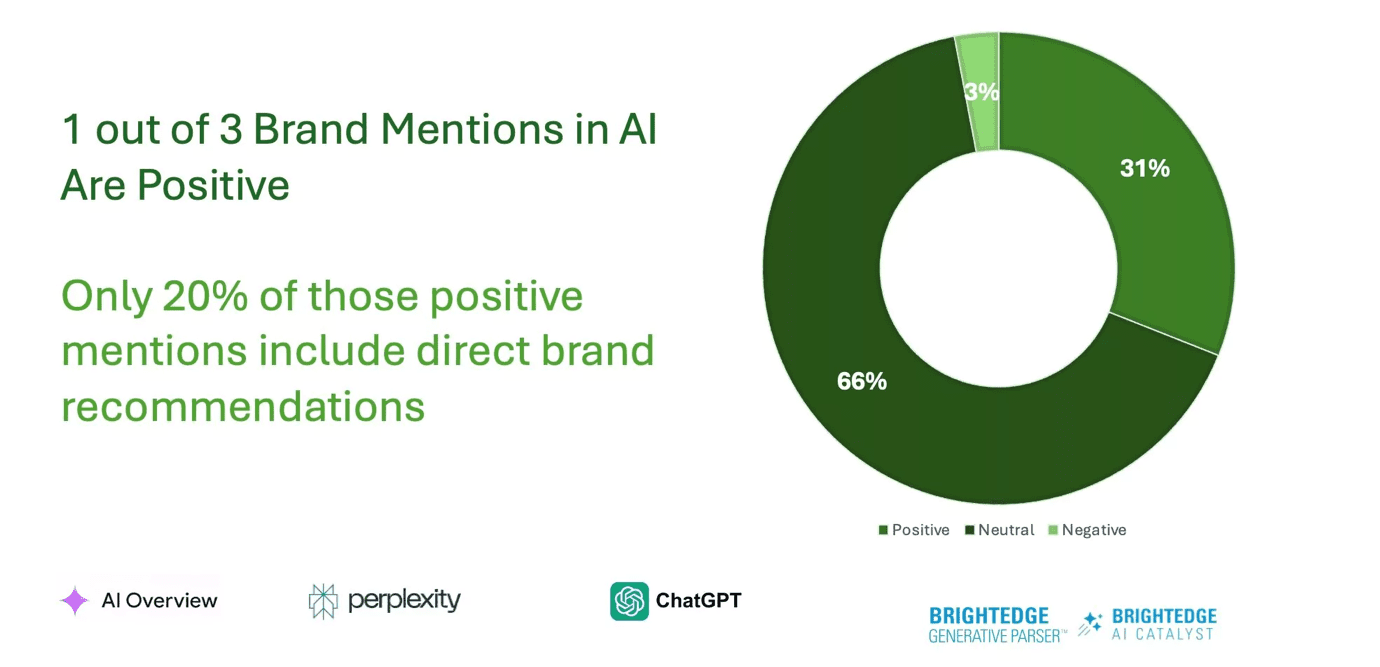
Consider the stark reality facing all marketers: Only 31% of AI-generated brand mentions are positive, and of those, just 20% include direct recommendations.

Source: BrightEdge, June 2025

This means that whether you’re marketing enterprise software, consumer products, or direct-to-consumer services, how your brand appears in AI results across Google AI Overviews, ChatGPT, and Perplexity varies dramatically depending on the AI model, its training data, and interpretive logic.

The growth trajectory tells the story:

  • ChatGPT: 21% growth in the last month.
  • Perplexity and Gemini: Remaining about one-tenth of ChatGPT’s size.
  • Claude, Meta, and Grok: Another one-tenth smaller than Perplexity and Gemini.

This isn’t just channel diversification; it’s a complete redefinition of discoverability where AI serves as both gatekeeper and advisor.

Being Aware Of What Is Going On In Your Broader Markets

Understanding The New Market Dynamics

Many marketers have traditionally taken an immediate and microscopic approach to SEO. Without thinking, the focus goes straight to the keyword and the link.

However, working across all market segments requires a shift in mindset towards understanding not just the business but the broader market and economic implications that may affect how you tailor your strategy.

Overall, market factors influence short-, mid-, and long-term strategies. Utilize models such as PEST analysis to understand what is going on in the market from a political, economic, social, and technological perspective:

  • Political: AI regulation, data privacy laws, elections, and new compliance requirements.
  • Economic: AI’s compression of decision cycles, changing sales velocities, and market volatility.
  • Social: Consumer behavior is shifting toward AI-assisted purchasing, altering the dynamics of brand trust.
  • Technological: AI model capabilities, real-time indexing, cross-platform optimization requirements.

The MAP Framework For AI Search Success

Modern marketing intelligence requires mastering three critical dimensions: Mention, Authority, and Performance – what I call the MAP Framework for AI search success.

This framework applies whether you’re marketing SaaS solutions, consumer electronics, fashion brands, financial services, or any product or service in today’s AI-influenced marketplace.

Mentions: Beyond Traditional Rankings

While Google still commands the foundation with over 90% market share, the ecosystem has diversified rapidly.

AI Overviews (AIOs) now appear in over 11% of Google queries – a 22% increase since debuting last year.

More significantly, longer, more complex queries have increased by 49% in AI Overviews since May 2024, specifically designed to support complex B2B decisions.

In contrast, ranking-style content and comparison queries have decreased by 60% and 14%, respectively.

BrightEdge data shows the industries with the strongest AI Overview presence are healthcare, education, B2B tech, and insurance. Travel and entertainment are on the rise, while ecommerce has not seen rapid growth in the past year.

Authority: When AI Forms Opinions About Your Brand

The most critical insight for all marketers is understanding how AI systems interpret and present brand information across every category.

Our research shows significant variation in how brands are portrayed across different AI platforms and industries:

  • Finance brands: Positive mentions align around regulatory compliance and security content.
  • Healthcare brands: Accuracy and credibility drive positive AI sentiment.
  • Technology brands: Innovation and reliability serve as primary AI evaluation criteria.
  • Consumer brands: Customer reviews, product quality, and brand reputation influence AI recommendations.
  • Retail/Ecommerce: Price competitiveness, product availability, and user experience drive AI mentions.
  • Professional services: Case studies, client success stories, and industry expertise shape AI perception.

Whether AI is evaluating enterprise software, consumer products, or professional services, it effectively writes the evaluation criteria and creates shortlists without brands having direct input, making perception management mission-critical across all verticals.

Performance: New Metrics That Matter

Traditional key performance indicators (KPIs), such as rankings, impressions, and traffic, aren’t disappearing, but they’re insufficient for AI-driven discovery.

While impressions on all content have skyrocketed by over 49% since the launch of AI Overviews, click-throughs have steadily declined, with a nearly 30% reduction since May 2024.

Yet, conversion rates remain strong, suggesting that AI successfully qualifies leads before they reach websites.

Essential AI Search Metrics:

  1. AI Mention Rate: Percentage of target queries where your brand appears in AI responses.
  2. Citation Authority: How consistently you’re cited as the primary source.
  3. Share of AI Conversation: Your semantic real estate in AI answers versus competitors.
  4. Prompt Effectiveness: How well your content answers natural language prompts.
  5. Response-to-Conversion Velocity: Speed at which AI-influenced prospects convert.

Monthly reporting cycles have become obsolete. AI-generated results can shift within hours based on content updates, prompt trends, or model training, demanding real-time monitoring capabilities.

Read more: How AI Is Changing The Way We Measure Success In Digital Advertising

Combining Business & Search Intelligence To Understand The Pulse Of The Customer

AI Intelligence With Comprehensive Market Insights

Modern marketing intelligence extends far beyond traditional keyword monitoring, requiring a 360-degree view across all consumer touchpoints and all key AI search engines.

Today’s successful organizations – whether B2B, B2C, or D2C – leverage AI to understand market pulse through multiple lenses:

Real-Time Consumer Intelligence

AI agents now research on behalf of consumers across all categories, from enterprise software to skincare products.

These agents analyze your brand through your digital presence, social proof, customer reviews, and competitive positioning.

They’re becoming sophisticated evaluation consultants that assess everything from product specifications to brand values.

Cross-Industry Predictive Modeling

Advanced business intelligence now incorporates AI behavior patterns to forecast demand shifts across all sectors.

When AI systems consistently recommend specific product categories, highlight particular brand attributes, or emphasize certain consumer benefits, these signals predict broader market movements – whether in B2B procurement, consumer purchasing, or direct-to-consumer trends.

Omni-Engine And LLM Sentiment Analysis

Different AI platforms treat content differently across all industries.

For consumer brands, ChatGPT might emphasize user reviews and social proof, while Perplexity focuses on expert analysis and technical specifications.

For B2B brands, LinkedIn-integrated AI may prioritize professional endorsements, whereas general AI platforms tend to emphasize case studies and return on investment (ROI) data.

Understanding these platform-specific nuances enables strategic content distribution across every marketing vertical.

From Search To AI As The Voice Of Every Customer

In many ways, AI is the voice of the customer across all industries.

Search queries contain intent signals, SERP analysis reveals how customers prefer to consume content, and keyword reports enable us to produce content that resonates – whether for enterprise buyers, individual consumers, or any audience in between.

However, especially in an agentic world, AI is not just forming opinions. It is taking actions for users. In shopping, it can actually make transactions for people.

Keeping a daily pulse on new insights impacting your market and on what is changing in AI responses daily should be of mandatory importance for those who want to benefit from fresh, new opportunities.

For example, a single result and opinion generated by AI in a search can significantly impact revenue in just one day.

During important seasons (especially in retail), subtle category-related demand shifts will require granular action.

New product launches require daily monitoring so stakeholders can see the daily impact and adjust accordingly, leveraging AI to automatically optimize the offering.

Utilizing Business Intelligence To Understand And Visualize The Pulse Of The Market

Real-Time AI Platform Monitoring

More than ever, organizations are seeking business intelligence (BI) to transform data into actionable insights that can be quickly leveraged across traditional search and every AI engine where customers discover solutions.

BI enables marketers to easily analyze insights for larger-than-usual data sets to uncover new opportunities and highlight campaign strategy inefficiencies.

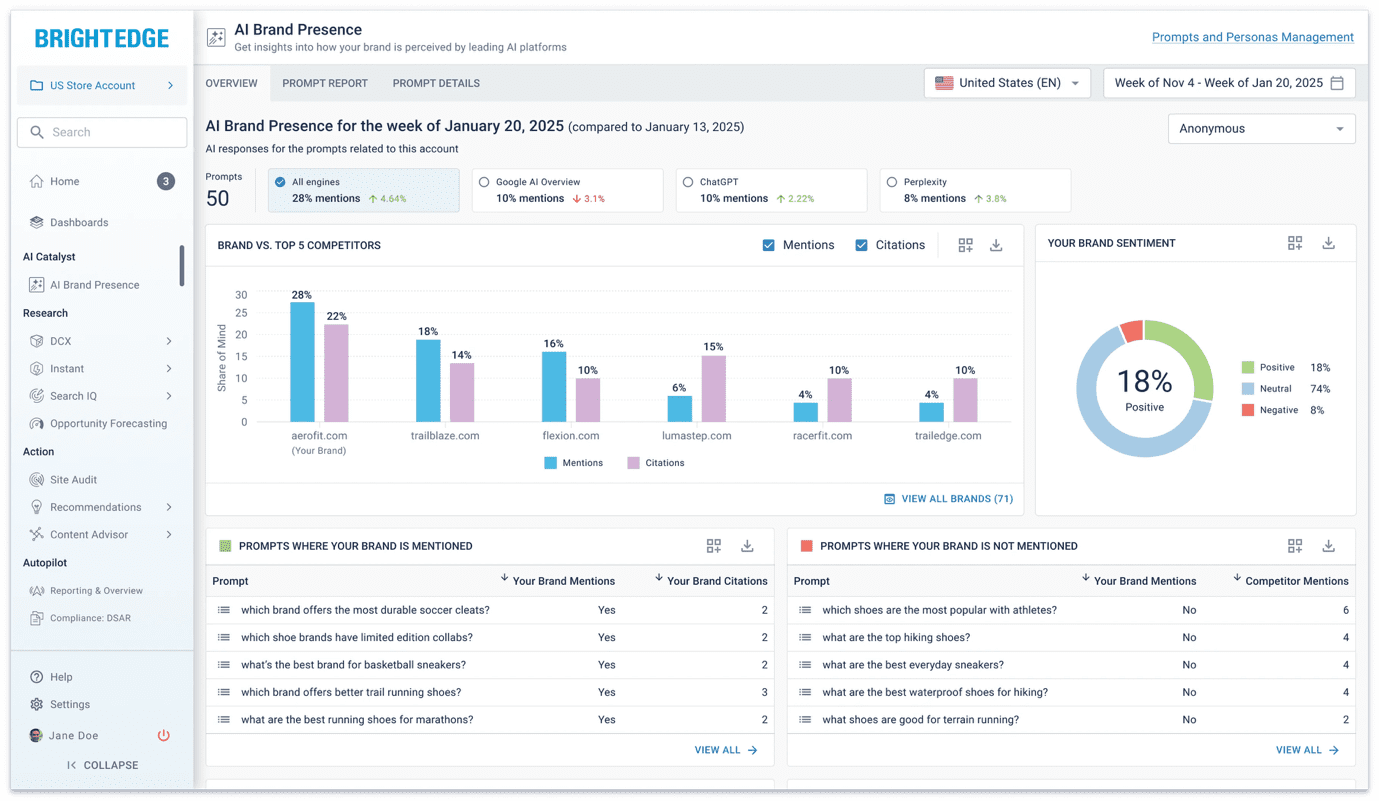
Here is an example from my company:

Source: BrightEdge, June 2025

This type of intelligence can inform you about what is happening now and what has happened in the past across all discovery channels.

Many types of business intelligence can help deliver digestible snapshots of the current state of your market, not just for SEO but also for digital, sales, product, and customer service functions.

Entity-Based SEO For AI Discovery Across All Verticals

Move beyond keywords to comprehensive topic authority, regardless of your industry.

AI prioritizes content from known, trusted entities, making authoritative content three times more likely to be cited in AI responses across B2B software, consumer electronics, fashion, healthcare, financial services, and every other vertical.

Implement robust schema markup, ensure consistent entity references across all digital properties, and build connections with recognized authorities in your space – whether that’s industry analysts, consumer advocates, or subject matter experts.

360-Degree AI Platform Strategy

Success requires presence and optimization across traditional search and every AI engine where your customers might discover solutions. This means:

  • Google Search & AI Overviews: Still the foundation with 90%+ market share.
  • ChatGPT: 21% growth rate, emphasis on conversational discovery.
  • Perplexity: Research-heavy platform with strong citation emphasis.
  • Vertical-specific AI: Industry tools, shopping assistants, and specialized platforms.
  • Social AI Integration: AI features within LinkedIn, TikTok, Instagram, and other social platforms.
  • Voice & Mobile AI: Alexa, Siri, Google Assistant across devices.

Consumer Intelligence Integration

Traditional search data must be combined with the following:

  • Social listening across AI-integrated platforms.
  • Review and rating sentiment from AI-crawled sources.
  • Purchase behavior data as it relates to AI recommendations.
  • Cross-platform brand mention analysis.
  • Consumer journey mapping across AI touchpoints.
  • Competitive intelligence from AI responses.

This approach reveals not just what consumers search for but how AI interprets and presents your brand across every possible discovery moment.

Mobile Vs. Desktop AI Optimization

Mobile and desktop AI Overviews aren’t just different sizes. They’re fundamentally different products targeting distinct user behaviors.

According to BrightEdge Generative Parser data from May and June 2025, these platforms serve different user intents and require tailored optimization strategies.

Key Mobile Vs. Desktop Differences:

Mobile Opportunities:

  • Ecommerce AIOs appear three times more often (13.5% vs 4.5% on desktop).
  • Mobile shows more size variability, suggesting Google is actively experimenting with format and content.
  • Users are in discovery/shopping mode, making mobile ideal for product research and comparison.

Desktop Patterns:

  • Takes 80% more screen space than mobile (1110 px vs. 617 px).
  • AIOs appear 39% more frequently than mobile.
  • More consistent, predictable sizing patterns.
  • Users want detailed, comprehensive information delivery.

As Jim Yu, CEO of BrightEdge, notes: “If marketers are not paying attention to how AI operates on different devices, they may be missing some key opportunities, especially in ecommerce!”

Read more: Newly Released Data Shows Desktop AI Search Referrals Dominate

Strategic Implications:

  • Mobile users require discovery-focused, shopping-oriented content optimization.
  • Desktop users need comprehensive, detailed information architectures.
  • Ecommerce brands must prioritize mobile-first AIO strategies.
  • Content strategy should consider device context alongside traditional keyword targeting.
  • Search marketers must ensure teams optimize for both user experiences simultaneously.

Vertical-Specific AI Optimization

Industry-specialized AI models are emerging for cybersecurity, manufacturing, fintech, and healthcare.

Content strategies must account for domain-specific AI companions that understand industry nuance and evaluate solutions using sector-appropriate criteria.

This can be visualized via daily dashboards, visualizations, and custom-based reports, and can be used to:

  1. Analyze industry trends in real-time across all AI platforms.
  2. Visualize category demand and inventory in real time.
  3. Compare historical data with current trends across traditional and AI search.
  4. Create and forecast based on predictive modeling that includes AI behavior patterns.
  5. Aggregate different sources of data from search engines and AI platforms.
  6. Identify new buyer trends across all customer segments.
  7. Monitor brand presence, perception, and performance.
  8. Find inefficiencies in product or pricing strategy based on AI recommendations.
  9. Identify key correlations between search activity and mentions of AI platforms.
  10. Plan across all discovery channels and map content to key AI touchpoints.
  11. Evaluate marketing campaign effectiveness across traditional and AI-driven channels.

Conclusion

Success in 2025’s marketing landscape requires understanding that AI isn’t just a channel. It’s becoming the primary interface between your brand and potential customers across every industry and buying scenario.

The organizations that master the MAP Framework (Mention, Authority, and Performance) while maintaining a 360-degree view across traditional search, AI engines, and consumer intelligence will be the ones AI recommends when it matters most.

The shift from traditional search to AI-powered discovery isn’t coming – it’s here.

Marketers across B2B, B2C, and D2C who embrace comprehensive AI intelligence tools, implement real-time monitoring across all platforms, and optimize for AI evaluation criteria will capture market opportunities.

In this new reality, staying attuned to the market means understanding not only what customers search for but also how AI interprets, evaluates, and presents your brand across every possible touchpoint.

The future belongs to brands that learn to collaborate with AI, guide its understanding across all platforms, and position themselves to stand out in an era where artificial intelligence often makes the first – and sometimes, final – impression, whether someone is buying enterprise software, choosing a restaurant, or selecting a healthcare provider.

Unless otherwise indicated, any data mentioned above was taken from this BrightEdge study

More Resources:


Featured Image: innni/Shutterstock

7 Ways to Prep for Holiday Selling

For retailers, holiday sales are too important to leave to guesswork. Last year’s data holds the key to a more profitable season this year.

So don’t wait. The dog days of summer are the right time to analyze last year’s Q4 results. Sales trends, campaign performance, and operational missteps all provide valuable insights that inform decisions.

Here are seven reminders to help plan effectively.

Illustration of bar graphs with Christmas items on top

Summer is the right time to analyze last year’s Q4 results.

Learn What Sold

Last year’s sales data reveals behavioral patterns: how shoppers responded to promotions, product launches, and site changes.

Review daily and weekly sales reports from October through December. Segment shoppers by device, location, and purchase date.

Look for sales spikes related to your marketing campaigns, categories, and products. Look also for missed opportunities, such as short-term sales slumps.

Use those learnings to schedule promotional periods and plan inventory. Replicate or even double down on what worked.

Know Top Channels

Next, analyze last year’s website traffic.

Perhaps most sales happened on mobile, but that is relatively less impressive if 90% of all site traffic was also mobile. The point being that not all ecommerce web traffic converts equally.

Learn which high-volume sources did not convert well, to improve this year.

Conversely, figure out which traffic sources had the best conversion rate. For example, if email marketing converted the best, start growing the list this summer.

Measure ROAS

Many B2C ecommerce businesses spend most of their annual advertising budget during the Christmas season. Knowing the top-converting channels leads to identifying the most profitable advertising campaigns.

Return on advertising spend is the ratio of dollars invested in a specific ad to the revenue or profit it generated. A campaign costing $100 and generating $400 in profit had an ROAS of 4:1 or 4x.

Perhaps you acquired one-time gift buyers via TikTok for $3 each, but spent $4 to acquire shoppers from YouTube, with a higher lifetime value.

Prioritize high-ROAS campaigns early in Q4. Scale back ineffective placements and, when suitable, negotiate performance-based advertising now.

Find Profitable Products

The mix of holiday products impacts profits. Slow-moving items tie up capital and often generate returns and support issues.

SKUs that sold in small quantities but had excellent conversion rates and low returns could likely benefit from more promotion.

Focus on proven sellers when ordering holiday inventory. Phase out low-margin or high-friction products. Some print-on-demand shops, for example, might decide to carry inventory for top sellers rather than wait for week-long production schedules.

Review Shipping Performance

Shipping errors and delays cost money, create churn, and destroy trust, especially during the gift-giving season. Customers hold the seller responsible even if it used a third-party fulfillment service.

Review warehouse performance logs, carrier tracking data, third-party shipping dashboards, and “where is my order?” requests. Identify:

  • Order-to-ship times across peak dates,
  • Product picking accuracy,
  • Delayed shipments,
  • Damaged shipments.

Some order management tools report shipping performance metrics. Regardless, last year’s fulfillment should inform shipping cut-off dates, staffing levels, carrier selection, and more.

Consider Customer Service

Customer service requests often reveal friction points in your store’s purchase flows and operations. Resolving these glitches once and for all could materially improve holiday profits.

Look at the volume of support requests by theme and date. Identify complaints associated with specific marketing campaigns, offers, or products.

Were shoppers confused about sizes? Did the “buy three items and get free shipping” offer cause consternation? Did the cryptic promo code create problems?

Identify items or offers that triggered support tickets and remove them from gift guides or sitewide promos.

Check for Refunds, Returns

Most holiday gift recipients return or exchange an unwanted item. Maybe the product did not fit well. It might have been a duplicate. Or perhaps the recipient just didn’t like it.

Check returns and refunds by product, channel, and date. Differentiate, when possible, between likely gift items and personal-use purchases.

Analyze whether returns resulted from a practice of your business.

This battery recycling company is now cleaning up AI data centers

In a sandy industrial lot outside Reno, Nevada, rows of battery packs that once propelled electric vehicles are now powering a small AI data center.

Redwood Materials, one of the US’s largest battery recycling companies, showed off this array of energy storage modules, sitting on cinder blocks and wrapped in waterproof plastic, during a press tour at its headquarters on June 26. 

The event marked the launch of the company’s new business line, Redwood Energy, which will initially repurpose (rather than recycle) batteries with years of remaining life to create renewable-powered microgrids. Such small-scale energy systems can operate on or off the larger electricity grid, providing electricity for businesses or communities.

Redwood Materials says many of the batteries it takes in for processing retain more than half their capacity. 

“We can extract a lot more value from that material by using it as an energy storage project before recycling it,” JB Straubel, Redwood’s founder and chief executive, said at the event. 

This first microgrid, housed at the company’s facility in the Tahoe Reno Industrial Center, is powered by solar panels and capable of generating 64 megawatt-hours of electricity, making it one of the nation’s largest such systems. That power flows to Crusoe, a cryptocurrency miner that pivoted into developing AI data centers, which has built a facility with 2,000 graphics processing units adjacent to the lot of repurposed EV batteries. 

(That’s tiny as modern data centers go: Crusoe is developing a $500 billion AI data center for OpenAI and others in Abilene, Texas, where it expects to install 100,000 GPUs across its first two facilities by the end of the year, according to Forbes.)

Redwood’s project underscores a growing interest in powering data centers partially or entirely outside the electric grid. Not only would such microgrids be quicker to build than conventional power plants, but consumer ratepayers wouldn’t be on the hook for the cost of new grid-connected power plants developed to serve AI data centers. 

Since Redwood’s batteries are used, and have already been removed from vehicles, the company says its microgrids should also be substantially cheaper than ones assembled from new batteries.

A close up of grid of battery packs from Redwood Materials.

COURTESY REDWOOD MATERIALS

Redwood Energy’s microgrids could generate electricity for any kind of operation. But the company stresses they’re an ideal fit for addressing the growing energy needs and climate emissions of data centers. The energy consumption of such facilities could double by 2030, mainly due to the ravenous appetite of AI, according to an April report by the International Energy Agency.

“Storage is this perfectly positioned technology, especially low-cost storage, to attack each of those problems,” Straubel says.

The Tahoe Reno Industrial Center is the epicenter of a data center development boom in northern Nevada that has sparked growing concerns about climate emissions and excessive demand for energy and water, as MIT Technology Review recently reported.

Straubel says the litany of data centers emerging around it “would be logical targets” for its new business line, but adds there are growth opportunities across the expanding data center clusters in Texas, Virginia, and the Midwest as well.

“We’re talking to a broad cross section of those companies,” he says.

Crusoe, which also provides cloud services, recently announced a joint venture with the investment firm Engine No. 1 to provide “powered data center real estate solutions” to AI companies by constructing 4.5 gigawatts of new natural-gas plants.

Redwood’s microgrid should provide more than 99% of the electricity Crusoe’s local facilities need. In the event of extended periods with little sunlight, a rarity in the Nevada desert, the company could still draw from the standard power grid.

Cully Cavness, cofounder and operating chief of Crusoe, says the company is already processing AI queries and producing conclusions for its customers at the Nevada facility. (Its larger data centers are dedicated to the more computationally intensive process of training AI models.)

Redwood’s new business division offers a test case for a strategy laid out in a paper late last year, which highlighted the potential for solar-powered microgrids to supply the energy that AI data centers need.

The authors of that paper found that microgrids could be built much faster than natural-gas plants and would generally be only a little more expensive as an energy source for data centers, so long as the facilities could occasionally rely on natural-gas generators to get them through extended periods of low sunlight.

If solar-powered microgrids were used to power 30 gigawatts of new AI data centers, with just 10% backup from natural gas, it would eliminate 400 million tons of carbon dioxide emissions relative to running the centers entirely on natural gas, the study found. 

“Having a data center running off solar and storage is more or less what we were advocating for in our paper,” says Zeke Hausfather, climate lead at the payments company Stripe and a coauthor of the paper. He hopes that Redwood’s new microgrid will establish that “these sorts of systems work in the real world” and encourage other data center developers to look for similar solutions. 

Redwood Materials says electric vehicles are its fastest-growing source of used batteries, and it estimates that more than 100,000 EVs will come off US roads this year.

The company says it tests each battery to determine whether it can be reused. Those that qualify will be integrated into its modular storage systems, which can then store up energy from wind and solar installations or connect to the grid. As those batteries reach the end of their life, they’ll be swapped out of the microgrids and moved into the company’s recycling process. 

Redwood says it already has enough reusable batteries to build a gigawatt-hour’s worth of microgrids, capable of powering a little more than a million homes for an hour. In addition, the company’s new division has begun designing microgrids that are 10 times larger than the one it unveiled this week.

Straubel expects Redwood Energy to become a major business line, conceivably surpassing the company’s core recycling operation someday.

“We’re confident this is the lowest-cost solution out there,” he says.

We’re learning more about what weight-loss drugs do to the body

Weight-loss drugs are this decade’s blockbuster medicines. Drugs like Ozempic, Wegovy, and Mounjaro help people with diabetes get their blood sugar under control and help overweight and obese people reach a healthier weight. And they’re fast becoming a trendy must-have for celebrities and other figure-conscious individuals looking to trim down.

They became so hugely popular so quickly that not long after their approval for weight loss, we saw global shortages of the drugs. Prescriptions have soared over the last five years, but even people who don’t have prescriptions are seeking these drugs out online. A 2024 health tracking poll by KFF found that around 1 in 8 US adults said they had taken one.

We know they can suppress appetite, lower blood sugar, and lead to dramatic weight loss. We also know that they come with side effects, which can include nausea, diarrhea, and vomiting. But we are still learning about some of their other effects.

On the one hand, these seemingly miraculous drugs appear to improve health in other ways, helping to protect against heart failure, kidney disease, and potentially even substance-use disorders, neurodegenerative diseases, and cancer.

But on the other, they appear to be harmful to some people. Their use has been linked to serious conditions, pregnancy complications, and even some deaths. This week let’s take a look at what weight-loss drugs can do.

Ozempic, Wegovy, and other similar drugs are known as GLP-1 agonists; they mimic a chemical made in the intestine, GLP-1, that increases insulin and lowers blood levels of glucose. Originally developed to treat diabetes, they are now known to be phenomenal at suppressing appetite. One key trial, published in 2015, found that over the course of around a year, people who took one particular drug lost between around 4.7% and 6% of their body weight, depending on the dose they took.

Newer versions of that drug were shown to have even bigger effects. A 2021 trial of semaglutide—the active ingredient in both Ozempic and Wegovy—found that people who took it for 68 weeks lost around 15% of their body weight—equivalent to around 15 kilograms.

But there appear to be other benefits, too. In 2024, an enormous study that included 17,604 people in 41 countries found that semaglutide appeared to reduce heart failure in people who were overweight or obese and had cardiovascular disease. That same year, the US approved Wegovy to “reduce the risk of cardiovascular death, heart attack, and stroke in [overweight] adults with cardiovascular disease.” This year, Ozempic was approved to reduce the risk of kidney disease.

And it doesn’t end there. The many users of GLP-1 agonists have been reporting some unexpected positive side effects. Not only are they less interested in food, but they are less interested in alcohol, tobacco, opioids, and other addictive substances.

Research suggests they might protect men from prostate cancer. They might help treat osteoarthritis. Some scientists think the drugs could be used to treat a range of pain conditions, and potentially help people with migraine. And some even seem to protect brain cells from damage in lab studies, and they are being explored as potential treatments for neurological disorders like Alzheimer’s and Parkinson’s (although we don’t yet have any evidence they can be useful here).

The more we learn about GLP-1 agonists, the more miraculous they seem to be. What can’t they do?! you might wonder. Unfortunately, like any drug, GLP-1 agonists carry safety warnings. They can often cause nausea, vomiting, and diarrhea ,and their use has also been linked to inflammation of the pancreas—a condition that can be fatal. They increase the risk of gall bladder disease.

There are other concerns. Weight-loss drugs can help people trim down on fat, but lean muscle can make up around 10% of the body weight lost by people taking them. That muscle is important, especially as we get older. Muscle loss can affect strength and mobility, and it also can also leave people more vulnerable to falls, which are the second leading cause of unintentional injury deaths worldwide, according to the World Health Organization.

And, as with most drugs, we don’t fully understand the effects weight-loss drugs might have in pregnancy. That’s important; even though the drugs are not recommended during pregnancy, health agencies point out that some people who take these drugs might be more likely to get pregnant, perhaps because they interfere with the effects of contraceptive drugs.

And we don’t really know how they might affect the development of a fetus, if at all. A study published in January found that people who took the drugs either before or during pregnancy didn’t seem to face increased risk of birth defects. But other research due to be presented at a conference in the coming days found that such individuals were more likely to experience obstetrical complications and preeclampsia.

So yes, while the drugs are incredibly helpful for many people, they are not for everyone. It might be fashionable to be thin, but it’s not necessarily healthy. No drug comes without risks. Even one that 1 in 8 American adults have taken.

This article first appeared in The Checkup, MIT Technology Review’s weekly biotech newsletter. To receive it in your inbox every Thursday, and read articles like this first, sign up here.

The Download: how to clean up AI data centers, and weight-loss drugs’ side effects

This is today’s edition of The Download, our weekday newsletter that provides a daily dose of what’s going on in the world of technology.

This battery recycling company is now cleaning up AI data centers

In a sandy industrial lot outside Reno, Nevada, rows of battery packs that once propelled electric vehicles are now powering a small AI data center.

Redwood Materials, one of the US’s largest battery recycling companies, showed off this array of energy storage modules, sitting on cinder blocks and wrapped in waterproof plastic, during a press tour at its headquarters on June 26.

The event marked the launch of the company’s new business line, Redwood Energy, which will initially repurpose (rather than recycle) batteries with years of remaining life to create renewable-powered microgrids. Such small-scale energy systems can operate on or off the larger electricity grid, providing electricity for businesses or communities. Read the full story.

—James Temple

We’re learning more about what weight-loss drugs do to the body

Weight-loss drugs are this decade’s blockbuster medicines. Drugs like Ozempic, Wegovy, and Mounjaro help people with diabetes get their blood sugar under control and help overweight and obese people reach a healthier weight. And they’re fast becoming a trendy must-have for celebrities and other figure-conscious individuals looking to trim down.

They became so hugely popular so quickly that not long after their approval for weight loss, we saw global shortages of the drugs. Prescriptions have soared over the last five years, but even people who don’t have prescriptions are seeking these drugs out online.

We know they can suppress appetite, lower blood sugar, and lead to dramatic weight loss. We also know that they come with side effects, which can include nausea, diarrhea, and vomiting. But we are still learning about some of their other effects. Read the full story.

—Jessica Hamzelou

This article first appeared in The Checkup, MIT Technology Review’s weekly biotech newsletter. To receive it in your inbox every Thursday, and read articles like this first, sign up here.

The must-reads

I’ve combed the internet to find you today’s most fun/important/scary/fascinating stories about technology.

1 The Supreme Court has paved the way to defund Planned Parenthood 
By allowing South Carolina to block the organization from its Medicaid program. (WP $)
+ Other red states are likely to follow suit. (CNN)
+ Planned Parenthood may be able to challenge the ban under state law. (Politico)

2 Iran is back online
The country appeared to cut connectivity in a bid to thwart foreign attacks. (Economist $)

3 ICE is using a new facial recognition app
It’s capable of recognizing someone from their fingerprints, too. (404 Media)
+ How a new type of AI is helping police skirt facial recognition bans. (MIT Technology Review)

4 Denmark has a potential solution for malicious deepfakes
By giving its residents copyright to their own body, facial features, and voice. (The Guardian)
+ An AI startup made a hyperrealistic deepfake of me that’s so good it’s scary. (MIT Technology Review)

5 Impossible Foods wants to bring its plant-based burgers to Europe 🍔
After sales started falling in America. (Bloomberg $)
+ Sales of regular old meat are booming in the States. (Vox)

6 The Three Mile Island nuclear plant’s restart is being fast tracked
It’s currently scheduled to start operating a year earlier than anticipated. (Reuters)
+ But bringing the reactor back online is no easy task. (The Register)
+ Why Microsoft made a deal to help restart Three Mile Island. (MIT Technology Review)

7 AI may be making research too easy
New research suggests that using LLMs results in weaker grasps of topics. (WSJ $)
+ It could also be making our thoughts less original. (New Yorker $)

8 Climate tech companies are struggling to weather Trump’s cuts
A lot of startups are expected to fold as a result. (Insider $)
+ The Trump administration has shut down more than 100 climate studies. (MIT Technology Review)

9 Billions of Facebook and Google passwords have been leaked
And people in developing nations are most at risk. (Rest of World)

10 Inside a couples retreat with humans and their AI companions
Chaos ensured. (Wired $)
+ The AI relationship revolution is already here. (MIT Technology Review)

Quote of the day

“[The internet blackout] makes us invisible. And still, we’re here. Still trying to connect with the free world.”

—’Amir,’ a student in Iran, tells the Guardian why young Iranians are working to overcome the country’s internet shutdowns.

One more thing

Maybe you will be able to live past 122

How long can humans live? This is a good time to ask the question. The longevity scene is having a moment, thanks to a combination of scientific advances, public interest, and an unprecedented level of investment. A few key areas of research suggest that we might be able to push human life spans further, and potentially reverse at least some signs of aging.

Researchers can’t even agree on what the exact mechanisms of aging are and which they should be targeting. Debates continue to rage over how long it’s possible for humans to live—and whether there is a limit at all.

But it looks likely that something will be developed in the coming decades that will help us live longer, in better health. Read the full story.

—Jessica Hamzelou

We can still have nice things

A place for comfort, fun and distraction to brighten up your day. (Got any ideas? Drop me a line or skeet ’em at me.)

+ This ancient amphibian skull is pretty remarkable.
+ A new Phantom of the Opera spin-off is coming—but no one really knows what it is.
+ Stop panicking, it turns out Marge Simpson isn’t dead after all.
+ I love these owls in towels 🦉

Ecommerce to Real Estate: An Owner’s Story

Shakil Prasla once owned 12 ecommerce consumer brands generating $50 million in combined annual revenue with 50 employees. But he grew weary of the fluctuating revenue and non-stop marketing, so he pivoted during Covid to wholesale personal protective equipment.

That’s when he and I last spoke. The PPE business, Gloves.com, had misgauged demand and lost, initially, a whopping $6 million. He has since recovered and pivoted again, this time to real estate and convenience-store gas stations.

He’s an example of resilience, priorities, and seizing opportunities. He shared those lessons and more in this our latest conversation.

Our entire audio is embedded below. The transcript is condensed and edited for clarity.

Eric Bandholz: Give us a rundown of what you do.

Shakil Prasla: I own Gloves.com. We primarily sell disposable protective gloves for medical, food service, and other industries, mostly wholesale. We import from overseas, store our inventory in warehouses, and have a team of sales representatives who build relationships and sell to large distributors, such as Sysco.

Sysco, in turn, supplies restaurants and businesses like McDonald’s and Taco Bell. Orders flow through backend integrations, and while we use automation, we’re essentially a logistics company: importing, storing, and distributing goods.

I acquired the business with a private equity group. The brand has been around for over 30 years, so it came with an established sales history. When evaluating it, we looked at total market share — disposable gloves are a surprisingly massive, multi-billion-dollar industry. They’re used everywhere: hospitals, nail salons, barber shops, grocery stores, even gardening.

While gloves are our core offering, we also provide other disposable wearables, such as bouffant caps and beard covers. What I learned from ecommerce is that consumables drive strong repeat business. Customers reorder when they run out, which increases lifetime value and makes the business model attractive.

I bought my first online business in 2013, before acquiring ecommerce brands was popular. I enjoyed improving and growing them. By 2018, I owned 12 brands, generating over $50 million in annual revenue with more than 50 employees.

During Covid, I sold most of my brands and transitioned into wholesale distribution of personal protective equipment. Now, I’m also involved in real estate — buying land, building strip centers, and gas stations around Austin, Texas.

Bandholz: You scaled this business quite a bit.

Prasla: We acquired the company with just the inventory — no team, no tech — so we had to rebuild it from the ground up. Fortunately, it had been a large business with strong brand recognition, so we focused on the low-hanging fruit: reactivating old customers.

We reached out to clients from 15 to 20 years ago and informed them that the brand had new ownership, improved service, and the same trusted products. We addressed past issues and emphasized improvements — faster shipping, better pricing, and consistent product quality. That approach worked well, and many customers returned.

Unlike ecommerce, where you’re constantly running ads on Facebook, Google, TikTok, and writing emails, we don’t rely on traditional marketing. Our sales reps do the marketing. They follow KPIs, and their bonuses are tied to performance. That incentive structure has been a key driver of our growth.

Bandholz: How do you find operators and get aligned so they can thrive and help scale the business?

Prasla: I realized early on that operations aren’t my strength — I get bored by the day-to-day details. Back in my ecommerce days, I started outsourcing operations. I hired someone from what was then oDesk (now Upwork) to handle customer service, agency calls, and other tasks. At first, it was messy because I didn’t have proper operating procedures, but I refined the process over time.

Finding great people is hard. A one-hour interview isn’t enough. Candidates are selling themselves, and what they present isn’t always accurate. So there’s a trial-and-error phase.

Today, we use staffing agencies, LinkedIn, and platforms like Monster. My human resources team handles job postings, and we make sure to clearly outline the role — for example, “I need a leader to run a nine-figure business and inspire sales reps.” That clarity helps attract the right people.

Incentives are also critical. Some candidates seek a stable income, while others prefer a lower base pay with high performance bonuses. I try to understand what motivates them and tailor compensation accordingly.

To filter applicants, we include a short questionnaire: “If you were running this company, how would you grow it?” Only thoughtful responses move forward. Then our team conducts interviews, and I speak with the final candidates. That’s the process that’s worked for me.

Bandholz: What is your relationship with the CEOs?

Prasla: I keep it simple. One 30-minute call per week, focused on high-level strategy. We review a dashboard with key metrics, including revenue, what’s working, what’s not, and where the opportunities lie. I get the agenda in advance, and we stick to it.

I don’t micromanage. My job is to empower, not control. I give CEOs guardrails — for example, “Let’s grow from $1 million to $1.2 million this year.” Then I ask how they plan to do it. They break it down into quarterly and monthly KPIs. Maybe the goal is to increase conversion from 1% to 1.5% through home page A/B testing. I guide the direction, but they own the execution.

That ownership is key. When they create the plan, they’re more committed to achieving it.

Compensation for a seven- or eight-figure company typically includes a base salary ranging from $150,000 to $300,000, plus phantom equity that vests over time, profit sharing, and performance bonuses.

If my CEO brings in an extra $1 million in value, I’m happy to share in that. It’s about alignment — when they win, we all win.

Bandholz: Tell us about the shift into real estate and convenience stores, and getting into strip malls.

Prasla: My move into real estate came from two things I noticed in ecommerce. First, the ecommerce revenue was unpredictable. One month it would be up, the next it would drop due to factors such as algorithm changes, underperforming ads, or supply chain issues. It was stressful, and I wanted more stability. Second, I wanted to build long-term wealth through equity, not just profit. Real estate gave me both.

It’s been a fun challenge. I enjoy negotiating land deals and working with brokers, developers, and banks. Once I find a property, the real planning begins — figuring out the building footprint, engineering, architecture, and sometimes dealing with environmental or access issues. It’s rewarding to see a project come to life from the ground up.

I’m not the general contractor — I hire one to manage all the subcontractors, including plumbing, roofing, MEP, and foundation, among others. We also work with about 20 professionals per project, including architects, engineers, and traffic consultants. Financing typically requires a down payment of 20–35%. After construction and getting a certificate of occupancy, it takes about six months to stabilize.

This isn’t a flip strategy for me — I plan to hold the properties long term. Traffic at busy intersections brings consistent footfall, unlike the volatility of ecommerce.

After years of grinding, experiencing burnout, and incurring some losses driven by ego, I’ve reevaluated what truly matters. I have two young kids, and now my priority is time — being present. I built a stable financial base, and now I’m focused on enjoying the next chapter.

Bandholz: Where can people find you?

Prasla: Gloves.com is our business for disposable products. Our convenience stores — called Snack Stop  — are in Austin, Texas, where I live. I’m on LinkedIn.

Google’s New MUVERA Algorithm Improves Search via @sejournal, @martinibuster

Google announced a new multi-vector retrieval algorithm called MUVERA that speeds up retrieval and ranking, and improves accuracy. The algorithm can be used for search, recommender systems (like YouTube), and for natural language processing (NLP).

Although the announcement did not explicitly say that it is being used in search, the research paper makes it clear that MUVERA enables efficient multi-vector retrieval at web scale, particularly by making it compatible with existing infrastructure (via MIPS) and reducing latency and memory footprint.

Vector Embedding In Search

Vector embedding is a multidimensional representation of the relationships between words, topics and phrases. It enables machines to understand similarity through patterns such as words that appear within the same context or phrases that mean the same things. Words and phrases that are related occupy spaces that are closer to each other.

  • The words “King Lear” will be close to the phrase “Shakespeare tragedy.”
  • The words “A Midsummer Night’s Dream” will occupy a space close to “Shakespeare comedy.”
  • Both “King Lear” and “A Midsummer Night’s Dream” will be located in a space close to Shakespeare.

The distances between words, phrases and concepts (technically a mathematical similarity measure) define how closely related each one is to the other. These patterns enable a machine to infer similarities between them.

MUVERA Solves Inherent Problem Of Multi-Vector Embeddings

The MUVERA research paper states that neural embeddings have been a feature of information retrieval for ten years and cites the ColBERT multi-vector model research paper from 2020 as a breakthrough but that says that it suffers from a bottleneck that makes it less than ideal.

“Recently, beginning with the landmark ColBERT paper, multi-vector models, which produce a set of embedding per data point, have achieved markedly superior performance for IR tasks. Unfortunately, using these models for IR is computationally expensive due to the increased complexity of multi-vector retrieval and scoring.”

Google’s announcement of MUVERA echoes those downsides:

“… recent advances, particularly the introduction of multi-vector models like ColBERT, have demonstrated significantly improved performance in IR tasks. While this multi-vector approach boosts accuracy and enables retrieving more relevant documents, it introduces substantial computational challenges. In particular, the increased number of embeddings and the complexity of multi-vector similarity scoring make retrieval significantly more expensive.”

Could Be A Successor To Google’s RankEmbed Technology?

The United States Department of Justice (DOJ) antitrust lawsuit resulted in testimony that revealed that one of the signals used to create the search engine results pages (SERPs) is called RankEmbed, which was described like this:

“RankEmbed is a dual encoder model that embeds both query and document into embedding space. Embedding space considers semantic properties of query and document in addition to other signals. Retrieval and ranking are then a dot product (distance measure in the embedding space)… Extremely fast; high quality on common queries but can perform poorly for tail queries…”

MUVERA is a technical advancement that addresses the performance and scaling limitations of multi-vector systems, which themselves are a step beyond dual-encoder models (like RankEmbed), providing greater semantic depth and handling of tail query performance.

The breakthrough is a technique called Fixed Dimensional Encoding (FDE), which divides the embedding space into sections and combines the vectors that fall into each section to create a single, fixed-length vector, making it faster to search than comparing multiple vectors. This allows multi-vector models to be used efficiently at scale, improving retrieval speed without sacrificing the accuracy that comes from richer semantic representation.

According to the announcement:

“Unlike single-vector embeddings, multi-vector models represent each data point with a set of embeddings, and leverage more sophisticated similarity functions that can capture richer relationships between datapoints.

While this multi-vector approach boosts accuracy and enables retrieving more relevant documents, it introduces substantial computational challenges. In particular, the increased number of embeddings and the complexity of multi-vector similarity scoring make retrieval significantly more expensive.

In ‘MUVERA: Multi-Vector Retrieval via Fixed Dimensional Encodings’, we introduce a novel multi-vector retrieval algorithm designed to bridge the efficiency gap between single- and multi-vector retrieval.

…This new approach allows us to leverage the highly-optimized MIPS algorithms to retrieve an initial set of candidates that can then be re-ranked with the exact multi-vector similarity, thereby enabling efficient multi-vector retrieval without sacrificing accuracy.”

Multi-vector models can provide more accurate answers than dual-encoder models but this accuracy comes at the cost of intensive compute demands. MUVERA solves the complexity issues of multi-vector models, thereby creating a way to achieve greater accuracy of multi-vector approaches without the the high computing demands.

What Does This Mean For SEO?

MUVERA shows how modern search ranking increasingly depends on similarity judgments rather than old-fashioned keyword signals that SEO tools and SEOs are often focused on. SEOs and publishers may wish to shift their attention from exact phrase matching toward aligning with the overall context and intent of the query. For example, when someone searches for “corduroy jackets men’s medium,” a system using MUVERA-like retrieval is more likely to rank pages that actually offer those products, not pages that simply mention “corduroy jackets” and include the word “medium” in an attempt to match the query.

Read Google’s announcement:

MUVERA: Making multi-vector retrieval as fast as single-vector search

Featured Image by Shutterstock/bluestork

YouTube Tests AI Features To Improve Search & Discovery via @sejournal, @MattGSouthern

YouTube is rolling out two AI-driven features designed to enhance content discovery and deepen user engagement.

The experimental tools include an AI-powered search results carousel for Premium users and a conversational AI assistant now expanding to some non-Premium accounts in the U.S.

AI Search Results Carousel (Premium Only)

Premium subscribers in the U.S. can now access an AI-generated search results carousel for select query types.

The carousel surfaces curated video suggestions along with brief topic descriptions, helping users explore subjects more efficiently.

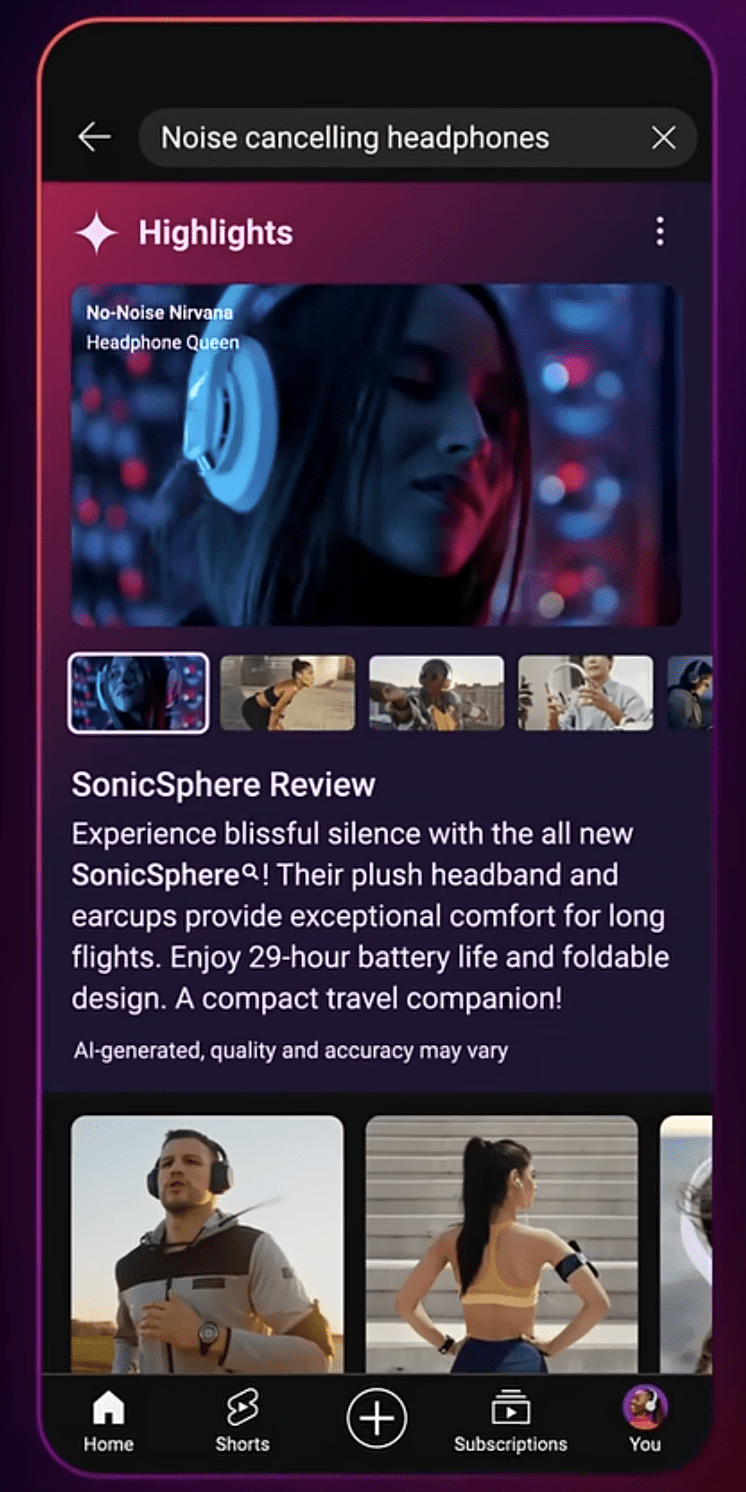
For example, searching for “best noise canceling headphones” might trigger a carousel like the one you see below:

Screenshot from: YouTube, June 2025.

This experimental feature:

  • Supports English-language videos
  • Focuses on shopping, travel, and local activities
  • Is available on iOS and Android
  • Will run through July 30

Conversational AI Assistant Expands

YouTube’s conversational AI tool, previously available only to Premium users, is now being tested with select non-Premium accounts in the U.S.

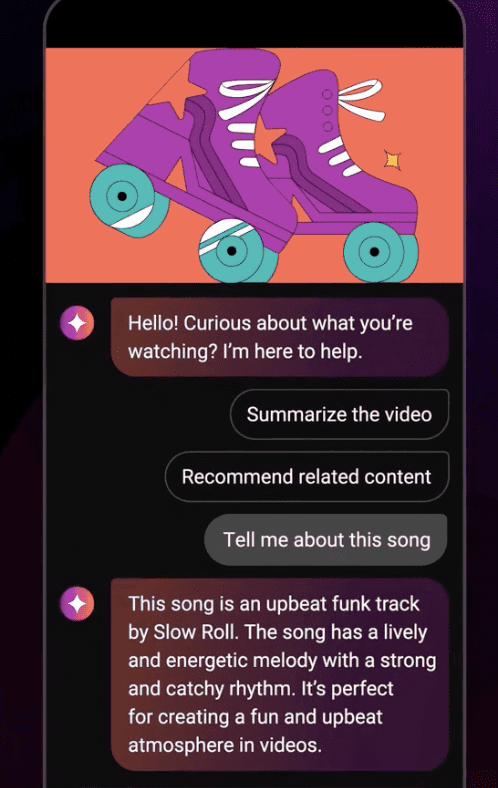
The tool allows users to:

  • Ask questions about the video they’re watching
  • Get recommendations
  • Quiz themselves on key concepts in educational videos
Screenshot from: YouTube, June 2025.

Implications for Creators and Marketers

Videos related to shopping, travel, or local activities may benefit from prominent placement in AI-curated carousels.

The focus on commercially relevant search types aligns with content that often drives conversions, making this a potentially valuable for affiliate marketers and small businesses.

While promising, both tools are being deployed with restrictions. The carousel is exclusive to Premium members and only supports a narrow range of queries. The conversational tool remains in limited testing with no timeline for wider release.

These limitations suggest that YouTube is still in the data-gathering phase, evaluating how users interact with AI-generated suggestions and whether these tools improve search satisfaction.

Looking Ahead

As YouTube experiments with AI in discovery and learning, creators should focus on producing content that is topically rich and well-structured, especially in categories such as shopping and travel.

Expect further refinements as YouTube incorporates user feedback ahead of potential broader adoption.

Mastering Local SEO: A Strategic Imperative For Travel And Tourism Operators via @sejournal, @JRiddall

The travel and tourism industry thrives on inspiration, discovery, and experience. While increasingly being challenged by social media and friend & family referrals, the first point of discovery for many travelers is still a search engine.

For operators in this competitive sector, ranging from boutique hotels and niche tour providers to vacation rental property owners and managers, as well as local attractions, a commanding online presence isn’t just beneficial – it’s fundamental to survival and growth.

This is where Local SEO emerges as a critical driver, connecting businesses with high-intent travelers actively seeking their next destination or experience.

As the search journey includes more AI-driven results, a sophisticated and adaptive Local SEO strategy is crucial.

This guide will navigate the essentials of Local SEO tailored for travel and tourism, incorporating strategies to thrive in the era of Google’s AI Overviews and other AI search platforms.

We’ll explore established best practices and new frontiers to help you enhance visibility, attract qualified leads, and convert searches into bookings.

Why Local SEO Is Non-Negotiable For Your Travel Business

Today’s travelers are digital nomads even before they pack their bags. They meticulously research, compare, and seek out authentic local experiences, with search engines as their primary guide.

A staggering 87% of consumers used Google to evaluate local businesses in 2022, according to BrightLocal, and this trend is particularly pronounced in the travel sector.

A robust Local SEO strategy ensures your offerings are prominent when potential customers conduct geographically specific searches. Consider these compelling reasons:

Hyper-Targeted Visibility

Local SEO puts your business in front of users searching for “boutique hotels in downtown Austin” or “eco-tours near me,” connecting you with an audience demonstrating clear local intent.

Increased Organic Traffic & Direct Bookings

Higher visibility in local search translates to more qualified traffic to your website, reducing reliance on commission-heavy Online Travel Agencies (OTAs).

Enhanced Credibility And Trust

Businesses appearing in top local search results, especially those with strong reviews, are perceived as more trustworthy. Indeed, according to Expedia group, studies show that 95% of travelers read reviews before booking

Competitive Edge

In a crowded marketplace, a sophisticated Local SEO strategy will differentiate your unique local offerings from larger, and perhaps less localized competitors.

Cost-Effectiveness

Compared to paid advertising, organic Local SEO can deliver a higher return on investment (ROI) over the long term by building sustainable visibility.

Building A Future-Proof Local SEO Strategy For Travel

To maximize visibility and capture the attention of modern travelers, operators must build their SEO strategy on several key pillars:

An Optimized Google Business Profile (GBP)

For businesses with a physical presence or those catering to broader service areas, a Google Business Profile is arguably the most potent Local SEO tool currently available.

It’s often the first interaction a potential customer has with a brand online, as Google Maps appears at the top of most local searches.

Here are the key GBP best practices you need to implement to leverage this important channel.

  • NAP Optimization: Claim and thoroughly complete your GBP listing. Ensure the accuracy of your business Name, Address (or service area), Phone number (NAP), website, hours, and a compelling, keyword-rich description.
  • Precise Categorization: Select the most accurate primary and secondary categories truly reflecting your business’s services, e.g., “Boutique Hotel,” “Adventure Tour Operator,” “Vacation Rental Agency.”
  • Service Area Definition: For businesses without a fixed customer-facing location (like tour operators) or those serving a broader region, accurately define your service areas. Google advises that this shouldn’t exceed a 2-hour drive from your base. If you serve an area beyond this 2-hour range, you will need to find ways to convince Google via reviews from customers located in the broader area, local partnerships, or perhaps establishing an actual satellite location.
  • Visual Storytelling: Invest in and share professional, high-resolution photos and videos of your business, properties, tours, amenities, local ambiance, guest experiences, team, etc.
  • Active Engagement via GBP Posts: Regularly use GBP posts to share updates, special offers, upcoming events, new blog content, and local insights. This signals to Google that your business is active and engaged in your community.
  • Review Management: Ask for and monitor customer reviews on GBP. Respond promptly and professionally to all reviews. This not only impacts rankings, but can also heavily influence booking decisions – 76% of consumers would update their negative review to a neutral or positive if a company acknowledged and fixed the complaint. Larger organizations with review volume across multiple locations will want to consider centralized and automated review management solutions such as BirdEye or BrightLocal.
  • Proactive Q&A Management: Monitor and answer questions in the GBP Q&A section to provide valuable information and manage customer perceptions.

Maintain A High-Performance, Locally Optimized Website

Your website is your digital flagship, where inspiration meets transaction.

Websites remain a core focus for all businesses because they are still the place where primary product and service content is housed, as well as for travel businesses where bookings begin, even if they are ultimately completed off-site.

Several components are involved in optimizing a site for local search.

Strategic Keyword Research

Identify terms your target audience uses at each stage of the travel planning funnel, and particularly those used during the Engage and Booking stages.

Focus on location-specific queries (“luxury safari tours Kenya”), property types (“beachfront villas Maui”), and unique selling propositions (“pet-friendly cabins in the Blue Ridge Mountains”).

On-Page Optimization

Craft unique, keyword-rich Title tags, hierarchical heading structures, and internal/external links for every key bottom-of-the-funnel page.

Review keyword rank, search volume, organic search traffic, and conversion data to determine the primary pages to focus on.

Larger organizations will want to take a broader, scalable approach with page templates, but will still hone attention and focus on key locations where some level of authority and visibility has already been established, upon which momentum can be built.

Dedicated Location/Service Pages

If you cater to multiple distinct areas or offer specialized tours/services per location, create unique, detailed landing pages for each location.

These pages should include unique localized content (particularly if services or products differ by location), local team information, testimonials, contact details, and embedded Google Maps.

Image & Video Optimization

Use descriptive filenames and alt text for all visuals, incorporating relevant keywords and location data, where applicable.

Optimize image file sizes for fast loading (the WebP format is recommended) without compromising quality. This is admittedly a challenge for many in the travel space as images and video can make or break a property, tour, or experience listing.

Mobile-Friendly Design

With a significant portion of travel searches and bookings occurring on mobile (mobile devices made up 70.5% of global online travel traffic in 2024), a responsive, fast-loading website is critical.

Furthermore, site speed is a recognized ranking factor, for which tools like Google PageSpeed Insights and Core Web Vitals are available to gauge and diagnose potential bottlenecks.

Rich, Informative Content

Develop content marketing plans to address traveler questions and showcase your local expertise via detailed itineraries, destination guides, “things to do” lists, and booking information.

Structured Data (Schema Markup)

Implement relevant schema, such as:

  • LocalBusiness.
  • Hotel.
  • LodgingBusiness.
  • VacationRental.
  • TouristAttraction.
  • TouristTrip (for itineraries).
  • Event.
  • FAQPage.
  • Article.

Schema helps search engines (and AI models) understand your content contextually.

Relevant, comprehensive structured data will improve your content’s eligibility for rich snippets and AI Overviews in Google, which are showing up in organic search results with increasing regularity across travel and all industries.

User Experience (UX) And Accessibility

A seamless UX with intuitive navigation, clear calls-to-action, and an easy booking process directly impacts conversion rates.

Further, ensuring your website is accessible to people with disabilities (based on WCAG Guidelines) broadens your target audience and is widely considered SEO best practice.

Building Authority With Off-Page SEO And Reputation Management

Off-page signals from relevant local and/or industry-specific sources significantly influence your local ranking and perceived trustworthiness.

Brand mentions, whether linked or not, are being recognized as an important factor in AI Search visibility.

Businesses looking to boost their local visibility need to consider their broad web presence, in addition to the content they control on their website and GBP.

  • NAP Consistency & Local Citations: Ensure your Name, Address, and Phone number (NAP) are identical across all online directories (e.g., Yelp, TripAdvisor, local tourism sites). Inconsistent NAP can harm rankings. Larger operators with multiple locations will want to consider implementing a centralized Listings Management tool like SOCi or Yext.
  • Strategic Link Building: Earn and obtain high-quality backlinks from relevant local organizations (tourism boards, chambers of commerce), travel blogs, local press, and complementary businesses.
  • Local Partnerships & Community Engagement: Collaborate with nearby businesses (restaurants, activity providers, event organizers) for cross-promotion and local link opportunities. Sponsoring and/or physically participating in local events can also help build visibility and relevant local links.
  • Local Influencer Collaboration: Partner with local travel and lifestyle influencers to tap into their engaged audiences with relevant content and messaging, thereby gaining authentic, local endorsements. These types of collaborations generally take time to establish and build trust, but can reap significant benefits by tapping into a loyal, local customer base.

Content Marketing: The Engine Of Local SEO And AI Visibility

High-quality, relevant content is fuel for both visibility in traditional organic and AI-driven search.

  • Audience-Centric Content Strategy: Understand your ideal traveler and their journey. Create content that inspires, informs, and facilitates booking.
  • Hyperlocal & Unique Storytelling: Develop blog posts, guides, videos, and itineraries highlighting your unique offerings and deep knowledge of the local area. Focus on what makes your experience or destination special, sharing authentic stories and insider tips.
  • Answer Questions Directly: Create content, including dedicated FAQ sections, and directly answer common traveler queries. Incorporate a Question and Answer schema to clearly call out this content for search and LLM crawlers. This is vital for appearing in Google’s AI Overviews and being useful to other AI chatbots.
  • Diverse Content Formats: Utilize blog articles, high-resolution photo galleries, engaging videos (destination spotlights, property tours, guest testimonials), interactive maps, and downloadable guides. Short-form video is highly effective on social media.
  • Content Promotion: Share your content strategically via GBP, social media, email marketing, and local partnerships to maximize its reach and opportunity to be shared further.

Thriving In The Era Of AI Overviews And AI Search

We can’t have an SEO conversation today, Local or otherwise, without considering the impact of AI on search.

Google’s AI Overviews and other AI tools like Perplexity and ChatGPT are changing how users find information.

In a recent Whitespark study, it was determined that AI Overviews are appearing for a significant 68% of local business-type searches.

To optimize for this new paradigm at a local level, there are a few things to consider, some of which you’ll note are in line with the SEO recommendations made above:

  • Prioritize E-E-A-T (Experience, Expertise, Authoritativeness, Trustworthiness): AI models, especially Google’s, are designed to prioritize information from sources that demonstrate the four qualities of E-E-A-T. Ensure your content is accurate, well-researched, or proprietary, written by experts (or showcases expertise), and your website projects credibility.
  • Create Comprehensive, Factual, and Well-Structured Content: AI loves well-organized information. Use clear headings, bullet points, and ensure your content thoroughly covers a topic, directly answering common questions. This makes it easier for AI to parse and use your information for generating and displaying summaries.
  • Optimize for Conversational & Question-Based Queries: Think about how users ask questions about your business, products, or services verbally or in natural language. Structure content around these queries (e.g., “What are the best family-friendly hotels in Orlando with a water park?”).
  • Reinforce Entity Recognition: Ensure clear and consistent information about your business (your “entity”) across the web – your name, what you do, where you’re located, and unique offerings.
  • Structured Data Matters Even More: As mentioned, schema markup helps search engines and AI Large Language Models (LLMs) understand the specifics of your content (business, products, etc), thereby improving its ability to be accurately represented in AI-generated results.
  • Ensure Broad Web Presence and Citations: AI models like Perplexity cite their sources. Being mentioned and linked to from other authoritative travel sites, blogs, and news outlets can increase your chances of being referenced.
  • Monitor Your Appearance in AI Search: While direct tracking in AI Overviews and other AI search platforms is still in development, consider leveraging new third-party tools and conducting manual checks to determine if and how your business or content is appearing in AI-generated responses for relevant queries.

Track, Analyze, And Adapt

Any worthwhile and effective Local SEO effort is backed by data.

Use Google Analytics, Google Search Console, and other SEO tools to monitor key metrics, including organic traffic, keyword rankings (especially local), Google Business Profile insights (views, clicks, calls, direction requests), conversion rates, and referral traffic from local sources.

This data will be key to helping you continually refine your strategy as modern SEO (and now GEO or AEO) is a moving target.

The Future Is Local And AI-Enhanced

Local SEO is no longer a niche tactic, but a foundational element of a successful digital marketing strategy for any travel and tourism operator.

By focusing on providing genuine value to travelers, creating exceptional local experiences, and meticulously optimizing your online presence across all relevant platforms, you can attract more customers.

As AI continues to reshape search, the emphasis on high quality, authoritative, and clearly structured content, along with a broad-based, brand-forward web presence, becomes even more important.

Embrace the principles and tactics here, stay agile, and you’ll be well-positioned to navigate the evolving digital landscape and welcome more guests through your virtual and physical doors.

More resources:


Featured Image: RobinRmD/Shutterstock