Two Nobel Prize winners want to cancel their own CRISPR patents in Europe

In the decade-long fight to control CRISPR, the super-tool for modifying DNA, it’s been common for lawyers to try to overturn patents held by competitors by pointing out errors or inconsistencies.

But now, in a surprise twist, the team that earned the Nobel Prize in chemistry for developing CRISPR is asking to cancel two of their own seminal patents, MIT Technology Review has learned. The decision could affect who gets to collect the lucrative licensing fees on using the technology.

­­The request to withdraw the pair of European patents, by lawyers for Nobelists Emmanuelle Charpentier and Jennifer Doudna, comes after a damaging August opinion from a European technical appeals board, which ruled that the duo’s earliest patent filing didn’t explain CRISPR well enough for other scientists to use it and doesn’t count as a proper invention.

The Nobel laureates’ lawyers say the decision is so wrong and unfair that they have no choice but to preemptively cancel their patents, a scorched-earth tactic whose aim is to prevent the unfavorable legal finding from being recorded as the reason. 

“They are trying to avoid the decision by running away from it,” says Christoph Then, founder of Testbiotech, a German nonprofit that is among those opposing the patents, who provided a copy of the technical opinion and response letter to MIT Technology Review. “We think these are some of the earliest patents and the basis of their licenses.”

Discovery of the century

CRISPR has been called the biggest biotech discovery of the century, and the battle to control its commercial applications—such as gene-altered plants, modified mice, and new medical treatments—has raged for a decade.

The dispute primarily pits Charpentier and Doudna, who were honored with the Nobel Prize in 2020 for developing the method of genome editing, against Feng Zhang, a researcher at the Broad Institute of MIT and Harvard, who claimed to have invented the tool first on his own.

Back in 2014, the Broad Institute carried out a coup de main when it managed to win, and later defend, the controlling US patent on CRISPR’s main uses. But the Nobel pair could, and often did, point to their European patents as bright points in their fight. In 2017, the University of California, Berkeley, where Doudna works, touted its first European patent as exciting, “broad,” and “precedent” setting.

After all, a region representing more than 30 countries had not only recognized the pair’s pioneering discovery; it had set a standard for other patent offices around the world. It also made the US Patent Office look like an outlier whose decisions favoring the Broad Institute might not hold up long term. A further appeal challenging the US decisions is pending in federal court.

Long-running saga

But now the European Patent Office is also saying—for different reasons—that Doudna and Charpentier can’t claim their basic invention. And that’s a finding their attorneys think is so damaging, and reached in such an unjust way, that they have no choice but to sacrifice their own patents. “The Patentees cannot be expected to expose the Nobel-prize winning invention … to the repercussions of a decision handed down under such circumstances,” says the 76page letter sent by German attorneys on their behalf on September 20.

The chief intellectual-property attorney at the University of California, Randi Jenkins, confirmed the plan to revoke the two patents but downplayed their importance. 

“These two European patents are just another chapter in this long-running saga involving CRISPR-Cas9,” Jenkins said. “We will continue pursuing claims in Europe, and we expect those ongoing claims to have meaningful breadth and depth of coverage.”

The patents being voluntarily disavowed are EP2800811, granted in 2017, and EP3401400, granted in 2019. Jenkins added the Nobelists still share one issued CRISPR patent in Europe, EP3597749, and one that is pending. That tally doesn’t include a thicket of patent claims covering more recent research from Doudna’s Berkeley lab that were filed separately.

Freedom to operate

The cancellation of the European patents will affect a broad network of biotech companies that have bought and sold rights as they seek to achieve either commercial exclusivity to new medical treatments or what’s called “freedom to operate”—the right to pursue gene-slicing research unmolested by doubts over who really owns the technique. 

These companies include Editas Medicine, allied with the Broad Institute; Caribou Biosciences and Intellia Therapeutics in the US, both cofounded by Doudna; and Charpentier’s companies, CRISPR Therapeutics and ERS Genomics.

ERS Genomics, which is based in Dublin and calls itself “the CRISPR licensing company,” was set up in Europe specifically to collect fees from others using CRISPR. It claims to have sold nonexclusive access to its “foundational patents” to more than 150 companies, universities, and organizations who use CRISPR in their labs, manufacturing, or research products.

For example, earlier this year Laura Koivusalo, founder of a small Finnish biotech company, StemSight, agreed to a “standard fee” because her company is researching an eye treatment using stem cells that were previously edited using CRISPR.

Although not every biotech company thinks it’s necessary to pay for patent rights long before it even has a product to sell, Koivusalo decided it would be the right thing to do. “The reason we got the license was the Nordic mentality of being super honest. We asked them if we needed a license to do research, and they said yes, we did,” she says.

A slide deck from ERS available online lists the fee for small startups like hers at $15,000 a year. Koivusalo says she agreed to buy a license to the same two patents that are now being canceled. She adds: “I was not aware they were revoked. I would have expected them to give a heads-up.” 

A spokesperson for ERS Genomics said its customers still have coverage in Europe based on the Nobelists’ remaining CRISPR patent and pending application.

In the US, the Broad Institute has also been selling licenses to use CRISPR. And the fees can get big if there’s an actual product involved. That was the case last year, when Vertex Pharmaceuticals won approval to sell the first CRISPR-based treatment, for sickle-cell disease. To acquire rights under the Broad Institute’s CRISPR patents, Vertex agreed to pay $50 million on the barrelhead—and millions more in the future.

PAM problem

There’s no doubt that Charpentier and Doudna were first to publish, in a 2012 paper, how CRISPR can function as a “programmable” means of editing DNA. And their patents in Europe withstood an initial round of formal oppositions filed by lawyers.

But this August, in a separate analysis, a technical body decided that Berkeley had omitted a key detail from its earliest patent application, making it so that “the skilled person could not carry out the claimed method,” according to the finding. That is, it said, the invention wasn’t fully described or enabled.

The omission relates to a feature of DNA molecules called “protospacer adjacent motifs,” or PAMs. These features, a bit like runway landing lights, determine at what general locations in a genome the CRISPR gene scissors are able to land and make cuts, and where they can’t.

In the 76-page reply letter sent by lawyers for the Nobelists, they argue there wasn’t really any need to mention these sites, which they say were so obvious that “even undergraduate students” would have known they were needed. 

The lengthy letter leaves no doubt the Nobel team feels they’ve been wronged. In addition to disavowing the patents, the text runs on because it seeks to “make of public record the reasons for which we strongly disagree with [the] assessment on all points” and to “clearly show the incorrectness” of the decision, which, they say, “fails to recognize the nature and origin of the invention, misinterprets the common general knowledge, and additionally applies incorrect legal standards.”

Want AI that flags hateful content? Build it.

Humane Intelligence, an organization focused on evaluating AI systems, is launching a competition that challenges developers to create a computer vision model that can track hateful image-based propaganda online. Organized in partnership with the Nordic counterterrorism group Revontulet, the bounty program opens September 26. It is open to anyone, 18 or older, who wants to compete and promises $10,000 in prizes for the winners.

This is the second of a planned series of 10 “algorithmic bias bounty” programs from Humane Intelligence, a nonprofit that investigates the societal impact of AI and was launched by the prominent AI researcher Rumman Chowdhury in 2022. The series is supported by Google.org, Google’s philanthropic arm.

“The goal of our bounty programs is to, number one, teach people how to do algorithmic assessments,” says Chowdhury, “but also, number two, to actually solve a pressing problem in the field.” 

Its first challenge asked participants to evaluate gaps in sample data sets that may be used to train models—gaps that may specifically produce output that is factually inaccurate, biased, or misleading. 

The second challenge deals with tracking hateful imagery online—an incredibly complex problem. Generative AI has enabled an explosion in this type of content, and AI is also deployed to manipulate content so that it won’t be removed from social media. For example, extremist groups may use AI to slightly alter an image that a platform has already banned, quickly creating hundreds of different copies that can’t easily be flagged by automated detection systems. Extremist networks can also use AI to embed a pattern into an image that is undetectable to the human eye but will confuse and evade detection systems. It has essentially created a cat-and-mouse game between extremist groups and online platforms. 

The challenge asks for two different models. The first, a task for those with intermediate skills, is one that identifies hateful images; the second, considered an advanced challenge, is a model that attempts to fool the first one. “That actually mimics how it works in the real world,” says Chowdhury. “The do-gooders make one approach, and then the bad guys make an approach.” The goal is to engage machine-learning researchers on the topic of mitigating extremism, which may lead to the creation of new models that can effectively screen for hateful images.  

A core challenge of the project is that hate-based propaganda can be very dependent on its context. And someone who doesn’t have a deep understanding of certain symbols or signifiers may not be able to tell what even qualifies as propaganda for a white nationalist group. 

“If [the model] never sees an example of a hateful image from a part of the world, then it’s not going to be any good at detecting it,” says Jimmy Lin, a professor of computer science at the University of Waterloo, who is not associated with the bounty program.

This effect is amplified around the world, since many models don’t have a vast knowledge of cultural contexts. That’s why Humane Intelligence decided to partner with a non-US organization for this particular challenge. “Most of these models are often fine-tuned to US examples, which is why it’s important that we’re working with a Nordic counterterrorism group,” says Chowdhury.

Lin, though, warns that solving these problems may require more than algorithmic changes. “We have models that generate fake content. Well, can we develop other models that can detect fake generated content? Yes, that is certainly one approach to it,” he says. “But I think overall, in the long run, training, literacy, and education efforts are actually going to be more beneficial and have a longer-lasting impact. Because you’re not going to be subjected to this cat-and-mouse game.”

The challenge will run till November 7, 2024. Two winners will be selected, one for the intermediate challenge and another for the advanced; they will receive $4,000 and $6,000, respectively. Participants will also have their models reviewed by Revontulet, which may decide to add them to its current suite of tools to combat extremism. 

Charts: Global M&A Activity, H1 2024

In the first half of 2024, the total value of global mergers and acquisitions increased by 5% to $1.3 trillion compared to the same period in 2023. But the number of transactions — roughly 23,000 — dropped by 25%, continuing the decline that began in 2022. That’s according to PwC’s ” 2024 Mid-Year Outlook: Global M&A Industry Trends.”

According to the PwC report, in the first six months of 2024, the Asia Pacific region saw a 17% drop in deal volume and a 32% decline in value compared to the same period in 2023.

In the first half of 2024, M&A deal volume in Europe, the Middle East, and Africa (EMEA) dropped by 26%. Although deal values ​​rose by 9% compared to the previous year, they remain lower than in the pandemic and before.

Moreover, deal volumes in the Americas fell by 30% in the first half. However, values ​​rose by 22% year-over-year, primarily driven by activity in the technology and energy sectors.

TikTok Enters Search Ads Market in United States via @sejournal, @brookeosmundson

TikTok is no longer just a platform for viral dances and meme-worthy content.

With its latest feature, Search Ads, TikTok is positioning itself as a serious player in the world of paid search marketing.

Announced on September 24th, TikTok launched its highly anticipated Search Ads in the United States, giving marketers a new way to reach consumers when they are actively looking for content, products, or services on the platform.

This move opens up a world of possibilities for brands as we head into the most lucrative time of the year: the holiday shopping season.

What Makes TikTok Search Ads Different?

TikTok Search Ads aren’t just a copy of what we see on Google or Microsoft Ads. TikTok ads blend seamlessly into the organic content flow. The ads feel less intrusive, more engaging, and natural to users who are already in discovery mode.

TikTok’s advanced algorithm is another major advantage. The platform is known for keeping users engaged through relevant content suggestions.

Search Ads also benefit from this targeting power. Marketers can reach their desired audience based on demographics, behaviors, and interests.

Currently, Traffic and Web Conversion objectives are supported in the TikTok Ads Manager, allowing the opportunity to optimize for scale and performance.

A unique aspect of TikTok’s Search Ads is the ability to use video ads. TikTok, as a video-first platform, allows brands to create dynamic, visually appealing content to engage users.

The Power of Search on TikTok Today

Search is crucial in a consumer’s journey, signaling intent. Until now, TikTok was mainly a discovery platform.

With Search Ads, TikTok merges discovery and intent, allowing brands to engage users actively searching for specific things.

TikTok users conduct over 3 billion searches annually. People look for more than entertainment; they seek product reviews, tutorials, beauty tips, and more.

TikTok has become a favorite for Gen Z and Millennials looking for authentic, community-driven content. Search Ads give advertisers a chance to target these users when they’re ready to explore or buy.

Even though ads have been available in the search results before, brands now have direct control over what keywords their ads show up for.

For example, a skincare brand could target users searching for “best moisturizers for dry skin.” This puts brands in front of consumers when their intent to act is at its highest.

The Impact on Holiday Marketing Campaigns

The timing of TikTok Search Ads couldn’t be better for marketers preparing for the holidays. This time of year is highly competitive, with Black Friday and the Christmas season driving huge e-commerce sales.

Consumer search intent spikes during the holiday season. People are actively searching for gifts, deals, and product reviews.

TikTok Search Ads help brands capture demand at the right moment. Marketers can target users looking for “best gifts for dads” or “holiday outfit ideas,” ensuring their brand is visible when intent is highest.

With TikTok’s video-first format, brands can showcase products more creatively than static images or text.

Video ads allow marketers to show their products in action, whether through unboxing videos or tutorials. This resonates with TikTok’s audience, who love authentic, engaging content—especially during the holidays.

How to Get Started with TikTok Search Ads

If you’re looking to add TikTok Search Ads to your holiday strategy, here’s how to begin:

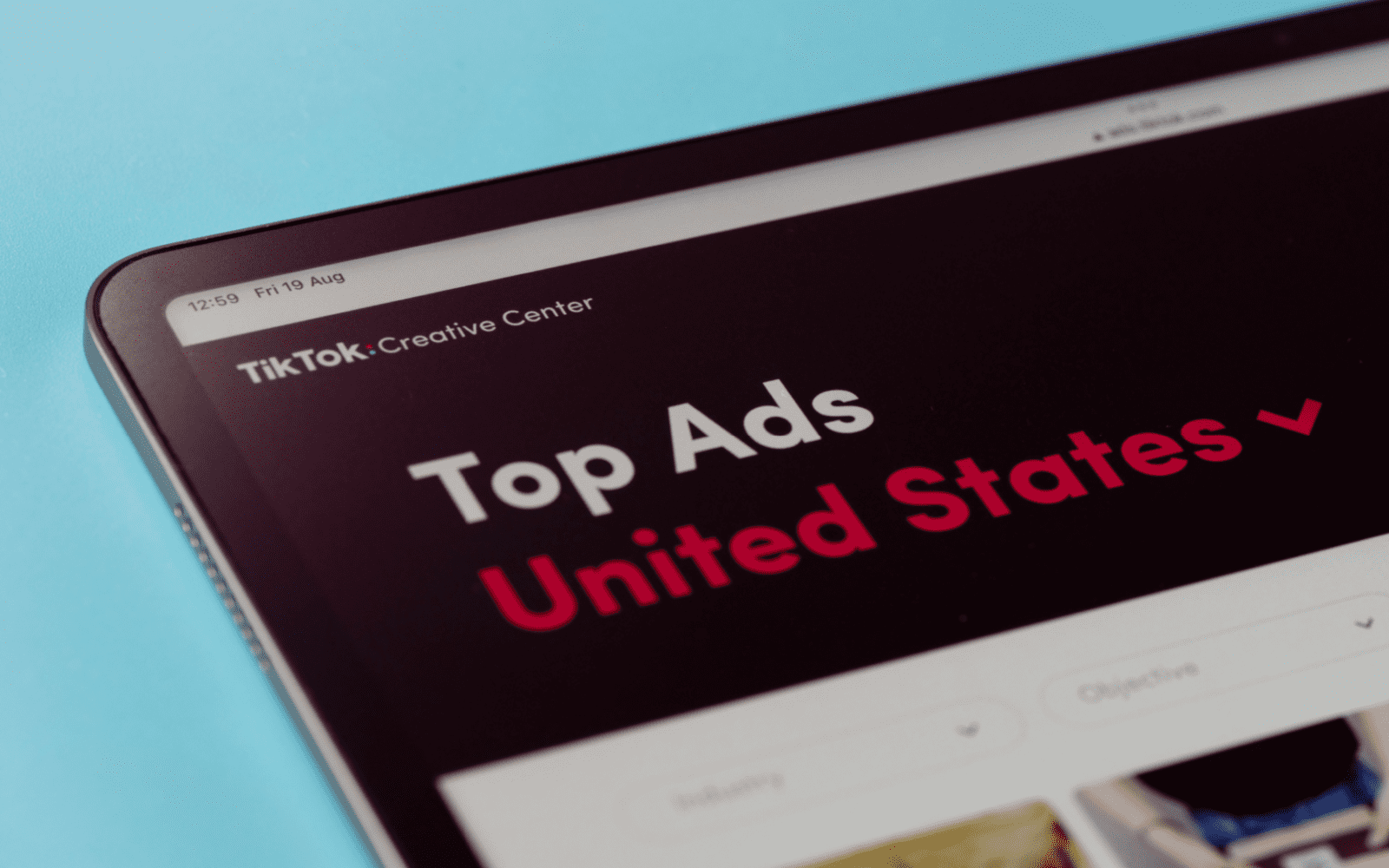
  1. Identify Your Keywords: Understand what your audience searches for on TikTok. Use TikTok’s Creative Center to find trending keywords relevant to your industry.
  2. Create Engaging Video Content: Make your ads visually appealing. They should fit into the organic content flow of TikTok.
  3. Monitor Performance: Track impressions, clicks, and conversions in TikTok Ads Manager. Adjust your campaigns based on performance data.
  4. Leverage TikTok’s Algorithm: Take advantage of TikTok’s powerful recommendation engine. Target the right users by setting up campaigns based on interests and behaviors.

To create your first TikTok Search Ads campaign, navigate to the TikTok Ads Manager.

When creating a new campaign, choose from either of the following campaign objectives to create a Search campaign:

  • Traffic
  • Website conversions

From there, the TikTok Ads Manager provides a new campaign flow with search-specific features. This includes a keyword research tool as well as the ability to add negative keywords.

TikTok Search Ads support both video and image carousel assets, which opens up the market to businesses who may not have video content readily available.

Final Thoughts

TikTok Search Ads provide a fresh way for brands to reach an engaged audience. As the holiday season nears, this feature allows marketers to target consumers when they’re ready to buy.

TikTok combines discovery with intent-driven advertising, making its search offering unique from other platforms like Google and Microsoft Ads.

This new feature could give your brand the edge it needs during the busiest shopping time of the year. Will you be making TikTok Search Ads part of your holiday PPC strategy this year?

WordPress Files to Trademark ‘Managed WordPress’ & ‘Hosted WordPress’ via @sejournal, @martinibuster

The WordPress Foundation applied to trademark ‘Managed WordPress’ and ‘Hosted WordPress’ for software and hosting services. If approved, this would limit commercial use of these terms by web hosts and even plugins without prior permission.

Trademark Applications Filed By WordPress

The trademark applications for the two hosting related phrases are dated July 12, 2024 and lists the WordPress Foundation as the applicant of the trademarks on the phrases “Managed WordPress” and “Hosted WordPress”.

The WordPress Foundation is the non-profit organization that’s behind the open-source WordPress content management system.

The applications cover the use of the phrases in web hosting, servers for web hosting, downloadable software platforms for web hosting, cloud hosting services, SaaS services, software for managing website content (including downloadable software), web development software, downloadable software for design and managing websites, and plugin software.

Why WordPress Filed Trademarks

The trademark application is filed on an “Intent to Use” basis, which means that they say they’re going to use it.

The trademark applications both inform:

“The applicant has a bona fide intention, and is entitled, to use the mark in commerce on or in connection with the identified
goods/services.”

Who Wants To Own The Trademarks?

The trademark application was filed by the WordPress Foundation, a non-profit entity that is separate from the for-profit Automattic. Yet it was Automattic that was demanding money in exchange for a license to use certain WordPress related phrase.

How can Automattic make claims for trademarks that are claimed by WordPress Foundation, a separate legal entity? The answer to the question may be that the WordPress Foundation has an agreement with Automattic for commercial use and enforcing their trademarks.

The cease and desist sent by WP Engine to Automattic explains:

“During calls on September 17th and 19th, for instance, Automattic CFO Mark Davies told a WP Engine board member that Automattic would “go to war” if WP Engine did not agree to pay its competitor Automattic a significant percentage of its gross revenues – tens of millions of dollars in fact – on an ongoing basis. Mr. Davies suggested the payment ostensibly would be for a “license” to use certain trademarks like WordPress, even though WP Engine needs no such license.

WP Engine’s uses of those marks to describe its services – as all companies in this space do – are fair uses under settled trademark law and consistent with WordPress’ own guidelines.”

The back and forth between WordPress, Matt Mullenweg and WP Engine omits this little detail but it suggests that Automattic is licensed to enforce trademarks on behalf of the WordPress Foundation.

Implications Of Trademark Filing

The trademark application could have an impact on web hosts that use the phrases “Managed WordPress” and “Hosted WordPress” because the WordPress Foundation would be able to enforce their ownership of the phrase or ask for licensing fees.

The WordPress Foundation’s role in this trademark application is to assert legal control over the terms “Managed WordPress” and “Hosted WordPress” so as to control what entities are able to use those phrases.

If the trademark application passes examination then there is supposed to be a period of time where third parties can file objections to the trademark application.

Read the trademark applications here:

Managed WordPress Trademark Application

Hosted WordPress Trademark Application

Featured Image by Shutterstock/Wirestock Creators

seo enhancements
The critical role of UX in ecommerce SEO

Online retailers work hard to make their stores stand out from the competition. One of the main points they should focus on is offering the best user experience. Combined with a proper SEO strategy, this can lead to great results. Search engines like Google prioritize user satisfaction, so integrating UX and ecommerce SEO helps improve search rankings and build a long-term relationship with your customers.

UX is the underrated SEO powerhouse

Traditionally, SEO focused on keywords, backlinks, and technical factors. However, Google’s algorithms also focus on user engagement and satisfaction. A great UX is not simply an add-on but the foundation of your SEO efforts.

As Steve Jobs famously said, “Design isn’t just what it looks like and feels like — design is how it works.” High-quality UX/UI design can increase visitors’ time on a website and lead to better conversion rates. Such metrics indicate to search engines that the site effectively addresses user needs, which could warrant higher rankings.

Customers seek a seamless experience when buying something. A great UX can influence those purchasing decisions and set your brand apart from competitors in a market with similar products and services.

As another business leader, Dr. Ralf Speth, ex-CEO of Jaguar Land Rover, famously said: “If you think good design is expensive, you should look at the cost of bad design.”

Improving conversion rates through UX

A website’s design, performance, and functionality directly impact its conversion rates. A well-executed user interface can boost conversions. Such enhancements attract more visitors and convert them into loyal customers. There are many sections on your online store that could benefit from UX improvements.

For example, abandonment of shopping carts is a big issue in ecommerce. There are many reasons why users leave their carts without buying. Most of these are tied to the buyer journey, but many customers also leave their carts due to issues with the store or the buying process UX. In numbers: the Baymard Institute found “that 22% of US online shoppers have abandoned an order in the past quarter solely due to a “too long/complicated checkout process,” while 17% left because of technical issues on the site.”

Improving page speed is also one of the pillars of UX. Portent found “that the difference in ecommerce conversion rate between blazing-fast and modestly quick sites is sizable. A site that loads in 1 second has an ecommerce conversion rate 2.5x higher than a site that loads in 5 seconds.”

These are all things you can fix in your UX strategy. In a well-known study, Forester Research showed that businesses can expect up to $100 in return for every dollar spent on UX. For many retailers, investing in UX and ecommerce SEO can drive business growth.

The importance of mobile optimization

Since mobile has far eclipsed desktop traffic in market share, optimizing for mobile is more important than ever. At the start of 2024, Statista calculated that smartphones were responsible for 77 percent of retail site traffic globally and for generating two-thirds of online shopping orders.

First impressions matter

Creating a positive first impression is critical for ecommerce businesses. Research suggests that users form an opinion about a website in just 50 milliseconds. Key factors influencing these lightning-fast judgments include visual complexity, prototypicality, and exposure time. Prototypicality refers to how closely a website aligns with users’ expectations based on familiar design patterns. Exposure time is the brief period visitors initially see and evaluate a site.

Websites that are visually simple yet stick to common conventions are perceived as more appealing, even within this short exposure time. As visitors spend more time on a site, the familiar structure becomes as influential as its simplicity. Focus on these design elements to make visitors happy and improve engagement.

Google NavBoost and user trust

Recent insights into Google’s NavBoost highlight the role of user behavior in search rankings. NavBoost analyzes user interactions, particularly click patterns, to refine search results based on user satisfaction. Metrics such as “good clicks” (indicating user satisfaction) and “last longest click” (where users spend the most time) directly correlate with UX.

A positive user experience leads to higher rates of good clicks and lower bounce rates. This shows that UX is important in establishing trust and credibility through Google’s E-E-A-T framework (Expertise, Experience, Authoritativeness, Trustworthiness).

The symbiosis of UX and SEO

UX and SEO are one. You might even call it SXO: Search Experience Optimization. Search engines prioritize websites that offer good user experiences. That makes sense because it aligns with their goal of delivering valuable content to users. A focus on UX boosts user satisfaction and could enhance search engine rankings. Those rankings could help drive traffic and improve conversions.

Strategic initiatives for UX and SEO

There are many things to do if you want to enhance both UX and ecommerce SEO, here are just a couple of them:

  1. Responsive design: Make your website mobile-friendly, as mobile devices account for over half of global web traffic. Responsive design improves user satisfaction by providing a seamless experience across devices. As a result, it might positively influence search engine rankings. For example, eCommerce giants like Amazon excel in responsive design. These stores make sure that users have a consistent and user-friendly experience whether they are browsing on a desktop, tablet, or smartphone. This adaptability helps capture and retain mobile users.
  2. Clear navigation and structure: Develop intuitive site architecture that facilitates easy navigation. This not only enhances the user experience but also aids search engines in understanding and indexing content effectively. A well-designed navigation system with a robust site search option can improve user satisfaction. For instance, ASOS, a popular online fashion retailer, offers a well-organized navigation menu with clear categories, making it easy for users to quickly find what they’re looking for.
  3. Improve performance: Optimize page speed to reduce bounce rates and improve user engagement. Google’s Core Web Vitals highlight the importance of fast, stable, and interactive pages. Practical steps include compressing images, leveraging browser caching, and using content delivery networks (CDNs). Research shows that a site that loads in one second can have a conversion rate 2.5 times higher than one that takes five seconds.
  4. Engaging content: Create informative, relevant, and engaging content. High-quality content draws users in and sends positive signals to search engines. For example, incorporating detailed product descriptions, customer reviews, and engaging blog posts can enrich the user experience and encourage visitors to spend more time on your site.
  5. Accessibility: Incorporate accessibility features to accommodate all users, including those with disabilities. This aligns with UX best practices and ecommerce SEO requirements. Following the Web Content Accessibility Guidelines (WCAG) ensures your site is usable for a diverse audience, enhancing user satisfaction and search visibility.
  6. A/B testing: Implement A/B testing to refine your UX and conversion strategies. This involves comparing two versions of a webpage to see which performs better. For example, testing different CTAs, headlines, or images can provide insights into what resonates most with your audience. Businesses can continuously optimize their site for better engagement and conversion rates by iterating based on real user feedback.

A strategy for success with UX and SEO

Today, it would be foolish not to integrate UX into your SEO strategy. Focus on user experience design and combine it with proven SEO strategies. This helps ecommerce businesses improve search visibility, engage users, and support long-term growth. This approach helps customers find and appreciate online stores, which leads to loyal customers and increased revenue.

Coming up next!

Fuel Your Lead Goals: How To Optimize Value-Based Bidding For Maximum ROI via @sejournal, @adsliaison

This is it, the final chapter in our journey to mastering value-based bidding!

We have covered a lot of ground, from determining whether value-based bidding is a fit for your business, to understanding what data you’ll need, to assigning the right values, and choosing the right bid strategy.

After you have executed your value-based bidding strategy in your campaigns, it’s important to understand how and when to measure performance and how to optimize for your goals.

Check out the last two-minute video in our series on value-based bidding, and then we’ll go deeper into the details of optimizing value-based bidding.

When To Start Analyzing

To get a clear picture of how your campaigns are performing, you need enough data to work with.

Aim for at least 50 conversions or a full month of data, whichever comes first.

Remember to exclude the initial ramp-up period when your campaigns are still learning and gathering data. This ensures you’re analyzing stable and representative performance.

Evaluating Performance: Focus On The Value Metrics

In value-based bidding, we’re primarily concerned with two key metrics:

  • Conversion Value: This represents the total value generated from conversions driven by your ads. It’s the monetary worth of the actions users take after clicking on your ad, whether it’s a purchase, a sign-up, or a subscription.
  • Average Target Return On Ad Spend (ROAS): This is the traffic-weighted average ROAS that your bid strategy optimized for over a given time period. If you don’t see this metric in your performance table, be sure to add it from the column icon at the top of your Campaigns table. It’s available for both standard and portfolio bid strategies.

Optimization: Balancing Efficiency And Growth

If you think of your value-based bidding campaign as a car, your target ROAS and budget are your controls to adjust its speed and efficiency. To take this analogy further:

Target ROAS: This is like setting your cruise control. Adjusting your target ROAS influences how aggressively your bids compete in auctions.

  • A higher target ROAS means your bids will be more conservative, and you’ll likely compete in fewer auctions. Set a higher target ROAS if you want to prioritize efficiency.
  • Setting a lower target ROAS allows for more aggressive bidding. You’ll likely compete in more auctions and reach more customers. Set a lower target If you want to prioritize growth.

Budget: This is your gas tank. The amount of gas you put in depends in part on the bidding strategy you’ve chosen.

  • If you’ve set a target ROAS, ensure your budget aligns with your target ROAS and allows the system enough room to optimize effectively. You want to always have plenty of gas in the tank.
  • With a Maximize Conversion Value bidding strategy (without a target ROAS), the system aims to use all the gas you give it each day. It prioritizes driving the highest possible value within a specific allocated budget.

Understanding The Relationship Between Your Controls

Just like in a car, how you use the controls affects your overall performance.

Bid Limits – Don’t Limit Your Speed

You might be tempted to set limits on how much you pay per click (like setting a maximum speed limit) by setting bid limits. However, they can actually constrain the system and hinder performance.

It’s like trying to win a race while keeping your car below a certain speed. In value-based bidding, it’s best to let the system automatically adjust your bids based on the potential value of each click.

  • You may opt to set bid limits when you’re getting started or are in a highly competitive sector, but keep these tradeoffs in mind as you evaluate performance.
  • Note that bid limits are only used in Search Network auctions and only available for portfolio bid strategies.

Budget Constraints – Ensure Enough Fuel

If you’re using a target ROAS, make sure your budget isn’t constrained. Otherwise, it’s like trying to drive a long distance with very little gas. You won’t get very far.

  • A restrictive budget can limit the system’s ability to participate in valuable auctions and achieve your desired return. The system needs a sufficient budget to effectively optimize for your target ROAS.

More Optimization Tools

Use these additional tools to help you optimize your value-based bidding campaigns:

Bid Simulators

These simulators allow you to experiment with different ROAS targets and see the estimated impact on key metrics like conversions and cost when adjusting your targets.

Bid Strategy Report

This report provides insights into your campaign performance over time. It helps you understand how your bids are performing, diagnose any unusual fluctuations, and identify areas for improvement.

  • The conversion value delay shows how long it takes for customers to convert. This amount of time is the recent period to exclude when evaluating performance, as some conversions may still be reported later.
  • This also is where you’ll find the “Actual ROAS” metric, which represents the actual ROAS that this strategy was able to achieve. Keep in mind that small fluctuations in performance are normal.

Performance Planner

Forecast target and budget scenarios across your campaigns.

  • Performance Planner simulates relevant ad auctions over the last seven to 10 days, including variables like seasonality, competitor activity, and landing page.
  • It also includes conversion delay estimates for Search and Performance Max impact estimates.

Portfolio Bidding & Shared Budgets

These features enable you to allocate spend across a group of campaigns. They can be especially useful when using a target ROAS since a shared budget will automatically reallocate any underused budget to budget-capped campaigns.

  • Only apply shared budgets to campaigns that share the same goal (e.g., don’t have campaigns with different targets or bidding strategies sharing a budget).
  • Also, note that shared budgets can’t be applied to campaigns that are part of an experiment.

Embracing The Journey

Optimization is an ongoing process.

As your business evolves and your understanding of your customers deepens, revisit your conversion values to ensure they still accurately reflect the worth of each lead.

Adding “value” to your advertising strategies will allow you to go beyond customer (or lead) acquisition costs, focusing on driving return in your campaigns.

You’re now equipped with the knowledge and tools to bid to value.

By focusing your budget on finding the leads that align with your goals, you can drive meaningful results for your business.

Watch The Other Videos In This Series:

More resources: 


Featured Image: BestForBest/Shutterstock

New Study Finds That Review Requests Should Be Treated Like Customer Service

Want to get rid of that sinking feeling of looking with envy at the high review volumes and star ratings of your top local competitors?

You already know that both review count and ratings are contributing to these brands’ dominance in Google’s Packs and Maps.

Today, I’ll share some good news that could help the local businesses you market catch up and compete.

A major report just published from GatherUp has studied 23,000 locations, and from this, I have three key actionable highlights for you.

My favorite overall takeaway from this interesting study is that improving your review volume, Net Promoter Score (NPS), and ratings may involve a slight adjustment in how your local business thinks about reputation management.

The data indicates that this powerful user-generated content (UGC) in the form of reviews actually belongs in the customer service/customer experience department of your operations.

Read on to see why.

Review Volume As A Customer Service KPI

In the real world, your local business has to invest maximum resources into providing the best customer service in town if you want your reputation to deliver optimum profits.

Everything you can do to provide convenient, memorable, neighborly customer experiences will impact both the offline word-of-mouth recommendations and online reviews you receive.

GatherUp’s new report takes this work ethic a step further, surfacing a striking correlation between your customers’ convenience and your review acquisition success.

Consider the following data:

1. Customers Appreciate Being Invited To Review Your Local Business

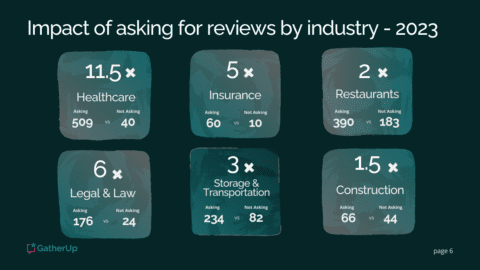
Impact of asking for reviews by industryImage from GatherUp, September 2024

Key Takeaway: businesses that actively ask customers for reviews have, on average, 122 reviews per location versus just 53 for locations where review requests are absent.

Across multiple industries, the impact of inviting customers to share their sentiments is powerful.

According to the study, 30% of all customers will act on a well-crafted review request.

Just as you greet every person who visits your premises or phones you, it’s time to extend your customer service policy to welcome all patrons to review you.

In this context, your review volume can be seen as a key performance indicator (KPI) of whether your efforts to engage your community are succeeding or need refinement to yield a better rate of response per request.

2. Customers Respond To Your Care For Their Convenience

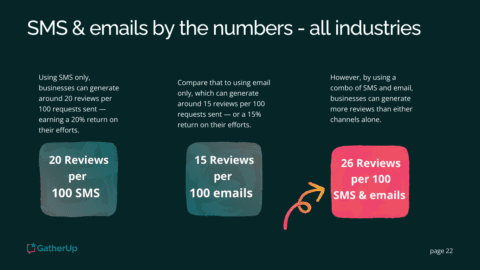
SMS & emails by the numbers - all industriesImage from GatherUp, September 2024

Key Takeaway: Only 6% of surveyed businesses use the magic combination of both SMS + email to request reviews.

A massive opportunity to increase review volume is being left on the table when your customer service policy overlooks the nicety of requesting reviews via customers’ preferred methodologies.

While email remains an excellent choice for communicating more detailed review requests to a wider audience, 48% of customers now prefer text-based review invitations. Texts have the added bonus of open rates as high as 98%.

On average, an email-only methodology delivers 15 reviews per 100 requests, SMS-only delivers 20 reviews per 100 requests, but a combined approach delivers 26 reviews per 100 requests.

These numbers quickly add up, and detailed findings by industry are available in the report.

Just as many local businesses offer indoor versus outdoor dining or in-store shopping versus delivery, you can improve customer experience, convenience, and responsiveness by diversifying your acquisition platforms.

3. Actively Engaged Customers Can Have A Higher Opinion Of Your Local Brand

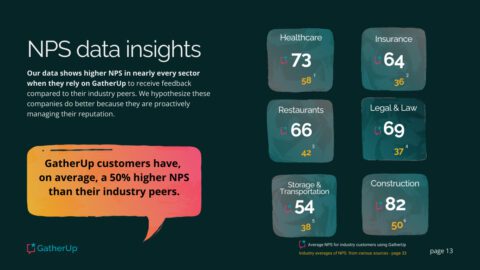
NPS data insightsImage from GatherUp, September 2024

Key Takeaway: Businesses that invest in reputation management software have, on average, a 50% higher NPS than industry peers.

Your NPS is a calculation of how likely it is that existing customers will recommend your local business to others.

Likewise, four of the six industries surveyed experienced a higher average star rating simply because they took the time to engage customers with a review request.

Your overall average Google star rating is widely believed to be a local search ranking factor, and any gains you can make in this regard should positively impact your visibility in Google’s Local Packs, local finders, and Maps.

Merchants have known since the dawn of commerce how engaging a customer underpins sales. In this scenario, the goal of your outreach is earning sentiment rather than transactions, but the principle remains the same.

If your customer service policy is based on ensuring that customers feel recognized, valued, and respected, you have only to extend this mindset to review requests to pursue referrals and review star growth.

Customer Service As The Nexus Of Local Business Success

I recently did an informal study of how the public rushed to the defense of the Ace Hardware franchise when someone criticized it on X (Twitter) for allegedly having higher prices than larger competitors like Lowe’s or Home Depot.

Nearly 4,000 accounts responded, with the overall sentiment of their comments being that they choose to shop at their local Ace branch because of the exceptionally high quality of its customer service.

Every local brand has options when seeking a competitive difference-maker that will help them become a memorable and trusted resource in the community.

Some common considerations include:

  • Location – like locales with high foot traffic.
  • Inventory – like a larger or more unusual selection of products.
  • Price – like lower prices or bulk-buying options.
  • Guarantees – like a no-questions-asked returns policy.
  • Deals – like annual sales or bundling offers.
  • Loyalty programs – like a referral program or birthday club.
  • Expertise – like the Ace hardware example of having highly knowledgeable staff.
  • Gimmicks – like an ad campaign that startles or amuses the public.
  • Convenience – like offering home delivery or curbside pickup.
  • Mission – like having a business story that strongly resonates with the public.

Each of these elements can contribute to a brand becoming known in a particular locale, but unless such factors are paired with excellent customer service, the business will struggle to earn local loyalty and optimum profits.

For example, warehouse-style brands can have an enormous inventory, but if there isn’t enough staff to help customers navigate the aisles, they can feel lost instead of assisted.

In another example, a business may be well-staffed with experts, but if they are not friendly, customers may feel belittled instead of supported.

Meanwhile, a publicity stunt like the owner of an auto dealership parachuting from a plane may momentarily grab attention on local TV, but if the customer experience feels gimmicky when a potential buyer comes to look at cars, the chance to build a strong reputation for the brand may be lost.

Monopolies lack the motivation to focus on customer care and often force the public to put up with unpleasant experiences like long hold times, long lines, or low-quality offerings.

Most small to medium local brands don’t have monopoly status. While some of the items on my bulleted list can be features of a great small brand, it’s only when they’re paired with exceptional customer experiences that these companies begin to achieve “household name” status.

Some of the traditional hallmarks of good customer service include:

  • Friendliness – the staff is welcoming and possesses good communication skills.
  • Adequate staffing – there are sufficient team members to prevent customers from having to wait to be helped.
  • Trustworthiness – all business practices and pricing are transparent.
  • Accountability – all staff are trained to resolve complaints with fairness.
  • Accessibility – the business is open during stated hours and offers some form of after-hours support.
  • Authoritativeness – the staff is well-versed in the offerings and policies of the business.

All of the above factors have mattered to the consumer public for centuries, but a bigger spotlight has been focused on them since the emergence of online local business reviews just a couple of decades ago.

Reviewers As The Authors Of Your Local Business Story

The quality of your customer service matters so much because it can strongly influence all of the following:

  • The average star rating of your Google Business Profile.
  • The individual star ratings customers leave on your Google Business Profile.
  • Your ratings on other review platforms like Yelp and TripAdvisor.
  • The sentiments customers share about your business in reviews across the web.
  • The offline word-of-mouth (WOM) recommendations you receive.
  • Your reputation in the local business community and potential B2B and cross-promotional relationships that may result from it.

Not only will each of these points impact your profitability, but your online reviews will also form a major component of both your local SEO and local search marketing strategies.

Whitespark conducts the longest-running annual local search ranking factors survey.

Review-related factors have historically ranked among the 20 greatest influences on your visibility within Google’s local search results.

The most recent survey placed all of the following factors in the top 20:

  • High numerical Google ratings.
  • Quantity of native Google reviews (with text).
  • Sustained influx of reviews over time.
  • Recency of reviews.

GatherUp’s study highlights the importance of actively asking for reviews. If you are getting customer service right at your place of business, you will get the most benefit from the ranking factors because the ratings and sentiment you receive will be largely positive.

In addition to conceptualizing ratings and reviews as major aids to your local SEO efforts, it turns out that user-generated content (UGC) is some of your most valuable local search marketing material.

A 2023 survey from Ipsos finds that consumers trust reviews from sites like Yelp more than they trust information published by brands.

In this context, it is the reviews that end up authoring the most influential narrative for your local business. Searchers trust online peers to tell them:

  • What a great experience feels like at your place of business.
  • How your business solves problems for customers when things go wrong.
  • What the best aspects are of your business.
  • Where your business needs to improve.

As SEM has matured, storytelling has emerged as a key differentiator between brands that harness its power and those who overlook it.

In the local business sector, requesting reviews is both the best and easiest way to turn customers into influential storytellers who are eager to contribute to the success of your business with their voluntary sentiments.

It can help to think of star ratings as a shorthand title for each customer review.

It’s a symbology that immediately signals a volume of information to the viewer, and in Google’s system, much of your UGC may consist only of ratings.

When you can inspire full reviews, however, a much more intriguing and interesting narrative will be at the disposal of every potential customer considering your business.

This dynamic brings us full circle back to the centrality of customer service.

I’ve been reading local business reviews for fun (and as part of my work) since their online debut, and have noticed a consistent phenomenon: Brands that go the extra mile to delight patrons get praised for it in review content.

It might be that part of your customer service policy includes offering random acts of kindness.

Your staff might be empowered to give away little perks like free desserts, really good coupons, or passes to an event.

You might have a pet watering station on your premises, dog treats at your counter, or free collar charms for the holidays.

Details like these regularly get mentioned in reviews, and are great storytelling for your local brand.

Summing Up

GatherUp’s formal report includes a wealth of industry-specific data and practical tips for pleasing potential reviewers.

The overall lesson I’ve learned from absorbing these valuable statistics should come as good tidings to local business owners in competitive markets: Your hard-earned skills at delivering exceptional customer service could be doing more to contribute to your brand’s success.

Demonstrating genuine care for the convenience and opinions of your patrons creates customer experiences that can dramatically impact reputation-oriented KPIs.

A separate large-scale review survey (which I conducted a few years ago at Moz) reached the same conclusion as the survey run by Ipsos: The public trusts what the public says about businesses more than what any business can say about itself.

Online local business reviews have become an incredibly influential sales force, and their value is an added reason to treat every customer with graciousness.

The concern you demonstrate for patrons’ preferences while asking for feedback can result in you achieving a competitive review volume, average star rating, and NPS.

It may require an expansion of your definition of customer service and some strategic planning to improve your review request processes, but your reputation is certainly worth the investment!

Read the full report from GatherUp: Maximizing Your Online Reputation.

More resources: 


Featured Image: RoBird/Shutterstock

Why Your Keyword Strategy Isn’t Driving Enough Traffic (And How to Fix It) via @sejournal, @Moz

This post was sponsored by Moz. The opinions expressed in this article are the sponsor’s own.

The scope of modern keyword strategy is expansive and crosses many disciplines. As Google leans further into user experience and user signals as part of its ranking algorithms, research, execution, and testing must become more interwoven and refined.

If your keyword strategy is underperforming and you’re struggling to drive traffic, rankings, or even onsite conversions, your keyword strategy could be missing critical components.

The following is a look at common mistakes and how to address them. You’ll see screenshots and examples of how you can solve keyword strategy issues and improve workflows during the keyword research stage using the premium keyword research features in Moz Pro, but you can get started free with  Moz’s Keyword Explorer tool.

Mistake #1: Failing To Target Intent

You can’t just pick a keyword you want to rank for and move straight into writing a page. What you want to target is the first part of a complex equation, of which the user is the most important part.

Intent can be expressed as a set of questions:

  • Why is the user searching for the query?
  • What does the user expect to find?
  • What do search engines deliver to meet this intent?

You must answer these questions to build content that fits neatly between the expectations of searchers and the search engines. Whether you’re a beginner in keyword research or you’re a professional SEO who wants to brush up on the fundamentals, you must understand the relationship between queries and search intent. Content that does not satisfy intent will result in a poor user experience, which leads to negative engagement signals, which will hurt your ability to rank.

You must understand the relationship between queries and search intent. Content that does not satisfy intent will result in a poor user experience, which leads to negative engagement signals.

If enough of your content is misaligned with user intent, it could impact your entire site, as you won’t be seen as trustworthy or authoritative.

If individual pages or your keyword strategy as a whole is underperforming, this is one of the first things you should audit because a mismatch between search intent and your content will kill those pages, whether they’re old or new.

You also need to keep in mind that intent changes. This can be due to one-off events, seasonal changes, or algorithm updates.

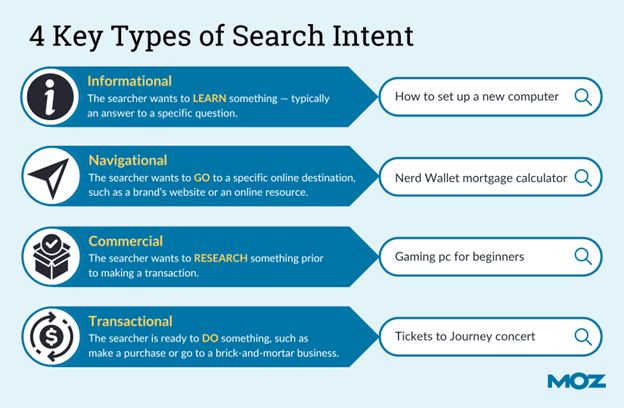
Here are some examples of intent:

  • Purchase intent: the user is actively looking for a product to buy.
  • Comparison intent: the user is shopping around and comparing products.
  • Informational or educational intent: The user wants to learn something.
Screenshot from Moz

Intents can be quite complicated, and you’ll need to rely on your own audience research to get granular. But a tool can help speed up the process by showing you the general intent of a keyword and what is currently ranking on the SERP.

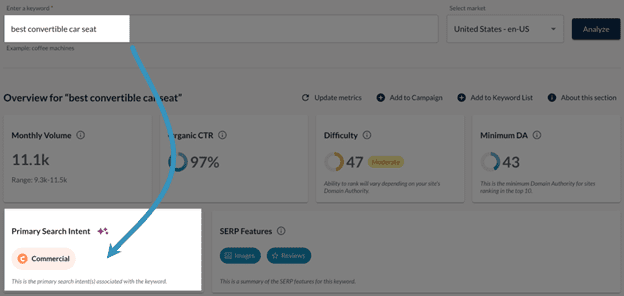
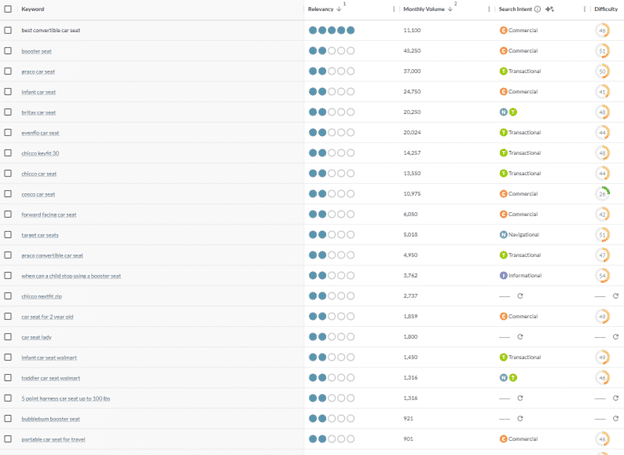
Explore by Keyword in Moz Pro makes it easy to see keyword intent at a glance for individual keywords and a whole batch of keyword suggestions. Let’s look at the keyword [best convertible car seat].

You can probably already guess the intent, and the tool confirms that it’s a commercial intent keyword. This means users are looking to compare products and features to find the best suited for them. Remember, this is based on the results in the SERPs, so it’s giving you some more intel into what Google expects a user’s intent to be, which we’ll discuss more in a bit.

Screenshot of Moz Pro

As you go through the research process, you can use a combination of factors such as Difficulty and intent to discover related keywords worth pursuing to bolster your strategy.

Mistake #2: Not Conducting Competitor And On-SERP Research

When you’re in the weeds of data tables and strategy, it’s easy to forget one of the most simple and critical rules in SEO.

Most of the information you need is on the SERP.

When you evaluate the SERP of a given keyword, you can gain a lot of information with the right approach. But you’re going to need to get good at reading between the lines.

You can use the existing pages on a SERP to understand how well the query is being satisfied and what competitors are and are not doing. If the SERP has many high-quality pages, you can learn a lot from the strategies your competitors use. If there are pages that you consider low-quality, based on your knowledge of the subject matter, then you’ve identified an opportunity.

So, to properly research SERPs, you need a few skills:

  • Understanding of design and UX to identify suboptimal user experiences or understand why some pages may be outperforming.
  • A deep understanding of the subject matter covered by the keyword so that you can identify which pages provide trustworthy, high-quality information.
  • Knowledge of the user intent behind a query so that you can match the intent with the experience that the ranking pages deliver.

From there, you can evaluate the quality of the pages and choose where to focus your efforts. If you’re lacking information or you can’t find a good angle of attack, then start looking at similar SERPs for related keywords or related intents. If you can find a SERP with sufficiently different results but related search intent, you can compare and contrast.

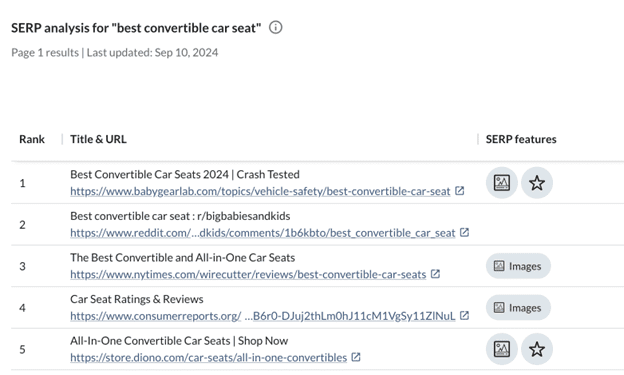
Going back to our research related to [best convertible car seat], let’s take a look at the SERP. We can do it right inside Moz’s tool:

Screenshot from Moz Pro

Yikes! This is going to be a tough one. We’ve got Reddit and Wirecutter on there.

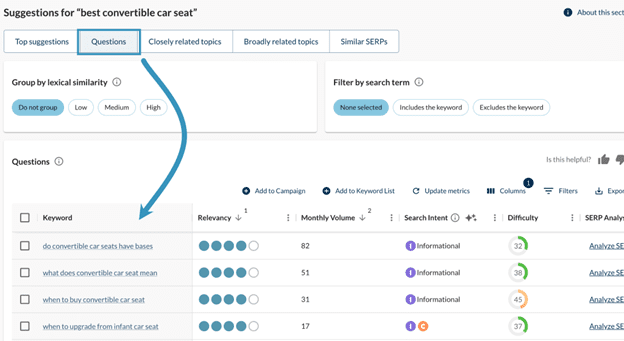
Luckily, there are options. Using the “questions” tab in the “keyword suggestions” tool, you can discover questions that searchers ask relatively frequently. Some of them may have the potential for a related keyword strategy.

Screenshot from Moz Pro

Even though the head term will be difficult to rank for, you can see a lot of “informational” intent related to this search. This is an opportunity to build trust with highly motivated consumers.

Mistake #3: Not Organizing Your Research

If you do keyword research intermittently or only at the beginning of campaigns, you might be missing important opportunities to refine your strategies.

Keyword research needs to be checked and refined as your strategy changes and the SERPs get updated.

It’s critical that you set yourself up for success when you begin a new campaign or strategy. You don’t want to do a ton of work and leave it in a disorganized state because, eventually, you will need to update your pages and reassess the strategy behind them. You can save yourself a lot of time by preparing for this eventuality and setting up a strategy that’s easy to jump back into.

Building keyword groups and lists help you understand how pages fit into the broader categorization of your website. It’s also a good idea to use a tool that tracks your progress so that when you return to strategy, you can see the past performance of pages at a glance.

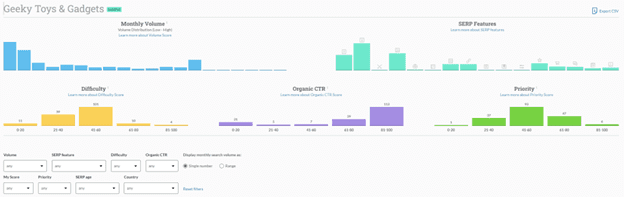
With Keyword Lists in Moz Pro you can to upload your own sheet file or build a list by typing it out. Once the list is in the system, you get a ton of insights about the keywords both individually and in aggregate, as you can see from the screenshot of the sample list below.

Screenshot from Moz Pro

Mistake #4: Not Building Entity And Topic Maps

The way you organize information is critical at two levels.

The first is on the page. How you present information, in what order, and in what format is critical to the experience of a page. If you can match this well with intent, you’ll provide users with a good experience and improve conversion rates.

The other level is site-wide. You must build a content and keyword strategy around topics and entities. This is how you build a content library that’s friendly to both users and advanced search algorithms. Building entity maps correctly helps you compete in an AI-heavy environment because you’re speaking the language of AI algorithms that work by connecting entities together through context.

Building these maps of context between topics also helps you to build a robust strategy and discover opportunities your competitors may have missed. Every page you add to a broader topic is an opportunity to reinforce your authority, succeed in a unique SERP, and transfer that SEO power to your other pages through internal linking.

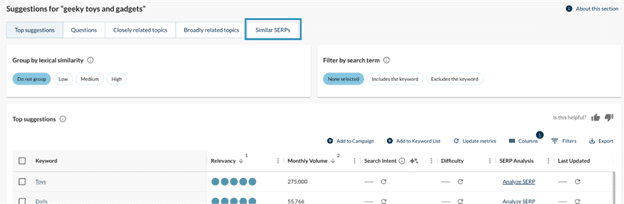
Moz’s “similar SERPs” tool comes in handy here. With Moz Pro, search by keyword and filter by Similar SERPs. Tada! By analyzing the top-ranking pages for your target keyword you’ll see other keywords those competing URLs ranked for. With this list of new keywords, you can identify opportunities to strategically expand your content based on that topical analysis. It’s a great way to see where there’s overlap in SERPs.

Screenshot from Moz Pro

So stop missing out on opportunities your competitors are capitalizing on. With the advanced keyword research features in Moz Pro you can streamline your research process, enabling deeper keyword analysis and smarter strategies. Prioritize intent, enhance user experience, increase conversions, and rank for the queries you need.

Stop missing out on traffic! Unlock the power of Keyword Explorer with over 500 million traffic-driving keywords.

Start your free trial today and fix your keyword strategy for real results.


Image Credits

Featured Image: Image by Moz. Used with permission.

In-Post Image: Images by Moz. Used with permission.

An AI script editor could help decide what films get made in Hollywood

Every day across Hollywood, scores of film school graduates and production assistants work as script readers. Their job is to find the diamonds in the rough from the 50,000 or so screenplays pitched each year and flag any worth pursuing further. Each script runs anywhere from 100 to 150 pages, and it can take half a day to read one and write up a “coverage,” or summary of the strengths and weaknesses. With only about 50 of these scripts selling in a given year, readers are trained to be ruthless. 

Now the film-focused tech company Cinelytic, which works with major studios like Warner Bros. and Sony Pictures to analyze film budgets and box office potential, aims to offer script feedback with generative AI. 

Today it launched a new tool called Callaia, which amateur writers and professional script readers alike can use to analyze scripts at $79 each. Using AI, it takes Callaia less than a minute to write its own coverage, which includes a synopsis, a list of comparable films, grades for areas like dialogue and originality, and actor recommendations. It also makes a recommendation on whether or not the film should be financed, giving it a rating of “pass,” “consider,” “recommend,” or “strongly recommend.” Though the foundation of the tool is built with ChatGPT’s API, the team had to coach the model on script-specific tasks like evaluating genres and writing a movie’s logline, which summarize the story in a sentence. 

“It helps people understand the script very quickly,” says Tobias Queisser, Cinelytic’s cofounder and CEO, who also had a career as a film producer. “You can look at more stories and more scripts, and not eliminate them based on factors that are detrimental to the business of finding great content.”

The idea is that Callaia will give studios a more analytical way to predict how a script may perform on the screen before spending on marketing or production. But, the company says, it’s also meant to ease the bottleneck that script readers create in the filmmaking process. With such a deluge to sort through, many scripts can make it to decision-makers only if they have a recognizable name attached. An AI-driven tool would democratize the script selection process and allow better scripts and writers to be discovered, Queisser says.

The tool’s introduction may further fuel the ongoing Hollywood debate about whether AI will help or harm its creatives. Since the public launch of ChatGPT in late 2022, the technology has drawn concern everywhere from writers’ rooms to special effects departments, where people worry that it will cheapen, augment, or replace human talent.  

In this case, Callaia’s success will depend on whether it can provide critical feedback as well as a human script reader can. 

That’s a challenge because of what GPT and other AI models are built to do, according to Tuhin Chakrabarty, a researcher who studied how well AI can analyze creative works during his PhD in computer science at Columbia University. In one of his studies, Chakrabarty and his coauthors had various AI models and a group of human experts—including professors of creative writing and a screenwriter—analyze the quality of 48 stories, 12 that appeared in the New Yorker and the rest of which were AI-generated. His team found that the two groups virtually never agreed on the quality of the works. 

“Whenever you ask an AI model about the creativity of your work, it is never going to say bad things,” Chakrabarty says. “It is always going to say good things, because it’s trained to be a helpful, polite assistant.”

Cinelytic CTO Dev Sen says this trait did present a hurdle in the design of Callaia, and that the initial output of the model was overly positive. That improved with time and tweaking. “We don’t necessarily want to be overly critical, but aim for a more balanced analysis that points out both strengths and weaknesses in the script,” he says. 

Vir Srinivas, an independent filmmaker whose film Orders from Above won Best Historical Film at Cannes in 2021, agreed to look at an example of Callaia’s output to see how well the AI model can analyze a script. I showed him what the model made of a 100-page script about a jazz trumpeter on a journey of self-discovery in San Francisco, which Cinelytic provided. Srinivas says that the coverage generated by the model didn’t go deep enough to present genuinely helpful feedback to a screenwriter.

“It’s approaching the script in too literal a sense and not a metaphorical one—something which human audiences do intuitively and unconsciously,” he says. “It’s as if it’s being forced to be diplomatic and not make any waves.”

There were other flaws, too. For example, Callaia predicted that the film would need a budget of just $5 to $10 million but also suggested that expensive A-listers like Paul Rudd would have been well suited for the lead role.

Cinelytic says it’s currently at work improving the actor recommendation component, and though the company did not provide data on how well its model analyzes a given script, Sen says feedback from 100 script readers who beta-tested the model was overwhelmingly positive. “Most of them were pretty much blown away, because they said that the coverages were on the order of, if not better than, the coverages they’re used to,” he says. 

Overall, Cinelytic is pitching Callaia as a tool meant to quickly provide feedback on lots of scripts, not to replace human script readers, who will still read and adjust the tool’s findings. Queisser, who is cognizant that whether AI can effectively write or edit creatively is hotly contested in Hollywood, is hopeful the tool will allow script readers to more quickly identify standout scripts while also providing an efficient source of feedback for writers.

“Writers that embrace our tool will have something that can help them refine their scripts and find more opportunities,” he says. “It’s positive for both sides.”