Meta has released a new AI model that can translate speech from 101 different languages. It represents a step toward real-time, simultaneous interpretation, where words are translated as soon as they come out of someone’s mouth.
Typically, translation models for speech use a multistep approach. First they translate speech into text. Then they translate that text into text in another language. Finally, that translated text is turned into speech in the new language. This method can be inefficient, and at each step, errors and mistranslations can creep in. But Meta’s new model, called SeamlessM4T, enables more direct translation from speech in one language to speech in another. The model is described in a paper published today in Nature.
Seamless can translate text with 23% more accuracy than the top existing models. And although another model, Google’s AudioPaLM, can technically translate more languages—113 of them, versus 101 for Seamless—it can translate them only into English. SeamlessM4T can translate into 36 other languages.
The key is a process called parallel data mining, which finds instances when the sound in a video or audio matches a subtitle in another language from crawled web data. The model learned to associate those sounds in one language with the matching pieces of text in another. This opened up a whole new trove of examples of translations for their model.
“Meta has done a great job having a breadth of different things they support, like text-to-speech, speech-to-text, even automatic speech recognition,” says Chetan Jaiswal, a professor of computer science at Quinnipiac University, who was not involved in the research. “The mere number of languages they are supporting is a tremendous achievement.”
Human translators are still a vital part of the translation process, the researchers say in the paper, because they can grapple with diverse cultural contexts and make sure the same meaning is conveyed from one language into another. This step is important, says Lynne Bowker, Canada Research Chair in Translation, Technologies and Society at Université Laval in Quebec, who didn’t work on Seamless. “Languages are a reflection of cultures, and cultures have their own ways of knowing things,” she says.
When it comes to applications like medicine or law, machine translations need to be thoroughly checked by a human, she says. If not, misunderstandings can result. For example, when Google Translate was used to translate public health information about the covid-19 vaccine from the Virginia Department of Health in January 2021, it translated “not mandatory” in English into “not necessary” in Spanish, changing the whole meaning of the message.
AI models have much more examples to train on in some languages than others. This means current speech-to-speech models may be able to translate a language like Greek into English, where there may be many examples, but cannot translate from Swahili to Greek. The team behind Seamless aimed to solve this problem by pre-training the model on millions of hours of spoken audio in different languages. This pre-training allowed it to recognize general patterns in language, making it easier to process less widely spoken languages because it already had some baseline for what spoken language is supposed to sound like.
The system is open-source, which the researchers hope will encourage others to build upon its current capabilities. But some are skeptical of how useful it may be compared with available alternatives. “Google’s translation model is not as open-source as Seamless, but it’s way more responsive and fast, and it doesn’t cost anything as an academic,” says Jaiswal.
The most exciting thing about Meta’s system is that it points to the possibility of instant interpretation across languages in the not-too-distant future—like the Babel fish in Douglas Adams’ cult novel The Hitchhiker’s Guide to the Galaxy. SeamlessM4T is faster than existing models but still not instant. That said, Meta claims to have a newer version of Seamless that’s as fast as human interpreters.
“While having this kind of delayed translation is okay and useful, I think simultaneous translation will be even more useful,” says Kenny Zhu, director of the Arlington Computational Linguistics Lab at the University of Texas at Arlington, who is not affiliated with the new research.
Eighty-two percent of global CEOs in retail sectors are confident in their company’s growth prospects, but only 59% are optimistic about the overall worldwide economy. That’s according to KPMG’s 2024 “Consumer and Retail CEO Outlook” (PDF) released in December 2024.
The report summarizes the results of a KPMG survey of 1,325 CEOs between July 25 and August 29, 2024, across 11 key global markets and industries. All participants represented organizations with annual revenue exceeding $500 million, with one-third reporting revenue over $10 billion.
–
According to the study, the leading challenges for retail CEOs in 2024 are economic uncertainty (58%), geopolitical complexities (53%), and generative AI integration (48%).
–
In addition, when asked about the trends that could hinder their organizations’ prosperity over the next three years, 81% of retail CEOs identified the cost of living, followed by cyber crime at 79% and trade regulation at 74%.
–
Moreover, 35% of surveyed CEOs ranked organic tactics as their top growth strategy. Twenty-seven percent identified mergers and acquisitions.
A new study analyzing 5,000 Google Shopping keywords sheds light on the factors that correlate with higher rankings.
The research, conducted by Jeff Oxford, Founder of 180 Marketing, reveals trends that could help ecommerce stores improve their visibility in Google’s free Shopping listings.
Amazon Dominates Google Shopping
Amazon ranks in the #1 position for 52% of Google Shopping searches, outpacing Walmart (6%) and Home Depot (3%).
Beyond Amazon’s dominance, the study found a strong correlation between website authority and rankings, with higher-ranking sites often belonging to well-established brands.
Takeaway: Building your brand and earning trust is vital to ranking well on Google Shopping.
Backlinks, Reviews, & Pricing
The study identified several trends that separate higher-ranking pages from the rest:
Referring Domains: Product pages in the top two positions had more backlinks than lower-ranking pages. Interestingly, most product pages analyzed (98%) had no backlinks at all.
Customer Reviews: Product pages with customer reviews ranked higher, and stores with star ratings below 3.5 struggled to rank well.
Pricing: Lower-priced products tended to rank higher, with top-performing listings often featuring prices below the category average.
Takeaway: Building backlinks, collecting customer reviews, and offering competitive pricing can make a difference.
Meta Descriptions A Top Signal
Among on-page factors, meta descriptions had the strongest correlation with rankings.
Pages that included exact-match keywords in their meta descriptions consistently ranked higher.
While keyword usage in title tags and H1 headers showed some correlation, the impact was much smaller.
Takeaway: Optimize meta descriptions and product copy with target keywords to improve rankings.
Structured Data Findings
Structured data showed mixed results in the study.
Product structured data had little to no correlation with rankings, and Amazon, despite dominating the top spots, doesn’t use structured data on its product pages.
However, pages using review structured data performed better.
Takeaway: Focus on collecting customer reviews and using review structured data, which appears more impactful than product structured data.
Shipping & Returns Scores
Google Shopping evaluates stores on shipping, returns, and website quality metrics.
The study found that stores with “Exceptional” or “Great” scores for shipping and returns were more likely to rank higher, especially in the top 10 positions.
Takeaway: Prioritize fast shipping and clear return policies to boost your Google Shopping scores.
What Does This Mean?
According to these findings, success in Google Shopping correlates with strong customer reviews, competitive pricing, and fast service.
Optimizing for traditional SEO—like backlinks and well-written metadata—can benefit both organic search and Shopping rankings.
Retailers should prioritize the customer experience, as Google’s scoring for shipping, returns, and website quality affects visibility.
Lastly, remember that correlation doesn’t equal causation—test changes thoughtfully and focus on delivering value to your customers.
For small, mobile, local businesses operating without a fixed storefront, navigating the world of local SEO can feel like charting uncharted territory.
Service area businesses (SABs) – think plumbers, electricians, mobile pet groomers, and the like – face unique challenges in establishing a strong online presence.
However, by understanding the nuances of local SEO for service area businesses and implementing the right strategies, you can effectively target your service areas and reach more customers than ever before.
This comprehensive guide will delve into the intricacies of local SEO for SABs, providing valuable insights, strategies, and best practices to help you effectively target your coverage area and maximize your online visibility to drive more local traffic and business.
Understanding Service Area Businesses
Service area businesses are those which travel to their customers’ locations to provide services.
Unlike traditional brick-and-mortar businesses, SABs don’t rely on foot traffic or a fixed storefront. Instead, their service area boundaries define their primary markets.
Common examples of SABs include:
Plumbers.
Electricians.
HVAC technicians.
Roofer.
Mobile pet groomers.
House cleaning services.
Mobile paramedical services.
Landscapers.
Challenges And Opportunities For SABs In Local SEO
SABs face unique challenges in local SEO due to the absence of a physical address to promote and establish authority for.
All local businesses have the challenge of establishing their localness and E-E-A-T, as found in Google’s Search Quality Raters Guidelines, and without a clearly defined base of operations, this can become a little more difficult.
However, this also presents opportunities to expand the business’ reach beyond a single location.
Challenges
No storefront to attract local foot traffic: SABs can’t rely on traditional local SEO tactics like optimizing a Google Business Profile listing with a physical address pinned to a Google Map, thereby more naturally appearing in searches “near me,” which has become a very common local consumer query. However, read on, as GBP optimizations are still possible and highly recommended.
Competition from businesses with storefronts: SABs often compete with both established businesses with a physical presence and other SABs in a local market.
Clearly defining, targeting, and establishing authority within the desired service area: Accurately defining and targeting the service area is crucial for SABs to reach the right customers. However, this means having to prove to Google your business is effectively able to reach customers across a potentially wide service area, which may cross into the “territory” of multiple other service area businesses.
Opportunities:
Wider reach: SABs can naturally target a broader geographic area compared to businesses with a fixed location.
Flexibility: SABs can adjust their service areas based on customer demand and expanding business goals.
Cost-effectiveness: SABs can typically operate with lower overhead costs compared to businesses with physical storefronts.
To overcome the stated challenges and capitalize on the opportunities, SABs need to implement effective local SEO strategies.
This means ensuring they are incorporating and optimizing content in the areas where customers are searching.
According to a 2023 Brightlocal study, the top five most trusted platforms consumers use to find information about local businesses are Google (66%), Google Maps (45%), business websites (36%), Facebook (32%), and Yelp (32%). We’ll review if and how to address each as a key organic channel.
Here are some key strategies to consider:
1. You Can And Must Still Optimize Your Google Business Profile
For many businesses, a GBP is as, if not more, important than their corporate website.
A Think with Google study from 2019 points out “60% of smartphone users have contacted a business directly using the search results (e.g., “click to call” option)” and this has no doubt only continued to increase.
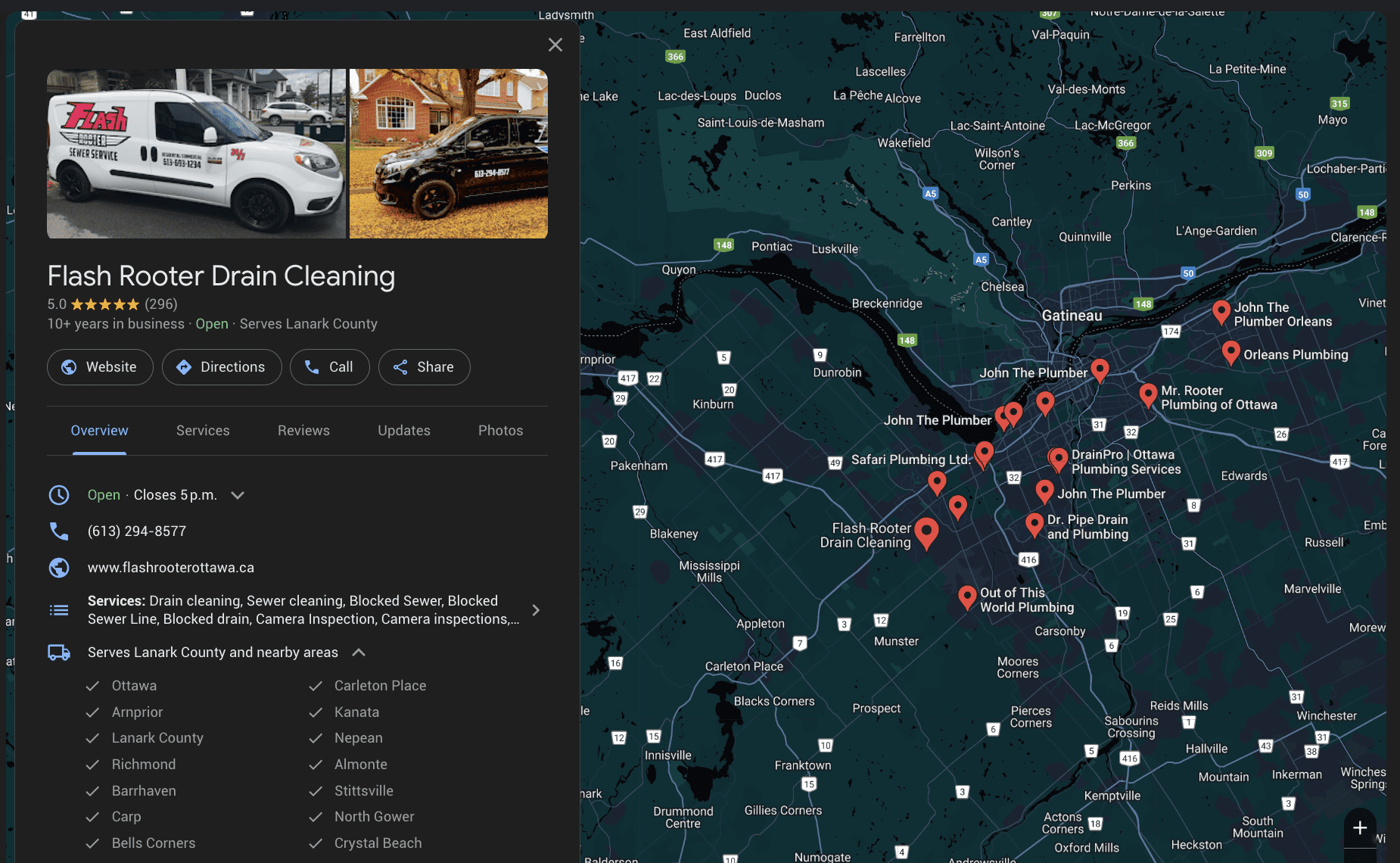
Screenshot from Google Business Profile, November 2024
While SABs don’t have a physical storefront, they can still leverage GBP to enhance online visibility. Here’s how:
Create A GBP Profile
Even without a storefront, you must create a GBP profile and select the “service-area business” option.
Under this option, you will add but hide your address and then select up to 20 service areas you cover based on city or postal code.
“The boundaries of your overall area should not extend farther than about 2 hours of driving time from where your business is based.”
If your service area does extend beyond two hours of driving time, you would be well advised to consider setting up another GBP with a primary address closer than two hours away.
Choose Only Relevant Categories
Select primary and secondary categories from those provided in GBP that most accurately reflect the services you offer.
Do not select a subcategory if you do not offer the service, but would like to be found by people searching for the service.
This is a common mistake many businesses make, which can backfire by diluting their authority.
Complete Your Entire Profile
Fill out all of the relevant sections of your GBP profile, including your business name, phone number, website, service areas, hours of operation, social links, payment options, accessibility, amenities, languages supported, and photos (i.e., logo, interior, exterior, product, etc).
Keep in mind that you are trying to provide your audience with every possible detail regarding your business and don’t want to exclude anyone by leaving out key information.
You may also find you are able to gain business by indicating you belong to or service a particular demographic.
Encourage And Promptly Respond To Customer Reviews
Positive reviews or even prompt and effective responses to negative reviews can significantly boost your local ranking and build trust with potential customers.
For service-area businesses needing to “prove” their coverage, it is important to gain reviews from customers across the defined service area.
So, if you’ve included 10 specific areas you service within a two-hour driving distance, you should be looking to obtain reviews from satisfied customers in each of those areas.
This will help to establish the “localness” described above.
Pro Tip: Don’t be afraid to ask customers to provide Google reviews that reference the specific service they received and the location where they received it. For example, “We were so pleased ABC Roofing Company was able to repair our roof in [location] on time and on budget!”
Post Content Regularly
GBP provides all businesses the opportunity to easily post content regarding their services, promotions, and links to external content like blog posts, events, etc., which is quite often underutilized.
This feature enables businesses to demonstrate engagement with their customers and authority on the topics they want to be found for.
If you are a local business creating content on a regular basis to share to social channels or via an email newsletter, sharing this content via GBP as well is a must.
2. Build A Solid, Mobile-Friendly Web Presence With Local SEO In Mind
While GBP is a primary landing place for many local searchers, a local business website still serves an important role as an online storefront and information resource.
When it comes to SABs and local SEO, here are a few specific considerations:
Create Location-Specific Pages
If you serve multiple areas, create dedicated pages for each location with unique, relevant content, contact information, and locally oriented keywords.
For example, if you offer specific services in different areas or have specific mobile technicians dedicated to specific service areas, be sure to call this out.
Another good tactic is to embed a Google map of the specific service area into its dedicated location page.
Be careful not to simply duplicate content across your location pages by incorporating something unique into each.
Locally Optimize Your Website Pages And Content
Use relevant local keywords throughout your localized website pages, including in your page titles, headings, meta descriptions, and image alt tags.
Ensure Mobile-Friendliness
This should go without saying, but it’s essential today for all businesses to have a responsive website.
According to Statista, in 2023, 58.67% of all website traffic worldwide came from mobile phones.
Much like reviews, for SABs, this means identifying and obtaining listings in relevant directories in each of the applicable service areas.
Again, the goal is to show Google the business operates in the area, so there should be an online presence in the area.
Pro Tip: When deciding which local directories you should appear in for free, or especially for a fee, conduct a few Google searches on the keywords you want to be found for and see if these directories appear. If they don’t, then they likely won’t add much value to you.
Alternatively, you can simply ask the directory to provide statistics on how much traffic/business you can expect to receive through them based on similar businesses they have worked with in the past.
3. Local Link Building
Building high-quality, relevant local backlinks can significantly improve your website’s authority and local search ranking. Here’s how:
Engage in community involvement:Sponsor local events, participate in community forums, and build relationships with local organizations to earn backlinks. Note: Links from your website (perhaps in a Local Events section) can also provide a signal to Google of your localness.
4. Leverage Service-Area Focused Content Marketing And Social Media
Modern SEO, beyond website structure and relevant backlinking, is very much about creating valuable and informative content to answer all of the questions your target audience has about your services, thereby establishing your business as a trusted resource in the eyes of your customers and search engines.
Here are a few local content marketing recommendations to further help build authority:
Create local, topically relevant content: Publish blog posts, articles, and guides addressing local issues, events, or topics related to the services you offer and of interest to your target audience. Again, as a service area business, try to identify topics specific to the various areas serviced and link from this content to the specific location pages on the website. Some examples of this type of content may include:
Blog posts about local events or community initiatives.
Case studies featuring customers from your different service areas.
Promote your content locally: Creating content is just half the battle. As noted above, content can be shared via your GBP, as well as via social media (provided you’ve established an online following), local online communities (e.g., Nextdoor, Facebook Groups), and email newsletters to reach the widest potential audience. Relevant, local, social SAB content may include:
Before-and-after photos of completed projects in different service areas.
Customer testimonials.
Behind-the-scenes glimpses of the business in action at different locations.
Regularly monitoring and tracking your local SEO performance is essential to understand which content and channels are working or not, to identify areas for improvement, and to measure the overall effectiveness of your strategies.
There are five primary areas a local SAB should focus on when considering performance.
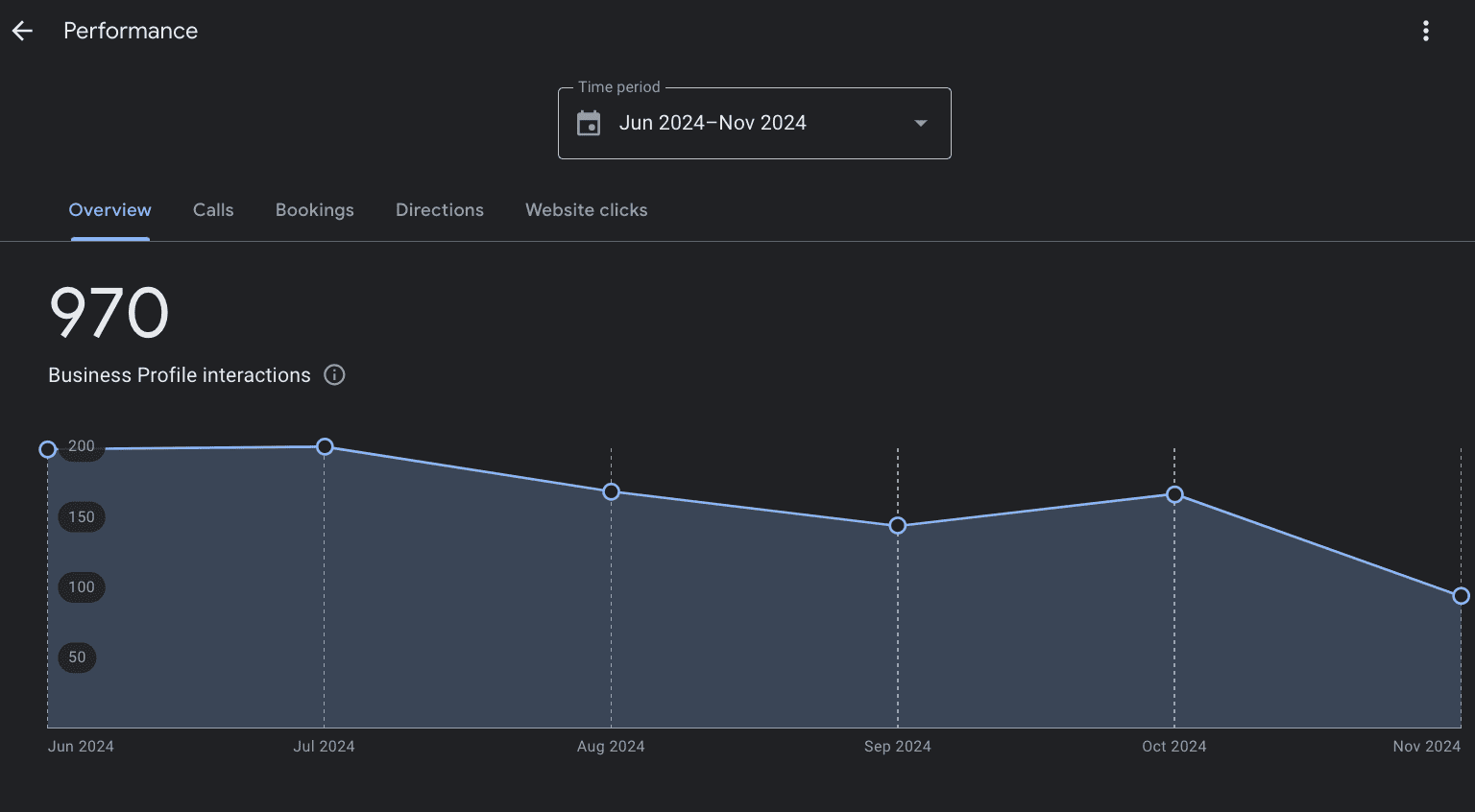
Analyze your GBP insights: Regularly review your GBP’s performance, including views, searches, clicks, messages, and calls, to understand how users find and engage with your profile.
Screenshot from Google Business Profile, November 2024
Use Google Analytics: Track the sources of your website traffic, performance of your landing pages, user behavior, and conversions to understand how users find and interact with your content. Use this information to focus your SEO and content marketing efforts.
Monitor your local rankings: Use rank tracking tools to monitor and optimize your website’s position in the local Map Pack and organic search results for relevant keywords.
Track your social media reach and engagement: All social media networks offer tools to measure the reach and engagement of your presence and individual posts. Pay attention to who your most engaged followers are and be sure to engage with them.
Creating and sharing relevant content to answer all of your customer’s questions.
Monitoring your performance to see what’s working and what isn’t.
With all of this in mind, do not try to over-extend your reach, as it will be difficult to convince Google you are truly “local” if your service areas are beyond the two-hour driving time range.
To truly resonate with potential customers and drive conversions, you need to understand your audience’s journey and tailor your content to align with each stage of your sales funnel.
By developing an editorial calendar that not only meets business objectives but also addresses your audience’s specific needs and questions at every stage, you can enhance conversions and boost your lifetime customer value (LCV).
In this comprehensive guide, we’ll explore and highlight the types of content that are most effective at each stage of the sales funnel.
We’ll provide practical examples and back up our recommendations with data to help you craft a content strategy that not only attracts but also retains customers.
Understanding The Buyer’s Journey
Before we dive into the specifics, it’s essential to understand the buyer’s journey – a framework that outlines the stages a customer goes through before making a purchase.
The typical stages are:
Awareness: The customer realizes they have a problem or need.
Consideration: They research and consider possible solutions.
Decision: They decide on a solution and make a purchase.
Retention: Post-purchase, the focus shifts to maintaining and enhancing the customer relationship.
Each stage requires a different content approach to effectively move the customer closer to a purchase and encourage repeat business.
Sparking Interest (Top Of Funnel)
The Awareness Stage
At the top of the funnel, your goal is to attract potential customers by addressing their needs and pain points.
This is often the first interaction they have with your brand, so making a strong, positive impression is crucial.
What Users Are Looking For
Informative Content: Users are seeking answers to their questions.
Authoritative Resources: Content that establishes your brand as a trusted expert.
Engaging Formats: Content that is easy to consume and share.
Effective Content Types
Blog Posts and Articles: Provide valuable insights on industry topics. For example, a company like HubSpot offers extensive resources on marketing strategies.
Ebooks and Whitepapers: In-depth guides that users can download. According to the Content Marketing Institute, 43% of marketers said ebooks produced the best results for their content marketing.
Videos and Webinars: Engaging visual content can increase information retention by 65%, as per Brain Rules.
Infographics: Visually appealing and shareable content. According to Venngage, 43% of marketers found infographics to be the best performing type of visual content.
Promotion Channels
Social Media: Utilize platforms like Facebook, LinkedIn, and Instagram to share content. Paid promotions can amplify reach; for instance, Facebook Ads can reach over 3 billion users.
SEO and Organic Search: Optimize content for search engines to appear in relevant searches. According to BrightEdge, organic search drives 53% of website traffic.
Guest Posting and PR: Publish content on reputable external sites to tap into new audiences.
Keyword Optimization
Focus on keywords that reflect informational intent:
“How to improve email open rates.”
“What is content marketing?”
“Guide to SEO best practices.”
Example
A company offering project management software could create a blog post titled “10 Tips for Streamlining Your Team’s Workflow,” targeting managers looking for efficiency solutions.
Nurturing Leads (Middle Of Funnel)
The Consideration Stage
In the middle of the funnel, users are evaluating their options. They are aware of their problem and are now looking for the best solution.
What Users Are Looking For
Detailed Information: Specifics about how your product or service solves their problem.
Credibility: Proof that your solution works.
Comparisons: How you stack up against competitors.
Effective Content Types
Case Studies: Showcase real-life success stories. For example, Salesforce shares detailed case studies highlighting customer successes.
Testimonials: User reviews can significantly impact decisions; 72% of customers trust online reviews as much as personal recommendations.
Webinars and Live Demos: Interactive sessions where potential customers can see your product in action and ask questions.
Product Guides and Datasheets: Detailed documents that provide in-depth information about features and benefits.
Building Trust
Social Proof: Display the number of users, positive reviews, or endorsements from influencers.
Certifications and Awards: Highlight any industry recognition your company or product has received.
Example
A cybersecurity firm might offer a webinar titled “Protecting Your Business from Ransomware: A Live Demo,” providing valuable insights while demonstrating their software’s capabilities.
Getting The Sale (Bottom Of Funnel)
The Decision Stage
At this stage, the customer is ready to make a purchase decision. Your content should facilitate an easy and compelling transition from consideration to action.
What Users Are Looking For
Clear Value Proposition: Why should they choose you over competitors?
Incentives: Promotions, discounts, or free trials that sweeten the deal.
Ease of Purchase: A seamless buying process.
Effective Content Types
Product Pages: Optimized with compelling copy, high-quality images, and clear CTAs.
Customer Testimonials: Reiterate positive experiences from satisfied customers.
Limited-Time Offers: Create a sense of urgency. The principle of scarcity can increase sales by up to 332%.
Calls To Action (CTAs)
Use strong, action-oriented language that encourages immediate action:
“Start Your Free Trial Now.”
“Get 50% Off Today Only.”
“Schedule Your Free Consultation.”
Example
An online course provider might offer a limited-time discount: “Enroll in our Digital Marketing Mastery Course today and save 30%! Offer ends at midnight.”
Creating & Measuring Content KPIs
Importance Of Metrics
Measuring the performance of your content is essential to understand what’s working and where improvements are needed.
According to the Content Marketing Institute, 53% of marketers attribute their content marketing success to measuring and demonstrating content performance effectively.
Top-Level Funnel KPIs
Brand Reach: Track impressions and overall visibility.
Website Traffic: Monitor the number of visitors and page views.
Bounce Rate: A high bounce rate may indicate irrelevant content.
Engagement Metrics: Shares, likes, and comments on social media.
Mid-Level Funnel KPIs
Time on Page: Indicates how engaging your content is.
Lead Generation: Number of sign-ups for newsletters, webinars, etc.
Click-Through Rate (CTR): From emails or CTAs within content.
Bottom-Level Funnel KPIs
Conversion Rate: Percentage of visitors who complete a desired action.
Average Order Value: Helps assess the profitability of conversions.
Customer Acquisition Cost (CAC): Total cost divided by the number of new customers.
Tools For Measurement
Google Analytics: For website traffic and behavior analysis.
CRM Systems: Like Salesforce for tracking leads and sales.
Marketing Automation Platforms: Such as HubSpot for comprehensive analytics.
Regular Audits and Adjustments
Conduct quarterly content audits to:
Identify content gaps.
Refresh outdated information.
Optimize high-performing content further.
Adjust strategies based on changing trends and data insights.
Focus On Retention & Loyalty
The Retention Stage
A 2022 study by SimplicityDX reported a 222% increase in customer acquisition costs. Therefore, nurturing existing customers is crucial for sustained business growth.
Strategies For Retention
Personalized Follow-Ups: Send emails thanking them for their purchase and suggesting related products.
Exclusive Content: Offer access to premium content, such as advanced tutorials or insider tips.
Loyalty Programs: Reward repeat purchases with discounts or points redeemable for products.
Feedback Mechanisms: Use surveys to gather customer insights and show that you value their opinions.
Remarketing Campaigns
Utilize targeted ads to re-engage customers who have interacted with your brand but haven’t made a recent purchase.
According to SharpSpring Ads, website visitors who are retargeted are 70% more likely to convert.
Example
An ecommerce retailer might implement a loyalty program where customers earn points for every purchase, which can be redeemed for discounts on future orders.
Drive Conversions With Strategic Content
By aligning your content strategy with each stage of the sales funnel, you create a cohesive journey that guides potential customers from initial awareness to brand loyalty.
Regularly measuring performance and being willing to adjust your approach based on data ensures that your content remains effective and relevant.
Remember, the goal isn’t just to make a sale – it’s about creating connections with your customers.
By providing value at every stage and continually optimizing your strategy, you’ll improve your ROI and foster a loyal customer base that plays a big role in your business’s long-term success.
A Motion to Intervene has been filed in the WP Engine lawsuit against Automattic and Matt Mullenweg, alleging fifteen claims and seeking monetary awards along with changes to WordPress.org’s governance structure.
A motion to intervene is a legal request by a third party that seeks to join an ongoing lawsuit, the success of which hinges on proving that they have a significant interest in the outcome of a case.
Legal Filing Seeks To Take Control Of WordPress
Among the requests made in the legal filing is one that compels Matt Mullenweg to create a WordPress Oversight Board to oversee the governance of the WordPress Foundation, WordPress.org and other related entities.
“D. Order Defendant Matt Mullenweg to establish a Governance Oversight Board as defined in the Proposed Order For Contempt filed by Michael Willman;”
Moderator Of WPDrama Subreddit
The person filing the court motion is a WordPress web developer and a moderator of the r/WPDrama subreddit named Michael Willman, CEO of Redev, a WordPress development and SEO company, who alleges that Mullenweg banned him, which caused him to lose two clients and a significant amount of earnings because of those losses.
Michael explained what happened in a message to Search Engine Journal:
“Near the start of this dispute, I lost a large ($14,500) contract as a direct result of being banned by Matt along with everyone else loosely associated. We had just closed the contract mere days before and the client is just seeing all these stories, and they back out. Losing that revenue would eventually make us unable to serve our largest client at the time, and we lost them too.
I took this all personally, and I tried to take to his #ranting channel on Slack to respond to his inane blog posts and share how his actions had damaged me and got me to the point of being ready to sue him as well.
He then banned me in retaliation for that and afterwards claimed a message saying I was going to go to Houston to file other legal documents was a “physical threat.”
He has a long history of inconsistent application of the Code of Conduct and I don’t think he can show that his actions here were justified, my own reading of the Code of Conduct implies that some type of warning in private is the first step. “
That last part about the allegedly false claim that he made a physical threat against Matt Mullenweg is now a part of the new motion.
Post On Reddit
Mr. Willman posted about his motion on Reddit, saying that he will donate 5% of any monetary awards to WordPress.
Members of the Reddit WordPress community were supportive, with one member named JonOlds posting:
“A client backing out of a signed contract ($14,500) because you being banned created a significant change is the most clear-cut example of harm from the WPE bans that I’ve seen so far. Fuck MM, and I really hope this is granted.”
Another person wrote:
“Dude you’re my hero ❤
And I’m sorry for all this stuff that’s happened to you, it’s awful. I genuinely admire how well you’ve handled all this, while moderating this sub too.”
Claims For Relief
Section D of the filing lists fifteen claims, among them he cites that Mullenweg’s retaliatory actions disrupted existing client contracts and the ability to cultivate new clients. It also describes attempted extortion, libel and trade libel among the many other claims.
Three of the claims made in the motion:
“1. Intentional Interference with Contractual Relations Defendant Matt Mullenweg’s actions, including banning Michael Willman from the Make.WordPress.org Slack workspace and retaliating against him, disrupted existing contractual relationships. Some specific examples are the $14,500 website development contract that was canceled due to Michael Willman being banned from WordPress.org, the remainder of another contract with Trellis that was lost valued at $5,526.35, and an ongoing relationship with Trellis that included active retainers valued at $4,700 per month in addition to regular ad-hoc work, the combination of which generated $77,638.65 in invoices in 2024.
2. Intentional Interference with Prospective Economic Relations By targeting and banning Michael Willman from essential WordPress platforms, Defendants interfered with potential business opportunities. The absence of new website development projects, loss of existing relationships and the unease expressed by clients about the WordPress ecosystem are direct results of these retaliatory actions.
4. Attempted Extortion During discussions, Matt Mullenweg offered to refer clients to Michael Willman’s business on the condition that he cease working with WP Engine and join Automattic’s affiliate program. This constitutes coercive conduct aimed at disrupting Michael Willman’s business relationships.
6. Libel Matt Mullenweg publicly claimed that Michael Willman made threats of physical violence, a statement that is objectively false and defamatory. This damaged Michael Willman’s reputation within the WordPress community and beyond.
7. Trade Libel Public statements by Matt Mullenweg disparaged Michael Willman’s professional services and integrity, causing harm to his business relationships and reputation.”
Possible Outcome Of New Court Motion
The motion to intervene contains serious allegations of abuse of authority by the single most influential person in the open-source WordPress project, a worldwide ecosystem of developers, business users, publishers, plugin and theme developers and thousands of volunteers around the world who contribute to the development of the WordPress content management software.
The filing not only seeks restitution, it also asks the court for changes to the WordPress governance to remove Matt Mullenweg from his position of power at WordPress.
Read The Reddit Post And Legal Document
A link to the legal document is posted on a Reddit discussion about the filing:
This story originally appeared in The Algorithm, our weekly newsletter on AI. To get stories like this in your inbox first, sign up here.
In December, our small but mighty AI reporting team was asked by our editors to make a prediction: What’s coming next for AI?
In 2024, AI contributed both to Nobel Prize–winning chemistry breakthroughs and a mountain of cheaply made content that few people asked for but that nonetheless flooded the internet. Take AI-generated Shrimp Jesus images, among other examples. There was also a spike in greenhouse-gas emissions last year that can be attributed partly to the surge in energy-intensive AI. Our team got to thinking about how all of this will shake out in the year to come.
As we look ahead, certain things are a given. We know that agents—AI models that do more than just converse with you and can actually go off and complete tasks for you—are the focus of many AI companies right now. Building them will raise lots of privacy questions about how much of our data and preferences we’re willing to give up in exchange for tools that will (allegedly) save us time. Similarly, the need to make AI faster and more energy efficient is putting so-called small language models in the spotlight.
We instead wanted to focus on less obvious predictions. Mine were about how AI companies that previously shunned work in defense and national security might be tempted this year by contracts from the Pentagon, and how Donald Trump’s attitudes toward China could escalate the global race for the best semiconductors. Read the full list.
What’s not evident in that story is that the other predictions were not so clear-cut. Arguments ensued about whether or not 2025 will be the year of intimate relationships with chatbots, AI throuples, or traumatic AI breakups. To witness the fallout from our team’s lively debates (and hear more about what didn’t make the list), you can join our upcoming LinkedIn Live this Thursday, January 16. I’ll be talking it all over with Will Douglas Heaven, our senior editor for AI, and our news editor, Charlotte Jee.
There are a couple other things I’ll be watching closely in 2025. One is how little the major AI players—namely OpenAI, Microsoft, and Google—are disclosing about the environmental burden of their models. Lots of evidence suggests that asking an AI model like ChatGPT about knowable facts, like the capital of Mexico, consumes much more energy (and releases far more emissions) than simply asking a search engine. Nonetheless, OpenAI’s Sam Altman in recent interviews has spoken positively about the idea of ChatGPT replacing the googling that we’ve all learned to do in the past two decades. It’s already happening, in fact.
The environmental cost of all this will be top of mind for me in 2025, as will the possible cultural cost. We will go from searching for information by clicking links and (hopefully) evaluating sources to simply reading the responses that AI search engines serve up for us. As our editor in chief, Mat Honan, said in his piece on the subject, “Who wants to have to learn when you can just know?”
Now read the rest of The Algorithm
Deeper Learning
What’s next for our privacy?
The US Federal Trade Commission has taken a number of enforcement actions against data brokers, some of which have tracked and sold geolocation data from users at sensitive locations like churches, hospitals, and military installations without explicit consent. Though limited in nature, these actions may offer some new and improved protections for Americans’ personal information.
Why it matters: A consensus is growing that Americans need better privacy protections—and that the best way to deliver them would be for Congress to pass comprehensive federal privacy legislation. Unfortunately, that’s not going to happen anytime soon. Enforcement actions from agencies like the FTC might be the next best thing in the meantime. Read more in Eileen Guo’s excellent story here.
Bits and Bytes
Meta trained its AI on a notorious piracy database
New court records, Wired reports, reveal that Meta used “a notorious so-called shadow library of pirated books that originated in Russia” to train its generative AI models. (Wired)
OpenAI’s top reasoning model struggles with the NYT Connections game
The game requires players to identify how groups of words are related. OpenAI’s o1 reasoning model had a hard time. (Mind Matters)
Anthropic’s chief scientist on 5 ways agents will be even better in 2025
The AI company Anthropic is now worth $60 billion. The company’s cofounder and chief scientist, Jared Kaplan, shared how AI agents will develop in the coming year. (MIT Technology Review)
A New York legislator attempts to regulate AI with a new bill
This year, a high-profile bill in California to regulate the AI industry was vetoed by Governor Gavin Newsom. Now, a legislator in New York is trying to revive the effort in his own state. (MIT Technology Review)
MIT Technology Review’s What’s Next series looks across industries, trends, and technologies to give you a first look at the future. You can read the rest of them here.
While nuclear reactors have been generating power around the world for over 70 years, the current moment is one of potentially radical transformation for the technology.
As electricity demand rises around the world for everything from electric vehicles to data centers, there’s renewed interest in building new nuclear capacity, as well as extending the lifetime of existing plants and even reopening facilities that have been shut down. Efforts are also growing to rethink reactor designs, and 2025 marks a major test for so-called advanced reactors as they begin to move from ideas on paper into the construction phase.
That’s significant because nuclear power promises a steady source of electricity as climate change pushes global temperatures to new heights and energy demand surges around the world. Here’s what to expect next for the industry.
A global patchwork
The past two years have seen a new commitment to nuclear power around the globe, including an agreement at the UN climate talks that 31 countries pledged to triple global nuclear energy capacity by 2050. However, the prospects for the nuclear industry differ depending on where you look.
The US is currently home to the highest number of operational nuclear reactors in the world. If its specific capacity were to triple, that would mean adding a somewhat staggering 200 gigawatts of new nuclear energy capacity to the current total of roughly 100 gigawatts. And that’s in addition to replacing any expected retirements from a relatively old fleet. But the country has come to something of a stall. A new reactor at the Vogtle plant in Georgia came online last year (following significant delays and cost overruns), but there are no major conventional reactors under construction or in review by regulators in the US now.
This year also brings an uncertain atmosphere for nuclear power in the US as the incoming Trump administration takes office. While the technology tends to have wide political support, it’s possible that policies like tariffs could affect the industry by increasing the cost of building materials like steel, says Jessica Lovering, cofounder at the Good Energy Collective, a policy research organization that advocates for the use of nuclear energy.
Globally, most reactors under construction or in planning phases are in Asia, and growth in China is particularly impressive. The country’s first nuclear power plant connected to the grid in 1991, and in just a few decades it has built the third-largest fleet in the world, after only France and the US. China has four large reactors likely to come online this year, and another handful are scheduled for commissioning in 2026.
This year will see both Bangladesh and Turkey start up their first nuclear reactors. Egypt also has its first nuclear plant under construction, though it’s not expected to undergo commissioning for several years.
Advancing along
Commercial nuclear reactors on the grid today, and most of those currently under construction, generally follow a similar blueprint: The fuel that powers the reactor is low-enriched uranium, and water is used as a coolant to control the temperature inside.
But newer, advanced reactors are inching closer to commercial use. A wide range of these so-called Generation IV reactors are in development around the world, all deviating from the current blueprint in one way or another in an attempt to improve safety, efficiency, or both. Some use molten salt or a metal like lead as a coolant, while others use a more enriched version of uranium as a fuel. Often, there’s a mix-and-match approach with variations on the fuel type and cooling methods.
The next couple of years will be crucial for advanced nuclear technology as proposals and designs move toward the building process. “We’re watching paper reactors turn into real reactors,” says Patrick White, research director at the Nuclear Innovation Alliance, a nonprofit think tank.
Much of the funding and industrial activity in advanced reactors is centered in the US, where several companies are close to demonstrating their technology.
Kairos Power is building reactors cooled by molten salt, specifically a fluorine-containing material called Flibe. The company received a construction permit from the US Nuclear Regulatory Commission (NRC) for its first demonstration reactor in late 2023, and a second permit for another plant in late 2024. Construction will take place on both facilities over the next few years, and the plan is to complete the first demonstration facility in 2027.
TerraPower is another US-based company working on Gen IV reactors, though the design for its Natrium reactor uses liquid sodium as a coolant. The company is taking a slightly different approach to construction, too: by separating the nuclear and non-nuclear portions of the facility, it was able to break ground on part of its site in June of 2024. It’s still waiting for construction approval from the NRC to begin work on the nuclear side, which the company expects to do by 2026.
A US Department of Defense project could be the first in-progress Gen IV reactor to generate electricity, though it’ll be at a very small scale. Project Pele is a transportable microreactor being manufactured by BWXT Advanced Technologies. Assembly is set to begin early this year, with transportation to the final site at Idaho National Lab expected in 2026.
Advanced reactors certainly aren’t limited to the US. Even as China is quickly building conventional reactors, the country is starting to make waves in a range of advanced technologies as well. Much of the focus is on high-temperature gas-cooled reactors, says Lorenzo Vergari, an assistant professor at the University of Illinois Urbana-Champaign. These reactors use helium gas as a coolant and reach temperatures over 1,500 °C, much higher than other designs.
China’s first commercial demonstration reactor of this type came online in late 2023, and a handful of larger reactors that employ the technology are currently in planning phases or under construction.
Squeezing capacity
It will take years, or even decades, for even the farthest-along advanced reactor projects to truly pay off with large amounts of electricity on the grid. So amid growing global electricity demand around the world, there’s renewed interest in getting as much power out of existing nuclear plants as possible.
One trend that’s taken off in countries with relatively old nuclear fleets is license extension. While many plants built in the 20th century were originally licensed to run for 40 years, there’s no reason many of them can’t run for longer if they’re properly maintained and some equipment is replaced.
Regulators in the US have granted 20-year extensions to much of the fleet, bringing the expected lifetime of many to 60 years. A handful of reactors have seen their licenses extended even beyond that, to 80 years. Countries including France and Spain have also recently extended licenses of operating reactors beyond their 40-year initial lifetimes. Such extensions are likely to continue, and the next few years could see more reactors in the US relicensed for up to 80-year lifetimes.
In addition, there’s interest in reopening shuttered plants, particularly those that have shut down recently for economic reasons. Palisades Nuclear Plant in Michigan is the target of one such effort, and the project secured a $1.52 billion loan from the US Department of Energy to help with the costs of reviving it. Holtec, the plant’s owner and operator, is aiming to have the facility back online in 2025.
However, the NRC has reported possible damage to some of the equipment at the plant, specifically the steam generators. Depending on the extent of the repairs needed, the additional cost could potentially make reopening uneconomical, White says.
A reactor at the former Three Mile Island Nuclear Facility is another target. The site’s owner says the reactor could be running again by 2028, though battles over connecting the plant to the grid could play out in the coming year or so. Finally, the owners of the Duane Arnold Energy Center in Iowa are reportedly considering reopening the nuclear plant, which shut down in 2020.
Big Tech’s big appetite
One of the factors driving the rising appetite for nuclear power is the stunning growth of AI, which relies on data centers requiring a huge amount of energy. Last year brought new interest from tech giants looking to nuclear as a potential solution to the AI power crunch.
Microsoft had a major hand in plans to reopen the reactor at Three Mile Island—the company signed a deal in 2024 to purchase power from the facility if it’s able to reopen. And that’s just the beginning.
Google signed a deal with Kairos Power in October 2024 that would see the startup build up to 500 megawatts’ worth of power plants by 2035, with Google purchasing the energy. Amazon went one step further than these deals, investing directly in X-energy, a company building small modular reactors. The money will directly fund the development, licensing, and construction of a project in Washington.
Funding from big tech companies could be a major help in keeping existing reactors running and getting advanced projects off the ground, but many of these commitments so far are vague, says Good Energy Collective’s Lovering. Major milestones to watch for include big financial commitments, contracts signed, and applications submitted to regulators, she says.
“Nuclear had an incredible 2024, probably the most exciting year for nuclear in many decades,” says Staffan Qvist, a nuclear engineer and CEO of Quantified Carbon, an international consultancy focused on decarbonizing energy and industry. Deploying it at the scale required will be a big challenge, but interest is ratcheting up. As he puts it, “There’s a big world out there hungry for power.”
This is today’s edition of The Download, our weekday newsletter that provides a daily dose of what’s going on in the world of technology.
What’s next for nuclear power
While nuclear reactors have been generating power around the world for over 70 years, the current moment is one of potentially radical transformation for the technology.
As electricity demand rises around the world for everything from electric vehicles to data centers, there’s renewed interest in building new nuclear capacity, as well as extending the lifetime of existing plants and even reopening facilities that have been shut down.
Efforts are also growing to rethink reactor designs, and 2025 marks a major test for so-called advanced reactors as they begin to move from ideas on paper into the construction phase. Here’s what to expect next for the industry.
—Casey Crownhart
This piece is part of MIT Technology Review’s What’s Next series, looking across industries, trends, and technologies to give you a first look at the future. You can read the rest of them here.
Mark Zuckerberg and the power of the media
On Tuesday last week, Meta CEO Mark Zuckerberg announced that Meta is done with fact checking in the US, that it will roll back “restrictions” on speech, and is going to start showing people more tailored political content in their feeds. While the end of fact checking has gotten most of the attention, the changes to its hateful speech policy are also notable.
Zuckerberg—whose previous self-acknowledged mistakes include the Cambridge Analytica data scandal, and helping to fuel a genocide in Myanmar—presented Facebook’s history of fact-checking and content moderation as something he was pressured into doing by the government and media. The reality, of course, is that these were his decisions. He famously calls the shots, and always has. Read the full story.
—Mat Honan
This story first appeared in The Debrief, providing a weekly take on the tech news that really matters and links to stories we love—as well as the occasional recommendation. Sign up to receive it in your inbox every Friday.
Here’s our forecast for AI this year
In December, our small but mighty AI reporting team was asked by our editors to make a prediction: What’s coming next for AI?
As we look ahead, certain things are a given. We know that agents—AI models that do more than just converse with you and can actually go off and complete tasks for you—are the focus of many AI companies right now. Similarly, the need to make AI faster and more energy efficient is putting so-called small language models in the spotlight. However, the other predictions were not so clear-cut. Read the full story.
—James O’Donnell
This story originally appeared in The Algorithm, our weekly newsletter on AI. To get stories like this in your inbox first, sign up here.
To witness the fallout from the AI team’s lively debates (and hear more about what didn’t make the list), you can join our upcoming LinkedIn Live this Thursday, January 16 at 12.30pm ET. James will be talking it all over with Will Douglas Heaven, our senior editor for AI, and our news editor, Charlotte Jee.
The must-reads
I’ve combed the internet to find you today’s most fun/important/scary/fascinating stories about technology.
1 China is considering selling TikTok to Elon Musk But it’s unclear how likely an outcome that really is. (Bloomberg $) + It’s certainly one way of allowing TikTok to remain in the US. (WSJ $) + For what it’s worth, TikTok has dismissed the report as ‘pure fiction.’ (Variety $) + Xiaohongshu, also known as RedNote, is dealing with an influx of American users. (WP $)
2 Amazon drivers are still delivering packages amid LA fires They’re dropping off parcels even after neighborhoods have been instructed to evacuate. (404 Media)
3 Alexa is getting a generative AI makeover Amazon is racing to turn its digital assistant into an AI agent. (FT $) + What are AI agents? (MIT Technology Review)
4 Animal manure is a major climate problem Unfortunately, turning it into energy is easier said than done. (Vox) + How poop could help feed the planet. (MIT Technology Review)
5 Power lines caused many of California’s worst fires Thousands of blazes have been traced back to power infrastructure in recent decades. (NYT $) + Why some homes manage to withstand wildfires. (Bloomberg $) + The quest to build wildfire-resistant homes. (MIT Technology Review)
6 Barcelona is a hotbed of spyware startups Researchers are increasingly concerned about its creep across Europe. (TechCrunch)
7 Mastodon’s founder doesn’t want to follow in Mark Zuckerberg’s footsteps Eugen Rochko has restructured the company to ensure it could never be controlled by a single individual. (Ars Technica) + He’s made it clear he doesn’t want to end up like Elon Musk, either. (Engadget)
8 Spare a thought for this Welsh would-be crypto millionaire His 11-year quest to recover an old hard drive has come to a disappointing end. (Wired $)
9 The unbearable banality of internet lexicon It’s giving nonsense. (The Atlantic $)
10 You never know whether you’ll get to see the northern lights or not AI could help us to predict when they’ll occur more accurately. (Vice) + Digital pictures make the lights look much more defined than they actually are. (NYT $)
Quote of the day
“Cutting fact checkers from social platforms is like disbanding your fire department.”
—Alan Duke, co-founder of fact-checking outlet Lead Stories, criticizes Meta’s decision to ax its US-based fact checkers as the groups attempt to slow viral misinformation spreading about the wildfires in California, CNN reports.
The big story
The world is moving closer to a new cold war fought with authoritarian tech
September 2022
Despite President Biden’s assurances that the US is not seeking a new cold war, one is brewing between the world’s autocracies and democracies—and technology is fueling it.
Authoritarian states are following China’s lead and are trending toward more digital rights abuses by increasing the mass digital surveillance of citizens, censorship, and controls on individual expression.
And while democracies also use massive amounts of surveillance technology, it’s the tech trade relationships between authoritarian countries that’s enabling the rise of digitally enabled social control. Read the full story.
—Tate Ryan-Mosley
We can still have nice things
A place for comfort, fun and distraction to brighten up your day. (Got any ideas? Drop me a line or skeet ’em at me.)
+ Before indie sleaze, there was DIY counterculture site Buddyhead. + Did you know black holes don’t actually suck anything in at all? + Science fiction is stuck in a loop, and can’t seem to break its fixation with cyberpunk. + Every now and again, TV produces a perfect episode. Here’s eight of them.