Mastering Content Mapping: A Strategic Approach To Boost SEO via @sejournal, @AdamHeitzman

Successful SEO content should act as a guide – not just around your website, but for users on their specific journey to answers and solutions.

Visitors to your website arrive with different intentions and levels of awareness.

Some may be casually browsing your site for the first time, others might be actively researching your products or services, and others may be on the verge of making a purchase.

So, what should you do to ensure your website caters to these diverse goals and needs? And how should you use content to facilitate the journey from early-stage prospect to repeat customer?

The answer: content mapping.

In this post, we’ll cover the importance of content mapping for SEO and explain how to develop a content strategy that helps transform visitors into customers.

Let’s dive in.

What Is Content Mapping?

Content mapping is the process of aligning content with the specific needs of your target audience at various stages of the buyer’s journey.

a chart of the buyer's journey, moving from

It involves defining your audience, understanding what content they need at different phases of the decision-making process, and delivering that content to guide them from initial awareness to a purchase decision (and beyond).

In other words, content planning is about organizing your site so that the right content reaches the right user at the right time.

Why Is Content Mapping Important For SEO?

Creating a content map can bolster your SEO efforts in multiple ways. Here are the key reasons content mapping matters for SEO.

Better Content Relevance And Targeting

Google aims to surface the most relevant results it can find for users’ search queries.

The more relevant the content, the more likely it is to rank higher in search results.

Content mapping helps increase your content’s relevance by aligning it with the search intentions of your target audience at different stages of the buying journey.

Increased User Engagement

Relevant content that directly addresses the goals and needs of visitors is also more engaging.

Better engagement means longer session durations, lower bounce rates, and more frequent interactions – all of which signal to Google that your site is a quality source of content worth ranking prominently in its search results.

Improved Keyword Optimization

Content mapping involves identifying the keywords your prospects use along the buyer’s journey.

Once you know which keywords people use at various stages of the customer lifecycle, you can incorporate those terms into the appropriate pages on your website.

Targeting a broad range of keywords lets you cater to a broader range of user intentions and boosts your organic visibility.

Structured Content Delivery

A well-planned content map helps create a clear and organized content architecture for your site.

A logical site structure improves user experience and makes it easier for search engines to crawl and index your pages correctly.

Moreover, strategic linking between thematically-related content can enhance your site’s authority for particular topics.

Support For Content Updates

A content map provides a complete overview of your site’s content, laying out the relationship between different pieces of content and their respective stages in the buyer’s journey.

With a map in hand, it’s easier to see which parts of your site are outdated or underperforming and to spot new opportunities to develop more content.

Remember, search engines favor fresh, up-to-date content, which can help maintain or improve your rankings over time.

How To Create An Effective Content Map In 6 Steps

Now, let’s break down the content mapping process.

1. Define Your Buyer Personas

The first step is to develop a clear understanding of your various customer segments.

The better you understand your ideal customers’ needs, goals, motivations, and objections, the easier it will be to create content that serves them.

The goal here is to create buyer personas (or customer avatars) that represent your target audience.

Start by gathering as much information as possible on your existing customers through surveys, interviews, customer service data, and website analytics.

Look for demographic data such as age, location, income level, and psychographic data, including personal interests, buying preferences, and lifestyle choices. Learn the challenges that lead them to seek products and services like yours.

Once you’ve collected this data, it’s time to build out your buyer personas. Each persona should be detailed and specific, like this:

Buyer Persona: “Digital Marketer Dan”

  • Demographics: Age 32, lives in San Francisco, single, masters in marketing.
  • Professional role: Senior digital marketing manager at a tech startup.
  • Goal: To increase brand awareness and lead generation through innovative digital strategies.
  • Challenges: Struggles with limited budget and resources; needs tools that maximize ROI.
  • Behavioral traits: Highly active on LinkedIn, relies on industry blogs and webinars for ongoing education.
  • Decision factors: Prioritizes cost-effective software and tools with strong user support.
  • Preferred content types: Enjoys in-depth guides, case studies, and free webinars.

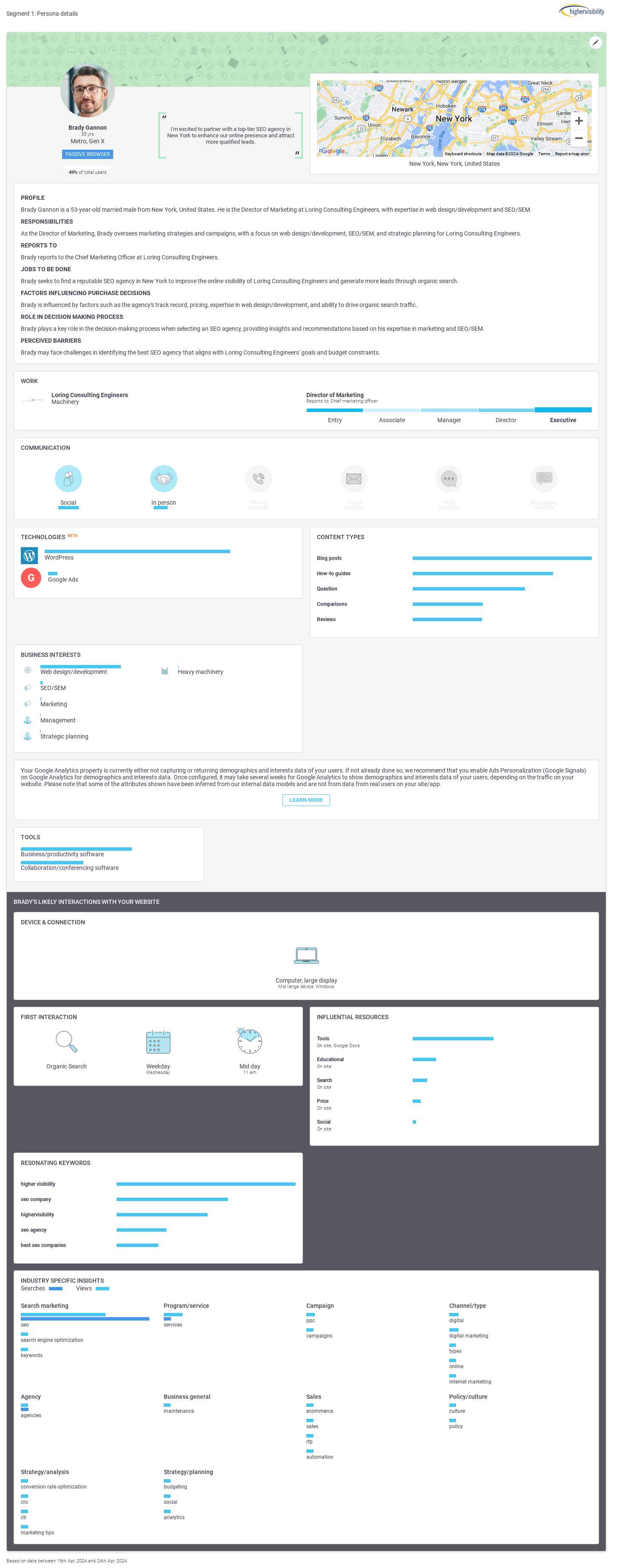
Here is a sample buyer persona we developed for my agency, HigherVisibility:

A sample buyer persona the author developed for his agency, HigherVisibility.Screenshot from author, May 2024

2. Map Out The Buyer’s Journey

The next step is to map out the customer journey for each of your personas. This will guide you in creating content that meets the needs of different personas at every stage of the decision-making process.

Typically, the customer journey is made up of three main phases:

  • Awareness: Here, the persona first becomes aware of a problem or need. For example, “Digital Marketer Dan” realizes he needs to improve his digital marketing ROI. He heads to Google for ideas and clicks through to one of your blog’s educational posts discussing various digital marketing strategies.
  • Consideration: At this point, your persona will be evaluating different solutions to their more fundamental problem. For example, Dan has realized that his team needs a new digital marketing platform to optimize campaigns more effectively. Now, he’s researching the features and benefits of different tools to see which solution can best meet his needs. To get a better sense of what your company offers, Dan reads through a few of your comparison guides and watches your product demonstration videos.
  • Decision: In this final phase, your persona has considered their options and is primed to make a buying decision. For example, Dan is now almost ready to buy. To alleviate any last-minute concerns, he reads through positive feedback from other customers on your testimonials page and then finally reaches for his bank card.

Read more: How To Create A Customer Journey Map

3. Map Existing Content To Different Stages Of The Buyer’s Journey

Now, it’s time to categorize your existing content according to where it fits into the customer journey.

A common approach here is to separate content into three buckets:

  • Top of the funnel (TOFU): This content caters to visitors in the awareness stage. The goal here isn’t to make a sales pitch. Instead, it’s about providing useful information, establishing your brand as a trustworthy source of insights, and raising awareness that your solution exists. TOFU content includes blog posts, infographics, and educational videos about topics within the remit of your brand.
  • Middle of the funnel (MOFU): This content caters to those in the consideration stage. It delves deeper into the benefits and features of your solution, showing visitors how it can help address their problems. Examples include webinars, case studies, and product overviews.
  • Bottom of the funnel (BOFU): This content is designed to help purchase-ready visitors commit to a final decision. Since users are now familiar with what you can offer them, the goal is to address any lingering objections or questions standing in the way of a sale. BOFU content includes special offers, free trials, shipping and refund policy pages, customer reviews, and testimonials.

4. Optimize Existing Pages For The Right Keywords

After identifying where each page fits into the customer journey, you’ll need to ensure those pages are optimized for the appropriate keywords.

But before you get started, we recommend you first refresh and expand your current keyword list to make it as up-to-date and comprehensive as possible.

The aim is to build a complete picture of the type of queries people use when searching for TOFU, MOFU, and BOFU content related to your business. Be sure to include search intent and search volume data in your list.

Once your new keyword list is ready, make sure each page is optimized for a relevant primary keyword if it isn’t already.

Here are some best practices to keep in mind when optimizing your content for keywords:

  • Match pages with keyword intent. Only assign a keyword to a page that genuinely addresses the search intent underlying that term. If you don’t yet have a page for a given keyword, you can add it to your content calendar (see Step 6).
  • Update meta tags. Adjust the title tags, meta descriptions, and header tags to include your target keyword and any close variants. This not only helps Google understand the page’s relevance but can also encourage more click-throughs from the search results.
  • Add keywords to the content. Integrate your target keyword into your content, especially the introduction, conclusion, and headers. All keyword placements should appear natural to the reader. Also, avoid cramming your text with keywords – keyword stuffing is considered spam by search engines and can damage your SEO efforts.
  • Avoid keyword cannibalization. When two or more pages from the same website target the same term, search engines have difficulty determining which page to rank. This can dilute the ranking potential of all the competing pages. So, try to make sure that no two pages target the same primary keyword.

Read more: Keyword Research: An In-Depth Beginner’s Guide

5. Update Internal Links Strategically

Internal links are the routes your users take from one page to another. Not only are they essential for site navigation, but they also help distribute link equity (ranking power) from high-authority pages to lower-authority ones.

However, since your website’s ultimate goal is to generate conversions, each page should contain links that direct users to the next step along the buyer’s journey.

For example, suppose your business sells and installs smart home technology.

Your blog post about “Improving Home Security” (TOFU) might contain an in-text link to a related comparison guide about “The Best Smart Home Security Systems of 2024” (MOFU). Likewise, the comparison guide might contain a link directing readers to your testimonials page (BOFU).

6. Identify Content Gaps To Inform Your Editorial Calendar

The next step is to identify opportunities to create new content or add to existing content.

After expanding your keyword list in Step 4, you will most likely find several relevant keywords for which you don’t currently have content. These keywords can form the basis of your new content calendar.

When deciding which keywords to prioritize in your production schedule, keep the following in mind:

  • Marketing goals: What is your primary marketing goal? If it’s to generate more traffic and brand awareness, targeting TOFU keywords should be your priority. If the aim is to maximize sales conversion rates, targeting BOFU keywords might be a better option.
  • Relevance to your audience: Prioritize keywords that reflect your core audience’s needs. Ask whether there are any topics or questions your buyer personas are likely to have that your content doesn’t currently address.
  • Search volume and competition: High-volume keywords are typically harder to rank for. Consider creating content clusters to increase your site’s authority for specific topics. Content clusters involve a central “pillar” page providing an overview of the main topic, which links to multiple “cluster” pieces covering related sub-topics in more depth.

Final Thoughts

Creating a content map is a powerful strategy for any business looking to increase their organic visibility and maximize their website’s ability to attract qualified visitors and convert them into customers.

By understanding and addressing the various needs of your audience throughout the buyer’s journey, you can position your brand as a valuable source of information and guide visitors from initial awareness to making a purchasing decision.

Building a content map requires careful planning and attention to detail. You should treat it as a living document that evolves with your audience’s needs and business goals.

Regularly reviewing and updating your content map will ensure it remains relevant and effective in guiding your content strategy.

More resources:


Featured Image: watchara panyajun/Shutterstock

How To Increase Website Traffic After The Google Update: 5 Blogger-Tested Tips via @sejournal, @getStay22

This post was sponsored by Stay22. The opinions expressed in this article are the sponsor’s own.

The latest Google update hit our partners – travel bloggers – hard. Despite the challenges presented by this update, we are amazed by their resilience.

Although we cannot influence Google, we can definitely take charge of the things within our reach.

Here are five travel blogger-tested ways to increase website traffic after the latest Google update.

Get the most out of each visitor. Check out our guide, Ten Tips for Maximizing Revenue for Travel Bloggers.

1. Use Pinterest As An Additional Search Engine

Many people think of Pinterest as a social media platform, but it functions much more as a search engine.

Pinterest’s tools make it a fantastic way to get visitors to your website.

How To Get Started With Pinterest

  1. Create a new business account or link/convert a personal account to gain access to business tools like Pinterest Business Hub and Pinterest Analytics, which allow you to monitor searches and keywords.
  2. Write a catchy bio for your profile. If you have niche keywords you use on your website, include them here.
  3. Claim your website, allowing you to track whenever someone shares your website content on Pinterest. Additionally, it will automatically include your Pinterest profile and a follow button so you can attract more visitors.

How To Use Pinterest Like A Pro

Pinterest is built around pictures, so having great visuals is critical. You want to make yours stand out on the page.

  1. When you travel, snap many pictures and pick the best ones later.
  2. Use design tools like Canva to add text, create interesting layouts, and add branding elements.
  3. Create boards to organize your content into categories, such as by destination or blog post type.
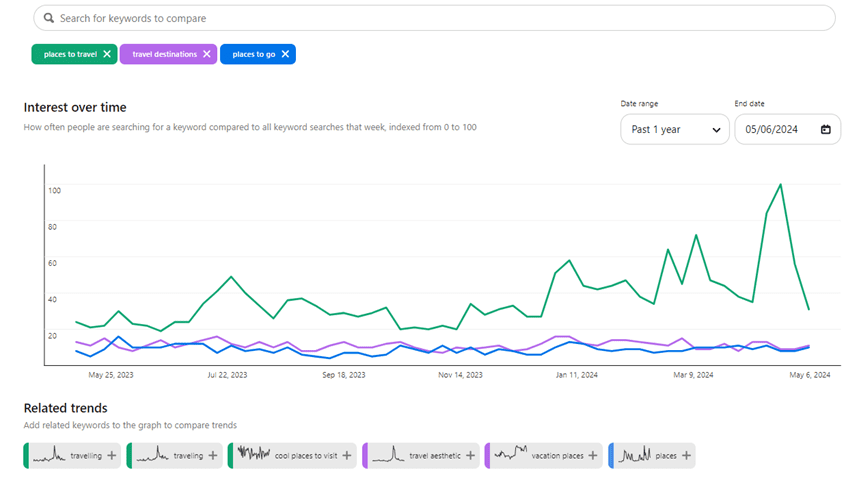
  4. Just like any other search engine, keyword research is necessary on Pinterest. Use business tools like Pinterest Trends, which lets you see keyword search volume and which pins are most popular for them.
  5. Use your selected keywords everywhere possible, including pin titles, pin descriptions, and board descriptions.
Screenshot from Pinterest Trends, June 2024

Before you start pinning, optimize your blog posts to maximize revenue to ensure every visitor counts. See how to do that in our guide Ten Tips for Maximizing Revenue for Travel Bloggers.

2. Keep Visitors Engaged With Email Marketing

Email marketing is important because you own it. Instagram could ban your account, Google can derank you, but your email list is always yours.

Use this strategy to build less volatile, consistent traffic instead of new traffic.

How To Get Started With Email Marketing

  1. Select an email marketing provider. Travel bloggers love MailerLite and MailChimp because they are low-cost and simple.
  2. Start collecting email addresses. Create a mailing list signup form with your website host and insert it at the end of posts to collect your readers’ information.

How To Use Email Marketing Like A Pro

  1. Create a lead magnet that entices readers to share their information in exchange for it. Popular lead magnets in the travel blogging community are travel guides, ebooks, and itineraries.
  2. The goal of email is to get your reader onto your site. Keep your emails short and include impressive pictures and a clear link to your website. Leave them wanting more so that they click through.
  3. Before sending an email directing traffic to one of your pages, ensure the page is set up to maximize revenue. See how in our guide, Ten Tips for Maximizing Revenue for Travel Bloggers.

“While SEO is often touted as the king of traffic, good email marketing is the absolute queen. We regularly see spikes in our web analytics when we email our audience, but those spikes aren’t just temporary. They help our users build habits. We simply wouldn’t have nearly the business we have today without activating our email list.”

Beth Stanos, Wanderful CEO & Founder

    3. Add Your Content To Flipboard To Grab More Website Visits

    Flipboard is an article curation website that lets users flip through articles from different publications, like magazines.

    How To Get Started With Flipboard

    1. Download the Flipboard app on mobile and create an account and profile.
    2. Create Flipboard magazines. These are topic categories that group your content (much like Pinterest boards).
    3. Add your blog posts to them from the magazine page on Flipboard or the Flipit Chrome bookmark.
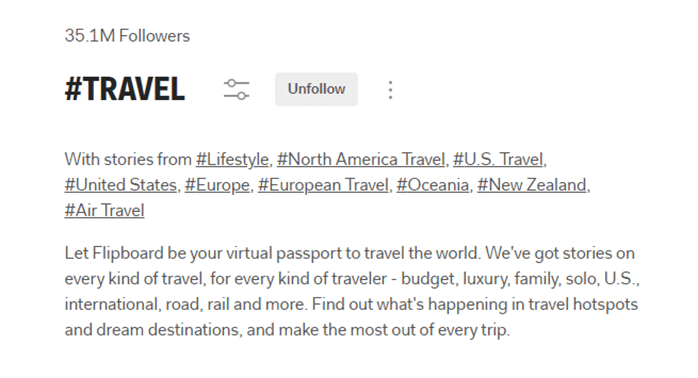
    Screenshot taken from Flipboard, June 2024

    How To Use Flipboard Like A Pro

    1. Add your fresh blog posts to Flipboard right after publishing.
    2. Add relevant content to your magazines that isn’t your own. Engaging with other bloggers’ content and maintaining new content in your magazines helps your reach.
    3. Include your target keywords in your magazine descriptions, post captions, and profile.

    “Flipboard has become a major traffic source for all 3 of my websites. They have fantastic tools for creators, like storyboards, scheduling, and RSS feeds for magazines, making creating and sharing compelling content easy.”

    Amanda O’Brien, theboutiqueadventurer.com Founder

    4. Get Discovered With Short-Form Videos On Social Media

    Did you know 77% of travelers use social media when planning their trips? Get their eyes on your content with short-form videos on platforms like TikTok, Instagram, and YouTube shorts.

    These platforms have algorithms to serve your content to people who don’t follow you, making them ideal for readers to discover you.

    How To Get Started Making Videos

    1. Create your accounts on YouTube, Instagram, and TikTok.
    2. Download Capcut, a free mobile app for video editing. It’s better than the in-app editing functionality, with pre-installed templates and effects.
    3. Create a Linktree account or an alternative. All three platforms make it difficult for users to leave and visit your site, so a place where users can go for all your links is necessary.
    “PLACES ON EARTH WITH THE BLUEST WATER” by @thetravelshack, June 2024

    How To Make Short Video Content Like A Pro

    1. While traveling, keep video creation in the back of your mind. When you see eye-catching scenery or an interesting environment, be ready to capture it in video. Your video’s “wow” factor differentiates between a mediocre and a fantastic video.
    2. On Instagram, write detailed captions. On YouTube and TikTok, keep captions as brief as possible.
    3. Voice-over, on-screen text, and music are crucial to your engagement rate. You can add these with Capcut or in-app.
    4. Pick your video thumbnails carefully. Make sure they stand out in a grid of other videos.
    5. Finally, keep your short video short. The ideal length for a Reel is seven to eleven seconds, a TikTok 21 to 34 seconds, and a YouTube Short 25 to 35 seconds.

    “TikTok helped us to get our second blog on Mediavine. We shared detailed videos about “how to do something” and always included a call to action, directing viewers to our blog for more information. In recent years, we’ve had videos go viral while encouraging followers to visit the link in our bio. This has resulted in thousands of clicks to our websites.”

    Natasha Alden, theworldpursuit.com Co-Founder

    5. Expose Yourself To New Audiences With Guest Posting

    Having your writing published on another website gives you access to a whole new audience, making it an excellent strategy for attracting new readers.

    How To Start Guest Posting

    1. Find places that accept guest posts. Many publications have open submissions that you can submit to.
    2. If you see a site that has guest posts but no open submissions, find their contact information and send an inquiry email.
    3. Create a pitch by explaining your travel expertise and provide writing samples.

    How To Guest Post Like A Pro

    1. When creating your pitch, understand the site’s needs. What content gaps do they have? Focus your pitch there.
    2. Organic guest posting opportunities arise if you take the time to network. Meeting and developing friendships with travel bloggers is a great way to share audiences. You can network on social media, as well as in-person events like TBEX, TravelCon, and Traverse.
    3. Create a clear link back to your blog and include a catchy description so readers will be enticed to read more of your content.
    4. Strategize by monitoring the traffic of potential sites with tools like SEMRush and pick the best option.
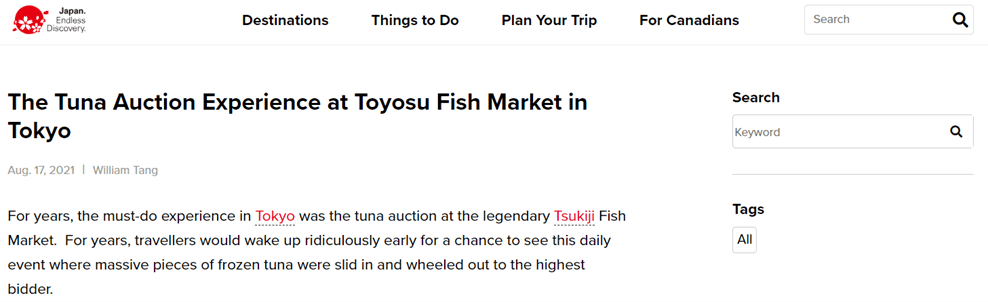
    Screenshot from japan.travel, June 2024

    “Creating content for another publication to share as a standalone article allows you to share new expertise about a certain area. Whether through the article itself or subsequent social shares, a new audience gets exposure to you as a writer.”

    William Tang, goingawesomeplaces.com Founder

    See how William Tang made travel blogging his full-time job with the help of Stay22’s revenue-boosting tools. Read the case study.

    Compensate For Traffic Dips By Maximizing Your Revenue.

    Maximize your conversions with strategic CTA placement and Stay22’s cutting-edge AI-powered affiliate tools! Skyrocket your affiliate sales with these proven tips:

    DOWNLOAD OUR GUIDE: Ten Tips for Maximizing Revenue for Travel Bloggers.


    Image Credits

    Featured Image: Image by Shutterstock. Used with permission.

    7 Ways AI Took My Job [To The Next Level] via @sejournal, @CallRail

    With AI-powered call attribution, you can gain valuable insights into which channels are driving the most conversions.

    How Call Attribution Works

    • Step 1: Assign – Select unique call tracking numbers to assign to each campaign or listing.
    • Step 2: Track – Potential customers see your ad or listing and call the associated phone number.
    • Step 3: Forward –The calls ring directly into your main business phone, regardless of which number they use.
    • Step 4: Analyze – Because they used one of your tracking numbers, you instantly know which ad or campaign inspired them to call.

    With AI-powered call tracking, gone are the days of wondering how your digital marketing efforts are tied to high-value inbound calls.

    For agencies, this helps prove the real value of your services and extend the life of your client relationships.

    2. AI Can Help You Save Time On Manually Reviewing Calls

    Listening to and analyzing phone calls manually can be time-consuming and inefficient for agencies.

    However, it’s an important part of understanding the customer experience and sales team performance.

    With AI-powered call analysis tools, you get quality, keyword-tagged transcriptions with near-human-level accuracy.

    Not only can this technology help you save over 50% of the time spent listening to phone calls, but it can also help you deliver actionable recommendations to clients and drive better results.

    Conversation Intelligence, for instance, is trained on over 1.1M hours of voice data and enables real-time analysis for instantaneous results.

    This advanced tool provides opportunities for you to improve your strategy through the following granular insights:

    • Spotting disparities in the industry-specific lingo your sales team uses, compared to the lingo your prospects are using to describe their business challenges and goals.
    • Identifying trends or gaps in your service offerings based on what your prospects are asking for.
    • Identifying frequently asked questions and other important topics to address through content marketing.
    • Setting goals for lead qualification — not just the quantity of leads generated for your business.

    Conversational AI is perfectly suited to summarize the content of long conversations – however, the call summaries still require a human to read them and determine the main takeaways.

    But if you work in a bustling small business, it’s unlikely you’d have the bandwidth for tasks such as call transcription, summaries, keyword spotting, or trend analysis.

    Rather than displacing human labor, conversational AI is assisting businesses in taking on tasks that may have been overlooked and leveraging data that would otherwise remain untapped.

    3. AI Can Help You Lower Cost Per Lead / Save Money On Tools & Ad Spend

    Ever wonder why certain campaigns take off while others fall flat? It’s all in the data!

    Even failed campaigns can offer invaluable insights into your client’s audience and messaging.

    But if you can’t spot the underperformers quickly enough, you risk wasting your ad budget on ineffective tactics.

    The quicker you can identify what’s working and what’s not, the quicker you can pivot and adjust your marketing strategy.

    With AI-powered tools, agencies can access instant insights that enable them to reduce wasteful spending and improve overall campaign efficiency.

    How To Deliver More Value With AI

    • Make a bigger impact in less time: AI-powered technology creates a force multiplier within your agency, allowing you to make more of an impact with the same level of inputs you’re already using.
    • Unlock actionable insights from call data: AI is revolutionizing the way companies leverage call data by enabling them to gain insights at scale. As a result, businesses can increase their ROI and deliver greater value to their clients by analyzing hundreds of calls efficiently.
    • Foster alignment with data-driven strategies: By analyzing customer conversations with AI, businesses can align their marketing strategy with data-driven recommendations, enhancing overall coherence. Additionally, the ability to create triggers based on specific phrases enables automated analysis and reporting, further streamlining the alignment process.
    • Drive effectiveness with rapid insights: Leveraging Conversation Intelligence enables agencies to deliver better insights faster, increase conversion rates, refine keyword strategies, and develop robust reporting capabilities.

    With the right AI-powered tools, you can access the insights you need to ensure maximum ROI for your clients.

    4. AI Can Help You Improve Overall Agency Efficiency

    Are you spending too much valuable time on tasks that produce minimal results?

    Many agencies find themselves bogged down by routine, administrative tasks that don’t contribute much to their bottom line.

    But with AI automation, agencies can streamline their operations and redirect their energy towards more strategic endeavors.

    From email scheduling and social media posting to data entry and report generation, AI can handle a wide array of tasks with precision and efficiency – giving you time to focus on high-impact activities that drive growth and deliver tangible results.

    Ways Your Business Can Benefit From Automation

    1. Automatically transcribe your calls to boost close rates: See how your team is handling difficult objections and ensure that they’re delivering your businessʼ value proposition in an effective manner.
    2. Score calls based on quality and opportunity: Take the time-consuming work out of scoring your calls and determine which campaigns drive the best calls to your business.
    3. Classify calls by your set criteria: Qualify, score, tag, or assign a value to the leads that meet your criteria, automatically.
    4. Automatically redact sensitive information: Protect your customers by removing billing or personal information. Keep your data safe and secure through complete HIPAA compliance.
    5. Monitor your teamsʼ performance: Use Conversation Intelligence as a valuable sales training tool to ensure your team doesn’t miss any key messaging marks.
    6. Know your customersʼ needs: Identify conversation trends in your phone calls and stay privy to evolving customer needs.
    7. Improve your digital marketing strategy: Use AI-powered insights to inform your digital marketing strategy and boost your online presence.

    By automating mundane tasks, agencies can optimize workflows, increase productivity, and improve efficiency across the board.

    Looking for 5 – 7? Download The Full Guide

    Rather than fearing AI, the future belongs to those who embrace it.

    By strategically combining human creativity with artificial intelligence, you can unlock capabilities that transcend what either could achieve alone.

    Want to discover even more ways to level up your agency with AI?

    Get the full guide here.

    Mastering The Content Maze: Strategies For Multi-Touchpoint Success via @sejournal, @hethr_campbell

    As digital platforms multiply and user engagement becomes more and more fragmented, understanding how to effectively distribute your content across various touchpoints is more crucial than ever.

    So how do you tailor your strategy to meet users wherever they are in their journey? 

    How do you create quality content that resonates and connects at every stage? 

    Join us live on May 29, as we show you how to successfully navigate the ever-evolving landscape of content strategy. 

    In this insightful session with iQuanti, we’ll explore innovative strategies to map out and meet the diverse needs of your audience at multiple touchpoints. 

    Key takeaways from this webinar

    • Today’s users interact with content in a myriad of ways, spanning across a variety of channels. Whether they’re browsing on their smartphones or exploring on their laptops, understanding these user behaviors is essential for crafting content that captures attention and drives engagement.
    • Mastering the latest methodologies for identifying and addressing content gaps helps keep your content strategy ahead of the curve. Learn how to uncover areas where your content may be lacking or where new opportunities lie. This proactive approach ensures that your content remains relevant and resonates with your audience’s evolving needs.
    • Discover the ins and outs of digital shelf space and how to pivot your content strategy. By strategically positioning your content where your audience is most likely to discover it, you can maximize your digital shelf space and drive better results for your brand.

    Wayne Cichanski, Vice President of Search and Site Experience at iQuanti, will walk you through ways to unlock the full potential of your content strategy and outperform your competition. 

    Whether you’re a seasoned professional or just starting out, this webinar will provide you with the tools and strategies you need to elevate your content marketing this year.

    Don’t miss out on these valuable expert insights. Sign up now and learn how to master the content maze. 

    At the end of the presentation, you’ll get a chance to ask Wayne your most pressing content questions in our live Q&A. 

    And if you can’t make it to the live event, register here and we’ll send you a recording, following the webinar. 

    Should You Include FAQs On Product Or Category Pages? via @sejournal, @rollerblader

    This week’s Ask An SEO question comes from Aleksandar, who asks:

    “Is there a role for product Q&A for a fashion brand, which only sells its own branded products, besides the obvious question on the sales/delivery/return process?”

    Yes, there is absolutely a role for product Q&A, and for FAQs on collections or categories.

    This applies to all niches and industries and is especially relevant in fashion, even more so when the company retails its own products.

    But it isn’t SEO-focused; it is about the user experience.

    Don’t limit yourself to FAQs alone, descriptions, and answering common questions in the copy works, too. This is something we do a lot in conversion rate optimization (CRO).

    A positive impact, when done correctly, is a reduction in customer returns and wait times due to poor website experiences with customer support. I share some examples by page type below.

    Proper Q&A on relevant pages answers visitors’ questions so they know the product or service will meet their needs. When you build the consumer’s confidence, they may be more inclined to click add to cart, schedule a meeting, or fill out a form.

    Don’t be afraid to say the product or accessory won’t work either, this lets you have an internal link to the product or service while leading them to a working solution.

    The first place we look for questions are live chat transcripts and customer service emails – and then we go to the web.

    If you look at popular review sites, forums, and communities, you’re going to find questions that your own customers and your competitor’s customers are asking.

    Here are a few examples by page type that I either researched or really want to try if the opportunity arises. I’ll start with product pages, then do categories, and finally, a homepage and FAQ.

    Product Pages

    If the query is about the product in particular and it doesn’t apply to other products you sell, place the content on the specific product page.

    I normally do the catch-all vs. the variants like size or color. If you have your canonical links set correctly, you can include them on variants. I’ll use fashion here as the example since that was in your question.

    Answer product questions like how the fit of the garment feels, or maybe whether it is meant for pear body shapes or diamonds. You can also compare the sizing of your products to popular brands, like how your company’s medium size fits like the XYZ size at AB, a popular retail store with the same customer demographics.

    Do you sell hair care products? Mention the hair types as well as thickness and lengths it is best for, or if it is not good for hair that is dry or chemically treated.

    This applies to shoes, too, where you’ll want to talk about them being good for play or comfort, road running or trail hiking, and whether the person pronates or not.

    Putting this information in the copy above the call to action (CTA) can help the user make a decision, and there is no harm in placing them in FAQs on the page since they are product-specific. I’ve done this with electronics, fashion, toys, tools, and plenty of other niches.

    Collections And Categories

    If you work in Shopify, you’ll know this as collections; for most other platforms, they’re called categories. It is a grouping of similar products or services that meet a consumer’s needs.

    It could be split by sizes, colors, variations, etc., and adding in questions and answers works just like the product pages above.

    In the copy above and below the product grid, don’t keyword stuff for SEO. Instead, answer the questions consumers are asking while focusing on brand talking points and benefits.

    You’ll be displaying why the person should shop from the selection of options on the page, have opportunities for natural internal links, and be able to build confidence that the consumer is in the right place.

    Instead of a retail experience, I’ll use cruise ships for this one.

    I’ve never worked with a cruise company before, but I’ve had this idea for about 10 or so years and have never seen it done. I was researching which cruise to take and saw cabin bathroom questions for a person of size often come up in forums.

    I have about 20 more ideas for cruise lines, airlines, and hotels that are similar. Hint hint: If you work in this space, submit an Ask An SEO question so I can get them into writing and out into the world.

    Cruise ships are notorious for maximizing limited space. That means they may not be friendly for all types of consumers based on size and physical abilities. You could use text and written language, which is normally smart, and you can use visuals.

    My idea here is to have eight or so “tour guides” that can walk the person through the experience as themselves. At least one model should be over 6 foot 5, one should be plus size, and one in a wheelchair.

    Not all showers in all cabin types will be able to accommodate someone who is larger, for example. By having a model that resonates with the cruise shopper, they can find out if the cabin type is a match, and the tour guide can walk them through which cabin experience may be better and alternatives like a locker room shower.

    Locker room showers on the ships tend to be large and spacious, and the water pressure is normally fantastic. This appeared in multiple comments when I was doing the research and true on the ship we were on.

    Tall people may want to see what it’s like to walk through the ship, try the games and amenities like waterslides, and see if there are activities they may not be able to participate in.

    The same goes for someone in a wheelchair or who has mobility issues.

    If they can have a tour guide that shows the distance from specific rooms to elevators and the fastest routes possible to dining areas and entertainment, they will know if the ship or cabin they’re looking at is right or if they should select a different one.

    Home And FAQ Pages

    Your homepage and FAQ pages are more similar than you think. The homepage is the perfect space to answer questions about your brand, service, and product lines, as well as things customers want to know. Do this in paragraph form.

    You’ll be building natural mentions of collection or category pages for keyword rich internal links that guide the user to the correct experience while you build consumer confidence.

    On your FAQs, list out brand and company questions that do not apply to a specific category or product. This could include hours of operation, return policies, where you ship to, and the costs, as well as funny questions to hide an “easter egg” for consumers and fans of your brand to find.

    Before you begin adding FAQs to any page, make sure the FAQ applies to that page and not to others. You don’t want to add content for the sake of adding content.

    Questions and answers on a collection page should be about the collection, not a specific product. And product questions shouldn’t be about company policies, they should be about the product on that page.

    I hope you found this answer helpful. It is one of the tools we use to help save on logistics and overhead expenses and to increase conversions. Great question, and thank you for asking it!

    More resources: 


    Featured Image: Visual Generation/Shutterstock

    Google Core Update: How To Write High-Ranking, High-Quality Content in 2024 via @sejournal, @fiverr

    This post was sponsored by Fiverr Pro. The opinions expressed in this article are the sponsor’s own.

    Were you impacted by Google’s recent core update?

    Have your search visibility and rankings begun to drop?

    Even in the era of automation, quality still wins over quantity when it comes to search rankings.

    With the recent surge of generative AI, the demand for human-created, high-quality content is greater than ever.

    Google’s latest update aimed to improve search result quality by reducing unhelpful, unoriginal content by 40%.

    So, what kind of content does Google deem high quality these days?

    How can you ensure your content performs well on search engines in 2024?

    The simple answer is to focus on user experience rather than the search engine itself – in other words: make human connection the priority.

    While many businesses are taking advantage of AI tools to populate their sites, those who still see the value in human-created, user-centric content will ultimately win out.

    In this guide, we’ll break down the key steps to creating high-quality content that ranks on Google in 2024.

    Step 1: Align Your Content Strategy With Campaign & User Journey Goals

    Delivering the right content to the right audience at the right time is crucial for SEO success.

    And with Google’s latest core update, it’s more important than ever to provide a seamless and personalized experience for your audience throughout their user journey.

    Here’s how you can use audience research and user insights to create content that drives results:

    • Identify Your Target Personas: Start by defining your ideal audience personas. Understand their demographics, preferences, pain points, and behaviors.
    • Map Out Your User Journey: Visualize the various stages your customers go through, and identify the touchpoints where they interact with your brand.
    • Tailor Your Content To Each Stage: Meet your audience at each stage of the user journey, and address their specific needs with content that’s relevant, targeted, and effective.

    Pro Tip: Don’t have the time or bandwidth to tackle these tasks? You can still move your business forward by hiring a professional SEO strategist to help plan your campaigns and keep you on track.

    Image created by Fiverr Pro, April 2024

    Step 2: Analyze Real User Data & Identify Content Gaps

    As you’re building your content strategy, you’ll need insights into your audience’s behavior, preferences, and engagement patterns.

    Utilize analytics tools to gather valuable user data and track key metrics such as website traffic, click-through rates, and conversion rates.

    With this information, you can conduct a thorough audit of your existing content and identify gaps and areas for improvement.

    Here’s how you can adjust your strategy to a more user-centric approach:

    • Build credibility by honing in on E-E-A-T (Experience, Expertise, Authoritativeness, and Trustworthiness).
    • Try leveraging real experts as content creators, elevating their first-hand experience to create truly helpful content from a trustworthy source. (This is particularly helpful for subjects such as finance or medicine.)
    • Be sure to display the writer as an experienced, authoritative figure in your post, with a link to an author archive page.
    • Maintain relevance by keeping your content up to date and checking frequently for possible revamps.

    Get started by outsourcing your audience research and content auditing needs to a Fiverr Pro freelancer.

    Step 3: Plan Content That Matches User Intent

    Once you gain a deeper understanding of your customer touchpoints, it’s time to plan your content accordingly.

    Start by developing detailed outlines for each piece of content that match user intent and meet their needs and expectations.

    “Understanding and aligning content with user intent is crucial for SEO success. With Google’s algorithm updates, it’s essential to create content that is not only helpful but also answers specific questions your target audience has. Focus on crafting content that resonates with your audience, addresses their needs, and communicates your message clearly, while ensuring it’s relevant, engaging, and directly addresses the concerns and interests of your readers.”

    Alan Redondo, SEO and PPC Expert

    It’s also important to establish your own unique voice, as authentic and original content tends to rank higher on SERPS.

    And make sure to avoid fluff and keep your content to the point – searchers want to see their questions answered and needs addressed with as little fuss as possible.

    If content is not exactly your specialty but you’re ready to start laying out the process, try Fiverr Pro’s professional services to get the help you need.

    Image created by Fiverr Pro, April 2024

    Step 4: Write Content With Proactive Engagement In Mind

    When you create content, the goal is to encourage interaction, discussion, and sharing among users, which boosts your brand awareness organically.

    One effective strategy is to craft compelling headlines, introductions, and calls-to-action that prompt users to engage with your content.

    You can also use interactive elements such as polls, quizzes, and surveys to encourage participation and feedback.

    If you’re looking to maximize user engagement, a multichannel approach is key.

    Choose the most appropriate content formats and channels for each stage of the user journey, and consider using blog posts, social media, email campaigns, etc. based on where your audience is most active.

    Pro Tip: User Generated Content (UGC) can be beneficial for your overall search strategy. With Google favoring human insights, comment sections and other forms of human interactions are helpful for discoverability.

    Ready to start getting the most out of your content and utilizing the multitude of channels available?

    Whether you need a social media manager or an email marketer, Fiverr Pro has you covered.

    Step 5: Analyze Performance & Pivot

    Once you’ve implemented your content strategy, it’s essential to regularly monitor its performance and be prepared to make adjustments as needed.

    Keep an eye on key performance indicators (KPIs) to gauge the effectiveness of your content, and pay attention to user feedback and comments to understand how your audience is responding.

    Are they finding it helpful and engaging, or are there areas where you could improve?

    Take note of any trends or patterns that emerge and use this information to inform future content decisions.

    Image created by Fiverr Pro, April 2024

    Embracing Human Talent In The AI Era

    The human touch is essential to SEO success in today’s landscape, and Google’s latest update supports that.

    As it stands, content that’s created for and by humans will outperform generic, AI-generated content every time.

    So if you’re looking to set your website apart, it’s best to pivot away from sheer search volume and more towards what will resonate deeply with your target audience.

    After all, the more value you provide to users, the more likely you are to beat the algorithm and boost your rankings.

    But let’s say you’re a small business owner with a small team and limited hiring capacity.

    How do you compete with organizations that have the in-house expertise necessary to implement this kind of content strategy?

    How can you access the human talent needed to form genuine connections with your audience?

    Whether you’re seeking an SEO professional to help you target your users, or a writer/artist to help you create content, it might help to start bringing on freelancers to fill in any talent gaps.

    Fiverr Pro, for example, is a great solution for matching and collaborating with top-tier, pre-vetted freelance talent.

    You can use it to find people with the right set of skills to help you execute your projects and add that much-needed human touch to your content.

    In the meantime, use these tips to build out your content strategy, so that as you begin to expand your team, you’ll know which tasks to prioritize, moving forward.

    Elevate Your Content Strategy With Fiverr Pro

    With Google’s updates constantly shaking things up, the key to staying ahead is staying true to your audience and their needs.

    While AI may be able to churn out content at lightning speed, it’s the authentic, user-centric content that truly stands out these days.

    By creating content that connects with real people on a human level, you can ensure sustained SEO success in 2024 and beyond.

    So if you’re looking for the right talent to bring that human touch to your content, Fiverr Pro is the ultimate solution.

    Whether you’re a small business owner or a seasoned marketer, this subscription-free service offers a wealth of talented, pre-vetted professionals ready to elevate your content strategy.

    Get started with Fiverr Pro today and let their experts find talent, plan, and manage projects for you.

    Plus, you can hire with confidence, knowing that you’ll get a full refund if you’re not satisfied with the results.


    Image Credits

    Featured Image: Image by Fiverr Pro Used with permission.

    How To Address Middle And Bottom Of Funnel Pain Points via @sejournal, @alexanderkesler

    The B2B marketplace has evolved rapidly in recent years due to various global factors, with the pandemic and economic turbulence being the top drivers.

    As a result, there has been a notable change in both marketer and buyer priorities in recent years.

    Speaking with our clients and partners, I have observed that in 2024, marketers’ top priorities have shifted from personalized outreach to generating sales-ready leads and driving pipeline opportunities.

    This likely results from a more evident objective of proving return on investment (ROI), and pressuring marketers to effectively guide prospective clients through the discovery and purchase journey more efficiently.

    However, this focus is understandable given the benefits of a stable pipeline with middle (MOFU) and bottom (BOFU) of the funnel leads.

    Not only does it offer a consistent avenue for sustained growth, but it also allows sales teams to capitalize on the best opportunities for conversion.

    In this guide, I present playbooks we implemented at INFUSE and recommend for B2B organizations in 2024 to effectively address the most common MOFU and BOFU pain points to increase conversions.

    The Evolution Of The B2B Buyer

    The increasing complexity of the buyer’s journey – a result of buyers taking a largely defensive position in an effort to de-risk their portfolios – has resulted in expanded B2B buying committees, extended sales cycles, and more discerning buyers across buying committees of organizations of all sizes and complexities.

    This shift is unsurprising, considering that 83% of buyers initiate first contact with vendors. It suggests that sellers learn about buying processes on the buyer’s terms.

    Buying committees are also increasingly younger, with many now comprising Millennials and Gen Z. These generations demonstrate unique buying behaviors compared to their predecessors; they are more independent, tech-native, and display a greater need for autonomy in their client journeys.

    In fact, research shows that approximately 70% of the buyer’s journey is now done completely independently, without ever engaging with sales.

    These young buyers have also prioritized cloud purchases, particularly due to the effortless integration of low/no-code solutions that allow organizations to build on their purchases in their own time as resources allow.

    Addressing Middle-Of-The-Funnel (MOFU) Pain Points

    Below is a list of the four most common middle-of-the-funnel pain points and strategies to address these challenges:

    1. Lack Of Personalization

    Conversions often stall due to a lack of understanding of the key needs buyers face in MOFU, as well as identifying the right timing and messaging to increase velocity to the bottom of the funnel.

    Below are four tactics to address this pain point effectively:

    Utilize Accurate Targeting With Segmentation

    Ensure that prospective buyers are correctly segmented throughout their buyer’s journey.

    Adjust targeting as their pain points and goals change to ensure aligned messaging. This can be streamlined with the use of data analytics tools to identify and categorize audiences based on their unique behaviors.

    Make Use Of Data Throughout The Buyer’s Journey

    It is normal for prospective clients to move freely in their buyer’s journey, often skipping phases or going back to research as needed.

    Be sure to continually assess their position using behavioral data and other feedback mechanisms to ensure they receive the correct nurturing for their funnel stage.

    Implement Feedback Mechanisms To Understand Prospect Challenges

    Set up regular feedback loops via surveys, focus groups, and social listening tools to gather insights.

    These can be used to make adjustments and optimize nurturing to target buyers at the right time with relevant messaging on the platforms or channels they frequent.

    Find The Right Go-To-Market (GTM) Motion To Lead Your Nurturing And Funnel Efforts

    GTM models act as a blueprint for molding an organization’s frameworks.

    This involves determining target buyer personas, establishing interdepartmental data processes, and coordinating efforts to ensure a seamless revenue cycle.

    Often, organizations have several GTM motions running simultaneously, which can be beneficial to accelerate velocity with certain buyer segments, hone in on the right product-market fit, or test a new market or solution.

    2. Limited Budgets

    Budgets will consistently remain a focal point, particularly in a time of high expectations – not only for vendors, but internally within organizations and buying committees.

    Committee members are tasked with making carefully considered purchases that yield tangible returns, underscoring the importance of budget consciousness.

    Below are three tactics to address this pain point effectively:

    • Create a tiered pricing structure per persona designed to evolve alongside their budget and requirements. This allows for strategic upsells and cross-sells, maximizing revenue and catering to diverse needs.
    • Provide referral programs to accommodate their budgetary requirements (with incentives) while encouraging clients to stimulate top-of-funnel demand.

    3. Incorrect Content Or Messaging

    When buyers receive content or messaging that is not relevant to their pain points, role, or stage in the buyer’s journey, it diminishes their interest and trust in the brand.

    In fact, 47% of buyers reported that the key driver behind opening emails was relevant messaging.

    Below are three tactics to address this pain point effectively:

    • Deliver the right content to the right audience by tailoring messaging to suit the specific pain points and buyer’s journey stage of each prospect. Utilize customer relationship management systems (CRMs), data analytics, surveys, and other sources of buyer data to build highly personalized nurturing programs.
    • Ensure your content is demand-ready by understanding the role of core decision-makers in the buying process and tailoring your content accordingly. In addition, ensure that your messaging is adjusted to the channels they frequent.
    • Keep your brand top of mind by engaging buyers early with relevant content that addresses their evolving pain points. Providing answers to frequently asked questions and highlighting distinctive value propositions are essential for driving high engagement rates at the top of the funnel. This, in turn, facilitates the transition toward conversions in the subsequent phases, fostering sustained interest.

    4. Single Channel Engagement

    Buyers utilize more channels than ever, with the majority engaging with brands on 10 or more channels.

    This trend is evident in current B2B buyer behavior, as prospective clients consult a variety of sources before making buying decisions. As a result, organizations that rely solely on single-channel engagement risk overlooking crucial audience segments.

    Below are two tactics to address this pain point effectively:

    • Omnichannel engagement is a necessity. B2B buyers increasingly seek a seamless omnichannel journey, with 87% preferring a personalized and consistent experience across all channels. To meet this demand, it is important to integrate your sales and marketing efforts across multiple touchpoints, ensuring consistency and continuity throughout the buyer’s journey.
    • Email-only does not work anymore. While email remains a fundamental tool in B2B communication, its effectiveness as a standalone channel is fading. With crowded inboxes and evolving buyer preferences, organizations must diversify their communications and invest in strategies across multiple channels to create demand in their market – not just capture it.

    Addressing Bottom-Of-Funnel Pain Points

    Below is a list of the three most common bottom-of-funnel (BOFU) pain points and strategies on how to address them:

    1. Performance Against Competitors

    Considering the increased scrutiny of buyers in the current landscape, it comes as no surprise that most buying committees will seek to compare your solution with multiple competitors.

    This highlights the importance of establishing key differentiators and demonstrating how your solution best supports your buyers’ business growth and objectives.

    In fact, brand equity – as a precursor and counterbalance to full-funnel demand generation – is a critical element of a solid business strategy. Research shows that 84% of deals are won by the first vendor a buyer contacts.

    This first contact requires companies to have comprehensive brand-to-demand strategies in place, to ensure they are first on their buyers’ minds.

    Below are three tactics to address this pain point effectively:

    • Offer competitor analysis that clearly defines your unique value proposition (UVP) to engage BOFU leads. Develop personalized comparisons of products against your competitors based on the features that are of the most interest to each segment. Make this information engaging and accessible in brief reports and datasets that highlight your strengths at a glance.
    • Provide assurance through nurture streams that engage and educate prospective clients. Offer problem-solving content such as case studies, whitepapers, webinars, executive briefs, and industry reports demonstrating how your solution addresses challenges and delivers ROI.
    • Offer free tools and demos illustrating personalized problem-solving. Enable buyers to experience the benefits of your solution firsthand by offering free tools, demos, or trials that allow them to explore its capabilities. Tailor demos to address the specific pain points and objectives of each buyer or segment, and adjust your demo tactics to meet the needs of the increasingly younger, tech-savvy, and independent buyer.

    2. Integration And AI Concerns

    Amidst the challenge of managing bloated tech stacks, integration has become a key concern. 35% of executives reported their legacy software was rigid, expensive, and difficult to use.

    Buyers actively seek tools to solve new business challenges while navigating integration requirements.

    In addition, the B2B landscape has embraced the advantages of incorporating generative AI into day-to-day operations, as demonstrated by the fact that 73% of marketers were already leveraging generative AI, just six months after the release of OpenAI’s GPT4.

    Below are three tactics to address these pain points effectively:

    • Ensure solutions seamlessly integrate with existing systems. Proactively evaluate compatibility features of popular software and prioritize features that facilitate seamless integration. Establish a robust testing protocol to verify compatibility before deployment, ensuring minimal disruption and maximum value to clients.
    • Integrate AI into existing solutions where possible. Identify areas within your solution where AI integration can truly enhance functionality and value for clients. Collaborate with developers to seamlessly embed AI capabilities into these solutions and ensure thorough testing to guarantee integration and optimal performance.
    • Provide training to meet the demand for innovation and automation. Develop customized training and coaching programs tailored to your buyers’ specific needs and skill levels. Offer ongoing support and resources to facilitate continuous learning and adaptation to new technologies.

    Due to the democratization of technology, the rise of low-code/no-code solutions, and the increasing tech-savvy Millennial and Gen Z buyers, sellers now require a more solution-oriented approach, equipped with technical knowledge.

    By the time buyers are ready to meet with sellers (typically 70% or more into their purchasing journey), they often have detailed technical inquiries and may no longer require the high-level discussions that vendors are traditionally accustomed to.

    Meeting buyers where they are has become a fundamental requirement.

    3. ROI Concerns

    Buyers are increasingly pressured to achieve ROI goals, making this a recurring concern among those seeking information on how solutions can assist them in reaching their performance objectives.

    Below are two tactics to address this pain point effectively:

    • Support claims with case studies and/or customer testimonials. Utilize tangible ROI data from existing clients, preferably from the same or similar industries to the buyers. Combine this with case studies to inform bottom-of-funnel nurturing activities such as content and webinars.
    • Foster brand evangelism to build confidence. Provide exemplary post-sales service to support clients and regularly check in with them to ensure their satisfaction. Brand evangelism can be utilized to address common objections after a sale while establishing brand credibility within your industry.

    Key Takeaways

    Engage Buyers Where They Are In Their Buyer’s Journey

    Lead nurturing and engagement tactics should always be tailored to address the pain points, challenges, platforms, and context of your buyers at their current stage in the sales funnel, ensuring relevance and effectiveness.

    Innovate In Both Service And Technology To Maintain A Competitive Edge

    In the B2B landscape, where technology is becoming increasingly democratized, it is crucial to consistently evaluate and refine your strategies, such as prioritizing low/no-code approaches, to stay updated with industry trends.

    Explore Go-To-Market (GTM) Strategies

    To fuel your GTM strategies with iterative approaches and data-driven insights, establish protocols for testing and optimization.

    Continuously analyze performance metrics, refine tactics based on feedback, and foster collaboration across teams to ensure relevance and effectiveness.

    Continuously Assess And Optimize Strategies To Streamline Nurturing

    Given that each buyer’s challenges, needs, and readiness to purchase will frequently shift, ensure that you are closely monitoring their behavior triggers to optimize nurturing activities.

    More resources: 


    Featured Image: NicoElNino/Shutterstock

    B2B Content Marketing Strategies For High-Quality Lead Generation via @sejournal, @sejournal

    Content is key for generating high-quality leads in B2B marketing.

    You must know how to leverage content to begin and nurture meaningful interactions. Words and graphics have the power to drive conversions and forge lasting connections.

    Ultimately, successful content marketing isn’t just about being noticed but being remembered.

    And generating leads isn’t just about numbers; it’s about connecting with real people.

    If you’re ready to elevate your content strategy in 2024, our latest ebook, B2B Lead Generation: Create Content That Converts, is your playbook to providing maximum value to your audience next year.

    This concise yet powerful guide is full of exclusive insights from high-profile experts, while drawing on our own internal expertise in delivering leads across multiple media types.

    Here’s a peek at what you’ll find inside:

    • Using content innovation for lead generation: The oversaturation of content is a big issue in B2B today – and standing out isn’t just a challenge; it’s an art form. In order to elevate your brand and leave a lasting impression, you need the right combination of innovation and strategy. The key is in surprising your audience with content that feels fresh, speaks directly to their needs, and keeps them eagerly awaiting your next move.
    • Building sustainable and scalable lead programs: Remember, it’s not just about acquiring leads; it’s about making sure they feel valued and guided, and cultivating long-lasting relationships. To build a strong lead program, you must properly qualify and score your leads to determine how to best engage with and nurture them. Be sure to map out your customer journey, tailor your communication, and provide valuable touchpoints at every step to guide your leads from curiosity to commitment.
    • Mastering the knowledge exchange: Your goal should be to “add value before you extract value” – as Curtis del Principe, Sr. Marketing Manager at Hubspot, puts it. It’s all about crafting a win-win scenario between you and your audience. When you manage to address their biggest pain points and answer their most pressing questions, they willingly share their information in return. Create the kind of content that can captivate, engage, and inspire your leads to action.
    • Leveraging consumer psychology to forge meaningful connections: At its core, B2B is about humans connecting with humans. Although interactions can sometimes feel transactional, forging genuine connections and building relationships that go beyond the surface is crucial for success in this space. Try to understand why your audience does what they do so you can adjust your content to their unique needs and preferences. Offer value to them upfront and present solutions in a way that resonates with them personally.

    B2B Lead Generation: Create Content That Converts

    This digital handbook is tailored for the B2B marketing professional, whether you work within a specific brand or with an agency.

    Grab your copy of B2B Lead Generation: Create Content That Converts for expert insights and actionable tips to help you start driving qualified leads and building genuine relationships.


    Featured Image: Paulo Bobita/Search Engine Journal

    How To Uncover Your Expertise To Become A Journalist’s Source via @sejournal, @_kevinrowe

    A company can generate influential media exposure by turning internal expertise into media sources.

    I challenge you to use brand scoring, like count, content shares, or other vanity metrics when pitching a journalist or editor to become an expert source.

    The best-case scenario is that you don’t get a response. But if the media contact feels snarky that day, they would respond with a laughing emoji.

    More than 50% of journalists need PR pros to provide expert sources. However, news happens fast around an event, and you must be a proven expert for journalists or editors to reach out or respond.

    To become an expert source, be ready to prove your expertise fast.

    Creditable experts are becoming a valuable resource, but this raises some questions:

    • How do you know you or a source is an expert in their field or topic?
    • How do I demonstrate my expertise and creditability?
    • Is there a way to improve my creditability?
    • How do I know what I’m an expert in?

    When identifying an expert’s core expertise, start by identifying the experience in a specific field. In that field, examine:

    • Proven expert knowledge: Depth of knowledge, real-world experience, and demonstration of skill.
    • Developing influential assets: Reputation and recognition, published research, and influence in the field.
    • Evolving with change: Innovative contributions, adaptability to feedback, and continuous learning.
    • Improve communications by teaching: Teaching and mentorship, real-world problem solving, and communication skills.

    I created this expert evaluation and planning tool to help guide this process.

    This tool helps to identify, improve, and prove a subject matter expert’s (SME) or company’s experience and expertise in a given field. It’s not an attempt to reverse engineer or deconstruct why pages rank in search engines but rather a human tool to judge if someone has expertise in a given field.

    PureLinq's expert evaluation workbookImage created by author, December 2023

    Start by selecting an expert and identifying their field of expertise. For each field of expertise, identify proof in each of these areas. Then, rate each one on a scale of one to five.

    These scores don’t add up to an overall score, as you would have to weigh each criterion against the others.

    The purpose of scoring is to provide a human rating scale in which a person can evaluate the levels of expertise for a given criteria.

    Each criterion is explained in-depth below, with examples.

    Specifying Field Of Expertise

    The specific field is a niche or area within a broader field where the expert has specialized knowledge. An expert in a field has deep knowledge that gives them a clearer perspective and insights into a complex topic.

    An expert can have general field knowledge or be a hyper-specialized subject matter expert (SME). The scale looks something like this:

    • General knowledge.
    • Some specialization.
    • Notable expertise in a niche.
    • Renowned in a specific niche.
    • Leading authority in a specialized area.

    When a field is identified and ranked, map the expert’s proven knowledge.

    Proven Expert Knowledge

    Malcolm Gladwell wrote a book called “Outliners: The Story of Success” and frequently mentioned the 10,000-hour rule to achieve true expertise. This means that by focusing on something for a long time, one can become a “true expert” in that skill, or any skill, by practicing.

    The book “Mastery” by Robert Greene postulated that to master something truly, one needs to integrate diverse experiences and use those to drive a unique practice (I’m butchering this idea a little).

    This reminds me of a training session with a blackbelt in Brazillian Jiu-Jitsu.

    Expert knowledge doesn’t just pop up; it’s developed through sweat and tears. This can lead to depth of knowledge.

    Depth Of Knowledge

    What depth and breadth does the subject matter expert have in their field of expertise? An expert should have deep knowledge in specific areas and a broad understanding of the entire field.

    Use the following scale to evaluate an expert’s depth of knowledge.

    • Basic understanding in a few areas.
    • Fair understanding in multiple areas.
    • Solid grasp of most areas.
    • Deep knowledge in several areas.
    • Expertise across the entire field.

    An expert who applies what they have learned gains a practical understanding that others can use.

    Experience & Practice

    The length of time in the field, the hands-on application, and the wide range of experience are reliable ways to understand any individual or company’s expertise.

    However, I remember telling someone I had put over 10,000 hours into something, and they looked at me like I was crazy. Hours are difficult to measure, so use years instead.

    The more diverse and long-term the experience in a specific field, the higher the score.

    • < 1 year.
    • 1-3 years.
    • 4-6 years.
    • 7-10 years.
    • >10 years.

    With years of practice from thorough learning, the next step is demonstrating those honed skills.

    Demonstration Of Skills

    A reputation combined with the demonstration of skills provides another filter to judge a level of expertise. These proofs are real-world examples of projects, implementations, or deep case studies.

    • Few examples.
    • Some basic examples.
    • Several good examples.
    • Wide range of examples.
    • Numerous standout examples of expertise.

    Developing Expert-Led Influential Assets

    Developing influential assets that other experts recognize and adopt can drive influence in a field and create significant proof of expertise alone.

    Michael E. Porter, a professor at Harvard Business School, specializes in strategy and competitiveness, which has led to his ideas influencing government and large corporations.

    Michael Porter expert influence profileScreenshot from LinkedIn, December 2023

    In 1996, Porter published an article called What is Strategy, where he explained that strategy is not just operational efficiency but also the creation of a unique position from a set of activities that work well together for a common purpose.

    This means that being able to produce a product at a lower cost or faster than others doesn’t generate a competitive advantage alone.

    I use this when examining a product’s competitive positioning or planning content strategy. This one article guides a lot of my thought process.

    Not to mention the number of scholarly citations he has amassed.

    This article, and much of what Porter produces, is an influential asset. These are not just articles but are well-researched and considered works.

    Proter’s work embodies three aspects of what comprises an influential asset:

    • Performing research and getting published.
    • Gaining a reputation with recognition from other experts’ citations.
    • Show influence in the field from the publisher research that other experts recognize, write about, and apply.

    Publications And Research

    Performing research and being quoted in reputable publications, journals, or books can indicate an in-depth understanding and contribution to the field.

    As an expert in the field generates recognition for published papers that stand up to scrutiny, their reputation strengthens.

    However, publishing peer-reviewed papers is time-consuming and not always a realistic investment of time – industry awards where peers review a case study or contributions to publications.

    Being published in a reputable publication and having reputable experts cite your work can validate a reputation. The scale may range from:

    • No research or publications.
    • Few research or publications.
    • Some research or publications.
    • A lot of research or publications.
    • Renowned author or researcher in the field.

    Improve an expert’s reputation by getting more published research recognized by other experts. Then, the expert can gain influence in a field.

    Pro tip: I asked my friend Adam Peruta, Associate Professor in the S.I. Newhouse School of Public Communications at Syracuse University and the director of the M.S. program in Advanced Media Management, about the importance of scholarly publications. He suggested that performing primary research and writing a book doesn’t require as much scrutiny as scholarly papers and can provide great insights to an audience.

    Reputation And Recognitions

    A reputation is built over time with ongoing recognition from reputable sources.

    Gaining acknowledgment from peers, reputable media mentions, or experts in the field can greatly influence reputation. Testimonials from clients or internal case studies are valuable tools but don’t carry enough weight for editors and journalists.

    I was on a Zoom call to interview a senior editor, and as we began talking, he looked at the bookshelf behind me and said, “Is that the ‘4-Hour Work Week by Tim Ferris’…I’m in that book.”

    After a few seconds of confusion, I asked what he meant, and he clarified that he was cited as an expert by Tim Ferris, who is known for his ability to vet experts. The interviewee’s reputation for producing high-quality work was immediately clear due to Tim Ferris’s recognition.

    The more recognitions by reputable sources, the higher the score. My scale is as follows:

    • Rarely recognized.
    • Occasionally acknowledged.
    • Known by some peers.
    • Frequently cited/thought leader.
    • Widely recognized in and outside of the field.

    With publications and recognition comes long-term influence, and not before.

    Influence In The Field

    When it comes to experts, influence is based on the impact and change in their field. It can be measured by other professionals’ adoption of their methods or concepts but less so by followers, citations, or mentions, which are vanity metrics.

    This is in contrast to an influencer who has followers and engagement but may not have a true influence on long-term behavior.

    Influence is determined by how people talk about that individual and how the expert’s knowledge impacted their process or methods to help create breakthroughs.

    My simple scale is as follows:

    • Minimal influence.
    • Some followers or citations.
    • Influences a group within the field.
    • Major influence in the field.
    • Transformative influence, setting trends or standards.

    Evolving With Change

    In the book “Mastery,” Greene explains that a master will reach a creative-active phase and find their unique methods. These methods can be breakthroughs, new methodologies, or tools they’ve introduced to the field.

    John Danaher is Gordon Ryan’s Jiujitsu coach. Danaher is considered one of the greatest BJJ coaches ever, while Ryan is the most dominant BJJ athlete with a 95-5-3 (Win-Decision-Loss).

    In the first 45 seconds of this video, Danaher explains that he has taught Ryan everything he knew, and Ryan has begun to create his own breakthroughs. This is the creative-active phase.

    Ryan states in the video that as he learned new moves, the industry, and competition evolved to identify and counter the moves; thus, his system would be ineffective in the evolving world of BJJ.

    If Ryan stuck to the known system Danaher created, he would quickly become ineffective. Instead, Ryan evolved his system and is still the most dominant athlete in BJJ.

    If you want to study how to master something, study the relationship between these two men. From the book “Mastery” and this example, I find three aspects to examine in an expert:

    • Continuous learning based on innovations.
    • Feedback & adaptability against those innovations.
    • Innovative contributions of your own based on your learnings and applications of the knowledge.

    Continuous Learning

    The first step in an expert’s evolution is a feedback loop from continually updating their knowledge. This shows commitment to the field, but they can’t change with the industry in a closed-loop system. The scale is very simple.

    Ryan learns by testing against other top players and experimenting. This is a great feedback loop, but attending workshops and industry events to learn is another indicator.

    • Rarely updates skills.
    • Attends occasional courses.
    • Regular self-learning.
    • Frequently attends courses/workshops.
    • Lifelong learner often seeks new knowledge.

    Feedback & Adaptability

    As you can see by Ryan’s continued dominance as the sport changes, responsiveness to feedback and the ability to adapt will keep an expert’s knowledge relevant and practical. An expert should be open to feedback and continuously refine their approach, especially in a fast-paced industry or niche.

    This is uniquely relevant in the SEO industry, where search engine algorithms and practices frequently evolve.

    When someone applies knowledge in real-world situations with a constant feedback loop and proves adaptability, they will produce continued results. That’s why the fifth level is active feedback:

    • Rarely accepts feedback.
    • Sometimes considers feedback.
    • Often adapts based on feedback.
    • Seeks out feedback.
    • Actively integrates feedback into their approach.

    Innovative Contributions

    Ryan and Danaher’s continuous learning and evolution through feedback & adaptability have created breakthroughs, new methodologies, and new tools introduced to the sport. Novel contributions demonstrate high expertise.

    Not all experts need to be such pioneers; making notable contributions can significantly influence how others perceive their expertise.

    Again, this scale is straightforward and is based on the level of and how significant the contributions are:

    • No contributions.
    • Minor contributions.
    • Some notable contributions.
    • Several major contributions.
    • Pioneering contributions in the field.

    Solidify Knowledge By Teaching

    Many of you reading this will know Eric Enge, founder of the SEO and digital marketing firm Stone Temple Consulting, which was later sold and merged into a global digital consultancy, Proficient.

    Enge is President of Pilot Holdings, advising startups, founders, or companies as a board member or consultant on anything that can help build businesses.

    Eric Enge LinkedIn profileScreenshot from LinkedIn, December 2023

    Eric is extremely generous with his time. The first time I met him was at a search engine event in San Diego, I believe, about five or six years ago. I had just started my latest company, PureLinq, and was trying to talk to anyone about how they founded and built their company.

    So, in my usually unusual fashion and probably with a wild look in my eyes, I asked Eric if I could talk to him about how he built Stone Temple. Like so many times before, I expected a quick answer or to be shrugged off.

    However, Eric sat down with me for about thirty minutes to one hour and answered every question I threw at him. I think he was late for a meeting as a result.

    I learned a lot from that interaction. First, to be very generous with my time. But also the importance of teaching and mentoring others.

    No wonder when I looked at the link profile for his LinkedIn page in Ahrefs, it had almost 190 referring domains linked to it. Teaching others is a way to solidify your knowledge and build a strong network of peers.

    Eric Enge LinkedIn profile backlinksScreenshot from Ahrefs, December 2023

    Eric has also shown me the importance of the following three factors in proving expertise:

    • Teaching and mentoring.
    • Problem-solving and consultation.
    • Communications skills.

    Teaching And Mentoring

    Experts who teach or mentor are often deeply knowledgeable in their subject. If an expert offers their knowledge to others and they are not well received, then it can demonstrate that the expert’s knowledge isn’t valued.

    Additionally, teaching others can help an expert examine their expertise in relation to other experts. This is a great feedback loop.

    A teacher doesn’t necessarily have to design the course material, but a renowned teacher will have a great understanding of the material and be able to make it clear and easy to apply to the real world.

    Eric is known for teaching classes on technical SEO based on his real-world applications and case studies. Here’s an example of Eric’s analytical style of presentation using real-world data.

    Eric regularly teaches and mentors people so influencers and experts are comfortable sharing his work. However, I might not categorize him as a renowned teacher as he doesn’t teach at Stamford or other elite universities. Sorry, Eric!

    Michael Porter is considered a renowned expert, as nations consult with him and are influenced by his research. The teaching and mentoring scale is as follows:

    • Rarely/never teaches.
    • Occasionally mentors.
    • Teaches a few courses.
    • Regularly teaches or mentors.
    • Renowned teacher or mentor in the field.

    Teaching others and allowing the students to answer questions can demonstrate or improve problem-solving.

    Problem-solving And Consultation

    Experts should offer actionable solutions to real-world issues.

    When faced with a real problem in the field, an expert can troubleshoot. On the low end of the scale, an expert might be unable to solve problems and tend to write a lot about them.

    You may see this in certain influencers who write a lot but don’t have any long-term clients or products that people buy.

    An expert who is regularly consulted and professionals who continue returning to them for advice tend to have proven their usefulness to others.

    The level of complexity is open to interpretation based on the field’s niche. Here is the scale I follow here:

    • Struggles with real-world problems.
    • Can solve basic problems.
    • Regularly consulted for advice.
    • Known for innovative solutions.
    • Go-to expert for complex problems.

    Communications Skills

    Experts should be able to convey complex information understandably to communicate their knowledge effectively to different audiences. Journalists will, of course, want this attribute. This also indicates that they know the subject matter well.

    I recently bought the book “How to Read a Book” by Mortimer Adler and Charles Van Doren. It highlighted that a practical book, or any how-to content, should be evaluated by how actionable the content is in the real world to accomplish a specific goal in a very specific scenario.

    This can only be evaluated by applying the information to solve a problem.

    I think about communication in the business world as how the content creates a particular outcome with clear steps and actions. So, this scale is based on communicating helpful information in a way that applies to a specific situation:

    • Struggles to explain concepts.
    • Can convey basic ideas.
    • Communicates clearly to peers.
    • Can break down complex ideas.
    • Excellent communicator at all levels.

    Start Uncovering And Developing Your Expertise

    To become an expert source for journalists and editors, it is crucial to understand and communicate one’s expertise in their field. The expert evaluation tool helps in identifying and enhancing these attributes.

    Becoming a recognized expert involves more than just knowledge, as we see in some influencers who teach but don’t execute; it requires proven expert knowledge, developing influential assets, evolving with change, and improving and proven communications by teaching.

    With the evolving media landscape, there’s a growing need for credible experts. Proper assessment and development of expertise can position individuals and organizations as expert media resources.

    Achieving media recognition as an expert involves genuine contributions to one’s field with continuous improvement, not just chasing superficial metrics like reach or likes.

    More resources:


    Featured Image: Pixel-Shot/Shutterstock

    Why Brands Should Prioritize Bottom Of Funnel Keywords In SEO (Festive Flashback)

    Celebrate the Holidays with some of SEJ’s best articles of 2023.

    Our Festive Flashback series runs from December 21 – January 5, featuring daily reads on significant events, fundamentals, actionable strategies, and thought leader opinions.

    2023 has been quite eventful in the SEO industry and our contributors produced some outstanding articles to keep pace and reflect these changes.

    Catch up on the best reads of 2023 to give you plenty to reflect on as you move into 2024.


    The concept of search intent and the recommendation that marketers pay close attention to it when targeting organic keywords is well established in SEO.

    But while a lot of SEO writing has described search intent (for example, these two excellent articles on SEJ on creating content that satisfies search intent and understanding how people search), most stop short of clearly prescribing how brands should prioritize keywords.

    Specifically, most discussions of search intent state the fact that search queries range from informational (people looking to learn about a topic), to comparative (people comparing solutions to their problem), to transactional (people looking to buy).

    This is often visualized as a marketing funnel.

    But regarding recommendations on how to use search intent to your advantage in SEO, the most common advice is to ensure you have a variety of content to “cover” the full spectrum of search intent; have some informational, some mid-funnel, and some transactional content.

    We disagree.

    Specifically, we’ve found in working with dozens of brands over many years in creating SEO-focused content that the vast majority of companies should not create an even spread of content across the funnel, but rather prioritize bottom of funnel content and slowly work their way up.

    Why?

    Because SEO resources are finite and bottom of funnel content (e.g., search queries with “transactional” search intent) generates tremendously more return on investment (ROI) on SEO spend than everything else.

    In this article, we’ll explain our reasoning and share data supporting this thesis.

    SEO Resources Are Finite: You Can’t Target All Keywords Well

    The general recommendation that you should “make sure you have content for all stages of the funnel” (aka all search intents) would be fine if companies had infinite SEO resources – meaning unlimited writers to produce content, unlimited SEO strategists to pick keywords and do SERP analysis, and unlimited budget for link building.

    But no brand has this.

    Even the idea of AI-assisted writing making producing massive amounts of content easier doesn’t negate this fact.

    Sure, AI tools can produce thousands of pieces in a fraction of the time it would take a human, but that doesn’t mean they will all rank or be good enough to impress prospective customers and convert.

    If a bunch of sites are all producing similar AI-assisted content to target the same keywords, Google will have to differentiate somehow to decide who to rank – and two safe bets in how it will make this decision are content quality and backlinks.

    In terms of content quality, it’s quite likely that the best pieces for a given keyword will be the ones with the most originality and specific personal expertise, traits that Google has clearly stated it prefers and which require human input.

    And backlinks have been a known ranking factor forever in SEO. In a world where many sites produce similar AI-produced pieces targeting the same keywords, it’s safe to assume it will be just as, if not more, important.

    So regardless of how content is produced, SEO resources for everyone are finite. There are a finite number of employee hours, a finite number of writing budgets (regardless of if writers use AI), and a finite link building budget.

    That means you have to prioritize the keywords you will target.

    And the most logical way to prioritize is to focus SEO efforts on whatever will generate the most ROI (that is, leads and sales attributable to SEO).

    In our experience, that is bottom of funnel, transactional, keywords.

    Bottom Of Funnel Keywords Convert Significantly More Than Everything Else

    To conclude, as we have, that bottom of funnel content converts significantly more than any other type of content, the first step is to actually measure and track conversions from SEO.

    This sounds obvious, but the reality is that most SEO and content teams don’t do this; they just assume the more traffic, the better, and their entire strategy is focused on growing traffic.

    You can measure conversion from SEO in different ways via different analytics tools, but in general, the process will require the following steps:

    • Define a conversion. This is typically a lead form fill or trial start for SaaS or sales-based businesses, or an actual transaction for ecommerce businesses.
    • Create a goal in your analytics platform to measure this conversion event.
    • Generate reports of which landing pages on your site resulted in how many conversions. This can be done via different attribution models like first or last click, depending on the analytics platform, but any data here is better than no data.

    When you do this, you’ll inevitably find what we have found over 5+ years, dozens of brands, and hundreds of SEO pieces.

    Specifically, pages on your site that rank for bottom of funnel keywords convert at multiple single digit percent (1% – 5%), whereas pages that rank for top of funnel, informational keywords typically convert at a fraction of a percent (0.01% – 0.5%).

    In other words, the difference in conversion rate between bottom and top of funnel keywords is not 10%, 20%, or even 50% – it’s multiple fold.

    This is exemplified in this data across 60+ content pieces for a software client of ours, where the content ranking for bottom of funnel queries converted on average at 25X higher than articles that targeted mid to top of funnel queries.

    BOTF vs TOF Total ConversionsImage created by author, June 2023

    Bottom of funnel posts had a 4.78% conversion rate versus 0.19% for top of funnel posts. Based on 60+ posts for a client.

    Even after accounting for top of funnel pieces getting more traffic, the raw conversions from just 20 bottom of funnel pieces were 3 times more than those from 40 top of funnel pieces:

    BOTF vs. TOF Total ConversionsImage created by author, June 2023

    20 bottom of funnel posts generated 1348 conversions while 40 top of funnel posts generated 397 conversions.

    To emphasize, the 1350 conversions from BOTF content above are from only 22 pieces, whereas the 400 conversions from TOF are from 42 articles.

    In addition, we should mention the articles we labeled as “top of funnel” in this study still had some buying intent. We went after them only after exhausting most bottom of funnel keywords and chose the keywords strategically to ensure they still had some chance of a conversion.

    In that respect it’s fair even to call them “mid-funnel.” For many companies, the majority of their content and SEO efforts are directed exclusively at top of funnel keywords that will convert to leads or sales at or below the conversion rates above.

    That’s a tragic waste of SEO efforts, in our minds.

    Why Are Informational, Top Of Funnel Keywords So Low Converting?

    The argument for chasing top of funnel keywords is typically that their search volumes are high.

    So, the story goes, you can get your brand in front of a large number of people who, at some point in the future, are likely to need a product or service like yours.

    But as the data above shows, and our collective experience confirms, it requires so many steps to get to a conversion from top of funnel traffic that the conversion rates are minuscule.

    Specifically, the journey from someone Googling a top of funnel informational query to becoming a customer is:

    • They Google the query.
    • They click into your results.
    • They read the article.
    • Some fraction of these users either return to your site on pure memory or give their email to download a white paper or gated resource.
    • Some fraction of those users open subsequent drip emails.
    • Then at some point, some fraction of those users will need your product or service and reach out.

    Each of these steps has a small conversion rate, so in combination, the entire journey has an absolutely minuscule conversion rate.

    So much so that, as per the data above, a possibly higher search volume of these top of funnel queries compared to transactional queries does not make up for the tiny conversion rates.

    There Are More Bottom Of Funnel Keywords Than You Think

    So if you buy into this notion that targeting bottom of the funnel keywords is a better use of finite SEO resources than evenly spreading SEO content across the full spectrum of search intent, the next important question to tackle is: “Which keywords in my space are bottom of the funnel are high converting and how many of them are there?”

    We’ve noticed that many SEO pros and marketers have a limited view of which keywords are bottom of funnel – that is, have some level of transaction or buying intent.

    In our experience, there are three common buckets of bottom of funnel keywords, only the first of which is commonly considered as bottom of funnel.

    1. Category Keywords

    If we use a hypothetical business that we’re all familiar with, SEO software, the obvious transactional keywords are things like “SEO software” or “best SEO tools.”

    Yes, those are very high-converting bottom of the funnel or transactional keywords that any SEO software brand should absolutely target.

    In our framework for BOTF SEO, called Pain Point SEO, we call these “category keywords” since they involve the user literally Googling the name of the product or service category.

    Most SEO and marketing teams are aware of these keywords and do target them, usually with the homepage or one or two landing pages.

    But what we’ve found is that many teams consider this to be the entirety of bottom of funnel or transactional keywords. They target a few category keywords and spend the rest of their time creating blog content to rank for top of funnel search terms.

    But there are actually a lot of other high-converting search terms that we notice most brands don’t think about and ignore in favor of producing content to go after extremely low converting top of funnel keywords.

    2. Comparison Keywords

    Specifically, another extremely high-converting category of keywords is what we call comparison keywords.

    These are keywords that show the searcher is comparing multiple options, such as “salesforce vs pipedrive” or “adidas vs nike womens running shoes.”

    Many discussions of search intent categorize this as a mid-funnel query because, they say, the searcher may not be ready to make a transaction but is simply doing product research.

    But in our measurements of conversion rates of hundreds of pages ranking for comparison keywords, they often convert just as high as the category keywords discussed above.

    As a result, in my view, companies that want to maximize ROI from SEO should aggressively target comparison keywords.

    They should identify every comparison keyword stemming from their top competitors that has any semblance of search volume and ensure they have a dedicated page on their site to rank for each.

    3. Jobs To Be Done Keywords

    The final of our three categories of keywords that we have found can generate conversions from SEO are jobs to be done keywords.

    This is the largest of these three categories of high-buying-intent keywords, meaning there are usually a lot more jobs to be done keywords than category or comparison.

    This category is often ignored or not prioritized by brands as being conversion-generating, though, because these are queries where the user is not overtly looking for or comparing product options but is indicating that they have a problem that your product happens to solve.

    In our SEO software example, this would include queries like “how to do competitor keyword research,” “how to know search volume of keywords,” or “how to track which keywords a site ranks for.”

    If you have an SEO software product with features that lets people do those things, then, in our experience, ranking for keywords like these will generate conversions.

    Typically the conversion rate of these keywords is slightly lower than category or comparison keywords.

    However, they are still much better than top of funnel queries like “SEO strategy,” “best SEO tips,” or even “digital marketing strategies,” which are typical top of funnel keywords companies go after but which have very little buying intent.

    More resources:


    Featured Image: Vitalii Vodolazskyi/Shutterstock