AI is fundamentally changing what doing SEO means. Not just in how results are presented, but in how brands are discovered, understood, and trusted inside the very systems people now rely on to learn, evaluate, and make decisions. This forces a reassessment of our role as SEOs, the tools and frameworks we use, and the way success is measured beyond legacy reporting models that were built for a very different search environment.
Continuing to rely on vanity metrics rooted in clicks and rankings no longer reflects reality, particularly as people increasingly encounter and learn about brands without ever visiting a website.
For most of its history, SEO focused on helping people find you within a static list of results. Keywords, content, and links existed primarily to earn a click from someone who already recognized a need and was actively searching for a solution.
AI disrupts that model by moving discovery into the answer itself, returning a single synthesized response that references only a small number of brands, which naturally reduces overall clicks while simultaneously increasing the number of brand touchpoints and moments of exposure that shape perception and preference. This is not a traffic loss problem, but a demand creation opportunity. Every time a brand appears inside an AI-generated answer, it is placed directly into the buyer’s mental shortlist, building mental availability even when the user has never encountered the brand before.
Why AI Visibility Creates Demand, Not Just Traffic
Traditional SEO excelled at capturing existing demand by supporting users as they moved through a sequence of searches that refined and clarified a problem before leading them towards a solution.
AI now operates much earlier in that journey, shaping how people understand categories, options, and tradeoffs before they ever begin comparing vendors, effectively pulling what we used to think of as middle and bottom-of-funnel activity further upstream. People increasingly use AI to explore unfamiliar spaces, weigh alternatives, and design solutions that fit their specific context, which means that when a brand is repeatedly named, explained, or referenced, it begins to influence how the market defines what good looks like.
This repeated exposure builds familiarity over time, so that when a decision moment eventually arrives, the brand feels known and credible rather than new and untested, which is demand generation playing out inside the systems people already trust and use daily.
Unlike above-the-line advertising, this familiarity is built natively within tools that have become deeply embedded in everyday life through smartphones, assistants, and other connected devices, making this shift not only technical but behavioral, rooted in how people now access and process information.
How This Changes The Role Of SEO
As AI systems increasingly summarize, filter, and recommend on behalf of users, SEO has to move beyond optimizing individual pages and instead focus on making a brand easy for machines to understand, trust, and reuse across different contexts and queries.
This shift is most clearly reflected in the long-running move from keywords to entities, where keywords still matter but are no longer the primary organizing principle, because AI systems care more about who a brand is, what it does, where it operates, and which problems it solves.
That pushes modern SEO towards clearly defined and consistently expressed brand boundaries, where category, use cases, and differentiation are explicit across the web, even when that creates tension with highly optimized commercial landing pages.
AI systems rely heavily on trust signals such as citations, consensus, reviews, and verifiable facts, which means traditional ranking factors still play a role, but increasingly as proof points that an AI system can safely rely on when constructing answers. When an AI cannot confidently answer basic questions about a brand, it hesitates to recommend it, whereas when it can, that brand becomes a dependable component it can repeatedly draw upon.
This changes the questions SEO teams need to ask, shifting focus away from rankings alone and toward whether content genuinely shapes category understanding, whether trusted publishers reference the brand, and whether information about the brand remains consistent wherever it appears.
Narrative control also changes, because where brands once shaped their story through pages in a list of results, AI now tells the story itself, requiring SEOs to work far more closely with brand and communication teams to reinforce simple, consistent language and a small number of clear value propositions that AI systems can easily compress into accurate summaries.
What Brands Need To Do Differently
Brands need to stop starting their strategies with keywords and instead begin by assessing their strength and clarity as an entity, looking at what search engines and other systems already understand about them and how consistent that understanding really is.
The most valuable AI moments occur long before a buyer is ready to compare vendors, at the point where they are still forming opinions about the problem space, which means appearing by name in those early exploratory questions allows a brand to influence how the problem itself is framed and to build mental availability before any shortlist exists.
Achieving that requires focus rather than breadth, because trying to appear in every possible conversation dilutes clarity, whereas deliberately choosing which problems and perspectives to own creates stronger and more coherent signals for AI systems to work with.
This represents a move away from chasing as many keywords as possible in favor of standardizing a simple brand story that uses clear language everywhere, so that what you do, who it is for, and why it matters can be expressed in one clean, repeatable sentence.
This shift also demands a fundamental change in how SEO success is measured and reported, because if performance continues to be judged primarily through rankings and clicks, AI visibility will always look underwhelming, even though its real impact happens upstream by shaping preference and intent over time.
Instead, teams need to look at patterns across branded search growth, direct traffic, lead quality, and customer outcomes, because when reporting reflects that broader reality, it becomes clear that as AI visibility grows, demand follows, repositioning SEO from a purely tactical channel into a strategic lever for long-term growth.
WP Engine recently filed its third amended complaint against WordPress co-founder Matt Mullenweg and Automattic, which includes newly s allegations that Mullenweg identified ten companies to pursue for licensing fees and contacted a Stripe executive in an effort to persuade Stripe to cancel contracts and partnerships with WPE.
Mullenweg And “Nuclear War”
The defendants argued that Mullenweg did not use the phrase “nuclear war.” However, documents they produced show that he used the phrase in a message describing his response to WP Engine if it did not comply with his demands.
The footnote states:
“During the recent hearing before this Court, Defendants represented that “we have seen over and over again ‘nuclear war’ in quotes,” but Mullenweg “didn’t say it” and it “[d]idn’t happen.” August 28, 2025 Hrg. Tr. at 33. According to Defendants’ counsel, Mullenweg instead only “refers to nuclear,” not “nuclear war.””
While WPE alleges that both threats are abhorrent and wrongful, reflecting a distinction without a difference, documents recently produced by Defendants confirm that in a September 13, 2024 message sent shortly before Defendants launched their campaign against WPE, Mullenweg declared “for example with WPE . . . [i]f that doesn’t resolve well it’ll look like all-out nuclear war[.]”
Email From Matt Mullenweg To A Stripe Executive
Another newly unredacted detail is an email from Matt Mullenweg to a Stripe executive in which he asked Stripe to “cancel any contracts or partnerships with WP Engine.” Stripe is a financial infrastructure platform that enables companies to accept credit card payments online.
The new information appears in the third amended complaint:
“In a further effort to inflict harm upon WPE and the market, Defendants secretly sought to strongarm Stripe into ceasing any business dealings with WPE. Shocking documents Defendants recently produced in discovery reveal that in mid-October 2024, just days after WPE brought this lawsuit, Mullenweg emailed a Stripe senior executive, insisting that Stripe “cancel any contracts or partnerships with WP Engine,” and threatening, “[i]f you chose not to do so, we should exit our contracts.”
“Destroy All Competition”
In paragraphs 200 and 202, WP Engine alleges that Defendants acknowledged having the power to “destroy all competition” and were seeking contributions that benefited Automattic rather than the WordPress.org community. WPE argues that Mullenweg abused his roles as the head of a nonprofit foundation, the owner of critical “dot-org” infrastructure, and the CEO of a for-profit competitor, Automattic.
These paragraphs appear intended to support WP Engine’s claim that the “Five for the Future” program and other community-oriented initiatives were used as leverage to pressure competitors into funding Automattic’s commercial interests. The complaint asserts that only a monopolist could make such demands and successfully coerce competitors in this manner.
Here are the paragraphs:
“Indeed, in documents recently produced by Defendants, they shockingly acknowledge that they have the power to “destroy all competition” and would inflict that harm upon market participants unless they capitulated to Defendants’ extortionate demands.”
“…Defendants’ monopoly power is so overwhelming that, while claiming they are interested in encouraging their competitors to “contribute to the community,” internal documents recently produced by Defendants reveal the truth—that they are engaged in an anticompetitive campaign to coerce their competitors to “contribute to Automattic.” Only a monopolist could possibly make such demands, and coerce their competitors to meet them, as has occurred here.”
“They Get The Same Thing Today For Free”
Additional paragraphs allege that internal documents contradict the defendants’ claim that their trademark enforcement is legitimate by acknowledging that certain WordPress hosts were already receiving the same benefits for free.
The new paragraph states:
“Contradicting Defendants’ current claim that their enforcement of supposed trademarks is legitimate, Defendants conceded internally that “any Tier 1 host (WPE for example)” would “pushback” on agreeing to a purported trademark license because “they get the same thing today for free. They’ve never paid for [the WordPress] trademarks and won’t want to pay …”
“If They Don’t Take The Carrot We’ll Give Them The Stick”
Paragraphs 211, 214, and 215 cite internal correspondence that WP Engine alleges reflects an intention to enforce compliance using a “carrot” or “stick” approach. The complaint uses this language to support its claims of market power and exclusionary conduct, which form the basis of its coercion and monopolization allegations under the Sherman Act.
Paragraph 211:
“Given their market power, Defendants expected to be able to enforce compliance, whether with a “carrot” or a “stick.””
Paragraph 214
“Defendants’ internal discussions further reveal that if market participants did not acquiesce to the price increases via a partnership with a purported trademark license component, then “they are fair game” and Defendants would start stealing their sites, thereby effectively eliminating those competitors. As Defendants’ internal correspondence states, “if they don’t take the carrot we’ll give them the stick.””
Paragraph 215:
“As part of their scheme, Defendants initially categorized particular market participants as follows: • “We have friends (like Newfold) who pay us a lot of money. We want to nurture and value these relationships.” • “We have would-be friends (like WP Engine) who are mostly good citizens within the WP ecosystem but don’t directly contribute to Automattic. We hope to change this.” • “And then there are the charlatans ( and ) who don’t contribute. The charlatans are free game, and we should steal every single WP site that they host.””
Plan To Target At Least Ten Competitors
Paragraphs 218, 219, and 220 serve to:
Support its claim that WPE was the “public example” of what it describes as a broader plan to target at least ten other competitors with similar trademark-related demands.
Allege that certain competitors were paying what it describes as “exorbitant sums” tied to trademark arrangements.
WP Engine argues that these allegations show the demands extended beyond WPE and were part of a broader pattern.
The complaint cites internal documents produced by Defendants in which Mullenweg claimed he had “shield[ed]” a competitor “from directly competitive actions,” which WP Engine cites as evidence that Defendants had and exercised the ability to influence competitive conditions through these arrangements.
In those same internal documents, proposed payments were described as “not going to work,” which the complaint uses to argue that the payment amounts were not standardized but could be increased at Defendants’ insistence.
Here are the paragraphs:
“218. Ultimately, WPE was the public example of the “stick” part of Defendants’ “trademark license” demand. But while WPE decided to stand and fight by refusing Defendants’ ransom demand, Defendants’ list included at least ten other competitors that they planned to target with similar demands to pay Defendants’ bounty.
219. Indeed, based on documents that Defendants have recently produced in discovery, other competitors such as Newfold and [REDACTED] are paying Defendants exorbitant sums as part of deals that include “the use of” Defendants’ trademarks.
220. Regarding [REDACTED], in internal documents produced by Defendants, [REDACTED] confirmed that “[t]he money we’re sending from the hosting page is going to you directly”.
In return, Mullenweg claimed he apparently “shield[ed]” [REDACTED] “from directly competitive actions from a number of places[.]”.
Mullenweg further criticized the level of contributions for the month of August 2024, claiming “I’d need 3 years of that to get a new Earthroamer”.
Confronted with Mullenweg’s demand for more, [REDACTED] described itself as “the smallest fish,” suggesting that Mullenweg “can get more money from other companies,” and asking whether [REDACTED] was “the only ones you’re asking to make this change” in an apparent reference to “whatever trademark guidelines you send over”.
Mullenweg responded “nope[.]”. Later, on November 26, 2024—the same day this Court held the preliminary injunction hearing—Mullenweg told [REDACTED] that its proposed “monthly payment of [REDACTED] and contributions to wordpress.org were not “going to work,” and wished it “[b]est of luck” in resisting Defendants’ higher demands.”
WP Engine Versus Mullenweg And Automattic
Much of the previously redacted material is presented to support WP Engine’s antitrust claims, including statements that Defendants had the power to “destroy all competition.” What happens next is up to the judge.
Electric vehicles could be economically competitive in Africa sooner than expected. Just 1% of new cars sold across the continent in 2025 were electric, but a new analysis finds that with solar off-grid charging, EVs could be cheaper to own than gas vehicles by 2040.
There are major barriers to higher EV uptake in many countries in Africa, including a sometimes unreliable grid, limited charging infrastructure, and a lack of access to affordable financing. As a result some previous analyses have suggested that fossil-fuel vehicles would dominate in Africa through at least 2050.
But as batteries and the vehicles they power continue to get cheaper, the economic case for EVs is building. Electric two-wheelers, cars, larger automobiles, and even minibuses could compete in most African countries in just 15 years, according to the new study, published in Nature Energy.
“EVs have serious economic potential in most African countries in the not-so-distant future,” says Bessie Noll, a senior researcher at ETH Zürich and one of the authors of the study.
The study considered the total cost of ownership over the lifetime of a vehicle. That includes the sticker price, financing costs, and the cost of fueling (or charging). The researchers didn’t consider policy-related costs like taxes, import fees, and government subsidies, choosing to focus instead on only the underlying economics.
EVs are getting cheaper every year as battery and vehicle manufacturing improve and production scales, and the researchers found that in most cases and in most places across Africa, EVs are expected to be cheaper than equivalent gas-powered vehicles by 2040. EVs should also be less expensive than vehicles that use synthetic fuels.
For two-wheelers like electric scooters, EVs could be the cheaper option even sooner: with smaller, cheaper batteries, these vehicles will be economically competitive by the end of the decade. On the other hand, one of the most difficult segments for EVs to compete in is small cars, says Christian Moretti, a researcher at ETH Zürich and the Paul Scherrer Institute in Switzerland.
Because some countries still have limited or unreliable grid access, charging is a major barrier to EV uptake, Noll says. So for EVs, the authors analyzed the cost of buying not only the vehicle but also a solar off-grid charging system. This includes solar panels, batteries, and the inverter required to transform the electricity into a version that can charge an EV. (The additional batteries help the system store energy for charging at times when the sun isn’t shining.)
Mini grids and other standalone systems that include solar panels and energy storage are increasingly common across Africa. It’s possible that this might be a primary way that EV owners in Africa will charge their vehicles in the future, Noll says.
One of the bigger barriers to EVs in Africa is financing costs, she adds. In some cases, the cost of financing can be more than the up-front cost of the vehicle, significantly driving up the cost of ownership.
Today, EVs are more expensive than equivalent gas-powered vehicles in much of the world. But in places where it’s relatively cheap to borrow money, that difference can be spread out across the course of a vehicle’s whole lifetime for little cost. Then, since it’s often cheaper to charge an EV than fuel a gas-powered car, the EV is less expensive over time.
In some African countries, however, political instability and uncertain economic conditions make borrowing money more expensive. To some extent, the high financing costs affect the purchase of any vehicle, regardless of how it’s powered. But EVs are more expensive up front than equivalent gas-powered cars, and that higher up-front cost adds up to more interest paid over time. In some cases, financing an EV can also be more expensive than financing a gas vehicle—the technology is newer, and banks may see the purchase as more of a risk and charge a higher interest rate, says Kelly Carlin, a manager in the program on carbon-free transportation at the Rocky Mountain Institute, an energy think tank.
The picture varies widely depending on the country, too. In South Africa, Mauritius, and Botswana, financing conditions are already close to levels required to allow EVs to reach cost parity, according to the study. In higher-risk countries (the study gives examples including Sudan, which is currently in a civil war, and Ghana, which is recovering from a major economic crisis), financing costs would need to be cut drastically for that to be the case.
Making EVs an affordable option will be a key first step to putting more on the roads in Africa and around the world. “People will start to pick up these technologies when they’re competitive,” says Nelson Nsitem, lead Africa energy transition analyst at BloombergNEF, an energy consultancy.
Solar-based charging systems, like the ones mentioned in the study, could help make electricity less of a constraint, bringing more EVs to the roads, Nsitem says. But there’s still a need for more charging infrastructure, a major challenge in many countries where the grid needs major upgrades for capacity and reliability, he adds.
Globally, more EVs are hitting the roads every year. “The global trend is unmistakable,” Carlin says. There are questions about how quickly it’s happening in different places, he says, “but the momentum is there.”
This is today’s edition of The Download, our weekday newsletter that provides a daily dose of what’s going on in the world of technology.
A “QuitGPT” campaign is urging people to cancel their ChatGPT subscriptions
In September, Alfred Stephen, a freelance software developer in Singapore, purchased a ChatGPT Plus subscription, which costs $20 a month and offers more access to advanced models, to speed up his work. But he grew frustrated with the chatbot’s coding abilities and its gushing, meandering replies. Then he came across a post on Reddit about a campaign called QuitGPT.
QuitGPT is one of the latest salvos in a growing movement by activists and disaffected users to cancel their subscriptions. In just the past few weeks, users have flooded Reddit with stories about quitting the chatbot. And while it’s unclear how many users have joined the boycott, there’s no denying QuitGPT is getting attention.Read the full story.
—Michelle Kim
EVs could be cheaper to own than gas cars in Africa by 2040
Electric vehicles could be economically competitive in Africa sooner than expected. Just 1% of new cars sold across the continent in 2025 were electric, but a new analysis finds that with solar off-grid charging, EVs could be cheaper to own than gas vehicles by 2040.
There are major barriers to higher EV uptake in many countries in Africa, including a sometimes unreliable grid, limited charging infrastructure, and a lack of access to affordable financing. But as batteries and the vehicles they power continue to get cheaper, the economic case for EVs is building. Read the full story.
—Casey Crownhart
MIT Technology Review Narrated: How next-generation nuclear reactors break out of the 20th-century blueprint
The popularity of commercial nuclear reactors has surged in recent years as worries about climate change and energy independence drowned out concerns about meltdowns and radioactive waste.
The problem is, building nuclear power plants is expensive and slow.
A new generation of nuclear power technology could reinvent what a reactor looks like—and how it works. Advocates hope that new tech can refresh the industry and help replace fossil fuels without emitting greenhouse gases.
This is our latest story to be turned into a MIT Technology Review Narrated podcast, which we’re publishing each week on Spotify and Apple Podcasts. Just navigate to MIT Technology Review Narrated on either platform, and follow us to get all our new content as it’s released.
The must-reads
I’ve combed the internet to find you today’s most fun/important/scary/fascinating stories about technology.
1 Social media giants have agreed to be rated on teen safety Meta, TikTok and Snap will undergo independent assessments over how effectively they protect the mental health of teen users. (WP $) + Discord, YouTube, Pinterest, Roblox and Twitch have also agreed to be graded. (LA Times $)
2 The FDA has refused to review Moderna’s mRNA flu vaccine It’s the latest in a long line of anti-vaccination moves the agency is making. (Ars Technica) + Experts worry it’ll have a knock-on effect on investment in future vaccines. (The Guardian) + Moderna says it was blindsided by the decision. (CNN)
3 EV battery factories are pivoting to manufacturing energy cells Energy storage systems are in, electric vehicles are out. (FT $)
4 Why OpenAI killed off ChatGPT’s 4o model The qualities that make it attractive for some users make it incredibly risky for others. (WSJ $) + Bereft users have set up their own Reddit community to mourn. (Futurism) + Why GPT-4o’s sudden shutdown left people grieving. (MIT Technology Review)
5 Drug cartels have started laundering money through crypto And law enforcement is struggling to stop them. (Bloomberg $)
6 Morocco wants to build an AI for Africa The country’s Minister of Digital Transition has a plan. (Rest of World) + What Africa needs to do to become a major AI player. (MIT Technology Review)
7 Christian influencers are bowing out of the news cycle They’re choosing to ignore world events to protect their own inner peace. (The Atlantic $)
8 An RFK Jr-approved diet is pretty joyless Don’t expect any dessert, for one. (Insider $) + The US government’s health site uses Grok to dispense nutrition advice. (Wired $)
9 Don’t toss out your used vape Hackers can give it a second life as a musical synthesizer. (Wired $)
10 An ice skating duo danced to AI music at the Winter Olympics Centuries of bangers to choose from, and this is what they opted for. (TechCrunch) + AI is coming for music, too. (MIT Technology Review)
Quote of the day
“These companies are terrified that no one’s going to notice them.”
—Tom Goodwin, co-founder of business consulting firm All We Have Is Now, tells the Guardian why AI startups are going to increasingly desperate measures to grab would-be customers’ attention.
One more thing
How AI is changing gymnastics judging
The 2023 World Championships last October marked the first time an AI judging system was used on every apparatus in a gymnastics competition. There are obvious upsides to using this kind of technology: AI could help take the guesswork out of the judging technicalities. It could even help to eliminate biases, making the sport both more fair and more transparent.
At the same time, others fear AI judging will take away something that makes gymnastics special. Gymnastics is a subjective sport, like diving or dressage, and technology could eliminate the judges’ role in crafting a narrative.
For better or worse, AI has officially infiltrated the world of gymnastics. The question now is whether it really makes it fairer. Read the full story.
—Jessica Taylor Price
We can still have nice things
A place for comfort, fun and distraction to brighten up your day. (Got any ideas? Drop me a line or skeet ’em at me.)
+ Today marks the birthday of the late, great Leslie Nielsen—one of the best to ever do it. + Congratulations are in order for Hannah Cox, who has just completed 100 marathons in 100 days across India in her dad’s memory. + Feeling down? A trip to Finland could be just what you need. + We love Padre Guilherme, the Catholic priest dropping incredible Gregorian chant beats.
Risky business of AI assistants OpenClaw, a viral tool created by independent engineer Peter Steinberger, allows users to create personalized AI assistants. Security experts are alarmed by its vulnerabilities, with even the Chinese government issuing warnings about the risks.
The prompt injection threat Tools like OpenClaw have many vulnerabilities, but the one experts are most worried about its prompt injection. Unlike conventional hacking, prompt injection tricks an LLM by embedding malicious text in emails or websites the AI reads.
No silver bullet for security Researchers are exploring multiple defense strategies: training LLMs to ignore injections, using detector LLMs to screen inputs, and creating policies that restrict harmful outputs. The fundamental challenge remains balancing utility with security in AI assistants.
AI agents are a risky business. Even when stuck inside the chatbox window, LLMs will make mistakes and behave badly. Once they have tools that they can use to interact with the outside world, such as web browsers and email addresses, the consequences of those mistakes become far more serious.
That might explain why the first breakthrough LLM personal assistant came not from one of the major AI labs, which have to worry about reputation and liability, but from an independent software engineer, Peter Steinberger. In November of 2025, Steinberger uploaded his tool, now called OpenClaw, to GitHub, and in late January the project went viral.
OpenClaw harnesses existing LLMs to let users create their own bespoke assistants. For some users, this means handing over reams of personal data, from years of emails to the contents of their hard drive. That has security experts thoroughly freaked out. The risks posed by OpenClaw are so extensive that it would probably take someone the better part of a week to readallofthesecurityblogposts on it that have cropped up in the past few weeks. The Chinese government took the step of issuing a public warning about OpenClaw’s security vulnerabilities.
In response to these concerns, Steinberger posted on X that nontechnical people should not use the software. (He did not respond to a request for comment for this article.) But there’s a clear appetite for what OpenClaw is offering, and it’s not limited to people who can run their own software security audits. Any AI companies that hope to get in on the personal assistant business will need to figure out how to build a system that will keep users’ data safe and secure. To do so, they’ll need to borrow approaches from the cutting edge of agent security research.
Risk management
OpenClaw is, in essence, a mecha suit for LLMs. Users can choose any LLM they like to act as the pilot; that LLM then gains access to improved memory capabilities and the ability to set itself tasks that it repeats on a regular cadence. Unlike the agentic offerings from the major AI companies, OpenClaw agents are meant to be on 24-7, and users can communicate with them using WhatsApp or other messaging apps. That means they can act like a superpowered personal assistant who wakes you each morning with a personalized to-do list, plans vacations while you work, and spins up new apps in its spare time.
But all that power has consequences. If you want your AI personal assistant to manage your inbox, then you need to give it access to your email—and all the sensitive information contained there. If you want it to make purchases on your behalf, you need to give it your credit card info. And if you want it to do tasks on your computer, such as writing code, it needs some access to your local files.
There are a few ways this can go wrong. The first is that the AI assistant might make a mistake, as when a user’s Google Antigravity coding agent reportedly wiped his entire hard drive. The second is that someone might gain access to the agent using conventional hacking tools and use it to either extract sensitive data or run malicious code. In the weeks since OpenClaw went viral, security researchers have demonstrated numeroussuchvulnerabilities that put security-naïve users at risk.
Both of these dangers can be managed: Some users are choosing to run their OpenClaw agents on separate computers or in the cloud, which protects data on their hard drives from being erased, and other vulnerabilities could be fixed using tried-and-true security approaches.
But the experts I spoke to for this article were focused on a much more insidious security risk known as prompt injection. Prompt injection is effectively LLM hijacking: Simply by posting malicious text or images on a website that an LLM might peruse, or sending them to an inbox that an LLM reads, attackers can bend it to their will.
And if that LLM has access to any of its user’s private information, the consequences could be dire. “Using something like OpenClaw is like giving your wallet to a stranger in the street,” says Nicolas Papernot, a professor of electrical and computer engineering at the University of Toronto. Whether or not the major AI companies can feel comfortable offering personal assistants may come down to the quality of the defenses that they can muster against such attacks.
It’s important to note here that prompt injection has not yet caused any catastrophes, or at least none that have been publicly reported. But now that there are likely hundreds of thousands of OpenClaw agents buzzing around the internet, prompt injection might start to look like a much more appealing strategy for cybercriminals. “Tools like this are incentivizing malicious actors to attack a much broader population,” Papernot says.
Building guardrails
The term “prompt injection” was coined by the popular LLM blogger Simon Willison in 2022, a couple of months before ChatGPT was released. Even back then, it was possible to discern that LLMs would introduce a completely new type of security vulnerability once they came into widespread use. LLMs can’t tell apart the instructions that they receive from users and the data that they use to carry out those instructions, such as emails and web search results—to an LLM, they’re all just text. So if an attacker embeds a few sentences in an email and the LLM mistakes them for an instruction from its user, the attacker can get the LLM to do anything it wants.
Prompt injection is a tough problem, and it doesn’t seem to be going away anytime soon. “We don’t really have a silver-bullet defense right now,” says Dawn Song, a professor of computer science at UC Berkeley. But there’s a robust academic community working on the problem, and they’ve come up with strategies that could eventually make AI personal assistants safe.
Technically speaking, it is possible to use OpenClaw today without risking prompt injection: Just don’t connect it to the internet. But restricting OpenClaw from reading your emails, managing your calendar, and doing online research defeats much of the purpose of using an AI assistant. The trick of protecting against prompt injection is to prevent the LLM from responding to hijacking attempts while still giving it room to do its job.
One strategy is to train the LLM to ignore prompt injections. A major part of the LLM development process, called post-training, involves taking a model that knows how to produce realistic text and turning it into a useful assistant by “rewarding” it for answering questions appropriately and “punishing” it when it fails to do so. These rewards and punishments are metaphorical, but the LLM learns from them as an animal would. Using this process, it’s possible to train an LLM not to respond to specific examples of prompt injection.
But there’s a balance: Train an LLM to reject injected commands too enthusiastically, and it might also start to reject legitimate requests from the user. And because there’s a fundamental element of randomness in LLM behavior, even an LLM that has been very effectively trained to resist prompt injection will likely still slip up every once in a while.
Another approach involves halting the prompt injection attack before it ever reaches the LLM. Typically, this involves using a specialized detector LLM to determine whether or not the data being sent to the original LLM contains any prompt injections. In a recent study, however, even the best-performing detector completely failed to pick up on certain categories of prompt injection attack.
The third strategy is more complicated. Rather than controlling the inputs to an LLM by detecting whether or not they contain a prompt injection, the goal is to formulate a policy that guides the LLM’s outputs—i.e., its behaviors—and prevents it from doing anything harmful. Some defenses in this vein are quite simple: If an LLM is allowed to email only a few pre-approved addresses, for example, then it definitely won’t send its user’s credit card information to an attacker. But such a policy would prevent the LLM from completing many useful tasks, such as researching and reaching out to potential professional contacts on behalf of its user.
“The challenge is how to accurately define those policies,” says Neil Gong, a professor of electrical and computer engineering at Duke University. “It’s a trade-off between utility and security.”
On a larger scale, the entire agentic world is wrestling with that trade-off: At what point will agents be secure enough to be useful? Experts disagree. Song, whose startup, Virtue AI, makes an agent security platform, says she thinks it’s possible to safely deploy an AI personal assistant now. But Gong says, “We’re not there yet.”
Even if AI agents can’t yet be entirely protected against prompt injection, there are certainly ways to mitigate the risks. And it’s possible that some of those techniques could be implemented in OpenClaw. Last week, at the inaugural ClawCon event in San Francisco, Steinberger announced that he’d brought a security person on board to work on the tool.
As of now, OpenClaw remains vulnerable, though that hasn’t dissuaded its multitude of enthusiastic users. George Pickett, a volunteer maintainer of the OpenGlaw GitHub repository and a fan of the tool, says he’s taken some security measures to keep himself safe while using it: He runs it in the cloud, so that he doesn’t have to worry about accidentally deleting his hard drive, and he’s put mechanisms in place to ensure that no one else can connect to his assistant.
But he hasn’t taken any specific actions to prevent prompt injection. He’s aware of the risk but says he hasn’t yet seen any reports of it happening with OpenClaw. “Maybe my perspective is a stupid way to look at it, but it’s unlikely that I’ll be the first one to be hacked,” he says.
This week’s rundown of new products and services for ecommerce merchants includes rollouts for reverse logistics, fraud prevention, fulfillment, AI assistants, AI store builders, chargebacks, checkouts, agentic commerce, and automated marketing.
Got an ecommerce product release? Email updates@practicalecommerce.com.
New Tools for Merchants
ReturnPro partners with Clarity to detect fraud on returns.ReturnPro, a provider of returns management and reverse logistics, has partnered with Clarity, an item intelligence platform, to introduce AI-powered fraud-detection technology that identifies counterfeit, altered, and fraudulent returns and flags missing accessories at the point of return. Clarity’s AI technology combines X-ray intelligence with computer vision to see inside the actual product, comparing each returned item against its original manufacturer profile and detecting counterfeits, component swaps, and product manipulation.
ReturnPro
Bolt partners with Socure for ecommerce identity.Bolt, a financial technology platform for one-click checkout, has partnered with Socure to verify real people in real time at the moment of purchase. By integrating Socure’s RiskOS platform, Bolt delivers an ecommerce identity layer powered by predictive risk signals and compliance decisioning. Socure’s Identity Graph enables low-friction authentication for trusted consumers, adaptive protections, and cross-merchant trust signals.
Knowband launches generative AI plugins for PrestaShop.Knowband, an ecommerce developer, has launched two AI-based plugins for merchants. The PrestaShop AI Chatbot module answers product and order questions in real time. It supports multiple languages and currencies and uses vector search to understand query meanings. The PrestaShop LLMs Txt Generator module helps store owners automatically produce llms.txt files for their catalog, increasing the likelihood that genAI platforms discover and reference the products.
ShipTime acquires Warehowz to expand North American capabilities.ShipTime, a Canada-based logistics technology platform, has acquired an ownership stake in Warehowz, an on-demand warehousing and fulfillment marketplace with a network of 2,500 warehouses across North America. According to ShipTime, integrating Warehowz into ShipTime’s ecosystem enables merchants to gain greater control, visibility, and adaptability across the supply chain.
ShipTime
WordPress.com releases a Claude connector.WordPress.com has launched an official connector for Claude, the AI assistant developed by Anthropic. Once set up, Claude can answer questions using your WordPress.com site data, not estimates or generic guidance. According to WordPress, the Claude plugin can identify what readers respond to, surface content that needs refreshing, and spot opportunities for improvement.
Cside launches AI Agent Detection toolkit.Cside, a provider of website security and compliance, has launched its AI Agent Detection toolkit to identify agentic traffic and behavior from both traditional and AI-powered headless browsers. AI Agent Detection governs which AI agents can interact with the website, what they are allowed to do, and when human validation is required. Cside says the new toolkit enables merchants to leverage agentic commerce behavior for cross-selling, dynamic pricing, and additional verification requirements.
Chargebase launches to help merchants cut chargebacks.Chargebase has launched its chargeback-prevention platform for ecommerce and SaaS businesses. The platform automates the alert-resolution process, matching alerts to orders and handling backend communication with transaction dispute platforms such as Verifi and Ethoca. By receiving real-time alerts when a customer initiates a dispute with their bank, merchants can issue a quick refund and avoid a costly chargeback. Merchants pay when the platform helps avoid or resolve a dispute.
Chargebase
Loop expands Europe-based returns capabilities with Sendcloud integration.Loop, a post-purchase platform for Shopify sellers, has launched Ship by Loop 2.0, an upgraded version of its integrated return shipping service that now includes Sendcloud, a Europe-based shipping platform. With the Sendcloud integration, Loop merchants gain access to an expanded carrier network across Europe without leaving Loop’s returns portal. The enhancement also introduces QR code returns and InPost locker drop-offs.
SDLC Corp announces connector for syncing Shopify and Odoo ERP data.SDLC Corp, part of open-source developer Odoo, has launched an SDLC Connector for teams running Shopify and Odoo ERP. According to SDLC Corp, the connector synchronizes products, customers, orders, inventory, payments, and collections in real-time. The integration features include real-time Shopify-to-Odoo data sync, automated imports with validation, bidirectional inventory updates, webhook and scheduled auto-sync modes, multi-store support, custom field mapping within the Odoo dashboard, token-based authentication, and more.
Genstore launches AI tool to build and operate stores.Genstore, a store builder, has launched its ecommerce platform that uses autonomous AI to build and operate ecommerce sites. According to Genstore, its platform deploys coordinated AI agents that collaborate to execute real business tasks autonomously. The design agent creates layout, branding, and motion. The product agent generates listings, descriptions, and imagery. The launch agent prepares search engine, compliance, and store readiness. And the analytics agent uncovers conversion-driving insights.
Genstore
Prolisto launches Lite for creating eBay listings.Prolisto, a software development company specializing in ecommerce automation, has announced the launch of Prolisto Lite, a free AI-powered web app that simplifies and accelerates the process of creating eBay listings. According to Prolisto, Lite analyzes uploaded product images and generates an eBay title, a detailed search-engine-friendly description, and the appropriate item specifics.
EcomHint launches conversion rate optimization tool for Shopify and WooCommerce.EcomHint has launched its AI-powered conversion rate optimization tool for Shopify and WooCommerce merchants. The tool helps merchants identify conversion issues throughout the shopping journey and provides step-by-step guidance on how to fix them. EcomHint combines AI-based visual analysis, technical checks, and Lighthouse performance metrics to review key parts of the store, including home and product pages, cart and checkout friction points, and page speed. EcomHint bases its recommendations on an analysis of 700 online stores.
Veho introduces FlexSave delivery option.Veho, a parcel delivery platform for ecommerce, has launched FlexSave to help online brands offer cost-effective delivery. According to Veho, FlexSave enables shippers to reduce costs by replacing day-certain delivery dates with slightly broader delivery windows. Veho customers continue to receive proactive delivery updates, live support, and photo delivery confirmation.
Reputation Signals Now Matter More Than Reviews Alone
Positive reviews are no longer the primary fast path to the top of local search results.
As Google Local Pack and Maps continue to evolve, reputation signals are playing a much larger role in how businesses earn visibility. At the same time, AI tools are emerging as a new entry point for local discovery, changing how brands are cited, mentioned, and recommended.
Join Alexia Platenburg, Senior Product Marketing Manager at GatherUp, for a data-driven look at the local SEO signals shaping visibility today. In this session, she will break down how modern reputation signals influence rankings and what scalable, defensible reputation programs look like for local SEO agencies and multi-location brands.
You will walk away with a clear framework for using reputation as a true visibility and ranking lever, not just a step toward conversion. The session connects reviews, owner responses, and broader reputation signals to measurable outcomes across Google Local Pack, Maps, and AI-powered discovery.
What You’ll Learn
How review volume, velocity, ratings, and owner responses influence Local Pack and Maps rankings
How to protect your brand from fake reviews before they impact trust at scale
Why Attend?
This webinar offers a practical, evidence-based view of how reputation management is shaping local visibility in 2026. You will gain clear guidance on what matters now, what to prioritize, and how to build trust signals that support long-term local growth.
Register now to learn how reputation is driving local visibility, trust, and growth in 2026.
🛑 Can’t attend live? Register anyway, and we’ll send you the on-demand recording after the webinar.
Google’s VP of Ads and Commerce, Vidhya Srinivasan, published her third annual letter to the industry, outlining how the company plans to connect advertising, commerce, and AI across Search, YouTube, and Gemini in 2026.
The letter covers agentic commerce, AI-powered ad formats, creator partnerships, and creative tools. Several of the announcements build on features Google previewed at NRF 2026 in January and detailed during its Q4 2025 earnings call earlier this month.
What’s New
UCP Adoption
The letter confirms that the Universal Commerce Protocol now powers purchases from Etsy and Wayfair for U.S. shoppers inside AI Mode in Search and Gemini. Google said it has received interest from “hundreds of top tech companies, payments partners and retailers” since launching UCP.
When Google announced UCP at NRF, the company said the protocol was co-developed with Shopify and that more than 20 companies had endorsed it.
Google also said UCP’s potential “extends far beyond retail,” describing it as the foundation for agentic experiences across all commercial categories.
AI Mode Ad Formats
Srinivasan wrote that Google is testing a new ad format in AI Mode that highlights retailers offering products relevant to a query and marks them as sponsored. The letter describes the format as helping “shoppers easily find convenient buying options” while giving retailers visibility during the consideration stage.
The letter also mentioned Direct Offers, the ad pilot Google introduced at NRF that lets businesses share tailored deals with shoppers in AI Mode. Google plans to expand Direct Offers beyond price-based promotions to include loyalty benefits and product bundles.
Creator-Brand Matching
Srinivasan described YouTube creators as “today’s most trusted tastemakers,” citing a Google/Kantar study of 2,160 weekly video viewers. YouTube CEO Neal Mohan outlined related creator and commerce priorities in his own annual letter last month.
The letter highlights new AI-powered tools that match brands with creator communities based on content and audience analysis. Google said it started with its “open call” feature for sourcing creator partnerships and plans to go further in 2026.
Creative Asset Stats
Google said it saw a 3x increase in Gemini-generated assets in 2025, and that Q4 alone accounted for nearly 70 million assets across AI Max and Performance Max campaigns, according to Google internal data.
Srinivasan wrote that Veo 3, Google’s video generation tool, is now in Google Ads Asset Studio alongside the previously launched Nano Banana.
AI Max Performance Claims
Srinivasan wrote that AI Max is “unlocking billions of net-new searches” that advertisers had not previously reached.
Google introduced AI Max as an expansion tool for Search campaigns and discussed its performance during the Q4 earnings call.
What this letter adds is a bigger picture of where Google’s leadership sees these pieces fitting together. Srinivasan says this is the year agentic commerce moves from concept to operating reality, with UCP as the connective layer across shopping, payments, and AI agents.
For advertisers, the notable updates are the expansion of Direct Offers beyond price discounts and the testing of AI Mode ad formats in travel. For ecommerce stores, the Etsy and Wayfair confirmation shows that UCP checkout is processing real transactions with recognizable retailers. But the open questions I raised in January’s coverage about Merchant Center controls, opt-in mechanics, and reporting remain unanswered.
Looking Ahead
Srinivasan’s letter didn’t include specific launch dates for the features coming later this year. Google Marketing Live, the company’s annual ads event, takes place in the spring and would be the likely venue for more detailed announcements.
Google’s John Mueller shared a case where a leftover HTTP homepage was causing unexpected site-name and favicon problems in search results.
The issue, which Mueller described on Bluesky, is easy to miss because Chrome can automatically upgrade HTTP requests to HTTPS, making the HTTP version easy to overlook.
What Happened
Mueller described the case as “a weird one.” The site used HTTPS, but a server-default HTTP homepage was still accessible at the HTTP version of the domain.
“A hidden homepage causing site-name & favicon problems in Search. This was a weird one. The site used HTTPS, however there was a server-default HTTP homepage remaining.”
The tricky part is that Chrome can upgrade HTTP navigations to HTTPS, which makes the HTTP version easy to miss in normal browsing. Googlebot doesn’t follow Chrome’s upgrade behavior.
“Chrome automatically upgrades HTTP to HTTPS so you don’t see the HTTP page. However, Googlebot sees and uses it to influence the sitename & favicon selection.”
Google’s site name system pulls the name and favicon from the homepage to determine what to display in search results. The system reads structured data from the website, title tags, heading elements, og:site_name, and other signals on the homepage. If Googlebot is reading a server-default HTTP page instead of the actual HTTPS homepage, it’s working with the wrong signals.
How To Check For This
Mueller suggested two ways to see what Googlebot sees.
First, he joked that you could use AI. Then he corrected himself.
“No wait, curl on the command line. Or a tool like the structured data test in Search Console.”
Running curl http://yourdomain.com from the command line would show the raw HTTP response without Chrome’s auto-upgrade. If the response returns a server-default page instead of your actual homepage, that’s the problem.
If you want to see what Google retrieved and rendered, use the URL Inspection tool in Search Console and run a Live Test. Google’s site name documentation also notes that site names aren’t supported in the Rich Results Test.
This case introduces a new complication. The problem wasn’t in the structured data or the HTTPS homepage itself. It was a ghost page in the HTTP version, which you’d have no reason to check because your browser never showed it.
Google’s site name documentation explicitly mentions duplicate homepages, including HTTP and HTTPS versions, and recommends using the same structured data for both. Mueller’s case shows what can go wrong when an HTTP version contains content different from the HTTPS homepage you intended to serve.
The takeaway for troubleshooting site-name or favicon problems in search results is to check the HTTP version of your homepage directly. Don’t rely on what Chrome shows you.
Looking Ahead
Google’s site name documentation specifies that WebSite structured data must be on “the homepage of the site,” defined as the domain-level root URI. For sites running HTTPS, that means the HTTPS homepage is the intended source.
If your site name or favicon looks wrong in search results and your HTTPS homepage has the correct structured data, check whether an HTTP version of the homepage still exists. Use curl or the URL Inspection tool’s Live Test to view it directly. If a server-default page is sitting there, removing it or redirecting HTTP to HTTPS at the server level should resolve the issue.
Most articles don’t make good videos. The ones that do share qualities that translate naturally to 60-second formats. Identifying them before you commit production resources saves more time than any editing shortcut.
Data and first-party guidance point to repeatable patterns in how short-form video holds attention. These patterns shape script structure in ways that written content doesn’t prepare you for.
A 1,500-word article that performs well as text may contain only 150 words worth converting to video, and those 150 words may not be the ones you’d instinctively choose.
In this guide, I’ll walk through the selection and scripting process, drawing on company guidance, third-party analysis, and creator workflows. The focus here is on two decisions that matter more than production quality. Which content to convert, and how to structure scripts that hold attention on each platform.
Some creator workflows follow an 80/20 rule: Spend most of your time choosing what article to convert, then polish the output. You may assume production quality drives results. In practice, selection matters more than polish.
How-To Content
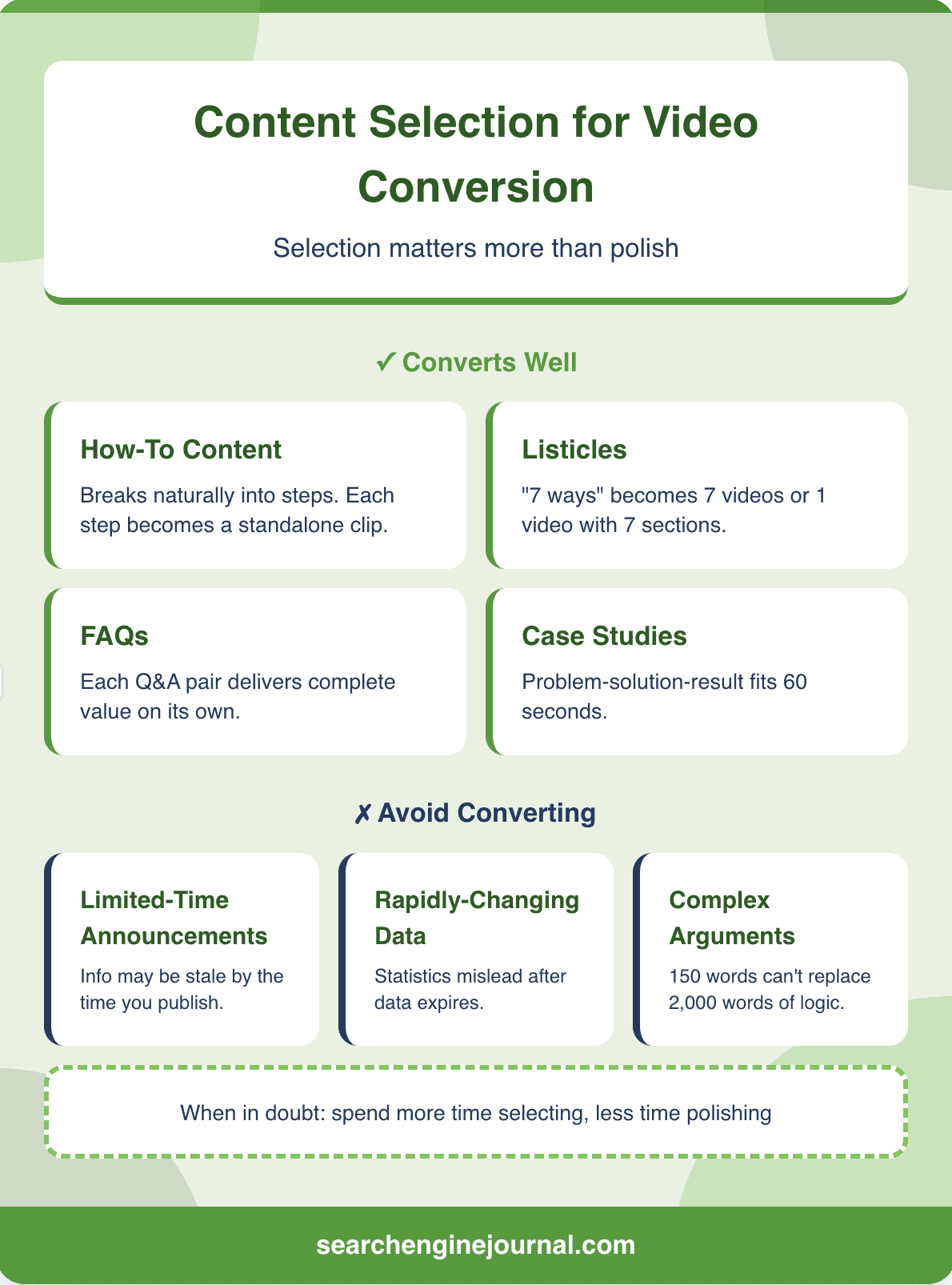
How-to and tutorial content adapts well when converted to video. The reason is because of how it’s structured. How-to content breaks naturally into steps, and each step becomes either a standalone clip or a beat within a longer video. The segmentation is already built into the written piece.
Listicles
Listicles have this quality as well. Each list item gives you a cut point, so a “7 ways to improve X” article can become seven separate videos or one video with seven sections.
FAQs
FAQ content works well as each question-answer pair delivers complete value on its own, matching how people consume short-form video. They arrive mid-scroll, expecting an immediate payoff.
Case Studies
Case studies with clear problem-solution-result structures fit naturally into 60 seconds. Problem in the first 10, solution in the middle 40, result in the final 10. The narrative arc compresses without losing its logic.
Avoiding Content That Doesn’t Convert
Content that converts poorly has its own unique qualities.
Limited-Time Announcements
Announcements with a short shelf life rarely justify the effort because by the time you script, record, edit, and publish, the information may be stale.
Rapidly-Changing Data
Statistics-heavy pieces where data changes frequently create maintenance problems. A video claiming “X platform has 500 million users” becomes misleading within months, but it keeps circulating after the number expires.
Complex Arguments
Complex arguments that require multiple supporting points rarely fit into 60 seconds. If an article’s value comes from building a case across 2,000 words, extracting 150 words guts the logic that made it persuasive.
Audit Using Engagement Metrics
Before committing production resources, audit existing content using engagement metrics. Articles with 5%+ engagement rates or 1,000+ monthly visits make prime candidates because they’ve already validated the topic with your audience. Converting them becomes distribution rather than experimentation.
In one Diggity Marketing case study, a real estate technology company saw 148% higher referral traffic after repurposing blog content this way. They identified where their audience searched, built format-specific assets, and drove users back to core content. The blog became a hub with videos pulling attention from social platforms back to owned properties.
Script Timing That Matches Platform Retention
Each platform has different structural requirements, which means scripts optimized for one may underperform on another.
OpusClip’s retention analysis suggests YouTube Shorts see strong retention at 15-30 seconds, with tutorials often running 25-40 seconds. YouTube Shorts can run up to three minutes, but many retention-focused workflows start with shorter cuts. Many Reels strategies even skew shorter, and retention can drop as videos run longer.
TikTok for Business recommends 21-34 seconds for In-Feed ads. On TikTok, strong completion and replay behavior tend to correlate with wider distribution. If you’re aiming for TikTok’s Creator Rewards Program, videos need to be at least one minute long.
These differences mean a single script may need three versions for cross-platform distribution. Your core content stays the same, but timing adjusts to match each platform’s retention curve.
For videos at least one minute long (required for TikTok’s Creator Rewards Program), TikTok’s Creative Codes recommend a three-part structure: hook, body, and close.
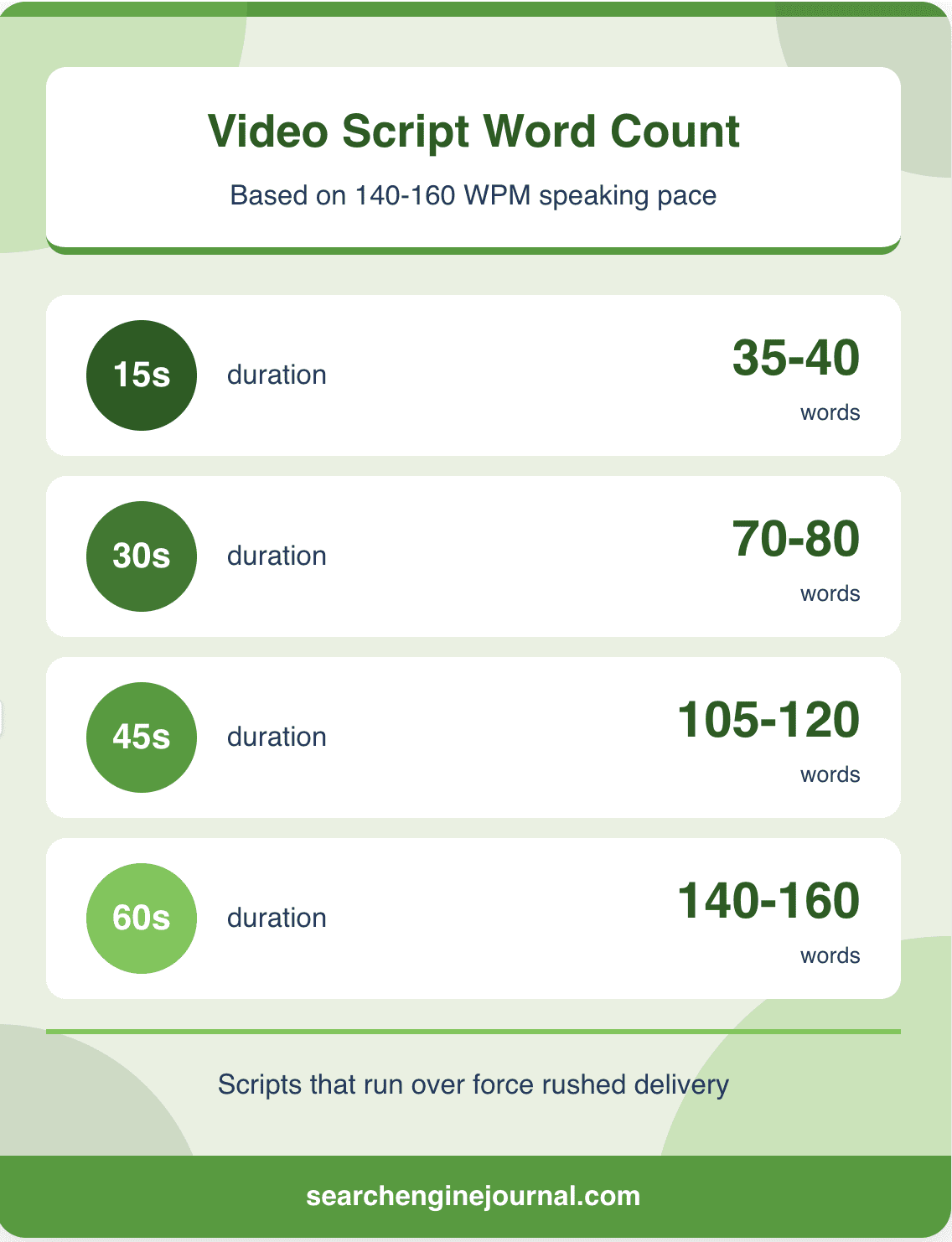
The math shapes everything else. Industry standard speaking pace for video runs 140-160 words per minute, which means a 60-second script caps at roughly 150 words. TikTok’s research shows 90% of ad recall happens within the first six seconds, so your hook needs to land in that window. At a typical speaking pace, six seconds gives you about 15-20 words to establish why viewers should care.
That leaves roughly 45 seconds for body content and 5-10 seconds for your close.
If you’re spending 15-20 words on the hook and 15-25 on the close, the body gets 100-120 words. That’s enough for two or three points with room to breathe between them. More than three points in that space creates rush that tanks retention.
Think about it like this: If you can only say 150 words, you have to choose the 150 most important words from your 1,500-word article. That selection process is where conversion skill lives.
Hook Formulas Backed By Retention Data
The first three seconds determine whether viewers stay or scroll. A video with a weak opening has a problem, regardless of how strong the rest of the content is.
Here are some examples of strong hook formulas.
Surprising Stat
A surprising statistic paired with immediate relevance stops the scroll. Numbers signal credibility, and the surprise creates curiosity.
In practice, it reads like this:
“60% of people admit to procrastinating regularly, even when they know it causes stress.”
There’s an attention-grabbing stat, followed by why it matters to the viewer. This works because the number is specific and the relevance is universal.
Look for the most striking data points in your articles and move them to the front. Your article may have buried it in paragraph seven, while your video leads with it.
Questions
Question hooks create tension. Once you pose a question, the mind wants an answer, and viewers have to keep watching to close that loop.
The question needs to be specific enough to promise an answer in 60 seconds but broad enough to matter to your audience.
“What’s the one thing successful people have in common?” works. “What are the 47 traits of successful people?” doesn’t work because viewers know they can’t get that answer in under a minute.
Direct Stake
Direct stake hooks can capture the attention of professional audiences.
“If your site uses Product markup, this affects your shopping visibility,” tells professionals whether this video applies to them. This respects their time because they don’t have to guess whether the content is relevant.
Vague promises like “this changes everything” underperform because they don’t commit to delivering anything specific.
Converting Articles To Scripts
Converting articles to short video scripts is all about extracting what’s most important. Start by reading your article and asking what the most surprising, useful, or consequential single fact is. That becomes your hook.
Often, the most compelling part of an article sits in paragraph three or four. Written content gives you time to build context in your opening, whereas video doesn’t.
You can simplify the extraction process by following the hook, hint, value, credibility, takeaway, action (HHVCTA) framework.
HHVCTA Framework
The HHVCTA framework maps article content to video structure. The hook at 0-2 seconds stops the scroll, and the hint at 2-5 seconds previews what viewers will learn.
Value delivery from 5-45 seconds delivers on the hook’s promise, with credibility woven throughout or concentrated in a key moment. The takeaway at 45-55 seconds lands the message, and the action in the final seconds directs viewers to next steps.
This prevents frontloading all value with nothing left for the final 15 seconds. It also prevents the opposite mistake of saving everything for the end, which viewers never reach because they swiped.
A common underperforming pattern is the hook-delivery gap. The hook asks a question, the body pivots to related content without answering it, and viewers who stayed for an answer feel cheated.
After writing your body, reread the hook and check whether you actually answered the question. If your hook says “here’s why X happens” but your body covers effects without explaining causes, the script is a fail.
Maintaining Attention Through The Middle
The middle section is where most videos lose viewers. Incorporating pattern interrupts every 3-5 seconds can help maintain viewer engagement. Effective techniques include text overlays, B-roll, camera angle changes, and graphics.
While sound is essential to the TikTok experience, captions are critical for viewers in “quiet mode” (commuting, in bed, at work) and for discoverability. Showing and saying information together boosts retention and gives platforms additional signals about your content.
SEO For Video Content
TikTok says it considers “video information” like captions, sounds, and hashtags, so captions, on-screen text, and spoken audio can help your video get understood and surfaced in recommendations and search features.
Video titles should include primary keywords while piquing curiosity, and descriptions expand on the titles with more keyword context.
Caption accuracy matters for search. Auto-generated captions contain errors that platforms can pick up as content signals, so a video about “SEO” with captions reading “CEO” may surface for wrong queries. Review and fix auto-captions before publishing.
Hashtags signal categories to algorithms. Use broad tags like #marketing to reach large audiences, and specific ones like #emailmarketing for direct relevance. Evergreen content benefits from evergreen hashtags that maintain visibility months after posting.
Batch Production For Scale
Content teams that produce video at scale typically batch their workflows. Creators like Thomas Frank and Ali Abdaal have documented their batch filming processes, and Gary Vaynerchuk’s “64 pieces of content in a day” model is built on recording pillar content and distributing clips afterward.
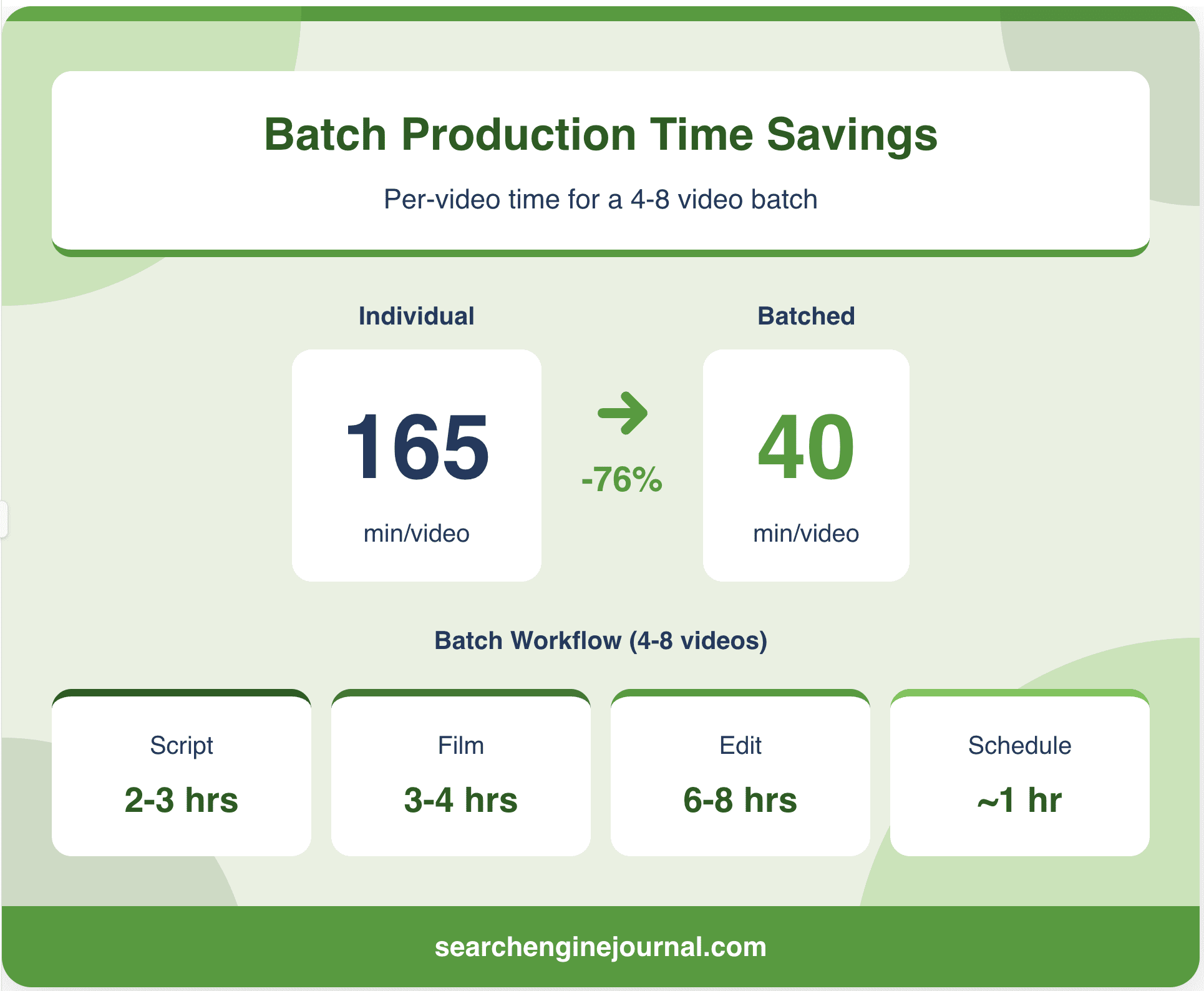
Creating one video from scratch each time burns hours on repetitive decisions. You can cut per-video time by 60-80% through batching.
Batching refers to scripting multiple videos in one session, filming them all together, editing in batches with consistent formats, and then scheduling across platforms.
A typical batch for four to eight videos breaks down like this. Scripting all at once using templates takes two to three hours. Filming all videos in one session with consistent setup takes three to four hours. Editing across several days takes six to eight hours total. Scheduling takes about an hour.
Per-video time drops to roughly 40 minutes. Without batching, individual videos typically take 150-180 minutes each. The savings come from eliminating setup and context-switching between sessions.
Measuring Results
Short-form video works as top-of-funnel for most content teams. A video with 100,000 views and zero conversions may matter less than one with 10,000 views and 500 email signups.
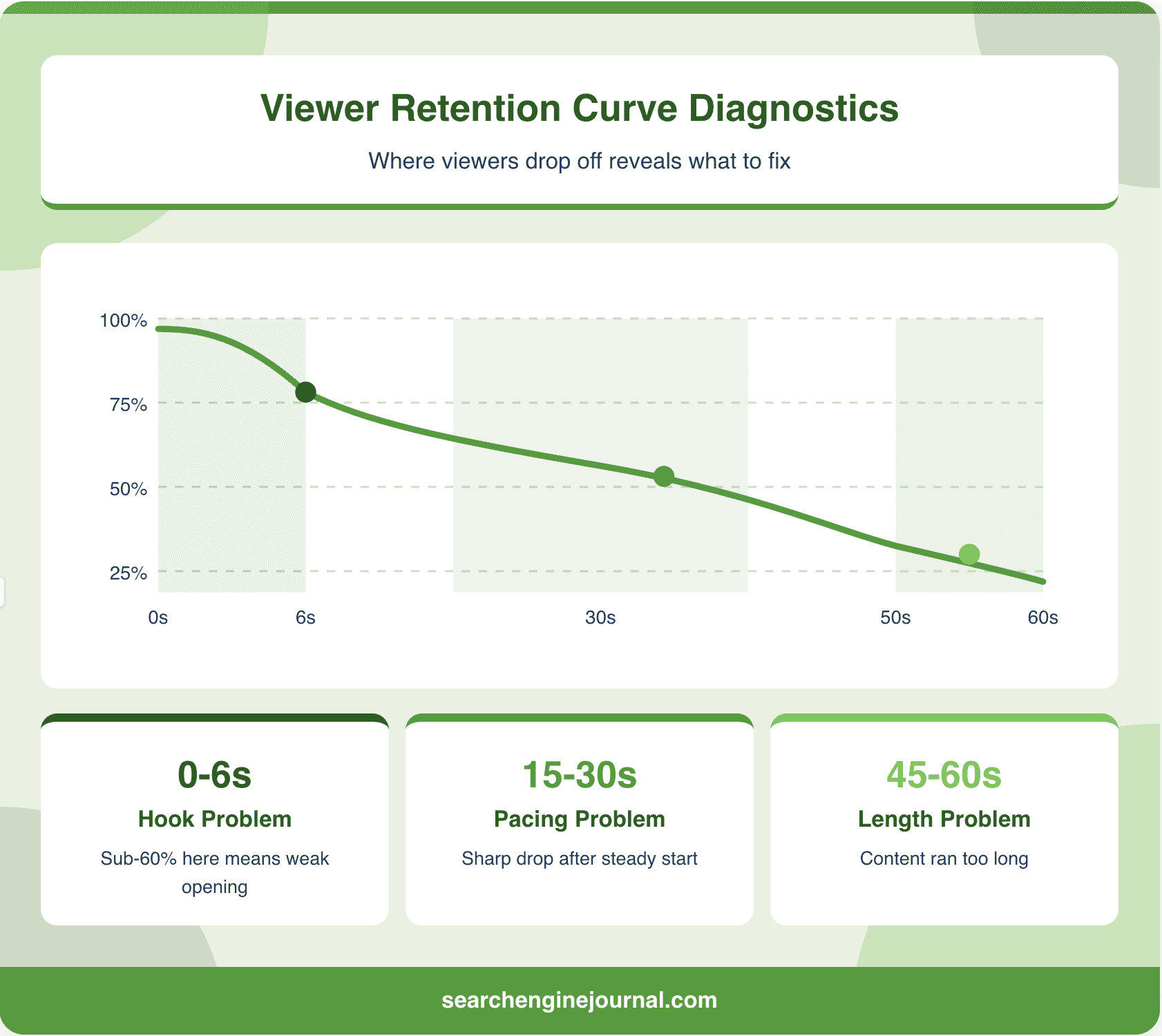
When results fall short, retention curves pinpoint the problem. Sub-60% retention at three seconds points to hook issues. Steady early retention with sharp mid-video drops suggests pacing problems. Late drops typically mean content ran long or delivered value without giving viewers a reason to stay.
Looking Ahead
The gap between written content and video content is smaller than most teams assume. The research already exists. The expertise already exists. The structure is the only new variable, and that structure fits on an index card.
Teams that struggle with video production usually aren’t struggling with production itself. They’re struggling with selection and compression. They try to convert articles that don’t fit the format, or they refuse to cut material that worked in text but dies on screen.
The 150-word constraint is a decision-making tool that cuts editing in half before you start. Pick one article from your archive that performed well and had a clear takeaway. Convert it to a script. Then record it, read the retention curve, and adjust as needed.
You can keep reading articles like this one, but doing the work and iterating on it will teach you more than I ever could.