6 AI Marketing Myths That Are Costing You Money [Webinar] via @sejournal, @duchessjenm

Stop letting AI drain your budget. Learn how to make it work for you.

Think AI can fully run your marketing strategy on autopilot? 

Or that AI-generated content should deliver instant results? 

It is time to bust the AI myths that are slowing you down and costing you money.

Join Bailey Beckham, Senior Partner Marketing Manager at CallRail, and Jennifer McDonald, Senior Marketing Manager at Search Engine Journal, on August 21, 2025, for an exclusive webinar. Get the insights you need to stop wasting time and money and start leveraging AI the right way.

In this session, you will learn:

Why this session is essential:

AI tools can’t run your strategy on autopilot. You need to make smarter decisions, ask the right questions, and guide your AI tools to work for you, not against you. 

This webinar will help you unlock AI’s full potential and optimize your content to improve your marketing performance.

Register now to learn how to get your content loved by AI, LLMs, and most importantly, your audience. Can’t attend live? Don’t worry, sign up anyway, and we will send you the on-demand recording.

Experience Forecasting: Content That Enables & Adds Value In The Modern Search World via @sejournal, @TaylorDanRW

Too often in our content and messaging, we default to listing features in a succession of brief, disconnected claims rather than showing readers how those features will make a genuine difference in their lives.

As a result, they are left to fill in the gaps themselves, often choosing to skim and move on rather than engage with that cold list of facts.

It’s common for us to focus heavily on features, then expect our audience to understand how those features directly impact them.

Instead, by describing a scenario in which users experience the benefits of the features, you invite the user to picture themselves using the features as part of their day-to-day life. That mental rehearsal is what sparks genuine interest.

In this article, we examine how to transition from “we have X” to “you will Y” and why this shift is more crucial than ever in today’s AI-driven search landscape.

This article serves as a summary of my talk at Google Search Central Live: Deep Dive Asia Pacific, delivered July 25, 2025.

The Rise Of AI Overviews And The Need For Context

As search engines now showcase AI Overviews or AI Mode snippets that extract passages of our copy into results pages and dashboard panels, those bite-sized answers may earn clicks.

However, every sentence must stand alone, or risk having nuance stripped out.

Headlines should hint at benefits, subheads need to frame outcomes, and meta descriptions become miniature forecasts rather than mere summaries.

Because Overviews appear outside the full context of the page it’s taken from, every word must carry weight and meaning on its own.

By weaving context and emotional hooks directly into key sentences, we can direct AI tools to lift passages that still resonate and invite deeper exploration.

Image from author, July 2025

Defining Experience Forecasting

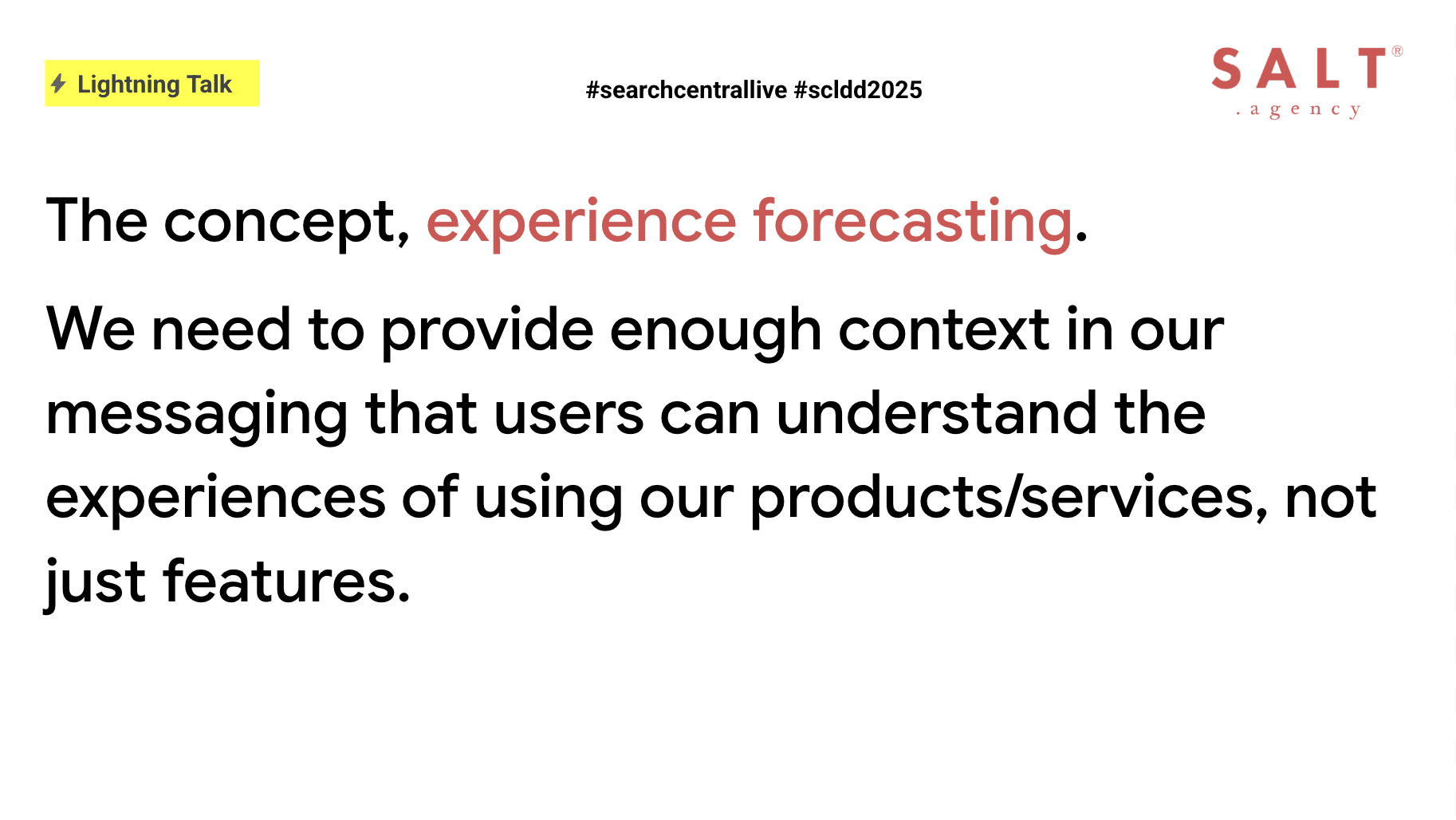
Experience forecasting is the practice of writing so vividly that readers can mentally rehearse using your product or service.

For a city break tours website, you might describe stepping off the train into Barcelona’s Gothic Quarter, following a curated walking tour that reveals hidden plazas, tantalizes with local tapas bars, and culminates in sunset views over the Mediterranean.

At the same time, for invoicing software, you could paint a picture of logging in to discover that overdue invoices have been sent automatically, payments are tracked in real time, and tax reports appear at the click of a button, allowing finance teams to close their books in minutes rather than hours.

In both cases, readers will imagine themselves in those moments of discovery and relief.

This technique relies on three complementary elements: scene setting through sensory details, emotional framing to highlight feelings such as relief and confidence, and a tangible payoff that demonstrates results like time saved or stress reduced.

Guiding Users Through Ambiguous Journeys

Because many search queries begin in a zone of uncertainty, questions such as how to plan a trip to Italy, what constitutes a healthy breakfast, or which tools best serve remote teams indicate that readers are exploring.

If your page opens with a laundry list of features, this will risk causing them to bounce.

Instead, guiding users with a vivid scenario immediately captures their attention by giving them a vision of success, such as picturing themselves strolling cobblestone streets in Rome on a custom itinerary that balances must‑see landmarks with hidden cafés.

By meeting readers at this exploratory stage, we can transform passive browsers into engaged readers who refine their own goals as they proceed.

Demonstrating that we understand their uncertainty builds trust, and previewing what success looks like shapes intent.

Forecastable Messaging In Action

We can tap into sensory memory and create an experience that sticks in the mind by describing the balcony, the sea, and the espresso.

By transforming before:

“A luxury hotel on the Amalfi Coast, with complimentary breakfast.”

To after:

“Wake up on your private balcony as the sun glints off the Tyrrhenian Sea, sip fresh Italian espresso while planning your morning adventure, and join us for a complimentary breakfast of flaky pastries and locally sourced cheeses, providing fuel for a day of discovery.”

If an AI tool then lifts a fragment of our description, such as “sipping fresh Italian espresso, while planning your morning adventure,” that phrasing still has the power to entice because it hints at both flavor and purpose.

Vivid details, such as “a private balcony overlooking the Tyrrhenian Sea” and “locally sourced cheeses,” can broaden our semantic footprint.

This helps to capture long-tail queries around experiences rather than generic hotel terms, which could ultimately increase the likelihood that readers move from casual browsing to booking.

Image from author, July 2025

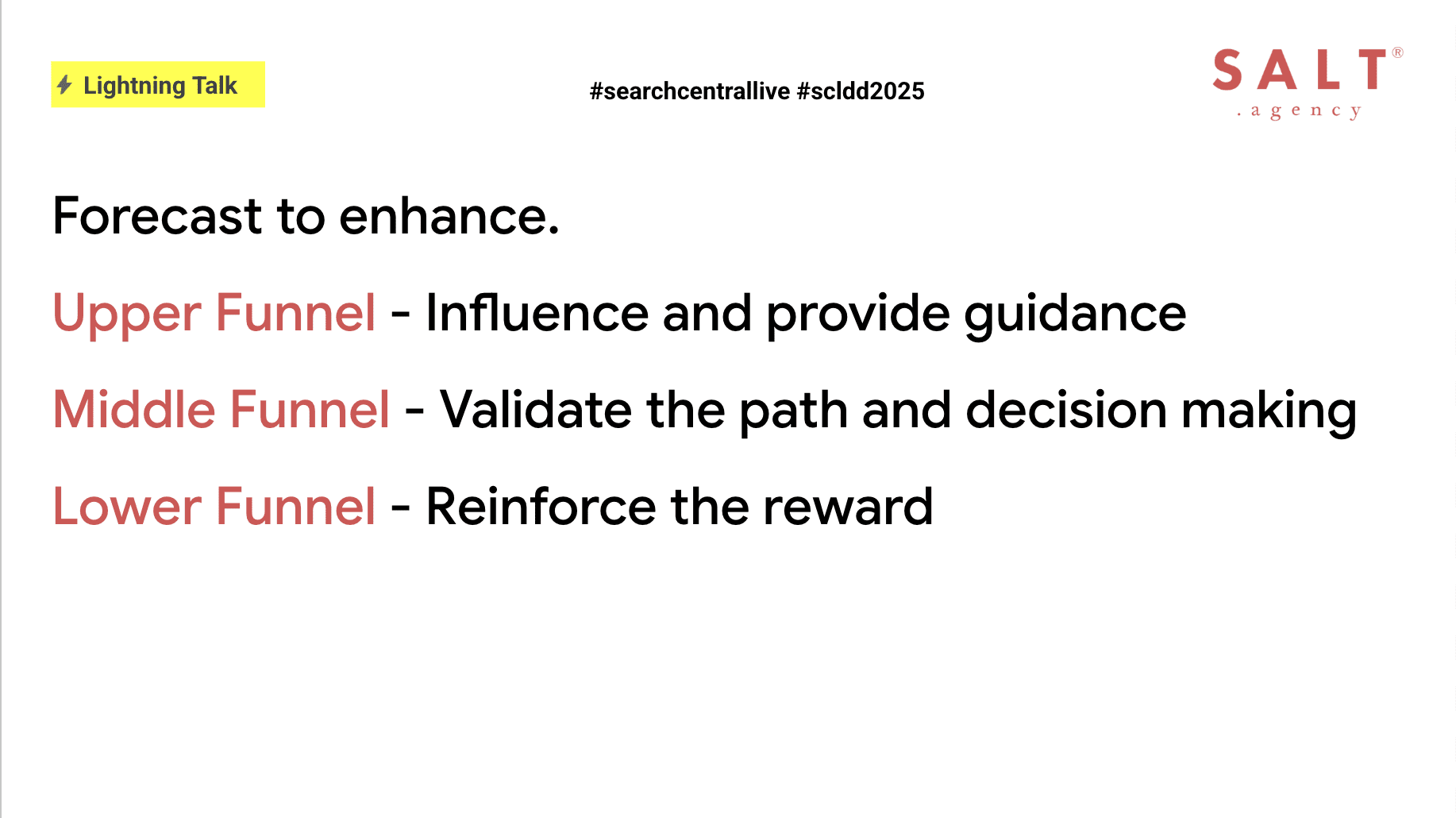
Forecasting Against The Funnel

Experience forecasting can enhance every stage of the funnel by sparking curiosity and building emotional hooks at the awareness stage.

Creating broad scenarios with narrative case studies, such as “imagine your team collaborating seamlessly from anywhere,” can help to validate decisions at the consideration stage, which can improve click-through rates and time on page.

Introducing reminders of the end reward at the conversion stage can help close a deal, such as offering free cancellation up to 24 hours before arrival, alongside a claim that customers save an average of $5,000 in their first year, to increase completion rates and purchase conversions.

For example, validations, such as “When Acme Corp adopted our platform, they cut project delays by 30%,” encourage readers to imagine comparable gains.

→ Read more: How To Write Content For Each Stage Of Your Sales Funnel

Ensuring Purpose, Expertise, And Originality

Strong forecasting rests on three pillars:

  1. Purpose, which means that every piece must address a clear user need, whether helping readers choose, compare, or commit, and stating that objective up front.
  2. Showcasing expertise, by linking claims to real-world proof, such as data points, practitioner quotes, or firsthand anecdotes, and providing sources for assertions like “instant setup in five minutes.”
  3. Originality, which involves avoiding clichés by grounding imagery in authentic capabilities and experiences that only you can deliver.

Key Questions For Content Creators

Before publishing, use a comprehensive checklist that confirms:

  • The problem being addressed is stated in relatable terms.
  • Each paragraph includes sensory or emotional details to help readers imagine the outcome.
  • Claims are supported by data, case studies, or user quotes.
  • The angle differs from competitors through fresh insights.
  • Section openers carry meaning when read in isolation.
  • Forecast tactics align with key metrics such as click-through rate, time on page, or form completions.
  • The narrative guides readers naturally from uncertainty to clarity and action.
Image from author, July 2025

Final Thoughts

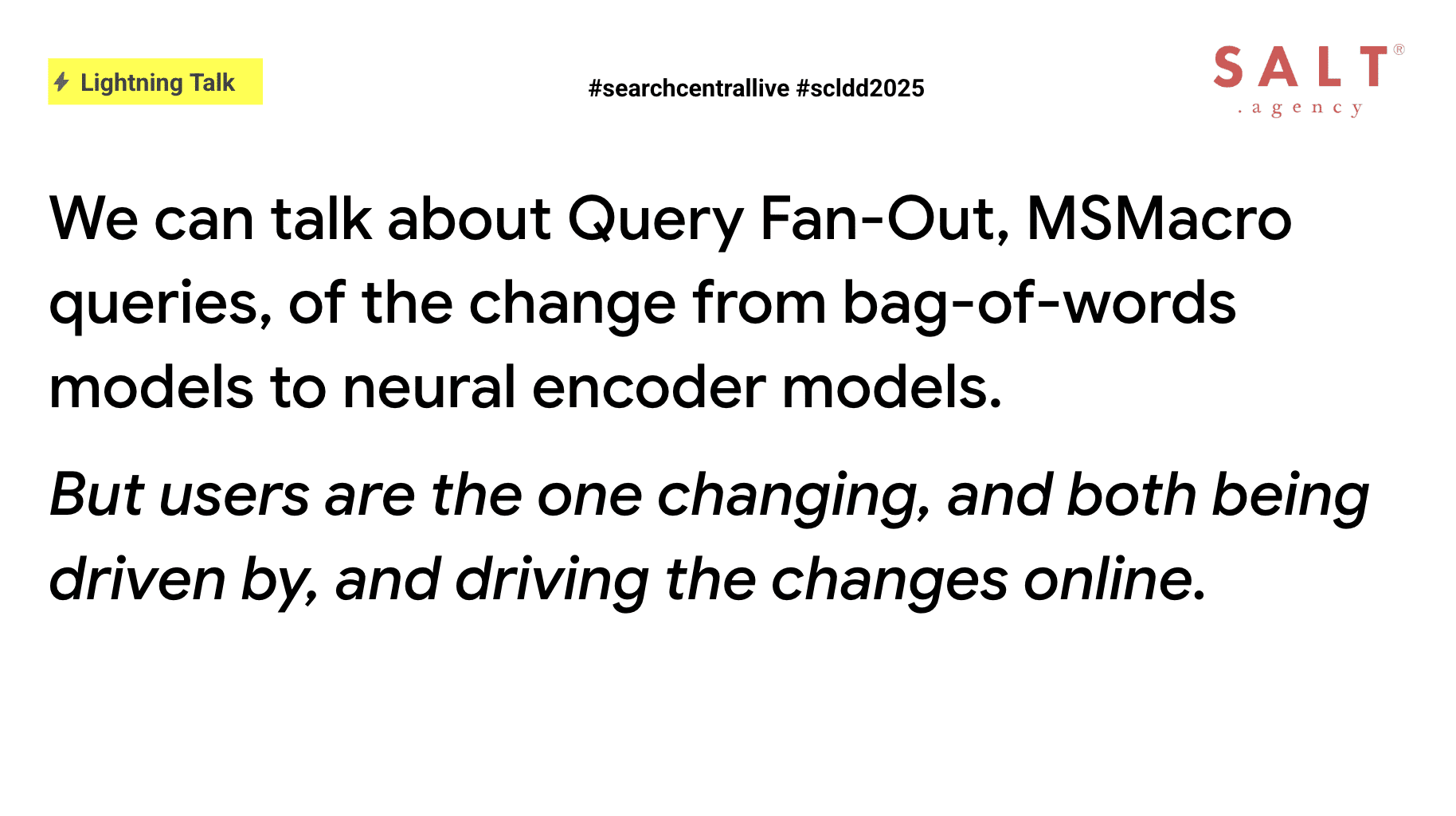
As search engines and AI continue to evolve, our copy must do more.

Transport readers into scenarios where they feel the benefit by weaving sensory details into every line.

This helps us stand out from the homogeneous, safe content that a lot of the internet has been built on.

Back up claims with evidence and constantly ask how effectively each sentence enables readers to imagine their success.

This helps to align with neural search models, feeding inclusion in AI Overviews, which then drives meaningful business results such as clicks and conversions.

Ultimately, words become experiences; experiences become results.

More Resources:


Featured Image: Dan Taylor/SALT.agency

How To Increase Google Discover Visibility Naturally Using These Ranking Signals via @sejournal, @rollerads

This post was sponsored by RollerAds. The opinions expressed in this article are the sponsor’s own.

Want more visibility in Google Discover?

Not sure how to get into Google’s personalized news feeds?

Discover isn’t like search. You don’t rank for keywords.

You get selected.

And that means the best way to get featured isn’t to optimize for keywords; it’s to optimize for specific algorithmic signals.

In this guide, we’ll cover the core ranking signals that help Google determine which content belongs in Discover feeds, and how you can naturally boost those signals using tools like push notifications.

Google Discover Optimization Tips: Which Signals Tell Google Your Content Belongs in Discover?

Google Discover uses a different algorithm from traditional search results.

While it still considers many of the same quality indicators, Discover visibility depends less on keywords and more on how your content performs in the real world.

Here are the most important content quality signals for Discover.

1. E-E-A-T: Experience, Expertise, Authoritativeness, Trust

A good rule of thumb is to follow the “E-E-A-T” guideline:

  • Experience: Firsthand, real-world familiarity with the subject.
  • Expertise: Deep knowledge and skill in your content niche.
  • Authoritativeness: Recognition from other trusted sources.
  • Trustworthiness: Accurate, unbiased, and reliable information.

2. Engagement Metrics

These tell Google your content resonates with users and may be worth promoting more widely.

3. Strong Visuals & Headlines

Discover is highly visual, so if you don’t stand out immediately, the users are likely to scroll past your content.

Take your time to polish headlines to get attention, but make sure they accurately reflect the content of your article, post, or whatever you’re writing right now.

Engaging headlines, images, and videos perform better, especially when those assets are optimized for mobile.

4. Technical SEO & Mobile Optimization

While you don’t need to “rank” per se, you do need a well-optimized site, which includes:

  • Fast load times: Consider page speed and overall efficiency. Use PageSpeed Insights to ensure your web pages are optimized for user performance.
  • Mobile-friendly layouts: Google Discover is only available on mobile devices, as there is currently no desktop version.
  • Structured data: Google relies on structured data to categorize content and provide relevant suggestions for users. To attract more engaged and relevant users, you need to add tags and structure data so that Google can better recognize and categorize your content.
  • Internal linking & link building: It will help you create your own network of content. This concerns old articles, too, as they might serve as a gateway to newer pieces of content.
  • RSS or Atom Feed: Allow users to follow you to receive updates quickly. Google generates a feed for you automatically, but you can connect your own.
  • Google Web Stories: Similar to Instagram, these stories appear under the Visual Stories banner on mobiles and serve to expand your reach. Stories are easy to create, engaging, interactive, and fun.

    Track, test, improve. Use Google Search Console (GSC) to monitor your performance and statistics. Unlike Google Analytics, it has a dedicated tab for monitoring Google Discover traffic.

    5. Freshness & Topical Relevance

    Valuable content addresses and solves pain points.

    For content to have a better chance of showing up in Discover feeds, it should be:

    • Accurate.
    • Timely.
    • Trending.
    • Helpful.
    • Continuously updated.

    This is especially powerful if your content is tied to current events or spikes in interest, as shown in Google Trends.

    To discover what users search for, try:

    • Google Search: Enter a query and scroll down to view related and popular requests.
    • Google Search’s Autocomplete: Start typing a search and observe the suggested autocomplete queries; these are the queries that many others regularly search for.
    • Google Trends: Identify how popular a content direction is in any part of the world. This is also great for identifying seasonality.

    How Google Discover Works

    1. Google Discover suggests your content, which should include all the positive signals mentioned above.
    2. The Google app user engages with your content within Google Discover, adding to Google’s knowledge of how users interact with your website.
    3. These engagements (visitor volume, time on page, user experience, etc.) indicate to Google that your content is well-suited for similar readers.
    4. Google increases your reach and visibility on Google Discover.
    5. Those new viewers engage with your content in a similar pattern.
    6. The cycle repeats, spreading your optimized content to more Google Discover timelines.

    This is known as a positive loop because your content consistently passes positive ranking signals back to Google’s Discover algorithm, thereby continuing to increase in engagement.

    How Do I Create A Positive Loop & Show Up In Google Discover?

    Now that you know what Google is looking for, here’s how to naturally boost those signals.

    We know that Google Discover places your content based on:

    • High-clickthrough rates.
    • Long time-on-page.
    • Repeat visitors.

    So, how can you increase those metrics?

    By getting a dedicated reader base that is always ready to consume your new content.

    Push notifications are a great way to alert your dedicated readers that new content is out.

    And they will feed your Google Discover algorithm data.

    How To Use Push Notifications To Boost These Google Signals

    Many publishers avoid push notifications, believing they’re too promotional or might harm user experience (UX).

    However, modern push notification platforms allow you to take a more hybrid approach, combining editorial updates with monetization to boost visibility.

    Why Hybrid Push Notifications Help Boost Discover Visibility

    Done right, push notifications help your content get discovered organically by:

    • Increasing CTR with a second wave of distribution.
    • Driving fast engagement shortly after publication.
    • Bringing back repeat readers to increase session depth.
    • Boosting behavioral signals that Google uses to judge quality.

    In other words, push notifications support the very engagement metrics that can lead to more Discover visibility.

        When users receive a mix of informative and promotional pushes, each message feels fresh, encouraging clicks and boosting your CTR.

        Higher engagement signals to Google that your content is valuable, increasing the chances of it being featured on Discover.

        And since Discover traffic is largely made up of new visitors, each one becomes a fresh opportunity to grow your subscriber base.

        Once users opt in, you can keep re-engaging them, creating a cycle of rising visibility, CTR, and traffic.

        Image created by RollerAds April, 2025

        How to Implement Hybrid Push Format to Get on Discover Faster

        In a recent case study, one RollerAds publisher increased their revenue from $0 to $60,000 per month by pairing great content with hybrid push notifications and Discover-optimized distribution. The key was creating content that signals quality and leveraging distribution to show it.

        With a tool like RollerAds, you can gain a streamlined way to:

        • Send personalized push notifications for your latest content.
        • Mix promotional and editorial messaging without spamming your readers.
        • Increase engagement, retention, and revenue simultaneously.

        Simply register your site, get a custom strategy from your account manager, and start boosting content visibility, without compromising user experience.

        Even better? You can monetize this traffic directly with ad formats designed for Discover audiences, no intrusive pop-ups or poor user experience. Just clear, engaging content with a side of revenue.

        For SEJ readers, use the code SEJ30 to add +30% to your funds before July 1st, 2025.

        Just show the code to your account manager on RollerAds before your first payment.

        Getting featured on Google Discover isn’t just about luck; it’s about strategy.

        From creating high-quality, relevant content to optimizing visuals, headlines, and mobile performance, every step counts. However, to truly stand out and amplify your chances, pairing content strategy with smart tools, such as hybrid push notifications from RollerAds, can make all the difference.

        Engaging your audience through push updates not only drives more clicks but also signals content quality to Google, boosting your Discover reach. With the right monetization tools, you can convert that traffic into substantial revenue.


        Image Credits

        Featured Image: Image by RollerAds. Used with permission.

        In-Post Image: Images by RollerAds. Used with permission.

        How LLMs Interpret Content: How To Structure Information For AI Search via @sejournal, @cshel

        In the SEO world, when we talk about how to structure content for AI search, we often default to structured data – Schema.org, JSON-LD, rich results, knowledge graph eligibility – the whole shooting match.

        While that layer of markup is still useful in many scenarios, this isn’t another article about how to wrap your content in tags.

        Structuring content isn’t the same as structured data

        Instead, we’re going deeper into something more fundamental and arguably more important in the age of generative AI: How your content is actually structured on the page and how that influences what large language models (LLMs) extract, understand, and surface in AI-powered search results.

        Structured data is optional. Structured writing and formatting are not.

        If you want your content to show up in AI Overviews, Perplexity summaries, ChatGPT citations, or any of the increasingly common “direct answer” features driven by LLMs, the architecture of your content matters: Headings. Paragraphs. Lists. Order. Clarity. Consistency.

        In this article, I’m unpacking how LLMs interpret content — and what you can do to make sure your message is not just crawled, but understood.

        How LLMs Actually Interpret Web Content

        Let’s start with the basics.

        Unlike traditional search engine crawlers that rely heavily on markup, metadata, and link structures, LLMs interpret content differently.

        They don’t scan a page the way a bot does. They ingest it, break it into tokens, and analyze the relationships between words, sentences, and concepts using attention mechanisms.

        They’re not looking for a tag or a JSON-LD snippet to tell them what a page is about. They’re looking for semantic clarity: Does this content express a clear idea? Is it coherent? Does it answer a question directly?

        LLMs like GPT-4 or Gemini analyze:

        • The order in which information is presented.
        • The hierarchy of concepts (which is why headings still matter).
        • Formatting cues like bullet points, tables, bolded summaries.
        • Redundancy and reinforcement, which help models determine what’s most important.

        This is why poorly structured content – even if it’s keyword-rich and marked up with schema – can fail to show up in AI summaries, while a clear, well-formatted blog post without a single line of JSON-LD might get cited or paraphrased directly.

        Why Structure Matters More Than Ever In AI Search

        Traditional search was about ranking; AI search is about representation.

        When a language model generates a response to a query, it’s pulling from many sources – often sentence by sentence, paragraph by paragraph.

        It’s not retrieving a whole page and showing it. It’s building a new answer based on what it can understand.

        What gets understood most reliably?

        Content that is:

        • Segmented logically, so each part expresses one idea.
        • Consistent in tone and terminology.
        • Presented in a format that lends itself to quick parsing (think FAQs, how-to steps, definition-style intros).
        • Written with clarity, not cleverness.

        AI search engines don’t need schema to pull a step-by-step answer from a blog post.

        But, they do need you to label your steps clearly, keep them together, and not bury them in long-winded prose or interrupt them with calls to action, pop-ups, or unrelated tangents.

        Clean structure is now a ranking factor – not in the traditional SEO sense, but in the AI citation economy we’re entering.

        What LLMs Look For When Parsing Content

        Here’s what I’ve observed (both anecdotally and through testing across tools like Perplexity, ChatGPT Browse, Bing Copilot, and Google’s AI Overviews):

        • Clear Headings And Subheadings: LLMs use heading structure to understand hierarchy. Pages with proper H1–H2–H3 nesting are easier to parse than walls of text or div-heavy templates.
        • Short, Focused Paragraphs: Long paragraphs bury the lede. LLMs favor self-contained thoughts. Think one idea per paragraph.
        • Structured Formats (Lists, Tables, FAQs): If you want to get quoted, make it easy to lift your content. Bullets, tables, and Q&A formats are goldmines for answer engines.
        • Defined Topic Scope At The Top: Put your TL;DR early. Don’t make the model (or the user) scroll through 600 words of brand story before getting to the meat.
        • Semantic Cues In The Body: Words like “in summary,” “the most important,” “step 1,” and “common mistake” help LLMs identify relevance and structure. There’s a reason so much AI-generated content uses those “giveaway” phrases. It’s not because the model is lazy or formulaic. It’s because it actually knows how to structure information in a way that’s clear, digestible, and effective, which, frankly, is more than can be said for a lot of human writers.

        A Real-World Example: Why My Own Article Didn’t Show Up

        In December 2024, I wrote a piece about the relevance of schema in AI-first search.

        It was structured for clarity, timeliness, and was highly relevant to this conversation, but didn’t show up in my research queries for this article (the one you are presently reading). The reason? I didn’t use the term “LLM” in the title or slug.

        All of the articles returned in my search had “LLM” in the title. Mine said “AI Search” but didn’t mention LLMs explicitly.

        You might assume that a large language model would understand “AI search” and “LLMs” are conceptually related – and it probably does – but understanding that two things are related and choosing what to return based on the prompt are two different things.

        Where does the model get its retrieval logic? From the prompt. It interprets your question literally.

        If you say, “Show me articles about LLMs using schema,” it will surface content that directly includes “LLMs” and “schema” – not necessarily content that’s adjacent, related, or semantically similar, especially when it has plenty to choose from that contains the words in the query (a.k.a. the prompt).

        So, even though LLMs are smarter than traditional crawlers, retrieval is still rooted in surface-level cues.

        This might sound suspiciously like keyword research still matters – and yes, it absolutely does. Not because LLMs are dumb, but because search behavior (even AI search) still depends on how humans phrase things.

        The retrieval layer – the layer that decides what’s eligible to be summarized or cited – is still driven by surface-level language cues.

        What Research Tells Us About Retrieval

        Even recent academic work supports this layered view of retrieval.

        A 2023 research paper by Doostmohammadi et al. found that simpler, keyword-matching techniques, like a method called BM25, often led to better results than approaches focused solely on semantic understanding.

        The improvement was measured through a drop in perplexity, which tells us how confident or uncertain a language model is when predicting the next word.

        In plain terms: Even in systems designed to be smart, clear and literal phrasing still made the answers better.

        So, the lesson isn’t just to use the language they’ve been trained to recognize. The real lesson is: If you want your content to be found, understand how AI search works as a system – a chain of prompts, retrieval, and synthesis. Plus, make sure you’re aligned at the retrieval layer.

        This isn’t about the limits of AI comprehension. It’s about the precision of retrieval.

        Language models are incredibly capable of interpreting nuanced content, but when they’re acting as search agents, they still rely on the specificity of the queries they’re given.

        That makes terminology, not just structure, a key part of being found.

        How To Structure Content For AI Search

        If you want to increase your odds of being cited, summarized, or quoted by AI-driven search engines, it’s time to think less like a writer and more like an information architect – and structure content for AI search accordingly.

        That doesn’t mean sacrificing voice or insight, but it does mean presenting ideas in a format that makes them easy to extract, interpret, and reassemble.

        Core Techniques For Structuring AI-Friendly Content

        Here are some of the most effective structural tactics I recommend:

        Use A Logical Heading Hierarchy

        Structure your pages with a single clear H1 that sets the context, followed by H2s and H3s that nest logically beneath it.

        LLMs, like human readers, rely on this hierarchy to understand the flow and relationship between concepts.

        If every heading on your page is an H1, you’re signaling that everything is equally important, which means nothing stands out.

        Good heading structure is not just semantic hygiene; it’s a blueprint for comprehension.

        Keep Paragraphs Short And Self-Contained

        Every paragraph should communicate one idea clearly.

        Walls of text don’t just intimidate human readers; they also increase the likelihood that an AI model will extract the wrong part of the answer or skip your content altogether.

        This is closely tied to readability metrics like the Flesch Reading Ease score, which rewards shorter sentences and simpler phrasing.

        While it may pain those of us who enjoy a good, long, meandering sentence (myself included), clarity and segmentation help both humans and LLMs follow your train of thought without derailing.

        Use Lists, Tables, And Predictable Formats

        If your content can be turned into a step-by-step guide, numbered list, comparison table, or bulleted breakdown, do it. AI summarizers love structure, so do users.

        Frontload Key Insights

        Don’t save your best advice or most important definitions for the end.

        LLMs tend to prioritize what appears early in the content. Give your thesis, definition, or takeaway up top, then expand on it.

        Use Semantic Cues

        Signal structure with phrasing like “Step 1,” “In summary,” “Key takeaway,” “Most common mistake,” and “To compare.”

        These phrases help LLMs (and readers) identify the role each passage plays.

        Avoid Noise

        Interruptive pop-ups, modal windows, endless calls-to-action (CTAs), and disjointed carousels can pollute your content.

        Even if the user closes them, they’re often still present in the Document Object Model (DOM), and they dilute what the LLM sees.

        Think of your content like a transcript: What would it sound like if read aloud? If it’s hard to follow in that format, it might be hard for an LLM to follow, too.

        The Role Of Schema: Still Useful, But Not A Magic Bullet

        Let’s be clear: Structured data still has value. It helps search engines understand content, populate rich results, and disambiguate similar topics.

        However, LLMs don’t require it to understand your content.

        If your site is a semantic dumpster fire, schema might save you, but wouldn’t it be better to avoid building a dumpster fire in the first place?

        Schema is a helpful boost, not a magic bullet. Prioritize clear structure and communication first, and use markup to reinforce – not rescue – your content.

        How Schema Still Supports AI Understanding

        That said, Google has recently confirmed that its LLM (Gemini), which powers AI Overviews, does leverage structured data to help understand content more effectively.

        In fact, John Mueller stated that schema markup is “good for LLMs” because it gives models clearer signals about intent and structure.

        That doesn’t contradict the point; it reinforces it. If your content isn’t already structured and understandable, schema can help fill the gaps. It’s a crutch, not a cure.

        Schema is a helpful boost, but not a substitute, for structure and clarity.

        In AI-driven search environments, we’re seeing content without any structured data show up in citations and summaries because the core content was well-organized, well-written, and easily parsed.

        In short:

        • Use schema when it helps clarify the intent or context.
        • Don’t rely on it to fix bad content or a disorganized layout.
        • Prioritize content quality and layout before markup.

        The future of content visibility is built on how well you communicate, not just how well you tag.

        Conclusion: Structure For Meaning, Not Just For Machines

        Optimizing for LLMs doesn’t mean chasing new tools or hacks. It means doubling down on what good communication has always required: clarity, coherence, and structure.

        If you want to stay competitive, you’ll need to structure content for AI search just as carefully as you structure it for human readers.

        The best-performing content in AI search isn’t necessarily the most optimized. It’s the most understandable. That means:

        • Anticipating how content will be interpreted, not just indexed.
        • Giving AI the framework it needs to extract your ideas.
        • Structuring pages for comprehension, not just compliance.
        • Anticipating and using the language your audience uses, because LLMs respond literally to prompts and retrieval depends on those exact terms being present.

        As search shifts from links to language, we’re entering a new era of content design. One where meaning rises to the top, and the brands that structure for comprehension will rise right along with it.

        More Resources:


        Featured Image: Igor Link/Shutterstock

        AI & SEO-Driven Content Marketing: How To Calculate True ROI for B2B Companies in 2025

        This post was sponsored by Heeet. The opinions expressed in this article are the sponsor’s own.

        How do you calculate the true cost of SEO content production?

        Are you overspending or underspending on SEO compared to performance?

        Can you connect SEO-driven awareness to pipeline and revenue?

        How do you make SEO efforts more visible to your C-suite?

        If you aren’t sure, that’s okay.

        You may simply lack the tools to measure the actual impact of SEO on revenue.

        So, let’s dive in and:

        • Break down the true steps to B2B conversion.
        • Highlight the tools to calculate the true ROI of your SEO-driven content in 2025.
        • Look past the simplified first and last-touch approach to attribution.
        • Leverage the need for multitouch solutions that track engagement with SEO content throughout the buyer’s journey.

        Can I Connect SEO To Revenue?

        Yes, you can connect SEO to revenue.

        Why Should I Connect SEO To Revenue?

        SEO plays a large role in future conversions.

        In fact, SEO helps prospects discover your brand, tool, or company.

        SEO also helps provide easy-to-discover content with informational intent, which helps to nurture a prospective lead into a sale.

        Your prospect’s journey:

        1. Starts at the first time they find your optimized webpage on the search engine results page (SERP).
        2. Moves into nurture, where your B2B prospects typically perform months of extensive product research via traditional searches and AI results before a sale is closed.

        The fact that informative content is found on SERPs is due to SEO.

        But how is this tracked? How do you know which non-conversion pages are:

        • Part of the user journey?
        • Part of the overall ROI?

        How Do I Tie SEO To Company Revenue?

        Luckily, your C-suite likely recognizes the need for SEO content.

        They are prepared to invest in a strategy incorporating AI search.

        However, you need tools that validate the investment and clearly showcase it for your higher-ups.

        How To Keep Revenue High When SERPs Are Changing

        Gartner predicts that traditional search engine volume will drop 25% by 2026 and flow directly to AI chatbots and agents.

        As AI continues to accelerate the evolution of SEO, it’s critical to ensure that high-performing pages:

        • Continue to rank in traditional SERPs.
        • Appear in Google’s AI overviews.
        • Get referenced by the Gen AI tools your audience relies on.
        • They are tracked, so these visits are attributed to a sale.

        That’s why you need to understand why certain content is picked up by AI tools and the cost of generating the content to calculate the true ROI of your SEO.

        Step 1. How To Create Content That Gets Seen In Traditional Search & AI Overviews

        With the shift in consumer search behavior, your first step is to create, optimize, and measure the ROI of content sourced by leading AI tools.

        That means appearing in AI Overviews and AI Answers that contain list-based content and product comparisons.

        Search Your Brand & See What Each AI Tool Recommends

        That’s the first step to determining whether your content or your competitor’s stands out.

        Give these prompts a try:

        • What is the best solution for…
        • Give me the top tools for…
        • Best alternative to…
        • Is [competitor] solution better than…

        Optimize Your Existing Content & Strategy To Feed AI’s Answer Base

        The next step is optimizing existing content and adjusting your strategy so that you write copy that gives AI the answers it’s looking for.

        With that said, following traditional SEO strategies and best practices championed by Google should help.

        Just like traditional search, AI tools also favor:

        • Proper site and article structure with explicit metadata and semantic markup.
        • Content with lists and bullet points that are easier to scan.
        • Websites optimized for speed.
        • Updated content, keeping things fresh with context.
        • Content with backlinks from high-quality publications.
        • FAQ sections.
        • Mobile-responsive websites with indexable content when pulling sources to provide an answer.

        These factors give your content more authority in your industry, just like the content outside your website that Google and LLMs look for to find answers from, such as videos on YouTube, reviews on G2, and conversations on Reddit forums.

        Publishing enough quality content for all those channels to optimize for AI and be visible in traditional search is no small task. It requires substantial human resources, SEO tools, and time.

        Step 2. Understand All Aspects Of The Real Cost Of SEO Content In 2025

        SEO is a long game, especially in B2B, where the path from first click to purchase can span weeks or months and involve multiple touchpoints.

        And now, with AI influencing how content is discovered, the cost of doing SEO well has increased.

        To accurately assess the cost of SEO-driven content in 2025, you need to go beyond production budgets and organic traffic. Here’s how:

        Break Down Your True SEO Investment

        Start by identifying all the resources that go into content creation and maintenance:

        • People: Writers, designers, SEOs, developers, and editors.
        • Tools: SEO platforms, content optimization tools, keyword research databases, analytics software.
        • Distribution: Paid support for SEO content, social promotion, and email newsletters.
        • Maintenance: Refreshing old content, updating links, and improving page experience.

        Monitor Content Performance Over Time

        Track the performance of each piece of content using more than just rankings:

        • Organic traffic (from both traditional search and AI surfaces).
        • Time on page and engagement metrics.
        • Cost per lead and pipeline contribution (if possible).
        • Assisted conversions across all touchpoints.

        Map Content to Buyer Journey Stages

        Content doesn’t just convert, it nurtures. Tie content assets to specific stages:

        • Top-of-funnel (education, discovery).
        • Mid-funnel (comparison, product evaluation).
        • Bottom-of-funnel (case studies, demos).

        Even if content isn’t the final touchpoint, it plays a role. Traditional tools miss this.

        Adjust, Monitor & Pivot

        No single metric will tell the full story. Instead:

        • Adjust: Re-optimize content based on AI overview visibility, CTR, and engagement.
        • Monitor: Watch how users arrive from search vs. AI sources.
        • Pivot: Invest more in formats and topics that show traction across both human and AI audiences.

        Without full-funnel attribution, even the most engaged content may look like a cost center instead of a revenue driver.

        That’s why accurate measurement, aligned with total investment and the full buyer journey, is critical to understanding the real ROI of your SEO content in 2025.

        However, we know that:

        • AI Overviews and similar answer engines also play a big role in education and nurturing.
        • Attributing a sale to content read on an untrackable AI Overview is impossible, but it’s happening.

        This is where the calculation gets difficult.

        Step 3. Incorporate Multi-Touch Attribution To Your Revenue Calculations

        Now that we’re here, you’re beginning to understand how tricky it is to tie ROI to AI Overview responses that nurture your prospects.

        How do you accurately determine the cost?

        Some people are creating their own attribution models to calculate ROI.

        Most people are using tools that are built specifically for this new calculation.

        The only way to accurately calculate cost in B2B SEO is to capture the engagement with content throughout the buyer journey, which conventional attribution models don’t credit.

        Incorporate These Blindspots: Pre-Acquisition & The Post-Lead Journey

        Another substantial blind spot in SEO measurement occurs when companies focus exclusively on pre-acquisition activities, meaning everything that happens before a lead is added to your CRM.

        Consider the typical journey enterprise clients take in an account-based marketing approach:

        1. After multiple organic searches, a prospect converts into a lead from direct traffic.
        2. After being qualified as an SQL, they’re included in an email sequence that they never respond to, but return through a Google Ads campaign promoting a white paper.
        3. They download it from an organic search visit and continue reading more blog articles to understand your product and the outcomes they hope to achieve.

        Can your marketing team track how each channel (direct, paid search, and organic) influenced the deal throughout the sales process?

        Multitouch attribution tools allow marketers to finally link SEO content to tangible business outcomes by tracking what SEO-driven content leads interacted with before a sale.

        Heeet Makes SEO ROI Calculations Easy

        After years of wrestling with these challenges, we built Heeet to fill the void: an end-to-end attribution solution that connects SEO efforts and interactions generated from content marketing to revenue by highlighting their impact throughout the sales cycle within Salesforce.

        Our proprietary cookieless tracking solution collects more data, ensuring your decisions are based on complete, unbiased insights rather than partial or skewed information.

        Traditional SEO measurement often relies on first-click or last-click attribution, which fails to capture SEO’s entire influence on revenue. Heeet places SEO on a level playing field by providing full-funnel attribution that tracks SEO’s impact at every customer journey stage.

        We help marketers determine whether SEO-driven content is the first touchpoint, one of the many intermediary interactions along the lengthy B2B sales cycle, or the final conversion leading to a sale to pinpoint SEO’s cumulative influence on your pipeline.

        Screenshot from Google, April 2025

        Heeet actively tracks every touchpoint, ensuring that the actual impact of SEO is neither underestimated nor misrepresented.

        Rather than neglecting SEO’s role when a prospect converts through another channel, Heeet delivers a complete view of how different personas in the buying committee interact with each piece of content and where they’re converting. This empowers businesses to make informed, data-driven SEO strategies and investment decisions.

        Screenshot from Heeet, April 2025
        Screenshot from Heeet, April 2025

        Measuring ROI is non-negotiable and hinges on precise revenue tracking and a thorough understanding of costs. Heeet streamlines this process by directly integrating SEO costs into Salesforce, covering all production expenses such as software, human resources, design, and other strategic investments.

        Screenshot from Heeet, April 2025

        Businesses can accurately evaluate SEO profitability by linking these costs to SEO-driven revenue. Heeet delivers a straightforward, unified view of previously fragmented data within Salesforce, empowering marketing and finance teams to confidently assess SEO ROI with a single tool.

        Screenshot from Heeet, April 2025

        SEO is more than ranking on Google; it’s about driving impactful engagement with quality content referenced in the multiple search tools buyers use. Heeet tracks which content prospects engage with and ties it directly to revenue outcomes, providing marketing and sales teams with critical insights that propel them forward. With our Google Search Console integration, we’re helping marketers draw more data into Salesforce to get the unified view of their content’s performance in a single place and connect search intents with business outcomes (leads, converted leads, revenue,…). This enables marketers to align ranking position with search intent and revenue, enhancing content strategy and tracking performance over time.

        Screenshot from Heeet, April 2025

        For B2B marketers pairing their SEO content with a paid strategy, our latest Google Ads update allows users to see the exact search query that prospects typed before clicking on a search result. This allows SEO experts and copywriters to gain the intel they need to reduce their cost per lead by creating content they know their audience is searching for.

        Screenshot from Heeet, April 2025

        Ready to enhance your marketing ROI tracking and connect every marketing activity to revenue?

        From SEO to events, paid ads, social organic, AI referrals, webinars, and social ads, Heeet helps you uncover the real performance of your marketing efforts and turn revenue data into actionable insights.


        Image Credits

        Featured Image: Image by Shutterstock. Used with permission.

        In-Post Image: Images by Heeet. Used with permission.

        10 Top Converting Landing Pages That Boost Your ROI [With Examples] via @sejournal, @unbounce

        This post was sponsored by Unbounce. The opinions expressed in this article are the sponsor’s own.

        Want to increase sign-ups, sales, or demo requests from your landing page?

        How can you ensure your landing page is optimized for conversions?

        Landing pages can make or break your conversions.

        A well-designed landing page doesn’t just look good; it also seamlessly guides visitors toward action, such as signing up, purchasing, or booking a demo.

        A high-performing landing page should align with your goals:

        • Capturing leads.
        • Driving sales.
        • Promoting an event.

        The best landing page templates are designed with conversion in mind, featuring strategic layouts, persuasive copy, and clear calls to action.

        So, let’s look at a few top-performing landing page examples to learn about why they work and how you should implement them.

        1 & 2. FreshGoods & Radiant Yoga Studio: Great For A Clear & Compelling Unique Selling Point

        The secret to beating the competition is positioning your brand so you’re the only one in your specific space.

        How? By honing in on your Unique Value Proposition (UVP):

        • What is the one reason to choose you, your products, or services?
        • Where does your competition fall short?
        • How do you make your UVP stand out?

        FreshGoods Landing Page

        Landing pageImage by Unbounce, 2025

        Radiant Yoga Landing Page

        yoga landing pageImage by Unbounce, 2025

        Why They Work

        These conversion-optimized landing page templates effectively highlight a USP throughout the design.

        • A clear and bold headline that immediately communicates the core benefit.
        • The supporting subheadline allows brands to reinforce the core USP message by expanding on the offer in a way that adds clarity without overwhelming visitors.
        • The strategic use of whitespace and strong typography ensures that the USP remains the focal point, making it easy for visitors to grasp the value of the offer at a glance.

        How To Recreate These Landing Pages

        Step 1: Define Your Unique Selling Proposition

        A strong USP makes visitors feel like they’ve found exactly what they need. Instead of blending in with competitors, it positions your brand as the only choice.

        • Ask yourself: What is the one reason customers should choose you over others?
        • Example: FreshGoods & Radiant Yoga Studio’s landing pages showcase a crystal-clear UVP in their messaging and design.

        Step 2: Craft a Compelling Headline & Supporting Headline

        Your headline is your first impression, so you have to make it count. The supporting headline expands on that core message.

        • Best Practices:
          • Be specific: Instead of “The Best Marketing Tool,” try “Turn Clicks into Customers with AI-Powered Marketing in Minutes.”
          • Reinforce value: “No coding, no guesswork. Just smarter campaigns that drive real revenue.”

        Step 3: Address Concerns with Reinforcing & Closing Statements

        • A reinforcing statement builds trust (“Trusted by over 10,000 businesses…”).
        • A closing statement eliminates hesitation (“Every second you wait is a sale you’re losing. Start your free trial now.”)

        3 & 4. Vita Health & Orbit SaaS: Great For Hero Images & Visual Storytelling

        Before visitors read a single word, visuals will capture their attention and convey meaning.

        A strong hero image isn’t just decoration,  it sets the tone, builds trust, and instantly reinforces your message. The right imagery makes your offer feel more tangible, relatable, and desirable.

        Vita Health Landing Page

        health wearables landing page exampleImage by Unbounce, 2025

        Orbit Flow Landing Page

        SaaS landing page example and inspirationImage by Unbounce, 2025

        Why They Work

        A landing page’s imagery is a strategic tool that helps communicate your offer, build trust, and nudge visitors toward conversion. Choose visuals that don’t just look good but work hard to sell.

        A well-chosen visual:

        • Supports the UVP.
        • Evokes an emotion that drives action
        • Showcases the product, service, or outcome in action
        • Makes the page feel polished, professional, and credible

        In addition to the visual, the full landing page benefits from:

        • Strong hero image placement
        • An opportunity to reinforce the messaging conveyed with the hero image throughout the page
        • White space highlights supporting visuals
        • Visual hierarchy guides site visitors down the page to the parts that matter.

        How To Recreate These Landing Pages

        Step 1: Choose the Right Hero Image

        Before visitors read a word, visuals capture attention. A great hero image should:

        • Support the USP
        • Evoke emotion & drive action
        • Showcase the product, service, or outcome

        Step 2: Guide the Visitor’s Eye

        Strategic use of visuals can nudge visitors toward your CTA:

        • Eye gaze: People follow where others are looking in an image.
        • Angles & positioning: Lines or arrows subtly direct attention to the CTA.
        • Contrast & color: Key elements should stand out.

        Step 3: Reinforce Messaging with Supporting Imagery

        Don’t rely on just one image. Use:

        • Icons & illustrations
        • Graphs & charts
        • Customer photos & testimonials
        • Short videos or GIFs

        Bonus Tip:

        Use A/B testing to find the ingredients for maximum impact.

        The right image can make or break conversions, so test different options. Some images resonate better with your audience, drive more engagement, or feel more aligned with your brand.

        Some elements to test include:

        • People vs. product-focused visuals.
        • Static images vs. motion (GIFs or videos).
        • Close-ups vs. wider perspective shots.
        • Different background colors or lighting.

        5 & 6. Serene Vista & Digital Foundry: Great For Clearly Conveying Benefits

        Visitors specifically care about what it does for them.

        That’s why benefits should take center stage on a conversion-optimized landing page, not just a list of features.

        Serene Vista

        Travel website landing page inspirationImage by Unbounce, 2025

        The Digital Foundry Landing Page

        Marketing agency landing page inspirationImage by Unbounce, 2025

        Why They Work

        • The benefits are concise and audience-focused
        • Each feature section is well-spaced to garner attention
        • Benefits are integrated well into the page structure with the subheadings and images to help visitors scan

        How To Recreate These Landing Pages

        Step 1: Translate Features into Benefits

        • Feature: “AI-powered keyword research tool”
        • Benefit: “Find high-converting keywords in seconds—no guesswork needed.”

        Step 2: Address Pressing Concerns

        • What pain points does your audience face?
        • How does your product solve them better than competitors?

        Step 3: Qualify Your Audience

        • Use benefit-driven copy that attracts the right people:
        • Example: “Perfect for fast-growing teams who need to scale without the chaos.”

        7 & 8. Revive Aesthetics & Smile Dental: Great For Social Proof That Builds Trust

        Not all social proof is created equal.

        The best reinforces your UVP, addresses concerns, and speaks directly to your audience.

        See what we mean here.

        Revive Landing Page

        Health and spa landing page inspirationImage by Unbounce, 2025

        Smile Kids Landing Page

        Dentist landing page inspirationImage by Unbounce, 2025

        Why These Landing Page Templates Work

        • The headshots paired with the social proof enhance trustworthiness and make a connection with site visitors because they can see themselves in the experiences being described.
        • The rounded shape and contrasting colors make the social proof stand out.
        • Located near the point of conversion.

        How To Create This Landing Page

        Step 1: Choose the Right Type of Social Proof

        • Customer testimonials & reviews
        • Case studies & success stories
        • Logos of recognizable brands
        • Ratings & review scores
        • Media mentions & awards

        Step 2: Strategically Place Social Proof

        • Near the CTA: Reinforces trust before action.
        • Midway down the page: Nudges hesitant visitors.
        • In the hero section: Puts endorsements front and center.

        9 & 10. Livewell Lifestyle & Inner Handyman: Great For Turning Interest Into Conversions With Calls To Action

        A landing page without a strong CTA is like a roadmap without a destination.

        Your CTA is the single most important element that tells visitors what to do next.

        And if it’s unclear, compelling, and easy to find, you’ll lose conversions.

        A compelling CTA is a combination of copy, design, and placement that removes hesitation and drives action.

        Livewell Landing Page

        Healthy living landing page exampleImage by Unbounce, 2025

        Inner Handyman Landing Page

        Local business landing page and website inspirationImage by Unbounce, 2025

        Why They Work

        • CTAs can be customized to stand out and get attention
        • CTA sizing and positioning make them clear focal points despite having multiple elements on the page. It ensures you get the most conversion power in every pixel
        • The CTA buttons are placed where it matters throughout the page, making sure the page attempts the conversion when and where it matters most

        How To Recreate These Landing Pages

        Step 1: Craft a Clear, Compelling CTA

        A high-converting CTA should be:

        • Action-oriented: “Start Growing Today” vs. “Submit”
        • Benefit-driven: “Unlock Exclusive Access” vs. “Sign Up”
        • Urgent (if appropriate): “Claim Your Spot Today”

        Step 2: CTA Placement for Maximum Impact

        • Above the fold: First CTA visible immediately.
        • After key information: CTA follows value explanation.
        • Near social proof or benefits: Reinforces trust.
        • At the end of the page: Captures hesitant visitors.

        Step 3: CTA Design That Stands Out

        • Color contrast: The CTA should pop from the background.
        • Size & positioning: Large enough to be noticeable but not overwhelming.
        • Whitespace & directional cues: Ensures the CTA is the focal point.

        Bonus Tip:

        A/B test your CTAs for better conversions.

        CTAs aren’t one-size-fits-all. Even small tweaks can make a huge impact on conversions, so A/B testing different variations is essential:

        • Wording – Try “Get Started” vs. “Try It Free”
        • Color – A bold button color vs. a softer, branded one
        • Placement – Above the fold vs. midway down the page
        • Size and shape – Larger buttons vs. compact ones
        • Personalization – “Start My Free Trial” vs. “Start Your Free Trial”

        Build High-Converting Landing Pages Faster

        A great landing page isn’t just about design.

        It’s about strategy.

        Every element, from your USP and hero images to your social proof and CTAs, is critical in guiding visitors toward conversion. When these elements work together, your landing page drives action.

        But building a high-converting landing page from scratch can be time-consuming and complex. That’s why using proven, conversion-optimized templates can give you a head start.

        With Unbounce, you get access to 100+ professionally designed landing page templates built for maximum conversions. Whether capturing leads, promoting a product, or running a campaign, these templates help you launch faster, test smarter, and convert better—without needing a developer.

        Ready to build an optimized landing page that converts?

        Explore Unbounce’s best-performing templates and start optimizing today!


        Image Credits

        Featured Image: Image by Shutterstock. Used with permission.

        How To Leverage Your Content Knowledge Graph To Support Your Marketing Strategy via @sejournal, @marthavanberkel

        Knowledge graphs have existed for a long time and have proven valuable across social media sites, cultural heritage institutions, and other enterprises.

        A knowledge graph is a collection of relationships between entities defined using a standardized vocabulary.

        It structures data in a meaningful way, enabling greater efficiencies and accuracies in retrieving information.

        LinkedIn, for example, uses a knowledge graph to structure and interconnect data about its members, jobs, titles, and other entities. It uses its knowledge graph to enhance its recommendation systems, search features, and other products.

        Google’s knowledge graph is another well-known knowledge graph that powers knowledge panels and our modern-day search experience.

        In recent years, content knowledge graphs, in particular, have become increasingly popular within the marketing industry due to the rise of semantic SEO and AI-driven search experiences.

        What Is A Content Knowledge Graph?

        A content knowledge graph is a specialized type of knowledge graph.

        It is a structured, reusable data layer of the entities on your website, their attributes, and their relationship with other entities on your website and beyond.

        In a content knowledge graph, the entities on your website and their relationships can be defined using a standardized vocabulary like Schema.org and expressed as Resource Description Framework (RDF) triples.

        RDF triples are represented as “subject-predicate-object” statements, and they illustrate how an entity (subject) is related to another entity or a simple value (object) through a specific property (predicate).

        For example, I, Martha van Berkel, work for Schema App. This is stated in plain text on our website, and we can use Schema.org to express this in JSON-LD, which allows machines to understand RDF statements about entities.

        Image showing how content gets translated into Schema.org using JSON-LD, which forms a connected graph of RDF triplesImage showing how content gets translated into Schema.org using JSON-LD, which forms a connected graph of RDF triples (Image from author, November 2024)

        Your website content is filled with entities that are related to each other.

        When you use Schema Markup to describe the entities on your site and their relationships to other entities, you essentially express them as RDF triples that form your content knowledge graph.

        Sure, we might be simplifying the process a little, as there are a few more steps to creating a content knowledge graph.

        But before you start building a content knowledge graph, you should understand why you’re building one and how your team can benefit from it.

        Content Knowledge Graphs Drive Semantic Understanding For Search Engines

        Over the past few years, search engines have shifted from lexical to semantic search. This means less matching of keywords and more matching of relevant entities.

        This semantic understanding is even more beneficial in the age of AI-driven search engines like Gemini, SearchGPT, and others.

        Your content knowledge graph showcases all the relationships between the entities on your website and across the web, which provides search engines with greater context and understanding of topics and entities mentioned on your website.

        You can also connect the entities within your content knowledge graph with known entities found in external authoritative knowledge bases like Wikipedia, Wikidata, and Google’s Knowledge Graph.

        This is known as entity linking, and it can add even more context to the entities mentioned on your site, further disambiguating them.

        Example of Entity Linking – Disambiguating the place Quebec by linking it to the corresponding entity found on wikipedia, wikidata and google's knowledge graphExample of linking an entity to external authoritative knowledge bases using Schema Markup (Image from author, November 2024)

        Your content knowledge graph ultimately enables search engines to explicitly understand the relevance of your content to a user’s search query, leading to more precise and useful search results for users and qualified traffic for your organization.

        Content Knowledge Graphs Can Reduce AI Hallucinations

        Beyond SEO, content knowledge graphs are also crucial for improving AI performance. As businesses adopt more AI technologies like AI chatbots, combatting AI hallucination is now a key factor to success.

        While large language models (LLMs) can use patterns and probabilities to generate answers, they lack the ability to fact-check, resulting in erroneous or speculative answers.

        Content knowledge graphs, on the other hand, are built from reliable data sources like your website, ensuring the credibility and accuracy of the information.

        This means that the content knowledge graph you’ve built to drive SEO can also be reused to ground LLMs in structured, verified, domain-specific knowledge, reducing the risk of hallucinations.

        A recent research done by data.world has shown that using a knowledge graph of the enterprise SQL database increases accuracy to 54% (from 16%).

        Content knowledge graphs are rooted in factual information about entities related to your organization, making them a great data source for content insights.

        Content Knowledge Graphs Can Drive Content Strategies

        High-quality content is one of the cornerstones of great SEO. However, content marketers are often challenged with figuring out where the gaps are in their existing content about the entities and topics they want to drive traffic for.

        Content knowledge graphs have the ability to provide content teams with a holistic view of their entities to get useful insights to inform their content strategy. Let’s dive deeper.

        Get A Holistic View Of Entities Across Your Content

        Traditionally, content marketing teams would manually audit or use a spreadsheet or relational database (tables, rows, and columns) to manage their content. The issue with a relational database is its lack of semantic meaning.

        For example, a table could capture the title, URL, author, meta description, word count, and topic of an article. However, it cannot capture entities mentioned in a plain-text article.

        If you want to know which pages on your website currently mention an old product you no longer provide, identifying these pages is hard and very manual.

        Content knowledge graphs, on the other hand, provide a multi-dimensional categorization system for your content.

        When built using the Schema.org vocabulary, the detailed types and properties enable you to capture the connections between different content pieces based on entities and taxonomy.

        For example, a blog post on your website would likely show up on your content knowledge graph as a BlogPosting with properties like author, publisher, mentions, datePublished, dateModified, audience, citations, and more.

        These properties connect your blog article (an entity) to other entities you’ve defined on your site. The author of a specific article is a Person who you might have defined on an Author page.

        Your article might mention a product or service that you’ve defined on other pages on your site.

        Example of a content knowledge graph that shows how a blog post is connected to other entities through the Schema.org propertiesExample of a content knowledge graph that shows how a blog post is connected to other entities through the Schema.org properties (Image from author, November 2024)

        For marketing teams that have to manage large volumes of content, structuring your content into a content knowledge graph can give you a more holistic view of your content and entities.

        You can easily perform a content audit to find out what exists on your website without manually auditing the site or updating a spreadsheet.

        This, in return, enables you to perform content analysis with ease and get deeper insights into your content.

        Get Deeper Insight Into Your Content

        With a holistic view provided by your content knowledge graph, you can easily audit your content and entities to identify gaps and opportunities to improve your content strategy.

        Example 1: You want to strengthen your E-E-A-T for specific authors on your site. Your content knowledge graph will showcase:

        • All the content this author has created, edited, or contributed to.
        • How the author is related to your organization and other acclaimed entities.
        • The author’s role, job title, awards, credentials, and certifications.

        This unified view can provide your team with a broad overview of this author and identify content opportunities to improve the author’s topical authority on your site.

        Example 2: Your organization wants to remove all mentions of COVID-19 protocols from your website.

        You can query your content knowledge graph to identify past content that mentions the topic “COVID-19” and assess the relevance and necessity of each mention before removing it from your content.

        This targeted approach can enable your team to refine their content without investing too much time in manual reviews.

        Since content knowledge graphs built using Schema.org are expressed as RDF triples, you can use the query language SPARQL to find out which pages a specific entity is mentioned in or how much content you have on a specific entity or topic.

        This will help your team answer strategic questions such as:

        • Which entities are unrepresented in your website content?
        • Where can additional content be created to improve entity coverage?
        • What existing content should be improved?

        Beyond its SEO and AI benefits, content knowledge graphs have the potential to help content marketing teams perform content analysis with greater efficiency and accuracy.

        It’s Time To Start Investing In Content Knowledge Graphs

        Today, content knowledge graphs represent a shift from thinking of creating content as a content manager’s job to the opportunity for SEO professionals to create an interconnected content data source that answers questions and identifies opportunities for the content team.

        It is a crucial technology for organizations looking to differentiate themselves in an increasingly complex digital landscape.

        Investing in content knowledge graphs now positions your organization at the forefront of SEO and content optimization, giving you the tools to navigate tomorrow’s challenges.

        And it all starts with implementing semantic schema markup on your site.

        More resources:


        Featured Image: optimarc/Shutterstock

        How To Write Content For Each Stage Of Your Sales Funnel via @sejournal, @krisjonescom

        Creating content for your audience involves much more than sprinkling the right keywords throughout your website.

        To truly resonate with potential customers and drive conversions, you need to understand your audience’s journey and tailor your content to align with each stage of your sales funnel.

        By developing an editorial calendar that not only meets business objectives but also addresses your audience’s specific needs and questions at every stage, you can enhance conversions and boost your lifetime customer value (LCV).

        In this comprehensive guide, we’ll explore and highlight the types of content that are most effective at each stage of the sales funnel.

        We’ll provide practical examples and back up our recommendations with data to help you craft a content strategy that not only attracts but also retains customers.

        Understanding The Buyer’s Journey

        Before we dive into the specifics, it’s essential to understand the buyer’s journey – a framework that outlines the stages a customer goes through before making a purchase.

        The typical stages are:

        1. Awareness: The customer realizes they have a problem or need.
        2. Consideration: They research and consider possible solutions.
        3. Decision: They decide on a solution and make a purchase.
        4. Retention: Post-purchase, the focus shifts to maintaining and enhancing the customer relationship.

        Each stage requires a different content approach to effectively move the customer closer to a purchase and encourage repeat business.

        Sparking Interest (Top Of Funnel)

        The Awareness Stage

        At the top of the funnel, your goal is to attract potential customers by addressing their needs and pain points.

        This is often the first interaction they have with your brand, so making a strong, positive impression is crucial.

        What Users Are Looking For

        • Informative Content: Users are seeking answers to their questions.
        • Authoritative Resources: Content that establishes your brand as a trusted expert.
        • Engaging Formats: Content that is easy to consume and share.

        Effective Content Types

        • Blog Posts and Articles: Provide valuable insights on industry topics. For example, a company like HubSpot offers extensive resources on marketing strategies.
        • Ebooks and Whitepapers: In-depth guides that users can download. According to the Content Marketing Institute, 43% of marketers said ebooks produced the best results for their content marketing.
        • Videos and Webinars: Engaging visual content can increase information retention by 65%, as per Brain Rules.
        • Infographics: Visually appealing and shareable content. According to Venngage, 43% of marketers found infographics to be the best performing type of visual content.

        Promotion Channels

        • Social Media: Utilize platforms like Facebook, LinkedIn, and Instagram to share content. Paid promotions can amplify reach; for instance, Facebook Ads can reach over 3 billion users.
        • SEO and Organic Search: Optimize content for search engines to appear in relevant searches. According to BrightEdge, organic search drives 53% of website traffic.
        • Guest Posting and PR: Publish content on reputable external sites to tap into new audiences.

        Keyword Optimization

        Focus on keywords that reflect informational intent:

        • “How to improve email open rates.”
        • “What is content marketing?”
        • “Guide to SEO best practices.”

        Example

        A company offering project management software could create a blog post titled “10 Tips for Streamlining Your Team’s Workflow,” targeting managers looking for efficiency solutions.

        Nurturing Leads (Middle Of Funnel)

        The Consideration Stage

        In the middle of the funnel, users are evaluating their options. They are aware of their problem and are now looking for the best solution.

        What Users Are Looking For

        • Detailed Information: Specifics about how your product or service solves their problem.
        • Credibility: Proof that your solution works.
        • Comparisons: How you stack up against competitors.

        Effective Content Types

        • Case Studies: Showcase real-life success stories. For example, Salesforce shares detailed case studies highlighting customer successes.
        • Testimonials: User reviews can significantly impact decisions; 72% of customers trust online reviews as much as personal recommendations.
        • Webinars and Live Demos: Interactive sessions where potential customers can see your product in action and ask questions.
        • Product Guides and Datasheets: Detailed documents that provide in-depth information about features and benefits.

        Building Trust

        • Social Proof: Display the number of users, positive reviews, or endorsements from influencers.
        • Certifications and Awards: Highlight any industry recognition your company or product has received.

        Example

        A cybersecurity firm might offer a webinar titled “Protecting Your Business from Ransomware: A Live Demo,” providing valuable insights while demonstrating their software’s capabilities.

        Getting The Sale (Bottom Of Funnel)

        The Decision Stage

        At this stage, the customer is ready to make a purchase decision. Your content should facilitate an easy and compelling transition from consideration to action.

        What Users Are Looking For

        • Clear Value Proposition: Why should they choose you over competitors?
        • Incentives: Promotions, discounts, or free trials that sweeten the deal.
        • Ease of Purchase: A seamless buying process.

        Effective Content Types

        • Product Pages: Optimized with compelling copy, high-quality images, and clear CTAs.
        • Customer Testimonials: Reiterate positive experiences from satisfied customers.
        • Limited-Time Offers: Create a sense of urgency. The principle of scarcity can increase sales by up to 332%.

        Calls To Action (CTAs)

        Use strong, action-oriented language that encourages immediate action:

        • “Start Your Free Trial Now.”
        • “Get 50% Off Today Only.”
        • “Schedule Your Free Consultation.”

        Example

        An online course provider might offer a limited-time discount: “Enroll in our Digital Marketing Mastery Course today and save 30%! Offer ends at midnight.”

        Creating & Measuring Content KPIs

        Importance Of Metrics

        Measuring the performance of your content is essential to understand what’s working and where improvements are needed.

        According to the Content Marketing Institute, 53% of marketers attribute their content marketing success to measuring and demonstrating content performance effectively.

        Top-Level Funnel KPIs

        • Brand Reach: Track impressions and overall visibility.
        • Website Traffic: Monitor the number of visitors and page views.
        • Bounce Rate: A high bounce rate may indicate irrelevant content.
        • Engagement Metrics: Shares, likes, and comments on social media.

        Mid-Level Funnel KPIs

        • Time on Page: Indicates how engaging your content is.
        • Lead Generation: Number of sign-ups for newsletters, webinars, etc.
        • Click-Through Rate (CTR): From emails or CTAs within content.

        Bottom-Level Funnel KPIs

        • Conversion Rate: Percentage of visitors who complete a desired action.
        • Average Order Value: Helps assess the profitability of conversions.
        • Customer Acquisition Cost (CAC): Total cost divided by the number of new customers.

        Tools For Measurement

        • Google Analytics: For website traffic and behavior analysis.
        • CRM Systems: Like Salesforce for tracking leads and sales.
        • Marketing Automation Platforms: Such as HubSpot for comprehensive analytics.

        Regular Audits and Adjustments

        Conduct quarterly content audits to:

        • Identify content gaps.
        • Refresh outdated information.
        • Optimize high-performing content further.
        • Adjust strategies based on changing trends and data insights.

        Focus On Retention & Loyalty

        The Retention Stage

        A 2022 study by SimplicityDX reported a 222% increase in customer acquisition costs. Therefore, nurturing existing customers is crucial for sustained business growth.

        Strategies For Retention

        • Personalized Follow-Ups: Send emails thanking them for their purchase and suggesting related products.
        • Exclusive Content: Offer access to premium content, such as advanced tutorials or insider tips.
        • Loyalty Programs: Reward repeat purchases with discounts or points redeemable for products.
        • Feedback Mechanisms: Use surveys to gather customer insights and show that you value their opinions.

        Remarketing Campaigns

        Utilize targeted ads to re-engage customers who have interacted with your brand but haven’t made a recent purchase.

        According to SharpSpring Ads, website visitors who are retargeted are 70% more likely to convert.

        Example

        An ecommerce retailer might implement a loyalty program where customers earn points for every purchase, which can be redeemed for discounts on future orders.

        Drive Conversions With Strategic Content

        By aligning your content strategy with each stage of the sales funnel, you create a cohesive journey that guides potential customers from initial awareness to brand loyalty.

        Regularly measuring performance and being willing to adjust your approach based on data ensures that your content remains effective and relevant.

        Remember, the goal isn’t just to make a sale – it’s about creating connections with your customers.

        By providing value at every stage and continually optimizing your strategy, you’ll improve your ROI and foster a loyal customer base that plays a big role in your business’s long-term success.

        More resources:


        Featured Image: fizkes/Shutterstock

        Wikipedia And SEO: Everything You Need To Know via @sejournal, @MattGSouthern

        Many people misunderstand how Wikipedia relates to SEO.

        Wikipedia doesn’t provide direct SEO benefits like followed backlinks or promotional content. However, it’s a valuable resource for digital marketers and content creators.

        This article examines how Wikipedia affects Google’s Knowledge Graph, provides keyword research guidance, supports content planning, and demonstrates effective internal linking practices.

        Key topics include:

        • Wikipedia’s content guidelines and their impact on SEO.
        • The platform’s role in Google’s Knowledge Graph.
        • How to use Wikipedia for keyword research and content planning.
        • Lessons from Wikipedia’s internal linking structure.
        • Best ways to include Wikipedia in SEO strategies.

        We will also explore how to add insights from Wikipedia into your SEO strategy without breaking its terms of use.

        Wikipedia Guidelines & SEO

        Wikipedia has strict rules about what content it allows.

        These rules include being notable, maintaining a neutral point of view, being verifiable, and using reliable sources.

        Following these rules is essential; otherwise, your content may be removed, and your account could be banned.

        Many people mistakenly believe that creating a Wikipedia page for their business or adding links to their website will improve their search engine rankings.

        However, Wikipedia doesn’t allow entries made for advertising purposes. Also, all external links are labeled as “nofollow,” which means they don’t help with SEO.

        John Mueller, a Google Search Advocate, has stated:

        “Randomly dropping a link into Wikipedia has no SEO value and will do nothing for your site. All you’re doing is creating extra work for the Wikipedia maintainers, who will remove your link drops. It’s a waste of your time and theirs.”

        While you can’t use Wikipedia for direct SEO benefits, you can still find several ways to use the platform to support your overall SEO strategy.

        Wikipedia’s Role In Google’s Knowledge Graph

        Google’s Knowledge Graph is a system that understands facts and entities and how they relate. It was originally informed by Freebase and also the CIA World Factbook and Wikipedia.

        The Knowledge Graph also informs Google Knowledge Panels, which display for known entities on the right hand side of SERPs.

        For example, when you search for a historical figure like Leonardo da Vinci, the panel overviews da Vinci’s life, key facts, and related entities, with much of the information coming from Wikipedia.

        Screenshot from Google, December 2024

        One of the most powerful ways to use Wikipedia is to understand how Google connects different topics and entities.

        This can help you when creating content to understand what entities are related to topics. And to optimize your content to align with how search engines interpret and display information, increasing your visibility in search results.

        Using Wikipedia For Keyword Research

        Keyword research is an integral part of SEO, and Wikipedia can help you find useful terms and phrases.

        Subject experts often write Wikipedia articles, so they use specific language that your audience may use when searching for information.

        For example, if you are writing about renewable energy, look at Wikipedia articles on solar, wind, and geothermal energy. These articles can help you find key terms to include.

        Studying the language in these articles can improve your keyword strategy and ensure your content connects with your audience.

        Wikipedia also provides valuable insights into how popular specific topics are. You can access traffic statistics that reveal how many users have visited a page.

        If a topic has many page views, it shows a strong interest in that subject. You can use this information to choose which topics to focus on, helping you attract more organic traffic.

        Wikipedia As A Content Planning Tool

        Wikipedia is a goldmine of ideas and inspiration for content planning.

        By looking at the citations, external links, and related pages in Wikipedia articles, you can find helpful information and potential topics for your website.

        For example, suppose you have a blog about digital marketing and research “content marketing” on Wikipedia. In that case, you may discover links to articles about the history of content marketing, different content formats, and successful case studies.

        These resources can inspire blog posts like “The Evolution of Content Marketing: From Print to Digital” or “10 Proven Content Formats to Engage Your Audience.”

        Wikipedia can also help you find content gaps and topics that are not thoroughly covered in your field.

        Look for stubs, short articles that lack detailed information, and pages with missing citations or broken links. These areas are good opportunities to create in-depth content that provides value to your audience.

        By filling these gaps, you can attract more visitors and make your website a trusted resource in your industry.

        Learning From Wikipedia’s Internal Linking Structure

        Wikipedia’s internal linking structure is an excellent example of how to organize and connect related information. It links articles extensively, creating an easy-to-navigate web of knowledge.

        You can learn effective ways to organize and connect your content by looking at how Wikipedia structures its content and links.

        To create a clear information hierarchy, Wikipedia uses categories, subcategories, and hyperlinks.

        For example, the “Search Engine Optimization” article falls under the category “Search Engines.” This structure helps users see how different topics relate to one another and makes navigation easier.

        Similar principles can be used for your website to keep your content organized, easy to navigate, and connected.

        Creating a clear structure and linking related pages improves the user experience and helps search engines understand your content’s context. This can enhance your search engine rankings and overall SEO performance.

        Summary: Using Wikipedia As A Tool For SEO

        Wikipedia may not directly affect search engine rankings, but it is an essential resource for your SEO strategy.

        You can use Wikipedia’s wealth of information to improve your keyword research, content planning, and understanding of how information connects online.

        Instead of trying to manipulate Wikipedia for quick SEO wins, use it as a tool for research and learning.

        Use the insights you gain from Wikipedia for your website and content strategy.

        More Resources:


        Featured Image: Antlii/Shutterstock

        17 Expert Tips For Content Writing In 2025 via @sejournal, @beacarlota17

        Let’s face it: Creating content that makes an impact has gotten a lot harder.

        With AI becoming more sophisticated by the day, it’s no wonder there’s a looming fear of machines replacing humans.

        And as if that weren’t enough, Google’s Helpful Content Update has reshaped the game entirely, favoring people-first content over mass-produced AI-generated material.

        Add to that the ever-present demand to produce fresh, engaging copy to satisfy the ever-shifting consumer behavior.

        If your work doesn’t grab attention or offer something authentic, it’s already buried in the algorithm’s dustbin faster than you can hit “publish.”

        Feeling overwhelmed? You’re not alone.

        That’s why we tapped into the brains of these seven content marketing pros to learn their best strategies and actionable tips.

        The wisdom they shared is a valuable resource for writers seeking to deliver real value, rise above the AI chatter, and create content that moves the needle.

        Read more: Why Content Is Important For SEO

        Beyond Words: How To Demonstrate Value

        Businesses don’t want writers who just churn out words – they need strategic thinkers who can align content with their vision and audience.

        So, how can you deliver value and provide content that resonates? We turned to our experts, and here’s what they had to say:

        1. Understand Audience Personas

        For Betts, the key to demonstrating value is simple. “Persona plus topic is the formula I use for providing reader value,” he explains.

        The success of any content lies in its relevance to the audience.

        Betts believes, “Understanding personas ensures readers get personal value and relevant information. This means really (going deep) and considering consumer psychology, demographics, and knowledge levels to sculpt appropriate tone, detail, and advice in your outputs.”

        He also stresses the importance of asking these two questions before writing anything: “Why should I write this, and why would readers care?”

        “If you can’t answer these questions confidently, don’t proceed,” advises Betts.

        “Without generating emotional or some type of audience connection and establishing trust, you’re just adding noise to an overcrowded content ecosystem,” he explains.

        2. Add Depth With Quality Research

        Instead of rushing to cover the latest AI developments like most content marketers, Betts deliberately avoids chasing trends.

        While many rush to publish first, he believes this approach typically produces low-value content.

        Alves agrees, stating that “it’s more important than ever to ensure every piece of content is high-quality – written for the benefit of the intended audience – and reads how humans naturally speak.”

        Providing an insight into his process, Betts explains that his focus is on quality and depth rather than speed.

        “I step back, gather data, and analyze existing coverage before creating authoritative content with actionable takeaways.

        My research process involves reading at least 20 articles spanning from the past year to the present day. This covers topic evolution, relevant statistics, influencer opinions, and user-generated content. The goal is to add genuine value rather than repeating existing information.”

        Building on the importance of thorough research, Ross Hudgens encourages writers to dig deeper.

        “Get curious about the topic,” he advises. “Once you’ve done your initial research, review your work and ask questions (who, what, where, when, why) about any claim that’s made. Find ways to include this additional insight into your writing.”

        Alves also points out the importance of having expertise when it comes to effectively demonstrating value to your audience. “Content marketers must truly understand the topic they’re writing about rather than leaving the research and drafting up to the machines.”

        3. Make Content Relatable

        According to Hennesey, “Providing value in content goes far beyond simply analyzing the SERPs and hitting the right SEO notes.”

        For him, true value comes from forming a deeper connection with clients. “We actually discuss with our clients the issues they are struggling with, what topics they care about, and what they’d like to see from us,” he shares.

        “We weave real-world examples into their content with relevant storytelling, case studies, and lessons learned.”

        Hudgens urges writers to make their content stand out from what’s on the SERP. He believes that this difference should be clear right from the introduction.

        “The intro sets the tone, and you can immediately tell if it’s going to be a basic SEO article written by AI or if it has a human element that will add value,” explains Hudgens.

        Foster also underscores the gap between AI and human creativity, noting, “At this time, AI technology is still not able to effectively capture the nuance and originality of human storytelling.”

        Foster expands on the human-centered approach, highlighting how content writers can demonstrate their impact by “effectively capturing brand voice, crafting unique stories, and injecting real-life examples into the content.”

        “The best way to provide value to readers is to make the content relatable to their genuine concerns, needs, and lived experiences,” she notes.

        Hennesey echoes the importance of incorporating unique stories, further suggesting that marketers can help brands showcase value by “not being afraid to write outside the bounds of traditionally over-structured SEO content.”

        By embracing authenticity, content writers can deliver content that addresses real pain points and builds trust.

        “A writer who can put themselves in a reader’s shoes and seamlessly weave this perspective into the content is miles ahead of AI,” Foster adds, reinforcing that the human touch is irreplaceable in producing meaningful content.

        4. Listen To Your Customer’s Pain Points

        Lloyd-Martin shares Hennesey’s emphasis on connecting with your clients but takes it a step further.

        She believes that “understanding your customer’s pain points, questions, and unique needs helps you answer the question, ‘How can I fully connect with my reader and provide truly unique, useful information – and not the same stuff that’s regurgitated on 1,000 websites?’”

        When writing sales pages, one of Lloyd-Martin’s favorite ways to learn about her audience and their needs is by watching recorded sales calls.

        “Those Zoom calls are gold,” she says.

        “As you listen to the conversation, pay attention to what’s being said, how the prospect says it, and how the prospect reacts. By doing so – and tracking trends across calls – you can gain an excellent sense of your readers’ pain points, needs, and objections.”

        She recalls when the prospect went from undecided to “I’m ready to sign.”

        “I wrote down what the salesperson said and wove it into the content,” she shares.

        For those without access to sales calls (or sales emails), Lloyd-Martin suggests checking out Reddit and other forums (especially highly specific forums, for instance, Facebook groups for Honda Fit owners).

        According to her, these spaces offer insights into what people are talking about, their questions, and what they like and dislike about current solutions.

        “If you’re ever wondering, ‘What questions can we answer in our blog to showcase our value and expertise,’ forums provide a wealth of cool content ideas,” she notes.

        Hudgens agrees, also recommending to “look at forums (like Reddit), comments on YouTube videos, social media content and comments (LinkedIn, TikTok, Instagram, etc.) to get a feel for gaps in current ranking blog content.”

        Tapping into real-world conversations helps build trust and authority.

        “These people are having a more honest conversation about real-life applications that you can incorporate into your writing to add credibility and make it more helpful,” he explains.

        5. Bring Your Experience And Expertise To The Table

        Riemer argues that, while it’s a powerful tool, AI falls short when it comes to giving expert advice, sourcing it, and sharing how it applies to real-life situations.

        “AI makes assumptions that a source is real and is also related to a specific question, topic, or answer,” he says.

        For Riemer, creating content should involve human expertise and intervention.

        By drawing on their experience and knowledge, content writers can find credible sources and validate their accuracy – something that is not possible for AI to do on its own.

        Once the groundwork is laid, Riemer points out the benefits of integrating AI into the process:

        “AI can make the writing more digestible and set the proper tone, and make sure it is easy to absorb. It can also help with formatting sections. Then, a human edit to make sure it is still factual is a perfect balance of quality content that provides a great user experience and knowledge sharing.”

        Lloyd-Martin also highlights the importance of adding the human element to content, stating that its unique value stems from the experience and expertise content writers (or clients, if freelancing) bring to the table.

        “In a world of AI-generated content and boring B2B writing, opinionated content with a brand voice and point of view stands out,” she explains. “Don’t be afraid to showcase what you know – that’s what your prospects want to read more about.”

        Read more: What Is A Target Audience And How Do You Find It

        Turning AI Noise Into Clarity

        Can AI replace writers? The short answer is no.

        Sure, AI-powered writing tools can research topics in seconds, whip up basic content drafts, and even suggest SEO-friendly keywords.

        But they fall short where it truly matters: Accuracy, creativity, and depth that elevates writing from good to great.

        Our experts revealed how they use AI in their writing workflows and shared their top tips to help you rise above the AI noise.

        6. Treat AI As Your Writing Assistant

        “I’m an AI writing tools convert. When ChatGPT hit the streets, I couldn’t see the appeal. I mocked it incessantly,” Lloyd-Martin admits. However, her perspective on using AI tools as a writing assistant has since shifted dramatically.

        She shares, “Now, I use it daily. I’m starting an AI/SEO writing community for business owners and B2B companies, and I teach other companies and writers how to do the same thing. Never say never.”

        According to Lloyd-Martin, the key to AI tools is to “treat them like a smart (but inexperienced) writing intern.” She explains, “You know they aren’t going to get it right every time. You have to give it very specific and step-by-step instructions to get the best possible work.”

        With proper guidance, AI tools can help writers save time and see their writing in an entirely new light.

        For instance, Lloyd-Martin loves to set ChatGPT loose when coming up with headline variations.

        “It can create a decent customer persona that you can test ideas against,” she notes.

        “When I’m tired on Saturday night and need to write the run report for my weekly 5K parkrun group, I have a ‘make it perky’ parkrun prompt that turns my yawner base text into something perkier. I edit the heck out of it, but it’s like going back and forth with an assistant.”

        But she draws the line at relying on AI to create original content without substantial editing.

        “Would I use AI for original content without heavy editing? Nope. I haven’t seen that perfect paragraph (or headline) yet.

        I can say that the writers who embraced AI – even grudgingly – found that they could offload at least one annoying task to our robot overlords.”

        7. Balance AI And Human Input

        Riemer finds AI tools useful for improving efficiency and helping “alleviate the stress when writer’s block kicks in.”

        AI helps him whenever he needs the inspiration to stay within a topic entity, use alternative words or phrasing, or condense a large sentence or paragraph.

        He shares, “Other times, I have to write the steps to accomplish something, and it can shrink it to become absorbable while keeping the instructions helpful.”

        Hudgens uses AI as a starting point.

        “AI can be helpful for creating a baseline of information,” he notes. “It can aid in primary research on an unfamiliar topic, help you build out an outline, and, in some cases, write a junior-level draft 1 of a post.”

        But Hudgens emphasizes the need for a human touch to refine content, “A strategic eye is needed to apply SEO best practices, include topic expertise, provide a unique point of view, and add value throughout.”

        Hudgens also advises, “If you find yourself coaxing an answer out of AI (rewriting your question multiple times to get a better or more accurate response), it’s probably time to find a different avenue to research the topic.”

        Echoing this sentiment, Hennessey advocates for a balance between human and AI-generated input.

        “We mainly rely on human writers to write our content,” he says. “AI has its place – such as in creating content outlines, generating headline ideas, etc. – but is often devoid of the unique storytelling and real-world scenarios provided by human writers.”

        Hennesey adds, “The best content is content that connects a concept to a real pain point that a reader is experiencing. AI content can often read as generic, and then you’re at risk of blending in with other brands.”

        8. Focus On Differentiation

        “It’s more evident than ever if and when writers are using AI for content creation,” Alves observes.

        “Think of words and phrases you’ve seen recently that have gained traction over the past few years. Some of these might include ‘delve into,’ ‘furthermore,’ ‘revolutionize,’ and more.”

        For content to stand out, Alves advises focusing on originality – a quality that remains beyond AI reach.

        “To rise above the AI noise requires creativity, differentiation, and using humans to draft text. AI hasn’t yet surpassed human writing capabilities, and it’s now easier than ever to spot.”

        9. Set The Limits Of AI In Content Creation

        Foster approaches AI tools with caution, strictly using them for specific tasks like content outlines, SOPs, and templates.

        “My clients have high standards when it comes to capturing their voice and stories, which are not easily replicated by AI,” she explains. “Also, the risk of the content getting ‘flagged’ as AI and subsequently hurting their rankings is not worth the risk.”

        That said, Foster doesn’t dismiss AI entirely. “Though I certainly understand that AI content has its place, and I don’t vilify anyone who uses it,” she acknowledges.

        10. Maintain Your Own Creativity And Direction

        According to Betts, “This is the biggest content marketing conundrum there has ever been.”

        While he’s a massive advocate of AI for broader insights and automation, his approach to AI in writing is selective.

        “I use it for research, generating ideas, and expanding angles – but not for automated content creation,” he clarifies. “Why? I spend more time correcting and editing, disrupting my creative flow, and burying key messages in unnecessary fluff.

        When you have an important message, you should convey it in two clear sentences, not two paragraphs of AI-generated content.”

        Betts notes that the challenge becomes more complex in larger organizations:

        “While AI can help small businesses scale content production when used properly for insights and assistance, larger organizations face significant process challenges. It exacerbates the ‘too many cooks’ problem – suddenly, every reviewer becomes a content marketing expert, sending edits from Claude, ChatGPT, and other AI tools.”

        He adds, “As the final owner, you waste time editing a mishmash of inputs that miss the original message and goal.”

        Looking ahead, Betts sees that this productivity versus counter-productivity battle will be a major issue for large organizations to solve in 2025.

        His advice is clear: “Success lies in using AI as a supportive tool while maintaining your own creativity and direction. Own it all, basically!”

        Read more: The 10 Best AI Writers & Content Generators Compared

        How To Succeed As A New Content Writer

        To thrive alongside AI, trends, and algorithms, content writers must lean into their unique strengths – skills that machines can’t replicate fully – and that’s where they win.

        How can beginner content writers break into this competitive space? Here’s our experts’ advice.

        11. Rely On Your Knowledge

        “Don’t let AI write your content or do your research,” Riemer advises. “It will respond in a very confident way, but it is not accurate.”

        AI, though advanced and sophisticated, is not without its flaws.

        Riemer explains, “AI makes assumptions and has biases. It also modifies like a social media algorithm to make you happy and meet your personal needs. That does not mean it is good, high quality, or factual.”

        Rather than leaning too heavily on AI, Riemer encourages content writers to rely on their expertise. “Use your brains, talents, and knowledge, and then have AI tidy up when you get stuck.”

        12. Stay Curious

        For Alves, curiosity and continuous learning are essential.

        “Always stay curious,” she advises. “Content marketing and SEO best practices are constantly evolving, and so too must writers.”

        To stay up to date on the latest best practices, Alves suggests reading credible industry-related publications, attending events, registering for webinars, and reading books from renowned authors.

        “It’s a fast-paced industry where expertise and continued education are a must,” she explains.

        13. Identify Your Strong Suits

        Foster advises writers “to identify their strong suits and learn how to communicate that to prospective clients.”

        Leveraging what you already know is key.

        “If you are a retired medical professional and are skilled at writing medical content, go in on that. If you have a quirky, conversational approach, you might be better matched to web copywriting for more creative brands,” she suggests.

        Finding your distinctive writing style also matters.

        “Generalism is a killer in such a competitive space; don’t try to do/be everything and anything,” Foster warns. “Find the one to three things you are best at, then find the prospective clients that are looking for that type of content or writing style.”

        14. Become A Subject Matter Expert

        Hudgens believes that content writers need to position themselves as subject matter experts to succeed in the industry. He explains, “The more you write on a topic, the more you can start connecting the dots and leveling up your examples.”

        He also recommends following industry experts on LinkedIn, reading competitor content, subscribing to newsletters, and generally immersing yourself in the industry.

        To make sure your writing sounds natural, Hudgens encourages reading your content out loud.

        He further notes that AI models tend to keyword stuff, include a lot of repetition, and lack personality in their writing.

        “Be sure that your writing avoids these faults and is easy for a reader to follow and understand,” he suggests.

        15. Use Your Experiences To Your Advantage

        Betts offers timeless advice: “Always start with what you know.”

        Reflecting on his career that began in search sales 25 years ago before moving to marketing, Betts shares that he wasn’t a writer initially, but his accumulated knowledge led to writing opportunities that snowballed.

        “Don’t pretend to be an expert on unfamiliar topics just because AI can provide information. This is especially crucial in niche industries with specific terminology and nuances,” he advises. “One misused concept will expose you as a novice.”

        To refine your craft, Betts recommends reading extensively before writing and studying different writers across industries to develop a unique style.

        “Build your own formulas and incorporate others’ opinions, but ensure they’re objective and supported by data,” he says. “Avoid becoming a ‘screenshot content marketer’ who prioritizes attention over substance.”

        Betts also encourages content writers to start with short articles and gradually build to longer-form content.

        “Messaging is fundamental,” he notes, suggesting the creation of simple message houses before writing. He recommends this exercise: “Take a 1,500-word piece and condense it to 50 words. This teaches you to identify and build key messages effectively.”

        Over time, you’ll gain valuable personal insights and experiences as you write more. Betts urges writers to use these to their advantage and not to hesitate to decline briefs that don’t align with their expertise or vision.

        “Quantity is important, and quality is essential – they don’t trump each other; you can have both, but that really does become an art form, and AI needs to improve – which it will – to help scale that more in the future.”

        16. Stand Out With Personal Branding

        In an age where AI-generated content is all too common, Hennessey encourages beginner content writers to break through the noise by demonstrating their unique style and tone of voice, highlighting the value of storytelling over the use of generic AI content.

        He points out that many brands are looking for creative, outside-the-box content. “There are also many brands that are resistant to the use of AI content and specifically want to work with human writers.”

        To gain visibility, “writers can make themselves known through personal branding, a great portfolio, and an active online presence (LinkedIn seems to be the goldmine),” he says.

        17. Find A Niche And Don’t Believe The AI Hype

        Lloyd-Martin believes in the big thing that beginner content writers need to do to succeed: “Learn how to differentiate themselves online and be clear in their web content and LinkedIn profile on how they help clients.”

        One way to achieve this is by finding a niche.

        “Some writers find working within a certain niche makes that easier – if you were a vet tech in a previous work life, you could showcase your expertise by writing for the pet care industry,” she explains.

        Lloyd-Martin also stresses the importance of writing case studies and asking for testimonials early in a career. “Keep asking,” she urges. “I know it feels weird to ask, but most people are happy to help. The more social proof you have that says you’re awesome, the easier it is to “sell” yourself to new clients.”

        It’s also always a good idea to join a community of like-minded folks (or hire a business coach). She says, “Other people can help us untangle our brains and figure out what to do next.”

        “As writers, it’s easy to get in our heads and think we can figure everything out ourselves. We can’t. Sometimes, it takes someone else to nudge us towards the answer,” Lloyd-Martin shares.

        She also recommends learning everything content writers can about SEO writing, Google, and UX. “The more you know, the more valuable you are to your target client.”

        Lloyd-Martin wraps up by addressing a common misconception.

        “As a side note, don’t believe the hype that AI has taken over and writers aren’t making money. Writers are making money – but they also have tight and wired business models.

        They charge appropriate money for their work, market themselves and their unique expertise where their target market lives, and ask for referrals.

        It is harder in today’s world, and those ‘Make Six Figures Your First Year’ emails are … aspirational. But you can create a digital content business that you love and supports you.

        Read more: The Top 10 Content Marketing Skills You Need (Plus Tips On How To Master Them)

        Why Content Writers Matter More Than Ever

        The future of content won’t settle for generic posts or surface-level ideas.

        As the insights of our industry experts affirm, there will always be a need for authentic and on-brand writing that connects on a human level.

        Adapt, or risk fading into the background. Think like a strategist. Tap into emotions and empathy.

        And watch yourself become the kind of content writer who’s irreplaceable.

        Editor’s note: All interviews have been lightly edited for clarity, brevity, and adherence to our Editorial Guidelines. The views expressed by the interviewees in this column are theirs alone and do not necessarily represent the view of Search Engine Journal.

        More resources: 


        Featured Image: mojo cp/Shutterstock