18 Essential Accessibility Changes To Drive Increased Website Growth via @sejournal, @skynet_lv

This post was sponsored by “Skynet Technologies USA LLC”.

Did you know that 1 billion people have not reached you or your customers’ websites yet.

1 billion potential customers are waiting for businesses to step up and do what’s right.

Find out if your website is accessible to 1 billion people >>>

Accessibility isn’t just a compliance checkbox anymore – it’s a growth strategy.

The demand for scalable, innovative accessibility solutions has skyrocketed.

And your competition is already making these improvements.

For agencies, this means an unprecedented opportunity to meet clients’ needs while driving revenue.

Learn how you can generate additional revenue and boost your clients’ SERP ranking by gaining access to:

Ready to get started?

How Accessibility Improvements Can Increase Growth

The digital economy thrives on inclusion.

There is a large market of individuals who are not included in modern website usability.

With over a billion people globally living with disabilities, accessible digital experiences open doors to untapped markets.

Do Websites Need To Be Accessible?

The short answer is yes.

How Does An Accessible Website Drive Traffic?

Traffic comes from people who have needs. Of course, everyone has needs, including people with disabilities.

Accessible websites and tools cater to all users, expanding reach to a diverse and often overlooked customer base.

Global Potential & Unlocking New Audiences

From a global perspective, the global community of people with disabilities is a market estimated to hold a staggering $13 trillion in spending power.

By removing barriers and ensuring inclusive digital experiences, you can tap into this 1 billion-person market and drive substantial economic growth.

Digital accessibility helps to increase employment opportunities, education options, and simple access to various banking and financial services for everybody.

Boosts User Experience & Engagement 

Accessibility improvements run parallel with SEO improvements.

In fact, they often enhance overall website performance, which leads to:

  • Better user experience.
  • Higher rankings.
  • Increased traffic.
  • Higher conversion rates.

Ensures Your Websites Are Compliant

Increasing lawsuits against businesses that fail to comply with accessibility regulations have imposed pressure on them to implement accessibility in their digital assets.

Compliance with ADA, WCAG 2.0, 2.1, 2.2, Section 508, Australian DDA, European EAA EN 301 549, UK Equality Act (EA), Indian RPD Act, Israeli Standard 5568, California Unruh, Ontario AODA, Canada ACA, German BITV, Brazilian Inclusion Law (LBI 13.146/2015), Spain UNE 139803:2012, France RGAA standards, JIS X 8341 (Japan), Italian Stanca Act, Switzerland DDA, Austrian Web Accessibility Act (WZG) guidelines aren’t optional. Accessibility solution partnerships ensure to stay ahead of potential lawsuits while fostering goodwill.

6 Steps To Boost Your Growth With Accessibility

  1. To drive growth, your agency should prioritize digital accessibility by following WCAG standards, regularly testing with tools like AXE, WAVE, or Skynet Technologies Website Accessibility Checker, and addressing accessibility gaps. Build accessible design frameworks with high-contrast colors, scalable text, and clear navigation.
  2. Integrate assistive technologies such as keyboard navigation, screen reader compatibility, and video accessibility. Focus on responsive design, accessible forms, and inclusive content strategies like descriptive link text, simplified language, and alternative formats.
  3. Providing accessibility training and creating inclusive marketing materials will further support compliance and growth.
  4. To ensure the website thrives, prioritize mobile-first design for responsiveness across all devices, adhere to WCAG accessibility standards, and incorporate keyboard-friendly navigation and alt text for media.
  5. Optimize page speed and core web vitals while using an intuitive interface with clear navigation and effective call-to-action buttons, and use SEO-friendly content with proper keyword optimization and schema markups to boost visibility.
  6. Ensure security with SSL certificates, clear cookie consent banners, and compliance with privacy regulations like GDPR and CCPA. Finally, implement analytics and conversion tracking tools to gather insights and drive long-term growth.

We know this is a lot.

If this sounds good to you, let us help you get set up.

How Can Digital Accessibility Partnerships Supercharge Your Clients’ SEO?

Partnering for digital accessibility isn’t just about inclusivity — it’s a game-changer for SEO, too!

Accessible websites are built with cleaner code, smarter structures, and user-friendly features like alt text and clear headings that search engines love.

Plus, faster load times, mobile-friendly designs, and seamless navigation keep users engaged, reducing bounce rates and boosting rankings. When you focus on making a site accessible to everyone, you’re not just widening your audience—you’re signaling to search engines that the website is high-quality and relevant. It’s a win-win for accessibility and SEO!

12 Essential Factors To Consider For Successful Accessibility Partnerships

  1. Expertise: Look for a provider with a proven track record in digital accessibility, including knowledge of relevant global website accessibility standards and best practices.
  2. Experience: Consider their experience working with similar industries or organizations.
  3. Tools and technologies: Evaluate their use of automated and manual testing tools to identify and remediate accessibility issues.
  4. Price Flexibility: Explore pricing models that align with both the budget and project requirements. Whether for a single site or multiple sites, the service should be compatible and scalable to meet the needs.
  5. Platform Compatibility: Ensure seamless accessibility integration across various platforms, providing a consistent and accessible experience for all users, regardless of the website environment.
  6. Multi-language support: Enhance user experience with global language support, making websites more inclusive and accessible to a global audience.
  7. Regular check-ins: Schedule regular meetings to discuss project progress, address any issues, and make necessary adjustments.
  8. Clear communication channels: Establish clear communication channels (for example: email, and project management tools) to facilitate efficient collaboration.
  9. Transparent reporting: Request detailed reports on the progress of accessibility testing, remediation efforts, and overall project status.
  10. KPIs to measure success: Review the partner’s historical data, especially those similar projects in terms of scale, complexity, and industry.
  11. Evaluate technical expertise: Assess their proficiency in using various accessibility testing tools and ability to integrate different APIs.
  12. Long-term partnership strategy: Compare previous data with the current one for improvement and optimization process. It is crucial for a long-term partnership that there is a specific interval of review and improvements.

    Scaling Accessibility With Smart Partnerships

    All in One Accessibility®: Simplicity meets efficiency!

    The All in One Accessibility® is an AI-powered accessibility tool that helps organizations to enhance their website accessibility level for ADA, WCAG 2.0, 2.1, 2.2, Section 508, Australian DDA, European EAA EN 301 549, UK Equality Act (EA), Indian RPD Act, Israeli Standard 5568, California Unruh, Ontario AODA, Canada ACA, German BITV, Brazilian Inclusion Law (LBI 13.146/2015), Spain UNE 139803:2012, France RGAA standards, JIS X 8341 (Japan), Italian Stanca Act, Switzerland DDA, Austrian Web Accessibility Act (WZG), and more.

    It is available with features like sign language LIBRAS (Brazilian Portuguese Only) integration, 140+ multilingual support, screen reader, voice navigation, smart language auto-detection and voice customization, talk & type, Google and Adobe Analytics tracking, along with premium add-ons including white label and custom branding, VPAT/ACR reports, manual accessibility audit and remediation, PDF remediation, and many more.

    • Quick Setup: Install the widget to any site with ease—no advanced coding required.
    • Feature-Rich Design: From text resizing and color contrast adjustments to screen reader support, it’s packed with tools that elevate the user experience.
    • Revenue Opportunities: Agencies can resell the solution to clients, adding a high-value service to their offerings while earning attractive commissions through the affiliate program.
    • Reduced development costs: Minimizes the financial impact of accessibility remediation by implementing best practices and quick tools.

    Agency Partnership: Scaling accessibility with ease!

    • Extended Service Offerings: The All in One Accessibility® Agency Partnership allows agencies to offer a powerful accessibility widget – quick accessibility solution into their services, enabling them that are in high demand.
    • White Label: As an agency partner, you can offer All in One Accessibility® under their own brand name.
    • Centralized Management: It simplifies oversight by consolidating accessibility data and reporting, allowing enterprises to manage multiple websites seamlessly.
    • Attractive Revenue Streams: Agencies can resell the widget to clients, earning significant revenue through competitive pricing structures and repeat business opportunities.
    • Boost Client Retention: By addressing accessibility needs proactively, agencies build stronger relationships with clients, fostering long-term loyalty and recurring contracts.
    • Increase Market Reach: Partnering with All in One Accessibility® positions agencies as leaders in inclusivity, attracting businesses looking for reliable accessibility solutions.
    • NO Investment, High Return: With no setup costs, scalable features, and up to 30% commission, the partnership enables agencies to maximize profitability with their clients.

    Affiliate Partnership: A revenue opportunity for everyone!

    The All in One Accessibility® Affiliate Partnership program is for content creators, marketers, accessibility advocates, web professionals, 501 (c) organizations (non-profit), and law firms.

    • Revenue Growth through Referrals: The All in One Accessibility® affiliate partnership allows affiliates to earn competitive commissions by promoting a high-demand accessibility solution, turning referrals into consistent revenue.
    • Expanding Market Reach: Affiliates can tap into a diverse audience of businesses seeking ADA and WCAG compliance, scaling both revenue and the adoption of accessibility solutions.
    • Fostering Accessibility Awareness: By promoting the All in One Accessibility® widget, affiliates play a pivotal role in driving inclusivity, helping more websites become accessible to users with disabilities.
    • Leveraging Trusted Branding: Affiliates benefit from partnering with a reliable and recognized quick accessibility improvement tool, boosting their credibility and marketing impact.
    • Scaling with Zero Investment: With user-friendly promotional resources and a seamless onboarding process, affiliates can maximize returns without any costs.

    Use Accessibility As A Growth Engine

    Endeavoring for strategic partnerships with accessibility solution providers is a win-win for agencies aiming to meet the diverse needs of their clients. These partnerships not only enhance the accessibility of digital assets but also create opportunities for growth, and loyalty, top search engine rankings, boost revenue, improve compliance with legal standards, and make you to contribute into digital accessibility world.

    With Skynet Technologies USA LLC, Transform accessibility from a challenge into a revenue-driving partnership. Let inclusivity power the success.

    Ready to get started? Embarking on a digital accessibility journey is simpler than you think! Take the first step by evaluating the website’s current WCAG compliance with a manual accessibility audit.

    For more information, Reach out hello@skynettechnologies.com.


    Image Credits

    Featured Image: Image by Skynet Technologies. Used with permission.

    AI is changing how we study bird migration

    A small songbird soars above Ithaca, New York, on a September night. He is one of 4 billion birds, a great annual river of feathered migration across North America. Midair, he lets out what ornithologists call a nocturnal flight call to communicate with his flock. It’s the briefest of signals, barely 50 milliseconds long, emitted in the woods in the middle of the night. But humans have caught it nevertheless, with a microphone topped by a focusing funnel. Moments later, software called BirdVoxDetect, the result of a collaboration between New York University, the Cornell Lab of Ornithology, and École Centrale de Nantes, identifies the bird and classifies it to the species level.

    Biologists like Cornell’s Andrew Farnsworth had long dreamed of snooping on birds this way. In a warming world increasingly full of human infrastructure that can be deadly to them, like glass skyscrapers and power lines, migratory birds are facing many existential threats. Scientists rely on a combination of methods to track the timing and location of their migrations, but each has shortcomings. Doppler radar, with the weather filtered out, can detect the total biomass of birds in the air, but it can’t break that total down by species. GPS tags on individual birds and careful observations by citizen-scientist birders help fill in that gap, but tagging birds at scale is an expensive and invasive proposition. And there’s another key problem: Most birds migrate at night, when it’s more difficult to identify them visually and while most birders are in bed. For over a century, acoustic monitoring has hovered tantalizingly out of reach as a method that would solve ornithologists’ woes.

    In the late 1800s, scientists realized that migratory birds made species-specific nocturnal flight calls—“acoustic fingerprints.” When microphones became commercially available in the 1950s, scientists began recording birds at night. Farnsworth led some of this acoustic ecology research in the 1990s. But even then it was challenging to spot the short calls, some of which are at the edge of the frequency range humans can hear. Scientists ended up with thousands of tapes they had to scour in real time while looking at spectrograms that visualize audio. Though digital technology made recording easier, the “perpetual problem,” Farnsworth says, “was that it became increasingly easy to collect an enormous amount of audio data, but increasingly difficult to analyze even some of it.”

    Then Farnsworth met Juan Pablo Bello, director of NYU’s Music and Audio Research Lab. Fresh off a project using machine learning to identify sources of urban noise pollution in New York City, Bello agreed to take on the problem of nocturnal flight calls. He put together a team including the French machine-listening expert Vincent Lostanlen, and in 2015, the BirdVox project was born to automate the process. “Everyone was like, ‘Eventually, when this nut is cracked, this is going to be a super-rich source of information,’” Farnsworth says. But in the beginning, Lostanlen recalls, “there was not even a hint that this was doable.” It seemed unimaginable that machine learning could approach the listening abilities of experts like Farnsworth.

    “Andrew is our hero,” says Bello. “The whole thing that we want to imitate with computers is Andrew.”

    They started by training BirdVoxDetect, a neural network, to ignore faults like low buzzes caused by rainwater damage to microphones. Then they trained the system to detect flight calls, which differ between (and even within) species and can easily be confused with the chirp of a car alarm or a spring peeper. The challenge, Lostanlen says, was similar to the one a smart speaker faces when listening for its unique “wake word,” except in this case the distance from the target noise to the microphone is far greater (which means much more background noise to compensate for). And, of course, the scientists couldn’t choose a unique sound like “Alexa” or “Hey Google” for their trigger. “For birds, we don’t really make that choice. Charles Darwin made that choice for us,” he jokes. Luckily, they had a lot of training data to work with—Farnsworth’s team had hand-annotated thousands of hours of recordings collected by the microphones in Ithaca.

    With BirdVoxDetect trained to detect flight calls, another difficult task lay ahead: teaching it to classify the detected calls by species, which few expert birders can do by ear. To deal with uncertainty, and because there is not training data for every species, they decided on a hierarchical system. For example, for a given call, BirdVoxDetect might be able to identify the bird’s order and family, even if it’s not sure about the species—just as a birder might at least identify a call as that of a warbler, whether yellow-rumped or chestnut-sided. In training, the neural network was penalized less when it mixed up birds that were closer on the taxonomical tree.  

    Last August, capping off eight years of research, the team published a paper detailing BirdVoxDetect’s machine-learning algorithms. They also released the software as a free, open-source product for ornithologists to use and adapt. In a test on a full season of migration recordings totaling 6,671 hours, the neural network detected 233,124 flight calls. In a 2022 study in the Journal of Applied Ecology, the team that tested BirdVoxDetect found acoustic data as effective as radar for estimating total biomass.

    BirdVoxDetect works on a subset of North American migratory songbirds. But through “few-shot” learning, it can be trained to detect other, similar birds with just a few training examples. It’s like learning a language similar to one you already speak, Bello says. With cheap microphones, the system could be expanded to places around the world without birders or Doppler radar, even in vastly different recording conditions. “If you go to a bioacoustics conference and you talk to a number of people, they all have different use cases,” says Lostanlen. The next step for bioacoustics, he says, is to create a foundation model, like the ones scientists are working on for natural-language processing and image and video analysis, that would be reconfigurable for any species—even beyond birds. That way, scientists won’t have to build a new BirdVoxDetect for every animal they want to study.

    The BirdVox project is now complete, but scientists are already building on its algorithms and approach. Benjamin Van Doren, a migration biologist at the University of Illinois Urbana-Champaign who worked on BirdVox, is using Nighthawk, a new user-friendly neural network based on both BirdVoxDetect and the popular birdsong ID app Merlin, to study birds migrating over Chicago and elsewhere in North and South America. And Dan Mennill, who runs a bioacoustics lab at the University of Windsor, says he’s excited to try Nighthawk on flight calls his team currently hand-­annotates after they’re recorded by microphones on the Canadian side of the Great Lakes. One weakness of acoustic monitoring is that unlike radar, a single microphone can’t detect the altitude of a bird overhead or the direction in which it is moving. Mennill’s lab is experimenting with an array of eight microphones that can triangulate to solve that problem. Sifting through recordings has been slow. But with Nighthawk, the analysis will speed dramatically.

    With birds and other migratory animals under threat, Mennill says, BirdVoxDetect came at just the right time. Knowing exactly which birds are flying over in real time can help scientists keep tabs on how species are doing and where they’re going. That can inform practical conservation efforts like “Lights Out” initiatives that encourage skyscrapers to go dark at night to prevent bird collisions. “Bioacoustics is the future of migration research, and we’re really just getting to the stage where we have the right tools,” he says. “This ushers us into a new era.”

    Christian Elliott is a science and environmental reporter based in Illinois.  

    This is where the data to build AI comes from

    AI is all about data. Reams and reams of data are needed to train algorithms to do what we want, and what goes into the AI models determines what comes out. But here’s the problem: AI developers and researchers don’t really know much about the sources of the data they are using. AI’s data collection practices are immature compared with the sophistication of AI model development. Massive data sets often lack clear information about what is in them and where it came from. 

    The Data Provenance Initiative, a group of over 50 researchers from both academia and industry, wanted to fix that. They wanted to know, very simply: Where does the data to build AI come from? They audited nearly 4,000 public data sets spanning over 600 languages, 67 countries, and three decades. The data came from 800 unique sources and nearly 700 organizations. 

    Their findings, shared exclusively with MIT Technology Review, show a worrying trend: AI’s data practices risk concentrating power overwhelmingly in the hands of a few dominant technology companies. 

    In the early 2010s, data sets came from a variety of sources, says Shayne Longpre, a researcher at MIT who is part of the project. 

    It came not just from encyclopedias and the web, but also from sources such as parliamentary transcripts, earning calls, and weather reports. Back then, AI data sets were specifically curated and collected from different sources to suit individual tasks, Longpre says.

    Then transformers, the architecture underpinning language models, were invented in 2017, and the AI sector started seeing performance get better the bigger the models and data sets were. Today, most AI data sets are built by indiscriminately hoovering material from the internet. Since 2018, the web has been the dominant source for data sets used in all media, such as audio, images, and video, and a gap between scraped data and more curated data sets has emerged and widened.

    “In foundation model development, nothing seems to matter more for the capabilities than the scale and heterogeneity of the data and the web,” says Longpre. The need for scale has also boosted the use of synthetic data massively.

    The past few years have also seen the rise of multimodal generative AI models, which can generate videos and images. Like large language models, they need as much data as possible, and the best source for that has become YouTube. 

    For video models, as you can see in this chart, over 70% of data for both speech and image data sets comes from one source.

    This could be a boon for Alphabet, Google’s parent company, which owns YouTube. Whereas text is distributed across the web and controlled by many different websites and platforms, video data is extremely concentrated in one platform.

    “It gives a huge concentration of power over a lot of the most important data on the web to one company,” says Longpre. 

    And because Google is also developing its own AI models, its massive advantage also raises questions about how the company will make this data available for competitors, says Sarah Myers West, the co–executive director at the AI Now Institute.

    “It’s important to think about data not as though it’s sort of this naturally occurring resource, but it’s something that is created through particular processes,” says Myers West.

    “If the data sets on which most of the AI that we’re interacting with reflect the intentions and the design of big, profit-motivated corporations—that’s reshaping the infrastructures of our world in ways that reflect the interests of those big corporations,” she says.

    This monoculture also raises questions about how accurately the human experience is portrayed in the data set and what kinds of models we are building, says Sara Hooker, the vice president of research at the technology company Cohere, who is also part of the Data Provenance Initiative.

    People upload videos to YouTube with a particular audience in mind, and the way people act in those videos is often intended for very specific effect. “Does [the data] capture all the nuances of humanity and all the ways that we exist?” says Hooker. 

    Hidden restrictions

    AI companies don’t usually share what data they used to train their models. One reason is that they want to protect their competitive edge. The other is that because of the complicated and opaque way data sets are bundled, packaged, and distributed, they likely don’t even know where all the data came from.

    They also probably don’t have complete information about any constraints on how that data is supposed to be used or shared. The researchers at the Data Provenance Initiative found that data sets often have restrictive licenses or terms attached to them, which should limit their use for commercial purposes, for example.

    “This lack of consistency across the data lineage makes it very hard for developers to make the right choice about what data to use,” says Hooker.

    It also makes it almost impossible to be completely certain you haven’t trained your model on copyrighted data, adds Longpre.

    More recently, companies such as OpenAI and Google have struck exclusive data-sharing deals with publishers, major forums such as Reddit, and social media platforms on the web. But this becomes another way for them to concentrate their power.

    “These exclusive contracts can partition the internet into various zones of who can get access to it and who can’t,” says Longpre.

    The trend benefits the biggest AI players, who can afford such deals, at the expense of researchers, nonprofits, and smaller companies, who will struggle to get access. The largest companies also have the best resources for crawling data sets.

    “This is a new wave of asymmetric access that we haven’t seen to this extent on the open web,” Longpre says.

    The West vs. the rest

    The data that is used to train AI models is also heavily skewed to the Western world. Over 90% of the data sets that the researchers analyzed came from Europe and North America, and fewer than 4% came from Africa. 

    “These data sets are reflecting one part of our world and our culture, but completely omitting others,” says Hooker.

    The dominance of the English language in training data is partly explained by the fact that the internet is still over 90% in English, and there are still a lot of places on Earth where there’s really poor internet connection or none at all, says Giada Pistilli, principal ethicist at Hugging Face, who was not part of the research team. But another reason is convenience, she adds: Putting together data sets in other languages and taking other cultures into account requires conscious intention and a lot of work. 

    The Western focus of these data sets becomes particularly clear with multimodal models. When an AI model is prompted for the sights and sounds of a wedding, for example, it might only be able to represent Western weddings, because that’s all that it has been trained on, Hooker says. 

    This reinforces biases and could lead to AI models that push a certain US-centric worldview, erasing other languages and cultures.

    “We are using these models all over the world, and there’s a massive discrepancy between the world we’re seeing and what’s invisible to these models,” Hooker says. 

    The Download: AI tracking birds, and a pig kidney transplant

    This is today’s edition of The Download, our weekday newsletter that provides a daily dose of what’s going on in the world of technology.

    AI is changing how we study bird migration

    In a warming world, migratory birds face many existential threats. Scientists rely on a combination of methods to track the timing and location of their migrations, but each has shortcomings. And there’s another problem: Most birds migrate at night, when it’s more difficult to identify them visually and while most birders are in bed.

    For over a century, acoustic monitoring has hovered tantalizingly out of reach as a method that would solve ornithologists’ woes. Now, finally, machine-learning tools are unlocking a treasure trove of acoustic data for ecologists. Read the full story.

    —Christian Elliot

    This story is from the forthcoming magazine edition of MIT Technology Review, set to go live on January 6—it’s all about the exciting breakthroughs happening in the world right now. If you don’t already, subscribe to receive a copy.

    A woman in the US is the third person to receive a gene-edited pig kidney

    Towana Looney, a 53-year-old woman from Alabama, has become the third living person to receive a kidney transplant from a gene-edited pig. 

    Looney, who donated one of her kidneys to her mother back in 1999, developed kidney failure several years later following a pregnancy complication that caused high blood pressure. She started dialysis treatment in December of 2016 and was put on a waiting list for a kidney transplant soon after.

    But it was difficult to find a match. So Looney’s doctors recommended the experimental pig organ as an alternative. After eight years on the waiting list, Looney was authorized to receive the kidney. Read the full story.

    —Jessica Hamzelou

    Roundtables: The Worst Technology Failures of 2024

    Each year, MIT Technology Review publishes a list of the worst technologies of the past 12 months.

    Antonio Regalado, our senior editor for biomedicine, sat down to discuss 2024’s worst failures with our executive editor Niall Firth in a subscriber-exclusive online Roundtable event yesterday. Watch their conversation about what made the cut here, and to make sure you don’t miss out in the future, subscribe

    MIT Technology Review Narrated: Meet the radio-obsessed civilian shaping Ukraine’s drone defense

    Despite it being over 100 years old, radio technology is still critical in almost all aspects of modern warfare—including in the drones that have come to dominate the Russia-Ukraine war. 

    Serhii “Flash” Beskrestnov, who has been obsessed with radios since childhood, has become an unlikely hero of the conflict, sharing advice and intel. His work may determine the future of Ukraine, and wars far beyond it.

    This is our latest story to be turned into a MIT Technology Review Narrated podcast, which 
    we’re publishing each week on Spotify and Apple Podcasts. Just navigate to MIT Technology Review Narrated on either platform, and follow us to get all our new content as it’s released.

    The must-reads

    I’ve combed the internet to find you today’s most fun/important/scary/fascinating stories about technology.

    1 Conspiracy theories are still circulating about those mysterious drones
    What are they? And where have they come from? (NY Mag $)
    + Authorities are attempting to quell public hysteria, but theories abound. (WP $)
    + Realistically, they’re probably just standard drones out for a night-time flight. (AP News)

    2 AI poses a major threat to the power grid
    That’s according to the US industry watchdog, which is feeling the pressure. (FT $)
    + AI’s emissions are about to skyrocket even further. (MIT Technology Review)

    3 SpaceX and Elon Musk are under investigation 
    US federal agencies are probing their repeated failures to comply with reporting rules. (NYT $)

    4 Nvidia has unveiled a tiny, affordable AI supercomputer
    Which is handy for roboticists looking to bypass connecting to remote data centers. (Gizmodo)
    + While it’s not the company’s most powerful device, it’s pretty speedy. (WSJ $)
    + Microsoft is gobbling up more of Nvidia’s chips than anyone else. (FT $)
    + Blacklisted Chinese AI chip firms gained access to cutting-edge UK tech. (The Guardian)

    5 Bitcoin’s value is rocketing even higher
    The industry continues to boom in the wake of Trump’s election victory. (Bloomberg $)
    + So much so, luxury brands are weighing up accepting crypto payments. (Reuters)

    6 Hepatitis B is an extremely treatable disease
    So why are so many people still dying from it? (New Yorker $)
    + We’re starting to understand the mysterious surge of hepatitis in children. (MIT Technology Review)

    7 Earth—briefly—had an extra second moon

    And scientists believe it originated from the actual moon we know and love. (New Scientist $) 

    8 The future of deep-sea mining
    A set of rules governing how we should do it is highly contentious—and up for debate.(Hakai Magazine)
    + These deep-sea “potatoes” could be the future of mining for renewable energy. (MIT Technology Review)

    9 Resist the temptation to outsource your Christmas shopping to a bot 
    You never know what you’ll end up with. (Insider $)
    + It’s probably quicker to browse the web yourself. (WP $)

    10 Our snacks could soon be designed by AI 🍪
    Confectionary giant Mondelez is using the tech to tweak recipes and test new ones. (WSJ $)
    + Forget cookies—this creamy vegan cheese was made with AI. (MIT Technology Review)

    Quote of the day

    “It takes a lot for an uber-wealthy, creative-type CEO, many of whom lean left, to suck it up and deal with Trump. But what choice do they have?”

    —A Washington lobbyist explains to the Financial Times why the steady stream of tech executives paying their respects to US President-elect Donald Trump shows no sign of slowing.

    The big story

    What does GPT-3 “know” about me?

    August 2022

    One of the biggest stories in tech is the rise of large language models that produce text that reads like a human might have written it.

    These models’ power comes from being trained on troves of publicly available human-created text hoovered up from the internet. If you’ve posted anything even remotely personal in English on the internet, chances are your data might be part of some of the world’s most popular LLMs.

    Melissa Heikkilä, MIT Technology Review’s AI reporter, wondered what data these models might have on her—and how it could be misused. So she put OpenAI’s GPT-3 to the test. Read about what she found.

    We can still have nice things

    A place for comfort, fun and distraction to brighten up your day. (Got any ideas? Drop me a line or tweet ’em at me.)

    + 2024 was a seriously weird year, as evidenced by this completely bonkers list.
    + Who knew Seal was such a grunge head?
    + These Charli xcx Christmas mashups will haunt my dreams forever, and not in a good way.
    + Next summer I feel the need to level up my sandcastle game.

    Charts: Global Investor Trends 2024

    For its fourth annual “Global Investor Survey,” PwC queried 345 global investors and analysts in September 2024 across various regions, asset classes, and investment approaches. The goal was to understand respondents’ expectations for the companies they invest in and cover and their views on risks and technology, including generative AI.

    Thirty-six percent of respondents replied the companies they own or cover are “highly” or “extremely” exposed to geopolitical conflict and cyber risk.

    Investors emphasized the importance of companies adapting business modelsTechnological change was the top priority, followed by government regulation, shifts in customer preferences, and supply chain instability.

    Generative AI will drive significant performance gains without compromising employees’ roles, according to the respondents. Sixty-six percent expect the companies they invest in to achieve productivity boosts from AI within the next year, while 63% foresee revenue growth and 62% predict increased profitability.

    Moreover, the data also shows that investors are more inclined to view AI as an opportunity rather than a challenge.

    OpenAI Announces 1-800-ChatGPT via @sejournal, @martinibuster

    OpenAI ChatGPT just rolled out speech access to ChatGPT by phone and text access through the WhatsApp messaging system. The new services allow users to talk to and message ChatGPT to get answers. The phone access method enables users with an unstable or no data connection to use ChatGPT from a telephone while on the go, even without a ChatGPT account.

    Speak With ChatGPT By Phone

    Speaking with ChatGPT only requires setting up ChatGPT as a contact, using their 1-800-ChatGPT phone number, which in numbers is 1-800-242-8478. Once added to the phone’s contacts list a user can now phone and speak with ChatGPT to get answers.

    Screenshot of video presenters pointing downward to a banner that reads Call Toll Free 1-800-ChatGPT

    The presenters phoned ChatGPT with an iPhone, an old flip phone and with a rotary dial telephone to demonstrate how it’s a phone call that is used to reach ChatGPT and access answers. You can do it on the road or at home from a land line.

    The functionality is currently only available in the United States and is limited to 15 minutes of free calling per month. However you can also download the ChatGPT App and create an account to speak even longer.

    Image of a man speaking with ChatGPT with an old fashioned rotary phone

    An example phone call involved asking ChatGPT to explain Reinforcement Learning as if to a five year old.

    ChatGPT spoke the following answer:

    “Sure! Imagine you have a robot friend and you want to teach it to clean up your room you give it a treat every time it does a good job that’s reinforcement fine-tuning the robot learns to do better by getting rewards.”

    ChatGPT On WhatsApp

    OpenAI also announced a way to reach ChatGPT with WhatsApp, and it’s available to users around anywhere in the world. The demonstration showed the presenters accessing 1-800-ChatGPT on WhatsApp through the mobile phone’s contacts list. But it can also be accessed by scanning the following QR code.

    Screenshot Of ChatGPT On WhatsApp QR Code

    The WhatsApp experience is currently limited to texting with ChatGPT and users can access it without having an account. OpenAI is working on ways to authenticate the WhatsApp access with a ChatGPT account and to be able to search with images.

    Facts About New Access Methods

    The new functionalities use the ChatGPT 40 Mini model. OpenAI engineers literally created these new functionalities over the past few weeks, which is pretty amazing.

    Watch the announcement of the new ways to interact with ChatGPT:

    1-800-ChatGPT

    What An Enterprise Client Wants From Their SEO Agency via @sejournal, @danielkcheung

    A lasting relationship with an enterprise client is good for business. It gives you authority, it gives your staff exposure to how large organizations work, and there should be a financial element.

    But winning the pitch is just the beginning. Many agencies make the grave mistake of misunderstanding their role in the relationship, and it is this: The relationship is transactional – at least, at first.

    This is what an enterprise client needs from you:

    • Clear, consistent communication.
    • Alignment with business objectives.
    • Flexibility.
    • Integrity.
    • Operational efficiency and responsiveness.
    • Proactive problem-solving.

    In many ways, these six things overlap on a Venn diagram. And when you get it right, we will see you not as an external vendor but as an extension of ourselves.

    1. Clear, Concise Communication

    Enterprise clients don’t just want emails or reports. They want clarity, alignment, and confidence that you’re on the same page.

    If they’re left guessing what’s happening, you’re failing.

    Always ask yourself: What is the message you wish to convey?

    Oftentimes, less is more.

    Instead of a lengthy email, sometimes a 15-minute Teams call will not only address the topic but also the bigger picture and the next steps. But this doesn’t mean long emails don’t have a place—they do.

    Context is everything.

    I get it – it’s purely subjective from one point-of-contact to the next. But that’s the name of the game.

    Be adaptable, and don’t assume. Reach out and ask how your point-of-contact prefers to communicate.

    At the start of every engagement, even when I was agency-side, I would ask for clear directions on ways of working.

    And lastly, before you hit send, ask yourself: Does this have to be mentioned/asked/challenged right now?

    How to do this effectively:

    • Send a pre-read ahead of time. Strive for two business days ahead of time, 24 hours worse case.
    • Include an executive summary at the beginning of every presentation. There is nothing worse than having skim reading a deck full of slides without an executive summary. I’m busy. My boss is busy; their boss is busy. If you’ve made the effort to create a presentation deck, put a TL;DR at the front for us.
    • Sign up to use the same team collaboration app as your client for quick updates. Most people don’t reply to emails immediately. Instant messaging such as Slack or Teams? Completely different rules. Plus, I speak from personal experience that shooting a Slack message in a dedicated channel takes far less mental bandwidth than crafting an email. The best part is that it works both ways, so win-win!

    Here’s the truth: Great communication reduces friction, builds trust, and keeps you in the loop when priorities shift.

    2. Alignment With Business Goals

    Increasing quarter-on-quarter traffic is nice. Rankings are cool. But if you’re not moving the needle on their actual business goals – revenue, customer retention, market share – you’re just noise.

    The biggest lesson I learned when moving agency-side to client-side was this: If your recommendation doesn’t ladder up directly to business goals, then you’re wasting everyone’s time with your research, audits, and recommendations.

    And, as SEO professionals, we default to problem identification mode because that’s how most of us got started. That is, find all the problems related to a particular pillar (e.g., content, technical SEO, off-page) and mistake this list as the strategy.

    This is what I did the first week I started my first enterprise SEO role.

    I fired up Screaming Frog and found all the things.

    But I had no context as to who was responsible for resolving each issue and what their priorities were.

    What may seem like an important SEO activity may not be a business priority.

    How to do this effectively:

    • Transparency goes both ways. Just as an enterprise client expects you to be transparent, you can as well by asking what their strategic pillars are for the quarter or year. To go a step further, get tangible guidance by requesting your point-of-contact what their objectives and key results (OKRs) are. Trust me, they’ll have them because that’s corporate life.
    • Bring the right people along the journey. If you wish to propose adding content, ask your point-of-contact what stakeholders are involved in making this change happen. If you’ve discovered crawling, indexing, and rendering issues, ask who can make changes to robots.txt, to the , and to the frontend stack. Chances are, they’re all separate teams who work in their own silos and backlogs.

    The lesson is this: Your role is not to fix all the things because you simply cannot. Instead, take a minute to understand who’s who because even your point-of-contact is an advocate, not an executioner.

    Why this matters: Clients don’t want SEO in a silo. We want strategies that tie into our biggest priorities.

    Why? Because our performance review and bonuses rely on them. So, speak our language and show us how SEO helps us win.

    3. Flexibility

    Markets change. Leadership changes direction. Enterprise clients want partners who can adapt to their evolving needs without skipping a beat.

    I don’t care that you’ve sunk 80 hours into something I asked you to do. I only care about what is top-of-mind right now.

    It’s nothing personal. I probably feel frustrated, just as you are. But priorities shift, so learn to go with the flow and be an asset instead of a blocker.

    When you’ve got my back, I’ve got yours because we’re in this together.

    The key: Be agile. Show that you’re not just a plan-follower but a partner who can pivot without losing focus on results.

    4. Integrity

    Integrity is the currency of trust. Enterprise clients need to know they can rely on you to tell the truth, even when it’s inconvenient or uncomfortable.

    If there’s a mistake, own it. If timelines slip, address it early. If you think the client’s ask won’t work, say so – and back it up with data or reasoning. The worst thing you can do is over-promise and under-deliver.

    Recently, a vendor blamed their lack of access to a Sharepoint file.

    Perhaps it was true; Sharepoint can be fickle with external vendors. But the fact that this was their explanation when I asked why there was a delay in the delivery disappointed me greatly.

    In my mind, I assumed they were overextended and did not get around to the task.

    There’s a really easy fix to this: Every time your client shares a file with you, open it and see if you have the required access. Don’t wait two weeks later because that’s too late and sends a very bad message.

    Similarly, not all campaigns go to plan. For example, perhaps your digital PR campaign didn’t produce the results you expected. That’s fine.

    The second worst thing you can do is lie about it. The worst thing you can do is buy backlinks to pad the numbers.

    Enterprise search marketers know that there are no guarantees with Google. What my boss, their boss, and their boss expect are learnings.

    What did we learn from this exercise?

    What can we do better next time?

    Did we document what we didn’t plan and why in a wiki so that we don’t make the same investment in something that doesn’t work?

    The flip side of this is to stand up for yourself because I’m not looking for a lackey. Not every idea I come up with is appropriate, and I expect – no, rely on – you to tell the truth even when it’s inconvenient or uncomfortable.

    5. Operational Efficiency And Responsiveness

    Enterprise projects are a symphony of moving parts, and delays in one area can cascade into chaos. Your job is to deliver fast, precise work while minimizing bottlenecks.

    I think most enterprise SEO professionals will agree with me on this – my calendar is full. On some days, it’s literally back-to-back meetings with different stakeholders.

    I don’t have the time or mental bandwidth to hold your hand.

    When I give you a task, speed matters – not just for execution but for acknowledgment. A simple “We’re on it, here’s when you can expect an update” goes a long way in showing you’re reliable.

    Efficiency isn’t just about working quickly – it’s about working smart. Streamline processes, remove redundancies, and bring structure to chaos. Help us feel like we’re in capable hands, no matter how derailed the project gets.

    The play: Deliver fast, precise work, and be responsive. They’ll keep coming back to the agency that gets it done.

    6. Proactive Problem-Solving Without Access To First-Party Data

    Enterprise clients often operate in silos, and as an external agency, you’re rarely handed direct access to our analytics platforms.

    Limited access to first-party data is the norm, but that doesn’t excuse you from identifying issues or presenting solutions.

    The best agencies thrive under constraints. If you don’t have access to first-party data, get creative with proxies. Use publicly available tools, competitive analysis, and trend data to craft recommendations.

    When possible, suggest ways the client can share aggregated insights or anonymized data that protect internal policies while giving you enough to work with.

    Your goal is to demonstrate that you can solve problems without needing to see everything. And if data gaps are creating risks, flag them early.

    Be proactive in suggesting solutions, such as data clean rooms or integrations that can provide the insights you need without breaching compliance.

    Do this instead: Leverage external data sources.

    If there’s one thing I know from working agency-side, it is that you have access to all the tools. So, pull insights from other data sources to identify patterns and opportunities.

    Why this matters: First-party data is a privilege, not a given. By showing that you can deliver value despite limitations, you position yourself as a resilient, resourceful partner who doesn’t let obstacles stand in the way of results.

    The 6 Pillars Of Enterprise SEO Success

    Enterprise clients don’t just want vendors. We want long-term partners because procurement and onboarding are painful.

    Here’s what we value most:

    • Clear communication that aligns and inspires.
    • Strategies tied directly to business outcomes.
    • Agility in the face of shifting priorities.
    • Integrity and transparency in every interaction.
    • Efficiency that respects our time and resources.
    • Creative problem-solving that delivers results, even under constraints.

    Master these six pillars, and you’ll become more than a service provider. You’ll be a partner we fight to keep.

    More resources:


    Featured Image: wee dezign/Shutterstock

    GA4 Metrics Every Advertiser Should Pay Attention To via @sejournal, @timothyjjensen

    While paying attention to metrics in ad platforms is crucial to the success of any online advertising initiative, you can’t ignore what users are doing after they click the ad.

    Sure, you can measure the website conversions in your ad platforms, but what else are people doing on your site that could be informative to your campaigns?

    Google Analytics can help you gain insight into the steps beyond the initial click, answering questions such as:

    • How much time are users spending on your landing page, and are they looking at other pages on your site?
    • How many paid users are coming to your site for the first time, and how many have previously been on the site before interacting with ads?
    • What other channels have led them to your site in addition to paid?
    • Are they watching the videos you’ve embedded in your site?
    • What percentage of users are adding items to their carts and not checking out right away?

    In this article, let’s take a look at several key metrics in Google Analytics 4 (GA4) that can help with these questions and more.

    Key Event Counts & Rates

    Key events in GA4 correlate to what you consider your primary business success metrics. These will vary based on your goals but may include lead form submissions, online account creation, purchases, or event registrations, to name a few options.

    Confusingly, while key events may match what you think of as “conversions” in other channels, GA4 currently reserves the “conversions” nomenclature specifically for Google Ads conversions tracked via a linked account.

    Events are a core functionality in GA4, with every action a user takes on the site potentially correlating to an event (from page views to form submissions).

    However, you should think carefully about what events actually matter to your business bottom line to be marked as a key event.

    Additionally, the key event rate is another metric you should consider. When looking at the session level, you will notice what percentage of sessions resulted in a key event taking place.

    GA4 Acquisition ReportScreenshot from Google Analytics, November 2024

    When looking at key events, you have a few useful ways to incorporate them, including:

    • View event counts and event rates by channel and by source/medium. For instance, you can compare key event rates between paid search and paid social to see which is more likely to yield qualified visits.
    • Look at performance by landing page to see which entry points attract the users most likely to take action. Are there any pages with low session volume and high key event rates that may be worth promoting more?
    • Filter specific key events to compare which ones have the highest volume and event rates. For instance, if you offer both a demo request and a free trial, you can compare which drives the most interest from paid search vs. paid social.
    • Compare attribution models (Advertising > Attribution > Attribution Models) to see how many key events are attributed to each source and channel when using a last-click model vs. a data-driven one.
      •  Last-click attribution credits the key event to the last non-direct source by which a user arrived on the site.
      • Data-driven attribution distributes credit between sources based on your account’s prior data. Factors may include time between visits from various sources, number of interactions, devices, and more. While this is, unfortunately, a “black box” model on Google’s part, it will help to weigh more toward sources that may have influenced consideration when users visit your site multiple times before taking action.

    General Event Counts & Rates

    While not every event should be considered a key event, you should take the time to look at other events that can give clues to user engagement on the site.

    If you’ve turned on Enhanced Measurement, you can see events for actions such as scroll activity, file downloads, outbound clicks, and video interaction (for embedded YouTube videos).

    While the specific application of these events will vary based on how your site is set up, here are a few ways they could be used in your analysis:

    • Determine if it is worth including an embedded video on your landing page. Are people watching the video, and if so, how far are they viewing on average? Additionally, are users who watch the video also more likely to submit a lead form or complete a purchase in the same session?
    • Weigh the importance of content below the fold on your landing page. Are a decent percentage of people bothering to scroll, or are most just viewing what is immediately visible when reaching the site?
    • Assess the value of downloadable content. If you’re offering a PDF such as an ebook or spec sheet, what percentage of people are clicking to download it?

    To take these out-of-the-box events a step further, you can also set up custom events for more advanced tracking.

    Ecommerce Metrics

    For those promoting ecommerce sites, GA4 offers a robust set of metrics that allow you to analyze the full path of purchase behavior.

    Once you’ve set up your site to incorporate ecommerce events, you can view them in Reports under Life Cycle > Monetization or Business Objectives > Sales. (Note that GA4 still displays the Life Cycle Collection instead of Business Objectives as default in certain circumstances.)

    GA4 Ecommerce ReportScreenshot from Google Analytics, November 2024

    Here are a few important metrics you should be paying attention to:

    • Transactions: The total number of purchases
    • Revenue: Get an idea of the income from on-site purchases, and use it to calculate return on ad spend (ROAS).
    • Add to cart: Understand how many users are expressing enough interest to add an item to their cart, and look at abandonment rates during the checkout process.

    Engagement Metrics

    GA4 introduced new metrics to assess how much interest users are showing while on your site, offering a more robust approach to measurement than the much-maligned bounce rate that was omnipresent in previous reporting.

    In order to qualify as an “engaged session,” a session needs to last longer than 10 seconds, include two page views or screen views, or have a key event fire.

    GA4 Engagement OverviewScreenshot from Google Analytics, November 2024

    Looking at engaged sessions in addition to total sessions will offer a more accurate picture of how often people spent at least enough time on the site to absorb some of the content vs. immediately leaving.

    The engagement rate will show you what percentage of sessions fit the “engaged” criteria, offering clues as to which landing pages and sources will most likely drive qualified individuals.

    Another metric is average engagement time, showing the average amount of time spent on the site either by session (visit level) or by user (individual level), depending on the report you are viewing.

    Finally, you can view new vs. returning users to get an idea of which channels will most likely drive people to the site for the first time vs. those who have previously interacted with it.

    Of course, note that these metrics aren’t perfect (with cross-device users and privacy settings complicating accuracy), but they can at least give you a rough idea.

    Additionally, be mindful that channels, where you’ve focused more heavily on retargeting, will naturally drive more returning users.

    Ad Platform Integrated Metrics

    If you have a Google Ads account, you should link it to your GA4 account in order to automatically pass through metrics from your campaigns. This will offer more robust data than just relying on UTM parameters.

    To ensure Google Ads data is flowing correctly, make sure you have admin access to the account, turn on auto-tagging, and link the proper Ads account ID to the correct GA4 property.

    GA4 Advertising ReportScreenshot from Google Analytics, November 2024

    You can see this data correlated with GA4 key events under Advertising > Planning > Google Ads.

    If desired, you can import cost data from non-Google ad platforms and view corresponding metrics in the Planning > All Channels report.

    GA4 Conversions ReportScreenshot from Google Analytics, November 2024

    Additionally, the Advertising > Conversion Performance report allows you to select a Google Ads account and Ads-based conversions to view counts by various breakdowns. This lets you compare totals for these conversions from Ads vs. other channels.

    As an added bonus, you can also see a few GA4 metrics directly within the Ads interface if you select the option to “Import app and web metrics” when setting up your link.

    The % engaged sessions (the percentage of total sessions qualifying as “engaged”), events/sessions, and average engagement duration are the three available as of the time of publishing.

    These can be useful to get a quick view of which campaigns, ads, etc., will most likely attract users willing to spend time on your site.

    As a side note, you should not be overly concerned about matching up sessions and click totals perfectly. These can vary for a number of reasons:

    • A session is only counted when a page is viewed, and any previous sessions have timed out. By default, if a user goes back to the site within 30 minutes, they will still be within the same session.
    • A user could click and leave the site before the GA4 code has time to fire, in which case the click would be counted, and a session would not register.
    • Some types of Google Ads campaigns count clicks for actions that may not entail visiting a website. For instance, Demand Gen campaigns include clicks to open Gmail ads.

    Start Analyzing Your Paid Traffic

    Now that we’ve reviewed several important GA4 metrics, think about how you can apply this data when managing your PPC campaigns.

    Understanding the metrics available to you is one important step in mastering GA4, but being able to segment data and understand context is the other crucial step.

    Be sure to review these metrics both at the channel and source level, as well as for individual landing pages you’re pushing traffic to.

    Wherever possible, incorporate takeaways from GA4 into your PPC reporting as well to show insight beyond the ad platform data.

    More resources:


    Featured Image: PeopleImages.com – Yuri A/Shutterstock

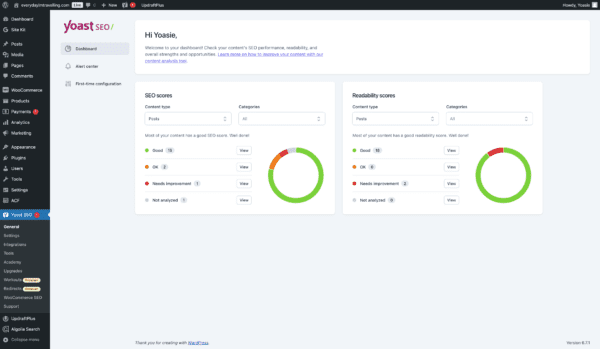
    Get instant clarity on your SEO with the new Yoast SEO Dashboard!

    With the new Yoast SEO Dashboard, you can see how your site is doing at a glance. Instead of hunting through pages, you’ll find all your key metrics in one place. It’s easy to spot which posts need attention, see where you can improve, and figure out what to tackle first so you can spend more time refining your content and less time searching for data.

    We know it can be challenging to improve your content when you have to dig through every post and page. That’s why we created a dashboard that instantly shows your site SEO Perfomance. It streamlines the process so you can focus on what matters: making your content shine.

    What you get from the Yoast SEO Dashboard:

    • Top-level overview of your SEO: see critical insights at a glance without hunting through individual pages
    • Filterable views of SEO and readability scores: quickly spot where you can make the most significant improvements

    Designed for clarity and direction, our dashboard makes it easy to check in, prioritize your next steps, and enhance your content strategy immediately. It’s straightforward, efficient, and all about helping you work smarter.

    How to access the Yoast SEO Dashboard:

    To access the Yoast SEO Dashboard, you just need to:

    1. Ensure your Yoast SEO is up-to-date: In your WordPress admin area, go to “Plugins” and update Yoast SEO to the latest version
    2. Navigate to the Dashboard: Click on “Yoast SEO” in your WordPress sidebar to land on the dashboard, or click on “Dashboard”
    3. Explore your insights: Review the overview, filter your scores, and start working through your task list

    Ready to see how much simpler managing your SEO can be?
    Get Yoast SEO today and let your new dashboard guide you toward better performance.

    Coming up next!

    10 Hosting Trends Agencies Should Watch In 2025

    This post was sponsored by Bluehost. The opinions expressed in this article are the sponsor’s own.

    Which hosting service is best for agencies?

    How do I uncover what will be best for my clients in 2025?

    What features should my hosting service have in 2025?

    Hosting has evolved well beyond keeping websites online.

    Hosting providers must align their services to meet clients’ technological needs and keep up with constantly changing technological advances.

    Today, quality hosting companies must focus on speed, security, and scalability. Staying ahead of hosting trends is critical to maintaining competitive offerings, optimizing workflows, and meeting client demands.

    So, what should you watch for in 2025?

    The next 12 months promise significant shifts in hosting technologies, with advancements in AI, automation, security, and sustainability leading the way.

    Understanding and leveraging these trends enables agencies and professionals to provide better client experiences, streamline operations, and reduce the negative effects of future industry changes.

    Trend 1: Enhanced AI & Automation Implemented In Hosting

    AI and automation are already transforming hosting, making it smarter and more efficient for service providers, agencies, brands, and end-point customers alike.

    Hosting providers now leverage AI to optimize server performance, predict maintenance needs, and even supplement customer support with AI-driven features like chatbots.

    As a result, automating routine tasks such as backups, updates, and resource scaling reduces downtime and the need for manual intervention. These innovations are game-changing for those managing multiple client sites and will become increasingly important in 2025.

    It only makes sense.

    Automated systems free up valuable time, allowing you more time to focus on strategic growth instead of tedious maintenance tasks. AI-powered insights can also identify performance bottlenecks, enabling you to address issues before they impact your website or those of your clients.

    Agencies that adopt these technologies this year will not only deliver exceptional service but also be able to position themselves as forward-thinking.

    Bluehost embraces automation with features like automated backups, one-click updates, and a centralized dashboard for easy site management. These tools streamline workflows, enabling agencies and professionals to manage multiple sites with minimal effort while ensuring optimal performance.

    Trend 2: Multi-Cloud & Hybrid Cloud Solutions Are Now Essential

    In 2025, as businesses demand more flexibility and reliability from their online infrastructure, multi-cloud and hybrid cloud solutions will become essential in the hosting world.

    These approaches offer the best of both worlds:

    • The ability to leverage multiple cloud providers for redundancy and performance.
    • The option to combine public and private cloud environments for greater control and customization.

    For agencies managing diverse client needs, multi-cloud and hybrid cloud strategies provide the scalability and adaptability required to meet modern demands. Multi-cloud solutions allow agencies to distribute their clients’ workloads across multiple cloud providers, ensuring that no single point of failure disrupts their operations.

    This feature is particularly valuable for agencies with high-traffic websites, where downtime or slow performance can have a significant impact on revenue and user experience. Hybrid cloud solutions, on the other hand, let agencies blend the scalability of public clouds with the security and control of private cloud environments.

    This service is ideal for clients with sensitive data or compliance requirements, such as ecommerce or healthcare businesses.

    Bluehost Cloud provides scalable infrastructure and tools that enable agencies to customize hosting solutions to fit their clients’ unique requirements. Our cloud hosting solution’s elastic architecture ensures that websites can handle sudden traffic spikes without compromising speed or reliability.

    Additionally, our intuitive management dashboard allows agencies to easily monitor and allocate resources across their client portfolio, making it simple to implement tailored solutions for varying workloads.

    By adopting multi-cloud and hybrid cloud strategies, agencies can offer their clients enhanced performance, improved redundancy, and greater control over their hosting environments.

    With our scalable solutions and robust toolset, agencies can confidently deliver hosting that grows with their clients’ businesses while maintaining consistent quality and reliability. This flexibility not only meets today’s hosting demands but also helps position your agency for long-term success in a rapidly evolving digital landscape.

    Trend 3: Edge Computing & CDNs Replace AMP For Improving Website Speed

    As online audiences grow, the demand for faster, more responsive websites has never been higher. Edge computing and Content Delivery Networks (CDNs) are at the forefront of this evolution, enabling websites to reduce latency significantly. For agencies managing clients with diverse and international audiences, these technologies are crucial for improving user experience and ensuring website performance remains competitive.

    Edge computing brings data processing closer to the end user by leveraging servers located at the “edge” of a network, reducing the time it takes for information to travel.

    Combined with CDNs that cache website content on servers worldwide, these technologies ensure faster load times, smoother navigation, and better performance metrics.

    These features are especially beneficial for media-heavy or high-traffic websites, where even a slight delay can impact engagement and conversions.

    Bluehost integrates with leading CDN solutions to deliver content quickly and efficiently to users across the globe. By leveraging a CDN, Bluehost ensures that websites load faster regardless of a visitor’s location, enhancing user experience and SEO performance.

    This integration simplifies the optimization of site speed for agencies with multiple clients. By adopting edge computing and CDN technology, you can help your clients achieve faster load times, improved site stability, and higher customer satisfaction.

    Bluehost’s seamless CDN integration enables you to deliver a hosting solution that meets the expectations of a modern, global audience while building trust and loyalty with your clients.

    Trend 4: Core Web Vitals & SEO Hosting Features Make Or Break Websites

    Core Web Vitals play an important role in today’s SEO, as Google is increasingly emphasizing website performance and user experience in its ranking algorithms. Today, loading speed, interactivity, and visual stability impact a site’s ability to rank well in search results and keep visitors engaged.

    That means optimizing Core Web Vitals isn’t just an SEO task for agencies managing client websites. Fast load times and responsive design are critical parts of delivering a high-quality digital experience. For example, metrics like Largest Contentful Paint (LCP), which measures how quickly a page’s main content loads, depend heavily on hosting infrastructure.

    Agencies need hosting solutions optimized for these metrics to ensure their clients’ sites stay competitive in the SERPs.

    Bluehost offers a WordPress-optimized hosting environment with features specifically designed to improve load times and server response speeds. From advanced caching technology to robust server architecture, Bluehost ensures that sites meet Core Web Vitals standards with ease.

    Additionally, our hosting solutions include tools for monitoring site performance, allowing agencies to proactively address any issues that could impact rankings or user experience.

    By prioritizing Core Web Vitals and leveraging SEO-focused hosting features, agencies can enhance their clients’ visibility, engagement, and overall online success. With Bluehost’s optimized hosting solutions, you’ll have the tools and infrastructure needed to deliver fast, stable, and high-performing websites that delight users and search engines.

    Trend 5: Sustainable Hosting Practices Help Reduce Energy Consumption

    Sustainability is no longer just a buzzword. It’s a key consideration for businesses and agencies alike. As 2025 progresses, more clients will prioritize environmentally conscious practices, and hosting providers will step up to offer greener solutions, such as energy-efficient data centers and carbon offset programs.

    Migrating to a sustainable hosting provider not only supports client values but also demonstrates a commitment to responsible business practices, which will resonate more with consumers in 2025 than ever before.

    Efficient hosting practices reduce energy consumption and create a more sustainable digital ecosystem. It will also allow you to help clients meet their environmental goals without compromising on performance.

    These benefits are especially valuable for clients with higher energy and performance demands, such as those in ecommerce, media-heavy, or high-traffic industries.

    Bluehost has long been recognized as a trusted hosting provider that operates with efficiency in mind.

    Our robust, energy-efficient infrastructure already aligns with the sustainability goals of environmentally conscious clients.

    In addition, our long-standing reputation, proven history with WordPress, and demonstrable reliability enhance your clients’ sustainability objectives, ensuring they can operate responsibly and confidently.

    By choosing sustainable hosting practices and partners like Bluehost, you can contribute to a greener digital future while reinforcing your clients’ environmental commitments and strengthening client relationships by aligning with their values.

    Trend 6: Security Must Be A Core Offering

    Security is a non-negotiable priority for any website. Cyber threats like data breaches, malware, and DDoS attacks are on the rise, and the consequences of a breach, including lost revenue, damaged reputations, and potential legal issues, can devastate clients. As a result, offering secure hosting solutions with proactive security measures is essential to safeguarding clients’ businesses and building trust.

    These key features include SSL certificates, which protect sensitive data while boosting SEO rankings and user trust, and regular malware scans to prevent vulnerabilities.

    They should also include automated backups that enable quick restoration in the event of a crash or attack and provide comprehensive protection and peace of mind. Essential security features are standard in Bluehost hosting plans, including SSL certificates, daily automated backups, and proactive malware scanning.

    These built-in tools eliminate the need for additional solutions, added complexity, or costs. For agencies, our security features reduce risks for your clients and provide peace of mind.

    By choosing a hosting provider like Bluehost, you can prioritize client security, reinforce client trust, and minimize emergencies, allowing you to avoid spending time and resources addressing threats or repairing damage.

    In short, by partnering with Bluehost, security becomes a core part of your agency’s value proposition.

    Trend 7: Hosting Optimized For AI & Machine Learning Is Key To High Visibility On SERPs

    As artificial intelligence and machine learning become increasingly integrated with websites and applications in 2025, hosting providers must keep pace with the increasing demands these technologies place on infrastructure.

    AI-driven tools like chatbots, recommendation engines, and predictive analytics require significant computational power and seamless data processing.

    AI and machine learning applications often involve handling large datasets, running resource-intensive algorithms, and maintaining real-time responsiveness. Hosting optimized for these needs ensures that websites can perform reliably under heavy workloads, reducing latency and downtime and delivering consistent performance.

    If you plan to be successful, you’ll also require scalable scalable hosting solutions. These solutions allow resources to expand dynamically with demand, accommodate growth, and handle traffic surges.

    Bluehost’s scalable hosting is built to support advanced tools and applications, making it an ideal choice for agencies working on AI-driven projects. Our robust infrastructure delivers consistent performance, and flexibility allows you to scale easily as your client’s needs evolve. By leveraging Bluehost, agencies can confidently deliver AI-integrated websites that meet modern performance demands.

    Trend 8: Managed Hosting Helps You Focus More On Profits

    In 2025, websites will become increasingly complex. Businesses will require higher performance and reliability, and everyone will be looking to operate as lean and efficiently as possible. These trends mean managed hosting will become the go-to solution for agencies and their clients.

    Managed hosting shifts time-intensive technical maintenance away from agencies and business owners by including features such as automatic updates, performance monitoring, and enhanced security. In short, managed hosting enables you to simplify workflows, save time, and deliver consistent quality to your clients.

    These hosting services are particularly valuable for WordPress websites, where regular updates, plugin compatibility checks, and security enhancements occur frequently but are essential to maintaining optimal performance.

    Managed hosting also typically includes tools like staging environments, which allow agencies to test changes and updates without risking disruptions to live sites and ensure you can deliver a seamless experience to clients.

    Bluehost offers managed WordPress hosting that includes automatic updates, staging environments, and 24/7 expert support. These features allow you to handle technical details efficiently while focusing on delivering results for your clients without added stress or time.

    Trend 9: The Shift Toward Decentralized Hosting Boosts Your Brand’s Longevity

    In 2025, expect to see decentralized hosting gain attention as a futuristic approach to web hosting. Like Bitcoin and similar advancements, the technology leverages blockchain technology and peer-to-peer networks to create hosting environments that prioritize privacy, resilience, and independence from centralized control.

    While this model appears to provide exciting new opportunities, it’s still in the early stages. It faces challenges in scalability, user-friendliness, and widespread adoption, which agencies can’t typically rely on for client sites.

    Decentralized hosting may become a viable option for specific use cases, such as privacy-focused projects or highly distributed systems. However, centralized hosting providers still offer the best balance of reliability, scalability, and accessibility for most businesses and agencies today.

    For these reasons, agencies managing client websites will continue to focus on proven, reliable hosting solutions that deliver consistent performance and robust support.

    So, while decentralized hosting may gain traction this year, Bluehost will continue to provide a trustworthy hosting environment designed to meet the needs of modern websites. With a strong emphasis on reliability, scalability, and user-friendly management tools, we offer a proven solution agencies can depend on to deliver exceptional client results.

    Trend 10: Scalable Hosting For High-Growth Websites Is Key For Growth

    As businesses grow, their websites will experience increasing traffic and resource demands. High-growth websites, such as e-commerce platforms, content-heavy blogs, or viral marketing campaigns, require hosting solutions that can scale instantly. And scalable hosting is critical to delivering consistent user experiences and avoiding downtime during peak periods.

    Scalable hosting like Bluehost ensures your clients’ websites can easily adjust resources like bandwidth, storage, and processing power to meet fluctuating demands. Our scalable hosting solutions are designed for high-growth websites. Our unmetered bandwidth and infrastructure were built to handle traffic surges, ensuring websites remain fast and accessible.

    These features make us the ideal choice for agencies looking to future-proof their clients’ hosting needs.

    As the digital landscape continues to evolve in 2025, keeping up with the latest trends in hosting is essential for agencies to provide top-tier service, drive client satisfaction, and maintain a competitive edge. From AI and automation to scalability and security, the future of hosting demands flexible, efficient solutions tailored to modern needs.

    By understanding and leveraging these trends, you can position your agency as a trusted partner and deliver exceptional results to your clients, whether by adopting managed hosting or integrating CDNs.

    Bluehost hosting will meet today’s demands while helping to prepare agencies like yours for tomorrow. With features like 100% uptime guaranteed through our Service Level Agreement (SLA), 24/7 priority support, and built-in tools like SSL certificates, automated backups, and advanced caching, Bluehost offers a robust and reliable hosting environment.

    Additionally, Bluehost Cloud makes switching easy and cost-effective with $0 migration costs and credit for remaining contracts, giving you the flexibility to transition seamlessly without the high cost.

    Take your agency’s hosting strategy to the next level with Bluehost. Discover how our comprehensive hosting solutions can support your growth, enhance client satisfaction, and keep your business ahead of the curve.


    Image Credits

    Featured Image: Image by Bluehost. Used with permission.