2. AI Can Help You Save Time On Manually Reviewing Calls
Listening to and analyzing phone calls manually can be time-consuming and inefficient for agencies.
However, it’s an important part of understanding the customer experience and sales team performance.
With AI-powered call analysis tools, you get quality, keyword-tagged transcriptions with near-human-level accuracy.
Not only can this technology help you save over 50% of the time spent listening to phone calls, but it can also help you deliver actionable recommendations to clients and drive better results.
Conversation Intelligence, for instance, is trained on over 1.1M hours of voice data and enables real-time analysis for instantaneous results.
This advanced tool provides opportunities for you to improve your strategy through the following granular insights:
Spotting disparities in the industry-specific lingo your sales team uses, compared to the lingo your prospects are using to describe their business challenges and goals.
Identifying trends or gaps in your service offerings based on what your prospects are asking for.
Identifying frequently asked questions and other important topics to address through content marketing.
Setting goals for lead qualification — not just the quantity of leads generated for your business.
Conversational AI is perfectly suited to summarize the content of long conversations – however, the call summaries still require a human to read them and determine the main takeaways.
But if you work in a bustling small business, it’s unlikely you’d have the bandwidth for tasks such as call transcription, summaries, keyword spotting, or trend analysis.
Rather than displacing human labor, conversational AI is assisting businesses in taking on tasks that may have been overlooked and leveraging data that would otherwise remain untapped.
3. AI Can Help You Lower Cost Per Lead / Save Money On Tools & Ad Spend
Ever wonder why certain campaigns take off while others fall flat? It’s all in the data!
Even failed campaigns can offer invaluable insights into your client’s audience and messaging.
But if you can’t spot the underperformers quickly enough, you risk wasting your ad budget on ineffective tactics.
The quicker you can identify what’s working and what’s not, the quicker you can pivot and adjust your marketing strategy.
Make a bigger impact in less time: AI-powered technology creates a force multiplier within your agency, allowing you to make more of an impact with the same level of inputs you’re already using.
Unlock actionable insights from call data: AI is revolutionizing the way companies leverage call data by enabling them to gain insights at scale. As a result, businesses can increase their ROI and deliver greater value to their clients by analyzing hundreds of calls efficiently.
Foster alignment with data-driven strategies: By analyzing customer conversations with AI, businesses can align their marketing strategy with data-driven recommendations, enhancing overall coherence. Additionally, the ability to create triggers based on specific phrases enables automated analysis and reporting, further streamlining the alignment process.
Drive effectiveness with rapid insights: Leveraging Conversation Intelligence enables agencies to deliver better insights faster, increase conversion rates, refine keyword strategies, and develop robust reporting capabilities.
4. AI Can Help You Improve Overall Agency Efficiency
Are you spending too much valuable time on tasks that produce minimal results?
Many agencies find themselves bogged down by routine, administrative tasks that don’t contribute much to their bottom line.
But with AI automation, agencies can streamline their operations and redirect their energy towards more strategic endeavors.
From email scheduling and social media posting to data entry and report generation, AI can handle a wide array of tasks with precision and efficiency – giving you time to focus on high-impact activities that drive growth and deliver tangible results.
Ways Your Business Can Benefit From Automation
Automatically transcribe your calls to boost close rates: See how your team is handling difficult objections and ensure that they’re delivering your businessʼ value proposition in an effective manner.
Score calls based on quality and opportunity: Take the time-consuming work out of scoring your calls and determine which campaigns drive the best calls to your business.
Classify calls by your set criteria: Qualify, score, tag, or assign a value to the leads that meet your criteria, automatically.
Automatically redact sensitive information: Protect your customers by removing billing or personal information. Keep your data safe and secure through complete HIPAA compliance.
Monitor your teamsʼ performance: Use Conversation Intelligence as a valuable sales training tool to ensure your team doesn’t miss any key messaging marks.
Know your customersʼ needs: Identify conversation trends in your phone calls and stay privy to evolving customer needs.
Improve your digital marketing strategy: Use AI-powered insights to inform your digital marketing strategy and boost your online presence.
By automating mundane tasks, agencies can optimize workflows, increase productivity, and improve efficiency across the board.
Looking for 5 – 7? Download The Full Guide
Rather than fearing AI, the future belongs to those who embrace it.
By strategically combining human creativity with artificial intelligence, you can unlock capabilities that transcend what either could achieve alone.
Want to discover even more ways to level up your agency with AI?
Wix recently announced the addition of three new image editing tools to their suite of AI-based website building tools. The combination of the new AI image generation and editing tools and the AI Website Builder as part of the overall Wix website building platform provides users with virtually everything they need to easily create professional websites.
Wix users no longer have to jump between different apps or pay for third party apps to create and optimize images, everything can be done in one place with one platform.
Three New AI Image Tools
Wix introduced three new tools for image editing that enables users to essentially ditch third-party image editors because virtually everything they need for creating, optimizing and editing images is now available on the Wix platform.
The new Wix AI image tools are:
AI Image Creator
Object Eraser
AI Image Editor
AI Image Creator
The AI image creator enables Wix users to create images for their websites completely from scratch. There’s no need to subscribe and pay extra to a stock images library, everything a small business needs for generating images now exists within the Wix platform. The tool works in the familiar text-to-image prompt generation mode where a user describes the image and the AI generates it. Users can create images in a variety of styles such as photo, painting, illustration, cartoons and other styles.
AI Object Eraser
This is a neat feature that can erase objects within a photograph. All a user needs to do is to highlight an object and select to remove it. That means that any publisher can easily improve an image that would otherwise not be usable, no extra technical or photo editing skills are necessary.
AI Image Editor
This is a prompt-based tool that that can edit an image to do add things to an image or change just a section of it. All a user has to do is highlight what they want the AI to change and then tell it what they want changed. For example, the AI can change the texture of a wall so that it’s wood or change a t-shirt a person’s wearing so that it’s now a casual button up shirt.
Ido Kosover, Head of Media at Wix, said:
“These AI-powered features underscore our commitment to providing users with powerful tools that simplify the website creation process while ensuring professional-quality results.”
Wix’s new AI image tools provides exceptional value to publishers because it saves them from having to purchase or subscribe to third party tools and services like photo editors and stock photo libraries. Professional images are now available to all Wix users, regardless of their technical experience.
Since March 2024, the SEO industry has seen significant disruptions, with Google rolling out its latest algorithm changes.
From the deindexing of websites to the delivery of manual penalties, site owners and SEO professionals have found themselves in a tough spot as Google attempts to clean up search results.
So what’s the path forward? How can you keep your site in good standing?
If you’re looking for strategies to help you not just survive but thrive in this dynamic digital landscape, join us on June 5 for an insightful webinar with PageOne Power.
In this live session, we’ll demonstrate how businesses like yours have maintained steadfast rankings amidst the recent volatility in search.
How to create valuable content for users: Crafting content that not only satisfies search engine algorithms but also resonates with users is key to long-term SEO success. By focusing on E-E-A-T (Experience, Expertise, Authoritativeness, Trustworthiness), you can ensure that your content provides genuine value to your audience and position your site as a reliable source of information in your niche.
How to build links that can boost rankings: Building high-quality links is essential for withstanding algorithm updates. By cultivating a diverse and robust backlink profile, you can enhance your website’s authority and relevance, thus improving your search rankings.
Best practices for content creation and link building: Discoverthe effectiveness of manual link building techniques and person-first content strategies. Through real-life case studies, we’ll demonstrate how you can use these tactics to thrive amidst algorithm updates.
Are you ready to start thriving in the new era of search?
Join Vince Ramos, SEO Consultant at PageOne Power, as he showcases how to implement white hat link building and user-focused content creation to elevate your SEO strategy.
Sign up now and get actionable insights and inspiration to help you endure future algorithm updates and maintain high search rankings.
Plus, you’ll get the chance to ask Vince your SEO questions in our live Q&A session after the presentation.
Can’t make the live event? No worries – just register here and we’ll send you a recording following the webinar.
In a recent interview, Google CEO Sundar Pichai sidestepped questions about whether the company would provide website owners with more granular data on traffic from AI-generated search previews.
As Google continues to integrate AI overviews, or “AI previews,” into its search results, publishers have grown increasingly concerned about the impact on their click-through rates and overall traffic.
Google could alleviate some concerns by breaking out traffic metrics for AI-generated results separately from traditional search clicks.
However, the company won’t commit to providing that data.
Pichai Dodges Direct Question
When pressed by The Verge on whether Google would commit to providing this data breakdown to publishers, Pichai avoided giving a straight answer.
“It’s a good question for the search team. They think about this at a deeper level than I do,” he said, deflecting responsibility.
The CEO suggested that Google needs to provide a “balance” in its data, arguing that website owners might try to game the system if it provides too many specifics.
” The more we spec it out, then the more people design for that,” he claimed.
Lack Of Transparency Fuels Publisher Frustration
Google’s lack of commitment to transparency will likely frustrate publishers who feel they have a right to know how much of their traffic is affected by Google’s AI implementations.
It’s publisher content that Google’s AI models are being trained on, and now their traffic is at stake. For Google to be so elusive about sharing that data breakdown feels disingenuous.
Pichai’s comments come across as tone-deaf to the plight of web publishers, who rely on search traffic to drive ad revenue and sustain their businesses.
With precise data on how AI previews impact click-through rates, publishers can adapt their strategies for greater visibility.
Antitrust Concerns Loom
Google’s reluctance to share this information also raises questions about anti-competitive practices.
As the dominant search engine, Google holds power over web traffic flow.
By keeping publishers in the dark about AI-driven metrics, the company could be seen as using its market position to unfairly disadvantage content creators.
This issue will likely attract further scrutiny from antitrust regulators, who are already investigating Google for alleged monopolistic behavior in the search market.
Long-Term Effects On Web Ecosystem
If publishers feel they’re not fairly compensated for their content or given the data they need to make informed decisions, it could disincentivize the creation of high-quality, original content.
This could lead to a poorer experience for internet users and less diversity of information online.
As AI becomes more integral to search, Google must find a way to collaborate with publishers and provide them with the insights they need to thrive.
FAQ
How does the introduction of AI previews by Google impact search traffic for publishers?
AI-generated search overviews might draw user attention away from traditional organic search results, leading to fewer clicks on publisher content.
As a result, the transparency and availability of separate traffic metrics for AI-generated results versus traditional search data become crucial for publishers to understand and respond to these changes effectively.
What are the main concerns of publishers regarding Google’s AI data transparency?
Publishers are particularly concerned about the lack of detailed data on traffic from AI-generated search previews. This transparency is vital for them to gauge the impact of AI on their website traffic and ad revenue.
Google’s reluctance to share this breakdown frustrates publishers, as it limits their ability to adapt their strategies to the new search environment.
Why does Google’s CEO believe providing specific data on AI preview traffic could be problematic?
Google CEO Sundar Pichai suggested that offering granular AI preview traffic data might encourage website owners to manipulate the system.
He believes providing detailed metrics could result in publishers designing their content specifically to game Google’s search engine, which may lead to a worse user experience.
What potential long-term impact could Google’s approach to AI search data have on the web ecosystem?
Publishers may produce less content if they aren’t compensated for their content or provided with data to make informed decisions. This could result in a poorer experience online and reduced diversity of information.
Getting your international SEO strategy right can be an elusive feat.
There are a lot more factors at play than people give credit for, and it’s often a thankless job.
A successful international SEO strategy requires a deep knowledge of your company’s commercial strategy as well as technical SEO knowledge, cultural sensitivity, and excellent data skills.
Yet the industry often regards international SEO as just your hreflang setup.
In this article, I will distill the complexities of international SEO success into an actionable step-by-step list that will take you from beginner to advanced practitioner. Let’s begin!
Part I: Be Commercially Aware
1. Understand Why Your Company Is Going International
Companies can grow by expanding their products and services, focusing on gaining market penetration or expanding into new markets.
While your team’s goal might be traffic, leads, or revenue, the leadership team is likely working under a different set of parameters. Most of the time, leadership’s ultimate goal is to maximize shareholder value.
In founder-owned companies, growth goals might be slower and more sustainable, usually aimed at maintaining and growing profitability.
VC-owned companies have high growth goals because they must provide their investors with a return that’s higher than the stock market. This is what is known as the alpha, or your company’s ability to beat the market in growth.
Publicly traded companies are likely aiming to grow their share value.
Startups, depending on their maturity stage, are likely looking to prove product-market fit or expand their reach fast to show that their operations are scalable and have the potential to be profitable in the future. The goal of this is to aid in raising further capital from investors.
Understanding why businesses go international is essential for informing your SEO decisions. What’s best practice for SEO isn’t always what’s best for business.
You must adapt your strategy to your company’s growth model.
Companies choosing to grow sustainably and maintain profitability will likely expand more slowly to a market that resembles their core market.
VC-owned companies will be able to invest in a wider range of countries, with a smaller concern for providing their users with an experience on par with that of their core markets.
Startups can try to beat their competitors to market by expanding quickly and throwing a lot of money at the project, or they might be concerned with cash flow and try to expand fast but cut corners by using automatic translation.
2. Stack Rank Your Target Markets To Prioritize Your Investment
I promise I’ll get to hreflang implementation soon, but so much about international SEO has to do with commercial awareness – so bear with me; this will make you a better professional.
Many companies have different market tiers to reflect how much of a priority each market is. Market prioritization can happen using many different metrics, such as:
Average order value or lifetime customer value.
Amount of investment required.
Market size.
And market similarity.
American companies often prioritize developed English-speaking countries such as the UK, Canada, or Australia. These are most similar to their core market, and most of their market knowledge will be transferable.
After that, companies are likely to target large European economies, such as Germany and France. They might also target the LatAm market and Spain in the same effort.
The last prioritization tier can vary widely among companies, with a focus on the Nordic, Brazilian, or Asian markets.
Part II: Know Your Tech
3. Define Your International URL Structure
When doing international SEO, there are 4 different possible URL structures, each with its pros and cons.
ccTLD Structure
A ccTLD structure is set up to target different countries based on the domain type.
This structure is not ideal for companies that target different languages rather than different countries. For example, a .es website is targeting Spain, not the Spanish language.
An advantage to this kind of structure is that the ccTLD sends a very strong localization signal to search engines as to what market they are targeting, and they can lead to improved trust and CTR in your core country.
On the other hand, ccTLDs can dilute your site’s authority, as links will be spread across domains rather than concentrated on the .com.
gTLD With Subdirectories
This is my personal favorite when it comes to international SEO.
These URL structures can look like website.com/en if they’re targeting languages or website.com/en-gb if they’re targeting countries.
This configuration aggregates the authority you gain across your different territories into a single domain, it’s cheaper to maintain, and the .com TLD is widely recognizable by users worldwide.
On the other hand, this setup can look less personalized to people outside the US, who might wonder if you can service their markets.
gTLD With Subdomains
This setup involves placing international content on a subdomain like us.website.com. While once popular, it’s slipping in favor because it doesn’t bring anything unique to the table anymore.
This setup offers a clear signal to users and search engines about the intended audience of a specific subdomain.
However, subdomains often face issues with SEO, as Google tends to view them as separate entities. This separation can dilute link, similar to the ccTLD approach but without the geo-targeting advantages.
gTLD With Parameters
This is the setup where you add parameters at the end of the URL to indicate the language of the page, such as website.com/?lang=en.
I strongly advise against this setup, as it can present multiple technical SEO challenges and trust issues.
Hreflang reminds me of a multilingual form of a canonical tag, where we tell search engines that one document is a version of the other and explain the relationship between them.
I find hreflang implementation very interesting from a technical point of view. Because development teams mostly manage it, and it can be very much hit or miss.
Often, hreflang is constructed from existing fields in your content management system (CMS) or content database.
You might find that your development team is pulling the HTML lang tag, which follows a different ISO standard than hreflang, leading to a broken implementation.
Other times, there is a field in your CMS that your development team pulls from to build your hreflang setup.
Finding out how your hreflang tags are generated can be extremely helpful in identifying the sources of different issues or mitigating potential risks.
So speak to your engineering team and ask them how you’re currently generating hreflang.
5. Implement Hreflang Without Errors
There are three ways to implement hreflang on your site:
On your sitemap.
Through your HTTP header.
On your HTML head.
The method most of us are most familiar with is the HTML head. And while you can use more than one method, they should match each other perfectly. Otherwise, you risk confusing search engines.
Here are some basic rules for getting it done correctly:
In your hreflang implementation, the URL must include domain and protocol.
Hreflang tags must be reciprocal. If the page you’re listing as a language alternative does not list you back, your implementation won’t work.
Audit your hreflang regularly. My favorite tool for this, since it added the hreflang cluster analysis and link graphs, is Ahrefs. For the record, Ahrefs is not paying me to say this; it’s a genuine recommendation and has helped me a lot in my work.
You should only have one page per language.
Your hreflang URLs should be self-canonicalizing and respond with a 200 code.
And if you’re interested in the technical SEO aspect beyond hreflang, I recommend reading Mind your language by Rob Owen.
Part III: Invest In Content Incrementally
6. Translate Your Top-performing Content Topics
Now that you have the basic commercial and technical knowledge covered, you’re ready to start creating a content strategy.
You likely have a wealth of content in your core market that can be recycled. But you want to focus on translating high-converting topics, not just any topic; otherwise, you might be wasting your budget!
Let’s go step by step.
Cluster Your Website’s Content By Topic
Crawl your site using your favorite SEO tool and extract the URL and H1.
Use ChatGPT to classify that list of URLs into topics. You might already know what you usually write about, so include those topics in your prompt. You don’t want to have a classification that’s too granular, so you can prompt chatGPT to only create groups with a minimum of 10 URLs (adjust this to reflect the size of your website) and class everything else as other. This is an example of what your prompt might look like: “I will provide you with a list of article titles and their corresponding URL. Classify this list into the following topics: survey best practices, research and analysis, employee surveys, market research and others. Return this in a table format with the URL, title and group name.”
Start a spreadsheet with all your URLs in the first column, titles in the second column, and the group they belong to in the third column.
Measure Your Performance By Topic
Export your GSC data and use a =VLOOKUP formula to match your clicks to your URLs.
Export your conversion data and use a =VLOOKUP formula to match your conversions (leads, sales, sign-ups, or revenue) to the right URL.
You can then copy your topics column onto a new sheet. Remove duplicates and use the =SUMIF formula to aggregate your click data and conversion data by topic.
Choose What Topics You’ll Be Translating First
Using this data, you can now choose what topics are most likely to drive conversions based on your core market data. Choose how many topics or pieces of content you’ll be translating based on your budget.
Personally, I like translating one topic at a time because I’ve found that generating topical authority on one specific topic makes it easier for me to rank on an adjacent topic that I write about next.
7. Localize Your English Content
Once you’re set up with all your key pages and a few content topics, it’s time to evaluate your investment and see where you could be getting a bigger return.
At this stage, many companies have translated their content into a few different languages and likely copied the US content into their UK and Australian sites. Now that you’ve done some translation, it’s time to work on localization.
If you’ve just copied your US content into your UK and Australian sites, your Google Search Console indexing report might be screaming at you, “Duplicate, Google selected a different canonical than the user.”
A very easy fix that could yield great returns is to localize your English content to the nuances of those English-speaking markets.
You will want to instruct your translation and localization providers to adapt the spellings of certain words, change the choice of words, introduce local expressions, and update any cited statistic for the US with their local equivalent.
For example, if I’m targeting a British audience, “analyze” becomes “analyse,” a “stroller” becomes a “pram,” and “soccer” becomes “football.”
8. Invest In In-market Content
Once you’ve got the basics in place, you can start tackling the specific needs of other markets. This strategy is expensive, and you should only use it in your priority markets, but it can really set you apart from your competitors.
For this, you will need to work with a local linguist to identify pain points, use cases, or needs exclusive to your target market.
For example, if France suddenly made it mandatory to run a diversity and inclusion study for companies with over 250 employees, I’d want to know this and create some content on DEI surveys at SurveyMonkey.
9. Integrate With Other Content Workflows
In step six, we evaluated our top-performing content, chose the best articles to translate, and got it all down. But wait. Some of these source articles have been updated. And there is even more content now!
To run a successful international SEO campaign you must integrate with all the other teams publishing content within your organization.
Usually, the teams creating content in an organization are SEO, content, PR, product marketing, demand generation, customer marketing, customer service, customer education, or solutions engineering.
That’s a lot, and you won’t be able to integrate with everyone all at once. Prioritize the teams that create the most revenue-generating content, such as SEO, content, or product marketing.
Working with these teams, you will have to establish a process for what happens when they create a new piece, update some content, or remove an existing piece.
These processes can differ for everyone, but I can tell you what I do with my team and hope it inspires you.
When a piece of content that’s already been localized into international markets isupdated, we get the content in a queue to be re-localized the next quarter.
When they create a new piece of content, we evaluate its performance, and if it’s performing above average, we add it to a localization queue for the next quarter.
When theychange the URL of a piece of content or delete it, all international sites must follow suit at the same time, since due to some technical limitations, not making the change globally would create some hreflang issues.
Wrapping Up
International SEO is vast and complex, and no article can cover it all, but many interesting resources have been created by SEO pros across the community for those who want to learn more.
Navigating the complexities of international SEO is no small feat. It’s an intricate dance of aligning commercial strategies with technical precision, cultural insights, and data-driven decisions.
From understanding your company’s core motives for global expansion to meticulously implementing hreflang tags and localizing content, every step plays a crucial role in building a successful international presence.
Humans are complicated beings. The ways we communicate are multilayered, and psychologists have devised many kinds of tests to measure our ability to infer meaning and understanding from interactions with each other.
AI models are getting better at these tests. New research published today in Nature Human Behavior found that some large language models (LLMs) perform as well as, and in some cases better than, humans when presented with tasks designed to test the ability to track people’s mental states, known as “theory of mind.”
This doesn’t mean AI systems are actually able to work out how we’re feeling. But it does demonstrate that these models are performing better and better in experiments designed to assess abilities that psychologists believe are unique to humans. To learn more about the processes behind LLMs’ successes and failures in these tasks, the researchers wanted to apply the same systematic approach they use to test theory of mind in humans.
In theory, the better AI models are at mimicking humans, the more useful and empathetic they can seem in their interactions with us. Both OpenAI and Google announced supercharged AI assistants last week; GPT-4o and Astra are designed to deliver much smoother, more naturalistic responses than their predecessors. But we must avoid falling into the trap of believing that their abilities are humanlike, even if they appear that way.
“We have a natural tendency to attribute mental states and mind and intentionality to entities that do not have a mind,” says Cristina Becchio, a professor of neuroscience at the University Medical Center Hamburg-Eppendorf, who worked on the research. “The risk of attributing a theory of mind to large language models is there.”
Theory of mind is a hallmark of emotional and social intelligence that allows us to infer people’s intentions and engage and empathize with one another. Most children pick up these kinds of skills between three and five years of age.
The researchers tested two families of large language models, OpenAI’s GPT-3.5 and GPT-4 and three versions of Meta’s Llama, on tasks designed to test the theory of mind in humans, including identifying false beliefs, recognizing faux pas, and understanding what is being implied rather than said directly. They also tested 1,907 human participants in order to compare the sets of scores.
The team conducted five types of tests. The first, the hinting task, is designed to measure someone’s ability to infer someone else’s real intentions through indirect comments. The second, the false-belief task, assesses whether someone can infer that someone else might reasonably be expected to believe something they happen to know isn’t the case. Another test measured the ability to recognize when someone is making a faux pas, while a fourth test consisted of telling strange stories, in which a protagonist does something unusual, in order to assess whether someone can explain the contrast between what was said and what was meant. They also included a test of whether people can comprehend irony.
The AI models were given each test 15 times in separate chats, so that they would treat each request independently, and their responses were scored in the same manner used for humans. The researchers then tested the human volunteers, and the two sets of scores were compared.
Both versions of GPT performed at, or sometimes above, human averages in tasks that involved indirect requests, misdirection, and false beliefs, while GPT-4 outperformed humans in the irony, hinting, and strange stories tests. Llama 2’s three models performed below the human average.
However, Llama 2, the biggest of the three Meta models tested, outperformed humans when it came to recognizing faux pas scenarios, whereas GPT consistently provided incorrect responses. The authors believe this is due to GPT’s general aversion to generating conclusions about opinions, because the models largely responded that there wasn’t enough information for them to answer one way or another.
“These models aren’t demonstrating the theory of mind of a human, for sure,” he says. “But what we do show is that there’s a competence here for arriving at mentalistic inferences and reasoning about characters’ or people’s minds.”
One reason the LLMs may have performed as well as they did was that these psychological tests are so well established, and were therefore likely to have been included in their training data, says Maarten Sap, an assistant professor at Carnegie Mellon University, who did not work on the research. “It’s really important to acknowledge that when you administer a false-belief test to a child, they have probably never seen that exact test before, but language models might,” he says.
Ultimately, we still don’t understand how LLMs work. Research like this can help deepen our understanding of what these kinds of models can and cannot do, says Tomer Ullman, a cognitive scientist at Harvard University, who did not work on the project. But it’s important to bear in mind what we’re really measuring when we set LLMs tests like these. If an AI outperforms a human on a test designed to measure theory of mind, it does not mean that AI has theory of mind. “I’m not anti-benchmark, but I am part of a group of people who are concerned that we’re currently reaching the end of usefulness in the way that we’ve been using benchmarks,” Ullman says. “However this thing learned to pass the benchmark, it’s not— I don’t think—in a human-like way.”
Fourteen years ago, a journalist named Melanie Reid attempted a jump on horseback and fell. The accident left her mostly paralyzed from the chest down. Eventually she regained control of her right hand, but her left remained “useless,” she told reporters at a press conference last week.
Now, thanks to a new noninvasive device that delivers electrical stimulation to the spinal cord, she has regained some control of her left hand. She can use it to sweep her hair into a ponytail, scroll on a tablet, and even squeeze hard enough to release a seatbelt latch. These may seem like small wins, but they’re crucial, Reid says.
“Everyone thinks that [after] spinal injury, all you want to do is be able to walk again. But if you’re a tetraplegic or a quadriplegic, what matters most is working hands,” she said.
Reid received the device, called ARCex, as part of a 60-person clinical trial. She and the other participants completed two months of physical therapy, followed by two months of physical therapy combined with stimulation. The results, published today in Nature Medicine, show that the vast majority of participants benefited. By the end of the four-month trial, 72% experienced some improvement in both strength and function of their hands or arms when the stimulator was turned off. Ninety percent had improvement in at least one of those measures. And 87% reported an improvement in their quality of life.
This isn’t the first study to test whether noninvasive stimulation of the spine can help people who are paralyzed regain function in their upper body, but it’s important because a trial has never been done before in this number of rehabilitation centers or in this number of subjects, says Igor Lavrov, a neuroscientist at the Mayo Clinic in Minnesota, who was not involved in the study. He points out, however, that the therapy seems to work best in people who have some ability to move below the site of their injury.
The trial was the last hurdle before the researchers behind the device could request regulatory approval, and they hope it might be approved in the US by the end of the year.
ARCex consists of a small stimulator connected by wires to electrodes placed on the spine—in this case, in the area responsible for hand and arm control, just below the neck. It was developed by Onward Medical, a company cofounded by Grégoire Courtine, a neuroscientist at the Swiss Federal Institute of Technology in Lausanne and now chief scientific officer at the company.
The stimulation won’t work in the small percentage of people who have no remaining connection between the brain and spine below their injury. But for people who still have a connection, the stimulation appears to make voluntary movements easier by making the nerves more likely to transmit a signal. Studies over the past couple of decades in animals suggest that the stimulation activates remaining nerve fibers and, over time, helps new nerves grow. That’s why the benefits persist even when the stimulator is turned off.
The big advantage of an external stimulation system over an implant is that it doesn’t require surgery, which makes using the device less of a commitment. “There are many, many people who are not interested in invasive technologies,” said Edelle Field-Fote, director of research on spinal cord injury at the Shepherd Center, at the press conference. An external device is also likely to be cheaper than any surgical options, although the company hasn’t yet set a price on ARCex.
“What we’re looking at here is a device that integrates really seamlessly with the physical therapy and occupational therapy that’s already offered in the clinic,” said Chet Moritz, an engineer and neuroscientist at the University of Washington in Seattle, at the press conference. The rehab that happens soon after the injury is crucial, because that’s when the opportunity for recovery is greatest. “Being able to bring that function back without requiring a surgery could be life-changing for the majority of people with spinal cord injury,” he adds.
Reid wishes she could have used the device soon after her injury, but she is astonished by the amount of function she was able to regain after all this time. “After 14 years, you think, well, I am where I am and nothing’s going change,” she says. So to suddenly find she had strength and power in her left hand—“It was extraordinary,” she says.
Onward is also developing implantable devices, which can deliver stronger, more targeted stimulation and thus could be effective even in people with complete paralysis. The company hopes to launch a trial of those next year.
Fraudulent payments are 40% more likely to occur in ecommerce than physical stores, according to LexisNexis Risk Solutions’ “True Cost of Fraud Study: Ecommerce and Retail Report.” Published March 27, 2024, the 14th annual study found digital wallets, payment apps, buy-now-pay-later plans, and cryptocurrencies account for one-fifth of all payment fraud.
Based on a survey of 346 risk and fraud executives in the U.S. (272) and Canada (74), the study revealed a 60% increase in attacks in 2023 compared to the previous year, led by fraudulent chargebacks and identity theft. Researchers advised that AI technologies are the best defense against these attacks.
“Advanced real-time transaction verification solutions using artificial intelligence and machine learning are especially crucial as they work in the background to help prevent fraudulent transactions with minimal impact on customers,” researchers wrote, emphasizing that these advanced technologies are the best defense against widescale, automated attempts.
High Cost, High Volume
Researchers noted that fraud is expensive. Fees, fines, and the cost of replacing products make every sale lost to fraud approximately three times more than its original value. These costs will only multiply, they added, as fraudsters continue to exploit weaknesses in back office and payment processing systems.
The report identified the top three attack schemes for all merchants (online and in-store): synthetic identity fraud, payment card fraud, and malicious bot attacks. Researchers also found that card-not-present fraud (25%) outranked all other forms of payment fraud, including counterfeit cards (22%), stolen or lost cards (20%), card ID theft (17%), and fake or doctored card fraud (17%).
Researchers found that the current threat environment makes it especially challenging to separate fraudsters from legitimate customers, especially in digital transactions. Survey respondents cited the use of mobile channels (47%), the rise of synthetic identities (47%), and limited or no real-time transaction tracking tools (46%) as the top three challenges of digital consumer verification.
Frictionless Tools
While 69% of survey respondents have implemented fraud prevention tools in digital channels, most found it difficult to deflect fraudsters without inconveniencing legitimate customers, particularly at the point of purchase. Researchers offered the following recommendations for creating a secure but frictionless experience:
Employ advanced, multi-tiered solutions. Use automated solutions, such as transaction scoring, to eliminate friction among low-risk shoppers. Transaction scoring creates a risk score to approve or deny a transaction and eliminate unnecessary steps in customer verification. When integrated with AI, biometrics, and other behavior-based authentication methods, these fraud prevention tools continuously evaluate customer identity and transaction risk while facilitating internal and external data sharing and collaboration.
Appoint a fraud management administrator. Assign an administrator to take ownership of a company’s fraud management, with responsibility for configuring, monitoring, maintaining, and continuously updating the system. This designated administrator will safeguard the customer journey, from account openings and checkouts to logins, an approach that protects all stakeholders — employees, customers, service providers — from card payment fraud and adjacent threats.
Risk-based, data-driven approach. Prioritize fraud mitigation to thrive in the ecommerce ecosystem. Leverage emerging technologies whenever possible to build a robust posture against fraud and reduce fraud losses, which can elevate conversions and trust.
Human, AI Oversight
As LexisNexis Risk Solutions noted, the growth of ecommerce has created more opportunities for criminals, with surprisingly little effort. A significant number of attacks in 2023 were prompted by human error, according to Verizon’s “Data Breach Investigations Report,” published May 1, 2024.
Chris Novak, senior director of cybersecurity consulting at Verizon Business, observed that 68% of data breaches in 2023 resulted from people making innocent mistakes or falling victim to social engineering attacks. “The persistence of the human element in breaches shows that there is still plenty of room for improvement with regard to cybersecurity training,” he said in a statement.
The Verizon Business data-breach team advised taking a multilayered approach to fraud prevention. “We (and many others) have said it before: Multifactor authentication goes a long way toward mitigating these types of attacks. For that matter, so does not letting your kids use your corporate computer to find ways of making free [gaming] V-Bucks,” they wrote. “As with anything else security-related, the most effective controls are typically the ones that leverage the human element along with technical resources.”
LexisNexis Risk Solutions proposed more than personal attributes — name, address, date of birth — to identify customers in the digital world. Merchants must also assess device risk, transaction risk, and online and mobile behaviors. AI-powered tools can do all of this and more, researchers stated, calling the approach the “new norm in fraud management.”
AI Overviews, Google’s generative AI search feature, is now live for all users. Google tested it for months, calling it Search Generative Experience.
AI Overviews summarizes search results for some queries, but Google has not disclosed the percentage. The feature has two versions:
An expandable AI answer on top of search results, pushing organic search listings further down the page.
A “Generate” button to create an Overview by clicking it.
The latter is less intrusive, but I’ve seen no statistics on which is more frequent.
AI Overviews often contain links referencing the sources. Google claims those links are more “clickable” — i.e., prominent — than conventional organic listings. We cannot verify this information because Google has provided no AI click data in Search Console or elsewhere.
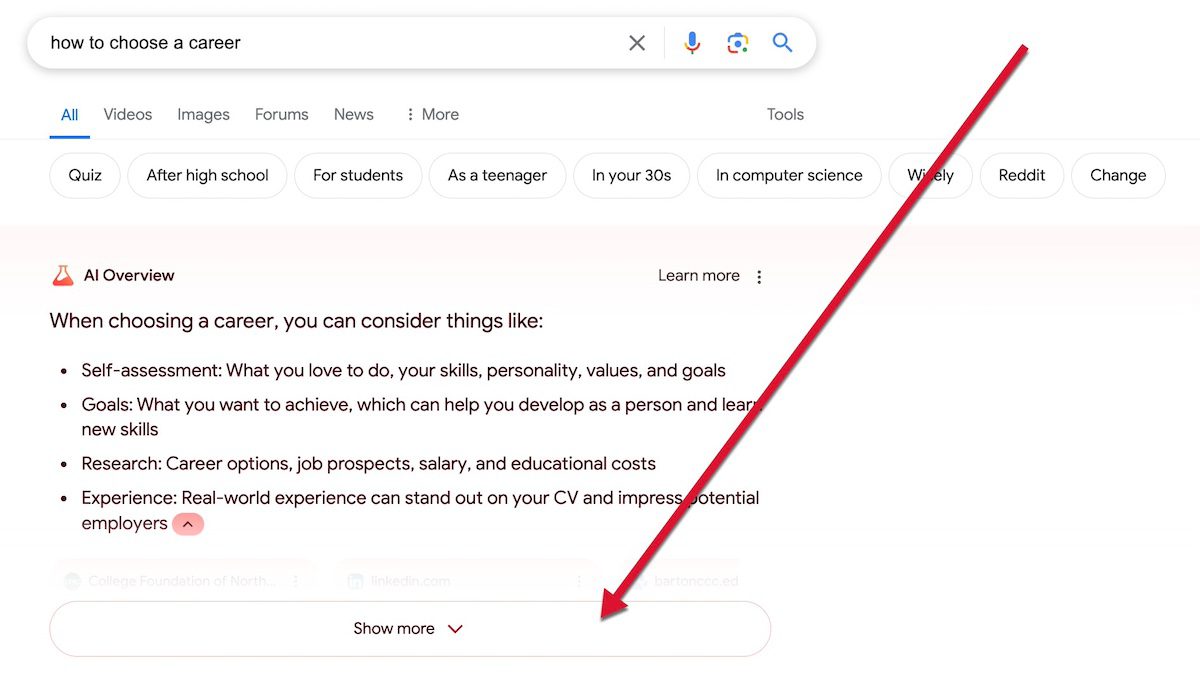
Yet I doubt Google’s claim because frequently the links are not visible without expanding an AI answer. For example, searching “how to choose a career” produces an AI answer but no immediately visible source link.
Searching “how to choose a career” produces an AI answer but no immediately visible source link. Click image to enlarge.
Content providers can block Google from showing their info in Overviews using nosnippet, max-snippet, or data-nosnippet meta tags. But any of those could impact organic search listings. I suggest waiting a bit before deciding, although it’s worth experimenting if you see a drop in overall organic clicks for an important query.
Keep an eye on your key pages for traffic losses via Search Console and Google Analytics 4. On Search Console, identify the queries that bring fewer clicks and then search on them for potential AI Overviews.
Despite widespread angst, the traffic impact of AI Overviews is impossible to evaluate at this early stage. Last month I addressed a third-party study of SGE’s impact, as it was then partially public.
Organic search traffic has been declining for years owing to all the new sections in search result pages. AI Overviews will likely continue this trend.
Still, monitoring traffic losses is important.
It’s possible to optimize a page to appear in Overviews. Last year, in “SEO for SGE,” I listed a few basics:
Create relevant content addressing all kinds of problems of your target audience.
Optimize product pages and categories based on users’ needs.
Structure the site to surface popular topics.
Obtain external links to key pages. Links drive discovery and the Knowledge Graph, among other things. They are especially important for co-citation links, which place your site next to known entities and gradually become one through those associations.
Use Google’s submission tools. Ranking organically is the only way to appear in Gemini, hence AI Overviews.
Indexed and Ranked
My main takeaway is this. AI Overviews rely on current rankings for each query. In that respect, SEO isn’t changing. It is still about getting pages indexed and ranked for relevant queries.
Duda has announced the addition of new AI assistant features that help digital agencies scale their website creation and optimization, making it easier for them to handle more clients without increasing costs.
Duda Website Builder For Digital Agencies
Duda is a proprietary website builder platform created specifically for digital marketing agencies that allows them to scale and take on more clients without having to hire an army of web developers to scale along with their growth.
The Duda platform facilitates creating high quality websites and easily maintaining them for clients. White labeling allows digital agencies the ability to provide a branded experience to their clients.
Duda AI Assistant Features
Duda added two new features to their robust set of AI tools that further improves the automation of webpage creation and optimization of alt text. The new Sections tool creates webpage sections and layouts using just prompts to describe what is required. It’s almost like something out of a science fiction movie where a designer tells the computer what it wants and the AI completes the project.
The alt text tool expands on the current alt text tool by now acquiring the ability to create alt text for images in bulk for the purposes of accessibility and search optimization. The improved AI alt text tool can also add alt text in multiple languages.
Video Of AI Tool
According to the Duda announcement:
“Duda’s AI sections tool automatically generates new site sections with suggested design, layout, copy, and images from a short user-provided prompt in just a few clicks. This feature drastically reduces the time needed to lay out the page, write copy, and select images. Now, content sections can be tailored and stylized in seconds.
Similarly, Duda’s AI alt text tool boosts productivity by enabling the creation of alt text for all site images at once. Users can generate alt text in multiple languages for images lacking tags or for all site images, streamlining the process of optimizing websites for SEO and accessibility.”
Duda’s continual improvements to their products demonstrates their commitment to helping digital agencies lower their costs while scaling their ability to handle more clients to keep growing into larger and more profitable businesses.